


Abstract
Coptic represents the final stage of the Ancient Egyptian language and remains an important component of Christian and Mediterranean cultural heritage. Although several digital resources exist for Coptic textual corpora, Greek-oriented computational tools for the interpretation of Coptic inscriptions on artifacts remain limited. This study presents the design and early implementation of a semi-automated software tool for the computer-assisted translation of Coptic inscriptions into Greek, with optional English support. The tool combines a Coptic–Greek digital dictionary, an interactive character-selection interface, and two dictionary-search strategies: a length/alphabetically structured linear search and a weighted linear search based on expected word frequency. The application is intended to support scholars working with inscriptions on fragile or fragmented cultural heritage objects, where full automation is not realistic and human supervision remains essential. The paper describes the linguistic and material challenges of Coptic inscriptions, the structure of the lexical database, the interface design, and the planned use of Coptic corpora for improving retrieval efficiency. The proposed approach contributes to cultural heritage digitization by offering a practical, expandable, and user-oriented framework for supporting the study, interpretation, and preservation of Coptic inscriptions.
1. Introduction
Since the Pre-dynastic period, ancient Egypt has been a major cradle of civilization, expressed through both its artistic creations and written script. The intellectual and cultural development of the Egyptians was closely linked to their economic and social prosperity, as well as to the various social, religious, political, and economic changes that occurred over time [1]. Interactions with Mediterranean peoples, foreign invasions, the Greek conquest, and Egypt’s incorporation into the Roman Empire all contributed to the evolution of Egyptian culture and language, particularly its writing system. Coptic represents the final stage of this long linguistic tradition, which began around 3200 BCE and remained in use until the 11th century CE [1]. As typically occurs during cultural osmosis, Coptic art emerged alongside the Coptic language in the early Christian centuries, persisting well after the Islamic conquest of Egypt (642 CE). Consequently, Coptic art blends the ancient Greek artistic tradition—which faithfully renders the human form and the environment—with Eastern and Pharaonic influences that emphasize rigid, hieratic forms and linear, decorative tendencies. Coptic epigraphic material has also been identified across Greece, in a wealth of inscribed artifacts; yet, local theoretical frameworks remain underdeveloped, while dedicated software tools tailored for Greek scholars have been entirely absent.
In this study, we present a software tool for the semi-automated translation of Coptic into Greek. This tool is designed to translate not only digital manuscript content but also, and more importantly, text found on physical artifacts made from various materials such as wood, linen, or stone. The system is adapted from an existing software framework originally developed for other ancient languages, which is currently being modified to process Coptic scripts. It consists of three main modules: a Coptic–Greek digital dictionary, a user interface, and a search engine. To date, no similar software tool exists for Greek data. Consequently, its significance lies not only in its status as a unique tool for Coptic-to-Greek research but also in its developed dual-method search engine (which utilizes both linear and weighted linear searches). This approach allows us to draw conclusions regarding how similar databases should operate to provide more user-friendly results [2]. Ultimately, these outcomes will contribute significantly to cultural heritage digitization, computational linguistics, and the creation of related bilingual dictionaries.
The novelty of this work lies in the development of a Greek-oriented, human-supervised translation environment for Coptic inscriptions on physical artifacts. This system combines a Coptic–Greek digital dictionary, an interactive character input interface, and two alternative database-search strategies. Unlike existing Coptic digital resources that primarily support standard textual corpora, this tool is specifically designed for the fragmented, material-based inscriptions encountered in cultural heritage contexts. Furthermore, this application is designed to be as compact as possible for field use on smaller devices like tablets, without requiring an internet connection.
2. Context & Methodology
2.1. The Coptic Language
The Coptic language, spoken roughly between 300 BCE and 1500 CE, represents the final stage in the development of the ancient Egyptian language. Following the conquest of Egypt by Alexander the Great in 332 BCE, the Greek language gradually began replacing Egyptian, becoming the primary language for official administrative documents. This administrative shift persisted until the late 1st century CE, a period that coincided with the early spread of Christianity across the Eastern Mediterranean. Egyptian Christians, however, were hesitant to record sacred texts using the Demotic script due to its close association with the traditional pagan religion. Consequently, they chose to represent the Egyptian language using the Greek alphabet supplemented by a few additional characters, an innovation that ultimately led to the creation of the Coptic script.
Coptic displays six distinct major dialects and numerous secondary sub-dialects [1,2]. These include the Sahidic dialect (historically known as the “dialect of Upper Egypt” or Thebaic), the Bohairic dialect (or the “dialect of Lower Egypt” or Memphitic), the Fayyumic dialect (or Bashmuric), the Akhmimic dialect, the Lycopolitan dialect (also termed Subakhmimic or Assiutic), and the Oxyrhynchite dialect (or Mesokemic). Each dialect possesses a distinct corpus characterized by unique linguistic features and, occasionally, specialized thematic content. Nevertheless, overlapping characteristics often allow researchers to associate specific dialects with particular geographic regions, even if clear territorial boundaries cannot be drawn. Although Coptic was eventually replaced by Arabic as the language of daily life in Egypt, it persists today as a liturgical language within Egyptian Christian and expatriate Coptic communities worldwide [2].
2.2. The Coptic Script
The phonetic structure of the language is reflected in its writing system and script. From this perspective, the Coptic script does not merely mark the final stage in the development of the ancient Egyptian language, nor is it simply an evolution or simplification of earlier writing systems like hieroglyphics, hieratic, and demotic. Following the conquest of Egypt by Alexander the Great in 332 BCE, Greek vocabulary increasingly influenced the Egyptian language. Greek terminology began to dominate administrative contexts, and Greek words were gradually incorporated into Demotic Egyptian. This linguistic blending eventually gave rise to what is known as “Old Coptic”. It is worth noting that while the earliest continuous Coptic texts are dated to approximately the 1st-to-2nd century CE, the roots of the Coptic alphabet can be traced back at least to the 3rd century BCE. This indicates that the practice of writing the ancient Egyptian language using alphabetic characters began at least three centuries earlier than the earliest confirmed Old Coptic textual traditions [1].
Because the spoken Egyptian language was written using Greek characters, the early Coptic alphabet closely reflected the phonological values of its Greek model. During this phase of linguistic evolution, Egyptian scribes adopted the Greek alphabet to represent their own language. However, to accommodate consonants that did not exist in Greek, the standard Coptic alphabet was expanded with eight additional signs derived from Demotic Egyptian. Consequently, the standard Coptic script consists of 31 signs plus one for the extended version that covers dialect differentiation: the 24 letters of the Greek alphabet plus these eight extra characters, which correspond to 26 distinct sounds. These 32 characters are included in the “virtual” keyboard of the interface (see Section 3.3).
2.3. The Greek Influence on Coptic
The profound influence of Greek on the formation of the Coptic language is evidenced by the large number of Greek loanwords it contains. For instance, the database of the Freie Universität Berlin includes approximately 8000 native Egyptian–Coptic entries alongside 3250 Greek loanword entries in Coptic [3]. Furthermore, Coptic corpora preserve a wide variety of documentary texts from the late Roman, Byzantine, and early Islamic periods. These texts form a rich and extensive body of translated Christian literature that is particularly valuable for understanding the early history of Christian monasticism. They are also regarded as vital primary sources for major Gnostic, Manichaean, and Hermetic writings [4].
The impact of Greek on Coptic was not limited to the alphabet. From its earliest stages, the Coptic language became closely associated with Christianity in Egypt. It was widely used by monastics to compose religious texts, including the Gospels, epistles, and other ecclesiastical writings. Concurrently, it was employed in secular contexts for economic records and administrative documents. Today, Coptic survives primarily as the liturgical language of the Coptic Orthodox Church. As such, it represents an invaluable cultural heritage that warrants preservation and continued study. Nevertheless, digital resources tailored for Coptic remain largely inaccessible, a gap that is particularly pronounced for Greek-speaking scholars.
2.4. Coptic Script and Artifacts
Coptic heritage reflects a remarkable cultural blend, representing a unique historical transition from paganism to Christianity and, eventually, to Islam. It combines elements of the old and the new, forming a distinctive and cohesive identity. Accordingly, museums and institutions worldwide [5] preserve physical traces of this largely extinct language and artistic tradition. In Greece specifically, notable artifacts and manuscripts are exhibited or preserved across several institutions: the Byzantine and Christian Museum, the Benaki Museum, and the Museum of Modern Greek Culture in Athens; the Basil Papantoniou Foundation (formerly the Peloponnesian Folklore Foundation) in Nafplion; the Holy Monastery of Iveron on Mount Athos; and the National Library of Greece [1]. However, the physical media bearing Coptic script are fragile and deteriorate over time. These text-bearing objects span a wide range of materials with varying durability, including limestone, ivory, wood, clay, papyrus, and textiles such as silk, linen, and wool. Due to the degraded condition and structural complexity of these materials, the automated processing of their scripts remains a highly challenging task.
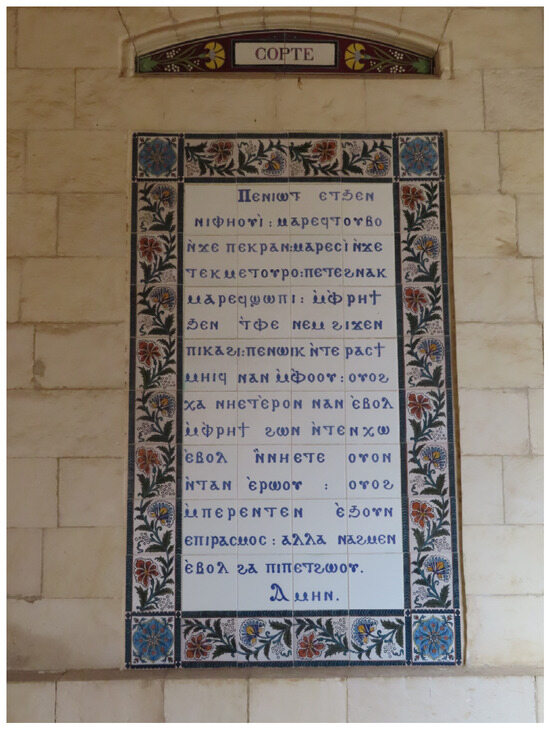
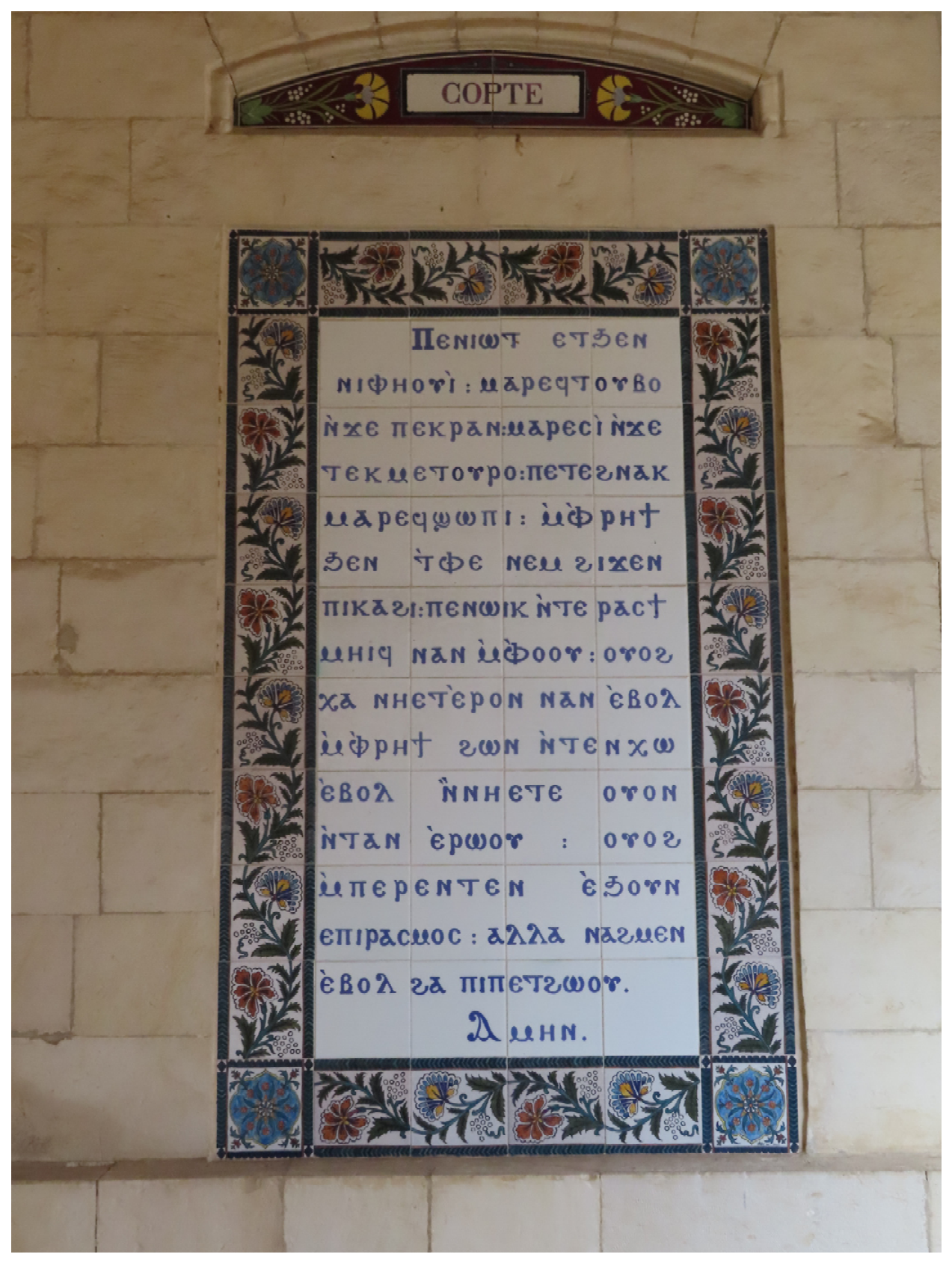
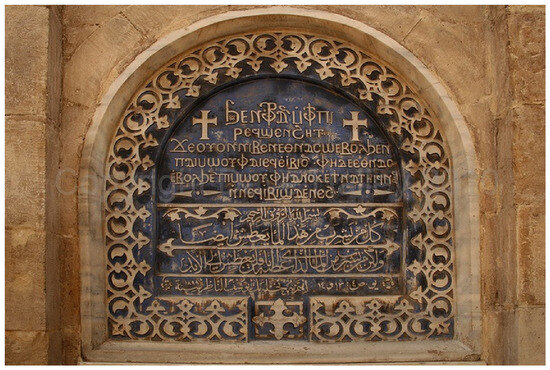
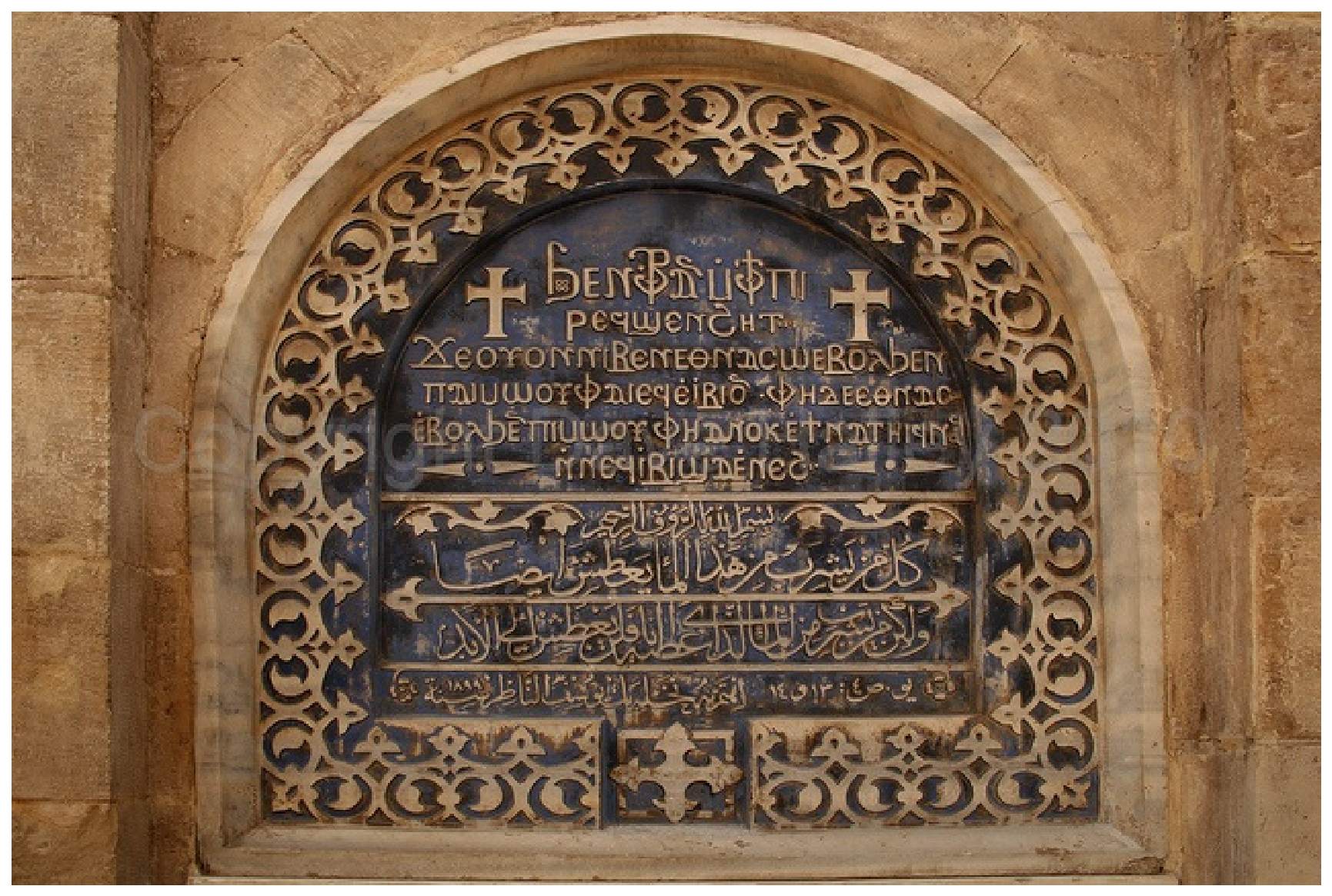
Inscriptions on stone constitute a vast and significant corpus of epigraphic resources, which are broadly classified into non-funerary (such as architectural or building inscriptions) and funerary (epitaphs) categories [6,7,8]. Magnificent examples of these inscriptions can be found throughout the Near East, such as the Lord’s Prayer plaques at the Church of the Pater Noster in Jerusalem (Figure 1) [9] and the bilingual Coptic–Arabic inscription in Old Cairo (Figure 2) [10]. Regarding Figure 2, it is worth noting that bilingual texts and inscriptions are uniquely valuable artifacts for yielding a deeper understanding of their precise socio-historical contexts [11].
Figure 1.
The Lord’s Prayer table in Jerusalem [9].
Figure 2.
The bilingual Coptic & Arabic inscription in Old Cairo [10].
One of the most traditional and significant facets of Coptic cultural heritage is iconography, a reflection of the predominantly religious nature of Coptic art. A prime example of this interplay between text and imagery is the illustrated Coptic Gospel of 1179–1180 CE, discovered in Damietta, Egypt [12]. Manuscripts of this nature clearly demonstrate that textual processing in these contexts must look beyond standard computational methods alone to account for visual and material complexities. Indeed, the artistic influence of traditional Coptic iconography is so profound that it has evolved into a vibrant contemporary movement; through Neo-Coptic iconography, it remains one of the most active and creative expressions of Coptic culture today [13].
2.5. Coptic Digital Resources
Digital resources for Coptic—spanning its various dialects like Sahidic and Bohairic—have expanded tremendously. Whether be an academic researcher, a language learner, or looking for liturgical materials, the digital ecosystem for Coptic can be broken down into four (4) distinct categories, briefly presented in the corresponding sub-subsections below.
2.5.1. Textual Corpora & Academic Databases
These tools allow users to search, analyze, and read historical Coptic texts digitally:
- Coptic SCRIPTORIUM (https://copticscriptorium.org/) (accessed on 16 May 2026) is the gold standard for digital Coptic research. It is an open-source platform providing heavily annotated Sahidic and Bohairic texts. Its built-in Natural Language Processing (NLP) tools allow you to search by word, grammatical pattern, or part of speech.
- The “Digital Edition of the Coptic Old Testament” (https://coptot.manuscriptroom.com/) (accessed on 16 May 2026), based at the Göttingen Academy, is a long-term project that aims to create the first complete virtual library and critical digital edition of the Coptic Bible, linking various biblical manuscripts.
- PaThs (Archaeological Atlas of Coptic Literature, http://paths.uniroma1.it//) (accessed on 16 May 2026) is an expansive database classifying Coptic literary works by geographical origin, author, and manuscript tradition.
- Koptoo (Koptische Ostraka Online, https://www.en.ag.geschichte.uni-muenchen.de/index.html) (accessed on 13 May 2026), run by LMU Munich, specifically indexes non-literary documentary texts (like receipts, private letters, and everyday records written on pottery pieces called ostraca).
- Brussels Coptic Database (BCD, https://mnamon.sns.it/index.php?page=Risorse&id=5&lang=en) (accessed on 14 May 2026), is a massive database hosted by the Université Libre de Bruxelles tracking over 100,000 entries of Coptic documentary texts and metadata.
- Coptic Magical Papyri (https://www.coptic-magic.phil.uni-wuerzburg.de/) (accessed on 12 May 2026), based at the University of Würzburg, is a project that focuses entirely on collecting and analyzing digital records of Coptic ritual and magical texts.
2.5.2. Dictionaries & Lexica
Finding definitions and linguistic roots digitally is much easier today than flipping through old paper volumes:
- Coptic Dictionary Online (https://corpling.uis.georgetown.edu/coptic-dictionary/) (accessed on 16 May 2026) is a highly accessible, searchable interface developed through the KELLIA project, where we can input Coptic script, English, German, or French keywords to look up translations.
- Crum’s Coptic Dictionary Online (https://www.bintel.org.uk/crum.html) (accessed on 16 May 2026) by Walter Ewing Crum remains the definitive dictionary of the language–several sites host digitized, searchable versions of it.
- DDGLC (Database and Dictionary of Greek Loanwords in Coptic, https://www.gwdg.de/) (accessed on 16 May 2026) is an essential tool for tracking the extensive integration of Greek vocabulary into the Coptic language.
2.5.3. Liturgical & Church Resources
For practicing Coptic Orthodox Christians, several initiatives host digitized versions of hymns, prayers, and historical texts:
- One Coptic Library (https://onecopticlibrary.com/) (accessed on 16 May 2026) is a comprehensive multilingual application (supporting English, Arabic, Coptic, French, and German) that brings together church rituals, hymns, and liturgical readings with text transliteration features.
- The Coptic Treasures Project (https://ml.coptic-treasures.com/) (accessed on 16 May 2026) is a massive online repository holding thousands of digitized Coptic books, manuscript studies, and audio files regarding church history, theology, and grammar.
2.5.4. Learning Software, Fonts, & Keyboards
For reading, writing, or studying the grammar:
- Marcion (http://marcion.sourceforge.net/) (accessed on 16 May 2026) is a downloadable desktop study environment built for Coptic, Greek, and Latin—it includes an offline searchable version of Crum’s dictionary and the Nag Hammadi gnostic library.
- Antinoou Font (http://www.evertype.com/fonts/coptic/) (accessed on 16 May 2026), commissioned by the International Association for Coptic Studies, is the standard Unicode-compliant font used by scholars to accurately display Coptic script on Windows and Mac.
- Coptic for All (https://copticforall.com/) (accessed on 14 May 2026)offers free interactive e-learning lessons, a hymn library with word-for-word translation, and online learning modules.
2.6. Coptic Software in Greek Context
Despite the plethora of Coptic digital resources presented in the previous subsection, none meet the specific needs of the application proposed here. Most are designed strictly for office environments or processing digital corpora, while others require an internet connection. Furthermore, they are often less user-friendly than advertised, lack support for Greek responses, and may omit features crucial for standalone field work directly with non-papyrus artifacts.
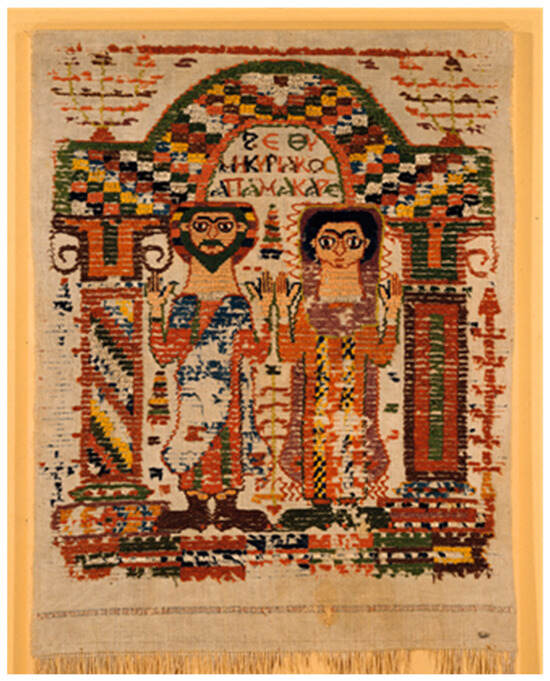
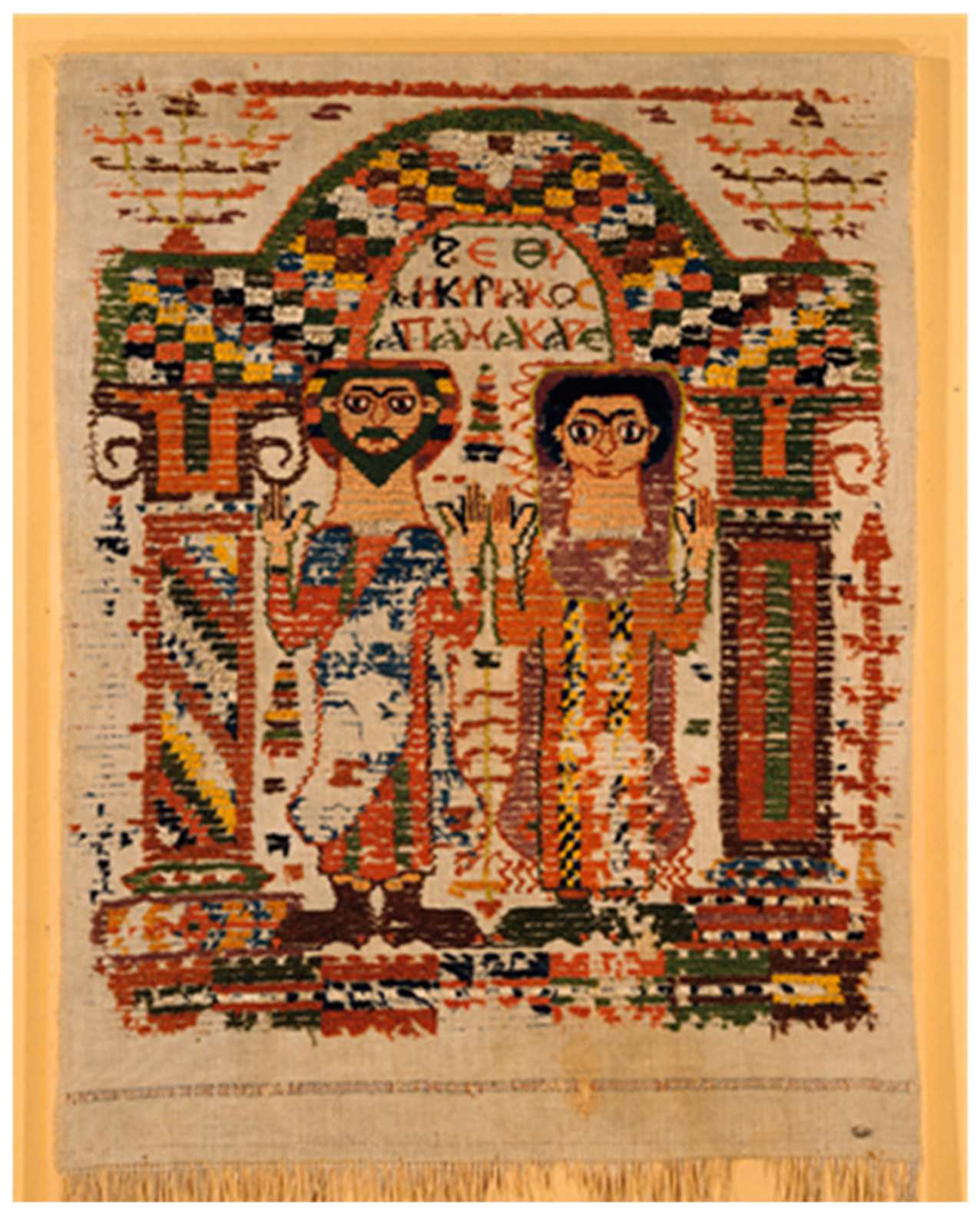
Consequently, local researchers require a dedicated tool capable of recognizing Coptic script on physical artifacts (Figure 3), thereby serving as an invaluable aid for interpreting short texts and studying the language in the field. To meet this need, the software application presented herein was developed to support scholars and researchers of Coptic in conducting direct linguistic analyses. By ensuring a user-friendly interface (see Section 3.3), the tool makes this material accessible even to individuals without advanced computational skills.
Figure 3.
Linen curtain, veil, with woven representation of a couple tied under an arch and a Coptic inscription in Greek letters; it comes from a monastery of Antinoe in Egypt and dates back to the 5th-6th century (Dimensions 1.05 × 0.86 m), Benaki Museum [1].
Developing language processing software for Coptic presents distinct computational challenges. First, classical Coptic was traditionally written in scriptura continua, meaning there are no spaces between words. The script also features frequent diacritics, punctuation marks, and abbreviations that necessitate a text normalizer prior to downstream machine processing. Furthermore, dialectal variations mean the same word can exhibit different spellings, or conversely, a single spelling can map to multiple dictionary entries. Together, these factors present significant obstacles that existing natural language processing (NLP) tools fail to address, as they primarily target standardized textual corpora rather than physical inscriptions on artifacts. Material-based inscriptions are frequently fragmented, degraded, or lacking a clear syntactic structure; moreover, they typically lack corresponding Greek translations, despite the deep historical, cultural, and linguistic ties connecting the two traditions [1].
3. Software Development
To address these challenges, a semi-automated approach is proposed herein that enables users to select their preferred unit of analysis—whether smaller than, equal to, or larger than a single word—while performing a word-by-word, computer-assisted translation into both Greek and English. This method emphasizes the efficient processing of material-based inscriptions through an intuitive interactive interface tailored for scholars. The core architecture is adapted from an existing software framework originally developed to process the Linear-B script of Mycenaean Greek [14], which was subsequently modified to handle Linear-A inscriptions. The versatility of this underlying computational framework is highlighted by its adaptation to Linear-A; unlike the deciphered Coptic script, Linear-A remains undeciphered and may encode more than one language [15].
The main features of the adapted software framework [14] include the following design choices. First, the interface features a virtual keyboard that allows the user to select an input word sign-by-sign by clicking or touching its displayed image, thereby eliminating the need for complex keystroke combinations on a physical keyboard. Upon executing a search, both the target word and its pronunciation are displayed alongside the retrieved data. To allow for direct user access for comparisons, corrections, or expansion, the dictionary (database) is implemented as a standard spreadsheet file. Furthermore, the processing strategy is designed to minimize dynamic complexity (i.e., algorithmic/time complexity) at the expense of static complexity (i.e., database structure/space complexity). To achieve this, the lemmata (words) are organized first by length (number of characters) and then alphabetically. This structure creates a two-dimensional, Cartesian search space that narrows the target group to fewer than one hundred words—the precise upper limit where the average performance of a linear search matches that of a binary search. Within this subset, a straightforward linear search is executed with an average time complexity of O(n) and a space complexity of O(1) (an “in-place algorithm”). Consequently, retrieval accuracy is absolute (100%), provided the input word is spelled correctly and exists within the database. The platform is implemented in Visual C#, leveraging the superior interface-design capabilities of the Visual Studio suite.
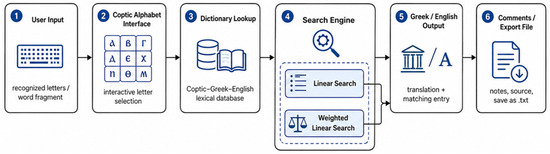
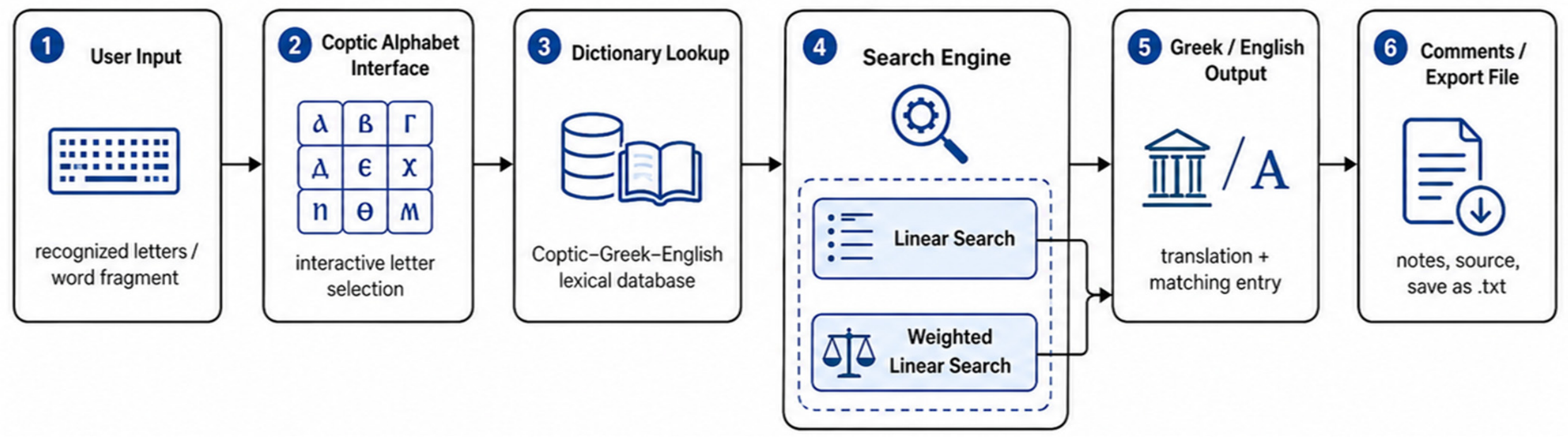
Structurally, the proposed software tool comprises three integrated components, following the exact pattern of the platform described previously: (i) a Coptic–Greek digital dictionary, (ii) a dedicated search engine, and (iii) the user interface. To facilitate a clearer understanding of the proposed system, Figure 4 illustrates the overall software architecture and processing pipeline of the Coptic translation tool.
Figure 4.
Software architecture and workflow of the proposed Coptic translation tool.
The workflow begins with user text input and interactive letter selection via the Coptic alphabet interface, proceeds through dictionary lookup and search-engine optimization, and concludes with the retrieval of translation results and the optional export of user annotations. This diagram highlights the interaction between the system’s core modules, providing a concise overview of how the tool supports the semi-automated interpretation of Coptic inscriptions. As shown in Figure 4, the proposed system is structured around three core components: the lexical database, the search engine, and the user interface, which together implement the semi-automated translation process.
3.1. The Coptic–Greek Digital Dictionary
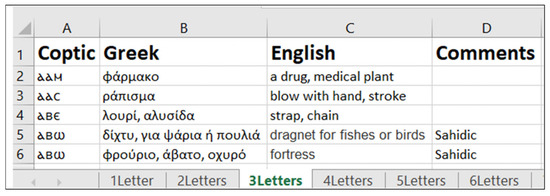
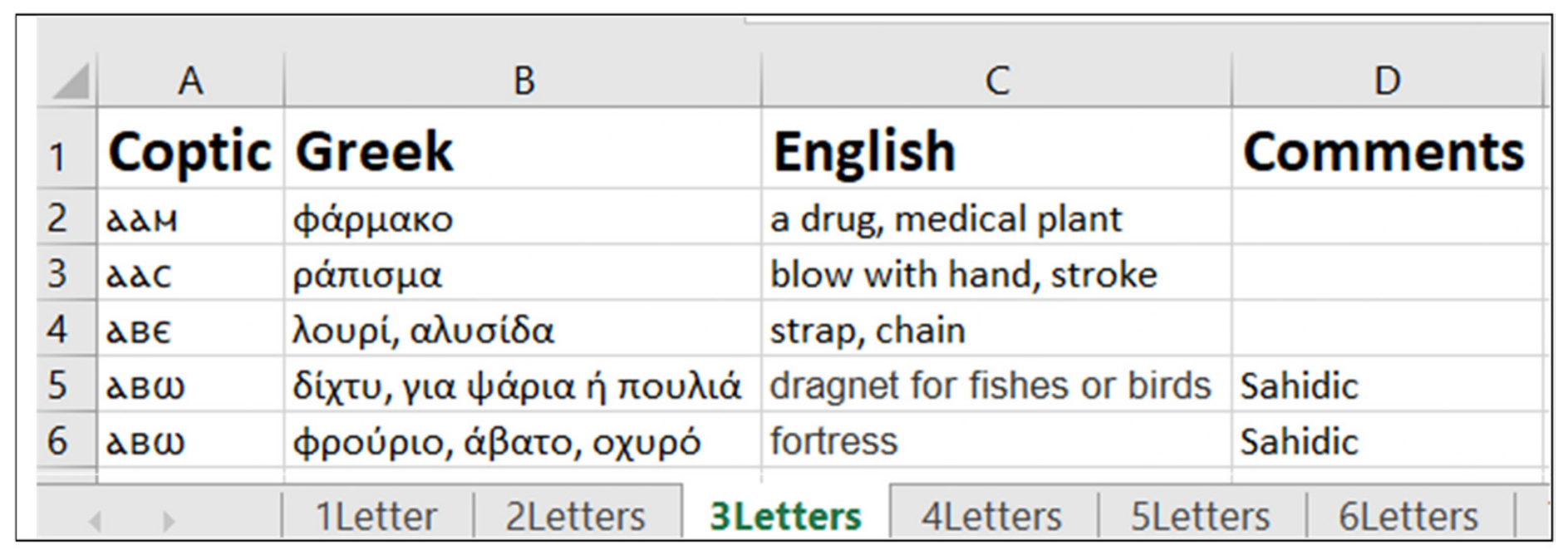
A critical component of any natural language processing (NLP) application is its underlying lexical database. In this system, the lexical dictionary is maintained within a single, unified spreadsheet format (Figure 5), which facilitates straightforward modification and seamless expansion of the stored data.
Figure 5.
A sample of the digital dictionary.
The Coptic vocabulary entries are primarily grouped by word length (i.e., character count) and secondarily sorted in alphabetical order within each length category. There are eight length categories, from one- to seven-letter words and more than seven. In Figure 5, there is a screenshot of the alphabetically first three-letter words. This hierarchical structure optimizes search-engine execution for rapid data retrieval. Structurally, the database matrix consists of four dedicated columns (Figure 5):
- Column 1 (“Coptic”): The lexical entry in Coptic script.
- Column 2 (“Greek”): The corresponding translation into Greek.
- Column 3 (“English”): The corresponding translation into English.
- Column 4 (“Comments”): Critical scholarly commentary regarding the entry, i.e., source citation, dialectal variant (e.g., “S” for Sahidic), or essential epigraphic context).
To construct this repository, standard Coptic lexica available in both print [16] and digital [17,18] formats are consulted. All commentary from these external source entries are translated into Greek by the authors, while data amendment is straightforward simply by accessing the spreadsheet manually. The digital dictionary is currently being enriched to include roughly 12,000 unique primary headword entries by the end of 2026 and be validated by a linguist/lexicographer. In addition, localized word variations (dialectal, multiple spellings, etc.) are being added explicitly because the framework is strictly designed for word-level lookups; full word-parsing features were not considered necessary at this stage of software development given the short length of the target inscriptions.
3.2. Searching Process and Corpora
The database search is experimentally executed via two distinct methods. The first utilizes a structured, Cartesian-style dictionary where words are organized primarily by length and secondarily by alphabetical order, enabling a standard linear search just like the adapted platform previously mentioned. Concurrently, a second database supports a weighted linear search. While this alternative method remains sequential, it operates on data tables that are pre-arranged in descending order according to their historical probability of occurrence (pre-loading) [2]. Weighted linear search is based on Pareto Principle, where 80% of searches are for 20% of the items. Although the formal time and space complexity of both search methods (linear vs. weighted linear) are the same, weighted linear search drastically outperforms standard linear search in practice. Therefore, the weighted linear search is being implemented to speed up average word retrieval, as the dictionaries of the original platform [14,15] contain fewer words than the size intended for this project. In this way, the most frequent words are retrieved first and, thus, faster. Preliminary testing though reveals no noticeable difference in performance between the two methods, once again due to the small size of the target inscriptions, the incomplete size of the dictionary, the large fragmentation of data in categories (see Section 3.1) that minimizes the target group, and the fact that machine processing is far faster than human reaction times. However, the weighted method is being developed to support future extensions of the system to larger datasets in automated processing. Word frequencies are currently calculated by counting instances within the digital corpus [19]; each time a word is encountered, its frequency count increases by one, recorded in the relevant cell of the spreadsheet (the second database includes a fifth column, compared to Figure 5, to keep word frequencies). The database is then sorted in descending order of frequency at the end of each session, an action that speeds up the next session.
3.3. The Interface
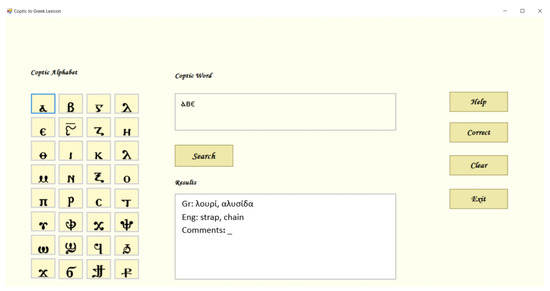
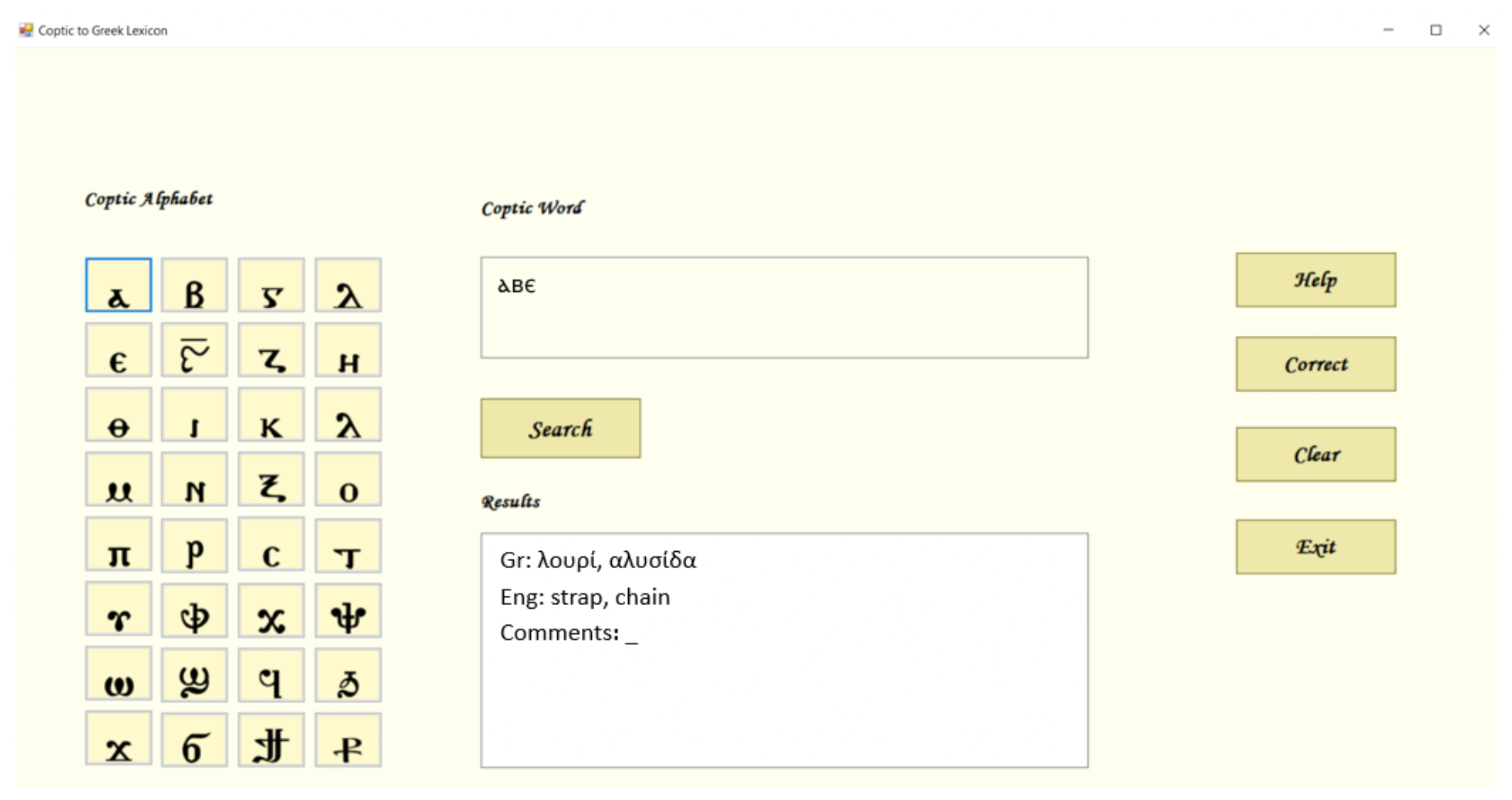
The user interface is designed to be highly intuitive and user-friendly (Figure 6). The left panel displays the Coptic alphabet, allowing users to interactively select the characters they recognize on an artifact or papyrus. Users can then trigger the database query by clicking the “Search” button, or utilize the “Correction” option if an input error occurs. If the submitted sequence matches a dictionary entry, its corresponding Greek translation and relevant scholarly commentary appear in the “Results” text area. If no match is found, a notification indicating an unsuccessful search is displayed. Like the adapted platform, an unsuccessful search may occur only if a word is misspelled or not included. Additionally, users can select the “Clear” button to reset the workspace for a new query, or “Help” to access documentation and guidance. Finally, clicking the “Exit” button prompts the system to automatically save the session log into a standard text (.txt) file [2] for further study.
Figure 6.
The interface of the software application.
In Figure 6, the search results are exhibited for the third Coptic word of Figure 5 (4th line). Firstly, the user chooses the three letters of the word from the virtual keyboard on the left (area “Coptic Alphabet”), by clicking their images. The selected word is displayed on top (frame “Coptic Word”). Then, the user clicks the “Search” button, below the word. The relevant information of the digital dictionary (Figure 5) is displayed inside the “Results” frame. We can see the Greek translation (“Gr:”), the English one (“Eng:”) and the comments (“Comments:”) if any. Finally, the user may choose either to continue searching by clicking the “Clear” button on the right, or to close the application by clicking the “Exit” button. In the latter case, the results of this session are saved into the log file.
3.4. Preliminary Validation
The application has undergone preliminary functional and field-oriented testing by the authors during its development. Since the software and the associated lexical database are still being expanded, the present evaluation should be regarded as an initial proof-of-concept verification rather than as a complete statistical validation.
The testing focused on the principal operations required during field use: interactive selection of Coptic characters through the virtual keyboard, submission of lexical queries, retrieval of the corresponding Greek and English translations, correction of user input, clearing of the workspace, and automatic export of the session results. During these preliminary trials, the application successfully performed the intended workflow for correctly entered words already available in the lexical database. The interface also operated without requiring an internet connection, which constitutes an important practical advantage for use in museums, archaeological collections, storage areas, and other environments where network availability may be limited.
The field-oriented testing further confirmed that the application is most effective when applied to short inscriptions containing sufficiently clear and recognizable characters. The virtual keyboard simplifies the manual transcription process and avoids the need for users to install or memorize specialized Coptic keyboard combinations. The retrieved translations and associated comments can subsequently be stored in a text file, allowing the user to preserve the results of an examination session for further linguistic or epigraphic analysis.
The preliminary testing also revealed important limitations. In its present form, the application does not automatically process incomplete, uncertain, visually ambiguous, or heavily damaged characters. In such cases, the interpretation and selection of the most probable character remain dependent on the expertise of the user. In addition, an unsuccessful query may occur when the transcribed word is not yet included in the developing lexical database or when the input does not correspond exactly to an available entry. These observations confirm that the tool should be considered a human-supervised translation aid rather than a fully automated recognition or translation system.
Regarding search performance, no practically perceptible difference was observed between the standard linear-search method and the weighted-linear-search method during the preliminary trials. This is consistent with the relatively short length of the target inscriptions, the current size and subdivision of the lexical database, and the fact that computational retrieval time remains substantially shorter than normal user interaction time. Nevertheless, the weighted-search approach is retained because it may become advantageous as the database expands and larger datasets are processed.
A broader evaluation with external specialists and a larger number of inscriptions is currently being organized in collaboration with museum experts at Cairo University. That subsequent study will examine usability and task performance using success score, error rate, task-completion time, and the Single Ease Question. Because this broader evaluation forms part of an ongoing doctoral research project and has not yet been completed, no statistically generalized claims are made in the present study. The results reported here are therefore limited to the preliminary functional feasibility and practical field-oriented operation of the proposed application.
4. Commentary
Art cannot be isolated from its historical era, and language remains the clearest reflection of that context. Consequently, this software tool is expected to enable researchers to restore degraded inscriptions on physical artifacts or generate missing captions—for instance, by analyzing epigraphic parallels and reconstructing related inscriptions. Furthermore, by utilizing the integrated digital dictionary in reverse, the tool can assist contemporary artists in creating authentic works of Neo-Coptic iconography adorned with grammatically accurate, contextually relevant religious inscriptions.
As previously mentioned, the database queries are experimentally executed via two distinct methods: a standard linear search utilizing an alphabetically structured dictionary, and a weighted linear search based on frequency data. To construct the underlying frequency tables, the tool leverages data from the Coptic SCRIPTORIUM corpora. Coptic SCRIPTORIUM is a collaborative digital platform founded by Caroline T. Schroeder and Amir Zeldes [19], which provides open-access text collections designed for linguistic reading, analysis, and complex queries. The repository spans a diverse corpus, including magical papyri, the Book of Ruth, the Gospel of Mark, the Assumption of John, and various historical biographies. Implementing this dual-search methodology offers significant advantages; it not only ensures faster and more accurate text retrieval but also serves as an experimental framework for determining how digital humanities databases can be optimally structured to improve query performance and system reliability [2].
Moreover, computational approaches to deciphering ancient scripts depend heavily on specialized processing software and the availability of corresponding lexical databases for ancient languages. Regarding the former, a groundbreaking unsupervised model was developed by Snyder et al. [20] to automatically decipher Ugaritic—an extinct, Northwest Semitic language from the fourteenth century BCE written in a cuneiform abjad [21]. Their statistical framework operates without human intervention, leveraging a comprehensive Hebrew lexical database due to the close linguistic affinity between Ugaritic and Hebrew. While this computational approach achieves an impressive decipherment accuracy of 90.53% for words with cognates, it simultaneously demonstrates that even highly sophisticated unsupervised systems still require human oversight to fully interpret the remaining textual anomalies.
The present work diverges from the aforementioned statistical model by emphasizing a human-in-the-loop, computer-assisted framework for studying ancient languages. Rather than relying on autonomous decryption, it serves as an interactive “lexical model” that leverages structural databases for language learning, translation, and self-instruction. Furthermore, while fully automated statistical models require prior, comprehensive digitization of a corpus, our lexical tool is immediately operational—facilitating digitization dynamically as the epigrapher physically works with the artifact [2].
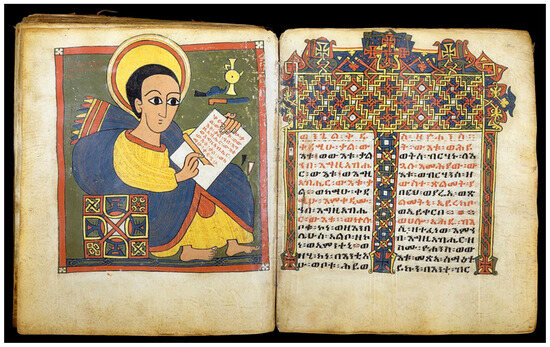
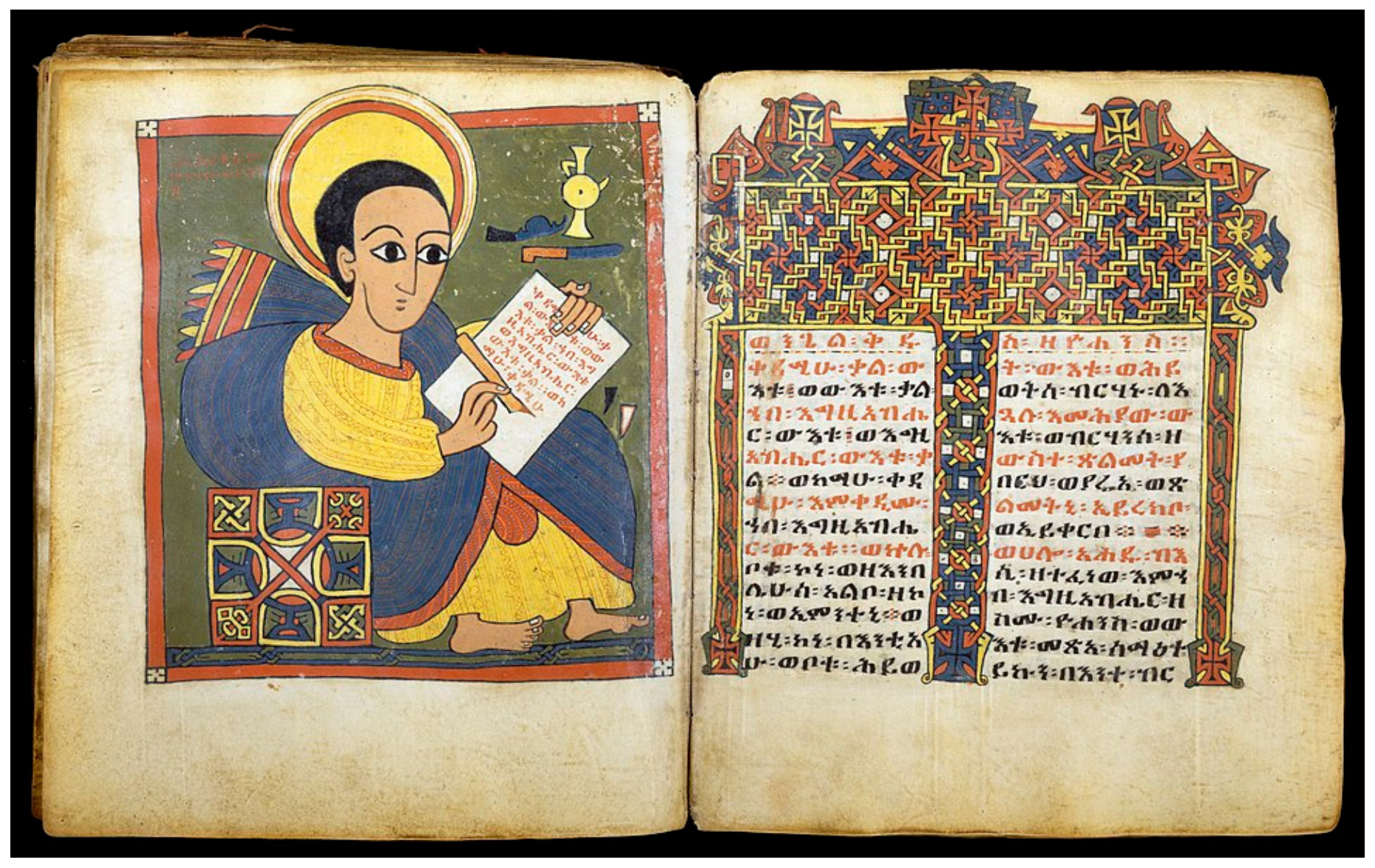
Future research will focus on expanding this platform into a unified ecosystem for studying diverse historical scripts and languages beyond well-documented corpora like Egyptian Hieroglyphs or Sumerian/Akkadian Cuneiform. Two particularly compelling expansion paths are the processing of Classical Ethiopic (Ge’ez) [22], given its deep historical, liturgical, and cultural parallels to the Coptic tradition (Figure 7) [23], and the implementation of computer vision to analyze damaged inscriptions.
Figure 7.
Depiction of John the Evangelist in one of the Gunda Gunde Gospels, c. 1540 [23].
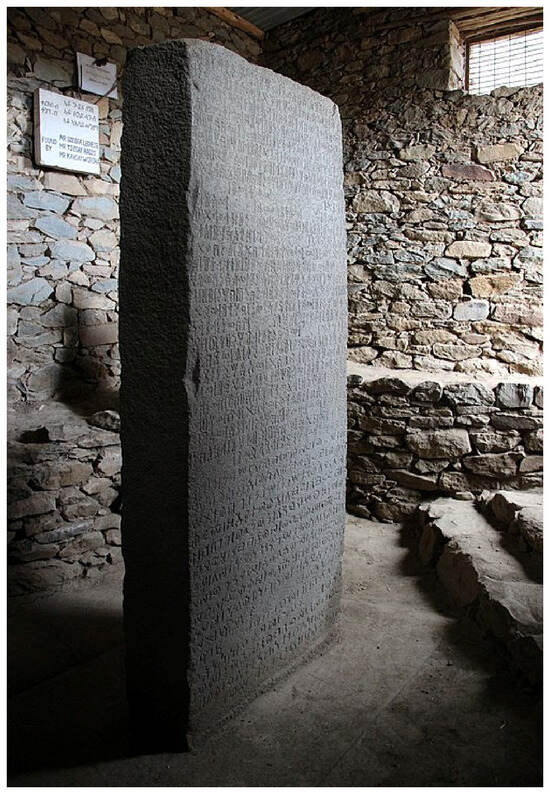
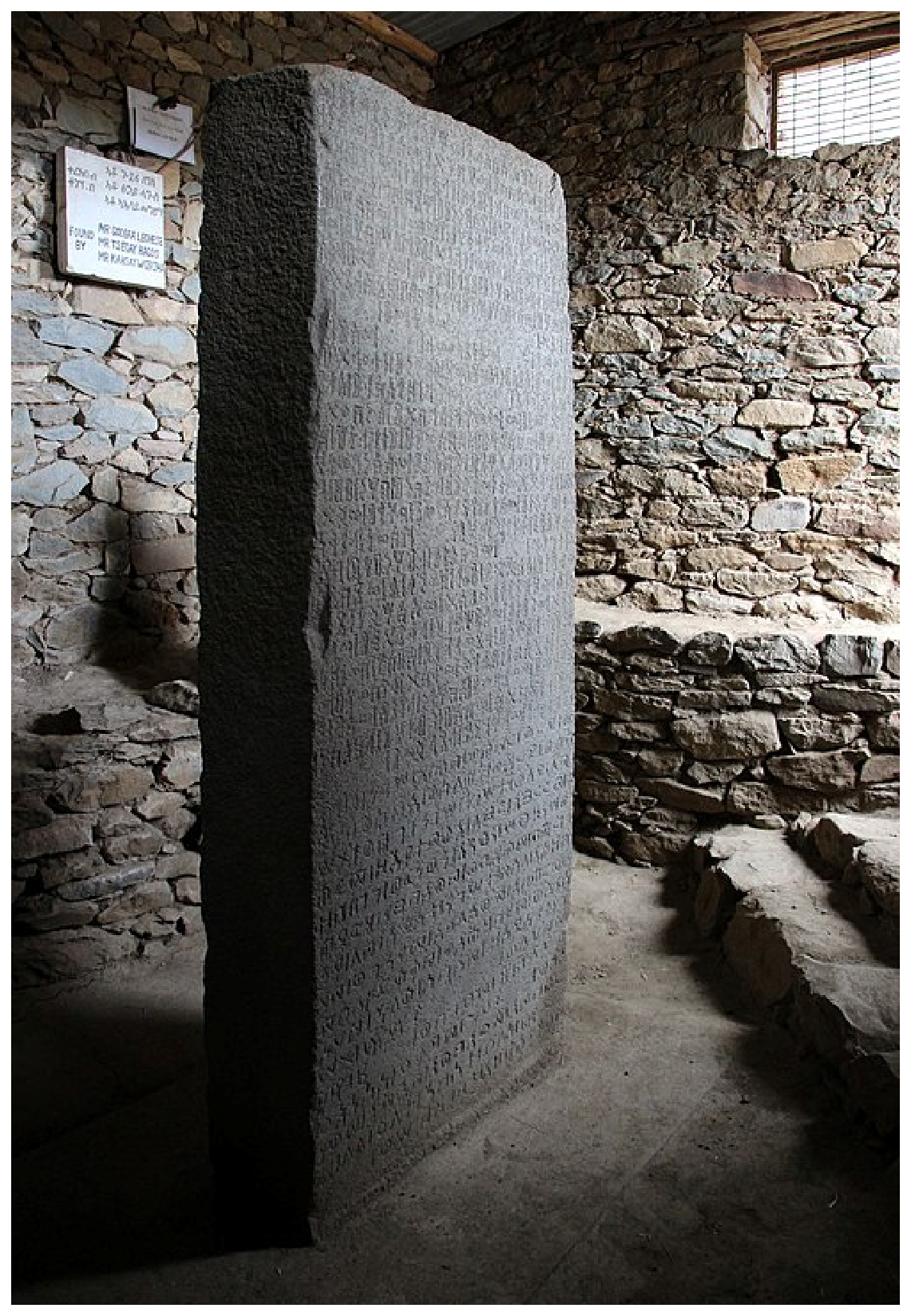
Ge’ez is an ancient language of Ethiopia and Eritrea that ceased to be widely spoken as a vernacular by the fourteenth century CE. It belongs to the South Semitic language family [24] and features its own distinct script. Parallel to Coptic, Ge’ez survives today primarily as the principal liturgical language of the Ethiopian Orthodox Tewahedo and Catholic Churches, the Eritrean Orthodox Tewahedo and Catholic Churches, and the Beta Israel Jewish community. Although distinct in artistic style from Coptic traditions, Classical Ethiopic artifacts share analogous motifs with the former due to the shared historical origins of Christianity in East Africa and the Nile Valley. Sacred texts are adorned with rich iconography (Figure 7), and multilingual epigraphic inscriptions are also frequently found engraved on stone stelae (Figure 8) [25].
Figure 8.
The Ezana Stone (c. 330-356 CE), written in early Geʽez, Sabaean and Koine Greek [25].
Another promising research and development trajectory involves leveraging visual recognition software to analyze inscriptions, especially in case of damaged artifacts and surfaces. This approach builds upon a well-established foundation of diverse computational methods and techniques tested over the last decade [26]. For instance, in 2018, the Histogram of Oriented Gradients (HOG) feature descriptor was integrated into a specialized software system designed to process Egyptian hieroglyphs [27]. While conventional optical character recognition (OCR) systems achieve high accuracy on standardized, well-defined documents, their performance drops significantly when applied to degraded or poorly preserved texts. Because Coptic epigraphic scripts are preserved on weathered or fragmented physical artifacts, standard OCR approaches often yield unsatisfactory results. Consequently, implementing visual object detection and computer vision architectures is highly recommended [28]. Since the inception of modern object recognition research in the 1990s, the field of computer vision has achieved major milestones [29], with each successive generation of deep learning technologies continuously improving retrieval and classification accuracy. This evolution led to the introduction of “two-stage” detectors in 2014, which bifurcate the process by first generating regional object proposals and then classifying those specific regions of interest. Conversely, “one-stage” detectors, which emerged in 2016, bypass the initial region-proposal step to map pixel locations directly to class probabilities. While early one-stage models traded a marginal amount of localization accuracy for significantly faster inference speeds and reduced computational overhead, iterative architectural advancements have since minimized this accuracy gap. By 2018, the paradigm expanded to include “anchor-free” object detection methods, which localize target entities via central key points rather than relying on predefined bounding-box dimensions [30].
Recently, this trajectory came full circle in the digital humanities when a state-of-the-art one-stage detector (YOLOv5) was successfully deployed to recognize the complex syllabograms of the undeciphered Linear-A script, yielding highly encouraging results [28] that can be applied to Coptic artifacts as well. This implementation is being designed around standard portable devices, like the camera of a tablet. Consequently, a promising computational horizon is opening for the automated study, digitization, and preservation of invaluable, visually rich cultural heritage.
5. Conclusions
Valuable Coptic epigraphic material has been identified across Greece, yielding a wealth of artifacts inscribed with Coptic script. Despite this rich material record, local theoretical frameworks remain underdeveloped, and dedicated software tools tailored for Greek researchers have been entirely absent. This critical void motivated the development of the proposed computational tool, which provides an effective, systematic methodology for digitizing Coptic cultural heritage. Because this script frequently appears on highly fragile materials vulnerable to physical deterioration, a human-in-the-loop digital workflow is essential. Enabling the non-destructive digitization, translation, analysis, and interpretation of these delicate texts helps safeguard the underlying source material from handling-induced degradation. Furthermore, this application belongs to a broader ecosystem of language processing utilities developed under the auspices of the University of West Attica. This ongoing research initiative aims to decode ancient languages, digitize endangered cultural property, and support the fabrication of physical reproductions—both for archival preservation and for sustaining historic artistic traditions within a contemporary context.
Author Contributions
Conceptualization, A.K. (Argyro Kontogianni) and E.P.; methodology, T.G. and E.P.; validation, P.K. and M.G.M.; formal analysis, A.K. (Antreas Kantaros) and E.P., investigation, A.K. (Argyro Kontogianni) and P.K.; data curation, P.K. and M.G.M.; writing—original draft preparation, A.K. (Argyro Kontogianni) and E.P.; writing—review and editing, A.K. (Antreas Kantaros) and E.P.; supervision, T.G., P.K. and E.P. All authors have read and agreed to the published version of the manuscript.
Funding
This research received no external funding.
Institutional Review Board Statement
Not applicable.
Informed Consent Statement
Not applicable.
Data Availability Statement
The data presented in this study are not yet available, until the end of the project.
Conflicts of Interest
The authors declare no conflicts of interest.
References
- Kontogianni, A.; Ganetsos, T.; Zacharis, N.; Kousoulis, P.; Papakitsos, E.C. A Detailed Study about Egyptian-Coptic and Software Engineering. Archaeology 2021, 9, 28–33. [Google Scholar]
- Kontogianni, A.; Papakitsos, E.C.; Ganetsos, T. An Integrated Software Application for the Ancient Coptic Language. J. Comput. Sci. Res. 2023, 5, 38–42. [Google Scholar] [CrossRef] [Scilit]
- Freie Universität Berlin. Database and Dictionary of Greek Loanwords in Coptic (DDGLC). Available online: https://www.geschkult.fu-berlin.de/en/e/ddglc/index.html (accessed on 24 February 2026).
- Wilfong, T.G. Coptic Language; Oxford Classical Dictionary: Oxford, UK, 2018. [Google Scholar]
- The Morgan Library & Museum. New York, NY. Available online: https://www.themorgan.org/collection/coptic-manuscripts (accessed on 24 February 2026).
- Łajtar, A.; Van Der Vliet, J. Qasr Ibrim: The Greek And Coptic Inscriptions. J. Juristic Papyrol. 2010, XIII. Available online: https://api.semanticscholar.org/CorpusID:192763656 (accessed on 14 July 2026).
- Davies, V. Appendix 2: Coptic Inscriptions. In The Phoebe A. Hearst Expedition to Naga ed-Deir, Cemeteries N 2000 and N 2500; Series: Harvard Egyptological Studies; Brill: Boston, MA, USA, 2021; Volume 10. [Google Scholar] [CrossRef] [Scilit]
- Blumell, L.H.; Yingling, E.O. A New Coptic Epitaph from the Petrie Museum. Bull. Am. Soc. Papyrol. 2016, 53, 223–232. [Google Scholar]
- Fallaner. Lord’s Prayer Table in the Church of the Pater Noster in Jerusalem. 2018. Available online: https://commons.wikimedia.org/wiki/Category:Coptic_inscriptions#/media/File:Holy_Land_2018_(2)_P091_Jerusalem_Pater_Noster_Lord’s_Prayer_Coptic.jpg (accessed on 24 February 2026).
- Disdero. Coptic & Arabic Inscriptions, Old Cairo. 2006. Available online: https://commons.wikimedia.org/wiki/File:Coptic_and_Arabic_inscriptions_in_an_Old_Cairo_church.jpg (accessed on 24 February 2026).
- Livne-Kafri, O. Between Arabic and Coptic in a Bilingual Manuscript of The Pentateuch: The Case of La’alla نمن. Acta Orient. Acad. Sci. Hung. 2011, 64, 201–208. [Google Scholar] [CrossRef] [Scilit]
- Coptic Gospel, Damietta, Egypt, 1179–1180. 2024. Available online: https://en.wikipedia.org/wiki/Coptic_art#/media/File:Coptic_Gospel,_Damietta,_Egypt,_1179-80.jpg (accessed on 24 February 2026).
- René, S. Concerning the Study of Iconography. 2020. Available online: https://copticiconography.com/2020/02/21/concerning-the-study-of-iconography/ (accessed on 24 February 2026).
- Papakitsos, E.C.; Kontogianni, A.; Papamichail, C.; Kenanidis, I.K. An Application of Software Engineering for Reading Linear-B Script. Int. J. Appl. Sci. 2018, 1, 58–67. [Google Scholar] [CrossRef] [Scilit]
- Mavridaki, A. Development of Calculation Methods and Tools That Will Contribute in Digitization, Studying and Interpreting the Linear A Script. Doctoral Thesis, Department of Informatics & Computer Engineering, University of West Attica, Egaleo, Greece, 2025. [Google Scholar]
- Crum, W.E. A Coptic Dictionary; Wipf and Stock: Eugene, OR, USA, 2005. [Google Scholar]
- Coptic Dictionary. CopticBook: Books of the Coptic Orthodox Church. Available online: http://e.copticbook.net/copticdictionary.php (accessed on 17 March 2021).
- Coptic Dictionary Online by the Koptische/Coptic Electronic Language and Literature International Alliance (KELLIA). Available online: https://coptic-dictionary.org/ (accessed on 17 March 2021).
- Scriptorium. Available online: https://copticscriptorium.org/ (accessed on 20 June 2021).
- Snyder, B.; Barzilay, R.; Knight, K. A Statistical Model for Lost Language Decipherment. In Proceedings of the 48th Annual Meeting of the Association for Computational Linguistics, ACL ’10, Uppsala, Sweden, 11 July 2010; pp. 1048–1057. Available online: https://dl.acm.org/citation.cfm?id=1858788 (accessed on 14 May 2026).
- Pardee, D. Ugaritic. In The Ancient Languages of Syria-Palestine and Arabia; Woodard, R.D., Ed.; Cambridge University Press: New York, NY, USA, 2008; pp. 5–6. [Google Scholar]
- Bauer, L. Geez, Online ed.; The Linguistics Student’s Handbook; Oxford University Press, Oxford English Dictionary: Edinburgh, UK, 2007. [Google Scholar]
- Walters Art Museum. Depiction of John the Evangelist in one of the Gunda Gunde Gospels, c. 1540. 2012. Available online: https://en.wikipedia.org/wiki/Ethiopian_art#/media/File:Ethiopian_-_John_the_Evangelist_-_Walters_W850153V_-_Open_Group.jpg (accessed on 24 February 2026).
- O’Leary, D.L. Comparative Grammar of the Semitic Languages; Routledge: London, UK, 2000. [Google Scholar]
- Sailko. The Ezana Stone, Engraved Between 330 and 356, Is Written in Early Geʽez, Sabaean and Koine Greek. 2018. Available online: https://en.wikipedia.org/wiki/Ge%CA%BDez#/media/File:Aksum,_iscrizione_di_re_ezana,_in_greco,_sabeo_e_ge’ez,_330-350_dc_ca._10.jpg (accessed on 24 February 2026).
- Sommerschield, T.; Assael, Y.; Pavlopoulos, J.; Stefanak, V.; Senior, A.; Dyer, C.; Bodel, J.; Prag, J.; Androutsopoulos, I.; De Freitas, N. Machine Learning for Ancient Languages: A Survey. Comput. Linguist. 2023, 49, 703–747. [Google Scholar] [CrossRef] [Scilit]
- Hossam, R.; Abdel-Megeed, M.; Salem, M.; Rimon, E. Image Based Hieroglyphic Character Recognition. In Proceedings of the 14th International Conference on Signal Image Technology and Internet Based Systems, SITIS 2018, Las Palmas de Gran Canaria, Spain, 26–29 November 2018; IEEE: Piscataway, NJ, USA, 2018; pp. 32–39. [Google Scholar]
- Samoladas, C. Development of an OCR Software for the Syllabograms of Cretan Protolinear Script. Postgraduate Dissertation, Department of Industrial Design & Production Engineering, University of West Attica, Egaleo, Greece, 2024. (In Greek) [Google Scholar]
- Wang, X.; Wang, A.; Yi, J.; Song, Y.; Chehri, A. Small Object Detection Based on Deep Learning for Remote Sensing: A Comprehensive Review. Remote Sens. 2023, 15, 3265. [Google Scholar] [CrossRef] [Scilit]
- Zou, Z.; Chen, K.; Shi, Z.; Guo, Y.; Ye, J. Object Detection in 20 Years: A Survey. Proc. IEEE 2023, 111, 257–276. [Google Scholar] [CrossRef] [Scilit]
Disclaimer/Publisher’s Note: The statements, opinions and data contained in all publications are solely those of the individual author(s) and contributor(s) and not of MDPI and/or the editor(s). MDPI and/or the editor(s) disclaim responsibility for any injury to people or property resulting from any ideas, methods, instructions or products referred to in the content. |
© 2026 by the authors. Licensee MDPI, Basel, Switzerland. This article is an open access article distributed under the terms and conditions of the Creative Commons Attribution (CC BY) license.