


Abstract
Background: This study aimed to assess cone-beam computed tomography (CBCT) knowledge, adherence to justification criteria, field-of-view (FOV) selection practices, and awareness of radiation protection guidelines among dental practitioners in the Asir region. In Saudi Arabia, the Saudi Food and Drug Authority (SFDA) and the Nuclear and Radiological Regulatory Commission are the regulatory bodies responsible for radiation protection and the safe use of dental imaging; limited awareness of their roles may undermine regulatory compliance and patient safety. Accordingly, the specific objectives of this study were: (i) to assess knowledge of CBCT justification criteria and radiation-dose magnitudes; (ii) to evaluate adherence to the requirement for a prior 2D radiograph; (iii) to examine FOV selection across standardized clinical vignettes; (iv) to explore factors associated with knowledge scores; and (v) to identify perceived barriers to appropriate CBCT prescribing. Methods: A cross-sectional descriptive-analytical survey targeted 73 dental practitioners in Abha, Saudi Arabia. A validated 30-item questionnaire was distributed via Google Forms using snowball convenience sampling. The effective target population comprised dental practitioners and interns working in Abha during the study period. Because recruitment used open snowball distribution without a fixed sampling frame, a formal response rate could not be calculated. Results: The mean knowledge score was 5.47/10 (standard deviation: 1.86). Item-level correct rates were 82.2% for caries detection, 80.8% for the requirement for a prior 2D radiograph, and 58.9% for paediatric CBCT justification. FOV selection across four clinical vignettes ranged from 27.4% to 68.5% correct, with the lower-left-molar implant vignette showing the lowest rate (27.4%) and the six-unit anterior implant bridge vignette also poorly answered (37.0%), reflecting a frequent tendency to select an inappropriately large FOV. Guideline awareness was low: 65.8% were completely unaware of the Safety and Efficacy of a New and Emerging Dental X-ray Modality Computed Tomography (SEDENTEX CT) 2012 guidelines, while 54.8% did not know that the American Dental Association publishes specific radiation guidelines. In an exploratory multivariable model, no factor was a statistically significant predictor of the knowledge score; formal CBCT training showed a small, non-significant association (B = 0.585; 95% confidence interval [−0.27, 1.44]; p = 0.175). Conclusions: In this preliminary survey, CBCT knowledge among dental practitioners in Abha was moderate but suboptimal, with almost half of respondents scoring below the satisfactory threshold and with significant gaps in FOV optimisation and guideline awareness. Given the small, non-probability sample, these findings should be regarded as preliminary and hypothesis-generating.
1. Introduction
Since its clinical introduction, cone-beam computed tomography (CBCT) has become a valuable diagnostic tool in dentistry, offering three-dimensional (3D) volumetric imaging of the maxillofacial skeleton at radiation doses significantly lower than those of conventional medical computed tomography (CT). CBCT has been rapidly adopted across dental specialties, including implantology, endodontics, oral and maxillofacial surgery, and orthodontics, due to its superior anatomical detail compared with conventional two-dimensional (2D) radiography [1,2]. However, this expansion carries inherent responsibilities, as the effective radiation dose of a single large-field CBCT scan ranges from approximately 68 to 1073 microsieverts (µSv), depending on the field of view (FOV), voxel size, and machine-specific protocol. This is considerably higher than the 4–22 µSv associated with a panoramic radiograph [3,4]. Therefore, wide dose variability, along with the increasing availability of CBCT machines across practice settings, makes justified and optimised prescribing an essential clinical skill.
To address concerns regarding the uncontrolled use of CBCT, the European Commission released Radiation Protection No. 172, titled Safety and Efficacy of a New and Emerging Dental X-ray Modality Computed Tomography (SEDENTEX CT) guidelines. These standards remain the most thorough worldwide framework for dental CBCT justification and optimisation [5]. These guidelines establish three core principles: (1) CBCT should not be used as a first-line imaging modality, (2) a relevant conventional 2D radiograph must be reviewed before escalating to CBCT in most clinical situations, and (3) the smallest FOV clinically sufficient for the diagnostic task must always be selected, in accordance with the ‘as low as reasonably achievable’ (ALARA) principle [5]. In 2024, the American Dental Association (ADA) updated its dental radiation safety guidelines, reinforcing these principles and explicitly contraindicating CBCT for routine interproximal caries screening [6]. Furthermore, because radiation-induced cancer risk varies with age, paediatric patients require special consideration. Dosimetric studies demonstrate that radiation risk decreases with increasing age at exposure and with decreasing FOV, making specific justification requirements for children a distinct clinical obligation [7,8].
Despite the clarity of these frameworks, extensive international evidence points to significant gaps between guideline recommendations and practitioners’ actual knowledge and behaviour. For instance, a 2025 Russian survey of 388 dentists found that 85% had fair-to-poor knowledge of CBCT, with most being unfamiliar with dose-optimisation principles Comparable deficits have been reported elsewhere in the Middle East: surveys of dental practitioners in Saudi Arabia, Jordan, and the wider Gulf region have similarly documented incomplete awareness of CBCT justification criteria, dose magnitudes, and FOV optimisation, indicating that the gaps observed here are consistent with a broader regional pattern rather than unique to Abha [9]. Similarly, a nationwide Turkish study involving 306 dentists and a European Academy of DentoMaxillofacial Radiology (EADMFR) survey reported limited knowledge of CBCT indications, radiation safety protocols, and FOV selection [10,11].
In Saudi Arabia, CBCT is increasingly becoming available in academic, government, and private dental settings; however, no published study has hitherto assessed CBCT-prescribing knowledge, guideline adherence, or dose awareness in the Asir region. Within Saudi Arabia, the bodies that regulate the use of ionising radiation in dentistry and provide guidance on the safe use of radiographic equipment are the Saudi Food and Drug Authority (SFDA) and the Nuclear and Radiological Regulatory Commission (NRRC). A practitioner’s lack of awareness regarding these regulatory frameworks may affect their ability to comply with regulations and place patients at risk. Thus, assessing practitioners’ awareness of these regulatory frameworks, alongside their clinical knowledge, is crucial.
This study aimed to assess CBCT knowledge, adherence to justification criteria, field-of-view (FOV) selection practices, and awareness of radiation protection guidelines among dental practitioners in the Asir region.
2. Materials and Methods
The present study was designed as a preliminary cross-sectional, descriptive-analytical investigation. It employed a structured, self-administered questionnaire to assess CBCT knowledge, justification practices, FOV selection behaviour, and radiation dose awareness among dental practitioners in Abha. A cross-sectional design was deemed appropriate for measuring the prevalence and distribution of knowledge and practices at a single point in time [12]. The study reporting is in accordance with the Strengthening the Reporting of Observational Studies in Epidemiology checklist [13]. The questionnaire was distributed among targeted participants working in the different dental centres in Abha city, including those working in different dental centres in Abha, including King Khalid University College of Dentistry, private dental clinics, and government hospitals, using snowball convenience sampling.
2.1. Questionnaire Development and Validation
The questionnaire was developed through a systematic process comprising four phases. Items were adapted from the 2025 EADMFR European CBCT dose optimisation survey [11] and a 2022 Saudi CBCT paediatric awareness study [14], with substantial modifications and original additions to address justification criteria, FOV selection behaviour, compliance with SEDENTEX CT 2012 [5], and ADA 2024 recommendations [6] within the local regional context. The draft questionnaire was examined for content relevance, clinical accuracy, and clarity by three experts: two oral and maxillofacial radiology specialists holding master’s and PhD degrees, and one specialist in oral medicine and radiology holding a master’s degree, whose input was used to finalise the wording and content of each item. This provided qualitative content validity through expert judgment; therefore, a full quantitative evaluation of content validity (using the I-CVI and S-CVI/Ave indices) was not computed.
Internal consistency of the composite knowledge score was evaluated using Cronbach’s alpha, with a threshold of ≥0.70 considered acceptable [15]. Cronbach’s alpha was computed on the ten dichotomously scored knowledge items comprising the composite score across all 73 respondents. Each knowledge item was scored as correct (1) or incorrect (0) against the SEDENTEX CT 2012 and ADA 2024 benchmarks, and a composite score (range 0–10) was derived; a score of ≥6/10 was pre-specified as ‘satisfactory’, serving as a conventional comparative threshold rather than a validated clinical-competency standard. The ten items comprising the composite knowledge score evaluated: the requirement for a prior 2D radiograph; the inappropriateness of CBCT for routine caries detection; the paediatric justification requirement; appropriate FOV selection for a single implant; four standardised FOV vignettes (anterior implant, posterior implant, suspected vertical root fracture, and impacted canine); and two radiation-dose comparison items (CBCT relative to a full-mouth periapical series and to a panoramic radiograph; OPG). Formal CBCT training was captured through a categorical item (formal course, workshop, or postgraduate training; self-directed study; no formal training; or currently in training) and collapsed into a binary variable (any training vs. none) for the regression analysis. The final questionnaire comprised 30 items across six parts: demographics (part 1); prescribing behaviour (part 2); guideline-based knowledge (part 3); four standardised FOV vignettes (part 4); radiation dose awareness (part 5); and guideline awareness and self-reported protection practices (part 6). An open-ended item captured the perceived barriers. Knowledge items were scored using correct answers benchmarked to the SEDENTEX CT 2012 and ADA 2024 recommendations [5,6]. Each correct response scored one point, while “I do not know” and incorrect responses scored zero. A composite knowledge score (range 0–10) was computed, with scores ≥ 6 indicating satisfactory performance [9,10]. Additionally, FOV vignettes were scored as one (guideline-concordant selection) or zero (oversized or default FOV).
2.2. Ethical Statement
Ethical approval was obtained from the King Khalid University Research Ethics Committee (KKU-REC; reference number: KKU-94-2026-15). The study was conducted in accordance with the Declaration of Helsinki (2013 revision) [16]. A Participant Information Statement was presented to all participants before questionnaire access was granted; proceeding with the questionnaire constituted implied consent. The demographic and professional characteristics of respondents were summarized in Table 1. The knowledge items and clinical vignettes are summarised in Table 2 and Table 3, and the full 30-item questionnaire and Participant Information Statement are available from the corresponding author on reasonable request. All participant data were completely anonymised, as no personal identification—including names, emails, or mobile numbers—was collected.
Table 1.
Demographic and professional characteristics of survey respondents (n = 73).
Table 2.
Item-level knowledge of CBCT justification criteria, FOV selection, and radiation dose awareness (n = 73).
Table 3.
Guideline-concordant FOV selection across four standardised clinical vignettes (n = 73).
2.3. Sample Size Calculation
A sample size target was established based on the number of participants needed to estimate a proportion of 50% (adequate CBCT knowledge) at a 95% confidence level with a margin of error of 7% [17]. The calculated number of participants required to achieve this was 196. Accounting for potentially incomplete or missing responses, it was determined that 225 participants would need to be recruited to meet the target sample size. However, only 73 participants completed the survey within the designated study timeframe. The effective target population comprised dental practitioners and interns working in Abha during the study period. The resulting sample size represents a maximum 95% confidence interval margin of error of ±11.5%, assuming p = 0.50 and the absence of finite population corrections. This failure to reach the planned sample size compromises the precision of the resulting estimates and reduces the statistical power to detect associations. As such, the results are reported as preliminary findings from a regional survey, providing descriptive estimates rather than definitive inferential conclusions. All subgroup comparisons and regression models are treated as exploratory, hypothesis-generating, rather than confirmatory statistical tests.
2.4. Statistical Analysis
All analyses were performed using Stata BE/19, with a significance threshold of p < 0.05. Normality was assessed using the Shapiro–Wilk test, and parametric tests were applied. One-way analysis of variance (ANOVA) with Tukey’s HSD post hoc tests compared knowledge scores across practitioner groups. A Pearson chi-square test examined the relationship between training and prior 2D radiograph adherence. Prior to fitting the multivariable linear regression, key assumptions were examined: normality of residuals was confirmed using the Shapiro–Wilk test (W = 0.99, p = 0.78); linearity and homoscedasticity were assessed by inspecting residual plots and applying the Breusch–Pagan test, and multicollinearity was evaluated using variance inflation factors (VIF), with a VIF less than 2 considered acceptable. Multiple linear regression (predictors: CBCT training, speciality, experience, and CBCT access) identified predictors of the knowledge score. The results are reported as unstandardised B coefficients with 95% confidence intervals [CI], R2, and adjusted R2. Because the achieved sample fell short of the calculated requirement, the one-way ANOVA and the multiple linear regression were treated as exploratory and hypothesis-generating rather than confirmatory, and all p-values from these inferential analyses are interpreted with caution.
3. Results
3.1. Participant Characteristics
A total of 73 dental practitioners completed the survey, the majority of whom were aged 25–34 years (74.0%), male (58.9%), and held a BDS general practitioner qualification (45.2%). The largest proportion of respondents worked at KKU Dental Hospital (37.0%) and had access to on-site CBCT facilities (76.7%). The complete demographic data are presented in Table 1.
3.2. Knowledge of CBCT Justification Criteria and Radiation Dose
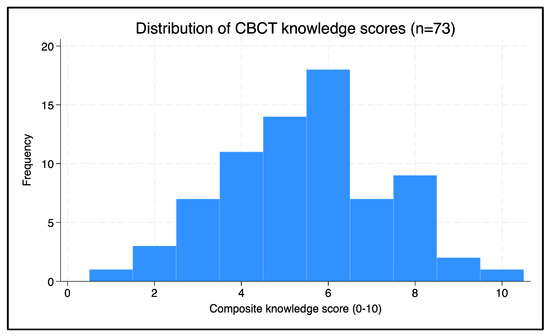
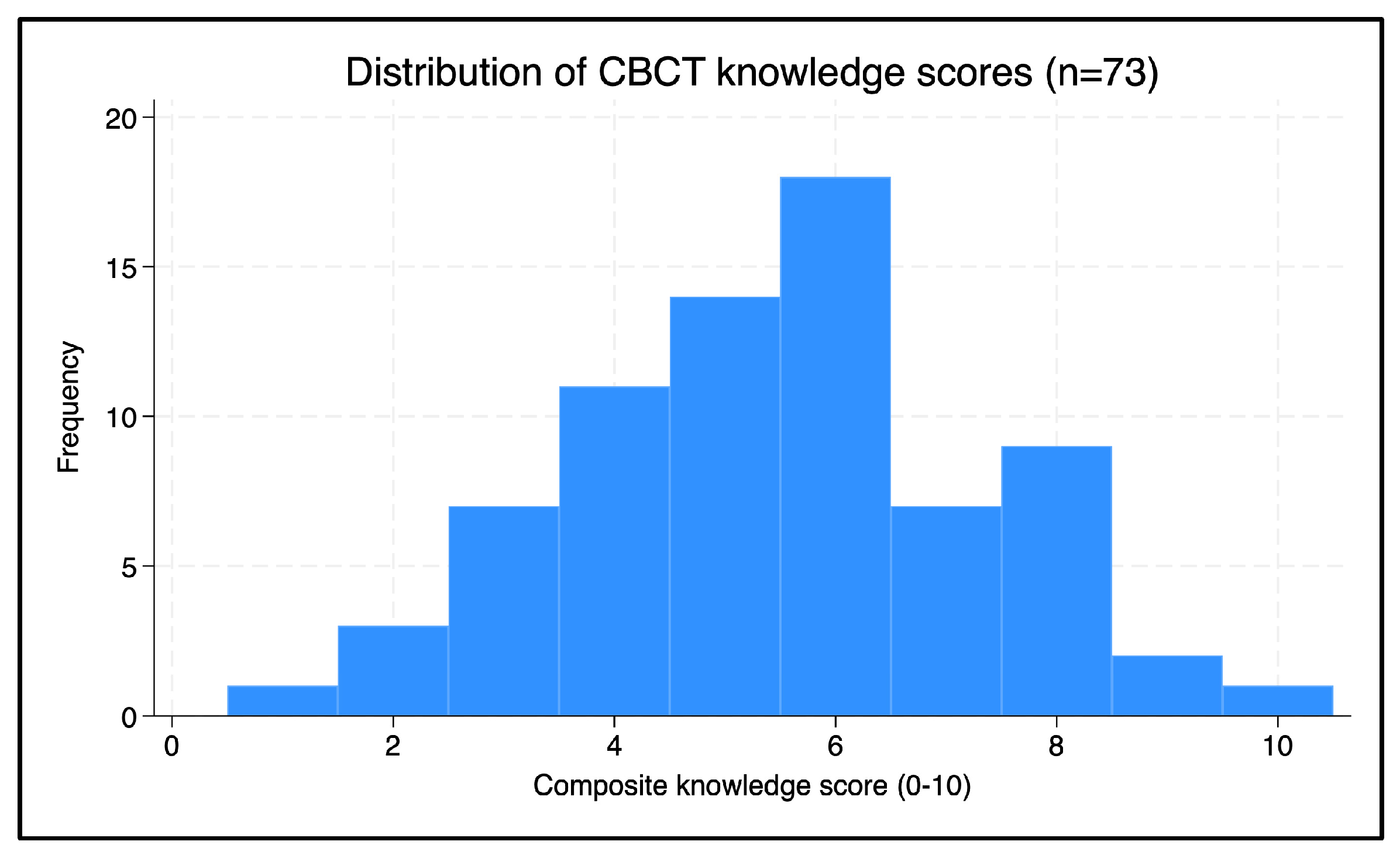
As Table 2 demonstrates, the highest item-level knowledge rate was for the caries detection item, with 60 respondents (82.2%) correctly identifying that CBCT is not indicated for routine interproximal caries screening. The majority also correctly identified the requirement for a prior 2D radiograph (59/73; 80.8%), whereas the paediatric justification requirement was answered correctly by only 43 respondents (58.9%). FOV selection knowledge was substantially lower, with a correct rate of 43.8% for the general single-implant question and ranging from 27.4% to 68.5% across the four clinical vignettes. Radiation dose awareness was also limited, with only 45.2% and 49.3% of respondents providing correct estimates for the CBCT dose relative to a full-mouth periapical survey and a panoramic radiograph, respectively. The overall composite knowledge score was 5.47/10 (standard deviation [SD] = 1.86; median = 6; interquartile range = 4–7), with 50.7% (37/73) achieving a satisfactory score (≥6/10). The distribution of composite scores is shown in Figure 1, and a Shapiro–Wilk test indicated no significant deviation from normality (W = 0.997, p > 0.99), supporting the use of parametric tests. Internal consistency was modest (Cronbach’s alpha = 0.63; Table 2).
Figure 1.
Distribution of composite CBCT knowledge scores among the 73 respondents (range 1–10; mean 5.47, SD 1.86; median 6, IQR 4–7). The approximately symmetric distribution supported the use of parametric tests.
3.3. FOV Selection Across Clinical Vignettes
The vignette-level results are presented in Table 3. Correct FOV selection ranged from 27.4% to 68.5% across the standardised vignettes. The most consistent error observed was selecting an unnecessarily large FOV. The lowest correct rate was recorded for the lower-left first-molar implant vignette (27.4%), while in the six-unit anterior implant bridge scenario, 63.0% of the respondents selected a larger-than-indicated FOV.
3.4. Awareness of CBCT and Radiation Protection Guidelines
Awareness of the guidelines was critically low, with 65.8% of respondents completely unaware of SEDENTEX CT 2012 and only 9.6% having read it (Table 4). Similarly, 54.8% were unaware that the ADA publishes radiation guidelines, and only 8.2% had read the 2024 update.
Table 4.
Awareness of SEDENTEX CT 2012 and ADA 2024 dental radiation safety guidelines (n = 73).
3.5. Perceived Barriers to Appropriate CBCT Prescribing
The most frequently cited barrier was a lack of formal training (43.8%), followed by dose unawareness (32.9%) and the absence of a supervising oral and maxillofacial radiologist (OMFR) or reporting service (30.1%) (Table 5). Additionally, eight respondents (11.0%) reported no significant barriers (Table 5).
Table 5.
Perceived barriers to appropriate CBCT prescribing (n = 73; up to two responses permitted).
3.6. Factors Associated with CBCT Knowledge Scores
Knowledge scores were compared across four practitioner groups—namely, dental interns (n = 13), dental residents (n = 4), general dental practitioners (n = 33), and dental specialists (n = 23; including Saudi Board-certified practitioners, diploma and fellowship holders, and MSc graduates)—using a one-way ANOVA. Mean knowledge scores were 5.31 ± 1.55 for interns, 6.50 ± 1.29 for residents, 5.30 ± 1.88 for general practitioners, and 5.61 ± 2.10 for specialists. The overall between-group difference was not statistically significant (F [3, 69] = 0.56; p = 0.643). These between-group comparisons must be interpreted with caution, as several groups were small, particularly dental residents (n = 4), which limits the reliability and statistical power of the analysis. The post hoc comparisons confirmed no significant pairwise differences (all p > 0.05). No clear performance gradient across practitioner categories was observed, and the small sizes of some groups (notably residents, n = 4) limit the reliability of these comparisons (Table 6).
Table 6.
Comparison of composite CBCT knowledge scores across practitioner groups (one-way ANOVA, n = 73).
Our findings reflect that an exploratory multiple linear regression model did not identify any statistically significant independent predictor of the composite knowledge score. Formal CBCT training was associated with a small, non-significant increase in score (B = 0.585; 95% CI [−0.27, 1.44]; p = 0.175), corresponding to approximately 0.6 of a point higher among trained respondents after adjusting for speciality, experience, and workplace CBCT access. Descriptively, mean knowledge scores were higher among respondents who reported any CBCT training (5.80 ± 1.69, n = 35) than among those with no training (5.16 ± 1.98, n = 38), although this unadjusted difference was not statistically significant (p = 0.143). The model accounted for only a modest, non-significant proportion of variance in knowledge (R2 = 0.107; adjusted R2 = 0.055; F = 2.05; p = 0.098), and no single predictor reached statistical significance (Table 7).
Table 7.
Multiple linear regression: predictors of CBCT knowledge score (n = 73).
Among the 35 respondents who had received CBCT training, 27 (77.1%) correctly identified the requirement for a prior 2D radiograph, compared to 32/38 (84.2%) of those without training (χ2 = 0.59, p = 0.444). Adherence to the requirement for a prior 2D radiograph was therefore similar regardless of training.
4. Discussion
This study provides the first assessment of CBCT-prescribing knowledge and awareness of guidelines among dental practitioners in Abha, within the Asir region. Notably, our findings revealed that the knowledge of core principles was moderate but suboptimal, with nearly half of the respondents (49.3%) scoring below the satisfactory threshold, while significant deficiencies were observed in FOV selection and guideline awareness. Although some form of CBCT training was reported by 35 of the participants (47.9%), no factor, including training, was a statistically significant independent predictor of composite knowledge scores in the exploratory multivariable model.
Regarding the knowledge of CBCT justification criteria, the correct response rates of 80.8% for the requirement of a prior 2D radiograph and 82.2% for caries detection indicate a reasonable baseline understanding of core prescribing principles. These findings are broadly comparable to those of the 2025 Russian KAP survey, in which 85% of 388 dentists demonstrated fair-to-poor CBCT knowledge [9], and a Sudanese Chinese study where more than 200 of the 294 participants scored below 50% [18]. The relatively stronger baseline performance observed in this cohort may reflect the high concentration of academic practitioners affiliated with KKU Dental Hospital (37.0%).
However, only 58.9% correctly answered the paediatric justification item, indicating that more than four in ten practitioners failed to integrate the age-specific radiation risk requirements mandated by both SEDENTEX CT and ADA guidelines. In this regard, several comparable international studies have documented similar systemic deficits in paediatric CBCT knowledge [10,11].
Radiation dose awareness was the weakest performance dimension overall, as only 54.8% and 61.6% of respondents could estimate the CBCT dose relative to a full-mouth periapical survey and a panoramic radiograph, respectively. This diagnostic blind spot has been widely reported worldwide, with similar studies confirming that dosimetry awareness remains poor among non-radiologist clinician cohorts [10,19]. Clinicians who do not clearly understand relative radiation dose levels may struggle to properly explain the associated radiation risk to patients during the informed consent process, a practice strongly recommended by the SEDENTEX CT guidelines. In relation to clinical application, FOV selection represents the most practically significant deficiency identified in this study. The correct selection rates ranged from 27.4% to 68.5% across the four vignettes, dropping to 37.0% for the six-unit anterior implant bridge. In this situation, 67.1% of respondents have selected a large FOV covering the full arch or both jaws rather than the guideline-recommended medium FOV confined to the upper anterior arch. This clinical tendency to select the largest available or machine-default FOV has been consistently documented in international literature. While the 2025 EADMFR European survey noted that FOV selection was the parameter most frequently modified by clinicians, it still revealed significant unindicated variability for identical clinical scenarios [11]. In addition, a Singapore-based study reported that registered dentists similarly documented gaps in CBCT training and practice, with fewer than half (46.6%) having received formal CBCT training [20]. Selecting a full-jaw FOV when a site-specific small volume is diagnostically sufficient exposes the patient to an unnecessary radiation burden and irradiates healthy tissues outside the region of interest, which has important therapeutic implications. To mitigate this, the core SEDENTEXCT principles explicitly state that the dimensions of the selected volume must not exceed the definitive diagnostic region of interest [21].
There is a structural deficiency in the awareness of guidelines; many practitioners prescribe CBCT without being aware of the frameworks governing its appropriate use, as demonstrated by the findings that 65.8% were completely unaware of SEDENTEXCT and 54.8% were unaware that the ADA provides radiation guidelines. Undergraduate curricula have not regularly included CBCT radiation governance training, according to the EADMFR position document [21], and the current study extends this observation to a previously unstudied regional context in Saudi Arabia.
The low awareness of SFDA’s and NRRC’s roles (with 20.5% unable to identify either body) reflects a broader pattern of incomplete guideline adherence documented in other areas of Saudi dental practice, such as antibiotic prescribing [22,23]. Addressing this requires active dissemination from the SFDA and NRRC directly targeting dental facilities.
In the exploratory regression analysis, no factor was a statistically significant independent predictor of the knowledge score. Formal CBCT training showed a small, non-significant association (B = 0.585; p = 0.175), with trained practitioners scoring approximately 0.6 of a point higher on average. It is crucial to make a distinction between statistical and clinical relevance at this point. Even if the difference had been statistically significant, a difference of about 0.6 on a 10-point scale would be clinically minor; it is unlikely that such a small difference would equate to substantial changes in prescribing behaviour or patient safety. This further emphasizes the notion that these observed knowledge gaps exist systematically and are not primarily attributable to training status.
Although this direction is consistent with international evidence that structured training supports CBCT knowledge, the present sample did not provide statistical support for training as a determinant of knowledge. Comparable knowledge deficits have likewise been documented among dental practitioners elsewhere in the Middle East and the wider Gulf region, including Saudi Arabia and Jordan, suggesting that the gaps observed here reflect a broader regional pattern rather than a purely local phenomenon [9,18,24].
The overall model was not statistically significant (p = 0.098, R2 = 0.107), and practitioner category did not significantly predict knowledge scores (F [3, 69] = 0.56; p = 0.643), possibly reflecting limited sample size and power rather than true equivalence. These findings indicate that knowledge gaps were widespread and were not explained by qualification level, specialty, years of experience, CBCT access, or reported training in this preliminary sample, suggesting that the deficits are systemic rather than attributable to any single factor and should be confirmed in larger studies.
The barrier findings reinforce the perspective that improving training and specialist support is important for change. The lack of formal training (43.8%), dose unawareness (32.9%), and absence of a supervising OMFR or reporting service (30.1%) were the top three perceived barriers. In this regard, SEDENTEXCT clearly recommends specialist evaluation of all CBCT images [5]. Even so, 28.8% of respondents reported no formal radiological interpretation of their CBCT scans, which is consistent with the EADMFR finding that the absence of specialist oversight is associated with larger FOV selections [11].
The integration of CBCT justification principles into undergraduate radiology education, rather than limiting them to postgraduate competency, is essential to address practitioners with limited direct prescribing exposure.
This study also had certain limitations. First, the convenience sampling limits the generalisability of the findings. The sample size of 73 limits regression power, and the non-significant model (p = 0.098) indicates that the findings should be interpreted as hypothesis-generating. Therefore, replication in a larger, randomly selected cohort is necessary. Another drawback is self-report bias. Consequently, the interpretation of the results should be carried out cautiously. Furthermore, the convenience snowball sampling approach could introduce selection bias, as a high proportion of practitioners associated with dental hospitals and universities (37.0%) who also had an interest in radiation safety may be over-represented. This could result in an inflated estimate of the level of knowledge in this sample compared with the larger group of all practitioners within the Asir region. Additionally, the model was able to explain very little of the variance for knowledge test scores (R2 = 0.107). Therefore, it can be inferred that the variability in knowledge results is due to unmeasured or unknown variables, meaning it should be considered an exploratory model.
Social desirability may exaggerate knowledge assessments, especially for dose-awareness tasks. Practitioners in the Asir region’s more rural areas may not be represented in Abha’s metropolitan academic context. Moreover, a longitudinal or interventional design is required to confirm the causal influence of training on CBCT-prescribing behaviour because the study is cross-sectional and cannot demonstrate causative links. In addition, the failure to reach the planned sample size compromises the precision of the estimates and reduces the statistical power to detect associations. A further limitation concerns instrument validation: internal consistency of the composite knowledge score was modest (Cronbach’s alpha = 0.63), but a formal quantitative content validity assessment (I-CVI and S-CVI/Ave) and a separate test–retest reliability study (intraclass correlation coefficient) was not conducted. Full psychometric validation of the questionnaire is therefore recommended in future studies.
5. Conclusions
This preliminary survey indicates that dental practitioners in Abha City demonstrated moderate but suboptimal CBCT-related knowledge, with suboptimal FOV selection and limited guideline awareness. Although under half of respondents (47.9%) reported some form of CBCT training, important knowledge gaps persisted, and no factor, including formal CBCT training, emerged as a statistically significant independent predictor of knowledge scores in this preliminary cross-sectional sample; the observed gaps therefore appear systemic rather than attributable to any single factor. These findings highlight the need to explore, in larger and more representative studies, structured CBCT justification training, curricular reform, continuing professional development, guideline implementation, and regulatory communication as potential strategies to improve patient safety.
Author Contributions
Writing—original draft, S.A.; writing—review and editing and supervision, H.A.A.; Formal analysis and data curation, A.H.A.A.; Methodology and project administration, A.A.A.; Conceptualization, H.S.A.-s.; Formal analysis, validation and visualization, E.A.; Data curation and formal analysis, H.M.A.; Methodology and resources, M.S.H.; Conceptualization and writing and reviewing the original draft, A.A.D. All authors have read and agreed to the published version of the manuscript.
Funding
The authors extend their appreciation to the Deanship of Research and Graduate Studies at King Khalid University for funding this work through the Large Research Groups Program under grant number (RGP2/494/47).
Institutional Review Board Statement
Ethical approval was obtained from the Research Ethics Committee at King Khalid University with the approval number (KKU-94-2026-15) on 9 April 2026. Since this is an anonymous online questionnaire distributed as a Google Form, written signed consent was not required; informed consent was obtained electronically. A participant information statement was presented to all participants before questionnaire access was granted; proceeding with the questionnaire constituted implied consent. No personal identifiers were collected.
Informed Consent Statement
A Participant Information Statement was presented to all participants before questionnaire access was granted; proceeding with the questionnaire constituted implied consent.
Data Availability Statement
The data of the study are included in the article. Further inquiries can be directed to the corresponding author.
Conflicts of Interest
The authors declare no conflicts of interest.
References
- Scarfe, W.C.; Farman, A.G. What is cone-beam CT and how does it Work? Dent. Clin. N. Am. 2008, 52, 707–730. [Google Scholar] [CrossRef] [Scilit] [PubMed]
- Pauwels, R.; Beinsberger, J.; Collaert, B.; Theodorakou, C.; Rogers, J.; Walker, A.; Cockmartin, L.; Bosmans, H.; Jacobs, R.; Bogaerts, R.; et al. Effective dose range for dental cone beam computed tomography scanners. Eur. J. Radiol. 2012, 81, 267–271. [Google Scholar] [CrossRef] [Scilit] [PubMed]
- Ludlow, J.B.; Timothy, R.; Walker, C.; Hunter, R.; Benavides, E.; Samuelson, D.B.; Scheske, M.J. Effective dose of dental CBCT: A meta analysis of published data and additional data for nine CBCT units. Dentomaxillofac. Radiol. 2015, 44, 20140197. [Google Scholar] [CrossRef] [Scilit]
- Pereira, R.; Sabri, H.; Pereira, P.; Wang, H.L. Associated risks with periodontal x-rays or CBCT scans: Are there any? Clin. Adv. Periodontics 2024, 14, 121–126. [Google Scholar] [PubMed]
- Publications Office of the European Union. European Commission. Protection Radiation No 172 Cone Beam CT for Dental and Maxillofacial RadiologyEvidence-Based Guidelines (SEDENTEXCT); Publications Office of the European Union: Luxembourg, 2012.
- Benavides, E.; Krecioch, J.R.; Connolly, R.T.; Allareddy, T.; Buchanan, A.; Spelic, D.; O’Brien, K.K.; Keels, M.A.; Mascarenhas, A.K.; Duong, M.-L.; et al. Optimizing radiation safety in dentistry: Clinical recommendations and regulatory considerations. J. Am. Dent. Assoc. 2024, 155, 280–293.e4. [Google Scholar] [CrossRef] [Scilit] [PubMed]
- De Felice, F.; Di Carlo, G.; Saccucci, M.; Tombolini, V.; Polimeni, A. Dental cone beam computed tomography in children: Clinical effectiveness and cancer risk due to radiation exposure. Oncology 2019, 96, 173–178. [Google Scholar] [CrossRef] [Scilit] [PubMed]
- Stratis, A.; Zhang, G.; Jacobs, R.; Bogaerts, R.; Bosmans, H. The growing concern of radiation dose in paediatric dental and maxillofacial CBCT: An easy guide for daily practice. Eur. Radiol. 2019, 29, 7009–7018. [Google Scholar] [CrossRef] [Scilit] [PubMed]
- Uvarichev, M.; Sherstneva, V.; Mikheikina, A.; Polyakova, M.; Zaytsev, A.; Doroshina, V.; Sokhova, I.; Babina, K.; Novozhilova, N. CBCT: Knowledge, attitude, and practice among dentists. BMC Oral Health 2025, 25, 1540. [Google Scholar] [CrossRef] [Scilit] [PubMed]
- Coşkun Albayrak, S.; Özdemir, Ö.S. Awareness of cone beam computed tomography (CBCT) use and radiation safety among dentists and specialists. BMC Oral Health 2025, 25, 1436. [Google Scholar] [CrossRef] [Scilit] [PubMed]
- Fakhtei, S.; Hoogeveen, R.; Berkhout, E. Dose optimization in CBCT in dentistry: A survey among EADMFR members. Dentomaxillofac. Radiol. 2026, 55, 43–51. [Google Scholar] [PubMed]
- Kesmodel, U.S. Cross-sectional studies: What are they good for? Acta Obstet. Gynecol. Scand. 2018, 97, 388–393. [Google Scholar] [CrossRef] [Scilit] [PubMed]
- von Elm, E.; Altman, D.G.; Egger, M.; Pocock, S.J.; Gøtzsche, P.C.; Vandenbroucke, J.P. The Strengthening the Reporting of Observational Studies in Epidemiology (STROBE) statement: Guidelines for reporting observational studies. J. Clin. Epidemiol. 2008, 61, 344–349. [Google Scholar] [CrossRef] [Scilit] [PubMed]
- Bhardwaj, S.S.; Alghamdi, S.; Almulhim, B.; Alassaf, A.; Almalki, A.; Bhardwaj, A.; Alzunaydi, A. CBCT in pediatric dentistry: Awareness and knowledge of its correct use in Saudi Arabia. Appl. Sci. 2021, 12, 335. [Google Scholar] [CrossRef] [Scilit]
- Tavakol, M.; Dennick, R. Making sense of Cronbach’s alpha. Int. J. Med. Educ. 2011, 2, 53–55. [Google Scholar] [CrossRef] [Scilit] [PubMed]
- World Medical Association. World Medical Association declaration of Helsinki: Ethical principles for medical research involving human subjects. JAMA 2013, 310, 2191–2194. [Google Scholar] [CrossRef] [Scilit] [PubMed]
- Lwanga, S.K.; Lemeshow, S.; World Health Organization. Sample Size Determination in Health Studies: A Practical Manual; World Health Organization: Geneva, Switzerland, 1991. [Google Scholar]
- Hayder, M.; Hashim, A.; Zo, R.; Mohamed, H.A.H. Knowledge and awareness of Sudanese and Chinese dentists towards cone-beam computed tomography (CBCT). Oral Health Dent. Sci. 2024, 8, 1–13. [Google Scholar] [CrossRef] [Scilit]
- Abuelhia, E.; Alghamdi, A.; Tajaldeen, A.; Mabrouk, O.; Bakheet, A.; Alsaleem, H.; Alaraik, W.; Msmar, A.; Quwaihes, F.; Alshahrani, K.; et al. Dental undergraduates and interns’ awareness, attitudes, and perception of radiological protection. Int. J. Dent. 2022, 2022, 5812627. [Google Scholar] [CrossRef] [Scilit] [PubMed]
- Ng, A.Y.Q.; Lai, C.W.M.; Ho, C.X.H.; Lim, L.Z. Dental imaging in Singapore: A survey of 2D radiographic techniques and CBCT practices. Dentomaxillofac. Radiol. 2025, 54, 649. [Google Scholar] [CrossRef] [Scilit] [PubMed]
- Brown, J.; Jacobs, R.; Levring Jäghagen, E.; Lindh, C.; Baksi, G.; Schulze, D.; Schulze, R. Basic training requirements for the use of dental CBCT by dentists: A position paper prepared by the European Academy of DentoMaxilloFacial Radiology. Dentomaxillofac. Radiol. 2014, 43, 20130291. [Google Scholar] [CrossRef] [Scilit] [PubMed]
- Abdellatif, H.M.; Alsagob, E.I.; Hebbal, M.; Kotha, S.L.; Aldossary, M.; Pai Khot, A.J.; Varghese, A.S.; Yahya, B.; Alajlan, G.; Alshamrani, L. Adherence to the current guidelines on antibiotic prescription among dental practitioners: A national survey. PLoS ONE 2025, 20, e0320528. [Google Scholar] [CrossRef] [Scilit] [PubMed]
- Alamri, H.; Alafaleg, R.; Aloraini, R.; Aljabr, J.; Alnukhaylan, L.; Alnassar, R.; Daghriri, A. Antibiotic prescribing practices among dental practitioners in Saudi Arabia: A cross-sectional study: Antibiotic prescribing practices among dental practitioners. J. Contemp. Med. Sci. 2025, 11, 281–285. [Google Scholar] [CrossRef] [Scilit]
- Balla, V.; Bathla, S.; Regalla, R.R.; Anand, A.; Neha, K.; Agrawal, P.; Kumari, A. Knowledge, attitude and practice of endodontic radiographic techniques among dentists: A survey. Bioinformation 2025, 21, 1093. [Google Scholar] [CrossRef] [Scilit] [PubMed]

Disclaimer/Publisher’s Note: The statements, opinions and data contained in all publications are solely those of the individual author(s) and contributor(s) and not of MDPI and/or the editor(s). MDPI and/or the editor(s) disclaim responsibility for any injury to people or property resulting from any ideas, methods, instructions or products referred to in the content. |
© 2026 by the authors. Licensee MDPI, Basel, Switzerland. This article is an open access article distributed under the terms and conditions of the Creative Commons Attribution (CC BY) license.