


Featured Application
Industrial helium leak monitoring in vacuum systems, manufacturing equipment, and automated technological installations.
Abstract
High-sensitivity helium leak detection is essential for the safe and efficient operation of modern vacuum and technological systems. This work presents the development and experimental validation of the GLD10 helium leak detector based on a magnetic sector mass spectrometer for industrial leak-testing applications. The detector combines helium mass spectrometric analysis with digital control and monitoring functions, enabling automated operation and integration with industrial vacuum and monitoring systems. Experimental investigations were carried out using calibrated helium reference leaks under controlled vacuum conditions and included comparative measurements with a commercial PHOENIX Quadro helium leak detector. The developed system demonstrated stable operation over a broad range of operating conditions and achieved a practical helium leak detection limit of approximately 1 × 10⁻¹⁰ mbar·L/s. The detector exhibited a response time shorter than 1 s and was designed for operation at inlet pressures up to 15 mbar measured at the inlet port of the aluminum manifold block. Measurements performed near the detection limit demonstrated stable detector response, good repeatability, and effective discrimination between helium leak signals and background noise. Comparison with the commercial reference detector demonstrated comparable measurement performance, while stable background behavior and good signal-to-noise characteristics were observed during low-level helium leak measurements. The obtained results demonstrate that the GLD10 detector is a promising solution for high-sensitivity industrial leak detection applications requiring accurate low-level measurements, continuous operation, and compatibility with automated monitoring environments.
1. Introduction
Leak detection plays a critical role in the safe operation and monitoring of vacuum and technological systems, particularly in hydrogen-related and high-vacuum applications [1,2,3,4,5,6]. Hydrogen, owing to its low molecular weight, high diffusivity, and flammability, presents significant safety and operational challenges. Even small hydrogen leaks may rapidly disperse and accumulate to hazardous concentrations, increasing the risk of fire or explosion [7,8]. In addition, the small molecular size of hydrogen enables rapid diffusion through materials and vacuum components, making reliable leak detection more challenging than in conventional gas systems [7,8]. Leakage in technological equipment is considered a critical defect directly affecting operational reliability, energy efficiency, environmental safety, and process stability [2,5,6]. Furthermore, leaks may result in uncontrolled release of working media, leading not only to economic losses associated with reduced process efficiency but also to potential environmental and safety hazards [5,6]. For this reason, permissible leakage levels are strictly specified for many industrial and vacuum systems. Typical industrial installations require leak rates below 10−4 mbar·L/s, whereas chemical and high-vacuum systems often require significantly lower leakage levels below 10−6 mbar·L/s [5,9]. Consequently, accurate detection and localization of leaks remain important research and engineering challenges in the development of modern vacuum technology systems [1,2,3,4,5,6,10,11,12,13].
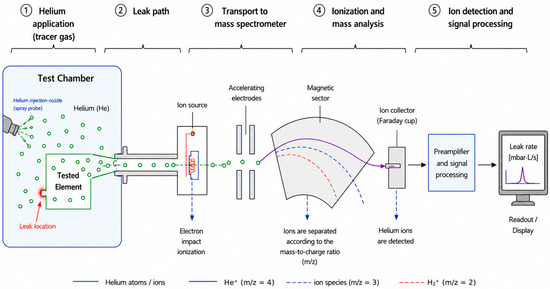
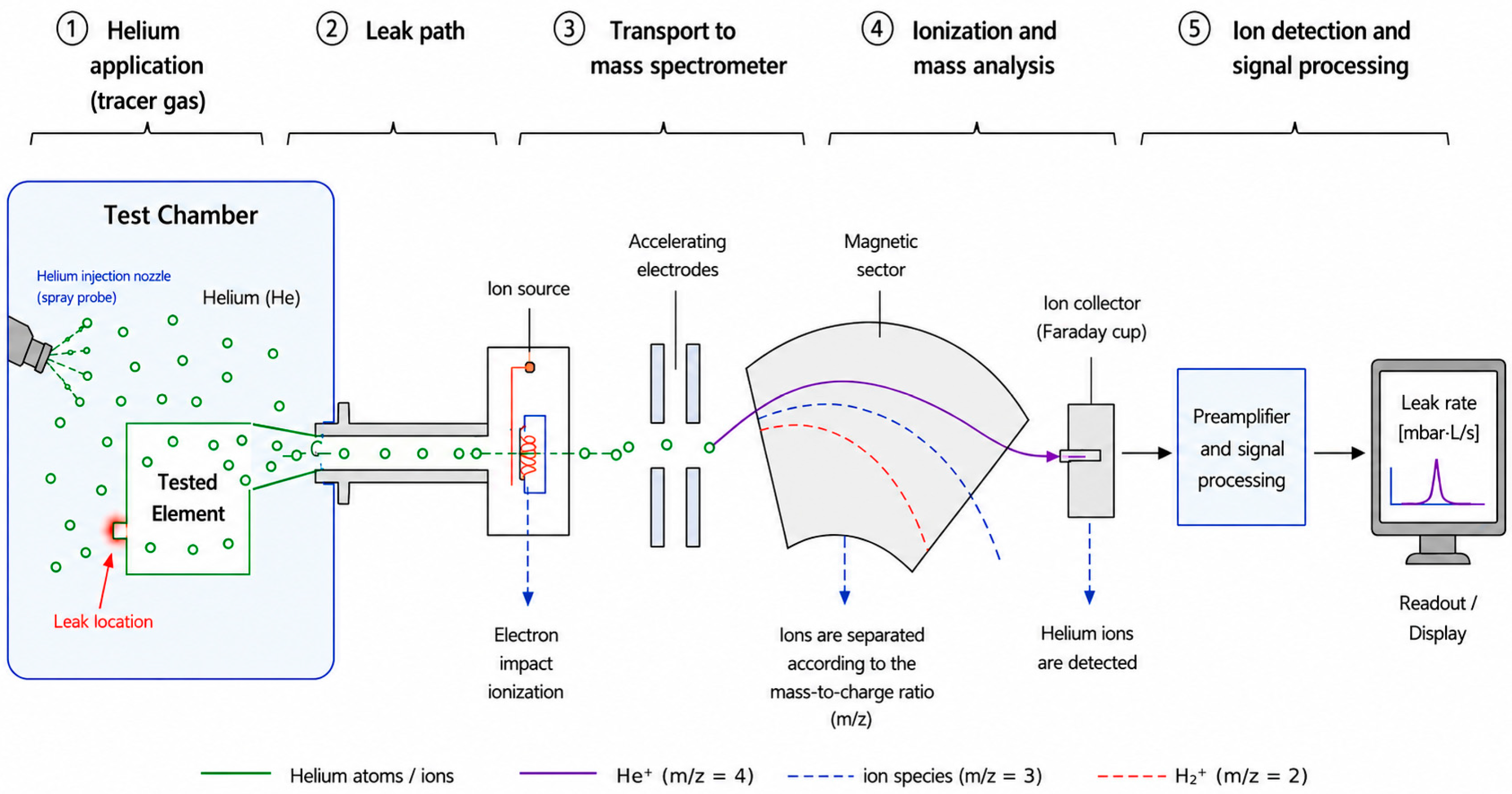
Among the available leak testing methods, helium mass spectrometry is recognized as one of the most sensitive and effective techniques for detecting very small leaks in vacuum systems and technological equipment [1,2,9,10,13,14,15,16]. Helium is commonly used as a tracer gas because of its chemical inertness, low natural concentration in the atmosphere, and favorable ionization characteristics enabling selective and highly sensitive leak measurements [9,13,14,15]. A general principle of helium leak detection using a magnetic sector mass spectrometer is presented in Figure 1.
Figure 1.
Simplified schematic illustration of helium leak detection using a magnetic sector mass spectrometer. Helium entering through a leak is ionized, separated according to the mass-to-charge ratio, and detected by the ion collection system.
In Figure 1, the trajectory labeled as m/z = 3 is shown only as a representative ion path used to illustrate the mass-separation principle of the magnetic sector analyzer. It does not correspond to the detected helium signal. In practice, ions with m/z = 3 may correspond, for example, to HD+ or 3He+, whereas helium leak detection in the developed system is based on He+ ions with m/z = 4.
In helium leak detectors, ionized helium atoms are separated according to their mass-to-charge ratio using magnetic sector analyzers, enabling selective leak detection with high sensitivity and fast response times [16,17,18,19]. Increasing interest has been observed in advanced helium leak detection systems for applications in hydrogen technologies, spacecraft propulsion systems, fusion devices, and automated semiconductor manufacturing environments [20,21,22,23,24]. Current developments in mass-spectrometry-based leak detection focus on improving detector sensitivity, signal processing, ion transport optimization, and application-specific leak-testing procedures. Advances have been reported in in situ mass-spectrometric leak detection techniques, numerical optimization of helium mass spectrometer systems, and high-sensitivity leak-testing methodologies for industrial and hydrogen-related applications [25,26]. Modern vacuum diagnostic systems increasingly employ digitally integrated control architectures, low-noise ion current acquisition systems, and automated data processing procedures to improve sensitivity, background stability, and operational reliability [11,12,20,21,22,23,24,27,28,29]. In particular, maintaining stable ion transport conditions and minimizing the influence of parasitic ion contributions remain important challenges in low-level helium leak measurements performed near the detection limit [27,28].
Current developments in industrial automation and Industry 4.0 technologies have increased the demand for compact and digitally integrated leak detection systems capable of operating in automated technological environments [30,31]. Commercial helium leak detectors currently available on the market employ similar fundamental components, including ion sources, magnetic sector analyzers, ion detectors, electronic instrumentation, and digital control systems [9,10,16,32]. However, further improvements in sensitivity, response time, signal stability, low-noise ion current acquisition, and repeatability of low-level leak measurements are still required, particularly for continuous operation in industrial vacuum systems [11,12,20,27,28,29].
In this work, a helium leak detector based on a magnetic sector mass spectrometer was designed and experimentally evaluated for industrial vacuum applications. The novelty of the developed architecture lies in the implementation of a modified ion detection path incorporating an ion-focusing lens positioned at the outlet of the magnetic sector analyzer, an ion collector equipped with an ion suppressor, and a low-noise digital ion current acquisition system. These modifications were introduced to support stable ion collection, reduce the influence of parasitic ions, and improve detector performance during low-level helium leak measurements. In addition, the detector incorporates a digital control and visualization module enabling real-time monitoring of operating parameters and integration with automated industrial environments.
Improving dynamic response characteristics, measurement repeatability, background stability, and operational reliability represented key design goals of the system. Experimental studies demonstrated a practical detection limit of approximately 1 × 10⁻¹⁰ mbar·L/s together with response times shorter than 1 s. The detector was designed for operation at inlet pressures up to 15 mbar measured at the inlet port of the aluminum manifold block. Comparative measurements performed using both the developed GLD10 detector and the commercial PHOENIX Quadro reference detector demonstrated good repeatability and stable response behavior. Both detectors exhibited stable background characteristics, with a tendency toward lower background fluctuations observed for the GLD10 configuration under the investigated operating conditions.
2. Materials and Methods
2.1. General Detector Architecture
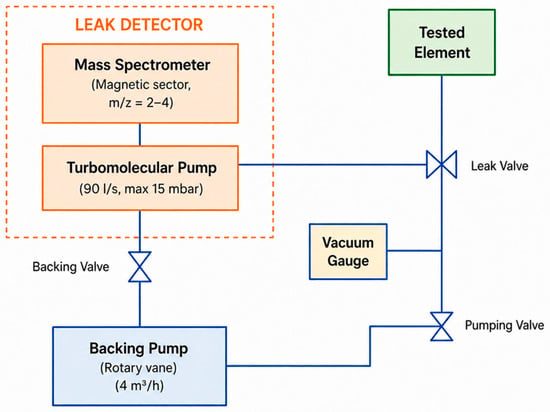
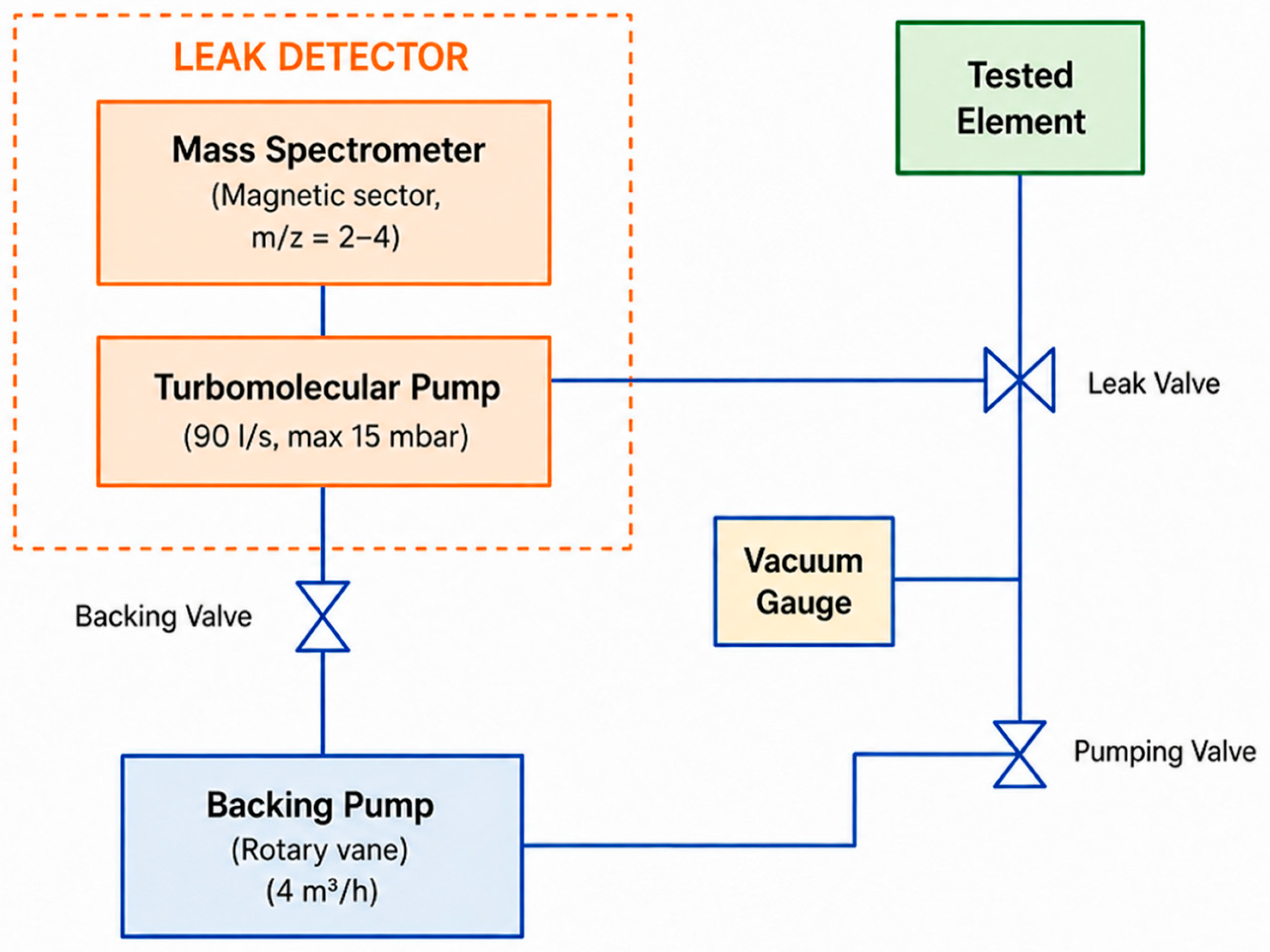
The helium leak detector developed in this work was designed as a compact measurement system intended for high-sensitivity leak-testing applications in vacuum technology and automated industrial systems [1,2,3,9]. The detector architecture was based on a magnetic sector mass spectrometer combined with a dedicated vacuum system, ion current acquisition electronics, and a digital control and visualization module. A general block diagram of the vacuum architecture of the developed detector system is presented in Figure 2.
Figure 2.
General block diagram of the vacuum architecture of the He leak detector system based on a magnetic sector mass spectrometer. The dashed orange frame indicates the leak detector module, the green block denotes the tested element, the yellow block denotes the vacuum gauge, and the blue lines indicate vacuum connections and valves.
The vacuum system consists of a turbomolecular pump, a backing pump, a leak-testing arrangement, and a vacuum monitoring subsystem. The turbomolecular pumping system enables detector operation at inlet pressures up to 15 mbar measured at the inlet port of the detector manifold. The remaining detector components, including the ion source, magnetic sector analyzer, ion detection system, signal acquisition electronics, and digital control module, are described in the following sections.
During operation, helium entering the vacuum system through a leak is ionized inside the ion source chamber [16,17]. The generated helium ions are subsequently accelerated and directed into the magnetic sector analyzer, where ion separation according to the mass-to-charge ratio takes place [17,18]. After magnetic separation, the helium ions are directed toward the ion detection region, where the ion current signal corresponding to the detected helium leak is generated.
The detected ion current is subsequently processed using a low-noise digital signal acquisition system, enabling real-time monitoring of the leak signal and operating parameters of the detector [27,28]. Stable ion transport and low-noise ion current acquisition are particularly important during measurements performed near the detection limit, where background fluctuations and parasitic ion contributions may significantly influence measurement repeatability and signal stability [25,27,28].
Special emphasis was placed on improving signal stability and reducing the influence of parasitic ions and background fluctuations during low-level helium leak measurements [20,33]. For this purpose, the detector architecture incorporates a modified ion detection path equipped with an ion suppressor and optimized ion-focusing conditions. These modifications were introduced to support stable ion collection, reduce the influence of parasitic ions, and improve detector performance during low-level helium leak measurements. The measurement system additionally incorporates a digital control and visualization module enabling real-time monitoring of vacuum conditions, operating voltages, ion current signals, and detector operating parameters. The implemented digital control architecture enables integration with automated industrial measurement environments and continuous leak-testing applications [30,31]. In addition, digital communication between the detector electronics and external monitoring systems enables operation in automated technological installations operating in accordance with Industry 4.0 requirements.
2.2. Magnetic Sector Mass Spectrometer
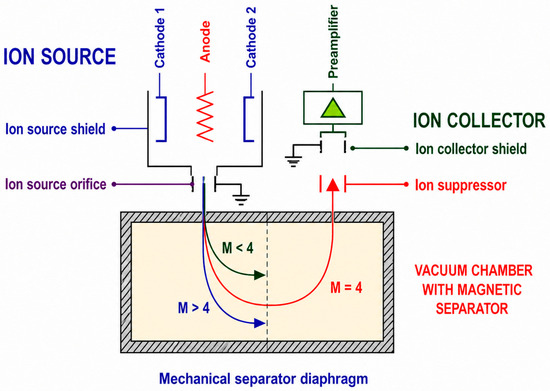
The helium leak detector utilizes a magnetic sector mass spectrometer operating as the main ion separation component of the measurement system [16,17,19]. The analyzer was designed to provide selective detection of helium ions while maintaining stable ion transport conditions during low-level leak measurements. A schematic representation of the magnetic sector analyzer together with the ion source, ion collector, and representative ion trajectories is presented in Figure 3.
Figure 3.
Magnetic sector mass spectrometer used in the helium leak detector system. The dashed/curved lines indicate schematic representative ion trajectories after magnetic separation. The red trajectory corresponds to helium ions with m/z = 4 directed toward the ion collector, whereas the blue and green trajectories illustrate ions with different mass-to-charge ratios deflected away from the collector.
During operation, helium entering the vacuum chamber is ionized inside the ion source by electron impact [16,17]. The generated positive ions are accelerated by an electric field and directed toward the magnetic sector separation region. Owing to the Lorentz force acting on moving charged particles in the magnetic field, ions follow curved trajectories dependent on their mass-to-charge ratio [16,17,18]. Under properly selected magnetic field and ion acceleration conditions, helium ions can be selectively separated from residual gas components and parasitic ion species present inside the vacuum system.
As illustrated in Figure 3, ions with different mass-to-charge ratios follow different trajectories within the magnetic sector analyzer. Helium ions (m/z = 4) are directed toward the ion collector, whereas ions with lower or higher mass-to-charge ratios are deflected toward different locations inside the analyzer chamber. A mechanical separator diaphragm positioned within the analyzer additionally assists in preventing undesired ions from reaching the collector region.
The magnetic field strength and ion acceleration parameters were selected to ensure stable ion transport conditions and reproducible ion beam focusing during detector operation [1,3,9]. Stable ion-focusing conditions inside the analyzer are particularly important for maintaining repeatable ion collection efficiency and minimizing background signal fluctuations during measurements performed near the detection limit [29,33]. To improve ion transport stability, the analyzer geometry was optimized with respect to ion beam alignment and ion trajectory reproducibility. Reducing the influence of secondary ions and scattered charged particles was considered essential, as these effects may significantly affect signal stability during low-level helium leak measurements [20,27]. Their presence can increase background noise and decrease the repeatability of ion current acquisition, particularly under very low helium concentration conditions.
The separated helium ions are subsequently directed toward the ion detection system positioned at the outlet of the magnetic sector analyzer. The resulting ion current signal is processed using dedicated low-noise signal acquisition electronics described in the following section.
2.3. Modified Ion Detection System
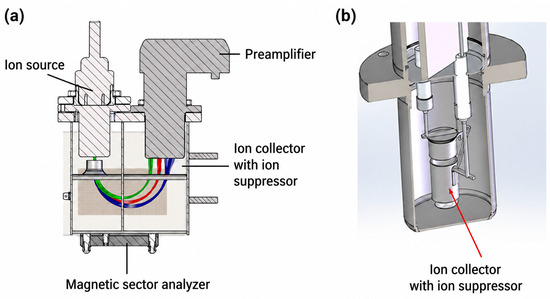
To improve the sensitivity and operational stability of the helium leak detector, a modified ion detection path was implemented at the outlet of the magnetic sector analyzer. The mechanical configuration of the ion detection system is presented in Figure 4.
Figure 4.
Mechanical design of the modified ion detection system together with representative ion trajectories originating from magnetic-sector analyzer simulations: (a) magnetic sector analyzer with ion detection path; (b) ion collector with ion suppressor. The colored curves in panel (a) indicate simulated representative ion trajectories after magnetic separation and are used to distinguish different ion paths toward or away from the ion detection region.
The modified ion detection path consists of an ion-focusing system, an ion collector, and an ion suppressor positioned near the collector region. The primary function of the suppressor electrode was to reduce the influence of secondary and parasitic ions generated inside the analyzer chamber during ion collection processes. Positioned directly in front of the ion collector, the suppressor operates as an electrostatic filtering electrode. Its applied positive potential deflects or intercepts unwanted charged particles before they reach the collector, thereby reducing their contribution to the measured ion current. Such unwanted ion contributions may significantly increase background fluctuations and reduce the stability of low-level ion current measurements [10,11,20,27].
An optimized ion-focusing configuration was additionally introduced to improve ion beam alignment and stabilize ion trajectories in the collector region. Stable ion transport conditions are particularly important during measurements performed near the detection limit, where even small ion current fluctuations may significantly influence measurement repeatability and achievable detection sensitivity [27,28]. The ion-focusing system and the suppressor electrode were implemented as complementary elements of the modified ion detection path. Their combined action was intended to support stable ion transport and reduce the influence of parasitic charged particles and secondary ion contributions during ion collection.
During helium measurements, the ion source was operated with a helium ionization anode potential of 460 V, a base potential of 320 V, an emission current of 4 mA, and a filament current ranging from 2.5 to 4.0 A. In this configuration, the base potential refers to the ion-source base potential, i.e., the cathode potential used as the reference operating potential of the ion source assembly. The electron-impact ionization conditions are determined by the potential configuration between the cathode/ion-source base and the ionization anode. The suppressor electrode was operated at approximately 300 V. The suppressor voltage was adjusted during spectrometer tuning and calibration to optimize background suppression and signal stability and remained fixed during normal detector operation.
The colored trajectories shown in Figure 4 originate from ion-transport simulations performed during the design and optimization of the modified ion detection region. The trajectory reaching the ion collector corresponds to helium ions, He+ (m/z = 4), and is identified as the path directed toward the ion collector. The remaining trajectories represent ions with different mass-to-charge ratios and are used only to illustrate the mass-separation concept of the magnetic-sector analyzer. Therefore, the trajectories are shown as representative ion paths rather than as a detailed quantitative analysis of ion masses or energies.
These simulated ion trajectories are intended to illustrate the expected ion-transport behavior within the modified ion detection region. The statement regarding stable detector response and low-noise ion-current acquisition is based on the overall detector design and experimental performance, including the ion-focusing system, suppressor electrode, and low-noise acquisition electronics, rather than on this figure alone.
2.4. Signal Acquisition and Digital Control System
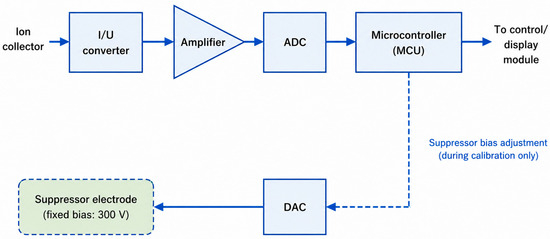
Accurate measurement of low-level ion currents requires highly stable and low-noise signal acquisition electronics. For this reason, a dedicated digital signal processing system was implemented as an integral part of the developed helium leak detector. The configuration of the ion current signal acquisition and digital control path is presented in Figure 5.
Figure 5.
Block diagram of the ion current acquisition system and suppressor-control architecture used in the developed helium leak detector. Blue arrows indicate the signal and control connections, while dashed blue arrows represent the suppressor-bias adjustment path used only during calibration. The dashed green box denotes the suppressor electrode operated at a fixed bias voltage.
The ion current generated at the collector output was converted into a voltage signal using a low-noise preamplifier positioned close to the ion detection region in order to minimize electromagnetic interference and signal distortion. Subsequent signal conditioning and digital processing enabled stable acquisition of ion current signals corresponding to very low helium leak rates. The applied low-noise signal acquisition configuration was particularly important during measurements performed near the detection limit, where even small background fluctuations may significantly influence signal stability and measurement repeatability [27,28].
The modified ion detection system additionally incorporates a suppressor electrode designed to reduce the contribution of low-energy parasitic ions and secondary charged particles reaching the ion collector. During normal detector operation, the suppressor electrode is biased at a fixed voltage of 300 V. The suppressor voltage is adjusted only during spectrometer calibration and tuning to optimize signal stability and background suppression. No active feedback control of the suppressor voltage is applied during measurements.
Minimizing background noise and improving signal stability during detector operation were among the key objectives of the signal acquisition design. Therefore, low-noise electronic components and digital filtering procedures were applied to reduce signal fluctuations associated with parasitic electromagnetic disturbances and ion current instability [20,27,28]. The applied signal conditioning procedures further improved the stability of low-level ion current acquisition during cyclic helium leak measurements. The digital processing system additionally enabled dynamic adjustment of measurement ranges and real-time monitoring of detector operating parameters. Automatic signal scaling and digital compensation procedures improved measurement repeatability and stabilized detector response during cyclic leak measurements performed under varying operating conditions. A digital control and visualization interface was additionally implemented for monitoring vacuum conditions, operating voltages, detector status, and measured leak rate values. Real-time visualization of operating parameters enabled continuous supervision of detector operation and facilitated integration of the system with automated industrial measurement environments.
The developed control architecture additionally enabled digital communication between the detector electronics and external monitoring systems. Such functionality is particularly important in automated technological installations and Industry 4.0 environments, where continuous process supervision, digital data acquisition, and automated monitoring procedures are required [30,31]. The integrated digital communication and control functions facilitate reliable detector operation during cyclic leak-testing procedures and support integration with industrial monitoring and automation systems.
2.5. Digital Control and Visualization Interface
A dedicated digital control and visualization interface was developed to provide real-time monitoring and control of helium leak detector operating parameters. The interface integrates measurement visualization, detector control functions, and operating parameter supervision within a unified digital environment. Continuous observation of the measured leak rate, vacuum pressure, detector status, and selected measurement modes was achieved through the control architecture. Real-time presentation of measurement data improved operational supervision and facilitated rapid interpretation of detector response during leak-testing procedures. In addition, the visualization environment supported continuous assessment of signal stability and detector operating conditions during cyclic measurements.
Digital control of selected operating parameters, including signal acquisition settings, measurement range adjustment, and suppressor-bias configuration during calibration, was additionally implemented. Integration of digital control procedures with the signal processing system improved measurement repeatability and stabilized detector operation during cyclic leak measurements performed under varying operating conditions. Automatic control of selected detector functions additionally enabled more stable operation during low-level helium leak measurements performed near the detection limit.
Operational reliability and usability in automated technological environments were considered important design objectives. Accordingly, the interface was designed to support continuous operation, automated measurement procedures, and rapid monitoring of detector response under varying operating conditions. In addition, the control architecture enabled digital supervision of detector operating parameters and facilitated integration with automated industrial leak-testing procedures.
Communication with external industrial monitoring and automation systems was also integrated into the visualization platform. Such functionality is particularly important for Industry 4.0 applications requiring continuous process supervision, digital data acquisition, and compatibility with automated technological installations [30,31]. The communication framework provided stable communication between the detector electronics and external industrial control systems operating in automated environments. The integrated communication and control functions further facilitate incorporation of the detector into industrial automation systems supporting digitally connected and automated manufacturing environments.
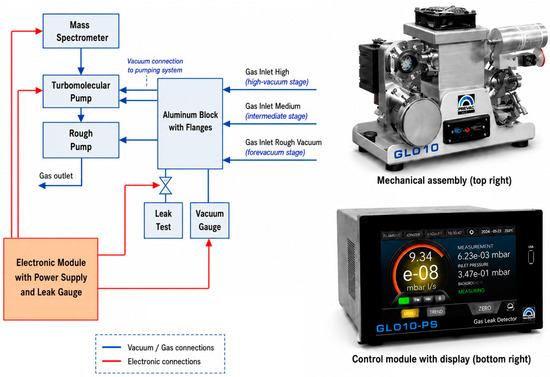
The High Vacuum, Medium Vacuum, and Rough Vacuum inlet ports are connected to different compression stages of the turbomolecular pumping system, enabling operation over a broad range of inlet pressures while maintaining measurement sensitivity. Figure 6 presents the complete helium leak detector system together with the digital control module.
Figure 6.
Complete He leak detector system based on a magnetic sector mass spectrometer, including the system block diagram (left), mechanical assembly (top right), and digital control module (bottom right).
3. Results and Discussion
3.1. Leak Detection Performance
The performance of the developed helium leak detector was evaluated under controlled laboratory conditions using calibrated helium reference leaks and dedicated vacuum test systems. The investigations focused on determination of the minimum detectable leak rate, response time, operating pressure range, and signal stability during repeated leak measurements.
Stable detector operation was achieved for inlet pressures below 15 mbar, enabling accurate leak measurements under industrial conditions. The inlet pressure was measured at the aluminum manifold block using the integrated vacuum gauge connected directly to the detector inlet assembly. Helium was used as a tracer gas owing to its low atomic mass, chemical inertness, and favorable ionization characteristics in magnetic sector mass spectrometers [1,14,15]. The practical detection limit of the developed measurement system was approximately 1 × 10⁻¹⁰ mbar·L/s. The achieved sensitivity is consistent with the overall detector architecture, including the modified ion detection path, optimized ion-focusing conditions, and the low-noise digital ion current acquisition system.
Response times shorter than 1 s were observed following rapid helium introduction into the measurement chamber. Such rapid response is particularly important in automated leak-testing systems requiring fast leak localization and reliable operation under varying operating conditions. The response behavior observed during repeated measurements further confirmed stable detector operation and reproducible signal acquisition.
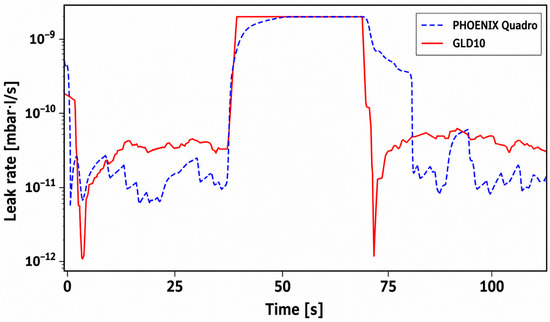
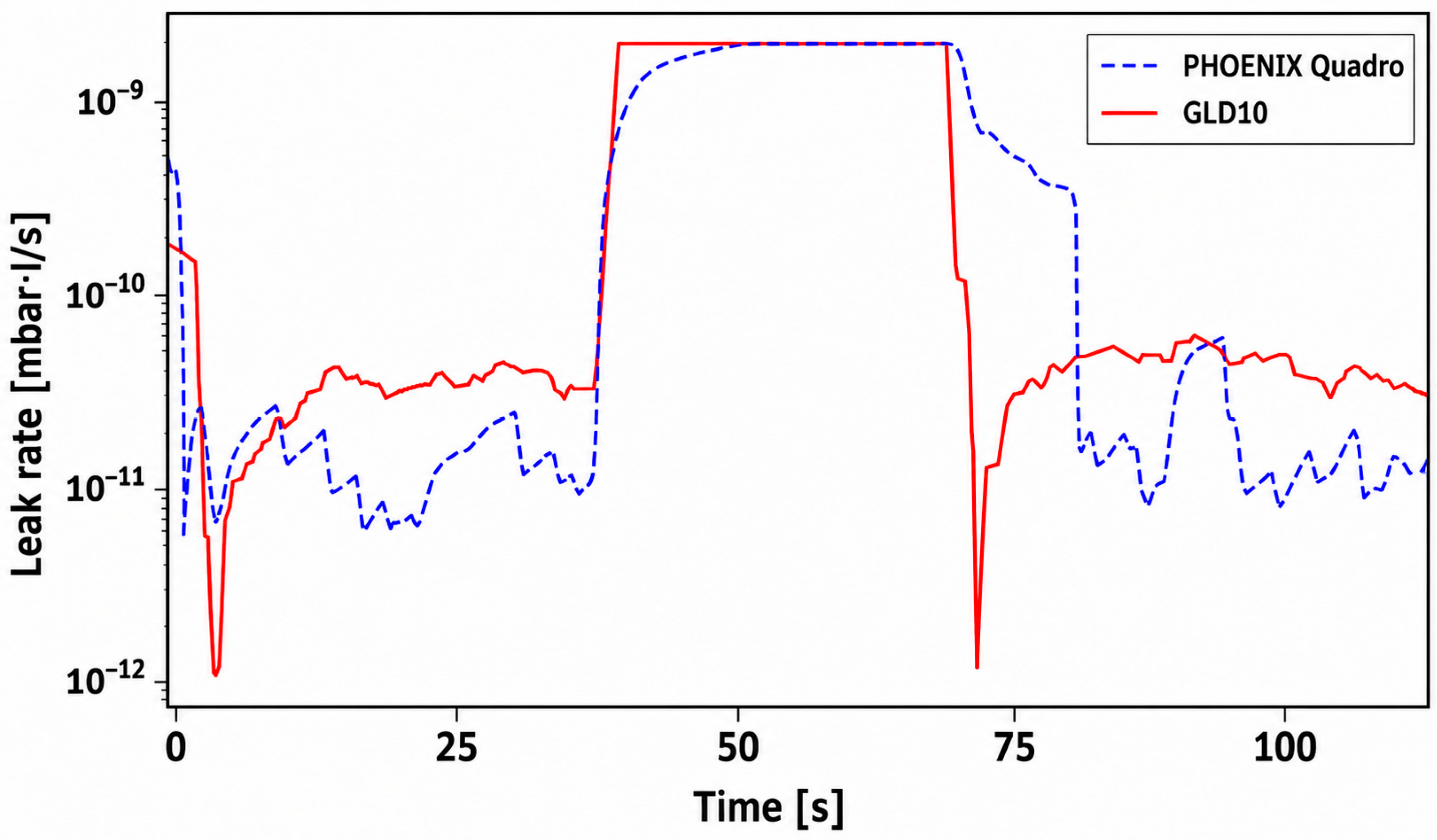
The modified ion detection path was designed to reduce the influence of parasitic ions and background disturbances during ion collection. Stable signal acquisition and low measurement noise were observed during low-level helium leak measurements. Reduced background disturbances additionally contributed to favorable signal-to-noise characteristics. Improved ion transport conditions also supported repeatable ion current acquisition during detector operation. Dynamic response and recovery characteristics of the detector during a single helium exposure and recovery measurement are presented in Figure 7.
Figure 7.
Comparison of the dynamic response and recovery behavior of the developed GLD10 helium leak detector (red solid line) and the commercial PHOENIX Quadro detector (blue dashed line) during a single helium exposure–recovery experiment performed at a leak rate of approximately 1 × 10⁻⁸ mbar·L/s.
A repeatable detector response together with rapid signal recovery following termination of helium exposure was observed during repeated measurements. The nearly rectangular response profile obtained during the response–recovery experiment is consistent with stable detector operation and effective ion current acquisition within the magnetic sector analyzer. Stable baseline behavior was observed between successive measurements, indicating good signal stability and low background noise under the investigated operating conditions.
The developed detector system exhibited stable response characteristics during repeated low-level helium leak measurements. Stable baseline characteristics enabled effective discrimination between helium leak signals and residual background noise during operation near the detection limit. Such behavior is particularly important in industrial vacuum applications requiring continuous monitoring and repeatable detector response under varying measurement conditions. These results demonstrate the suitability of the GLD10 detector for high-sensitivity helium leak measurements in industrial vacuum systems.
3.2. Performance Evaluation Against a Commercial Leak Detector
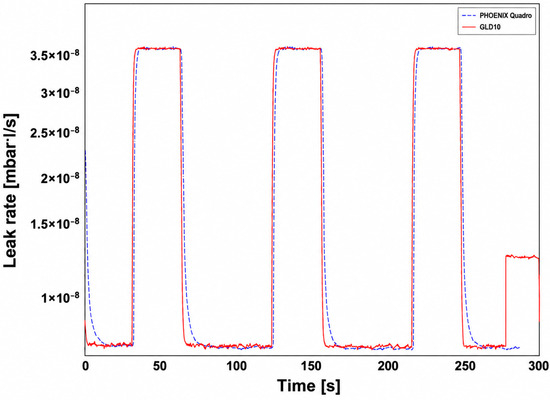
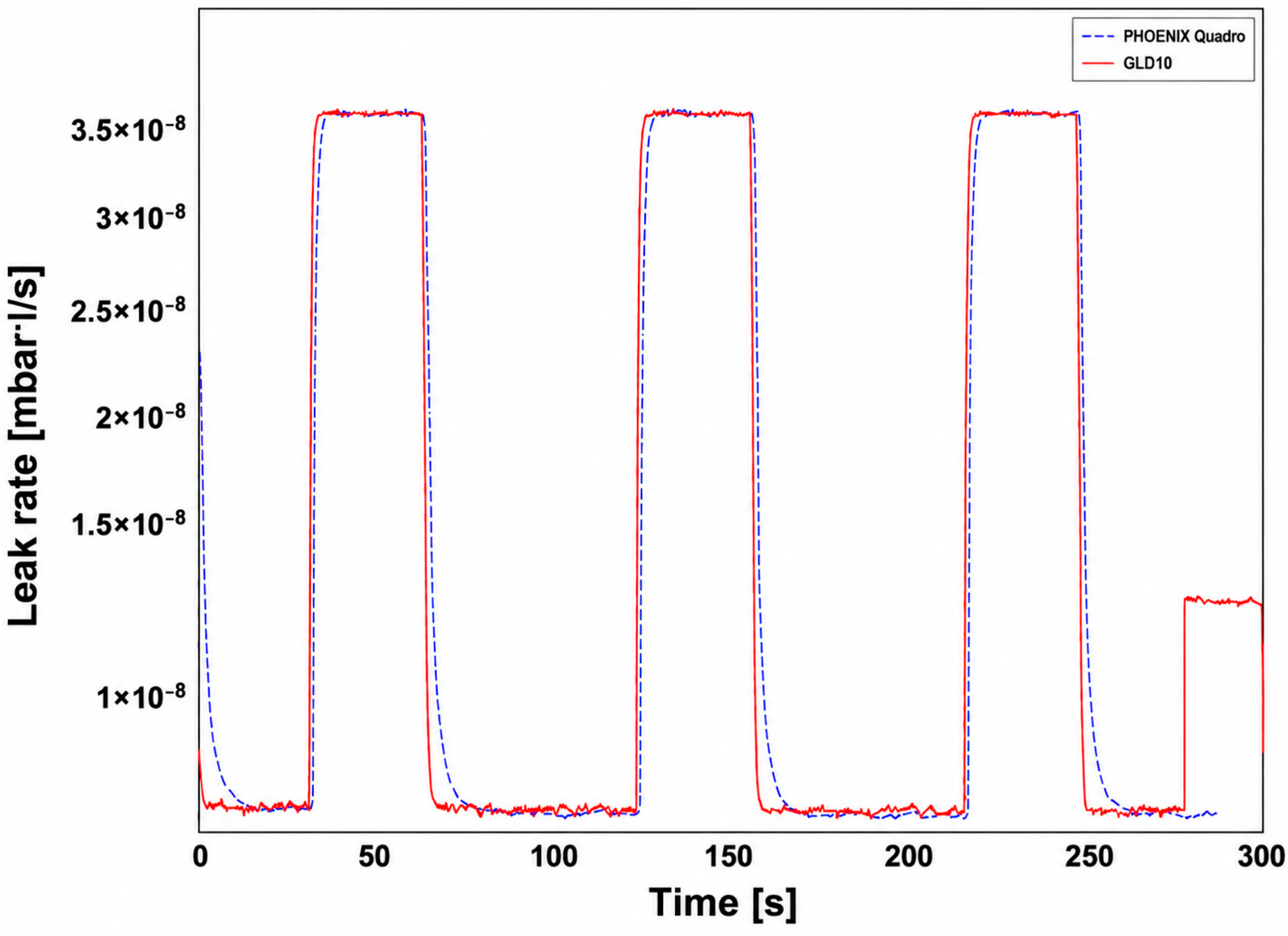
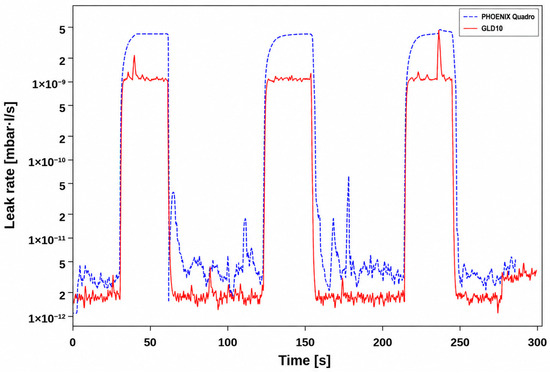
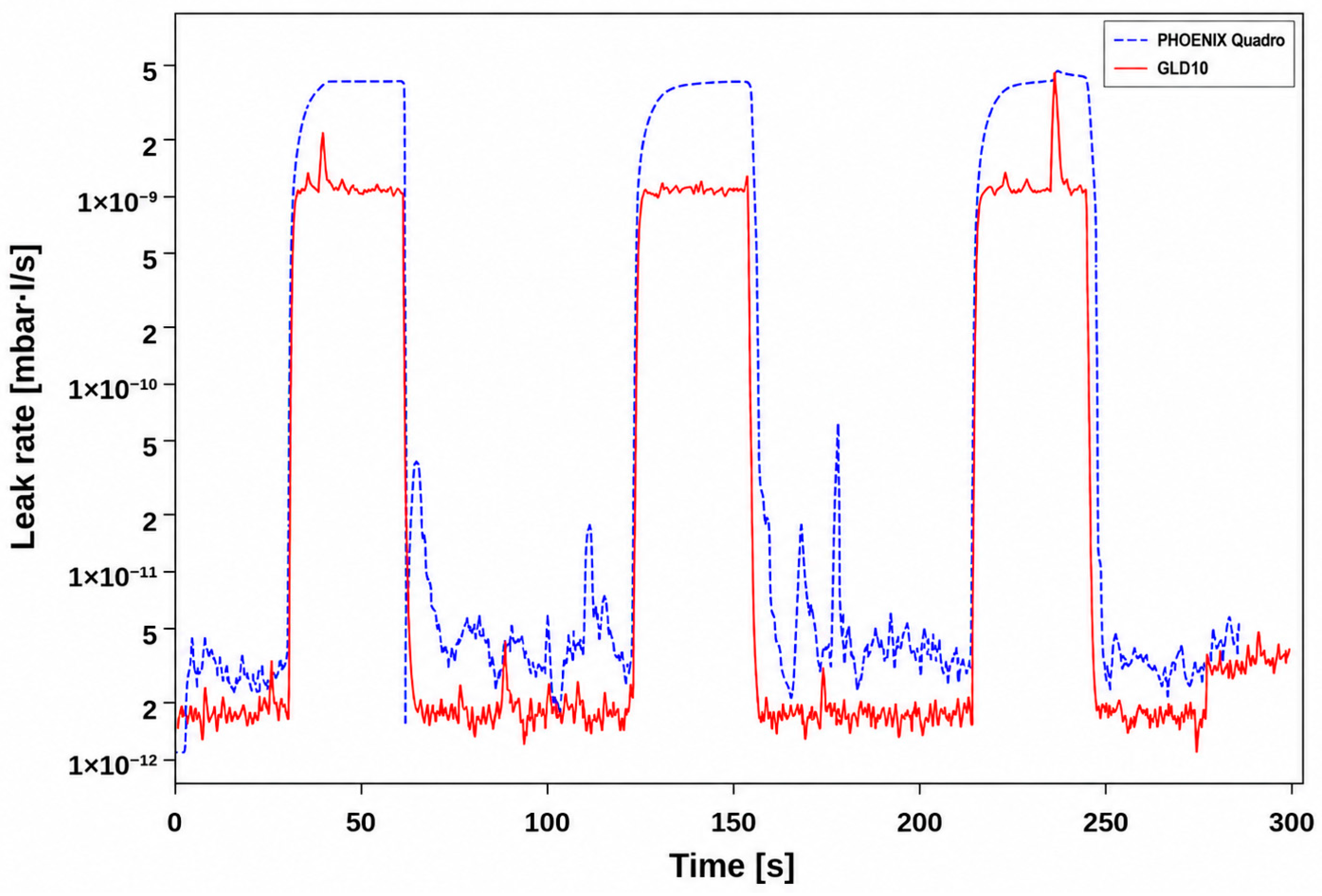
To verify the performance of the GLD10 detector, comparative measurements were conducted using the commercial PHOENIX Quadro helium leak detector manufactured by Leybold GmbH (Cologne, Germany), a commercially available reference instrument commonly used in industrial helium leak-testing applications. The experiments were performed under identical operating conditions using a calibrated helium reference leak corresponding to a leak rate of approximately 3.5 × 10⁻⁸ mbar·L/s. Figure 8 presents the dynamic response and recovery characteristics of the GLD10 and PHOENIX Quadro detectors during a single helium exposure and recovery measurement.
Figure 8.
Comparison of helium standard leak signals corresponding to a leak rate of 3.5 × 10⁻⁸ mbar·L/s obtained with the commercial PHOENIX Quadro detector (blue dashed line) and the developed GLD10 detector (red solid line).
Similar response dynamics were observed for both detector systems, confirming proper operation of the magnetic sector analyzer together with effective functionality of the ion current acquisition and digital signal processing systems. The GLD10 detector exhibited consistent response behavior during repeated measurements, indicating stable detector operation and reproducible signal acquisition. Rapid signal recovery following termination of helium exposure was observed for both detector systems.
Both detectors exhibited stable background behavior during the intervals between helium exposures. A tendency toward lower background fluctuations was observed for the GLD10 detector, although the difference was relatively small. The observed behavior is consistent with the implementation of the modified ion detection system, including the ion suppressor and optimized ion-focusing configuration, which were designed to reduce the influence of parasitic ions and secondary charged particles during ion collection. Analysis of the baseline signal indicated stable detector operation and good signal-to-noise characteristics under the investigated operating conditions.
Based on the measured signal and background levels, the estimated signal-to-noise ratio was on the order of 103 under the investigated operating conditions, facilitating effective discrimination of helium leak signals from background noise. Stable baseline characteristics and good measurement repeatability were observed under the investigated operating conditions. Stable baseline behavior additionally facilitated discrimination between helium leak signals and residual background fluctuations during repeated measurements.
The fast response and recovery characteristics observed for the GLD10 detector are particularly important for automated leak-testing systems operating under dynamic industrial conditions. The response profiles obtained during repeated measurements indicate stable detector operation and effective performance of the signal acquisition system. No detector instability was observed during the measurement sequence.
Overall, the GLD10 architecture provides performance comparable to commercially available helium leak detectors while maintaining stable detector response, good repeatability, and reliable operation during helium leak measurements. The obtained results demonstrate the suitability of the developed detector for industrial leak-testing applications requiring automated operation and sensitive helium leak detection.
3.3. Repeatability of Cyclic Helium Leak Measurements
Cyclic measurements were performed to evaluate the operational stability and repeatability of the GLD10 helium leak detector in comparison with the commercial PHOENIX Quadro reference system under repeated helium exposure conditions. The investigations were carried out using a calibrated helium reference leak with a leak rate on the order of 10−8 mbar·L/s. Time-dependent response and recovery characteristics obtained during cyclic detector operation are presented in Figure 9.
Figure 9.
Repeatability of cyclic helium leak measurements performed at a leak rate of 1 × 10⁻⁸ mbar·L/s using the commercial PHOENIX Quadro leak detector (blue dashed line) and the developed GLD10 leak detector (red solid line).
It should be noted that small signal fluctuations are visible in the GLD10 response during helium exposure. These fluctuations originate from the high sensitivity of the ion current acquisition system and from intentionally limited signal filtering used to preserve a fast detector response. Additional filtering could further reduce the fluctuation level; however, this would increase the detector response and recovery times. Importantly, the observed fluctuations remained stable and repeatable throughout the measurement sequence.
Interestingly, despite the slightly higher short-term signal fluctuations observed during helium exposure, the GLD10 detector maintained nearly constant response amplitudes throughout all measurement cycles. In contrast, the PHOENIX Quadro detector exhibited small cycle-to-cycle variations in peak response levels. This observation is consistent with stable detector operation during repeated measurements.
Both detector systems demonstrated stable and repeatable cyclic responses during successive helium exposure measurements. Reliable signal recovery following termination of helium exposure was observed for both detectors, confirming reproducible detector response throughout the measurement sequence. The repeatability of detector response profiles further demonstrated proper operation of the magnetic sector analyzer and reproducible ion current acquisition conditions during the measurements.
The GLD10 detector demonstrated stable baseline behavior during intervals between successive measurement cycles. A consistent baseline was maintained throughout the measurements, indicating good signal stability under the investigated operating conditions. Stable baseline characteristics additionally facilitated discrimination between helium leak signals and residual background fluctuations during repeated measurements.
Fast response and recovery behavior observed during cyclic operation are particularly important for industrial vacuum systems requiring continuous leak monitoring and automated testing procedures. Stable signal acquisition conditions also enabled effective discrimination between helium leak signals and residual background fluctuations throughout the measurement sequence.
As shown in Figure 9, highly consistent detector responses were recorded during successive measurement cycles, with good repeatability of both maximum leak signal intensity and baseline characteristics between individual helium exposures. These findings are consistent with stable operation of the magnetic sector analyzer, ion transport system, ion collection path, and digital ion current acquisition electronics during repeated measurements.
Minor differences between the two investigated detector systems were identified in terms of background signal behavior. A tendency toward lower background fluctuations was observed for the GLD10 detector, although the difference was relatively small. This behavior is consistent with the design of the modified ion detection path and the low-noise signal acquisition system. Analysis of the baseline signal indicated good signal-to-noise characteristics under the investigated operating conditions.
Consistent recovery behavior was also observed following termination of helium exposure. No detector instability was observed during consecutive operating cycles, indicating reproducible ion transport and ion current acquisition throughout the measurements. The stable baseline further enabled effective differentiation between helium leak signals and residual background variations. The highly reproducible response profiles obtained during cyclic measurements are consistent with stable detector operation and reproducible ion current acquisition conditions within the magnetic sector analyzer. Such characteristics are particularly important for automated industrial leak-testing systems operating under dynamic measurement conditions.
Overall, the GLD10 helium leak detector demonstrated stable and repeatable performance during cyclic helium leak measurements. The obtained results indicate that the developed detector is suitable for industrial leak-testing applications requiring reproducible detector response, stable baseline characteristics, and sensitive helium leak detection during repeated measurement procedures.
3.4. Detection Limit and Low-Level Helium Leak Measurements
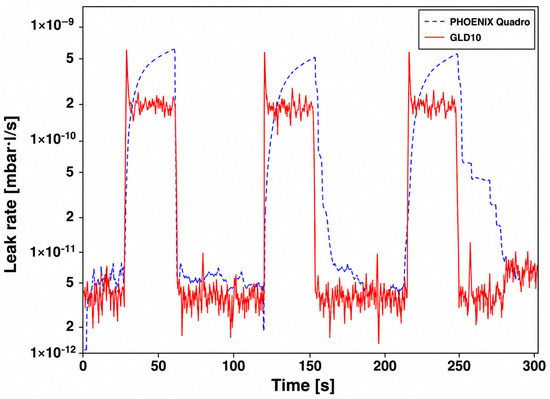
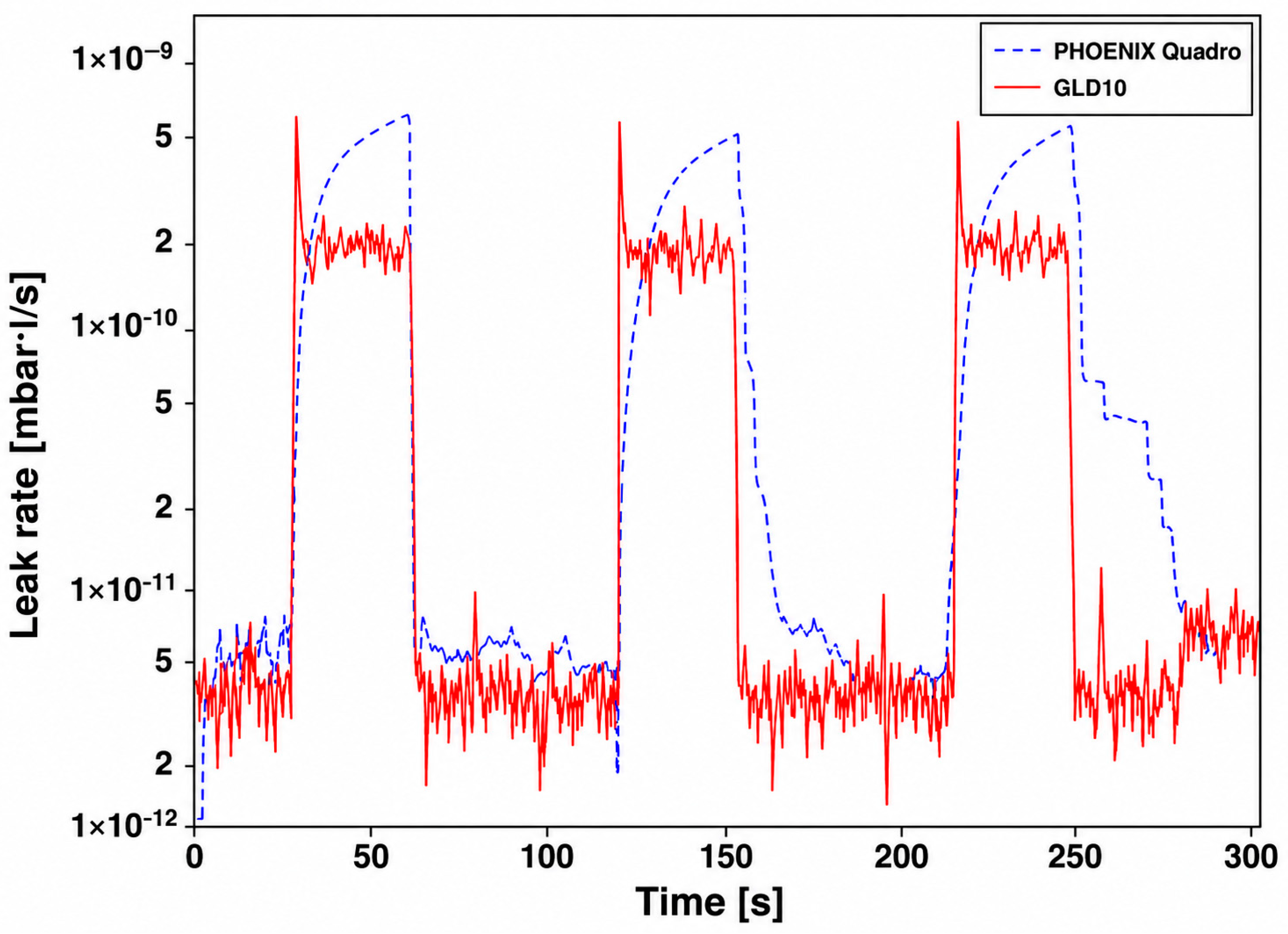
Additional measurements were performed to evaluate the minimum detectable helium leak rate and low-level measurement capability of the GLD10 detector system. The experiments were carried out using calibrated helium reference leaks under controlled vacuum conditions. Measurements were subsequently performed at leak-rate values approaching the practical detection limit of the detector. The corresponding results are presented in Figure 10.
Figure 10.
Repeatability of cyclic helium leak measurements performed at a leak rate of approximately 1 × 10⁻⁸ mbar·L/s using the commercial PHOENIX Quadro detector (blue dashed line) and the developed GLD10 detector (red solid line).
The study focused on detector response behavior, background signal characteristics, and repeatability of ion current acquisition near the detection threshold, with particular emphasis on background noise and response stability at very low helium leak rates. The detector system demonstrated consistent response characteristics together with good repeatability of recorded ion current signals during low-level helium leak measurements. Stable baseline behavior enabled clear detection of helium leak signals at levels close to 1 × 10⁻¹⁰ mbar·L/s. The observed behavior is consistent with stable detector operation and low-noise signal acquisition under near-threshold measurement conditions.
As shown in Figure 10, helium leak signals were successfully detected at leak rates of approximately 1 × 10⁻¹⁰ mbar·L/s, corresponding to the practical detection limit of the developed system. Consistent detector response together with reproducible signal characteristics was observed during repeated low-level measurements. Analysis of the baseline signal indicated stable background behavior and good signal-to-noise characteristics under the investigated operating conditions. The background signal level remained at least two orders of magnitude lower than the measured helium leak signal, enabling effective discrimination of helium leak events from residual background noise under near-threshold operating conditions.
The observed signal stability is consistent with the overall detector architecture, including the modified ion detection path and the low-noise digital ion current acquisition system. Stable response characteristics and good repeatability of low-level ion current measurements were observed throughout the measurement sequence. Effective discrimination between helium leak signals and residual background noise was maintained during operation near the detection limit. These features enabled stable operation at leak rates of approximately 1 × 10⁻¹⁰ mbar·L/s and ensured consistent performance throughout successive measurement cycles. The GLD10 detector maintained reproducible response and recovery characteristics during operation near the detection limit. No detector instability was observed during repeated low-level helium exposure measurements, indicating reproducible detector response throughout the measurement sequence.
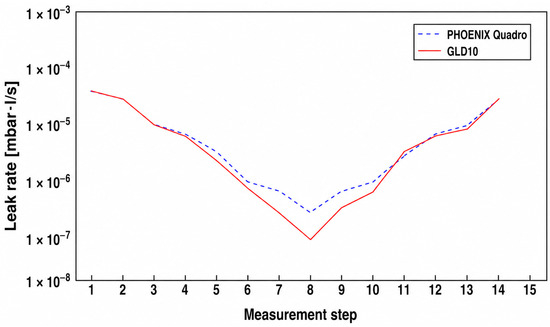
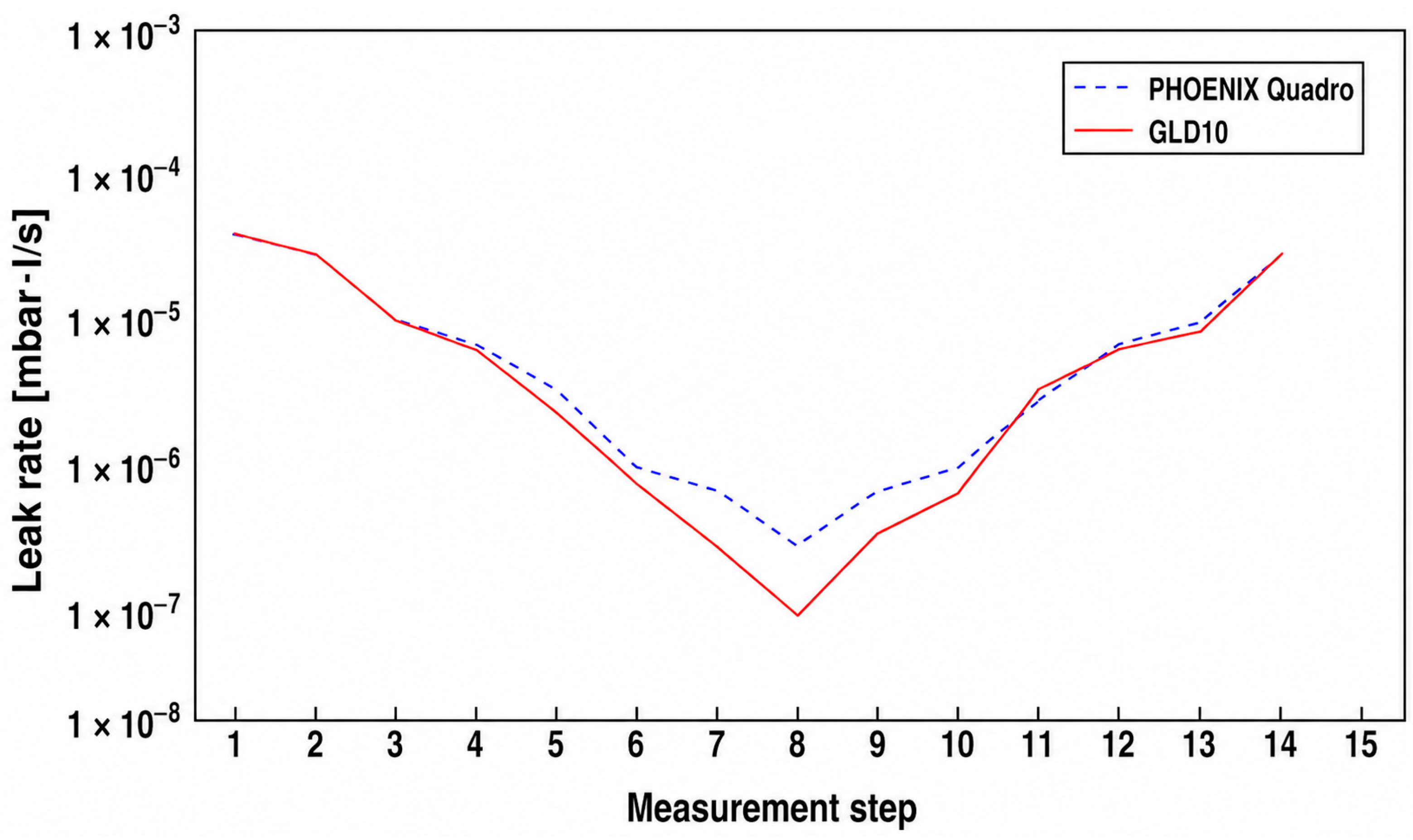
To further evaluate the developed system over a broader leak-rate range, comparative measurements were performed using both the GLD10 detector and the commercial PHOENIX Quadro reference instrument. The experiments were carried out using the experimental arrangement described previously. The effective helium leak rate was adjusted by means of a throttling valve, and a series of fifteen measurements covering approximately two orders of magnitude was conducted.
Figure 11 presents a comparison of the leak-rate values obtained with both detectors. The measurements were performed using a calibrated helium reference leak (Inficon) with a nominal leak rate of 1 × 10⁻⁸ mbar·L/s. The effective leak rate was adjusted using a throttling valve to generate measurement points covering approximately two orders of magnitude. Good agreement was observed throughout the investigated range, and the measured values followed similar trends for both instruments, indicating reliable operation under varying leak-rate conditions.
Figure 11.
Comparison of helium leak-rate measurements obtained using the developed GLD10 detector (orange line) and the commercial PHOENIX Quadro detector (blue line) for fifteen measurement points covering approximately two orders of magnitude of leak rates.
The results demonstrate the capability of the GLD10 detector to reliably quantify helium leak rates over an extended measurement range. The observed agreement with the reference instrument further supports the validity of the developed approach. The achieved detection limit, together with stable low-level operation and stable baseline characteristics, demonstrates the suitability of the GLD10 detector for industrial vacuum applications requiring detection of very small helium leaks and automated monitoring procedures.
4. Conclusions
A helium leak detector based on a magnetic sector mass spectrometer was designed and experimentally validated for high-sensitivity applications in industrial vacuum systems. The GLD10 architecture integrates a modified ion detection path incorporating an ion-focusing system, an ion suppressor, low-noise signal acquisition electronics, and a digital monitoring and control module designed to support stable detector operation and facilitate integration into automated industrial environments.
Experimental studies demonstrated stable operation over a broad range of operating conditions. The detector achieved helium leak detection at levels of approximately 1 × 10⁻¹⁰ mbar·L/s while being designed for operation at inlet pressures up to 15 mbar measured at the inlet port of the aluminum manifold block. Response times shorter than 1 s were obtained under dynamic operating conditions. Reproducible response behavior observed during repeated measurements further demonstrated stable detector performance and consistent signal acquisition.
In addition to the achieved detection capability, stable baseline behavior and good signal-to-noise characteristics were observed during low-level helium leak measurements. The background signal level remained at least two orders of magnitude lower than the measured helium leak signal, enabling effective discrimination between helium leak signals and residual background noise near the detection limit. Comparative investigations using the commercial PHOENIX Quadro detector demonstrated comparable dynamic response and repeatability characteristics. A tendency toward lower background fluctuations was observed for the GLD10 detector under near-threshold operating conditions; however, the observed differences were relatively small.
The modified ion detection path and the low-noise signal acquisition system contributed to stable detector response and reproducible low-level helium leak measurements. Although the individual contributions of the ion-focusing system and suppressor electrode were not evaluated separately, the overall detector architecture enabled stable operation near the detection limit together with good measurement repeatability.
Taken together, these findings demonstrate the potential of the GLD10 detector for industrial helium leak detection applications requiring high sensitivity, rapid response, stable baseline characteristics, reproducible detector operation, and compatibility with Industry 4.0 environments.
Author Contributions
Conceptualization, P.S., A.G. and M.K.-C.; methodology, P.S. and M.K.-C.; validation, P.S.; formal analysis, P.S.; investigation, P.S.; data curation, P.S.; writing—original draft preparation, P.S. and M.K.-C.; writing—review and editing, M.K.-C., A.G. and P.S.; visualization, P.S. and M.K.-C.; supervision, M.K.-C. and A.G. All authors have read and agreed to the published version of the manuscript.
Funding
The work of P.S. was carried out within the Implementation Doctorate Program funded by the Ministry of Science and Higher Education of Poland at the Silesian University of Technology.
Institutional Review Board Statement
Not applicable.
Informed Consent Statement
Not applicable.
Data Availability Statement
The raw data supporting the conclusions of this article are available from the corresponding author upon reasonable request. Some data are not publicly available due to industrial and commercial confidentiality restrictions.
Conflicts of Interest
P.S. is employed by PREVAC Sp. z o.o., and A.G. is President of the Management Board of PREVAC Sp. z o.o., the company involved in the development and industrial implementation of the GLD10 helium leak detector described in this manuscript. M.K.-C. declares no conflict of interest. Apart from the relationships disclosed above, the authors declare that there are no other commercial or financial relationships that could be construed as a potential conflict of interest.
References
- O’Hanlon, J.F. A User’s Guide to Vacuum Technology, 3rd ed.; Wiley: Hoboken, NJ, USA, 2003. [Google Scholar]
- Redhead, P.A. The evolution of vacuum leak detection. Vacuum 1999, 53, 137–142. [Google Scholar] [CrossRef] [Scilit]
- Jousten, K. (Ed.) Handbook of Vacuum Technology, 2nd ed.; Wiley-VCH: Weinheim, Germany, 2016. [Google Scholar]
- Benvenuti, C. Helium Leak Detection in Vacuum Systems; CERN Vacuum Course: Geneva, Switzerland, 2001. [Google Scholar]
- ASTM E498-11; Standard Test Methods for Leaks Using the Mass Spectrometer Leak Detector or Residual Gas Analyzer in the Tracer Probe Mode. ASTM International: West Conshohocken, PA, USA, 2011.
- ISO 20485:2018; Non-Destructive Testing—Leak Testing—Tracer Gas Method. ISO: Geneva, Switzerland, 2018.
- Hübert, T.; Boon-Brett, L.; Palmisano, V.; Bader, M.A. Developments in gas sensor technology for hydrogen safety. Int. J. Hydrogen Energy 2014, 39, 20474–20483. [Google Scholar] [CrossRef] [Scilit]
- Hübert, T.; Boon-Brett, L.; Black, G.; Banach, U. Hydrogen sensors—A review. Sens. Actuators B Chem. 2011, 157, 329–352. [Google Scholar] [CrossRef] [Scilit]
- Nerken, A. History of helium leak detection. J. Vac. Sci. Technol. A 1991, 9, 2036–2038. [Google Scholar] [CrossRef] [Scilit]
- Rottländer, H.; Umrath, W.; Voss, G. Fundamentals of Leak Detection. In Handbook of Vacuum Technology; Jousten, K., Ed.; Wiley-VCH: Weinheim, Germany, 2016; Chapter 19. [Google Scholar]
- Bergoglio, M.; Mari, D. Leak rate metrology for society and industry. Measurement 2012, 45, 2434–2440. [Google Scholar] [CrossRef] [Scilit]
- Calcatelli, A.; Bergoglio, M.; Mari, D. Leak detection, calibrations and reference flows: Practical example. Vacuum 2007, 81, 1538–1544. [Google Scholar] [CrossRef] [Scilit]
- Hidalgo, J.M.; de Segovia, J.L. Leak calibration by comparison with reference standard leaks. Vacuum 2008, 82, 1151–1156. [Google Scholar] [CrossRef] [Scilit]
- Roth, A. Vacuum Technology; Elsevier: Amsterdam, The Netherlands, 1990. [Google Scholar]
- Hablanian, M.H. High-Vacuum Technology: A Practical Guide, 2nd ed.; CRC Press: Boca Raton, FL, USA, 1997. [Google Scholar]
- Bley, W.G. Methods of Leak Detection. In Handbook of Vacuum Technology; Jousten, K., Ed.; Wiley-VCH: Weinheim, Germany, 2016; Chapter 19. [Google Scholar]
- Nier, A.O. A Mass Spectrometer for Isotope and Gas Analysis. Rev. Sci. Instrum. 1947, 18, 398–411. [Google Scholar] [CrossRef] [Scilit] [PubMed]
- Dawson, P.H. Quadrupole Mass Spectrometry and Its Applications; Elsevier: Amsterdam, The Netherlands, 1976. [Google Scholar]
- de Hoffmann, E.; Stroobant, V. Mass Spectrometry: Principles and Applications; Wiley: Chichester, UK, 2007. [Google Scholar]
- Ha, T.; Shin, H. Vacuum leak detection method using index regression and correction in semiconductor manufacturing systems. Appl. Sci. 2021, 11, 11762. [Google Scholar] [CrossRef] [Scilit]
- Baldzuhn, J.; Reimer, H.; Biedermann, C.; Grote, H.; Hathiramani, D.; Kornejew, P.; Rademann, D.; Volzke, O. Vacuum leak search on the Wendelstein 7-X cryostat vessel. Vacuum 2015, 115, 89–100. [Google Scholar] [CrossRef] [Scilit]
- Yu, X.F.; Dou, R.-C.; Feng, Q. Study on In Situ mass spectrometry leak detection technique of working fluid in spacecraft electric propulsion system. Vacuum 2024, 226, 113292. [Google Scholar] [CrossRef] [Scilit]
- Zhang, Y.; Chen, Z.; Zuo, G.; Hu, J.; Yuan, X.; Hou, J.; Huang, M. Machine learning-based system for vacuum leakage detection in fusion devices. Fusion Eng. Des. 2023, 197, 114070. [Google Scholar] [CrossRef] [Scilit]
- Ferreira, O.; Fonseca, A.; Adame, C.F.; Bundaleski, N.; Robinson, R.; Teodoro, O.M.N.D. Advancing hydrogen leak detection: Design and calibration of reference leaks. Int. J. Hydrogen Energy 2024, 68, 1090–1096. [Google Scholar] [CrossRef] [Scilit]
- Wang, R.; Jiao, J.; Zang, K.; Guo, F. Self-Consistent PIC/MCC Simulation and Control System Design for High-Sensitivity Helium Mass Spectrometer Leak Detection. Meas. Sci. Technol. 2026, 37, 035107. [Google Scholar] [CrossRef] [Scilit]
- Palau, F.E.; Medina Cabello, F. Vacuum/Helium Leak Screening and 650 Bar Hydrogen Testing of High-Pressure Components for Hydrogen Applications. Hydrogen 2026, 7, 41. [Google Scholar] [CrossRef] [Scilit]
- Bergin, M.; Ward, D.J.; Lambrick, S.M.; von Jeinsen, N.A.; Holst, B.; Ellis, J.; Jardine, A.P.; Allison, W. Low-energy electron ionization mass spectrometer for efficient detection of low-mass species. Rev. Sci. Instrum. 2021, 92, 073305. [Google Scholar] [CrossRef] [Scilit] [PubMed]
- Kelly, R.T.; Tolmachev, A.V.; Page, J.S.; Tang, K.; Smith, R.D. The ion funnel: Theory, implementations, and applications. Mass Spectrom. Rev. 2010, 29, 294–312. [Google Scholar] [CrossRef] [Scilit] [PubMed]
- Zapfe, K. Leak Detection. In CAS—CERN Accelerator School: Vacuum in Accelerators; Brandt, D., Ed.; CERN Yellow Reports: School Proceedings, CERN-2007-003; CERN: Geneva, Switzerland, 2007; pp. 227–240. [Google Scholar] [CrossRef]
- Kagermann, H.; Wahlster, W.; Helbig, J. Recommendations for Implementing the Strategic Initiative INDUSTRIE 4.0; German National Academy of Science and Engineering: Frankfurt, Germany, 2013. [Google Scholar]
- Lee, J.; Bagheri, B.; Kao, H.A. A cyber-physical systems architecture for Industry 4.0-based manufacturing systems. Manuf. Lett. 2015, 3, 18–23. [Google Scholar] [CrossRef] [Scilit]
- Bley, W.G. Helium leak detectors: From a laboratory device to dedicated industrial leak test units. Vacuum 1993, 44, 627–632. [Google Scholar] [CrossRef] [Scilit]
- Lang, J.K. Handbook on Mass Spectrometry: Instrumentation, Data Analysis and Applications; Nova Science Publishers: New York, NY, USA, 2010. [Google Scholar]
Disclaimer/Publisher’s Note: The statements, opinions and data contained in all publications are solely those of the individual author(s) and contributor(s) and not of MDPI and/or the editor(s). MDPI and/or the editor(s) disclaim responsibility for any injury to people or property resulting from any ideas, methods, instructions or products referred to in the content. |
© 2026 by the authors. Licensee MDPI, Basel, Switzerland. This article is an open access article distributed under the terms and conditions of the Creative Commons Attribution (CC BY) license.