


Abstract
The aim of this study was the quality assessment and antioxidant activity of chokeberry, raspberry and blackberry low-alcohol beverages produced from native berry fruits from the southeastern region of the Republic of North Macedonia. This is the first study on the fermentation of chokeberries, raspberries and blackberries in order to achieve low-alcohol beverages enriched by polyphenols such as monomeric and polymeric anthocyanins, low and high molecular proanthocyanidins derived from these berry fruits. The pre-fermentative addition of sugar was avoided in order to achieve the amount of ethanol less than 4%. The commercial Saccharomyces cerevisiae yeast strain Lalvin ICV D80 was used for fermentation as the most suitable for contributing significant tannin volume and stabilization of the color of the beverages. Chemical analyses revealed the acetic and lactic acids were the most abundant in the chokeberry beverage, while malic acid was the most dominant in the blackberry beverage. All low-alcohol beverages had an amount of residual sugar less than 1 g/L, while the highest total acidity was noticed in the raspberry beverage (25.45 g/L). High and low molecular proanthocyanidins were in similar amounts in the chokeberry and blackberry beverages, while total anthocyanins and total phenols were in favor to the blackberry beverage. Despite the total phenolic content, the highest antioxidant activity was measured in the raspberry beverage which can be linked to the amount and particular classes of phenolic compounds. The results presented in this study can provide insight in the new formulations of health-promoting beverages with low levels of alcohol.
1. Introduction
Nowadays, berry fruits such as chokeberries, raspberries and blackberries are very popular due to the high amount of pigmented natural antioxidants which enables their classification as “superfood”. Furthermore, low level of sugars makes them suitable for fermentation and production of low-alcohol beverages.
Aronia melanocarpa L. or well-known black chokeberries belong to the Rosaceae family. The berry fruits are native to eastern parts of North America, but they were introduced in Europe at the beginning of the twentieth century. Today many cultivated chokeberry varieties are known, but ‘Viking’ and ‘Nero’, are the most cultivated [1]. The chokeberries are very popular fruits due to the huge range of polyphenolic compounds although their main disadvantage is their bitter and astringent taste. Usually, during the process of production of juices, marmalades and syrups, the addition of sugar as saccharose, as well as other additives, mask the bitterness in their products and allow the acceptable taste of fresh fruits [2]. The main classes of polyphenolic compounds in black chokeberries are proanthocyanidins, anthocyanins, phenolic acids, flavonols, and flavanols. Apart from polyphenols, the composition of black chokeberries includes sugars (glucose and fructose), proteins, amino acids, soluble and insoluble fibers and sorbitol [3]. According to the results of the working group of Frumuzachi, the main anthocyanins in black chokeberries were cyanidin-3-O-galactoside and cyanidin-3-O-arabinoside while from the group of flavonols the most abundant were quercetin, quercetin-3-O-galactoside, quercetin-3-O-glucoside and quercetin-3-O-rutinoside [4]. The results presented in the study of Wang et al. indicated a presence of significant amounts of protocatechuic acid, catechin and resveratrol in chokeberries.
The technology of fermentation of black chokeberries usually involves Saccharomyces cerevisiae and Saccharomyces bayanus yeasts due to the nature of the matrix rich with phenolic compounds in their monomer and polymer form [5]. According to the findings of Gumienna et al., the antioxidant potential of chokeberry wine was 5642.8 mg of Trolox/L wine while total phenolic compounds were 3198.9 mg of gallic acid/L wine [6].
Fermentation of raspberries is very interesting due to the significant content of an-thocyanins, especially cyanidin-3-O-glucoside and pelargonidin-3-O-glucoside, and phenolic acids such chlorogenic acid, coumaric acid, ellagic acid, ferulic acid, syringic acid and gallic acid, while catechin and myricetin are the most abundant flavonoids in raspberries [7]. Apart from anthocyanins, the raspberries are rich sources of epicatechin, procyanidin B4, flavan-3-ol trimers, quercetin, quercetin-3-O-glucuronide, lambertianin C, and sanguiin H-6 [8]. Successful fermentation and production of alcoholic raspberry beverage implies acceptable flavor with the presence of 4-(4-hydroxyphenyl)butan-2-one, (Z)-3-hexenal, 2-hexenal, 2-pentanone, hexanal, α-ionone and β-ionone as the most important aroma compounds for typical raspberry flavor [9]. The production of red raspberry alcohol beverage by immobilized yeast of P. chrysogenum had higher fermentation efficiency than free yeast, due to the fact that anthocyanins and other polyphenols were better retained [10,11]. Fermentation of the red raspberries and production of red spirits was the object of the study of the working group of Petric [12]. According to their findings, the red fruits fermentation was successful without need for juice supplementation with nutrients. The fermentation of raspberry juice was conducted with inoculation of Saccharomyces cerevisiae subsp. Bayanus as the most appropriate yeast (SAI, Paredes, Portugal) [13,14].
In comparison to red raspberries, the blackberries contain higher amounts of anthocyanins and other phenolic compounds. The working group of Wang established fermentation of blackberry beverages by inoculation of two Oenococcus oeni (commercial O-Mega and native DS04) and two Lactiplantibacillus plantarum (commercial NoVA and native NV27). The emphasis of their study was aromatic profile and volatile compounds of produced alcoholic blackberry beverages. According to the recommendation of Pavlović and his working group, the fermentation of fruit wines can be successful with non-Saccharomyces yeasts such Candida zemplinina, Candida californica, Hanseniaspora meyer, Hanseniaspora osmophila and Hanseniaspora uvarum. Results from the study demonstrated the best aromatic profile of blackberry beverage fermented by the native L. plantarum NV27 [15]. The working group of Czyżowska identified and quantified around 150 phenolic compounds in examined fermented berry beverages and 59 polyphenols were presented in 100% pure blackberry beverages.
The health benefit of daily consumption of anthocyanins from blueberry–blackberry alcohol beverage blends strongly inhibited DPP-IV and α glucosidase activities, with anthocyanins from blackberry beverage being the most effective at reducing the activity of DPP-IV [16]. The antioxidant and vasodilatory effect of fermented blackberry beverage was examined by Mundic et al. [17]. According to their findings, vasodilatory activity of blackberry beverages was strongly related to their anthocyanin profile [17]. The working group of Amidžić Klarić investigated the impact of the tannins and nonflavonoids on the antioxidant potential of blackberry beverages [18]. Furthermore, the important amounts of phenolic acids such gallic, caffeic, chlorogenic, cinnamic, and p-coumaric and their effect on antioxidant activity of blackberry wines was investigated by Čakar et al. [19]. His research group concluded that the concentration of caffeic acid can significantly influence the antioxidant and bioactive potential of blackberry wine.
However, the main problem of blackberry beverage is its stability. The findings of Wu et al. (2021) and Pargoletti et al. (2021) presented that the haze, usually formed as a chemical reaction between polyphenols and proteins, can significantly influence the bioactive potential of fermented blackberry beverage [20,21]. The precipitation of main anthocyanins, in particular, cyanidin-3-O-glucoside, cyanidin-3-O-rutinoside, a xylose-cyanidin derivative, two acylated cyanidin derivatives, cyanidin and a polymeric derivative occurred in blackberry juices and wines of blackberry which resulted in haze development and sediment formation [22].
Taking into account the importance of chokeberries, raspberries and blackberries, their health-promoting effects and their potential for production of beverages rich in polyphenols, the main focus in this study is the production of low-alcohol beverages from these berries’ growth in the Republic of North Macedonia. To the best of our knowledge, this is a first study focusing on a production of low-alcohol fruit beverages in the country as well as characterization of their chemical properties and antioxidant activity.
Usually, the so-called “fruit wines” available on the Macedonian market from berries are imported and always produced with the addition of sugar and an alcohol percentage between 10–13%, which makes them unsuitable for frequent consumption in larger quantities. Due to the fact that alcohol strongly affects the sensory profile of alcohol beverages, this is the first study on the production of fermented berry beverages with a low percentage of alcohol (up to 4% which is necessary for the extraction of polyphenols and their bioactivity) and satisfactory sensory characteristics. Hence, we evaluated the chemical composition of low-alcohol beverages from chokeberries, raspberries and blackberries from the southeast region of North Macedonia as well as the impact of the total phenolic composition (total polyphenols, total anthocyanins, high and low proanthocyanidins) on their antioxidant activity.
2. Materials and Methods
2.1. Selection of Berry Fruits
The design of the experiment was established in the area of the village of Psača, southeastern region of the Republic of North Macedonia (42°16.46′ N, 22°20.22′ E). The chokeberry plants were of the Nero variety, the Wilamette variety was the best choice for raspberry plants, while the Thornfree variety was chosen for blackberry plants. The planting pattern of the berry plants (2 × 0.5 m) were single for each variety. Harvesting of mature fruits was done at the period July–August. The berries were manually harvested at commercial maturity (12–14 °Brix) in 2025 harvested year. The samples were collected from 15 plants of each berry variety (45 in total). Five samples of each fruit plant were taken (75 samples in total); the samples were collected in plastic boxes from 500 g and kept in fridge at 5 °C.
2.2. Fermentation Procedure
Chokeberries, raspberries and blackberries were collected and processed separately in order to completely squeeze the liquid from the fleshy part of the fruit. During the pressing, K2S2O5 was added in a dose of 6 g per 100 kg of fruit. The obtained liquid/juice of each fruit was separated and subjected to fermentation. All fermentations were performed in triplicate using one liter glass fermentation vessels for each treatment. The commercial Sacharomycess cerevisiae yeast Lalvin ICV D80 (Lalemand, Saint-Simon, France) (20 g/hL) was rehydrated in water (38–40 °C for 30 min), followed with addition of bioavailable microprotectors and micronutrients, in a dose of 45 g/hL (Go-ferm protect, Lallemand, Saint-Simon, France). Lalvin ICV D80 is the optimal choice for fruit berry beverages due to its capacity for high production of esters, which accentuates the rich and concentrated aromas normally found in chokeberries, raspberries and blackberries. After starting fermentation, treatments were performed in triplicate. Yeast nutrient was added, 10 g/hL (FERMAID E, Lallemand, Saint-Simon, France), to prevent slow fermentation. During the alcoholic fermentation, the temperature was controlled and maintained between 14 and 18 °C. Sampling and analysis of beverage metabolites were performed after fermentation, immediately after SO2 addition. After the fermentation, SO2 was additionally added to protect the beverages from oxidation, followed by collecting the beverages from the lees and stored until sensory evaluation. Each low-alcoholic beverage was produced from independent fermentation batches and statistical interpretation was calculated on triplicates originated from a three fermentation batches. The samples of fruit beverages for chemical analysis of polyphenols compounds were frozen at −20 °C before analysis.
2.3. Chemicals for Analysis
All necessary chemicals such as solvents (methanol and ethanol) and inorganic acids (sulfuric acid and hydrochloric acid) were supplied from Alkaloid (Skopje, Republic of North Macedonia). The standard kits and reagents for determination of total phenolic compounds (TPC), including Folin–Ciocalteu reagent, iron and vanillin were purchased from Merck, Darmstadt, Germany. (+)-Catechin and cyanidin-3-O-glycoside with HPLC purity over 99.9% were supplied from Sigma-Aldrich (Steinheim, Germany).
2.4. Methods for Analysis
The overall quality of the produced low-alcohol beverages was determined by official analytical methods (OIV 2016) and standard oenological methods (total and free SO2 and titratable acidity (Ivanova et al., 2015 and OIV-MA-AS313-01, respectively) [23]. Methorm pH meter (Herisau, Switzerland) was used for determination of pH using the OIV method OIV-MA-AS313-15. The most important organic acids in fermented beverages such as malic and lactic acid were obtained by method of Zakharova et al., 2011 [24]. Ebulliometer was used for determination of alcohol content in fermented beverages (Alcolyzer Wine M, Anton Paar, Graz, Austria). Determination of the glucose and fructose were determined by the method of Boulton et al., 1996 [25], while the amount of magnesium was measured by the modified method of Iwano & Sawanobori, 1962 [26]. The amount of glycerol was measured enzymatically by standard OIV, 2016 method [27]. Ammonium salts were measured by an enzymatic assay (Enzytec, DiasSys Diagnostic Systems GmbH, Holzheim, Germany) [28].
2.5. Determination of Total Phenolic Conetnt, High and Low Molecular Proanthocyanidins
The total phenolic content of the fermented low-alcohol beverages from chokeberries, raspberries and blackberries was measured using a Varian Cary 100 spectrophotometer (Agilent Technologies Inc., Palo Alto, CA, USA) according to the proposed method of Rigo et al., 2000 [29]. The quantification of total polyphenols was performed using an external standard of (+)-catechin and the amounts were expressed in mg/L of catechin equivalents [30,31]. Although the gallic acid is the most used as universal standard for total polyphenols, in our study the more appropriate was (+)-catechin which contains multiple hydroxyl groups that readily react with the aluminum chloride reagent used in flavonoid assays, producing a stable-colored complex that is precisely measured spectrophotometrically. A calibration curve was constructed using (+)-catechin in a concentration range of 5 to 140 µg/mL. The coefficient of determination (R2) of the resulting calibration curve (y = 0.0072x + 0.0105) was 0.9995, suggesting excellent linearity in the studied range of concentrations. The LOD and LOQ of the method were 2.03 and 6.14 µg/mL, respectively.
The vanillin index was used for determination of high and low molecular proanthocyanidins, with (+)-catechin as an external standard for construction of the calibration curve. The results were expressed as mg/L of catechin and cyandinin-3-O-glucoside equivalents [32]. The coefficient of determinations (R2) was used to evaluate the linearity of the calibration curve. Limit of detection (LOD) and limit of quantitation (LOQ) were calculated as 3.3 σ/s and 10 σ/s, respectively, where σ is the standard deviation of the response, and S is the slope of the calibration curve. The maximal absorbance of monomeric anthocyanins is detected in the visible range from 536 nm to 542 nm and was expressed in mg/L berry beverage [33]. The maximal absorbance at 425, 520 and 620 nm was responsible for the color of chokeberry, raspberry and blackberry low-alcohol beverages [34].
Determination of Anthocyanins with HPLC Analysis
The analysis of the most abundant anthocyanins cyanidin-3-O-glucoside and cyanidin-3-O-sophoroside was performed by high-performance liquid chromatography system (Agilent 1200 RR, Agilent, Waldbronn, Germany) coupled with a diode-array detector (DAD, model). Separation of anthocyanins was achieved on a Lichrospher RP-18 (Agilent) column (250 mm × 4 mm, 5 μm). Elution was performed with solvent A (10%, v/v solution of formic acid in water) and solvent B (acetonitrile), using gradient elution as follows: 1% B, 0–0.5 min; 1–7% B, 0.5–1 min; 7% B, 1–4 min; 7–10% B, 4–7.5 min; 10–14% B, 7.5–11.5 min; 14–25% B, 11.5–15.5 min; 25–40% B, 15.5–18.5 min; 40–75% B, 18.5–22 min; 75% B, 22–25 min. The injection volume was 10 μL, the flow rate was 1 mL/min and the detection wavelength was set at 520 nm. Anthocyanins identification was performed in double online detection using DAD (at 520 nm). Before HPLC analysis, the low-alcoholic beverages from chokeberries, blackberries and raspberries were diluted with 70% methanol in a ratio 1:25 and injected in the system.
The compounds identification was achieved by comparing their retention times and UV–Vis spectra with those of the available standards or data available in the literature. Quantification was done with the calibration curves of the standard compounds: cyanidin-3-O-glucoside and cyanidin-3-O-sophoroside. The limits of detection (LOD) and quantification (LOQ) were calculated by the ratio between the regression error (SE) and analytical curve slope multiplied by 3.1 and 9.8, respectively. Consequently, the obtained LOD and LOQ values varied from 2.8 to 6.9 μg/L and 8.4 to 19 μg/L, respectively.
2.6. Determination of Antioxidant Activity of Low-Alcohol Beverages
For determination of antioxidant activity of the produced low-alcoholic beverages from chokeberries, raspberries and blackberries, the DPPH radical scavenging test was used following both the methods of Brand-Williams et al., 1995 and Re et al., 1999, respectively [35,36]. In brief, the chokeberry, raspberry and blackberry beverages were placed in 96-well microplates, and 200 mL of 0.1 mmol methanolic solution of DPPH was added and allowed to react in the dark at room temperature. The decrease of DPPH absorbance was measured at 520 nm at 5 min intervals by a spectrophotometer (MRX Dynex Technologies), until absorbance stabilized (30 min). Water was used as blank solution, and DPPH solution without test samples served as the control. All sample analyses were performed in triplicate. The antioxidant activity was expressed as IC50 (the extract concentration required to inhibit 50% of the DPPH in the assay medium). The applied method was tested for validation parameters of limit of detection (LOD), limit of quantitation (LOQ) and coefficient of variation (CV) in comparison to the conventional spectrophotometric method (Table 1). The applied colorimetric method showed well acceptable LOD, LOQ and CV values especially for screening applications.
Table 1.
Validation parameters of spectrophotometric and the new colorimetric methods.
2.7. Sensory Analysis of Low-Alcohol Beverages
Sensory characterization of newly produced low-alcoholic beverages was performed on 4-month-old fermented beverages by seven professional wine tasters, who compared the three berry beverages produced from chokeberries, blackberries and raspberries, in one ranking test (1 ranking test per day in three consecutive days, n = 3 days). Since the evaluation of the sensory properties of chokeberry, blackberry and raspberry beverages with a reduced alcohol percentage were determined for the first time in this study by trained panelists, the obtained (0–10) can be observed as preliminary qualitative and quantitative evaluations. The panel’s training level was established based on the Wine Tasting Table of American Wine Society (AWS) and Wine Aroma Wheel (U.C. Davis Aroma Wheel). The sensory panel consisted of seven qualified tasters with certificates of the Wine & Spirit Education Trust (WSET) Award in Wines. Due to the fact that beverages examined in our study are 100% natural and had an ethanol content below 4%, they belong to the standard foodstuff. Standard, safe, sensory analysis (taste-testing commercially available food) typically falls under food safety regulations, not the strict ethical oversight required for clinical trials involving investigational products, invasive procedures, or risk to health. Hence, we did not need the ethical standards and last amendments of the 1964 Helsinki declaration and approved by the Ethics Committee for Non-Biomedical Human Research [37]. Prior to the experiments, tasters were required to sign an informed consent form disclosing the type of research, voluntary participation and agreement to taste and spit reference solutions and beverages. All data were collected anonymously. Each member of the group tasting panel had participated in three 40 min professional training courses before the sensory evaluation test. The color, sourness, body, sweetness, astringency, freshness, floral and fruity notes of the three berry beverages produced from chokeberries, blackberries and raspberries were characterized with gates from 0 to 10. The low-alcohol beverages were served in a random order at room temperature (20 ± 2 °C) in OIV tasting glasses in daylight. To avoid carryover effects, at least 30 s between tasting each sample was applied.
2.8. Statistical Analysis
All measurements and analyses were performed in triplicate. Significance differences among observed oenological parameters in low-alcoholic beverages (volatile acids, glucose, fructose, total acids, pH, percentage of solids) as well as the amounts of phenolic compounds such total anthocyanins and total polyphenols following the higher and lower proanthocyanidins were estimated by one-way ANOVA. The Duncan test was used to discriminate the wine category (p ≤ 0.05). Differences which were statistically significant between mean values were denoted by decreasing letters (a–c). The one-way ANOVA was performed using the R-4.6.1 CRAN software package.
3. Results
3.1. Variation of Basic Parameters of Low-Alcohol Beverages from Chokeberries, Raspberries and Blackberries
The chemical composition of the fermented beverages from chokeberries, raspberries and blackberries is presented in Table 2. The level of reducing sugars in the blackberry beverage was the highest in comparison to the chokeberry and raspberry beverages (0.80 ± 0.05 g/L and p = 0.025, respectively). However, after fermentation the content of alcohol was similar in all three beverages without significant difference observed between the values of ethanol (less than 4%). The highest amount of glycerol was determined for the chokeberry beverage (0.51 ± 0.01 g/L and p = 0.02) while the ratio of the ammoniacal to primary amino nitrogen showed an inversed trend in the chokeberry and blackberry beverages. Determination of total acidity indicated the raspberry beverage as the most acidic, although the pH value was not significantly different from that of the blackberry beverage. In addition, free and total SO2 were the most abundant in the chokeberry beverage although all samples were treated with the same amount of potassium metabisulfite during the fermentation procedure.
Table 2.
Chemical composition of low-alcohol beverages from chokeberries, raspberries and blackberries.
The results for the concentrations of organic acids presented in Table 3 indicated that lactic acid was the most abundant organic acid in the chokeberry beverage with a value of 4.37 ± 0.04 g/L and p = 0.02. Furthermore, the low-alcohol beverage obtained from the fermented juice of chokeberry was the richest source of acetic acid while D-gluconic acid, tartaric and malic acid were the most abundant in the blackberry beverage with amounts of 0.23 ± 0.01 g/L, 0.92 ± 0.01 g/L and 1.86 ± 0.02 g/L, and p = 0.02 and p = 0.03, respectively.
Table 3.
Organic acids in low-alcohol beverages from chokeberries, raspberries and blackberries.
3.2. Color, Bioactive Compounds and Antioxidant Activity of Low-Alcohol Beverages from Chokeberry, Raspberries and Blackberries
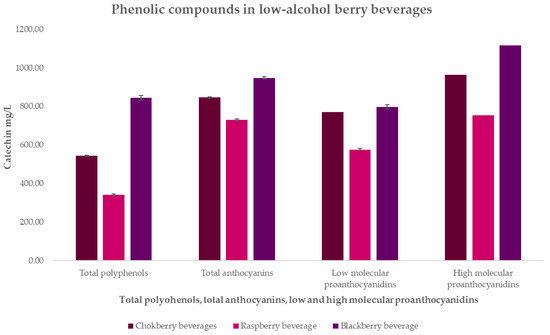
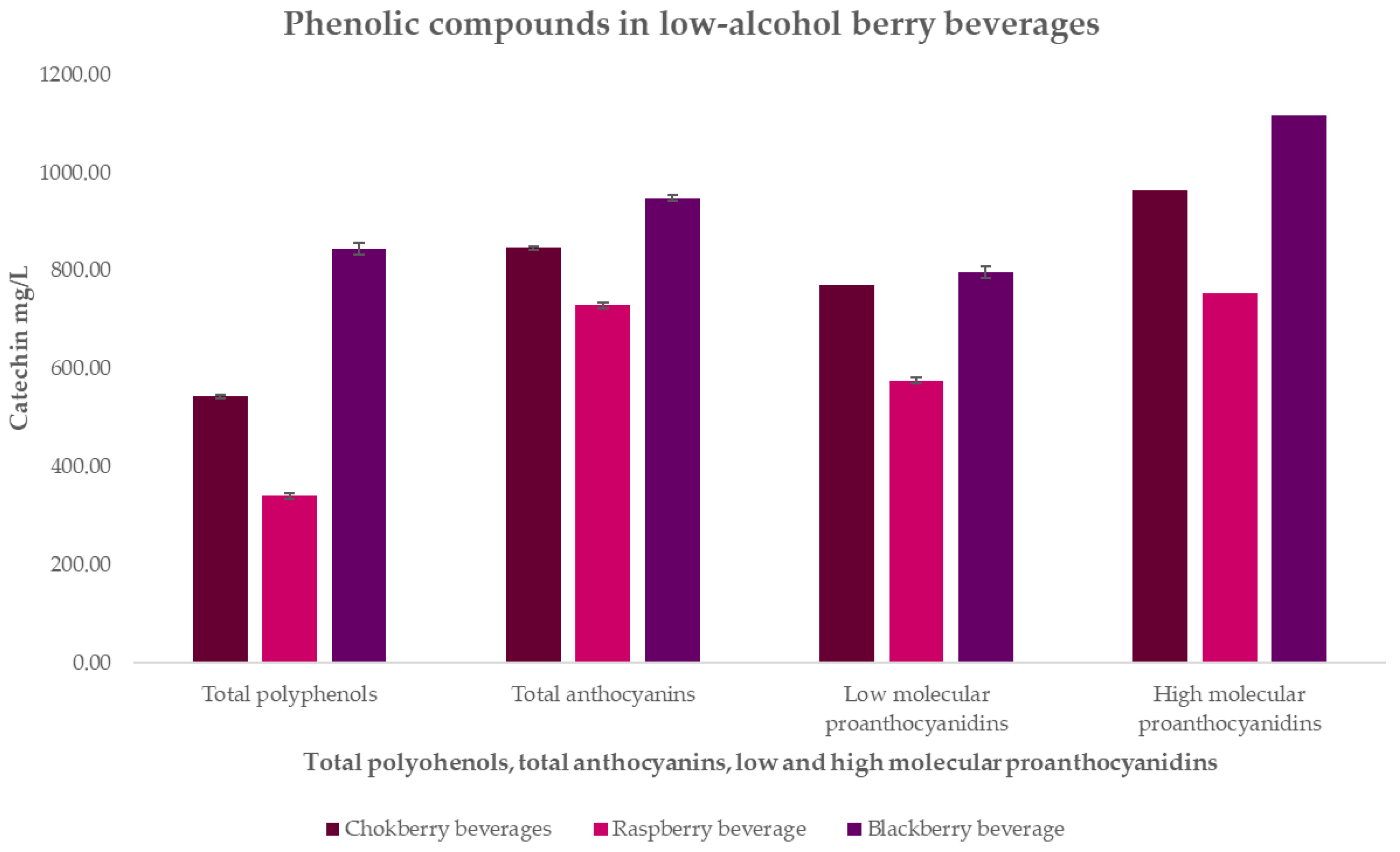
The color of berry fruits used for fermentation and production of appropriate beverages was different and can be linked with the amount and type of phenolic compounds presented in the berry fruits (Table 4). The color intensity (CI) and color hue/tint were especially significant for the raspberry beverage. The maximum intensity at 520 nm as well as hue value of 0.70 indicated a predominance of monomeric anthocyanins. On the other hand, a predominance of color at 425 nm and a hue value of 1.14 for the chokeberry beverage can be linked by yellow and brown oxidized polymeric compounds. Results presented on Figure 1 demonstrate the highest amounts of all measured phenol compounds obtained from low-alcohol beverage fermented by blackberry juice. The quantity of total polyphenols was 844.8 ± 11.51 mg/L which was more than double of the same compounds measured in the low-alcohol beverage from raspberries (340.7 ± 6.11 mg/L, p = 0.02). Furthermore, the amounts of total anthocyanins presented on Figure 1 are 948.1 ± 5.25 mg/L which can be strongly linked to the highest value for absorbance at 520 nm for red color which showed in this beverage. Additionally, the lowest level of high molecular proanthocyanidins in the raspberry beverage showed the lowest level of polymerization of polyphenols in this beverage. Although the levels of low molecular proanthocyanidins were similar in the beverages from chokeberries and blackberries, the amount of high molecular proanthocyanidins were higher (1116.5 ± 6.65 mg/L) for the blackberry beverage, but not significantly.
Table 4.
Color intensity and hue/tint of low-alcohol beverages from chokeberries, raspberries and blackberries.
Figure 1.
Phenolic compounds and antioxidant activity of low-alcohol berry beverages from chokeberries, raspberries and blackberries.
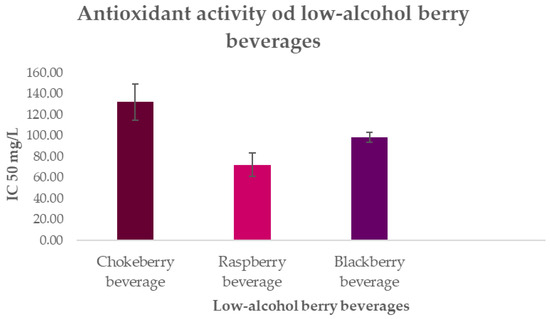
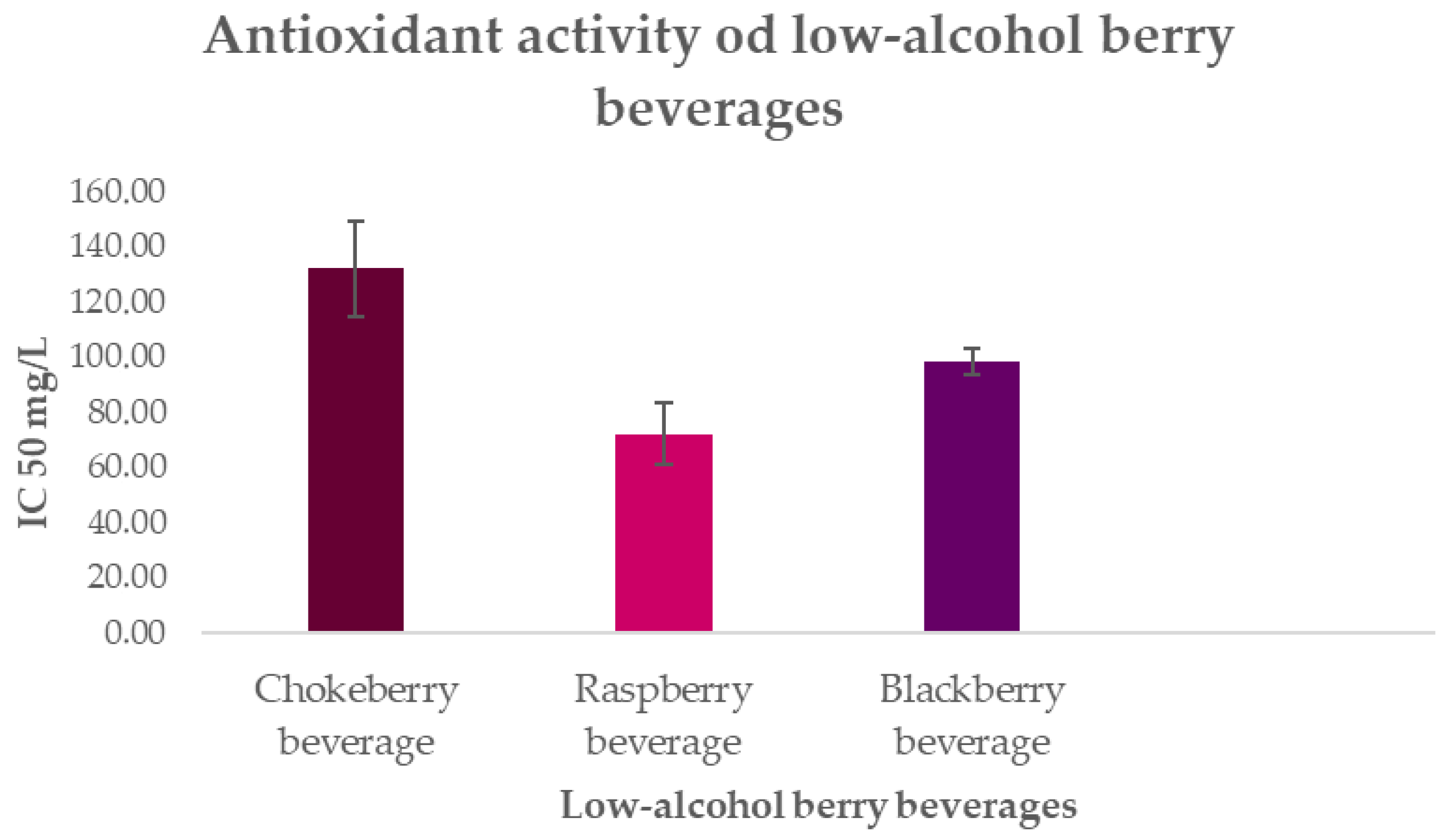
In addition, results from the antioxidant activity of low-alcohol beverages from chokeberries, raspberries and blackberries juices are presented in Figure 2.
Figure 2.
Antioxidant activity of low-alcohol berry beverages from chokeberries, raspberries and blackberries.
Although the antioxidant activity of the fermented berry beverages is always in strong relationship with total polyphenols and total anthocyanins, the results presented in Figure 2 show the highest antioxidant activity for the raspberry beverage while the lowest antioxidant activity is determined for the chokeberry beverage. However, further compositional profiling is needed to clarify this discrepancy.
3.3. Sensory Evaluation of Fermented Low-Alcohol Beverages from Chokeberries, Raspberries and Blackberries
The results from sensory evaluation of fermented berry beverages from chokeberries, raspberries and blackberries are presented in Table 5. Due to the fact that the panel size (n = 7) is small and the fermented beverages are new, our results can be described as preliminary and indicative. In terms of beverage appearance, the highest scores were obtained by the blackberry and chokeberry beverage (9.9 ± 0.5 and 9.2 ± 0.3 with p = 0.02 and 0.01, respectively), which showed a dark violet color, differing significantly from the medium purplish red color of the raspberry beverage, wherein the higher anthocyanins content gave the beverage a deeper color. The smooth and silky tannins of chokeberries perhaps dominated on the rough taste, well known as astringency, which is commonly an undesirable taste for some consumers. It can be assumed that the highest score for astringency was obtained for the chokeberry beverage (9.5 ± 0.5; p = 0.01) which some panelists described as bitterness. The fresh and floral taste typically for raspberries reduced excessive acidity and enhanced the sensory quality of the raspberry beverage (8.9 ± 0.7, p = 0.02 and 8.5 ± 0.8, p = 0.04). The low-alcohol beverages from raspberries and blackberries might have had the highest grades for fruity notes. Comparing the three types of fruit beverages, the best color, fruity and floral notes, the lowest astringency and acidity and overall quality was determined to be the blackberry beverage.
Table 5.
Sensory evaluation in low-alcohol beverages from chokeberries, raspberries and blackberries.
4. Discussion
Generally speaking, low-alcohol berry beverages can be often favored by young and middle-aged consumers, especially young women. This can be concluded by the fact that the older population appreciates the well-known taste of grape wines [38].
The fermentation process and production of blackberry beverages usually involve the addition of sugar to increase the percentage of ethanol. For instance, the Korean traditional blackberry winemaking process a pre-fermentative stage where blackberries are mixed with approximately 20% raw brown sugar by blackberry weight [39]. If we take into account the percentage of glucose and fructose in native blackberries and raspberries (less than 35 mg/100 g and 25 mg/100 g fruit, respectively), it is clear that ethanol measured in a blackberry beverage can yield this result by the addition of saccharose [39].
The percentage of glucose and fructose as well as sucrose in blackberry beverages presented in this study revealed optimal maturity of fruits before the fermentation. Furthermore, the blackberry beverage was the richest source of polyphenols, anthocyanins, high and low molecular proanthocyanidins. Furthermore, the absorbance of 520 nm showed a higher intensity of red color in comparison to a low intensity of blue-purple color while hue/tint value indicated production of a young, fermented beverage. The only indication of incomplete malolactic fermentation (MLF) was high abundance of malic acid which can give a sharp note to the taste. The significant amount of this acid in the blackberry beverage can be linked to potential liver detoxification [38,39].
Different fermentation techniques significantly affect the chemical and sensory profiles of Aronia melanocarpa wines [40]. According to the findings of the working group of Yauan, prolonged maceration significantly increased the amounts of anthocyanins, proanthocyanidins, tannins, and bitter compounds like stilbenes, protocatechuic acid and caffeoylquinic acids, resulting in deeper color and stronger astringency, sourness, bitterness, and body. Prolonged maceration enhances the extraction process of polyphenols from skin and the seeds of black chokeberry and even a low level of alcohol (less than 4%) is enough for efficient transfer of resveratrol, tannins and other phenolic compounds [41]. The content of organic acids in black chokeberry enhances the sour flavor of the native berry fruits [41]. Usually, the titratable acidity is in range with other berries at 0.85 to 1.22% [42,43]. At least eight organic acids were reposted in black chokeberry, including malic, ascorbic, shikimic and citric acids, but others have reported that malic acid is the primary organic acid [44,45,46]. During the process of fermentation, the addition of sugar was avoided in order to keep a low level of alcohol in the fermented beverage. A significantly high amount of lactic acid in our low-alcohol chokeberry beverage usually refers to the occurrence of malolactic fermentation (MLF)—a natural or inoculated process where sharp malic acid is converted into softer, smoother lactic acid [46]. This acid strongly affected the sensory profile of chokeberry beverage because malolactic fermentation reduces the sharp, aggressive tartness of the beverage and replaces it with a softer, creamier mouthfeel [47]. Additionally, the amount of d-glucuronic acid in the blackberry beverage presented in our study was indicative. Usually, D-glucuronic acid is a minor, naturally occurring organic acid in the blackberry beverage, typically found in very small trace amounts (around 0.01 g/L) [48]. It is forming primarily as a product of reaction between of pectin and microbial activity of yeasts during fermentation. Furthermore, this beverage had the highest amount of ammoniacal nitrogen which is crucial for fermentation due to the fact that Saccharomyces cerevisiae utilizes ammoniacal nitrogen preferentially over amino acids. According to the findings of Amidžić Klarić, the amount of ethanol in fermented blackberry beverage was in the range from 7 to 15% which implicated the addition of sugar during the process of fermentation [49]. According to the results presented in our study, the alcohol content in fruit beverages presented in Table 1 was less than 4% which corresponds to the amount of sugars presented in the native fruits. The levels of total phenolic compounds of blackberry beverage were in a good correlation with the published results which range from 868 to 2581 mg/L [49,50]. The main anthocyanins which are responsible for the color of raspberry alcoholic beverages are cyanidin-3-O-sophoroside, cyanidin-3-O-rutinoside, and cyanidin-3-O-glucoside which were the predominant anthocyanins in red raspberry; in contrast, delphinidin-3-O-β-D-glucoside, cyanidin-3-O-glucoside, malvidin-β-d-glucopyranoside, and peonidin-3β-D-glucoside were presented in blackberry wines. The research group of Yuan demonstrated that an increase in total anthocyanins content in raspberry was lower during fermentation compared to grape, while the decrease in the content of main anthocyanins in raspberry was more remarkable than in grape [50]. Results presented in our study indicated a strong relationship between color, total anthocyanin content and antioxidant activity of low-alcohol berry beverages. The raspberry beverage had the highest color intensity and the highest antioxidant activity. Some authors reported that main anthocyanins in the red raspberry extracts were delphinidin-3-O-glucoside and cyanidin-3-O-glucoside which can significantly influence the color of the final product [51]. This can lead us to a hypothesis that this low-alcohol beverage is the richest source of monomeric anthocyanins presented in fresh fruits and young fermented beverages.
The chemical composition of low-alcohol beverages presented in our study indicates that fermentation with the same yeast may not be the best choice for chokeberries as well as the raspberries and blackberries. If we take into account the amount of volatile acetic acid in the chokeberry beverage, we assume that optimization of fermentation process with different yeasts and temperature is necessary. Furthermore, the highest value of absorbance at 425 nm is an additional indication that yellow-brown components which generally indicate oxidized anthocyanins or aged, browned pigments were present in the chokeberry beverage. Our results for total phenolic compounds and total anthocyanins of the chokeberry beverage were in good agreement to those published by Frumuzachi et al. (2024) [3]. According to their findings chokeberries are a rich source of cyanidine-3-O-glucoside (Cy3G),-3-O-galactoside,-3-O-xyloside, and-3-O-arabinoside while from the group of flavonols the main component was quercetin derivatives (such as isorhamnetin, quercetin-3-O-glucoside,-3-O-galactoside,-3-O-rutinoside,-3-O-robinobioside, and-3-O-vicianoside) [3,20]. The chemical composition and antioxidant activity of raspberries and blackberries which was used for production of fruit wines presented in this study were examined by Kostadinović Veličkovska et al. [52]. According to their findings, HPLC analysis confirmed the highest amounts of the two most dominant anthocyanins in blackberries and raspberries, cyanidin-3-O-glucoside and cyanidin-3-O-sophoroside, respectively [52]. Comparing the results presented in Table 3, it shows that fermented beverage from blackberry was the richest source of polyphenols and total anthocyanins but antioxidant activity was the highest for the raspberry beverage. This can be explained by the fact that some phenolic components such as flavonols and phenolic acids might be more active via DPPH radical [3,52]. Furthermore, our results from antioxidant activity of fruit alcoholic beverages are in strong agreement with the published results of the working group of Ljevar. The results from antioxidant activity of the raspberry beverage presented in their study might be linked to a significant concentration of delphinidin-3-O-glucoside, cyanidin-3-O-glucoside, cyanidin-3-sophoroside, followed by cyanidin-3-glucosylrutinoside and cyanidin-3-rutinoside [53]. The working group of Mitic demonstrated a correlation between anthocyanin content and the antioxidant activity of R. idaeus fruits due to the fact that red raspberry fruits, compared to other berries, were characterized by the highest share (70–80% of all phenols) in the chemical composition of compounds from the ellagitannin group [54].
However, action of polyphenolic compounds on human health has been mainly emphasized in the last decade [55]. If we take into account the different and complex pathways involved in fermented berry beverages and the fact that polyphenols’ biosynthesis are still not completely understood, we can agree that deeper comprehension about the mechanism behind the synthesis and accumulation of polyphenols in different berries is necessary to develop fermentation techniques for production of new, potential health-promoting beverages with improved polyphenolic composition, low amount of alcohol, increased antioxidant activity and acceptable organoleptic characteristics (Soni et al., 2021) [56]. It is well known that berries have been popularized as super foods or antioxidant-rich foods. Several types of berries like raspberry, chokeberry, and blackberry have been explored for fruit beverage production. According to the findings of the working group of Gumienna, the chokeberry beverage was a rich source of trans-resveratrol (8.67 ± 0.02 μg/mL) [6]. The reported amount of this stilbene is higher than the trans-resveratrol presented in Macedonian Vranec and Merlot wines [55]. There is an inverse relationship between daily intake of trans-resveratrol and other polyphenols presented in red wines and the incidence of cardiovascular diseases, cancer, neurodegenerative diseases, and possibly in longevity among the French population despite the consumption of a diet high in saturated fats [56].
The main point of our study was to show that the creation of a possible formulation for health-promoting beverages is not an easy task. This is the first study on chemical composition and antioxidant activity of low-alcohol berry beverages with potential functional properties which can be proved by further biological validation. Our findings suggest potential health-promoting properties that warrant further in vivo validation.
In case of fermented fruit beverages from chokeberries, raspberries and blackberries, extraction strongly depends on the percentage of ethanol in the beverage. The most controversial issue in alcohol beverages and their impact on human health is the effect of alcohol [57]. In fact, some of authors emphasize the phenolic profile of classical wines and ignore the potential negative health effects of alcohol in the range between 10 and 13%. Part of the controversy arises from the fact that the risk of certain diseases, most notably cardiovascular disease, is reduced with moderate alcohol consumption [57].
On the other hand, we should mention that the percentage of ethanol strongly influenced the overall flavor of the wine, and the decrease of the ethanol from usually 10% to 4% reduced the fullness of taste [58]. In addition, the second goal of our study was the production of 100% native low-alcohol berry beverages without the addition of grapes which can increase the percentage of alcohol or mask the undesirable bitterness to the chokeberry beverage and of acidity to the raspberry beverage.
To consider a food as “functional”, it should have high amount of nutraceutical compounds that will have physiological effects.
Taking into account that the results for low-alcohol berry beverages from the region of North Macedonia are new, we should emphasize them as preliminary observations related only to chemical composition, antioxidant activity and sensory characteristics. Our next study will be focused on bioactivity of the produced beverages and their health-promoting potential.
5. Advantages, Limitations and Further Prospects
Recently, several studies have attempted to develop new technology for grape and blackberry low-alcohol wine, using sequential fermentation with Lachancea thermotoletans adding Saccharomyces cerevisiae 72 h later or by reduction in the alcohol content of the beverage using vacuum distillation without deteriorating either the color or the flavor of the fermented product [59]. However, every new technology faces challenges and limitations. The main limitation of the results from the presented study belongs to the quality of the berry fruits, especially the percentage of sugar (the ratio of glucose/fructose) and the amounts of organic acids which are linked to the climate conditions such as sunny days, humidity, rains and UV irradiation during the summer months. The amounts of polyphenols usually are responsible for the astringent and bitter taste of the low-alcohol beverages (especially for chokeberry). Due to the fact that produced low-alcoholic fruit beverages from chokeberries, raspberries and blackberries are 100% natural (without addition of sucrose), the fermentation procedure and final quality have to be adapted to the quality of berry fruits. In addition, vinification procedures applied during the process of fermentation should avoid any loss or sedimentation of polyphenols as the powerful antioxidants which play a main role in possible classification of produced alcoholic berry beverages as functional beverages.
6. Conclusions
Newly presented fermentation procedures for low-alcohol berry beverages with significant amounts of natural antioxidant such as monomeric and polymeric anthocyanins, tannins, low and high molecular proanthocyanidins are promising new formulations for health-promoting beverages. More precisely, this study aimed to access the impact of chemical composition and antioxidant activity on sensory characteristics of fermented berry beverages produced from chokeberries, blackberries and raspberries. During the process of fermentation, the percentage of alcohol was less than 4% which indicates no addition of sugar during the production process. Beside the fact that the amount of ethanol strongly affects the beverage taste, the newly produced low-alcohol berry beverages hold satisfactory sensory characteristics. Although the highest amounts of favorable organic acids, total anthocyanins and total polyphenols were present in the blackberry beverage, the highest antioxidant potential was determined to be in the raspberry beverage. This can lead us to the conclusion that the proposed procedure for fermentation is the best choice for the raspberry beverage, but for the chokeberry beverage, the optimization of fermentation in terms of yeast and temperature are necessary for avoiding oxidation and polymerization of anthocyanins. Our further investigations will be focused on application of different antioxidant assays and in vivo validation in order to prove the potential health-promoting properties of newly produced low-alcohol berry beverages.
Author Contributions
Conceptualization, S.K.V., S.M., D.T. and D.P.; Data curation, D.T.; Formal analysis, S.K.V., S.M., Z.T. and V.I.-P.; Methodology, S.K.V., D.T.; Software, Z.T. and D.T.; Supervision, D.T.; Validation, D.T.; Writing—original draft, S.K.V., D.T. and D.P.; Writing—review and editing, S.K.V., V.I.-P. and D.T. All authors have read and agreed to the published version of the manuscript.
Funding
This research was funded by ex Fund for Innovation and Technological Development from the Republic of North Macedonia (FITR) and newly established Agency for Innovation Activity, Scientific and Technological Development and Entrepreneurship (INOVA) North Macedonia, project title “Traditional production of medicinal wines and vinegars from berries”.
Institutional Review Board Statement
Not applicable.
Informed Consent Statement
Not applicable.
Data Availability Statement
The original contributions presented in this study are included in the article. Further inquiries can be directed to the corresponding author.
Acknowledgments
The authors are grateful for the financial grant from ex-Fund for Innovation and Technological Development from the Republic of North Macedonia (FITR), and newly established Agency for Innovation Activity, Scientific and Technological Development and Entrepreneurship (INOVA) from the Republic of North Macedonia which enables successful realization of this study with the title “Traditional production of medicinal wines and vinegars from berries”. The authors are greateful to Natasa Mavromihailova for performing analysis presented in Table 1 and her technical support.
Conflicts of Interest
Author Zorica Temelkova was employed by Tikveš Winery AD. Author Dragana Popovska was employed by Bioactive-Antioxidant DOO. The remaining authors declare that the research was conducted in the absence of any commercial or financial relationships that could be construed as a potential conflict of interest. The ex-Fund for Innovation and Technological Development from the Republic of North Macedonia (FITR), and newly established Agency for Innovation Activity, Scientific and Technological Development and Entrepreneurship (INOVA) did not participate in the design of the experiments; in the collection, analyses, or interpretation of data; in the writing of the manuscript; or in the decision to publish the results.
References
- Sidor, A.; Gramza-Michałowska, A. Black Chokeberry Aronia melanocarpa L.—A Qualitative Composition, Phenolic Profile and Antioxidant Potential. Molecules 2019, 24, 3710. [Google Scholar] [CrossRef] [Scilit]
- Sidor, A.; Drożdżyńska, A.; Anna Gramza-Michałowska, A. Black chokeberry (Aronia melanocarpa) and its products as potential health-promoting factors—An overview. Trends Food Sci. Technol. 2019, 89, 45–60. [Google Scholar] [CrossRef] [Scilit]
- Frumuzachi, O.; Rohn, S.; Andrei Mocan, A. Fermented black chokeberry (Aronia melanocarpa (Michx.) Elliott) products—A systematic review on the composition and current scientific evidence of possible health benefits. Food Res. Int. 2024, 196, 115094. [Google Scholar] [CrossRef] [Scilit] [PubMed]
- Wang, J.Y.; Yu, H.; Li, R.Y.; Wang, R.Q.; Wang, R.J.; Zhang, Z.R.; Jiang, G.Q. Green and efficient extraction of polyphenols from Aronia melanocarpa using deep eutectic solvents. Microchem. J. 2024, 207, 112228. [Google Scholar] [CrossRef] [Scilit]
- Lachowicz, S.; Wojdyło, A.; Chmielewska, J.; Oszmiański, J. The influence of yeast type and storage temperature on content of phenolic compounds, antioxidant activity, colour and sensory attributes of chokeberry wine. Eur. Food Res. Technol. 2017, 243, 2199–2209. [Google Scholar] [CrossRef] [Scilit]
- Gumienna, M.; Lasik, M.; Czarnecki, Z. Bioconversion of grape and chokeberry wine polyphenols during simulated gastrointestinal in vitro digestion. Int. J. Food Sci. Nutr. 2011, 62, 226–233. [Google Scholar] [CrossRef] [Scilit] [PubMed]
- Tan, X.; Ding, M.; Wang, C.; Huang, L.; Bai, J. The Transformation of Pigment in Fruit Wine, Precise Control of Pigment Formation, and Their Effect on Product Quality. Foods 2025, 14, 2207. [Google Scholar] [CrossRef] [Scilit] [PubMed]
- Vipotnik, Z.; Golob, M.; Albreht, A. Hydroethanolic Extracts of Raspberry (Rubus idaeus) Pomace as Ingredients of Functional Foods: Characterization and Effect of Gastrointestinal Digestion. Plants 2025, 14, 2444. [Google Scholar] [CrossRef] [Scilit] [PubMed]
- Kobori, R.; Yakami, S.; Kawasaki, T.; Saito, A. Changes in the Polyphenol Content of Red Raspberry Fruits during Ripening. Horticulturae 2021, 7, 569. [Google Scholar] [CrossRef] [Scilit]
- Aprea, E.; Biasioli, F.; Gasperi, F. Volatile Compounds of Raspberry Fruit: From Analytical Methods to Biological Role and Sensory Impact. Molecules 2015, 20, 2445–2474. [Google Scholar] [CrossRef] [Scilit] [PubMed]
- Liu, M.; Qin, X.; Wu, X. Study on the technology of brewing red raspberry wine by using new immobilized yeast technology. Sci. Rep. 2022, 12, 21344. [Google Scholar] [CrossRef] [Scilit] [PubMed]
- Petric, I.V.; Duralija, B.; Leder, R. Analytical Techniques for the Authenticity Evaluation of Chokeberry, Blackberry and Raspberry Fruit Wines: Exploring FT-MIR Analysis and Chemometrics. Horticulturae 2024, 10, 1043. [Google Scholar] [CrossRef] [Scilit]
- Bezerra, M.; Cosme, F.; Nunes, F.M. Production and Characterization of Red Fruit Spirits Made from Red Raspberries, Blueberries, and Strawberries. Foods 2024, 13, 1187. [Google Scholar] [CrossRef] [Scilit] [PubMed]
- Pavlović, H.; Petravić Tominac, V.; Velić, D.; Mađarević Pavetić, T.; Zechner-Krpan, V.; Velić, N. Application of Wine Yeast Starter Cultures in the Production of Grape and Fruit Wines. Fermentation 2025, 11, 228. [Google Scholar] [CrossRef] [Scilit]
- Wang, C.; Sun, S.; Zhou, H.; Cheng, Z. The Influence of Lactiplantibacillus plantarum and Oenococcus oeni Starters on the Volatile and Sensory Properties of Black Raspberry Wine. Foods 2023, 12, 4212. [Google Scholar] [CrossRef] [Scilit] [PubMed]
- Czyżowska, A.; Wilkowska, A.; Staszczak, A.; Nowak, A. Characterization of Phytochemicals in Berry Fruit Wines Analyzed by Liquid Chromatography Coupled to Photodiode-Array Detection and Electrospray Ionization/Ion Trap Mass Spectrometry (LC-DAD-ESI-MSn) and Their Antioxidant and Antimicrobial Activity. Foods 2020, 9, 1783. [Google Scholar] [CrossRef] [Scilit] [PubMed]
- Mudnic, I.; Budimir, D.; Modun, D.; Gunjaca, G.; Generalic, I.; Skroza, D.; Katalinic, V.; Ljubenkov, I.; Boban, M. Antioxidant and vasodilatory effects of blackberry and grape wines. J. Med. Food 2012, 15, 315–321. [Google Scholar] [CrossRef] [Scilit] [PubMed]
- Amidžić Klarić, D.; Klarić, I.; Mornar, A.; Velić, N.; Velić, D. Assessment of Bioactive Phenolic Compounds and Antioxidant Activity of Blackberry Wines. Foods 2020, 9, 1623. [Google Scholar] [CrossRef] [Scilit] [PubMed]
- Čakar, U.; Petrović, A.; Pejin, B.; Čakar, M.; Živković, M.; Vajs, V.; Đorđev, B. Fruit as a substrate for a wine: A case study of selected berry and drupe fruit wines. Sci. Hortic. 2019, 244, 42–49. [Google Scholar] [CrossRef] [Scilit]
- Wu, G.; Fan, G.; Zhou, J.; Liu, X.; Wu, C.; Wang, T. Structure and main polyphenols in the haze of blackberry wine. LWT-Food Sci. Technol. 2021, 149, 111821. [Google Scholar] [CrossRef] [Scilit]
- Pargoletti, E.; Sanarica, L.; Ceruti, M.; Elli, F.; Pisarra, C.; Cappelletti, G. A comprehensive study on the effect of bentonite fining on wine charged model molecules. Food Chem. 2021, 338, 127840. [Google Scholar] [CrossRef] [Scilit] [PubMed]
- Rommel, A.; Wrolstad, R.E.; Heatherbell, D.A. Blackberry Juice and Wine: Processing and Storage Effects on Anthocyanin Composition, Color and Appearance. J. Food Sci. 1992, 57, 385–391. [Google Scholar] [CrossRef] [Scilit]
- Ivanova, V.; Petruseva, D.; Mitrev, S. Methods for determination of SO2 and reducing sugars in wines and alcoholic beverages. Yearb. Fac. Agric. 2015, 13, 119–127. [Google Scholar]
- Zakharova, E.A.; Moskaleva, M.L.; Akeneev, Y.A.; Moiseeva, E.S.; Slepchenko, G.B.; Pikula, N.P. Potentiometric determination of the total acidity and concentration of citric acid in wines. J. Anal. Chem. 2011, 66, 848–853. [Google Scholar] [CrossRef] [Scilit]
- Boulton, R.B.; Singleton, V.L.; Bisson, L.F.; Kunkee, R.E. Principles and Practices of Winemaking; Chapman and Hall: New York, NY, USA, 1996. [Google Scholar]
- Iwano, S.; Sawanobori, H. Titration of Calcium and Magnesium in Wine with Ethylenediamine Tetraacetate. Am. J. Enol. Vitic. 1962, 13, 54–57. [Google Scholar] [CrossRef] [Scilit]
- OIV-MA-AS312-05; Compendium of International Methods of Wine and Must Analysis. OIV: Paris, France, 2016.
- Casalta, E.; Sablayrolles, J.M.; Salmon, J.M. Comparison of different methods for the determination of assimilable nitrogen in grape musts. LWT—Food Sci. Technol. 2013, 54, 271–277. [Google Scholar] [CrossRef] [Scilit]
- Rigo, A.; Vianello, F.; Clementi, G.; Rossetto, M.; Scarpa, M.; Vrhovšek, U. Contribution of proanthocyanidins to the peroxy radical scavenging capacity of some Italian red wines. J. Agric. Food Chem. 2000, 48, 1996–2002. [Google Scholar] [CrossRef] [Scilit] [PubMed]
- Wildenradt, H.L.; Singleton, V.L. The production of aldehydes as a result of oxidation of polyphenolic compounds and its relation to wine aging. Am. J. Enol. Vitic. 1974, 25, 119–124. [Google Scholar] [CrossRef] [Scilit]
- Vrhovsek, U.; Mattivi, F.; Watterhouse, A.L. Analysis of red wine phenolics: Comparison of HPLC and spectrophotometric methods. Vitis 2001, 40, 87–91. [Google Scholar] [CrossRef]
- Butler, L.G.; Martin, L.; Price, M.L.; Brotherton, J.E. Vanillin assay for proanthocyanidins (condensed tannins): Modification of the solvent for estimation of the degree of polymerization. J. Agric. Food Chem. 1982, 30, 1087–1089. [Google Scholar] [CrossRef] [Scilit]
- Lee, J.; Finn, C.E.; Wrolstad, R.E. Comparison of anthocyanin pigment and other phenolic compounds of Vaccinium membranaceum and Vaccinium ovatum native to the Pacific Northwest of North America. J. Agric. Food Chem. 2004, 52, 7039–7044. [Google Scholar] [CrossRef] [Scilit] [PubMed]
- Lisjak, K.; Lelova, Z.; Žigon, U.; Bolta, Š.V.; Teissedre, P.L.; Vanzo, A. Effect of extraction time on content, composition and sensory perception of proanthocyanidins in wine-like medium and during industrial fermentation of Cabernet Sauvignon. J. Sci. Food Agric. 2020, 100, 1887–1896. [Google Scholar] [CrossRef] [Scilit] [PubMed]
- Brand-Williams, W.; Cuvelier, E.; Berset, C.M. Use of free radical method to evaluate antioxidant activity. LWT—Food Sci. Technol. 1995, 28, 25–30. [Google Scholar] [CrossRef] [Scilit]
- Re, R.; Pellegrini, N.; Proteggente, A.; Pannala, A.; Yang, M.; Rice-Evans, C. Antioxidant activity applying an improved ABTS radical cation decolorization assay. Free Radic. Biol. Med. 1999, 26, 1231–1237. [Google Scholar] [CrossRef] [Scilit] [PubMed]
- Kumar, Y.; Ricci, A.; Parpinello, G.P.; Versari, A. Understanding Consumer Acceptance and Barriers to Alcohol-Free Wine: Insights into Quality Perception and Purchase Motivations Across Demographics. J. Sens. Stud. 2025, 40, 70074. [Google Scholar] [CrossRef] [Scilit]
- Joh, Y.; Maness, N.; McGlynn, W. Antioxidant Properties of “Natchez” and “Triple Crown” Blackberries Using Korean Traditional Winemaking Techniques. Int. J. Food Sci. 2017, 2017, 5468149. [Google Scholar] [CrossRef] [Scilit] [PubMed]
- Chang, K.; Thach, M.L.; Olsen, J. Wine and health perceptions: Exploring the impact of gender, age and ethnicity on consumer perceptions of wine and health. Wine Econ. Policy 2016, 5, 105–113. [Google Scholar] [CrossRef] [Scilit]
- Yu, Y.; Yang, G.; Sun, L.; Song, X.; Bao, Y.; Luo, T.; Wang, J. Comprehensive Evaluation of 24 Red Raspberry Varieties in Northeast China Based on Nutrition and Taste. Foods 2022, 11, 3232. [Google Scholar] [PubMed]
- Yuan, Q.; Zhang, Z.; Li, M.; Xu, H.; Xiao, H.; Xu, B.; Zhao, X. Effect of different vinification processes on chemical and sensory properties of Aronia melanocarpa wines. Food Res. Int. 2025, 217, 116755. [Google Scholar] [CrossRef] [Scilit] [PubMed]
- Kostadinović, S.; Wilkens, A.; Stefova, M.; Ivanova, V.; Vojnoski, B.; Mirhosseini, H.; Winterhalter, P. Stilbene levels and antioxidant activity of Vranec and Merlot wines from Macedonia: Effect of variety and enological practices. Food Chem. 2012, 135, 3003–3009. [Google Scholar] [CrossRef] [Scilit] [PubMed]
- King, E.S.; Bolling, B.W. Composition, polyphenol bioavailability, and health benefits of aronia berry: A review. J. Food Bioact. 2020, 11, 13–30. [Google Scholar] [CrossRef] [Scilit]
- Bolling, B.W.; Taheri, R.; Pei, R.; Kranz, S.; Yu, M.; Durocher, S.N.; Brand, M.H. Harvest date affects aronia juice polyphenols, sugars, and antioxidant activity, but not anthocyanin stability. Food Chem. 2015, 187, 189–196. [Google Scholar] [CrossRef] [Scilit] [PubMed]
- Denev, P.; Kratchanova, M.; Petrova, I.; Klisurova, D.; Georgiev, Y.; Ognyanov, M.; Yanakieva, I. Black chokeberry (Aronia melanocarpa (Michx.) Elliot) fruits and functional drinks differ sig nificantly in their chemical composition and antioxidant activity. J. Chem. 2018, 1, 9574587. [Google Scholar] [CrossRef] [Scilit]
- Kulling, S.; Rawel, H. Chokeberry (Aronia melanocarpa)–are view on the characteristic components and potential health effects. Planta Med. 2008, 74, 1625–1634. [Google Scholar] [CrossRef] [Scilit] [PubMed]
- Bontsidis, C.; Mallouchos, A.; Terpou, A.; Nikolaou, A.; Batra, G.; Mantzourani, I.; Alexopoulos, A.; Plessas, S. Microbiological and Chemical Properties of Chokeberry Juice Fermented by Novel Lactic Acid Bacteria with Potential Probiotic Properties during Fermentation at 4 °C for 4 Weeks. Foods 2021, 10, 768. [Google Scholar] [CrossRef] [Scilit] [PubMed]
- Kafkas, E.; Koşar, M.; Türemiş, N.; Başer, K.H.C. Analysis of sugars, organic acids and vitamin C contents of blackberry genotypes from Turkey. Food Chem. 2006, 97, 732–736. [Google Scholar] [CrossRef] [Scilit]
- Amidžić Klarić, D.; Ilija Klarić, I.; Mornar, A.; Nigović, B. Evaluation of volatile compound and food additive contents in blackberry wine. Food Control 2015, 50, 714–721. [Google Scholar] [CrossRef] [Scilit]
- Tarko, T.; Duda, A. Volatilomics of Fruit Wines. Molecules 2024, 29, 2457. [Google Scholar] [CrossRef] [Scilit] [PubMed]
- Yuan, Y.; Tian, Y.; Gao, S.; Zhang, X.; Gao, X.; He, J. Effects of environmental factors and fermentation on red raspberry anthocyanins stability. LWT—Food Sci. Technol. 2023, 173, 114252. [Google Scholar] [CrossRef] [Scilit]
- Kostadinović Veličkovska, S.; Todevska, D.; Zorica Temelkova, Z.; Pljevljakušić, D.; Živković, J.; Davčev, Ž.; Davčev, P. Influence of shade netting on the chemical properties and antioxidant activity of raspberries and blackberries from the south-east region of North Macedonia. Bulg. J. Agric. Sci. 2024, in press. [Google Scholar]
- Ljevar, A.; Ćurko, N.; Tomašević, M.; Radošević, K.; Srček, V.G.; Ganić, K.K. Phenolic Composition, Antioxidant Capacity and in vitro Cytotoxicity Assessment of Fruit Wines. Food Technol. Biotechnol. 2016, 54, 145–155. [Google Scholar] [CrossRef] [Scilit] [PubMed]
- Mitic, V.; Stankov Jovanovic, V.; Dimitrijevic, M.; Cvetkovic, J.; Simonovic, S.; Nikolic Mandic, S. Chemometric Analysis of Antioxidant Activity and Anthocyanin Content of Selected Wild and Cultivated Small Fruit from Serbia. Fruits 2014, 69, 413–422. [Google Scholar] [CrossRef] [Scilit]
- Giovinazzo, G.; Francesco Grieco, F. 9—Tapping into Health: Wine as Functional Beverage. In Alcoholic Beverages; Grumezescu, A.M., Holban, A.M., Eds.; Woodhead Publishing: Cambridge, UK, 2019; pp. 279–302. [Google Scholar] [CrossRef] [Scilit]
- Soni, S.K.; Swami, U.; Trivedi, N.; Soni, R. Wine as a Complete Functional Beverage: A Perspective. In Winemaking Basics and Applied Aspects; Joshi, V.K., Ray, R.C., Eds.; CRC Press, Taylor & Francis Group: Boca Raton, FL, USA, 2021; p. 67. [Google Scholar]
- Anderson, P. The Impact of Alcoholic Beverages on Human Health. Nutrients 2021, 13, 4417. [Google Scholar] [CrossRef] [Scilit] [PubMed]
- Bucher, T.; Frey, E.; Wilczynska, M.; Deroover, K.; Dohle, S. Consumer perception and behaviour related to low-alcohol wine: Do people overcompensate? Public Health Nutr. 2020, 23, 1939–1947. [Google Scholar] [CrossRef] [Scilit] [PubMed]
- Andrade Ferreira, A.L.; Monteiro Wanderleya, B.R.S.; Itaciara Larroza Nunesa, I.; Castanho Ambonia, R.D.M.; Fritzen-Freirea, C.B. Low-alcohol fruit wines: A bibliometric analysis, technological review, and market perspectives. Biotechnol. Res. Innov. 2024, 8, e2024021. [Google Scholar] [CrossRef] [Scilit]

Disclaimer/Publisher’s Note: The statements, opinions and data contained in all publications are solely those of the individual author(s) and contributor(s) and not of MDPI and/or the editor(s). MDPI and/or the editor(s) disclaim responsibility for any injury to people or property resulting from any ideas, methods, instructions or products referred to in the content. |
© 2026 by the authors. Licensee MDPI, Basel, Switzerland. This article is an open access article distributed under the terms and conditions of the Creative Commons Attribution (CC BY) license.