


Featured Application
This study provides practical guidance for selecting surface treatment protocols for additively manufactured definitive restorative materials by evaluating their bond strength to self-adhesive resin cement. Airborne-particle abrasion with alumina particles may be recommended before cementation, whereas hydrofluoric acid etching should be used cautiously for resin-rich materials.
Abstract
Additively manufactured definitive restorative materials have gained popularity recently. The current in vitro study evaluated the effects of surface treatment and thermocycling on the shear bond strength (SBS) between four 3D-printed definitive restorative materials and a self-adhesive resin cement (SARC). Disc-shaped specimens were fabricated from four printable materials: two composite materials, Crowntec (Crowntec) and CRS Composite (Custom Resin Solutions), and two ceramic-filled composites, Alias Dental Crown (Alias) and Permanent Crown (PC) (n = 12 per subgroup). Specimens were divided into four surface treatment subgroups: control, 9% hydrofluoric acid etching (HF), 50 µm aluminum oxide (Al2O3) airborne-particle abrasion (S50), and 110 µm Al2O3 airborne-particle abrasion (S110). SARC was applied using Teflon molds (). After all specimens were stored in water at 37 °C for 24 h, half of the specimens were subjected to 10,000 thermocycles. Subsequently, SBS testing was performed for all specimens. Data were analyzed using Kruskal–Wallis and Mann–Whitney U tests (α = 0.05), and failure modes were classified microscopically. Before thermocycling, compared with control groups, HF significantly decreased SBS in Crowntec, whereas S110 significantly increased SBS in Alias (p < 0.05). After thermocycling, surface-treated CRS and Alias groups showed significantly higher SBS than controls (p < 0.05); Crowntec showed increased SBS after HF and S50, and Permanent Crown only after S50. No significant differences were found among control groups (p > 0.05). Surface-treated groups exhibited mainly mixed and cohesive failures. Surface treatments generally improved the SBS after thermocycling.
1. Introduction
In recent years, computer-aided design and computer aided manufacturing (CAD/CAM) technology has taken on an important role in modern dentistry as the goal has been to standardize production and achieve more clinically efficient and cost-saving outcomes [1]. While subtractive manufacturing provides the advantage of increased quality of new materials, it also has significant disadvantages with respect to material waste and cost due to the use of non-recyclable materials used in the manufacturing process [2,3]. The rapid advancement of additive manufacturing, especially three-dimensional (3D) printing, has revolutionized the field of prosthodontics due to its ability to make accurate and customized dental restorations [4]. Compared to subtractive methods, 3D printing offers the advantages of material efficiency, complex geometries, and a digital workflow that integrates intraoral scanning with CAD/CAM design [5].
Vat photopolymerization (VP) technology, a specific type of additive manufacturing, has gained widespread acceptance as a method for producing definitive restorative materials due to its accuracy, repeatability, and cost-effectiveness [6]. There has been continual development and diversification of ceramic and resin-based materials within CAD/CAM systems [7]. Photopolymerizable resins are among the most extensively used restorative materials currently available primarily due to their printability and ability to be reinforced with ceramic fillers to enhance mechanical performance [8,9,10].
The durability of restorations based on resin is influenced predominantly by the adhesion quality between the adhesive restorative material and the luting cement [11,12]. A strong bond reduces post-operative sensitivity and improves the fracture resistance of the restoration, while also preventing marginal leakage and secondary marginal caries [13,14].
Adhesive bonding is affected by factors such as the composition of the restorative material and the resin cement, the surface treatments, and the type of adhesion mechanism [15,16]. To improve bond strength, mechanical (airborne-particle abrasion/sandblasting, bur grinding) and chemical (silane, primer, acid application) surface treatments are applied [7,11]. Airborne-particle abrasion cleans and roughens the resin surface, exposing filler particles and thereby enhancing micromechanical retention. The exposed filler particles consequently become available for silanization [17]. Hydrofluoric acid dissolves the glassy phase and preserves the polymer network, leaving behind a honeycomb-like surface morphology that can micromechanically interlock [18,19].
The adhesive interface is primarily subjected to both chemical and mechanical degradation induced by mastication, swallowing and bruxism [20]. Chemically, the tooth–material interface is exposed to water, salivary components, and enzymes of host and bacterial origin, leading to hydrolysis and plasticization of the resin matrix, followed by leaching and structural breakdown [21]. Thermocycling has been widely used to simulate intraoral thermal fluctuations and to assess the aging resistance of adhesive interfaces [22,23]. Shear bond strength (SBS) testing is commonly employed to evaluate adhesion between restorative materials and dental substrates, as the applied parallel load application approximates functional masticatory shear forces [24,25]. Despite its limitation of non-uniform stress distribution, it remains an accepted method for assessing adhesive performance [26,27].
Despite growing research on surface treatments for 3D-printed materials [11,16,23,28,29], the influence of different treatment protocols on adhesion between various 3D-printed restorative materials and resin cements has yet to be sufficiently explored [19]. These materials differ in resin matrix composition, filler content, and post-polymerization characteristics. Therefore, conventional surface treatment protocols developed for CAD/CAM ceramics or resin-matrix ceramics may not be directly transferable. Establishing material-specific cementation protocols is essential for improving the clinical reliability of emerging 3D-printed definitive restorative materials. Thus, the purpose of this study was to investigate the effects of surface treatment and thermocycling on the bond strength of 3D-printed definitive restorative materials luted with SARC. The null hypothesis was that bond strength would not be affected by material type, surface treatment, or thermocycling.
2. Materials and Methods
Ethical approval was granted by the Cyprus Health and Social Sciences University Research Ethics Committee (Approval No: KSTU//2024/354).
The relevant properties of all materials evaluated in this study are summarized in Table 1. The sample size was calculated using G*Power statistical software (version 3.1.9.3; Heinrich Heine University Düsseldorf, Düsseldorf, Germany). Based on an assumed effect size of Cohen’s f = 0.36 derived from previous studies [30,31], a statistical power of 99% and an alpha level of 0.05, the minimum required sample size was calculated as 384 specimens. Accordingly, 12 specimens per experimental group were included.
Table 1.
Contents and manufacturers of the materials used.
For this in vitro study, disc-shaped specimens () were designed with the FreeCAD 0.19 open-source software program and saved as a standard tessellation language (STL) file for manufacturing. All specimens were printed with 50 μm layer thickness and 0° build orientation. Crowntec and CRS specimens were manufactured with a DLP-based 3D printer (Asiga Max UV, Asiga, Sydney, Australia). The light source had a wavelength of 385 nm (high-power UV LED). After printing, specimens were ultrasonically cleaned in 99% isopropyl alcohol for 10 min at room temperature, air-dried, and post-polymerized for 10 min in washing and curing units (Elegoo Mercury X Bundle; Shenzhen Elegoo Technology Co. Ltd., Shenzhen, China). Alias specimens were manufactured with a masked stereolithography-based (MSLA) printer (Anycubic Photon Mono X, Anycubic, Shenzhen, China) with a 405 nm LED. Specimens were cleaned for 5 min in an unheated ultrasonic bath containing 99% isopropyl alcohol, air-dried, and post-polymerized for 5 min in a polymerization unit (ShapeCure UV; RAYSHAPE, Shenzhen, China). Permanent Crown specimens were manufactured with an SLA-based printer (Form 3B, Formlabs, Somerville, MA, USA). The light source used was a 405 nm ultraviolet source and a 250 mW laser. After printing, the specimens were cleaned for 3 min by ultrasonic cleaning with FormWash (Formlabs, Somerville, MA, USA) in a solution of 99% isopropyl alcohol before post-polymerization in FormCure (Formlabs, Somerville, MA, USA), an ultraviolet polymerization device, for 20 min at 60 °C, twice. A total of 384 specimens were mounted in aluminum molds () using auto-polymerizing acrylic resin (Imicryl, Konya, Turkey), with cementation surfaces exposed. Surfaces were polished with 600-grit silicon carbide paper under water irrigation and ultrasonically cleaned. For each material, specimens were randomly assigned to four groups (n = 12) by lottery. The control group (C) received no surface treatment. Hydrofluoric acid (HF): A 9% hydrofluoric acid gel was applied to the cementation surface of the specimens for 1 min, then thoroughly rinsed with water, and dried with oil-free compressed air. 50 μm Al2O3 (S50): Airborne-particle abrasion was performed on the cementation surface using 50 μm aluminum oxide particles at 2 bar pressure from a distance of 2 cm for 15 s. 110 μm Al2O3 (S110): Airborne-particle abrasion was performed on the cementation surface of the specimens using 110 μm aluminum oxide particles at 2 bar pressure from a distance of 2 cm for 15 s. The HF etching and airborne-particle abrasion protocols were selected based on previous studies on resin-based CAD/CAM and 3D-printed restorative materials [19,30,32,33]. The airborne-particle abraded specimens were then ultrasonically cleaned in distilled water for 5 min.
After the surface treatments, the specimens underwent the cementation process. Teflon molds with a cement gap of were positioned on the specimen surfaces, and SARC was applied using an auto-mixing tip, followed by polymerization according to the manufacturer’s instructions. Subsequently, the specimens were stored in 37 °C distilled water for 1 day. All the specimens were prepared by a single operator (İCK). Subsequently, 12 specimens from each group (192 in total) were subjected to thermocycling. Thermocycling was performed using a thermocycler (SD Mechatronik Thermocycler, SD Mechatronik; Westerham, Germany) in accordance with ISO 11405. Each cycle consisted of 25 s immersions in distilled water at 5 °C and 55 °C, with a 10 s transfer time. A total of 10,000 thermocycles were applied.
A universal testing machine (Lloyd LRX, Lloyd Instruments Ltd., Fareham, UK) was used to test the SBS of all specimens. A 1 mm cross head was aligned with the resin cement material interface, and load was applied at 1 mm/min until failure. The failure load (N) was recorded digitally. SBS (MPa) was calculated using the formula σ = P/A, where σ is SBS (MPa), P is the failure load (N), and A is the bonded area (mm2). Following SBS testing, the fracture surfaces were analyzed under a digital microscope (USB Digital Microscope; Shenzhen Northvision Technologies Co., Ltd., Shenzhen, China) at ×50 magnification, and the failure modes were recorded. Failure mode analysis was performed as an exploratory descriptive assessment, and no inferential statistical comparisons were conducted for failure mode distributions.
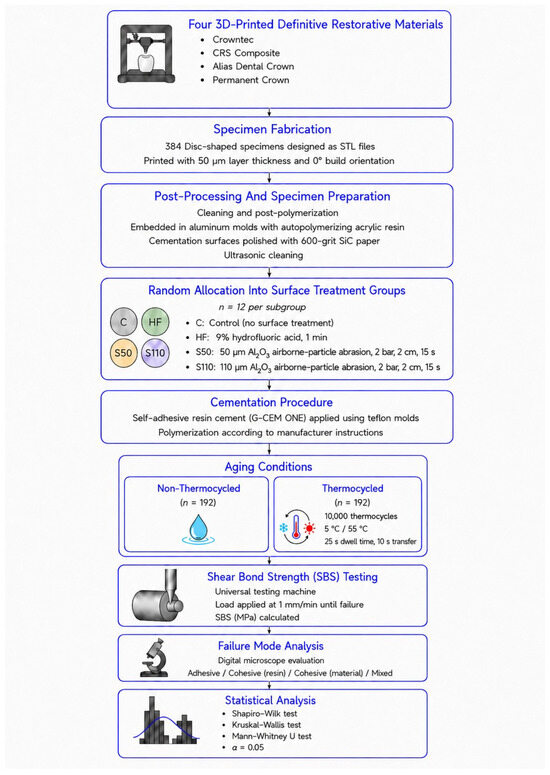
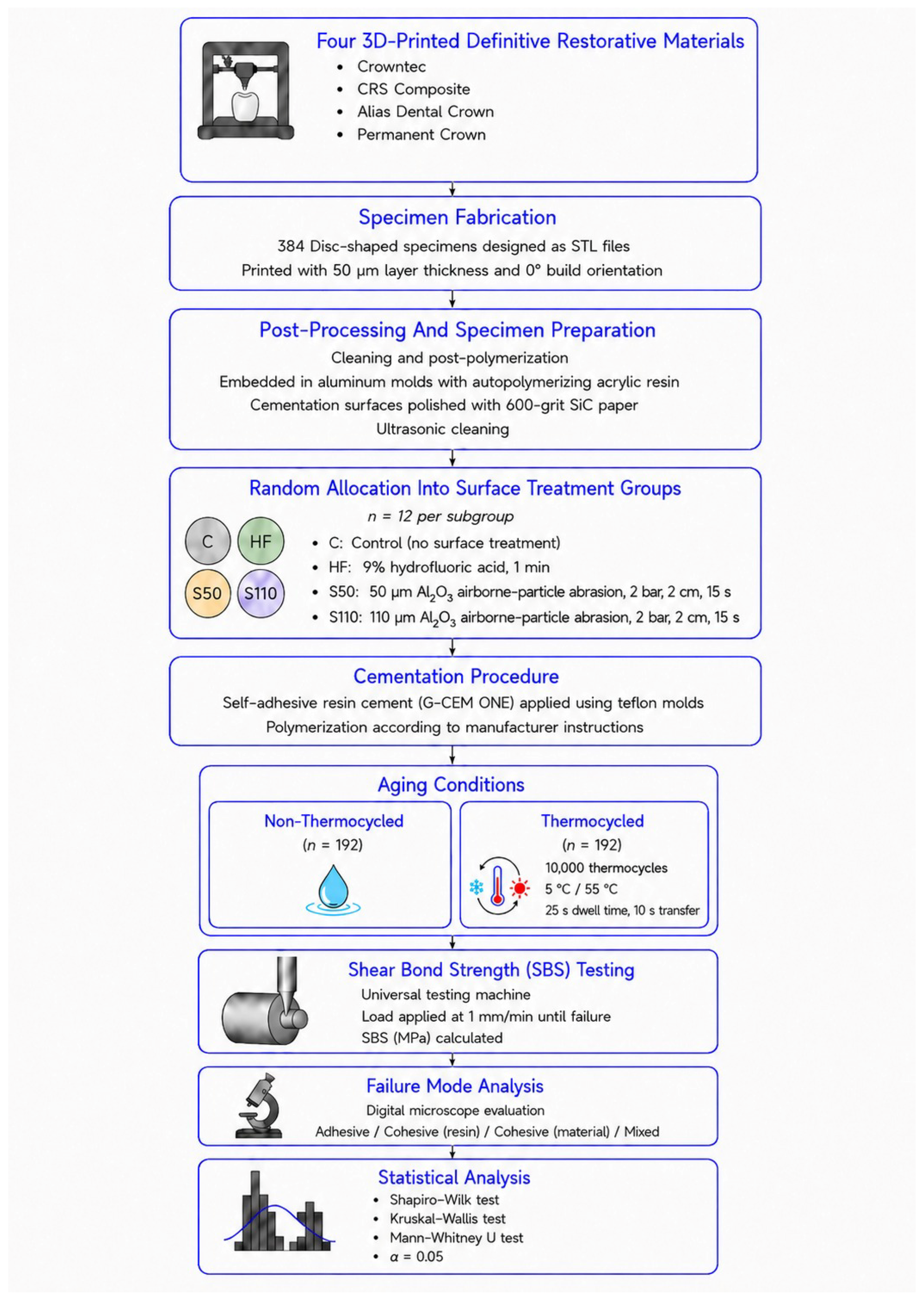
The statistical analyses were performed using NCSS software (Number Cruncher Statistical System, 2007, Kaysville, UT, USA). Descriptive statistics (mean, standard deviation, median, minimum, maximum) were computed, and data distribution was evaluated using the Shapiro–Wilk test. Group differences were analyzed using the Kruskal–Wallis test. Pairwise comparisons were performed with the Mann–Whitney U test. The effect of thermocycling on SBS within each group was also assessed using the Mann–Whitney U test, with the significance level set at α = 0.05. A workflow diagram of the study procedures is presented in Figure 1.
Figure 1.
Diagram representing the experimental workflow.
3. Results
The median, minimum, maximum, mean, and standard deviation SBS values for all materials before and after thermocycling are presented in Table 2 and Table 3.
Table 2.
Median (Med), minimum (min), maximum (max), mean and standard deviation (M ± SD) of shear bond strength (SBS) values for tested materials before thermocycling (MPa).
Table 3.
Median (Med), minimum (min), maximum (max), mean and standard deviation (M ± SD) of shear bond strength (SBS) values for tested materials after thermocycling (MPa).
Before thermocycling, the Kruskal–Wallis test demonstrated that material type had a statistically significant effect on SBS values in the C (p = 0.001, ε2 = 0.33, 95% CI [0.16–0.56]), HF (p = 0.034, ε2 = 0.13, 95% CI [0.01–0.39]), and S110 (p = 0.007, ε2 = 0.21, 95% CI [0.04–0.51]) groups, whereas no statistically significant effect was observed in the S50 group (p = 0.093, ε2 = 0.07, 95% CI [−0.04–0.40]). The Mann–Whitney U test revealed that Crowntec exhibited the highest SBS values in the C group and the lowest SBS values in the HF group (p = 0.001). Statistically, PC exhibited significantly lower SBS values in the S110 group than all other materials (p = 0.001). The Kruskal–Wallis test showed a statistically significant effect of surface treatments on SBS in both Crowntec (p = 0.001) and Alias (p = 0.016), while surface treatments showed no statistically significant effect in CRS (p = 0.333) or PC (p = 0.152) groups. The results of Mann–Whitney U testing showed that HF significantly decreased SBS values in Crowntec compared with the C group, whereas airborne-particle abrasion procedures (S50 and S110) had no significant effect on SBS values. S110 significantly increased bond strength in Alias compared with the C group, whereas the other surface treatments showed no significant effect.
For post-thermocycling, according to the Kruskal–Wallis test, material type had a statistically significant effect on SBS values in the C (p = 0.001, ε2 = 0.48, 95% CI [0.24–0.74]), HF (p = 0.001, ε2 = 0.36, 95% CI [0.22–0.57]), and S110 (p = 0.001, ε2 = 0.28, 95% CI [0.08–0.54]) groups, while no statistically significant effect was observed in the S50 group (p = 0.378, ε2 = 0.01, 95% CI [−0.05–0.28]). The Mann–Whitney U test revealed that Alias exhibited the lowest SBS values in the C group, followed by PC, Crowntec, and CRS. PC demonstrated the lowest SBS values in the HF and S110 groups (p = 0.001), with no statistically significant differences observed in SBS values among the remaining materials. The Kruskal–Wallis test demonstrated that surface treatments had a statistically significant effect on SBS values in Crowntec (p = 0.048), CRS (p = 0.001), Alias (p = 0.001), and PC (p = 0.001). According to the Mann–Whitney U test, HF, S50, and S110 surface treatments resulted in significantly higher SBS values in Crowntec, CRS, and Alias compared with the C group (p = 0.001), whereas no statistically significant differences in SBS values were detected among these surface treatments. All surface treatments were associated with increased SBS values in PC compared with the C group, with the highest SBS values observed following the S50 surface treatment (p = 0.001).
Thermocycling significantly increased SBS values in Crowntec following HF and S110 treatments, in CRS following HF, S50, and S110 treatments, in Alias following HF and S50 treatments, and in PC following S50 treatment (Table 4).
Table 4.
Comparison of SBS values before and after thermocycling according to material and surface treatment.
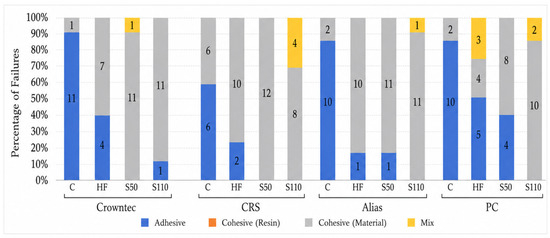
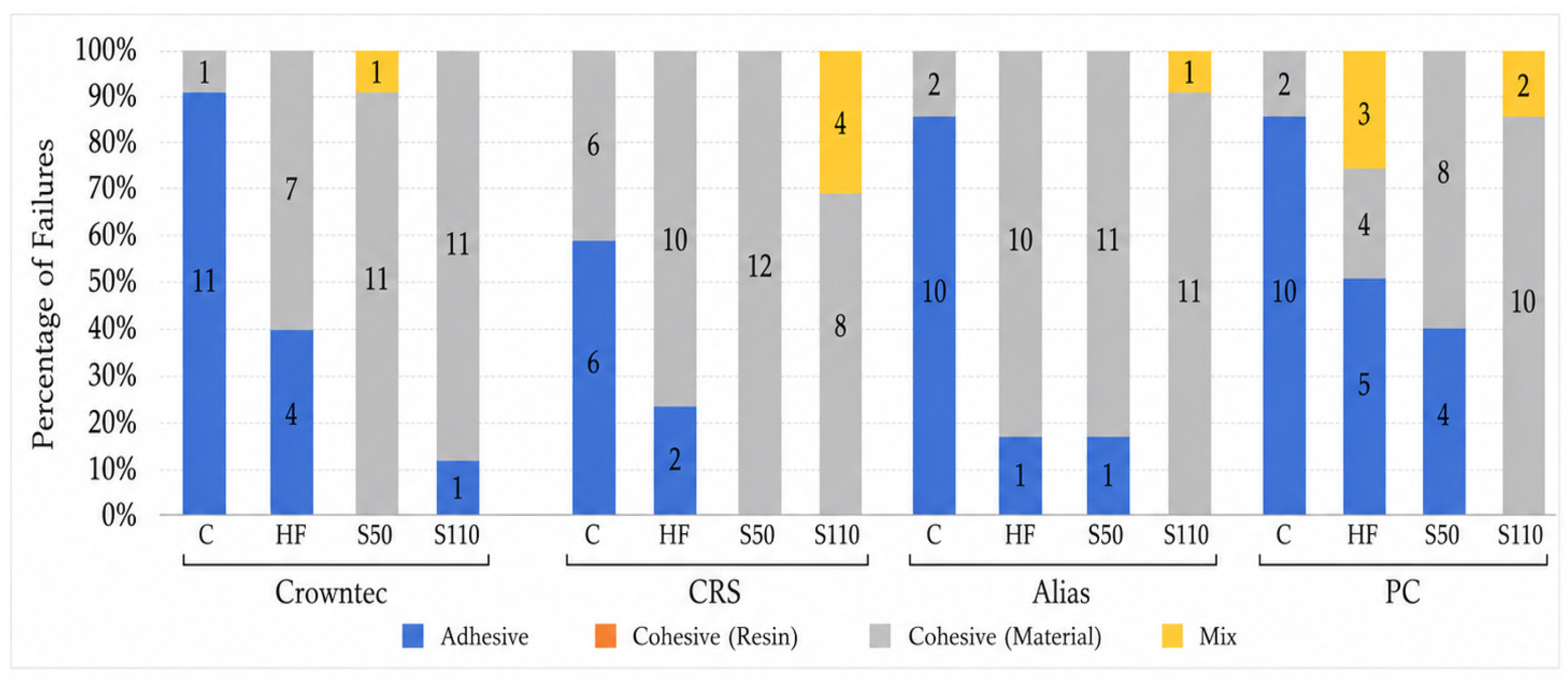
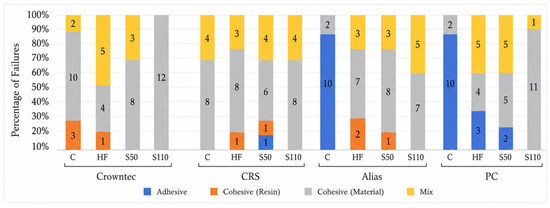
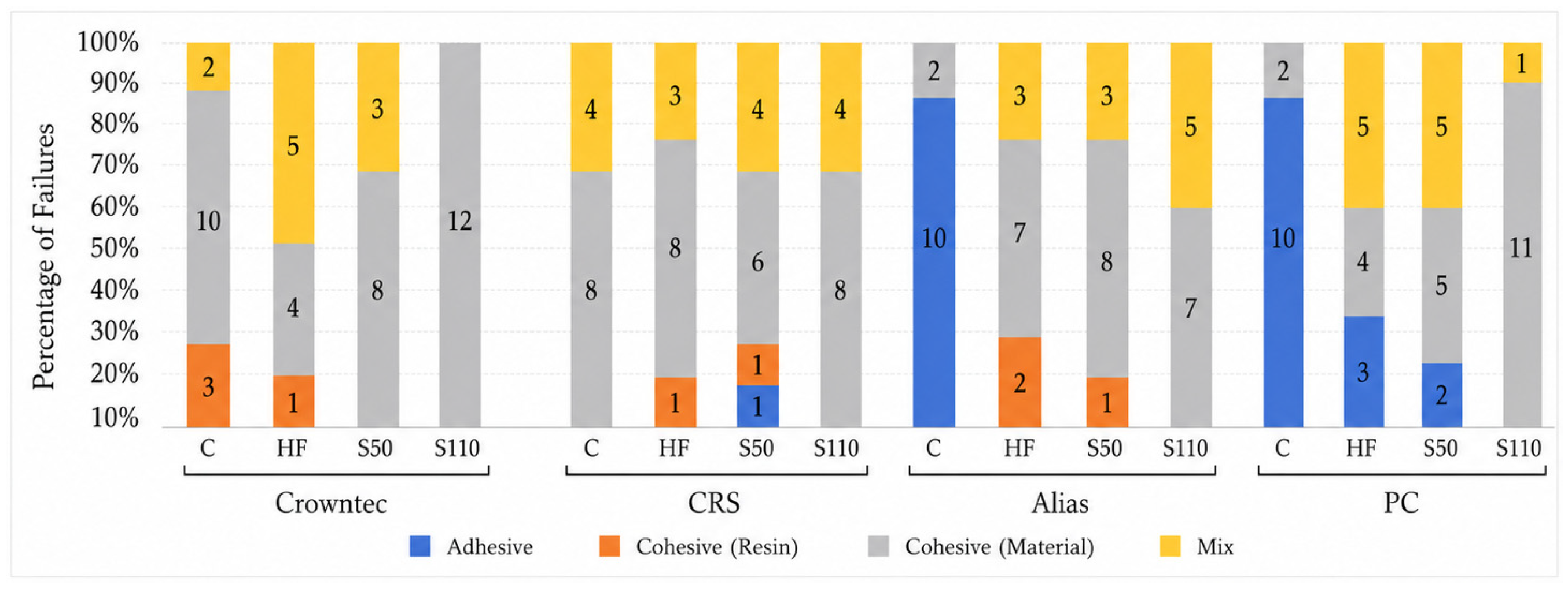
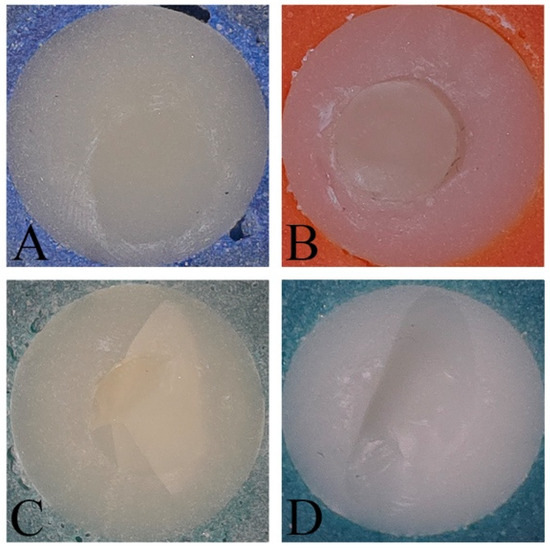
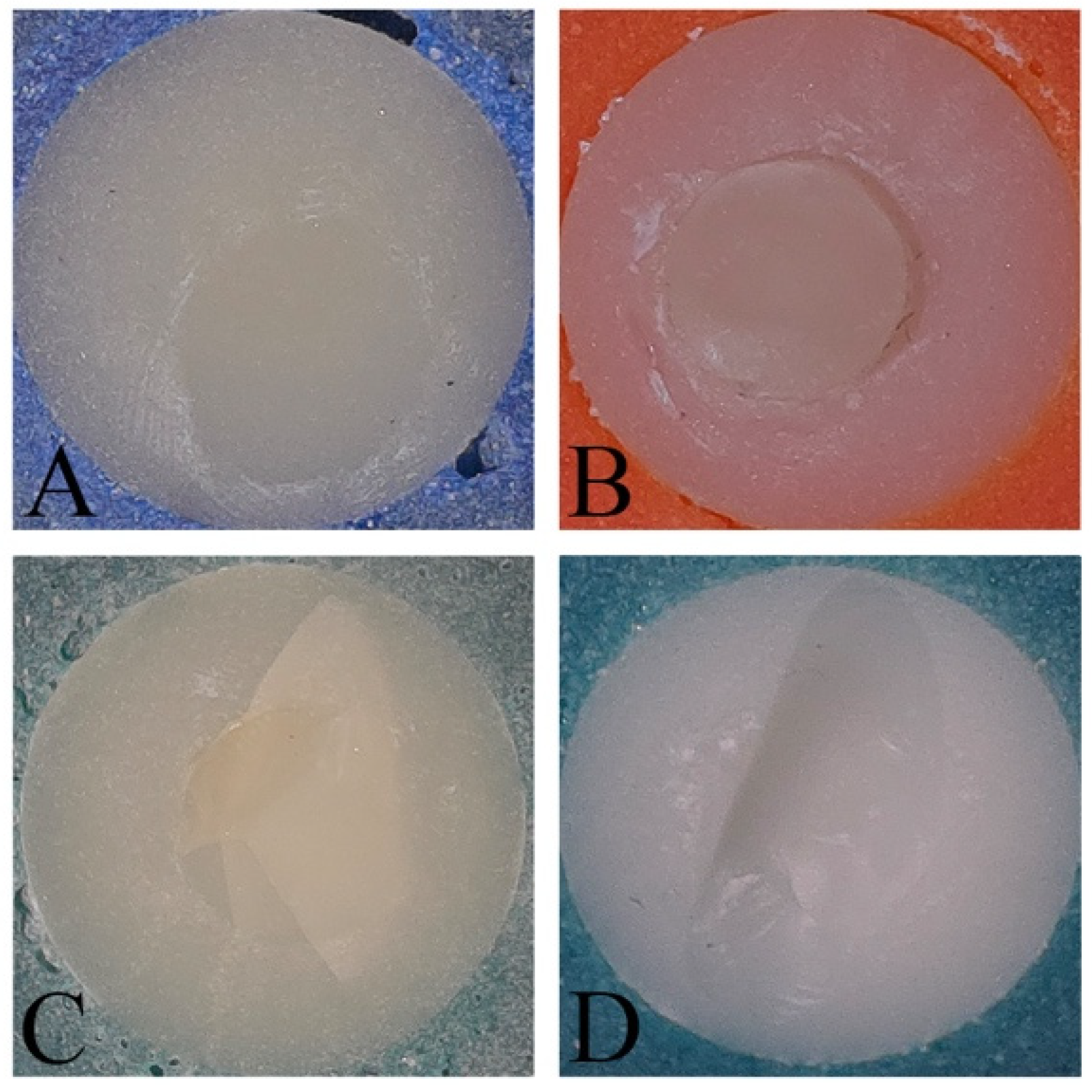
Failure mode findings were interpreted descriptively as exploratory observations. Before thermocycling, failure mode analysis showed that cohesive fractures within the restorative materials were the most frequently observed failure pattern in all experimental groups, accounting for approximately 50–80% of the failures, independent of the surface treatment applied (Figure 2). Adhesive failures occurred less often, generally ranging from 10% to 40%, with comparatively higher frequencies observed in the control and hydrofluoric acid-treated groups. Mixed failure patterns were uncommon and were mainly detected in the S110 airborne-particle abraded groups, where they represented up to 15–30% of the failures. Cohesive failures within the resin cement were rare across all groups and consistently remained below 10%. After thermocycling, failure mode analysis demonstrated that cohesive fractures within the restorative materials continued to be the most prevalent failure type in all groups, accounting for approximately 45–75% of the observed failures (Figure 3). Adhesive failures were more variably distributed after aging, ranging from 20% to 60%, with clearly higher frequencies noted in the control groups. Mixed failures were observed in all surface treatment groups and accounted for roughly 15–30% of the recorded failures, with a modest increase noted in the airborne-particle abraded conditions. Cohesive failures within the resin cement were uncommon and, in all groups, represented less than 10% of the total failures. Representative failure types are shown in Figure 4.
Figure 2.
Distribution of failure patterns before thermocycling. Crowntec; CRS: CRS Composite; Alias: Alias Dental Crown; PC: Permanent Crown. C: Control; HF: Hydrofluoric acid etched; S50: 50 µm Al2O3 airborne-particle abraded; S110: 110 µm Al2O3 airborne-particle abraded.
Figure 3.
Distribution of failure patterns after thermocycling. Crowntec; CRS: CRS Composite; Alias: Alias Dental Crown; PC: Permanent Crown. C: Control; HF: Hydrofluoric acid etched; S50: 50 µm Al2O3 airborne-particle abraded; S110: 110 µm Al2O3 airborne-particle abraded.
Figure 4.
Failure types of tested materials: (A) Adhesive; (B) Cohesive from resin cement; (C) Mixed; (D) Cohesive from material.
4. Discussion
In this in vitro study, material type and surface treatment significantly influenced the SBS of SARC to additively manufactured definitive restorative materials. Accordingly, the null hypothesis regarding the effects of material type, surface treatment, and thermocycling on bond strength was rejected.
Water storage is a commonly used artificial aging method for assessing the degradation of resin-based materials. However, thermocycling simulates temperature changes in the oral cavity to provide a more relevant measure of bond durability over time [34,35]. In the current study, 10,000 thermal cycles were applied to half of the specimens, representing approximately one year of simulated clinical aging [36]. The SBS test is a commonly used method for evaluating the bonding performance of dental materials after different surface treatments [16,28,29]. Since the masticatory forces in the oral cavity are predominantly shear in nature, SBS test is considered a clinically relevant method [25]. Although tensile bond strength tests theoretically provide a more uniform stress distribution, their reliability may be compromised by factors such as specimen misalignment [37,38]. The findings of the current study demonstrated that SBS values increased after thermocycling; however, the control groups did not show any statistically significant increase. Thermocycling has often been linked to hydrolytic degradation of adhesive interfaces, as previous studies attributed thermocycling-related bond strength reductions to dimensional changes caused by thermal expansion mismatch and water sorption of hydrophilic adhesive components [39,40,41]. However, other studies have reported an increase in SBS after thermocycling in resin-based adhesive systems [31,42]. This increase in SBS after thermocycling in surface-treated groups may be related to temperature-induced post-polymerization of the resin cements and restorative materials, which can occur in those containing residual unreacted methacrylate groups [31]. In addition, the SARC used in this study contains functional components such as 10-methacryloyloxydecyl dihydrogen phosphate (10-MDP) and silane-containing constituents. These components may help support interfacial stability through chemical interactions with inorganic phases and copolymerization with methacrylate-based materials. The long hydrophobic character of the alkylene component of MDP was suggested to contribute to hydrophobicity, which may favor long-term bond durability [43]. In addition, the silane content in SARC may facilitate chemical interaction with inorganic fillers and improve surface wettability, which may potentially contribute to interfacial adaptation and micromechanical retention [23]. However, since degree of conversion, interfacial chemistry, surface morphology, and water sorption were not directly evaluated, these possible explanations should be considered tentative and based on the previous literature rather than direct findings of the present study [44].
The findings of the current study showed that both material and surface treatment significantly affected the SBS values of additively manufactured definitive restorative materials prior to thermocycling assessments in all groups except S50. This may indicate that the 50 µm airborne-particle abrasion has a more neutral effect on the surfaces of different materials which yielded similar SBS values in all tested groups [45]. In addition, the materials were produced using different printing and post-processing conditions. Therefore the observed differences cannot be attributed solely to resin composition or filler content. They likely result from a combination of material formulation, printing technology, and post-processing conditions.
In the present study, the Crowntec HF group showed the lowest SBS values compared with the control and airborne-particle abrasion groups before thermocycling. The 9% HF protocol was included as a commonly investigated chemical surface treatment; however, its effectiveness was expected to be material-dependent [19,30]. Hydrofluoric acid dissolves the glass matrix of the ceramic materials but it may not be as effective on resin-based restorative materials [46]. This may be related to the relatively high resin polymer content of the material and lower inorganic filler content. Other than material composition, the manufacturing workflow may have influenced the behavior of Crowntec, which was fabricated using a DLP-based system and a specific post-polymerization protocol in the present study. Ersöz et al. reported that both printer technology and surface treatment significantly affected SBS. Their results showed that DLP-fabricated Crowntec showed higher SBS values than SLA-fabricated Permanent Crown. This finding is consistent with the present results, in which Crowntec generally exhibited higher SBS values than PC, suggesting that the observed bonding performance may be related not only to material formulation but also to the combined effects of printing technology and post-processing procedures [19,47].
In addition, the Crowntec material contains barium glass, an inorganic component which may respond less favorably to HF etching as reported by Niizuma et al. [48]. Consistent with the present study, in previous articles, the SBS of CAD/CAM hybrid ceramic materials was tested after airborne-particle abrasion and HF etching, and the results showed that HF etching was not as effective as airborne-particle abrasion [44,49]. In the present study, after thermocycling, the SBS values of the Crowntec HF group increased. One possible explanation can be that the temperature changes during thermocycling may have contributed to additional polymer network maturation at the bonded interface. Lankes et al. [31] tested the SBS after different surface treatments on the resin-based material and found that thermocycling significantly improved the SBS values, similar to the results of the present study. In contrast Mao et al. [49] studied different surface treatments on machinable and printable resin-based materials and found that thermocycling did not show statistically significant differences on the SBS values.
In the literature, various alumina particle sizes have been investigated; however, optimal airborne-particle abrasion parameters for 3D-printed definitive restorative materials have not yet been established. The present study compared 50 µm and 110 µm Al2O3 particles under standardized pressure, distance, and application time to allow controlled comparison between the two alumina particle sizes. Although the airborne-particle abrasion parameters were standardized, the response to abrasion may differ among materials because manufacturer recommendations and material compositions vary [50,51]. The results of this study showed that the PC S110 group demonstrated lower SBS values both before and after thermocycling when compared to the other materials with S110 surface treatment. This may be attributed to the reduction in physical properties associated with the use of larger alumina particle sizes during airborne-particle abrasion. This lower SBS observed in PC group treated with S110 may be influenced not only by particle size but also by the interaction of its material composition and SLA-based fabrication and post-processing workflow. Previous studies have reported that printing and processing parameters can significantly affect bonding outcomes [19,47]. A previous study has shown that increasing alumina particle size adversely affects physical properties of the resin-based definitive restoration materials [33]. After thermocycling, the PC S50 group demonstrated a statistically significant increase in SBS. This effect may be attributed to increased surface roughness and disruption of C–C and C–H polymer chains, which may enhance the micromechanical interlocking and improves the wettability and penetration of the bonding agent into the polymer matrix. In addition, free radicals generated by polymer chain breakage may further strengthen chemical bonding with resin-based adhesive cements through chain transfer reactions [52].
The results of the present study showed that the Alias S110 group exhibited significantly higher SBS values when compared to the Alias C group before and after thermocycling. This may be explained by the material’s resin matrix characteristics. A UDMA-based resin matrix has been reported to exhibit lower maximum deformation and higher elastic recovery under identical loading conditions compared with Bis-EMA-based materials [33]. This characteristic may allow effective surface modification with airborne-particle abrasion without substantial mechanical degradation, which may explain the favorable bonding performance observed after S110 treatment.
Failure mode analysis was exploratory. The exploratory analysis showed a majority of cohesive failures within the restorative materials both before and after thermocycling. This may suggest that, in several groups, the apparent interfacial bond strength approached or exceeded the cohesive strength of the tested restorative materials [53]. The higher incidence of adhesive failures observed in the C and HF-treated groups before thermocycling indicates that the surface modifications in these groups were less effective. In contrast, the increased occurrence of mixed failures in the S110 groups may reflect a more balanced distribution of stress between the adhesive interface and the restorative material. Cohesive failures within the resin cement were rare, indicating that cement integrity was not the limiting factor in bond performance. Overall, these findings are consistent with previous studies reporting that surface treatments enhance durable bonding and shift failure patterns toward cohesive modes in 3D-printed restorative materials following thermocycling [15,18].
The present study demonstrated that bond strength between SARC and additively manufactured definitive restorative materials varied according to the type of restorative material, as materials respond differently to similar surface treatments due to variations in resin matrix compositions and the type and distribution of fillers. Selection of surface treatments should therefore be guided by the specific compositional and structural characteristics of the restorative materials. This material-dependent interpretation is supported by recent evidence showing that the SBS of self-adhesive resin cements is influenced by the specific cement–substrate combination, with different CAD/CAM ceramic systems showing different bonding performance after aging [54]. This approach may achieve more consistent adhesive outcomes and reduce the risk of interfacial complications such as microleakage or debonding. In this context, material-specific surface treatment protocols appear critical for ensuring the long-term clinical reliability of 3D-printed definitive restorative materials. The tested materials differed not only in composition but also in printing technology and post-processing protocols. Because each material was fabricated using a different printer type and curing procedure, the observed differences should be interpreted as reflecting commercial material–manufacturing systems rather than material composition alone. It has been reported that printing and post-curing parameters can significantly affect the mechanical properties and aging behavior of 3D-printed restorative materials. Therefore, the findings of the present study likely reflect the combined influence of material composition and manufacturing workflow [55,56].
This study has several limitations. The in vitro design cannot replicate the full complexity of the oral environment, including saliva, pH fluctuations, masticatory forces, and long-term degradation. Only one self-adhesive resin cement and a limited number of surface treatment protocols were evaluated, which restricts generalizability. A critical limitation is the absence of direct surface characterization after treatment. Bond strength differences were discussed in relation to surface roughness, micromechanical retention, wettability, and polymer matrix alteration; however, these mechanisms were not experimentally verified and should be considered literature-based interpretations. Including SEM imaging, contact angle measurements, and surface analysis in future research would provide a much deeper insight into the findings. Furthermore, the tested materials differed in composition and filler content as well as in printing technology, post-processing, and post-curing conditions. This makes it difficult to attribute findings solely to material composition. Future studies should standardize these variables or evaluate identical materials across different workflows to better isolate their individual effects.
5. Conclusions
- Within the limitations of this in vitro study, both material type and surface treatment significantly affected the SBS of SARC to 3D-printed definitive restorative materials.
- Airborne-particle abrasion generally improved bond strength and maintained adhesion after thermocycling, whereas the effectiveness of hydrofluoric acid etching was material-dependent and limited in resin-based materials.
- Under the experimental conditions, thermocycling was not associated with reduced bond strength in most surface-treated groups and, in some conditions, resulted in increased SBS values.
- These findings emphasize the significance of choosing appropriate surface treatment protocols compatible with material composition to enhance bond strength of 3D-printed definitive restorative materials.
Author Contributions
İ.C.K. Investigation, Conceptualization, Methodology, Validation, Resources, Writing—Original Draft, Writing—Review and Editing. Y.A.S.A.H. Investigation, Reviewing and Editing. A.İ. Investigation, Methodology, Reviewing and Editing. S.T. Investigation, Conceptualization, Methodology, Validation, Reviewing and Editing, Project administration. All authors have read and agreed to the published version of the manuscript.
Funding
This research received no external funding.
Institutional Review Board Statement
Ethical approval was granted by the Cyprus Health and Social Sciences University Research Ethics Committee on 12/02/2025 (Approval No: KSTU//2024/354).
Informed Consent Statement
Not applicable.
Data Availability Statement
The datasets used and/or analyzed during the current study are available from the corresponding author on reasonable request.
Acknowledgments
The authors would like to thank Mustafa Yeşil, from Ankara University Research Laboratory, for his support during the laboratory work.
Conflicts of Interest
The authors declare no conflicts of interest.
Abbreviations
| 3D | Three-dimensional |
| CAD/CAM | Computer-aided design and computer aided manufacturing |
| DLP | Digital light processing |
| HF | Hydrofluoric acid |
| LED | Light-emitting diode |
| MSLA | Masked stereolithography |
| SARC | Self-adhesive resin cement |
| SBS | Shear bond strength |
| SLA | Stereolithography |
| STL | Standard tessellation language |
| UV | Ultraviolet |
| VP | Vat photopolymerization |
References
- Cengiz-Yanardag, E.; Kurtulmus Yilmaz, S.; Karakaya, I.; Ongun, S. Effect of Different Surface Treatment Methods on Micro-Shear Bond Strength of CAD-CAM Restorative Materials to Resin Cement. J. Adhes. Sci. Technol. 2019, 33, 110–123. [Google Scholar] [CrossRef] [Scilit]
- Awada, A.; Nathanson, D. Mechanical Properties of Resin-Ceramic CAD/CAM Restorative Materials. J. Prosthet. Dent. 2015, 114, 587–593. [Google Scholar] [CrossRef] [Scilit] [PubMed]
- Dawood, A.; Marti, B.M.; Sauret-Jackson, V.; Darwood, A. 3D Printing in Dentistry. Br. Dent. J. 2015, 219, 521–529. [Google Scholar] [CrossRef] [Scilit] [PubMed]
- Al Hamad, K.Q.; Al-Rashdan, B.A.; Ayyad, J.Q.; Al Omrani, L.M.; Sharoh, A.M.; Al Nimri, A.M.; Al-Kaff, F.T. Additive Manufacturing of Dental Ceramics: A Systematic Review and Meta-Analysis. J. Prosthodont. 2022, 31, E67–E86. [Google Scholar] [CrossRef] [Scilit] [PubMed]
- Yüceer, Ö.M.; Kaynak Öztürk, E.; Çiçek, E.S.; Aktaş, N.; Bankoğlu Güngör, M. Three-Dimensional-Printed Photopolymer Resin Materials: A Narrative Review on Their Production Techniques and Applications in Dentistry. Polymers 2025, 17, 316. [Google Scholar] [CrossRef] [Scilit] [PubMed]
- Tigmeanu, C.V.; Ardelean, L.C.; Rusu, L.-C.; Negrutiu, M.-L. Additive Manufactured Polymers in Dentistry, Current State-of-the-Art and Future Perspectives-A Review. Polymers 2022, 14, 3658. [Google Scholar] [CrossRef] [Scilit] [PubMed]
- Nagasawa, Y.; Eda, Y.; Shigeta, H.; Ferrari, M.; Nakajima, H.; Hibino, Y. Effect of Sandblasting and/or Priming Treatment on the Shear Bond Strength of Self-Adhesive Resin Cement to CAD/CAM Blocks. Odontology 2022, 110, 70–80. [Google Scholar] [CrossRef] [Scilit] [PubMed]
- Uçar, Y.; Aysan Meriç, İ.; Ekren, O. Layered Manufacturing of Dental Ceramics: Fracture Mechanics, Microstructure, and Elemental Composition of Lithography-Sintered Ceramic. J. Prosthodont. 2019, 28, e310–e318. [Google Scholar] [CrossRef] [Scilit] [PubMed]
- Donmez, M.B.; Çakmak, G.; Yılmaz, D.; Schimmel, M.; Abou-Ayash, S.; Yilmaz, B.; Peutzfeldt, A. Bond Strength of Additively Manufactured Composite Resins to Dentin and Titanium When Bonded with Dual-Polymerizing Resin Cements. J. Prosthet. Dent. 2024, 132, 1067.e1–1067.e8. [Google Scholar] [CrossRef] [Scilit] [PubMed]
- Han, J.; Shin, J.; Shim, J.-S.; Kim, R.J.Y. Effects of Dentin Bonding Agents and Silanization on Bond Strength between 3D Printed Resin and Composite Resin. Dent. Mater. J. 2024, 43, 400–406. [Google Scholar] [CrossRef] [Scilit] [PubMed]
- Graf, T.; Erdelt, K.-J.; Güth, J.-F.; Edelhoff, D.; Schubert, O.; Schweiger, J. Influence of Pre-Treatment and Artificial Aging on the Retention of 3D-Printed Permanent Composite Crowns. Biomedicines 2022, 10, 2186. [Google Scholar] [CrossRef] [Scilit] [PubMed]
- Şenol, M.; Gürbüz, A.; Oyar, P. Bond Strength of Conventional Resin-Based Adhesive Cement and Self-Adhesive Resin Cement to CAD-CAM Restorative Materials. BMC Oral Health 2025, 25, 296. [Google Scholar] [CrossRef] [Scilit] [PubMed]
- Yeolekar, T.S.; Chowdhary, N.R.; Mukunda, K.S.; Kiran, N.K. Evaluation of Microleakage and Marginal Ridge Fracture Resistance of Primary Molars Restored with Three Restorative Materials: A Comparative in Vitro Study. Int. J. Clin. Pediatr. Dent. 2015, 8, 108–113. [Google Scholar] [CrossRef] [Scilit] [PubMed]
- Kumari, A.; Singh, N. A Comparative Evaluation of Microleakage and Dentin Shear Bond Strength of Three Restorative Materials. Biomater. Investig. Dent. 2022, 9, 1–9. [Google Scholar] [CrossRef] [Scilit] [PubMed]
- Alp, G.; Subaşı, M.G.; Johnston, W.M.; Yilmaz, B. Effect of Different Resin Cements and Surface Treatments on the Shear Bond Strength of Ceramic-Glass Polymer Materials. J. Prosthet. Dent. 2018, 120, 454–461. [Google Scholar] [CrossRef] [Scilit] [PubMed]
- Hammamy, M.; Rueda, S.; Pio, A.; Rizzante, F.; Lawson, N. Effect of Air Particle Abrasion and Primers on Bond Strength to 3D-Printed Crown Materials. Materials 2025, 18, 265. [Google Scholar] [CrossRef] [Scilit] [PubMed]
- Yoshihara, K.; Nagaoka, N.; Maruo, Y.; Nishigawa, G.; Irie, M.; Yoshida, Y.; Van Meerbeek, B. Sandblasting May Damage the Surface of Composite CAD–CAM Blocks. Dent. Mater. 2017, 33, e124–e135. [Google Scholar] [CrossRef] [Scilit] [PubMed]
- Fathy, H.; Hamama, H.H.; El-Wassefy, N.; Mahmoud, S.H. Effect of Different Surface Treatments on Resin-Matrix CAD/CAM Ceramics Bonding to Dentin: In Vitro Study. BMC Oral Health 2022, 22, 635. [Google Scholar] [CrossRef] [Scilit] [PubMed]
- Ersöz, B.; Aydın, N.; Ezmek, B.; Karaoğlanoğlu, S.; Çal, İ. Effect of Surface Treatments Applied to 3D Printed Permanent Resins on Shear Bond Strength. J. Clin. Exp. Dent. 2024, 16, e1059–e1066. [Google Scholar] [CrossRef] [Scilit] [PubMed]
- Amaral, F.L.B.; Colucci, V.; Palma-Dibb, R.G.; Corona, S.A.M. Assessment of In Vitro Methods Used to Promote Adhesive Interface Degradation: A Critical Review. J. Esthet. Restor. Dent. 2007, 19, 340–353. [Google Scholar] [CrossRef] [Scilit] [PubMed]
- Amin, F.; Fareed, M.A.; Zafar, M.S.; Khurshid, Z.; Palma, P.J.; Kumar, N. Degradation and Stabilization of Resin-Dentine Interfaces in Polymeric Dental Adhesives: An Updated Review. Coatings 2022, 12, 1094. [Google Scholar] [CrossRef] [Scilit]
- Nagasawa, Y.; Hibino, Y.; Eda, Y.; Nakajima, H. Effect of Surface Treatment of CAD/CAM Resin Composites on the Shear Bond Strength of Self-Adhesive Resin Cement. Dent. Mater. J. 2021, 40, 364–378. [Google Scholar] [CrossRef] [Scilit] [PubMed]
- Kang, Y.-J.; Park, Y.; Shin, Y.; Kim, J.-H. Effect of Adhesion Conditions on the Shear Bond Strength of 3D Printing Resins after Thermocycling Used for Definitive Prosthesis. Polymers 2023, 15, 1390. [Google Scholar] [CrossRef] [Scilit] [PubMed]
- Van Meerbeek, B.; De Munck, J.; Yoshida, Y.; Inoue, S.; Vargas, M.; Vijay, P.; Van Landuyt, K.; Lambrechts, P.; Vanherle, G. Buonocore Memorial Lecture. Adhesion to Enamel and Dentin: Current Status and Future Challenges. Oper. Dent. 2003, 28, 215–235. [Google Scholar] [CrossRef] [Scilit]
- El Mourad, A.M. Assessment of Bonding Effectiveness of Adhesive Materials to Tooth Structure Using Bond Strength Test Methods: A Review of Literature. Open Dent. J. 2018, 12, 664–678. [Google Scholar] [CrossRef] [Scilit] [PubMed]
- al-Salehi, S.K.; Burke, F.J. Methods Used in Dentin Bonding Tests: An Analysis of 50 Investigations on Bond Strength. Quintessence Int. Berl. Ger. 1997, 28, 717–723. [Google Scholar] [PubMed]
- Leinfelder, K.F. Dentin Adhesives for the Twenty-First Century. Dent. Clin. N. Am. 2001, 45, 1–6. [Google Scholar] [CrossRef] [Scilit]
- Dederichs, M.; Badr, Z.; Viebranz, S.; Nietzsche, S.; Schulze-Späte, U.; Schmelzer, A.-S.; Lehmann, T.; Guentsch, A. Effect of Surface Conditioning on the Adhesive Bond Strength of 3D-Printed Resins Used in Permanent Fixed Dental Prostheses. J. Dent. 2025, 155, 105621. [Google Scholar] [CrossRef] [Scilit] [PubMed]
- Kim, M.; Lee, J.; Park, C.; Jo, D.; Yu, B.; Khalifah, S.A.; Hayashi, M.; Kim, R.H. Evaluation of Shear Bond Strengths of 3D Printed Materials for Permanent Restorations with Different Surface Treatments. Polymers 2024, 16, 1838. [Google Scholar] [CrossRef] [Scilit] [PubMed]
- Güngör, M.B.; Nemli, S.K.; Bal, B.T.; Ünver, S.; Doğan, A. Effect of Surface Treatments on Shear Bond Strength of Resin Composite Bonded to CAD/CAM Resin-Ceramic Hybrid Materials. J. Adv. Prosthodont. 2016, 8, 259. [Google Scholar] [CrossRef] [Scilit] [PubMed]
- Lankes, V.; Reymus, M.; Liebermann, A.; Stawarczyk, B. Bond Strength between Temporary 3D Printable Resin and Conventional Resin Composite: Influence of Cleaning Methods and Air-Abrasion Parameters. Clin. Oral Investig. 2022, 27, 31–43. [Google Scholar] [CrossRef] [Scilit] [PubMed]
- Kim, J.-E.; Lim, J.-H.; Kang, Y.-J.; Kim, J.-H.; Shim, J.-S. Effect of Pressure and Particle Size During Aluminum Oxide Air Abrasion on the Flexural Strength of Disperse-Filled Composite and Polymer-Infiltrated Ceramic Network Materials. Polymers 2020, 12, 1396. [Google Scholar] [CrossRef] [Scilit] [PubMed]
- Kang, Y.-J.; Kim, H.; Lee, J.; Park, Y.; Kim, J.-H. Effect of Airborne Particle Abrasion Treatment of Two Types of 3D-Printing Resin Materials for Permanent Restoration Materials on Flexural Strength. Dent. Mater. 2023, 39, 648–658. [Google Scholar] [CrossRef] [Scilit] [PubMed]
- Lüthy, H.; Loeffel, O.; Hammerle, C.H.F. Effect of Thermocycling on Bond Strength of Luting Cements to Zirconia Ceramic. Dent. Mater. 2006, 22, 195–200. [Google Scholar] [CrossRef] [Scilit] [PubMed]
- Eliasson, S.T.; Dahl, J.E. Effect of Thermal Cycling on Temperature Changes and Bond Strength in Different Test Specimens. Biomater. Investig. Dent. 2020, 7, 16–24. [Google Scholar] [CrossRef] [Scilit] [PubMed]
- Gale, M.S.; Darvell, B.W. Thermal Cycling Procedures for Laboratory Testing of Dental Restorations. J. Dent. 1999, 27, 89–99. [Google Scholar] [CrossRef] [Scilit] [PubMed]
- Sirisha, K.; Ravishankar, Y.; Ravikumar, P.; Rambabu, T. Validity of Bond Strength Tests: A Critical Review-Part II. J. Conserv. Dent. 2014, 17, 420. [Google Scholar] [CrossRef] [Scilit] [PubMed]
- Aydin, N.; Celik Oge, S.; Guney, O.; Okbaz, O.; Sertdemir, Y. A Comparison of the Shear Bond Strength between a Luting Composite Resin and Both Machinable and Printable Ceramic–Glass Polymer Materials. Materials 2024, 17, 4697. [Google Scholar] [CrossRef] [Scilit] [PubMed]
- Smith, R.L.; Villanueva, C.; Rothrock, J.K.; Garcia-Godoy, C.E.; Stoner, B.R.; Piascik, J.R.; Thompson, J.Y. Long-Term Microtensile Bond Strength of Surface Modified Zirconia. Dent. Mater. 2011, 27, 779–785. [Google Scholar] [CrossRef] [Scilit] [PubMed]
- Deng, D.; Yang, H.; Guo, J.; Chen, X.; Zhang, W.; Huang, C. Effects of Different Artificial Ageing Methods on the Degradation of Adhesive–Dentine Interfaces. J. Dent. 2014, 42, 1577–1585. [Google Scholar] [CrossRef] [Scilit] [PubMed]
- Sutuven, E.O.; Yildirim, N.C. Bond Strength of Self-Adhesive Resin Cement to Definitive Resin Crown Materials Manufactured by Additive and Subtractive Methods. Dent. Mater. J. 2025, 44, 41–51. [Google Scholar] [CrossRef] [Scilit] [PubMed]
- Yoshida, K.; Kamada, K.; Atsuta, M. Effects of Two Silane Coupling Agents, a Bonding Agent, and Thermal Cycling on the Bond Strength of a CAD/CAM Composite Material Cemented with Two Resin Luting Agents. J. Prosthet. Dent. 2001, 85, 184–189. [Google Scholar] [CrossRef] [Scilit] [PubMed]
- Lee, S.-E.; Bae, J.-H.; Choi, J.-W.; Jeon, Y.-C.; Jeong, C.-M.; Yoon, M.-J.; Huh, J.-B. Comparative Shear-Bond Strength of Six Dental Self-Adhesive Resin Cements to Zirconia. Materials 2015, 8, 3306–3315. [Google Scholar] [CrossRef] [Scilit]
- Palomeque, S.; Loguercio, A.D.; Arrais, C.A.G.; Sánchez, C.; Pulido, C. Three-Dimensionally Printed and Milled Composite Materials for Definitive Restorations. Part 2: Effect of Surface Treatment on the Bond Strength of Light-Polymerized Resin Cement and Surface Morphology. J. Prosthet. Dent. 2025, 135, 581.e1–581.e9. [Google Scholar] [CrossRef] [Scilit] [PubMed]
- Bourgi, R.; Etienne, O.; Holiel, A.A.; Cuevas-Suárez, C.E.; Hardan, L.; Roman, T.; Flores-Ledesma, A.; Qaddomi, M.; Haikel, Y.; Kharouf, N. Effectiveness of Surface Treatments on the Bond Strength to 3D-Printed Resins: A Systematic Review and Meta-Analysis. Prosthesis 2025, 7, 56. [Google Scholar] [CrossRef] [Scilit]
- Kilinc, H.; Sanal, F.A.; Turgut, S. Shear Bond Strengths of Aged and Non-Aged CAD/CAM Materials after Different Surface Treatments. J. Adv. Prosthodont. 2020, 12, 273. [Google Scholar] [CrossRef] [Scilit] [PubMed]
- Kagaoan, Z.; Liu, X.; Cameron, A.; Aarts, J.; Choi, J.J.E. Prolonged Post-Washing in Ethanol Decreases Bond Strength of Additively Manufactured Crown Materials. J. Dent. 2024, 144, 104873. [Google Scholar] [CrossRef] [Scilit] [PubMed]
- Niizuma, Y.; Kobayashi, M.; Toyama, T.; Manabe, A. Effect of Etching with Low Concentration Hydrofluoric Acid on the Bond Strength of CAD/CAM Resin Block. Dent. Mater. J. 2020, 39, 1000–1008. [Google Scholar] [CrossRef] [Scilit] [PubMed]
- Mao, Z.; Schmidt, F.; Beuer, F.; Yassine, J.; Hey, J.; Prause, E. Effect of Surface Treatment Strategies on Bond Strength of Additively and Subtractively Manufactured Hybrid Materials for Permanent Crowns. Clin. Oral Investig. 2024, 28, 371. [Google Scholar] [CrossRef] [Scilit] [PubMed]
- El-Shazly, M.; Alkaranfilly, G.; El-Ghazawy, M.O.; Emad, B.; Mahrous, A. Micro-Shear Bond Strength of 3D Printed Hybrid Ceramic with Non-Thermal Plasma Surface Treatment: In-Vitro Study. Sci. Rep. 2026, 16, 11237. [Google Scholar] [CrossRef] [Scilit] [PubMed]
- Sinha, N.; Thompson, G.A.; Drago, C.; An, H. Shear Bond Strength Characteristics on Surface Treatment Modalities of CAD-CAM Resin Polymers. J. Prosthodont. 2023, 34, 26–32. [Google Scholar] [CrossRef] [Scilit] [PubMed]
- Alnafaiy, S.M.; Labban, N.; Albaijan, R.; AlKahtani, R.N.; Al-Aali, K.A.; Abozaed, H.W.; Alturki, N.Y.; Alenezi, J.E. Evaluation of Shear Bond Strength and Failure Modes of Lithium Disilicate Ceramic Veneering Material to Different High-Performance Polymers. Polymers 2025, 17, 554. [Google Scholar] [CrossRef] [Scilit] [PubMed]
- Kim, J.-E.; Kim, J.-H.; Shim, J.-S.; Roh, B.-D.; Shin, Y. Effect of Air-Particle Pressures on the Surface Topography and Bond Strengths of Resin Cement to the Hybrid Ceramics. Dent. Mater. J. 2017, 36, 454–460. [Google Scholar] [CrossRef] [Scilit] [PubMed]
- Malin, J.; Anja, L.; Christoph, S. Impact of Self-Adhesive Resin Cements on Shear Bond Strength to CAD/CAM Silicate Ceramics. Dent. Med. Probl. 2026, 63, 189–198. [Google Scholar] [CrossRef] [Scilit] [PubMed]
- Aktug Karademir, S.; Atasoy, S.; Akarsu, S.; Karaaslan, E. Effects of Post-Curing Conditions on Degree of Conversion, Microhardness, and Stainability of 3D Printed Permanent Resins. BMC Oral Health 2025, 25, 304. [Google Scholar] [CrossRef] [Scilit] [PubMed]
- Hoffmann, M.; Coldea, A.; Stawarczyk, B. Mechanical Properties of Novel 3D-Printed Restorative Materials for Definitive Dental Applications. Materials 2025, 18, 4662. [Google Scholar] [CrossRef] [Scilit] [PubMed]

Disclaimer/Publisher’s Note: The statements, opinions and data contained in all publications are solely those of the individual author(s) and contributor(s) and not of MDPI and/or the editor(s). MDPI and/or the editor(s) disclaim responsibility for any injury to people or property resulting from any ideas, methods, instructions or products referred to in the content. |
© 2026 by the authors. Licensee MDPI, Basel, Switzerland. This article is an open access article distributed under the terms and conditions of the Creative Commons Attribution (CC BY) license.