1. Introduction
Hydrotherapy has been widely used in rehabilitation and therapeutic exercise because the physical properties of water reduce gravitational loading, facilitate movement execution, and enable motor tasks to be performed with lower mechanical impact while maintaining neuromuscular and cardiovascular stimulation [
1,
2]. These characteristics make aquatic exercise particularly attractive for individuals with musculoskeletal, neurological, and functional limitations [
3,
4,
5]. Among aquatic exercise modalities, deep-water running (DWR) has received increasing attention because it reproduces several characteristics of terrestrial running while eliminating ground contact and substantially reducing joint loading [
6,
7]. Consequently, DWR has been employed in rehabilitation programs, injury prevention strategies, and cardiovascular conditioning interventions [
6,
7].
The biomechanical assessment of DWR is important for understanding movement quality, exercise intensity, and motor adaptations during aquatic locomotion. Previous studies have investigated aquatic movement using electromyography, motion capture systems, force-related analyses, and observational kinematic approaches [
8,
9,
10]. These methodologies have contributed substantially to understanding muscle activation patterns, movement coordination, and locomotor adaptations in water. However, many of these techniques require specialized equipment, laboratory environments, and extensive data-processing procedures, limiting their applicability in clinical and field settings [
11,
12].
Wearable inertial sensors have emerged as a practical alternative for movement monitoring because they are portable, relatively affordable, and capable of providing continuous biomechanical measurements. In aquatic locomotion, accelerometry-derived variables can characterize different dimensions of movement performance. Temporal variables, such as cycle duration, provide information regarding movement rhythm and coordination. Intensity-related variables, including peak acceleration and root mean square (RMS) acceleration, describe the magnitude and variability of acceleration signals throughout movement execution. In addition, volumetric metrics such as area under the acceleration curve and cumulative acceleration represent the cumulative acceleration generated throughout the locomotor cycle and may provide indirect information regarding propulsion characteristics and external load. Together, these variables offer a comprehensive description of movement behavior and have been increasingly used in validation studies involving wearable technologies [
13,
14,
15].
Despite their potential, the application of wearable technologies in aquatic environments remains challenging. Traditional optical motion-capture systems may be affected by water refraction, reflection, and bubble formation, which can compromise tracking accuracy and increase measurement uncertainty [
11,
12,
16]. Similarly, inertial sensors used underwater must overcome waterproofing requirements, signal transmission constraints, sensor fixation challenges, and hydrodynamic disturbances that may influence signal quality and measurement stability [
11,
12,
17]. Although specialized underwater monitoring systems are available, their high acquisition and maintenance costs frequently restrict their use to research laboratories and high-performance sports settings [
11].
Another important consideration is that methodologies originally developed for terrestrial locomotion do not always adequately account for the unique biomechanical characteristics of aquatic exercise. Buoyancy, drag forces, hydrostatic pressure, and the absence of ground reaction forces fundamentally alter movement execution and motor control strategies in water [
3,
4]. Consequently, recent reviews have emphasized the need for monitoring approaches specifically adapted to aquatic environments rather than relying exclusively on assessment methods developed for land-based activities [
4,
12,
16].
In this context, accelerometry represents a promising approach for aquatic biomechanical assessment. Although accelerometers cannot directly quantify muscle activation patterns or detailed joint kinematics, they can objectively characterize temporal organization, acceleration profiles, movement variability, and cycle-related intensity metrics. These characteristics make accelerometry particularly attractive for continuous movement monitoring in rehabilitation and exercise settings, where portability, accessibility, and ease of implementation are important considerations. To address the need for accessible biomechanical monitoring tools in aquatic environments, the present study introduces a custom-built, low-cost accelerometric system specifically designed for underwater movement assessment. The proposed device was developed using commercially available components and a low-cost hardware architecture while maintaining the functionality required for biomechanical data acquisition in aquatic settings. Therefore, the aim of this study was to evaluate the concurrent validity of this low-cost accelerometric system for cycle-based biomechanical analysis of deep-water running, using a commercial waterproof inertial sensor system (Mini Wave, Cometa Systems®, Italy) as the reference measurement system. Given that this was an initial validation study conducted in healthy participants during a single assessment session, the findings should be interpreted as a first step toward the future development of accessible biomechanical monitoring technologies for aquatic rehabilitation and exercise applications.
2. Materials and Methods
2.1. Measurement System
The system under validation consists of a compact and portable main module, powered by an internal rechargeable battery, with no need for a direct connection to the electrical grid. The device integrates two inertial sensors connected to a microcontroller through I2C serial communication. The hardware architecture is based on the ESP32-S3 Super Mini development board (Espressif Systems, Shanghai, China), which has a dual-core 32-bit Xtensa® LX7 processor operating at up to 240 MHz, as well as integrated wireless connectivity (2.4 GHz Wi-Fi and Bluetooth® 5 Low Energy), 4 MB of flash memory, and 512 KB of SRAM. The sensor unit incorporates the MPU-9250 module, which combines a triaxial accelerometer, gyroscope, and magnetometer based on MEMS technology, totalling nine degrees of freedom. The module features 16-bit analog-to-digital converters, allowing simultaneous acquisition of the X, Y, and Z axis signals with high precision and low power consumption.
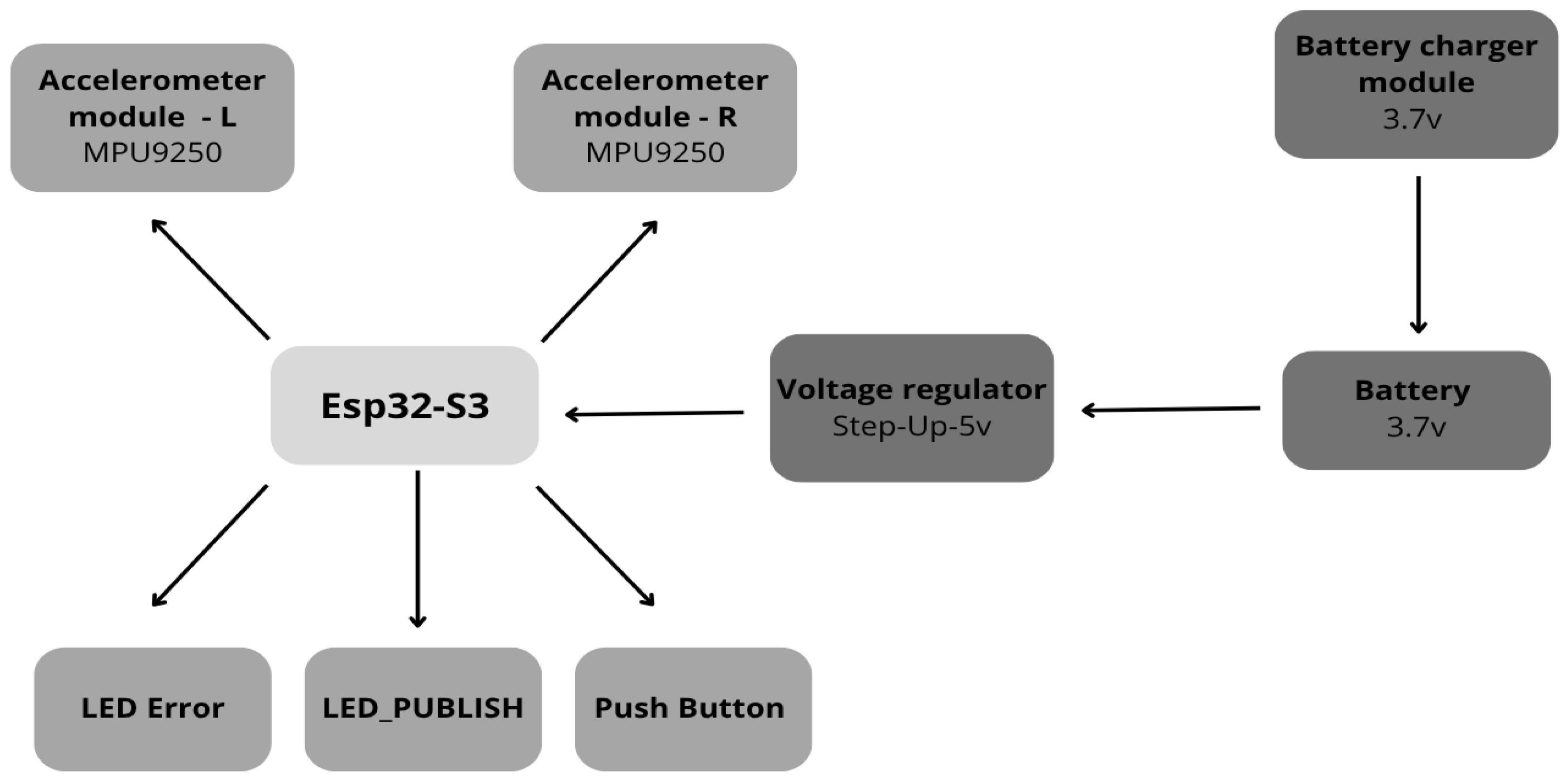
The electronic architecture of the proposed system is illustrated in
Figure 1. The device comprises an ESP32-S3 microcontroller connected to two MPU-9250 inertial sensor modules, one assigned to each lower limb. The system is powered by a rechargeable 3.7 V (3000 mAh) battery connected to a charging module and a voltage regulator responsible for supplying the electronic circuits. Additionally, the system includes two status LEDs and a push-button switch used for device activation and shutdown.
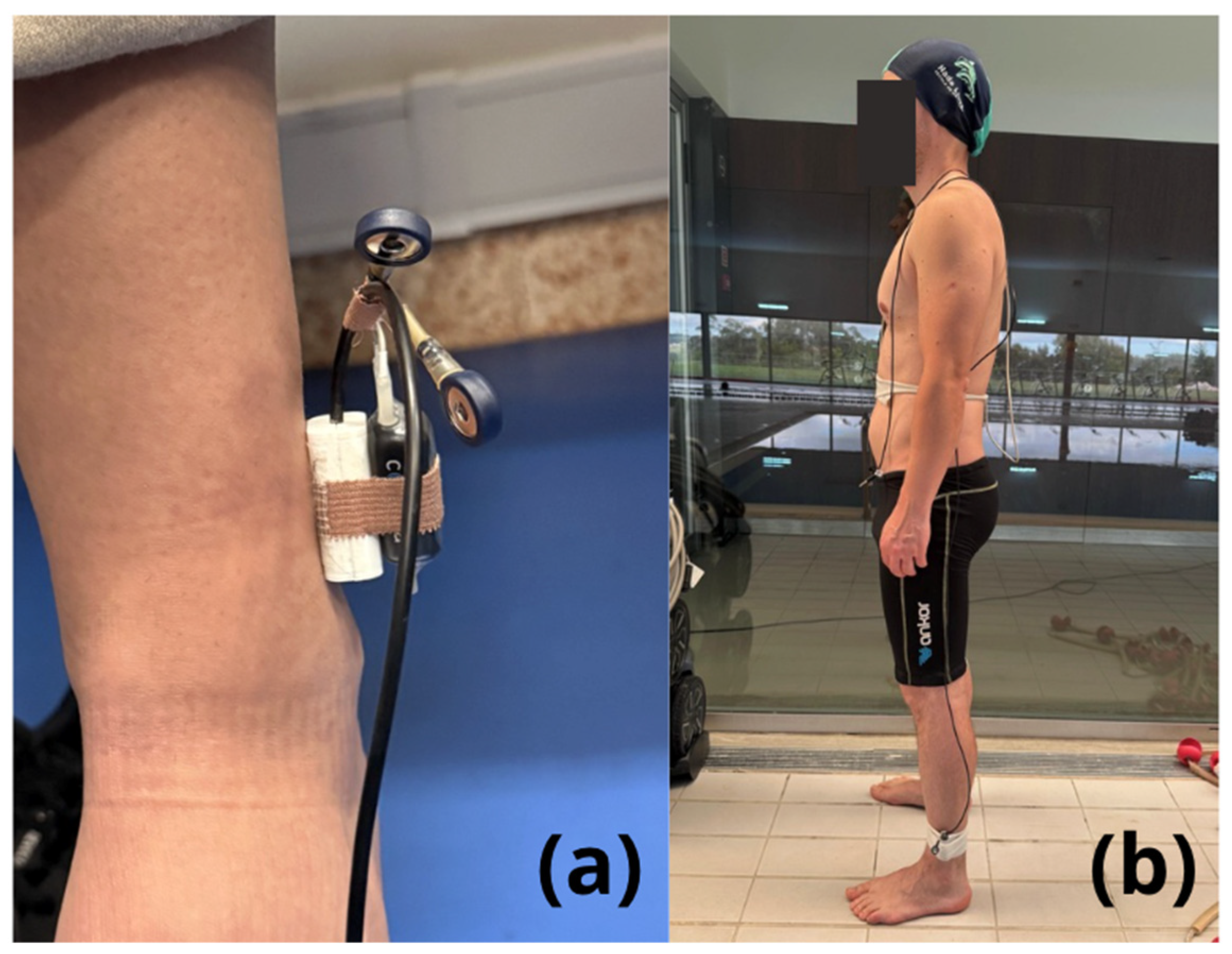
The embedded system, including the microcontroller, battery, and other electronic components, is housed within a 3D-printed enclosure. During data collection, this module remains above the waterline inside a waterproof support pouch positioned on the participant’s head, protecting the electronics from water exposure while allowing continuous data transmission. Only the cables and inertial sensor modules remain submerged during the experimental protocol. The inertial sensor modules located at the distal end of the cables were waterproofed using epoxy adhesive resin (Araldite®) to protect the sensor electronics during immersion. To minimize movement artifacts caused by cable oscillation during deep-water running, the cables connecting the inertial sensors to the main acquisition module were secured along the participant’s body and additionally anchored at the waist using an elastic strap. The proposed device sensor and the reference sensor were rigidly coupled and positioned together approximately 2 cm above the lateral malleolus. Both sensors were attached directly to the skin using double-sided adhesive tape and further secured with an elastic wrap around the ankle region to minimize relative motion between the sensors and the body segment throughout data collection. Data were acquired in real time at a sampling frequency of 50 Hz and a measurement range of ±2 g per axis (x, y, z), via Wi-Fi transmission to a web platform developed as an integral part of the system. The ±2 g configuration was selected to increase sensitivity for the acceleration amplitudes expected during deep-water running. The MPU-9250 sensors were operated using their factory calibration settings, and no additional external calibration procedure was performed prior to data collection.
Additionally, it is important to highlight that the proposed system was designed using low-cost and widely available components, including a microcontroller-based architecture and 3D-printed enclosure. This design approach contributes to the development of a cost-effective solution when compared to conventional commercial systems, without compromising the system’s functionality for biomechanical data acquisition.
2.2. Reference System
The Mini Wave Waterproof wireless system (Cometa® srl, Bareggio, Italy) was adopted as the reference system for collecting kinematic data. Acceleration signals were acquired through its internal triaxial accelerometer at a sampling frequency of 2000 Hz, 10-bit resolution, and a measurement range set to ±2 g, in order to ensure comparability with the device under validation.
2.3. Sample
The study sample consisted of 21 volunteers (9 females and 12 males). Detailed anthropometric and demographic characteristics of the participants, categorized by sex to avoid baseline confounding factors, are presented in
Table 1. Regarding lifestyle, the participants exhibited heterogeneous levels of physical activity practice, including strength training, swimming, running, tennis, and functional training, with weekly frequencies ranging from 1 to 7 sessions.
Inclusion criteria encompassed apparently healthy individuals capable of performing deep-water running, as well as those able to understand and sign the informed consent form. Participants with recent musculoskeletal injuries, uncontrolled cardiovascular or respiratory conditions, medical restrictions on physical exercise, or any condition that could compromise the safe execution of the experimental procedures were excluded. Additionally, individuals with acute pain or functional limitations at the time of assessment were not included.
2.4. Familiarization and Evaluation
Upon arrival, all participants received detailed information about the study’s objectives and procedures. Subsequently, they signed an informed consent form and completed an individual characterization form. Next, a familiarization phase with the deep-water running technique using an aquatic flotation belt (Pool Gim®, Golfinho Sports, Coimbra, Portugal) was conducted. The flotation belt was used to maintain buoyancy and an upright body position while preventing contact of the feet with the pool floor, thereby ensuring proper execution of the deep-water running technique. During this phase, participants were instructed about postural alignment, cyclic movement patterns, and lower limb coordination, and were encouraged to maintain consistent execution.
Once familiarization was completed, participants remained equipped with the flotation belt. The immersion level was standardized at approximately the sternal angle region to ensure homogeneous testing conditions among participants. Subsequently, instrumentation proceeded. The device under validation and the reference measurement system Mini Wave (Cometa Systems
®, Bareggio, Italy) were positioned in an overlapping and rigidly coupled manner, allowing simultaneous and synchronized signal acquisition. The sensors were fixed bilaterally, approximately 2 cm above the right and left lateral malleolus, to ensure consistency in anatomical location and reliability in data collection (
Figure 2).
Data were collected in a 25 m long pool with a depth of 2 m and water temperature maintained at approximately 28 °C, conditions considered suitable for aquatic exercise practice and for the stability of instrumental signals. After preparation, each participant performed a single 25 m course in deep-water running, maintaining the technique previously established during the familiarization phase. Participants were asked to maintain a continuous, stable, and consistent movement pattern throughout the entire course.
2.5. Data Processing
Raw acceleration data from both systems were processed using a custom analysis pipeline developed in Python version 3.14.3, following a standardized multi-step procedure. Initially, acceleration signals from both systems were imported and converted into numerical arrays. For the proposed device, data stored as text lists were converted into numerical vectors, while reference system data were loaded as tab-separated matrices. The resultant acceleration magnitude was calculated for both systems as the Euclidean norm of the three axes, as defined in Equation (1).
A fourth-order Butterworth low-pass filter with a cutoff frequency of 10 Hz was applied to the acceleration signals. This cutoff frequency was selected based on previous studies on human locomotion using inertial sensors, which indicate that the relevant frequency content of lower-limb cyclical movement is predominantly below 10 Hz. This approach allows preservation of biomechanically meaningful signal components while attenuating high-frequency noise associated with sensor motion, hydrodynamic disturbances, and electronic artifacts. To ensure comparability between systems for temporal alignment (cross-correlation) and integral calculations, reference system data were down sampled from 2000 Hz to 50 Hz through a decimation procedure. While this standardizes the temporal resolution, we acknowledge that this mathematical procedure does not negate the inherent hardware and internal signal conditioning differences present in the systems prior to sampling. Temporal synchronization between systems was achieved through cross-correlation analysis. Signals were normalized by removing the mean and scaling by the standard deviation. The optimal time lag was identified as the point of maximum cross-correlation, and signals were subsequently aligned to ensure temporal correspondence between systems.
Movement cycles were identified using a peak detection algorithm applied to the filtered resultant acceleration magnitude signal. For each signal, an adaptive threshold based on the median and interquartile range (IQR) was calculated as: threshold height = median + (multiplier × IQR). The initial multiplier was set to 0.3 for the prototype and 0.2 for the Cometa system, with minimum peak distances of 0.20 s and 0.15 s, and prominence thresholds of 0.05 and 0.01, respectively. In cases of insufficient detection (<10 peaks), a fallback adaptive strategy was triggered, reducing the multiplier to 0.1 (prototype) and 0.05 (Cometa), with a minimum distance of 0.15 s and prominence of 0.01. If the detection remained insufficient, a forced temporal segmentation was applied by dividing the signal into 10 equal segments, defining the local maximum of each segment as a peak. Finally, cycle boundaries were defined as the midpoints between consecutive peaks, ensuring exactly 10 cycles per limb for each system. For each of these segmented cycles, a set of biomechanical parameters was calculated, including temporal variables (e.g., cycle duration), statistical measures (such as mean, root mean square and standard deviation), and energy-related metrics (such as area under the curve and impulse). All processing procedures were applied consistently to both systems to ensure comparability between the extracted parameters.
2.6. Statistical Analysis
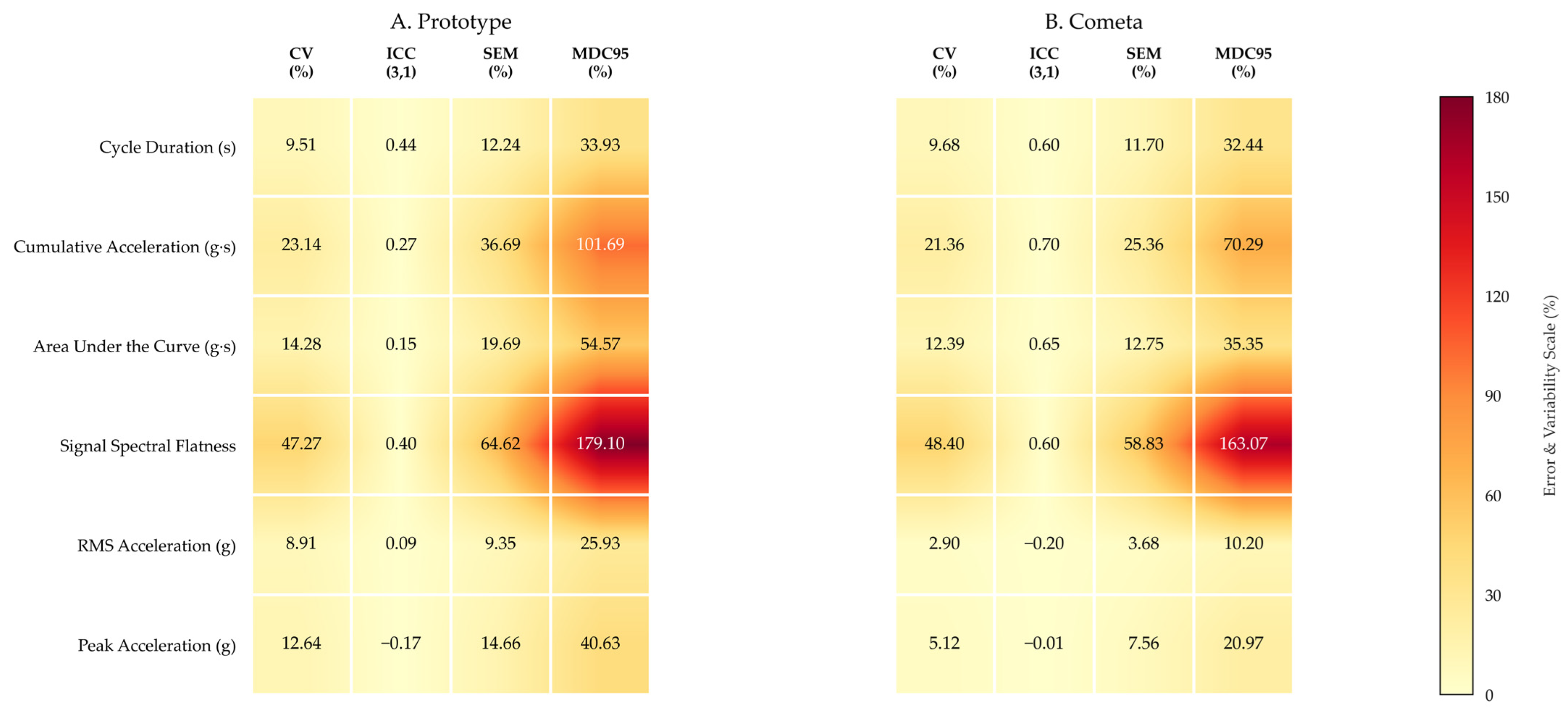
The assumption of normality for all continuous variables was assessed using the Shapiro–Wilk test. As the data did not meet normality assumptions, results are presented as median and interquartile range (IQR). To satisfy the assumption of statistical independence, kinematic data from multiple cycles were averaged per participant prior to inferential testing. Systematic differences between the prototype sensor and the reference system (Cometa) were evaluated using the Wilcoxon signed-rank test for paired samples. The magnitude of these differences was quantified using the effect size r, calculated as: r = Z/√N, where N represents the total number of paired observations. Effect sizes were interpreted as small (0.10 to <0.30), moderate (0.30 to <0.50), and large (≥0.50). Relative variability between devices was assessed using the inter-device coefficient of variation (CV inter-device), calculated as the standard deviation of paired differences divided by the grand mean of both systems. Concurrent validity and rank-order association were evaluated using Spearman’s rank correlation coefficient (ρ). Absolute agreement was determined using the intraclass correlation coefficient (ICC), based on a two-way mixed-effects model for absolute agreement and single measurements (ICC 3.1), reported with 95% confidence intervals. ICC values were interpreted according to Koo and Li as poor (<0.50), moderate (0.50–0.75), good (0.75–0.90), and excellent (>0.90). Measurement error and systematic bias were further examined using Bland–Altman analysis. Bias was defined as the mean difference between devices, and the limits of agreement (LoA) were calculated as the bias plus or minus 1.96 times the standard deviation. The proportion of observations within the LoA was also reported. The standard error of measurement (SEM) was calculated using the following formula: SEM = SDpooled × √(1 − ICC) and expressed as a percentage of the reference mean (SEM%) to facilitate interpretation. Intra-device reliability and measurement stability across repeated cycles were also evaluated. Intra-subject variability was quantified using the coefficient of variation (CV%). The minimal detectable change at the 95% confidence level (MDC95), representing the smallest change considered beyond measurement error, was calculated as: MDC95 = SEM × 1.96 × √2. All statistical analyses were performed using IBM SPSS Statistics (version 20.0.2.0, IBM Corp., Armonk, NY, USA), while graphical visualizations were generated using custom scripts in Python version 3.14.3. Statistical significance was set at α < 0.05.
4. Discussion
4.1. Validity and Interpretation of Temporal and Volumetric Variables
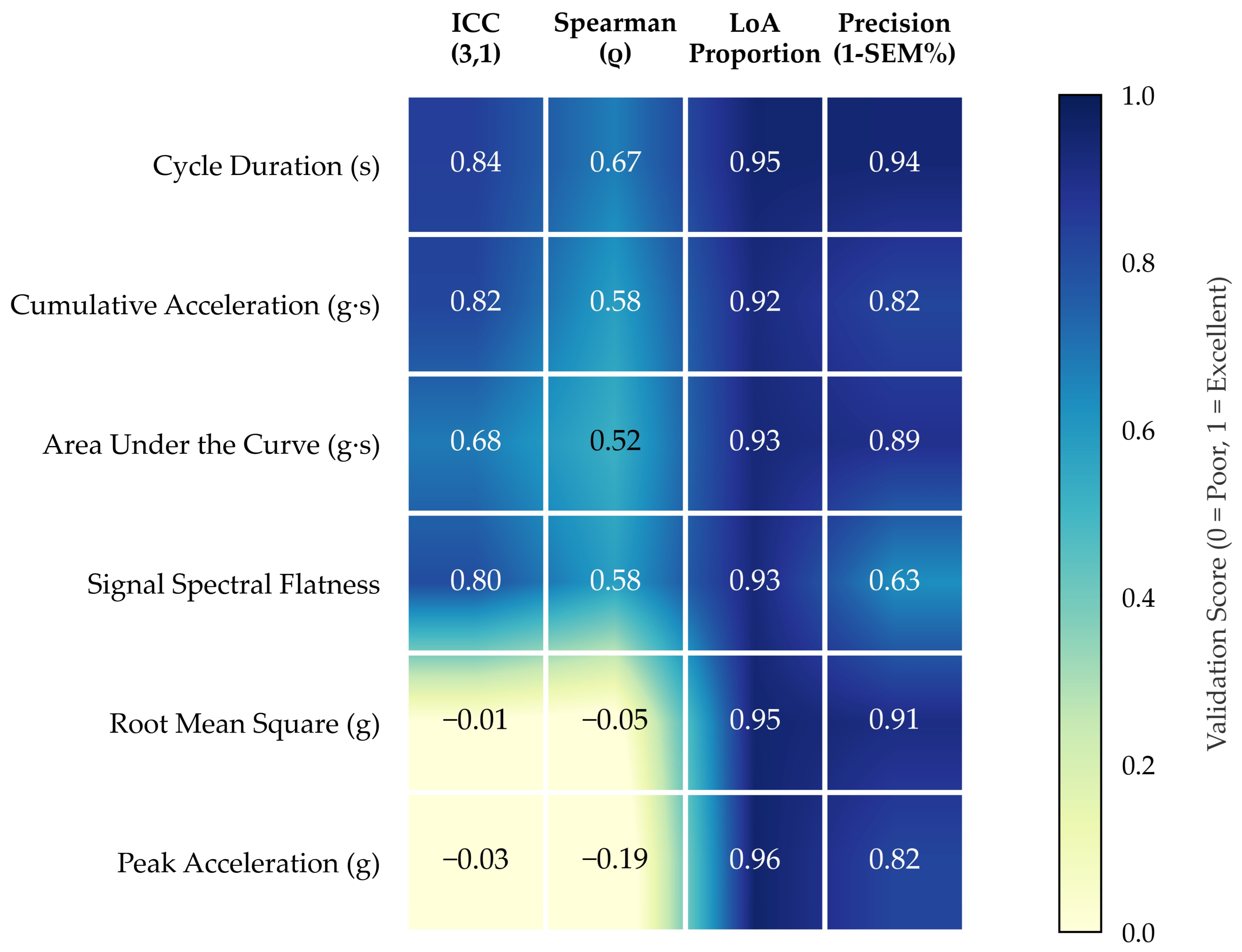
The results of the present study demonstrate that the prototype showed high agreement with the reference system in quantifying temporal and volumetric variables, namely, cycle duration and cumulative acceleration, while the area under the curve showed moderate agreement, indicating greater variability in this metric [
18]. These results are particularly relevant because they indicate that the device is capable of consistently capturing the overall organization of movement throughout the locomotor cycle, enabling its use in continuous monitoring tasks in aquatic environments [
19]. Obtaining ICC values above 0.80 for these variables suggests a very good level of concurrent validity, which reinforces the system’s potential for movement monitoring under the experimental conditions evaluated in this study [
13,
14].
According to Killgore et al. [
9], deep-water running is described as a practical form of exercise that preserves the cyclic logic of the running gesture, albeit under distinct biomechanical conditions, while Reilly et al. [
6] highlight the physiological effects associated with deep-water practice, including reduced impact and mechanical loading on osteoarticular structures. In this context, the present findings support the potential applicability of the proposed device for functional movement analysis in aquatic environments, particularly in the assessment of cycle-related parameters during deep-water running.
Additionally, the observed agreement in temporal and volumetric variables suggests that the proposed device can be useful for monitoring cadence and indirectly estimating external load during aquatic exercise. This capability may be particularly relevant for aquatic movement monitoring, as it allows the assessment of movement performance without relying on complex and less accessible laboratory systems [
14]. Recent literature has highlighted the need for portable, accessible, and reliable instruments for aquatic environments, since most conventional assessment methods were originally developed for land-based conditions and may not be easily transferred to water-based applications [
4,
12]. In this context, the low-cost architecture of the proposed device may represent an accessible alternative for biomechanical monitoring during deep-water running, particularly in settings where access to specialized laboratory equipment is limited.
4.2. Systematic Differences in Intensity Variables
In stark contrast to the temporal and volumetric variables, the proposed device demonstrated poor absolute agreement for intensity metrics, yielding near-zero or negative ICC values for RMS (ICC = −0.01) and peak acceleration (ICC = −0.03). While these negative findings highlight a limitation in the device’s current capacity to measure absolute acceleration magnitudes in the aquatic environment, the peak acceleration differences reflect a consistent systematic disagreement between systems, rather than a simple random error. These differences do not necessarily invalidate the device’s performance but suggest that the two systems may be capturing different characteristics of the acceleration signal. Rather than representing an absolute limitation of the device, this pattern may reflect intrinsic hardware differences between systems, such as analog-to-digital converter gain, sensor sensitivity, and other electronic acquisition characteristics [
15].
Laboratory-grade reference systems present specific hardware characteristics that directly influence signal acquisition. In the case of the reference system used, the signal is conditioned by a native band-pass filter (10–500 Hz) and a high common mode rejection ratio (CMRR > 100 dB), contributing to noise reduction and measurement stability. In contrast, the proposed device has a different signal acquisition and conditioning architecture, which may result in differences in how high-frequency variations are captured and represented, particularly in dynamic contexts such as the aquatic environment.
In the aquatic context, this issue becomes even more complex, as movement is subject to interferences caused by flotation, hydrodynamic resistance, and the relative instability of sensor attachment [
9,
14,
15]. Thus, Monoli et al. [
11] emphasized that the application of wearable technologies in aquatic exercises remains limited by technical challenges related to waterproofing, device stability, and signal reliability, which helps interpret the differences observed here. Therefore, discrepancies between systems may reflect not methodological limitations, but rather intrinsic hardware differences, particularly in how high-frequency components of the signal are captured and represented by each system.
An important aspect is that acceleration peaks are particularly sensitive to small changes in sensor attachment, device orientation, and signal filtering method [
15]. Thus, higher values in the proposed device may reflect greater preservation of high-frequency components, while the reference system may apply more conservative processing with greater attenuation of those components [
20]. The interpretation of these results should therefore be made with caution, as differences in intensity variables do not always mean poorer prototype performance; in many cases, they may reflect that the devices are capturing different components of the acceleration signal.
4.3. Absolute Agreement and Systematic Error
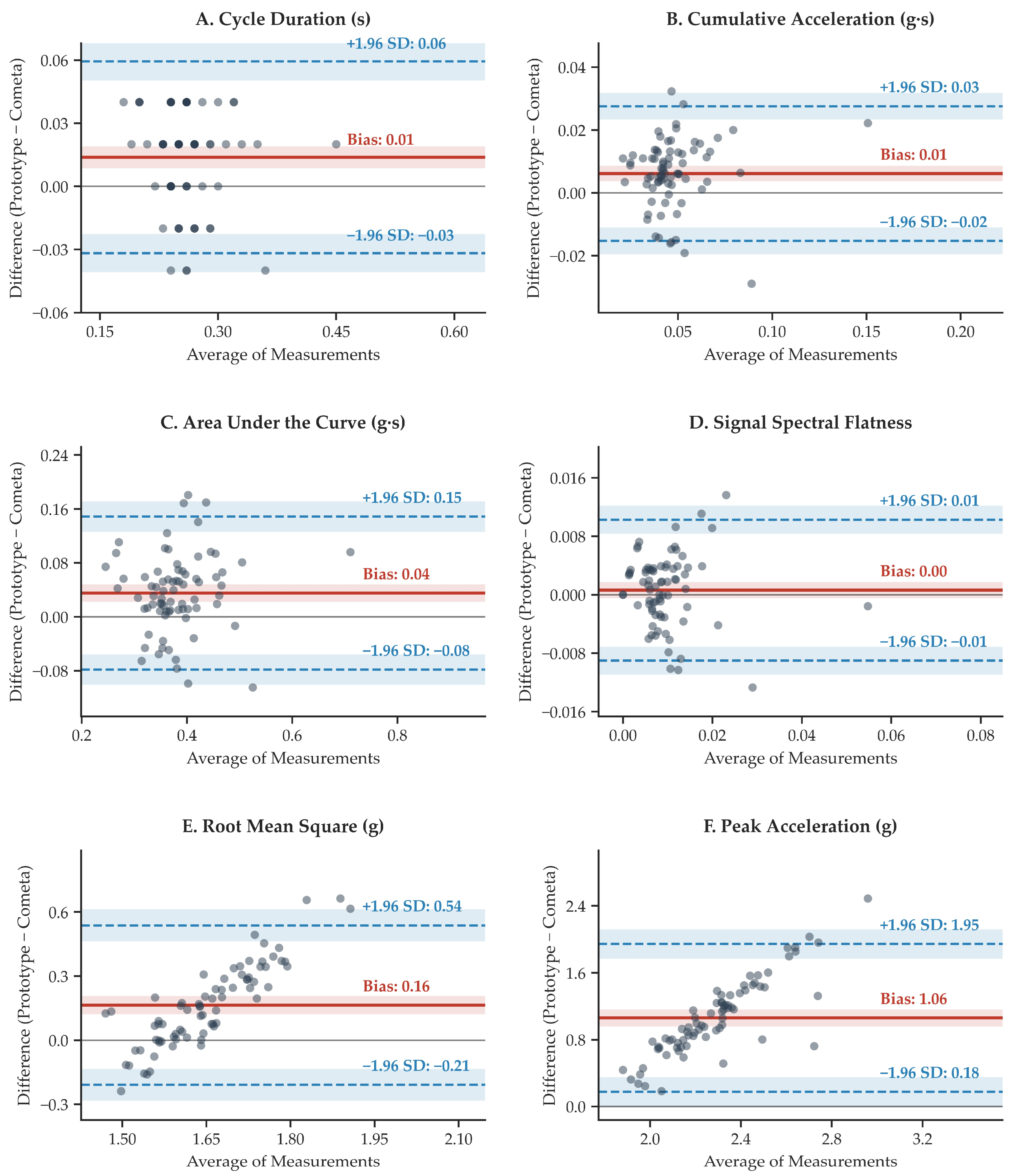
The Bland–Altman analysis (
Figure 4) reinforces the idea that the difference between devices was predominantly systematic rather than random [
21]. The fact that more than 92% of cycles fell within the 95% LoA suggests a stable relationship between measurements, albeit with bias in intensity variables [
22,
23]. This result indicates that the observed error is not erratic but predictable and relatively stable across the sample [
1]. In sensor engineering terms, this is consistent with a scale difference between systems rather than a structural malfunction [
12,
24].
While temporal and volumetric variables demonstrated narrow LoAs and predictable error margins, the wide LoAs and large bias magnitudes in intensity variables underscore a more complex relationship. Crucially, the Bland–Altman plots revealed a proportional bias (heteroscedasticity) in intensity metrics, indicating that the measurement error and the prototype’s overestimation increases proportionally with acceleration magnitude. This type of behaviour is important in the interpretation of validation studies, because a low or moderate ICC does not always imply a lack of practical utility [
25,
26]. When the error has a systematic nature, it may indicate consistent differences between measurement systems that should be considered when interpreting the results [
22,
23]. Thus, the proposed device may be measuring consistently, albeit with a different amplitude from that observed in the reference system. The Bland–Altman analysis suggests that these differences followed a relatively stable pattern across the measurement range, reinforcing the presence of systematic rather than purely random disagreement between systems [
21,
22].
The literature on aquatic monitoring also suggests that measurement error in aquatic environments tends to be influenced by the interaction between the device and the water, more than by purely electronic failures [
12,
27]. Studies on wearable sensors for underwater gait analysis have shown that reliability improves when sensor position is carefully controlled and when an acquisition and processing strategy adapted to the water is used [
11,
12,
28]. Likewise, the review on wearables in aquatic activities indicates that agreement between systems strongly depends on experimental conditions, task type, and the nature of the analysed variable [
11].
4.4. Intra-Subject Variability and Biomechanical Implications
The high intra-subject variability observed in intensity metrics in both systems (e.g., Cometa RMS ICC = −0.20) warrants careful interpretation. This finding shows that variability is not exclusive to the prototype, as it is also present in the reference system [
12,
28,
29], suggesting that the main source of dispersion is not associated with instrumental instability, but rather with the inherent complexity of motor control in the aquatic environment [
8,
30]. Cycle-to-cycle variability is consistent with the high sensitivity of aquatic locomotion to small kinematic changes, such as lower limb angle, segmental velocity, and body position in the fluid [
8,
10,
12].
Unlike terrestrial locomotion, where ground support partially stabilizes the motor pattern, deep-water running depends on the continuous interaction between the body and buoyancy and drag forces [
30]. Under these conditions, small differences in stride amplitude or timing can generate significant differences in the resistance encountered and, consequently, in the recorded acceleration [
31,
32]. Thus, the observed dispersion (
Figure 4) should be understood as an expression of the biological variability of human movement under specific conditions, rather than merely an instrumentation issue [
33].
This point is critical from the perspective of applied rehabilitation and training. While the device consistently reflects this biological variability, the inherently high standard error of measurement and minimal detectable change (MDC) for intensity metrics in both systems present a practical challenge. Practically, a high MDC implies that tracking small, session-to-session progression using peak acceleration or RMS is unreliable, as large margins of change are required to exceed measurement error. Therefore, in clinical practice, assessments cannot rely on single-cycle analysis. To achieve reliable biomechanical monitoring, practitioners must standardize their evaluation protocols by averaging kinematic data over a continuous series of multiple cycles.
4.5. Clinical Relevance and Applicability
The results obtained in the present study support the use of the proposed device as a low-cost and potentially scalable tool for monitoring deep-water running. The main contribution of the system appears to lie in its ability to quantify the temporal and volumetric dimensions of movement with good fidelity, which are particularly useful for cadence control, cycle organization, and tracking external load. This aspect is especially relevant in rehabilitation contexts, where ease of use and portability have great practical value.
At the same time, the study shows that intensity variables require more cautious interpretation, both due to systematic differences compared to the reference system and their inherently high intra-subject variability. For practical application, this means clinicians should prioritize temporal and volumetric metrics to monitor subtle patient progress or cadence adjustments. Intensity metrics, given their high variability thresholds, should be reserved for identifying gross differences in motor execution or tracking long-term macroscopic trends rather than subtle day-to-day adaptations. This limitation does not compromise the overall utility of the device; instead, it establishes clear, evidence-based guidelines on how its different metrics should be utilized in real-world scenarios, while suggesting that future versions could benefit from additional signal processing refinements.
4.6. Limitations and Future Perspectives
Although the results are promising, some limitations of the present study must be acknowledged. The sample was relatively small and composed of healthy participants, which limits the generalization of results to clinical populations. Additionally, the analysis focused on a single task and experimental context, meaning the device’s robustness should be tested at different depths, execution rhythms, populations, and sensor attachment conditions. These aspects are especially relevant in aquatic environments, where variability between contexts can significantly influence signal quality [
11]. Furthermore, inherent technical limitations of the device must be considered, namely, the ±2 g measurement range and 50 Hz sampling frequency, which may limit the characterization of very high acceleration amplitudes and high-frequency signal components and consequently influence the analysis of intensity metrics.
Given the identified limitations, future research should also explore calibration approaches specific to intensity variables, ideally based on regression between systems and cross-validation in independent samples. Another relevant line of investigation involves assessing the device’s performance in individuals with altered motor patterns, such as patients with musculoskeletal or neurological pathology, to determine if the good performance observed in healthy subjects holds in real clinical conditions. Finally, additional studies could evaluate the prototype’s performance in different aquatic tasks, which would consolidate its utility as a biomechanical monitoring tool in the water. Additionally, heteroscedasticity was observed in intensity-related variables, indicating magnitude-dependent error. Furthermore, although cycle-level data were used for agreement analysis, inferential statistics were conducted at the participant level, which may influence the interpretation of variability across cycles.
5. Conclusions
Therefore, the proposed device demonstrated acceptable agreement for temporal and volumetric variables during deep-water running, particularly for cycle duration and cumulative acceleration. In contrast, systematic differences and lower agreement were observed for intensity-related variables, including RMS and peak acceleration, indicating that these metrics should be interpreted with caution.
The Bland–Altman analysis showed that most observations remained within the limits of agreement, suggesting a consistent measurement relationship between systems under the experimental conditions evaluated. However, the observed systematic bias highlights the need for further investigation and potential methodological refinements before intensity-related variables can be considered interchangeable between systems.
Overall, the findings support the potential use of the proposed device as a low-cost tool for biomechanical monitoring during deep-water running in healthy individuals. Future studies involving different populations, exercise intensities, testing sessions, and aquatic conditions are necessary to further establish the applicability of the system in broader rehabilitation and training contexts.




 ,
,