


Abstract
3D Gaussian Splatting (3DGS) has emerged as a cornerstone technique for 3D asset acquisition. However, existing copyright protection methods for 3DGS predominantly rely on embedding watermarks directly into Gaussian primitives, which inevitably degrades rendering quality. To address this issue, this paper proposes a zero-watermarking framework. By directly mapping the inherent features of rendered images to copyright information without modifying Gaussian parameters, the framework achieves perfect visual fidelity. Conventional image zero-watermarking maps features of a single image to a dedicated watermark. In contrast, our method guarantees mapping consistency: features of rendered images from any unknown viewpoint can be mapped to the same copyright identifier. To address this cross-view consistency challenge, we introduce an uncertainty-guided strategy that scores individual pixels to guide the decoder to mine shared features across multiple perspectives. This strategy enables accurate watermark retrieval even from novel viewpoints. Extensive experiments on the Blender, LLFF, and MipNeRF-360 datasets demonstrate that our method achieves superior performance, characterized by high message capacity, strong adversarial robustness, and a low false positive rate (FPR), while fully maintaining the integrity of the original 3DGS model.
1. Introduction
3DGS [1] has rapidly become a cornerstone for 3D asset representation due to its exceptional rendering performance and high-fidelity reconstruction. This surge in popularity has spurred the development of various watermarking techniques for copyright protection [2]. However, nearly all existing methods rely on perturbing Gaussian primitives to embed copyright information. This perturbation process inherently introduces rendering artifacts and degrades visual quality [3,4,5,6,7]. Such degradation is unacceptable in high-precision domains, including digital twin reproduction [8,9] and high-end virtual reality production [10], where visual fidelity is paramount. This raises a critical question: how can we provide robust copyright protection for 3DGS without compromising its visual fidelity?
A promising solution to this dilemma lies in zero-watermarking. Unlike traditional watermarking, this technique enables copyright protection without modifying the source content; instead, it extracts intrinsic features to generate an independent, encrypted signature [11]. While widely adopted in fields requiring strict data integrity—such as medical and geospatial imaging [12,13,14]—extending zero-watermarking to 3DGS presents unique challenges. A typical 3DGS scene consists of millions of primitives, making direct feature extraction from the underlying point cloud computationally prohibitive and conceptually complex [2]. Furthermore, unauthorized use predominantly occurs through two channels: (1) misappropriating the 3D model for rendering or (2) stealing rendered views directly. In both scenarios, the rendered image serves as the primary medium for copyright verification. We therefore argue that constructing zero-watermarks from rendered views is more practical and robust than extracting features from raw Gaussian primitives.
However, 3DGS zero-watermarking fundamentally differs from its 2D counterparts. Traditional 2D approaches map a single, static image to a unique watermark [12,15]. In contrast, 3DGS offers an infinite manifold of viewpoints. A valid 3DGS zero-watermark must be consistently extractable from both known training views and rendered images from novel, unknown viewpoints. To ensure this consistency, the extracted features must exhibit cross-view shareability—a property that ensures core descriptors remain stable across varying perspectives.
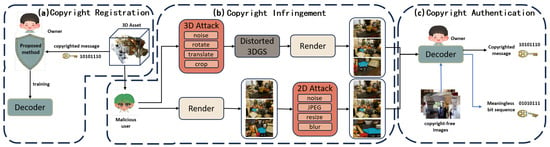
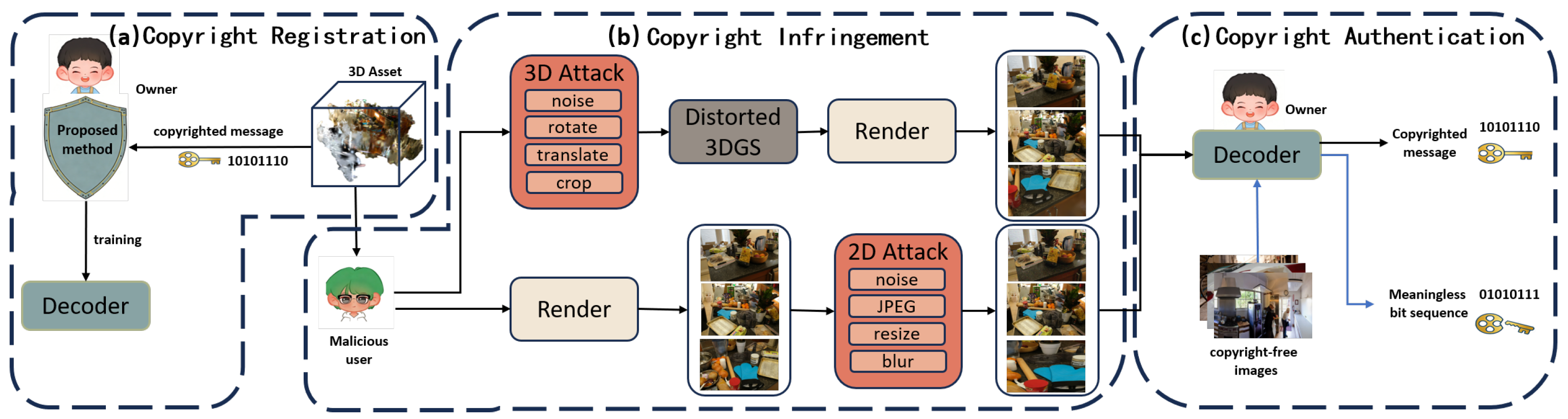
To address this challenge, we propose an uncertainty-guided zero-watermarking framework, whose application scenarios are illustrated in Figure 1. We quantify the uncertainty of each Gaussian primitive using the Hessian matrix of the reconstruction loss [16]. Primitives with low uncertainty are those strongly constrained by multi-view geometry; they represent the “core” of the scene and are highly likely to be preserved across novel viewpoints. By focusing feature extraction on pixels rendered by these stable primitives, we satisfy the cross-view shareability requirement. To ensure discriminability, we employ a contrastive learning strategy [17] that maps valid features to the target watermark while maintaining a wide margin away from pseudo-watermarks generated by non-copyrighted content. Finally, we integrate a distortion layer [18] to simulate common transmission attacks, further enhancing adversarial robustness.
Figure 1.
Application scenarios of the proposed uncertainty-guided zero-watermarking framework for 3DGS copyright protection. (a) Copyright Registration: The model owner trains a dedicated decoder to map inherent discriminative features of 3D Gaussian Splatting (3DGS) assets to a unique zero-watermark for formal copyright registration. (b) Copyright Infringement: A malicious user attempts unauthorized appropriation of 3DGS assets via geometric attacks on the 3DGS model or post-processing distortions on rendered views. (c) Copyright Authentication: The model owner extracts the embedded zero-watermark from suspicious rendered images using the pre-trained decoder to verify and assert copyright ownership.
Our main contributions are summarized as follows:
- We present the first zero-watermarking framework specifically tailored for 3DGS, enabling copyright protection with zero visual quality loss.
- We propose an uncertainty-guided strategy to identify and extract “cross-view shared features”, ensuring consistent watermark retrieval from arbitrary viewpoints.
- We utilize contrastive learning to enhance the uniqueness of the watermark, significantly reducing the FPR for copyright-free assets.
- Extensive evaluations on the Blender, LLFF, and MipNeRF-360 datasets demonstrate that our method provides robust protection, high message capacity, and complete fidelity preservation.
The remainder of this paper is organized as follows. Section 2 reviews existing studies and elaborates the essential differences between 3DGS zero-watermarking, traditional 2D zero-watermarking and conventional embedding-based 3DGS watermarking, which further clarifies the motivation of this work. Section 3 presents the detailed design of our uncertainty-guided zero-watermarking framework, which consists of pixel-level scoring, weighted pooling and contrastive learning modules. Section 4 presents comprehensive experimental results. We validate the effectiveness of each individual module in Section 4.3. Meanwhile, quantitative evaluations are conducted to assess the performance of the proposed zero-watermarking approach in terms of bit accuracy, FPR, message capacity and computational efficiency. Moreover, hyperparameter sensitivity analysis is carried out in Section 4.6. Finally, Section 5 concludes the major contributions, discusses the limitations of the current method and outlines potential future research directions.
2. Related Work
2.1. 3D Gaussian Splatting
3DGS [1] has emerged as a transformative 3D rendering paradigm that addresses the efficiency bottlenecks of Neural Radiance Fields (NeRF) [19]. By representing scenes using explicit, differentiable Gaussian primitives, 3DGS achieves high-fidelity, real-time novel view synthesis, effectively bridging the gap between geometric reconstruction accuracy and neural rendering efficiency. The versatility of 3DGS has driven its rapid adoption across diverse application domains: in AIGC-driven 3D generation, GaussianDreamer [20] employs it for text-guided 3D asset creation; in human digitization, GaussianAvatar [21] enables animatable digital human reconstruction from monocular videos; and in autonomous driving, DrivingGaussian [22] enables large-scale dynamic scene modeling. This rapid proliferation underscores the urgent need for robust copyright protection mechanisms tailored to the unique characteristics of 3DGS.
2.2. Zero-Watermarking
First proposed by Tan et al. [11], zero-watermarking preserves the complete integrity of digital content by generating a copyright signature without any modification to the source data. In the 2D image domain, existing approaches typically extract either handcrafted [13,14] or deep learning-based features [12,15], which are then secured using chaotic encryption or scrambling techniques. These features are then bound to copyright identifiers (e.g., logos) via mapping rules such as XOR operations or neural networks, and registered with Intellectual Property Rights (IPR) platforms. While effective, these approaches operate under the assumption that a static, known image is available. However, they cannot be directly applied to 3DGS, where the watermark must be consistently reconstructed from an infinite manifold of potentially unknown viewpoints.
For explicit 3D models, zero-watermarking research has primarily focused on meshes [23,24] and point clouds [25,26], which extract geometric statistical descriptors, such as vertex normal distributions or neighborhood angle skewness values. However, directly adapting these techniques to 3DGS is infeasible for three key reasons: (1) Computational Complexity: The massive number of multi-dimensional Gaussian primitives incurs prohibitive computational overhead during feature extraction. (2) Attribute Sensitivity: 3DGS is rendering-centric; subtle adjustments to Gaussian attributes can alter geometric statistics without perceptible visual quality degradation, allowing attackers to easily bypass statistical watermarks. (3) Deployment Realities: As 3DGS models are predominantly shared and consumed via rendered views, performing watermark detection directly on Gaussian primitives deviates from real-world deployment requirements.
3. Uncertainty-Guided Zero-Watermarking
We propose leveraging the robust, discriminative, and cross-view shared features intrinsic to 3DGS for zero-watermark construction, thereby establishing a persistent link between the 3D model and its copyright information. Since these features can be reliably extracted from rendered 2D views, our uncertainty-guided framework facilitates effective ownership assertion over any 2D assets derived from the source 3DGS model. Consistent with the fundamental principles of zero-watermarking, an effective 3DGS zero-watermarking must maximize decoding accuracy for copyrighted rendered images while simultaneously minimizing the FPR for copyright-free content. To achieve this dual goal, we define the following optimization objective:
where I denotes a rendered image of the copyrighted 3DGS model, represents a copyright-free image, D is the message decoder, and M is the target copyright message. The terms and denote distance metrics—such as Binary Cross Entropy (BCE) or Mean Squared Error (MSE)—used to quantify the divergence between the decoded message and the ground-truth watermark M. By minimizing this loss function, the decoder learns to map intrinsic 3DGS features to the correct watermark while ensuring that arbitrary, copyright-free images are mapped to a distinct, non-informative feature space.
3.1. Pixel Scoring
To ensure the cross-view shareability of the features used for zero-watermark construction, we employ a selective sampling strategy for pixel-level feature extraction. Our approach builds on recent observations that Gaussian primitives with low uncertainty represent scene regions strongly constrained by multi-view supervision and fully observed during optimization [27,28,29]. Intuitively, the pixels rendered from these low-uncertainty primitives constitute the geometric backbone of the scene, ensuring they remain identifiable and stable across diverse viewpoints. By prioritizing these pixels as the primary feature source, we ensure that the constructed zero-watermark is derived from the most stable and persistent components of the 3DGS model, thereby facilitating robust retrieval from novel viewpoints.
To quantify the uncertainty of each Gaussian primitive, we first compute the loss over the rendered images :
where is the set of all training camera poses, is the image rendered from camera pose , and is the corresponding ground-truth image. Taking the second derivative of Equation (2) twice gives the Hessian matrix of the loss function with respect to all Gaussian parameters:
For a well-converged 3DGS model, the term in Equation (3) approaches zero, which simplifies Equation (3) to:
Since Gaussian primitives in 3DGS are mutually independent, we adopt the block-diagonal approximation for Equation (4) and neglect cross terms between parameters of different Gaussians. This gives the local Hessian matrix for parameters of each Gaussian primitive:
Finally, the primitive-level uncertainty is computed as the log determinant of the local Hessian matrix :
Using the primitive-level uncertainty , we compute pixel-level uncertainty by leveraging the standard 3DGS rasterization pipeline. Specifically, we map each primitive’s uncertainty to its zero-order spherical harmonic (SH) coefficient, effectively treating the uncertainty as a pseudo-color attribute. By projecting these values into the image plane using the same alpha-blending process as the original scene rendering, we obtain an opacity-weighted uncertainty map. This map characterizes the localized stability of the rendered content, where the uncertainty at each pixel is given by:
where denotes the set of primitives contributing to the rendering of pixel p, represents the opacity of each primitive, and denotes the opacity-weighted sum of uncertainty at pixel p. Finally, we assign higher scores to pixels with lower uncertainty and lower scores to pixels with higher uncertainty. The scoring function is defined as:
3.2. Weighted Pooling
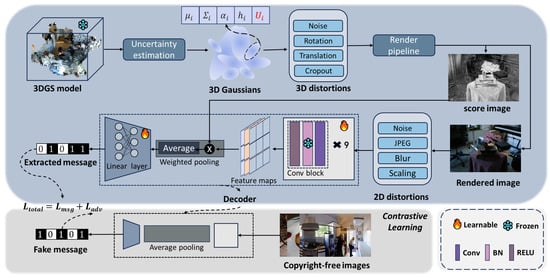
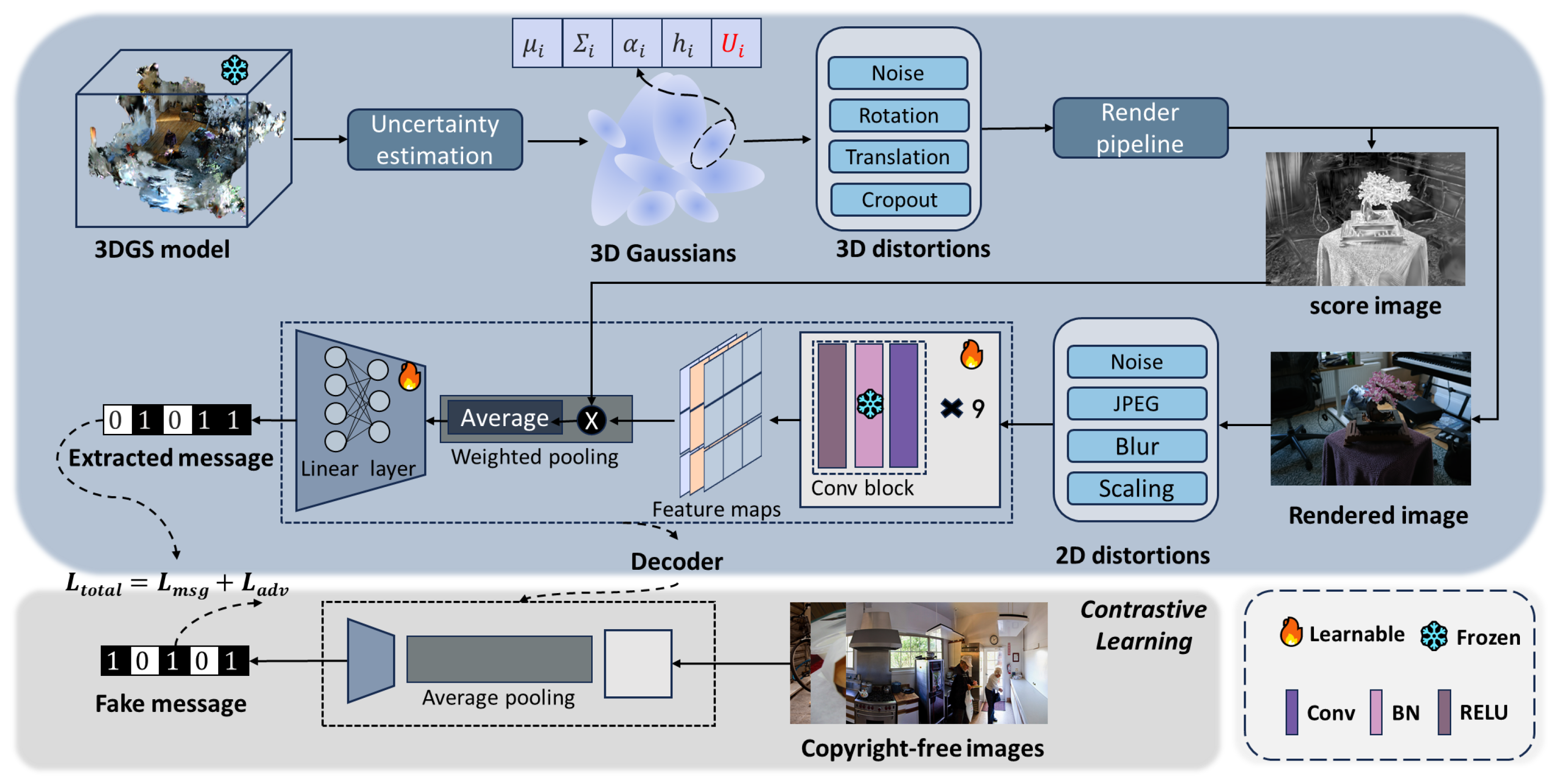
The complete architecture of our uncertainty-guided 3DGS zero-watermarking pipeline is illustrated in Figure 2. We generate pixel-level score maps from uncertainty estimates. These maps distinguish pixels critical for cross-view feature extraction from non-informative ones. Specifically, features associated with high-score pixels exhibit strong spatial correspondence across multiple viewpoints, whereas low-score pixels often represent regions that lack stable counterparts in novel views. To leverage this, we train the decoder to prioritize these reliable regions during training. Mathematically, this is implemented by weighting the intermediate feature maps of the decoder’s convolutional layers with the normalized pixel scores. This process effectively attenuates the representations in low-score regions, ensuring that the gradient updates and parameter optimization are driven by the most stable, cross-view shared features.
Figure 2.
Pipeline overview of the proposed uncertainty-guided zero-watermarking framework for 3DGS. The framework first performs uncertainty estimation on a pre-trained 3DGS model, followed by a 3D distortion module to simulate practical adversarial attacks. During view rendering, pixel-level importance score maps are generated to weight convolutional feature maps, which guides the decoder to extract robust inherent features from 3DGS renderings. The decoder is optimized by the message loss () to guarantee accurate watermark retrieval. Meanwhile, the contrastive learning loss () constrains the model to extract only non-informative pseudo-watermarks from non-copyrighted assets, thereby effectively reducing the false positive rate (FPR).
Let denote the intermediate feature map generated by the decoder’s convolutional layers, where denotes the spatial resolution and C is the number of feature channels. denotes the normalized score at spatial position within the score map. Following the score-based feature modulation, we perform global spatial aggregation to condense the weighted features into a compact latent vector . This vector serves as the input to the final linear layer for watermark extraction. The aggregation process for each channel c is defined as:
By employing this weighted pooling strategy, the features derived from low-uncertainty pixel regions are prioritized, ensuring that the final zero-watermark output is dominated by the most stable and cross-view consistent descriptors.
3.3. Contrastive Learning
Contrastive learning enables the learning of discriminative descriptors by aligning the latent representations of positive samples with an anchor while maximizing their distance from negative samples within the embedding space [17]. Inspired by this mechanism, we define the target zero-watermark as the anchor feature. In this framework, rendered images of the 3DGS model from diverse viewpoints are treated as positive samples, whereas copyright-free images serve as negative samples. By computing the cosine similarity between the features output by the linear layer and the anchor watermark, we maximize the similarity for positive cross-view samples while ensuring a wide margin of separation for negative samples. This contrastive objective ensures that the decoder effectively maps intrinsic scene features to the correct copyright identifier while maintaining high discriminative sensitivity against unauthorized content. Our optimization objective is formulated as follows:
In this formulation, and denote hyperparameters used to balance the respective loss terms, while l denotes the bit-length of the zero-watermark. The variables and denote the normalized feature embeddings extracted from the copyrighted rendered images and the copyright-free images, respectively; denotes the copyright message serving as the anchor feature. Notably, the contrastive term is selectively imposed only when the cosine distance between the features of copyright-free images and the anchor is less than . This conditional optimization prevents the decoder from redundantly learning to extract the inverse bit-sequence of the watermark from irrelevant content, thereby ensuring that the model focuses on maintaining a wide margin in the embedding space rather than overfitting to copyright-free noise.
Furthermore, we employ online hard negative mining (OHNM) throughout the iterative training process [30,31]. By prioritizing samples that yield high contrastive losses, the decoder learns to discern more subtle, discriminative features within a constrained number of iterations. Specifically, we maintain a priority queue of “hard” negative samples—those characterized by significantly large losses in previous iterations. During each training step, negative samples are sampled stochastically, with a high probability of selection from the hard negative queue and a lower probability from the remaining pool of negative data. This sampling strategy ensures that the optimization process remains focused on the most informative and challenging regions of the feature space, thereby enhancing the robustness of the watermark extraction.
4. Experiments
4.1. Experimental Settings
4.1.1. Dataset
We evaluated our method on three benchmark datasets: Blender (8 synthetic objects), LLFF (9 real-world scenes), and Mip-NeRF360 (9 real-world scenes). For the Blender dataset, we adopted the default split with 100 viewpoints for training and 200 for testing. For LLFF and Mip-NeRF360, we followed the standard protocols established in NeRF and the original Mip-NeRF360 work, respectively: specifically, every eighth image in each scene was used for testing, while the remainder served as training data. Furthermore, we sampled 1000 images from both the training and test partitions of the COCO 2014 dataset to serve as copyright-free reference images. Finally, an additional 200 training and 100 test images from COCO were randomly selected for contrastive learning.
4.1.2. Implementation Details
To achieve robust copyright protection for 3DGS models via zero-watermarking while minimizing FPR for unauthorized content, our training pipeline is structured into two sequential phases. In the first phase, we reconstruct 3DGS models on the Blender, LLFF, and Mip-NeRF360 datasets following the official implementation [1], and concurrently pre-train a HiDDeN-based [18] decoder. In the second phase, we freeze both the Gaussian models and the batch normalization layers of the decoder, replacing the standard average pooling layer in the decoder with our proposed weighted pooling module.
Prior to the second-phase training, a unique random bit sequence is generated to serve as the copyright message for each 3DGS model. During each training iteration, a single novel viewpoint is rendered from the frozen Gaussian model to produce a copyrighted image and its corresponding importance score map. Since rendered image resolutions vary across different 3DGS models, all copyright-free reference images are resized to match the resolution of the current rendered image. The copyrighted image is processed together with two resized copyright-free reference images to fine-tune only the decoder’s convolutional and fully connected layers within our proposed contrastive learning framework. To improve robustness against perturbations, the rendered copyrighted images are subjected to a suite of 2D and 3D distortion layers during training.
We employ the Adam optimizer with hyperparameters , , and , using a fixed learning rate of . The contrastive loss weights are set to and . The copyright judgment threshold is set to 0.7: images with bit accuracy below 0.7 are classified as copyright-free, while those exceeding 0.7 are deemed copyrighted. The sampling probability p for the online hard negative mining (OHNM) queue is set to 0.75. The True Positive Rate (TPR) is defined as the ratio of test-view rendered images with bit accuracy exceeding the threshold to the total number of test-view rendered images. The False Positive Rate (FPR) denotes the percentage of copyright-free images with bit accuracy above the threshold among all tested copyright-free images.
The second-phase training requires 1000 iterations for the Blender dataset and 2000 iterations for the LLFF and Mip-NeRF360 datasets, with a maximum total training time of 20 min. To verify the stability of the proposed method and ensure experimental reliability, all experiments are conducted three times with distinct random seeds, and the mean and standard deviation of the results are reported. All experiments are performed on a single NVIDIA RTX 3090 GPU with 24 GB of video memory (VRAM). The experimental environment uses the Ubuntu 22.04 LTS operating system, and all models are implemented using the PyTorch 2.0.1 deep learning framework.
4.2. Comparisons with Existing Methods
To the best of our knowledge, this is the first work to investigate zero-watermarking for 3DGS. We benchmark our method against three embedding-based approaches: (1) 3DGS w/ WaterRF, which is the improved WateRF [32] adapted for 3DGS, (2) 3D-GSW [4], which employs frequency-guided densification and wavelet-subband loss for robust embedding, and (3) GaussianMarker [5], which utilizes high-uncertainty Gaussian densification for message embedding. To highlight the lossless protection property of zero-watermarking, we evaluate visual fidelity by measuring the change in PSNR, SSIM [33] and LPIPS [34] before and after protection even though zero-watermarking inherently outperforms embedding-based watermarking in these metrics. All metrics are computed using their respective widely accepted standard formulas. Robustness is evaluated along two complementary dimensions: message integrity in 2D renderings subjected to distortions (e.g., Gaussian noise, JPEG compression, scaling, and VAE attacks [35]) and watermark persistence in 3D model metadata under model-level attacks (e.g., additive noise and cropping). Following standard practice, the message length is fixed at 48 bits. As demonstrated in Table 1, the proposed zero-watermarking scheme requires no embedding of watermark signals into Gaussian parameters, thus perfectly preserving the original model’s visual quality without any perceptible distortion. It achieves ideal values of ∞, 1, and 0 in terms of PSNR, SSIM, and LPIPS, respectively. In comparison, conventional embedding-based watermarking methods cause significant fidelity degradation. Furthermore, even without explicit watermark embedding, our scheme maintains competitive robustness and achieves state-of-the-art (SOTA) bit extraction accuracy under multiple attack scenarios. Consistent with our theoretical expectation, our approach exhibits superior performance on the LLFF dataset. This is attributed to the subtle viewpoint variations in the LLFF dataset, which result in highly consistent extracted features across multi-view renderings.
Table 1.
Quantitative robustness comparison against diverse adversarial attacks. We compare the proposed method with representative embedding-based 3DGS watermarking methods across multiple datasets. For fairness, experimental results are reported on a per-dataset basis. The best performance for each evaluation metric is highlighted in bold. For the proposed method, results are presented as mean ± standard deviation over three independent repeated experiments.
4.3. Model Analysis
To validate the rationality of our core designs and the effectiveness of each proposed component, we conducted comprehensive analyses including mechanism validation and systematic ablation studies.
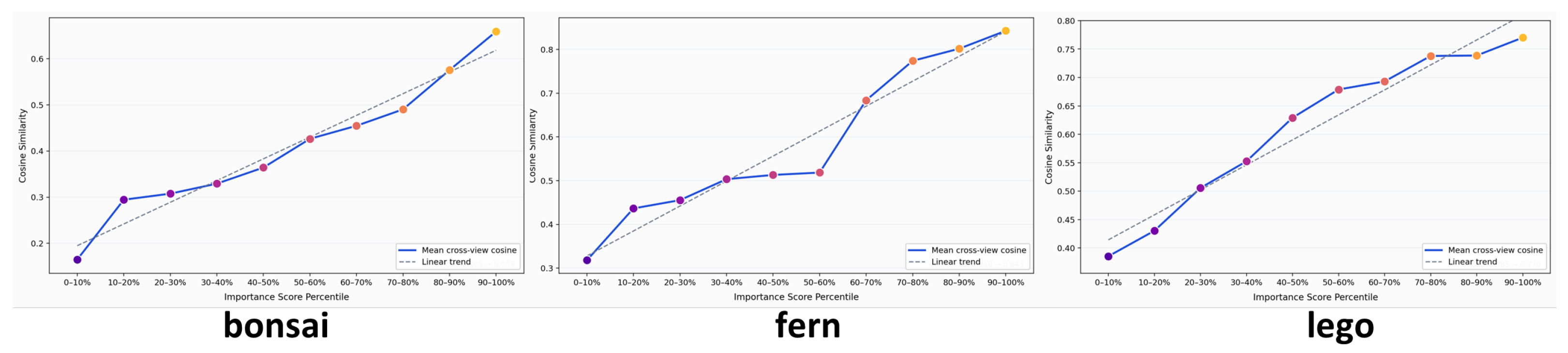
To validate that regions with high importance scores correspond to stable cross-view shared features, we rank all spatial positions by their importance scores and evenly partition them into ten percentile bins, each containing 10% of the total samples. We perform average pooling over the features in each bin. We then compute the pairwise cosine similarity between pooled features from corresponding matched bins of every pair of rendered images. Finally, we compute the average of all pairwise similarity scores. As shown in Figure 3, the average cosine similarity increases monotonically with the importance score percentile of the scores. This result confirms that high-score regions capture the most stable cross-view features in 3DGS images.
Figure 3.
Correlation between importance score percentiles and cross-view feature similarity. Each data point denotes the average cosine similarity between interval-matched pooled features derived from all 3DGS rendered images.
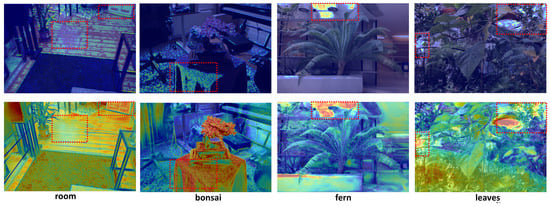
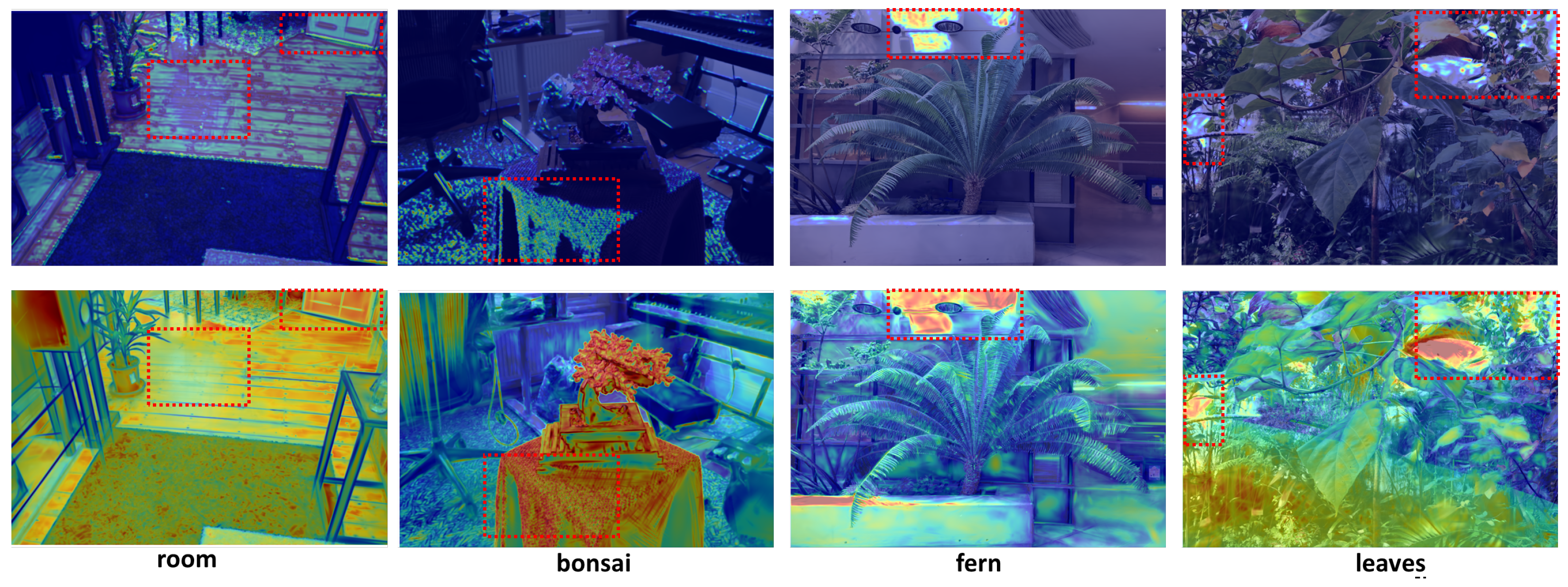
For the weighted pooling module, we present the ablation results obtained by removing this component and replacing it with standard average pooling in Table 2. It can be observed that bit accuracy decreases under both clean and attacked conditions, while the FPR increases correspondingly. Without the guidance of weighted pooling, the decoder fails to effectively prioritize cross-view shared features and extract discriminative information from stable cross-view representations, ultimately leading to overall performance degradation. This ablation result validates the effectiveness of the proposed weighted pooling strategy. To further confirm that weighted pooling guides the decoder to attend to cross-view shared features, we visualize the outputs of the trained decoder’s convolutional layers in Figure 4. The visualization reveals a strong spatial correlation between the feature regions attended by the decoder and the high-score pixel locations.
Table 2.
Ablation study of core components. The first row corresponds to our full proposed method. Results are evaluated across all 3DGS scenes with a 48-bit message length. The “Attacks” column reports the average bit accuracy under all tested distortion scenarios. All results are presented as mean ± standard deviation calculated from three independent repeated experiments.
Figure 4.
Visual comparison of feature and score heatmaps. The first row presents convolutional feature maps extracted from the decoder, while the second row illustrates the corresponding pixel-level importance score maps.
Regarding the contrastive learning module, Table 2 presents the ablation results of removing or substituting its specific components, with the first row corresponding to the full baseline configuration used in this work. Notably, omitting the cosine loss () results in a 100% FPR, as the decoder collapses to mapping all arbitrary input images to the identical zero-watermark sequence. Without the supervision from copyright-free negative samples, the decoder cannot learn discriminative scene-specific features and instead overfits to the fixed target bit sequence.
Furthermore, as shown in the fourth row, replacing the cosine loss with Binary Cross-Entropy (BCE) loss [36]—a common choice in embedding-based watermarking—leads to a significant decline in both bit accuracy and robustness. We attribute this to the fact that BCE loss forces the decoder to map copyright-free images to a specific bit sequence (the inverse of the copyright message), whereas our zero-watermarking framework only requires them to be mapped to arbitrary, non-informative sequences. Consequently, BCE loss imposes unnecessary optimization constraints that hinder the decoder from balancing competing objectives within a limited training budget. Finally, the fifth row demonstrates that removing the Online Hard Negative Mining (OHNM) strategy leads to a marked increase in FPR, confirming that OHNM is critical for enabling the decoder extract highly discriminative features from positive samples.
4.4. Capacity
To evaluate the capacity of our proposed zero-watermarking method, we performed experiments using 128-bit copyright messages and tested the bit accuracy under multiple attack scenarios in comparison with embedding-based watermarking schemes, as detailed in Table 3. The results show that our approach retains high bit accuracy and a low false positive rate (FPR) even at the high capacity of 128 bits. By contrast, conventional embedding-based watermarking methods experience both severe deteriorated rendering quality degradation and substantially reduced robustness against attacks when embedding 128-bit copyright information.
Table 3.
Performance comparison between our method and embedded watermarking with 128-bit message length. Bold text indicates the best performance in this table.
4.5. Efficiency
Table 4 provides a detailed analysis of the training efficiency and computational overhead of our zero-watermarking method. Compared to the original 3DGS reconstruction process, our framework only requires an additional 1000–2000 iterations. The uncertainty calculation stage prior to optimization takes less than 20 s, and the maximum total additional training time is approximately 13 min. These results underscore the high efficiency and practical feasibility of our approach for securing 3DGS models in real-world applications.
Table 4.
Computational efficiency analysis on different datasets.
4.6. Sensitivity Analysis
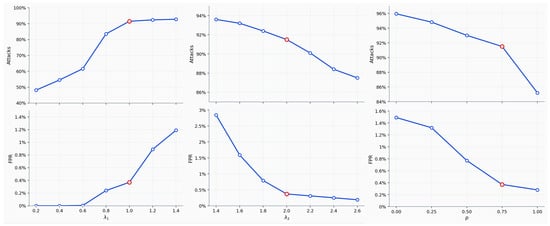
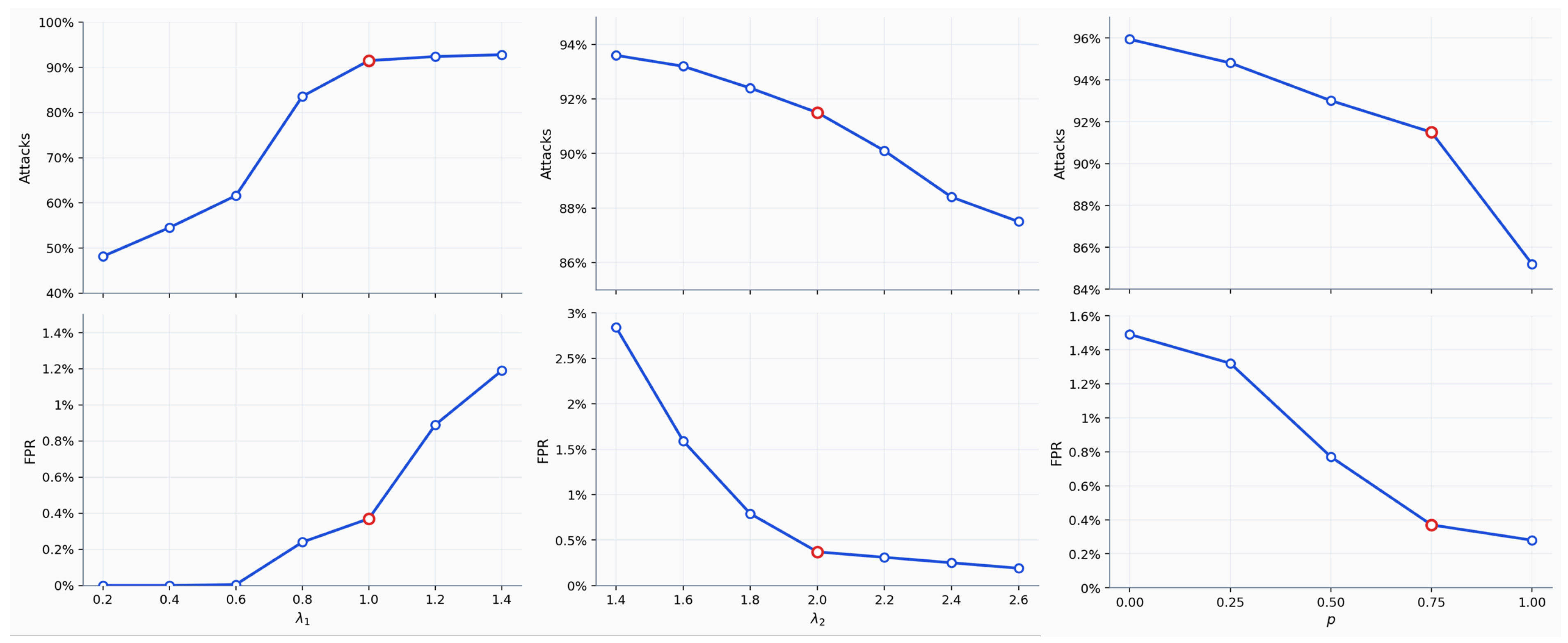
We analyze the sensitivity of three key hyper-parameters: , , and p, as presented in Figure 5. For simplicity, we only change the value of one hyper-parameter, while keeping the other two at their default values. Quantitatively, as increases from 0.2 to 1.0, the bit accuracy increases significantly accompanied by a minor elevation in FPR. When further increases from 1.0 to 1.4, the gain in bit accuracy becomes negligible, whereas the FPR rises sharply. For in the range of , the bit accuracy decreases gradually. The FPR drops drastically when increases from 1.4 to 2.0, and then plateaus as ranges from 2.0 to 2.6. The value acts as a performance watershed, as values exceeding this threshold will disrupt the favorable trade-off between bit accuracy and FPR. Consequently, we select , , and as the optimal hyper-parameter configuration for the best overall performance.
Figure 5.
Hyperparameter sensitivity analysis with a 48-bit copyright message across all 3DGS scenes.
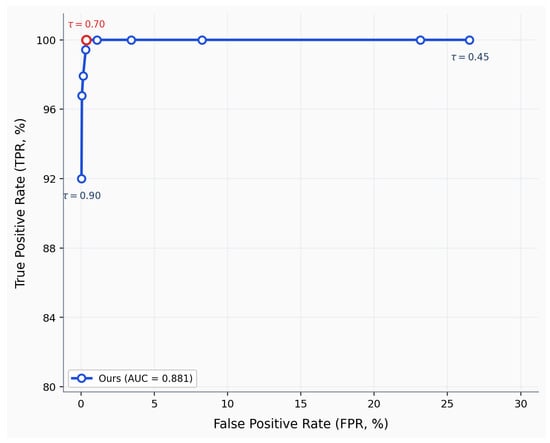
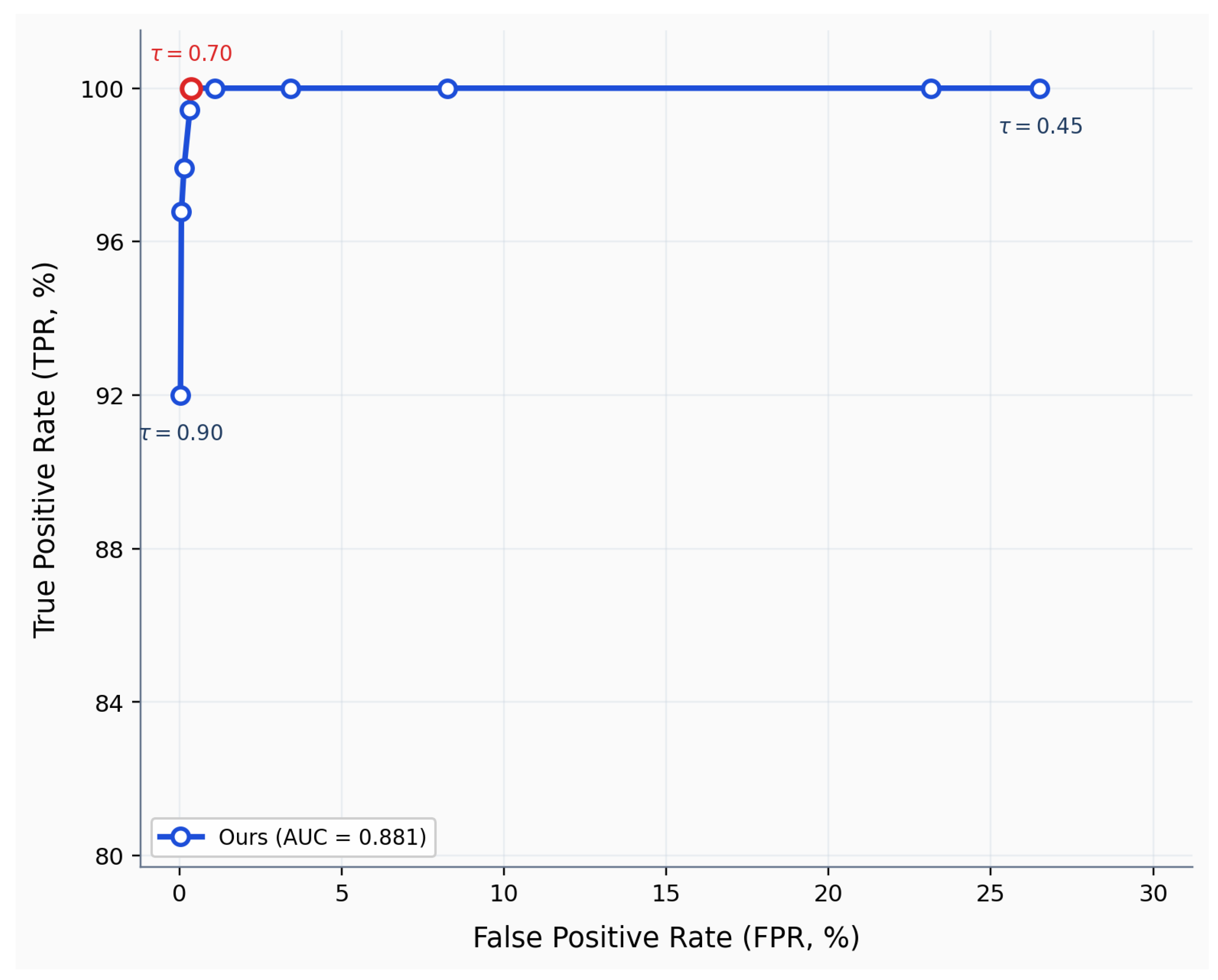
In addition, we further investigate the impact of the copyright judgment threshold on the true positive rate (TPR) and FPR in Figure 6. As illustrated in the ROC curve, achieves the optimal balance between TPR and FPR. Specifically, values larger than 0.7 will lead to missed detections of copyrighted 3DGS renderings, while values smaller than 0.7 primarily result in an increased FPR with noticeable degradation in TPR.
Figure 6.
ROC curves produced by varying the copyright judgment thresholds.
5. Conclusions
In this paper, we propose a novel zero-watermarking framework tailored explicitly for 3D Gaussian Splatting (3DGS). By synergistically integrating uncertainty-guided feature selection, contrastive learning, and distortion-aware attack augmentation, our approach trains a decoder to extract cross-view consistent, discriminative, and robust features from 3DGS renderings and map them to a unique zero-watermark sequence. Extensive experimental results demonstrate that our method enables reliable copyright extraction from arbitrary novel viewpoints, even under severe 2D and 3D perturbations, while maintaining a negligible FPR for unauthorized content. Furthermore, in stark contrast to conventional embedding-based watermarking approaches, our zero-watermarking paradigm requires no modifications to the parameters of the original 3DGS model. This fundamental design choice confers an unparalleled advantage in preserving the original rendering fidelity of 3DGS models and supporting substantially higher message capacities.
Limitations. While the proposed method achieves a visually lossless and robust copyright protection scheme for 3DGS models, it has several notable limitations. Its evaluation scope against potential attacks on rendered images and 3D models is consistent with that of conventional embedding-based watermarking methods. We only validated its robustness against common 2D image distortions and basic 3D model perturbations, including rotation, additive noise injection, and cropping. However, the method cannot effectively defend against advanced practical 3D attacks such as model re-optimization, Gaussian pruning, and density augmentation. Since no unified benchmarks or evaluation protocols currently exist for these advanced 3D attacks, we plan to conduct comprehensive experiments in our future work. Additionally, under common attack scenarios and low message capacity settings, the robustness of the proposed method lags behind that of state-of-the-art embedding-based watermarking approaches. To address these limitations, our future work will focus on adopting more powerful feature extractors and developing improved strategies for cross-view shared feature mining to further enhance the robustness of the proposed zero-watermarking scheme.
Author Contributions
Conceptualization, X.Z. and K.L.; methodology, X.Z. and K.L.; validation, X.Z. and K.L.; formal analysis, X.Z. and K.L.; investigation, X.Z.; resources, K.L.; data curation, K.L.; writing—original draft preparation, X.Z. and K.L.; writing—review and editing, X.Z. and K.L.; visualization, K.L.; supervision, X.Z.; funding acquisition, X.Z. All authors have read and agreed to the published version of the manuscript.
Funding
This research received no external funding.
Institutional Review Board Statement
Not applicable.
Informed Consent Statement
Not applicable.
Data Availability Statement
The data presented in this study are available from [19,37,38].
Conflicts of Interest
The authors declare no conflicts of interest.
Abbreviations
The following abbreviations are used in this manuscript:
| 3DGS | 3D Gaussian Splatting |
| TPR | True Positive Rate |
| FPR | False Positive Rate |
| NeRF | Neural Radiance Fields |
| IPR | Intellectual Property Rights |
| BCE | Binary Cross Entropy |
| SH | Spherical Harmonic |
| OHNM | Online Hard Negative Mining |
References
- Kerbl, B.; Kopanas, G.; Leimkuehler, T.; Drettakis, G. 3D Gaussian Splatting for Real-Time Radiance Field Rendering. ACM Trans. Graph. 2023, 42, 1–14. [Google Scholar] [CrossRef] [Scilit]
- Bao, Y.; Ding, T.; Huo, J.; Liu, Y.; Li, Y.; Li, W.; Gao, Y.; Luo, J. 3D Gaussian Splatting: Survey, Technologies, Challenges, and Opportunities. IEEE Trans. Circuits Syst. Video Technol. 2025, 35, 6832–6852. [Google Scholar] [CrossRef] [Scilit]
- Tan, Y.; Liu, X.; Xie, S.; Chen, B.; Xia, S.T.; Wang, Z. Water-GS: Toward Copyright Protection for 3D Gaussian Splatting via Universal Watermarking. arXiv 2024, arXiv:2412.05695. [Google Scholar] [CrossRef] [Scilit]
- Jang, Y.; Park, H.; Yang, F.; Ko, H.; Choo, E.; Kim, S. 3D-GSW: 3D Gaussian Splatting for Robust Watermarking. In Proceedings of the IEEE/CVF Conference on Computer Vision and Pattern Recognition; IEEE: New York, NY, USA, 2025; pp. 5938–5948. [Google Scholar]
- Huang, X.; Li, R.; Cheung, Y.m.; Cheung, K.C.; See, S.; Wan, R. GaussianMarker: Uncertainty-Aware Copyright Protection of 3D Gaussian Splatting. Adv. Neural Inf. Process. Syst. 2024, 37, 33037–33060. [Google Scholar] [CrossRef] [Scilit]
- Chen, Z.; Wang, G.; Zhu, J.; Lai, J.; Xie, X. GuardSplat: Efficient and Robust Watermarking for 3D Gaussian Splatting. In Proceedings of the IEEE/CVF Conference on Computer Vision and Pattern Recognition; IEEE: New York, NY, USA, 2025; pp. 16325–16335. [Google Scholar] [CrossRef] [Scilit]
- Li, L.; Wang, J.; Ming, X.; Lu, Y. GS-Marker: Generalizable and Robust Watermarking for 3D Gaussian Splatting. arXiv 2025, arXiv:2503.18718. [Google Scholar] [CrossRef] [Scilit]
- Yu, Y.; Verbree, E.; van Oosterom, P.; Pottgiesser, U. 3D Gaussian Splatting for Modern Architectural Heritage: Integrating UAV-Based Data Acquisition and Advanced Photorealistic 3D Techniques. AGIL Giscience Ser. 2025, 6, 51. [Google Scholar] [CrossRef] [Scilit]
- Mohamad, M.A.; Elghazaly, G.; Hubert, A.; Frank, R. DENSER: 3D Gaussian Splatting for Scene Reconstruction of Dynamic Urban Environments. In Proceedings of the 2025 IEEE International Conference on Robotics and Automation (ICRA); IEEE: New York, NY, USA, 2025; pp. 2701–2707. [Google Scholar] [CrossRef] [Scilit]
- Xie, T.; Zong, Z.; Qiu, Y.; Li, X.; Feng, Y.; Yang, Y.; Jiang, C. PhysGaussian: Physics-Integrated 3D Gaussians for Generative Dynamics. In Proceedings of the IEEE/CVF Conference on Computer Vision and Pattern Recognition; IEEE: New York, NY, USA, 2024; pp. 4389–4398. [Google Scholar] [CrossRef] [Scilit]
- Tan, S.Y.; Liu, J.; Guo, Z. Concept and Application of Zero-Watermark. J. Softw. 2003, 14, 2056–2063. [Google Scholar]
- Taj, R.; Tao, F.; Kanwal, S.; Almogren, A.; Altameem, A.; Ur Rehman, A. A Reversible-Zero Watermarking Scheme for Medical Images. Sci. Rep. 2024, 14, 17320. [Google Scholar] [CrossRef] [Scilit] [PubMed]
- Hu, K.; Wang, X.; Hu, J.; Wang, H.; Qin, H. A Novel Robust Zero-Watermarking Algorithm for Medical Images. Vis. Comput. 2021, 37, 2841–2853. [Google Scholar] [CrossRef] [Scilit]
- Wang, C.p.; Wang, X.y.; Chen, X.j.; Zhang, C. Robust Zero-Watermarking Algorithm Based on Polar Complex Exponential Transform and Logistic Mapping. Multimed. Tools Appl. 2017, 76, 26355–26376. [Google Scholar] [CrossRef] [Scilit]
- Hu, K.; Zhai, D.; Gao, H.; Xie, H.; Wang, X. Rad-Mark: Reliable Adversarial Zero-Watermarking. Neurocomputing 2025, 636, 129970. [Google Scholar] [CrossRef] [Scilit]
- Jiang, W.; Lei, B.; Daniilidis, K. FisherRF: Active View Selection and Uncertainty Quantification for Radiance Fields Using Fisher Information. arXiv 2023, arXiv:2311.17874. [Google Scholar] [CrossRef] [Scilit]
- Chopra, S.; Hadsell, R.; LeCun, Y. Learning a Similarity Metric Discriminatively, with Application to Face Verification. In Proceedings of the 2005 IEEE Computer Society Conference on Computer Vision and Pattern Recognition (CVPR’05); IEEE: New York, NY, USA, 2005; Volume 1, pp. 539–546. [Google Scholar] [CrossRef] [Scilit]
- Zhu, J.; Kaplan, R.; Johnson, J.; Fei-Fei, L. HiDDeN: Hiding Data with Deep Networks. In Proceedings of the European Conference on Computer Vision (ECCV); Springer: Cham, Switzerland, 2018; pp. 657–672. [Google Scholar] [CrossRef] [Scilit]
- Mildenhall, B.; Srinivasan, P.P.; Tancik, M.; Barron, J.T.; Ramamoorthi, R.; Ng, R. NeRF: Representing Scenes as Neural Radiance Fields for View Synthesis. Commun. ACM 2021, 65, 99–106. [Google Scholar] [CrossRef] [Scilit]
- Yi, T.; Fang, J.; Wang, J.; Wu, G.; Xie, L.; Zhang, X.; Liu, W.; Tian, Q.; Wang, X. GaussianDreamer: Fast Generation from Text to 3D Gaussians by Bridging 2D and 3D Diffusion Models. In Proceedings of the IEEE/CVF Conference on Computer Vision and Pattern Recognition; IEEE: New York, NY, USA, 2024; pp. 6796–6807. [Google Scholar] [CrossRef] [Scilit]
- Hu, L.; Zhang, H.; Zhang, Y.; Zhou, B.; Liu, B.; Zhang, S.; Nie, L. GaussianAvatar: Towards Realistic Human Avatar Modeling from a Single Video via Animatable 3D Gaussians. In Proceedings of the IEEE/CVF Conference on Computer Vision and Pattern Recognition; IEEE: New York, NY, USA, 2024; pp. 634–644. [Google Scholar] [CrossRef] [Scilit]
- Zhou, X.; Lin, Z.; Shan, X.; Wang, Y.; Sun, D.; Yang, M.H. DrivingGaussian: Composite Gaussian Splatting for Surrounding Dynamic Autonomous Driving Scenes. In Proceedings of the IEEE/CVF Conference on Computer Vision and Pattern Recognition; IEEE: New York, NY, USA, 2024; pp. 21634–21643. [Google Scholar] [CrossRef] [Scilit]
- Lee, J.S.; Chen, Y.C.; Chew, C.J.; Hung, W.C.; Fan, Y.Y.; Li, B. Constructing Gene Features for Robust 3D Mesh Zero-Watermarking. J. Inf. Secur. Appl. 2023, 73, 103414. [Google Scholar] [CrossRef] [Scilit]
- Wang, X.; Zhan, Y. A Zero-Watermarking Scheme for Three-Dimensional Mesh Models Based on Multi-Features. Multimed. Tools Appl. 2019, 78, 27001–27028. [Google Scholar] [CrossRef] [Scilit]
- Zhang, H.; Zhang, Z.; Liu, X.; Guo, S.; Gao, C.; Jiang, M. Robust and Discriminative 3D Point Cloud Zero-Watermarking Scheme Based on Multi-Feature Attentional Fusion. Knowl.-Based Syst. 2025, 33, 114982. [Google Scholar] [CrossRef] [Scilit]
- Zhang, Z.; Zhang, L.; Wang, P.; Zhang, M.; Tan, T. Robust Watermarking Algorithm Based on Mahalanobis Distance and ISS Feature Point for 3D Point Cloud Data. Earth Sci. Inform. 2024, 17, 783–796. [Google Scholar] [CrossRef] [Scilit]
- Goli, L.; Reading, C.; Sellán, S.; Jacobson, A.; Tagliasacchi, A. Bayes’ Rays: Uncertainty Quantification for Neural Radiance Fields. In Proceedings of the IEEE/CVF Conference on Computer Vision and Pattern Recognition; IEEE: New York, NY, USA, 2024; pp. 20061–20070. [Google Scholar] [CrossRef] [Scilit]
- Savant, L.; Valsesia, D.; Magli, E. Modeling Uncertainty for Gaussian Splatting. arXiv 2024, arXiv:2403.18476. [Google Scholar] [CrossRef] [Scilit]
- Kheradmand, S.; Rebain, D.; Sharma, G.; Sun, W.; Tseng, Y.C.; Isack, H.; Kar, A.; Tagliasacchi, A.; Yi, K.M. 3D Gaussian Splatting as Markov Chain Monte Carlo. In Proceedings of the Advances in Neural Information Processing Systems; Globerson, A., Mackey, L., Belgrave, D., Fan, A., Paquet, U., Tomczak, J., Zhang, C., Eds.; Curran Associates, Inc.: New York, NY, USA, 2024; Volume 37, pp. 80965–80986. [Google Scholar] [CrossRef] [Scilit]
- Sung, K.K.; Poggio, T. Example-Based Learning for View-Based Human Face Detection. IEEE Trans. Pattern Anal. Mach. Intell. 1998, 20, 39–51. [Google Scholar] [CrossRef] [Scilit]
- Felzenszwalb, P.F.; Girshick, R.B.; McAllester, D.; Ramanan, D. Object Detection with Discriminatively Trained Part-Based Models. IEEE Trans. Pattern Anal. Mach. Intell. 2009, 32, 1627–1645. [Google Scholar] [CrossRef] [Scilit]
- Jang, Y.; Lee, D.I.; Jang, M.; Kim, J.W.; Yang, F.; Kim, S. WateRF: Robust Watermarks in Radiance Fields for Protection of Copyrights. In Proceedings of the 2024 IEEE/CVF Conference on Computer Vision and Pattern Recognition (CVPR); IEEE: New York, NY, USA, 2024; pp. 12087–12097. [Google Scholar] [CrossRef] [Scilit]
- Wang, Z.; Bovik, A.C.; Sheikh, H.R.; Simoncelli, E.P. Image Quality Assessment: From Error Visibility to Structural Similarity. IEEE Trans. Image Process. 2004, 13, 600–612. [Google Scholar] [CrossRef] [Scilit] [PubMed]
- Zhang, R.; Isola, P.; Efros, A.A.; Shechtman, E.; Wang, O. The Unreasonable Effectiveness of Deep Features as a Perceptual Metric. arXiv 2018, arXiv:1801.03924. [Google Scholar] [CrossRef] [Scilit]
- Zhao, X.; Zhang, K.; Su, Z.; Vasan, S.; Grishchenko, I.; Kruegel, C.; Vigna, G.; Wang, Y.X.; Li, L. Invisible Image Watermarks Are Provably Removable Using Generative AI. In Proceedings of the Advances in Neural Information Processing Systems; Curran Associates, Inc.: New York, NY, USA, 2024; Volume 37, pp. 8643–8672. [Google Scholar] [CrossRef] [Scilit]
- Goodfellow, I.; Bengio, Y.; Courville, A. Deep Learning; MIT Press: Cambridge, MA, USA, 2016; Volume 1. [Google Scholar] [CrossRef] [Scilit]
- Barron, J.T.; Mildenhall, B.; Verbin, D.; Srinivasan, P.P.; Hedman, P. Mip-NeRF 360: Unbounded Anti-Aliased Neural Radiance Fields. In Proceedings of the IEEE/CVF Conference on Computer Vision and Pattern Recognition; IEEE: New York, NY, USA, 2022; pp. 5470–5479. [Google Scholar] [CrossRef] [Scilit]
- Mildenhall, B.; Srinivasan, P.P.; Ortiz-Cayon, R.; Kalantari, N.K.; Ramamoorthi, R.; Ng, R.; Kar, A. Local Light Field Fusion: Practical View Synthesis with Prescriptive Sampling Guidelines. ACM Trans. Graph. (ToG) 2019, 38, 1–14. [Google Scholar] [CrossRef] [Scilit]

Disclaimer/Publisher’s Note: The statements, opinions and data contained in all publications are solely those of the individual author(s) and contributor(s) and not of MDPI and/or the editor(s). MDPI and/or the editor(s) disclaim responsibility for any injury to people or property resulting from any ideas, methods, instructions or products referred to in the content. |
© 2026 by the authors. Licensee MDPI, Basel, Switzerland. This article is an open access article distributed under the terms and conditions of the Creative Commons Attribution (CC BY) license.