


Abstract
With the rapid advancement of generative AI (AIGC) technology, synthetic images are increasingly approaching real pictures in terms of resolution and semantic consistency. Traditional detection methods face numerous challenges, such as insufficient cross-modal generalization capabilities and difficulty in identifying hidden generative traces. Existing solutions primarily design feature extractors for single generative models, struggling to address the complexity of multimodal forgeries. Therefore, we propose a multi-domain feature fusion Transformer network that integrates spatial, frequency, and wavelet transform features and introduce a cross-domain feature fusion module (CDAF) to detect subtle forgery traces in deepfake images. This model demonstrates superior detection performance on current forged images generated by generative adversarial networks (GANs) and diffusion models while exhibiting enhanced robustness.
1. Introduction
With the rapid development of deep generative technologies—such as Generative Adversarial Networks (GANs) [1], Variational Autoencoders (VAEs) [2], and Diffusion Models (DMs) [3,4]—it has become increasingly challenging to distinguish high-fidelity deepfake images from authentic ones. Deepfake technology has proliferated rapidly, giving rise to serious security concerns, including misuse on social media, fabrication of personal information, and political fraud. These threats pose severe challenges to public information security, personal privacy, and societal trust. Consequently, there is an urgent need for efficient and robust deepfake detection techniques.
In the early stages of deepfake generation, due to technological limitations, synthetic images often exhibited obvious visual artifacts—such as visible splicing boundaries, inconsistent facial structures, abnormal color distributions, and other generation-related anomalies. As a result, many early detection approaches adopted standard binary classification models or simple convolutional neural networks (CNNs) to distinguish real from fake images. For example, Tyagi et al. [5] proposed MiniNet, a lightweight fully convolutional neural network that emphasizes image-level features for detecting forgeries such as copy-move and image splicing. Gaurav et al. [6] employed a CNN combined with error-level analysis to identify image tampering by evaluating the effects of resaving images at specific JPEG quality levels and quantifying discrepancies in compression artifacts. Muthukumar et al. [7] utilized the DenseNet121 architecture with hyperparameter optimization to adaptively extract shared discriminative features for detecting forged face images. Yang et al. [8] enhanced texture artifacts induced by post-processing by applying a guided filter with a saliency map as the guidance image, thereby amplifying texture differences between real and fake samples to improve discriminability. Wang et al. [9] introduced semantic masks to direct the detector’s attention toward key facial regions, enabling their CNN-based model to achieve improved detection performance on forged face images. However, these methods typically perform well only on data distributions similar to their training sets and often lack generalization capabilities. Moreover, as deepfake generation techniques have advanced—particularly with the iterative improvements in GANs and the emergence of diffusion models—the resulting synthetic images now exhibit richer details, more coherent structures, and fewer detectable artifacts. This evolution renders traditional CNN-based detection approaches increasingly ineffective and insufficient.
To address these limitations, several recent works have explored more robust and generalizable strategies. Frank et al. [10] leveraged GANs to generate synthetic images and introduced perturbations in the discrete cosine transform (DCT) domain to suppress frequency-level artifacts in real images. Their classifier was trained on both original and perturbed images, demonstrating enhanced generalization across unseen forgery types. Gu et al. [11] proposed a progressive reinforcement learning framework that jointly exploits RGB and frequency-domain cues by decomposing images into frequency-specific components, thereby isolating genuine and forged traces in the spectral domain. However, frequency-based methods often exhibit limited robustness against common post-processing operations—such as upsampling, downsampling, or additive noise—which can significantly degrade their discriminative power. Recognizing that over-reliance on frequency artifacts may hinder generalization, Jeong et al. [12] argued that ignoring such artifacts during training can improve a detector’s adaptability across diverse GAN architectures. They proposed FrePGAN, a framework that simultaneously trains a perturbation generator and a deep forgery detector, substantially improving cross-model generalization. Shiohara [13] introduced a self-blended image synthesis technique to train detectors to identify boundary inconsistencies between source and blended regions in forged faces. Shi et al. [14] adopted a reconstruction-based approach: they first pre-trained models on real facial data using masked image modeling, then applied these models to reconstruct fake images and classified samples based on the discrepancy between the input and reconstructed outputs. While promising, such reconstruction-based methods often require intermediate resampling steps, increasing computational complexity. Moreover, their detection performance heavily depends on the quality and relevance of the reconstructed features; poorly chosen reconstruction objectives can even degrade detection accuracy.
Continuous iterations of Generative Adversarial Networks (GANs) and diffusion models have produced synthetic images that are increasingly indistinguishable from real ones. Detecting deepfakes remains challenging due to the diversity of forgery techniques, the high visual fidelity of generated content, and the limited cross-domain generalization of existing detection models. Despite significant advances in the field, accurately distinguishing authentic images from deepfakes remains a formidable task. To address these challenges, we propose a multi-domain Transformer network that integrates features from the spatial domain, the frequency domain, and the wavelet transform for deepfake image detection. Our method first extracts spatial representations, frequency-domain spectrograms, and wavelet coefficients from the input image. These heterogeneous features are then projected into a unified embedding space through a carefully designed feature embedding module. Subsequently, a multi-branch Transformer encoder processes each domain-specific feature stream in parallel, while cross-domain attention mechanisms facilitate interaction and fusion across domains. Finally, the fused high-level semantic features are fed into a classifier to discriminate between genuine and deepfake images. The proposed model demonstrates enhanced robustness against state-of-the-art fake images generated by both GANs and diffusion models and exhibits superior cross-generator generalization capabilities.
The specific contributions of this work are as follows:
- We propose a multi-domain feature fusion Transformer network that jointly leverages spatial, frequency, and wavelet-domain representations—capturing multi-scale characteristics through wavelet transforms—to uncover subtle and otherwise imperceptible forgery traces in deepfake images.
- Features are extracted using EfficientNet independently from the spatial domain, the frequency domain, and the wavelet domain. These features are then fused via a novel Cross-Domain Attention Fusion (CDAF) module, followed by a Swin Transformer that effectively identifies fine-grained forgery artifacts.
- We conduct comprehensive evaluations across multiple benchmark datasets for AI-generated image detection, covering a wide spectrum of state-of-the-art generative models. Extensive experimental results demonstrate that our approach significantly outperforms existing state-of-the-art detectors in both in-domain and cross-domain settings.
2. Related Works
Early work in deepfake detection primarily focused on identifying specific physiological or physical inconsistencies. Li et al. [15] exposed anomalies in fake videos by detecting abnormal blinking patterns. Similarly, Yang et al. [16] leveraged inconsistencies in head pose to distinguish real from fabricated footage. With the advancement of deep learning, research shifted toward designing more robust network architectures capable of learning universal forgery patterns. Rossler et al. [17] released the large-scale benchmark dataset FaceForensics++ and systematically evaluated the performance of various CNN architectures—including Xception [18] and ResNet [19]—on deepfake detection tasks. Their study revealed that the Xception network exhibited exceptional generalization capabilities for this task. Nguyen et al. [20] (2021) proposed Capsule-Forensics, which employs capsule networks to capture spatial hierarchies among local features, thereby identifying geometric distortions introduced during the forgery process. Chen et al. [21] introduced Self-Supervised Deepfake Detection (SSDD), which constructs positive–negative sample pairs (real–real vs. real–fake) to learn forgery-invariant representations. Although these methods achieve strong performance on specific datasets, their effectiveness significantly degrades when faced with unseen generative models or cross-dataset scenarios, revealing limitations in generalization.
Consequently, recent research has focused on improving the robustness and universality of detection models. Ren et al. [22] proposed exploiting GAN fingerprints—unique, learnable artifacts left by different generative models in their outputs—that persist even after post-processing. Separately, researchers have found that incorporating frequency-domain analysis can reveal subtle generation artifacts by examining the spectral characteristics of images. Genuine and forged images exhibit statistically significant differences in the frequency domain, particularly in high-frequency components. For instance, Zhao et al. [23] identified anomalies in high-frequency coefficients (e.g., Discrete Cosine Transform coefficients) within deepfake images and proposed the Frequency-aware Deepfake Detection (F3-Net) framework, which substantially improves cross-domain detection performance. Kim et al. [24] introduced FReTA, a detection method based on representation learning and knowledge distillation. It leverages pre-trained models to rapidly adapt to performance-based deepfakes via transfer learning. Aneja et al. [25] proposed a few-shot learning approach grounded in transfer learning, framing deepfake detection as a domain-shift problem: an encoder is first trained on a source domain and then fine-tuned using only a few samples from the target domain. During inference, classification is performed based on the distance between the latent representations of real and fake samples. Wang et al. [26] proposed the RFM framework, which enhances the training efficacy of CNNs through attention mechanisms. Their method first generates a forgery attention map for the backbone network using the original image, then performs data augmentation by erasing suspicious regions before retraining the model.
In recent years, the widespread adoption of Transformers [27] in natural language processing and computer vision—owing to their performance surpassing that of CNNs—has inspired their application in deepfake detection. Wodajo et al. [28] proposed CvT, which combines CNNs and Vision Transformers (ViTs) as dual backbones for feature extraction to authenticate facial images. Heo et al. [29] integrated knowledge distillation into a detection model with a Vision Transformer as the backbone, using the CNN-based EfficientNet as the teacher model. Park et al. [30] explored a novel model based on the Swin-Transformer architecture to distinguish between real and fake images generated by convolutional neural networks (CNNs) and generative adversarial networks (GANs), preventing the misuse of AI images through procedural discrimination/legal sanctions. Xu et al. [31] proposed an efficient visual Transformer model that combines CNN features derived from vector concatenation with a patch-based localization method to identify fake regions by interacting with all locations, for DeepFake detection to extract local and global features. In this paper, we propose an efficient forgery detection network that adopts a Transformer as the backbone architecture. Specifically, we employ a Vision Transformer (ViT) to extract global semantic features and integrate an attention mechanism to localize forged regions. Furthermore, our method fuses multimodal features from both the spatial domain and the frequency domain to effectively detect images generated by diverse classes of generative models.
3. Materials and Methods
This section mainly introduces our proposed model and its details.
3.1. Overview
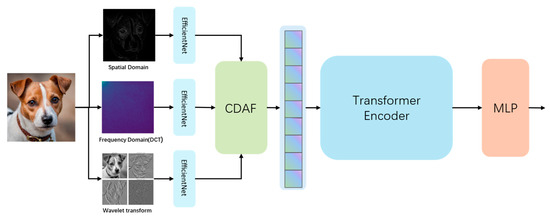
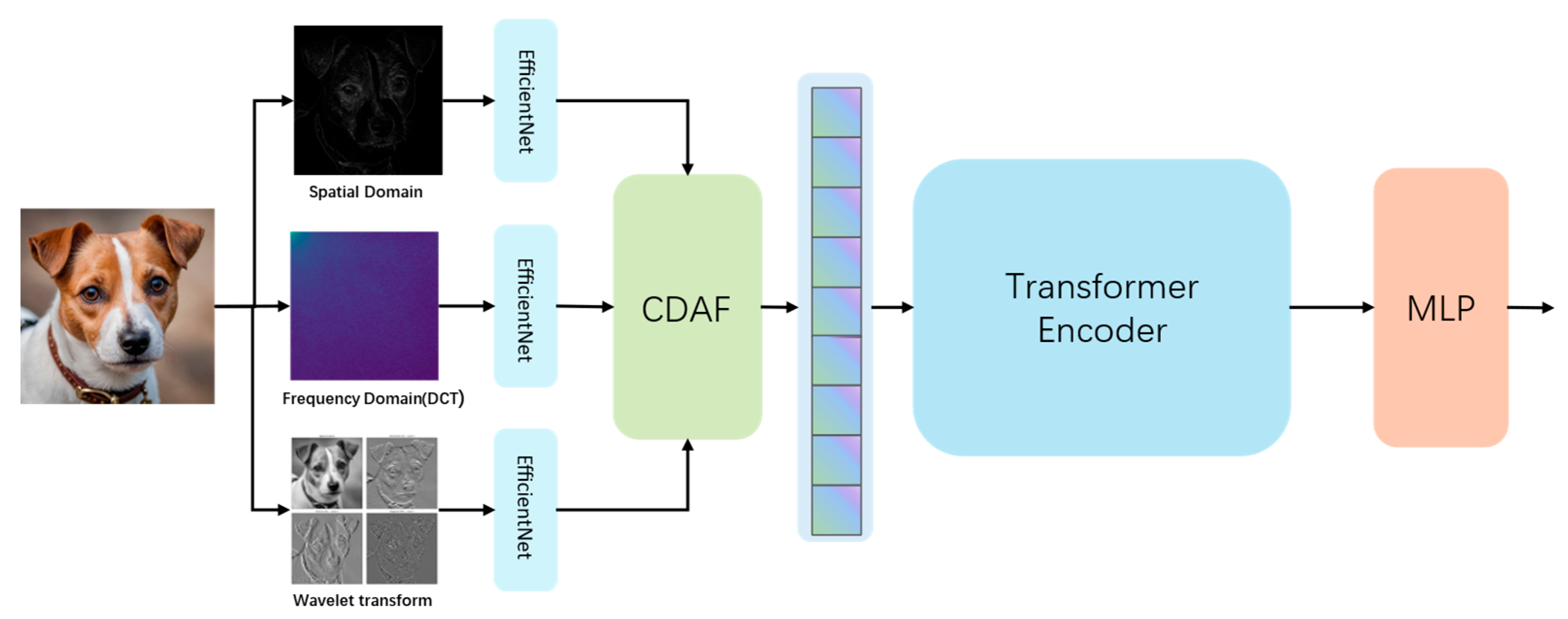
At present, deepfake images are predominantly generated by more stable GAN models and advanced diffusion models, resulting in richer and more accurate fine-grained details. To accurately detect these increasingly indistinguishable deepfakes, we propose a multi-domain Transformer network framework that integrates spatial, frequency, and wavelet transform features. This framework jointly utilizes representations from the image’s spatial, frequency, and wavelet domains. Deepfakes inevitably exhibit multi-domain inconsistencies, such as spatial artifacts, frequency anomalies, and multi-scale distortions. A carefully designed embedding module maps these features into a unified feature space. Subsequently, a multi-branch Transformer encoder processes features from each domain while enabling interaction and fusion through cross-domain attention mechanisms. Finally, the fused high-level semantic features distinguish between real and fake images. The model framework is illustrated in Figure 1.
Figure 1.
The proposed model framework. The framework includes spatial domain, frequency domain, and wavelet domain feature extraction based on EfficientNet, a cross-domain attention feature integration module (CDAF), and a backbone network based on Swin Transformer.
3.2. Multi-Domain Feature Extraction
In the spatial domain extraction section, a lightweight EfficientNet-B0 network is employed for feature extraction, capturing inconsistent feature information such as image texture, edges, and local features. To enhance edge sensitivity, a gradient-based map (Laplacian map) is concatenated to the RGB channels before convolution, capturing fine-grained local distortions commonly seen in blending or diffusion-based artifact boundaries.
Spatial domain features:
where is the batch size, represents the spatial feature channel, and is the spatial resolution of the image.
In the frequency domain extraction stage, most image generation models—such as GANs and diffusion models—tend to produce smoother, more natural low-frequency content. However, they often struggle with high-frequency details like textures and edge sharpness, leading to anomalies such as excessive smoothing and periodic artifacts. Here, we compute a block-wise Discrete Cosine Transform (DCT), retaining only mid-frequency and high-frequency coefficients to eliminate semantic redundancy.
Frequency domain features:
where are frequency domain coordinates. The frequency domain coefficients obtained by performing a two-dimensional discrete cosine transform on the image I constitute the frequency domain feature map.
The wavelet domain feature extraction component leverages the multi-scale and multi-directional properties of wavelet transforms to effectively capture local image details, edge structures, and texture information. captures low-frequency and high-frequency subband (LL, LH, HL, HH) feature information Fwave through multi-level discrete wavelet transforms (DWT). Here, we employ EfficientNet for feature detail extraction, the same model used for extracting spatial and frequency domain features. Frequency domain features:
3.3. Cross-Domain Attention Feature Fusion Module
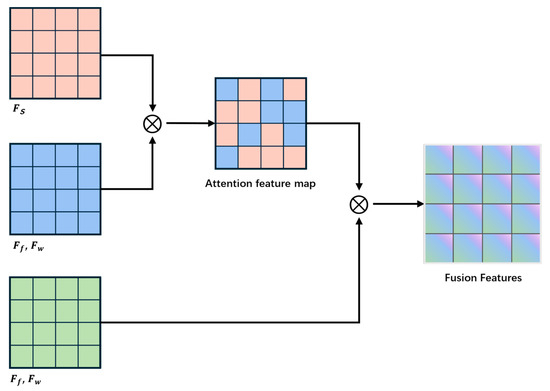
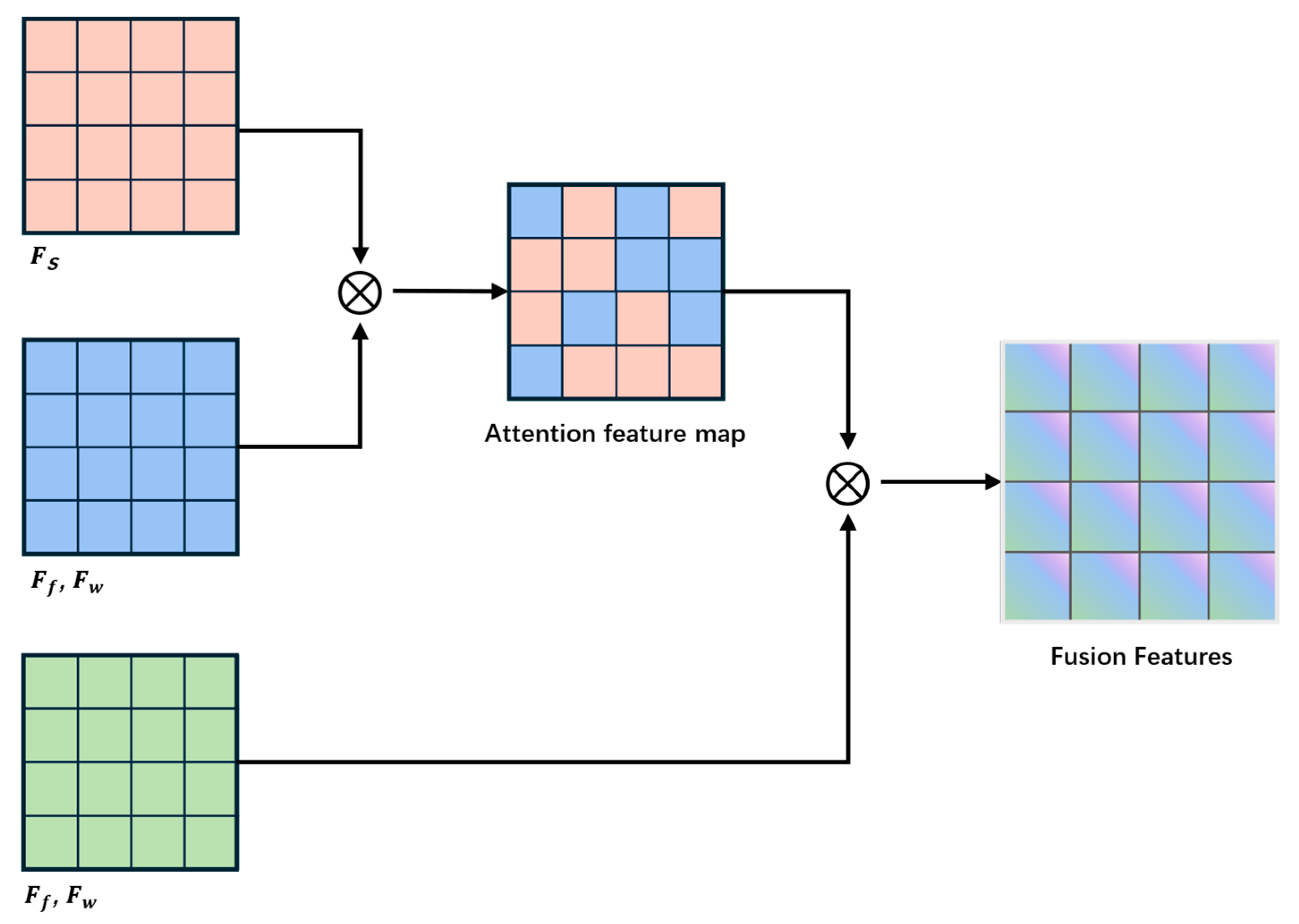
The spatial domain features , frequency domain features , and wavelet domain features obtained through lightweight EfficientNet convolutional computations require feature fusion before proceeding to the next step. Here, we employ a cross-domain attention fusion model for feature integration, as illustrated in Figure 2. The cross-domain attention fusion is defined as:
where represents the spatial domain feature , is the concatenated feature (, ) from the frequency domain and wavelet domain, and .
Figure 2.
Cross-Domain Attention Feature Fusion Module framework.
The final result is the fused feature . It is defined as:
where is a sigmoid gate.
The fused representation is then fed into the Swin Transformer for hierarchical global reasoning.
3.4. Transformer Module
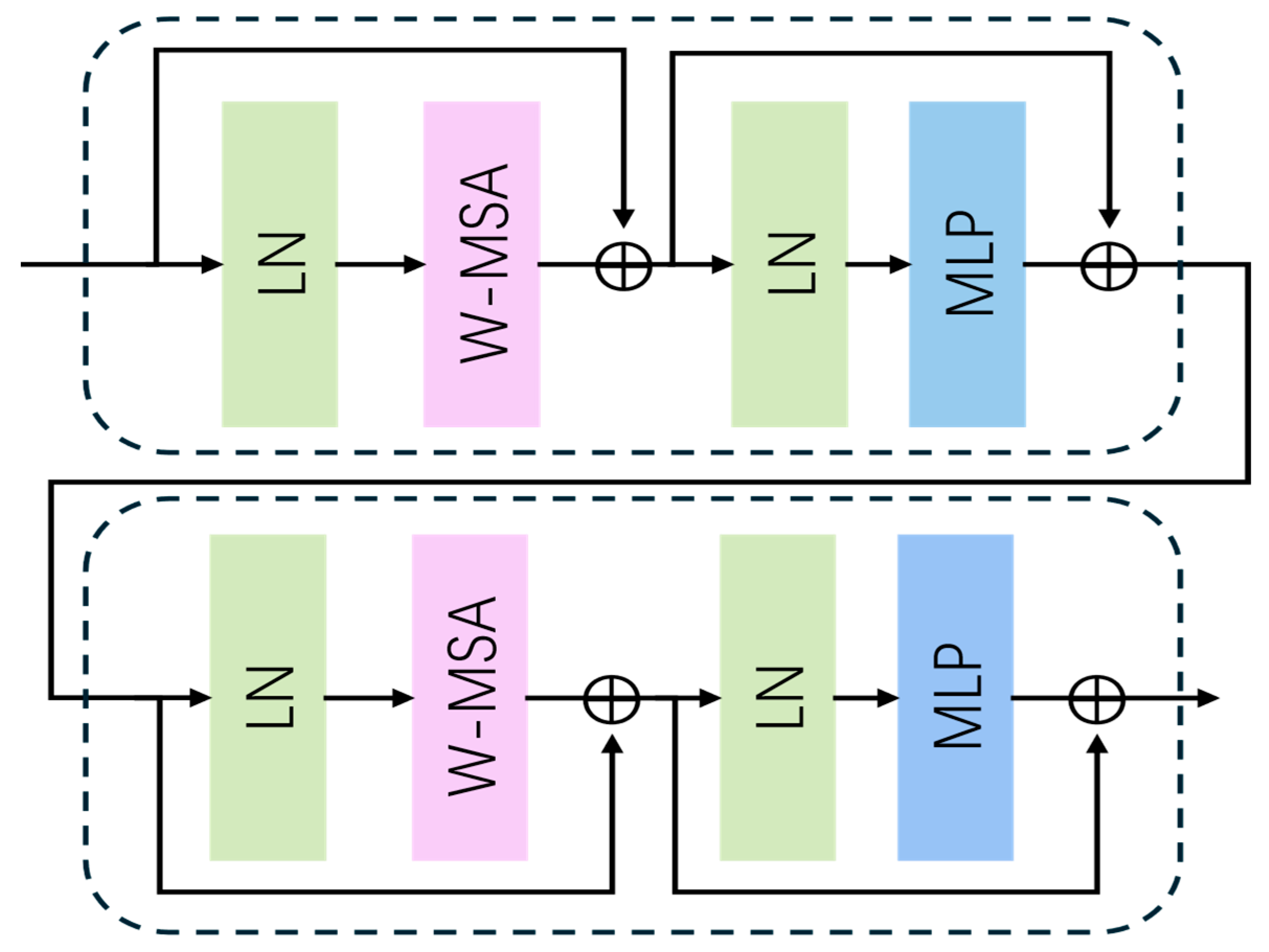
In the configuration of the backbone feature detection network, to better uncover subtle artifacts in forged images, we employ the Swin Transformer as the backbone network for detecting genuine and forged features after feature fusion, as shown in Figure 3. Swin Transformer is built by replacing the standard multi-head self-attention (MSA) module in a Transformer block with a module based on shifted windows, with other layers kept the same. A Swin Transformer block consists of a shifted window-based MSA module, followed by a 2-layer MLP with GELU nonlinearity in between. A LayerNorm (LN) layer is applied before each MSA module and each MLP, and a residual connection is applied after each module.
Figure 3.
Transformer Module. The framework includes a LayerNorm (LN) layer, a shift-window-based multi-head self-attention layer (W-MSA), and a Multi-Layer Perceptron (MLP) layer. A LayerNorm (LN) layer is applied before each MSA module and each MLP, with a residual connection following every module.
Overall loss function:
where represents the spatial domain feature, represents the frequency domain feature, represents the wavelet transform feature, represents the true label, and represents the attention weight vector generated in the fusion module.
4. Experiments and Results
4.1. Dataset
In terms of dataset selection, to better verify the reliability and robustness of the model and consider the impact of different types of generative models on the detection model, this study used multiple datasets for verification experiments, including the common face datasets DFDC [32] and Celeb-DF [33], as well as ForenSynths [34], based on various types of images. All images were resized to 256 × 256 pixels. In splitting the dataset, we used 80% for model training and 20% for testing.
Celeb-DF is a large-scale challenging dataset for deep fake forensics. The dataset includes 590 original videos collected from YouTube and 5639 fake videos generated by DeepFake, with people of different ages, races, and genders in the videos.
DFDC, the Deepfake Detection Challenge dataset, is a large dataset released by Meta to measure the progress of Deepfake detection technology. This dataset is a deep face detection dataset consisting of more than 100,000 fake videos created from 19,154 real videos and fully considers the diversity of subjects and backgrounds in real scenes (skin color, gender, lighting conditions, etc.).
ForenSynths: This dataset contains fake images generated by 11 different convolutional neural network (CNN)-based image generator models. These models cover commonly used architectures today (ProGAN, StyleGAN, BigGAN, CycleGAN, StarGAN, GauGAN, DeepFakes, etc.).
On the other hand, we also considered and selected some fake image data generated based on diffusion models, including PNDM [35], Guided [36], DALL-E [37], and VQ-Diffusion [38].
4.2. Evaluation Metrics and Implementation Details
In the initial spatial, we employ three parallel EfficientNet-B3 encoders to extract features from the spatial, frequency, and wavelet domain representations of the input image, respectively. Each EfficientNet-B0 is initialized with ImageNet-pretrained weights and fine-tuned end-to-end. The output feature maps from each branch have a spatial resolution of H/32 × W/32 and a channel dimension of 384 (i.e., the final stage output before global pooling in EfficientNet-B3). These features are then projected via lightweight 1 × 1 convolutions into a unified embedding space of dimension d = 256, enabling cross-domain alignment. The three domain-specific embeddings are concatenated along the channel dimension and fed into a modified Swin Transformer backbone (Tiny configuration: window size = 8, 4 stages, depths = [2, 2, 6, 2], embed dim = 96). To accommodate the fused input, the first linear patch embedding layer of Swin Transformer is reconfigured to accept an input dimension of 3 × 256 = 768, and its weights are initialized using Xavier uniform initialization. Subsequent transformer blocks maintain the standard Swin architecture, ultimately producing a high-resolution feature map that is upsampled via a transposed convolution head for output forgery localization. EfficientNet employs the Adam optimizer with a learning rate of 1 × 10⁻⁴. The backbone Swin Transformer network utilizes the Adamw optimizer with a learning rate of 5 × 10⁻⁵. Here, the spatial loss , frequency domain loss , and wavelet domain loss are all set to 0.3, the fusion loss is 0.2, and the backbone transformer network loss is 1.0. The batch size is set to 16, and the number of epochs is 100. We evaluate the proposed method using Average Precision (AP) and Accuracy (ACC) as assessment metrics. All experiments were trained on a server equipped with dual NVIDIA RTX 3090Ti GPUs, AMD Threadripper 2950X CPU, and 64 G RAM.
4.3. Comparisons with State-of-the-Art Methods
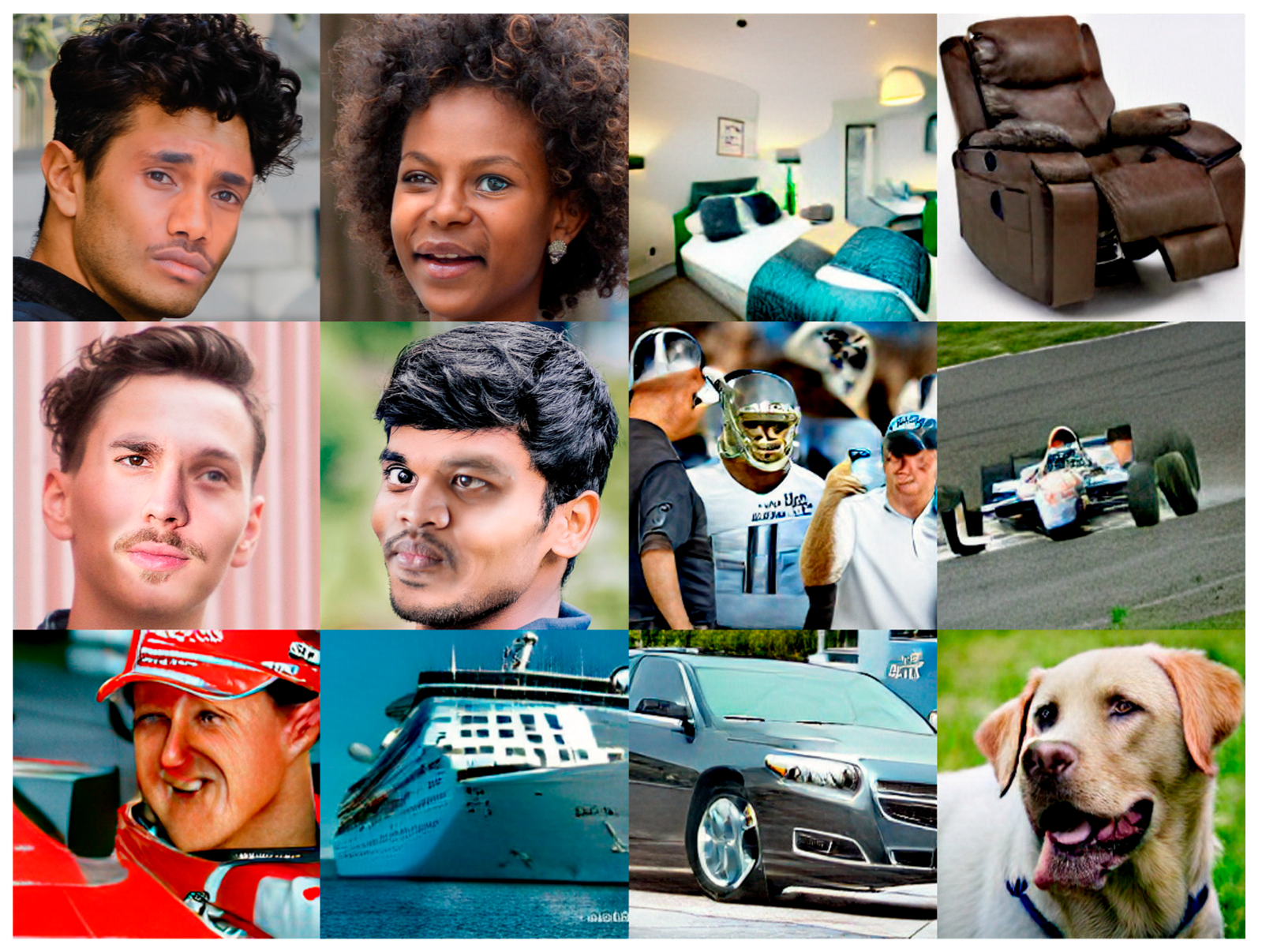
GAN-generated fake images commonly exhibit certain telltale signs or anomalous features, as shown in Figure 4. Their fabricated texture characteristics are relatively conspicuous, making them easier for detection models to identify. However, fake images generated using the Stable Diffusion model, as illustrated in Figure 5, possess forgery traces that are difficult to discern at a glance. Consequently, models that extract only a single feature from an image struggle to accurately detect the subtle, deep-seated forgery traces within them.
Figure 4.
Examples of images generated by GAN generation models.
Figure 5.
Examples of images generated by the diffusion-based generation models.
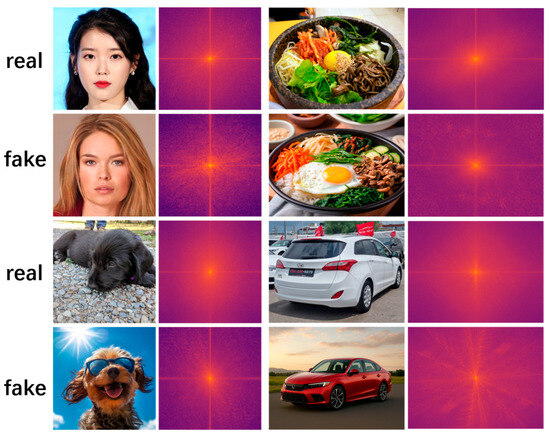
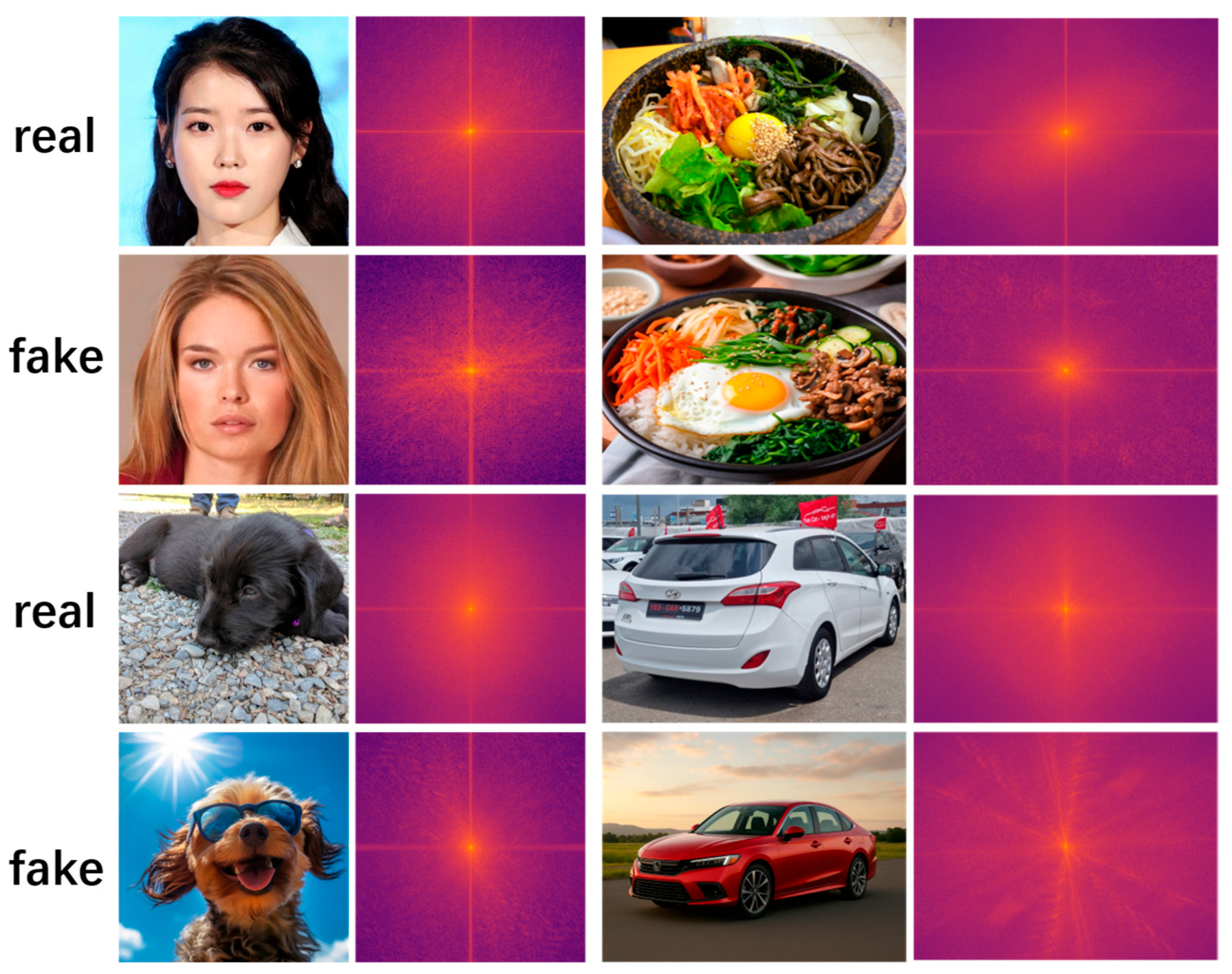
To uncover hidden traces in deepfake images, we performed frequency domain visualization analysis on the forged images, as shown in Figure 6. In the image frequency domain visualization spectrum, the forgery features of the forged image are magnified, and its spectral features are clearly different from those of the real image.
Figure 6.
Frequency domain visualization analysis of real and fake images.
In the model performance comparison test, we first used the CFDC and celeb-DF datasets based on face images to analyze the model performance. Simultaneously, we tested the impact of different modules on the overall network framework. As shown in Table 1, our model performed better in both accuracy and average precision. The addition of wavelet domain features significantly improved detection performance through multi-scale feature extraction, and the inclusion of CDAF further enhanced the ability to identify image forgery traces.
Table 1.
Comparing with advanced models on facial forgery datasets.
In model testing experiments for detecting deepfake images generated by GANs, we employed the Forensynths dataset to evaluate images produced by various GAN models, as shown in Table 2. Compared to other state-of-the-art models, our model demonstrates greater robustness.
Table 2.
Performance comparison with other state-of-the-art models on the ForenSynths dataset based on accuracy (ACC)/average precision (AP).
Compared to GAN-based deepfakes, diffusion model-generated deepfakes are more difficult to detect. They exhibit more natural edge transitions and more concealed forgery traces. Most detection models perform poorly against these challenges, as shown in Table 3. Our proposed multi-domain fusion Transformer network simultaneously searches for forgery traces in the spatial, frequency, and wavelet domains of the manipulated images, significantly enhancing the model’s detection capabilities. Even when compared to other excellent models, our approach consistently demonstrates outstanding performance.
Table 3.
Accuracy and average precision comparisons with state-of-the-art methods on the diffusion model dataset.
5. Discussion and Conclusions
In deepfake image detection tasks, most existing research has focused on verifying the authenticity of individual facial images, with only a limited body of work addressing general-purpose fake detection. Among these, the majority target the authentication of images synthesized by Generative Adversarial Networks (GANs). However, such methods often exhibit strong performance only on images generated by specific architectures or training paradigms, and their effectiveness significantly degrades when applied to images produced by more advanced generators—particularly stable GAN variants and, more recently, diffusion models. To address these limitations, this paper proposes a multi-domain Transformer network that jointly leverages spatial, frequency, and wavelet-domain representations for robust detection of deepfakes. Specifically, our method first extracts spatial features, frequency-domain spectrograms (obtained via the Fourier transform), and multi-scale wavelet coefficients from the input image. These heterogeneous signals are then projected into a unified latent space through a dedicated embedding module. A multi-branch Transformer encoder processes each domain separately, while cross-domain attention mechanisms facilitate dynamic interaction and fusion of complementary cues across domains. The resulting fused high-level features are subsequently used for binary classification between real and deepfake images.
Extensive experiments demonstrate that our approach achieves superior robustness against a wide spectrum of generative models—including both GANs and state-of-the-art diffusion-based synthesizers—and exhibits markedly improved cross-generator generalization compared to existing methods. This suggests that integrating multi-domain signatures can effectively capture intrinsic artifacts left by diverse generative processes, which are often imperceptible in the spatial domain alone. We hope this work will inspire further exploration of hybrid signal representations and innovative architecture designs for deepfake detection. Future research directions will focus on three key areas: (1) model miniaturization to enable deployment on resource-constrained devices; (2) optimization for low-power hardware platforms to facilitate real-time detection in edge computing environments; and (3) extension to handle compressed and re-encoded media commonly encountered on social platforms, with ultimate progression toward comprehensive video-level deepfake forensics. These advancements will collectively contribute to building a more robust, efficient, and holistic deepfake detection ecosystem capable of addressing real-world deployment challenges.
Author Contributions
Conceptualization, Q.M., S.-J.G. and Y.-I.C.; methodology, software, Q.M.; validation, Q.M. and Y.-I.C.; formal analysis, Q.M. and S.-J.G.; investigation, Q.M.; resources, Q.M. and Y.-I.C.; data curation, Q.M. and S.-J.G.; writing—original draft preparation, Q.M.; writing—review and editing, Q.M.; visualization, Q.M.; supervision, Q.M. and Y.-I.C.; project administration, Q.M. and Y.-I.C.; funding acquisition, Q.M. and Y.-I.C. All authors have read and agreed to the published version of the manuscript.
Funding
This research was supported by the Korea Institute of Marine Science & Technology Promotion (KIMST) from 2022 under the project entitled “Development and Demonstration of a Data Platform for AI-Based Safe Fishing Vessel Design” (RS-2022-KS221571). This work was also supported by the Ministry of Trade, Industry and Energy (MOTIE) and implemented by the Korea Institute for Advancement of Technology (KIAT) under the project entitled “Development of an International Standardization and Sustainability Integration Framework for AI Industry Internalization and Global Competitiveness Enhancement” (RS-2025-07372968). In addition, this work was supported by the Gachon University Research Fund in 2021 (GCU-202106340001).
Institutional Review Board Statement
All subjects gave their informed consent for inclusion before they participated in the study. Ethics approval is not required for this type of study. The study has been granted exemption by the Creative Commons BY 2.0, Creative Commons BY-NC 2.0, Public Domain Mark 1.0, Public Domain CC0 1.0, or U.S. Government Works license.
Informed Consent Statement
Not applicable.
Data Availability Statement
All datasets utilized in this article are open-source and publicly available for researchers.
Conflicts of Interest
The authors declare no conflicts of interest.
References
- Goodfellow, I.; Pouget-Abadie, J.; Mirza, M.; Xu, B.; Warde-Farley, D.; Ozair, S.; Courville, A.; Bengio, Y. Generative adversarial networks. Commun. ACM 2020, 63, 139–144. [Google Scholar] [CrossRef] [Scilit]
- Kingma, D.P.; Welling, M. Auto-encoding variational bayes. arXiv 2013, arXiv:1312.6114. [Google Scholar]
- Rombach, R.; Blattmann, A.; Lorenz, D.; Esser, P.; Ommer, B. High-resolution image synthesis with latent diffusion models. In Proceedings of the IEEE/CVF Conference on Computer Vision and Pattern Recognition, New Orleans, LA, USA, 19–20 June 2022; pp. 10684–10695. [Google Scholar]
- Luo, Z.; Chen, D.; Zhang, Y.; Huang, Y.; Wang, L.; Shen, Y.; Zhao, D.; Zhou, J.; Tan, T. Videofusion: Decomposed diffusion models for high-quality video generation. arXiv 2023, arXiv:2303.08320. [Google Scholar]
- Tyagi, S.; Yadav, D. MiniNet: A concise CNN for image forgery detection. Evol. Syst. 2023, 14, 545–556. [Google Scholar] [CrossRef] [Scilit]
- Aggarwal, G.; Srivastava, A.K.; Jhajharia, K.; Sharma, N.V.; Singh, G. Detection of deep fake images using convolutional neural networks. In Proceedings of the 2023 3rd International Conference on Technological Advancements in Computational Sciences (ICTACS), Tashkent, Uzbekistan, 1–3 November 2023; pp. 1083–1087. [Google Scholar]
- Muthukumar, A.; Raj, M.T.; Ramalakshmi, R.; Meena, A.; Kaleeswari, P. Fake and propaganda images detection using automated adaptive gaining sharing knowledge algorithm with DenseNet121. J. Ambient. Intell. Humaniz. Comput. 2024, 15, 3519–3531. [Google Scholar] [CrossRef] [Scilit]
- Yang, J.; Xiao, S.; Li, A.; Lan, G.; Wang, H. Detecting fake images by identifying potential texture difference. Future Gener. Comput. Syst. 2021, 125, 127–135. [Google Scholar] [CrossRef] [Scilit]
- Wang, R.; Yang, Z.; You, W.; Zhou, L.; Chu, B. Fake face images detection and identification of celebrities based on semantic segmentation. IEEE Signal Process. Lett. 2022, 29, 2018–2022. [Google Scholar] [CrossRef] [Scilit]
- Frank, J.; Eisenhofer, T.; Schönherr, L.; Fischer, A.; Kolossa, D.; Holz, T. Leveraging frequency analysis for deep fake image recognition. In Proceedings of the International Conference on Machine Learning, Vienna, Austria, 12–18 July 2020; pp. 3247–3258. [Google Scholar]
- Gu, Q.; Chen, S.; Yao, T.; Chen, Y.; Ding, S.; Yi, R. Exploiting fine-grained face forgery clues via progressive enhancement learning. In Proceedings of the AAAI Conference on Artificial Intelligence, Virtual, 22 February–1 March 2022; pp. 735–743. [Google Scholar]
- Jeong, Y.; Kim, D.; Ro, Y.; Choi, J. Frepgan: Robust deepfake detection using frequency-level perturbations. In Proceedings of the AAAI Conference on Artificial Intelligence, Virtual, 22 February–1 March 2022; pp. 1060–1068. [Google Scholar]
- Shiohara, K.; Yamasaki, T. Detecting deepfakes with self-blended images. In Proceedings of the IEEE/CVF Conference on Computer Vision and Pattern Recognition, New Orleans, LA, USA, 18–24 June 2022; pp. 18720–18729. [Google Scholar]
- Shi, L.; Zhang, J.; Ji, Z.; Bai, J.; Shan, S. Real face foundation representation learning for generalized deepfake detection. Pattern Recognit. 2025, 161, 111299. [Google Scholar] [CrossRef] [Scilit]
- Li, Y.; Chang, M.-C.; Lyu, S. In ictu oculi: Exposing ai generated fake face videos by detecting eye blinking. arXiv 2018, arXiv:1806.02877. [Google Scholar] [CrossRef] [Scilit]
- Yang, X.; Li, Y.; Lyu, S. Exposing deep fakes using inconsistent head poses. In Proceedings of the ICASSP 2019-2019 IEEE International Conference on Acoustics, Speech and Signal Processing (ICASSP), Brighton, UK, 12–17 May 2019; pp. 8261–8265. [Google Scholar]
- Rossler, A.; Cozzolino, D.; Verdoliva, L.; Riess, C.; Thies, J.; Nießner, M. Faceforensics++: Learning to detect manipulated facial images. In Proceedings of the IEEE/CVF International Conference on Computer Vision, Seoul, Republic of Korea, 27 October–2 November 2019; pp. 1–11. [Google Scholar]
- Chollet, F. Xception: Deep learning with depthwise separable convolutions. In Proceedings of the IEEE Conference on Computer Vision and Pattern Recognition, Honolulu, HI, USA, 21–26 July 2017; pp. 1251–1258. [Google Scholar]
- He, K.; Zhang, X.; Ren, S.; Sun, J. Identity mappings in deep residual networks. In Proceedings of the European Conference on Computer Vision, Amsterdam, The Netherlands, 11–14 October 2016; pp. 630–645. [Google Scholar]
- Nguyen, H.H.; Yamagishi, J.; Echizen, I. Capsule-forensics networks for deepfake detection. In Handbook of Digital Face Manipulation and Detection: From DeepFakes to Morphing Attacks; Springer International Publishing: Cham, Switzerland, 2022; pp. 275–301. [Google Scholar]
- Chen, L.; Zhang, Y.; Song, Y.; Liu, L.; Wang, J. Self-supervised learning of adversarial example: Towards good generalizations for deepfake detection. In Proceedings of the IEEE/CVF Conference on Computer Vision and Pattern Recognition, New Orleans, LA, USA, 19–20 June 2022; pp. 18710–18719. [Google Scholar]
- Ren, H.; Yan, A.; Ren, X.; Ye, P.-G.; Gao, C.-Z.; Zhou, Z.; Li, J. Ganfinger: Gan-based fingerprint generation for deep neural network ownership verification. arXiv 2023, arXiv:2312.15617. [Google Scholar]
- Zhao, H.; Zhou, W.; Chen, D.; Wei, T.; Zhang, W.; Yu, N. Multi-attentional deepfake detection. In Proceedings of the IEEE/CVF Conference on Computer Vision and Pattern Recognition, Nashville, TN, USA, 20–25 June 2021; pp. 2185–2194. [Google Scholar]
- Kim, M.; Tariq, S.; Woo, S.S. Fretal: Generalizing deepfake detection using knowledge distillation and representation learning. In Proceedings of the IEEE/CVF Conference on Computer Vision and Pattern Recognition, Nashville, TN, USA, 20–25 June 2021; pp. 1001–1012. [Google Scholar]
- Aneja, S.; Nießner, M. Generalized zero and few-shot transfer for facial forgery detection. arXiv 2020, arXiv:2006.11863. [Google Scholar] [CrossRef] [Scilit]
- Wang, C.; Deng, W. Representative forgery mining for fake face detection. In Proceedings of the IEEE/CVF Conference on Computer Vision and Pattern Recognition, Nashville, TN, USA, 20–25 June 2021; pp. 14923–14932. [Google Scholar]
- Dosovitskiy, A. An image is worth 16 × 16 words: Transformers for image recognition at scale. arXiv 2020, arXiv:2010.11929. [Google Scholar]
- Wodajo, D.; Atnafu, S. Deepfake video detection using convolutional vision transformer. arXiv 2021, arXiv:2102.11126. [Google Scholar] [CrossRef] [Scilit]
- Heo, Y.-J.; Choi, Y.-J.; Lee, Y.-W.; Kim, B.-G. Deepfake detection scheme based on vision transformer and distillation. arXiv 2021, arXiv:2104.01353. [Google Scholar] [CrossRef] [Scilit]
- Park, J. Using the Swin-Transformer for Real & Fake Data Recognition in PC-Model. In Proceedings of the 2024 IEEE Integrated STEM Education Conference (ISEC), Princeton, NJ, USA, 9 March 2024; pp. 1–5. [Google Scholar]
- Heo, Y.-J.; Yeo, W.-H.; Kim, B.-G. Deepfake detection algorithm based on improved vision transformer. Appl. Intell. 2023, 53, 7512–7527. [Google Scholar] [CrossRef] [Scilit]
- Dolhansky, B.; Howes, R.; Pflaum, B.; Baram, N.; Ferrer, C.C. The deepfake detection challenge (dfdc) preview dataset. arXiv 2019, arXiv:1910.08854. [Google Scholar] [CrossRef] [Scilit]
- Li, Y.; Yang, X.; Sun, P.; Qi, H.; Lyu, S. Celeb-df: A large-scale challenging dataset for deepfake forensics. In Proceedings of the IEEE/CVF Conference on Computer Vision and Pattern Recognition, Seattle, WA, USA, 13–19 June 2020; pp. 3207–3216. [Google Scholar]
- Wang, S.-Y.; Wang, O.; Zhang, R.; Owens, A.; Efros, A.A. CNN-generated images are surprisingly easy to spot… for now. In Proceedings of the IEEE/CVF Conference on Computer Vision and Pattern Recognition, Seattle, WA, USA, 13–19 June 2020; pp. 8695–8704. [Google Scholar]
- Liu, L.; Ren, Y.; Lin, Z.; Zhao, Z. Pseudo numerical methods for diffusion models on manifolds. arXiv 2022, arXiv:2202.09778. [Google Scholar] [CrossRef] [Scilit]
- Dhariwal, P.; Nichol, A. Diffusion models beat gans on image synthesis. Adv. Neural Inf. Process. Syst. 2021, 34, 8780–8794. [Google Scholar]
- Ramesh, A.; Pavlov, M.; Goh, G.; Gray, S.; Voss, C.; Radford, A.; Chen, M.; Sutskever, I. Zero-shot text-to-image generation. In Proceedings of the International Conference on Machine Learning, Virtual, 18–24 July 2021; pp. 8821–8831. [Google Scholar]
- Gu, S.; Chen, D.; Bao, J.; Wen, F.; Zhang, B.; Chen, D.; Yuan, L.; Guo, B. Vector quantized diffusion model for text-to-image synthesis. In Proceedings of the IEEE/CVF Conference on Computer Vision and Pattern Recognition, New Orleans, LA, USA, 19–20 June 2022; pp. 10696–10706. [Google Scholar]
- Zhao, Y.; Jin, X.; Gao, S.; Wu, L.; Yao, S.; Jiang, Q. TAN-GFD: Generalizing face forgery detection based on texture information and adaptive noise mining. Appl. Intell. 2023, 53, 19007–19027. [Google Scholar] [CrossRef] [Scilit]
- Peng, S.; Zhang, T.; Gao, L.; Zhu, X.; Zhang, H.; Pang, K.; Lei, Z. Wmamba: Wavelet-based mamba for face forgery detection. In Proceedings of the 33rd ACM International Conference on Multimedia, Dublin, Ireland, 27–31 October 2025; pp. 4768–4777. [Google Scholar]



Disclaimer/Publisher’s Note: The statements, opinions and data contained in all publications are solely those of the individual author(s) and contributor(s) and not of MDPI and/or the editor(s). MDPI and/or the editor(s) disclaim responsibility for any injury to people or property resulting from any ideas, methods, instructions or products referred to in the content. |
© 2026 by the authors. Licensee MDPI, Basel, Switzerland. This article is an open access article distributed under the terms and conditions of the Creative Commons Attribution (CC BY) license.