


Abstract
Corner kicks are one of the most frequent and potentially decisive set pieces in soccer, occurring approximately ten times per match. Aim: This systematic review aimed to synthesize the existing evidence on the technical–tactical execution of corner kicks in male soccer, assess the methodological quality of published studies, and provide practical recommendations for coaching staff. Methodology: Following PRISMA guidelines, a systematic search was conducted on 2 March 2025, in the Web of Science and Scopus databases. Studies were included if they focused on the technical–tactical analysis of corner kicks in male soccer, published in peer-reviewed journals or conferences, and written in English. A total of 21 eligible studies were identified. Each study was assessed for quality using a 13-item checklist, and a qualitative synthesis was performed based on key tactical, contextual, and methodological dimensions. Results: The included studies showed that most corners were delivered to the central area between the six-yard box and penalty spot. Dynamic attacking organizations involving 3–4 players and indirect deliveries to the far post were associated with higher probabilities of shots on target. Defensively, mixed marking strategies with players covering the near post yielded lower concession rates. Methodological quality was generally moderate to high. Inconsistencies in zone division and limited reporting of contextual variables were common limitations. Only two studies examined the transition phase after ball loss. Conclusions: Despite their strategic importance, corner kicks remain understudied in certain aspects. There is a need for standardized frameworks in zone division and a greater focus on contextual and transitional elements. This review provides evidence-based recommendations for optimizing set-piece strategy and highlights key areas for future research, including the systematic integration of transition phases and meta-analytical synthesis of performance indicators.
1. Introduction
Set pieces, along with attacking, defending, and the two transition phases (offensive and defensive), represent one of the five key moments of the game [1,2]. Game interruptions account for a substantial portion of match time, with research indicating that they comprise approximately 38% of elite domestic and international competitions [3], and can be an opportunity for planning and strategic organization for both playing teams [3]. A set piece in football may include a free kick, corner kick, throw-in, penalty, goal kick, or kick-off [4]. Among them, corner kicks are one of the most frequent and potentially decisive, occurring approximately 10 times per match [3,5]. Studies have shown that in 70–75% of cases where a goal is scored from a corner kick, it leads to the scoring team winning or drawing the match [6,7]. Despite their significance in determining match outcomes, corner kicks remain relatively inefficient, with a success rate of approximately 3% [7,8,9,10]. This paradox, high frequency yet low yield, poses a compelling challenge for performance analysts, coaches, and researchers. If addressed effectively, teams could capitalize on one of the few structured situations in the otherwise dynamic and fluid nature of soccer, creating consistent scoring advantages. Nuno Mauricio, head of Match Analysis for SL Benfica, highlights the strategic dominance of corner kicks, contrasting them with the more balanced interplay of creativity, tactical behavior, and strategy seen in open play [11]. Moreover, while offensive training sessions typically focus on navigating opponent pressure, breaking defensive lines, and progressing into the final third and penalty area, corner kicks effectively shortcut these processes, positioning players directly within the opponent’s box. This instant proximity to the goal, a primary objective of attacking play, makes corner kicks a uniquely valuable opportunity for goal-scoring, reinforcing the importance of dedicated strategic preparation.
The outcome of set pieces, and corner kicks in particular, has been shown to be influenced by various psychological factors [9,12], biomechanical aspects [13], and physical attributes such as player height, given that most deliveries are aerial [4,6,14]. Fatigue also plays a significant role [15,16]. More recently, performance analysts and researchers have turned their attention to technical–tactical variables—such as delivery type (inswinging or outswinging) [5,7,17], delivery zone [5,7,18], and the number and organization of attacking and defending players [11,19,20]. These elements are often examined alongside situational–contextual variables, such as match status, time remaining, and opponent quality [4,15,17,21]. However, the findings of these studies are often inconsistent or even contradictory, partly due to significant methodological differences. As Tütüncü et al. [7] insightfully noted, there is no consensus among researchers regarding how to divide the penalty area into zones, which severely limits comparability and the generalization of findings.
To address these challenges and provide practical, science-based guidance to analysts and coaches, we conducted a systematic review of the available literature. Taking into account the absence of a systematic review on corner kicks in the international literature, the primary aim of this review was to systematically synthesize the existing evidence on the technical–tactical execution of corner kicks in male soccer. The central research questions were: (a) What are the key tactical behaviors associated with successful offensive and defensive corner kicks? (b) How do contextual variables impact the execution and outcome of corner kicks? (c) What do we know about the transition phase following corner kicks? (d) What is the methodological quality of the existing research in this area, and what are its limitations?
2. Materials and Methods
2.1. Reporting
This review followed the PRISMA framework [22,23] while adhering to specific guidelines for performing systematic reviews in sports science [24,25]. Supplementary Materials File S1 presents the completed PRISMA 2020 27-item checklist corresponding to the present review [26]. It was not eligible for registration in PROSPERO, as the platform does not accept reviews focusing on sports performance if these do not assess outcomes directly related to health [27]. However, it was registered on the Open Science Framework (doi.org/10.17605/OSF.IO/EFXBD). Ethical approval was deemed unnecessary, since the review utilizes data already available in published literature and does not involve human or animal subjects [28].
2.2. Literature Search
Two authors (S.P. and V.A.) independently conducted searches on 2 March 2025 using two electronic databases: Web of Science and Scopus. Any discrepancies between the two authors were resolved through discussion and consensus, with the involvement of the third author (GG). The search strategy involved the keyword “corner,” which was combined using the Boolean operator AND with the expression “soccer OR football.” The term “corner” was required to appear in the article title to ensure that corner kicks were a central focus of the study. In Scopus, the expression “soccer OR football” was applied to the Title–Abstract–Keywords fields, whereas in Web of Science, it was applied across all fields due to the lack of a corresponding option. Therefore, the exact search string for the SCOPUS database was “(TITLE (corner) AND TITLE-ABS-KEY (soccer OR football))”, while for the Web of Science database it was “corner (Title) and soccer OR football (All Fields)”. No restrictions were applied regarding the publication date of the studies.
The article selection process followed three main stages. In the first stage, duplicate records were removed. In the second stage (screening), titles and abstracts were reviewed. In the third stage (eligibility), the full texts of the remaining articles were evaluated. To be included in the review, articles had to meet the following criteria: focus on male soccer, have the primary aim of conducting a technical–tactical analysis of corner kicks, be original research articles published in peer-reviewed journals or conference proceedings, be written in English with full-text availability, and represent observational studies that utilized notational analysis. The detailed inclusion and exclusion criteria are presented in Table 1.
Table 1.
Inclusion and exclusion criteria applied for study selection.
2.3. Data Extraction
A Microsoft Excel spreadsheet (XLS) was exported from the Web of Science database, and a CSV file was downloaded from Scopus. After converting the CSV file to XLS format, the two Excel sheets were merged into a single file to facilitate the removal of duplicates. Following the completion of the remaining two selection stages (screening and eligibility), the following information was recorded for each article deemed eligible for inclusion in the review: title, authors, year of publication, data analysis methods, competition, number of matches observed, and number of corners analyzed.
2.4. Quality Assessment
All studies included in the review were assessed using 13 targeted questions (Q1–Q13), scored on a binary scale where “yes” equaled 1 point and “no” equaled 0 (Table 2). The checklist was specifically created for this review, drawing on items from previous systematic reviews in sports science [29,30,31], as well as the goals of the current study. Agreement between the two reviewers was evaluated with Cohen’s kappa (κ = 0.94), reflecting excellent consistency. Any differences were resolved through discussion and joint decision making, with input from a third author (GG) when needed.
Table 2.
Questions used for the quality assessment of the included studies.
The total score for each study was calculated by summing the points from all 13 questions. In addition, the cumulative score for each individual question across all included studies was also computed. It should be noted that the quality assessment was not used as a criterion for the inclusion or exclusion of studies in the review.
3. Results
3.1. Search and Selection of Studies
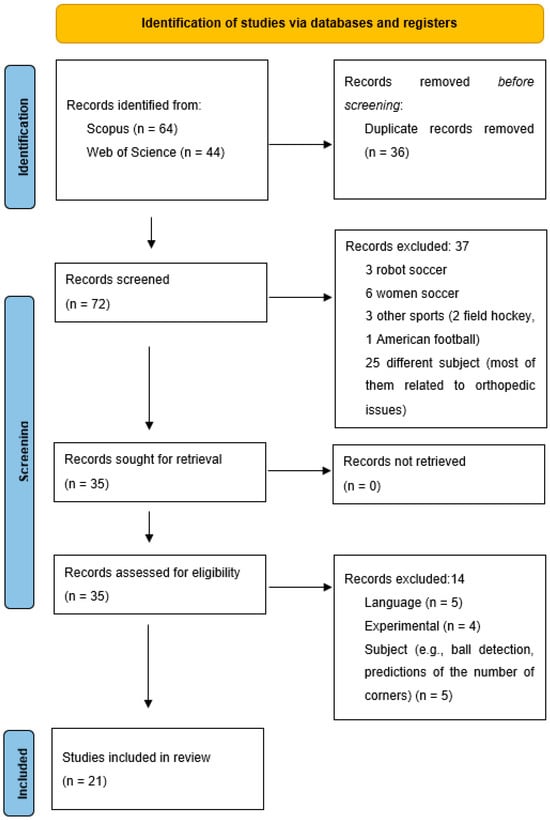
The initial search yielded 64 studies from Scopus and 44 from Web of Science. After removing 36 duplicates, 72 studies remained. These were screened based on their titles and abstracts, leading to the exclusion of 37 studies that did not meet the selection criteria. Of the 35 remaining studies, 14 were excluded after a full-text assessment (5 because of language, 4 because they were experimental studies, and 5 because the subject of the article was not corner kicks), resulting in a final inclusion of 21 studies in the present review. The entire process is detailed in the flowchart in Figure 1.
Figure 1.
PRISMA flow diagram illustrating the study-selection process.
The 21 included studies are listed in Table 3, where the following information is provided for each study: title, authors, year of publication, data analysis methods, competition, number of matches observed, and number of corners analyzed. The studies are presented in chronological order of publication, from the oldest to the most recent.
Table 3.
Overview of the included studies analyzing corner kicks in soccer.
3.2. Quality Assessment
In Table 4, it is evident that all studies had a minimum total score of seven; however, none were entirely comprehensive, as no study achieved a total score of 13. The scores for questions Q1, Q2, Q9, Q10, and Q12 indicate strong methodological rigor. However, it appears that (a) only two studies examined what happens after ball loss for the team that executed the corner kick, (b) the context was not sufficiently analyzed, and (c) only a few studies (eight) provided specific practical recommendations for coaches based on their findings.
Table 4.
Quality assessment of the included studies based on 13 evaluation criteria (Q1–Q13).
4. Discussion
4.1. Qualitative Synthesis
4.1.1. Execution
In every soccer match, an average of 9.8 to 10.6 corner kicks are executed [15,17,18,33]. These are approximately evenly distributed between the right and left sides, with some studies showing a slight predominance of corners from the left side [8,18] and others from the right side [19,21,33,37], but there is no statistically significant difference. Most executions are performed directly [4,14,19], but it appears that higher-ranked teams use short (indirect) executions more frequently compared to lower-ranked teams [21]. Additionally, most corners are executed through aerial routes compared to ground routes. The percentage of aerial executions ranges from 78.2% to 91.6% [4,14,19,33].
Several authors have investigated the differences between inswinging and outswinging corners, which have trajectories toward or away from the goal, respectively. Schmicker [17] and Gouveia et al. [37] found that the majority (54–57%) of corner kicks were executed with an inswinging curve. However, Prieto-Lage et al. [4], who studied six leagues, found this to be true only in the English Premier League, while in the other five leagues, teams alternated between inswinging and outswinging trajectories. Most authors found that inswinging corners have higher success rates in terms of goals compared to outswinging ones, but the differences were not statistically significant [5,9,17,21]. Considering the delivery zone, Fernández-Hermógenes et al. [15] found that the most successful kicks were outswing when delivered to the penalty box and inswing when delivered to the near post. Conversely, a statistically significant difference was found in favor of outswinging corners regarding final attempts [5]. Furthermore, it appears that when teams are leading, they prefer outswinging corners, while when they are losing, they opt for inswinging corners [10,17]. Finally, Strafford et al. [18] found that in the 2015/2016 English Premier League Season, the top six teams favored outswinging deliveries, while the bottom six teams favored inswinging deliveries (p < 0.001).
Most authors who have studied corners have focused on the delivery zone. However, there is significant variability in how researchers divide the defending team’s area into zones, making it difficult to draw clear conclusions. Researchers have divided the area into 2 zones (near post/far post) [6,33,35], 3 zones [19], 5 zones [5], 6 zones [8,9,10], 7 zones [34], 8 zones [14,37], 9 zones [15,21], 11 zones [4], 13 zones [18], 16 zones [7], and 66 zones [17]. In studies that divided the area into two zones, it appears that most corners are executed to the near post, but there are conflicting findings regarding the effectiveness of the two zones. In studies with more detailed research dividing the area into more zones, it appears that most corners are executed in the center of the box, 6–9 yards from goal, and this zone had the best success rates for goals [9,17,21,34]. However, Fernández-Hermógenes et al. [15], considering the curve of the execution, found that the most successful kicks were outswing when delivered to the center of the penalty box and inswing when delivered to the near post, while Plakias et al. [5] found that corners directed within the six-yard box and toward its center (goalkeeping zone) more often led to counterattacks by the opposing team. Therefore, not only is it necessary for researchers to agree on how to divide the area into zones, but this parameter should also be examined in conjunction with other variables.
4.1.2. Strategies and Tactics
In football, teams winning a corner usually position 4–5 players in the opponent’s penalty area to receive the ball [33]. The most common setup involves placing five attackers [37], although in some countries, placing six players is more prevalent [4]. In the final 30 min of a match, when the score is tied or the attacking team is ahead, they typically position two to five players in the shooting area. Conversely, if the attacking team is trailing, they position six or more players to create shooting opportunities.
According to Ref. [6], in most leagues, there is an absence of attacking placement in the goalkeeper’s area, except for the English league, where it is more common to place an attacker to intercept the goalkeeper [4]. Generally, one or two attackers are involved in the play, but the involvement of three or four attackers increases the likelihood of a shot on goal [33,35].
Shaw and Gopaladesikan [11] identified several attacking tactics. Particularly, in the “jellyfish” strategy, three or four players initially group together outside the six-yard box and then make gradually diverging runs into the penalty area. Variations of this setup include starting from the far corner of the penalty area or having a player move around and behind the cluster, targeting the far post. Another variation involves four players lining up at the far edge of the six-yard box and then running horizontally toward the ball. The “love train” formation, made popular by England during the 2018 World Cup, is characterized by players starting in a straight line instead of a cluster. Some teams also adopt a six-yard box overload, where four or five attackers initially crowd the six-yard area.
Overall, while offensive setups are predominantly static (67.5%), dynamic attacking movements increase the probability of producing a shot on goal [14,33]. In the 2015/2016 English Premier League season, the top six teams predominantly employed dynamic attacking movements during corner kick deliveries, while the bottom six teams alternated equally between static and dynamic attacking strategies (p < 0.001) [18].
On the defensive side, teams usually position six or more defenders in the area during a corner kick [4,33], ensuring numerical superiority over the attackers [14,21,33]. When teams that are leading perform the corner kick, the defending teams tend to have fewer players defending the goal [10]. Bauer et al. [36] identified six roles for defending team players: player-marking (PM), zonal-marking (ZM), defending a short-corner (SD), marking the near-post (NP) or far-post (FP), defending the back-space (BS), and being positioned for a counterattack (CA). Regarding players positioned at the goalposts, Goodman et al. [21] found that teams were most often guarding the near post only (35.7%), followed by no one on the posts (25.1%), far post only (24.2%), and both posts (14.9%). Prieto-Lage et al. [4] claim that the absence of defenders positioned at the posts is more frequent. Although there was no significant association between different post guard systems and the number of attempts at goal [20,32], teams that did not place players at the posts conceded more goals [9,21]. Specifically, for players positioned at the near post, Pulling and Newton [20] found that teams placing two players at the near post (one inside the six-yard box and one outside) conceded only one goal from 148 corner kicks (0.7%), whereas the one-zero system conceded eight goals from 159 corner kicks (5.0%).
When defending corners, teams use three types of defense: zonal, man marking, and mixed. In some leagues, man marking is more common [4,32]; in others, zonal marking [4]; and in others, a mixed approach [33]. Kubayi and Larkin [9] found that teams conceded more goals using a zonal marking strategy (6.0%) compared to a mixed marking strategy (3.7%), while Pulling et al. [32] found that teams applying zonal marking conceded fewer goals and fewer attempts at goal than those using one-to-one marking. Additionally, De Baranda and Lopez-Riquelme [10] found no significant statistical association between match status and defensive system. It is noteworthy that some researchers studied all three marking types [33], while others studied only two. For instance, De Baranda and Lopez-Riquelme [10] and Kubayi and Larkin [9] studied only zonal and mixed, whereas Prieto-Lage et al. [4] and Pulling et al. [32] studied only zonal and man marking.
4.1.3. Outcome
Zileli and Söyler [8] found that for direct corner kicks, the first player to touch the ball after the execution is most likely to be the goalkeeper (23.9%), the defender (28.1%), or the attacker (48.0%). In contrast, Gouveia et al. [37] found these probabilities to be 16%, 44%, and 31%, respectively. Regarding the body part that makes the first contact after direct corners, it appears to be the head [4,33], unaffected by the match status [10].
Research indicates that corners result in a final attempt (without a goal) in 20.7–31.2% of cases [5,9,11,14,15,20,32,33]. The highest rates of final attempts occur in the central area between the six-yard box and the penalty spot, as well as in front of the near post within the six-yard box [5,34]. Pulling et al. [32] reported no significant relationship between the marking system or the positioning of defenders at the posts and the number of final attempts. In contrast, Plakias et al. [5] observed that outswinging corners resulted in significantly more final attempts compared to inswinging deliveries. Casal et al. [33], using multivariate analysis, found that the probability of producing a shot or a shot on target increased when three or four attackers were involved, when attacks were dynamic, and when the ball was delivered indirectly to the far post. They also observed that shots on target from corner kicks were more frequent during the first and last 30 min of a match. Additionally, corners taken with the same foot as the side of the pitch, or deliveries aimed at the far post, were more likely to result in a shot.
The percentage of corners that result in goals ranges from 2.2% to 4.43% [5,7,8,9,10,11,14,17,18,20,32,33,34]. An exception was found in the study by Gouveia et al. [37], which reported a rate of 6%, but this study was not conducted at a professional level (Portugal Championship, third national division). Goals from corners appear to be more frequent in the last two quarters of the match [4,33], particularly after the 70th min [17], although Mitrotasios, et al. [14] found similar success rates between the 45 and 60 min mark. Notably, Schmicker [17] found that the success rate increases in corner kicks taken after the 90th min (i.e., stoppage time). Kubayi and Larkin [9] and Goodman et al. [21] found that most goals came from inswinging corners, but Plakias et al. [5] and Tütüncü et al. [7] did not find a statistically significant difference between inswinging and outswinging corners. Additionally, Mitrotasios et al. [14] found that the most effective delivery was natural, meaning a right-footed kick from the right side or a left-footed kick from the left side. Regarding the zone from which goals originate, most goals came from the center of the 18-yard box and the first goalpost [5,9,32,34]. Tütüncü et al. [7], who conducted a large-scale study analyzing 455,898 corner kicks, found that most goals were scored near the near-post area, specifically in the space between the goal area and the penalty spot. However, since this was also the zone with the highest number of deliveries, the analysis ultimately showed that the area with the highest goal-to-delivery ratio was the far-post zone—particularly within the goal area. Nevertheless, the authors did not clarify whether the ball was delivered directly to this zone or if a first touch by an attacker at the near post preceded the goal. Furthermore, most goals are scored by the winning teams [14], the home teams [21], and when the score is tied [18,21].
Finally, only two studies have focused on the continuation of play after a corner kick when the defending team regains possession. Plakias et al. [5] found that the probability of a counterattack increases significantly for corners executed in the goalkeeping zone compared to those executed in the near post zone, whereas De Baranda and Lopez-Riquelme [10] found no significant association between match status and subsequent play. Future research on corners should emphasize this aspect, as counterattacks have high success rates for scoring goals [39,40], and teams that frequently execute counterattacks increase their chances of winning [41].
4.2. Suggestions for Future Research
Based on the quality assessment scores of the included studies, as well as the findings that emerged from the qualitative synthesis, we propose several directions for future research. Specifically, future investigations on corner kicks in soccer should place greater emphasis on the continuation of play following ball loss by the attacking team. Only two studies in the current review examined this transition phase, despite the fact that counterattacks arising from corners can often lead to high-percentage scoring opportunities [39,41,42], especially against unbalanced defenses [43,44]. Additionally, contextual variables such as match status, time, team quality, and home or away conditions remain underexplored, yet they play a crucial role in shaping tactical decisions [45,46,47]. Researchers are also encouraged to adopt a standardized approach to dividing the penalty area into zones, as the current lack of consistency across studies hinders comparative analysis and the generalizability of findings [7]. Importantly, more studies should aim to provide clear and actionable recommendations for coaches based on their results—something only a small number of existing studies have accomplished. Finally, as the body of research continues to grow, a comprehensive meta-analysis would be valuable for synthesizing quantitative findings across studies, identifying patterns, and informing evidence-based tactical and strategic decisions in set-piece execution.
4.3. Practical Applications for Coaches
Based on the findings of this systematic review, several practical recommendations can be made for coaches and performance analysts in designing and training both offensive and defensive corner kick strategies. First, it is essential to move beyond static and isolated practice routines [48]. Corner kicks should be trained within dynamic, game-representative contexts that also incorporate the transition phase [49]. Teams that integrate offensive corner execution with immediate defensive organization (and vice versa) are likely to gain a tactical advantage, especially in managing counterattacks. Furthermore, expert staff should design set-piece sessions that simulate real match conditions, including context-specific variables such as scoreline, time of match, and player fatigue [50]. Generally, corner kicks must not be rehearsed in isolation; rather, they should involve live decision making, pressure from opponents, and immediate shifts into defensive or attacking transition.
For attacking strategy, teams should consider using 3–4 actively involved players and favor dynamic movements (e.g., “jellyfish” or “love train” formations) to increase the likelihood of creating goal-scoring opportunities. To maximize the effectiveness of offensive corner kicks, coaches should prioritize set-piece routines that involve multiple attackers actively participating in the play and aim for indirect deliveries—especially toward the far-post zone inside the goal area. Designing corner kick strategies that not only exploit high-traffic zones like the near post but also include secondary movements or flick-ons that redirect the ball to the far post are likely to disrupt the opposing defense [51,52].
Conversely, from a defensive point of view, a mixed marking system, with at least one player guarding the near post, may offer greater security than pure man marking or zonal marking. Coaches should also ensure numerical superiority in the penalty area and consider assigning specific roles (e.g., near-post coverage, back-space protection, and counterattack positioning) based on opponent tendencies.
Finally, it seems that collaboration between coaches, set pieces experts, and analysts is key. Match footage and notational data should guide tactical adjustments and be translated into clear, individualized instructions for players [53,54].
4.4. Limitations of This Study
This systematic review, despite adhering to rigorous methodological standards, presents certain limitations that should be acknowledged. Firstly, the review focused exclusively on studies written in English, potentially introducing a language bias and excluding relevant research published in other languages. Secondly, only two electronic databases (Web of Science and Scopus) were searched, meaning that relevant studies indexed elsewhere may have been missed. Thirdly, the heterogeneity among the included studies—particularly in terms of penalty area division methods, contextual variable reporting, and outcome measures—limited the possibility of conducting a quantitative meta-analysis and reduced comparability between studies. Fourthly, the search strategy did not include gray literature sources, such as dissertations, conference proceedings, or unpublished studies, which may have led to publication bias. Additionally, a snowballing strategy (screening references of included studies) was not employed, which could have further limited the comprehensiveness of the review. Moreover, publication bias and selective reporting cannot be ruled out, as studies with statistically significant or positive findings are more likely to be published, while studies with non-significant results may remain unpublished. This could have influenced the available evidence and the overall findings of this review. Finally, we focused solely on male soccer, thus limiting the generalizability of the findings to female or youth competitions, where technical–tactical dynamics may differ substantially.
5. Conclusions
This systematic review synthesized the existing evidence on the technical–tactical execution of corner kicks in male soccer. We found that corner kicks occur approximately 10 times per match, with a success rate of around 3%. Most corners are executed to the center of the box, 6–9 yards from the goal, which has the best success rates for goals. Attacking teams usually position 4–5 players in the opponent’s penalty area, while defending teams position six or more defenders to ensure numerical superiority. Dynamic attacking organization and the involvement of 3–4 attackers increase the likelihood of a shot on goal. Defending teams use zonal, man marking, or mixed defensive strategies, with mixed marking showing lower rates of conceding goals. The review identified several limitations in the existing research, including a lack of consensus on dividing the penalty area into zones and insufficient examination of the transition phase following corner kicks. Future research should address these gaps and provide clear, actionable recommendations for coaches based on the findings.
Supplementary Materials
The following supporting information can be downloaded at: https://www.mdpi.com/article/10.3390/app15094984/s1, PRISMA 2020 27-item checklist.
Author Contributions
Conceptualization, S.P. and V.A.; methodology, S.P. and V.A.; software, S.P.; validation, S.P., V.A. and G.G.; formal analysis, S.P.; investigation, S.P. and V.A.; resources, V.A.; data curation, S.P.; writing—original draft preparation, S.P.; writing—review and editing, V.A and G.G.; visualization, S.P.; supervision, G.G.; project administration, G.G. All authors have read and agreed to the published version of the manuscript.
Funding
This research received no external funding.
Conflicts of Interest
The authors declare no conflict of interest.
References
- Gollan, S.; Ferrar, K.; Norton, K. Characterising game styles in the English Premier League using the “moments of play” framework. Int. J. Perform. Anal. Sport 2018, 18, 998–1009. [Google Scholar] [CrossRef] [Scilit]
- Hewitt, A.; Greenham, G.; Norton, K. Game style in soccer: What is it and can we quantify it? Int. J. Perform. Anal. Sport 2016, 16, 355–372. [Google Scholar] [CrossRef] [Scilit]
- Siegle, M.; Lames, M. Game interruptions in elite soccer. J. Sports Sci. 2012, 30, 619–624. [Google Scholar] [CrossRef] [Scilit] [PubMed]
- Prieto-Lage, I.; Bermúdez-Fernández, D.; Paramés-González, A.; Gutiérrez-Santiago, A. Analysis of the corner kick in football in the main European leagues during the 2017–2018 season. Int. J. Perform. Anal. Sport 2021, 21, 611–629. [Google Scholar] [CrossRef] [Scilit]
- Plakias, S.; Kokkotis, C.; Tsaopoulos, D.; Moustakidis, S.; Papalexi, M.; Giakas, G.; Tsatalas, T. The effectiveness of direct corners in high level soccer depending on the type and the zone of delivery. J. Phys. Educ. Sport 2023, 23, 449–456. [Google Scholar] [CrossRef] [Scilit]
- Casal, C.; Losada, J.; Maneiro, R.; Ardá, T. Influence of match status on corner kicks tactics in elite soccer. Int. J. Med. Sci. Phys. Act. Sports 2017, 17, 715–728. [Google Scholar] [CrossRef] [Scilit]
- Tütüncü, O.; Mehta, S.; Memmert, D. Zones where corner kicks are most effective in the penalty box: Is there a sweet spot? Int. J. Sports Sci. Coach. 2024, 19, 1706–1722. [Google Scholar] [CrossRef] [Scilit]
- Zileli, R.; Söyler, M. Analysis of corner kicks in FIFA 2018 World Cup. J. Hum. Sport Exerc. 2022, 17, 156–166. [Google Scholar] [CrossRef] [Scilit]
- Kubayi, A.; Larkin, P. Analysis of teams’ corner kicks defensive strategies at the FIFA World Cup 2018. Int. J. Perform. Anal. Sport 2019, 19, 809–819. [Google Scholar] [CrossRef] [Scilit]
- De Baranda, P.S.; Lopez-Riquelme, D. Analysis of corner kicks in relation to match status in the 2006 World Cup. Eur. J. Sport Sci. 2012, 12, 121–129. [Google Scholar] [CrossRef] [Scilit]
- Shaw, L.; Gopaladesikan, S. Routine inspection: A playbook for corner kicks. In Proceedings of the Machine Learning and Data Mining for Sports Analytics: 7th International Workshop, Ghent, Belgium, 14–18 September 2020; pp. 3–16. [Google Scholar]
- Mahoney, M.J.; Gabriel, T.J.; Perkins, T.S. Psychological skills and exceptional athletic performance. Sport Psychol. 1987, 1, 181–199. [Google Scholar] [CrossRef] [Scilit]
- DiCesare, C.A.; Kiefer, A.W.; Bonnette, S.; Myer, G.D. High-risk lower-extremity biomechanics evaluated in simulated Soccer-Specific virtual environments. J. Sport Rehabil. 2020, 29, 294–300. [Google Scholar] [CrossRef] [Scilit]
- Mitrotasios, M.; Casal, C.; Armatas, V.; Losada, J.; Maneiro, R. Analysis of Corner Kick Success in Laliga Santander 2019/2020. Eur. J. Hum. Mov. 2021, 47, 8–22. [Google Scholar] [CrossRef] [Scilit]
- Fernández-Hermógenes, D.; Camerino, O.; Hileno, R. Corner kick performance indicators in elite football. Apunt. Educ. Física I Esports 2021, 144, 52–64. [Google Scholar] [CrossRef] [Scilit]
- Russell, M.; Benton, D.; Kingsley, M. The effects of fatigue on soccer skills performed during a soccer match simulation. Int. J. Sports Physiol. Perform. 2011, 6, 221–233. [Google Scholar] [CrossRef] [Scilit]
- Schmicker, R.H. An Application of SaTScan to Evaluate the Spatial Distribution of Corner Kick Goals in Major League Soccer. Int. J. Comput. Sci. Sport (Int. Assoc. Comput. Sci. Sport) 2013, 12, 70–79. [Google Scholar]
- Strafford, B.W.; Smith, A.; North, J.S.; Stone, J.A. Comparative analysis of the top six and bottom six teams’ corner kick strategies in the 2015/2016 English Premier League. Int. J. Perform. Anal. Sport 2019, 19, 904–918. [Google Scholar] [CrossRef] [Scilit]
- Maneiro, R.; Losada, J.L.; Portell, M.; Ardá, A. Observational analysis of corner kicks in high-level football: A mixed methods study. Sustainability 2021, 13, 7562. [Google Scholar] [CrossRef] [Scilit]
- Pulling, C.; Newton, J. Defending corner kicks in the English Premier League: Near-post guard systems. Int. J. Perform. Anal. Sport 2017, 17, 283–292. [Google Scholar] [CrossRef] [Scilit]
- Goodman, J.; Ferguson, K.; Paradis, K. Corner Kick Characteristics: A Case Study of the 2020/21 Northern Ireland Football League (NIFL) Premiership Season. Int. J. Perform. Anal. Sport 2024, 25, 332–355. [Google Scholar] [CrossRef] [Scilit]
- Page, M.J.; McKenzie, J.E.; Bossuyt, P.M.; Boutron, I.; Hoffmann, T.C.; Mulrow, C.D.; Shamseer, L.; Tetzlaff, J.M.; Akl, E.A.; Brennan, S.E. The PRISMA 2020 statement: An updated guideline for reporting systematic reviews. BMJ 2021, 29, 32. [Google Scholar]
- Moher, D.; Shamseer, L.; Clarke, M.; Ghersi, D.; Liberati, A.; Petticrew, M.; Shekelle, P.; Stewart, L.A. Preferred reporting items for systematic review and meta-analysis protocols (PRISMA-P) 2015 statement. Syst. Rev. 2015, 4, 1. [Google Scholar] [CrossRef] [PubMed]
- Rico-González, M.; Pino-Ortega, J.; Clemente, F.; Los Arcos, A. Guidelines for performing systematic reviews in sports science. Biol. Sport 2022, 39, 463–471. [Google Scholar] [CrossRef] [Scilit] [PubMed]
- Ardern, C.L.; Büttner, F.; Andrade, R.; Weir, A.; Ashe, M.C.; Holden, S.; Impellizzeri, F.M.; Delahunt, E.; Dijkstra, H.P.; Mathieson, S. Implementing the 27 PRISMA 2020 Statement items for systematic reviews in the sport and exercise medicine, musculoskeletal rehabilitation and sports science fields: The PERSiST (implementing Prisma in Exercise, Rehabilitation, Sport medicine and SporTs science) guidance. Br. J. Sports Med. 2022, 56, 175–195. [Google Scholar] [CrossRef] [Scilit]
- PRISMA. PRISMA 2020 Statement Paper. Available online: https://www.prisma-statement.org/prisma-2020-statement (accessed on 5 March 2025).
- Schiavo, J.H. PROSPERO: An international register of systematic review protocols. Med. Ref. Serv. Q. 2019, 38, 171–180. [Google Scholar] [CrossRef] [Scilit] [PubMed]
- Miracle, V.A. The Belmont Report: The triple crown of research ethics. Dimens. Crit. Care Nurs. 2016, 35, 223–228. [Google Scholar] [CrossRef] [Scilit]
- Castellano, J.; Alvarez-Pastor, D.; Bradley, P.S. Evaluation of research using computerised tracking systems (Amisco® and Prozone®) to analyse physical performance in elite soccer: A systematic review. Sports Med. 2014, 44, 701–712. [Google Scholar] [CrossRef] [Scilit]
- Vieira, L.H.P.; Carling, C.; Barbieri, F.A.; Aquino, R.; Santiago, P.R.P. Match running performance in young soccer players: A systematic review. Sports Med. 2019, 49, 289–318. [Google Scholar] [CrossRef] [Scilit]
- Plakias, S.; Moustakidis, S.; Kokkotis, C.; Papalexi, M.; Tsatalas, T.; Giakas, G.; Tsaopoulos, D. Identifying Soccer Players’ Playing Styles: A Systematic Review. J. Funct. Morphol. Kinesiol. 2023, 8, 104. [Google Scholar] [CrossRef] [Scilit]
- Pulling, C.; Robins, M.; Rixon, T. Defending corner kicks: Analysis from the English Premier League. Int. J. Perform. Anal. Sport 2013, 13, 135–148. [Google Scholar] [CrossRef] [Scilit]
- Casal, C.A.; Maneiro, R.; Ardá, T.; Losada, J.L.; Rial, A. Analysis of corner kick success in elite football. Int. J. Perform. Anal. Sport 2015, 15, 430–451. [Google Scholar] [CrossRef] [Scilit]
- Pulling, C. Long corner kicks in the English Premier League: Deliveries into the goal area and critical area. Kinesiology 2015, 47, 193–201. [Google Scholar]
- Maneiro, R.; Casal, C.A.; Ardá, A.; Losada, J.L. Application of multivariant decision tree technique in high performance football: The female and male corner kick. PLoS ONE 2019, 14, e0212549. [Google Scholar] [CrossRef] [Scilit] [PubMed]
- Bauer, P.; Anzer, G.; Smith, J.W. Individual role classification for players defending corners in football (soccer) Categorisation of the defensive role for each player in a corner kick using positional data. J. Quant. Anal. Sports 2022, 18, 147–160. [Google Scholar] [CrossRef] [Scilit]
- Gouveia, V.; Duarte, J.P.; Sarmento, H.; Freitas, J.; Rebelo-Gonçalves, R.; Amaro, N.; Matos, R.; Antunes, R.; Field, A.; Monteiro, D. Systematic Observation of Corner Kick Strategies in Portuguese Football Players. Sustainability 2022, 14, 896. [Google Scholar] [CrossRef] [Scilit]
- Casal, A.C.; Maneiro, R.; Ardá, T.; Losada, J.L.; Rial, A. Effectiveness of indirect free kicks in elite soccer. Int. J. Perform. Anal. Sport 2014, 14, 744–760. [Google Scholar] [CrossRef] [Scilit]
- González-Rodenas, J.; Aranda-Malaves, R.; Tudela-Desantes, A.; Nieto, F.; Usó, F.; Aranda, R. Playing tactics, contextual variables and offensive effectiveness in English Premier League soccer matches. A multilevel analysis. PLoS ONE 2020, 15, e0226978. [Google Scholar] [CrossRef] [Scilit] [PubMed]
- Biermann, H.; Wieland, F.-G.; Timmer, J.; Memmert, D.; Phatak, A. Towards expected counter-using comprehensible features to predict counterattacks. In Machine Learning and Data Mining for Sports Analytics, Proceedings of the 9th International Workshop, MLSA 2022, Grenoble, France, 19 September 2022; Springer Nature: Cham, Switzerland, 2022; pp. 3–13. [Google Scholar]
- Plakias, S.; Tsatalas, T.; Armatas, V.; Tsaopoulos, D.; Giakas, G. Tactical Situations and Playing Styles as Key Performance Indicators in Soccer. J. Funct. Morphol. Kinesiol. 2024, 9, 88. [Google Scholar] [CrossRef] [Scilit]
- Plakias, S.; Armatas, V.; Mitrotasios, M. Influence of tactics and situational variables on goal scoring in European football. Proc. Inst. Mech. Eng. Part P J. Sports Eng. Technol. 2025, 17543371241313252. [Google Scholar] [CrossRef] [Scilit]
- Tenga, A.; Holme, I.; Ronglan, L.T.; Bahr, R. Effect of playing tactics on goal scoring in Norwegian professional soccer. J. Sports Sci. 2010, 28, 237–244. [Google Scholar] [CrossRef] [Scilit]
- Tenga, A.; Holme, I.; Ronglan, L.T.; Bahr, R. Effect of playing tactics on achieving score-box possessions in a random series of team possessions from Norwegian professional soccer matches. J. Sports Sci. 2010, 28, 245–255. [Google Scholar] [CrossRef] [Scilit] [PubMed]
- Gollan, S.; Bellenger, C.; Norton, K. Contextual factors impact styles of play in the English premier league. J. Sports Sci. Med. 2020, 19, 78. [Google Scholar] [PubMed]
- Kim, J.; James, N.; Gwon, U.; Kim, B.; Parmar, N.; Pocrnjič, M.; Vučković, G. The influence of situational variables on the attacking process in football. Kinesiol. Slov. 2024, 30, 127–140. [Google Scholar] [CrossRef] [Scilit]
- Fernandez-Navarro, J.; Fradua, L.; Zubillaga, A.; McRobert, A.P. Influence of contextual variables on styles of play in soccer. Int. J. Perform. Anal. Sport 2018, 18, 423–436. [Google Scholar] [CrossRef] [Scilit]
- Deuker, A.; Braunstein, B.; Chow, J.Y.; Fichtl, M.; Kim, H.; Körner, S.; Rein, R. “Train as you play”: Improving effectiveness of training in youth soccer players. Int. J. Sports Sci. Coach. 2024, 19, 677–686. [Google Scholar] [CrossRef] [Scilit]
- Asian-Clemente, J.A.; Rabano-Muñoz, A.; Requena, B.; Suarez-Arrones, L. High-speed training in a specific context in soccer: Transition games. Int. J. Sports Med. 2022, 43, 881–888. [Google Scholar] [CrossRef] [Scilit]
- Petiot, G.H.; Vitulano, M.; Davids, K. The key role of context in team sports training: The value of played-form activities in practice designs for soccer. Int. J. Sports Sci. Coach. 2024, 19, 1262–1274. [Google Scholar] [CrossRef] [Scilit]
- Anzer, G.; Bauer, P.; Brefeld, U. The origins of goals in the German Bundesliga. J. Sports Sci. 2021, 39, 2525–2544. [Google Scholar] [CrossRef] [Scilit]
- Jamil, M.; Liu, H.; Phatak, A.; Memmert, D. An investigation identifying which key performance indicators influence the chances of promotion to the elite leagues in professional European football. Int. J. Perform. Anal. Sport 2021, 21, 641–650. [Google Scholar] [CrossRef] [Scilit]
- Praça, G.M.; Moreira, P.E.D.; de Andrade, A.G.P.; Clemente, F.M.; de Oliveira, W.B.; Demétrio, G. Integrating notational and positional analysis to investigate tactical behavior in offensive and defensive phases of football matches. Proc. Inst. Mech. Eng. Part P J. Sports Eng. Technol. 2022, 17543371221122044. [Google Scholar] [CrossRef] [Scilit]
- Gong, U.; Zhang, Q.; Yin, Z.; Zollmann, S. Collaborative XRTactics: A Formative Study on Tactical Communication in Outdoor Team Sports. arXiv 2024, arXiv:2408.14305. [Google Scholar] [CrossRef] [Scilit]

Disclaimer/Publisher’s Note: The statements, opinions and data contained in all publications are solely those of the individual author(s) and contributor(s) and not of MDPI and/or the editor(s). MDPI and/or the editor(s) disclaim responsibility for any injury to people or property resulting from any ideas, methods, instructions or products referred to in the content. |
© 2025 by the authors. Licensee MDPI, Basel, Switzerland. This article is an open access article distributed under the terms and conditions of the Creative Commons Attribution (CC BY) license (https://creativecommons.org/licenses/by/4.0/).