


Abstract
This study presents a knowledge graph construction scheme leveraging large language models (LLMs) for task-oriented semantic communication systems. The proposed methodology systematically addresses four critical stages: corpus collection, entity extraction and relationship analysis, knowledge base generation, and dynamic updating mechanisms. It is worth noting that prompt engineering is combined with few-shot learning to enhance reliability and accuracy in this methodology. Experimental demonstration showed that this methodology had superior entity extraction performance, achieving 89.7% precision and 92.3% recall rate. This scheme overcomes the demand for domain knowledge and the labor cost of traditional knowledge base construction schemes. It greatly improves the construction efficiency of knowledge graphs. This paper provides an efficient and reliable task knowledge base construction scheme for task-oriented semantic communication, which is expected to promote its wider application.
1. Introduction
Semantic communication has emerged as a pivotal enabling technology for 6G networks, demonstrating significant advantages in reducing transmission loads and enhancing service quality [1]. Unlike conventional syntactic systems focusing on bit-level accuracy, semantic communication focus on the meaning of information. This paradigm shift relies on knowledge-driven frameworks, where semantic analysis is performed against background knowledge. Recent studies confirm that semantic knowledge bases (SKBs) serve as essential infrastructure for formalizing task information and domain expertise in semantic communication systems [2,3,4,5]. Especially in task-oriented scenarios, accurate and complete SKBs are crucial to efficient semantic interactions. Consequently, the rapid construction of task SKBs constitutes a critical research challenge in optimizing task-driven semantic communication architectures.
Traditional knowledge graph construction methods exhibit three fundamental limitations in semantic communication applications [6]: (1) labor-intensive manual annotation requiring domain specialists, (2) rigid schema design dependent on prior expertise, (3) scalability constraints caused by iterative quality assurance processes. Typically, these methods require domain experts, creating bottlenecks in dynamic environments. For knowledge-sensitive semantic communication scenarios, such constraints hinder rapid knowledge base deployment. Consequently, there is an urgent need to streamline the process of constructing knowledge graphs to meet semantic communication requirements.
The rapid development of large language models (LLMs), particularly the GPT series and DeepSeek, offers transformative capabilities for knowledge engineering [7]. These models exhibit three core strengths: natural language understanding, cross-domain reasoning, and representation learning. Such capabilities enable the automated execution of key tasks, including corpus collection, entity extraction, and relationship mapping [8]. Furthermore, prompt engineering allows precise model fine-tuning to enhance task-specific accuracy [9]. These advantages establish LLMs as foundational tools for reconstructing knowledge base development in semantic communication systems.
Therefore, it is believed that LLMs can be adopted to quickly complete knowledge collation, entity extraction, and knowledge graph construction for specific tasks. Designing a knowledge graph construction scheme based on LLMs that integrates knowledge organization, entity extraction, and graph generation will advance the development of task-driven semantic communication technologies. This paper aims to design a knowledge graph construction based on LLMs and improve the efficiency and accuracy through prompt engineering and few-shot learning techniques.
The principal contributions of this study comprise three key aspects:
- An LLM-driven framework is developed to construct task SKBs, and entity extraction accuracy is improved by using few-shot learning technology. With this approach, task knowledge bases in semantic communication systems can be built without the high dependence on manual annotation and domain expertise found in traditional knowledge graph construction methods.
- The knowledge base for UAV aerial photography tasks is designed, which provides basic support for the application of task-oriented semantic communication technology in UAV aerial photography scenes. This advancement is expected to advance the adoption of semantic communication in drone communications, addressing critical challenges, such as bandwidth resource constraints, in drone communication systems.
- In the experimental phase, this study tested multiple LLMs. The results demonstrate that all LLMs successfully accomplished entity extraction and relationship analysis tasks with robust performance. Especially, DeepSeek provided authentic and valid corpus data, significantly enhancing knowledge base construction reliability. The experimental results validate the effectiveness and reliability of the proposed knowledge graph construction scheme.
The remainder of this paper is organized as follows. Section 2 reviews related research. Section 3 introduces the scheme proposed in this paper. Section 4 presents the experimental verification. Finally, a conclusion is drawn in Section 5. It should be noted that this paper was completed in a Chinese context. All Tables in the main text are translated versions of the output from the LLMs. As translations may not fully capture experimental nuances, we provide the raw data in the original language in Appendix A for reference.
2. Related Work
2.1. The Construction Method for the Semantic Knowledge Base
SKBs originated as computational knowledge graphs, designed to formally represent entity concepts and their relational networks. Recent advancements in semantic communication have driven the evolution of four distinct SKB construction methodologies.
The first is to construct a semantic knowledge base based on a knowledge graph. It is mainly oriented to text transmission and speech transmission, and constructs a semantic knowledge base with multi-level structure by extracting ternary groups [2,10,11]. The second is to use the labeled training dataset as a knowledge base, which describes the knowledge through the distribution of statistical properties of the training dataset. This method can dynamically update the coding and decoding scheme through the domain adaptive technique in migration learning. It solves the problem of mismatch between the transmitted data information and the training dataset [2]. The third is to use the statistical properties of features extracted from deep learning models as a semantic knowledge base. This method is mainly oriented to tasks such as image categorization, which extracts the correlation between the feature maps of image datasets with category labels and object categories as a semantic knowledge base [12,13]. The last one uses LLMs to replace the knowledge base, and semantic extraction and recovery through LLMs effectively solves the semantic ambiguity problem with good generalization [14,15].
Currently, various semantic knowledge base construction schemes have been applied to end-to-end semantic communication systems. Particularly in task-oriented semantic communication, the integration of task knowledge into semantic encoding and decoding processes achieves higher compression rates. However, existing studies embed knowledge into semantic encoding/decoding algorithms in the form of algorithmic parameters, which hinders knowledge updating during communication. This approach struggles to adapt to dynamic changes in task knowledge in task-oriented semantic communication. In contrast, entity knowledge bases represented by knowledge graphs can address this limitation [16]. Therefore, it is a critical step to realize the efficient and accurate construction of task knowledge bases in enhancing task-driven image semantic communication technologies.
2.2. Application of Large Language Models
In recent years, LLMs have developed rapidly and become a research hotspot in China. They provide brand-new solutions for semantic communication, natural language processing, and other fields.
LLMs possess robust semantic understanding capabilities and find extensive applications in semantic communication. Specifically, they are employed in two primary ways. First, LLMs calculate semantic loss and assess semantic importance to optimize the semantic compilation code process [14,17]. Second, they serve as semantic knowledge bases, facilitating precise extraction and recovery in semantic communication [18,19]. However, LLMs require extensive computational and storage resources to function. Integrating LLMs into semantic communication systems poses significant challenges to meeting resource requirements. Additionally, LLMs suffer from the problem of “hallucination”, which reduces accuracy on professional issues [20]. Currently, leveraging LLMs to enhance semantic communication remains an open research question. Harnessing LLMs’ extensive knowledge reserves and learning abilities to improve semantic communication represents a crucial development direction in this field.
In the realm of knowledge graphs, the application of LLMs has also become a prominent research area. LLMs have a powerful semantic comprehension ability, which enables them to perform tasks such as corpus collection and knowledge extraction, offering novel approaches to knowledge graph construction. Performance comparable to other state-of-the-art methods can be achieved if LLMs are fine-tuned via prompt engineering [21]. For instance, [22] introduced a scheme for clinical tasks that integrates few-sample learning techniques, achieving high performance in named entity recognition. Similarly, [9] proposes a method for constructing a Chinese medicine knowledge graph based on LLMs, significantly reducing manual effort and enhancing construction efficiency.
Therefore, we believe that a knowledge graph construction method tailored to semantic communication can be developed using LLMs. This approach can accommodate knowledge evolution’s dynamic nature during the semantic communication processes.
3. Method
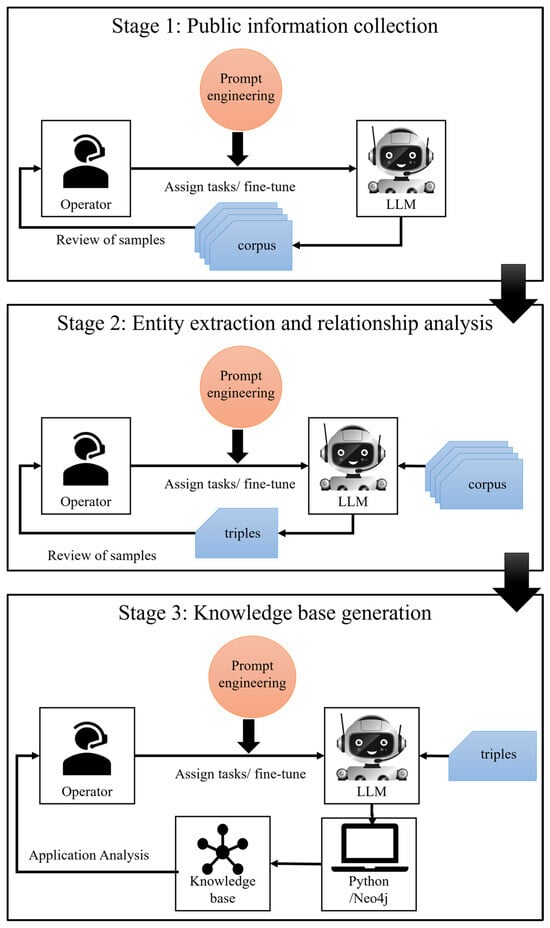
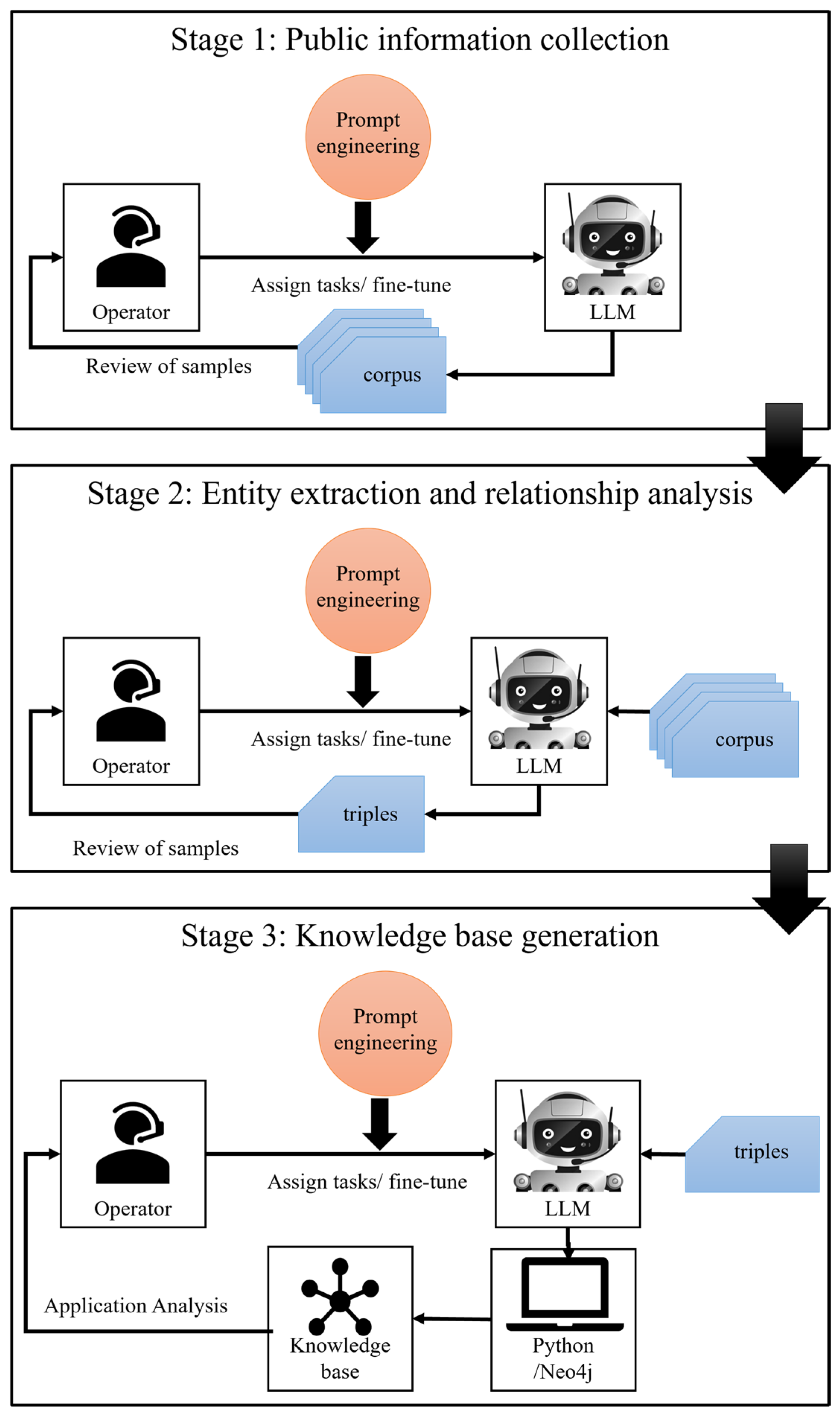
In this section, an interactive semantic knowledge base construction method based on LLMs is proposed for semantic communication. The scheme consists of three components: public information collection, entity extraction and relationship analysis, and knowledge base generation, as shown in Figure 1.
Figure 1.
Schematic structural diagram.
- Stage 1: Public Information Collection
The initial step involves assigning the primary task to LLMS to generate first-round output. Following this, operators sample the produced content to evaluate whether it complies with the specified requirements. In cases where discrepancies are detected, prompt engineering is employed to fine-tune the model through iterative refinement cycles. This iterative process persists until the corpus attains the predefined quality standards.
- Stage 2: Entity Extraction and Relationship Analysis
- a.
- Entity Extraction
The LLMs extract entities to generate task-entity formatted data. Operators then randomly sample the output. For incomplete entity recognition or erroneous extraction results, prompt engineering guides iterative model adjustments until comprehensive and accurate entity identification is achieved.
- b.
- Relationship Analysis
The relationship analysis task is delegated to the LLMs with integrated quantitative scoring principles, producing task-entity-score triples. These triples undergo operator verification through sampling reviews. When relationship interpretations deviate from practical observations, prompt-driven iterative refinement is implemented to obtain logically consistent triples.
- Stage 3: Knowledge Base Generation
The system transforms validated triples into executable Knowledge base generated by Neo4j programs through LLM. Neo4j visualization is implemented via Python (version 3.9.2), followed by comprehensive CRUD operation testing (Create, Read, Update, Delete). If functional requirements remain unmet, prompt-based optimization is conducted to finalize an operational knowledge base.
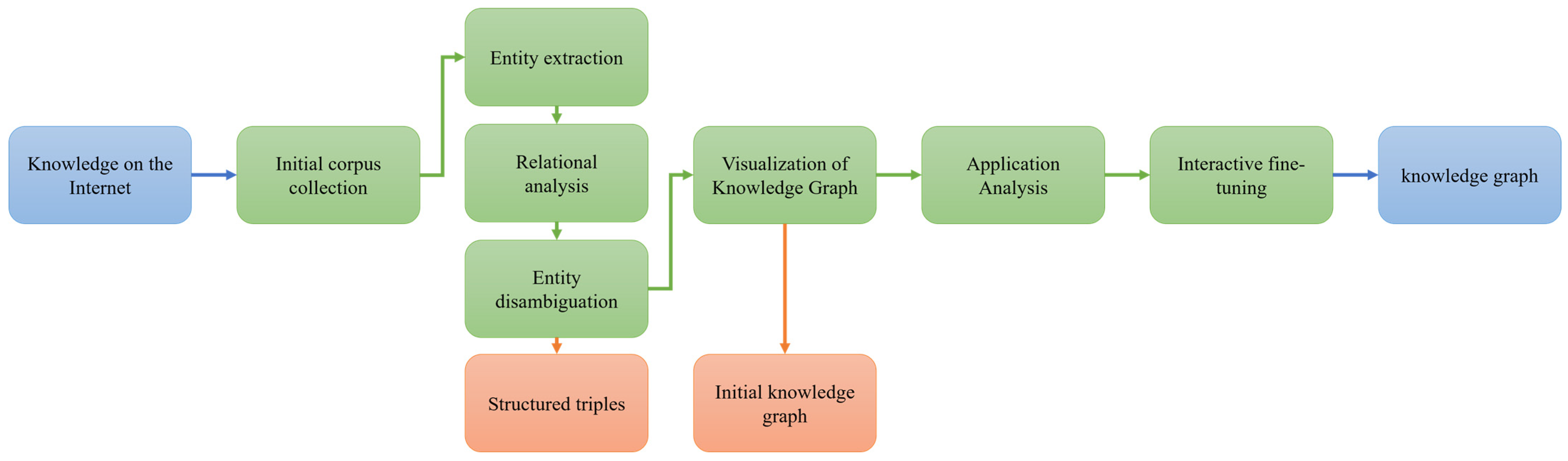
Our framework implements a knowledge base construction pipeline through LLM-mediated human-computer interaction. This improves knowledge base reliability through prompt engineering. The knowledge graph is visualized with Python and Neo4j. This framework completes the work of corpus collection, data preprocessing, and program writing through LLMs, which greatly improves the efficiency of the knowledge base construction and reduces labor cost. In addition, the output results are analyzed by manual sampling review, and the LLMs are fine-tuned by human–computer interaction through prompt engineering in order to improve accuracy. The complete workflow visualization is provided in Figure 2.
Figure 2.
Flowchart of knowledge processing.
In our prior research, the task knowledge base served as the foundation for task-oriented image semantic communication systems [16]. During semantic encoding/decoding, it is essential to acquire the entity names and task relevance scores, necessitating a task knowledge graph structured as “Task–Entity–Relevance Score”. This study implemented an LLM-powered construction pipeline comprising five stages: corpus acquisition, entity recognition, relevance assessment, graph generation, and continuous updating mechanisms.
3.1. Corpus Collection
Our study attempted to complete the corpus collection through three LLMs: the iFLTTEK, DeepSeek and ERNIE Bot. This paper attempts to guide the LLMs to output the expected text through prompt engineering to ensure alignment with real-world events. To maintain corpus authenticity, the prompt templates explicitly require verifiable sources (e.g., news articles) and mandate the inclusion of UAV aerial photography task contexts with entity-specific objectives. Table 1 shows the prompt word template and the large model output results.
Table 1.
Partial results of the corpus collected by the LLMs.
Table 1 reveals critical challenges in LLM-driven corpus collection. ERNIE Bot and iFLTTEK exhibited task misinterpretation, producing non-compliant outputs resembling instructional guidelines rather than authentic journalistic content. DeepSeek generated new articles, but its outputs contained divergent elements unrelated to its core objectives (e.g., “drone no-fly zone management” discussions). The experimental results indicate two limitations:
- Specifying a task directly to the LLMs may cause the LLMs to misinterpret the task, such as in the output of ERNIE Bot and iFLTTEK.
- Specifying a task directly to the LLMs may cause the output of the LLMs not to be as expected, such as the output of DeepSeek.
To address these limitations, we used a few-shot learning approach. This paper implemented a structured few-shot learning protocol with DeepSeek by providing three domain-specific news articles as contextual exemplars. As evidenced in Table 1, this approach successfully achieved effective corpus collection.
However, due to length constraints, DeepSeek could only output approximately 15 corpus entries per interaction. Therefore, it needs multiple rounds of interaction to collect the corpus. To ensure comprehensive coverage and factual accuracy in the constructed knowledge base, we present an iterative saturation protocol to govern corpus collection. This operational standard requires continuing data acquisition until three consecutive interaction cycles yield no novel task-relevant content from verified sources (news reports and official announcements), thereby guaranteeing two critical metrics:
- a.
- Information Completeness:
Full coverage of all publicly available task-related data that existed before the experimental time.
- b.
- Content Authenticity:
Strict adherence to source verification protocols for collected materials
Finally, 50 valid corpus entries meeting the requirements were collected through five rounds of iterative querying. It should be noted that completeness in this paper means that the final constructed knowledge base covers all task-related information on the internet at the time of the experiment, which is also the reason why the iterative saturation principle was adopted.
3.2. Entity Extraction and Relationship Analysis
During the entity extraction phase, manual annotation took place of all corpora in order to identify tasks and the entities that appear in the task entities in the UAV aerial photography task segments. This process yielded 14 distinct task categories and 155 unique entities, establishing foundational references for subsequent analysis. These manually curated results served as standard benchmarks for evaluating LLM-based entity extraction performance. Then, we instructed multiple LLMs to extract entities on raw corpora under identical task specifications. The comparative results in Table 2 reveal critical performance variations across models.
Table 2.
Partial results of the entities extracted by the LLMs.
Table 2 demonstrates significant differences in LLMs’ entity extraction performance. iFLTTEK exhibited fundamental task misalignment, generating partial semantic descriptors, like “ terrain changes in landslide areas and vegetation destruction”, rather than discrete entities. While ERNIE Bot and DeepSeek were able to comprehend basic tasks, both models suffered from contextual recognition limitations, creating composite phrases like “forest burn areas” instead of atomic entities. This pattern reveals challenges in isolating core semantic units from descriptive contexts, exemplified by erroneous outputs like “fire source locations” (contextual dependency) versus the required “fire sources” (atomic entities). Furthermore, inconsistent semantic granularity persisted across models, indicating difficulties in maintaining abstraction levels aligned with task specifications.
To optimize LLMs-based entity extraction performance, we developed an enhanced few-shot learning protocol by supplying 10 annotated domain-specific exemplars during task configuration. As demonstrated in Table 3, this methodological refinement substantially reduced erroneous extraction instances across all evaluated models, enabling precise identification of atomic entities (e.g., “smoke”) from contextual descriptions (e.g., “smoke coverage areas”). However, the extraction accuracy and effectiveness of the three LLMs still exhibited significant variations, which are quantitatively analyzed in Section 4.
Table 3.
Partial results of LLMs with few-shot learning techniques to extract entities.
To establish robust relevance assessment criteria, we developed an LLM-driven analytical framework for evaluating entity–task relationships through semantic correlation analysis. This methodology introduces structured prompt templates (Equation (1)) to standardize scoring rationality, incorporating two fundamental evaluation dimensions:
- Frequency Significance: Assessed through the frequency of occurrence of entities in different corpora under the same task.
- Descriptive Salience: Assessed through contextual importance indicators in semantic expressions
High-frequency manifestations (e.g., repeated entity appearances in related task contexts) and semantically salient descriptors (e.g., critical functional attributes in domain-specific descriptions) jointly determine relevance metrics. The framework’s operational criteria ensure systematic weighting of quantitative occurrence patterns and qualitative contextual value, effectively bridging statistical prevalence with semantic essentiality.
The output of relationship analysis by LLMs is shown in Table 4.
Table 4.
Partial results of relationship analysis by LLMs.
Experimental evaluations demonstrate that all three LLMs successfully generated relevance analyses with logically grounded scoring rationales. ERNIE Bot combines the references provided and LLMs’ internal knowledge during the analysis. DeepSeek strictly adheres to the evaluation methodology defined by the prompt word project. iFLTTEK mainly relied on LLMs’ internal knowledge for its analysis, ignoring the provided references. As Table 4 illustrates, ERNIE Bot and iFLTTEK produced small score variance, limiting their discriminative capacity for nuanced relevance differentiation. DeepSeek, conversely, demonstrated superior granularity with pronounced inter-entity score disparities, enabling clear hierarchical distinctions. To leverage complementary strengths while mitigating individual model biases, we adopted the average of outputs from all three LLMs for subsequent knowledge base construction.
3.3. Knowledge Base Generation
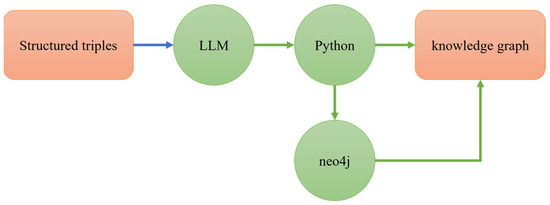
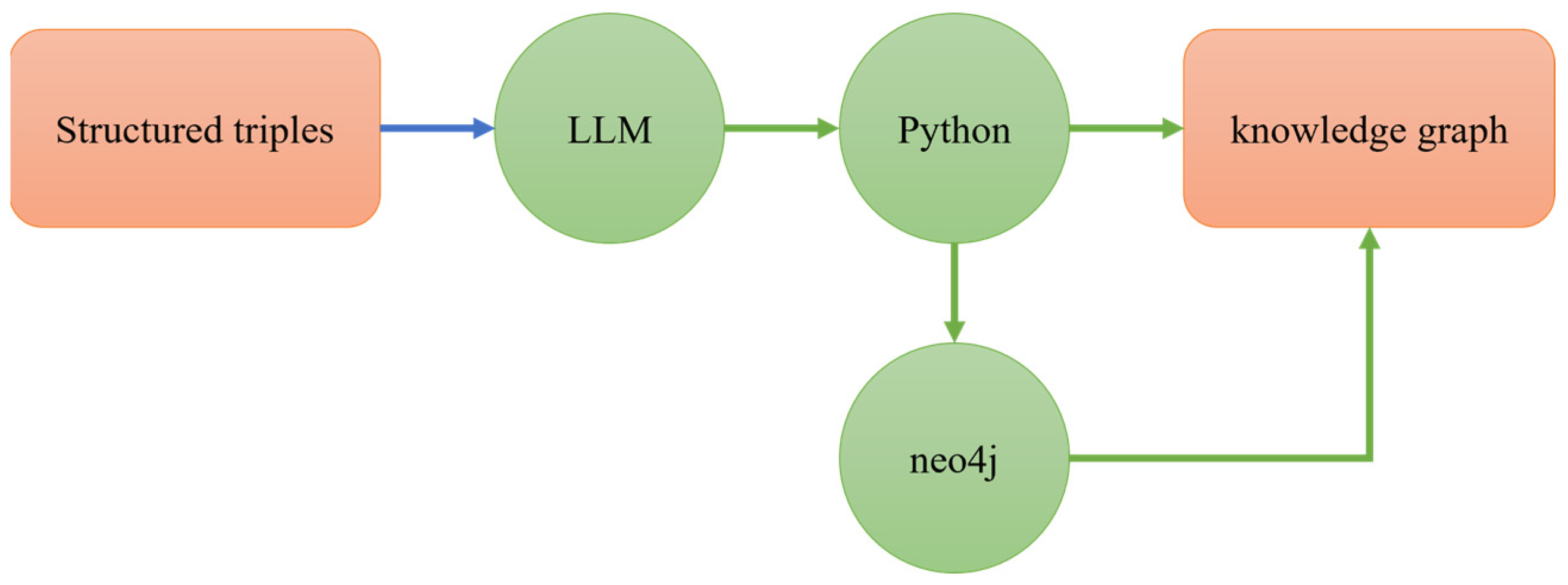
Our knowledge graph construction framework integrates LLMs, Python, and Neo4j through a coordinated workflow, as shown in Figure 3. The system directs LLMs to convert structured task–entity–relevance triplets into executable Python code, which subsequently interfaces with Neo4j’s graph database engine via dedicated API calls.
Figure 3.
Flowchart of knowledge base generation.
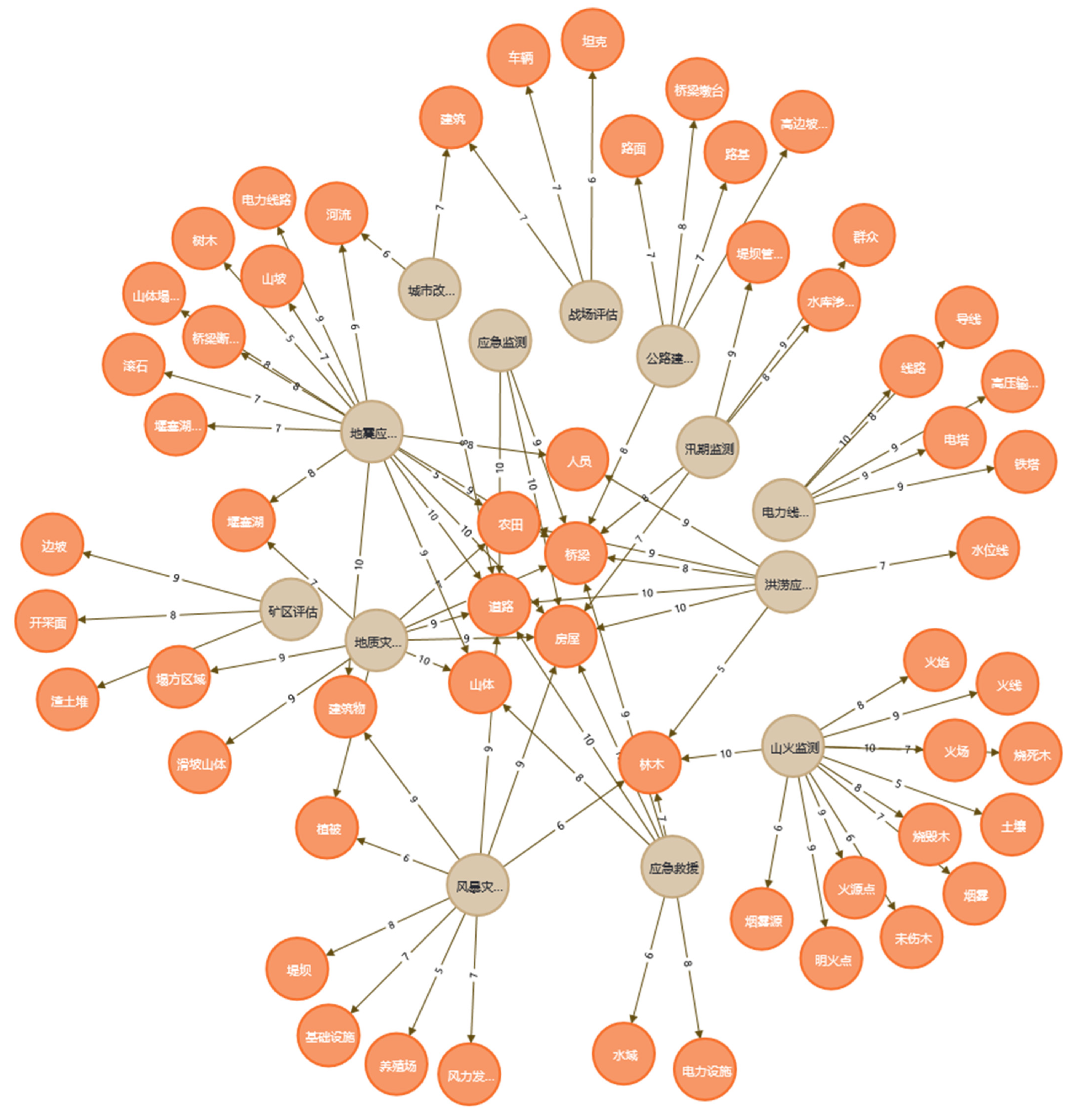
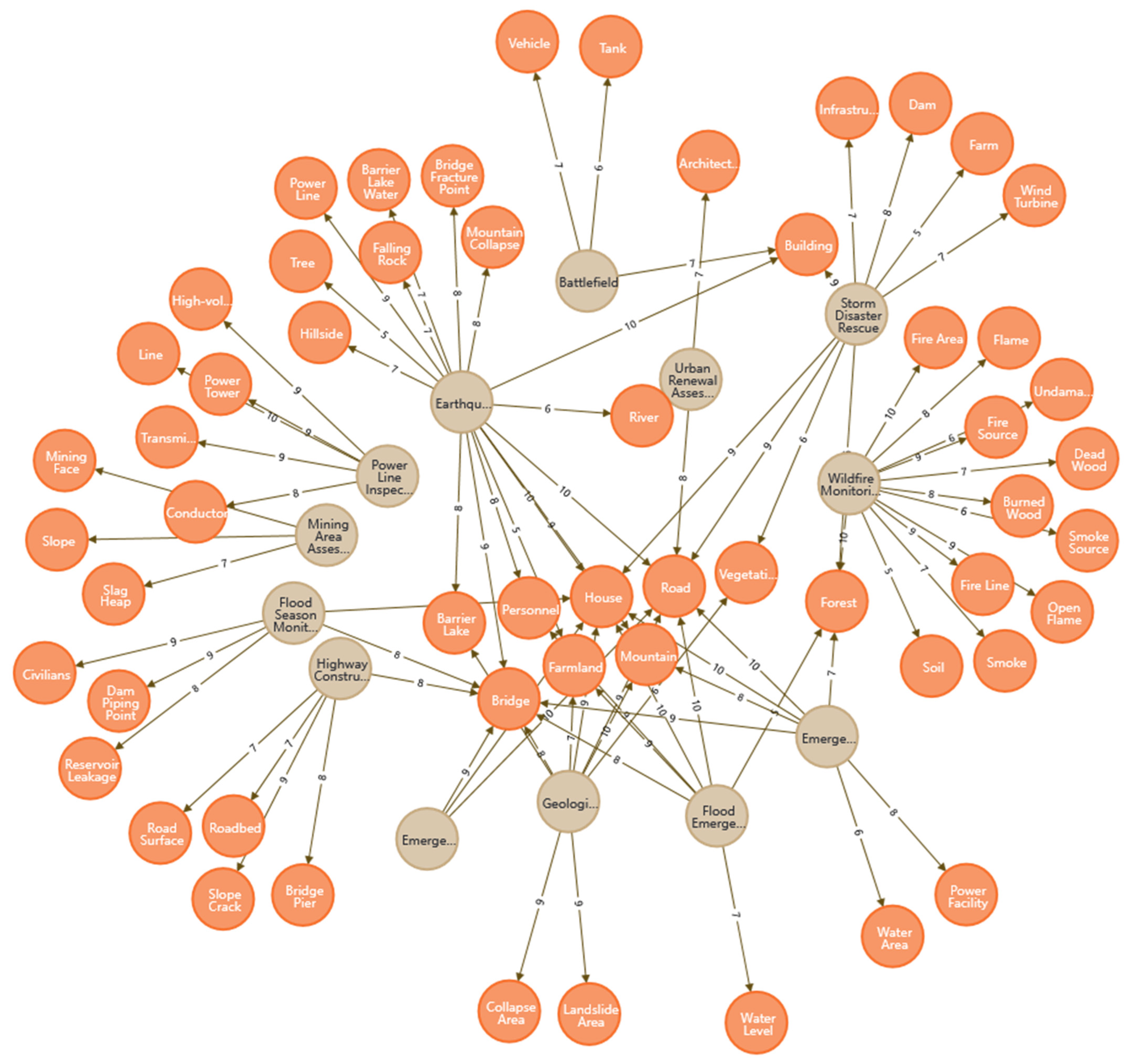
This paper processed the obtained structured triples through neo4j, python, and LLMs to obtain the UAV emergency rescue mission knowledge base, as shown in Figure 4. Through the above process, it realized semi-manual and semi-automatic knowledge graph generation, which greatly saves labor costs in the knowledge base construction process and improves the efficiency of knowledge graph construction. It should be noted that Figure 4 presents a translated representation of the Neo4j (version 4.4.5 for Windows) output, with the original Chinese interface screenshots preserved in Appendix A for verification purposes.
Figure 4.
Knowledge base generated by Neo4j.
From Figure 4, it can be seen that, although UAV aerial photography technology is applied in various mission contexts, they all contain a large number of the same entities. The knowledge base contains tasks, entities, and relevance scores. Therefore, based on the built task knowledge base, it can use the natural language processing ability of LLMs to reason about the task information for the new task.
3.4. Knowledge Base Updating
In reality, task knowledge bases cannot achieve completeness, as new tasks may emerge during task execution, requiring rapid inference of task information for those tasks based on existing knowledge bases. This paper proposed that LLMs can directly generate task information for novel tasks based on their inherent knowledge and powerful reasoning abilities. Table 5 shows the experimental results.
Table 5.
Results of task inference based on LLMs.
Table 5 demonstrates the reasoning capabilities of three LLMs in inferring potential entities for novel tasks and analyzing relevance scores using established knowledge bases. The experimental results show that DeepSeek has better reasoning ability and can provide more possible entities, while ERNIE Bot is relatively cautious and only provides a small number of entities. This divergence may stem from inherent architectural differences in parameter optimization strategies—DeepSeek’s expansive reasoning pathways encourage exploratory hypothesis generation, whereas ERNIE Bot implements stricter output validation protocols to ensure high-confidence predictions.
4. Performance Analysis
This paper analyzed the accuracy and validity of corpus collection and entity extraction. For its corpus, this paper adopted the 50 items collated by DeepSeek. For entity extraction and relationship analysis, 50 corpora are processed with different LLMs and different clue templates. Accuracy, recall and F1-scores are used to evaluate the performance of the program.
The meanings of TP, FP and FN are as follows:
TP: the number of correct triples
FP: the number of omissive triples
FN: the number of incorrect triples
It is critical to note that this paper employed manually processed triples as the ground truth, which serves as the criterion for evaluating the correctness of triples extracted by LLMs. TP denotes the number of triples output by the LLMs that match the ground truth; FN represents the number of triples generated by the LLMs but absent in the ground truth (i.e., spurious triples); FP indicates the number of triples missing in the LLM’s output compared to the ground truth. The experimental results are presented in Table 6.
Table 6.
Test results for different schemes.
Experimental evaluations demonstrate distinct performance characteristics across LLMs in entity extraction and relation analysis tasks. While DeepSeek and ERNIE Bot successfully extracted comprehensive triplets through direct instruction, achieving baseline accuracy exceeding 75% with 87% recall rates, iFLTTEK initially failed to meet fundamental task requirements. However, the implementation of few-shot learning methodologies substantially enhanced all models’ capabilities, particularly enabling iFLTTEK not only to complete core extraction tasks but also exhibit superior Chinese linguistic processing proficiency. iFLTTEK achieved baseline accuracy exceeding 85% with a 91% recall rate.
Overall, the experimental results shown in Table 6 fully illustrate the accuracy and reliability of the scheme in extracting entities. This framework demonstrates robust extraction reliability, with the obtained entities showing precise semantic alignment while maintaining comprehensive corpus coverage. The methodology’s effectiveness is further reinforced by using real-world data spanning complete domain representations from verified internet sources. This dual validation through both algorithmic performance metrics and source authenticity verification confirms that the constructed task knowledge base achieves superior completeness and accuracy, effectively supporting requirements in task-oriented semantic communication systems. The experimental results substantiate the effectiveness of LLM-driven entity extraction as a robust methodology for knowledge base development. This framework achieves efficient large-scale corpus processing and precise triple structure generation. The methodology significantly reduces manual intervention requirements when compared to conventional approaches, particularly evident in complex data environments requiring rapid knowledge graph deployment. This approach significantly reduces manual labor for knowledge base construction and improves overall efficiency.
5. Conclusions
To address the dynamic construction demands of task-oriented knowledge bases in semantic communication systems, a novel LLM-driven knowledge graph framework is proposed in this study. By fusing prompt engineering and few-shot learning, the accuracy of entity extraction and relationship analysis is significantly improved. Experiments show that LLMs combined with few-shot learning and prompt engineering (such as DeepSeek) perform well in knowledge reasoning and dynamic updating, and can quickly generate task-related entities and association scores, supporting real-time reasoning for new tasks. This scheme not only reduces manual intervention costs but also provides a technical basis for knowledge-driven optimization of semantic communication systems. Future work can further explore the generalization ability of LLMs in complex task scenarios. This can optimize model parameters to reduce the “illusion” phenomenon, and enhance the reliability and practical application value of the knowledge base.
Author Contributions
Conceptualization, C.G. and J.Y.; Data curation, C.G.; Formal analysis, Y.L.; Funding acquisition, C.G. and J.Y.; Investigation, J.L.; Methodology, C.G. and C.W.; Project administration, C.G. and J.Y.; Resources, Z.L.; Software, C.G.; Supervision, C.W. and J.Y.; Validation, C.G. and J.L.; Visualization, C.G. and W.G.; Writing—original draft, C.G.; Writing—review and editing, J.L. All authors have read and agreed to the published version of the manuscript.
Funding
This research was funded by the National Natural Science Foundation of China Grant No. 62402505, the Independent Innovation Science Fund of National University of Defense Technology under Grant No. 22-ZZCX-055 and the Graduate Research Innovation Project of National University of Defense Technology under Grant No. XJZH2024006.
Data Availability Statement
Data are contained within the article.
Conflicts of Interest
The authors declare no conflicts of interest.
Appendix A
Table A1, Table A2, Table A3, Table A4 and Table A5 in the appendix correspond to Table 1, Table 2, Table 3, Table 4 and Table 5 in the main text, which contain the raw data from the LLM output. Figure A1 in the appendix corresponds to Figure 4 in the main text and is the output result of Neo4j.
Table A1.
Partial results for the corpus collected by the LLMs.
Table A2.
Partial results for the entity extracted by the LLMs.
Table A3.
Partial results for LLMs with few-shot learning techniques to extract entities.
Table A4.
Partial results of relationship analysis by LLMs.
Table A5.
Results of task inference based on LLMs.
Figure A1.
Knowledge base generated by Neo4j.
References
- Shannon, C.; Weaver, W. The Mathematical Theory of Communication. Philos. Rev. 1949, 60, 398–400. [Google Scholar]
- Jiang, S.; Liu, Y.; Zhang, Y.; Luo, P.; Cao, K.; Xiong, J.; Zhao, H.; Wei, J. Reliable Semantic Communication System Enabled by Knowledge Graph. Entropy 2022, 24, 846. [Google Scholar] [CrossRef] [Scilit] [PubMed]
- Liang, J.; Xiao, Y.; Li, Y.; Shi, G.; Bennis, M. Life-Long Learning for Reasoning-Based Semantic Communication. In Proceedings of the 2022 IEEE International Conference on Communications Workshops (ICC Workshops), Seoul, Republic of Korea, 16 May 2022; pp. 271–276. [Google Scholar]
- Xiao, Y.; Li, Y.; Shi, G.; Poor, H.V. Reasoning on the Air: An Implicit Semantic Communication Architecture. In Proceedings of the 2022 IEEE International Conference on Communications Workshops (ICC Workshops), Seoul, Republic of Korea, 16 May 2022; pp. 289–294. [Google Scholar]
- Li, A.; Wei, X.; Wu, D.; Zhou, L. Cross-Modal Semantic Communications. IEEE Wirel. Commun. 2022, 29, 144–151. [Google Scholar] [CrossRef] [Scilit]
- Chen, H.; Luo, X. An Automatic Literature Knowledge Graph and Reasoning Network Modeling Framework Based on Ontology and Natural Language Processing. Adv. Eng. Inform. 2019, 42, 100959. [Google Scholar] [CrossRef] [Scilit]
- Floridi, L.; Chiriatti, M. GPT-3: Its Nature, Scope, Limits, and Consequences. Minds Mach. 2020, 30, 681–694. [Google Scholar] [CrossRef] [Scilit]
- Kommineni, V.K.; König-Ries, B.; Samuel, S. From Human Experts to Machines: An LLM Supported Approach to Ontology and Knowledge Graph Construction. arXiv 2024, arXiv:2403.08345. [Google Scholar]
- Zhang, Y.; Hao, Y. Traditional Chinese Medicine Knowledge Graph Construction Based on Large Language Models. Electronics 2024, 13, 1395. [Google Scholar] [CrossRef] [Scilit]
- Shi, G.; Gao, D.; Song, X.; Chai, J.; Yang, M.; Xie, X.; Li, L.; Li, X. A New Communication Paradigm: From Bit Accuracy to Semantic Fidelity. arXiv 2021, arXiv:2101.12649. [Google Scholar]
- Zhou, F.; Li, Y.; Xu, M.; Yuan, L.; Wu, Q.; Hu, R.Q.; Al-Dhahir, N. Cognitive Semantic Communication Systems Driven by Knowledge Graph: Principle, Implementation, and Performance Evaluation. IEEE Trans. Commun. 2023, 72, 193–208. [Google Scholar] [CrossRef] [Scilit]
- Yang, Y.; Guo, C.; Liu, F.; Liu, C.; Sun, L.; Sun, Q.; Chen, J. Semantic Communications With Artificial Intelligence Tasks: Reducing Bandwidth Requirements and Improving Artificial Intelligence Task Performance. EEE Ind. Electron. Mag. 2023, 17, 4–13. [Google Scholar] [CrossRef] [Scilit]
- Hu, Q.; Zhang, G.; Qin, Z.; Cai, Y.; Yu, G.; Li, G.Y. Robust Semantic Communications Against Semantic Noise. In Proceedings of the 2022 IEEE 96th Vehicular Technology Conference (VTC2022-Fall), London, UK, 26–29 September 2022; pp. 1–6. [Google Scholar]
- Guo, S.; Wang, Y.; Li, S.; Saeed, N. Semantic Importance-Aware Communications Using Pre-Trained Language Models. IEEE Commun. Lett. 2023, 27, 2328–2332. [Google Scholar] [CrossRef] [Scilit]
- Jiang, F.; Peng, Y.; Dong, L.; Wang, K.; Yang, K.; Pan, C.; You, X. Large AI Model-Based Semantic Communications. IEEE Wirel. Commun. 2024, 31, 68–75. [Google Scholar] [CrossRef] [Scilit]
- Guo, C.; Xi, J.; He, Z.; Liu, J.; Yang, J. A Knowledge Base Driven Task-Oriented Image Semantic Communication Scheme. Remote Sens. 2024, 16, 4044. [Google Scholar] [CrossRef] [Scilit]
- Guo, S.; Wang, Y.; Zhangz, P. Signal Shaping for Semantic Communication Systems with A Few Message Candidates. In Proceedings of the 2022 IEEE 96th Vehicular Technology Conference (VTC2022-Fall), London, UK, 26–29 September 2022; pp. 1–5. [Google Scholar]
- Jiang, F.; Dong, L.; Peng, Y.; Wang, K.; Yang, K.; Pan, C.; You, X. Large AI Model Empowered Multimodal Semantic Communications. IEEE Commun. Mag. 2024, 63, 76–82. [Google Scholar] [CrossRef] [Scilit]
- Nam, H.; Park, J.; Choi, J.; Bennis, M.; Kim, S.-L. Language-Oriented Communication with Semantic Coding and Knowledge Distillation for Text-to-Image Generation. In Proceedings of the ICASSP 2024–2024 IEEE International Conference on Acoustics, Speech and Signal Processing (ICASSP), Seoul, Republic of Korea, 14–19 April 2024; pp. 13506–13510. [Google Scholar]
- Zhang, Y.; Li, Y.; Cui, L.; Cai, D.; Liu, L.; Fu, T.; Huang, X.; Zhao, E.; Zhang, Y.; Chen, Y.; et al. Siren’s Song in the AI Ocean: A Survey on Hallucination in Large Language Models. arXiv 2023, arXiv:2309.01219. [Google Scholar]
- Ni, X.; Li, P.; Li, H. Unified Text Structuralization with Instruction-Tuned Language Models. arXiv 2023, arXiv:2303.14956. [Google Scholar]
- Hu, Y.; Chen, Q.; Du, J.; Peng, X.; Keloth, V.K.; Zuo, X.; Zhou, Y.; Li, Z.; Jiang, X.; Lu, Z.; et al. Improving Large Language Models for Clinical Named Entity Recognition via Prompt Engineering. J. Am. Med. Inform. Assoc. 2024, 31, 1812–1820. [Google Scholar] [CrossRef] [Scilit] [PubMed]



Disclaimer/Publisher’s Note: The statements, opinions and data contained in all publications are solely those of the individual author(s) and contributor(s) and not of MDPI and/or the editor(s). MDPI and/or the editor(s) disclaim responsibility for any injury to people or property resulting from any ideas, methods, instructions or products referred to in the content. |
© 2025 by the authors. Licensee MDPI, Basel, Switzerland. This article is an open access article distributed under the terms and conditions of the Creative Commons Attribution (CC BY) license (https://creativecommons.org/licenses/by/4.0/).