


Abstract
Background: Seated shot put is a core Paralympic event in which lower-limb-impaired athletes generate throwing power primarily through the trunk and upper limbs. The configuration of the throwing frame may influence performance stability and biomechanics. This study aimed to evaluate the effect of two seated orientations on throwing performance, kinematics, and within-subject reliability in a Paralympic F55 athlete using markerless motion capture. Methods: A para-athlete F55-class (age: 37 years; body mass: 93 kg; height: 180 cm; training experience: 20 years) performed 20 throws (10 per seat position: perpendicular and 54.5° rotated). Kinematic data were recorded with an eight-camera, 250 Hz markerless motion capture system. Variables included throw distance, trial time, release angle, wrist acceleration and velocity, and torso angular velocities. Reliability was assessed using intraclass correlation coefficients (ICC), standard error of measurement (SEM), coefficient of variation (CV%), Bland–Altman analysis, and ROC curve discrimination. Results: Throw distance did not differ significantly between positions (p = 0.1086), but trial duration was significantly shorter in the rotated position (p = 0.0114). Most kinematic variables showed poor-to-moderate reliability (ICC = −0.51 to 0.40). Bland–Altman and ROC analyses indicated stable performance measures but higher variability in torso motion, with torso rotation (AUC = 0.72) showing the strongest discriminative ability. Conclusions: Seated orientation minimally affected performance but influenced trunk kinematics and reliability, emphasizing the need for individualized biomechanical assessment in Paralympic shot put training.
1. Introduction
Seated shot put is a key field event in para-athletics, performed by athletes who throw from a seated frame due to lower-limb impairments. During the 2024 Paralympic Games in Paris, athletes from 170 countries competed in 549 events, including the seated shot put, emphasizing its significance in modern Paralympic sport. Athletes are classified according to their functional capabilities, injuries, or disabilities [1], with the F55 class representing individuals who have full shoulder function and partial or full trunk strength but no lower-limb mobility [2]. For such athletes, the configuration of the throwing frame is crucial, as it determines stability and influences how force is transmitted from the trunk and upper limbs to the shot [3,4].
Kinematic analysis of throwing techniques has been widely used in sports biomechanics research since the late 1970s [5]. Studies in both able-bodied and para-athletic populations have identified key performance determinants such as release velocity, release angle, and trunk motion, which together explain much of the variability in throwing distance [3,4]. The similar role of key kinematic parameters in generating force and movement efficiency is also emphasized by studies on other disciplines in which performance quality depends on precise trajectory control and body segment stability [6]. In para-athletics, however, functional limitations and seated posture introduce unique biomechanical constraints, requiring individualized adaptations and training strategies [7,8]. Biomechanical parameters often analyzed include the angle and velocity of release, temporal characteristics of the preparatory and propulsive phases, trunk range of motion, and angular momentum of the throwing arm and torso [3,4,9]. These metrics provide valuable information for coaches and athletes to refine technique and classify performance potential [9,10].
Despite the established biomechanical knowledge base, existing literature highlights the importance of assessing reliability and variability in movement patterns. Even highly trained Paralympic throwers may show within-subject fluctuations between trials due to factors such as posture, seating stability, or fatigue [11,12]. Therefore, evaluating the reliability (consistency) and variability (trial-to-trial fluctuations) of both performance and kinematic variables is critical for interpreting changes in technique or training effectiveness [13]. However, as noted in existing literature, few studies have examined these aspects in single-subject, elite-level Paralympic cases [14]. O’Riordan et al. [14] explored frame configurations using 2D and marker-based systems, but detailed analyses of within-subject reliability in seated throws remain scarce [14].
To assess movement dynamics with high precision, motion capture analysis has become a cornerstone of sport biomechanics [15,16], and recent advances, including data-driven deep learning approaches, have further enhanced the ability to characterize tissue loading and injury risk mechanisms [17]. Traditional marker-based systems provide excellent spatial accuracy but are time-consuming, intrusive, and difficult to use outside laboratory conditions [18]. Recent advances in markerless motion capture, based on computer vision and artificial intelligence, enable three-dimensional tracking without the use of physical markers [11,12]. This approach has demonstrated good to excellent reliability across numerous sports applications, including running, jumping, squatting, and throwing [3,19]. The literature emphasizes that advanced motion analysis tools are also increasingly used in research on coordination, jumping ability and motor skills in sport, as con-firmed by the latest reports on the training of young athletes and the assessment of the quality of complex motor tasks [20]. Existing literature suggests that markerless motion capture can achieve similar accuracy to marker-based systems under controlled conditions, while significantly simplifying the testing process [21,22]. For example, Philipp et al. [23] reported strong reliability (ICC = 0.61–0.99) in 3D markerless systems, and Hauenstein et al. [24] confirmed comparable consistency for athletic movements. Frühschütz [25] evaluated the accuracy of a silhouette-based markerless motion capture system (Simi Shape 3D) against a traditional marker-based system (Simi Motion 3D) during tennis power strokes, including the serve, forehand, and one- and two-handed backhands, performed by an elite player. Joint centers and segment center-of-mass locations showed small mean deviations (~15 ± 10 mm) and acceptable variability, particularly when a hybrid tracking approach was employed. Some joint rotations, such as those of the shoulder and elbow, exhibited larger errors due to segment symmetry. Overall, these findings support the use of silhouette-based markerless tracking for applied tennis analysis when focusing on segment kinematics and global movement patterns, although detailed joint rotation angles should be interpreted with caution. Nevertheless, applications of markerless technology in seated shot put, particularly among Paralympic throwers, remain underrepresented in the literature.
Given the technical complexity of seated shot put, understanding how kinematic and performance measures vary within an individual is essential for effective performance monitoring. Existing literature indicates that small alterations in seated position or trunk angle may lead to significant biomechanical differences [26]. Therefore, identifying which variables are most stable and which fluctuate provides valuable insights for evidence-based coaching and athlete classification. This study extends previous findings by applying modern markerless motion-capture analysis to evaluate the reliability and variability of key biomechanical parameters within a single Paralympic thrower [27,28].
The aim of this study was to evaluate the effect of two seated positions on the performance and biomechanical characteristics of shot put in a single trained individual. Specifically, the study sought to compare the throwing distance, temporal parameters, and kinematic variables of the wrist and torso between the two positions. In addition, the study aimed to assess the reliability and consistency of performance across trials using the intraclass correlation coefficient (ICC), and to determine the discriminative ability of selected variables between positions using receiver operating characteristic (ROC) analysis. The final objective was to identify which biomechanical factors demonstrated the highest stability and potential influence on shot put performance under seated conditions.
2. Materials and Methods
2.1. The Athlete Profile
The study involved a single male shot put para-athlete (age: 37 years; body mass: 93 kg; height: 180 cm; class: F55) with 20 years of training experience. He was an active national representative, currently training and competing in Paralympic sport, and reported no injuries or recent modifications to his equipment. Prior to enrolment, the participant was fully informed of the study’s aims and procedures and was assured that he could withdraw at any time without repercussions. The study was approved by the Senate Bioethics Committee of the Józef Piłsudski University of Physical Education in Warsaw, Poland (SKE01-02/2023).
2.2. Experimental Protocol
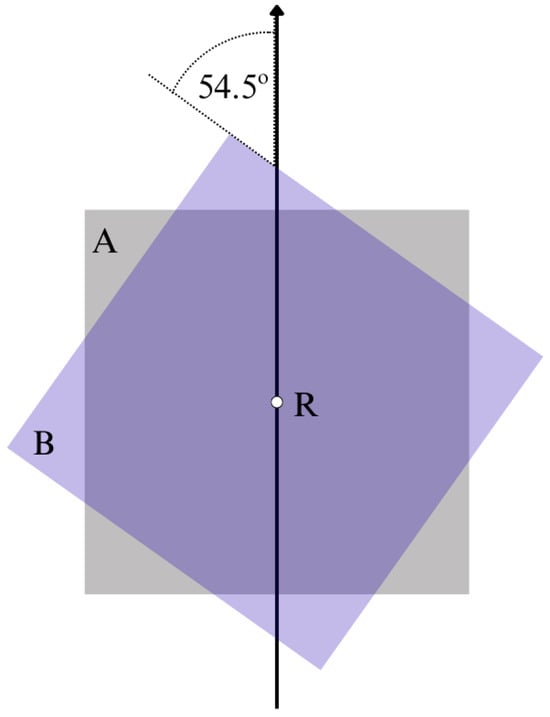
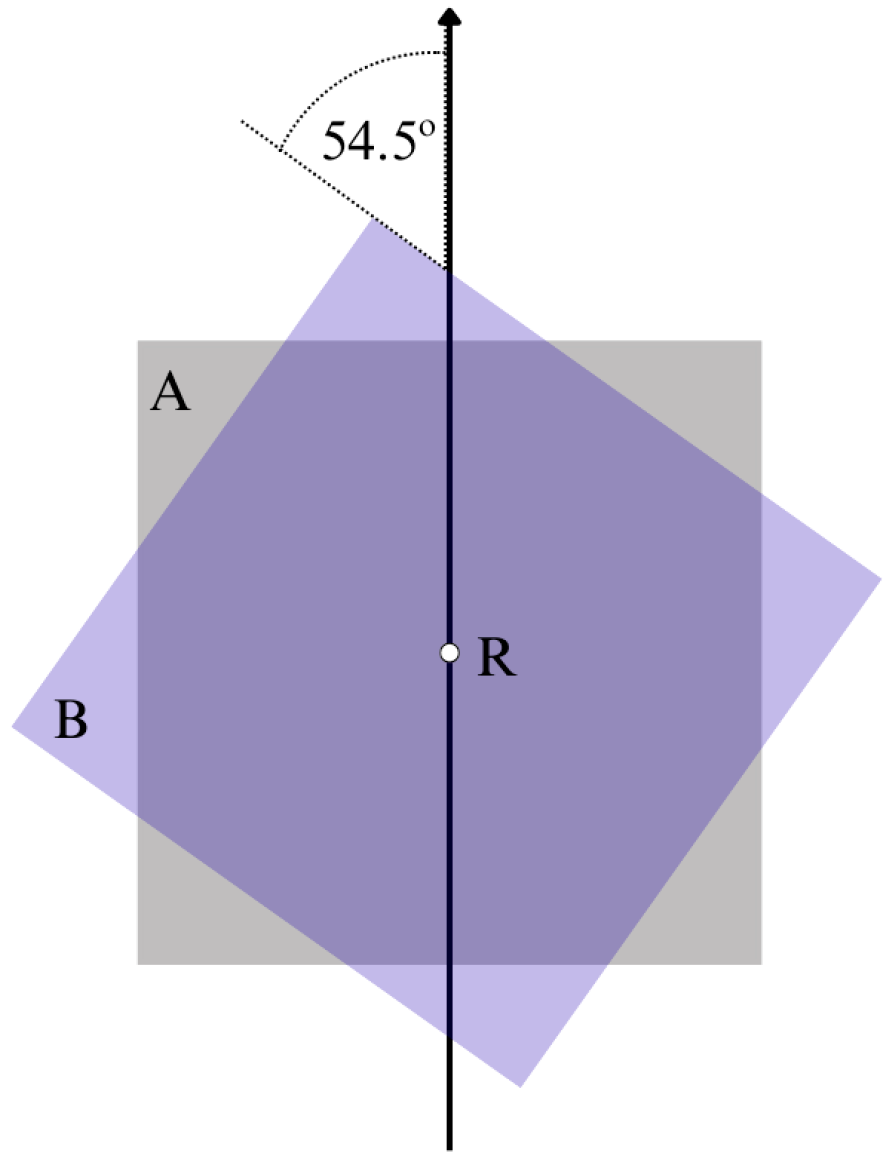
The study protocol consisted of 20 overhead seated throws (10 per seat position). In Position 1 (Figure 1A), the throwing chair was aligned perpendicularly to the throwing line. In Position 2 (Figure 1B), the chair was rotated clockwise until reaching 54.5° relative to the line.
Figure 1.
Schematic representation of the two throwing seat positions. The throwing seat is illustrated as a gray or blue square. (A) Original seat position (Position 1), aligned perpendicularly to the throwing direction; (B) Modified seat position (Position 2), rotated 54.5° relative to the throwing direction. The arrow indicates the throwing line and direction, while R denotes the rotation axis of the seat.
The athlete’s lower body was secured with a strap fixed to the thighs and the throwing frame. Before testing, he completed a 20 min individualized warm-up. All trials were conducted in the same sports hall, on the same day, under controlled environmental conditions. Intervals of one minute were maintained between attempts, following the World Para Athletics Rules and Regulations (March 2024) [29]. The athlete received no coaching cues; the only instruction was to throw as far as possible.
2.3. Data Collection and Kinematic Analysis
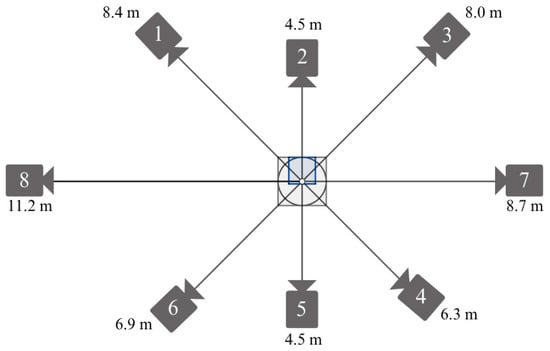
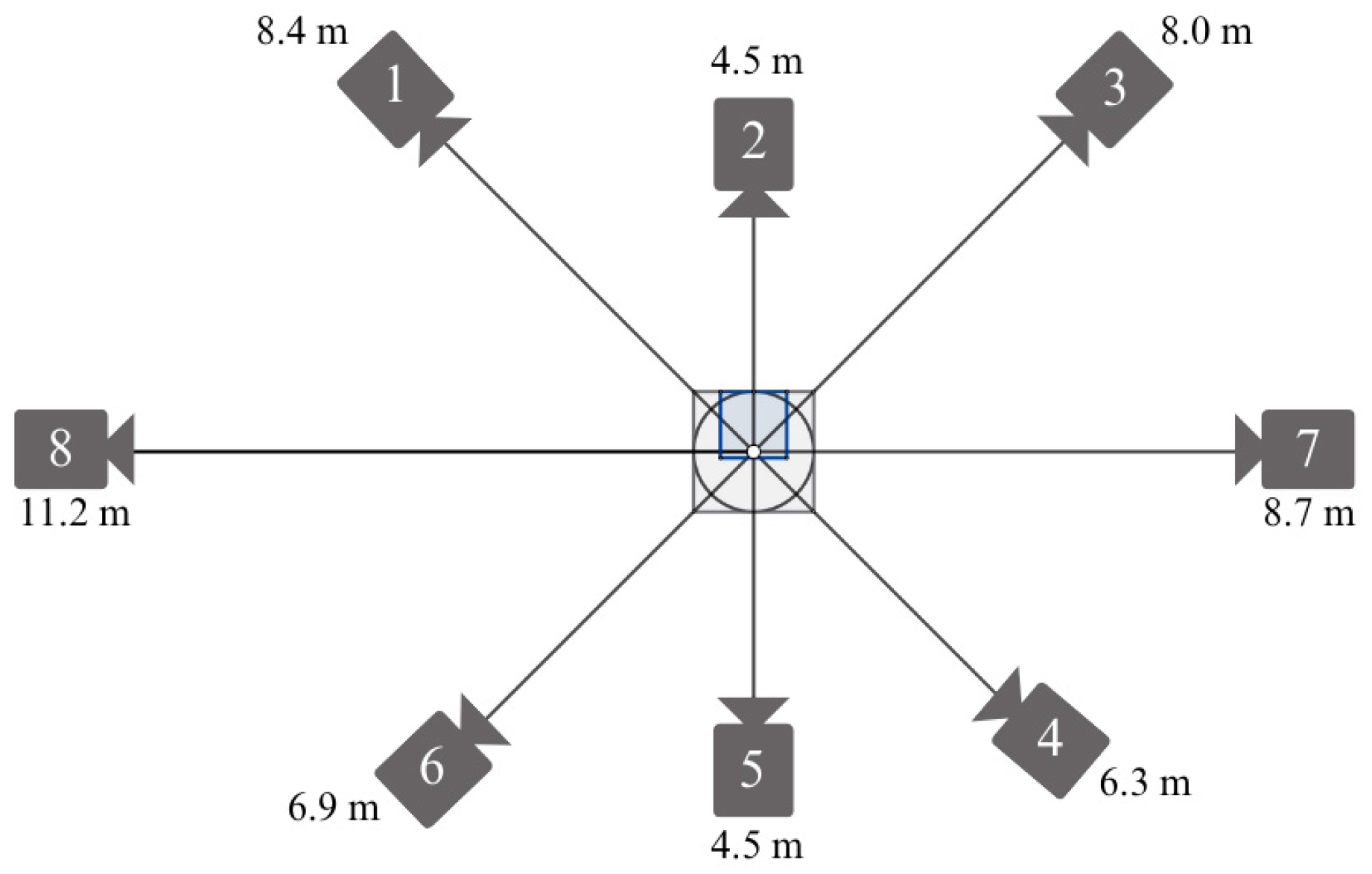
Kinematic data were collected using eight motion capture cameras (Simi Motion 3D v10.2; Simi Reality Motion System GmbH, Unterschleißheim, Germany), positioned around the shot put circle (Figure 2) and recording at 250 Hz.
Figure 2.
Motion capture camera arrangement, showing positions and distances from the center of the throwing frame in meters [m].
A 3D spatial calibration was performed before testing, with the origin set at the center of the circle. The software Simi Shape 3D v5.0.1 (Simi Reality Motion System GmbH, Unterschleißheim, Germany) was used to perform contour-based tracking, in which a digital silhouette of the athlete was matched to a computational body model. The markerless tracking workflow involved segmenting the silhouette through background subtraction, which required two video sequences—one with the athlete and one of the empty background. This was followed by model initialization, during which a 3D virtual body model was fitted to the segmented silhouette. At the start of each trial, the athlete adopted a standardized posture with a slight forward lean and flexed arms to facilitate alignment. Motion tracking was then performed using the Iterative Closest Point (ICP) algorithm, which continuously aligned the model frame by frame with the recorded silhouette, updating segment positions throughout the trial. To ensure optimal accuracy, the athlete wore solid-colored, form-fitting clothing, providing clear separation from the background and consistent visibility from all camera angles. The accuracy of this system has been evaluated previously against marker-based motion capture across sport and gait tasks, demonstrating very strong agreement for segment center-of-mass trajectories and joint angles in the sagittal plane, reporting acceptable errors for frontal and transverse plane rotations during complex, high-speed movements [25,30].
From the obtained data, the following parameters were analyzed: throw distance (distance [m]), trial duration (time [s]), angle of release (AoR [°]), maximum wrist acceleration (WA [m/s2]), maximum wrist velocity (WV [m/s]), trunk forward and backward flexion (TF [°/s]), and torso rotation angular velocity (TR [°/s]). Trials were analyzed starting from the power position, operationally defined as the point of maximal backward trunk inclination in the sagittal plane with the athlete still in contact with the seat and immediately before the initiation of the final forward motion toward release. This event was detected using the trunk angle–time curve and subsequently confirmed visually by the examiner. Due to inter-individual differences in sitting posture and impairment, the power position was determined separately for each trial instead of applying a fixed absolute trunk angle. Kinematic parameters were time-normalized, processed using Simi Motion and Simi Shape software, and filtered with a second-order low-pass filter at 7 Hz.
2.4. Statistical Analysis and Reliability Assessment
All statistical analyses were performed using Statistica v.12 (StatSoft Inc., Tulsa, OK, USA) and MATLAB R2021a (The MathWorks, Natick, MA, USA). Descriptive statistics were calculated for all performance and kinematic variables, including the mean, standard deviation (SD), and coefficient of variation (CV%) to express within-position variability.
Before inferential analyses, the normality of data distribution was tested using the Shapiro–Wilk test (α = 0.05). For normally distributed variables, paired-samples t-tests were applied to compare mean values between the two seated positions. If the assumption of normality was violated, the Wilcoxon signed-rank test was used as a non-parametric alternative. Effect sizes were reported as Cohen’s d (for t-tests) or r (for Wilcoxon tests), interpreted according to conventional thresholds (small: 0.2, medium: 0.5, large: 0.8) [31].
The reliability of repeated trials within each position was assessed using the Intraclass Correlation Coefficient (ICC) based on a two-way mixed model, single measurement, absolute agreement [ICC(3, 1)]. ICC values were interpreted as follows: poor (<0.5), moderate (0.5–0.75), good (0.75–0.9), and excellent (>0.9) [32]. The standard error of measurement (SEM) and coefficient of variation (CV%) were also calculated to provide complementary indicators of trial-to-trial consistency.
To further examine agreement between positions, Bland–Altman plots were generated for key continuous variables (e.g., throwing distance, release velocity, torso angle). These plots display the mean bias and 95% limits of agreement, offering a visual interpretation of measurement consistency and potential systematic differences between conditions.
The Receiver Operating Characteristic (ROC) analysis was conducted to provide a supplementary illustration of which kinematic variables demonstrated the largest relative differences between seat positions. The area under the curve (AUC) was used as an indicator of relative sensitivity to changes in posture, complementing the primary comparison using paired t-tests/Wilcoxon tests and effect sizes. AUC was interpreted as: 0.5 (no discrimination), 0.6–0.7 (poor), 0.7–0.8 (fair), 0.8–0.9 (good), and >0.9 (excellent).
3. Results
3.1. Comparison of Throwing Performance and Kinematics Between Seat Positions
Performance and kinematic variables were compared between two seated throwing positions: Position 1 (Original), aligned perpendicularly to the throwing direction, and Position 2 (Modified), rotated 54.5° relative to the throwing direction (Table 1).
Table 1.
Comparison of performance and kinematic variables between two seated throwing positions (mean ± SD, CV%, effect sizes, and p-values).
Overall trends indicate that throwing distance remained relatively stable across positions, while trial duration was shorter in the rotated seat, suggesting faster execution. Other kinematic measures, such as wrist acceleration, wrist velocity, trunk flexion, and torso rotation, showed variable patterns, with some moderate effect sizes but no statistically significant differences. Within-position variability, expressed as the coefficient of variation, was generally low for distance and time, and higher for angular and kinematic measures, reflecting greater trial-to-trial variability in these parameters.
3.2. The Reliability of Throwing Measures Across Chair Orientations
The reliability of repeated trials within each seat position was assessed, and overall, measures ranged from poor to moderate consistency (Table 2). Outcome-based measures, such as throwing distance and wrist velocity, were generally more reliable, whereas temporal and upper-body kinematic variables, particularly trunk rotation and wrist acceleration, showed greater within-subject variability. The standard error of measurement (SEM) and relative variability suggested that fine motor and rotational parameters were less consistent across trials, while gross performance measures remained relatively stable. Slightly greater variability was observed in the rotated seat position, especially for rotational kinematics, indicating that chair orientation may influence movement consistency. These findings highlight that although overall performance output was maintained, underlying upper-body mechanics were more sensitive to positional changes, reflecting individualized movement strategies.
Table 2.
Reliability of repeated trials within each seat position assessed using Intraclass Correlation Coefficient ICC(3, 1), Standard Error of Measurement (SEM), and Coefficient of Variation (CV%).
3.3. Agreement Analysis Between Seated Throwing Positions Using the Bland–Altman Method
The Bland–Altman analysis was conducted to assess the agreement between the two seated positions across all measured biomechanical variables (Table 3).
Table 3.
Bland–Altman analysis showing mean bias and limits of agreement (LoA) for performance and kinematic parameters comparing two seated shot put positions in a Paralympic thrower. Positive bias values indicate higher measurements in position 1 relative to position 2.
Outcome measures such as throw distance and trial duration showed relatively narrow agreement bands, indicating that these performance variables were largely consistent between positions. In contrast, kinematic variables, particularly those related to trunk rotation, displayed wider limits of agreement, reflecting substantial trial-to-trial variability and less stable agreement between seat orientations.
Systematic bias was minimal for most variables, though greater dispersion was observed for rotational and upper-limb kinematics. These patterns suggest that while overall throwing performance remained stable across chair orientations, the underlying biomechanical strategies used to generate the throw varied considerably between positions.
3.4. ROC Curve Analysis and Variable Discrimination
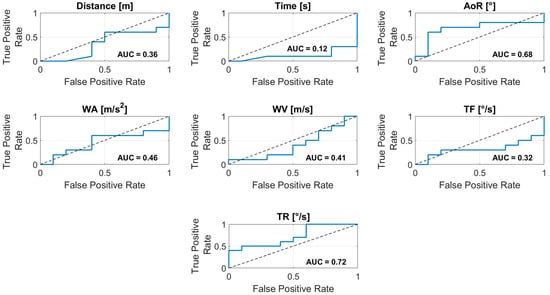
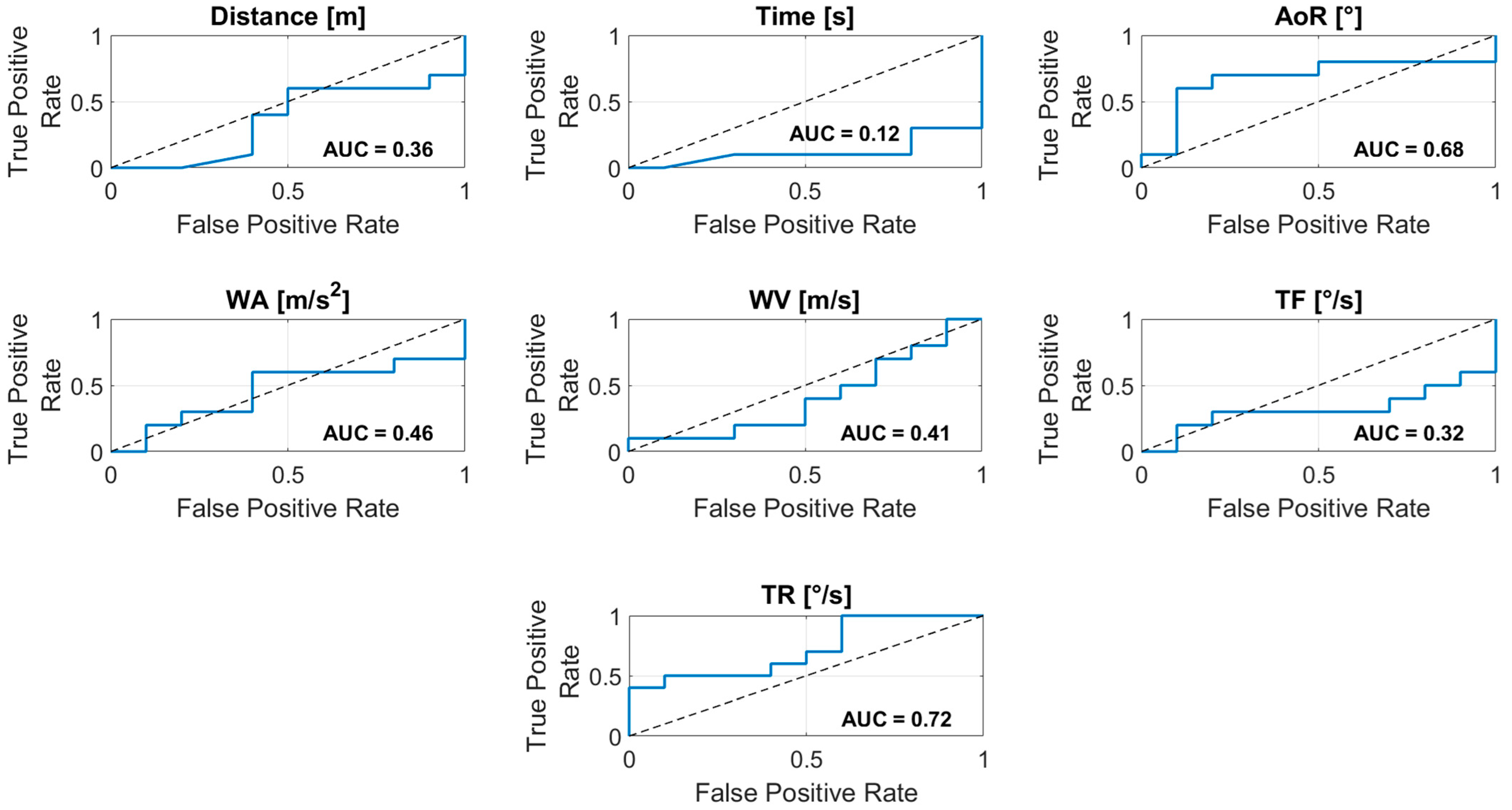
As a supplementary, exploratory analysis, ROC curves were generated to provide a visual indication of which kinematic variables exhibited the largest relative differences between the two seat positions (Figure 3). It is emphasized that this analysis is not used for formal classification or diagnostic purposes. AUC values are reported solely to highlight the sensitivity of individual variables to posture changes, complementing the primary inferential statistics presented in Table 1.
Figure 3.
Discriminative analysis of biomechanical variables using ROC curves.
Among all analyzed variables, TR (AUC = 0.72) and AoR (AUC = 0.68) demonstrated the highest discriminative ability, suggesting that differences in the torso rotation angular velocity and release mechanics were the most pronounced between the two seated positions. These results indicate that subtle kinematic adjustments in torso control and release angle are likely key differentiators between throwing setups.
In contrast, distance (AUC = 0.36), WA (AUC = 0.46), and WV (AUC = 0.41) demonstrated poor discriminatory power, indicating that these parameters did not vary sufficiently between positions to enable accurate classification. Similarly, time of throw (AUC = 0.12) and TF (AUC = 0.32) exhibited low sensitivity and specificity, implying that they remain relatively stable regardless of the throwing position.
4. Discussion
This case study investigated the effects of two seated throwing positions on performance and kinematic characteristics in a single elite F55-class Paralympic shot put athlete, with particular attention to reliability, variability, and discriminative potential of biomechanical variables. Overall, the results demonstrate that while overall performance outcomes, such as throwing distance and trial duration, remained relatively stable between positions, upper-body kinematics, especially trunk rotation, exhibited substantial variability. Because these observations are derived from a single athlete, they reflect an individualized motor strategy and should not be generalized to the broader F55 population or to other seated throwers.
4.1. Performance and Kinematics
Mean throwing distance was slightly higher in the original perpendicular seat (Position 1) compared to the rotated position (Position 2), although this difference was not statistically significant. This aligns with prior research suggesting that throw distance in seated shot put is relatively robust to moderate changes in chair orientation, as performance is largely determined by upper-limb force production and trunk engagement rather than lower-limb contribution [9,14]. Release-related variables (angle of release, wrist acceleration, wrist velocity) also did not differ between positions, further supporting the relative stability of gross performance metrics despite changes in seat orientation. However, these findings should be interpreted strictly within the context of this athlete’s unique biomechanics and should not be assumed to reflect typical responses among other athletes.
The significantly shorter trial duration observed in Position 2 suggests that chair rotation may facilitate faster movement execution, potentially by altering the kinetic chain and enabling a more direct transfer of torque from the trunk to the shot. Similar findings have been reported in able-bodied shot put studies, where small adjustments in stance or release mechanics can alter temporal parameters without significantly affecting throw distance [33].
Kinematic variables such as wrist acceleration, wrist velocity, trunk flexion, and torso rotation showed moderate-to-high trial-to-trial variability. Particularly, trunk rotation angular velocity (TR) and trunk flexion (TF) displayed higher coefficients of variation and poor ICCs. This variability is likely highly individualized and reflects compensatory movement strategies unique to this specific athlete, meaning it should not be assumed to represent typical variability patterns among other seated throwers, even within the same classification or performance level. These findings support the notion that seated throwers must employ individualized motor strategies to compensate for postural constraints and the lack of lower-limb support, consistent with earlier biomechanical analyses in F54–F56 classes [9,14]. Trunk instability can lead to posterior pelvic tilt, kyphotic posture, and a shortened upper-limb lever arm, increasing the risk of musculoskeletal injuries such as low back pain or rotator cuff pathology [34].
4.2. Reliability and Variability
The reliability analysis revealed that distance and wrist velocity had the highest ICCs, whereas time, wrist acceleration, and torso angular velocities demonstrated poor reliability. Notably, some ICC values were negative or near zero, indicating extremely poor reliability. This likely reflects a combination of factors: inherent instability in the technical movements of seated shot put, particularly for trunk rotation and rapid wrist motions; measurement limitations of markerless motion capture in capturing fine rotational kinematics; and the athlete’s transient adaptation to the rotated seat position, which may introduce trial-to-trial inconsistencies in motor control. These observations highlight that while gross performance metrics are relatively reproducible, finer aspects of upper-body coordination are highly sensitive to subtle changes in posture and equipment orientation. Previous studies on Paralympic athletes have similarly emphasized that upper-body kinematics in seated throws exhibit greater within-subject variability than outcome-based measures [3,9,14]. High variability in parameters related to trunk function and core stability is also observed in studies of young athletes and in tasks requiring precise postural control, where minor disturbances can significantly affect movement technique [35]. The elevated variability in torso rotation may reflect compensatory strategies to maximize throwing power, as the athlete adjusts trunk engagement relative to chair orientation. Importantly, these reliability patterns are specific to this athlete and demonstrate the challenges in maintaining consistent kinematics under seated conditions, rather than reflecting errors in experimental design alone.
The Bland–Altman analysis further confirmed that performance measures such as throwing distance and trial duration demonstrated good agreement between positions. Whereas kinematic variables, especially those associated with trunk motion, displayed wider limits of agreement. These findings underscore the individualized nature of movement strategies in seated throwing and reinforce that the conclusions drawn here apply only to the studied athlete.
4.3. Discriminative Ability of Biomechanical Variables
The exploratory ROC analysis suggested that torso rotation velocity (TR) and angle of release (AoR) showed the largest relative differences between positions. Importantly, this does not imply classification or diagnostic use. Consistent with the main analysis, inferential statistics and effect sizes remain the primary indicators for comparing performance and kinematic variables between the two seat positions. This aligns with biomechanical reasoning: subtle changes in seat orientation primarily affect trunk mechanics and release strategy rather than gross output metrics. Again, these discriminative characteristics reflect this athlete’s unique trunk control patterns and should not be assumed to generalize to athletes with different impairment profiles, training histories, or trunk control capacities. Comparable observations have been reported in other markerless and marker-based kinematic studies of seated throwing, highlighting the importance of torso control in achieving optimal force transfer [2,22,36].
Additional contextual information supports these findings. O’Riordan et al. [14] highlighted that only a small proportion of studies on seated throwing used 3D motion capture, likely due to technical complexity and the difficulty of accessing athletes with consistent technique. The study confirmed that trunk angular velocity and wrist acceleration are key parameters for distinguishing between different seat positions, even when the overall throwing distance remains unchanged. Similarly, Guebli et al. [37] demonstrated that F32–33 athletes’ performance depends on armrest distance and wrist angle, whereas Chow and Mindock [38] found that trunk mobility and control strongly influence throwing distance in athletes within the same class. Hyde et al. [33] further showed that grip strength, trunk flexion, and the use of an assistive pole can meaningfully affect hand speed at release, though seat configuration alone had minimal effects. Holdback et al. [36] observed that lower grip positions increase trunk angular velocities and power output, supporting the notion that equipment and technique interact with trunk mechanics. Finally, Lee et al. [39] confirmed that release speed and angle are primary predictors of throw distance across genders in Paralympic shot put, highlighting the critical role of trunk and upper-limb coordination.
5. Study Limitations
This case study has several limitations that should be considered when interpreting the findings. First, the study focused on a single elite F55-class para-athlete, which limits the generalizability of the results to broader populations or other classification levels. Individual differences in technique, strength, and trunk control among para-athletes mean that the observed kinematic patterns may not fully represent the wider cohort.
Second, while markerless motion capture provides advantages in terms of ecological validity and reduced intrusiveness, it may be less accurate than marker-based systems for detecting rotational movements. This limitation could have affected the precision of trunk rotation measurements and other axial kinematics.
Third, although testing conditions were carefully standardized, slight variations in the athlete’s effort or positioning across trials cannot be completely ruled out. Additionally, the rotated seat position was new for the athlete, which may have influenced performance due to unfamiliarity or subtle adjustments in motor control.
Finally, the study did not include electromyographic (EMG) analysis of trunk muscles or grip strength measurements, which could have provided valuable insights into muscle activation patterns and force generation.
Overall, while single-subject studies offer detailed insights into elite performance, future research should involve larger samples across multiple classification levels to identify common biomechanical patterns and individual adaptations. Studies conducted under real competition conditions and incorporating EMG or strength assessments would also help to better understand the long-term effects of seat orientation, including potential impacts on strength development, fatigue, and injury risk.
6. Conclusions and Practical Applications
The findings of this study suggest that seated shot put frame position can be adjusted to optimize athlete comfort and stability without negatively affecting throwing distance. However, training should emphasize multiplanar trunk control, as effective trunk engagement is a critical component of the kinetic chain and a key determinant of throwing performance.
For classification and performance testing, standardizing frame orientation is recommended, as variations in seat configuration may mask functional deficits and complicate comparisons across sessions or between athletes.
Overall, this study demonstrates that while performance outcomes such as throwing distance are relatively stable across moderate chair rotations, upper-body kinematics, particularly trunk rotation and flexion, exhibit substantial variability. Crucially, because the study was conducted on a single elite F55 athlete, all findings should be interpreted as athlete-specific observations rather than generalizable outcomes. They cannot be directly applied to other Paralympic throwers, even within the same classification or performance tier. The practical implications, therefore, pertain to individualized assessment and technique refinement rather than broad recommendations for all seated shot put athletes.
Finally, markerless motion capture has proven to be a practical and reliable tool for quantifying 3D kinematics in seated shot put, offering valuable applications for athlete training, performance monitoring, and Paralympic classification. Future studies with larger and more diverse samples are required before general conclusions about the effects of seat orientation can be made.
Author Contributions
Conceptualization, J.K.; methodology, J.K.; software, J.K. and R.B.; validation, J.K., R.B., M.B., L.R. and J.W.; formal analysis, J.K., M.F., K.K., R.B., M.B. and J.W.; investigation, J.K.; resources, J.K. and R.B.; data curation, J.K.; writing—original draft preparation, J.K., R.B., M.F. and K.K.; writing—review and editing, K.K., R.B., M.F., J.K., M.B. and J.W.; visualization, R.B., M.F. and K.K.; supervision, M.B., L.R. and J.W.; project administration, J.K.; funding acquisition, J.K. and J.W. All authors have read and agreed to the published version of the manuscript.
Funding
This research was funded under the public task “Supporting scientific projects in the field of competitive sports in 2023” co-financed from the state budget, administered by the Polish Ministry of Sports and Tourism, Warsaw, Poland, in the period from 1 February to 31 December 2023, project title: “Assessment of the possibility of applying spatial motion analysis methods (3D analysis) in natural conditions to optimize athletic throws in para-athletics team members.”.
Institutional Review Board Statement
The study was conducted in accordance with the Declaration of Helsinki, and approved by the Senate Bioethics Committee of the Józef Piłsudski University of Physical Education in Warsaw, Poland (protocol code SKE01-02/2023 and date of approval 1 February 2023).
Informed Consent Statement
Informed consent was obtained from all subjects involved in the study.
Data Availability Statement
The data presented in this study are available on request from the corresponding author. The data are not publicly available due to ongoing data collection and further research being conducted on this topic.
Acknowledgments
The authors gratefully thank the athletes for their cooperation during the study.
Conflicts of Interest
The authors declare no conflicts of interest.
References
- Reina, R.; Vilanova-Périz, N. Guía Sobre Clasificación de la Discapacidad en Deporte Paralímpico; Limencop SL: Elche, Spain, 2016. [Google Scholar]
- Holdback, C.J.M.; Ibrahim, R.; Haydon, D.S.; Pinder, R.A.; Grimshaw, P.N.; Kelso, R.M. Seated-Shot-Put Equipment in Para Athletics-A Review and Presentation of Data From the Tokyo 2020 Paralympic Games. Adapt. Phys. Act. Q. APAQ 2024, 41, 33–50. [Google Scholar] [CrossRef] [Scilit]
- Frossard, L.; Smeathers, J.; O’Riordan, A.; Goodman, S. Shot trajectory parameters in gold medal stationary shot-putters during world-class competition. Adapt. Phys. Act. Q. APAQ 2007, 24, 317–331. [Google Scholar] [CrossRef] [Scilit]
- Pleša, J.; Kozinc, Ž.; Šarabon, N. A Brief Review of Selected Biomechanical Variables for Sport Performance Monitoring and Training Optimization. Appl. Mech. 2022, 3, 144–159. [Google Scholar] [CrossRef] [Scilit]
- Fletcher, J.R.; Gallinger, T.; Prince, F. How Can Biomechanics Improve Physical Preparation and Performance in Paralympic Athletes? A Narrative Review. Sports 2021, 9, 89. [Google Scholar] [CrossRef] [Scilit]
- Petrů, J.; Vencúrik, T. The effect of jump topspin serve speed on reception quality in men’s volleyball. Phys. Act. Rev. 2024, 12, 11–19. [Google Scholar] [CrossRef] [Scilit]
- Scataglini, S.; Abts, E.; Van Bocxlaer, C.; Van den Bussche, M.; Meletani, S.; Truijen, S. Accuracy, Validity, and Reliability of Markerless Camera-Based 3D Motion Capture Systems versus Marker-Based 3D Motion Capture Systems in Gait Analysis: A Systematic Review and Meta-Analysis. Sensors 2024, 24, 3686. [Google Scholar] [CrossRef] [Scilit] [PubMed]
- Drazan, J.F.; Phillips, W.T.; Seethapathi, N.; Hullfish, T.J.; Baxter, J.R. Moving outside the lab: Markerless motion capture accurately quantifies sagittal plane kinematics during the vertical jump. J. Biomech. 2021, 125, 110547. [Google Scholar] [CrossRef] [Scilit] [PubMed]
- O’Riordan, A.; Frossard, L.; Greenhalgh, A.; Miller, S. Influence of pole position on trunk angle in seated shotput. In XI International Council on Coaching Excellence (ICCE) Global Coaches; Human Kinetics: Champaign, IL, USA, 2017; pp. 264–266. [Google Scholar]
- Van Hooren, B.; Pecasse, N.; Meijer, K.; Essers, J.M.N. The accuracy of markerless motion capture combined with computer vision techniques for measuring running kinematics. Scand. J. Med. Sci. Sports 2023, 33, 966–978. [Google Scholar] [CrossRef] [Scilit] [PubMed]
- Torvinen, P.; Ruotsalainen, K.S.; Zhao, S.; Cronin, N.; Ohtonen, O.; Linnamo, V. Evaluation of 3D Markerless Motion Capture System Accuracy during Skate Skiing on a Treadmill. Bioengineering 2024, 11, 136. [Google Scholar] [CrossRef] [Scilit]
- Zheng, C.; Wu, W.; Yang, T.; Zhu, S.; Chen, C.; Liu, R.; Shen, J.; Kehtarnavaz, N.; Shah, M. Deep Learning-Based Human Pose Estimation: A Survey. ACM Comput. Surv. 2023, 56, 1–37. [Google Scholar] [CrossRef] [Scilit]
- Miranda, D.L.; Schwartz, J.B.; Loomis, A.C.; Brainerd, E.L.; Fleming, B.C.; Crisco, J.J. Static and dynamic error of a biplanar videoradiography system using marker-based and markerless tracking techniques. J. Biomech. Eng. 2011, 133, 121002. [Google Scholar] [CrossRef] [Scilit]
- O’Riordan, A.; Greenhalgh, A.; Frossard, L.; Miller, S. Biomechanics of Seated Shot Put. In Proceedings of the 2017 International Paralympic Committee (IPC) VISTA Conference, Toronto, ON, Canada, 20–23 September 2017. [Google Scholar]
- Walker, J.; Thomas, A.; Lunn, D.E.; Nicholson, G.; Tucker, C.B. Concurrent validity of Theia3D markerless motion capture for detecting sagittal kinematic differences between gait speeds. J. Sports Sci. 2025, 43, 1560–1571. [Google Scholar] [CrossRef] [Scilit]
- Suo, X.; Tang, W.; Li, Z. Motion Capture Technology in Sports Scenarios: A Survey. Sensors 2024, 24, 2947. [Google Scholar] [CrossRef] [Scilit]
- Xu, D.; Zhou, H.; Jie, T.; Zhou, Z.; Yuan, Y.; Jemni, M.; Quan, W.; Gao, Z.; Xiang, L.; Gusztav, F.; et al. Data-driven deep learning for predicting ligament fatigue failure risk mechanisms. Int. J. Mech. Sci. 2025, 301, 110519. [Google Scholar] [CrossRef] [Scilit]
- Das, K.; de Paula Oliveira, T.; Newell, J. Comparison of markerless and marker-based motion capture systems using 95% functional limits of agreement in a linear mixed-effects modelling framework. Sci. Rep. 2023, 13, 22880. [Google Scholar] [CrossRef] [Scilit]
- Wade, L.; Needham, L.; McGuigan, P.; Bilzon, J. Applications and limitations of current markerless motion capture methods for clinical gait biomechanics. PeerJ 2022, 10, e12995. [Google Scholar] [CrossRef] [Scilit] [PubMed]
- Zwierko, M.; Jedziniak, W.; Popowczak, M.; Rokita, A. Effects of six-week stroboscopic training program on visuomotor reaction speed in goal-directed movements in young volleyball players: A study focusing on agility performance. BMC Sports Sci. Med. Rehabil. 2024, 16, 59. [Google Scholar] [CrossRef] [Scilit]
- Molteni, L.E.; Andreoni, G. Comparing the Accuracy of Markerless Motion Analysis and Optoelectronic System for Measuring Gait Kinematics of Lower Limb. Bioengineering 2025, 12, 424. [Google Scholar] [CrossRef] [Scilit]
- Valenzuela, R.; Corral, J.; Diez, M.; Provot, T.; Campa, F.J.; Herrero, S.; Macho, E.; Pinto, C. Validation of a markerless motion capture system for centre of mass kinematic analysis. Biocybern. Biomed. Eng. 2025, 45, 278–286. [Google Scholar] [CrossRef] [Scilit]
- Philipp, N.M.; Fry, A.C.; Mosier, E.M.; Cabarkapa, D.; Nicoll, J.X.; Sontag, S.A. Biological reliability of a movement analysis assessment using a markerless motion capture system. Front. Sports Act. Living 2024, 6, 1417965. [Google Scholar] [CrossRef] [Scilit]
- Hauenstein, J.D.; Huebner, A.; Wagle, J.P.; Cobian, E.R.; Cummings, J.; Hills, C.; McGinty, M.; Merritt, M.; Rosengarten, S.; Skinner, K.; et al. Reliability of Markerless Motion Capture Systems for Assessing Movement Screenings. Orthop. J. Sports Med. 2024, 12, 23259671241234339. [Google Scholar] [CrossRef] [Scilit]
- Frühschütz, H. Evaluation of Markerless Tracking for Kinematics in Tennis. Master’s Thesis, Technical University of Munich, Munich, Germany, 2017. [Google Scholar]
- Cho, M.; Han, J.S.; Kang, S.; Ahn, C.H.; Kim, D.H.; Kim, C.H.; Kim, K.T.; Kim, A.R.; Hwang, J.M. Biomechanical Effects of Different Sitting Postures and Physiologic Movements on the Lumbar Spine: A Finite Element Study. Bioengineering 2023, 10, 1051. [Google Scholar] [CrossRef] [Scilit]
- Tan, J.Q.J.; Chow, J.Y.; Komar, J. The utility of markerless motion capture for performance analysis in racket sports. Proc. Inst. Mech. Eng. Part P J. Sports Eng. Technol. 2024, 17543371241230731. [Google Scholar] [CrossRef] [Scilit]
- Lam, W.W.T.; Tang, Y.M.; Fong, K.N.K. A systematic review of the applications of markerless motion capture (MMC) technology for clinical measurement in rehabilitation. J. Neuroeng. Rehabil. 2023, 20, 57. [Google Scholar] [CrossRef] [Scilit] [PubMed]
- World Para Athletics. World Para Athletics Rules and Regulations; World Para Athletics: Bonn, Germany, 2024. [Google Scholar]
- Becker, L. Evaluation of joint angle accuracy using markerless silhouette-based tracking and hybrid tracking against traditional marker tracking. Procedia Eng. 2016, 147, 710–717. [Google Scholar]
- Cohen, J. Statistical Power Analysis for the Behavioral Sciences; Lawrence Erlbaum Associates: Hillsdale, NJ, USA, 1988. [Google Scholar]
- Koo, T.K.; Li, M.Y. A Guideline of Selecting and Reporting Intraclass Correlation Coefficients for Reliability Research. J. Chiropr. Med. 2016, 15, 155–163. [Google Scholar] [CrossRef] [Scilit] [PubMed]
- Hyde, A.; Hogarth, L.; Sayers, M.; Beckman, E.; Connick, M.J.; Tweedy, S.; Burkett, B. The Impact of an Assistive Pole, Seat Configuration, and Strength in Paralympic Seated Throwing. Int. J. Sports Physiol. Perform. 2017, 12, 977–983. [Google Scholar] [CrossRef] [Scilit]
- Triolo, R.J.; Bailey, S.N.; Miller, M.E.; Lombardo, L.M.; Audu, M.L. Effects of stimulating hip and trunk muscles on seated stability, posture, and reach after spinal cord injury. Arch. Phys. Med. Rehabil. 2013, 94, 1766–1775. [Google Scholar] [CrossRef] [Scilit]
- Jandová, S.; Bartizalova, B. Compensatory exercises for young cyclists in the pubescents. Phys. Act. Rev. 2024, 12, 100–111. [Google Scholar] [CrossRef] [Scilit]
- Holdback, C.J.; Ibrahim, R.; Haydon, D.S.; Grimshaw, P.; Kelso, R.; Pinder, R.A. The dynamics of seated shot put: A case study example of pole grip optimisation. Front. Sports Act. Living 2025, 7, 1509435. [Google Scholar] [CrossRef] [Scilit]
- Guebli, A.; Madani, R.; Bouabdellah, S. Kinematical variables analysis of shot-put activity in para athletics (class F32/33) and their relationships with digital level achievement. Int. J. Sport Exerc. Train. Sci. 2020, 6, 65–72. [Google Scholar] [CrossRef] [Scilit]
- Chow, J.W.; Mindock, L.A. Discus throwing performances and medical classification of wheelchair athletes. Med. Sci. Sports Exerc. 1999, 31, 1272–1279. [Google Scholar] [CrossRef] [Scilit] [PubMed]
- Lee, S.; Davis, R.; Judge, L.W.; Kwon, Y.H.; Han, K.; Kim, J.; Kim, J.; Kim, J. Gender-Based Correlation Profiles Among the Release Factors and Distance Thrown in Paralympic Seated Shot Put. Adapt. Phys. Act. Q. APAQ 2015, 32, 318–330. [Google Scholar] [CrossRef] [Scilit] [PubMed]

Disclaimer/Publisher’s Note: The statements, opinions and data contained in all publications are solely those of the individual author(s) and contributor(s) and not of MDPI and/or the editor(s). MDPI and/or the editor(s) disclaim responsibility for any injury to people or property resulting from any ideas, methods, instructions or products referred to in the content. |
© 2025 by the authors. Licensee MDPI, Basel, Switzerland. This article is an open access article distributed under the terms and conditions of the Creative Commons Attribution (CC BY) license (https://creativecommons.org/licenses/by/4.0/).