


Abstract
Edges in two-dimensional structures are the source of nonlinear transport and optical phenomena which are particularly important in small-size flakes. We present a microscopic theory of the edge photogalvanic effect, i.e., the formation of DC electric current flowing along the sample edges in response to AC electric field of the incident terahertz radiation, for two-dimensional Dirac materials including the systems with massive and massless charge carriers. The edge current direction is controlled by the AC field polarization. The spectral dependence of the current is determined by the carrier dispersion and the mechanism of carrier scattering, as shown for single-layer and bilayer graphene as examples.
1. Introduction
The discovery of graphene and other two-dimensional (2D) crystals opened a new page in the physics of low-dimensional systems [1,2] and triggered the research aimed at the development of efficient sources and detectors of terahertz radiation based on 2D Dirac materials [3,4]. In small-size samples, e.g., flakes obtained by mechanical exfoliation, the important and sometimes decisive role in the formation of photoelectric response is played by edges and nearby regions [5,6]. At the edges, the translational and space inversion symmetries are naturally broken, which gives rise to edge-related mechanisms of the photogalvanic effect [5,6,7,8,9,10,11] and the second harmonic generation [12,13,14].
The photocurrents flowing along the sample edges (the edge photogalvanic effect) were observed and studied in single-layer and bilayer graphene samples excited by terahertz radiation [5,6,10], also in an external magnetic field in the conditions of cyclotron resonance [9] and in the regime of the quantum Hall effect [15]. It is found that the edge photocurrent is induced by both linearly and circularly polarized radiation. Moreover, the photocurrent direction is controlled by the polarization of the incident radiation: the electric field direction with respect to the edge for the linearly polarized field and the photon helicity for the circularly polarized field. The edge photogalvanic effect in 2D structures can be considered as a low-dimensional analog of the surface photogalvanic effect studied in bulk semiconductor crystals and metal films and recently in nanocomposite films [16,17,18,19,20,21,22].
The microscopic theory of the edge photogalvanic effect in the spectral range of intraband transport has been developed so far for 2D systems with parabolic energy spectrum of charge carriers [6,8]. Here, we generalize the theory to the class of 2D Dirac materials. We present a comprehensive theoretical study of the edge currents for 2D systems with arbitrary dispersion and arbitrary type of electron scattering in the 2D bulk. We show that the edge current is determined by the dispersion of carriers and the relaxation times of the first and second angular harmonics of the distribution function and compare the results for single-layer and bilayer graphene, which are examples of 2D systems with parabolic and linear energy spectra.
2. Microscopic Theory
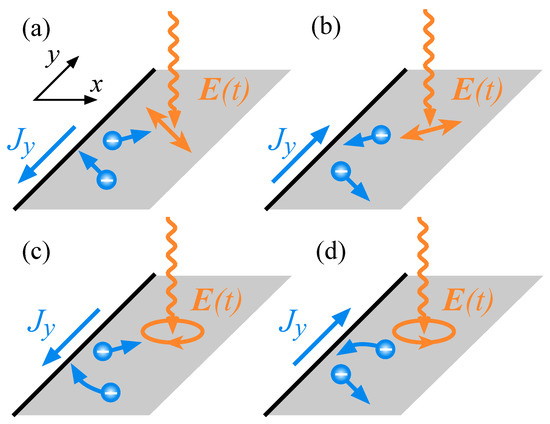
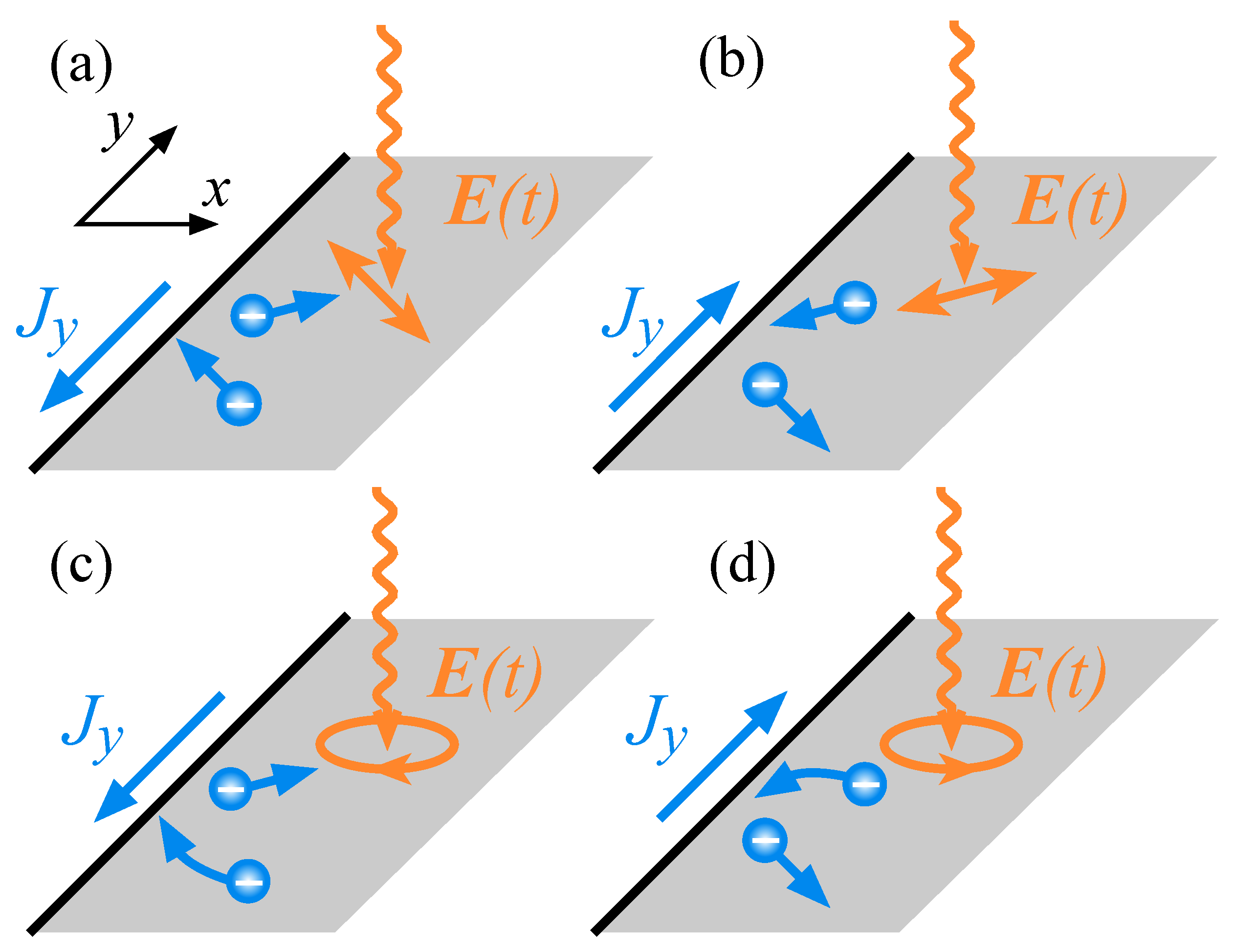
Consider an electromagnetic wave incident on the structure hosting a 2D electron gas occupying the half-plane at , see Figure 1. The AC electric field of the incident wave has the form , where and are the field amplitude and frequency, respectively, and the abbreviation “” denotes the complex conjugation. The AC electric field causes the back-and-forth in-plane motion of electrons. At the edge of the structure (here, at ), the AC motion of electrons gets distorted due to electron reflection from the edge and dynamic charge accumulation, which leads to an asymmetry of the high-frequency electron transport. This asymmetry results in the rectification of the AC current and, hence, the emergence of a DC current flowing along the edge. As Figure 1 illustrates, the DC edge current can be excited by both linearly polarized and circularly polarized electromagnetic waves and the current direction is controlled by the wave polarization.
Figure 1.
Illustration of the edge current formation. The back-and-forth motion of 2D carriers occupying the half-plane by linearly polarized (a,b) or circularly polarized (c,d) AC electric field results, due to electron scattering from the edge and dynamical charge accumulation, in the DC current flowing along the edge. The edge current direction is controlled by the field polarization.
Now we present the microscopic theory of high-frequency non-linear electron transport and calculate the edge currently. We consider the classical range of the electromagnetic wave frequencies, i.e., , where is the Fermi energy of the 2D electron gas, and describe the electron kinetics by the Boltzmann equation
Here, is the electron distribution function, and are the electron momentum and energy, respectively, is the velocity, , e is the electron charge, is the local electric field acting upon the electrons, and is the collision integral. At this stage, we assume that the electron spectrum is isotropic in the 2D plane but do not specify the exact form of the dispersion . The field near the edge differs from the incident field by the correction due to the screening produced by dynamical charge accumulation [6,23,24]. Therefore, whereas .
At equilibrium, the electron distribution is isotropic and homogenous at and is described by the Fermi–Dirac function . In the presence of an AC electric field, the distribution function acquires corrections. We expand the resulting distribution function in the series in the electric field amplitude as follows
where is the first-order correction, which determines the linear (Drude) conductivity, and is the time-independent second-order correction. The second-order correction oscillating at is not considered here since it does not contribute to DC electric current.
The density of DC electric current is determined by the asymmetric part of the correction and is given by
where g is the factor that takes into account possible spin and valley degeneracy (e.g., for GaAs quantum wells and for single-layer and bilayer graphene) and .
We solve Equations (4) and (5) in the approximation of elastic electron scattering in the bulk of the 2D system and for specular reflection of electrons from the edge. The latter implies that which also ensures the lack of electric current across the edge. Multiplying Equation (5) by the velocity and averaging the resulting equation over the directions of one obtains
where the angular brackets stand for the averaging and is the momentum relaxation time (relaxation time of the first angular harmonic) defined as . Such a definition of enables the consideration of its dependence on the electron energy . Equations (3) and (6) yield the equation for the current density
After the integration of the second term by parts, Equation (7) assumes the form
where and is the (energy-dependent) effective mass. In the case of parabolic dispersion the effective mass is energy-independent whereas for linear dispersion the effective mass linearly depends on energy. Note that the mass m also determines the quasi-classical cyclotron motion. Equation (8) is valid for arbitrary dispersion and arbitrary boundary conditions at the edge. Obviously, the DC current vanishes for the AC field polarized along or perpendicularly to the edge and emerges only if the incident field has both x and y components. Therefore, the corrections in the second and third terms on the right-hand side of Equation (8) should be calculated for the y and x components of the field, respectively.
For specular reflection of electrons from the edge, the second sum in Equation (8) vanishes since in response to is an even function of . The third sum in Equation (8) can be rewritten via using the equalities
which follow from Equation (4). Here, is the relaxation time of the second angular harmonic of the distribution function defined as . Therefore, Equation (8) assumes the form
The current density is determined by spatial derivatives of the distribution function and, as expected, vanishes in the 2D bulk where the electron distribution is homogenous.
The total electric current flowing along the edge is given by
Integrating Equation (11) over x we obtain
where and are the corrections to the distribution function at the edge and far from the edge, respectively. For the particular case of specular reflection of electrons from the edge, the functions and are even in and, therefore, the sums with and vanish. As a result, the edge current is determined by the functions and in the bulk where the actual field coincides with the incident field . The sums with and can be readily calculated from Equations (4) and () neglecting spatial inhomogeneous terms and the electric field screening. Below, we do such calculations for the degenerate electron gas with the Fermi energy .
The first-order correction in the 2D bulk has the form
Therefore, the second sum in Equation (13) is calculated as follows
where is the conductivity,
all the values are taken at the Fermi level, is the carrier density, and and are the Stokes parameters of the incident radiation. The third sum in Equation (13) is calculated as follows
Lastly, the sum with in Equation (13) can be expressed with the help of Equation (5) via the sum with as follows
Integration of the right-hand side of Equation (18) by parts gives
The above sums can be calculated similarly to the sums in Equations (15) and (17), which yields
Finally, summing up all contributions to the edge current we obtain
Equation (21) represents the main result of this paper. It describes the DC edge current in 2D electron gas with an arbitrary electron dispersion and arbitrary energy-dependent relaxation times.
For parabolic energy spectrum with , Equation (21) gives
This result was obtained previously in the approximation of a single energy-independent relaxation time () in Ref. [6] and in the form of Equation (22) in Ref. [8].
For linear energy spectrum , Equation (21) gives
3. Results and Discussion
Now, we discuss the spectral and polarization dependence of the edge current in 2D systems with parabolic and linear dispersions, also for different scattering mechanisms. First, we note that the current is proportional to the square of the electric field amplitude (), i.e., to the intensity of the incident field. Therefore, it belongs to the class of photocurrents. Here, the photocurrent emerges due to the intraband (Drude-like) absorption of the electromagnetic field and is proportional to the real part of the high-frequency conductivity .
The direction of the edge current (the polarity along the y axis) depends on the polarization state of the field via the Stokes parameters and . The contribution is induced by linearly polarized radiation. This current is maximal if the radiation is polarized at the angle with respect to the edge and vanishes if the radiation is polarized along or perpendicular to the edge, Figure 1a,b. The contribution describes the edge current induced by circularly polarized radiation and its direction is controlled by the radiation helicity, Figure 1c,d.
Equation (21) is quite general and can be applied to a wide class of 2D systems, including conventional III-V and II-VI quantum wells, bilayer graphene, and transition metal dichalcogenide monolayers with the parabolic spectrum, graphene and HgTe/CdHgTe quantum wells of the critical thickness with the linear spectrum, and narrow-gap 2D systems with the Dirac-like spectrum . Below, we calculate for single-layer and bilayer graphene.
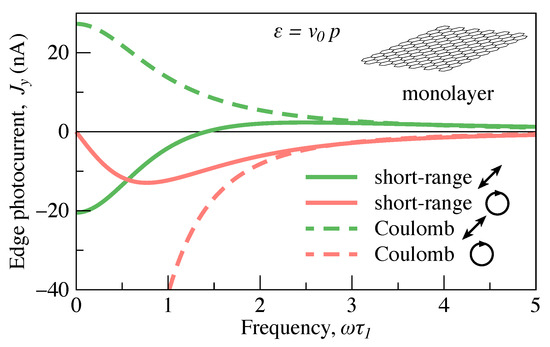
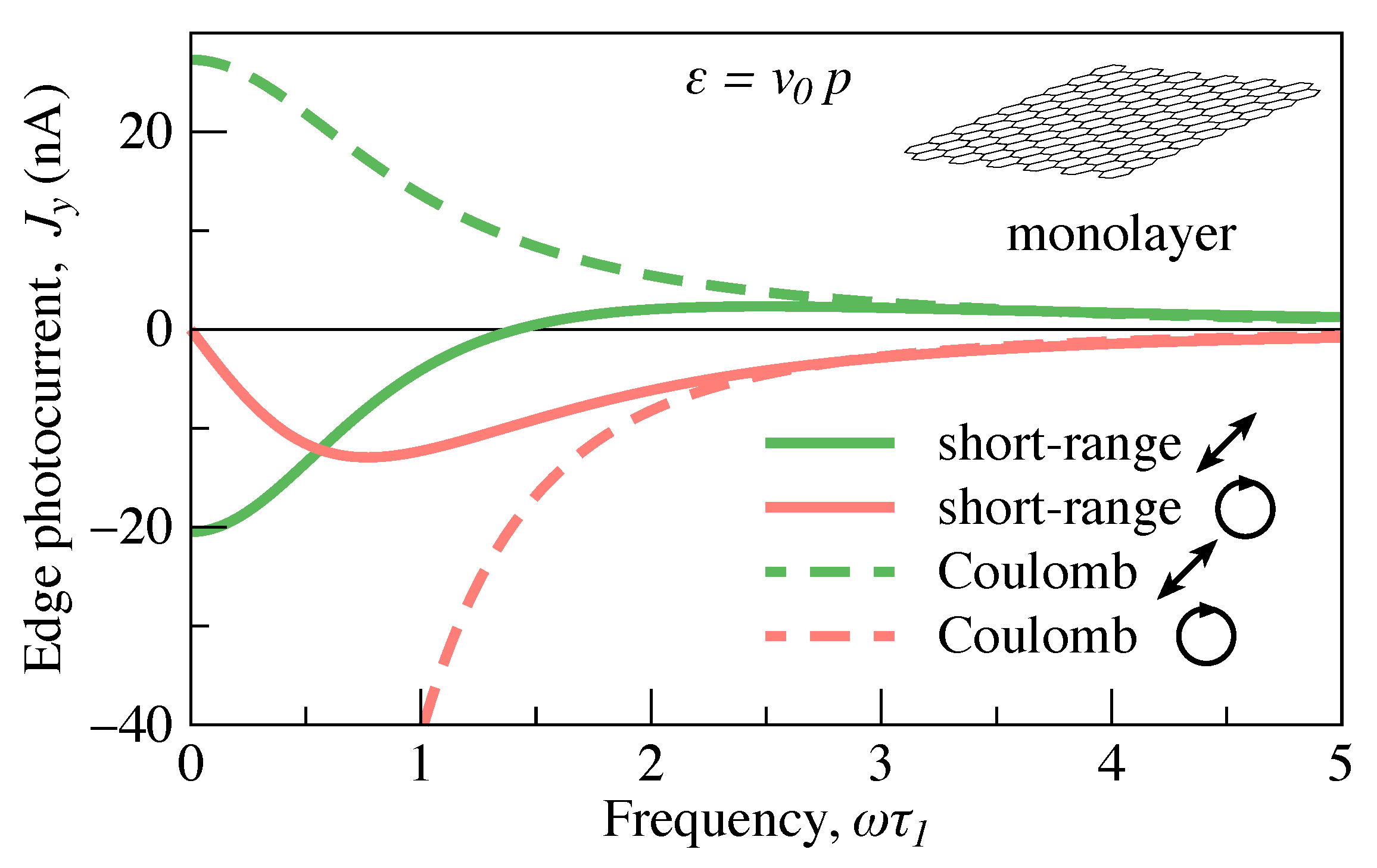
Figure 2 shows the frequency dependence of the edge photocurrent in a 2D system with the linear dispersion law . The parameters used for calculations are given in the caption of Figure 2 and correspond to high-quality graphene [25] with the electron density cm. The curves are calculated after Equation (23) for linearly polarized radiation with the electric field directed at the angle with respect to the edge (, ) and for circularly polarized radiation (, ). We consider two model types of scattering potential: (i) short-range scatterers, resulting in the energy dependence of the relaxation times , and (ii) charged scatterers with the Coulomb potential, resulting in [7]. For charged scatterers, the ratio does not depend on energy and the edge current is given by for linearly polarized radiation and for circularly polarized radiation. Hence, the frequency dependence of the edge currents excited by linearly and circularly polarized radiation are determined by and , respectively. For short-range scatterers, all terms in Equation (21) contribute to the current, and the frequency dependence gets more complicated. In particular, the current induced by linearly polarized radiation is constant at low frequencies, changes its sign at an intermediate frequency, and decays as at high frequencies. The circular contribution for short-range scatterers behaves as at low frequencies, in contrast to the diverging behavior for Coulomb scatterers. The current magnitude is nA for 1 W/cm of the radiation intensity.
Figure 2.
Frequency dependence of the edge current in 2D systems with a linear dispersion of carriers. Solid curves correspond to short-range scatterers and linearly polarized field with (green curve) and circularly polarized field with (red curve). Dashed curves present the results for scattering by charged impurities. The curves are calculated after Equation (23) for the parameters corresponding to single-layer graphene: cm/s, cm (the Fermi energy meV and the effective mass at the Fermi level ), ps, and V/cm corresponding to the radiation intensity W/cm.
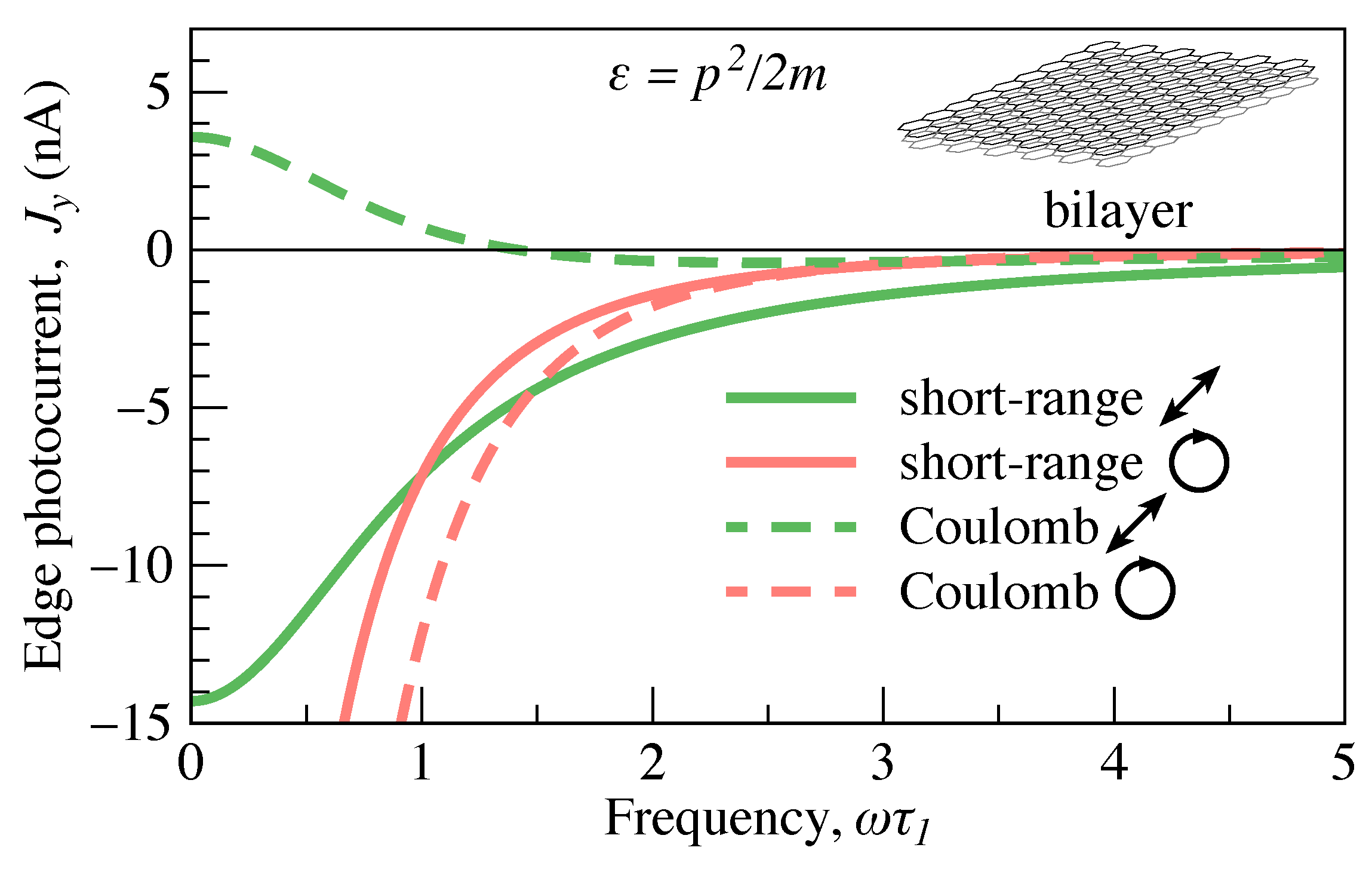
Figure 3 shows the frequency dependence of the edge photocurrent in the 2D system with the parabolic dispersion law . The parameters used for calculations are given in the caption of Figure 3 and correspond to high-quality bilayer graphene [6]. We use the same electron density cm as in the case of single-layer graphene. The curves are calculated after Equation (22) for linearly polarized radiation with the electric field directed at the angle with respect to the edge (, ) and for circularly polarized radiation (, ). For 2D systems with the parabolic spectrum and short-range scatterers, both the mass m and relaxation times are independent of energy and Equation (21) yields for linearly polarized radiation and for circularly polarized radiation. For Coulomb scatterers, , and the frequency dependence of is more complicated. Note that both the direction and magnitude of the current are determined to a great extent by the scattering mechanism. The calculated current magnitude for bilayer graphene is of the order of several nA for the radiation intensity 1 W/cm and is slightly smaller than that for monolayer graphene at the same electron density due to the larger effective mass in bilayer graphene.
Figure 3.
Frequency dependence of the edge photocurrent in 2D systems with parabolic energy dispersion. Solid curves correspond to short-range scatterers and linearly polarized field with (green curve) and circularly polarized field with (red curve). Dashed curves present the results for scattering by charged impurities. The curves are calculated after Equation (22) for parameters corresponding to bilayer graphene: , cm, ps, and V/cm corresponding to the radiation intensity W/cm.
Experimentally, edge photocurrents are detected as electric currents in short circuits or as voltage drops between contacts in open circuits [5,6,9,10]. If the sample is small and fully illuminated, the photocurrents are generated along all the edges and the resulting distribution of the photoinduced electric potential in the sample is determined by the edge photocurrents and the compensating drift currents in the sample. For linearly polarized radiation, the photocurrents generated along different edges are generally not equal because of different orientations of the edges with respect to the electric field polarization. For circularly polarized radiation, the edge photocurrents form a vortex whose winding direction depends on the radiation helicity. The photocurrents circulating around the sample produce, in turn, a magnetic field, which can be seen as a manifestation of the inverse Faraday effect.
4. Conclusions
To conclude, we have developed a kinetic theory of the edge photogalvanic effect for the intraband electron transport in two-dimensional materials. It is shown that the back-and-forth motion of charge carriers by AC electric field of incident radiation is distorted at the edges of the sample resulting in direct electric currents flowing along the edges. The edge current direction is controlled by the radiation polarization while its spectral dependence is determined by the carrier dispersion and the mechanism of carrier scattering. We have obtained an analytical expression for the edge current valid for arbitrary dispersion law and scattering mechanism and analyzed the result for single-layer and bilayer graphene for electron scattering by short-range defects and Coulomb impurities. Considering the important role of edge regions in small-size samples such as flakes of two-dimensional crystals, one can expect that the edge photogalvanic effect will find applications in fast detectors of terahertz radiation and radiation polarization.
Author Contributions
M.V.D. and S.A.T. have contributed equality to the paper. All authors have read and agreed to the published version of the manuscript.
Funding
This research was supported by the Russian Science Foundation (project 21-72-00047).
Institutional Review Board Statement
Not applicable.
Informed Consent Statement
Not applicable.
Data Availability Statement
Not applicable.
Conflicts of Interest
The authors declare no conflict of interest.
Abbreviations
The following abbreviations are used in this manuscript:
| 2D | Two-dimensional |
References
- Novoselov, K.S.; Jiang, D.; Schedin, F.; Booth, T.J.; Khotkevich, V.V.; Morozov, S.V.; Geim, A.K. Two-dimensional atomic crystals. Proc. Natl. Acad. Sci. USA 2005, 102, 10451. [Google Scholar] [CrossRef] [Scilit]
- Geim, A.K.; Grigorieva, I.V. Van der Waals heterostructures. Nature 2013, 499, 419. [Google Scholar] [CrossRef] [Scilit] [PubMed]
- Koppens, F.H.L.; Mueller, T.; Avouris, P.; Ferrari, A.C.; Vitiello, M.S.; Polini, M. Photodetectors based on graphene, other two-dimensional materials and hybrid systems. Nat. Nanotechnol. 2014, 9, 780. [Google Scholar] [CrossRef] [Scilit] [PubMed]
- Bandurin, D.A.; Svintsov, D.; Gayduchenko, I.; Xu, S.G.; Principi, A.; Moskotin, M.; Tretyakov, I.; Yagodkin, D.; Zhukov, S.; Taniguchi, T.; et al. Resonant terahertz detection using graphene plasmons. Nat. Commun. 2018, 9, 5392. [Google Scholar] [CrossRef] [Scilit]
- Karch, J.; Drexler, C.; Olbrich, P.; Fehrenbacher, M.; Hirmer, M.; Glazov, M.M.; Tarasenko, S.A.; Ivchenko, E.L.; Birkner, B.; Eroms, J.; et al. Terahertz Radiation Driven Chiral Edge Currents in Graphene. Phys. Rev. Lett. 2011, 107, 276601. [Google Scholar] [CrossRef] [Scilit] [PubMed]
- Candussio, S.; Durnev, M.V.; Tarasenko, S.A.; Yin, J.; Keil, J.; Yang, Y.; Son, S.K.; Mishchenko, A.; Plank, H.; Bel’kov, V.V.; et al. Edge photocurrent driven by terahertz electric field in bilayer graphene. Phys. Rev. B 2020, 102, 045406. [Google Scholar] [CrossRef] [Scilit]
- Glazov, M.; Ganichev, S. High frequency electric field induced nonlinear effects in graphene. Phys. Rep. 2014, 535, 101. [Google Scholar] [CrossRef] [Scilit]
- Durnev, M.V.; Tarasenko, S.A. Rectification of AC Electric Current at the Edge of 2D Electron Gas. Phys. Status Solidi (B) 2021, 258, 2000291. [Google Scholar] [CrossRef] [Scilit]
- Candussio, S.; Durnev, M.V.; Slizovskiy, S.; Jötten, T.; Keil, J.; Bel’kov, V.V.; Yin, J.; Yang, Y.; Son, S.K.; Mishchenko, A.; et al. Edge photocurrent in bilayer graphene due to inter-Landau-level transitions. Phys. Rev. B 2021, 103, 125408. [Google Scholar] [CrossRef] [Scilit]
- Candussio, S.; Golub, L.E.; Bernreuter, S.; Jötten, T.; Rockinger, T.; Watanabe, K.; Taniguchi, T.; Eroms, J.; Weiss, D.; Ganichev, S.D. Nonlinear intensity dependence of edge photocurrents in graphene induced by terahertz radiation. Phys. Rev. B 2021, 104, 155404. [Google Scholar] [CrossRef] [Scilit]
- Durnev, M.V.; Tarasenko, S.A. Edge photogalvanic effect caused by optical alignment of carrier momenta in two-dimensional Dirac materials. Phys. Rev. B 2021, 103, 165411. [Google Scholar] [CrossRef] [Scilit]
- Yin, X.; Ye, Z.; Chenet, D.A.; Ye, Y.; O’Brien, K.; Hone, J.C.; Zhang, X. Edge Nonlinear Optics on a MoS2 Atomic Monolayer. Science 2014, 344, 488. [Google Scholar] [CrossRef] [Scilit] [PubMed]
- Mishina, E.D.; Sherstyuk, N.E.; Shestakova, A.P.; Lavrov, S.D.; Semin, S.V.; Sigov, A.S.; Mitioglu, A.; Anghel, S.; Kulyuk, L. Edge effects in second-harmonic generation in nanoscale layers of transition-metal dichalcogenides. Semiconductors 2015, 49, 791. [Google Scholar] [CrossRef] [Scilit]
- Durnev, M.V.; Tarasenko, S.A. Second harmonic generation at the edge of a two-dimensional electron gas. Phys. Rev. B 2022, 106, 125426. [Google Scholar] [CrossRef] [Scilit]
- Plank, H.; Durnev, M.V.; Candussio, S.; Pernul, J.; Dantscher, K.M.; Mönch, E.; Sandner, A.; Eroms, J.; Weiss, D.; Bel’kov, V.V.; et al. Edge currents driven by terahertz radiation in graphene in quantum Hall regime. 2D Mater. 2019, 6, 011002. [Google Scholar] [CrossRef] [Scilit]
- Magarill, L.I.; Entin, M.V. Photogalvanic effect in films. Sov. Phys. Solid State 1979, 21, 743. [Google Scholar]
- Alperovich, V.L.; Belinicher, V.I.; Novikov, V.N.; Terekhov, A.S. Surface photovoltaic effect in solids. Theory and experiment for interband transitions in gallium arsenide. Sov. Phys. JETP 1981, 53, 1201. [Google Scholar]
- Alperovich, V.L.; Minaev, A.O.; Terekhov, A.S. Ballistic electron transport through epitaxial GaAs films in a magneti- cally induced surface photocurrent. JETP Lett. 1989, 49, 702. [Google Scholar]
- Gurevich, V.L.; Laiho, R. Photomagnetism of metals: Microscopic theory of the photoinduced surface current. Phys. Rev. B 1993, 48, 8307–8316. [Google Scholar] [CrossRef] [Scilit]
- Schmidt, C.B.; Priyadarshi, S.; Tarasenko, S.A.; Bieler, M. Ultrafast magneto-photocurrents in GaAs: Separation of surface and bulk contributions. Appl. Phys. Lett. 2015, 106, 142108. [Google Scholar] [CrossRef] [Scilit]
- Mikheev, G.M.; Saushin, A.S.; Styapshin, V.M.; Svirko, Y.P. Interplay of the photon drag and the surface photogalvanic effects in the metal-semiconductor nanocomposite. Sci. Rep. 2018, 8, 8644. [Google Scholar] [CrossRef] [Scilit] [PubMed]
- Mikheev, G.M.; Fateev, A.E.; Kogai, V.Y.; Mogileva, T.N.; Vanyukov, V.V.; Svirko, Y.P. Helicity dependent temporal profile of the semiconductor thin film photoresponse. Appl. Phys. Lett. 2021, 118, 201105. [Google Scholar] [CrossRef] [Scilit]
- Volkov, V.; Mikhailov, S. Edge magnetoplasmons: Low frequency weakly damped excitations in inhomogeneous two-dimensional electron system. JETP 1988, 67, 1639. [Google Scholar]
- Zabolotnykh, A.A.; Volkov, V.A. Interaction of gated and ungated plasmons in two-dimensional electron systems. Phys. Rev. B 2019, 99, 165304. [Google Scholar] [CrossRef] [Scilit]
- Castro Neto, A.H.; Guinea, F.; Peres, N.M.R.; Novoselov, K.S.; Geim, A.K. The electronic properties of graphene. Rev. Mod. Phys. 2009, 81, 109. [Google Scholar] [CrossRef] [Scilit]
Disclaimer/Publisher’s Note: The statements, opinions and data contained in all publications are solely those of the individual author(s) and contributor(s) and not of MDPI and/or the editor(s). MDPI and/or the editor(s) disclaim responsibility for any injury to people or property resulting from any ideas, methods, instructions or products referred to in the content. |
© 2023 by the authors. Licensee MDPI, Basel, Switzerland. This article is an open access article distributed under the terms and conditions of the Creative Commons Attribution (CC BY) license (https://creativecommons.org/licenses/by/4.0/).