Article

Deep Visual Waterline Detection for Inland Marine Unmanned Surface Vehicles

1
Zhejiang Scientific Research Institute of Transport, Hangzhou 310023, China
2
National Engineering Research Center for Water Transport Safety, Wuhan University of Technology, Wuhan 430063, China
3
School of Computer Science and Artificial Intelligence, Wuhan University of Technology, Wuhan 430063, China
*
Author to whom correspondence should be addressed.
Appl. Sci. 2023, 13(5), 3164; https://doi.org/10.3390/app13053164
Submission received: 1 February 2023 / Revised: 23 February 2023 / Accepted: 24 February 2023 / Published: 1 March 2023
(This article belongs to the Special Issue Recent Advances in Image Processing)

Abstract

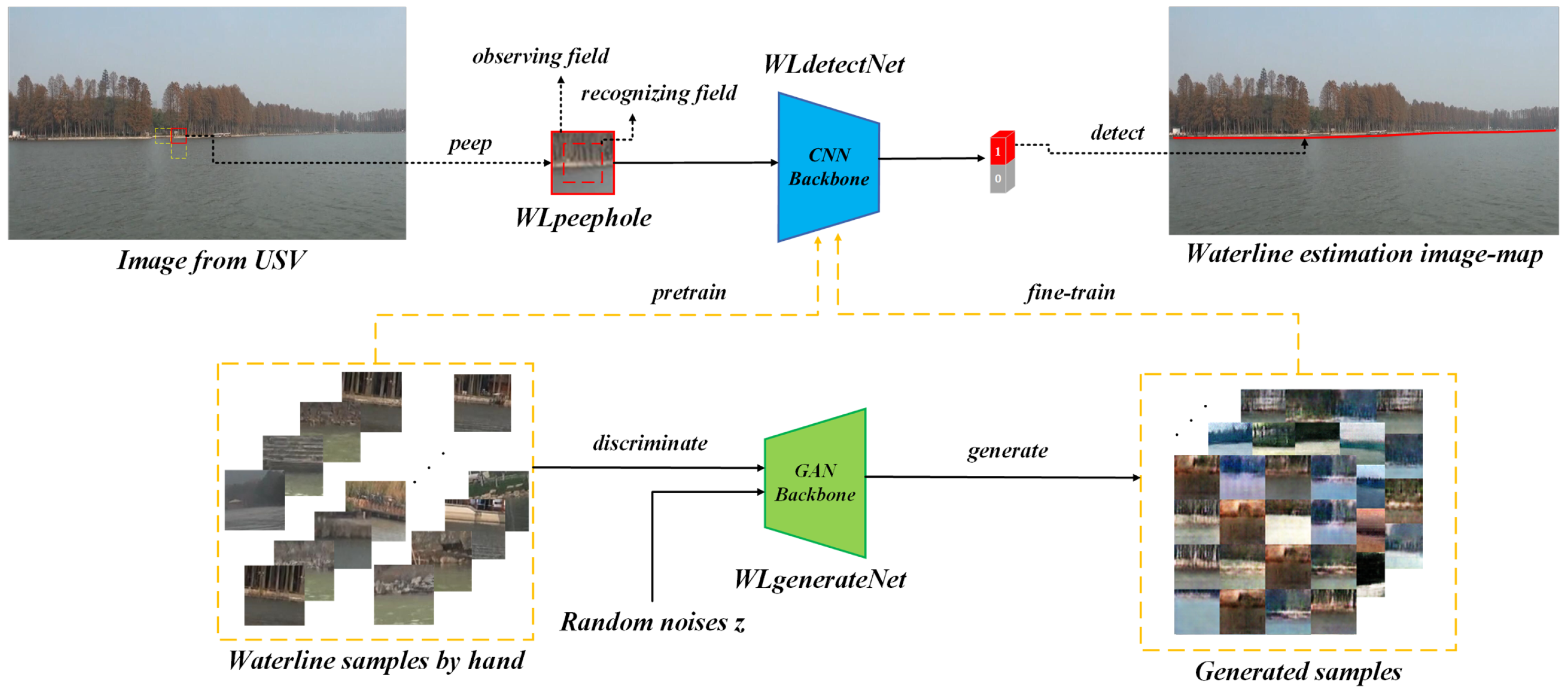
Waterline usually plays as an important visual cue for the autonomous navigation of marine unmanned surface vehicles (USVs) in specific waters. However, the visual complexity of the inland waterline presents a significant challenge for the development of highly efficient computer vision algorithms tailored for waterline detection in a complicated inland water environment that marine USVs face. This paper attempts to find a solution to guarantee the effectiveness of waterline detection for the USVs with a general digital camera patrolling variable inland waters. To this end, a general deep-learning-based paradigm for inland marine USVs, named DeepWL, is proposed, which consists of two cooperative deep models (termed WLdetectNet and WLgenerateNet, respectively). They afford a continuous waterline image-map estimation from a single video stream captured on board. Experimental results demonstrate the effectiveness and superiority of the proposed approach via qualitative and quantitative assessment on the concerned performances. Moreover, due to its own generality, the proposed approach has the potential to be applied to the waterline detection tasks of other water areas such as coastal waters.
Keywords: waterline detection; unmanned surface vehicles (USVs); deep learning; generative adversarial networks (GANs) waterline detection; unmanned surface vehicles (USVs); deep learning; generative adversarial networks (GANs)