


Abstract
This paper focuses on the design of a distributed algorithm for generalized eigenvalue problems (GEPs) in one-shot communication. Since existing distributed methods for eigenvalue decomposition cannot be applied to GEP, a general one-shot distributed GEP framework is proposed. The theoretical analysis of the approximation error reveals its relation to the divergence of the data covariance, the eigenvalues of the empirical data covariance, and the number of local servers. If the symmetric data covariance has repeated eigenvalues in GEP, e.g., in canonical component analysis, we further modify the method for better convergence and prove the necessity experimentally. Numerical experiments validate the effectiveness of the proposed algorithms both on synthetic and real-world datasets.
1. Introduction
Nowadays, as the data dimension and quantity increases, distributed local servers are essential in storing large-scale data. The distributed framework enables many equivalent local servers to seek the solution to the same class of problems, where specific servers may provide insight for other servers. This process is usually achieved by iteratively exchanging information between local servers, namely, in multi-round communication, to partially improve the way they accomplish their tasks. As increasing scenarios, such as financial [1], medical [2], and biomedical [3] tasks, come into view, where they usually hold the sensitive and limited scale of datasets in a distributed manner, the distributed systems shall offer a relatively safe and efficient way to obtain a satisfying result.
There have been many works on distributed systems in the past decades, especially in classification [4,5] and regression [6,7,8,9]. However, the discussion about distributed generalized eigenvalue problem (GEP) is rare. GEP is known as another important type of learning task that involves (generalized) eigenvalue decomposition (GED), including Singular Value Decomposition (SVD) [10], Principal Component Analysis (PCA) [11], Canonical Correlation Analysis (CCA) [12], etc. In optimization, such problems can be formulated in the following way:
where is a symmetric matrix, is a positive definite matrix, and denotes the conjugate transpose matrix of w. The optimization problem has an equivalent solution to [13], which pursues the maximum eigenvalue of the symmetric data covariance with an invertible matrix B. In short, (1) finds the generalized eigenvector w corresponding to the largest eigenvalue of the data covariance. Then, we can build the relationship between GEP and GED. The Lagrangian for (1) is given by:
where is the Lagrange multiplier. By equating the derivation of Lagrangian to zero, we obtain the generalized eigenvalue decomposition as below:
where denotes the generalized eigenvector of GEP with respect to the generalized eigenvalue .
Since GEP plays a vital role in a large family of high-dimensional statistical models, distributed algorithms for GEP are desired. However, only some variant cases are discussed in the distributed manner. There are two common variants of GEP whose distributed algorithms are well studied. On the one hand, when the constraint of (1) is linear, distributed linearly constrained minimum variance (LCMV) is widely used in signal processing [14,15] with the same objective function in beamforming. However, its algorithms cannot deal with quadratic constraints in GEP obviously. On the other hand, when B in (1) is an identity matrix, GEP turns to the ordinary eigenvalue problem (EP). Moreover, distributed algorithms for EP are numerous due to its good characteristics. Further in detail, when A is symmetric, it is PCA, and it is SVD otherwise. For one-shot communication with efficiency, distributed PCA algorithms are given in [16,17,18]. In addition, distributed SVD [19] conducts distributed averaging over measurement vectors in one-shot communication. For iterative communication, a distributed sparse PCA [20] is proposed based on the power method, which is numerically efficient for the large-scale data. In addition, distributed SVD methods in [21,22] utilize the distributed power method in both the centralized and decentralized way. However, the distributed algorithms mentioned above cannot be used in distributed GEP because, in distributed systems, the sum of the local covariance matrices of GEP does not equal to the global centered covariance matrix while it equals in EP. We call this phenomenon the divergence of data covariance, which has been neglected in the previous work. Thus, although these distributed algorithms above perform well in theory and practice, they cannot be directly applied to distributed GEP. Due to the distributed data storage method, some techniques, e.g., partial differential equations, used in non-linear systems [23,24] cannot be used in distributed GEP. In brief, there is not a general distributed algorithm for GEP formulated as in (1).
To solve GEP in a distributed manner, in this paper, we propose a one-shot algorithm with high communication efficiency and bounded approximation error. To our best knowledge, it is the first sample-distributed algorithm for GEP. The key is to estimate the centered global covariance from local empirical data covariances. Generally, there are two types of distributed algorithms: multi-round communication and one-shot. Algorithms with multi-round communication are usually more accurate but suffer from the high communication cost and the privacy risk. One-shot algorithms overcome these shortcomings but require better design and approximation analysis. Thus, for the proposed algorithm, we investigate the upper bound of the approximation error, and show it is concerned with the eigenvalues of the empirical data covariance and the number of local servers.
To demonstrate the effectiveness of the proposed distributed algorithm in practice, we consider Fisher’s Discriminant Analysis (FDA) [25] and CCA as specific applications of GEP. Among them, distributed FDA achieves remarkable performance in the learning task of binary classification. However, CCA is more special for its symmetric self-adjoint dilation [26] of the empirical covariance matrix in the GEP form. When using the power method (PM), which is commonly used to solve GEP for computation efficiency, the iterations become inefficient due to the repeated non-zero generalized eigenvalues of the covariance matrix, namely, no eigengap (see Corollary 1 in [27]). Note that such a problem only exists in sample-distributed CCA while not in feature-distributed ones [28,29]. To solve this problem in the sample-distributed setting, we reformulate the objective function of CCA and further propose the distributed multiple CCA algorithm for better convergence in the experiments.
The main contributions of the paper are summarized as follows:
- The first one-shot distributed algorithm is specially designed for the Generalized Eigenvalue Problem (GEP) with communication efficiency.
- The efficient reformulated distributed multiple CCA algorithm is established for better convergence under the distributed GEP framework and proven necessary in some cases.
- The approximation error is bounded theoretically in relation to the eigenvalues of the empirical data covariance and the number of local servers.
The remainder of the paper is organized as follows. Section 2 gives a general framework of the distributed GEP algorithm in one-shot communication and its extensional applications. In Section 3, we analyze the approximation error of the proposed algorithm. Section 4 puts forward the distributed multiple CCA algorithm with the power method as one detailed application. The performance of numerical experiments is shown in Section 5. The conclusion is presented in Section 6. Based on our former conference paper, we provide thoughtful discussion about our formulation, the whole process, and extensional applications of distributed GEP in Section 2. We also complement the experiments both on synthetic and real-word datasets to illustrate the effectiveness of our proposed methods in Section 5.
2. Distributed GEP Algorithm and Its Extensional Applications
In this section, the GEP is represented as a trace optimization subjecting to fixed quadratic constraints. Then, a one-shot distributed GEP algorithm (DGEP) is proposed. We are seeking the generalized eigenvectors of the symmetric empirical data covariance in distributed settings with one-shot communication.
2.1. Problem Formulation
We consider a kind of distributed generalized eigenvalue problem, where the data of the same d observations are provided from N local servers to their shared believable central server. That is, the centered data are established as and , where d is the feature dimension and and are the number of data X and Y. and are i.i.d, respectively, for . Each local server prepares data matrices and according to the different tasks of GEP from X and Y. The centered GEP is formulated as a maximum optimization as below:
It is equivalent to:
where the covariance matrix and are all symmetric. The solution to (4) is the ground truth of the centered GEP.
In our distributed setting of GEP, the difficulty lies in estimating the centered covariance with local data. Hence, based on the trace maximization method, we formulate the central optimization problem in the central server as follows:
where is the local covariance, calculated and stored locally.
2.2. Distributed GEP in One-Shot Communication
Then, the general one-shot distributed GEP algorithm (DGEP in Algorithm 1) is shown as below.
| Algorithm 1 One-shot Distributed GEP algorithm (DGEP). |
|
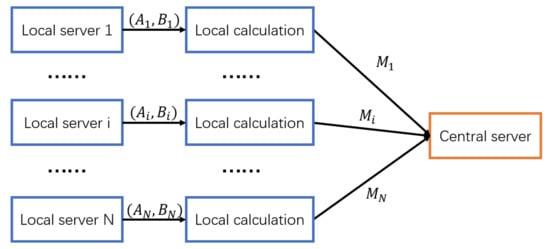
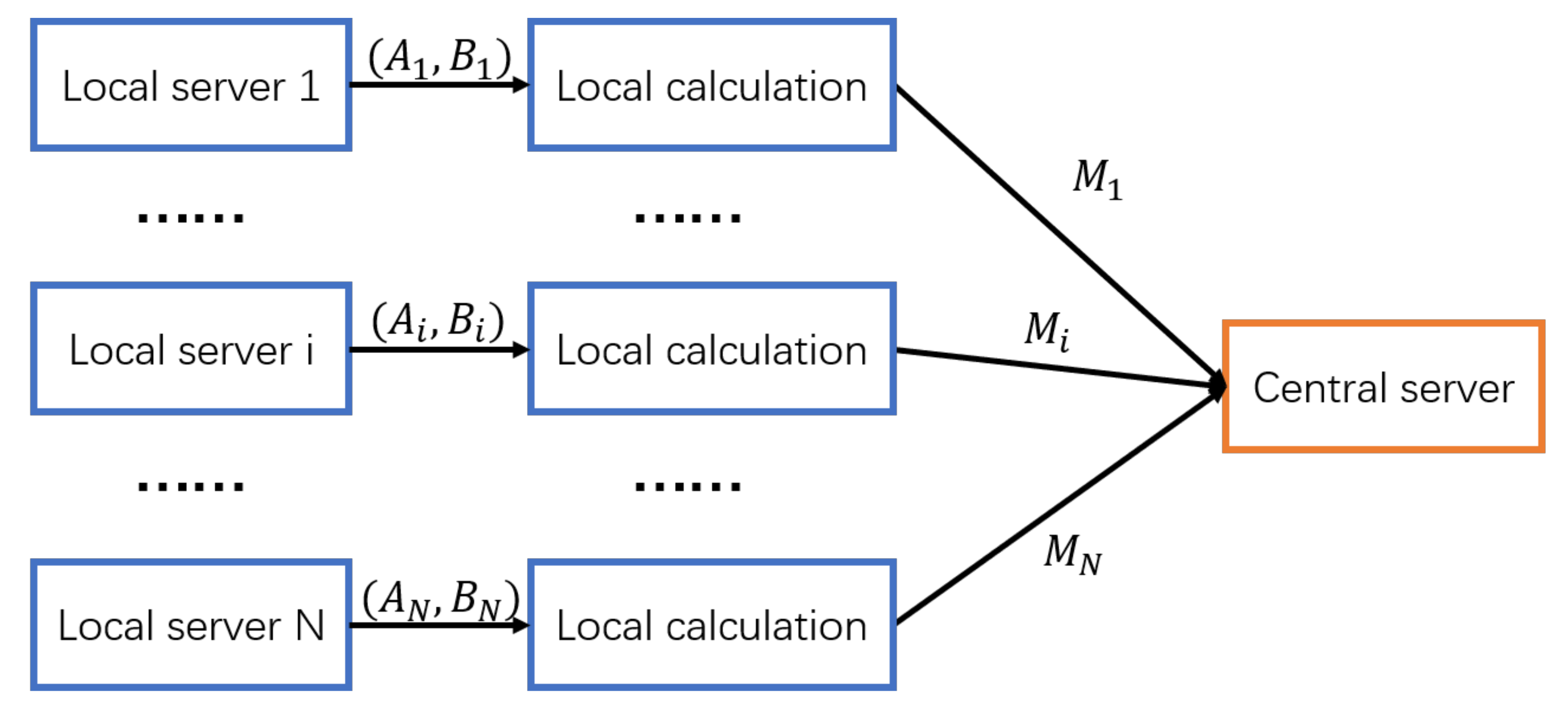
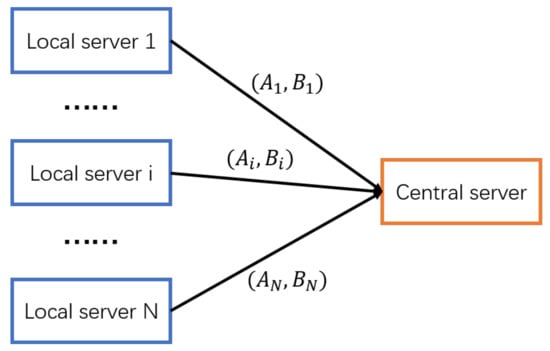
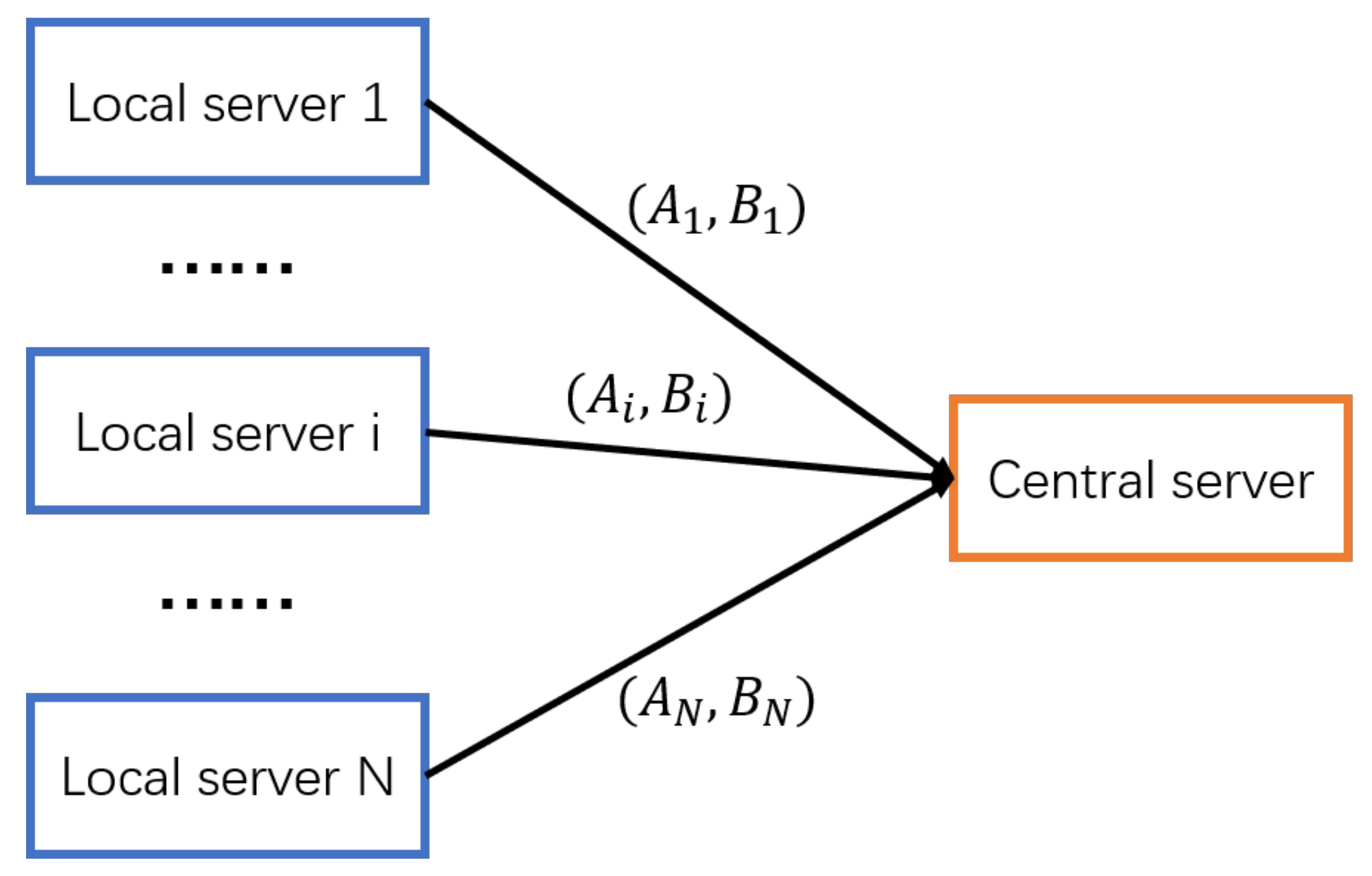
We focus on the distributed optimization of GEP in (5) with symmetric for . N local servers broadcast the data covariance to the central server in one-shot communication for efficiency. Learning the generalized eigenvector occurs in the central server. To be more specific, the whole process is depicted in Figure 1, among which ’Local calculation’ denotes calculating the local covariance matrix, which is different from the traditional one-shot method in Figure 2. When solving (5) in the central server, SVD and the power method [30] can be carried out, among which the power method is to find a dominant eigenvalue and a corresponding eigenvector and is summarized in Algorithm 2.
| Algorithm 2 The power method (PM) in the central server. |
|
Figure 1.
The one-shot communication process of Algorithm 1.
Figure 2.
The classical one-shot communication process of distributed GEP.
2.3. Discussion
In some cases, e.g., [21], they consider that the centered data covariance is divided into local agents as such that the distributed GEPs are reduced to distributed SVDs. However, in our distributed setting, which is more concrete, we can communicate the data covariance and and obtain the exact solution of the centered GEP as depicted in Figure 2.
Furthermore, from a data privacy perspective, since data covariance pair (, ) may lose privacy for its simple symmetry, sending local covariance to the central server is much safer and more efficient than sending and directly.
In addition, a dense is regarded as compromising a mix of multi-view data, which are hard to recover. However, there is a divergence between and , and it is decided by the data structure.
In this paper, we will further analyze the approximation error in this one-shot communication method in a distributed GEP.
Note that in the one-shot distributed system, it is assumed that node failure and asynchronization are ignored. All the local servers have a similar scale of data to ensure that synchronous communication will not result in a long delay in the whole system.
2.4. Extensional Applications of Distributed GEP
Many statistical tools in machine learning fields can be formulated as special instances of GEP in (1) with the symmetric-definite matrix pair (A,B). We briefly give three instances below. They all fit for the proposed Algorithm 1 when in the distributed framework:
- PCA (Principal Component Analysis): It is the most widely used statistical technique for data analysis and dimensionality reduction. It involves the eigenvalue problem, which is reduced from GEP with a symmetric A and .
- FDA (Fisher’s Discriminant Analysis [31]): It is desired to maximize the between-class variance and minimize the within-class variance . Therefore, the instances of every class become close to one another, and the classes become far away from each other. It is a direct instace of GEP with and .
- CCA (Canonical Correlation Analysis ): Given two random vectors X and Y, let and be the covariance matrices of X and Y, respectively. is the cross-covariance matrix between X and Y. The canonical vectors and can be obtained by solving GEP with , , .
- PLS (Partial Least Squares [32]): It is a common method for dimension reduction. Derived from CCA with X and Y, it is also an instance of GEP with , , .
3. Approximation Error Analysis of Distributed GEP
In this section, we analyze the approximation error of DGEP in Algorithm 1, which is defined as the distance between the centered ground truth and the estimator . Without loss of generality, the top k subspace distance, measured by the sine of the angle , is analyzed. Thus,
where , norm denotes norm as default, and denotes the top k subspace distance. Our analysis is based on theorem in [33], which reveals how much the invariant subspace will be affected if the covariance matrix is slightly perturbed. We first define that the centered covariance before one-shot communication and the approximation covariance in the center server are represented by the detailed data matrix multiplication of and , respectively. The goal of Algorithm 1 is to learn a central orthonormal matrix to estimate , which is the top k eigenspace of and also the ground truth. Our main result is in the following.
Theorem 1.
Given matrices with eigenvalues and in the central server with eigenvalues . For a given dimension k, where , let and have orthogonal columns satisfying and for . Assume , where and and . The approximation error is upper-bounded by:
where are the maximum spectral radii of , respectively.
Proof of Theorem 1.
From the theorem in [33], a direct conclusion is obtained as:
Considering Jensen’s Inequality for , we have:
and only if , the equality holds. That is, . Then:
where are the maximum spectral radii of , , respectively, for . Hence, Theorem 1 is obtained. □
The upper bound of the approximation error of Algorithm 1 is concerned with the eigenvalues of the empirical data covariance, and the number of local servers. This accounts for the divergence of data covariance in one-shot communication. For the special case, such as distributed EP, for any local server, for any eigenvalue, and . When the number of local servers and the eigengap is , the right side of (6) approaches zero, satisfying the known conclusion.
4. Distributed Canonical Correlation Analysis and Its Multiple Formulation
In this section, we investigate distributed CCA, which is a special instance of distributed GEP. In the classical setting, the CCA finds the linear combinations of two sets of random variables with maximal correlation. Furthermore, multiple CCA [34] is the cornerstone of multi-view learning. However, if considering the original data from each view, Algorithm 1 encounters the theoretical barrier of convergence in solving the distributed CCA with the tool of the power method. So, we put forward a new algorithm based on Algorithm 1 when using the power method in this section.
We first provide the mathematical formulation of CCA. Given d observations, denote , . The covariances , and . Without loss of generality, its multiple version is formulated as below:
where stands for identity matrix, and its number of columns is k, denoting the number of canonical components and normally . When , it degrades to the standard CCA. Recall from the formulation of CCA, we obtain:
where , , . This kind of self-adjoint structure keeps the symmetry of A and B. However, according to Theorem 2 in [21], there must be an eigengap of when using the power method. Hence, using Algorithm 1 in distributed CCA may not only increase the approximation error during communication but also result in a convergence barrier for no eigengap. We will also illustrate this barrier in further numerical experiments.
So, in this section, we reformulate CCA and put forward a one-shot distributed multiple CCA algorithm with the power method, which solves the inherent structure defect efficiently. The reformulated centered problem is shown as below:
where and are concatenations of original data from N local servers. is the asymmetric covariance of the centered problem. The distributed optimization problem is:
where the covariance for CCA is also asymmetric, and is an approximation of in the distributed setting. Then, we derive the one-shot distributed algorithm for multiple CCA in the following.
Algorithm 3 shows the one-shot distributed multiple CCA algorithm which improves the performance by breaking the self-adjoint symmetric GEP structure. The power iterations in the central optimization are divided into two parts as computing the eigenspace of and . The process can be viewed as seeking the left and right singular vector of the approximated covariance at the same time. QR factorization [30] is used to become the orthonormal approximated eigenspace. The analysis of the approximated error of Algorithm 3 is similar as that in Section 3. The convergence boils down to that of the power method in [30].
| Algorithm 3 One-shot Distributed multiple CCA algorithm. |
|
5. Numerical Experiments
In this section, numerical experiments on synthetic and real data are carried out to illustrate the effectiveness and accuracy of the proposed algorithms. In the GEP, Algorithm 1, as the first distributed algorithm for the GEP, is compared with the centered result. In the pursuit of the eigenvectors of the DGEP in the central server, SVD and the power method (PM) are carried out. They are denoted as DGEP-SVD and DGEP-PM in the following. In CCA, Algorithm 3 (denoted as DCCA-PM) and DGEP-PM are compared with the centered results. We only pursue the generalized eigenvector corresponding to the largest generalized eigenvalue for convenience in the maximum optimization of distributed GEP and distributed CCA, which is . All the experiments are performed on MATLAB R2019a on a computer with 6 Core 2.20 GHz CPUs and 8GB RAM. The codes are available in https://github.com/kelenlv/one-shot-DGEP (accessed on 1 May 2022).
5.1. DGEP on Synthetic Datasets
Considering the general settings of the GEP in (1), we generate a symmetric matrix and a positive definite matrix randomly and independently, which compromise data-mixed information in the i-th local server with . Then, we first evaluate Algorithm 1 including DGEP-SVD and DGEP-PM in running time and error. The running time concludes communication time and optimization time for DGEP-PM and the maximum iteration step of PM is set to be 10. The error is calculated as
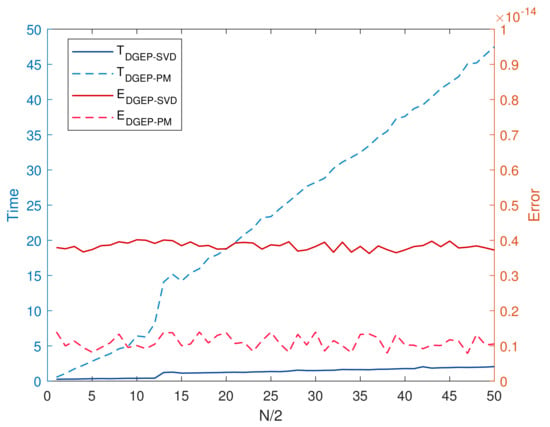
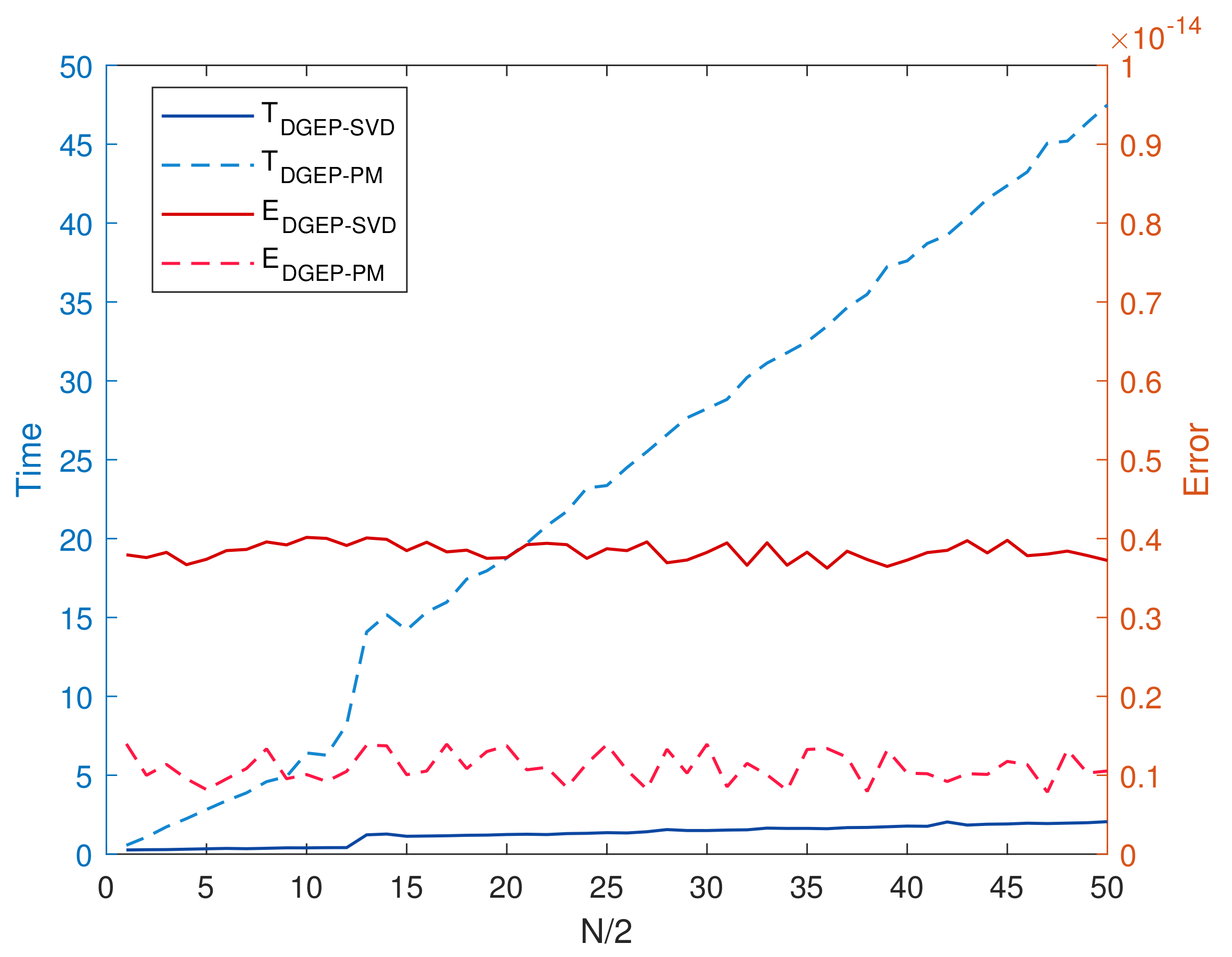
where is the ground truth, and is obtained in the central server. The performance of DGEP in time and error is depicted in Figure 3 with and N varying from 2 to 100 in intervals of 2. As the number of local servers (N) increases, the running time of DGEP goes up, and SVD as a solver in MATLAB is efficient if the complexity is acceptable. The errors of DGEP-PM and DGEP-SVD are similar and keep in a low level as N varies.
Figure 3.
Performance of DGEP-SVD and DGEP-PM in running time () and error (E) with respect to the number of local severs (N).
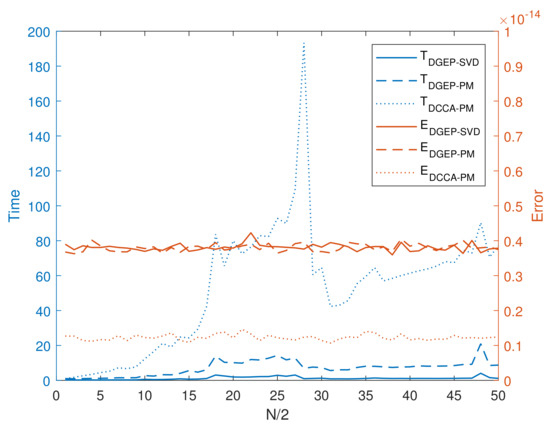
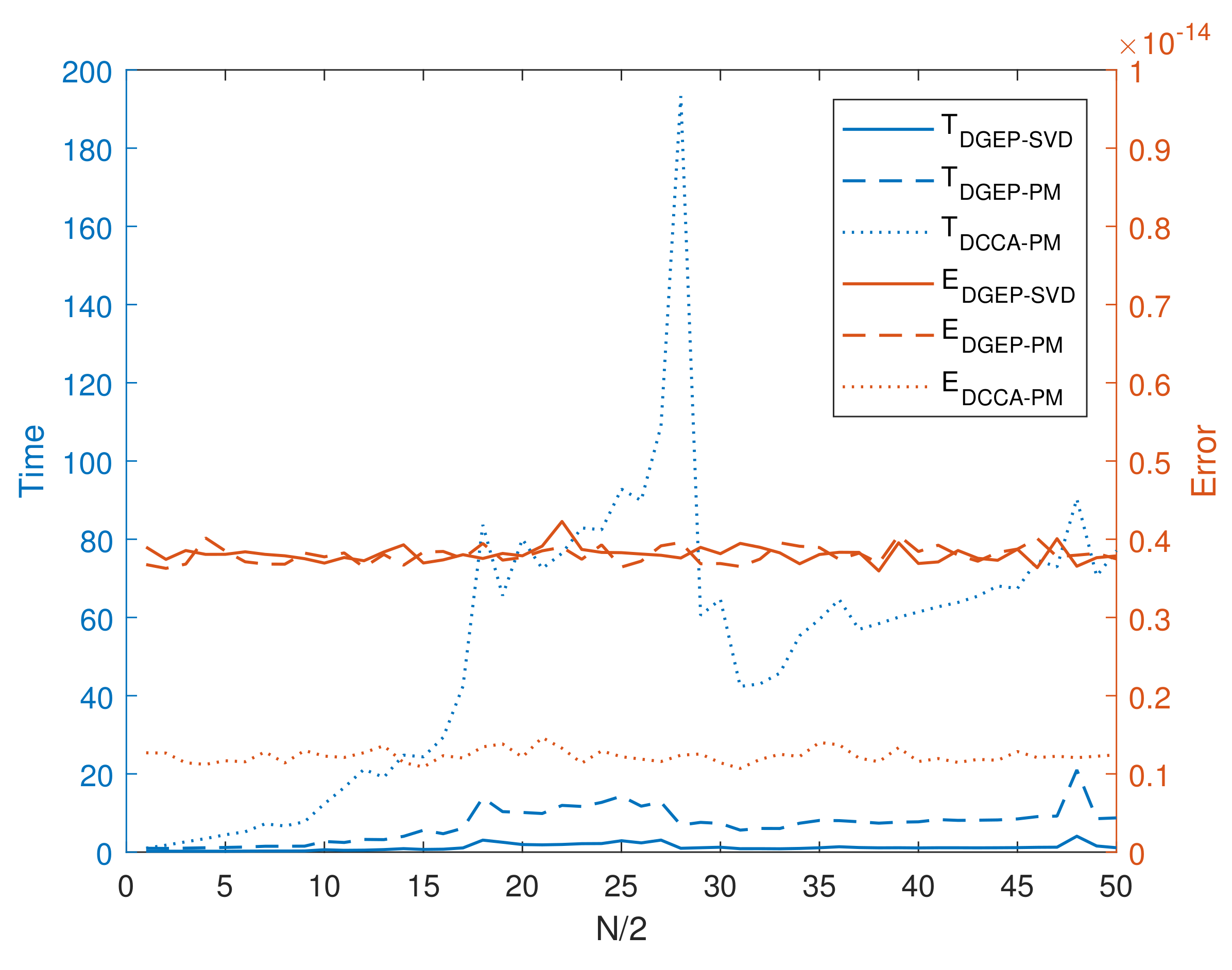
Then, we investigate Algorithm 3 (DCCA-PM) and compare it to Algorithm 1 (DGEP-PM). Considering the settings of mutiple CCA in (8), we generate the self-adjoint symmetric and randomly and independently with . The other settings are in the same. The performance in running time and error is depicted in Figure 4, with and N varying from 2 to 100 in intervals of 2. The errors of DGEP-PM and DCCA-PM stay at a low level as N varies, and DCCA-PM performs better. However, excluding the abnormal experiment, the running time that DCCA-PM costs is eight times of that DGEP-PM costs on average. That is, when using PM, DCCA-PM achieves higher accuracy but more running time than DGEP-PM, which is a trade-off in real-world scenarios. It needs to be evaluated by the performance on real-world data to validate whether it is worthwhile.
Figure 4.
P Performance of DCCA-PM and DGEP-PM in running time () and error (E)with respect to the number of local severs (N).
5.2. DGEP on Real Datasets
The technique of FDA [31], as an instance of a GEP, is used in the binary classification of the GSE2187 dataset (https://www.ncbi.nlm.nih.gov/geo/query/acc.cgi?acc=GSE2187 (accessed on 1 May 2005)), which is a large cRNA microarray dataset reflecting the drugs and toxicants response of rats. Only two categories (toxicants and fibrates, named as and , respectively, for short) are used in classification, and the missing values are filled with mean values. The data are randomly divided into training data and testing data with a ratio of 1:1. The detailed information is displayed in Table 1.
Table 1.
GSE2187 data structures: number of data (), data dimension (d).
The number of local servers is set to be 5, and the maximum iteration steps of PM is set to be 10. The binary classification accuracy from distributed data depends on the classification threshold of centered data, which is:
with the mean of and ( and ). The classification accuracy is calculated with as:
where and are the indicator functions. When the projected value is less than the mean threshold value, equals 1 and 0 otherwise, and is exactly the opposite. The repeated experiments are carried out 10 times and the classification accuracy in GSE2187 data is reported in Table 2.
Table 2.
Classification accuracy of GSE2187 data in FDA: training accuracy of (), testing accuracy of ().
The centered accuracy is regarded as the benchmark. Clearly, no algorithm can beat the performance of the best centered estimator. However, the classification accuracy of the proposed algorithm does not decrease much, even though there is the covariance divergence in the one-shot communication. Generally, DGEP including DGEP-SVD and DGEP-PM in the one-shot communication performs well in the distributed FDA application.
5.3. Distributed CCA on Real Datasets
In this case, we apply Algorithm 3 to a multi-classification problem where the feature is denoted as a view X and the class as another view Y. Two real datasets from the gene expression database [35] are considered as data-sensitive and are dispersed evenly for convenience in local servers. Each dataset is locally divided into training data and testing data in terms of the same data dimension d. The details are explained below, and the statistics can be found in Table 3:
Table 3.
Genedata structures: data dimension (d), number of data (), number of training data (), number of testing data (), number of classes (K).
- Lymphoma: 42 samples of diffuse large B-cell lymphoma, 9 observations of follicular lymphoma, and 11 cases of chronic;
- SRBCT: the filtered dataset of 2308 gene expression profiles for 4 types of small round blue cell tumors of childhood.
The classification accuracy is defined as
where is the indicator function. When the obtained label is equal to the provided label , it equals 1 and 0 otherwise. Considering the limited number of Gene data, the maximum N is set to be 8. The experiments on two gene datasets are repeated 20 times each, and the detailed mean accuracy is reported in Table 4. It reveals that the accuracy decreases as the number of local servers N goes up. The divergence of covariance in the distributed way influences the classification accuracy of Gene data, especially in SRBCT. However, it is acceptable especially in multi-classification.
Table 4.
Classification accuracy of Gene data: number of local servers (N), training and testing accuracy of Algorithm 3 (, ).
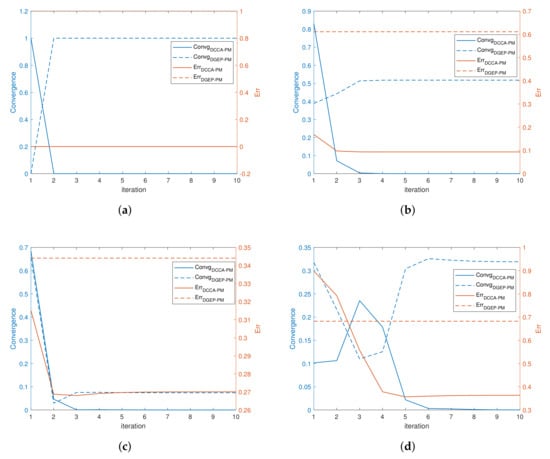
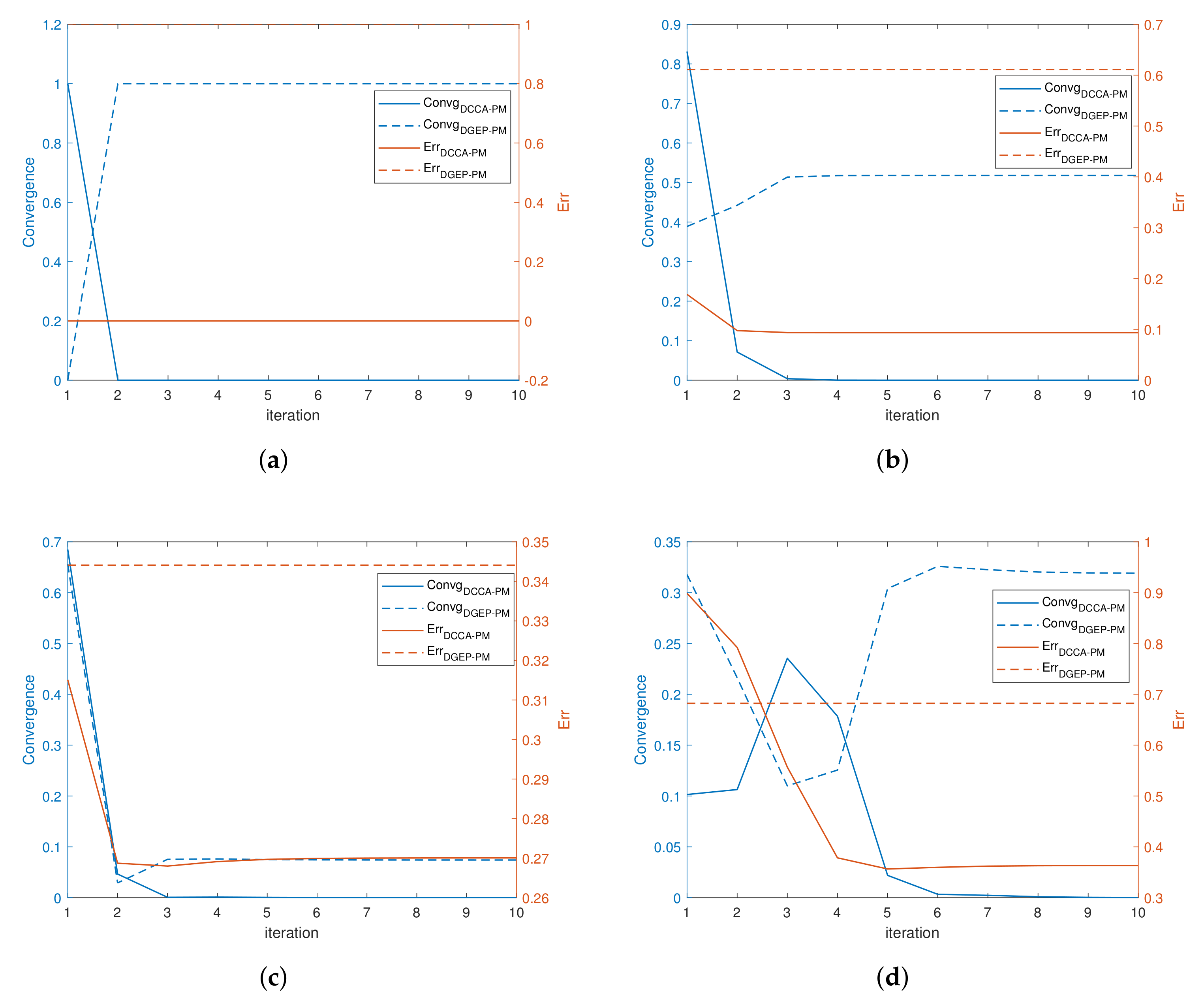
When , without the communication error, the results reveal that DGEP-PM, the distributed CCA in GEP form without an eigengap, leads to a worse accuracy which is no higher than 72% for training and 68% for testing in Lymphomia and no higher than 41% for training and 36% for testing in SRBCT. The performance of Algorithm 3 in Table 4 is obviously higher. To illustrate the difference in detail, we further investigate the convergence and the error of the two algorithms and show the result in Figure 5. For Lymphoma data as an instance, we define as the successive difference of the objective function value, and as the error between the objective function value of the proposed method and ground truth. The maximum iteration is set to be 10. Due to no eigengap in using DGEP-PM in self-adjoint CCA, the convergence performance is poor, even totally on the contrary in Figure 5. However, DCCA-PM converges fast, which accounts for its better performance. In addition, it is validated that there has been progress in effectiveness compared with DGEP-PM.
Figure 5.
The performance of DGEP-PM and DCCA-PM in distibuted CCA with respect to the number of local servers N. (a) (centered); (b) ; (c) ; (d) .
6. Conclusions
The paper proposes a general distributed algorithm for a generalized eigenvalue problem (GEP) in one-shot communication. For multi-view analysis in DGEPs such as distributed CCA, the algorithm meets hard convergence when there are no eigengaps in the approximated covariance matrix. The one-shot distributed multiple CCA algorithm produced solves this problem. The theoretical analysis of the approximation error reveals the divergence of data covariance in the distributed system and gives the upper bound concerned with the eigenvalues of the data covariance and the number of local servers. The quantities of numerical experiments demonstrate the effectiveness of proposed algorithms in different applications.
As a one-shot method, our proposed algorithms amplify the computation efficiency for communication efficiency. Furthermore, we are devoted to developing an advanced distributed algorithm to obtain a more precise solution. It is believed that deep learning has achieved great development in many applications, including in distributed learning fields. How to combine our works and deep learning networks is the goal of our future work.
Author Contributions
Conceptualization and methodology, K.L., F.H. and X.H.; formal analysis, K.L. and F.H.; supervision, X.H. and J.Y.; project administration, Z.S. and J.Y.; writing—original draft preparation, K.L.; writing—review and editing, F.H., Z.S., X.H. and J.Y. All authors have read and agreed to the published version of the manuscript.
Funding
This research is partly supported by the National Key R&D Programof China (No.2019YFB1311503); National Science Foundation, China (61876107, U1803261, 61977046); and the Committee of Scienceand Technology, Shanghai, China (No. 19510711200).
Institutional Review Board Statement
Not applicable.
Informed Consent Statement
Not applicable.
Data Availability Statement
The data presented in this study are available on request from the corresponding author.
Acknowledgments
The authors are grateful to the Editor-in-Chief, Editor, and anonymous Reviewers for their valuable reviews.
Conflicts of Interest
The authors declare no conflict of interest.
References
- Zhou, J.; Li, X.; Zhao, P.; Chen, C.; Li, L.; Yang, X.; Cui, Q.; Yu, J.; Chen, X.; Ding, Y.; et al. Kunpeng: Parameter server based distributed learning systems and its applications in alibaba and ant financial. In Proceedings of the 23rd ACM SIGKDD International Conference on Knowledge Discovery and Data Mining, Leipzig, Germany, 13–17 August 2017; pp. 1693–1702. [Google Scholar]
- Balachandar, N.; Chang, K.; Kalpathy-Cramer, J.; Rubin, D.L. Accounting for data variability in multi-institutional distributed deep learning for medical imaging. J. Am. Med. Inform. Assoc. 2020, 27, 700–708. [Google Scholar] [CrossRef] [Scilit] [PubMed]
- Li, Z.; Roberts, K.; Jiang, X.; Long, Q. Distributed learning from multiple EHR databases: Contextual embedding models for medical events. J. Biomed. Inform. 2019, 92, 103138. [Google Scholar] [CrossRef] [Scilit] [PubMed]
- Brooks, R.R.; Ramanathan, P.; Sayeed, A.M. Distributed target classification and tracking in sensor networks. Proc. IEEE 2003, 91, 1163–1171. [Google Scholar] [CrossRef] [Scilit]
- Kokiopoulou, E.; Frossard, P. Distributed Classification of Multiple Observation Sets by Consensus. IEEE Trans. Signal Process. 2011, 59, 104–114. [Google Scholar] [CrossRef] [Scilit]
- de Cock, M.; Dowsley, R.; Nascimento, A.C.; Newman, S.C. Fast, privacy preserving linear regression over distributed datasets based on pre-distributed data. In Proceedings of the 8th ACM Workshop on Artificial Intelligence and Security, Denver, CO, USA, 16 October 2015; pp. 3–14. [Google Scholar]
- Dankar, F.K. Privacy Preserving Linear Regression on Distributed Databases. Trans. Data Priv. 2015, 8, 3–28. [Google Scholar]
- Gascón, A.; Schoppmann, P.; Balle, B.; Raykova, M.; Doerner, J.; Zahur, S.; Evans, D. Privacy-Preserving Distributed Linear Regression on High-Dimensional Data. Proc. Priv. Enhancing Technol. 2017, 4, 248–267. [Google Scholar] [CrossRef] [Scilit]
- Wang, S.; Gittens, A.; Mahoney, M.W. Sketched ridge regression: Optimization perspective, statistical perspective, and model averaging. In Proceedings of the International Conference on Machine Learning, Sydney, Australia, 6–11 August 2017; pp. 3608–3616. [Google Scholar]
- Klema, V.; Laub, A. The singular value decomposition: Its computation and some applications. IEEE Trans. Autom. Control. 1980, 25, 164–176. [Google Scholar] [CrossRef] [Scilit]
- Abdi, H.; Williams, L.J. Principal component analysis. Wiley Interdiscip. Rev. Comput. Stat. 2010, 2, 433–459. [Google Scholar] [CrossRef] [Scilit]
- Hotelling, H. Relations Between Two Sets of Variates. Biometrika 1936, 28, 321–377. [Google Scholar] [CrossRef] [Scilit]
- Beck, A.; Teboulle, M. On Minimizing Quadratically Constrained Ratio of Two Quadratic Functions. J. Convex Anal. 2010, 17, 789–804. [Google Scholar]
- Bertrand, A.; Moonen, M. Distributed LCMV Beamforming in a Wireless Sensor Network With Single-Channel Per-Node Signal Transmission. IEEE Trans. Signal Process. 2013, 61, 3447–3459. [Google Scholar] [CrossRef] [Scilit]
- Bertrand, A.; Moonen, M. Distributed Node-Specific LCMV Beamforming in Wireless Sensor Networks. IEEE Trans. Signal Process. 2012, 60, 233–246. [Google Scholar] [CrossRef] [Scilit]
- Grammenos, A.; Mendoza-Smith, R.; Mascolo, C.; Crowcroft, J. Federated PCA with adaptive rank estimation. arXiv 2019, arXiv:1907.08059. [Google Scholar]
- Fan, J.; Wang, D.; Wang, K.; Zhu, Z. Distributed Estimation of Principal Eigenspaces. Ann. Stat. 2017, 47, 3009. [Google Scholar] [CrossRef] [Scilit] [PubMed]
- Liang, Y.; Balcan, M.F.F.; Kanchanapally, V.; Woodruff, D. Improved distributed principal component analysis. Adv. Neural Inf. Process. Syst. 2014, 27, 3113–3121. [Google Scholar]
- Tron, R.; Vidal, R. Distributed computer vision algorithms through distributed averaging. In Proceedings of the IEEE Computer Society Conference on Computer Vision and Pattern Recognition, Colorado Springs, CO, USA, 20–25 June 2011; pp. 57–63. [Google Scholar]
- Ge, J.; Wang, Z.; Wang, M.; Liu, H. Minimax-optimal privacy-preserving sparse pca in distributed systems. In Proceedings of the International Conference on Artificial Intelligence and Statistics, Lanzarote, Canary Islands, 9–11 April 2018; pp. 1589–1598. [Google Scholar]
- Li, X.; Wang, S.; Chen, K.; Zhang, Z. Communication-efficient distributed SVD via local power iterations. In Proceedings of the International Conference on Machine Learning, Virtual, 18–24 July 2021; pp. 6504–6514. [Google Scholar]
- Raja, H.; Bajwa, W.U. Cloud K-SVD: A Collaborative Dictionary Learning Algorithm for Big, Distributed Data. IEEE Trans. Signal Process. 2016, 64, 173–188. [Google Scholar] [CrossRef] [Scilit]
- Sohail, A.; Arshad, S.; Ehsan, Z. Numerical Analysis of Plasma KdV Equation: Time-Fractional Approach. Int. J. Appl. Comput. Math. 2017, 3, 1325–1336. [Google Scholar] [CrossRef] [Scilit]
- Chauhan, H.V.S.; Singh, B.; Tunç, C.; Tunç, O. On the existence of solutions of non-linear 2D Volterra integral equations in a Banach Space. Rev. Real Acad. Cienc. Exactas Fisicas Nat. Ser. Mat. 2022, 116, 101. [Google Scholar] [CrossRef] [Scilit]
- Fisher, R.A. The use of multiple measurements in taxonomic problems. Ann. Eugen. 1936, 7, 179–188. [Google Scholar] [CrossRef] [Scilit]
- Tropp, J.A. User-Friendly Tail Bounds for Sums of Random Matrices. Found. Comput. Math. 2012, 12, 389–434. [Google Scholar] [CrossRef] [Scilit]
- Tan, K.M.; Wang, Z.; Liu, H.; Zhang, T. Sparse generalized eigenvalue problem: Optimal statistical rates via truncated Rayleigh flow. J.R. Stat. Soc. Ser. Stat. Methodol. 2018, 80, 1057–1086. [Google Scholar] [CrossRef] [Scilit]
- Bertrand, A.; Moonen, M. Distributed Canonical Correlation Analysis in Wireless Sensor Networks With Application to Distributed Blind Source Separation. IEEE Trans. Signal Process. 2015, 63, 4800–4813. [Google Scholar] [CrossRef] [Scilit]
- Chen, Z.; Cao, Y.; Ding, S.X.; Zhang, K.; Koenings, T.; Peng, T.; Yang, C.; Gui, W. A Distributed Canonical Correlation Analysis-Based Fault Detection Method for Plant-Wide Process Monitoring. IEEE Trans. Ind. Inform. 2019, 15, 2710–2720. [Google Scholar] [CrossRef] [Scilit]
- Golub, G.H.; Van Loan, C.F. Matrix Computations; JHU Press: Baltimore, MD, USA, 2013. [Google Scholar]
- Sugiyama, M. Dimensionality Reduction of Multimodal Labeled Data by Local Fisher Discriminant Analysis. J. Mach. Learn. Res. 2007, 8, 1027–1061. [Google Scholar]
- Höskuldsson, A. PLS regression methods. J. Chemom. 1988, 2, 211–228. [Google Scholar] [CrossRef] [Scilit]
- Wedin, P.A. Perturbation bounds in connection with singular value decomposition. BIT Numer. Math. 1972, 12, 99–111. [Google Scholar] [CrossRef] [Scilit]
- Hardoon, D.R.; Szedmak, S.R.; Shawe-taylor, J.R. Canonical Correlation Analysis: An Overview with Application to Learning Methods. Neural Comput. 2004, 16, 2639–2664. [Google Scholar] [CrossRef] [Scilit]
- Dettling, M. BagBoosting for tumor classification with gene expression data. Bioinformatics 2004, 20, 3583–3593. [Google Scholar] [CrossRef] [Scilit]

Publisher’s Note: MDPI stays neutral with regard to jurisdictional claims in published maps and institutional affiliations. |
© 2022 by the authors. Licensee MDPI, Basel, Switzerland. This article is an open access article distributed under the terms and conditions of the Creative Commons Attribution (CC BY) license (https://creativecommons.org/licenses/by/4.0/).