


Abstract
Workplace incivility and workplace polarization represent two increasingly significant challenges in contemporary organizations. Although both phenomena have been studied extensively, their interrelationship remains underdeveloped in organizational behavior research. This conceptual study develops an integrative multilevel framework proposing how workplace incivility and workplace polarization may become reciprocally connected over time within the organizational context. Drawing on the Incivility Spiral Model, Organizational Justice Theory, and Social Identity Theory, the study proposes that repeated interpersonal incivility may contribute to identity-relevant interpretations and identity threat, which may, in turn, strengthen in-group/out-group differentiation. Trust erosion and emotional contagion may complement this process through relational and affective-transmission mechanisms, creating conditions that may support the emergence of workplace polarization. In turn, workplace polarization may reshape civility norms across perceived group boundaries and make expectations of respectful treatment increasingly group-contingent, thereby increasing the likelihood that subsequent workplace incivility will be directed toward perceived out-group members. The central contribution of this study is to explain how ambiguous interpersonal mistreatment may become interpreted as group-based disrespect and theorize how workplace polarization may make expectations of respectful treatment increasingly contingent on perceived group membership. The proposed model further identifies ethical leadership, organizational justice, psychological safety, and diversity climate as distinct contextual conditions that may influence different stages of the incivility-to-polarization pathway, rather than uniformly moderating the entire reciprocal process. By conceptualizing workplace incivility and workplace polarization as potentially reciprocally linked cross-level processes, this study contributes to theory development on workplace mistreatment, intergroup dynamics, and organizational division. It also outlines directions for longitudinal, experimental, multilevel, and network-based research to empirically examine the proposed relationships and highlights practical implications for fostering more respectful, cohesive, and inclusive work environments.
1. Introduction
Contemporary organizations increasingly face subtle forms of negative interpersonal behavior that may contribute to weakened collaboration, conflict, and lower employee morale. Two phenomena that may undermine workplace cohesion are workplace incivility and workplace polarization.
Recognized as one of the most common forms of mistreatment in organizations, workplace incivility is defined as low-intensity, ambiguous-intent behavior that violates norms of civility and mutual respect, typically expressed through rudeness, sarcasm, and exclusion (Porath & Pearson, 2012; Andersson & Pearson, 1999). Although such behavior may seem minor, workplace incivility can accumulate over time and has been associated with significant psychological distress, the erosion of employees’ job satisfaction and productivity, and damage to their well-being and team effectiveness (Gloor et al., 2024; Cortina et al., 2022; Reich et al., 2021). Polarization has also received increasing attention in organizational research, particularly regarding political differences in the workplace (I. Ali et al., 2026). In this study, workplace polarization refers to increasing affective and relational differentiation between identifiable employee subgroups, reflected in stronger in-group alignment, more negative or distrustful evaluations of perceived out-groups, and reduced willingness to interact or cooperate across group boundaries (Iyengar et al., 2019; Mason, 2015). Political and ideological differences may serve as identity bases or contextual triggers for this process when they become salient in workplace interactions, but they are not treated as equivalent to workplace polarization itself. Broader research on affective and political polarization links increasing intergroup differentiation with distrust, negative out-group evaluations, and reduced communication across group boundaries (Iyengar et al., 2019; Bail et al., 2018). These findings provide indirect evidence for mechanisms relevant to the present framework rather than direct evidence of workplace polarization. More context-specific organizational research shows that political differences within workplace teams may be associated with reduced trust and increased conflict (Javidan et al., 2023).
Despite growing research on workplace incivility and broader forms of polarization, the relationship between workplace incivility and workplace polarization remains underdeveloped, both theoretically and empirically. While workplace incivility research has largely emphasized interpersonal and employee-level outcomes (e.g., Namin et al., 2022a; Cortina et al., 2017; Rahim & Cosby, 2016; Reio & Ghosh, 2009), most polarization research has focused on affective, political, or ideological group dynamics, with relatively limited attention to directly conceptualizing polarization within organizational settings (e.g., DeBode et al., 2024; Iyengar et al., 2019; Mason, 2015). Still, the extent to which workplace incivility may contribute to the emergence or reinforcement of workplace polarization has received limited direct empirical investigation. Additionally, it remains unclear whether and under what conditions existing workplace polarization may, in turn, reinforce uncivil behavior by shaping interactions and behavioral expectations across perceived group boundaries.
Using an integrative conceptual synthesis, this study develops a multilevel theoretical framework that proposes a potentially reciprocal relationship between workplace incivility and workplace polarization in organizational contexts. Specifically, this study examines how uncivil workplace interactions may contribute to more oppositional and affectively differentiated group boundaries and how established workplace polarization may, in turn, shape subsequent patterns of interpersonal incivility. The framework takes a multilevel perspective by distinguishing interpersonal acts of incivility and individual interpretations of those acts from emerging subgroup-level patterns of shared interpretation, social identification, relational differentiation, and workplace polarization. It also theorizes how these collective patterns may shape further interpersonal behavior. Drawing upon the Incivility Spiral Model (Andersson & Pearson, 1999), Organizational Justice Theory (Greenberg, 1987), and Social Identity Theory (Tajfel & Turner, 1986), the framework integrates psychological and organizational mechanisms to provide a theoretical basis for the proposed pathways linking workplace incivility and workplace polarization.
By integrating two largely independent research streams, this study has three key contributions. First, it develops a multilevel perspective that connects interpersonal workplace interactions with broader identity-based divisions within the organization by integrating the Incivility Spiral, Organizational Justice Theory, and Social Identity Theory. Second, it extends research on workplace incivility and polarization by proposing a reciprocal, cross-level process in which interpersonal incivility may contribute to the emergence of subgroup-relational polarization, while established workplace polarization may, in turn, reshape subgroup civility norms, increasing the likelihood of subsequent out-group-directed incivility. Third, it presents a research agenda to guide further research and inspire scholars to empirically test whether, when, and through which mechanisms the proposed reciprocal relationship develops over time using multilevel, longitudinal, and social network-based approaches.
As a central theoretical contribution, this study extends existing research by connecting workplace incivility and workplace polarization within a reciprocal, multilevel framework rather than treating them as separate organizational phenomena. Specifically, the framework proposes that workplace incivility may become polarizing when employees interpret ambiguous interpersonal disrespect as group-based mistreatment, whereas established workplace polarization may create conditions for subsequent out-group-directed incivility when civility expectations become increasingly contingent on perceived group membership. The framework conceptualizes this group-contingency as a proposed subgroup-normative mechanism, in which expectations of respectful treatment increasingly differ depending on whether interaction partners are perceived as in-group or out-group members. Thus, these expectations are not treated as an organizational climate shared uniformly across all employees. The framework specifies theoretical pathways through which negative interpersonal interactions may gradually contribute to increasingly oppositional subgroup boundaries and affective or relational differentiation within organizational settings and through which workplace polarization may, in turn, reinforce uncivil behavior in everyday workplace interactions. Within the forward pathway, these mechanisms are not treated as equivalent parallel mediators. Identity threat represents the primary cognitive and self-categorization pathway, while trust erosion and emotional contagion serve as complementary relational and affective-transmission mechanisms that may strengthen the conditions for the emergence of group boundaries.
Finally, this study considers practical implications for leaders, HR professionals, and practitioners seeking to reduce uncivil behavior, improve constructive cross-group interaction, and foster more cohesive and inclusive work environments.
2. Conceptual Synthesis Approach for Identifying Literature
An integrative conceptual synthesis is adopted in this study rather than a systematic review approach. Because providing a comprehensive evaluation of all empirical studies on workplace incivility or workplace polarization is not the purpose, this paper instead aims to integrate relevant theoretical and empirical studies to develop a multilevel conceptual model of the potentially reciprocal relationship between these phenomena. To identify relevant literature, targeted searches were conducted in major academic databases, including Scopus, Web of Science, and Google Scholar, using combinations of terms such as “incivility,” “workplace incivility,” “incivility spiral,” “polarization,” “political polarization,” “affective polarization,” “social identity,” “workplace division,” “psychological safety,” and “organizational justice.”
The selection of sources was based on their conceptual relevance to the following three areas: workplace incivility and mistreatment; workplace polarization and related research on identity-based group differentiation; and organizational mechanisms potentially linking interpersonal behavior to group-level dynamics. Peer-reviewed journal articles, meta-analyses, theoretical contributions, systematic reviews, and studies addressing workplace incivility, workplace polarization, or related forms of polarization in organizational settings, identity dissimilarity, organizational justice, or intergroup dynamics were prioritized in this selection. The narrative and conceptual synthesis identified several mechanisms discussed across these literatures (e.g., identity threat, trust erosion, emotional contagion, changes in civility norms, and differential treatment across group boundaries) that may theoretically link interpersonal mistreatment to identity-based group processes. These mechanisms were subsequently integrated to develop the proposed multilevel framework. Importantly, the synthesis does not suggest that prior research provides direct empirical evidence for a reciprocal relationship between workplace incivility and workplace polarization. Instead, the current framework proposes this reciprocal relationship by integrating previously separate research streams and provides a basis for future empirical testing. In developing this framework, specific attention was given to clarifying distinctions between processes at the individual, interpersonal/relational, and collective subgroup levels, and to identifying the social processes through which individual interpretations may develop into shared group dynamics. Rather than treating the workplace incivility and polarization literature as two separate bodies of evidence, the analytical synthesis was organized around the mechanisms underlying the proposed model. Specifically, studies were compared based on three criteria: (a) the mechanism they inform, including identity-relevant appraisal and identity threat, trust erosion and relational withdrawal, affective transmission, social categorization and subgroup differentiation, or group-contingent civility; (b) the analytical level at which the relevant construct or finding operates; and (c) whether the evidence comes directly from organizational settings or from political or broader social contexts. Evidence from non-organizational settings is used only to inform theoretically relevant mechanisms and is not considered direct empirical evidence of workplace polarization.
Accordingly, the synthesis distinguishes four types of evidence throughout the manuscript. Established empirical evidence refers to relationships that have been directly examined in prior studies, although they do not necessarily demonstrate causality. Indirect empirical evidence refers to related constructs or settings and helps explain a proposed mechanism without directly testing workplace polarization as defined in the current study. Theoretical inference refers to a relationship that has not been directly tested but is derived by integrating separate research streams. Finally, the proposed reciprocal relationship between workplace incivility and workplace polarization, including the feedback process between them, goes beyond existing findings and constitutes a novel theoretical proposition that requires direct empirical testing.
3. Conceptual and Theoretical Foundations
3.1. Understanding Workplace Incivility
Workplace incivility refers to “low-intensity deviant behavior with ambiguous intent to harm the target, in violation of workplace norms for mutual respect. Uncivil behaviors are characteristically rude and discourteous, displaying a lack of regard for others” (Andersson & Pearson, 1999, p. 457). Many employees experience different forms of this phenomenon throughout their careers (Schilpzand et al., 2016; C. Pearson, 2010). For example, in a study among more than 9000 employees, Porath and Pearson (2012) found that only 1% reported never having witnessed incivility. This behavior is also associated with substantial organizational costs (Dhanani et al., 2021).
According to C. M. Pearson et al. (2005), uncivil behaviors are more likely to be verbal, passive, indirect, and subtle than other forms of organizational mistreatment. In general, workplace incivility refers to low-intensity rude or disrespectful behavior at work with ambiguous intent to harm, allowing for multiple interpretations by the target, and can be easily overlooked in the organization, as the perpetrator may simply avoid accusations by ignoring the detrimental effect on the target (Reio & Ghosh, 2009; Bowling & Beehr, 2006; Andersson & Pearson, 1999). Examples include spreading rumors, ignoring colleagues, blaming them without reason, taking undue credit, and using body language or gestures that are perceived as offensive (Namin et al., 2021; C. M. Pearson et al., 2005).
Workplace incivility may originate from three primary sources: supervisors, coworkers, and customers, with supervisors and coworkers representing internal sources and customers representing external sources (Arasli et al., 2018; Sliter et al., 2012; Cortina et al., 2001). Evidence suggests that uncivil behaviors may be perceived as more or less severe depending on their source and the perpetrator in the workplace (e.g., Arasli et al., 2018). For example, interdependent customer service employees face a higher risk of uncivil behavior from multiple sources (Sliter et al., 2012).
Research has identified several key antecedents of workplace incivility. In a recent systematic review, Yaqoob et al. (2025) systematically classified the antecedents of workplace incivility based on 76 empirical studies. Among these antecedent mechanisms is the incivility spiral (Andersson & Pearson, 1999), which posits that experienced incivility may trigger retaliatory responses or the instigation of subsequent incivility, potentially resulting in escalating disrespectful interactions. The incivility-retaliation mechanism has received empirical support in previous studies (Hughes & Jex, 2022; Loh & Loi, 2018; Van Jaarsveld et al., 2010). Leadership has also been identified as a contextual factor affecting workplace incivility (e.g., Iqbal et al., 2023; Namin et al., 2022b; Lee & Jensen, 2014). Additionally, perceptions of more civil contextual environments have been associated with lower involvement in workplace incivility among employees (Namin et al., 2022b), whereas a perception of an uncivil climate is more likely to prompt employees to engage in uncivil behavior (Torkelson et al., 2016b).
Previous studies on the consequences of individual-level incivility have extensively demonstrated adverse effects on targets’ emotions and well-being (Park et al., 2022; Sakurai & Jex, 2012). This may gradually escalate to higher levels of aggression or severe interpersonal conflicts (Andersson & Pearson, 1999), leading targets to reciprocate the damaging behavior and attempt to harm the instigator through uncivil responses (Lee et al., 2024; Everton et al., 2007). More interestingly, C. M. Pearson et al. (2001) demonstrated that simply observing incivility can be associated with a need to retaliate against the instigator on the target’s behalf, indicating that the effects of incivility may extend beyond the immediate target and may lead observers to engage in uncivil behavior themselves (Torkelson et al., 2016a; Ferguson & Barry, 2011). At the team level, workplace incivility has been associated with lower shared trust and mutual respect among team members (Stawnychko et al., 2025) and weaker communication and collaborative engagement (Ostroff et al., 2023). These findings indicate that incivility undermines employee, relational, and organizational outcomes (Namin et al., 2022a; Cortina et al., 2017; Rahim & Cosby, 2016).
3.2. Understanding Polarization in the Organization
In this study, workplace polarization is conceptualized as a process of increasing affective and relational differentiation between identifiable employee subgroups characterized by strengthened alignment with perceived in-groups, increasingly negative or distrustful evaluations of perceived out-groups, and reduced willingness to interact or cooperate across group boundaries (Iyengar et al., 2019; Mason, 2015). This definition distinguishes workplace polarization from ordinary disagreement or interpersonal conflict. Whereas disagreement may involve differences in opinions or interests without producing stable oppositional group boundaries, workplace polarization involves the gradual alignment of employees around salient group identities, increasing affective distance, and deteriorating cross-group relations (Iyengar et al., 2019; DiMaggio et al., 1996). As individuals’ opinions become increasingly aligned with group memberships and social identities, workplace interactions may become structured more around opposition rather than shared organizational objectives (DiMaggio et al., 1996). Accordingly, the focal construct is workplace polarization as a specific form of identity-based organizational division in which identifiable in-groups and out-groups become increasingly distinct in how they perceive and relate to one another. Therefore, workplace polarization refers neither to workplace division in general nor exclusively to political polarization.
Workplace polarization is also conceptually distinct from several related organizational phenomena. Interpersonal conflict concerns incompatibilities or tensions among organizational members, but does not necessarily create stable, opposing identity-based subgroups (Jehn, 1995). Workplace bullying involves repeated exposure to negative acts directed at a particular target over time (Einarsen et al., 2009). In contrast, workplace polarization concerns differentiation between identifiable employee subgroups rather than the repeated mistreatment of an individual target. Workplace ostracism or social exclusion involves being ignored, isolated, or excluded from workplace interactions (Ferris et al., 2008). Although such exclusion may contribute to relational distancing, it does not constitute polarization unless it becomes systematically organized along increasingly oppositional subgroup boundaries. Social categorization and subgroup formation involve the perception or emergence of meaningful group distinctions among organizational members (Zhang et al., 2024; Lau & Murnighan, 1998). However, the existence of such distinctions alone does not indicate workplace polarization. Rather, in the present framework, polarization emerges when these distinctions become increasingly oppositional and involve growing affective or relational differences between groups. Organizational identification, by contrast, concerns employees’ sense of oneness with and self-definition through organizational membership (Mael & Ashforth, 1992; Ashforth & Mael, 1989) and does not inherently imply oppositional subgroup boundaries or negative evaluations of other organizational members. Factionalism is more closely related to workplace polarization because it involves the formation and conflict of internal subgroups or factions within a larger organizational unit (Kretschmer, 2022; Li & Hambrick, 2005). However, factionalism primarily concerns the existence of and conflict among internal factions, whereas workplace polarization, as conceptualized in this study, emphasizes the dynamic process by which subgroup boundaries become increasingly oppositional, affectively and relationally differentiated, and consequential for cross-group interaction. Thus, in the present framework, group differentiation is treated as a necessary but insufficient condition for workplace polarization: polarization additionally requires increasingly oppositional group boundaries and sustained affective or relational differentiation across those boundaries.
Research on political, ideological, and affective polarization offers relevant theoretical and empirical perspectives on how workplace polarization may develop; however, these constructs are not treated as subtypes of workplace polarization in the present framework. Affective polarization is particularly informative because it reflects individuals’ tendencies to develop stronger emotional attachment to in-group members alongside hostility, distrust, and negative evaluations of out-group members (Iyengar et al., 2019). Such differentiation can be strongly structured by social identities rather than substantive issue disagreements, as individuals increasingly define themselves through group memberships involving in-group favoritism and out-group differentiation (Mason, 2015; Tajfel, 1981). At the theoretical level, the affective-distance mechanism is relevant to organizational settings because increasingly negative evaluations of perceived out-groups may reduce employees’ willingness to engage constructively across group boundaries. However, findings from affective polarization research should not be treated as direct evidence of workplace polarization. Related organizational research provides a more context-specific basis for examining whether similar relational differentiation occurs in workplace settings (DeBode et al., 2024). Research on ideological and political polarization provides additional insight into how values, belief systems, and political identities may become bases for group differentiation. Ideological polarization involves reinforcing belief systems and value-based differences that distinguish groups, whereas political polarization is typically associated with policy-related disagreements and growing opposition between competing viewpoints (Iyengar et al., 2019; Olzak, 2011). Within the present framework, political and ideological differences are therefore treated as potential identity bases or contextual triggers around which workplace polarization may develop when these identities become salient in organizational interactions and increasingly structure employees’ perceptions of group boundaries.
Despite their conceptual differences, these research streams share an emphasis on stronger in-group alignment and more salient boundaries between groups. Related organizational research on political polarization reports reduced trust, more conflicts, and weaker interpersonal relationships among organizational members with different political affiliations (Javidan et al., 2023). Accordingly, the element most relevant to the present framework is not disagreement itself but the gradual reinforcement of oppositional group boundaries. Political or ideological differences may provide salient identity bases around which such boundaries develop, whereas research on affective polarization helps explain the negative evaluations and relational distancing that may emerge between groups. These research streams therefore help explain different aspects of the proposed workplace polarization process without being treated as interchangeable with the focal construct itself.
3.3. Toward an Integrative Perspective on Incivility–Polarization Connection
Research on workplace incivility and polarization has largely developed as separate streams, and no study identified in the present synthesis directly tests the reciprocal relationship between workplace incivility and workplace polarization as conceptualized in this study. Existing organizational research instead investigates related associations, including political identity dissimilarity and workplace incivility (He et al., 2019), while a conceptual study links polarized disagreement, perception of unfairness, and uncivil responses using an organizational justice perspective (Lilly, 2017). Integrating the Incivility Spiral Model (Andersson & Pearson, 1999), Organizational Justice Theory (Greenberg, 1987), and Social Identity Theory (Tajfel & Turner, 1986) provides a theoretical basis for examining how interpersonal incivility may contribute to the development of oppositional group boundaries within organizations.
Specifically, workplace incivility may activate identity-based processes that reinforce in-group alignment and out-group differentiation, which under certain conditions may contribute to workplace polarization. Nevertheless, such a reciprocal relationship has not yet been empirically established, highlighting an important gap in the literature. The following theoretical frameworks provide complementary insights into the proposed relationship between workplace incivility and workplace polarization.
The Tit-for-Tat or Incivility Spiral Model (Andersson & Pearson, 1999) proposes that uncivil exchanges may trigger reciprocal responses and potentially escalate into increasingly intense interpersonal mistreatment. Subsequent experimental evidence demonstrates that low-intensity negative behavior can extend beyond an initial interaction and affect later interaction partners (Foulk et al., 2016), while related research further documents recurring incivility across workplace interactions (Zivnuska et al., 2024). More recently, Lee et al. (2024) found that employees’ perceptions of coworker incivility increase their likelihood of reciprocating uncivil behavior. If such spirals persist, recurring interpersonal tensions may extend beyond interpersonal exchanges and contribute to broader relational divisions. However, workplace polarization requires these divisions to involve increasingly oppositional group boundaries and growing affective differentiation between identifiable employee subgroups.
Organizational Justice Theory (Greenberg, 1987), which concerns employees’ perceptions of fairness within organizational contexts, provides additional explanatory power. When employees perceive injustice and unfair treatment, they are more likely to engage in retaliatory behaviors, particularly when responses to workplace incivility are inconsistent or biased (Andersson & Pearson, 1999). Similarly, Lilly (2017) argued that employees’ perceptions of unfairness, uncertainty, and exclusion can provide a common foundation for both workplace incivility and polarization, suggesting that perceived organizational injustice may serve as a mechanism linking interpersonal mistreatment to broader workplace division. Within the proposed forward pathway, however, perceived unfairness is treated more specifically as an appraisal through which an ambiguous uncivil encounter may become relevant to an employee’s identity, rather than as a parallel mediator equivalent to identity threat. Extending Lilly’s (2017) conceptual argument, the present framework proposes that individual perceptions of unfair treatment may have broader social implications when employees discuss recurring experiences, recognize similar interpretations among coworkers, and increasingly attribute these experiences to salient group membership. When recurring mistreatment is perceived as unfair and linked to salient group membership, the present framework proposes that this appraisal may strengthen identity threat and make social categorization more relevant. Such alignment of interpretations does not automatically transform individual perceptions of injustice into a group-level phenomenon. Instead, it may contribute to shared interpretations of group-based mistreatment, making in-group/out-group distinctions increasingly salient. Identity threat is therefore conceptualized as the primary cognitive and self-categorization mechanism through which identity-relevant incivility may strengthen in-group alignment and out-group differentiation. These distinctions may contribute to workplace polarization only when they become sustained and increasingly shape affective and relational differentiation between identifiable employee subgroups. This distinction is important for clarifying the role of organizational justice in the proposed model. Organizational Justice Theory provides the theoretical basis for explaining why fairness evaluations matter, while perceived unfairness in response to an uncivil encounter is treated as an individual-level appraisal within the forward pathway. In contrast, perceived organizational justice, as a broader contextual evaluation, is proposed below as a boundary condition that may shape this appraisal process. Thus, organizational justice is not conceptualized as an additional mediator directly linking workplace incivility to workplace polarization.
Social Identity Theory (Tajfel & Turner, 1986; Tajfel, 1981) further refers to individuals’ tendency to categorize themselves and others into social groups, derive part of self-concept from group membership, and differentiate between in-groups and out-groups. Such categorization may foster in-group preference and greater social or relational distance from perceived out-groups, and these processes are relevant to understanding the development of oppositional group boundaries (Tajfel & Turner, 1986). Related non-organizational research on in-group/out-group identity construction further illustrates such differentiation processes (Rasoulikolamaki et al., 2025). Identity threat does not necessarily lead to stronger in-group alignment. The present framework proposes an identity-based pathway specifically when an uncivil experience is interpreted as relevant to a salient social identity and similar interpretations become socially recognized among employees. Under these conditions, social categorization may lead employees to interpret mistreatment through in-group/out-group distinctions (Tajfel & Turner, 1986), making stronger in-group alignment and out-group differentiation theoretically more likely than when the experience remains individualized. Within the proposed multilevel framework, social categorization provides a mechanism through which individual interpretations of workplace experiences may become structured around socially meaningful group distinctions. When employees repeatedly experience and communicate similar identity-relevant interpretations, shared perceptions of “us” and “them” may become increasingly salient among group members. At this point, the process extends beyond individual identification: repeated alignment in how employees categorize and interact with others may contribute to emerging subgroup-level boundaries, reflected in stronger within-group alignment and greater relational differentiation between groups.
Analytically, the literatures informing these theoretical mechanisms differ in both context and evidentiary relevance. Workplace incivility research provides organizational evidence on ambiguous mistreatment, unfairness appraisals, retaliation, trust erosion, and the interpersonal spread of negative interaction patterns. In contrast, research on political and affective polarization provides mainly indirect evidence regarding identity alignment, negative out-group evaluation, and relational distancing (Iyengar et al., 2019). Emerging organizational research offers more context-specific, although still partial, evidence. Political identity and identity dissimilarity have been associated with patterns of workplace incivility (He et al., 2019; Miner et al., 2021), while research on political differences and political misfit at work provides related evidence concerning trust, conflict, social connection, and interpersonal relations (Javidan et al., 2023; Sinclair et al., 2024). These findings are therefore integrated according to the specific mechanisms they inform, rather than treated as evidence of the same construct or analytical level. Particularly, evidence from political or broader social contexts is used only to inform theoretically relevant mechanisms and is not considered direct empirical evidence of workplace polarization. Direct organizational evidence for the proposed cross-level transition from individual and relational processes to an emergent subgroup-relational structure remains limited.
Thus, in work environments where group identities are salient, even relatively minor acts of incivility may be interpreted as identity-relevant mistreatment, potentially strengthening in-group alignment and negative orientation toward perceived out-groups. When these responses persist over time and increasingly structure relations across identifiable employee subgroups, they may contribute to the emergence or intensification of workplace polarization. These theories provide complementary perspectives and constitute an integrative theoretical proposition within the present framework, which requires further longitudinal and multilevel empirical investigation.
4. Empirical Foundations for the Conceptual Framework
4.1. Empirical Foundations for Workplace Incivility
Workplace incivility was originally introduced and defined by Andersson and Pearson, who also developed the Incivility Spiral (Tit-for-Tat) Model in 1999. Since then, this phenomenon has been extensively examined as a specific form of interpersonal mistreatment in the workplace with low-intensity and unclear intent to harm, confirming its pervasiveness and detrimental outcomes, including damaged employees’ well-being and adverse organizational functioning (Cortina et al., 2022; Namin et al., 2021; Arasli et al., 2018). Based on a fundamental study of 1180 employees in the public sector in the USA, Cortina et al. (2001) found that over 70% reported experiencing incivility in the past five years, with the rate significantly higher among female employees than among male employees. This study also revealed strong correlations between experiences of incivility and employees’ psychological distress, job dissatisfaction, and withdrawal behaviors. In another study, Lim and Cortina (2005) documented an association between supervisor incivility and employees’ emotional exhaustion. In their experimental studies, Foulk et al. (2016) examined the contagion effect of incivility, showing that individuals exposed to incivility (as targets or witnesses) may subsequently be more likely to engage in uncivil behavior toward others, which supports the conclusion that low-intensity negative behavior can spread beyond an initial interpersonal episode and affect subsequent interaction partners.
A substantial body of research has examined antecedents of workplace incivility, identifying factors such as increased workload (Koon & Pun, 2018), lack of consequences for negative behavior (Estes & Wang, 2008), organizational culture that tolerates or even rewards uncivil behavior (Torkelson et al., 2016b), individual conditions such as depression and stress (Meier & Semmer, 2013), and structural power imbalances (S. Ali et al., 2022). Considering broader driving forces, societal and identity-based factors may also facilitate workplace incivility since social and political contexts can extend into organizational interactions (Miner et al., 2021).
Beyond antecedents, most studies on workplace incivility have focused on its consequences, which can be broadly categorized as psychological, behavioral, and organizational outcomes. At the psychological level, incivility is associated with higher stress, anxiety, and lower well-being among employees (Adams & Webster, 2013; Porath & Pearson, 2012; Miner-Rubino & Reed, 2010). Behaviorally, workplace incivility has been associated with lower job satisfaction and performance, decreased organizational commitment, lower creativity, and higher turnover intentions (Chen et al., 2013; Giumetti et al., 2013; Porath & Erez, 2009; Lim et al., 2008; Martin & Hine, 2005; Cortina et al., 2001). It may also lead to retaliatory and reciprocal behaviors against the perpetrators, as suggested by the incivility spiral model, whereby targets react with similar forms of mistreatment (Andersson & Pearson, 1999), and even observers may exhibit uncivil behavior through “secondary spirals” of incivility (Holm et al., 2019). At broader relational and organizational levels, workplace incivility has been associated with weaker workplace relationships and poorer organizational functioning, as well as the erosion of necessary social norms for effective collaboration (Foulk et al., 2016; Schilpzand et al., 2016).
To consolidate these findings, review papers and meta-analytic studies reinforce the strength and multilevel nature of these effects. For example, Schilpzand et al. (2016) categorized the negative consequences of incivility into affective, attitudinal, cognitive, and behavioral domains, highlighting that it affects not only direct targets but also witnesses and, in some cases, even instigators. Similarly, meta-analytic results confirm that the consequences of workplace incivility are comparable to, and in some cases exceed, those associated with more severe forms of mistreatment such as bullying and abusive supervision (Han et al., 2022). Moreover, a systematic review revealed that regardless of how workplace incivility is expressed, employees may experience critical negative emotional and behavioral consequences (Gupta et al., 2025). Evidence also shows that the source of incivility matters: coworker incivility is more pervasive, whereas supervisor incivility tends to generate stronger negative organizational consequences (Schilpzand et al., 2016; Hershcovis & Barling, 2010; Cortina et al., 2001). Research further indicates that organizational climate and leadership, as specific contextual factors, are among the strongest predictors of incivility, emphasizing its embeddedness within broader organizational systems (Yao et al., 2022).
Taken together, these studies provide evidence that workplace incivility may affect not only direct targets but also observers and subsequent interpersonal interactions within organizational settings (Schilpzand et al., 2016; Foulk et al., 2016). This evidence supports the possibility that workplace incivility can extend beyond isolated interpersonal episodes. However, the proposed link between recurring workplace incivility and the development of workplace polarization is a theoretical inference within the present framework and has not yet been empirically examined.
4.2. Empirical Foundations for Polarization Within Organizations
Direct empirical research on workplace polarization as conceptualized in this study remains limited. However, organizational studies of political identity and ideological differences at work (e.g., Miner et al., 2021; He et al., 2019), together with broader political and affective polarization research (Shafranek, 2020; Iyengar et al., 2019; Mason, 2015), provide related evidence concerning the identity-based and relational processes that may contribute to polarization within organizational settings.
Evidence from political and affective polarization research is therefore used here as theoretical and indirect empirical support for specific mechanisms (e.g., identity alignment, negative out-group evaluation, and relational distancing) rather than as direct evidence of workplace polarization. Considering affective polarization, Mason (2015) showed that political identity is associated with individuals’ political bias, emotions, and participation, and that alignment among ideological identities is associated with higher levels of polarization in behavior, emotions, and political evaluations. Organizational evidence from Miner et al. (2021) indicated that employees’ experiences of workplace incivility may be related to their political identity and linked to the perception of the workplace political context. Although these findings highlight that political identity may become relevant to interpersonal treatment at work, they do not investigate workplace polarization as conceptualized in this study. Although their study was not carried out in an organizational setting, Iyengar and Westwood (2015) found that people are more likely to select a member of their own political group over an out-group member for academic scholarships, even when they know the out-group member has higher qualifications. These studies inform the identity-categorization component of the proposed framework from different contexts. Mason (2015) and Iyengar and Westwood (2015) provide indirect evidence from political or broader social settings concerning identity alignment and in-group/out-group differentiation. In contrast, Miner et al. (2021) provide organizational evidence that political identity may become relevant to patterns of uncivil interpersonal treatment in the workplace.
A second empirical bridge concerns trust erosion and weakened interpersonal relations within organizational settings. Javidan et al. (2023) examined political polarization within workplace teams and linked political differences with reduced trust, more conflict, less constructive interpersonal relations, and difficulties in achieving team objectives. Complementary organizational evidence comes from He et al. (2019), who found that political identity dissimilarity was associated with greater experienced coworker incivility. This experienced incivility, in turn, was associated with lower job satisfaction and higher burnout and turnover intentions. Moreover, Iyengar et al. (2019) indicated that affective polarization is characterized by stronger distrust and negative evaluations of political out-groups, reduced willingness to socialize across partisan boundaries, and outcomes that extend beyond the political domain. Since Iyengar et al.’s (2019) findings come from political rather than organizational contexts, they provide indirect evidence of negative out-group evaluation and relational distancing, rather than direct evidence of workplace polarization in organizational settings.
In workplace settings characterized by political misfit and employee self-censorship, employees may report lower perceived social community and higher burnout and turnover intentions (Sinclair et al., 2024). I. Ali et al. (2026) similarly provide qualitative evidence linking political polarization at work with strained interpersonal relationships, weakened communication and collaboration, reduced psychological safety, and negative employee experiences and outcomes. These organizational studies therefore provide more direct evidence of social withdrawal, weakened communication, and deteriorating workplace relationships than broader research on political polarization. However, they do not directly establish workplace polarization as the emergent subgroup-relational construct defined in this study.
Taken together, the evidence provides complementary insights into the component mechanisms of the proposed framework, although it differs in both context and evidentiary relevance. Organizational studies provide more direct evidence that salient political identities, identity dissimilarity, and political tensions at work may be associated with patterns of incivility, trust erosion, conflict, social withdrawal, and weakened workplace relationships. In contrast, research on political and affective polarization provides indirect evidence of identity alignment, in-group/out-group differentiation, negative out-group evaluation, and relational distancing. However, neither body of research directly establishes workplace polarization as the emergent subgroup-relational construct defined in the present study, nor does it demonstrate the proposed cross-level transition from interpersonal experiences to increasingly oppositional and affectively or relationally differentiated employee subgroups. Accordingly, the present framework integrates these literatures at the level of complementary mechanisms rather than treating their findings as evidence of the same construct or analytical level.
4.3. Empirical Bridges Between Incivility and Polarization
Despite the extensive empirical literature on workplace incivility and the growing organizational research on political and ideological differences at work, direct evidence linking workplace incivility to workplace polarization as defined in this study remains limited. Instead, existing organizational studies provide evidence for specific processes relevant to the proposed framework rather than for the complete reciprocal relationship. The evidence reviewed below is organized around three empirical bridges: (1) identity salience and identity dissimilarity in relation to patterns of interpersonal treatment and relational outcomes; (2) the diffusion, reciprocation, and relational consequences of workplace incivility; and (3) contextual and power-related conditions that may influence how interpersonal mistreatment is interpreted and sustained. These studies, therefore, provide empirical support for specific elements of the proposed model, but they do not directly test the emergence of workplace polarization or the full reciprocal, cross-level process.
The first empirical bridge concerns the relationship between identity salience and identity dissimilarity, and between interpersonal treatment and relational outcomes, in organizational settings. Miner et al. (2021) suggest that employees may be targeted for workplace incivility because of their political identity, and that this may vary depending on how they perceive the workplace’s political orientation. Their findings provide organizational evidence that salient political identities may be associated with patterns of uncivil treatment; however, they neither examine workplace polarization as defined in the present study nor directly test the proposed polarization-to-incivility pathway (Miner et al., 2021).
In a four-wave survey study, He et al. (2019) provide particularly relevant organizational evidence by showing that political identity dissimilarity was associated with increased reports of coworker incivility. Their findings provide longitudinal evidence linking political identity differences with subsequent workplace experiences, but they do not provide direct evidence of workplace polarization as conceptualized in the present study (He et al., 2019). Moreover, related organizational studies on political fit offer additional evidence that concerns relational effects of perceived ideological differences. For example, Sinclair et al. (2024) examined political fit and self-censorship in workplace contexts, and the results revealed that employees who perceive a poorer ideological alignment with others are more likely to self-censor, experience lower job satisfaction, fear social isolation, and show higher turnover intentions. Although Sinclair et al. (2024) focus on political fit rather than on workplace incivility or workplace polarization directly, their findings identify relational conditions such as perceived social isolation, self-censorship, and lower job satisfaction that may be relevant to understanding how salient identity differences affect workplace interactions. I. Ali et al. (2026) similarly provide qualitative organizational evidence suggesting that political polarization may be associated with strained interpersonal relationships, reduced trust, weakened communication and collaboration, and greater workplace divisions. These organizational studies provide evidence concerning identity-related interpersonal treatment, trust and relational difficulties, social withdrawal, and weakened collaboration. However, they focus on different constructs, and none directly demonstrates the emergence of workplace polarization as the subgroup-relational construct defined in the present framework.
The second empirical bridge concerns how workplace incivility may spread, be reciprocated, and affect interpersonal relationships. For example, Lee et al. (2024) provide evidence that incivility can spread among employees through workplace interactions, as employees’ perception and reciprocation of uncivil behavior can potentially contribute to recurring patterns of negative interactions. These outcomes, however, should not be interpreted as evidence of workplace polarization unless they develop around increasingly oppositional boundaries between identifiable employee subgroups. The findings of another study revealed that when an incivility spiral is enacted primarily through digital communication (characterized by a lack of physical intimacy and direct social cues), it may gradually reduce the quality of relationships and mutual collaboration and contribute to divisions among employees (Zivnuska et al., 2024). These findings provide evidence of relational damage associated with incivility but not directly with workplace polarization. Within the present framework, such damage may contribute to polarization only when it develops into sustained affective and relational differentiation across identifiable employee subgroup boundaries. Thus, this evidence supports the interpersonal spread and reciprocation of workplace incivility, as well as its negative relational consequences. However, the transition from these interpersonal processes to shared subgroup categorization and oppositional group boundaries remains a theoretical proposition that requires direct empirical examination.
The third empirical bridge concerns contextual and power-related conditions that may influence how interpersonal mistreatment is interpreted and maintained over time. Jungert and Holm (2022) suggest that the perpetrator’s hierarchical position may influence how employees evaluate negative workplace treatment. Mistreatment by supervisors may have particularly important implications for employees’ perceptions of unfairness and injustice. Such power asymmetries may therefore intensify perceived injustice and interpersonal tension within hierarchical relationships. However, these effects would reflect workplace polarization in the current framework only when they contribute to sustained oppositional differentiation between identifiable employee subgroups.
Related organizational evidence also highlights the role of leadership and perceived injustice in employees’ responses to workplace mistreatment. Alam (2025) found that abusive supervision was positively associated with counterproductive work behavior, with perceived injustice mediating this relationship. Transformational leadership also moderated some relationships involving abusive supervision. These findings inform the contextual and appraisal processes included in the present framework. However, the study does not examine workplace incivility–polarization dynamics or the emergence of workplace polarization.
These organizational studies provide empirical support for distinct processes involving identity-related interpersonal treatment and relational outcomes; the diffusion and reciprocation of incivility; weakened interpersonal relationships; unfairness appraisals; and contextual influences on recurring mistreatment. However, they differ in their focal constructs, analytical levels, and outcomes, and none directly examines the emergence of workplace polarization as defined in this study. The proposed framework therefore integrates these findings as evidence for complementary mechanisms rather than as direct tests of the same construct or causal sequence. Current evidence remains insufficient to determine whether these mechanisms may operate together over time to produce the proposed cross-level transitions and reciprocal pattern between workplace incivility and workplace polarization. This temporal and multilevel sequence therefore remains a set of theoretical propositions requiring direct empirical examination.
5. Synthesis and Theoretical Integration: A Proposed Reciprocal Model of Workplace Incivility and Workplace Polarization
The preceding literature suggests that workplace incivility and broader polarization research have largely developed as separate research streams, with limited theoretical integration between them. Workplace incivility research has mainly examined interpersonal mistreatment and its psychological and behavioral consequences, whereas broader polarization research has largely focused on identity-based group differentiation, affective distance, and oppositional group dynamics, often outside organizational settings. Accordingly, insufficient attention has been given to how repeated interpersonal incivility may contribute to increasingly oppositional subgroup boundaries and greater affective differentiation in the workplace, and how established workplace polarization may, in turn, shape subsequent patterns of incivility.
Drawing on the Incivility Spiral Model (Andersson & Pearson, 1999), Social Identity Theory (Tajfel & Turner, 1986), and Organizational Justice Theory (Greenberg, 1987), this study proposes a multilevel framework in which workplace incivility and workplace polarization may become reciprocally connected over time. Prior research provides empirical support for several of the component relationships represented in the framework, but no study has directly established the complete temporal feedback sequence. Specifically, the framework proposes that repeated exposure to workplace incivility may, under certain conditions, contribute to increasingly oppositional and affectively or relationally differentiated boundaries between employee subgroups. In the reverse direction, it proposes that established workplace polarization may make perceived group membership increasingly relevant to interpersonal evaluations and civility expectations, thereby creating conditions in which subsequent uncivil treatment may become structured along group boundaries. Figure 1 illustrates the proposed feedback process linking workplace incivility and workplace polarization.
Figure 1.
Proposed Feedback Process Linking Workplace Incivility and Workplace Polarization.
Therefore, integration occurs through theoretically complementary mechanisms rather than by assuming that findings across these literatures represent the same construct or analytical level. Organizational incivility research provides the interpersonal starting point and evidence concerning mistreatment, unfairness appraisals, trust erosion, and the spread of incivility across interactions. Social identity and polarization research informs the proposed processes of categorization, in-group/out-group differentiation, negative out-group evaluation, and relational distancing. Organizational studies of political identity and political tensions provide more context-specific links between these areas of research. The framework integrates these mechanisms into a proposed cross-level sequence. However, the transitions from individual and relational processes to emergent subgroup polarization remain theoretical propositions, with direct evidence from organizations lacking.
5.1. Cross-Level Logic of the Proposed Model
The proposed model adopts a multilevel perspective that distinguishes interpersonal exchanges from individual interpretations, relational processes, and emerging collective patterns. Within this framework, workplace incivility originates at the interpersonal level as low-intensity mistreatment between organizational members (Andersson & Pearson, 1999). The experience and interpretation of an uncivil episode occur at the individual level, as targets or observers may perceive the interaction as identity-threatening or unfair. Trust erosion initially occurs at the relational level, as employees’ expectations of specific interaction partners begin to change. These individual and relational responses are therefore conceptually distinct from the collective subgroup processes involved in workplace polarization.
The shift toward the collective level is proposed to occur through social transmission, increasingly shared interpretations, and more patterned subgroup relations, rather than through the simple aggregation of individual perceptions. Employees may communicate about uncivil experiences, observe similar interactions involving coworkers, and exchange interpretations of ambiguous treatment. Emotional contagion is an affective process by which negative reactions may spread across interactions, whereas communication enables employees to recognize similarities in their experiences and interpretations (Foulk et al., 2016). Through repeated interaction, these processes may lead connected employees to develop increasingly similar perceptions of exclusion, unfairness, or group-based mistreatment.
Social identification provides a distinct mechanism through which categorization occurs in this emergence process. As employees interpret recurring experiences in relation to salient group memberships, shared interpretations may increasingly form around identifiable in-group and out-group categories (Tajfel & Turner, 1986). The collective phenomenon therefore emerges not by simply combining or averaging individual perceptions, but as employees develop shared understandings of socially meaningful group distinctions and express these distinctions through patterns of affiliation, evaluation, and interaction. Stronger within-group alignment and more systematic differentiation from perceived out-groups indicate the emergence of subgroup boundaries but do not by themselves constitute workplace polarization.
Within this framework, workplace polarization is conceptualized at the collective, subgroup-relational level rather than as an individual perception. It emerges only when identifiable employee subgroups become increasingly oppositional, with sustained affective or relational differentiation across group boundaries. The relevant unit of analysis is therefore the relationship between employee subgroups within a team, unit, or organization. Accordingly, polarization among subgroups in one part of an organization should not automatically be considered evidence of organization-wide polarization.
The proposed reverse pathway reflects a corresponding influence from the collective to the interpersonal level. Once oppositional subgroup boundaries become established, they may create a social context in which employees increasingly interpret interaction partners and expectations for respectful treatment in terms of group membership. Group-contingent civility expectations may therefore provide the individual-level basis for the development of an emergent subgroup-normative mechanism when such expectations are repeated and socially recognized among subgroup members. Further, workplace incivility remains an interpersonal outcome, even when its occurrence is shaped by the broader group context. Accordingly, workplace polarization is not conceptualized as an individual perception or an organization-wide climate, but as a collective subgroup-relational structure. Group-contingent civility norms represent the proposed normative bridge through which this structure may shape employees’ subsequent interpersonal behavior. These norms may develop within specific subgroups or in relationships between subgroups without necessarily being shared across the entire organization.
5.2. From Workplace Incivility to Workplace Polarization: Individual-to-Collective-Level Escalation Mechanisms
The proposed forward pathway distinguishes three mechanisms that serve different rather than equivalent functions. Identity threat is conceptualized as the primary cognitive and self-categorization mechanism through which identity-relevant incivility may strengthen in-group/out-group differentiation. Trust erosion serves as a complementary relational mechanism that may reduce interaction across perceived group boundaries, while emotional contagion functions as an affective-transmission mechanism through which negative responses to incivility may extend beyond the initial interpersonal interaction. Thus, these mechanisms are not conceptualized as three parallel mediators with equal theoretical roles.
Workplace incivility communicates interpersonal disrespect and may be experienced as devaluation or exclusion. From a Social Identity Theory perspective (Tajfel & Turner, 1986), identity threats may increase the salience of group memberships and strengthen individuals’ orientation toward perceived in-groups. With repeated exposure to workplace incivility, especially when perpetrators are perceived as salient out-group members, employees may increasingly interpret interpersonal mistreatment through a group-based lens rather than as an isolated interpersonal event. The present framework proposes that such identity-relevant interpretations may increase the salience of in-group/out-group distinctions and intensify employees’ orientation toward perceived in-groups. Related organizational research supports the relevance of political identity, group boundary, and relational processes (I. Ali et al., 2026), while Lilly (2017) provides conceptual support for unfairness-related interpretations. However, the proposed transition from an uncivil episode to polarized subgroup relations has not been directly examined empirically. Within the proposed identity-based pathway, identity threat is not assumed to lead directly to workplace polarization. Instead, identity-relevant interpretations may increase the salience of social categorization and strengthen individual in-group alignment and perceived out-group differentiation. These processes become relevant to workplace polarization only when they are increasingly shared and patterned across employees and contribute to sustained, oppositional subgroup boundaries.
Importantly, this transition is theorized as an emergence process rather than as a direct shift from individual identity threat to a group-level boundary. Identity threat remains an individual-level appraisal, but it may become relevant to collective differentiation when similar identity-related interpretations are communicated or recognized among employees and organized around shared social categories (Tajfel & Turner, 1986). Over time, increasing alignment in these categorizations may strengthen within-group identification and create more consistent differences in how employees evaluate and interact with perceived out-group members. Thus, the cross-level transition is proposed to occur through social transmission, increasingly shared interpretations, and shared categorization rather than through the simple aggregation of individual reactions.
Prior empirical research suggests that workplace incivility may undermine interpersonal trust, which is important for open communication and collaboration across workplace relationships (Schilpzand et al., 2016). As trust weakens, employees may increasingly rely on familiar in-group relationships while reducing interactions with perceived out-group members. Trust erosion is treated here primarily as a relational process rather than as a group-level construct. It becomes relevant at the collective level when reduced trust is systematically patterned across perceived group boundaries, for example, when employees maintain stronger trust toward perceived in-group members while showing lower levels of trust toward out-group members. Trust erosion alone is not assumed to produce workplace polarization, as it may weaken workplace relationships without creating group-based division. Within the proposed framework, its relevance to polarization is specifically relational. When declining trust becomes patterned across perceived group boundaries, it may strengthen reliance on in-group relationships and reduce interaction with perceived out-group members. Reduced cross-group communication may further lead to greater misinterpretation and more negative attribution across group boundaries (e.g., Tomlinson, 2025). As ambiguous interactions are increasingly perceived as out-group hostility, relational distance may grow, and subgroup boundaries may become more oppositional, creating conditions that may contribute to workplace polarization.
Moreover, Foulk et al. (2016) provide experimental evidence that exposure to workplace incivility can influence subsequent perceptions and behavior, which demonstrates how uncivil interactions may spread beyond an initial interpersonal episode. Such contagion provides one possible pathway through which experiences of incivility may spread beyond individual interactions and across workplace relationships. Emotional contagion is therefore treated as an affective-transmission mechanism rather than as a group-level mediator or evidence of polarization itself. Accordingly, emotional contagion is not proposed as a parallel mediator that independently links workplace incivility to workplace polarization. Instead, it serves a complementary role by spreading negative affective and interactional cues beyond the original interpersonal exchange, thereby creating broader conditions for their social transmission among employees. The development of workplace polarization, however, requires additional processes, including social categorization, increasingly shared in-group/out-group differentiation, and sustained relational separation across subgroup boundaries. Further theoretical and empirical research is therefore needed to determine whether this process contributes to shared identity-based interpretations and, ultimately, workplace polarization. These relational transitions are therefore theorized as a potential pathway rather than treated as an empirically established sequence.
These mechanisms play distinct roles in the proposed forward pathway. The core identity-based sequence begins with identity-relevant interpretations of workplace incivility, which may contribute to identity threat and social categorization, followed by stronger in-group alignment and out-group differentiation. When these distinctions become socially shared and relationally patterned, they may contribute to the emergence of workplace polarization. Trust erosion complements this sequence by potentially weakening relational engagement across group boundaries, while emotional contagion may spread negative affective cues beyond the original interpersonal exchange. Thus, the framework does not treat identity threat, trust erosion, and emotional contagion as equivalent parallel mediators.
5.3. From Workplace Polarization to Subsequent Workplace Incivility: Group-Contingent Civility as a Normative Mechanism
In the proposed framework, once workplace polarization becomes established, increasingly oppositional and affectively differentiated subgroup boundaries are theorized to shape how employees perceive, evaluate, and respond to interactions with perceived in-group and out-group members. Because workplace polarization is conceptualized as a collective subgroup-relational structure, its proposed effect on subsequent incivility does not require treating polarization as an individual perception or an organization-wide climate. Instead, established subgroup boundaries may create a social context in which perceived group membership becomes increasingly relevant to expectations of appropriate interpersonal treatment. Group-contingent civility provides the proposed mechanism linking this collective structure to interpersonal behavior, as expectations of respectful treatment may increasingly differ depending on whether interaction partners are perceived as in-group or out-group members.
Research on selective incivility provides related but conceptually distinct organizational evidence that uncivil treatment may follow social-group patterns. Cortina et al. (2013) conceptualized selective incivility as a contemporary form of discrimination in which subtle and ambiguous mistreatment may disproportionately affect members of historically disadvantaged social groups. Accordingly, the present framework does not use “selective incivility” as a general term for incivility directed toward any perceived organizational, political, or ideological out-group. Instead, Cortina et al. (2013) provide a more specific empirical precedent showing that group membership may influence patterns of uncivil treatment. The construct proposed in this study, “group-contingent civility,” has a different scope. It refers to differences in expectations of respectful treatment across salient perceived subgroup boundaries, without assuming these boundaries necessarily involve the historically marginalized identities central to selective-incivility theory.
Research on affective polarization provides indirect evidence related to the proposed reverse pathway. Iyengar et al. (2019) demonstrated that stronger partisan differentiation is associated with more negative evaluations and greater distrust among political out-groups. Such findings suggest that affectively differentiated group boundaries can shape interpersonal evaluations across perceived in-groups and out-groups. However, since this evidence derives primarily from political rather than organizational contexts, it should not be interpreted as direct evidence that workplace polarization contributes to workplace incivility. Accordingly, this literature suggests that differentiated group relations may shape interpersonal evaluations. However, the proposed transition from subgroup polarization to differentiated expectations of workplace civility remains theoretically inferred rather than empirically established.
More directly relevant organizational evidence indicates that salient political identities and identity dissimilarities may influence patterns of uncivil treatment at work. Miner et al. (2021) found that employees may experience workplace incivility related to political identity and the perceived political context of the workplace, while He et al. (2019) showed that political identity dissimilarity was associated with higher reported coworker incivility. Therefore, these studies provide organizational evidence that salient group identities and identity dissimilarities may be associated with patterns of uncivil interpersonal treatment. However, the proposed intervening mechanism of group-contingent civility norms remains empirically untested.
Lilly (2017) provides relevant conceptual support for the reverse pathway by linking polarized opposing viewpoints, perceived unfairness, uncivil responses, and reduced willingness to compromise. Building on and extending this conceptual argument, the present framework proposes “group-contingent civility” as a normative mechanism through which established workplace polarization may shape subsequent interpersonal treatment. Group-contingent civility refers to a condition in which expectations of respectful treatment are not applied equally across perceived group boundaries but increasingly depend on whether an interaction partner is viewed as an in-group or out-group member. At the individual level, employees may therefore evaluate the acceptability or seriousness of the same interpersonal behavior differently depending on the recipient’s perceived group membership. When these differentiated expectations become recurrent and socially recognized among subgroup members, they may develop into an emergent subgroup-level normative pattern rather than remaining individual attitudes. The framework does not assume that these expectations constitute an organization-wide civility climate; rather, they may remain specific to relations within specific subgroups.
This normative differentiation does not imply that workplace polarization automatically causes employees to behave uncivilly toward out-group members. Instead, group-contingent civility expectations may change the perceived social constraints on interpersonal behavior. When respectful treatment is expected more strongly toward in-group members than toward perceived out-group members, subtle disrespect toward out-group members may be viewed as less norm-violating, less consequential, or less deserving of correction. These differentiated normative evaluations may reduce interpersonal and social barriers to out-group-directed incivility and make ambiguous disrespectful behavior more likely to recur across group boundaries. However, subsequent workplace incivility remains a dyadic/interpersonal behavior. The subgroup norm is theorized to shape the context in which such behavior is considered more or less acceptable rather than directly determining individual behavior.
The persistence of group-contingent civility expectations may also depend on organizational responses to incivility. Lilly (2017) highlights the importance of responses in addressing conditions that allow uncivil treatment to continue in the organization. The present framework extends this argument by proposing that tolerance of disrespectful interactions or inconsistent enforcement of civility expectations may create conditions that allow group-contingent patterns of interpersonal treatment to persist. These organizational conditions are therefore treated as potential reinforcing conditions rather than as the source or defining level of group-contingent civility itself. The levels of analysis and cross-level roles in the proposed model are presented in Table 1.
Table 1.
Levels of Analysis and Cross-Level Roles in the Proposed Framework.
Drawing on these empirical bridges and theoretical inferences, the current study proposes a set of propositions concerning a potentially reciprocal relationship between workplace incivility and workplace polarization (Figure 2). The proposed pathways, including the reverse pathway from workplace polarization to subsequent incivility, remain to be directly tested:
Proposition 1 (P1).
At the individual and relational levels, repeated exposure to workplace incivility may increase the likelihood that employees perceive ambiguous interpersonal interactions as unfair. When such treatment is interpreted as relevant to a salient social identity, it may heighten individual-level identity threat. Workplace incivility may also contribute to relational trust erosion as a distinct relational response.
Proposition 2 (P2).
Individual-level identity threat may strengthen social categorization, in-group alignment, and perceived out-group differentiation. These processes may become relevant at the collective level when employees’ interpretations increasingly converge and become socially shared through interaction. Relational trust erosion may complement this process when declining trust becomes patterned across perceived group boundaries, thereby contributing to reduced cross-group interaction.
Proposition 3 (P3).
At the collective subgroup-relational level, increasingly shared in-group/out-group differentiation and reduced cross-group interaction may contribute to the emergence of workplace polarization when identifiable employee subgroups develop increasingly oppositional boundaries and sustained affective or relational differentiation.
Proposition 4 (P4).
At the collective subgroup-relational level, workplace polarization may contribute to the emergence of group-contingent civility expectations, whereby expectations of respectful treatment increasingly differ according to perceived in-group/out-group membership.
Proposition 5 (P5).
Emergent group-contingent civility norms may make subsequent out-group-directed workplace incivility more likely by reducing the consistent application of expectations for respectful treatment across perceived group boundaries.
The proposed contextual conditions are expected to influence different stages of the forward pathway rather than serve as interchangeable moderators of the overall incivility–polarization relationship. Their specific theoretical roles are explained in the following section and summarized in the path-specific propositions below:
Proposition 6a (P6a).
Ethical leadership may weaken the relationship between workplace incivility and identity-relevant interpretations of mistreatment by reinforcing consistent standards of respectful and civil treatment.
Proposition 6b (P6b).
Higher perceived organizational justice may weaken the relationship between perceived unfairness following an uncivil encounter and its interpretation as identity-relevant or group-based mistreatment.
Proposition 6c (P6c).
Higher psychological safety may weaken the relationship between trust erosion and reduced constructive interaction across perceived group boundaries.
Proposition 6d (P6d).
A more supportive diversity climate may weaken the relationship between in-group/out-group differentiation and the emergence of workplace polarization by reducing the likelihood that salient subgroup distinctions develop into increasingly oppositional and affectively or relationally differentiated group boundaries.
The proposed model theorizes workplace incivility and workplace polarization as potentially interconnected processes operating across multiple levels of analysis. Rather than treating incivility solely as an interpersonal phenomenon or workplace polarization solely as a group-level outcome, the model theorizes how recurring workplace interactions may contribute to increasingly oppositional and affectively or relationally differentiated employee subgroup boundaries over time, while established workplace polarization may subsequently contribute to the emergence of group-contingent civility norms, which may shape interpersonal expectations and make subsequent out-group-directed workplace incivility more likely. Within the forward pathway, this cross-level progression is not conceptualized as a set of equivalent parallel mediators. Identity threat represents the central cognitive and self-categorization mechanism, while trust erosion and emotional contagion serve complementary roles in relational and affective-transmission processes.
5.4. Moderators and Boundary Conditions
The proposed relationship between workplace incivility and workplace polarization may not develop in the same way across all organizational contexts. Several contextual conditions may affect whether repeated uncivil interactions contribute to increasingly oppositional subgroup boundaries and greater affective or relational differentiation between identifiable employee subgroups.
These contextual conditions are not proposed as interchangeable moderators of the same overall relationship. Instead, each has a distinct theoretical role within the forward pathway. Ethical leadership involves modeling and consistently reinforcing civility standards; organizational justice reflects the broader fairness context in which ambiguous mistreatment is interpreted; psychological safety supports interpersonal voice and constructive interaction across group boundaries; and diversity climate influences whether salient subgroup distinctions remain within an inclusive context or become increasingly oppositional. Accordingly, the framework proposes path-specific boundary conditions rather than assuming that all four variables uniformly moderate the entire incivility–polarization sequence.
Ethical leadership can play a moderating role by reinforcing consistent standards of civility and respectful treatment. Previous studies have linked ethical or active leadership with lower levels of workplace incivility, whereas passive leadership may facilitate uncivil behavior (Alenick et al., 2022; Namin et al., 2022b; Lee & Jensen, 2014). Within the present framework, ethical leadership serves the functions of norm modeling and norm enforcement. When leaders consistently model respectful behavior and apply civility expectations to all employees, ambiguous, uncivil encounters may be less likely to be interpreted as evidence that disrespect is selectively tolerated across group boundaries. In contrast, inconsistent enforcement or perceived favoritism may make identity-relevant interpretations of mistreatment more likely (Lilly, 2017). Ethical leadership is therefore proposed to influence the early interpretive transition from workplace incivility to identity-relevant interpretations, rather than moderating the entire incivility–polarization pathway.
Perceived organizational justice is proposed to shape the context in which employees interpret ambiguous uncivil treatment. This role is distinct from perceived unfairness related to a specific uncivil encounter. Perceived unfairness is treated as an individual-level appraisal within the forward pathway, whereas perceived organizational justice reflects a broader evaluation of fairness in the organizational context. When the broader context is perceived as fair, employees may be less likely to interpret an uncivil encounter as evidence of systematic exclusion, bias, or group-based mistreatment. In contrast, when organizational justice is perceived as low, identity-relevant interpretations of the same ambiguous treatment may become more likely (Greenberg, 1987; Lilly, 2017). Thus, organizational justice is not proposed as an additional mediator or a direct cause of workplace polarization, but as a boundary condition that may shape the transition from perceived unfairness surrounding an uncivil experience to an identity-relevant interpretation of that experience.
Another contextual condition that may buffer against relational fragmentation is psychological safety, which Edmondson (1999) defined as a shared belief among team members that the team is safe for interpersonal risk-taking. Prior research suggests that workplace incivility can undermine employees’ collaborative engagement and the quality of communication (Ostroff et al., 2023; Schilpzand et al., 2016). Psychological safety within the organization may encourage employees to take interpersonal risks and maintain open interpersonal engagement without excessive concern about negative consequences (Edmondson, 1999). Moreover, Bradley et al. (2012) found a moderating effect of psychological safety climate on the relationship between task conflict and team performance, suggesting that disagreement may not necessarily lead to negative team outcomes when psychological safety is high. Building on these findings, psychological safety serves a relational-communication function in the proposed framework. When employees experience greater psychological safety, declining trust following uncivil encounters may be less likely to result in avoidance, silence, or reduced constructive interaction across perceived group boundaries. Psychological safety is therefore proposed to shape the transition from relational trust erosion to weakened cross-group interaction, rather than the initial interpretation of incivility or the entire incivility–polarization pathway.
Moreover, diversity climate represents another potentially relevant contextual condition. Hofhuis et al. (2012) defined a strong diversity climate as an organizational climate characterized by openness to and appreciation of diversity and demonstrated its association with employees’ different patterns of organizational and cultural identification. From a Social Identity Theory perspective, social categorization and identification may increase the salience of distinctions between in-groups and out-groups within organizations (Ashforth & Mael, 1989; Tajfel & Turner, 1986). Related research on affective polarization links stronger partisan differentiation to more negative evaluations and higher distrust across political group boundaries (Iyengar et al., 2019), while research on political polarization in top management teams shows how political and ideological differences may become important for team interactions and their decision-making processes (DeBode et al., 2024). Within the proposed framework, diversity climate serves as an identity-boundary function. A supportive diversity climate is not expected to eliminate subgroup identification but may reduce the likelihood that salient in-group/out-group distinctions become increasingly oppositional and develop into sustained affective or relational differentiation between employee subgroups. Diversity climate is therefore proposed to shape the later transition from in-group/out-group differentiation to workplace polarization.
Taken together, these contextual conditions are proposed to operate at different stages of the forward pathway rather than as interchangeable buffers of a single indirect relationship. Ethical leadership concerns the consistent application of civility standards when mistreatment is interpreted; organizational justice shapes the broader fairness context in which event-specific unfairness may become identity-relevant; psychological safety influences whether relational trust erosion is associated with reduced constructive interaction across group boundaries; and diversity climate influences whether salient subgroup differentiation develops into increasingly oppositional workplace polarization. These path-specific boundary conditions may weaken different transitions through which interpersonal incivility develops into workplace polarization, thereby making it less likely that the forward pathway reaches the collective conditions needed to sustain the proposed reciprocal cycle. Their moderating roles are limited to the specific forward-pathway relationships proposed in P6a–P6d; moderation of the reverse pathway is not formally proposed.
Figure 2.
Proposed Reciprocal Model of Workplace Incivility and Workplace Polarization within Organizational Contexts.
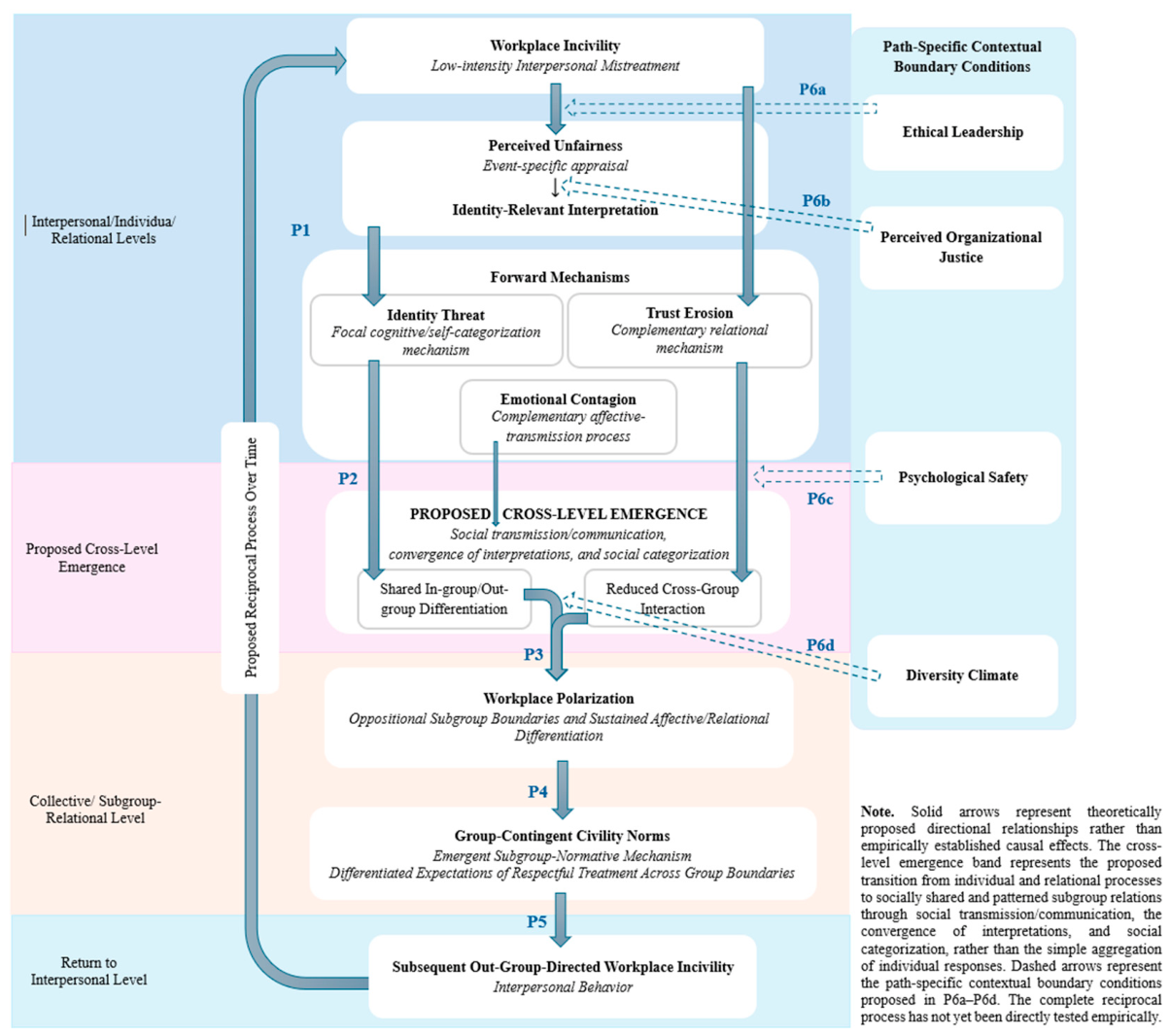
6. Research Agenda and Future Directions
6.1. Empirical Research on the Proposed Workplace Incivility–Workplace Polarization Relationship
The proposed model highlights several directions for future empirical research. Most notably, scholars should investigate workplace incivility and workplace polarization as potentially interconnected processes within organizational contexts rather than as separate phenomena. Future research should examine the mechanisms through which interpersonal experiences of incivility may contribute to increasingly oppositional subgroup boundaries and greater affective or relational differentiation between identifiable employee subgroups, as well as whether established workplace polarization subsequently shapes employees’ everyday interpersonal interactions. Specifically, empirical investigation is needed to determine whether the proposed temporal sequence occurs independently in either direction, or whether repeated observations reveal a reciprocal pattern between the two constructs over time.
Therefore, future research should primarily test the proposed relationship between workplace incivility and workplace polarization, including its potentially reciprocal development over time. Prior research has extensively investigated the consequences of workplace incivility for employee attitudes and well-being (e.g., Namin et al., 2022a; Schilpzand et al., 2016), while organizational research on political polarization provides related evidence concerning trust, workplace relationships, and organizational functioning (e.g., I. Ali et al., 2026; Javidan et al., 2023). However, such evidence should not be interpreted as direct empirical support for workplace polarization as conceptualized in the current study. Direct research examining the dynamic relationship between workplace incivility and workplace polarization as conceptualized in the present study remains limited.
Future studies should investigate whether repeated exposure to workplace incivility contributes to workplace polarization by examining the mechanisms through which individual experiences of interpersonal mistreatment may become associated with stronger in-group alignment, greater out-group differentiation, and weakened cross-group interaction. Specifically, research should examine whether identity threat and trust erosion contribute to the strengthening of subgroup boundaries and under what conditions those boundaries become increasingly oppositional, accompanied by greater affective or relational differentiation. Moreover, future studies may also investigate whether targets of workplace incivility increasingly form social networks with similar others, identify more strongly with perceived in-group members, and interact less with perceived out-groups.
Future research should also investigate the proposed reverse pathway by testing whether established workplace polarization may alter expectations of respectful treatment across perceived group boundaries. More specifically, future studies could investigate whether increasingly oppositional and affectively or relationally differentiated employee subgroups are associated with the development of group-contingent civility norms, such that tolerance of uncivil treatment varies depending on whether targets are perceived as in-group or out-group members. Research could then assess whether such normative differentiation predicts subsequent patterns of out-group-directed incivility. Such research should distinguish employees’ individual perceptions of civility expectations from emergent subgroup-level norms. Repeated measures could examine whether members of identifiable subgroups increasingly develop shared expectations of respectful treatment across in-group and out-group interactions, and whether these shared expectations subsequently predict differences in interpersonal incivility across group boundaries. This would provide a direct empirical test of the proposed transition from collective subgroup polarization to group-contingent civility norms and, subsequently, to interpersonal behavior. Testing this sequence would help determine whether workplace polarization may contribute to subsequent workplace incivility and provide empirical evidence for (or against) the proposed reciprocal relationship.
6.2. Methodological Opportunities and Research Designs
One important direction for future research concerns the multilevel nature of the proposed reciprocal model. In general, workplace incivility is conceptualized as an interpersonal phenomenon involving interactions among organizational members, whereas workplace polarization is conceptualized in the present framework as involving increasingly oppositional boundaries and greater affective or relational differentiation between identifiable employee subgroups. To gain deeper insight into their proposed relationship, specific research designs are needed that can examine how these processes develop within and across different analytical levels. Multilevel studies could therefore investigate whether repeated interpersonal experiences of incivility are associated with stronger in-group alignment, greater out-group differentiation, and weakened cross-group interaction, and additionally under what conditions these processes develop into workplace polarization. Testing the proposed cross-level process requires more than collecting individual responses and statistically aggregating them. Researchers should first determine whether employees within relevant subgroups show sufficient convergence in their interpretations of mistreatment, group identification, or relational evaluations before treating these phenomena as shared group-level constructs. Multilevel designs could then examine whether convergence within subgroups and differentiation between subgroups increase over time, and whether these changes are associated with increasingly oppositional subgroup relations and greater affective or relational differentiation. For example, researchers could examine whether repeated exposure to uncivil exchanges is associated with stronger subgroup boundaries or weaker cross-group connections within organizational communication networks.
The methodological requirements of the proposed model vary across propositions. P1 is particularly suited to repeated-measures, experience-sampling, and experimental designs that can examine whether uncivil encounters are followed by perceived unfairness, identity-relevant interpretations, identity threat, and trust erosion. P2 and P3 require multilevel and network-sensitive designs because they address the transition from individual and relational processes to increasingly shared subgroup differentiation and reduced cross-group interaction. P4 and P5 require longitudinal and multilevel designs to examine whether established workplace polarization precedes the emergence of group-contingent civility norms and whether these norms subsequently predict out-group-directed workplace incivility. P6a–P6d require path-specific moderation tests, with each contextual condition examined at the specific transition specified in the relevant sub-proposition. Finally, testing the complete reciprocal process requires longitudinal data with repeated observations of both workplace incivility and workplace polarization.
Longitudinal designs provide another useful methodological approach in this research area. Because workplace polarization is unlikely to develop from a single episode of incivility, longitudinal research is particularly important for testing the temporal ordering proposed in P1–P5 and the broader reciprocal relationship. Repeated observations could examine whether workplace incivility precedes changes in identity threat, trust erosion, in-group/out-group differentiation, and cross-group interaction (P1–P3). They could also test whether established workplace polarization subsequently precedes changes in group-contingent civility norms and out-group-directed workplace incivility (P4–P5). For P4 and P5, repeated observations should distinguish employees’ individual perceptions of civility expectations from the emergence of shared subgroup-level norms. Research could then examine whether these subgroup norms precede subsequent interpersonal out-group-directed workplace incivility. Experience-Sampling Methods (Hektner et al., 2007) may be particularly useful for examining the shorter-term processes proposed in P1 and P2. They can capture repeated uncivil encounters, event-specific unfairness, identity-relevant interpretations, identity threat, changes in trust, and interaction behavior close to when these experiences occur. In contrast, repeated longitudinal surveys may be better suited to examining slower changes in shared subgroup differentiation, workplace polarization, and the reverse pathway proposed in P3–P5.
Network-based approaches, such as Social Network Analysis (Wasserman & Faust, 1994), may provide another useful methodological framework for examining structural changes associated with uncivil behavior in organizational settings. This approach is particularly relevant to P2 and P3, as these propositions address the emergence of patterned in-group/out-group differentiation, reduced interaction across subgroup boundaries, and the development of workplace polarization as a collective subgroup-relational phenomenon. Such approaches could help researchers investigate whether workplace incivility is associated with communication fragmentation, subgroup formation, and reduced cross-group interactions. Importantly, these structural patterns should not be treated as equivalent to workplace polarization; rather, future studies could investigate whether, and under what conditions, they are accompanied by increasingly oppositional subgroup boundaries and greater affective or relational differentiation. When combined with repeated longitudinal observations, network analysis could examine whether changes in interpersonal ties and cross-group interaction precede the emergence of increasingly oppositional and affectively or relationally differentiated employee subgroups. This approach would provide a direct test of the relational processes specified in P2 and the collective emergence of workplace polarization proposed in P3.
Experimental designs are particularly useful for isolating the immediate mechanisms proposed in P1 and selected components of P2. For example, controlled manipulations of ambiguous uncivil treatment could examine whether differences in perceived unfairness or identity relevance affect identity threat, relational trust, and subsequent evaluations of in-group and out-group members. Using research designs appropriate to each mechanism, studies should separately examine whether trust erosion predicts reduced cross-group interaction and whether emotional contagion contributes to the spread of negative affective responses across workplace relationships. Such research would allow cognitive/self-categorization, relational, and affective-transmission mechanisms to be examined as theoretically distinct processes rather than as interchangeable mediators. These methodological approaches are intended to test specific propositions and stages of the framework rather than serve as interchangeable designs for testing the complete model.
6.3. Potential Contextual and Organizational Moderators
The next promising opportunity for future research is to test the contextual conditions that may strengthen or weaken the proposed relationship between workplace incivility and workplace polarization. Consistent with the path-specific boundary conditions proposed in P6a–P6d, future studies should examine each contextual condition at its specified stage of the forward pathway. Specifically, research should examine ethical leadership in the transition from workplace incivility to identity-relevant interpretations, perceived organizational justice in the transition from event-specific perceived unfairness to identity-relevant interpretation, psychological safety in the transition from trust erosion to reduced constructive cross-group interaction, and diversity climate in the transition from in-group/out-group differentiation to workplace polarization. Accordingly, empirical tests of P6a–P6d should examine each contextual condition at its theoretically specified transition rather than treating all four conditions as interchangeable moderators of the overall incivility–polarization relationship. Future research could also explore whether these or other contextual conditions influence the reverse pathway from established workplace polarization to group-contingent civility norms and, subsequently, to out-group-directed incivility. However, such effects are not formally proposed as moderating relationships in the present framework.
Future studies could examine whether ethical leadership weakens the transition from workplace incivility to identity-relevant interpretations of mistreatment by reinforcing consistent standards of respectful and civil treatment. Research could also investigate whether inconsistent enforcement of civility expectations or perceived favoritism makes employees more likely to interpret ambiguous uncivil treatment as evidence of group-based exclusion or differential treatment. Future research should examine whether broader perceptions of organizational justice influence the transition from perceived unfairness surrounding a specific uncivil encounter to an identity-relevant interpretation of that experience. Studies could test whether employees who perceive the broader organizational context as fair are less likely to interpret an ambiguous unfair encounter as evidence of systematic exclusion, bias, or group-based mistreatment.
Furthermore, future research should examine whether psychological safety weakens the relationship between trust erosion and reduced constructive interaction across perceived group boundaries. Specifically, when psychological safety is high, employees experiencing declining interpersonal trust may remain more willing to communicate and engage constructively across subgroup boundaries. Research on diversity climate could similarly examine whether a supportive diversity climate weakens the transition from in-group/out-group differentiation to workplace polarization. Specifically, a supportive diversity climate may allow organizational and subgroup identities to coexist while reducing the likelihood that salient subgroup distinctions become increasingly oppositional and affectively or relationally differentiated.
This line of research may contribute to theoretical development by moving beyond direct-effect or overall moderation models toward path-specific conditional models. Such models could clarify when and where each contextual condition influences the proposed forward pathway. It may also improve practical understanding of the organizational conditions that support constructive interaction across group boundaries and reduce the likelihood that subgroup differences will develop into increasingly oppositional workplace relations.
6.4. Practical Implications for Organizations
The proposed relationship between workplace incivility and workplace polarization has important implications for human resource management and organizational leadership. Because repeated uncivil interactions may, under certain conditions, contribute to increasingly oppositional subgroup boundaries, leaders and HR professionals should consider both interpersonal mistreatment and emerging patterns of cross-group division. Similarly, in organizational settings where workplace polarization is already developing, attention should be given to whether civility expectations are becoming increasingly contingent on perceived group membership. This requires examining not only how frequently uncivil incidents occur, but also whether similar behavior is evaluated, tolerated, or corrected differently depending on the perceived group membership of those involved.
Organizations may therefore benefit from proactively establishing and promoting norms of civility, respectful interactions, and collaborative communication practices to reduce the likelihood that interpersonal tensions contribute to increasingly oppositional relations between employee subgroups. Given that recurring exposure to low-intensity mistreatment, such as incivility, may erode trust over time and potentially reinforce in-group/out-group distinctions, organizational interventions should not only support effective conflict management but also identify early patterns of subtle disrespectful interactions. Therefore, training programs that focus on perspective shifting, conflict management, and open communication may further help employees navigate identity-relevant tensions before subgroup distinctions become increasingly oppositional and meaningful for cross-group interaction.
Leadership behavior may shape several organizational conditions involved in the proposed relationship between workplace incivility and workplace polarization. Previous studies have shown employees’ great sensitivity to uncivil behavior from individuals in higher-power positions, since they often perceive such behavior as more severe, unfair, and socially impactful (Jungert & Holm, 2022). Organizational responses to incivility and the consistent expectations for respectful treatment standards are important for addressing conditions under which uncivil interactions persist (Lilly, 2017). Therefore, the present framework suggests that tolerance of disrespectful interactions or inconsistent application of civility standards may create conditions that sustain group-contingent patterns of interpersonal treatment. However, if leaders take a consistent role in modeling respectful interactions, clearly address incivility, and promote fair interpersonal treatment, they may help sustain psychological safety and constructive cross-group interaction, thereby reducing conditions under which subgroup boundaries could become increasingly oppositional.
Moreover, organizations may benefit from developing institutional and formal mechanisms to facilitate social engagement and encourage constructive interaction among employees with differing perspectives. Open communication practices, collaborative decision-making structures, and sustained cross-group interaction may support shared understanding across political, ideological, or other salient social group boundaries. Such differences should not themselves be considered as workplace polarization; rather, organizational attention may be particularly important when these identity-based distinctions become increasingly oppositional and are accompanied by greater affective or relational differentiation across groups.
Thus, workplace incivility may have implications that extend beyond immediate interpersonal interactions, as repeated mistreatment may contribute to identity-relevant interpretations, the erosion of trust, and increasingly oppositional subgroup relations. Leaders and HR professionals may therefore benefit from addressing patterns of uncivil behavior while also monitoring emerging cross-group dynamics, promoting inclusive organizational norms, and fostering constructive interaction and trust across group boundaries.
7. Conclusions
By integrating two largely independent research streams, this study develops a proposed reciprocal, multilevel framework linking workplace incivility and workplace polarization within organizational contexts. Grounded in the Incivility Spiral Model, Organizational Justice Theory, and Social Identity Theory, the framework specifies theoretical pathways through which interpersonal incivility may contribute to workplace polarization and through which established workplace polarization may, in turn, create conditions for subsequent incivility. These pathways should be interpreted as testable theoretical propositions rather than as an empirically established reciprocal causal process. The framework’s multilevel contribution lies in distinguishing interpersonal acts and individual interpretations from the emerging collective processes through which shared categorizations and patterned cross-group relations may develop. Workplace polarization is therefore not viewed as an aggregation of individual reactions but as a collective subgroup-relational configuration that may emerge when group boundaries become sustained and increasingly oppositional with affective or relational differentiation across groups.
This paper emphasized the potential of workplace incivility to undermine organizational cohesion and intergroup relations despite its low intensity and ambiguous nature. Repeated experiences of disrespectful interactions in the workplace may activate identity-based processes, intensify employees’ perceptions of exclusion, and erode their interpersonal trust. Within this forward pathway, identity threat serves as the primary cognitive and self-categorization mechanism, while trust erosion and emotional contagion function as complementary relational and affective-transmission mechanisms rather than as equivalent parallel mediators. These dynamics may strengthen in-group alignment and out-group differentiation; however, workplace polarization is proposed to emerge only when subgroup boundaries become increasingly oppositional and involve greater affective or relational differentiation between identifiable employee subgroups. In the reverse pathway, the framework proposes group-contingent civility norms as an emergent subgroup-normative mechanism through which established workplace polarization may shape subsequent interpersonal behavior. Increasingly oppositional subgroup relations may lead to differing expectations of respectful treatment across perceived group boundaries, thereby increasing the likelihood of subsequent out-group-directed workplace incivility. This proposed normative mechanism requires direct empirical examination.
The proposed reciprocal model may be particularly relevant in contemporary organizational contexts where ideological differences, pervasive digital communication, and broader social and political tensions may become salient in workplace interactions. Under such conditions, subtle uncivil interactions and interpersonal mistreatment may increasingly be interpreted in terms of salient group identities, thereby strengthening oppositional subgroup boundaries. By theorizing workplace incivility and workplace polarization as potentially reciprocally linked processes, this study offers a testable account of how routine interpersonal interactions may become connected to increasingly oppositional and affectively or relationally differentiated subgroup relations within organizational settings. The contribution lies in identifying the conditions and mechanisms through which such a feedback relationship may develop while recognizing that the complete reciprocal process has not yet been directly tested in organizational settings.
Funding
This research received no external funding.
Institutional Review Board Statement
Not applicable.
Informed Consent Statement
Not applicable.
Data Availability Statement
The original contributions presented in this study are included in the article. Further inquiries can be directed to the corresponding author.
Conflicts of Interest
The author declares no conflict of interest.
References
- Adams, G. A., & Webster, J. R. (2013). Emotional regulation as a mediator between interpersonal mistreatment and distress. European Journal of Work and Organizational Psychology, 22(6), 697–710. [Google Scholar] [CrossRef] [Scilit]
- Alam, M. N. (2025). Toxic leadership and employee reactions: Examining how perceived injustice and turnover intentions influence counterproductive work behavior. Employee Responsibilities and Rights Journal, 1–30. [Google Scholar] [CrossRef] [Scilit]
- Alenick, P. R., Zhou, Z. E., Nagel, J. A., & Che, X. (2022). How supervisor passivity begets subordinate incivility: A moderated mediation model. Occupational Health Science, 6(1), 111–130. [Google Scholar] [CrossRef] [Scilit]
- Ali, I., Aziz, M. F., Albishri, N., Dash, S., Temperini, V., & Usai, A. (2026). Political polarization at the workplace: Implications for knowledge management behaviors and coping mechanisms. Journal of Knowledge Management, 30(5), 1656–1677. [Google Scholar] [CrossRef] [Scilit]
- Ali, S., Hussain, I., Shahzad, F., & Afaq, A. (2022). A multidimensional model of abusive supervision and work incivility. Sustainability, 14(11), 6505. [Google Scholar] [CrossRef] [Scilit]
- Andersson, L. M., & Pearson, C. M. (1999). Tit for tat? The spiraling effect of incivility in the workplace. Academy of Management Review, 24(3), 452–471. [Google Scholar] [CrossRef] [Scilit]
- Arasli, H., Hejraty Namin, B., & Abubakar, A. M. (2018). Workplace incivility as a moderator of the relationships between polychronicity and job outcomes. International Journal of Contemporary Hospitality Management, 30(3), 1245–1272. [Google Scholar] [CrossRef] [Scilit]
- Ashforth, B. E., & Mael, F. (1989). Social identity theory and the organization. Academy of Management Review, 14(1), 20–39. [Google Scholar] [CrossRef] [Scilit]
- Bail, C. A., Argyle, L. P., Brown, T. W., Bumpus, J. P., Chen, H., Fallin Hunzaker, M. B., Lee, J., Mann, M., Merhout, F., & Volfovsky, A. (2018). Exposure to opposing views on social media can increase political polarization. Proceedings of the National Academy of Sciences, 115(37), 9216–9221. [Google Scholar] [CrossRef] [Scilit] [PubMed]
- Bowling, N. A., & Beehr, T. A. (2006). Workplace harassment from the victim’s perspective: A theoretical model and meta-analysis. The Journal of Applied Psychology, 91(5), 998–1012. [Google Scholar] [CrossRef] [Scilit] [PubMed]
- Bradley, B. H., Postlethwaite, B. E., Klotz, A. C., Hamdani, M. R., & Brown, K. G. (2012). Reaping the benefits of task conflict in teams: The critical role of team psychological safety climate. Journal of Applied Psychology, 97(1), 151–158. [Google Scholar] [CrossRef] [Scilit] [PubMed]
- Chen, C.-Y., Mao, H. Y., Hsieh, A. T., Liu, L.-L., & Yen, C.-H. (2013). The relationship among interactive justice, leader–member exchange, and workplace friendship. The Social Science Journal, 50(1), 89–95. [Google Scholar] [CrossRef] [Scilit]
- Cortina, L. M., Kabat-Farr, D., Leskinen, E. A., Huerta, M., & Magley, V. J. (2013). Selective incivility as modern discrimination in organizations: Evidence and impact. Journal of Management, 39(6), 1579–1605. [Google Scholar] [CrossRef] [Scilit]
- Cortina, L. M., Kabat-Farr, D., Magley, V. J., & Nelson, K. (2017). Researching rudeness: The past, present, and future of the science of incivility. Journal of Occupational Health Psychology, 22(3), 299–313. [Google Scholar] [CrossRef] [Scilit]
- Cortina, L. M., Magley, V. J., Williams, J. H., & Langhout, R. D. (2001). Incivility in the workplace: Incidence and impact. Journal of Occupational Health Psychology, 6(1), 64–80. [Google Scholar] [CrossRef]
- Cortina, L. M., Sandy Hershcovis, M., & Clancy, K. B. (2022). The embodiment of insult: A theory of biobehavioral response to workplace incivility. Journal of Management, 48(3), 738–763. [Google Scholar] [CrossRef] [Scilit] [PubMed]
- DeBode, J. D., Fox, C. J., & McSweeney, J. J. (2024). Top management team political polarization and its implications for strategic decision-making. Small Group Research, 55(1), 184–217. [Google Scholar] [CrossRef] [Scilit]
- Dhanani, L. Y., LaPalme, M. L., & Joseph, D. L. (2021). How prevalent is workplace mistreatment? A meta-analytic investigation. Journal of Organizational Behavior, 42(8), 1082–1098. [Google Scholar] [CrossRef] [Scilit]
- DiMaggio, P., Evans, J., & Bryson, B. (1996). Have American’s social attitudes become more polarized? American Journal of Sociology, 102(3), 690–755. [Google Scholar] [CrossRef] [Scilit] [PubMed]
- Edmondson, A. (1999). Psychological safety and learning behavior in work teams. Administrative Science Quarterly, 44(2), 350–383. [Google Scholar] [CrossRef] [Scilit]
- Einarsen, S., Hoel, H., & Notelaers, G. (2009). Measuring exposure to bullying and harassment at work: Validity, factor structure and psychometric properties of the Negative Acts Questionnaire-Revised. Work & Stress, 23(1), 24–44. [Google Scholar] [CrossRef] [Scilit]
- Estes, B., & Wang, J. (2008). Integrative literature review: Workplace incivility: Impacts on individual and organizational performance. Human Resource Development Review, 7(2), 218–240. [Google Scholar] [CrossRef] [Scilit]
- Everton, W. J., Jolton, J. A., & Mastrangelo, P. M. (2007). Be nice and fair or else: Understanding reasons for employees’ deviant behaviors. Journal of Management Development, 26(2), 117–131. [Google Scholar] [CrossRef] [Scilit]
- Ferguson, M., & Barry, B. (2011). I know what you did: The effects of interpersonal deviance on bystanders. Journal of Occupational Health Psychology, 16(1), 80–94. [Google Scholar] [CrossRef] [Scilit] [PubMed]
- Ferris, D. L., Brown, D. J., Berry, J. W., & Lian, H. (2008). The development and validation of the Workplace Ostracism Scale. Journal of Applied Psychology, 93(6), 1348–1366. [Google Scholar] [CrossRef] [Scilit] [PubMed]
- Foulk, T. A., Woolum, A. H., & Erez, A. (2016). Catching rudeness is like catching a cold: The contagion effects of low-intensity negative behaviors. Journal of Applied Psychology, 101(1), 50–67. [Google Scholar] [CrossRef] [Scilit] [PubMed]
- Giumetti, G. W., Hatfield, A. L., Scisco, J. L., Schroeder, A. N., Muth, E. R., & Kowalski, R. M. (2013). What a rude E-mail! Examining the differential effects of incivility versus support on mood, energy, engagement, and performance in an online context. Journal of Occupational Health Psychology, 18(3), 297–309. [Google Scholar] [CrossRef] [Scilit] [PubMed]
- Gloor, J. L., Okimoto, T. G., Li, X., Gazdag, B. A., & Ryan, M. K. (2024). How identity impacts bystander responses to workplace mistreatment. Journal of Management, 50(7), 2641–2674. [Google Scholar] [CrossRef] [Scilit] [PubMed]
- Greenberg, J. (1987). A taxonomy of organizational justice theories. Academy of Management Review, 12(1), 9–22. [Google Scholar] [CrossRef] [Scilit] [PubMed]
- Gupta, A., Chaudhuri, R., Apoorva, A., Chaudhary, S., Thrassou, A., Sakka, G., & Grandhi, B. (2025). Vicenarian of workplace incivility: A bibliometric analysis and systematic review. EuroMed Journal of Business, 20(1), 52–74. [Google Scholar] [CrossRef] [Scilit]
- Han, S., Harold, C. M., Oh, I. S., Kim, J. K., & Agolli, A. (2022). A meta-analysis integrating 20 years of workplace incivility research: Antecedents, consequences, and boundary conditions. Journal of Organizational Behavior, 43(3), 497–523. [Google Scholar] [CrossRef] [Scilit]
- He, Y., Costa, P. L., Walker, J. M., Miner, K. N., & Wooderson, R. L. (2019). Political identity dissimilarity, workplace incivility, and declines in well-being: A prospective investigation. Stress and Health, 35(3), 256–266. [Google Scholar] [CrossRef] [Scilit] [PubMed]
- Hektner, J. M., Schmidt, J. A., & Csikszentmihalyi, M. (2007). Experience sampling method: Measuring the quality of everyday life. Sage. [Google Scholar]
- Hershcovis, M. S., & Barling, J. (2010). Towards a multi-foci approach to workplace aggression: A meta-analytic review of outcomes from different perpetrators. Journal of Organizational Behavior, 31(1), 24–44. [Google Scholar] [CrossRef] [Scilit]
- Hofhuis, J., van Der Zee, K. I., & Otten, S. (2012). Social identity patterns in culturally diverse organizations: The role of diversity climate 1. Journal of Applied Social Psychology, 42(4), 964–989. [Google Scholar] [CrossRef] [Scilit]
- Holm, K., Torkelson, E., & Bäckström, M. (2019). Exploring links between witnessed and instigated workplace incivility. International Journal of Workplace Health Management, 12(3), 160–175. [Google Scholar] [CrossRef] [Scilit]
- Hughes, I. M., & Jex, S. M. (2022). Individual differences, job demands and job resources as boundary conditions for relations between experienced incivility and forms of instigated incivility. International Journal of Conflict Management, 33(5), 909–932. [Google Scholar] [CrossRef] [Scilit]
- Iqbal, M., Yan, Y., Shrestha, S., Mubarik, S., Riaz, M. N., Jiang, L., Nadeem, M., & Imran, M. H. (2023). A moderated mediation model between perceived incivility and instigated incivility on workplace: A cross-cultural daily diary study. International Journal of Stress Management, 30(4), 388–405. [Google Scholar] [CrossRef] [Scilit]
- Iyengar, S., Lelkes, Y., Levendusky, M., Malhotra, N., & Westwood, S. J. (2019). The origins and consequences of affective polarization in the United States. Annual Review of Political Science, 22(1), 129–146. [Google Scholar] [CrossRef] [Scilit]
- Iyengar, S., & Westwood, S. J. (2015). Fear and loathing across party lines: New evidence on group polarization. American Journal of Political Science, 59(3), 690–707. [Google Scholar] [CrossRef] [Scilit]
- Javidan, M., Cotton, R., Kar, A., Kumar, M. S., & Dorfman, P. W. (2023). A new leadership challenge: Navigating political polarization in organizational teams. Business Horizons, 66(6), 729–740. [Google Scholar] [CrossRef] [Scilit]
- Jehn, K. A. (1995). A multimethod examination of the benefits and detriments of intragroup conflict. Administrative Science Quarterly, 40(2), 256–282. [Google Scholar] [CrossRef] [Scilit]
- Jungert, T., & Holm, K. (2022). Workplace incivility and bystanders’ helping intentions. International Journal of Conflict Management, 33(2), 273–290. [Google Scholar] [CrossRef] [Scilit]
- Koon, V. Y., & Pun, P. Y. (2018). The mediating role of emotional exhaustion and job satisfaction on the relationship between job demands and instigated workplace incivility. The Journal of Applied Behavioral Science, 54(2), 187–207. [Google Scholar] [CrossRef] [Scilit]
- Kretschmer, K. (2022). Factions/factionalism. In The Wiley-Blackwell encyclopedia of social and political movements (pp. 1–5). Wiley-Blackwell. [Google Scholar] [CrossRef] [Scilit]
- Lau, D. C., & Murnighan, J. K. (1998). Demographic diversity and faultlines: The compositional dynamics of organizational groups. Academy of Management Review, 23(2), 325–340. [Google Scholar] [CrossRef] [Scilit]
- Lee, J., & Jensen, J. M. (2014). The effects of active constructive and passive corrective leadership on workplace incivility and the mediating role of fairness perceptions. Group & Organization Management, 39(4), 416–443. [Google Scholar] [CrossRef] [Scilit]
- Lee, J., Steigerwald, N., Jex, S., Rada-Bayne, A., & Holden, C. (2024). Perpetrator-targeted reciprocated incivility: The investigation of the incivility spiral and the effects of agreeableness as a moderator. Basic and Applied Social Psychology, 46(1), 19–31. [Google Scholar] [CrossRef] [Scilit]
- Li, J., & Hambrick, D. C. (2005). Factional groups: A new vantage on demographic faultlines, conflict, and disintegration in work teams. Academy of Management Journal, 48(5), 794–813. [Google Scholar] [CrossRef] [Scilit]
- Lilly, J. D. (2017). What happened to civility? Understanding rude behavior through the lens of organizational justice. Business Horizons, 60(5), 707–714. [Google Scholar] [CrossRef] [Scilit]
- Lim, S., & Cortina, L. M. (2005). Interpersonal mistreatment in the workplace: The interface and impact of general incivility and sexual harassment. Journal of Applied Psychology, 90(3), 483–496. [Google Scholar] [CrossRef] [Scilit] [PubMed]
- Lim, S., Cortina, L. M., & Magley, V. J. (2008). Personal and workgroup incivility: Impact on work and health outcomes. The Journal of Applied Psychology, 93(1), 95–107. [Google Scholar] [CrossRef] [Scilit] [PubMed]
- Loh, J. M., & Loi, N. (2018). Tit for tat: Burnout as a mediator between workplace incivility and instigated workplace incivility. Asia-Pacific Journal of Business Administration, 10(1), 100–111. [Google Scholar] [CrossRef] [Scilit]
- Mael, F., & Ashforth, B. E. (1992). Alumni and their alma mater: A partial test of the reformulated model of organizational identification. Journal of Organizational Behavior, 13(2), 103–123. [Google Scholar] [CrossRef] [Scilit]
- Martin, R. J., & Hine, D. W. (2005). Development and validation of the uncivil workplace behavior questionnaire. Journal of Occupational Health Psychology, 10(4), 477–490. [Google Scholar] [CrossRef] [Scilit] [PubMed]
- Mason, L. (2015). “I disrespectfully agree”: The differential effects of partisan sorting on social and issue polarization. American Journal of Political Science, 59(1), 128–145. [Google Scholar] [CrossRef] [Scilit]
- Meier, L. L., & Semmer, N. K. (2013). Lack of reciprocity, narcissism, anger, and instigated workplace incivility: A moderated mediation model. European Journal of Work and Organizational Psychology, 22(4), 461–475. [Google Scholar] [CrossRef] [Scilit]
- Miner, K. N., Costa, P. L., He, Y., & Wooderson, R. L. (2021). Your politics are making me sick! Political identity-based workplace incivility and physical health complaints during two US presidential elections. Occupational Health Science, 5(3), 361–389. [Google Scholar] [CrossRef] [Scilit]
- Miner-Rubino, K., & Reed, W. D. (2010). Testing a moderated mediational model of workgroup incivility: The roles of organizational trust and group regard. Journal of Applied Social Psychology, 40(12), 3148–3168. [Google Scholar] [CrossRef] [Scilit]
- Namin, B. H., Marnburg, E., & Bakkevig Dagsland, Å. H. (2022a). Frontline service employees’ profiles: Exploring individual differences in perceptions of and reactions to workplace incivility. Behavioral Sciences, 12(3), 76. [Google Scholar] [CrossRef] [Scilit] [PubMed]
- Namin, B. H., Marnburg, E., & Bakkevig Dagsland, Å. H. (2022b). The effect of a caring climate on frontline employees’ turnover intention in the service industry: A serial multiple mediation model. Scandinavian Journal of Hospitality and Tourism, 22(3), 235–254. [Google Scholar] [CrossRef] [Scilit]
- Namin, B. H., Øgaard, T., & Røislien, J. (2021). Workplace incivility and turnover intention in organizations: A meta-analytic review. International Journal of Environmental Research and Public Health, 19(1), 25. [Google Scholar] [CrossRef] [Scilit] [PubMed]
- Olzak, S. (2011). Does globalization breed ethnic discontent? Journal of Conflict Resolution, 55(1), 3–32. [Google Scholar] [CrossRef] [Scilit]
- Ostroff, C., Benincasa, C., Rae, B., Fahlbusch, D., & Wallwork, N. (2023). Eyes on incivility in surgical teams: Teamwork, well-being, and an intervention. PLoS ONE, 18(11), e0295271. [Google Scholar] [CrossRef] [Scilit] [PubMed]
- Park, L. S., Martinez, L., & Xu, S. (2022). Job experience as a buffer against incivility: A daily diary study. Journal of Managerial Psychology, 37(3), 243–263. [Google Scholar] [CrossRef] [Scilit]
- Pearson, C. (2010). The cost of bad behavior: How incivility is damaging your business and what to do about it. Human Resource Management International Digest, 18(6), 2. [Google Scholar] [CrossRef] [Scilit]
- Pearson, C. M., Andersson, L. M., & Porath, C. L. (2005). Workplace incivility. In S. Fox, & P. E. Spector (Eds.), Counterproductive work behavior: Investigations of actors and targets (pp. 177–200). American Psychological Association. [Google Scholar]
- Pearson, C. M., Andersson, L. M., & Wegner, J. W. (2001). When workers flout convention: A study of workplace incivility. Human Relations, 54(11), 1387–1419. [Google Scholar] [CrossRef] [Scilit]
- Porath, C. L., & Erez, A. (2009). Overlooked but not untouched: How rudeness reduces onlookers’ performance on routine and creative tasks. Organizational Behavior and Human Decision Processes, 109(1), 29–44. [Google Scholar] [CrossRef] [Scilit]
- Porath, C. L., & Pearson, C. M. (2012). Emotional and behavioral responses to workplace incivility and the impact of hierarchical status. Journal of Applied Social Psychology, 42(S1), E326–E357. [Google Scholar] [CrossRef] [Scilit]
- Rahim, A., & Cosby, D. M. (2016). A model of workplace incivility, job burnout, turnover intentions, and job performance. Journal of Management Development, 35(10), 1255–1265. [Google Scholar] [CrossRef] [Scilit]
- Rasoulikolamaki, S., Kaur, S., Zhdanava, A., & Mat Isa, N. A. N. (2025). In-group and out-group identity construction in extremist discourse: A critical multimodal approach. Behavioral Sciences of Terrorism and Political Aggression, 17(4), 377–395. [Google Scholar] [CrossRef] [Scilit]
- Reich, T. C., Hershcovis, M. S., Lyubykh, Z., Niven, K., Parker, S. K., & Stride, C. B. (2021). Observer reactions to workplace mistreatment: It’s a matter of perspective. Journal of Occupational Health Psychology, 26(5), 374–392. [Google Scholar] [CrossRef] [Scilit] [PubMed]
- Reio, T. G., Jr., & Ghosh, R. (2009). Antecedents and outcomes of workplace incivility: Implications for human resource development research and practice. Human Resource Development Quarterly, 20(3), 237–264. [Google Scholar] [CrossRef] [Scilit]
- Sakurai, K., & Jex, S. M. (2012). Coworker incivility and incivility targets’ work effort and counterproductive work behaviors: The moderating role of supervisor social support. Journal of Occupational Health Psychology, 17(2), 150–161. [Google Scholar] [CrossRef] [Scilit] [PubMed]
- Schilpzand, P., De Pater, I. E., & Erez, A. (2016). Workplace incivility: A review of the literature and agenda for future research. Journal of Organizational Behavior, 37(S1), S57–S88. [Google Scholar] [CrossRef] [Scilit]
- Shafranek, R. M. (2020). Political consequences of partisan prejudice. Political Psychology, 41(1), 35–51. [Google Scholar] [CrossRef] [Scilit]
- Sinclair, S., Nilsson, A., & Holm, K. (2024). The role of political fit and self-censorship at work for job satisfaction, social belonging, burnout, and turnover intentions. Current Psychology, 43, 20935–20947. [Google Scholar] [CrossRef] [Scilit]
- Sliter, M., Sliter, K., & Jex, S. (2012). The employee as a punching bag: The effect of multiple sources of incivility on employee withdrawal behavior and sales performance. Journal of Organizational Behavior, 33(1), 121–139. [Google Scholar] [CrossRef] [Scilit]
- Stawnychko, L., Rafi, M., & Eaton, S. E. (2025). Exploring the impact of workplace incivility on psychological safety and leadership succession in higher education. International Journal of Leadership in Education, 1–23. [Google Scholar] [CrossRef] [Scilit]
- Tajfel, H. (1981). Human groups and social categories: Studies in social psychology. Cambridge University Press. Available online: https://lccn.loc.gov/80041200 (accessed on 29 June 2026).
- Tajfel, H., & Turner, J. C. (1986). The social identity theory of intergroup behaviour. In S. Worchel, & W. G. Austin (Eds.), Psychology of intergroup relations. Nelson-Hall. [Google Scholar]
- Tomlinson, E. C. (2025). Trust repair in politically polarized workplaces. Human Resource Management Review, 35(2), 101071. [Google Scholar] [CrossRef] [Scilit]
- Torkelson, E., Holm, K., & Bäckström, M. (2016a). Workplace incivility in a Swedish context. Nordic Journal of Working Life Studies, 6(2), 3–22. [Google Scholar] [CrossRef]
- Torkelson, E., Holm, K., Bäckström, M., & Schad, E. (2016b). Factors contributing to the perpetration of workplace incivility: The importance of organizational aspects and experiencing incivility from others. Work & Stress, 30(2), 115–131. [Google Scholar] [CrossRef] [Scilit] [PubMed]
- Van Jaarsveld, D. D., Walker, D. D., & Skarlicki, D. P. (2010). The role of job demands and emotional exhaustion in the relationship between customer and employee incivility. Journal of Management, 36(6), 1486–1504. [Google Scholar] [CrossRef] [Scilit]
- Wasserman, S., & Faust, K. (1994). Social network analysis: Methods and applications. Cambridge University Press. [Google Scholar]
- Yao, J., Lim, S., Guo, C. Y., Ou, A. Y., & Ng, J. W. X. (2022). Experienced incivility in the workplace: A meta-analytical review of its construct validity and nomological network. Journal of Applied Psychology, 107(2), 193–220. [Google Scholar] [CrossRef] [Scilit] [PubMed]
- Yaqoob, S., Shahzad, K., Faisal, M., Kitchlew, N., & Abualigah, A. (2025). Why, how, and when incivility unfolds in the workplace: A 24-year systematic literature review. Management Review Quarterly, 12(1), 1–57. [Google Scholar] [CrossRef] [Scilit]
- Zhang, Y., Liang, Q., & Deng, W. (2024). Stratification or polarization: A qualitative study of the formation of status-based subgroups in China. Journal of Business and Psychology, 39(1), 159–186. [Google Scholar] [CrossRef] [Scilit] [PubMed]
- Zivnuska, S., Harris, K., Valle, M., Harris, R., Carlson, J., & Carlson, D. S. (2024). The spiraling effect of incivility enacted through information and communication technology (ICT) in the workplace. Asia-Pacific Journal of Business Administration, 17(5), 1230–1246. [Google Scholar] [CrossRef] [Scilit]
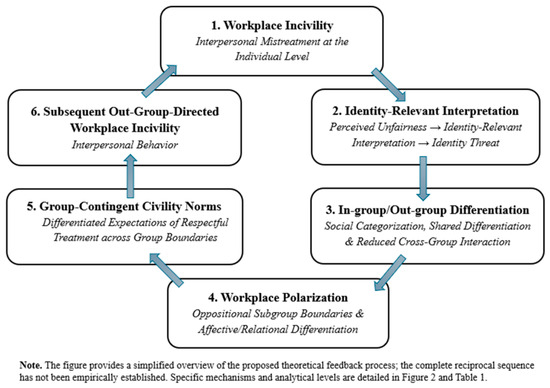
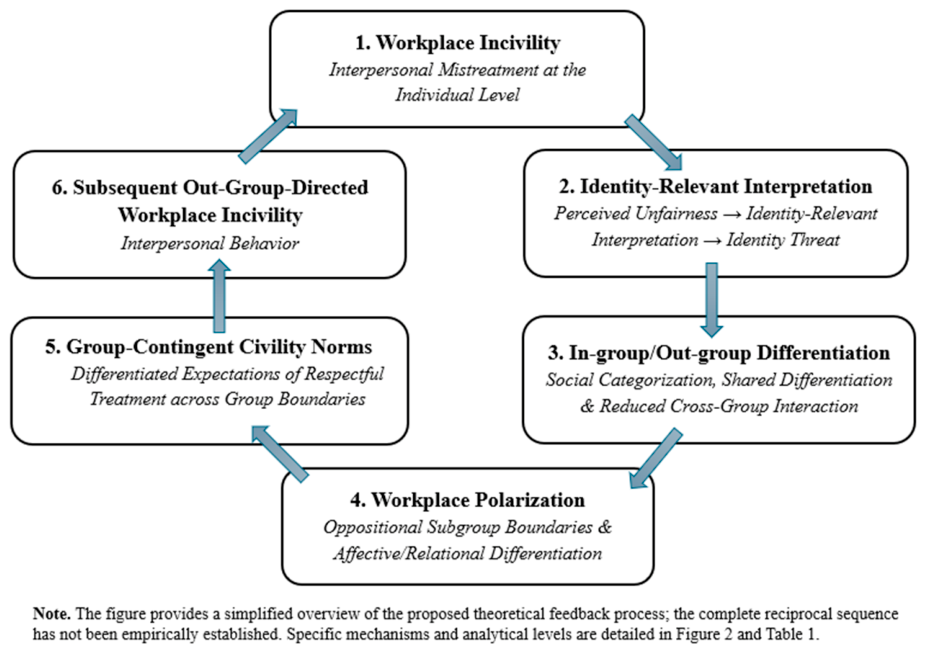

Disclaimer/Publisher’s Note: The statements, opinions and data contained in all publications are solely those of the individual author(s) and contributor(s) and not of MDPI and/or the editor(s). MDPI and/or the editor(s) disclaim responsibility for any injury to people or property resulting from any ideas, methods, instructions or products referred to in the content. |
© 2026 by the author. Licensee MDPI, Basel, Switzerland. This article is an open access article distributed under the terms and conditions of the Creative Commons Attribution (CC BY) license.