


Abstract
AI-driven personalization has become a defining feature of digital advertising, yet whether it drives purchase intention directly or depends on other underlying mechanisms remains insufficiently understood, particularly in under-studied emerging markets. This study investigates how perceived relevance, usefulness, and privacy concerns shape perceived trust and purchase intention in response to AI-driven personalized advertising across Lebanon and Türkiye, two digitally distinct markets. Drawing on the Stimulus Organism Response model, Technology Acceptance Model, Privacy Calculus Theory, and Trust in Automation Theory, a quantitative cross-national design was employed, using a structured questionnaire administered to 802 social media users (394 Lebanon; 408 Türkiye), with data analyzed through partial least squares structural equation modeling and permutation-based multigroup analysis following partial measurement invariance. Results confirm perceived personalization has no direct effect on purchase intention, operating solely through relevance, usefulness, and privacy concerns; relevance and usefulness build trust while privacy concerns erode it, and trust, relevance, and usefulness each independently drive purchase intention. This study advances an asymmetric mediation account of AI advertising, positioning trust as the conduit through which privacy risk reaches behavior and, for managers, the lever converting personalization into purchase. Future research could examine these dynamics longitudinally or across other digitally emerging markets.
1. Introduction
Artificial intelligence (AI) has become essential to modern marketing, enabling firms to move beyond mass messaging toward individualized engagement built on behavioral data at scale (Huang & Rust, 2021). Personalized advertising is where this capability becomes concrete, converting consumer data into the specific messages individuals receive (Yeo et al., 2025). This precision cuts both ways: the same data-driven targeting that makes recommendations feel relevant and reduces search effort also raises concerns about surveillance and informational control (Boerman et al., 2017; Dinev & Hart, 2006). Whether personalization alone is sufficient to drive consumer behavior, or whether its effectiveness is contingent on the perceived value consumers derive from it, remains a critical unresolved question for marketing theory and practice, especially in emerging markets.
Despite growing scholarly interest in AI-driven advertising, three interrelated gaps remain. First, most empirical studies examine consumer responses within single-country frameworks, substantially limiting the generalizability of findings across different market conditions (Alalwan, 2018; Gupta et al., 2025; Yin et al., 2025). Second, the few studies that do compare similar contexts seldom establish measurement invariance before interpreting structural differences (Nguyen et al., 2026), so reported cross-national differences cannot be cleanly attributed to contextual variation rather than measurement artifacts. Third, while some studies have begun examining combinations of several constructs together (An & Ngo, 2025; Cloarec et al., 2024; Sipos, 2025), the competing and complementary roles of trust, relevance, usefulness, and privacy concerns have not been simultaneously captured within a unified framework that models both direct and trust-mediated pathways.
This study addresses all three gaps through a comparative analysis of Lebanon and Türkiye, two contextually distinct yet comparably relevant digital markets. Türkiye represents a digitally mature e-commerce environment, with 77.3 million internet users and 58.5 million active social media users as of January 2025 (Kemp, 2025b), supported by advanced digital payment infrastructure and strong governmental investment, with e-commerce volume reaching 4.57 trillion TL in 2025 (Turkish Ministry of Trade, 2025). Lebanon, despite ongoing economic and political instability, shows strong social media engagement relative to its size, with 5.34 million internet users and 4.02 million active social media users as of January 2025 (Kemp, 2025a), reflecting a rapidly growing but less consolidated market. The structural gap is reflected in their ICT Development Index scores: Türkiye scored 85.8 and Lebanon 76.1 out of 100 in 2023, indicating a meaningful difference in digital infrastructure maturity (ITU, 2023). This contrast anchors digital market maturity as the interpretive lens for cross-national differences used throughout the paper.
The study integrates four complementary theoretical frameworks. The SOR model (Mehrabian & Russell, 1974) provides the structural backbone, positioning perceived personalization as the external stimulus that activates organism-stage evaluations: perceived relevance, perceived usefulness, privacy concerns, and perceived trust, which together shape purchase intention as the behavioral response. The Technology Acceptance Model (TAM; Davis, 1989) specifies the utility-evaluation mechanism, Privacy Calculus Theory (PCT; Dinev & Hart, 2006) frames privacy concerns as an active risk-benefit trade-off, and Trust in Automation Theory (TAT; Lee & See, 2004) anchors trust formation in perceived system performance. Together, these frameworks produce a theoretically grounded and empirically testable model of AI advertising.
Three main contributions are made in the study. Theoretically, an asymmetric mediation pattern emerged, whereby privacy concerns influenced purchase intention only through trust, whereas perceived relevance and usefulness exerted both direct and trust-mediated pathways. Methodologically, it applies MICOM-based measurement invariance assessment prior to multigroup analysis, and reports bootstrapped indirect effects for all mediated pathways, contributing a rigorous analytical approach for cross-national AI marketing research. Practically, it provides retailers and digital marketers in Lebanon, Türkiye, and comparable emerging markets with evidence-based guidance for designing trust-centered AI advertising strategies.
2. Theoretical Framework
This study integrates four complementary theoretical frameworks, each addressing a distinct dimension of consumer evaluation in AI-driven advertising.
The SOR model (Mehrabian & Russell, 1974) forms the structural backbone, positioning perceived personalization as the stimulus (S) that activates organism-stage evaluations (O), namely perceived relevance, usefulness, privacy concerns, and perceived trust, which collectively shape purchase intention as the behavioral response (R). This architecture precludes direct stimulus-to-response pathways unless mediated by organism-stage evaluations.
The TAM (Davis, 1989) specifies how consumers assess whether AI-driven recommendations deliver functional benefit. It adopts perceived usefulness as its primary evaluative construct, with perceived relevance added as a complementary dimension reflecting content-goal alignment, a construct not native to TAM but consistent with its utility-assessment logic and supported in personalized advertising research (Yeo et al., 2025).
The PCT (Dinev & Hart, 2006) introduces risk as a counterweight to functional utility, framing privacy concerns not as a background variable but as an active component of a conscious benefit-risk trade-off in which consumers weigh personalization value against perceived data exposure. This is especially relevant cross-nationally, where privacy sensitivity may vary across cultural and regulatory environments.
The TAT (Lee & See, 2004) anchors trust formation in perceived system performance and predictability, explaining how consumers develop confidence in AI systems incrementally through consistent, accurate, and contextually appropriate recommendations rather than a single interaction. Within the model, TAT grounds perceived trust as a cognitive-evaluative response to system performance, linking organism-stage evaluations to trust as the key mediating construct between perceptual and behavioral outcomes.
2.1. Perceived Personalization and Organism-Stage Evaluations
Perceived personalization refers to the degree to which a consumer perceives a message as personalized (Li, 2016), based on the perceived match between the message and their own characteristics (de Groot, 2022; Petty et al., 2000). AI-driven advertising uses behavioral, demographic, and contextual data to match interests in real time, so experiences feel individually relevant rather than broadly targeted (Saura et al., 2026). This precision is double-edged: it drives engagement through perceived value, yet provokes negative reactions when targeting feels excessive, intrusive, or opaque (My & Phong, 2025). It is precisely this tension that the organism stage must capture. Across AI retail research, perceived value consistently emerges through a tradeoff between the benefits captured by relevance and usefulness, and the costs captured by privacy concerns, a tradeoff that in turn shapes the trust anchoring organism-stage evaluations in the present study.
2.1.1. Perceived Personalization and Perceived Relevance
Perceived relevance refers to the extent to which individuals believe a message aligns with their personal needs, preferences, and current goals (Celsi & Olson, 1988). Research shows relevance enhances attention, engagement, and message evaluation, with personalization algorithms strengthening this effect through real-time behavioral targeting (Alalwan, 2018; De Keyzer et al., 2024). When personalization accurately reflects user intent, it raises the perceived fit between the advertisement and the consumer’s goals, strengthening relevance perceptions (Arora et al., 2025; Odoom, 2022). Perceived personalization is therefore hypothesized to positively influence perceived relevance.
Hypothesis 1.
Perceived personalization has a significant positive effect on perceived relevance.
2.1.2. Perceived Personalization and Perceived Usefulness
Perceived usefulness refers to the degree to which a consumer believes a system enhances the efficiency or quality of task-related outcomes (Davis, 1989). In AI-driven advertising, this captures whether personalized recommendations are seen as functionally beneficial: reducing search effort, improving decision quality, and delivering timely information that facilitates purchasing goals. Evidence from personalized advertising research confirms that perceived personalization significantly enhances perceived usefulness, underscoring the effectiveness of tailored content in strengthening consumers’ utility evaluations of the system (An & Ngo, 2025). This effect has also been replicated within a stimulus-organism-response framework, where AI-enabled personalization was found to positively influence perceived usefulness (Teepapal, 2025). When aligned with user expectations, personalized content is experienced as value-adding rather than interruptive, positioning the AI system as a useful decision-support tool (My & Phong, 2025). Hence, by tailoring content to individual needs, personalization directly strengthens these utility perceptions, suggesting perceived personalization positively shapes perceived usefulness.
Hypothesis 2.
Perceived personalization has a significant positive effect on perceived usefulness.
2.1.3. Perceived Personalization and Privacy Concerns
Privacy concerns refer to the degree to which individuals worry about how their personal information is collected, stored, and used by organizations (Culnan & Armstrong, 1996; Menard & Bott, 2025). These concerns significantly shape consumer behavior online, influencing both willingness to disclose personal information and broader attitudes toward personalized marketing (McKee et al., 2024). As personalization grows more precise, consumers become more aware of how closely they are tracked, heightening perceived vulnerability when data practices lack transparency (Y. Hu & Min, 2025). This vulnerability intensifies when targeting feels excessively precise or intrusive, turning precision itself into a backfire (Kim & Han, 2025). This suggests that higher perceived personalization may activate stronger concerns even among consumers who generally accept data-driven advertising.
Hypothesis 3.
Perceived personalization has a significant positive effect on privacy concerns.
2.1.4. Perceived Personalization and Purchase Intention
Personalization may also influence purchase intention directly: when sufficiently compelling, it can reduce cognitive resistance and activate purchase motivation (Kumar et al., 2025). Empirical evidence shows that personalized recommendations increase consumers’ likelihood of clicking and purchasing by delivering content that matches their immediate needs and preferences (Yin et al., 2025). This effect is further amplified in e-commerce and social media environments, where algorithmic personalization creates immersive, goal-congruent experiences that directly accelerate purchase decisions (Jeong et al., 2022). The SOR framework predicts the opposite: once organism-stage evaluations are modeled, personalization should retain no direct residual on purchase intention (Mehrabian & Russell, 1974). H4 therefore tests between these competing predictions.
Hypothesis 4.
Perceived personalization has a significant positive effect on purchase intention.
2.2. Organism-Stage Evaluations and Perceived Trust
Trust reduces perceived uncertainty and strengthens consumer confidence in a brand’s products and services, thereby making consumers more at ease with their purchase decisions (Wang et al., 2022). Three first-level organism-stage evaluations are proposed to shape it: perceived relevance and usefulness as positive antecedents, and privacy concerns as a negative antecedent.
2.2.1. Perceived Relevance and Perceived Trust
Perceived relevance is a foundational precursor to perceived trust. Personalized advertising does not affect trust directly; rather, it fosters trust indirectly through enhanced perceived relevance, indicating that trust is cultivated through perceived value rather than personalization efforts alone (An & Ngo, 2025). This mechanism operates because relevance signals that the brand understands its audience, leading consumers to attribute competence, integrity, and reliability to the brand and to view the ad as authentic and credible rather than intrusive. Rahmawaty et al. (2024) confirm this pattern empirically, finding that personalized relevance directly enhances trust by fostering a perception of brand understanding and care. This relationship reflects a broader pattern in AI-mediated retail, where trust forms through cognitive and affective evaluations of system performance, particularly whether the system demonstrates credibility and benevolence in its recommendations (Chang et al., 2026). Taken together, this evidence suggests that perceived relevance functions as a critical antecedent through which consumers come to trust AI-powered advertising. Accordingly, we hypothesize:
Hypothesis 5.
Perceived relevance has a significant positive effect on perceived trust.
2.2.2. Perceived Usefulness and Perceived Trust
Perceived usefulness is also a critical determinant of trust in technology-mediated services. Consumers who find AI-powered systems functionally beneficial are more likely to develop positive evaluations of those systems, perceiving them as competent and reliable (Gefen et al., 2003). When AI-generated recommendations prove useful, consumers infer that the system is dependable and acting in their interest, a link consistent with TAM’s logic of utility-based evaluation (Davis, 1989). This aligns with the strategic AI framework, which positions functional value delivery as the primary mechanism through which consumers develop confidence in AI systems, a proposition confirmed in AI financial service adoption (Chang et al., 2026). Perceived usefulness is thus a cornerstone of trust formation, reflecting Lee and See’s (2004) proposition that system performance is the primary basis for reliance on automated systems. Accordingly, we hypothesize:
Hypothesis 6.
Perceived usefulness has a significant positive effect on perceived trust.
2.2.3. Privacy Concerns and Perceived Trust
The negative link between privacy concerns and trust is well established in digital advertising. When data is collected or used without adequate transparency or consent, consumers question the platform’s integrity and benevolence, two foundational dimensions of trust (Gupta et al., 2025; Mayer et al., 1995). This erosion is pronounced where algorithmic opacity obscures how data drives recommendations, undermining confidence even when accuracy is not in question (Kim & Han, 2025; Menard & Bott, 2025). PCT predicts this erosion is most acute when personalization is high and transparency low, since consumers cannot evaluate how their data is used (Gupta et al., 2025; Y. Hu & Min, 2025). Heightened privacy concerns are expected, therefore, to weaken trust formation in AI-driven advertising contexts.
Hypothesis 7.
Privacy concerns have a significant negative effect on perceived trust.
2.3. Organism-Stage Evaluations and Purchase Intention
Beyond shaping perceived trust, organism-stage evaluations may also influence purchase intention directly. The following subsections develop these direct pathways from perceived relevance, perceived usefulness, privacy concerns, and perceived trust to purchase intention alongside the trust-mediated routes established above.
2.3.1. Perceived Relevance and Purchase Intention
Perceived relevance is consistently identified as a direct driver of purchase intention in digital advertising (Alalwan, 2018; Odoom, 2022). When advertised content aligns with consumers’ preferences and goals, it reduces information overload and simplifies decision-making, making consumers more likely to act on the advertisement (Saura et al., 2026). This direct effect is particularly pronounced in AI-driven personalization contexts, where relevance functions as a driver of purchase intention alongside trust and usefulness (An & Ngo, 2025). Relevant advertising has similarly been linked to stronger purchase intention in social media settings, where content perceived as fitting a consumer’s interests translates more readily into engagement and action (De Keyzer et al., 2024). Building on this, we hypothesize the following:
Hypothesis 8.
Perceived relevance has a significant positive effect on purchase intention.
2.3.2. Perceived Usefulness and Purchase Intention
The relationship between perceived usefulness and purchase intention is well established within TAM. Perceived usefulness has been confirmed as a significant driver of purchase intention in personalized advertising contexts (S. Hu et al., 2025), reflecting the instrumental logic of TAM: consumers rely on systems they perceive as useful, and in advertising contexts, this reliance manifests as purchase engagement (Davis, 1989; Huang & Rust, 2021). This relationship extends beyond advertising-specific contexts: in eWOM research, perceived usefulness has been shown to mediate the influence of eWOM characteristics on online repurchase intention, confirming its role as a consistent behavioral driver across digital consumer contexts (Matute et al., 2016). Accordingly, we hypothesize the following:
Hypothesis 9.
Perceived usefulness has a significant positive effect on purchase intention.
2.3.3. Privacy Concerns and Purchase Intention
Beyond their trust-eroding effect, privacy concerns can directly suppress purchase intention. When consumers are uncomfortable with the data practices behind AI-driven advertising, this discomfort inhibits purchase motivation even when the product is relevant and useful (My & Phong, 2025). This reflects a risk-avoidance response: consumers perceiving significant privacy risks may disengage, avoiding clicks, withholding information, and suppressing purchase as a protective strategy (De Keyzer et al., 2024). The evidence is mixed, however. While several studies confirm privacy concerns as a significant negative predictor of purchase intention (Srivastava & Gurme, 2026), privacy calculus reasoning suggests that where personalization benefits are salient, privacy discomfort may register within trust evaluation rather than independently overriding purchase (Bol et al., 2018). Given this tension, testing whether privacy concerns exert an effect on purchase intention independent of trust remains necessary to establish whether the two constructs operate through a single mediated channel or through separate direct and indirect routes.
Hypothesis 10.
Privacy concerns have a significant negative effect on purchase intention.
2.3.4. Perceived Trust and Purchase Intention
Trust plays a well-documented role in shaping purchase intention, as it lowers the uncertainty and perceived risk associated with online transactions, making consumers more comfortable acting on AI-generated recommendations (Dinev & Hart, 2006; Handoyo, 2024) and converting favorable evaluations into actual purchase behavior (Jung et al., 2025; Vrtana & Krizanova, 2023). This effect extends to individual ads as well: messaging that resonates with consumers on a personal level builds a psychological connection that heightens consumer interest, fosters engagement, and purchase motivation (Abdel Monem, 2021). Accordingly, we hypothesize:
Hypothesis 11.
Perceived trust has a significant positive effect on purchase intention.
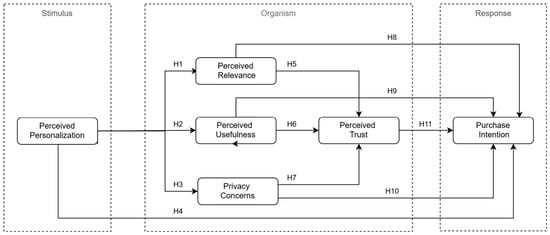
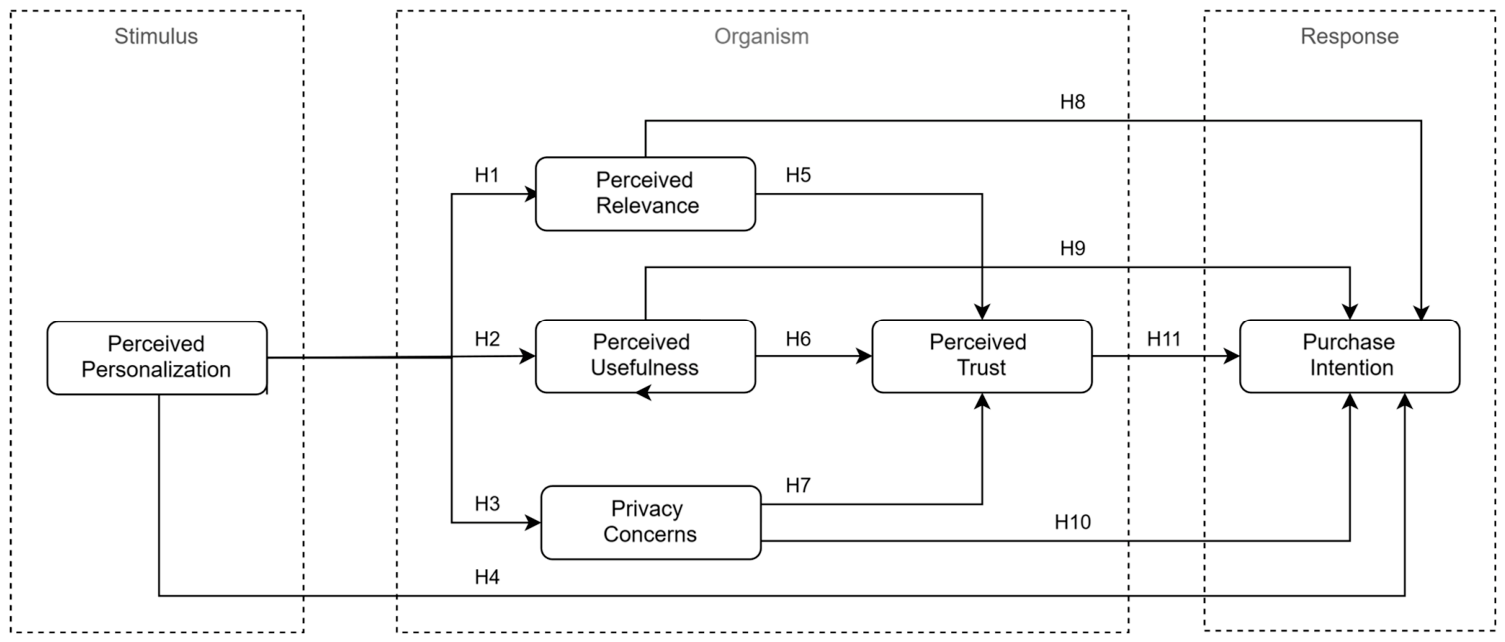
Trust does not operate in isolation. As established above, perceived relevance, usefulness, and privacy concerns each may exert both direct effects on purchase intention and indirect effects through trust, a dual-pathway structure reflecting the logic of the SOR model (Mehrabian & Russell, 1974). Whether this mediation is full or partial is an empirical question addressed in the Results through bootstrapped indirect effect analysis. Figure 1 presents the full research model integrating all eleven hypotheses.
Figure 1.
Research Model.
3. Materials and Methods
3.1. Questionnaire Design and Measures
A structured self-administered questionnaire operationalized six latent constructs through 24 reflective items rated on a five-point Likert scale (1 = Strongly Disagree; 5 = Strongly Agree). All items were drawn from validated scales: perceived personalization from Tran (2017) and Baek and Morimoto (2013); perceived relevance from Alalwan (2018) and Odoom (2022); perceived usefulness from Davis (1989); perceived trust from Helal et al. (2023); privacy concerns from Dolnicar and Jordaan (2007) and Odoom (2022); purchase intention from Alalwan (2018) and Odoom (2022). The five-point format maintained fidelity to the validated scales and ensured accessibility across varying levels of digital literacy. The original English version was used for Lebanese respondents. For the Turkish sample, the instrument was translated by a professional translator and subsequently reviewed item by item by a native Turkish-speaking academic co-researcher with domain expertise in marketing and consumer behavior to ensure linguistic equivalence and cultural appropriateness; a formal back-translation procedure was not employed. Measurement equivalence was instead assessed empirically through the MICOM procedure, which established partial measurement invariance across the two language versions (Section 4). All items are included in Table 1.
Table 1.
Measurement Constructs and Items.
3.2. Sampling and Data Collection
Prior to data collection, the minimum required sample size was determined using the item-to-response ratio guideline of 1:10 (Hair et al., 2019). With 24 observed indicators, this yielded a minimum of 240 responses; the combined sample of 802 substantially exceeds this threshold. In addition to the item-to-response ratio, an a priori power analysis was conducted using G*Power 3.1 (Faul et al., 2009). Based on the maximum number of predictors directed at a single endogenous construct in the model (five predictors of purchase intention), detecting a medium effect size (f2 = 0.15) at α = 0.05 with a statistical power of 0.95 requires a minimum sample of 138 respondents. Both country subsamples (Lebanon, n = 394; Türkiye, n = 408) comfortably surpass this requirement, ensuring adequate power for the PLS-SEM and multigroup analyses.
Using convenience sampling, data were collected from Lebanon and Türkiye using an online Google Forms survey distributed via LinkedIn, WhatsApp, and Instagram over approximately ten weeks (8 March–17 May 2026). As the model applies to social-media-using, ad-exposed consumers, recruiting through these platforms aligned the sample with the target population, supporting analytic rather than descriptive generalization (Hair et al., 2019). The same three platforms were used in both countries to ensure comparable recruitment exposure. Two screening questions were applied: “Do you have experience purchasing products or services online?” and “Have you been exposed to personalized advertisements on social media or online platforms?” Only respondents answering “yes” to both proceeded with the main survey. Responses were further excluded for completion times under two minutes, missing data, straight-line patterns, or internal inconsistency. In total, 843 responses were collected (411 in Lebanon; 431 in Türkiye). Item-level missing data were precluded by design, as all survey items were mandatory. Following quality control, 41 responses were excluded: 17 from Lebanon and 24 from Türkiye for completion times under two minutes, straight-line response patterns, or internal inconsistency, yielding 802 usable responses (394 from Lebanon; 408 from Türkiye).
The combined sample was predominantly young and highly educated across both markets, consistent with social media-based recruitment. Lebanon’s sample skewed younger (42.9% aged 18 to 25) and included a higher share of postgraduate degree holders (38.1% holding a master’s or PhD, versus 18.1% in Türkiye), while occupational and income distributions were broadly comparable across the two countries. Both samples were predominantly female (68.5% in Lebanon; 70.3% in Türkiye). Daily social media use was high in both samples, with most respondents reporting four to six hours of daily use. This age and education gap is addressed in the Section 5.4.2 as a plausible alternative explanation, alongside digital market maturity, for the one divergent structural path. The demographics of the sample are presented in detail in Table 2.
Table 2.
Demographic Profile of Respondents.
3.3. Common Method Bias Assessment
As data came from a single self-report source, potential common method bias (CMB) was assessed. Following Podsakoff et al. (2003), several procedural remedies were implemented at the design stage. First, the questionnaire was structured clearly, with distinct sections, headings, and introductory notes, helping to separate constructs and reduce respondents’ ability to infer hypothesized relationships, mitigating consistency-motivation bias. Second, to minimize social desirability bias and evaluation apprehension, respondents were assured of confidentiality and anonymity and told the data would be used solely for academic purposes (Fisher, 1993). Participants were also advised that there were no right or wrong answers and encouraged to respond based on genuine perceptions. In addition to procedural remedies, common method bias was assessed statistically using Kock’s (2015) full collinearity approach. All inner VIF values were below the 3.3 threshold, indicating that common method bias is not a concern in the structural model (see Table A1).
3.4. Analytical Procedure
Data were analyzed in SmartPLS 4. PLS-SEM was selected for its suitability with complex models, robustness to non-normal data, and predictive orientation (Hair et al., 2019), consistent with the study’s exploratory extension of established frameworks to a new cross-national context. The analysis proceeded in four stages. First, the measurement model was assessed for internal consistency, reliability, convergent validity, discriminant validity (Henseler et al., 2016), and collinearity. Second, the structural model was evaluated via bootstrapped path coefficients and bootstrapped indirect effects. Because the two samples differed in age and education composition (Table 2), age group and education level were included as control variables on purchase intention to rule out demographic composition as an alternative explanation for the structural estimates and cross-national differences. Third, measurement invariance was established through the three-step MICOM procedure (Henseler et al., 2016). Fourth, permutation-based MGA was used to test cross-national path differences. Both the MICOM procedure and the MGA were conducted using 1000 permutations at the 5% significance level, and bootstrapped estimates were based on 5000 subsamples.
4. Results
4.1. Measurement Model Assessment
All constructs demonstrated adequate to excellent reliability across both samples, with Cronbach’s α and composite reliability (ρc) exceeding 0.70 (Hair et al., 2019). All AVE values exceeded the 0.50 convergent validity threshold, with perceived personalization marginally adequate (AVE = 0.544 Lebanon; 0.527 Türkiye; Table 3). Full indicator outer loadings with bootstrap t-values for both subsamples are reported in Appendix A Table A2. All loadings were significant at p < 0.001; PP1 and PP4 loaded below the 0.708 ideal and were retained given adequate AVE and composite reliability (Hair et al., 2019).
Table 3.
Construct Reliability and Convergent Validity.
Discriminant validity was tested using HTMT, with all ratios below 0.85, the closest being PU–PR in Türkiye (HTMT = 0.833), reflecting theoretical construct proximity (Henseler et al., 2015; Table 4).
Table 4.
Discriminant Validity (Heterotrait–Monotrait Ratio, HTMT).
Discriminant validity was further confirmed via the Fornell-Larcker criterion, where the square root of each construct’s AVE exceeded its correlations with all other constructs (Table 5; Fornell & Larcker, 1981).
Table 5.
Discriminant Validity (Fornell-Larcker Criterion).
All inner VIF values remained below 3.3, confirming the absence of structural multicollinearity. A few outer VIF values in the Turkish subsample exceeded 5.0 (PT2 = 6.033; PT3 = 5.088; PI2 = 5.631), reflecting expected indicator overlap within reflective scales rather than a measurement problem. Re-estimating the model without the flagged indicators changed all coefficients by less than 0.04 with no change in significance patterns, confirming estimate stability (Table A1).
Model fit was acceptable in both samples, with SRMR values of 0.061 (Lebanon) and 0.065 (Türkiye) below the 0.08 threshold. Together, the explanatory power, coherent path estimates, mediation structure, and acceptable fit support the proposed model across both contexts.
4.2. Structural Model Assessment
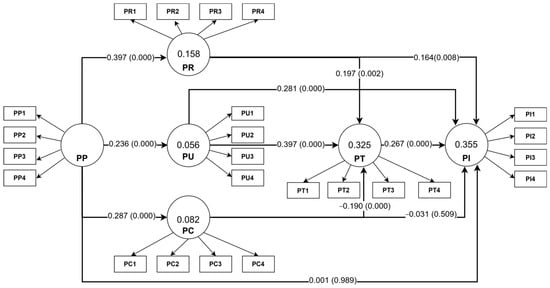
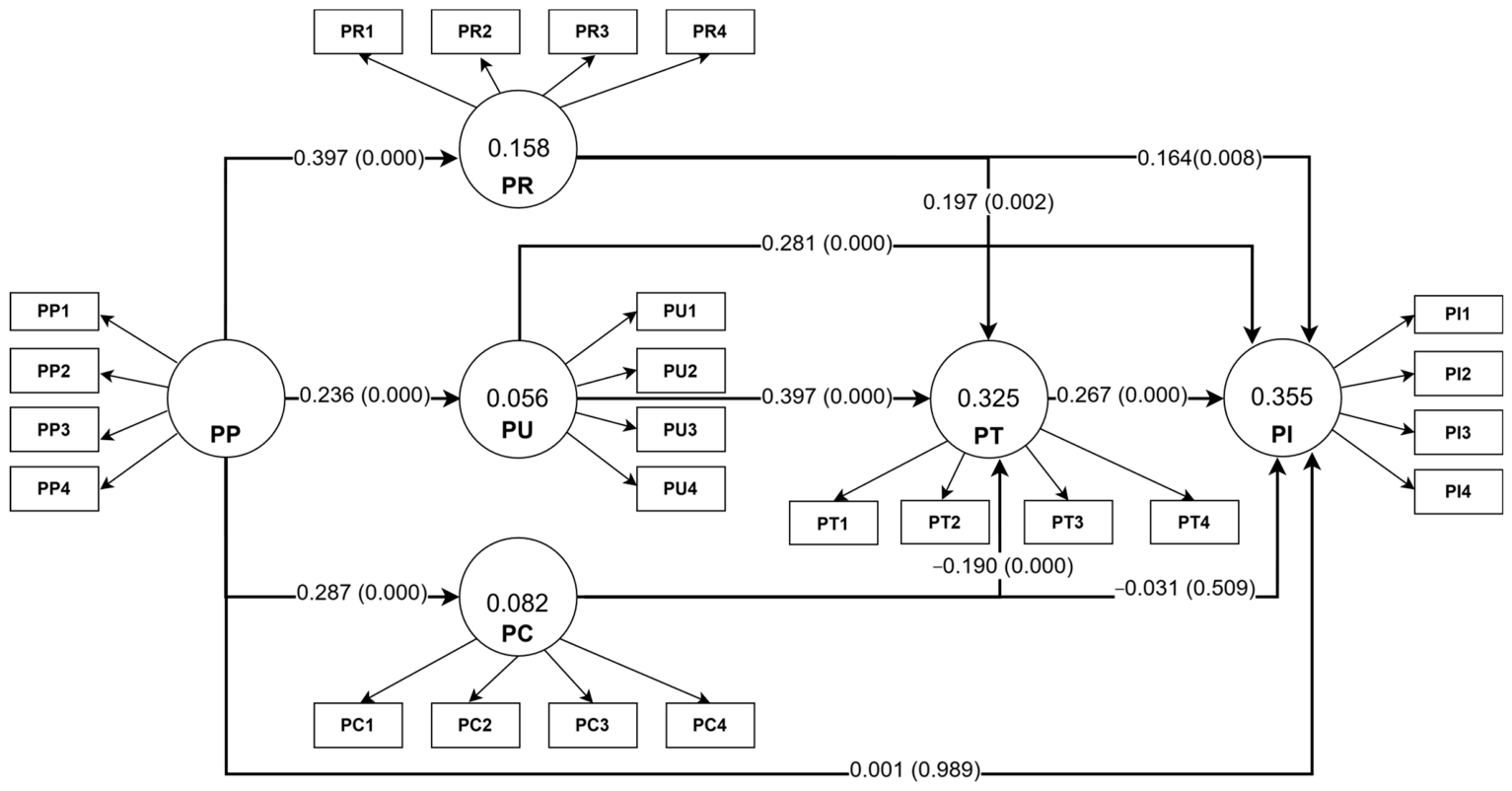
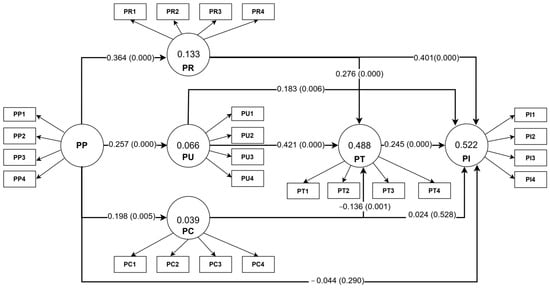
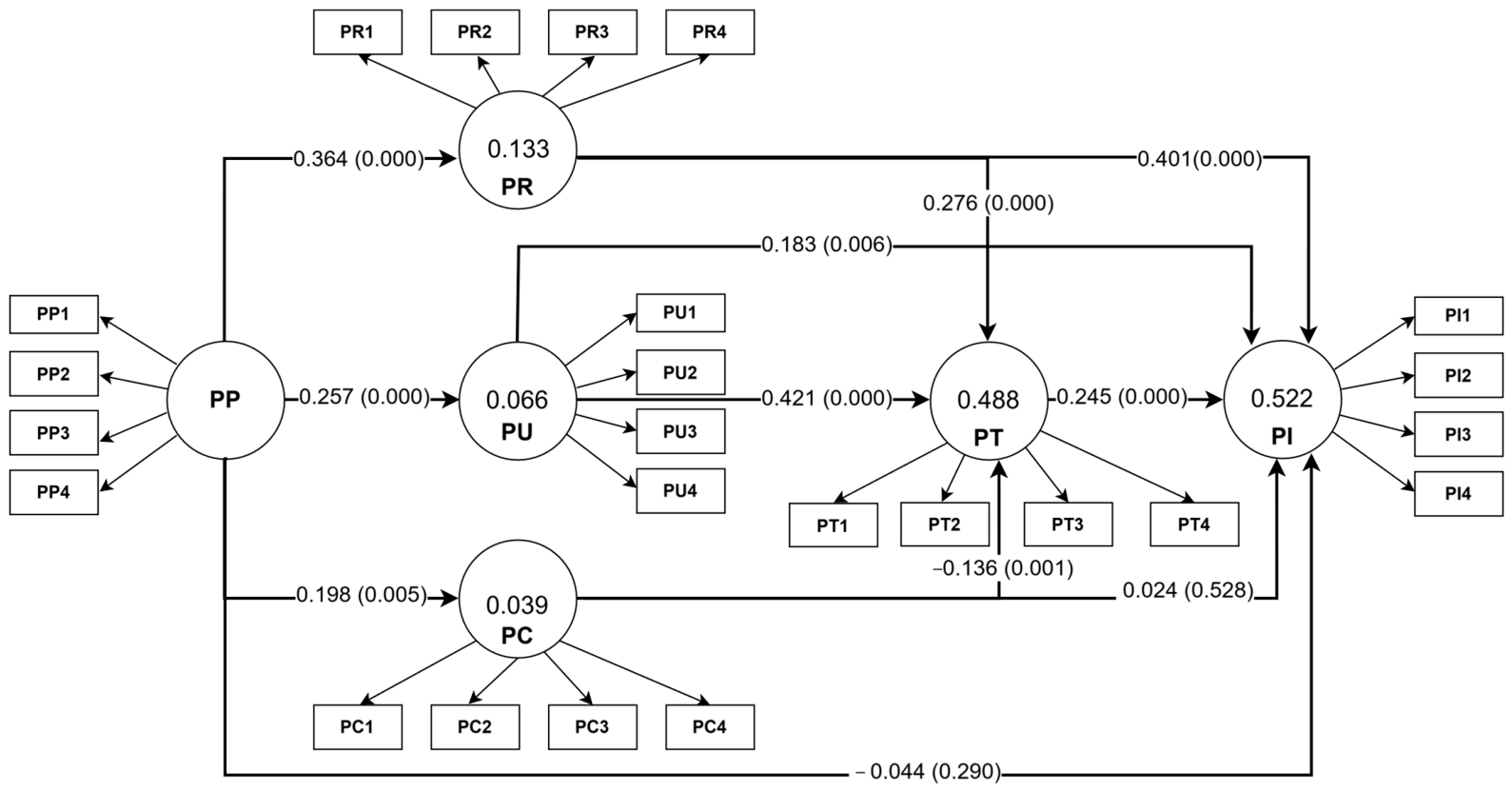
The structural model was assessed following Hair et al. (2019), with path coefficients tested through bootstrapping (5000 subsamples) and bias-corrected confidence intervals. The hypothesized relationships were supported in both samples except the direct effects of personalization (H4) and privacy concerns (H10) on purchase intention, which were non-significant in both countries. Effect sizes corroborated this structure: the personalization-to-relevance path was largest in both samples, and the relevance-to-purchase effect was markedly stronger in Türkiye. Full path coefficients, effect sizes, and hypothesis outcomes appear in Table 6; the estimated structural models, with standardized coefficients and R2 values, are shown for Lebanon and Türkiye in Figure 2 and Figure 3.
Table 6.
Structural Path Coefficients, Effect Sizes, and Hypothesis Outcomes.
Figure 2.
Estimated structural model—Lebanon (n = 394). Values on paths are standardized coefficients with p-values in parentheses; the value within each endogenous construct is R2.
Figure 3.
Estimated structural model—Türkiye (n = 408). Values on paths are standardized coefficients with p-values in parentheses; the value within each endogenous construct is R2.
After including age group and education level as controls on purchase intention, neither reached significance in either subsample (Lebanon: age β = −0.077, p = 0.076; education β = −0.098, p = 0.052; Türkiye: age β = −0.029, p = 0.398; education β = −0.005, p = 0.866), and all hypothesized paths retained their magnitude and significance. The multigroup comparison of the controlled model likewise confirmed that the relevance → purchase intention path remained significantly stronger in Türkiye (Δβ = 0.231, p = 0.016), while no other path differed significantly across countries. Full estimates are reported in Appendix A Table A3.
The model demonstrated satisfactory explanatory power in both markets, with perceived trust emerging as the most strongly determined mediator (Table 7).
Table 7.
Model Explanatory Power (R2 and Adjusted R2).
Bootstrapped specific indirect effects (Table 8) clarified the mediating structure. Personalization exerted significant indirect effects on purchase intention through perceived relevance and usefulness in both samples, yielding a significant total indirect effect (β = 0.154 Lebanon; β = 0.196 Türkiye), whereas its two-step path via privacy concerns (PP → PC → PI) was non-significant, confirming that privacy concerns act on purchase intention solely through trust erosion. Because relevance and usefulness retained significant direct effects (H8, H9) alongside their effects through trust, trust serves as a complementary (partial) mediator for these constructs, while personalization and privacy concerns, lacking any direct effect (H4, H10), display indirect-only (full) mediation (Nitzl et al., 2016).
Table 8.
Bootstrapped Specific and Total Indirect Effects.
4.3. Measurement Invariance and Multigroup Analysis
Prior to multigroup comparison, measurement invariance was assessed using the three-step MICOM procedure (Henseler et al., 2016). Configural invariance was confirmed through identical model specification across both samples, and compositional invariance was established for all six constructs, with all Step 2 permutation p-values exceeding 0.05 (Table 9). Steps 3a and 3b revealed significant mean and/or variance differences for several constructs, yielding partial rather than full invariance. Partial invariance permits valid comparison of structural path coefficients across groups while precluding confident latent mean comparisons (Henseler et al., 2016). This constraint is observed throughout the Discussion: all cross-national comparisons are restricted to path coefficients and effect sizes, and any reference to construct-level differences is framed as speculative interpretation not supported by the invariance findings.
Table 9.
MICOM Results—Measurement Invariance Assessment.
Permutation-based MGA revealed that ten of eleven structural paths showed no significant cross-national difference (p > 0.05, two-tailed), supporting the broad generalizability of the proposed model (Table 10). One path differed: the effect of perceived relevance on purchase intention was stronger in Türkiye (β = 0.401) than in Lebanon (β = 0.164; difference = 0.237, p = 0.010).
Table 10.
Multigroup Analysis Results—Lebanon vs. Türkiye.
5. Discussion
Our findings support the SOR-grounded model across both national contexts. Perceived personalization, as the stimulus, activated the three first-level organism-stage evaluations: perceived relevance, perceived usefulness, and privacy concerns. These three evaluations in turn converged on perceived trust, the second-level, integrative organism-stage construct, with relevance and usefulness building trust and privacy concerns eroding it. At the response stage, purchase intention was driven directly by perceived relevance, perceived usefulness, and perceived trust, while privacy concerns reached intention only indirectly through trust erosion. Personalization exerted no direct effect on purchase intention in either market, while its total indirect effect through the organism stage was significant in both contexts, confirming that AI-driven advertising operates as a coherent stimulus-organism-response process rather than a direct stimulus-response mechanism.
5.1. Personalization as Stimulus: Activating Organism-Stage Evaluations
Perceived personalization successfully activated the first-level organism-stage evaluations. The strongest activation was the personalization-to-relevance path in both samples, consistent with Arora et al. (2025) finding that perceived ad personalization positively influences perceived relevance in social media contexts. The weaker personalization-to-usefulness path relative to relevance suggests that consumers more readily translate personalization into content-goal alignment than into functional task efficiency. Teepapal (2025) similarly found that AI-enabled personalization positively influences perceived usefulness in social media contexts, corroborating the usefulness pathway identified in this study.
The personalization-to-privacy concerns path was significant in both markets but weaker in Türkiye (β = 0.198) than Lebanon (β = 0.287), mirroring De Keyzer et al. (2024) finding that personalization raises privacy concerns without necessarily triggering creepiness. The comparatively low R2 for privacy concerns in Türkiye (0.039) suggests that in more digitally mature markets, privacy concerns are driven more by dispositional and regulatory factors than by personalization exposure alone, consistent with Gupta et al. (2025) finding that regulatory awareness critically shapes perceived trust and acceptance of AI personalization in emerging digital markets. A parallel pattern in Lebanon (R2 = 0.082) indicates this is not solely a function of market maturity: in both samples, privacy concerns proved largely exogenous to the advertising encounter, which qualifies their treatment as an organism-stage response and suggests that personalization intensity governs when privacy concern becomes salient rather than how much concern consumers hold, pointing toward specification as a moderating disposition rather than a mediating response (Dai et al., 2025).
5.2. The Absence of Direct Personalization Effects: SOR Mechanism Confirmed
The non-significant direct effect of personalization on purchase intention in both markets confirms the SOR framework’s prediction that stimuli reach behavioral responses exclusively through organism-stage appraisals (Mehrabian & Russell, 1974). Personalization has no behavioral force of its own; it acts only by generating the organism-stage evaluations that follow. The significant total indirect effect of personalization on purchase intention in both countries (β = 0.142 Lebanon; β = 0.243 Türkiye) confirms that personalization matters, but only through the organism stage it activates, extending prior work showing personalization’s effectiveness is contingent on the value it generates (Alalwan, 2018; Kumar et al., 2025; My & Phong, 2025; Teepapal, 2025).
5.3. Organism-Stage Evaluations, Trust, and Purchase Intention
The organism stage comprises four constructs: perceived relevance, perceived usefulness, privacy concerns, and perceived trust. The first three shaped trust in precisely the directions hypothesized, with trust functioning as the integrative organism-stage construct that accumulates the net effect of value and risk appraisals before translating them into behavioral intention.
Perceived usefulness emerged as the strongest trust driver in both samples (β = 0.397 Lebanon; β = 0.421 Türkiye), aligning with TAM’s proposition that functional value evaluations drive technology acceptance and confidence (Davis, 1989), and with Kumar et al. (2025) observation that personalization positively relates to buying intention when perceived trust dominates. The relevance-to-trust path confirms that content-goal alignment functions as a competence signal: when recommendations accurately reflect consumer preferences, consumers attribute reliability and integrity to the system (Mayer et al., 1995). The privacy-to-trust erosion path confirms PCT’s prediction that perceived data exposure undermines confidence in AI systems, consistent with Menard and Bott’s (2025) finding that AI-related privacy concerns significantly decrease trusting beliefs and with Canhoto et al.’s (2024) observation that consumers attempt to control access to private information.
Perceived relevance and usefulness reached purchase intention through both direct and trust-mediated routes, constituting partial mediation, whereas privacy concerns reached purchase intention only through trust erosion, constituting full mediation, confirmed by the non-significant H10 direct path. Trust is therefore not a uniform mediator: it is the necessary and complete gate through which risk translates into behavioral restraint, but only one of several routes through which value translates into action. Functional value can move behavior even before trust fully accumulates, while privacy risk cannot suppress behavior unless it has first degraded trust. This extends Odoom’s (2022) finding of no direct privacy concern effect on purchase intention to an AI-specific cross-national context. This full-mediation pattern also refines privacy calculus reasoning: rather than privacy risk operating as an independent cost alongside personalization’s benefits, the present findings indicate that in this context, privacy discomfort is entirely absorbed into trust evaluation before reaching purchase intention. This is consistent with earlier privacy calculus research showing that trust and personal interest in a platform can outweigh privacy risk perceptions in decisions to disclose personal information online (Dinev & Hart, 2006).
The direct effect of relevance on purchase intention is consistent with Alalwan (2018) findings that relevance is a direct behavioral driver of purchase intention. The present study extends this by showing relevance also operates indirectly through trust, revealing a dual-pathway structure seldom captured in prior single-mechanism models. The direct usefulness-to-intention path is consistent with TAM’s instrumental logic (Davis, 1989). Trust’s direct effect on purchase intention (β = 0.267 Lebanon; β = 0.245 Türkiye) confirms the well-established trust-intention link in digital commerce (Handoyo, 2024), positioning trust as the organism-stage convergence point where competing value and risk appraisals are reconciled before reaching behavior.
The trust mechanism identified in this study bears directly on the emerging literature on algorithmic transparency and Explainable AI (XAI). This stream of research holds that rendering algorithmic reasoning legible to users is a central condition for trust in AI systems (Rai, 2020), and has recently extended to marketing contexts, including personalized recommendation and targeted advertising (Alijoyo et al., 2025; Nizette & Hammedi, 2025). The present findings sharpen this proposition by specifying where explainability should exert its influence: given that privacy concerns affected purchase intention exclusively through trust, interventions that clarify how personal data inform recommendations address precisely the algorithmic opacity from which such concerns arise (Kim & Han, 2025; Menard & Bott, 2025). Transparency, on this account, is not a generic reassurance strategy but a theoretically targeted trust-building mechanism operating at the single point where privacy risk translates into behavioral consequence. The trust-centered model advanced here thereby contributes to the XAI-in-marketing literature a testable consumer-behavior pathway from algorithmic opacity through privacy concern and trust to purchase intention within which the effects of explainable personalization can be formally theorized and empirically examined.
5.4. Cross-National Consistency and the Single Divergent Path
Ten of eleven structural paths showed no significant cross-national difference, supporting broad generalizability of the SOR mechanism, consistent with Riandhi et al. (2025) finding that consumer attitudes and behavioral intentions emerge as primary mediators of AI adoption. The single significant divergence, the relevance-to-purchase intention path being stronger in Türkiye (β = 0.401) than Lebanon (β = 0.164; difference = 0.237, p = 0.010), identifies a boundary condition the mechanism does not generalize across. This divergence concerns the strength of the relevance-purchase intention relationship, not the underlying level of relevance itself, since partial invariance supports comparing paths but not construct means. The market maturity explanation that follows is therefore offered as a plausible reading of this path difference, not a directly tested claim. In Türkiye’s more digitally mature environment, relevant content functions as a near-direct behavioral trigger consistent with Yin et al.’s (2025) finding that relevance directly promotes clicking intention. In Lebanon, the relevance-to-purchase pathway requires trust as a strengthening intermediary, suggesting that in less mature markets confidence in the system must be established before relevance reliably converts to purchase. This implies the SOR mechanism is broadly universal, with its directness potentially scaling with digital market maturity. This finding resonates with Riandhi et al.’s (2025) call for cross-cultural investigations as a priority research agenda.
5.4.1. Contributions and Implications
Theoretical Implications
This study makes three theoretical contributions. First, it provides empirical evidence that perceived relevance, usefulness, and privacy concerns influence purchase intention through different mediation pathways, highlighting the central role of trust in AI-driven advertising.
Second, it provides evidence consistent with the model’s mediation typology: personalization reaches purchase intention only indirectly, through relevance, usefulness, and trust-mediated pathways, while privacy concerns reach purchase intention exclusively through trust. Relevance and usefulness operate both through trust and directly (partial mediation), resolving whether personalization acts directly or indirectly and confirming trust as the sole channel through which privacy risk reaches behavior.
Third, this study is among the first to subject the personalization-trust-intention mechanism to a formal cross-national invariance test. Consistency across ten of eleven paths indicates the mechanism is more universal than single-country studies imply. In contrast, the lone divergence, a stronger relevance-to-purchase intention path in Türkiye, plausibly reflects digital market maturity rather than cultural values. However, demographic composition cannot yet be ruled out as an alternative account. This boundary condition identifies where the mechanism’s underlying strength varies and requires direct measurement of market maturity to resolve definitively.
Practical Implications
The findings offer actionable guidance for online retailers and digital marketers in Lebanon, Türkiye, and comparable emerging markets. Since perceived usefulness is the strongest trust driver, AI advertising should prioritize functional value over targeting precision; personalization that sacrifices consumer benefit for algorithmic accuracy risks engagement without conversion.
The full mediation of privacy concerns through trust highlights the importance of transparent data practices. The priority is not eliminating privacy concerns but ensuring trust remains strong enough to absorb them through clear data disclosures and opt-in mechanisms. For marketing managers, this carries a direct prescription: privacy objections do not deter purchase directly, but corrode the trust on which purchase depends, so investments in verifiable trust signals, transparent data practices, visible compliance, and explainable recommendations can outperform generic privacy assurances.
Market-specific calibration is warranted: in Türkiye, relevance functions as a stronger near-direct behavioral trigger, converting to purchase intention with less reliance on trust, while in Lebanon, relevance still drives purchase directly but relies more heavily on trust to reach its full effect. The broad cross-national consistency nonetheless supports a unified framework calibrated for local digital maturity rather than fundamentally different country strategies.
Policy Implications
The erosion of trust by privacy concerns carries direct regulatory implications. Türkiye’s data protection legislation already mandates transparency in data-driven advertising, while Lebanon’s draft Personal Data Protection Law offers an opportunity to establish comparable standards before AI advertising becomes further entrenched. Policymakers should consider requiring plain-language disclosure of how behavioral data generates recommendations, robust consent frameworks, and algorithmic transparency audits for high-volume platforms. The cross-national robustness of the trust-to-purchase mechanism suggests that region-wide data governance frameworks could produce consistent consumer protection outcomes across MENA digital markets.
5.4.2. Limitations and Future Research
Several limitations warrant consideration. First, the study relies on self-reported intentions rather than observed behavior; future research should integrate behavioral data to test whether the mediation pathways hold in actual purchase behavior. The cross-sectional design compounds this constraint: it prevents examination of how trust evolves through repeated exposure and precludes causal inference, since reverse relationships such as trust shaping relevance and usefulness perceptions cannot be ruled out. The estimated paths should therefore be read as associations consistent with the hypothesized directionality, and longitudinal designs are needed to establish causal ordering and to assess whether personalization-driven trust accumulates, erodes after privacy violations, or plateaus with habituation.
Second, convenience sampling through social media limits generalizability. The sample skewed younger, more educated, and digitally active, so the non-significant direct path from privacy concerns to purchase intention may partly reflect sample composition rather than structure and warrants retesting on more privacy-sensitive groups. The findings accordingly generalize to theory rather than to the national populations of either country, and probability-based sampling should re-examine whether the indirect-only mediation of privacy concerns holds across more diverse consumer segments. Although age and education controls left the cross-national difference intact, directly measuring market maturity would allow these explanations to be tested rather than inferred.
Additionally, some measurement properties warrant acknowledgment. The AVE of perceived personalization, while exceeding the 0.50 threshold, was borderline in both samples (0.544 in Lebanon; 0.527 in Türkiye), reflecting the below-ideal loadings of PP1 and PP4 (Table 3), and the HTMT ratio between perceived usefulness and perceived relevance in the Türkiye sample (0.833) approached the 0.85 threshold. Although all values remain within accepted bounds, these borderline results suggest that the personalization construct may benefit from refined indicators, and that usefulness and relevance evaluations may partially overlap in consumers’ minds; future studies should consider revalidated or extended scales for these constructs.
Finally, AI transparency was not modeled despite its relevance to the privacy–trust pathway; incorporating perceived algorithmic transparency would enrich the framework and connect it to regulatory debates on algorithmic disclosure.
6. Conclusions
This study examined how AI-driven personalized advertising shapes perceived trust and purchase intention across Lebanon and Türkiye, integrating SOR, TAM, PCT, and TAT. Using PLS-SEM with MICOM and permutation-based MGA on 802 respondents, nine of eleven hypotheses were supported, and ten of eleven structural paths were cross-nationally invariant. Perceived personalization acted as the stimulus activating three organism-stage evaluations, relevance, usefulness, and privacy concerns, that shaped trust and, through it, purchase intention. Personalization never reached purchase intention directly. Relevance and usefulness acted both directly and through trust, whereas privacy concerns influenced purchase intention only via trust. Structural relationships were broadly consistent across both countries; only the relevance-to-purchase effect differed, proving stronger in Türkiye, a difference plausibly reflecting greater digital market maturity. Trust, therefore, must be cultivated through perceived value rather than personalization alone, making trust-building rather than privacy reassurance the more productive managerial lever.
Supplementary Materials
The following supporting information can be downloaded at: https://www.mdpi.com/article/10.3390/admsci16080396/s1. File S1: Dataset used in the analysis, including data for Lebanon and Türkiye (provided in separate worksheets).
Author Contributions
Conceptualization, S.D.; methodology, S.D. and H.H.; software, H.H.; validation, S.D., H.H., M.K. and T.A.; formal analysis, S.D. and H.H.; investigation, S.D., M.K. and M.N.T.; resources: M.K. and M.N.T.; data curation, M.N.T. and N.A.F.; writing—original draft preparation, S.D. and M.K.; writing—review and editing, S.D., H.H., M.N.T., N.A.F. and T.A.; visualization, S.D.; supervision, S.D.; project administration, S.D. All authors have read and agreed to the published version of the manuscript.
Funding
This research received no external funding.
Institutional Review Board Statement
The study was conducted in accordance with the Declaration of Helsinki and approved by the Institutional Review Board (Ethics Committee) of USAL University, Lebanon (protocol code: 2026-000, Date of approval: 27 February 2026).
Informed Consent Statement
Informed consent was obtained from all subjects involved in the study. Participants were informed of the voluntary and anonymous nature of participation and that their responses would be used solely for academic research purposes prior to completing the survey instrument.
Data Availability Statement
The data supporting the findings of this study are available in the Supplementary Materials. The Supplementary File contains the datasets used in the analysis for Lebanon and Türkiye, provided in separate worksheets. Further inquiries can be directed to the corresponding author.
Acknowledgments
During the preparation of this study, the authors used Claude 3.5 Sonnet and Grammarly (v1.2.285.1937) for the purposes of enhancing English. The authors have reviewed and edited the output and take full responsibility for the content of this publication.
Conflicts of Interest
The authors declare no conflicts of interest.
Abbreviations
The following abbreviations are used in this manuscript:
| AVE | Average Variance Extracted |
| CI | Confidence Interval |
| HTMT | Heterotrait-Monotrait Ratio |
| MGA | Multigroup Analysis |
| MICOM | Measurement Invariance of Composite Models |
| PC | Privacy Concerns |
| PCT | Privacy Calculus Theory |
| PI | Purchase Intention |
| PLS-SEM | Partial Least Squares Structural Equation Modeling |
| PP | Perceived Personalization |
| PR | Perceived Relevance |
| PT | Perceived Trust |
| PU | Perceived Usefulness |
| SOR | Stimulus Organism Response |
| SRMR | Standardized Root Mean Square Residual |
| TAM | Technology Acceptance Model |
| TAT | Trust in Automation Theory |
| VIF | Variance Inflation Factor |
Appendix A
Table A1.
Collinearity Assessment (Variance Inflation Factors, VIF).
Table A2.
Indicator Outer Loadings, Lebanon and Türkiye Subsamples.
Table A3.
Structural Model Estimates with Age and Education as Control Variables.
References
- Abdel Monem, H. (2021). The effectiveness of advertising personalization. Journal of Design Sciences and Applied Arts, 2(1), 335–344. [Google Scholar] [CrossRef] [Scilit]
- Alalwan, A. A. (2018). Investigating the impact of social media advertising features on customer purchase intention. International Journal of Information Management, 42, 65–77. [Google Scholar] [CrossRef] [Scilit]
- Alijoyo, F. A., Aziz, T. S. A., Omer, N., Yusuf, N., Kumar, M. D., Ramesh, A. V. N., Ulmas, Z., & Baker El-Ebiary, Y. A. (2025). Personalized marketing: Leveraging AI for culturally aware segmentation and targeting. Alexandria Engineering Journal, 119, 8–21. [Google Scholar] [CrossRef] [Scilit]
- An, G. K., & Ngo, T. T. A. (2025). AI-powered personalized advertising and purchase intention in Vietnam’s digital landscape: The role of trust, relevance, and usefulness. Journal of Open Innovation: Technology, Market, and Complexity, 11(3), 100580. [Google Scholar] [CrossRef] [Scilit]
- Arora, N., Rahman, A., Rana, M., Prashar, S., & Palacios-Marques, D. (2025). Personalized advertising on social media: Is it building desired customer attitude? FIIB Business Review. [Google Scholar] [CrossRef] [Scilit]
- Baek, T. H., & Morimoto, M. (2013). Stay away from me. Journal of Advertising, 41, 59–76. [Google Scholar] [CrossRef] [Scilit]
- Boerman, S. C., Kruikemeier, S., & Zuiderveen Borgesius, F. J. (2017). Online behavioral advertising: A literature review and research agenda. Journal of Advertising, 46(3), 363–376. [Google Scholar] [CrossRef] [Scilit]
- Bol, N., Dienlin, T., Kruikemeier, S., Sax, M., Boerman, S. C., Strycharz, J., Helberger, N., & de Vreese, C. H. (2018). Understanding the effects of personalization as a privacy calculus: Analyzing self-disclosure across health, news, and commerce contexts. Journal of Computer-Mediated Communication, 23(6), 370–388. [Google Scholar] [CrossRef] [Scilit]
- Canhoto, A. I., Keegan, B. J., & Ryzhikh, M. (2024). Snakes and ladders: Unpacking the personalisation-privacy paradox in the context of ai-enabled personalisation in the physical retail environment. Information Systems Frontiers, 26(3), 1005–1024. [Google Scholar] [CrossRef] [Scilit] [PubMed]
- Celsi, R. L., & Olson, J. C. (1988). The role of involvement in attention and comprehension processes. Journal of Consumer Research, 15(2), 210–224. [Google Scholar] [CrossRef] [Scilit]
- Chang, C.-Y., Park, S., & Dinh, M. C. (2026). Advice by algorithms: Dual dimensions of trust in AI financial service adoption. Journal of Retailing and Consumer Services, 88, 104537. [Google Scholar] [CrossRef] [Scilit]
- Cloarec, J., Meyer-Waarden, L., & Munzel, A. (2024). Transformative privacy calculus: Conceptualizing the personalization-privacy paradox on social media. Psychology and Marketing, 41(7), 1574–1596. [Google Scholar] [CrossRef] [Scilit]
- Cohen, J. (1988). Statistical power analysis for the behavioral sciences (2nd ed.). Lawrence Erlbaum Associates, Publishers. [Google Scholar]
- Culnan, M. J., & Armstrong, P. K. (1996). Information privacy concerns, procedural fairness and impersonal trust: An empirical investigation. Organization Science, 10(1), 104–115. [Google Scholar] [CrossRef] [Scilit]
- Dai, B., Zhu, J., & Zhu, X. (2025). The impact of AI-recommended content affordances on post-purchase intention in stockout substitution scenarios. Behavioral Sciences, 15(11), 1507. [Google Scholar] [CrossRef] [Scilit] [PubMed]
- Davis, F. (1989). Perceived usefulness, perceived ease of use, and user acceptance of information technology. MIS Quarterly, 13(3), 319–340. [Google Scholar] [CrossRef] [Scilit] [PubMed]
- de Groot, J. I. M. (2022). The personalization paradox in facebook advertising: The mediating effect of relevance on the personalization–brand attitude relationship and the moderating effect of intrusiveness. Journal of Interactive Advertising, 22(1), 57–74. [Google Scholar] [CrossRef] [Scilit]
- De Keyzer, F., Buzeta, C., & Lopes, A. I. (2024). The role of well-being in consumer’s responses to personalized advertising on social media. Psychology and Marketing, 41(6), 1206–1222. [Google Scholar] [CrossRef] [Scilit]
- Dinev, T., & Hart, P. (2006). An extended privacy calculus model for e-commerce transactions. Information Systems Research, 17(1), 61–80. [Google Scholar] [CrossRef] [Scilit]
- Dolnicar, S., & Jordaan, Y. (2007). A market-oriented approach to responsibly managing information privacy concerns in direct marketing. Journal of Advertising, 36(2), 123–149. [Google Scholar] [CrossRef] [Scilit]
- Faul, F., Erdfelder, E., Buchner, A., & Lang, A.-G. (2009). Statistical power analyses using G*Power 3.1: Tests for correlation and regression analyses. Behavior Research Methods, 41(4), 1149–1160. [Google Scholar] [CrossRef] [Scilit] [PubMed]
- Fisher, R. (1993). Social desirability bias and the validity of indirect questioning. Journal of Consumer Research, 20, 303–315. [Google Scholar] [CrossRef] [Scilit] [PubMed]
- Fornell, C., & Larcker, D. F. (1981). Evaluating structural equation models with unobservable variables and measurement error. Journal of Marketing Research, 18(1), 39–50. [Google Scholar] [CrossRef] [Scilit]
- Gefen, D., Karahanna, E., & Straub, D. (2003). Trust and TAM in online shopping: An integrated model. MIS Quarterly, 27, 51–90. [Google Scholar] [CrossRef] [Scilit]
- Gupta, S., Sharma, L., & Mathew, R. (2025). Balancing personalization and privacy in AI-enabled marketing consumer trust, regulatory impact, and strategic implications—A qualitative study using NVivo. Advances in Consumer Research, 2, 46–57. [Google Scholar]
- Hair, J. F., Risher, J. J., Sarstedt, M., & Ringle, C. M. (2019). When to use and how to report the results of PLS-SEM. European Business Review, 31(1), 2–24. [Google Scholar] [CrossRef] [Scilit]
- Handoyo, S. (2024). Purchasing in the digital age: A meta-analytical perspective on trust, risk, security, and e-WOM in e-commerce. Heliyon, 10(8), e29714. [Google Scholar] [CrossRef] [Scilit] [PubMed]
- Helal, E., Hassan, T., Abdelmoaty, M., Salem, A., Ibraheam Saleh, M., Helal, M., Abuelnasr, M., Mohamoud, Y., Abdou, A., Radwan, S., & Szabo-Alexi, P. (2023). Exploration or exploitation of a neighborhood destination: The role of social media content on the perceived value and trust and revisit intention among world cup football fans. Journal of Risk and Financial Management, 16, 210. [Google Scholar] [CrossRef] [Scilit]
- Henseler, J., Ringle, C. M., & Sarstedt, M. (2015). A new criterion for assessing discriminant validity in variance-based structural equation modeling. Journal of the Academy of Marketing Science, 43, 115–135. [Google Scholar] [CrossRef] [Scilit]
- Henseler, J., Ringle, C. M., & Sarstedt, M. (2016). Testing measurement invariance of composites using partial least squares. International Marketing Review, 33(3), 405–431. [Google Scholar] [CrossRef] [Scilit]
- Hu, S., Liu, J., Li, H., Yin, J., & Liu, X. (2025). Exploring the mechanism of AI-powered personalized product recommendation on generation Z users’ spontaneous buying intention on short-form video platforms: A perceived evaluation perspective. Journal of Theoretical and Applied Electronic Commerce Research, 20(4), 290. [Google Scholar] [CrossRef] [Scilit]
- Hu, Y., & Min, H. K. (2025). Information transparency, privacy concerns, and customers’ behavioral intentions regarding AI-powered hospitality robots: A situational awareness perspective. Journal of Hospitality and Tourism Management, 63, 177–184. [Google Scholar] [CrossRef] [Scilit]
- Huang, M.-H., & Rust, R. T. (2021). A strategic framework for artificial intelligence in marketing. Journal of the Academy of Marketing Science, 49(1), 30–50. [Google Scholar] [CrossRef] [Scilit]
- International Telecommunication Union. (2023). Measuring digital development: ICT development index 2023. Available online: https://www.itu.int/itu-d/reports/statistics/idi2023/ (accessed on 10 June 2026).
- Jeong, J., Kim, D., Li, X., Li, Q., Choi, I., & Kim, J. (2022). An empirical investigation of personalized recommendation and reward effect on customer behavior: A stimulus–organism–response (SOR) model perspective. Sustainability, 14(22), 15369. [Google Scholar] [CrossRef] [Scilit]
- Jung, T., Koghut, M., Lee, E., & Kwon, O. (2025). Artificial creativity in luxury advertising: How trust and perceived humanness drive consumer response to AI-generated content. Journal of Retailing and Consumer Services, 87, 104403. [Google Scholar] [CrossRef] [Scilit]
- Kemp, S. (2025a). Digital 2025: Lebanon. DataReportal. Available online: https://datareportal.com/reports/digital-2025-lebanon (accessed on 10 June 2026).
- Kemp, S. (2025b). Digital 2025: Turkey. DataReportal. Available online: https://datareportal.com/reports/digital-2025-turkey (accessed on 10 June 2026).
- Kim, H., & Han, S. (2025). Triggering the personalization backfire effect: The moderating role of situational privacy concern. Behavioral Sciences, 15(10), 1323. [Google Scholar] [CrossRef] [Scilit] [PubMed]
- Kock, N. (2015). Common method bias in PLS-SEM: A full collinearity assessment approach. International Journal of E-Collaboration, 11, 1–10. [Google Scholar] [CrossRef] [Scilit]
- Kumar, S. R., Alpeshkumar Patel, B., Singh, M., Khanna, C., Ayodeji Ogunmola, G., & Bhosale, Y. H. (2025). AI-powered personalization in e-commerce: Consumer perceptions, trust, and purchase decision-making. Advances in Consumer Research, 2, 3779. [Google Scholar]
- Lee, J. D., & See, K. A. (2004). Trust in automation: Designing for appropriate reliance. Human Factors, 46, 50–80. [Google Scholar] [CrossRef] [Scilit] [PubMed]
- Li, C. (2016). When does web-based personalization really work? The distinction between actual personalization and perceived personalization. Computers in Human Behavior, 54, 25–33. [Google Scholar] [CrossRef] [Scilit]
- Matute, J., Polo-Redondo, Y., & Utrillas, A. (2016). The influence of EWOM characteristics on online repurchase intention: Mediating roles of trust and perceived usefulness. Online Information Review, 40(7), 1090–1110. [Google Scholar] [CrossRef] [Scilit]
- Mayer, R. C., Davis, J. H., & David Schoorman, F. (1995). An integrative model of organizational trust. The Academy of Management Review, 20(3), 709–734. [Google Scholar] [CrossRef] [Scilit]
- McKee, K. M., Dahl, A. J., & Peltier, J. W. (2024). Gen Z’s personalization paradoxes: A privacy calculus examination of digital personalization and brand behaviors. Journal of Consumer Behaviour, 23(2), 405–422. [Google Scholar] [CrossRef] [Scilit]
- Mehrabian, A., & Russell, J. A. (1974). An approach to environmental psychology. The MIT Press. [Google Scholar]
- Menard, P., & Bott, G. J. (2025). Artificial intelligence misuse and concern for information privacy: New construct validation and future directions. Information Systems Journal, 35(1), 322–367. [Google Scholar] [CrossRef] [Scilit]
- My, D. V., & Phong, N. N. (2025). The impact of perceived personalization on customer experience and purchase intention in social commerce: The moderating role of similarity-induced confusion. European Modern Studies Journal, 9(6), 7–23. [Google Scholar] [CrossRef] [Scilit]
- Nguyen, K. M., Phan, T. M., Tran, Y. N. N., Nguyen, A. T., Nguyen, T. L. N., Hoang, G. H., Tran, T. T., & Nguyen, N. T. (2026). Evaluating the efficacy of AI-generated advertising: A cross-national analysis of customer responses on brand perceptions and customer engagement with evidence from Vietnam and Australia. Journal of Global Scholars of Marketing Science: Bridging Asia and the World, 36, 293–341. [Google Scholar] [CrossRef] [Scilit]
- Nitzl, C., Roldan, J. L., & Cepeda, G. (2016). Mediation analysis in partial least squares path modeling: Helping researchers discuss more sophisticated models. Industrial Management & Data Systems, 116(9), 1849–1864. [Google Scholar] [CrossRef] [Scilit]
- Nizette, F., & Hammedi, W. (2025). Explainable AI in marketing. In R. Ladhari (Ed.), Encyclopedia of artificial intelligence in marketing (pp. 1–13). Springer Nature. [Google Scholar] [CrossRef] [Scilit]
- Odoom, P. T. (2022). Personalised display advertising and online purchase intentions: The moderating effect of internet use motivation. International Journal of E-Services and Mobile Applications, 14(1), 1–16. [Google Scholar] [CrossRef] [Scilit]
- Petty, R., Wheeler, C., & Bizer, G. (2000). Attitude functions and persuasion: An elaboration likelihood approach to matched versus mismatched messages. Lawrence Erlbuam Associates. [Google Scholar]
- Podsakoff, P., MacKenzie, S., Lee, J.-Y., & Podsakoff, N. (2003). Common method biases in behavioral research: A critical review of the literature and recommended remedies. Journal of Applied Psychology, 88, 879–903. [Google Scholar] [CrossRef] [Scilit] [PubMed]
- Rahmawaty, P., Sunarta, S., & Nuranti, B. R. (2024). The impact of personalized advertising on consumer purchase decisions with brand trust as a mediator toward sustainable development goals (SDGs). In Proceedings of the 4th international conference on social sciences and law (ICSSL 2024) (pp. 426–442). Atlantis Press. [Google Scholar] [CrossRef] [Scilit] [PubMed]
- Rai, A. (2020). Explainable AI: From black box to glass box. Journal of the Academy of Marketing Science, 48(1), 137–141. [Google Scholar] [CrossRef] [Scilit]
- Riandhi, A. N., Arviansyah, M. R., & Sondari, M. C. (2025). AI and consumer behavior: Trends, technologies, and future directions from a scopus-based systematic review. Cogent Business & Management, 12(1), 2544984. [Google Scholar] [CrossRef] [Scilit]
- Saura, J. R., Ratten, V., & Jeremic, V. (2026). Digital cognition in predictive marketing personalization: A conceptual framework. Psychology & Marketing, 43(5), 1228–1260. [Google Scholar] [CrossRef] [Scilit]
- Sipos, D. (2025). The effects of AI-powered personalization on consumer trust, satisfaction, and purchase intent. European Journal of Applied Science, Engineering and Technology, 3(2), 14–24. [Google Scholar] [CrossRef] [Scilit] [PubMed]
- Srivastava, R. K., & Gurme, V. (2026). Artificial intelligence and consumer behaviour on social media: A study of personalization, trust, and privacy. Measurement: Digitalization, 5, 100021. [Google Scholar] [CrossRef] [Scilit]
- Teepapal, T. (2025). AI-driven personalization: Unraveling consumer perceptions in social media engagement. Computers in Human Behavior, 165, 108549. [Google Scholar] [CrossRef] [Scilit]
- Tran, T. (2017). Personalized ads on facebook: An effective marketing tool for online marketers. Journal of Retailing and Consumer Services, 39, 230–242. [Google Scholar] [CrossRef] [Scilit]
- Turkish Ministry of Trade. (2025). E-commerce outlook in Türkiye report. Turkish Ministry of Trade. [Google Scholar]
- Vrtana, D., & Krizanova, A. (2023). The power of emotional advertising appeals: Examining their influence on consumer purchasing behavior and brand–customer relationship. Sustainability, 15(18), 13337. [Google Scholar] [CrossRef] [Scilit]
- Wang, J., Shahzad, F., Ahmad, Z., Abdullah, M., & Hassan, N. M. (2022). Trust and consumers’ purchase intention in a social commerce platform: A meta-analytic approach. Sage Open, 12(2), 1–15. [Google Scholar] [CrossRef] [Scilit]
- Yeo, T. E. D., Chu, T. H., & Li, Q. (2025). How persuasive is personalized advertising? A meta-analytic review of experimental evidence of the effects of personalization on ad effectiveness. Journal of Advertising Research, 65(4), 616–631. [Google Scholar] [CrossRef] [Scilit]
- Yin, J., Qiu, X., & Wang, Y. (2025). The impact of AI-personalized recommendations on clicking intentions: Evidence from Chinese e-commerce. Journal of Theoretical and Applied Electronic Commerce Research, 20(1), 21. [Google Scholar] [CrossRef] [Scilit]

Disclaimer/Publisher’s Note: The statements, opinions and data contained in all publications are solely those of the individual author(s) and contributor(s) and not of MDPI and/or the editor(s). MDPI and/or the editor(s) disclaim responsibility for any injury to people or property resulting from any ideas, methods, instructions or products referred to in the content. |
© 2026 by the authors. Licensee MDPI, Basel, Switzerland. This article is an open access article distributed under the terms and conditions of the Creative Commons Attribution (CC BY) license.