


Abstract
Anticipatory governance is regarded as an important governance approach that promotes strategic foresight and future-oriented policymaking under conditions of uncertainty. Following recent crises, European states continue to face challenges in bridging the gap between evidence and policymaking and in translating scientific knowledge into policy responses. This highlights the need to connect the anticipatory governance approach with evidence-informed policymaking to support more proactive, systematic, and informed policy processes. The aim of this research is to identify the strategic, legal, and institutional elements of governance frameworks that support the integration of anticipatory governance and evidence-informed policymaking in European states. The study compares Estonia, Lithuania, and Spain, three countries that have recently established dedicated science-for-policy structures, including science and innovation adviser roles within governmental institutions. A directed qualitative content analysis of selected strategic documents, legal acts, and institutional policy documents was conducted using deductively derived analytical categories. This was complemented by a quantitative keyword frequency analysis of selected studies of national science-for-policy ecosystems. The findings reveal both shared and country-specific elements that may support strategic foresight, evidence use, knowledge brokerage, stakeholder engagement, and collaboration between governmental and scientific communities. The study contributes a comparative analytical framework for examining how anticipatory governance and evidence-informed policymaking may be institutionally connected across different national policy ecosystems.
1. Introduction
The enduring challenge of bridging the “evidence-policy gap” elucidates the difficulties faced by scientists in translating their findings into actionable policy changes (Cairney & Oliver, 2017). Despite a general commitment among decision-makers to “evidence-informed” policymaking, this ideal often proves elusive, frequently being influenced by cognitive shortcuts and the prioritisation of subjective judgement over objective scientific evidence (Cairney, 2022). Such inconsistencies necessitate an approach that encompasses both empirical evidence and the socio-political contexts within which policies are formulated (Head, 2013). The concept of anticipatory governance advocates for the development of strategic foresight and future-oriented policymaking in addressing emerging challenges. Anticipatory governance enables a proactive stance in policymaking by fostering strategic foresight and the systematic consideration of potential future developments, which are crucial for managing uncertainties (Guston, 2014; Umbach, 2024; Morovat et al., 2026). When effectively institutionalised, this governance approach can guide decision-makers to act pre-emptively in light of potential future scenarios and to use evidence systematically. The anticipatory governance approach not only encourages the use of scientific evidence but also supports the anticipation of and proactive response to evolving societal needs. This dual emphasis on evidence and foresight is critical for fostering sustainable and effective governance in the face of complex and dynamic challenges and uncertainties. However, embedding the anticipatory governance approach and evidence-informed policymaking within coherent governance frameworks remains challenging.
Several European countries are institutionalising the science-for-policy approach by establishing dedicated roles within governmental bodies, such as scientific or science and innovation advisers. These advisers serve as knowledge brokers, acting as intermediaries between government and the scientific community to facilitate the exchange of knowledge and the evidence needed to address policy challenges or problems. Moreover, science advisers are encouraged to engage in state governance processes, contributing to the integration of evidence into policymaking while responding to the demands of anticipatory governance, which is linked to strategic planning and foresight. While this practice is not yet widespread across all European states, countries such as the United Kingdom have institutionalised it and have been implementing it for 60 years, incorporating scientific advice into decision-making processes (GOV.UK, 2024). Inspired by models implemented in countries such as the United Kingdom and Ireland, several states have recently established similar advisory bodies to enhance their policymaking processes. The system of science advisers in Estonia was established in 2015 as part of the RITA programme—National Programme for Addressing Socio-Economic Challenges through Research and Development—coordinated by the Estonian Research Council (Eek, 2022). To strengthen and promote governance based on scientific knowledge and evidence, the Research Council of Lithuania initiated the creation of a network of science and innovation advisers in 2023, which was completed in 2024 (Lietuvos Mokslo Taryba, 2025). The establishment and operation of the network were supported through a national project implemented from 2023 to 2026, which concluded at the end of May 2026. By the end of 2024, 22 scientific advisers had already joined the ministries of Spain, thereby reinforcing the connections between the executive government and the scientific community; this network of advisers is coordinated by the National Scientific Advisory Office (ONAC) of the Presidency of the Government (La Moncloa, 2024). Consequently, motivated by these recent developments, this study focuses on three European states—Estonia, Lithuania, and Spain—as comparative cases for identifying the strategic, legal, and institutional elements of governance frameworks that support the integration of anticipatory governance and evidence-informed policymaking. The cases were selected purposively because they had established coordinated science-advisory systems within the preceding 15 years, combined dedicated advisory roles within ministries with a central coordinating structure, and provided comparable institutional arrangements embedded in different national contexts.
Despite previous research, important knowledge gaps remain, particularly regarding the following questions: What are the key elements that enable the integration of anticipatory governance and evidence-informed policymaking? What are the specific features of integrated governance frameworks in Estonia, Lithuania, and Spain? What are the specific characteristics of these frameworks that support the embedding of a science-for-policy approach?
The aim of this research is to identify the strategic, legal, and institutional elements of governance frameworks that support the integration of anticipatory governance and evidence-informed policymaking in European states.
This research combines qualitative and quantitative analyses of the strategic, legal, and institutional elements of governance frameworks supporting the integration of anticipatory governance and evidence-informed policymaking in European states. A directed qualitative content analysis was applied to strategic documents, legal acts, and institutional policy documents using deductively derived analytical categories presented in the theoretical framework. This analysis was complemented by a quantitative keyword frequency analysis of selected studies examining national science-for-policy ecosystems. Together, these procedures enabled the identification and comparison of documented elements that may support the integration of anticipatory governance and evidence-informed policymaking, and the embedding of a science-for-policy approach.
The study is structured into several key sections: the theoretical foundations of anticipatory governance and evidence-informed policymaking, and their integration within governance frameworks; the research methodology; the results of the comparative analysis of Estonia, Lithuania, and Spain; the discussion; and the conclusions.
2. Theoretical Framework
Contemporary governance structures must support the fundamental competence of anticipating and strategically managing change within governmental systems and societies, particularly in the face of various uncertainties that necessitate a responsive policymaking approach for timely reactions and proactive anticipation of challenges (Umbach, 2024). In this context, anticipatory governance and evidence-informed policymaking emerge as complementary approaches for improving governance in European states. The following sections define these two approaches and identify the elements required for their integration within governance frameworks.
2.1. The Essence of the Concept of Anticipatory Governance
The concept of anticipatory governance has gained prominence as a crucial concept for promoting foresight and future-oriented decision-making in governance structures. Anticipatory governance is defined in various ways across the literature, reflecting its multifaceted nature. For instance, it is described as “a broad-based capacity extended through society that can act on a variety of inputs to manage emerging knowledge-based technologies while such management is still possible”, motivating activities that build capacities in foresight, engagement, and integration among policymakers, scientists, engineers, and other stakeholders (Guston, 2014). Another definition characterises it as a system of institutions, rules, and norms that utilise foresight, networks, and feedback to reduce risk and enhance the capacity for timely responses to events (Fuerth, 2009, 2011). Additionally, anticipatory governance is viewed as “a mode of decision-making that perpetually scans the horizon” and involves a “scalable system of systems” aimed at integrating foresight into policy-making and strengthening responsiveness to changing environments (Maffei et al., 2020). Given these multifarious definitions, this article adopts a comprehensive perspective on anticipatory governance that emphasises its connection to evidence-informed policymaking. Anticipatory governance can be understood as a dynamic governance approach that integrates strategic foresight into policy development and decision-making, thereby supporting future-oriented and responsive governance under conditions of uncertainty (Umbach, 2024).
Anticipatory governance can be characterised by its five interconnected elements: guiding values, strategic intelligence, stakeholder engagement, agile regulation, and (inter)national cooperation (European Commission: Directorate-General for Research and Innovation et al., 2024). Moreover, specific characteristics of anticipatory governance include its emphasis on future-oriented thinking, the capacity to manage emerging technologies by involving diverse societal actors, and the establishment of systems that can self-organise in response to unforeseen challenge (Fuerth, 2009; Guston, 2014). It is designed to handle complex interactions among various streams of information and events, thereby providing the necessary agility to confront and respond to shifting circumstances (Fuerth, 2011). In this context, anticipatory governance relies on foresight to shape policies and strategies, enabling decision-makers to concentrate on achieving positive future outcomes through collaborative efforts among various stakeholders, including government, businesses, the public, and academics. A key component of this approach is horizon scanning, which allows for the identification of emerging trends and developments, and provides a basis for foresight initiatives, ensuring that anticipatory governance remains proactive and responsive to changes in the environment (Heo & Seo, 2021).
In the context of modern uncertainties, the importance of anticipatory governance cannot be overstated. It promotes a proactive and future-oriented approach to policymaking, allowing for the anticipation of political challenges and the expansion of planning horizons (Umbach, 2024). This proactive stance not only enhances decision-making capabilities but also aims to mitigate risks associated with systemic stress or policy emergencies, ensuring that governments are better equipped to navigate an increasingly complex world. Anticipatory governance, combined with strategic foresight, provides an approach for systematically considering possible future developments and informing present-day governance decisions (Umbach, 2024; Ramos, 2014).
In summary, anticipatory governance supports future-oriented policymaking in the face of uncertainty and complexity by integrating strategic foresight into governance and decision-making processes. By involving diverse societal actors and establishing responsive and self-organising systems, anticipatory governance can support governments in anticipating emerging challenges and mitigating risks associated with uncertainty and policy emergencies.
2.2. The Essence of the Concept of Evidence-Informed Policymaking
Evidence-informed policymaking is a critical concept in governance that has evolved through various definitions in the literature, highlighting its complexity and relevance. At its core, the “evidence-policy” connection, concerns scientists’ efforts to communicate identified issues and possible solutions to policymakers and to promote the use of evidence in policymaking processes under conditions of uncertainty (Cairney & Oliver, 2017). A foundational premise of evidence-based practice is that professional decisions are more likely to yield positive outcomes when grounded in three critical pillars: the best available evidence, professional judgement, and the contextual values of customers (society) (Spencer et al., 2012; Raymaekers et al., 2026).
Amidst the evolving dialogue, many practitioners prefer the term “evidence-informed” policymaking, recognising that decision-making often involves reasoned argumentation rather than being solely data-driven. This form of policymaking considers not only scientific facts but also the professional judgements of policymakers along with the interests of stakeholders (Head, 2013; Cairney, 2022). Thus, for the purposes of this article, evidence-informed policymaking is defined as a policymaking approach that combines scientific evidence with professional judgement and stakeholder knowledge to inform policy decisions and strengthen the systematic consideration of available information under changing conditions.
The specifics of evidence-informed policymaking reveal several characteristics that define its operational landscape. Policymaking occurs within a multifaceted environment, populated by various actors who influence decisions at multiple levels of government. Scientists frequently compete with other stakeholders to present their evidence effectively, navigating a complex network of institutions that shape the rules and norms of evidence acceptance (Cairney, 2022; Head, 2008). This environment is characterised by the presence of both formal regulations and informal practices, which can dictate how evidence is perceived and utilised in policymaking (Cairney, 2022; European Commission: Directorate-General for Structural Reform Support et al., 2021). Additionally, entrenched beliefs or paradigms can dominate discussions, requiring new evidence to be compellingly presented if it is to shift existing perspectives and garner attention from decision-makers (Cairney, 2022; MacKillop & Downe, 2022).
The role of science advice is integral to the process of evidence-informed policymaking. Scientific evidence is defined as knowledge grounded in scientific methods that supports policy arguments through data, information, and recognised research findings (European Commission: Directorate-General for Structural Reform Support et al., 2021). This evidence must foreground objective facts while excluding unfounded perceptions and opinions, allowing for a clearer understanding of the issues at hand (Spencer et al., 2012). Central to this is the concept of knowledge brokerage, which facilitates the translation of policymakers’ needs into precise requests for evidence from the research community, ensuring that useful and relevant information is provided (European Commission: Directorate-General for Structural Reform Support et al., 2021; Head, 2008). In the face of modern uncertainties, the role and importance of science advice become even more pronounced. Governments are significant investors and users of applied social sciences, often taking an active role in shaping policy through engagement with research (Head, 2008; Gundersen, 2024). Such engagement includes determining national research priorities, funding specific initiatives, and commissioning research that directly informs policy decisions. Given the complexities inherent in today’s societal challenges, a paradigm that embraces both scientific and alternative forms of knowledge is critical for maintaining institutional credibility in scientific advice (Kim & Dankel, 2025). Normative principles help to guide effective science advice in the context of uncertainties. These principles, encapsulated by the acronym “TRUST”, include Transparency, Reflexivity, Uncertainty management, Sustainability, and Transdisciplinarity (Kønig et al., 2017). Together, they ensure that scientific advice is not only credible but also capable of addressing the intricate issues facing modern governance. By fostering an environment in which uncertainties are openly communicated, and a variety of knowledge sources are engaged, the establishment of trust in science advice becomes increasingly feasible (Kim & Dankel, 2025; MacKillop & Downe, 2022). Ultimately, evidence-informed policymaking represents a holistic process that interweaves scientific evidence, policy advice, and stakeholder engagement, allowing governments to respond more systematically to contemporary uncertainties. By promoting fruitful collaborations between scientists and policymakers, this approach equips them to better navigate complex societal challenges (Gundersen, 2024; Hudec, 2023).
In summary, evidence-informed policymaking integrates scientific evidence with professional judgement and stakeholder engagement, creating a robust policymaking approach for effective governance in the face of modern uncertainties. This collaborative approach supports the responsiveness of policy processes and fosters trust in science advice, enabling policymakers to address complex societal challenges more effectively.
2.3. The Role of the Integration of Anticipatory Governance and Evidence-Informed Policymaking
The integration of anticipatory governance and evidence-informed policymaking is important for addressing the complexities and uncertainties inherent in contemporary governance. This integration leverages the strengths of both approaches, combining the future orientation of anticipatory governance with the systematic use of evidence promoted by evidence-informed policymaking. To realise the full potential of integrating anticipatory governance and evidence-informed policymaking, both approaches must be embedded within national and regional governance frameworks that articulate a clear vision for the future of the state. These strategies should identify specific priorities in the realms of anticipation and science advising, ensuring that policy development is guided by a forward-looking perspective. Furthermore, a solid legal basis is essential, as regulations can act as either a catalyst or an impediment to the successful implementation of these approaches. Effective institutionalisation is also paramount, necessitating the establishment of dedicated bodies or roles responsible for overseeing the integration process. By assigning clear duties and responsibilities, governments can create a structured approach that enhances collaboration between different sectors, thereby facilitating the development of policies informed by both anticipatory thinking and scientific evidence. Such an integrated governance framework may support more systematic, future-oriented, and evidence-informed governance under conditions of uncertainty.
Based on the analysis of previous studies, a set of strategic, legal, and institutional categories was deductively derived to examine how anticipatory governance and evidence-informed policymaking may be integrated within national governance frameworks. These categories form the analytical coding framework applied in the subsequent qualitative content analysis of the selected documents (see Table 1).
Table 1.
Deductive Analytical Coding Framework for Examining the Integration of Anticipatory Governance and Evidence-Informed Policymaking.
These elements collectively illustrate the multifaceted nature of anticipatory governance and evidence-informed policymaking, highlighting the need to create and maintain connections among strategic, legal, and institutional elements. Understanding these elements allows stakeholders to identify areas for potential change and improvement in the integration of foresight and scientific evidence into policymaking processes. Key elements of integrated governance frameworks include strategic foresight, effective knowledge brokerage, and collaborative engagement among diverse stakeholders, all of which are important for strengthening the responsiveness of policy and governance processes. To achieve successful integration, it is vital to cultivate an organisational culture within governmental bodies, scientific communities, and other stakeholder organisations that prioritises transparency, reflexivity, and collaboration in the co-production of knowledge. By fostering an environment conducive to scientific advising and evidence-informed decision-making, the integration of these two approaches may contribute to more systematic and effective governance in the face of emerging challenges.
3. Materials and Methods
This study employs both qualitative and quantitative research approaches, combining directed qualitative content analysis with quantitative keyword frequency analysis. The qualitative component focused on strategic documents, legal acts, and institutional policy documents relevant to the governance frameworks supporting the integration of anticipatory governance and evidence-informed policymaking. Document analysis provided the source material for the study, due to its suitability for analysing strategic, legal, and institutional arrangements. Documents constitute an important source of evidence in policy and governance research because they reflect formal priorities, institutional arrangements, rules, and policy intentions. Document analysis enables researchers to explore how various documents represent society, organise activities, and express how communities interpret their past and plan for the future (Bowen, 2009; Wood et al., 2020). As policy and governance studies primarily rely on two types of data—documents and individuals—documentary sources are particularly valuable for examining formally established governance arrangements (Owen, 2014; de Andrade et al., 2018). Documents serve specific purposes and target intended audiences; they are created by individuals or groups within socio-historic contexts and can be examined both qualitatively and quantitatively, making them useful sources for examining institutional practices, policy priorities, social values, and societal trends (Davie & Wyatt, 2021). The analysis therefore focused on what was formally documented rather than on the actual implementation or effects of the identified arrangements.
As mentioned in the Introduction, this research adopts a comparative case-study design focusing on three European states—Estonia, Lithuania, and Spain—which have recently established specific roles for scientific advising to enhance knowledge brokering and strengthen collaboration between governmental bodies and the scientific community. The cases were selected purposively according to three criteria: the timing of the establishment of the science-advisory system, its institutional structure, and the comparability of the cases across different national contexts. First, Estonia, Lithuania, and Spain had established formal networks or coordinated systems of science advisers within governmental institutions during the preceding 15 years. Second, their systems combine dedicated science-advisory roles within individual ministries with a central governmental structure responsible for coordination, reflecting key features of the distributed advisory model (STRATA, 2021). Third, the cases provide comparable examples of how a similar institutional arrangement has been embedded within different national strategic, legal, and institutional contexts.
A directed qualitative content analysis was applied because it allows theoretically derived categories to guide the systematic examination of textual material and is particularly suitable when the purpose is to apply or extend an existing conceptual framework in specific empirical contexts (Hsieh & Shannon, 2005; Elo & Kyngäs, 2008). This method was used to examine how the strategic, legal, and institutional elements identified in the theoretical framework were reflected in the selected national documents. The analytical categories deductively derived from the theoretical framework and presented in Table 1 served as the coding framework and research instrument for the analysis. The analysis was guided by two questions: (1) How are the identified elements of integrated governance frameworks reflected in the selected national documents? (2) What country-specific features characterise these elements within the respective national science-for-policy ecosystems?
The coding unit was a meaningful textual segment, such as a sentence, paragraph, legal provision, or clearly defined section of a document, that contained information relevant to one or more analytical categories. Each segment was assigned to the category that best represented its primary meaning. Where a segment addressed more than one category, multiple coding was permitted. Ambiguous segments were interpreted in relation to the wider section and the purpose of the source document. The coded material was subsequently organised by country and by the three groups of elements—strategic, legal, and institutional—to enable systematic comparison across the cases.
The qualitative document sample comprised 12 items, including 4 national strategies, 4 national laws, 3 studies of the European Commission Joint Research Centre, and 1 planning document. These documents were selected based on specific criteria: (1) they aligned with the research focus areas, including anticipatory governance, foresight, evidence-informed policymaking, strategic governance, science-for-policy, science and research development, and national progress; (2) they were current or applicable during the period under analysis and included a long-term or future-oriented perspective; (3) they were publicly accessible; and (4) they were identified as relevant by national representatives involved in coordinating science-for-policy initiatives.
The national representatives did not participate in coding, interpretation, or the formulation of the findings. All consulted representatives were directly responsible for coordinating the science-advisory network or related science-for-policy initiatives in their respective countries. Their role was limited to identifying the principal national documents that, in their expert judgement, were necessary for understanding the relevant governance frameworks and the institutional integration of anticipatory governance and evidence-informed policymaking, as well as clarifying the institutional context in which the science-for-policy arrangements had been established. Before providing their recommendations, the representatives were informed about the purpose of the consultation, the intended use of the identified documents in the research, and the subsequent dissemination of the study findings. Final decisions on document inclusion were made by the authors according to the predefined selection criteria. The consultations therefore served to support the relevance and contextual adequacy of the document sample, while analytical responsibility remained exclusively with the authors.
The quantitative analysis concentrated on investigating keywords and their frequency within studies conducted by the European Commission Joint Research Centre that focus on the comprehensive analysis and evaluation of science-for-policy ecosystems across states. Its purpose was supplementary: it was used to identify the relative prominence of recurring terms within the selected ecosystem studies rather than to measure the effectiveness or maturity of the national systems. Google Colab was used to process the textual material and calculate term frequencies.
The Google Colab script carried out the following methodological steps on the selected files: (1) text preprocessing, including the removal of common stop words, such as “the” and “and”, words shorter than three letters, and hyperlinks; (2) calculation of the number of occurrences of individual terms; (3) compilation of frequency tables listing the most frequently occurring terms and their respective counts; and (4) generation of word clouds as supplementary visual representations of the calculated frequencies. The interpretation was based on the frequency counts and percentages, while the word clouds were used only for illustrative purposes.
The analysis was conducted between March 2025 and April 2026. The key insights from the research are presented through comparative tables, frequency data, and figures.
The study relied exclusively on publicly accessible documentary sources and did not directly involve human participants or personal data. To enhance analytical transparency, the same deductive coding framework and document-selection criteria were applied across all three cases. Interpretations were restricted to the content of the analysed documents, and claims concerning the actual implementation, effectiveness, or outcomes of the identified governance arrangements were avoided.
4. Results
Before analysing the governance frameworks supporting the integration of anticipatory governance and evidence-informed policymaking in European states, a list of keywords was developed for each analytical category based on the analysis of guiding studies issued by the European Commission (European Commission: Directorate-General for Research and Innovation et al., 2024; European Commission: Directorate-General for Structural Reform Support et al., 2021) (see Appendix A, Table A1).
The governance frameworks supporting the integration of the anticipatory governance and evidence-informed policymaking approaches encompass a multitude of elements and keywords that illustrate the complexity and interconnectivity of modern policymaking processes. The analysis of these elements reveals salient themes that are important for effective governance in an increasingly uncertain and rapidly changing environment.
The group of strategic elements emphasises the importance of forward-looking methods, such as strategic foresight integration and proactive approaches, which are important for anticipating future challenges and informing present-day policy decisions. Keywords such as “horizon scanning”, “scenario analysis”, and “long-term vision” underscore the necessity of comprehensive planning in navigating complex policy landscapes. Additionally, concepts such as “knowledge brokerage” and “evidence-informed decision-making” highlight the role of scientific evidence and collaboration among stakeholders as fundamental components in shaping informed policy choices.
The group of legal elements addresses the legal and regulatory arrangements necessary for supporting the integration of foresight and evidence into policymaking. It encompasses regulatory frameworks that underpin evidence integration, ensuring that institutional actions are supported by robust legal standards. This group also recognises the engagement of diverse societal actors and the delineation of roles and responsibilities, which are important for building trust and facilitating collaborative policymaking.
Within the group of institutional elements, a holistic perspective is advocated through broad-based management capacities that integrate emerging technologies and research capabilities. The focus on self-organising systems and co-production of knowledge mechanisms illustrates the need for dynamic and flexible structures that can respond effectively to evolving societal needs. Furthermore, risk mitigation strategies outlined in this group emphasise preparedness for systemic uncertainties and complex challenges.
Considering these findings, the identified analytical categories provide a basis for examining how the two approaches are reflected within national governance frameworks. Therefore, it is important to explore how the strategic, legal, and institutional elements identified in the theoretical framework are represented in the selected national documents.
4.1. Strategic Elements Supporting Integration
Strategic elements of governance frameworks supporting the integration of anticipatory governance and evidence-informed policymaking are tailored to the specific national contexts of Estonia, Lithuania, and Spain (see Appendix B, Table A2).
According to the analysed documents, Estonia’s focus on developing a comprehensive policy analysis and impact assessment system illustrates a strong commitment to evidence-based decision-making and future-oriented governance. The integration of strategic foresight and proactive approaches is evidenced by the establishment of a specialised body—an Innovation Team within the Government Office—which acts as a conduit between policymakers and researchers. This emphasises a collaborative culture in which innovative methodologies are tested, thereby supporting the capacity of public servants to engage with academic literature. Lithuania’s governance framework highlights the importance of stakeholder engagement and foresight methodologies. The State Progress Strategy and subsequent documents advocate for evidence-based decision-making grounded in public dialogue and stakeholder involvement. This reflects a national ecosystem prioritising transparency, inclusivity, and the rigorous analysis of various future scenarios, ensuring that policies are responsive to evolving public expectations and external changes. Spain’s strategic orientation, particularly as illustrated by the “Spain 2050” initiative, underscores the role of transformative foresight. The strategic emphasis on empirical evidence is geared towards modernising public administration, thus supporting improvements in the policymaking process. The use of careful analysis to design convergence pathways indicates an intention to incorporate historical and projected data into policy formation, reinforcing a future-oriented approach to governance.
In summary, Estonia’s focus on internal capacity and experimental culture, Lithuania’s emphasis on participatory governance, and Spain’s integration of empirical analysis demonstrate how these strategic elements are reflected within their national ecosystems. The common thread across these governance frameworks is a commitment to future-oriented and evidence-informed policymaking, in which the ability to foresee and respond to complexities and uncertainties is paramount. This highlights the significance of integrating foresight and evidence in shaping governance processes that respond more systematically to societal needs and challenges across these diverse national contexts.
4.2. Legal Elements Supporting Integration
The legal elements of the governance frameworks that support the integration of anticipatory governance and evidence-informed policymaking have been customised to reflect the unique national contexts of Estonia, Lithuania, and Spain (see Appendix B, Table A3).
In Estonia, the legal framework is characterised by a systematic approach to research and development, underscored by the creation of formal policies that guide governmental actions. The integration of a system of institutions, rules, and norms facilitates collaboration among ministries, reflecting a strong commitment to coordinating research efforts and aligning them with national priorities. This is complemented by a focus on citizen empowerment and participation in governance, promoting active societal engagement in policymaking processes. Lithuania’s legal framework showcases a strong emphasis on ethical standards and inclusivity within its policymaking ecosystem. The State Progress Strategy highlights the importance of data transparency and equal access for all citizens, advocating for a democratic approach that respects individual rights and promotes collective well-being. The commitment to evidence-informed governance demonstrates a deliberate effort to ensure that policymaking is grounded in rigorous analysis and societal values, thus fostering trust between public authorities and citizens. Spain’s national context illustrates a significant advancement in incorporating scientific advice into legislative processes. The establishment of the Office of Science and Technology illustrates a strategic move towards creating and maintaining a parliamentary culture that values empirical evidence in political decision-making. The enactment of laws aimed at institutionalising public policy evaluation further reflects Spain’s dedication to accountability and continuous improvement in governance.
Collectively, these legal frameworks indicate that all three countries are actively working to bridge the gap between scientific knowledge and policy development through formal legal and regulatory structures. Features such as institutional collaboration, ethical oversight, inclusivity, and evidence utilisation are central to their ecosystems, supporting policymaking that is responsive to and reflective of societal needs. The alignment of legal frameworks with anticipatory governance principles highlights each country’s commitment to embedding future-oriented and evidence-informed practices within governance systems capable of addressing complex challenges.
4.3. Institutional Elements Supporting Integration
The institutional elements of the governance frameworks supporting the integration of anticipatory governance and evidence-informed policymaking in Estonia, Lithuania, and Spain are presented, revealing how these elements are tailored to their distinctive national contexts (see Appendix B, Table A4).
In Estonia, the elements of the framework are characterised by a strong emphasis on broad-based management capacity and the development of a digital data infrastructure. The initiatives outlined in “Estonia 2035” focus on creating a cohesive data management and cybersecurity system aimed at fostering efficient public service delivery. This reflects a national ecosystem that prioritises technological innovation and secure data access as foundational to responsive governance. The commitment to evidence-informed policymaking further reinforces institutional capacity, ensuring that research and development activities are closely aligned with societal needs. Lithuania’s framework demonstrates a robust valorisation of knowledge, which is integral to its public administration. The focus on innovation and knowledge transfer underlines the importance of cross-sectoral cooperation in creating a sustainable knowledge ecosystem. The promotion of flexible strategic coordination networks showcases Lithuania’s approach to facilitating collaboration across sectors, enabling the integration of diverse expertise to address complex societal challenges. This participatory ethos reflects a governance model that values inclusivity and seeks to engage multiple stakeholders in the policy process. Spain’s framework embodies features of multi-level, networked governance systems, which aim to leverage territorial synergies and streamline available resources. The “Spain 2050” initiative highlights the importance of integrating digital technologies to utilise data effectively in policy monitoring and evaluation. This signals a strategic move towards creating interconnected governance structures that support cooperation between public institutions and private actors. Additionally, the establishment of dedicated bodies represents Spain’s commitment to embedding scientific advice within its parliamentary culture, demonstrating the institutionalisation of evidence-based decision-making.
Across these countries, the institutional elements reveal a shared commitment to fostering systems capable of responding to changing environments. Estonia’s focus on supporting innovative solutions and experiments reflects an agile approach to policymaking that encourages digital projects and co-creative processes. Lithuania’s emphasis on continuous learning and engagement encapsulates the necessity for flexibility within its governance structures. In Spain, the integration of evaluation mechanisms into public policymaking signifies a cultural shift towards accountability and transparency.
Ultimately, the institutional elements of these frameworks reflect a concerted effort to integrate anticipatory governance and evidence-informed policymaking into the core of national decision-making processes. By cultivating environments that prioritise data-driven strategies, stakeholder engagement, and flexibility, Estonia, Lithuania, and Spain establish institutional conditions that may support more systematic responses to contemporary challenges within their respective science-for-policy ecosystems.
4.4. Specifics of National Science-for-Policy Ecosystems
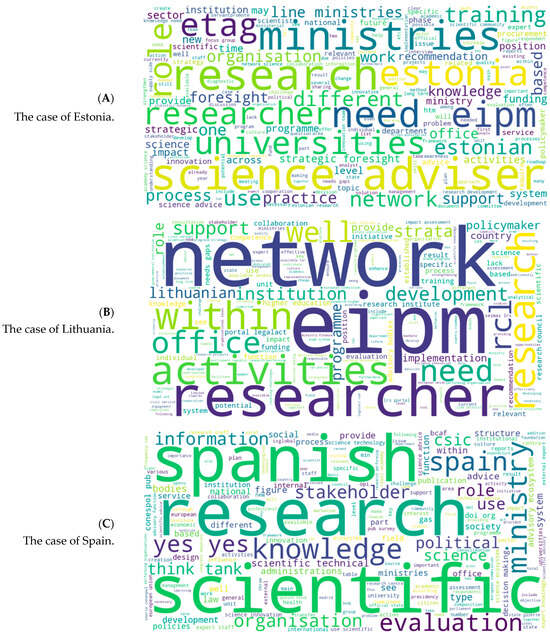
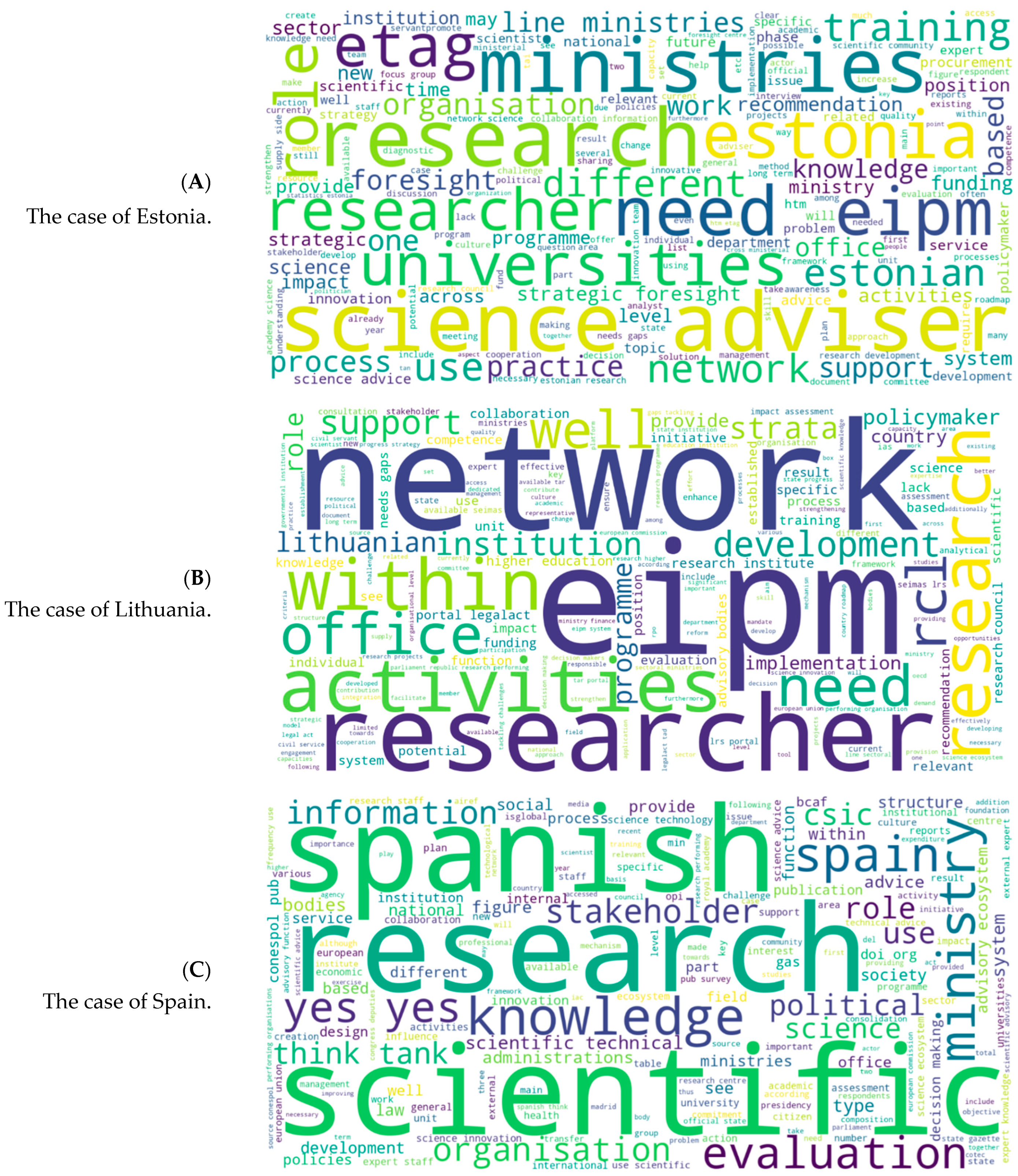
An analysis of keywords from recent studies examining the science-for-policy ecosystems of Estonia, Lithuania, and Spain was conducted (European Commission: Joint Research Centre et al., 2023, 2024, 2025) to identify their focal areas. The keyword frequency analysis identified recurring terms and differences in thematic emphasis across the three national ecosystems. Detailed frequency data are presented in Appendix C, while the word clouds in Figure 1 provide visualisations of the results.
Figure 1.
Word clouds of keywords, representing national science-for-policy ecosystems. Source: authors conducted based on European Commission: Joint Research Centre et al. (2023, 2024, 2025).
In Estonia, the most frequent analytically relevant terms included “research”, “ministry”, “science”, “adviser”, “need”, and “foresight” (Appendix C, Table A5; see also Figure 1, part A). Their frequency indicates a strong textual emphasis on governmental and scientific actors, science-advisory roles, and the identification of research needs. The prominence of “foresight”, “strategic”, “knowledge”, “advice”, and “network” further suggests that the analysed study places particular emphasis on future-oriented policymaking, knowledge brokerage, and institutional coordination. Keywords such as “innovation”, “funding”, “universities”, “capacity”, and “researchers” also indicate attention to the resources and organisational capacities supporting the Estonian science-for-policy ecosystem.
In Lithuania, the most frequent analytically relevant terms included “research”, “EIPM”, “ministry”, “science”, “scientific”, and “state” (Appendix C Table A5; see also Figure 1, part B). This distribution indicates that the analysed study primarily focuses on the institutionalisation of evidence-informed policymaking and the relationship between governmental and research actors. The prominence of “researchers”, “institutions”, “office”, “network”, “knowledge”, and “policymakers” suggests particular attention to the institutional architecture of the national ecosystem and the connections between evidence providers and policy actors. Terms such as “strategic”, “support”, “development”, and “implementation” also reflect an emphasis on the organisational development and practical establishment of science-for-policy functions.
In the Spanish case, the most frequent analytically relevant terms included “scientific”, “science”, “ministry”, “research”, “knowledge”, and “technical” (Appendix C Table A5; see also Figure 1, part C). The prominence of these terms indicates a focus on the scientific and technical foundations of policy advice and on the institutional actors involved in its provision. Terms such as “advice”, “advisory”, “staff”, “ecosystem”, and “evaluation” suggest attention to the professionalisation, organisation, and assessment of science-advisory functions. The frequency of “expert”, “stakeholders”, “bodies”, “functions”, and “political” further indicates that the analysed study considers the roles of different actors and organisations within the Spanish science-for-policy ecosystem.
Collectively, the keyword frequency analysis shows that the three studies share an emphasis on science, research, governmental institutions, and knowledge-related functions, while differing in the relative prominence of particular terms. The Estonian study places comparatively visible emphasis on science advisers, foresight, research needs, and institutional capacity. The Lithuanian study focuses particularly on evidence-informed policymaking, institutional networks, research actors, and the implementation of science-for-policy arrangements. The Spanish study gives greater textual prominence to scientific and technical advice, advisory functions, professional staff, and evaluation. These patterns should be interpreted as thematic emphases within the analysed documents rather than as direct measures of the performance or maturity of the national ecosystems.
In summary, this comparative analysis illustrates both shared and country-specific thematic emphases within the three national science-for-policy ecosystems. It shows how similar science-for-policy functions are described through different combinations of institutional actors, knowledge-brokerage arrangements, strategic foresight, advisory roles, and evaluation mechanisms. These findings complement the qualitative document analysis by indicating which concepts receive greater textual prominence in each national ecosystem; they do not, however, demonstrate the actual effectiveness or outcomes of the identified arrangements.
5. Discussion
The findings indicate that the integration of anticipatory governance and evidence-informed policymaking depends on the interaction of strategic, legal, and institutional elements. Across the three cases, recurring elements included strategic foresight, knowledge brokerage, stakeholder engagement, legal provisions supporting evidence use, and dedicated science-advisory roles. These findings are consistent with the understanding of anticipatory governance as a governance approach centred on foresight and future-oriented policymaking (Guston, 2014; Umbach, 2024), and with the literature on evidence-informed policymaking, which emphasises the combination of scientific evidence, professional judgement, stakeholder knowledge, and institutional context (Head, 2013; Cairney, 2022).
The analysis suggests that the two approaches may become institutionally connected when strategic priorities, legal arrangements, and organisational responsibilities reinforce one another. Strategic documents establish future-oriented priorities, legal provisions define responsibilities and procedures, and institutional structures create interfaces between governmental and scientific communities. Knowledge brokerage is particularly important in this configuration because evidence does not enter policymaking automatically and often requires translation between research and policy environments (Head, 2008; Cairney & Oliver, 2017).
The three cases reveal both common elements and different national emphases. Estonia places stronger emphasis on research needs, foresight, science advisers, digital infrastructure, and institutional capacity. Lithuania highlights evidence-informed policymaking, stakeholder engagement, knowledge valorisation, ethical principles, and institutional networking. Spain gives greater prominence to scientific and technical advice, evaluation, specialised advisory bodies, and the institutionalisation of scientific advice. The keyword frequency analysis supports these distinctions, although the frequencies reflect textual prominence within the analysed studies rather than institutional performance or system maturity.
The study contributes by clarifying the distinction between anticipatory governance as a governance approach, evidence-informed policymaking as a policymaking approach, and an integrated governance framework as the configuration of strategic, legal, and institutional elements that may connect them. It also provides a deductive analytical coding framework for examining how these elements are formally represented across national contexts.
However, the findings should be interpreted within the limits of documentary analysis. The analysed sources reveal formal priorities, institutional designs, and intended arrangements, but they do not demonstrate how consistently these arrangements are implemented or whether they produce particular policy outcomes. Therefore, the identified elements should be understood as enabling conditions and potential points of connection between the two approaches rather than evidence that their integration has been fully achieved in practice.
Future research should examine how the identified elements are implemented in practice, including the operation of science-advisory roles, the use of evidence and foresight in decision-making, and coordination between governmental and scientific communities. Interviews, organisational case studies, process tracing, and longitudinal comparative research could help assess how formal arrangements function and evolve across national contexts.
6. Conclusions
This study identified the strategic, legal, and institutional elements of governance frameworks that may support the integration of anticipatory governance and evidence-informed policymaking. Across Estonia, Lithuania, and Spain, the recurring elements included strategic foresight, evidence use, knowledge brokerage, stakeholder engagement, legal provisions supporting science-informed decision-making, and dedicated science-advisory structures. The findings indicate that the integration of the two approaches depends on the alignment of strategic priorities, formal rules, and clearly defined institutional responsibilities.
The comparative analysis also revealed distinct national emphases. Estonia places greater emphasis on foresight, research needs, science advisers, digital infrastructure, and institutional capacity. Lithuania highlights evidence-informed policymaking, stakeholder engagement, knowledge valorisation, ethical principles, and institutional networking. Spain gives greater prominence to scientific and technical advice, evaluation, specialised advisory bodies, and the formal institutionalisation of science-advisory functions. These differences show how similar science-for-policy arrangements may be embedded within different national governance contexts.
The study contributes a comparative analytical framework that distinguishes anticipatory governance as a governance approach, evidence-informed policymaking as a policymaking approach, and an integrated governance framework as the configuration of strategic, legal, and institutional elements that may connect them. The identified elements provide a basis for examining and comparing formal science-for-policy arrangements in other national contexts. As the findings are based on documentary evidence, they reflect formally established priorities and institutional designs rather than their implementation or policy effects.
Author Contributions
Conceptualization, V.J. and S.V.; methodology, V.J.; software, S.V.; formal analysis, V.J. and S.V.; investigation, V.J.; resources, V.J.; writing—original draft preparation, V.J.; writing—review and editing, S.V. and V.J.; visualization, S.V.; supervision, V.J. All authors have read and agreed to the published version of the manuscript.
Funding
This research received no external funding.
Institutional Review Board Statement
Not applicable.
Informed Consent Statement
Not applicable.
Data Availability Statement
The data presented in this study are available on request from the corresponding author due to privacy and ethical reasons.
Conflicts of Interest
The authors declare no conflicts of interest.
Abbreviations
The following abbreviations are used in this manuscript:
| EE | Estonia |
| LT | Lithuania |
| ES | Spain |
Appendix A
Table A1.
Elements and keywords of integrated governance frameworks.
Appendix B
Table A2.
Strategic elements of integrating frameworks.
Table A3.
Legal elements of integrating frameworks.
Table A4.
Institutional elements of integrating frameworks.
Appendix C
Table A5.
Most frequent analytically relevant keywords * in the Estonian, Lithuanian and Spanish science-for-policy ecosystem study.
References
- Bowen, G. A. (2009). Document analysis as a qualitative research method. Qualitative Research Journal, 9(2), 27–40. [Google Scholar] [CrossRef] [Scilit]
- Cairney, P. (2022). The myth of ‘evidence-based policymaking’ in a decentred state. Public Policy and Administration, 37(1), 46–66. [Google Scholar] [CrossRef] [Scilit]
- Cairney, P., & Oliver, K. (2017). Evidence-based policymaking is not like evidence-based medicine, so how far should you go to bridge the divide between evidence and policy? Health Research Policy and Systems, 15, 35. [Google Scholar] [CrossRef] [Scilit] [PubMed]
- Davie, G., & Wyatt, D. (2021). Document analysis. In S. Engler, & M. Stausberg (Eds.), The Routledge handbook of research methods in the study of religion (pp. 245–255). Routledge. [Google Scholar]
- de Andrade, S. R., Schmitt, M. D., Storck, B. C., Piccoli, T., & Ruoff, A. B. (2018). Documentary analysis in nursing theses: Data collection techniques and research methods. Cogitare Enferm, 23(1), e53598. [Google Scholar] [CrossRef] [Scilit]
- Eek, L. (2022). Formal network: Ministerial science advisors in Estonia. Estonian Research Council (ETAg). Available online: https://reform-support.ec.europa.eu/document/download/22564d4b-367b-4897-8f65-51b731401434_en?filename=5.%20Formal%20network.pdf (accessed on 8 February 2026).
- Elo, S., & Kyngäs, H. (2008). The qualitative content analysis process. Journal of Advanced Nursing, 62(1), 107–115. [Google Scholar] [CrossRef] [Scilit] [PubMed]
- Estonia 2035, adopted by the Riigikogu on 12 May 2021. (2021). Available online: https://www.valitsus.ee/sites/default/files/documents/2021-11/Eesti%202035_PUHTAND%20%C3%9CLDOSA_210512_ENG_0.pdf (accessed on 16 March 2026).
- European Commission: Directorate-General for Research and Innovation, Richardson, K., Renda, A., Świeboda, P., Walz, R., Heather, J. S., Balland, P. A., Dunlop, K., Alkemade, F., Muntean, B., Christophilopoulos, E., Huchet, J. F., Potočnik, D., Weresa, M., & Marin, M. C. (2024). Embedding anticipatory governance in Europe’s transitions. Publications Office of the European Union. Available online: https://data.europa.eu/doi/10.2777/3778181 (accessed on 8 February 2026).
- European Commission: Directorate-General for Structural Reform Support, Mackie, I., Fobé, E., Škarica, M., Reinholde, I., & Virtanen, T. (2021). Evidence-informed policy making—Building a conceptual model and developing indicators. Publications Office of the European Union. Available online: https://data.europa.eu/doi/10.2887/81339 (accessed on 10 January 2026).
- European Commission: Joint Research Centre, Cañibano, C., & Real-Dato, J. (2023). The Spanish scientific and technical advisory ecosystem for public policy (L. Melchor Fernandez, & K. Krieger, Eds.). Final Discussion Paper. Publications Office of the European Union. Available online: https://publications.jrc.ec.europa.eu/repository/bitstream/JRC135017/JRC135017_02.pdf (accessed on 16 March 2026).
- European Commission: Joint Research Centre, Koppel, A., Selg, P., Radma-Liiv, T., Raju, M., Klasche, B., Tõnurist, P., Kock, E., & Olajos-Szabo, A. (2024). Building capacity for evidence-informed policymaking in governance and public administration in a post-pandemic Europe. Final Integrated Country Report—Estonia. Publications Office of the European Union. Available online: https://publications.jrc.ec.europa.eu/repository/bitstream/JRC139946/JRC139946_01.pdf (accessed on 16 March 2026).
- European Commission: Joint Research Centre, Nakrošis, V., Petraitė, I., Bortkevičiūtė, R., Vilpišauskas, R., Almeida, M., & Olajos-Szabo, A. (2025). Building capacity for evidence-informed policymaking in governance and public administration in a post-pandemic Europe—Country analysis, policy recommendations and implementation roadmap Lithuania. Publications Office of the European Union. Available online: https://publications.jrc.ec.europa.eu/repository/bitstream/JRC141125/JRC141125_01.pdf (accessed on 16 March 2026).
- Fuerth, L. S. (2009). Foresight and anticipatory governance. Foresight, 11(4), 14–32. [Google Scholar] [CrossRef] [Scilit]
- Fuerth, L. S. (2011). Operationalizing anticipatory governance. Prism, 2(4), 31–46. [Google Scholar]
- Gobierno De España, Ministerio de Ciencia e Innovación. (2022). Plan de transferencia y colaboración. La ciencia y la innovación al servicio de la Sociedad [Transfer and collaboration plan. Science and innovation at the service of society]. Ministerio de Ciencia e Innovación Secretaría General Técnica. Centro de Publicaciones. Available online: https://www.ciencia.gob.es/InfoGeneralPortal/documento/c599474a-abc3-42db-ab3d-84ffdb27f4a9 (accessed on 16 March 2026). (In Spanish)
- GOV.UK. (2024). Celebrating 60 years of putting excellent science advice at the heart of decision making. Available online: https://www.gov.uk/government/news/celebrating-60-years-of-putting-excellent-science-advice-at-the-heart-of-decision-making (accessed on 8 February 2026).
- Gundersen, T. (2024). Trustworthy science advice: The case of policy recommendations. Res Publica, 30(1), 125–143. [Google Scholar] [CrossRef] [Scilit]
- Guston, D. H. (2014). Understanding ‘anticipatory governance’. Social Studies of Science, 44(2), 218–242. [Google Scholar] [CrossRef] [Scilit] [PubMed]
- Head, B. W. (2008). Three lenses of evidence-based policy. Australian Journal of Public Administration, 67(1), 1–11. [Google Scholar] [CrossRef] [Scilit]
- Head, B. W. (2013). Evidence-based policymaking–speaking truth to power? Australian Journal of Public Administration, 72(4), 397–403. [Google Scholar] [CrossRef] [Scilit]
- Heo, K., & Seo, Y. (2021). Anticipatory governance for newcomers: Lessons learned from the UK, the Netherlands, Finland, and Korea. European Journal of Futures Research, 9, 9. [Google Scholar] [CrossRef] [Scilit]
- Hsieh, H.-F., & Shannon, S. E. (2005). Three approaches to qualitative content analysis. Qualitative Health Research, 15(9), 1277–1288. [Google Scholar] [CrossRef] [Scilit] [PubMed]
- Hudec, R. M. (2023). Policy advisory systems in times of crisis: A case study of Slovak advisory committees during COVID-19. The NISPAcee Journal of Public Administration and Policy, 16(1), 58–80. [Google Scholar] [CrossRef] [Scilit]
- Kim, M. H., & Dankel, D. J. (2025). Are we ready to be wrong? Extended peer community for quality science-advice in uncertainty. Futures, 166, 103520. [Google Scholar] [CrossRef] [Scilit]
- Kønig, N., Børsen, T., & Emmeche, C. (2017). The ethos of post-normal science. Futures, 91, 12–24. [Google Scholar] [CrossRef] [Scilit]
- La Moncloa. (2024). The Government of Spain brings in 22 scientific advisors to strengthen public policy design. President’s News. Available online: https://www.lamoncloa.gob.es/lang/en/presidente/news/paginas/2024/20241203-scientific-advisors-incorporation.aspx (accessed on 10 January 2026).
- Ley 27/2022, de 20 de diciembre, de institucionalización de la evaluación de políticas públicas en la Administración General del Estado, Núm. 305, de 21/12/2022 [Law 27/2022, of December 20, on the institutionalization of the evaluation of public policies in the General State Administration, No. 305, 21/12/2021]. (2022). Available online: https://www.boe.es/buscar/pdf/2022/BOE-A-2022-21677-consolidado.pdf (accessed on 16 March 2026). (In Spanish)
- Lietuvos Mokslo Taryba. (2025). Mokslo ir inovacijų patarėjų tinklas Vyriausybės institucijose [Network of science and innovation advisors in government institutions]. Research Council of Lithuania (RCL). Available online: https://lmt.lrv.lt/lt/veiklos-sritys/mokslo-politika/mokslo-ir-inovaciju-patareju-tinklas/ (accessed on 8 February 2026). (In Lithuanian)
- Lietuvos Respublikos strateginio valdymo įstatymas [Law on strategic management of the Republic of Lithuania]. (2024). Adopted on 25 June 2020, No. XIII-3096, current valid version of the law 2024-01-01. Available online: https://e-seimas.lrs.lt/portal/legalAct/lt/TAD/90386d20bab711ea9a12d0dada3ca61b/asr (accessed on 16 March 2026). (In Lithuanian)
- MacKillop, E., & Downe, J. (2022). What counts as evidence for policy? An analysis of policy actors’ perceptions. Public Administration Review, 83(5), 1037–1050. [Google Scholar] [CrossRef] [Scilit]
- Maffei, S., Leoni, F., & Villari, B. (2020). Data-driven anticipatory governance. Emerging scenarios in data for policy practices. Policy Design and Practice, 3(2), 123–134. [Google Scholar] [CrossRef] [Scilit]
- Morovat, A. B., Nazarizadeh, F., & Radan, A. (2026). Strategic foresight as policy infrastructure for financial governance: A multi-layered framework for anticipatory policymaking in emerging economies. Futures & Foresight Science, 8(1), e70031. [Google Scholar] [CrossRef] [Scilit]
- National Office of Foresight and Strategy of the Government of Spain. (2021). Spain 2050: Foundations and proposals for a long-term national strategy. Ministerio de la Presidencia, Oficina Nacional de Prospectiva y Estrategia del Gobierno de España. Available online: https://futuros.gob.es/sites/default/files/esp2050/pdf/en/Spain_2050.pdf (accessed on 16 March 2026).
- National Office of Foresight and Strategy of the Government of Spain. (Coordinator). (2025). HispanIA 2040: How artificial intelligence will improve our future. Available online: https://futuros.gob.es/sites/default/files/2025-03/HispanIA-2040-Report-EN.pdf (accessed on 16 March 2026).
- Office of the Committee for the Future of the Seimas of the Republic of Lithuania. (2023). State progress strategy “Lithuania’s vision for the future ‘Lithuania 2050’”. Approved by order of the Parliament of the Republic of Lithuania, 2023-12-23, No. XIV-2466. Available online: https://www.lrs.lt/sip/getFile3?p_fid=83423 (accessed on 16 March 2025).
- Owen, G. T. (2014). Qualitative methods in higher education policy analysis: Using interviews and document analysis. The Qualitative Report, 19(26), 1–19. [Google Scholar] [CrossRef] [Scilit]
- Planeerimisseadus [Planning act]. (2024). Adopted on 28 January 2015, Publication Reference: RT I, 30 December 2024, 14. Available online: https://www.riigiteataja.ee/akt/130122024014 (accessed on 16 March 2026). (In Estonian)
- Ramos, J. M. (2014). Anticipatory governance: Traditions and trajectories for strategic design. Journal of Futures Studies, 19(1), 35–52. [Google Scholar]
- Raymaekers, P., Migchelbrink, K., Pattyn, V., & De Smedt, P. (2026). Organizational and individual factors of evidence informed policy making in public organizations. Public Administration Review, 86(1), 58–73. [Google Scholar] [CrossRef] [Scilit]
- Rokk, R. M., Viks-Binsol, P., & Bachmann, M. (2022). Programmi „Valdkondliku teadus-ja aren-dustegevuse tugevdamine (RITA)” mõju- ja tulemuslikkuse analüüs [Analysis of the impact and effectiveness of the programme “Strengthening sectoral research and development activities (RITA)”]. Civitta Eesti AS. Available online: https://www.etag.ee/wp-content/uploads/2022/03/Lopparuanne_RITA-mojuanaluus-1.pdf (accessed on 16 March 2026). (In Estonian)
- Spencer, T. D., Detrich, R., & Slocum, T. A. (2012). Evidence-based practice: A framework for making effective decisions. Education and Treatment of Children, 35(2), 127–151. [Google Scholar] [CrossRef] [Scilit]
- STRATA. (2021). Mokslo ir inovacijų pareigūnų tinklo sukūrimo Lietuvoje alternatyvos ir įgyvendinimo sėkmės prielaidos [Alternatives for establishing a network of science and innovation officers in Lithuania and prerequisites for successful implementation]. Government Strategic Analysis Center. Available online: https://strata.gov.lt/wp-content/uploads/2024/01/20220302-Mokslo-ir-inovaciju-pareigunu-tinklas.pdf (accessed on 29 June 2026). (In Lithuanian)
- Teadus-ja arendustegevuse korralduse seadus (TAKS) [Research and development activities organisation act]. (2019). Adopted on 26 March 1997, Publication reference: RT, I 19 March 2019, p. 92. Available online: https://www.riigiteataja.ee/akt/119032019092?leiaKehtiv (accessed on 16 March 2026). (In Estonian)
- Umbach, G. (2024). Futures in EU governance: Anticipatory governance, strategic foresight and EU better regulation. European Law Journal, 30(3), 409–421. [Google Scholar] [CrossRef] [Scilit]
- Wood, L. M., Sebar, B., & Vecchio, N. (2020). Application of rigour and credibility in qualitative document analysis: Lessons learnt from a case study. The Qualitative Report, 25(2), 456–470. [Google Scholar] [CrossRef] [Scilit]

Disclaimer/Publisher’s Note: The statements, opinions and data contained in all publications are solely those of the individual author(s) and contributor(s) and not of MDPI and/or the editor(s). MDPI and/or the editor(s) disclaim responsibility for any injury to people or property resulting from any ideas, methods, instructions or products referred to in the content. |
© 2026 by the authors. Licensee MDPI, Basel, Switzerland. This article is an open access article distributed under the terms and conditions of the Creative Commons Attribution (CC BY) license.