The Roles of Culture and Spirituality in Entrepreneurial Behavior: A Comparison Between South Korea and China


Abstract
1. Introduction
2. Theoretical Foundations and Hypotheses Development
2.1. TPB in Entrepreneurship
2.2. The Influence of Culture and Spirituality on Entrepreneurship
2.2.1. Culture
2.2.2. Spirituality
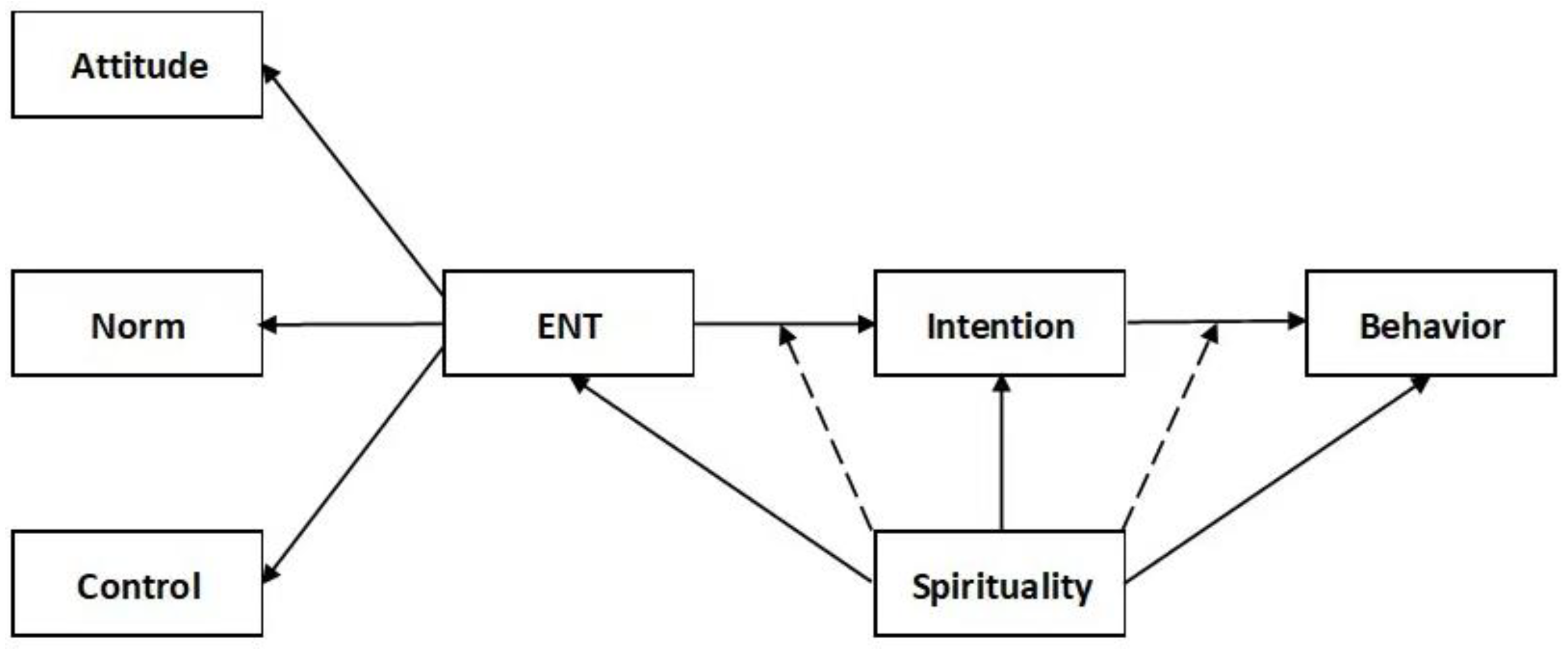
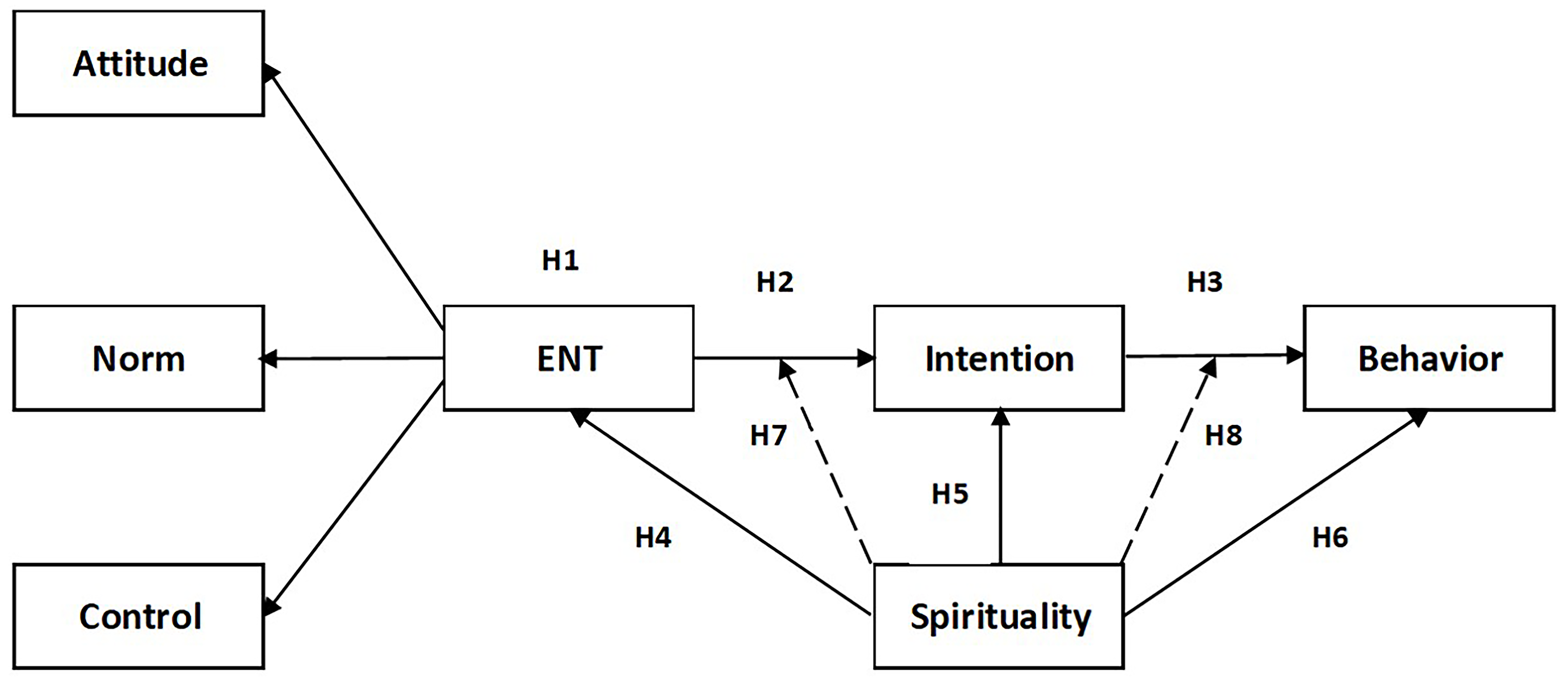
2.3. Hypothesis Development
2.3.1. Relationship Between Attitudes, Norms, Control, and Entrepreneurship
2.3.2. Direct Relationship Between Entrepreneurship and Entrepreneurial Intention
2.3.3. Direct Relationship Between Entrepreneurial Intention and Behavior
2.3.4. Direct Impact of Spirituality on Entrepreneurship, Entrepreneurial Intention, and Entrepreneurial Behavior
2.3.5. Moderating Effect of Spirituality on Entrepreneurship and Entrepreneurial Intention
2.3.6. Moderating Role of Spirituality in the Relationship Between Entrepreneurial Intention and Entrepreneurial Behavior
3. Methodology
3.1. Qualitative Data Analysis
3.2. Questionnaire and Data Collection
3.3. Adoption of Scales
3.4. Generating Data Groups
3.5. Data Analysis
4. Results
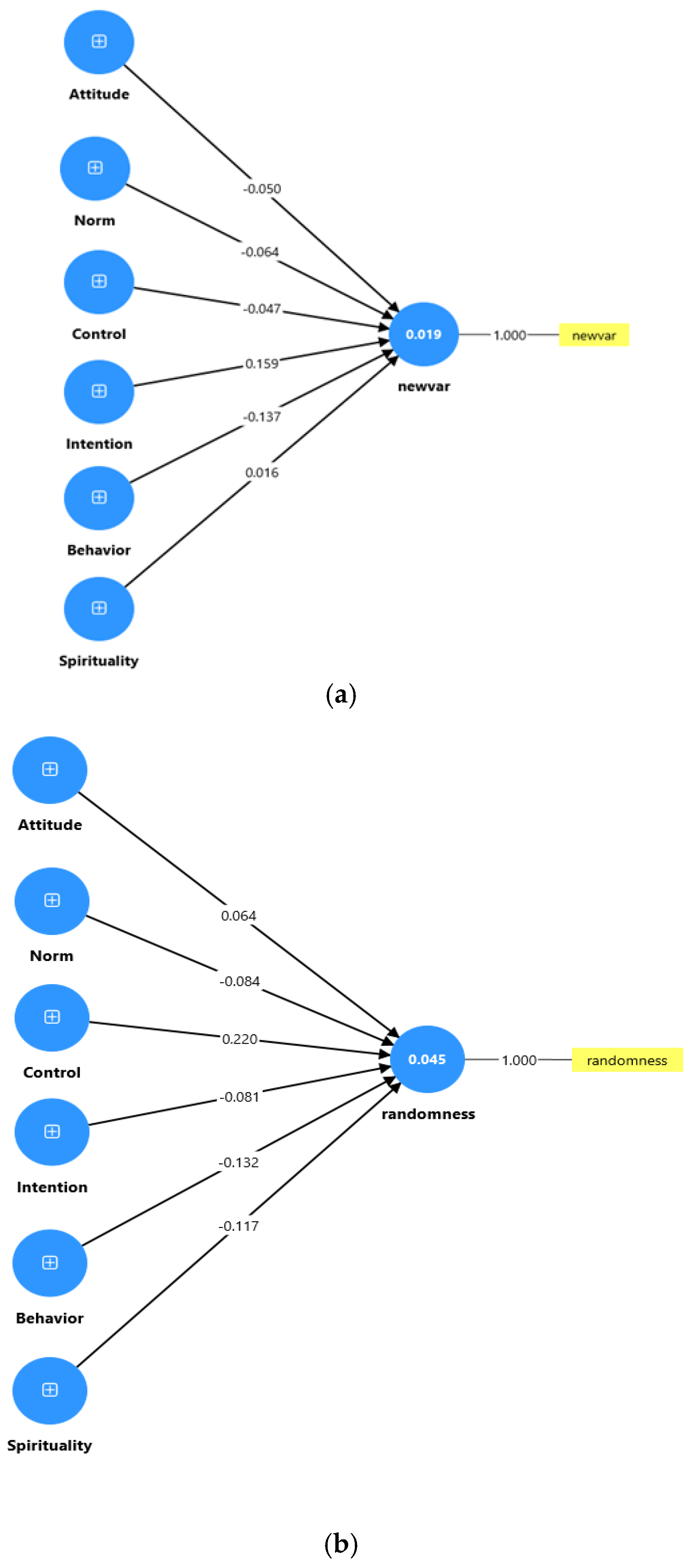
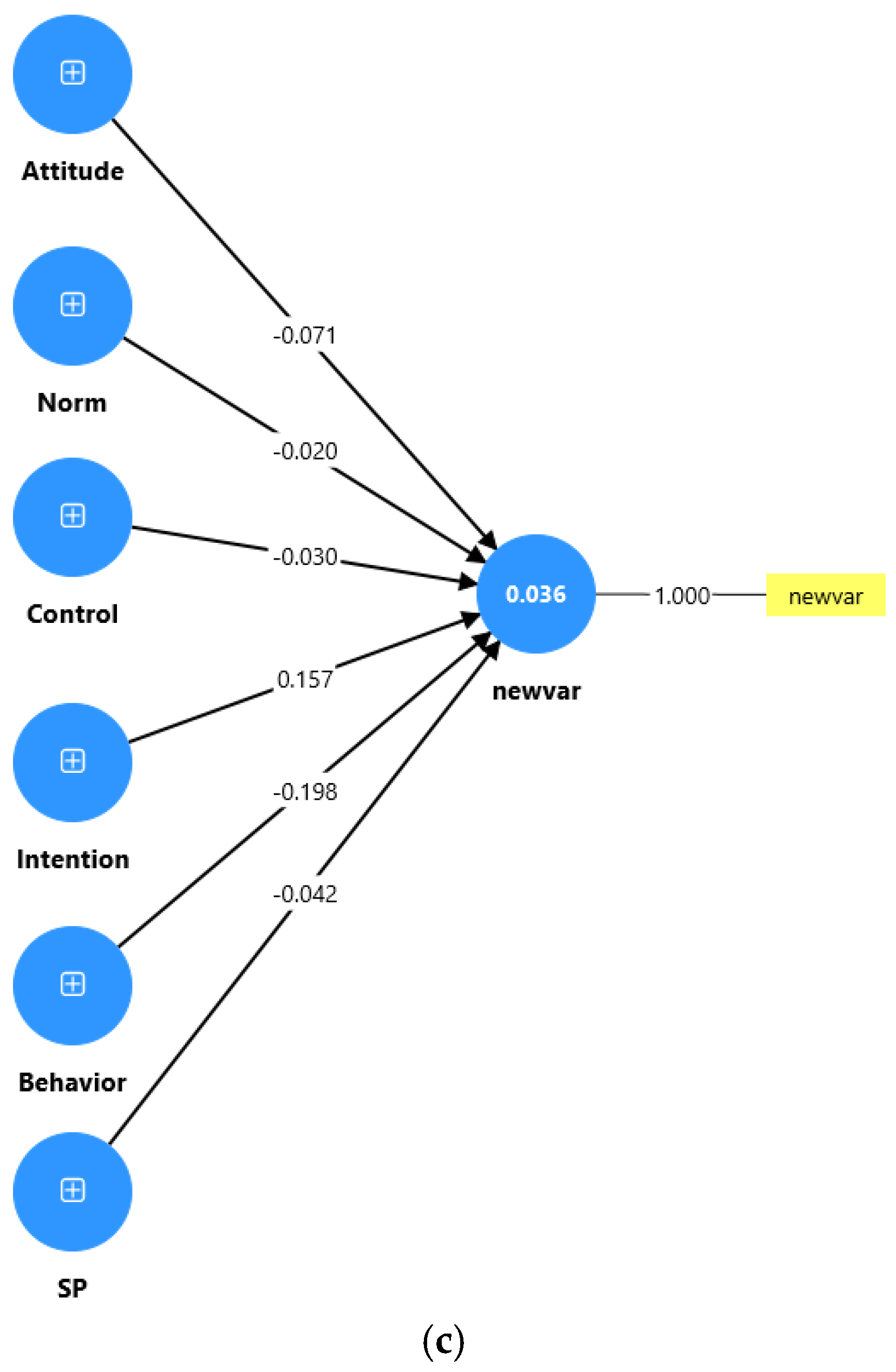
4.1. Common Method Variance (CMV)
4.2. Measurement Invariance of Composite Measures (MICOM)
4.3. Testing Hypotheses
4.4. Discussion
5. Conclusions
5.1. Implications
5.2. Limitations and Future Research
Author Contributions
Funding
Institutional Review Board Statement
Informed Consent Statement
Data Availability Statement
Conflicts of Interest
References
- Ajzen, I. (1991). The theory of planned behavior. Organizational Behavior and Human Decision Processes, 50(2), 179–211. [Google Scholar] [CrossRef] [Scilit]
- Ajzen, I. (2011). The theory of planned behaviour: Reactions and reflections. Psychology & Health, 26(9), 1113–1127. [Google Scholar] [CrossRef] [Scilit]
- Al-Mamary, Y. H., Alwaeheb, M. A., Alshammari, N. G. M., Abdulrab, M., Balhareth, H., & Soltane, H. B. (2020). The effect of entrepreneurial orientation on financial and non-financial performance in Saudi SMEs: A review. Journal of Critical Reviews, 7(14), 270–278. [Google Scholar] [CrossRef] [Scilit]
- Amrouni, A., & Azouaou, L. (2024). Determinant factors of entrepreneurial intention within Generation Z students: Case of Kolda University campus in Algeria. European Journal of Management Issues, 32(1), 30–43. [Google Scholar] [CrossRef] [Scilit]
- APCDA. (2024). August 2024 Korea report. Available online: https://asiapacificcda.org/korea-information/ (accessed on 19 October 2025).
- Baron, R. A. (2008). The role of affect in the entrepreneurial process. Academy of Management Review, 33(2), 328–340. [Google Scholar] [CrossRef] [Scilit]
- Bosnjak, M., Ajzen, I., & Schmidt, P. (2020). The theory of planned behavior: Selected recent advances and applications. Europe’s Journal of Psychology, 16(3), 352–356. [Google Scholar] [CrossRef] [Scilit] [PubMed]
- Braun, V., & Clarke, V. (2006). Using thematic analysis in psychology. Qualitative Research in Psychology, 3(2), 77–101. [Google Scholar] [CrossRef] [Scilit]
- Brislin, R. W., & Freimanis, C. (2001). Back-translation. In S.-w. Chan, & D. E. Pollard (Eds.), An encyclopaedia of translation: Chinese-English, English-Chinese. Chinese University Press. [Google Scholar]
- Chan, A. (1996). Confucianism and development in East Asia. Journal of Contemporary Asia, 26(1), 28–45. [Google Scholar] [CrossRef] [Scilit]
- Chan, K., Prendergast, G., & Ng, Y. L. (2016). Using an expanded theory of planned behavior to predict adolescents’ intention to engage in healthy eating. Journal of International Consumer Marketing, 28(1), 16–27. [Google Scholar] [CrossRef] [Scilit]
- Churchill, G. A., & Iacobucci, D. (2006). Marketing research: Methodological foundations. Dryden Press. [Google Scholar]
- DeVellis, R. F., & Thorpe, C. T. (2021). Scale development: Theory and applications. Sage Publications. [Google Scholar]
- Fang, T. (2012). Yin Yang: A new perspective on culture. Management and Organization Review, 8(1), 25–50. [Google Scholar] [CrossRef] [Scilit]
- Fayolle, A., & Liñán, F. (2014). The future of research on entrepreneurial intentions. Journal of Business Research, 67(5), 663–666. [Google Scholar] [CrossRef] [Scilit]
- Fornell, C., & Larcker, D. F. (1981). Evaluating structural equation models with unobservable variables and measurement error. Journal of Marketing Research, 18(1), 39–50. [Google Scholar] [CrossRef] [Scilit]
- Gieure, C., del Mar Benavides-Espinosa, M., & Roig-Dobón, S. (2020). The entrepreneurial process: The link between intentions and behavior. Journal of Business Research, 112, 541–548. [Google Scholar] [CrossRef] [Scilit]
- Global News. (2024). China’s unemployment rate for youth aged 16–24 stands at 14.9% in December. Available online: https://www.globaltimes.cn/page/202401/1305555.shtml (accessed on 19 October 2025).
- Hair, J., Black, W. C., Babin, B., Anderson, R., & Tatham, R. (2009). Multivariate data analysis (17th ed.). Prentice Hall. [Google Scholar]
- Hair, J., Hult, G., Ringle, C., & Sarstedt, M. (2017). A primer on partial least squares structural equation modeling (PLS-SEM) (2nd ed.). Sage Publications. [Google Scholar]
- Hair, J. F., Risher, J. J., Sarstedt, M., & Ringle, C. M. (2019). When to use and how to report the results of PLS-SEM. European Business Review, 31(1), 2–24. [Google Scholar] [CrossRef] [Scilit]
- Henseler, J., Ringle, C. M., & Sarstedt, M. (2015). A new criterion for assessing discriminant validity in variance-based structural equation modeling. Journal of the Academy of Marketing Science, 43(1), 115–135. [Google Scholar]
- Henseler, J., Ringle, C. M., & Sinkovics, R. R. (2009). The use of partial least squares path modeling in international marketing. In R. R. Sinkovics, & P. N. Ghauri (Eds.), New challenges to international marketing (pp. 277–319). Emerald Group Publishing Limited. [Google Scholar]
- Hofstede, G., Hofstede, G. J., & Minkov, M. (2010). Cultures and organizations: Software of the mind (3rd ed.). McGraw-Hill. [Google Scholar]
- House, R. J., Hanges, P. J., Javidan, M., Dorfman, P. W., & Gupta, V. (Eds.). (2004). Culture, leadership, and organizations: The GLOBE study of 62 societies. Sage Publications. [Google Scholar]
- Ilomo, M., & Mwantimwa, K. (2023). Entrepreneurial intentions of undergraduate students: The moderating role of entrepreneurial knowledge. International Journal of Entrepreneurial Knowledge, 11(1), 14–34. [Google Scholar] [CrossRef] [Scilit]
- Karimi, S., Biemans, H. J., Lans, T., Chizari, M., & Mulder, M. (2014). Effects of role models and gender on students’ entrepreneurial intentions. European Journal of Training and Development, 38(8), 694–727. [Google Scholar] [CrossRef] [Scilit]
- Kautonen, T., Van Gelderen, M., & Fink, M. (2015). Robustness of the theory of planned behavior in predicting entrepreneurial intentions and actions. Entrepreneurship Theory and Practice, 39(3), 655–674. [Google Scholar] [CrossRef] [Scilit]
- Klotz, A. C., Swider, B. W., & Kwon, S. H. (2023). Back-translation practices in organizational research: Avoiding loss in translation. Journal of Applied Psychology, 108(5), 699–727. [Google Scholar] [CrossRef] [Scilit] [PubMed]
- Kock, N. (2025). Methods showcase—Using PLS-SEM in business communication research. International Journal of Business Communication, 62(1), 187–205. [Google Scholar]
- Krueger, N. F., Jr., Reilly, M. D., & Carsrud, A. L. (2000). Competing models of entrepreneurial intentions. Journal of Business Venturing, 15(5–6), 411–432. [Google Scholar] [CrossRef] [Scilit]
- Lee, B. (2024). Jesuit higher educational leadership: A case study of universities in Asia. Springer Nature. [Google Scholar]
- Lee, B. (2026). Customer ren orientation. Springer Nature. [Google Scholar]
- Lee, B., Cho, N., Yau, O. H., & Yu, G. (2026). Interaction of spirituality with entrepreneurial attitudes and intentions in South Korea: Extending the theory of planned behavior. Frontiers in Psychology, 17, 1756793. [Google Scholar] [CrossRef] [Scilit] [PubMed]
- Lee, Y., Ahn, D., Kwon, J., Lee, S., & Lim, H. (2025). Understanding digital gifting through messengers across cultures: A comparative study of university students in South Korea, China, and Japan. Proceedings of the ACM on Human-Computer Interaction, 9(7), 1–21. [Google Scholar] [CrossRef] [Scilit]
- Liñán, F., & Chen, Y. W. (2009). Development and cross-cultural application of a specific instrument to measure entrepreneurial intentions. Entrepreneurship Theory and Practice, 33(3), 593–617. [Google Scholar] [CrossRef] [Scilit]
- Malhotra, N. K. (2020). Marketing research: An applied orientation. Pearson. [Google Scholar]
- Milohnic, I., & Licul, I. (2025). The factors influencing students’ entrepreneurial intentions: An analysis using the theory of planned behavior. Ekonomisk Horizonti, 27(1), 79–95. [Google Scholar] [CrossRef] [Scilit]
- Morris, M. H., Webb, J. W., & Franklin, R. J. (2011). Understanding the manifestation of entrepreneurial orientation in the nonprofit context. Entrepreneurship Theory and Practice, 35(5), 947–971. [Google Scholar] [CrossRef] [Scilit]
- Mothibi, N. H., Malebana, M. J., & Rankhumise, E. M. (2024). Munificent environment factors influencing entrepreneurial intention and behaviour: The moderating role of risk-taking propensity. Administrative Sciences, 14(9), 230. [Google Scholar] [CrossRef] [Scilit]
- Ndofirepi, T. M. (2020). How spatial contexts, institutions, and self-identity affect entrepreneurial intentions. Journal of Entrepreneurship in Emerging Economies, 5(2), 153–174. [Google Scholar] [CrossRef] [Scilit]
- Nunnally, J. C. (1978). Psychometric theory (2nd ed.). McGraw-Hill. [Google Scholar]
- Peterman, N. E., & Kennedy, J. (2003). Enterprise education: Influencing students’ perceptions of entrepreneurship. Entrepreneurship Theory and Practice, 28(2), 129–144. [Google Scholar] [CrossRef] [Scilit]
- Pew Research Center. (2024). Religion and spirituality in East Asian societies. Available online: https://www.pewresearch.org/religion/2024/06/17/religion-and-spirituality-in-east-asian-societies/ (accessed on 31 May 2026).
- Redding, G., & Witt, M. A. (2007). The future of Chinese capitalism: Choices and chances. Oxford University Press. [Google Scholar]
- Sarstedt, M., Henseler, J., & Ringle, C. M. (2011). Multigroup analysis in partial least squares (PLS) path modeling: Alternative methods and empirical results. In M. Sarstedt, M. Schwaiger, & C. R. Taylor (Eds.), Measurement and research methods in international marketing (pp. 195–218). Emerald Group Publishing Limited. [Google Scholar]
- Shane, S. (1993). Cultural influences on national rates of innovation. Journal of Business Venturing, 8(1), 59–73. [Google Scholar] [CrossRef] [Scilit]
- Singh, D., & Awasthy, R. (2025). Spirituality in social entrepreneurship: An ethical approach to sustainability. Social Enterprise Journal, 21(3), 492–518. [Google Scholar]
- Terpstra-Tong, J. L., & Ralston, D. A. (2025). Beyond Confucianism: Embracing Asia’s cultural diversity in cross-cultural business research. Asian Business & Management, 24(3), 333–356. [Google Scholar] [CrossRef] [Scilit]
- Trompenaars, F., & Hampden-Turner, C. (2011). Riding the waves of culture: Understanding diversity in global business. Nicholas Brealey International. [Google Scholar]
- Tu, W. M. (1998). Confucius and Confucianism. In W. H. Slote, & G. A. De Vos (Eds.), Confucianism and the family (pp. 3–36). State University of New York Press. [Google Scholar]
- Tung, R. L., & Verbeke, A. (2010). Beyond Hofstede and GLOBE: Improving the quality of cross-cultural research. Journal of International Business Studies, 41, 1259–1274. [Google Scholar] [CrossRef] [Scilit]
- Vedula, S. B., & Agrawal, R. K. (2024). Mapping spiritual leadership: A bibliometric analysis and synthesis of past milestones and future research agenda. Journal of Business Ethics, 189(2), 301–328. [Google Scholar]
- Wathanakom, N., Khliasang, J., & Songkram, N. (2020). The study of the causal relationship between innovativeness and entrepreneurial intention among undergraduate students. Journal of Innovation and Entrepreneurship, 9(1), 15. [Google Scholar] [CrossRef] [Scilit]
- Yau, O. H. M. (1988). Chinese cultural values: Their dimensions and marketing implications. European Journal of Marketing, 22(5), 44–57. [Google Scholar] [CrossRef] [Scilit]
- Yau, O. H. M. (1994). Consumer behaviour in China: Customer satisfaction and cultural values. Routledge. [Google Scholar]
- Yau, O. H. M., & Lee, B. (2024). Chinese marketing and management scales. Springer Nature. [Google Scholar]




| Characteristics | South Korea (n = 204) | China (n = 207) | ||
|---|---|---|---|---|
| N | % | N | % | |
| Gender | ||||
| Male | 105 | 51.47 | 63 | 32.81 |
| Female | 99 | 48.53 | 129 | 67.19 |
| Age | ||||
| Under 20 | 53 | 25.98 | 7 | 3.65 |
| 21–25 | 113 | 55.39 | 127 | 66.15 |
| 26–30 | 9 | 4.41 | 30 | 15.61 |
| 31–35 | 6 | 2.94 | 27 | 14.06 |
| 36 and above | 23 | 11.27 | 1 | 0.52 |
| Education | ||||
| High School | 16 | 7.84 | 1 | 0.52 |
| Associate Degree | 4 | 1.96 | 0 | 0 |
| College/University | 149 | 73.04 | 21 | 10.94 |
| Graduate School | 35 | 17.16 | 170 | 88.54 |
| Religion | ||||
| Protestantism | 36 | 17.65 | 1 | 0.48 |
| Buddhism | 14 | 6.86 | 10 | 4.83 |
| Catholicism | 11 | 5.39 | 2 | 0.97 |
| Islam | 1 | 0.49 | 1 | 0.48 |
| Others | 18 | 8.82 | 5 | 2.41 |
| None | 142 | 69.61 | 188 | 90.82 |
| Monthly Household Income | ||||
| $2728 or Below | 46 | 22.55 | 76 | 36.58 |
| $2729~$5457 | 66 | 32.35 | 74 | 38.54 |
| $5458~$8186 | 36 | 17.65 | 21 | 10.94 |
| $8187~$10,914 | 13 | 6.37 | 2 | 1.04 |
| $10,915 or Above | 25 | 12.25 | 16 | 8.33 |
| Other | 18 | 8.82 | 3 | 1.56 |
| Total | 204 | 100.00 | 207 | 100.00 |
| Construct/Associate Item | Full Sample | South Korea | China | |||
|---|---|---|---|---|---|---|
| Mean | SD | Mean | SD | Mean | SD | |
| Attitude | ||||||
| Good career choice | 4.29 | 1.326 | 4.500 | 1.222 | 4.082 | 1.393 |
| Great satisfaction | 4.29 | 1.256 | 4.412 | 1.223 | 4.657 | 1.278 |
| Creating excites me. | 4.535 | 1.440 | 4.172 | 1.454 | 4.116 | 1.430 |
| Norm | ||||||
| Family would approve it | 4.29 | 1.375 | 4.093 | 1.281 | 3.720 | 1.441 |
| Family supports | 3.905 | 1.375 | 4.083 | 1.434 | 3.609 | 1.417 |
| Good idea | 3.844 | 1.438 | 3.799 | 1.189 | 3.970 | 1.354 |
| Control | ||||||
| Confident in ability | 3.550 | 1.273 | 3.588 | 1.420 | 3.512 | 1.329 |
| Effective problem-solving | 3.920 | 1.230 | 3.892 | 1.359 | 3.947 | 1.204 |
| Have the necessary skills | 3.401 | 1.306 | 3.422 | 1.305 | 3.382 | 1.309 |
| Intention | ||||||
| Start business soon | 2.908 | 1.568 | 2.729 | 1.496 | 2.729 | 1.496 |
| Actively planning | 2.501 | 1.527 | 2.444 | 1.420 | 2.444 | 1.420 |
| Behavior | ||||||
| Involving a business | 2.073 | 1.512 | 2.230 | 1.652 | 1.918 | 1.347 |
| Engaging in doing | 2.275 | 1.462 | 2.240 | 1.540 | 2.309 | 1.383 |
| Spirituality | ||||||
| Life meaningful | 4.915 | 1.073 | 4.779 | 1.160 | 5.048 | 0.964 |
| Maintain inner peace | 4.328 | 1.190 | 4.147 | 1.243 | 4.507 | 1.110 |
| Attend spiritual classes | 2.725 | 1.662 | 2.471 | 1.659 | 2.976 | 1.629 |
| Path Coefficients (Random Variable as a Dependent) | VIF | ||
|---|---|---|---|
| Total Sample | S. Korea Sample | China Sample | |
| Attitude → Random Variable | 2.169 | 1.915 | 2.179 |
| Behavior → Random Variable | 2.103 | 1.599 | 2.060 |
| Control → Random Variable | 3.041 | 2.812 | 3.108 |
| Intention → Random Variable | 3.135 | 1.814 | 3.147 |
| Norm → Random Variable | 1.789 | 1.130 | 1.789 |
| Spirituality → Random Variable | 1.312 | 1.182 | 1.369 |
| R-Square | 0.019 | 0.045 | 0.036 |
| Construct | Item | Full Sample (n = 411) | South Korea (n = 204) | China (n = 207) | ||||||
|---|---|---|---|---|---|---|---|---|---|---|
| Loading | AVE | CR | Loading | AVE | CR | Loading | AVE | CR | ||
| Attitude | 2.1 | 0.806 | 0.738 | 0.894 | 0.766 | 0.732 | 0.891 | 0.846 | 0.758 | 0.893 |
| 2.2 | 0.872 | 0.896 | 0.860 | |||||||
| 2.3 | 0.897 | 0.898 | 0.950 | |||||||
| Norm | 2.4 | 0.901 | 0.746 | 0.898 | 0.899 | 0.733 | 0.892 | 0.920 | 0.765 | 0.794 |
| 2.5 | 0.871 | 0.839 | 0.900 | |||||||
| 2.6 | 0.807 | 0.829 | 0.799 | |||||||
| Control | 2.7 | 0.924 | 0.823 | 0.933 | 0.940 | 0.943 | 0.943 | 0.907 | 0.799 | 0.931 |
| 2.8 | 0.905 | 0.839 | 0.875 | |||||||
| 2.9 | 0.892 | 0.893 | 0.899 | |||||||
| Intention | 2.10 | 0.951 | 0.908 | 0.952 | 0.948 | 0.948 | 0.948 | 0.954 | 0.915 | 0.951 |
| 2.11 | 0.954 | 0.950 | 0.959 | |||||||
| Behavior | 2.12 | 0.915 | 0.853 | 0.920 | 0.922 | 0.928 | 0.928 | 0.911 | 0.844 | 0.918 |
| 2.13 | 0.931 | 0.938 | 0.926 | |||||||
| Spirituality | 3.1 | 0.692 | 0.531 | 0.771 | 0.761 | 0.513 | 0.759 | 0.626 | 0.535 | 0.776 |
| 3.2 | 0.682 | 0.706 | 0.697 | |||||||
| 3.3 | 0.804 | 0.680 | 0.853 | |||||||
| Construct | * CI | ** CI | *** MV | **** EM | |
|---|---|---|---|---|---|
| Interval (CI) | Established | Difference | ***** CIs | ||
| Entrepreneurship | |||||
| Attitude | Yes | 0.997 {0.999, 1.000} | No | 0.059 | {−0.194, 0.191} |
| Norm | Yes | 1.000 {0.997, 1.000} | Yes | 0.080 | {−0.200, 0.188} |
| Control | Yes | 1.000 {1.000, 1.000} | No | 0.017 | {−0.200, 0.188} |
| Entrepreneurial Intention | No | 1.000 {1.000. 1.000} | Yes | 0.222 | {−0.196, 0.187} |
| Entrepreneurial Behavior | No | 1.000 {0.999, 1.000} | Yes | 0.213 | {−0.196, 0.187} |
| Spirituality | No | 0.994 {0.972, 0.995} | Yes | −0.390 | {−0.200, 0.189} |
| Constructs | Differences | * EVCI | ** FMIS |
|---|---|---|---|
| Entrepreneurship | |||
| Attitude | 0.000 | {−0.257, 0.264} | Yes |
| Norm | −0.011 | {−0.322, 0.296} | Yes |
| Control | −0.000 | {−0.242, 0.240} | Yes |
| Entrepreneurial Intention | −0.005 | {−0.220, 0.215} | Yes |
| Entrepreneurial Behavior | −0.001 | {−0.227, 0.219} | Yes |
| Spirituality | −0.002 | {−0.275, 0.275} | Yes |
| Hypothesis | Path | SK Coef. | SK | China Coef. | China | ||
|---|---|---|---|---|---|---|---|
| t-Value | p-Value | t-Value | p-Value | ||||
| H1 | ENT → Attitude | 0.846 | 32.873 | 0.000 | 0.895 | 57.856 | 0.000 |
| ENT → Norm | 0.839 | 35.669 | 0.000 | 0.881 | 52.297 | 0.000 | |
| ENT → Control | 0.923 | 86.004 | 0.000 | 0.896 | 59.760 | 0.000 | |
| H2 | ENT → Intention | 0.663 | 15.881 | 0.000 | 0.695 | 15.125 | 0.000 |
| H3 | Intention → Behavior | 0.575 | 9.692 | 0.000 | 0.642 | 10.456 | 0.000 |
| H4 | Spirituality → ENT | 0.467 | 7.859 | 0.000 | 0.529 | 10.562 | 0.000 |
| H5 | Spirituality → Intention | 0.125 | 2.201 | 0.028 | 0.051 | 0.906 | 0.368 |
| H6 | Spirituality → Behavior | 0.149 | 2.816 | 0.005 | 0.107 | 1.715 | 0.086 |
| H7 | Spirituality × ENT → Intention | 0.084 | 2.530 | 0.011 | 0.097 | 2.251 | 0.024 |
| H8 | Spirituality × Intention → Behavior | 0.139 | 3.119 | 0.002 | 0.140 | 2.419 | 0.016 |
| Hypothesis | Difference (S. Korea—China) | t Value (S. Korea vs. China) | p-Value (S. Korea vs. China) | |
|---|---|---|---|---|
| H1 | ENT → Attitude | −0.050 | 1.674 | 0.095 |
| ENT → Norm | −0.042 | 1.414 | 0.158 | |
| ENT → Control | 0.027 | 1.526 | 0.128 | |
| H2 | ENT → Intention | −0.047 | 0.776 | 0.438 |
| H3 | Intention → Behavior | −0.076 | 0.905 | 0.366 |
| H4 | Spirituality → ENT | −0.053 | 0.668 | 0.504 |
| H5 | Spirituality → intention | 0.083 | 1.056 | 0.292 |
| H6 | Spirituality → Behavior | 0.056 | 0.701 | 0.484 |
| H7 | Spirituality × ENT → Intention | −0.019 | 0.348 | 0.728 |
| H8 | Spirituality × Intention → Behavior | 0.007 | 0.087 | 0.931 |
| Hypothesis | Path | Results |
|---|---|---|
| H1 | ENT → Attitude ENT → Norm ENT → Control | Supported (both countries) |
| H2 | ENT → Intention | Supported (both countries) |
| H3 | Intention → Behavior | Supported (both countries) |
| H4 | Spirituality → ENT | Supported (both countries) |
| H5 | Spirituality → Intention | Supported as stated: significant in South Korea, non-significant in China |
| H6 | Spirituality → Behavior | Supported as stated: significant in South Korea, non-significant in China |
| H7 | Spirituality × ENT → Intention | Supported (both countries) |
| H8 | Spirituality × Intention → Behavior | Supported (both countries) |
Disclaimer/Publisher’s Note: The statements, opinions and data contained in all publications are solely those of the individual author(s) and contributor(s) and not of MDPI and/or the editor(s). MDPI and/or the editor(s) disclaim responsibility for any injury to people or property resulting from any ideas, methods, instructions or products referred to in the content. |
© 2026 by the authors. Licensee MDPI, Basel, Switzerland. This article is an open access article distributed under the terms and conditions of the Creative Commons Attribution (CC BY) license.
Share and Cite
Lee, B.; Cho, N.; Yau, O.O.H.M.; Yu, G. The Roles of Culture and Spirituality in Entrepreneurial Behavior: A Comparison Between South Korea and China. Adm. Sci. 2026, 16, 348. https://doi.org/10.3390/admsci16070348
Lee B, Cho N, Yau OOHM, Yu G. The Roles of Culture and Spirituality in Entrepreneurial Behavior: A Comparison Between South Korea and China. Administrative Sciences. 2026; 16(7):348. https://doi.org/10.3390/admsci16070348
Chicago/Turabian StyleLee, Bernard, Namjae Cho, Oliver O. H. M. Yau, and Giseob Yu. 2026. "The Roles of Culture and Spirituality in Entrepreneurial Behavior: A Comparison Between South Korea and China" Administrative Sciences 16, no. 7: 348. https://doi.org/10.3390/admsci16070348
APA StyleLee, B., Cho, N., Yau, O. O. H. M., & Yu, G. (2026). The Roles of Culture and Spirituality in Entrepreneurial Behavior: A Comparison Between South Korea and China. Administrative Sciences, 16(7), 348. https://doi.org/10.3390/admsci16070348