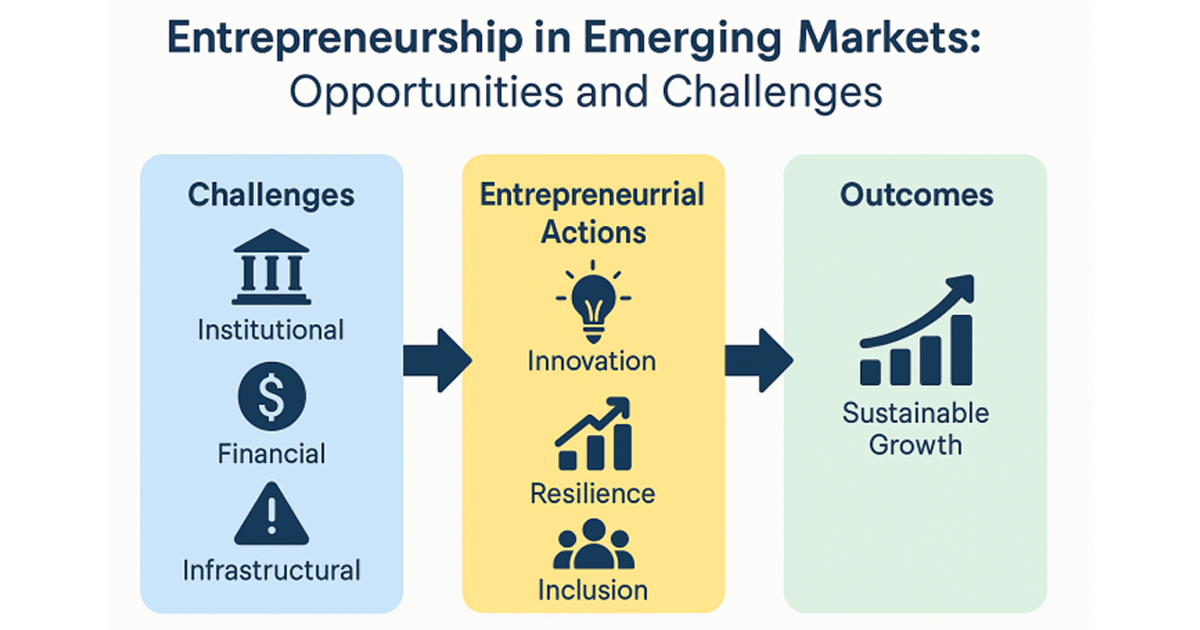

Entrepreneurship in Emerging Markets: Opportunities and Challenges

A Special Issue of Administrative Sciences (ISSN 2076-3387) belonging to the section "International Entrepreneurship".

Deadline for manuscript submissions: 31 March 2027 | Viewed by 12464

Editors


E-Mail Website
Guest Editor
Department of Business Administration, University of West Attica, Agiou Spiridonos 28, 122 43 Egaleo, Greece
Interests: employee motivation; leadership; human resource management; organizational change; organizational culture; entrepreneurship and corporate social responsibility
Special Issues, Collections and Topics in MDPI journals

E-Mail Website
Guest Editor
Department of Business Administration, University of West Attica, 12241 Egaleo, Greece
Interests: e-learning; organizational behavior; entrepreneurship digital technologies
Special Issues, Collections and Topics in MDPI journals

Special Issue Information

Dear Colleagues,

Entrepreneurship plays a pivotal role in driving economic growth, innovation, and social transformation in emerging markets. However, entrepreneurs in these contexts face unique challenges, including institutional voids, financing constraints, limited infrastructure, and volatile policy environments. This Special Issue aims to bring together high-quality research that deepens our understanding of entrepreneurial behavior, innovation ecosystems, and firm growth in emerging economies. We invite theoretical, empirical, and policy-oriented studies that examine topics such as access to finance and venture capital, digital transformation and technology adoption, social and sustainable entrepreneurship, the role of government and regulation, informal and microenterprises, and gender and inclusivity in entrepreneurship. Comparative studies between emerging and developed markets are also welcome. The goal of this Special Issue is two-fold: foster a richer understanding of how entrepreneurs identify and exploit opportunities in uncertain and resource-constrained environments; and provide insights that can inform policymakers, practitioners, and scholars. In this Special Issue, we aim to highlight both the dynamism and the complexity of entrepreneurship as a driver of inclusive and sustainable development.

Entrepreneurship is widely recognized as a key driver of economic growth, innovation, and social transformation. In emerging markets, entrepreneurial activity holds immense potential to generate employment, stimulate technological advancement, and promote inclusive development. However, these markets also present distinct challenges, including institutional voids, financing constraints, infrastructure limitations, and policy volatility. Understanding how entrepreneurs navigate such complex environments is crucial for advancing theory and practice in entrepreneurship and development studies.

The aim of this Special Issue is to explore how entrepreneurs identify and exploit opportunities in emerging markets and how contextual factors shape their behavior, performance, and impact. This Special Issue aligns closely with Administrative Sciences’ mission to disseminate high-quality research that advances the fields of economics, management, and social sciences and foster dialog between academia, industry, and policymakers.

In this Special Issue, original research articles and reviews are welcome. Research areas may include, but are not limited to, the following:

  • Entrepreneurial ecosystems and innovation in emerging markets;
  • Access to finance, venture capital, and microfinance;
  • Digital transformation and technology-based entrepreneurship;
  • Social and sustainable entrepreneurship;
  • Gender, diversity, and inclusivity in entrepreneurship;
  • Institutional frameworks, governance, and policy support;
  • Comparative studies between emerging and developed economies.

We look forward to receiving your contributions.

Prof. Dr. Alexandros Sahinidis
Dr. Panagiota Xanthopoulou
Guest Editors

Manuscript Submission Information

Manuscripts should be submitted online at www.mdpi.com by registering and logging in to this website. Once you are registered, click here to go to the submission form. Manuscripts can be submitted until the deadline. All submissions that pass pre-check are peer-reviewed. Accepted papers will be published continuously in the journal (as soon as accepted) and will be listed together on the special issue website. Research articles, review articles as well as short communications are invited. For planned papers, a title and short abstract (about 250 words) can be sent to the Editorial Office for assessment.

Submitted manuscripts should not have been published previously, nor be under consideration for publication elsewhere (except conference proceedings papers). All manuscripts are thoroughly refereed through a double-anonymized peer-review process. A guide for authors and other relevant information for submission of manuscripts is available on the Instructions for Authors page. Administrative Sciences is an international peer-reviewed open access monthly journal published by MDPI.

Please visit the Instructions for Authors page before submitting a manuscript. The Article Processing Charge (APC) for publication in this open access journal is 1600 CHF (Swiss Francs). Submitted papers should be well formatted and use good English. Authors may use MDPI's English editing service prior to publication or during author revisions.

Keywords

  • entrepreneurship
  • emerging markets
  • innovation
  • sustainability
  • access to finance
  • digital transformation
  • inclusive growth
  • institutional development

Benefits of Publishing in a Special Issue

  • Ease of navigation: Grouping papers by topic helps scholars navigate broad scope journals more efficiently.
  • Greater discoverability: Special Issues support the reach and impact of scientific research. Articles in Special Issues are more discoverable and cited more frequently.
  • Expansion of research network: Special Issues facilitate connections among authors, fostering scientific collaborations.
  • External promotion: Articles in Special Issues are often promoted through the journal's social media, increasing their visibility.
  • Reprint: MDPI Books provides the opportunity to republish successful Special Issues in book format, both online and in print.

Further information on MDPI's Special Issue policies can be found here.

Published Papers (9 papers)

Order results
Result details
Select all
Export citation of selected articles as:

Research

24 pages, 1438 KB  
Article
The Influence of Behavioral Intention on the Entrepreneurial Passion and Organizational Commitment of Women Entrepreneurs: A Qualitative Study
by Norma Betanzos Díaz, Jorge Oseguera-Gamba, Marta Lilia Eraña-Diaz, Lorena Paredes and Francisco Paz Rodríguez
Adm. Sci. 2026, 16(9), 449; https://doi.org/10.3390/admsci16090449 - 14 Sep 2026
Viewed by 252
Abstract
In Mexico, women entrepreneurs represent a significant portion of the population that contributes economically to the country. Few studies describe the challenges they face in creating and maintaining businesses, such as access to resources and the motivations that influence their intention and commitment [...] Read more.
In Mexico, women entrepreneurs represent a significant portion of the population that contributes economically to the country. Few studies describe the challenges they face in creating and maintaining businesses, such as access to resources and the motivations that influence their intention and commitment to entrepreneurship, given that it is considered a predominantly male activity. To describe this behavioral intention that precedes entrepreneurship, the Theory of Reasoned Action (TRA) is used as a theoretical framework. However, unlike previous applications of TRA in entrepreneurship research—which predominantly treat intention as a static predictor of the decision to start a business—we broaden the framework by conceptualizing behavioral intention as a continuous motivational force that sustains entrepreneurial passion and deepens organizational commitment in the entrepreneurial process. In doing so, the study addresses a gap in the literature: TRA has been criticized for neglecting the psychological mechanisms that underpin entrepreneurial behavior once the business has been launched. Based on in-depth interviews with ten women entrepreneurs in Cuernavaca, Morelos (Mexico), the findings show that entrepreneurial intention does not dissolve once the business is created: it re-emerges as entrepreneurial passion during the uncertain early stages of the venture and, as the business incorporates employees and customers, crystallizes into organizational commitment, which in turn feeds back into and reinforces entrepreneurial passion. These findings are synthesized into an integrative, sequential model—intention, behavior, passion, and commitment—that offers a novel processual account of women’s entrepreneurship beyond the moment of business creation. Full article
(This article belongs to the Special Issue Entrepreneurship in Emerging Markets: Opportunities and Challenges)
Show Figures

Figure 1

18 pages, 543 KB  
Article
From Mindset to Action: Bridging the Intention–Action Gap Among Generation Z Students in a Post-Transition Economy
by Oana Bărbulescu and Elena-Nicoleta Untaru
Adm. Sci. 2026, 16(8), 406; https://doi.org/10.3390/admsci16080406 - 21 Aug 2026
Viewed by 515
Abstract
Purpose: This study investigates the structural pathways driving the startup potential of Generation Z students in Romania’s post-transition economy. It examines the sequential relationship between Entrepreneurial Mindset (EM), Entrepreneurial Intentions (EIs), and Entrepreneurial Behavior (EB), focusing on the mediating role of intentions in [...] Read more.
Purpose: This study investigates the structural pathways driving the startup potential of Generation Z students in Romania’s post-transition economy. It examines the sequential relationship between Entrepreneurial Mindset (EM), Entrepreneurial Intentions (EIs), and Entrepreneurial Behavior (EB), focusing on the mediating role of intentions in bridging the gap between cognition and action. Design/methodology/approach: Using a quantitative explanatory design, data were collected through a two-stage hybrid framework from a sample of 215 Romanian business students associated with the Hackathon Innovation Labs (HILs), selected via a non-probability purposive sampling method. Hypotheses were tested using Structural Equation Modeling (SEM) with maximum likelihood estimation, supported by Confirmatory Factor Analysis (CFA) to ensure statistical rigor. Findings: Results confirm that EM is a robust predictor of EI, which significantly drives EB, explaining 45.2% of its variance. The findings highlight that intentions fully mediate the relationship, suggesting that a growth-oriented mindset turns into firm intentions to overcome institutional and cultural barriers. Originality: This research applies a rigorous SEM framework to a cohort of digital natives in an underrepresented Eastern European emerging market. It integrates mindset as a foundational cognitive precursor and provides empirical evidence of the sequential path to entrepreneurial behavior. Research limitations/implications: The study is limited by its sample size and geographic focus on Romanian business students. Future longitudinal research should explore external contingency factors, such as access to capital and ecosystem support, to validate model generalizability. Practical and social implications: Higher education should shift toward experiential programs like HILs, embedding credit-bearing hackathons and micro-credentials to foster an entrepreneurial mindset. Socially, sustaining this momentum with structured mentorship bridges the intention–action gap, transforming Gen Z’s digital potential into tangible economic value for the post-transition ecosystem. Full article
(This article belongs to the Special Issue Entrepreneurship in Emerging Markets: Opportunities and Challenges)
Show Figures

Figure 1

32 pages, 2643 KB  
Article
The Roles of Culture and Spirituality in Entrepreneurial Behavior: A Comparison Between South Korea and China
by Bernard Lee, Namjae Cho, Oliver O. H. M. Yau and Giseob Yu
Adm. Sci. 2026, 16(7), 348; https://doi.org/10.3390/admsci16070348 - 21 Jul 2026
Viewed by 640
Abstract
This study tests an extended Theory of Planned Behavior (TPB), examining how culture, religion, and spirituality shape entrepreneurial cognition among final-year university students in South Korea and China—two Confucian-heritage societies with sharply divergent religious compositions (30.4% vs. 9.2% religiously affiliated). Using a mixed-methods [...] Read more.
This study tests an extended Theory of Planned Behavior (TPB), examining how culture, religion, and spirituality shape entrepreneurial cognition among final-year university students in South Korea and China—two Confucian-heritage societies with sharply divergent religious compositions (30.4% vs. 9.2% religiously affiliated). Using a mixed-methods design, we analyzed survey data from 411 students and alumni via PLS-SEM, triangulated with four focus groups. The core TPB chain held in both countries: attitudes, subjective norms, and perceived behavioral control predicted entrepreneurial intention, which predicted behavior. Spirituality, however, operated differently across contexts. In the religiously diverse Korean sample, it directly affected intention and behavior and amplified the intention–behavior link; in the predominantly non-religious Chinese sample, its effects were null—focus groups there emphasized practical capability and social support instead. We propose a context-contingent model distinguishing spirituality as a direct driver (in religiously diverse settings) from spirituality as an amplifier (moderating TPB relationships). Because the sample comprises pre-entrepreneurial students, findings speak to early-stage cognition rather than practicing founders. Integrative entrepreneurship models should incorporate cultural and religious boundary conditions; future work should adopt longitudinal designs and include practicing entrepreneurs across more varied populations. Full article
(This article belongs to the Special Issue Entrepreneurship in Emerging Markets: Opportunities and Challenges)
Show Figures

Figure 1

22 pages, 547 KB  
Article
Family Firms’ Tax Behavior: The Effect of Brazil’s New Transfer Pricing Rules
by Cledilson Viana, Sérgio Cruz and Ana Dinis
Adm. Sci. 2026, 16(7), 330; https://doi.org/10.3390/admsci16070330 - 8 Jul 2026
Viewed by 689
Abstract
This study investigates how family firms adjusted their tax strategies following Brazil’s 2023 alignment with the OECD transfer pricing guidelines, using nonfamily firms as a benchmark. The analysis adopts a blended socioemotional wealth (SEW) and implicit theory perspective, which explains family firms’ behavioral [...] Read more.
This study investigates how family firms adjusted their tax strategies following Brazil’s 2023 alignment with the OECD transfer pricing guidelines, using nonfamily firms as a benchmark. The analysis adopts a blended socioemotional wealth (SEW) and implicit theory perspective, which explains family firms’ behavioral responses to institutional change by linking SEW intensity to owners’ cognitive orientations. The sample comprises 1239 firm-year observations from 177 nonfinancial companies listed on Brazil’s stock exchange between 2018 and 2024. Before the transfer pricing reform, family firms displayed a more aggressive approach to corporate income tax (CIT) minimization than their nonfamily counterparts. After the reform, only nonfamily firms, typically more internationalized, intensified their CIT minimization, indicating greater responsiveness to the new OECD-aligned rules. Family firms, by contrast, exhibited no significant change. Exploiting the new rules requires cross-border operations, which family firms tend to limit to preserve family control. With little such exposure, they were not positioned to benefit from the reform and their tax behavior remained unchanged. This inertia is consistent with an entity-oriented mindset, indirectly inferable from the firms’ muted tax response to the reform. The study contributes to family business and international taxation research by revealing that ownership structure conditions firms’ responses to regulatory change, extending the SEW–implicit theory framework to explain heterogeneous tax behavior, and offering policy insights that standardized enforcement may yield uneven outcomes across ownership types. Full article
(This article belongs to the Special Issue Entrepreneurship in Emerging Markets: Opportunities and Challenges)
Show Figures

Figure 1

35 pages, 1747 KB  
Article
Beyond Creativity: A Filtered Entrepreneurial Intent Model—New Evidence, Confirmations, and Paradoxes Among Students
by Mihaela Brindusa Tudose, Valentina Diana Rusu, Angela Roman and Silvia Avasilcai
Adm. Sci. 2026, 16(6), 259; https://doi.org/10.3390/admsci16060259 - 29 May 2026
Viewed by 834
Abstract
This study examines the determinants of entrepreneurial intention among students from a Romanian economics faculty. Based on the empirical findings, the paper proposes a Filtered Entrepreneurial Intent Model. Although the traditional literature supports a linear relationship between creativity and intention, the regression analysis [...] Read more.
This study examines the determinants of entrepreneurial intention among students from a Romanian economics faculty. Based on the empirical findings, the paper proposes a Filtered Entrepreneurial Intent Model. Although the traditional literature supports a linear relationship between creativity and intention, the regression analysis in this research identifies a series of psychological paradoxes and barriers. The methodology combines exploratory factor analysis (EFA) to build psychological dimensions with binomial logistic regression to test hypotheses on a sample of 237 students. The empirical results directly demonstrate that self-efficacy and resilience are positive predictors, while counterintuitive negative correlations are found for proactivity and innovation. A key statistical finding is that financial risk-taking acts as a significant moderator: innovation acts as a catalyst for intent only when a student’s risk tolerance threshold is exceeded. Data also show a significant impact of inherited windfall capital, which serves as a structural factor surpassing personality traits. Conceptually, the study interprets these findings by proposing that the intention-behaviour gap is governed by a filtration process. The study concludes by offering practical recommendations for academic decision-makers to recalibrate programmes beyond merely stimulating creativity, addressing the psychological and structural filters identified. Full article
(This article belongs to the Special Issue Entrepreneurship in Emerging Markets: Opportunities and Challenges)
Show Figures

Figure 1

18 pages, 483 KB  
Article
Female Entrepreneurship Under Constraint: An Explanatory Model of Structural Barriers and Strategic Decision-Making in Ecuador
by Sedolfo Carrasquero-Ferrer, Amanda Hidalgo-Astudillo, Nayade Domenech-Polo and Marisela Giraldo
Adm. Sci. 2026, 16(6), 256; https://doi.org/10.3390/admsci16060256 - 28 May 2026
Viewed by 961
Abstract
This study examines how women entrepreneurs in Ecuador confront structural constraints and how these conditions influence their strategic management decisions. Adopting an explanatory approach, a structural equation model (PLS-SEM) was developed based on a survey administered to 110 female entrepreneurs. The instrument was [...] Read more.
This study examines how women entrepreneurs in Ecuador confront structural constraints and how these conditions influence their strategic management decisions. Adopting an explanatory approach, a structural equation model (PLS-SEM) was developed based on a survey administered to 110 female entrepreneurs. The instrument was designed to capture perceptions of institutional, financial, sociocultural, and technological limitations, as well as strategic responses in areas such as innovation, networks, digitalization, and formalization. The questionnaire was validated through expert judgment and a pilot test, and data were analyzed using SmartPLS. The results show that structural constraints are significantly associated with the adoption of strategic decisions (β = 0.496; R2 = 0.246), suggesting an adaptive resilience pattern in response to adverse contexts. While internal reliability indicators were acceptable (α > 0.87; ρc > 0.89), convergent validity was limited (AVE = 0.43 and 0.45, below the 0.50 threshold), reflecting the multidimensional complexity of the constructs measured. The study adds value by demonstrating how female entrepreneurial agency emerges in environments marked by institutional fragility, reinforcing the need for comprehensive public policies that reduce structural frictions and expand the entrepreneurial decision space. Future research should explore mediational models and heterogeneity analyses to deepen understanding and inform targeted interventions. Full article
(This article belongs to the Special Issue Entrepreneurship in Emerging Markets: Opportunities and Challenges)
Show Figures

Figure 1

23 pages, 485 KB  
Article
Short-Term Transformative Learning Activation in Higher Education: The Impact of an Intensive Social Entrepreneurship Program on an Ashoka U Changemaker Campus
by José Carlos Vázquez-Parra, Fernando Adrián Mora-Dávila, Eidi Cruz-Valdivieso, Salvador Leetoy and David Santiago Mayoral Bonilla
Adm. Sci. 2026, 16(1), 52; https://doi.org/10.3390/admsci16010052 - 21 Jan 2026
Cited by 1 | Viewed by 2719
Abstract
This study examines outcomes associated with a short-term intensive pedagogical experience aimed at developing social entrepreneurship competencies among university students at an Ashoka U–affiliated institution in Mexico. The program, Semana Tec de Agencia de Cambio, is a five-day experiential learning experience grounded in [...] Read more.
This study examines outcomes associated with a short-term intensive pedagogical experience aimed at developing social entrepreneurship competencies among university students at an Ashoka U–affiliated institution in Mexico. The program, Semana Tec de Agencia de Cambio, is a five-day experiential learning experience grounded in the SEL4C (Social Entrepreneurship Learning for Complexity) framework and designed to promote changemaking through interdisciplinary collaboration, reflection, and action. Using a quantitative quasi-experimental pre–post design (n = 210), data were collected through the validated Social Entrepreneur Profile (SEP), which assesses four dimensions: self-control, leadership, social awareness and social value, and social innovation and financial sustainability. Paired-samples t-tests indicated statistically significant increases (p < 0.001) across all dimensions, with small to medium effect sizes (Cohen’s d = 0.40–0.63). Multiple regression analysis showed that changes in social awareness and social value (β = 0.33, p < 0.001), leadership (β = 0.27, p = 0.004), and innovation and sustainability (β = 0.24, p = 0.006) were most strongly associated with overall changes in self-perceived competencies, explaining 58% of the variance (R2 = 0.58). Overall, the findings suggest that short-term intensive educational experiences grounded in active and interdisciplinary pedagogical approaches may contribute to measurable changes in students’ self-perceived social entrepreneurship competencies. Rather than evidencing consolidated transformation, the results are best interpreted as early indicators of competency activation within changemaker-oriented learning environments. The study contributes empirical insight into the use of intensive formats in social entrepreneurship education and situates the SEL4C framework as a coherent pedagogical reference within the Ashoka U context, without implying causal validation. Full article
(This article belongs to the Special Issue Entrepreneurship in Emerging Markets: Opportunities and Challenges)
Show Figures

Figure 1

29 pages, 876 KB  
Article
Entrepreneurial Dynamics: The Serial Role of Entrepreneurial Alertness and Intention in the Impact of Individual Entrepreneurial Orientation on Behavior in an Emerging Economy
by Mohammed Awad Alshahrani, Muhammad Zafar Yaqub and Abdullah Alsabban
Adm. Sci. 2026, 16(1), 28; https://doi.org/10.3390/admsci16010028 - 6 Jan 2026
Cited by 1 | Viewed by 2255
Abstract
Building on multiple theoretical views, this paper aimed to investigate how traits and their specific mechanisms transfer into realized entrepreneurial behaviors. Thus, this paper seeks to address various apparent gaps through an integrative theoretical framework that examines the serial mediation between Individual Entrepreneurial [...] Read more.
Building on multiple theoretical views, this paper aimed to investigate how traits and their specific mechanisms transfer into realized entrepreneurial behaviors. Thus, this paper seeks to address various apparent gaps through an integrative theoretical framework that examines the serial mediation between Individual Entrepreneurial Orientation, Entrepreneurial Alertness, and Entrepreneurial Intentions, and their influence on Entrepreneurial Behavior. Based on a quantitative method with a survey strategy, this paper applied partial least squares-based structural equation modeling on a sample of 405 aspiring entrepreneurs in Saudi Arabia. The paper’s findings confirmed the positive and significant relationships between Individual Entrepreneurial Orientation and Entrepreneurial Alertness, Entrepreneurial Alertness and Entrepreneurial Intentions, and Entrepreneurial Intentions and Entrepreneurial Behavior. In addition, the results supported three indirect hypotheses, corroborating that Individual Entrepreneurial Orientation could affect Entrepreneurial Behavior indirectly through Entrepreneurial Alertness and Entrepreneurial Intentions. Likewise, the results supported the serial mediation hypothesis, in which Individual Entrepreneurial Orientation influenced Entrepreneurial Behavior through a sequential process, with both Entrepreneurial Alertness and Entrepreneurial Intentions as mediators. This paper offers theoretical and practical implications for the literature and practice of entrepreneurship. The study contributes to our understanding of the traits and cognitions that can motivate individuals to start a business. In addition, this study responded to many previous calls to examine not only the direct effects of EI antecedents but also the mediating roles of key factors. Full article
(This article belongs to the Special Issue Entrepreneurship in Emerging Markets: Opportunities and Challenges)
Show Figures

Figure 1

40 pages, 2449 KB  
Article
When Intentions Stall: Exploring the Quasi-Longitudinal Divide Between Entrepreneurial Intention and Action
by Panagiota Xanthopoulou, Alexandros Sahinidis, Evangelos E. Vassiliou and Androniki Kavoura
Adm. Sci. 2026, 16(1), 14; https://doi.org/10.3390/admsci16010014 - 28 Dec 2025
Cited by 3 | Viewed by 1877
Abstract
The purpose of the study is to investigate the gap between entrepreneurial intention and entrepreneurial action among business administration students with the aim of understanding why many who develop entrepreneurial intentions do not ultimately take action. A quantitative methodology was adopted from a [...] Read more.
The purpose of the study is to investigate the gap between entrepreneurial intention and entrepreneurial action among business administration students with the aim of understanding why many who develop entrepreneurial intentions do not ultimately take action. A quantitative methodology was adopted from a sample of students who took entrepreneurship courses at different stages of their studies, allowing for the mapping of changes in entrepreneurial intention over time. Findings show that although entrepreneurship education initially strengthens intention, it declines after course completion, mainly due to external constraints, perceived risk, lack of support, and differences in students’ personal backgrounds. This research confirms the existence of a significant “intention-action gap” and highlights determining factors such as self-confidence, family support, and entrepreneurial culture. The value of this study lies in its combined and quasi-longitudinal approach, which offers new insights into the conversion of intention into action and contributes to the development of educational and policy strategies to enhance student entrepreneurship. Full article
(This article belongs to the Special Issue Entrepreneurship in Emerging Markets: Opportunities and Challenges)
Show Figures

Figure 1

Back to TopTop