


Abstract
This study explored the associations among business intelligence (BI) capabilities and innovative performance (IP) in four- and five-star luxury hotels, while also examining the moderating key role of absorptive capacity (ACAP). Based on the Resource-Based View (RBV), the study conceptualised BI as a multidimensional construct comprising six key capabilities. Data were collected from a sample of 470 hotel managers, and the model was analysed using Partial Least Squares Structural Equation Modelling (PLS-SEM). The results revealed that four BI dimensions (analytical decision-making culture, use of information in business processes, information access quality, and information content quality) have a significant positive association with IP. On the contrary, analytical capability and data integration did not exhibit a direct significant association with IP. The moderation analysis offered further insights, illustrating that ACAP can selectively strengthen the association between information content quality and IP, as well as between data integration and IP. These findings highlighted that, in the luxury hotel context, the value of BI depends not only on technological infrastructure but also on the firm’s ability to transform high-quality, integrated data into actionable knowledge. The study contributed to the literature by indicating the moderating role of absorptive capacity in the BI–IP relationship and by providing nuanced insights into how distinctive BI capabilities can drive innovation in a service-intensive setting. From a practical perspective, the results suggested that hotel managers should prioritise promoting a data-driven culture, improving data quality, and designing organisational learning capabilities to leverage BI for IP fully.
1. Introduction
The hotel industry is undergoing rapid digital transformation driven by the substantial growth and spread of data (Gangwar & Reddy, 2023). This digital revolution increased customer expectations, intensified rivalry, and accelerated technological change (Wynn & Jones, 2022). Nowadays, the hotel industry operates in environments characterised by elevated levels of uncertainty, demand instability, and increased global competition. In such settings, survival and success rely not only on functional efficiency but also on the ability to continually innovate in services, people, processes, and business methods (Aksoy et al., 2022). The digital revolution has thus shifted from a supporting asset to a key strategic resource that can shape the firm’s competitive position. Among these supportive technologies, business intelligence (BI) has evolved as a core organisational infrastructure that can enable organisations to convert raw data into a measurable insight for operational and strategic decision-making processes (Liu et al., 2025; Maghsoudi & Nezafati, 2023; Tajeddini et al., 2026; Tong-On et al., 2021). BI is a set of integrated processes, infrastructures, and technologies that can transform raw data into useful, meaningful insights for business analysis (Alshareef & Emeagwali, 2026). Instead of being restricted to reporting tools, current BI methods include data integration, analytical capabilities, information access quality, content quality, and embedded functional systems that support informed, evidence-based decision-making (Popovič et al., 2012). In service sectors such as hotels, BI mechanisms support top-level managers in analysing booking trends, customer requirements, pricing policies, social media reviews, functional costs, and market patterns in real time. Investments in these BI systems can improve the processing of market information and, consequently, enhance managerial decision-making, leading to superior and innovative performance (Ibrahim & Handayani, 2025; Mariani et al., 2021; Tong-On et al., 2021; Tsiu et al., 2025).
The Resource-Based View (RBV) provides a useful theoretical lens for understanding how firms create competitive advantage through the strategic use of internal resources and capabilities. According to the RBV, valuable, rare, difficult to imitate, and non-substitutable resources can help organisations achieve superior performance and sustain long-term competitiveness (Barney et al., 2001). In the present study, RBV is particularly relevant because business intelligence capabilities can be viewed as strategic organisational resources that support informed decision-making, knowledge use, and innovation. From this perspective, hotels that develop stronger business intelligence capabilities are more likely to convert information into actionable insights and, in turn, achieve higher innovative performance. Thus, RBV offers a strong conceptual basis for examining the relationship between business intelligence and innovation in the hotel industry.
Despite the growing interest in BI in the hotel sector, empirical evidence of its influence on innovation performance (IP) remains limited. Most previous studies have assessed its impact on several potential outcomes, such as firm financial performance, functional efficiency, or superior performance, while far fewer have investigated innovation performance (IP) as a direct outcome of BI systems. This gap is theoretically substantial because IP serves as a primary mechanism through which hotels can achieve differentiation, guest loyalty, and long-term sustainability. IP in hotels may involve new service processes, such as smart-room technologies, customised digital guest experiences, and data-based marketing policies. Accordingly, exploring how BI can contribute to IP represents a significant research priority.
IP describes the level to which organisations can successfully produce new services or products, employee-developed technologies, enhance business processes, and obtain technological competitiveness (Elshaer et al., 2025, 2026a, 2026b; Elshaer & Augustyn, 2016). Prajogo and Sohal (2003) defined IP as indicators such as novelty, pace of development, superior technological level, level of change in operational processes, and superior initiatives. In a hotel setting, IP may be conceptualised through the prompt adoption of digital check-in platforms, the incorporation of artificial intelligence (AI) into guest services, or the improvement of data-driven loyalty programmes. However, IP did not evolve routinely from access to required data. The plain existence of BI systems did not ensure that firms would translate information into new and profitable innovations. The previous argument highlights a central theoretical challenge: what mechanisms explain the conversion of information-processing competencies into innovative outcomes? From the lens of the “knowledge-based view” (KBV), knowledge is the most substantial asset and a strategic resource that can create superior performance. BI tools can enhance knowledge accessibility by integrating internal and external data sources, improving information quality, and accelerating analytical capacity (Popovič et al., 2012). Yet, knowledge accessibility alone is not enough. Companies must acquire the capacity to identify the value of external knowledge, understand it, convert it, and utilise it commercially. This capability is intellectualised as absorptive capacity (ACAP).
ACAP can enable organisations to use new information efficiently, integrate it with existing knowledge bases, and transform it into innovative outcomes (Zahra & George, 2002). In a continuously changing service context, ACAP can serve as a key moderator between BI and IP. Although BI can offer built-in information-processing infrastructures, their success depends on whether firms acquire sufficient ACAP to internalise and exploit the generated insights (Jang & Lee, 2025). In the absence of an effective ACAP, BI results may still be underutilised, misunderstood, or disconnected from innovation processes. On the contrary, firms with strong ACAP can leverage BI-generated insights to detect unmet guest needs, forecast market trends, and develop innovative solutions. Consequently, ACAP might denote the missing path that explains why some hotels obtain superior IP from BI employment while others do not. This study aims to examine the relationships between six business intelligence capabilities and innovative performance in four- and five-star hotels in Egypt, while also testing the moderating role of absorptive capacity.
The luxury hotel industry provided sufficient context for exploring the proposed interrelationships among BI, IP, and ACAP. In hotels, guest data, booking platforms, pricing policies, large online reviews, loyalty systems, and planning interactions create a vast number of datasets that require sophisticated analysis. Simultaneously, hotel innovation is mostly service- and experiential, largely based on understanding guest behaviour and market trends. The evolution of digital analytics and service innovation has made the hotel sector a perfect empirical context for exploring the interrelationships among BI, ACAP, and IP.
This study extended the business intelligence and innovation literature in three important ways. First, it conceptualised business intelligence as a multidimensional capability and examined the differential effects of six BI dimensions on innovative performance, moving beyond the dominant unidimensional treatment found in much of the prior literature. Second, it investigated the selective moderating role of absorptive capacity, providing a more nuanced understanding of how organisational learning capabilities condition the effectiveness of specific BI resources. Third, the study contributed empirical evidence from the context of luxury hotels, a service-intensive environment where the mechanisms linking BI capabilities to innovation remain insufficiently understood. Finally, by treating ACAP as a moderator, this research sought to advance our theoretical understanding in three ways. First, it extended the knowledge-based perspectives by empirically connecting BI with ACAP and IP. Second, it contributed to the hotel management literature by determining how BI can be translated into service IP. Third, it addressed variations in previous results about BI performance and its consequences by identifying ACAP as a moderator mechanism rather than proposing a direct linear path.
This paper is structured as follows. Section 2 presents the literature review and hypothesis development. Section 3 outlines the research methodology. Section 4 reports the study results. Section 5 discusses the findings and their implications. Finally, Section 6 highlights the main limitations and future research directions.
2. Literature Review and Hypothesis Development
The expansion of digitalisation in the hotel business has transformed the way information is created, managed, and used for strategic survival and innovation. Hotels operate in highly dynamic environments, characterised by inconsistent demand patterns, guest heterogeneity, technological advancements, and severe international competition. In such settings, IP becomes a main determinant of strategic competitiveness (Prajogo & Sohal, 2003). From the lens of the “Resource-Based View” (RBV) framework, competitive advantage (CA) can be generated from valuable, rare, inimitable, and non-substitutable (VRIN) resources (Barney, 1991). However, in unstable service environment, fixed resources are not enough to gain CA. The “Dynamic Capabilities Theory” proposed that organisations must combine, create, and reconfigure internal and external capabilities to address rapidly changing conditions (Teece et al., 1997). Within this assumption, BI can be theorised as a higher-order capability that can improve information management, strategic orientation, and evidence-based decision-making (Popovič et al., 2012). BI is not just a technological infrastructure but a multidimensional construct with six main dimensions named (1) analytical decision-making culture (AC), (2) use of information in business processes (UI), (3) information access quality (AQ), (4), information content quality (QC), (5) analytical capabilities (AC), and (6) data integration (DI) (Popovič et al., 2012). Together, these factors can enable organisations to convert available data into measurable, actionable knowledge, thereby fostering IP. The “knowledge-based view” (Grant, 1996) further argued that innovation is profoundly a knowledge-based process. BI competencies can improve knowledge possession, distribution, and exploitation, which are fundamental antecedents of IP. Therefore, each factor of BI is presumed to directly contribute to positive innovation consequences in the hotel business and AD.
Analytical decision-making culture (AC) reflects the extent to which organisational decisions are driven by data, efficient analysis, and evidence rather than intuition (Popovič et al., 2012). Corporate culture plays a focal role in shaping innovative behaviour, as it influences openness to investigation and risk-taking (Hurley & Hult, 1998). Companies that integrate rational analysis into strategic functions can easily detect and exploit market opportunities, analyse performance gaps, and reinforce innovative performance. Evidence-based management can improve resource exploitation efficiency and lowers uncertainty correlated with innovative initiatives (Musiello-Neto et al., 2021). In the tourism industry, where services are frequently customised to meet customer requirements, data-driven cultures foster new service development and functional innovation. Empirical evidence supported the idea that an analytical orientation can be positively associated with firm performance and innovation outcomes (Mikalef et al., 2020). Therefore, we can assume that:
H1.
Analytical decision-making culture has a direct significant positive relationship with innovative performance in the hotel industry.
The use of information in business processes conceptualises the extent to which data and analytical results are embedded in functional and strategic processes. Consistent with the “Dynamic Capabilities Theory,” the value of information depends not only on its availability but also on its implementation within organisational functions (Teece, 2018; Tong-On et al., 2021). When hotel organisations steadily integrate information into the service design process, pricing strategies, policies, marketing promotions, and customer relationship management (CRM), they improve their capacity for continuous innovation and improvement. Organisational learning theory argues that knowledge use can strengthen innovation capacity by accelerating experimentation and feedback loops (Argote & Miron-Spektor, 2011). Empirical evidence confirmed that organisation leveraging analytics in functional processes exhibited higher innovation scales (Chen et al., 2012). Thus, the active utilisation of information in business processes could directly reinforce the innovative performance. Hence, we can hypothesis that:
H2.
The use of information in business processes has a direct, significant, positive relationship with innovative performance in the hotel industry.
Information access quality (AQ) is concerned with the speed, ease, and reliability of retrieving relevant information (Popovič et al., 2012). From a knowledge management perspective, accessibility can facilitate knowledge sharing and cross-functional collaboration (Alavi & Leidner, 2001). In the hotel context, quick access to actual customer data, occupancy rates, and operational metrics can enable agile responses and reinforce service innovation (Nam et al., 2021). Information-processing theory holds that companies facing frequent environmental ambiguity and uncertainty should improve their information-processing capabilities to innovate successfully (Flynn & Flynn, 1999). When workforces can access accurate data, they are better able to identify emerging trends and propose innovative solutions. Therefore:
H3.
Information access quality has a direct significant positive relationship with innovative performance in the hotel industry.
Information content quality (CQ) covers relevance, completeness, and timeliness of data (Nelson et al., 2005). High-quality information can reduce ambiguity and reinforce decision-making efficiency (Maghsoudi & Nezafati, 2023). Innovation decisions are fundamentally risky and resource intensive (Camisón & Monfort-Mir, 2012). Poor data quality can lead to misaligned innovation policies and unsuccessful initiatives (Nelson et al., 2005). On the contrary, high-quality information can support strategic foresight and the exploitation of opportunities (George et al., 2014). Empirical studies in information systems research have demonstrated that information content quality can be positively associated with decision quality and organisational outcomes (Wixom & Todd, 2005). In a hotel setting, accurate consumer insights can enable customised service innovation and technological elevations. Therefore, we can assume that:
H4.
Information content quality has a direct significant positive relationship with innovative performance in the hotel industry.
Analytical capabilities (AC) are the organisation’s ability to process large sets of data using advanced methods, predictive modelling, and performance instrument panels (Popovič et al., 2012). These capabilities signify a core dynamic capacity that reinforces the ability to seize and sense opportunities (Teece et al., 1997). Big data analytics studies suggest that analytical capabilities can accelerate innovation by uncovering hidden patterns and market opportunities (Mikalef et al., 2020). Predictive analytics in hotels can forecast customer behaviour, adjust pricing policies, and enhance innovation in service processes. Organisations with strong analytical capacity can achieve greater innovation performance through improved strategic insight and experimentation (Chen et al., 2012). Accordingly, we can assume that:
H5.
Analytical capabilities have a direct significant positive relationship with innovative performance in the hotel industry.
Data integration (DI) refers to the capability to merge information from multiple internal and external sources into a unified, adequate system (Popovič et al., 2012). Integrated data infrastructures can accelerate the holistic understanding of consumer demands and functional performance. From the standpoint of knowledge recombination, innovation arises from integrating diverse knowledge sources (Grant, 1996). Integrated data mechanisms can decrease silos and improve cross-operational collaboration, which are core for service innovation. Empirical evidence indicates that integrated data systems can improve synchronisation and innovation outcomes (Patnayakuni et al., 2006). In a hotel setting, integration across different data sources (e.g., CRM platforms, reservation systems, revenue management systems, and marketing analytics) can enable a complete service restructuring (Wynn & Jones, 2022). Therefore, we can assume that:
H6.
Data integration has a direct significant positive relationship with innovative performance in the hotel industry.
Absorptive capacity (ACAP), first coined by Cohen and Levinthal (1990) and later reviewed by Zahra and George (2002), describes a firm’s ability to attain, assimilate, translate, and exploit knowledge for commercial objectives. Within the hotel industry, ACAP is gradually perceived as a dynamic capacity that enables the organisation to leverage both external and internal knowledge to reinforce innovation outcomes (Thomas & Wood, 2015). Hotels organisations are frequently operated in dynamic and complex environments characterised by rapidly changing consumer expectations, technological advancement, and competitive challenges, making the ability to exploit knowledge a core factor in efficient innovative performance. From a theoretical lens, the Dynamic Capabilities Theory and the knowledge-based view argue that organisational abilities do not function in isolation; instead, their efficiency relies on complementary capacities that enable knowledge utilisation (Wang & Ahmed, 2007). In this context, while BI systems can generate valuable insights and data, absorptive capacity determines the extent to which these insights can be integrated, interpreted, and translated into innovative processes, products, or services. Accordingly, ACAP operates as an enabler that enhances the value derived from BI’s existence.
More specifically, the analytical decision-making culture depends on the organisation’s ability to translate analytical results into actionable strategies and incorporate them into strategic decisions. Organisations with elevated absorptive capacity tend to critically assess and internalise analytical insights, thereby reinforcing decision quality and advancing innovation performance (Zahra & George, 2002). Likewise, the use of information in business processes depends upon the capacity to apply and assimilate knowledge across operational areas. Without adequate absorptive capacity, the incorporation of information into functional areas might stay superficial, restricting its influence on innovation performance (Kale et al., 2017). Additionally, information access quality and information content quality provide a basis for successful decision-making; however, their main value depends on the organisation’s capacity to contextualise and process information. Absorptive capacity expedites this mechanism by facilitating the relevance of information and combining it into occurring knowledge structures (De la Gala-Velásquez et al., 2025). Furthermore, analytical capabilities and data integration create dynamics insights through advanced data processing systems. Yet, these insights can contribute to innovation performance only if the organisation has the ability to exploit and transform them successfully (Elbashir et al., 2011).
Previous empirical evidence supported the core role of absorptive capacity in improving the associations between BI capabilities and innovative performance. Prior research in hospitality contexts indicates that ACAP can strengthen the associations between organisational capabilities and innovation outcomes by enabling knowledge application and transformation (Berdejo-Fariña & Espino-Rodríguez, 2025; Thomas & Wood, 2015). Furthermore, research in wider management settings demonstrated that ACAP can amplify the success of information processing and analytical capacities in shaping innovation performance (Sáenz et al., 2014). Consequently, it can be argued that ACAP did not fully replace BI capabilities but, instead, can enhance their success by supporting firms in fully leveraging the insights generated through BI processes. Hotels with higher levels of ACAP are therefore better placed to transform BI-driven knowledge into innovative performance, whereas those with lower levels might fail to capitalise on readily available information resources. Hence, we can argue that:
H7–H12.
Absorptive capacity positively moderates the relationship between business intelligence dimensions (analytical decision-making culture, use of information in business processes, information access quality, information content quality, analytical capabilities, and data integration) and innovation performance in the hotel industry.
3. Research Methods
3.1. Study Measures
Business intelligence (BI) was operationalised in this study as a multidimensional construct with six subdimensions (i.e., DI, AC, CQ, AQ, UI, and AD), as recommended by Popovič et al. The dimensions comprise a set of items and collectively capture the technological, informational, analytical, and organisational aspects of BI capability. Data integration is the first factor of BI and has 2 main items, whereby the sample item is “Data from different hotel systems are consistent and aligned”, and dimension number two (analytical capabilities) has 6 variables and questions that include “To what level does the hotel employee BI capabilities such as “Static paper-based or basic electronic reports””. Dimension three (information content quality) has seven questions, where sample item is “The information is easy for hotel managers to understand and interpret.” Dimension four (information access quality) has 4 questions, and the sample variable is “Information clearly shows its source, date, and relevance”. Dimension number five (use of information in business processes) has 9 questions and asks about the availability of information in the hotel’s processes (i.e., “enables rapid response to operational issues and proactive planning”. Dimension six (analytical decision-making culture) has three variables, where the sample item is “managers rely on data and analysis regardless of the type or level of decision.” Additionally, innovation performance (IP) was operationalised with nine items, as suggested by Prajogo and Sohal (2003), measuring technological competitiveness, service novelty, first-mover advantage, speed of innovation, and level of technological change. This measure is adequate for the hotel sector because it measures the innovative aspects of both product/service process dimensions. Finally, absorptive capacity (ACAP) was measured with a concise six-item scale derived from Zahra and George’s (2002) work, capturing the organisation’s ability to assimilate, acquire, transform, and exploit information successfully. All scale items are presented in Appendix A. All the measures were assessed on 5-item Likert scale (1 “completely disagree”; 5 “completely agree”). To ensure the measures have sufficient content validity, 18 experts (8 hoteliers and 10 professors) evaluated the full-scale items. They verified that all the items on the scale are relevant, clear, and adequate. Consequently, no changes were needed.
3.2. Data Collection Process
Luxury hotels categorised as four- and five-star enterprises in Egypt were chosen as the context. These types of hotels are more likely to adopt business intelligence (BI) practices to achieve innovative performance (Ibrahim & Handayani, 2025). The data collection process was accelerated with the help of the authors’ colleagues, who graduated from tourism and hotel faculties and are presently working in the field. This collaboration supported the targeted approach by coordinating hotel management and distributing the survey via a QR code or a digital link. Primarily, the questionnaire link was shared with managers at the targeted hotels; they were then encouraged to spread it among supervisory staff and department heads. The study targeted precisely top- and middle- managers, as these levels are energetically engaged in the implementation and development of BI capabilities. Likewise, they have a comprehensive insight into administrative processes and innovative performance, enabling them to offer informed and valid answers to the study objectives. An introductory section was included at the start of the questionnaire to justify the study’s aim and to reassure applicants about the anonymity and confidentiality of their answers. Respondents acknowledged that their participation was completely voluntary and that informed consent was essential before completing the survey. They were also informed that there were no wrong or right responses, fostering reliable responses. Data was gathered from July to September 2025. A total of 470 valid replies were attained. The online survey was developed to require responses to all variables (except the demographic-sensitive questions of age and gender) before submission, which facilitated the reducing of missing data and enhancing overall data quality. In line with the sample adequacy suggestions (Krejcie & Morgan, 1970), a confidence level of 95% is required with a margin of error of 5%. For populations (unknown) exceeding 100,000 subjects, the lowest sample size of 384 participants is considered adequate for good generalisability and statistical power. Thus, the obtained sample size of 470 participants exceeds this limit. The target population for this study consisted of managers and supervisors employed in four- and five-star hotels. Respondents were selected from various managerial and supervisory positions, including operations, marketing, human resources, finance, and departmental management functions. Approximately 55% were employed in customer-facing and administrative departments, including front office, marketing, human resources, and guest relations, whereas 45% worked in operational and technical departments, such as food and beverage, housekeeping, finance, information technology, and hotel operations. This diversity enhances the sample’s representativeness by capturing managerial perspectives across multiple functional areas within the hotel sector.
To examine the potential occurrence of “common method bias” (CMB), multiple successive statistical procedures were conducted to safeguard the robustness of the measurement model. First, “Harman’s single-factor test”, as suggested in prior methodological research (Podsakoff et al., 2003), was implemented to observe whether a single latent factor can account for the majority of the variance between the measured factors. The findings revealed that the unrotated factor solution yielded one principal factor, accounting for 35.57% (below 50%) of the total variance, indicating no empirical evidence of a serious CMB in the dataset. Second, multicollinearity was evaluated by employing “variance inflation factors” (VIFs). The findings indicated that VIF scores ranged from 1.288 to 4.821 (see Table 1), all of which were well below the conservative threshold of 5.0 recommended in previous research (Tabachnick & Fidell, 2007). This implies that the predictor factors are adequately distinctive and that multicollinearity concern is unlikely to bias the estimated structure or increase the standard errors.
Table 1.
Measurement model psychometric properties.
3.3. Data Analysis Techniques
The current research designed and examined a structural model containing six exogenous latent variables, one endogenous latent variable, and one moderating variable, based on a total sample size of 470 participants. The current study model has three main characteristics that make “Partial Least Squares Structural Equation Modelling” (PLS-SEM) the most appropriate analytical approach. These characteristics are (1) its comparative complexity, (2) its focus on prediction, and (3) the presence of a moderating impact (Hair et al., 2021). PLS-SEM, as a variance-based approach, is particularly well-suited for predictive and exploratory models with multiple correlated constructs. The analysis was run with SmartPLS software (version 4) and adopted a two-stage process (Chin, 2010). The first focused on estimating the measurement model to confirm the scale’s psychometric quality. This implied evaluating convergent validity through indicators such as factor loadings (FL), Cronbach’s alpha (a), composite reliability (C.R.), and average variance extracted (AVE). Additionally, discriminant validity (DV) was assessed using both the “Fornell–Larcker criterion” and the “heterotrait–monotrait ratio” (HTMT) to ensure that each factor was empirically distinct from the others in the study. The second phase focused on estimating the structural model. This phase examined the hypothesised relationships among latent factors by inspecting path coefficients (β), the “coefficient of determination” (R2), “predictive relevance” (Q2), and related t-values derived from the bootstrapping method with 5000 iterations (Leguina, 2015).
4. Study Results
4.1. Phase One: Results of Assessing Measurement Model
As depicted in Table 1, the standardised factor loadings (SFL) for all measurement items ranged from 0.726 to 0.981. Each SFL exceeded the frequently accepted threshold value of 0.70, offering convincing evidence of item reliability and, accordingly, no modification were conducted for eliminating any variables from further assessment (Sarstedt et al., 2022). Convergent validity was also inspected through AVE. The results in Table 1 show that all latent factors have AVEs above the suggested minimum of 0.50. Simultaneously, reliability of items’ internal consistency was supported, as the C.R. along with Cronbach’s alpha (a) all surpassed their relevant benchmark values. Together, these results indicated that the study constructs demonstrated satisfactory levels of both convergent validity and reliability. Furthermore, to examine DV, two corresponding methods were examined: the “Fornell–Larcker criterion” (Table 2) and the “heterotrait–monotrait ratio” (HTMT) (Table 3). The Fornell–Larcker calculation disclosed that the square root of each latent factors’ AVE was larger than its main correlations with other latent constructs, confirming the expected condition for DV (Sarstedt et al., 2022). Furthermore, all HTMT scores were below the traditional value of 0.85 (Henseler & Sarstedt, 2013), offering additional evidence for DV.
Table 2.
Fornell–Larcker analysis.
Table 3.
HTMT calculations.
4.2. Phase Two: Results of Evaluating Structural Model
The R2 of the structural model revealed a substantial level of variance in innovative performance (R2 = 0.875) (Sarstedt et al., 2020), which means that around 87% of the variance in IP (as an endogenous construct) could be explained by the six BI capabilities (exogenous predictors). The model explained 87.5% of the variance in innovative performance (R2 = 0.875), indicating substantial explanatory power. While this value is relatively high for organisational and social science research, it is theoretically justified given that the model incorporates multiple business intelligence capabilities and absorptive capacity, which are conceptually proximal antecedents of innovation under the Resource-Based View and Dynamic Capabilities perspectives. Furthermore, the high explanatory power should not be interpreted as evidence of construct redundancy, as discriminant validity was established through HTMT assessment and all multicollinearity diagnostics remained within recommended thresholds. Collectively, these results suggest that the constructs are related yet empirically distinct, supporting the stability and robustness of the proposed model.
Moreover, Stone–Geisser’s Q2 value of predictive relevance was above zero for IP (Q2 = 0.853), which is adequate per Chin. Similarly, the “standardised root means square residual” (SRMR) as a goodness of fit (GoG) index is 0.034, which is under the recommended value of 0.08, representing adequate GoF (Leguina, 2015). In addition, the “Normed Fit Index” (NFI) is 0.921, which exceeds the threshold of 0.090, verifying the adequacy of the GoF (Tabachnick & Fidell, 2007). Once verifying the GoF’s validity, and reliability of the structural model, hypotheses were assessed with several indices (i.e., β values, t-values, and p-values) (Henseler et al., 2009).
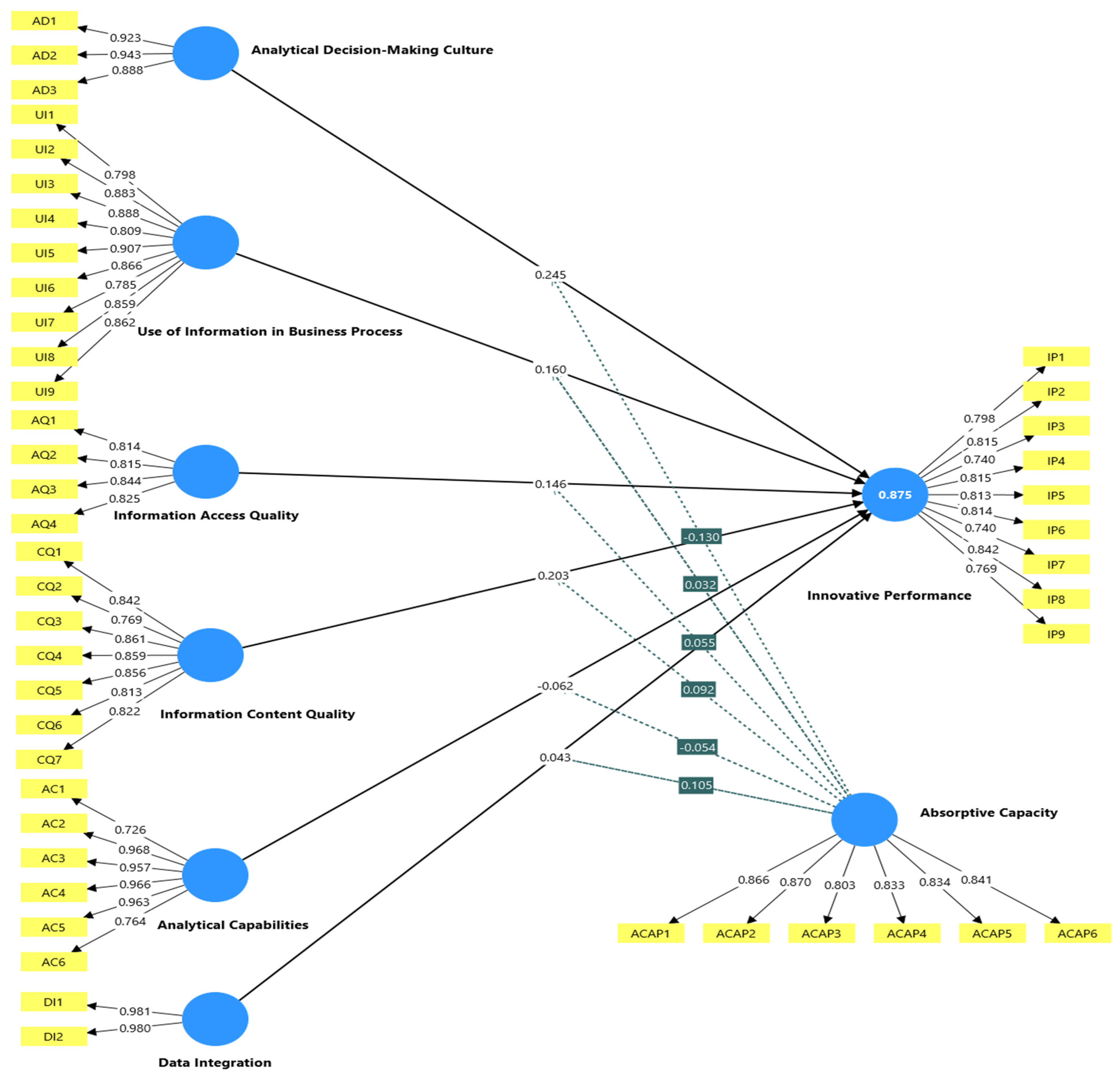
As shown in Table 4, four out of the six direct associations between business intelligence (BI) and innovative performance (IP) were confirmed. Specifically, IP was found to be significantly and positively impacted by analytical decision-making culture (β = 0.245, t = 7.823, p < 0.001), use of information in business process (β = 0.160, t = 2.268, p < 0.001), information access quality (β = 0.146, t = 4.748, p < 0.05), and information content quality (β = 0.203, t = 5.348, p < 0.05), supporting H1, H2, H3, and H4.
Table 4.
Study hypotheses assessment.
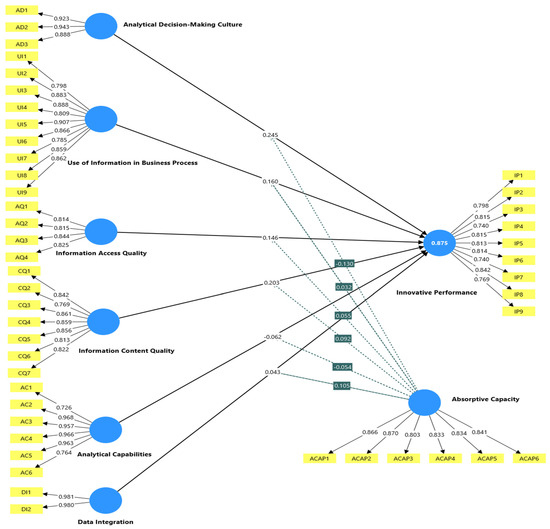
Conversely, two BI competencies, analytical integration (β = −0.062, t = 0.888, p = 0.374) and data integration (β = −0.043, t = 1.553, p = 0.120), were found to have insignificant association with IP, rejecting H5 and H6 (see Figure 1).
Figure 1.
Study model results.
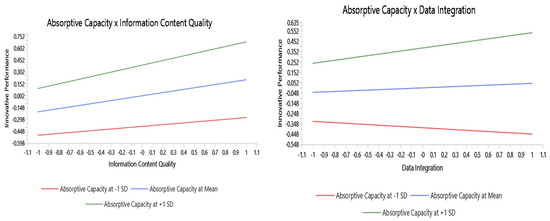
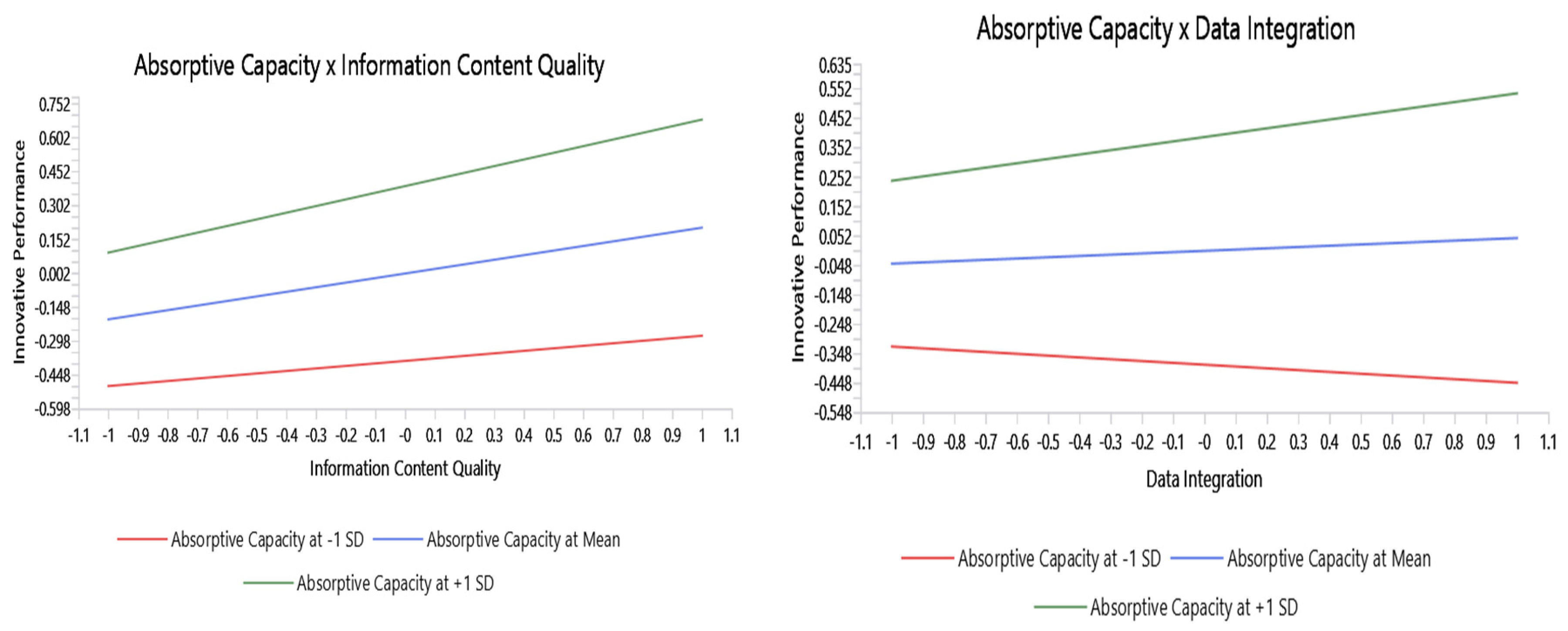
Regarding the moderate analysis shown in Figure 2, the model was developed to examine the moderate impact of adaptive capacity in the direct associations of six BI capabilities and IP. Interestingly, the findings revealed that ACAP unsuccessfully moderates the impacts of four BI capabilities on IP. However, ACAP successfully moderates the impacts of information content quality and IP (β = 0.092, t = 2.422, p < 0.05) and, interestingly, ACAP can moderate the association between data integration and IP (β = 0.105, t = 3.502, p < 0.001), as depicted in Figure 2’s slope analysis, which means that when ACAP is high (green line), the slope of the path from information content quality and data integration to IP is strongly positive.
Figure 2.
Slope analysis findings.
5. Discussion and Implications
The current study provided some evidence that specific BI factors can play a core role in improving IP in four- and five-star hotels. Particularly, four BI capabilities: information access quality, the use of information in business processes, analytical decision-making culture, and information content qualitywere found to have significant positive impact on innovation performance. First, the strong association between analytical decision-making culture (AC) and IP underscores the importance of promoting a data-based organisational attitude in the luxury hotel environment. Hotels that embed analytics into managerial practices are better positioned to detect emerging customer trends, improve service quality, and drive innovation in performance. These findings are consistent with previous research highlighting that data-driven cultures can improve managerial agility and innovation performance by facilitating evidence-based decision-making (Davenport et al., 2010; Thomas & Wood, 2015). Second, the positive association between the use of information in business processes (UI) and innovative performance emphasised the functional value of BI integration. When data is embedded in core processes such as customer relationship management (CRM), service design, and revenue management systems, hotels can improve both radical and incremental innovation. This aligns with the previous literature arguing that the efficient exploitation of information resources can strengthen managerial learning and innovation capacities (Alavi & Leidner, 2001).
Third, information access quality (AQ) was found to be significantly associated with IP, indicating that seamless, timely access to appropriate data is core to IP. In the high-end hotel context, where decision-making regularly arises under severe time pressure, the accessibility of precise, approachable information fosters proactive behaviour among managers and employees. This result aligns with prior research indicating that information accessibility can improve knowledge sharing and facilitate innovation performance (Dawar, 2013). Fourth, the significant relationship between information content quality (CQ) and IP emphasises that the value of BI depends not only on the availability of relevant data but also on its accuracy and completeness. High-quality information reinforces better strategic visions and decreases ambiguity in innovation-correlated decisions. This finding is consistent with prior evidence implying that information quality is a core determinant of BI and successful and innovative performance (DeLone & McLean, 2003).
Inconsistent with previously established expectations, the results of the current study indicated that analytical capabilities (AC) and data integration (DI) failed to show a statistically significant association with innovative performance (IP) in four- and five-star hotels. These findings call for a more nuanced explanation of how BI capabilities can be translated into IP in service-intensive contexts. One probable explanation is related to the difference between technical capability accessibility and successful exploitation. While AC and DI represent basic BI infrastructure, their mere existence cannot ensure value creation without actively embedding them into decision-making processes. Previous research suggests that information technology (IT) and AC can foster organisational performance only when they are consistent with managerial processes and organisational practices (Gupta & George, 2016). In four- and five-star hotels, where customised guest experiences and staff responsiveness frequently guide innovation, the influence of information integration capabilities may remain indirect or unobserved unless translated into actionable insights. Furthermore, the insignificant association between AC and IP might reflect managerial silos and limited cross-functional cooperation, which remain prevalent in many hotel organisations. Even when IT systems are technically embedded in organisational practices, departments such as operations, marketing, and guest services might not fully share or leverage the integrated analytics’ outcomes. This explanation aligns with the results of Côrte-Real et al. (2020a, 2020b), who argued that the business value of AC relies heavily on knowledge-sharing processes rather than on technological complexity.
Likewise, the insignificant association between DI and IP might be credited to data usability and quality challenges. Incorporating data from numerous sources (e.g., CRM, reservation systems, and guest review platforms) can introduce complexity and create inconsistencies, which might deter rather than accelerate IP if not appropriately managed. In the hotel setting, where accurate and timely information is significant, inadequately integrated data can undermine trust in analytics outcomes and limit their adoption in innovation-driven decision-making (Mariani et al., 2021). Moreover, innovation in five- and four-star luxury hotels is often experience-driven rather than technology-centric, placing strong emphasis on personal interaction, service innovation, and emotional involvement. In such an environment, capabilities such as an analytical decision-making culture and the quality of information content and access might play a more important role in fostering innovation than technical capabilities such as AC and DI. This assumption is consistent with the service-dominant logic proposition, which highlights that value can be co-created through interactions rather than rooted solely in technological mechanisms (Vargo & Lusch, 2017).
The slope analysis of the moderation impacts provided a more fine-grained insight into how BI capabilities can be translated into IP in four- and five-star hotels by initiating the contingent role of ACAP. The findings revealed that a selective moderating influence: ACAP strengthens the relationships between (1) CQ and IP and (2) DI and IP, while it did not significantly moderate the remaining BI–IP connections. The significant moderating role underscores the value of an organisation’s capacity to identify, assimilate, and utilise high-quality information. This result aligns with the work of Cohen and Levinthal (1990), who argued that ACAP can determine the extent to which internal and external knowledge can be translated into IP. More recent hotel-related research also confirmed that knowledge exploitation capabilities can significantly improve innovation outcomes when reinforced by high-quality data (Mariani et al., 2021). Likewise, ACAP’s moderating effect on the association between DI and IP provided an important justification for the previously unexpected results regarding the direct association between DI and IP. While DI alone failed to exhibit a significant direct association with IP, its relationship becomes positive and significant under conditions of elevated ACAP levels. This suggested that incorporating data from multiple sources yields innovation gains only when organisations are skilled at transforming the integrated data into actionable insights. This is consistent with the Dynamic Capabilities’ viewpoint, which highlights that selective organisational competencies (i.e., knowledge and learning transformation) are vital for transferring internal and external resources into performance outcomes (Teece, 2018). In the context of five- and four-star hotels, this indicates that the significance of integrated data is recognised through organisational interpretation and strategic implementation rather than solely through technical integration.
The slope analysis further supports this explanation by showing that, at higher ACAP levels, the association between CQ and DI and IP becomes positive. This signals that ACAP can serve in a catalytic capacity, enabling hotels to uncover the latent value embedded in their BI structures. Such conclusions align with previous research suggesting that big data and AC require complementary managerial capabilities to create innovative performance and achieve CA (Gupta & George, 2016). On the contrary, the lack of ACAP moderation on the association between the other BI dimensions and IP suggested that selective capabilities might exert a more direct, less contingent influence on IP. These BI capabilities might already be embedded in managerial routines and decision-making procedures in this type of hotel, reducing the need for additional knowledge transformation mechanisms.
This research contributed to the current body of knowledge on the association of BI and IP by empirically verifying the multidimensional nature of business intelligence capabilities in a hotel context. Unlike previous studies that frequently operationalise BI as a unidimensional construct, the current results demonstrate that distinct BI capabilities can exert differential influences on IP. This extends and supports the Resource-Based View (RBV) by emphasising that not all BI-related resources are equally valuable; instead, their success depends on how they are embedded within managerial culture and processes (Barney, 1991; Hurbean et al., 2024; Pop et al., 2026). The findings also highlight the assumption that intangible resources (i.e., analytical culture and information quality) can function as critical antecedents of IP in service-driven industries. Additionally, the results extended hospitality-related research by highlighting that innovation drivers in hotels are more closely tied to human-centric and information-quality elements than to solely technical facilities. Furthermore, this research advanced the literature by proving that ACAP can play a selective moderating role in the BI–IP relationship. Rather than strengthening all BI capabilities equally, ACAP selectively improved the more technically driven capabilities (CQ and DI). These results contributed to the RBV and “Dynamic Capabilities Theory” by demonstrating that the value of technological resources relies on balancing organisational capabilities (Teece et al., 1997). These findings demonstrated that innovation in luxury hotels is knowledge-guided rather than technology-based per se. This opens opportunities for future studies to explore additional moderating factors, such as digital maturity, organisational learning, and leadership support.
From a practical perspective, the study’s results provided actionable insights for managers in luxury hotels. First, hotel managers should prioritise analytical decision-making culture (AC) by investing in and supporting training programmes and data-driven performance appraisal. Encouraging top managers and supervisors to rely on analytics rather than intuition can substantially improve innovation performance. Second, integrating BI capabilities into daily business routines could be a strategic priority. This involves integrating analytics into core operational areas such as marketing, finance, and CRM. By doing so, luxury hotels can leverage data to design customised services, enhance operational effectiveness, and identify new market opportunities. Third, hotels would invest in user-friendly BI programmes that provide real-time access to relevant data across different hotel departments. Improving data accessibility not only fosters decision-making speed but also improves cross-functional partnerships and innovation. Fourth, top managers should focus on advancing information content quality by forming a strong data governance system. This involves ensuring data consistency, accuracy, and relevance through regular audits and enhanced data management practices. High-quality data can serve as the basis for reliable understanding and innovative plans. Fifth, the findings suggested that investments in analytical capabilities (AC) and data integration (DI) tools alone may not yield immediate innovation advantages in the hotel industry. Hotel managers should consequently avoid over-dependence on technological infrastructure and, instead, focus on bridging the gap between DI and practical implementation. Finally, managers must prioritise the development of absorptive capacity (ACAP) by advancing a learning-driven culture, investing in staff training, and reinforcing knowledge sharing across diverse departments. Without such capabilities, investments in DI and AC might fail to yield meaningful innovation.
6. Limitations and Opportunities for Future Research
Despite providing valuable contributions, several limitations in this study should be acknowledged, offering significant opportunities for future research. First, the study adopted a cross-sectional research design, which may limit the ability to infer causal associations among BI capabilities, ACAP, and IP. While the structural associations are theoretically grounded and empirically confirmed, a longitudinal research approach might offer a deeper understanding of how these associations can evolve over a longer period of time. Second, the empirical setting of the research is limited to four- and five-star hotels, which may limit the generalisability of the results to other segments of the hotel industry. As such, future studies might extend the current study’s model to other hotel segments, such as small- and medium-sized enterprises. Third, although the proposed model explains a substantial proportion of the variance in innovative performance, the study focused primarily on the direct effects of business intelligence capabilities and the moderating role of absorptive capacity. Consistent with the principle of ceteris paribus, other organisational and contextual factors that may influence innovative performances—such as hotel size, degree of digitalisation, ownership structure, organisational culture, and technological maturity—were not explicitly incorporated into the model. Future research could extend the present framework by examining these variables as control factors, moderators, or antecedents to provide a more comprehensive understanding of the conditions under which business intelligence capabilities contribute to innovation outcomes in hospitality organisations. Fourth, this study relied on self-reported data collected from the same source, which might raise concerns about common method bias (CMB), even with the statistical analyses conducted to mitigate this bias. Future studies would address this limitation by using a multi-source data collection design. Fourth, the moderating role of ACAP was found to be selective rather than universal, suggesting that additional moderating factors may influence the BI–IP associations. Future studies would examine other moderate variables, such as environmental uncertainty, innovation culture, or leadership style. Finally, qualitative or mixed research methods could offer deeper insights into how BI is associated with IP in the luxury hotel context.
Author Contributions
Conceptualisation, I.A.E.; Methodology, I.A.E. and A.M.S.A.; Software, A.M.S.A.; Validation, C.K. and A.M.S.A.; Formal analysis, I.A.E. and A.M.S.A.; Resources, C.K. and A.M.S.A.; Data curation, C.K. and A.M.S.A.; Writing—original draft, I.A.E., C.K. and H.A.; Writing—review and editing, I.A.E. and H.A.; Visualisation, A.M.S.A.; Project administration, I.A.E.; Funding acquisition, I.A.E. and H.A. All authors have read and agreed to the published version of the manuscript.
Funding
This work was funded by the Deanship of Scientific Research, Vice Presidency for Graduate Studies and Scientific Research, King Faisal University, Saudi Arabia [Project No. KFU262428].
Institutional Review Board Statement
The study was conducted in accordance with the Declaration of Helsinki and approved by the scientific research ethical committee of King Faisal University (protocol code: KFU-262428 and date of approval: 25 April 2025).
Informed Consent Statement
Informed consent was obtained from all subjects involved in the study.
Data Availability Statement
The original contributions presented in this study are included in the article. Further inquiries can be directed to the corresponding authors.
Conflicts of Interest
The authors declare no conflicts of interest.
Appendix A. Scale Items
| Factors | Items |
| Absorptive Capacity | |
| ACAP1 | Our hotel effectively acquires and understands new external knowledge. |
| ACAP2 | We quickly identify valuable new information from the environment. |
| ACAP3 | We efficiently share and interpret new knowledge internally. |
| ACAP4 | We successfully combine new knowledge with existing capabilities. |
| ACAP5 | We apply new knowledge to develop new services/processes. |
| ACAP6 | We use acquired knowledge to enhance innovation performance. |
| Analytical Capabilities Capacity | |
| To what extent does your hotel use the following BI capabilities? | |
| AC1 | Static paper-based or basic electronic reports |
| AC1 | Interactive and ad hoc reports for managerial analysis |
| AC3 | Online analytical processing (OLAP) for multidimensional analysis |
| AC4 | Advanced analytical tools (e.g., trend analysis, forecasting, what-if scenarios) |
| AC5 | Data mining or predictive analytics (e.g., demand patterns, guest behaviour) |
| AC6 | Dashboards with performance metrics, KPIs, and alerts (e.g., occupancy, RevPAR, ADR) |
| Analytical Decision-Making Culture | |
| AD1 | Decision-making processes in our hotel are well defined and understood by managers. |
| AD2 | It is hotel policy to base decisions on available data and analytical information. |
| AD3 | Managers rely on data and analysis regardless of the type or level of decision. |
| Data Integration | |
| (1 = Statement A best represents the current situation, 7 = Statement B best represents the current situation) | |
| DI1 | Statement A: Hotel data are scattered across different systems (e.g., PMS, POS, revenue management, spreadsheets, ERP) and are difficult to combine. Statement B: Hotel data are fully integrated across systems, enabling real-time reporting and analysis. |
| DI2 | Statement A: Data from different hotel systems are often inconsistent or contradictory. Statement B: Data from different hotel systems are consistent and aligned. |
| Information Access Quality | |
| AQ1 | The information provided matches managers’ needs and working habits. |
| AQ2 | Information is delivered quickly without unnecessary delays. |
| AQ3 | Information clearly shows its source, date, and relevance. |
| AQ4 | Managers can easily and interactively access the information when needed. |
| Information Content | |
| CQ1 | The information provided is appropriate in scope (neither too much nor too little). |
| CQ2 | The information accurately reflects the actual operating conditions of the hotel. |
| CQ3 | The information is easy for hotel managers to understand and interpret. |
| CQ4 | The information is concise and free from unnecessary details. |
| CQ5 | The information provided is consistent and non-contradictory. |
| CQ6 | The information is reliable and free from errors or bias. |
| CQ7 | The information is up to date and available when needed. |
| Innovative Performance | |
| IP1 | The level of newness of our new products/services |
| IP2 | The competitiveness of our technology. |
| IP3 | The innovation of our technology in new product/service development. |
| IP4 | The updated-ness of our technology in hotel’s processes. |
| IP5 | The speed of our new product/service development. |
| IP6 | The speed of our adoption of the latest technological innovations in hotel’s processes. |
| IP7 | The number of our new products/services introduced to the market. |
| IP8 | The rate of our change in processes, techniques and technology. |
| IP9 | The number of our new products/services that is first-to-market. |
| Use of Information in Business Processes | |
| The information available within our hotel’s business processes… | |
| UI1 | … highlights problems in hotel operations and makes managers aware of them. |
| UI2 | … supports evaluating hotel processes against standards and improving service quality. |
| UI3 | … encourages innovation in internal operations and guest service delivery. |
| UI4 | … reduces uncertainty in managerial decisions and improves operational effectiveness. |
| UI5 | … enables rapid response to operational issues and proactive planning. |
| UI6 | … is used to revise strategies, adjust KPIs, and evaluate new performance indicators. |
| UI7 | … enhancing the value and quality of services delivered to guests. |
| UI8 | … reducing operational and managerial risks. |
| UI9 | … reducing costs related to hotel operations and service delivery. |
References
- Aksoy, L., Choi, S., Dogru, T., Keiningham, T., Lorenz, M., Rubin, D., & Bruce Tracey, J. (2022). Global trends in hospitality. Journal of Business Research, 142, 957–973. [Google Scholar] [CrossRef] [Scilit] [PubMed]
- Alavi, M., & Leidner, D. E. (2001). Knowledge management and knowledge management systems: Conceptual foundations and research issues. MIS Quarterly, 25(1), 107–136. [Google Scholar] [CrossRef] [Scilit]
- Alshareef, H. R., & Emeagwali, O. L. (2026). Business intelligence capabilities and SME innovation: The mediating role of knowledge management capability and the moderating effect of data-driven decision making. Systems, 14(4), 339. [Google Scholar] [CrossRef] [Scilit]
- Argote, L., & Miron-Spektor, E. (2011). Organizational learning: From experience to knowledge. Organization Science, 22(5), 1123–1137. [Google Scholar] [CrossRef] [Scilit]
- Barney, J. (1991). Firm resources and sustained competitive advantage. Journal of Management, 17(1), 99–120. [Google Scholar] [CrossRef] [Scilit]
- Barney, J., Wright, M., & Ketchen, D. J. (2001). The resource-based view of the firm: Ten years after 1991. Journal of Management, 27, 625–641. [Google Scholar] [CrossRef]
- Berdejo-Fariña, A. V., & Espino-Rodríguez, T. F. (2025). Hotel gastronomic innovation from the perspective of absorptive capacity and organisational learning: Its impact on performance. European Journal of Tourism Research, 41, 4117. [Google Scholar] [CrossRef] [Scilit]
- Camisón, C., & Monfort-Mir, V. M. (2012). Measuring innovation in tourism from the Schumpeterian and dynamic-capabilities perspectives. Tourism Management, 33(4), 776–789. [Google Scholar] [CrossRef] [Scilit]
- Chen, H., Chiang, R. H., & Storey, V. C. (2012). Business intelligence and analytics: From big data to big impact. MIS Quarterly, 36(4), 1165–1188. Available online: https://misq.umn.edu/misq/article/36/4/1165/1483 (accessed on 1 January 2025).
- Chin, W. W. (2010). How to write up and report PLS analyses. In V. Esposito Vinzi, W. W. Chin, J. Henseler, & H. Wang (Eds.), Handbook of partial least squares (pp. 655–690). Springer. [Google Scholar] [CrossRef] [Scilit]
- Cohen, W. M., & Levinthal, D. A. (1990). Absorptive capacity: A new perspective on learning and innovation. Administrative Science Quarterly, 35(1), 128–152. [Google Scholar] [CrossRef] [Scilit]
- Côrte-Real, N., Oliveira, T., & Ruivo, P. (2020a). Assessing business value of big data analytics in European firms. Journal of Business Research, 70, 379–390. [Google Scholar] [CrossRef] [Scilit]
- Côrte-Real, N., Ruivo, P., & Oliveira, T. (2020b). Leveraging internet of things and big data analytics initiatives in European and American firms: Is data quality a way to extract business value? Information & Management, 57(1), 103141. [Google Scholar] [CrossRef] [Scilit]
- Davenport, T. H., Harris, J. G., & Morison, R. (2010). Analytics at work: Smarter decisions, better results. Harvard Business School Press. [Google Scholar]
- Dawar, N. (2013). When marketing is strategy. Harvard Business Review, 91(12), 100–108. [Google Scholar]
- De la Gala-Velásquez, B., Hurtado-Palomino, A., Zirena-Bejarano, P. P., & Arredondo-Salas, A. Y. (2025). Does absorptive capacity foster open innovation? Journal of Open Innovation: Technology, Market, and Complexity, 11, 100538. [Google Scholar] [CrossRef] [Scilit]
- DeLone, W. H., & McLean, E. R. (2003). The DeLone and McLean model of information systems success: A ten-year update. Journal of Management Information Systems, 19(4), 9–30. [Google Scholar] [CrossRef] [Scilit]
- Elbashir, M. Z., Collier, P. A., & Sutton, S. G. (2011). The role of organizational absorptive capacity in strategic use of business intelligence to support integrated management control systems. The Accounting Review, 86(1), 155–184. [Google Scholar] [CrossRef] [Scilit]
- Elshaer, I. A., & Augustyn, M. M. (2016). Direct effects of quality management on competitive advantage. International Journal of Quality & Reliability Management, 33(9), 1286–1310. [Google Scholar] [CrossRef] [Scilit]
- Elshaer, I. A., Azazz, A. M. S., Aljoghaiman, A., Mansor, M., Salama, M. A., & Fayyad, S. (2025). Artificial intelligence-driven supply chain agility and resilience: Pathways to competitive advantage in the hotel industry. Logistics, 10(1), 5. [Google Scholar] [CrossRef] [Scilit]
- Elshaer, I. A., Kooli, C., Azazz, A. M. S., & Alyahya, M. (2026a). Large language models and innovative work behavior in higher education curriculum development. Administrative Sciences, 16(1), 56. [Google Scholar] [CrossRef] [Scilit]
- Elshaer, I. A., Kooli, C., Azazz, A. M. S., Fayyad, S., Algezawy, M., & Mohammad, A. A. A. (2026b). Going green in SMEs: Unpacking how innovative work behavior impacts employee commitment through a mediated–moderated model. Administrative Sciences, 16(1), 27. [Google Scholar] [CrossRef] [Scilit]
- Flynn, B. B., & Flynn, E. J. (1999). Information-processing alternatives for coping with manufacturing environment complexity. Decision Sciences, 30(4), 1021–1052. [Google Scholar] [CrossRef] [Scilit]
- Gangwar, V. P., & Reddy, D. (2023). Hospitality industry 5.0: Emerging trends in guest perception and experiences. In Opportunities and challenges of business 5.0 in emerging markets (pp. 185–211). IGI Global Scientific Publishing. [Google Scholar] [CrossRef] [Scilit]
- George, G., Haas, M. R., & Pentland, A. (2014). Big data and management. Academy of Management Journal, 57(2), 321–326. [Google Scholar] [CrossRef] [Scilit]
- Grant, R. M. (1996). Toward a knowledge-based theory of the firm. Strategic Management Journal, 17(S2), 109–122. [Google Scholar] [CrossRef] [Scilit]
- Gupta, M., & George, J. F. (2016). Toward the development of a big data analytics capability. Information & Management, 53(8), 1049–1064. [Google Scholar] [CrossRef] [Scilit]
- Hair, J. F., Jr., Hult, G. T. M., Ringle, C. M., Sarstedt, M., Danks, N. P., & Ray, S. (2021). Partial least squares structural equation modeling (PLS-SEM) using R: A workbook. Springer Nature. [Google Scholar] [CrossRef] [Scilit]
- Henseler, J., Ringle, C. M., & Sinkovics, R. R. (2009). The use of partial least squares path modeling in international marketing. In R. R. Sinkovics, & P. N. Ghauri (Eds.), New challenges to international marketing (Vol. 20, pp. 277–319). Emerald Group Publishing Limited. [Google Scholar] [CrossRef] [Scilit]
- Henseler, J., & Sarstedt, M. (2013). Goodness-of-fit indices for partial least squares path modeling. Computational Statistics, 28(2), 565–580. [Google Scholar] [CrossRef] [Scilit]
- Hurbean, L., Militaru, F., Munteanu, V. P., Danaiata, D., Fotache, D., & Muntean, M. (2024). Assessing the influence of business intelligence and analytics and data-driven culture on managerial performance: Evidence from Romania. Systems, 13(1), 2. [Google Scholar] [CrossRef] [Scilit]
- Hurley, R. F., & Hult, G. T. M. (1998). Innovation, market orientation, and organizational learning: An integration and empirical examination. Journal of Marketing, 62(3), 42–54. [Google Scholar] [CrossRef] [Scilit]
- Ibrahim, N., & Handayani, P. W. (2025). Business intelligence system adoption in the hotel industry: Identifying barriers and actions. Interdisciplinary Journal of Information, Knowledge, and Management, 20, 23. [Google Scholar] [CrossRef] [Scilit] [PubMed]
- Jang, S. H., & Lee, C. W. (2025). Digital entrepreneurial orientation, technology absorptive capacity, and digital innovation on business performance. Systems, 13(4), 300. [Google Scholar] [CrossRef] [Scilit]
- Kale, E., Başar, Ö., & Aknar, A. (2017). Absorptive capacity: An empirical study on Turkey’s hotel companies. International Journal of Tourism Economics and Business Sciences, 1(1), 48–55. [Google Scholar]
- Krejcie, R. V., & Morgan, D. W. (1970). Determining sample size for research activities. Educational and Psychological Measurement, 30(3), 607–610. [Google Scholar] [CrossRef] [Scilit]
- Leguina, A. (2015). A primer on partial least squares structural equation modeling (PLS-SEM). International Journal of Research & Method in Education, 38(2), 220–221. [Google Scholar] [CrossRef] [Scilit]
- Liu, Z., Wang, M., Liu, D., Du, Z., Zhang, L., & Wang, J. (2025). Integrating analyst-forecasting indicators into business intelligence systems for data-driven financial distress prediction. Systems, 14(1), 29. [Google Scholar] [CrossRef] [Scilit]
- Maghsoudi, M., & Nezafati, N. (2023). Navigating the acceptance of implementing business intelligence in organizations: A system dynamics approach. Telematics and Informatics Reports, 11, 100070. [Google Scholar] [CrossRef] [Scilit]
- Mariani, M. M., Baggio, R., Fuchs, M., & Höepken, W. (2021). Business intelligence and big data in hospitality and tourism: A systematic literature review. International Journal of Contemporary Hospitality Management, 33(6), 2194–2213. [Google Scholar] [CrossRef] [Scilit]
- Mikalef, P., Krogstie, J., Pappas, I. O., & Pavlou, P. (2020). Investigating the effects of big data analytics capabilities on firm performance: The mediating role of dynamic capabilities. Information & Management, 57(2), 103169. [Google Scholar] [CrossRef] [Scilit]
- Musiello-Neto, F., Rua, O. L., Arias-Oliva, M., & Silva, A. F. (2021). Open innovation and competitive advantage on the hospitality sector: The role of organizational strategy. Sustainability, 13(24), 13650. [Google Scholar] [CrossRef] [Scilit]
- Nam, K., Dutt, C. S., Chathoth, P., Daghfous, A., & Khan, M. S. (2021). The adoption of artificial intelligence and robotics in the hotel industry: Prospects and challenges. Electronic Markets, 31(3), 553–574. [Google Scholar] [CrossRef] [Scilit]
- Nelson, R. R., Todd, P. A., & Wixom, B. H. (2005). Antecedents of information and system quality: An empirical examination within the context of data warehousing. Journal of Management Information Systems, 21(4), 199–235. [Google Scholar] [CrossRef] [Scilit]
- Patnayakuni, R., Rai, A., & Seth, N. (2006). Relational antecedents of information flow integration for supply chain coordination. Journal of Management Information Systems, 23(1), 13–49. [Google Scholar] [CrossRef] [Scilit]
- Podsakoff, P. M., MacKenzie, S. B., Lee, J.-Y., & Podsakoff, N. P. (2003). Common method biases in behavioral research: A critical review of the literature and recommended remedies. Journal of Applied Psychology, 88(5), 879. [Google Scholar] [CrossRef] [Scilit] [PubMed]
- Pop, E.-A., Mircea, G., & Iliescu, C.-R.-M. (2026). A comprehensive business intelligence framework for diabetes management in telemedicine: Advancing data-driven decision support through integrated visualization and predictive analytics. Systems, 14(2), 155. [Google Scholar] [CrossRef] [Scilit]
- Popovič, A., Hackney, R., Coelho, P. S., & Jaklič, J. (2012). Towards business intelligence systems success: Effects of maturity and culture on analytical decision making. Decision Support Systems, 54(1), 729–739. [Google Scholar] [CrossRef] [Scilit]
- Prajogo, D. I., & Sohal, A. S. (2003). The relationship between TQM practices, quality performance, and innovation performance. International Journal of Quality & Reliability Management, 20(8), 901–918. [Google Scholar] [CrossRef] [Scilit]
- Sarstedt, M., Ringle, C. M., Cheah, J.-H., Ting, H., Moisescu, O. I., & Radomir, L. (2020). Structural model robustness checks in PLS-SEM. Tourism Economics, 26(4), 531–554. [Google Scholar] [CrossRef] [Scilit]
- Sarstedt, M., Ringle, C. M., & Hair, J. F. (2022). Partial least squares structural equation modeling. In C. Homburg, M. Klarmann, & A. Vomberg (Eds.), Handbook of market research (pp. 587–632). Springer International Publishing. [Google Scholar] [CrossRef] [Scilit]
- Sáenz, M. J., Revilla, E., & Knoppen, D. (2014). Absorptive capacity in buyer–supplier relationships: Empirical evidence of its mediating role. Journal of Supply Chain Management, 50(2), 18–40. [Google Scholar] [CrossRef] [Scilit]
- Tabachnick, B. G., & Fidell, L. S. (2007). Using multivariate statistics. Pearson Education. [Google Scholar]
- Tajeddini, O., Martin, E., & Altinay, L. (2026). Smart insights, stronger performance: Leveraging business intelligence and AI capabilities in tourism and hospitality firms. Tourism Management. [Google Scholar] [CrossRef] [Scilit]
- Teece, D. J. (2018). Business models and dynamic capabilities. Long Range Planning, 51(1), 40–49. [Google Scholar] [CrossRef] [Scilit]
- Teece, D. J., Pisano, G., & Shuen, A. (1997). Dynamic capabilities and strategic management. Strategic Management Journal, 18(7), 509–533. [Google Scholar] [CrossRef] [Scilit]
- Thomas, R., & Wood, E. (2015). The absorptive capacity of tourism organisations. Annals of Tourism Research, 54, 84–99. [Google Scholar] [CrossRef] [Scilit]
- Tong-On, P., Siripipatthanakul, S., & Phayaphrom, B. (2021). The implementation of business intelligence using data analytics and its effects towards on performance in the hotel industry in Thailand (SSRN scholarly paper no. 3944077). Social Science Research Network. Available online: https://papers.ssrn.com/abstract=3944077 (accessed on 4 May 2026).
- Tsiu, S. V., Ngobeni, M., Mathabela, L., & Thango, B. (2025). Applications and competitive advantages of data mining and business intelligence in SMEs performance: A systematic review. Businesses, 5(2), 22. [Google Scholar] [CrossRef] [Scilit]
- Vargo, S. L., & Lusch, R. F. (2017). Service-dominant logic 2025. International Journal of Research in Marketing, 34(1), 46–67. [Google Scholar] [CrossRef] [Scilit]
- Wang, C. L., & Ahmed, P. K. (2007). Dynamic capabilities: A review and research agenda. International Journal of Management Reviews, 9(1), 31–51. [Google Scholar] [CrossRef] [Scilit]
- Wixom, B. H., & Todd, P. A. (2005). A theoretical integration of user satisfaction and technology acceptance. Information Systems Research, 16(1), 85–102. [Google Scholar] [CrossRef] [Scilit]
- Wynn, M., & Jones, P. (2022). IT strategy in the hotel industry in the digital era. Sustainability, 14(17), 10705. [Google Scholar] [CrossRef] [Scilit]
- Zahra, S. A., & George, G. (2002). Absorptive capacity: A review, reconceptualization, and extension. Academy of Management Review, 27(2), 185–203. [Google Scholar] [CrossRef] [Scilit] [PubMed]

Disclaimer/Publisher’s Note: The statements, opinions and data contained in all publications are solely those of the individual author(s) and contributor(s) and not of MDPI and/or the editor(s). MDPI and/or the editor(s) disclaim responsibility for any injury to people or property resulting from any ideas, methods, instructions or products referred to in the content. |
© 2026 by the authors. Licensee MDPI, Basel, Switzerland. This article is an open access article distributed under the terms and conditions of the Creative Commons Attribution (CC BY) license.