


Abstract
Hybrid work has changed the behavioural foundations of organizational change. Employees are no longer continuously embedded in a common physical workplace where informal communication, shared routines, visible leadership and spontaneous peer sensemaking help them interpret new priorities. This study investigates how psychological ownership is associated with resistance to change when work is organized through hybrid arrangements rather than continuous office presence. Drawing on psychological ownership theory, self-determination theory, organizational identification, employee engagement, remote work design and recent digital transformation research, the paper develops an internalization-based model in which leadership communication transparency and perceived autonomy are associated with psychological ownership, and psychological ownership is associated with lower resistance to change. Hybrid work intensity is conceptualized as a boundary condition that strengthens ownership formation because employees who more frequently work remotely rely less on physical embeddedness and more on internal psychological connection. The model is tested using cross-sectional survey data from 412 employees working in hybrid arrangements across the fields of information technology, consulting, energy, manufacturing, financial services and professional services. Data were screened using IBM SPSS Statistics 29, and the measurement and structural models were estimated using covariance-based structural equation modelling in IBM SPSS AMOS 29, with maximum likelihood estimation and 5000 bootstrap resamples for indirect and conditional indirect associations. The findings show that leadership communication transparency and perceived autonomy are positively associated with psychological ownership. Psychological ownership is negatively associated with resistance to change and mediates the associations of communication transparency and autonomy with resistance. Hybrid work intensity strengthens the association of communication transparency and autonomy with psychological ownership and also strengthens the indirect associations with resistance. The study positions psychological ownership as an internal substitute for weakened physical embeddedness in hybrid change contexts. It further clarifies that resistance in hybrid organizations is not only a problem of communication volume, employee engagement or formal identification; it is also a problem of whether or not employees come to experience change as personally meaningful, identity relevant and partly theirs.
1. Introduction
Hybrid work has moved organizational change to more complex behavioural terrain. In office-centred organizations, change is interpreted not only through formal messages but also through everyday proximity, corridor conversations, visible leadership, peer reactions, routine cues and collective sensemaking. These mechanisms help employees decide whether a new policy, technology, workflow or restructuring effort is credible, fair and relevant to their role. Hybrid work weakens the continuity of these mechanisms. Employees remain formally connected to the organization, but their experience of change is increasingly mediated through digital platforms, scheduled interactions and intermittent office presence.
The managerial debate over hybrid work has often concentrated on productivity, job satisfaction, retention and the number of days employees should spend in the office. Recent evidence shows that hybrid and remote-capable work can improve retention, job satisfaction and flexibility without necessarily damaging performance (Barrero et al., 2021; Aksoy et al., 2023; Bloom et al., 2024; Gallup, 2024). Large-scale workplace evidence also shows that organizations continue to revise work-from-office policies as employees evaluate flexibility, belonging, wellbeing and career consequences more actively (Cisco, 2025). These findings do not resolve the deeper change-management problem. A hybrid arrangement may keep employees productive in routine work while still leaving them psychologically distant from transformation efforts. The question is therefore not only whether hybrid work is efficient. The more important question for change management is how employees internalize organizational change when the workplace no longer provides continuous physical embeddedness.
This study addresses that question by placing psychological ownership at the centre of the explanation. Psychological ownership refers to the state in which individuals feel that a target is mine or ours, even without legal ownership (Pierce et al., 2001). In organizational settings, the target may be the job, the team, the organization, a work process or a change initiative. When employees experience ownership, they are more likely to invest effort, accept responsibility and connect the target with their identity. This makes psychological ownership theoretically relevant to resistance to change because resistance often arises when change is experienced as external, threatening, unclear or imposed.
Resistance to change is not treated here as irrational opposition. Following Piderit (2000), Oreg (2003) and Oreg et al. (2011), resistance is understood as a multidimensional response involving cognitive, emotional and behavioural reluctance toward change. Employees may resist because they fear loss of control, doubt the fairness of the process, mistrust leaders, feel identity threat, or believe the change will reduce competence and security. In hybrid environments, these responses may be more difficult to observe. Resistance may appear as silence in virtual meetings, delayed responses, minimal participation, passive compliance, weak adoption of new processes or psychological withdrawal rather than direct confrontation.
Therefore, the central research question is how is psychological ownership associated with employee resistance to change in hybrid work environments, and under what organizational and contextual conditions does this association become stronger? This question anchors the entire paper. The study does not simply ask whether transparent communication and autonomy are positive work conditions. It asks whether these conditions matter because they help employees form psychological ownership and whether ownership matters because it converts change from an external demand into an internal responsibility.
The literature offers important but incomplete answers. Change-management research emphasizes communication, participation, readiness and leadership support (Armenakis & Bedeian, 1999; Armenakis & Harris, 2009; Kotter, 1995; Kotter & Schlesinger, 2008). Recent reviews of change reactions and digital transformation resistance further show that employees respond to change through intertwined cognitive, emotional and behavioural evaluations rather than through simple acceptance or rejection (Khaw et al., 2022; Cieslak & Valor, 2025). Self-determination theory emphasizes autonomy as a basic psychological need that supports motivation and internalization (Deci & Ryan, 2000; Gagné & Deci, 2005). Psychological ownership theory explains how control, intimate knowledge and self-investment create feelings of possession (Pierce et al., 2003; Van Dyne & Pierce, 2004). Employee engagement and organizational identification research explain why employees devote energy to work and define themselves through organizational membership (Kahn, 1990; Ashforth & Mael, 1989; Saks, 2006; Uru et al., 2022). Yet these themes have not been sufficiently integrated to explain why employees support or resist change in hybrid work environments.
Recent hybrid work scholarship strengthens the need for such integration. Hybrid work should not be understood merely as a numerical split between office days and remote days. It includes spatial, temporal, virtual and social dimensions that reshape coordination, identity and belonging (Vartiainen & Vanharanta, 2024; Lauring & Jonasson, 2025; Urrila et al., 2025). Work from anywhere and partial work from home arrangements have been linked with flexibility, retention and job satisfaction (Choudhury et al., 2021; Barrero et al., 2021; Bloom et al., 2024). At the same time, research on digital collaboration shows that remote work may alter communication networks and reduce cross-group interaction (Yang et al., 2022), while work design studies show that remote workers face communication, loneliness, work–home interference and self-regulation challenges (Wang et al., 2021; van Zoonen et al., 2021). These findings indicate that hybrid work can be beneficial, but it also changes the social infrastructure through which employees understand and internalize organizational change.
The strengthened literature base also shows that hybrid work is now part of a broader digital transformation context. Employee participation in digital transformation depends on psychological readiness, perceived efficacy and positive sentiment toward change (Abhari, 2025). Reviews of hybrid and remote work indicate that performance and wellbeing outcomes depend on managerial support, digital infrastructure, communication norms and work design quality rather than on location alone (Wang et al., 2021; Aksoy et al., 2023; Maity & Lee, 2025). This reinforces the argument that resistance to change in hybrid settings cannot be understood only through traditional office-based models of supervision and communication. It must also be understood through the psychological mechanisms that keep employees connected to change when work is mediated through technology, distance and intermittent presence.
This paper argues that psychological ownership provides the missing internal mechanism. In physically co-located workplaces, employees may learn the meaning of change through presence and social observation. In hybrid workplaces, presence is intermittent. Therefore, organizations must rely more heavily on internalized attachment. Psychological ownership becomes important because it helps employees see change not as something done to them, but as something connected to their own role, competence, responsibility and identity.
The paper makes four contributions. First, it extends psychological ownership theory by positioning ownership as an internal substitute for weakened physical embeddedness in hybrid work settings. Second, it advances resistance-to-change literature by shifting attention from visible opposition to latent and internalized responses in digitally mediated work. Third, it integrates employee engagement and organizational identification with ownership theory, clarifying that ownership is related to but distinct from energy-based engagement and membership-based identification. Fourth, it connects hybrid work research with digital transformation participation by arguing that employees are more likely to support transformation when transparent communication and autonomy are converted into ownership, responsibility and change-related self-investment (Abhari, 2025; Maity & Lee, 2025). Fifth, it provides an empirically tested model using covariance-based structural equation modelling using explicit software, estimation, and bootstrapping details, thereby improving methodological transparency and reproducibility.
2. Literature Review and Theoretical Positioning
2.1. Resistance to Change in Hybrid Work Environments
Resistance to change has traditionally been defined as an employee response to perceived threat, uncertainty or loss. Lewin (1951) framed change as movement from one state to another, requiring forces that overcome inertia. Later scholarship moved away from treating resistance as a simple obstacle and instead conceptualized it as a complex attitude involving emotion, cognition and behaviour (Piderit, 2000). Oreg (2003) showed that resistance may reflect dispositional tendencies, while Oreg et al. (2011) demonstrated that reactions to change are shaped by trust, information, perceived consequences and justice. This literature is important because it shows that resistance can be a meaningful signal rather than a managerial failure alone.
Hybrid work modifies the conditions under which resistance is expressed. In a shared office, resistance may be detected through meeting behaviour, informal conversations, visible disengagement, explicit disagreement or withdrawal from shared routines. In hybrid settings, resistance may become quieter and more dispersed. Employees may attend online meetings but contribute little, read change messages without internalizing them, continue old routines in private workspaces, or comply with minimum requirements while withholding commitment. Recent work on digital transformation resistance confirms that such hidden and delayed responses are particularly important when technology-mediated change alters work routines and identity expectations (Khaw et al., 2022; Cieslak & Valor, 2025; Abhari, 2025). This form of resistance is strategically important because it is less visible to managers but still harmful to transformation.
The hybrid setting also changes the meaning of change communication. Employees cannot always rely on spontaneous interpretation with peers, immediate clarification from supervisors or repeated exposure to visible organizational cues. Formal communication must therefore carry a heavier sensemaking burden. This does not mean that more messages are automatically better. Rather, employees need communication that clarifies the rationale, consequences and role-level implications of change. Recent remote work evidence shows that communication quality, social connection and manager accessibility strongly influence employee adjustment when work is digitally mediated (Wang et al., 2021; van Zoonen et al., 2021; Urrila et al., 2025). Without such clarity, hybrid employees may experience change as abstract, distant or imposed.
The core problem is therefore one of internalization. Employees may understand the content of change and still remain psychologically detached from it. They may know what leaders expect but still not feel responsible for making the change work. Hybrid change management therefore requires an explanation that connects formal organizational conditions with the employee’s internal sense of meaning, control and responsibility. Psychological ownership offers that explanation.
2.2. Psychological Ownership as an Internalization Mechanism
Psychological ownership refers to a felt sense of possession toward a target (Pierce et al., 2001). The construct is rooted in three motives: efficacy and control, self-identity, and belongingness (Pierce et al., 2003). Individuals develop ownership when they can exercise control over a target, gain intimate knowledge of it and invest themselves in it. In organizational contexts, psychological ownership has been associated with commitment, stewardship, job satisfaction and citizenship behaviour (Van Dyne & Pierce, 2004; Avey et al., 2009).
Psychological ownership is particularly relevant to change because it changes the way employees interpret managerial initiatives. A change that is experienced as external may produce reluctance or passive compliance. A change that is experienced as connected to one’s own work and identity can evoke responsibility. Ownership does not imply uncritical acceptance. Employees with strong ownership may question poor decisions because they care about the organization. However, they are less likely to detach psychologically from the change because the change falls within a domain they feel responsible for.
This internalization logic distinguishes psychological ownership from adjacent concepts. Employee engagement captures the degree of energy, absorption and dedication employees bring to work (Kahn, 1990; Schaufeli et al., 2002; Saks, 2006). Organizational identification captures the extent to which employees define themselves in terms of organizational membership (Ashforth & Mael, 1989; Mael & Ashforth, 1992). Recent evidence from remote, hybrid and onsite work suggests that work arrangement can shape how engagement relates to identification (Uru et al., 2022). Psychological ownership is related to both, but it is not identical. Engagement concerns investment of energy. Identification concerns self-definition through membership. Ownership concerns a felt possession and responsibility toward a target. In a change context, this distinction matters because employees may be engaged in their tasks or identify with the organization while still not feeling that a specific change initiative is theirs.
The present paper therefore positions psychological ownership as a mechanism of change internalization. Leadership communication transparency provides the clarity needed to understand change. Perceived autonomy provides the control needed to influence work. Psychological ownership converts clarity and control into responsibility. Resistance declines when employees experience change as meaningful and partly self-relevant.
2.3. Hybrid Work, Embeddedness and the Ownership Substitute
Physical embeddedness refers to the everyday integration of employees into a shared organizational space. It is created through co-presence, informal talk, visible routines, leader availability and peer observation. These mechanisms help employees make sense of change. Hybrid work reduces the continuity of this embeddedness. Employees still meet colleagues and managers, but the interaction rhythm is more planned, digital and discontinuous. Conceptual research on hybrid work argues that the phenomenon must be understood through modality, location and temporality rather than through location alone (Lauring & Jonasson, 2025). Studies on belonging in hybrid settings further show that connection is produced through repeated relational practices, not merely through formal membership (Urrila et al., 2025).
The reduced continuity of physical embeddedness makes psychological ownership more consequential. When employees are physically present, the organization can partly rely on local cues and social reinforcement to sustain alignment. When employees are frequently remote, alignment must be sustained more through internal psychological connection. Ownership becomes an internal substitute because it creates responsibility and identity connection even when employees are not continuously visible to leaders and peers.
This does not mean that hybrid work is inherently harmful. It means that the basis of attachment changes. Hybrid work may improve flexibility, reduce commuting strain and support retention, but it can also weaken informal belonging and spontaneous sensemaking. Cross-national and organization-level evidence indicates that hybrid work is becoming durable rather than temporary, but its benefits depend on how organizations design communication, coordination, technology support and managerial practices (Barrero et al., 2021; Aksoy et al., 2023; Cisco, 2025; Maity & Lee, 2025). Thus, hybrid work intensity is treated in this study as a boundary condition. As remote work becomes more frequent, communication transparency and perceived autonomy should become more important for the formation of psychological ownership.
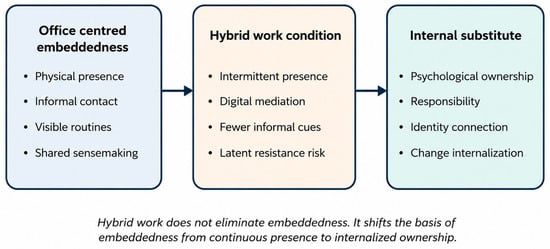
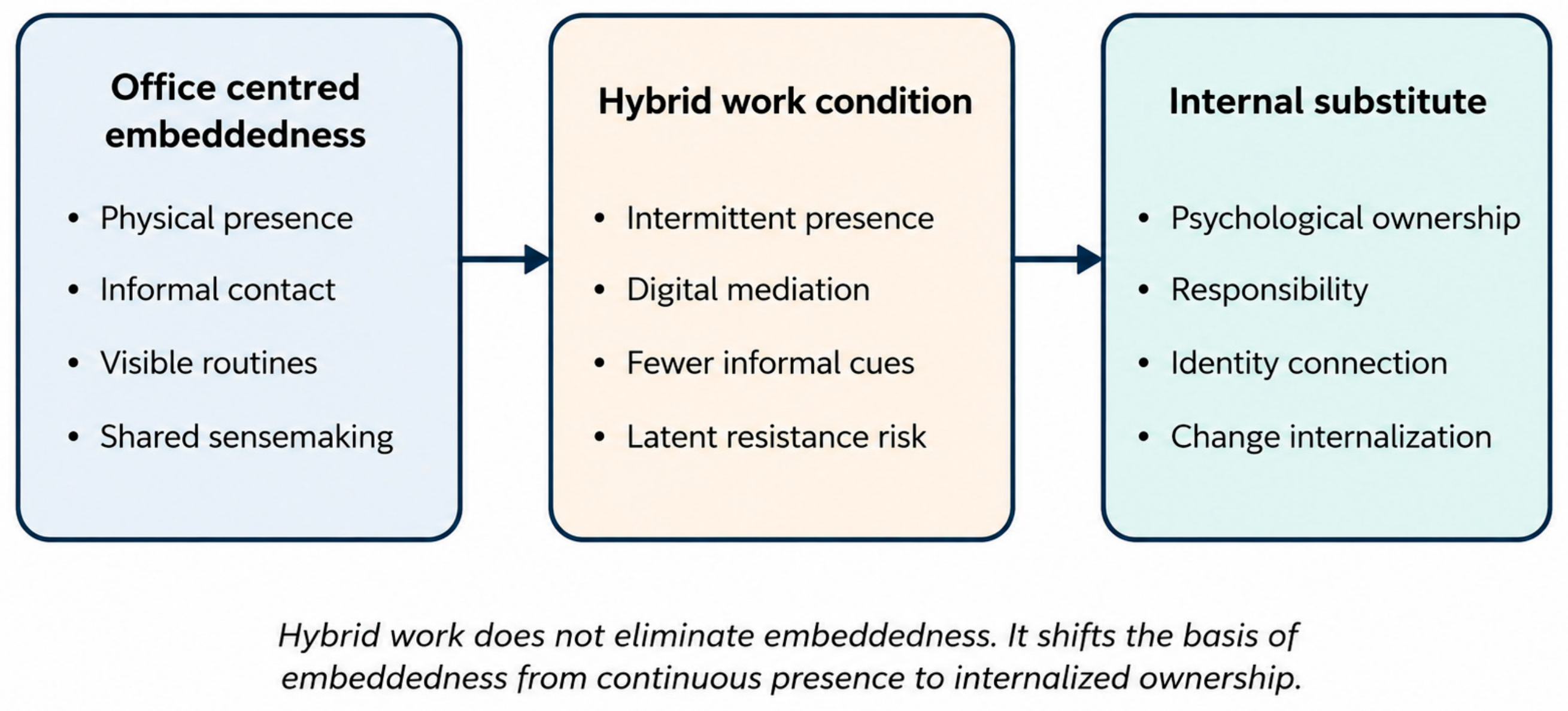
Figure 1 presents the general theoretical premise for the research model. It shows why psychological ownership is not inserted as another positive attitude, but as the internal substitute through which employees can remain responsible for change when continuous physical embeddedness is weakened.
Figure 1.
Psychological ownership as an internal substitute for weakened physical embeddedness.
3. Hypothesis Development
Leadership communication transparency is expected to be positively associated with psychological ownership because employees cannot feel ownership toward a change they cannot understand. Transparent communication provides information about why change is occurring, what it means for the organization, how employees are expected to participate and how uncertainty will be handled. Communication research shows that internal communication is central to employee relationship quality and trust (Men, 2014; Men & Stacks, 2014). Change research similarly emphasizes communication as a foundation of readiness and acceptance (Armenakis & Harris, 2009; Khaw et al., 2022). In hybrid settings, transparent communication becomes even more important because informal office cues are less continuous, and digital communication may narrow spontaneous cross-group interaction (Yang et al., 2022).
Transparent communication also conveys inclusion. When leaders explain change openly and in a timely manner, employees are more likely to feel respected and treated as organizational participants rather than as passive recipients. This supports belongingness, one of the motivational roots of ownership. It also helps employees connect the change with their own role and contribution. Therefore, communication transparency is expected to support psychological ownership.
H1.
Leadership communication transparency is positively associated with psychological ownership in hybrid work environments.
Perceived autonomy is expected to be positively associated with psychological ownership because autonomy gives employees control over how work is organized and executed. Control is a central pathway through which psychological ownership develops (Pierce et al., 2003). Self-determination theory also treats autonomy as a basic psychological need that supports internal motivation (Deci & Ryan, 2000; Gagné & Deci, 2005). In hybrid work, autonomy is often experienced through discretion over work timing, coordination routines, digital communication and task execution. Remote work design research indicates that autonomy can support effectiveness when accompanied by manageable demands, social support and communication clarity (Wang et al., 2021; van Zoonen et al., 2021).
However, the claim is not that autonomy is always beneficial. Autonomy can create empowerment when employees experience it as trusted agency. It can create isolation when employees experience it as abandonment. This distinction is critical for hybrid work. Autonomy becomes change-relevant when it is interpreted as meaningful control over work rather than distance from the organization. Under this condition, autonomy should strengthen psychological ownership because employees feel that they can influence the domain for which they are responsible.
H2.
Perceived autonomy is positively associated with psychological ownership in hybrid work environments.
Psychological ownership is expected to be negatively associated with resistance to change because ownership converts external demands into internal responsibility. Employees who feel ownership toward their work and organization are more likely to perceive change as relevant to their own contribution. They may still evaluate the change critically, but they are less likely to respond through avoidance, disengagement or passive compliance. The identity pathway is central. When employees see organizational outcomes as connected to the self, change becomes part of their responsibility space.
This logic is especially important in hybrid work because managers cannot rely only on direct supervision or continuous visibility. Hybrid organizations require employees to regulate their own engagement with change. Psychological ownership provides this internal regulation because it links change support with identity, competence and responsibility.
H3.
Psychological ownership is negatively associated with resistance to change in hybrid work environments.
The mediation logic follows from the argument that communication and autonomy matter because they support ownership formation. Communication transparency provides cognitive clarity. Perceived autonomy provides control. Psychological ownership transforms clarity and control into responsibility. In this sense, ownership is the conversion mechanism through which organizational conditions become associated with lower resistance. This is more precise than claiming that communication and autonomy directly reduce resistance in all contexts.
H4.
Psychological ownership mediates the association between leadership communication transparency and resistance to change.
H5.
Psychological ownership mediates the association between perceived autonomy and resistance to change.
Hybrid work intensity refers to the proportion of work time spent remotely. As hybrid work intensity increases, employees have fewer continuous opportunities for informal office sensemaking and visible peer interpretation. Under such conditions, communication transparency and autonomy should become more important for psychological ownership. Transparent communication substitutes for missing informal cues. Autonomy provides control in a dispersed work environment. Thus, the positive association of both antecedents with ownership should be stronger when hybrid work intensity is higher.
H6.
Hybrid work intensity positively moderates the association between leadership communication transparency and psychological ownership, such that the association is stronger when hybrid work intensity is higher.
H7.
Hybrid work intensity positively moderates the association between perceived autonomy and psychological ownership such that the association is stronger when hybrid work intensity is higher.
The final hypothesis integrates the full model. If communication transparency and autonomy are more strongly associated with psychological ownership at a higher hybrid work intensity, and if psychological ownership is associated with lower resistance, then the indirect associations should also be stronger when hybrid work intensity is high. This is the moderated mediation logic, and it represents the complete internalization-based explanation.
H8.
Hybrid work intensity moderates the indirect associations of leadership communication transparency and perceived autonomy with resistance to change through psychological ownership such that the indirect associations are stronger when hybrid work intensity is higher.
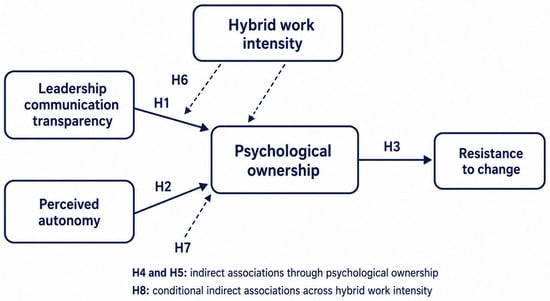
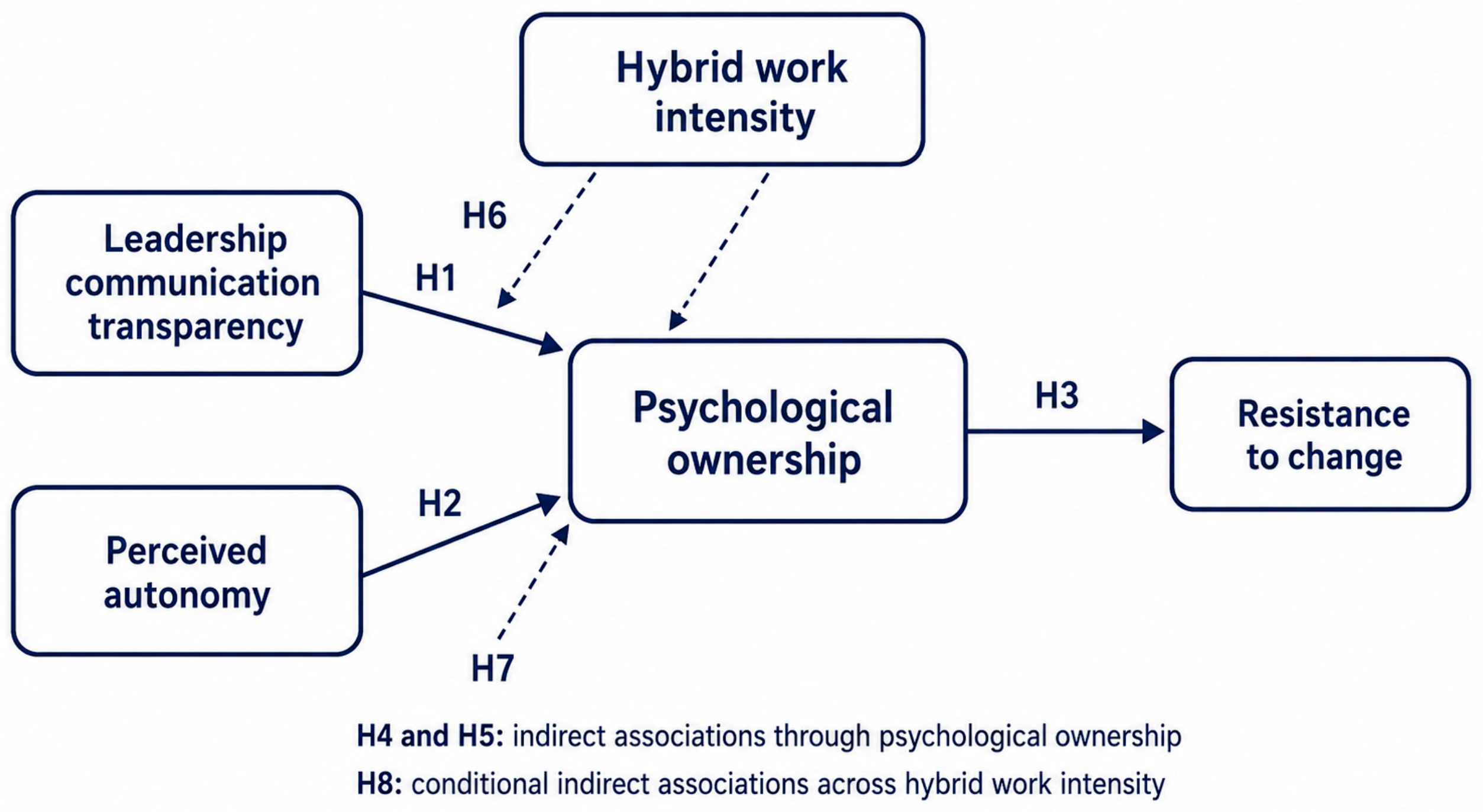
Figure 2 presents the specific research model derived from the theoretical premise. It shows how hybrid work weakens physical embeddedness, how psychological ownership restores employees’ sense of responsibility and belonging, and how this internal ownership mechanism reduces resistance to change through the proposed relational pathways.
Figure 2.
Conceptual model of psychological ownership and resistance to change in hybrid work environments.
4. Methodology
4.1. Research Design and Sample
The study uses a quantitative cross-sectional survey design. This design is suitable for examining employee perceptions of communication transparency, autonomy, psychological ownership and resistance to change across hybrid work settings. Because the data were collected at a single point in time, all empirical claims are framed as associations consistent with the theoretically ordered model rather than as proof of causality.
The target population comprised employees working in hybrid arrangements, defined as employees who worked partly remotely and partly from an employer designated office or worksite during the data collection period. Respondents were included only if they had worked in a hybrid arrangement for at least three months and had experienced or were experiencing organizational change, such as workflow redesign, digital technology adoption, restructuring, process transformation, policy change or role realignment.
The final sample consisted of 412 valid responses. Respondents came from the fields of information technology, consulting, energy, manufacturing, financial services and professional services. These sectors were selected because hybrid work practices and digitally mediated coordination are widely present in them. The sample included junior, middle and senior professional employees. The study does not claim national representativeness. It claims relevance to hybrid-capable professional work settings where employees have direct exposure to both hybrid work and organizational change.
A purposive sampling strategy was used to identify employees working in hybrid arrangements. This was supplemented with snowball sampling through professional networks because there is no single accessible sampling frame for hybrid employees across sectors. Data were collected through an online structured questionnaire. Respondents were informed about the academic purpose of the study, voluntary participation, and anonymous handling of responses. No personally identifiable information was collected.
Table 1 reports the demographic, occupational and hybrid work characteristics of the study sample and clarifies the boundary conditions within which the findings should be interpreted. It shows that the sample is adequate for testing the proposed model and is most applicable to hybrid capable, knowledge intensive professional settings, rather than to the entire working population.
Table 1.
Sample profile and external validity boundary.
4.2. Measures
All constructs were measured using established multi-item scales adapted from prior research. Responses were captured on a five-point Likert scale ranging from 1, strongly disagree, to 5, strongly agree. Leadership communication transparency was measured with items adapted from Men (2014) and Men and Stacks (2014). Perceived autonomy was measured using items grounded in self-determination theory and work motivation research (Deci & Ryan, 2000; Gagné & Deci, 2005). Psychological ownership was measured using items adapted from Pierce et al. (2001, 2003) and Van Dyne and Pierce (2004). Resistance to change was measured with items adapted from Oreg (2003, 2006) and Oreg et al. (2011). Hybrid work intensity was measured as the number of remote workdays divided by the total number of workdays in a standard week.
The measurement design distinguishes organizational antecedents, psychological internalization and employee response. Communication transparency captures clarity, timeliness and explanation. Autonomy captures discretion and control. Psychological ownership captures responsibility, personal connection and meaning. Resistance captures discomfort, reluctance and preference for existing routines.
Table 2 reports the construct level measurement design used in the study by listing each item, its theoretical source and the common five-point response anchor. It demonstrates that the empirical model is built on established scales for communication transparency, perceived autonomy, psychological ownership and resistance to change, with all items aligned to the hybrid work and change context.
Table 2.
Measurement items, scale sources and response anchors.
4.3. Analytical Procedure and Software
Data screening, missing value checks, descriptive statistics, correlation analysis and mean centring were conducted in IBM SPSS Statistics 29. The measurement model and structural model were estimated using covariance-based structural equation modelling in IBM SPSS AMOS 29. Maximum likelihood estimation was used because the study tested a theoretically specified latent variable model and reported conventional model fit indices, including CFI, TLI, RMSEA and SRMR. The use of CB SEM is appropriate because the objective is theory testing rather than prediction-oriented component estimation.
The analysis followed a cumulative sequence. First, the data were examined for missing values, outliers and distributional irregularities. Second, confirmatory factor analysis was used to assess the four latent constructs. Third, reliability, convergent validity and discriminant validity were assessed using Cronbach’s alpha, composite reliability and average variance extracted. Fourth, the structural model was estimated to test the direct associations. Fifth, mediation and moderated mediation were assessed using bootstrapped standard errors and confidence intervals based on 5000 resamples. Bootstrapping was used because indirect effects often have non-normal sampling distributions.
Latent interaction effects were tested through a two-stage procedure. Factor scores from the validated measurement model were saved, mean-centred and multiplied to create interaction terms for communication transparency by hybrid work intensity and perceived autonomy by hybrid work intensity. These interaction terms were then entered into the structural model predicting psychological ownership. This procedure provides an interpretable test of moderation while retaining the measurement validation logic of SEM. Conditional indirect associations were estimated at low, medium and high levels of hybrid work intensity, corresponding to one standard deviation below the mean, the mean, and one standard deviation above the mean.
A priori power analysis was conducted before final model estimation. The most demanding structural equation included communication transparency, perceived autonomy, hybrid work intensity, two interaction terms and control variables. Using a conservative small to medium effect size, an alpha of 0.05 and a desired power of 0.80, the minimum required sample was estimated at 263 respondents. The achieved sample of 412 exceeded this threshold and was considered adequate for the planned SEM and bootstrapping analyses.
Because the study uses self-reported survey data, common method bias was addressed through procedural and statistical safeguards. Procedurally, respondents were assured anonymity, items were separated by construct, and leading wording was avoided. Statistically, Harman single-factor analysis and a common latent factor model were used. The first unrotated factor accounted for 32.6 percent of the total variance, below the conventional 50 percent concern threshold. In the common latent factor model, substantive standardized path coefficients changed by less than 0.08. These diagnostics suggest that common method variance is unlikely to fully explain the observed associations, although it cannot be ruled out in a single-source cross-sectional design.
5. Results
5.1. Descriptive Statistics and Correlations
Table 3 reports descriptive statistics and correlations. Communication transparency and perceived autonomy are positively correlated with psychological ownership. Psychological ownership is negatively correlated with resistance to change. The correlation pattern is consistent with the theoretical model, although correlations alone do not establish mediation, moderation or causality.
Table 3.
Descriptive statistics and correlation matrix.
5.2. Measurement Model
The measurement model demonstrated acceptable reliability and validity. Cronbach’s alpha values ranged from 0.84 to 0.92. Composite reliability values ranged from 0.88 to 0.94. Average variance extracted values ranged from 0.60 to 0.72. Standardized factor loadings were within acceptable ranges. Confirmatory factor analysis showed acceptable model fit, with CFI = 0.94, TLI = 0.92, RMSEA = 0.052 and SRMR = 0.046. These results indicate that the constructs are sufficiently reliable and distinct for structural testing.
Measurement quality is important for the theory because the model depends on separating organizational conditions from psychological internalization and employee response. If communication transparency, autonomy, ownership and resistance were not empirically distinguishable, the claim that ownership mediates the association between organizational conditions and resistance would be weak. The measurement results support proceeding to structural analysis.
Table 4 reports the reliability and convergent validity of the four latent constructs. The results show that all constructs meet acceptable measurement standards, with strong factor loadings, Cronbach’s alpha, composite reliability and AVE values, thereby supporting the adequacy of the measurement model before structural testing.
Table 4.
Measurement model assessment.
Table 5 presents the confirmatory factor analysis and model fit results for the measurement model, structural model and common latent factor model. The fit indices indicate that the proposed model achieves acceptable fit, while the stability of substantive paths under the common latent factor specification reduces concerns regarding common method bias.
Table 5.
Confirmatory factor analysis and model fit assessment.
5.3. Structural Model and Hypothesis Testing
The structural model showed acceptable fit, with CFI = 0.93, TLI = 0.91, RMSEA = 0.056 and SRMR = 0.049. Leadership communication transparency was positively associated with psychological ownership, i.e., β = 0.41; t = 7.82; p < 0.001, supporting H1. Perceived autonomy was positively associated with psychological ownership, i.e., β = 0.36; t = 6.95; p < 0.001, supporting H2. Psychological ownership was negatively associated with resistance to change, i.e., β = −0.48; t = −9.11; p < 0.001, supporting H3.
These direct associations support the internalization argument. Communication transparency is associated with ownership because it helps employees understand change. Autonomy is associated with ownership because it provides control. Ownership is associated with lower resistance because it links change with responsibility and identity. The evidence does not prove causality, but it is consistent with the theoretically ordered model.
Table 6 reports the estimated path coefficients for the hypothesised structural relationships. The results show that communication transparency and perceived autonomy significantly strengthen psychological ownership, while psychological ownership significantly reduces resistance to change. The significant interaction effects further indicate that hybrid work intensity amplifies the positive effects of communication transparency and autonomy on psychological ownership.
Table 6.
Structural model results.
5.4. Mediation, Moderation and Moderated Mediation
The indirect association between communication transparency and resistance to change through psychological ownership was significant, i.e., β = −0.20; SE = 0.03; 95% CI [−0.27, −0.14], supporting H4. The indirect association between perceived autonomy and resistance to change through psychological ownership was also significant, i.e., β = −0.17; SE = 0.04; 95% CI [−0.24, −0.11], supporting H5. These findings indicate that communication and autonomy are associated with resistance, partly through the ownership mechanism.
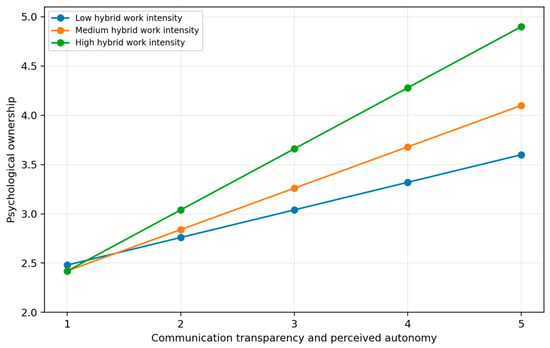
Hybrid work intensity positively moderated the association between communication transparency and psychological ownership, i.e., β = 0.18; t = 3.72; p < 0.01, supporting H6. It also positively moderated the association between perceived autonomy and psychological ownership, i.e., β = 0.15; t = 3.21; p < 0.01, supporting H7. The associations of communication and autonomy with ownership were stronger for employees with higher remote work intensity.
The conditional indirect associations were also stronger at higher levels of hybrid work intensity. For communication transparency, the indirect association with resistance through psychological ownership increased in magnitude from −0.14 at low hybrid work intensity to −0.26 at high hybrid work intensity. For perceived autonomy, the corresponding indirect association increased from −0.12 to −0.23. These results support H8 and complete the internalization-based explanation. The ownership pathway becomes more important as physical embeddedness becomes less continuous.
Table 7 reports the indirect effects of communication transparency and perceived autonomy on resistance to change through psychological ownership. The significant negative indirect effects and confidence intervals excluding zero indicate that psychological ownership acts as a key mediating mechanism through which transparent communication and autonomy reduce employee resistance to change.
Table 7.
Mediation analysis through psychological ownership.
Table 8 shows how the indirect effects vary across low, medium and high levels of hybrid work intensity. The results indicate that the negative indirect effects become stronger at higher levels of hybrid work intensity, suggesting that psychological ownership becomes more important in reducing resistance to change when employees work in more hybridized arrangements.
Table 8.
Moderated mediation across hybrid work intensity levels.
Figure 3 visualizes the interaction pattern. The steeper line at high hybrid work intensity indicates that communication transparency and perceived autonomy have stronger associations with psychological ownership when employees more frequently work remotely. The figure therefore supports the claim that ownership formation becomes more dependent on communication clarity and autonomy as physical embeddedness weakens.
Figure 3.
Moderating effect of hybrid work intensity.
6. Discussion
This study asked how psychological ownership is associated with resistance to change in hybrid work environments. The answer is that psychological ownership functions as an internalization mechanism. Employees who feel that their work and organizational outcomes are partly theirs report lower resistance to change. This finding moves the hybrid work conversation beyond the familiar issues of productivity, flexibility and attendance. It shows that hybrid work also changes the psychological conditions under which employees accept or resist organizational transformation.
The first theoretical contribution is the repositioning of psychological ownership as an internal substitute for weakened physical embeddedness. Existing ownership research has emphasized the role of control, self-investment and identity in creating stewardship and citizenship behaviour. This study extends that logic to hybrid change management. When employees are not continuously embedded in a shared workplace, ownership becomes a stronger internal anchor because it links change to responsibility and self-relevance. Recent hybrid work studies on belonging and conceptual clarity strengthen this contribution by showing that hybrid work changes not only the location but also the social and temporal architecture through which employees experience connection (Vartiainen & Vanharanta, 2024; Lauring & Jonasson, 2025; Urrila et al., 2025).
The second contribution involves resistance to change theory. Resistance is often explained through poor communication, loss of control or distrust. The present model integrates these explanations through psychological ownership. Communication transparency reduces ambiguity, but it matters most when employees use that clarity to develop ownership. Autonomy provides discretion, but it becomes change-relevant when discretion is experienced as responsible agency. Resistance is therefore not only a failure of information or participation. It is also a failure of ownership.
The third contribution is to hybrid-work scholarship. Hybrid-work intensity is not treated here as a neutral scheduling variable. It is a boundary condition that changes how employees internalize change. When remote work is more frequent, employees rely less on continuous office presence and more on transparent communication, meaningful autonomy and internal connection. This helps explain why debates about mandatory office days are incomplete. The central issue is not only where employees work, but how they remain psychologically connected to change. This interpretation aligns with recent evidence that hybrid work can sustain performance and retention but must be deliberately designed to preserve collaboration, belonging and career fairness (Bloom et al., 2024; Cisco, 2025; Gallup, 2024; Maity & Lee, 2025).
The fourth contribution is the conceptual comparison regarding employee engagement and organizational identification. Engagement explains how much energy employees invest in their work. Identification explains how strongly they define themselves through organizational membership. Psychological ownership explains whether employees feel responsible possession toward a work domain or change target. This distinction strengthens the originality of the model. Employees may be engaged in routine tasks and identify with the organization, yet still resist a specific change if they do not feel that the change is theirs to shape, protect and implement.
The findings also clarify the autonomy paradox in hybrid work. Autonomy is often celebrated as a benefit of hybrid arrangements, but autonomy can create either empowerment or detachment. The results suggest that autonomy becomes valuable for change when it strengthens psychological ownership. Autonomy without ownership may become distance. Autonomy with ownership becomes responsible agency. For hybrid organizations, the managerial task is therefore not to provide unlimited flexibility, but to connect autonomy with role clarity, contribution and accountability.
The moderation and moderated mediation findings are central. The ownership pathway is stronger when hybrid work intensity is higher. This supports the argument that psychological ownership becomes more important when physical embeddedness is less continuous. In practical terms, highly hybrid employees may need more deliberate ownership-building because they have fewer everyday opportunities to absorb change through proximity, informal interaction and repeated social cues.
7. Implications for Management and Policy
The managerial implications are direct. First, leaders should design communication as sensemaking rather than as announcements. Change messages should explain the rationale for change, the expected consequences, the implications for employee roles and the spaces where employees can influence implementation. In hybrid environments, communication should be repeated, dialogic and role specific because employees cannot rely on continuous informal clarification.
Second, organizations should design autonomy as responsible discretion. Hybrid employees need flexibility, but flexibility must be paired with purpose and accountability. Autonomy should clarify what employees can decide, where alignment is required and how individual discretion contributes to collective transformation. When autonomy is connected to change goals, it is more likely to produce ownership rather than isolation.
Third, managers should create ownership rituals. These may include change charters at the team level, role-based implementation commitments, feedback loops, recognition of employee contributions, peer learning sessions and visible acknowledgement of teams that translate change into practice. Such rituals make employee contribution visible and convert change from a managerial programme into a shared domain of responsibility.
Fourth, hybrid work policy should move beyond attendance rules. Many organizations define hybrid policy through office-day requirements. This is insufficient. A stronger policy should define communication norms, decision rights, participation mechanisms, collaboration rhythms and ownership-building practices. Policy should clarify not only where work happens but also how employees remain informed, trusted and connected to transformation.
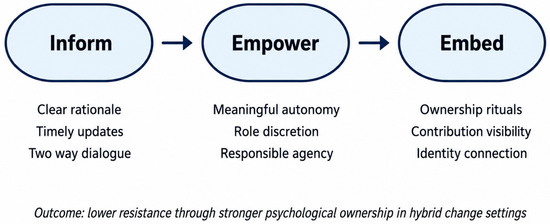
Figure 4 converts the empirical model into a practical framework. ‘Inform’ means communicating change with clarity and dialogue. ‘Empower’ means giving employees meaningful autonomy connected to change goals. ‘Embed’ means institutionalizing ownership through contribution visibility, rituals and identity connection. The outcome is lower resistance through the development of stronger psychological ownership.
Figure 4.
Ownership activation framework for hybrid change management.
8. Conclusions
This study examined psychological ownership and resistance to change in hybrid work environments. The central question addressed how employees internalize change when continuous physical embeddedness is weakened. The study shows that psychological ownership is negatively associated with resistance to change and mediates the associations of leadership communication transparency and perceived autonomy with resistance. It also shows that hybrid work intensity strengthens the ownership formation pathway and the conditional indirect associations.
The conclusion is that hybrid work changes the psychology of change management. Organizations cannot rely only on physical presence, managerial visibility or formal control. They need to build transparent communication, meaningful autonomy and psychological ownership. Hybrid work can support flexibility and performance, but change commitment requires something deeper. Employees must understand the change, feel trusted in their role and experience the change as connected to their own responsibility. Psychological ownership provides that internal connection.
9. Limitations and Future Research
The study has limitations. First, the cross-sectional design does not permit causal inference. The theoretical model positions communication and autonomy before psychological ownership and ownership before resistance, but longitudinal designs are needed to test temporal ordering more effectively. Future studies should measure organizational conditions at the start of a change initiative, ownership during implementation, and resistance after employees experience the change.
Second, the study used purposive and snowball sampling. This strategy was appropriate for reaching employees with direct hybrid work and change experience, but it limits generalizability. Future research should replicate the model using probability-based samples, sector-specific samples, public sector employees, frontline hybrid workers and cross-national datasets.
Third, the study relied on self-reported survey data. Self-reporting is suitable for subjective perceptions such as autonomy, ownership and resistance, but it may be affected by common method variance. The study used procedural safeguards and statistical checks, yet future research should combine surveys with behavioural indicators such as participation in change meetings, adoption of digital tools, response latency, supervisor ratings and project contribution records.
Fourth, psychological ownership may have different targets. Employees may feel ownership toward their job, team, organization, existing work routines or the change initiative itself. This study measured ownership in relation to work and organizational outcomes. Future studies should distinguish between ownership targets because ownership of existing routines may sometimes increase resistance to changes that threaten those routines.
Fifth, hybrid work intensity was measured as the proportion of remote workdays. This captures physical dispersion but not the quality of hybrid work. Future research should examine hybrid work quality, digital communication richness, manager accessibility, team cohesion and perceived fairness of hybrid policies. It should also test whether the association between hybrid work intensity and ownership is nonlinear, with moderate hybrid arrangements possibly offering both autonomy and social reinforcement. Future research may also integrate external workplace indicators and policy data because recent evidence suggests that hybrid work arrangements are being recalibrated continuously across organizations and countries (Eurofound, 2022; Gallup, 2024; Cisco, 2025).
Finally, intervention-based research is needed. The ownership-activation framework can be tested through field experiments comparing standard change communication with ownership-oriented communication that explains rationale, clarifies influence and invites self-investment. Such studies would help determine whether psychological ownership can be deliberately cultivated during hybrid transformation.
Author Contributions
Conceptualization, S.S.S.; methodology, S.S.S.; software, V.G.; validation, V.G.; formal analysis, S.S.S. and V.G.; investigation, A.K.J.; resources, S.S.S.; data curation, S.S.S.; writing—original draft, S.S.S.; writing—review and editing, V.G. and A.K.J.; visualization, V.G. and A.K.J.; supervision, V.G. and A.K.J.; project administration, V.G. and A.K.J. All authors have read and agreed to the published version of the manuscript.
Funding
This research received no external funding.
Institutional Review Board Statement
Ethical review and approval were waived for this study due to the study was reviewed as an exempt category study by the MDI Institutional Review Board, as it involved non invasive academic research and did not involve clinical intervention, vulnerable groups, deception, biomedical procedures, or collection of personally sensitive identifiable information.
Informed Consent Statement
Informed consent was obtained from all subjects involved in the study.
Data Availability Statement
The data presented in this study are available on request from the corresponding author.
Conflicts of Interest
The authors declare no conflicts of interest.
References
- Abhari, K. (2025). Employee participation in digital transformation: From digitalization sentiment to transformation predisposition. Information and Management, 62(8), 104212. [Google Scholar] [CrossRef] [Scilit]
- Aksoy, C. G., Barrero, J. M., Bloom, N., Davis, S. J., Dolls, M., & Zarate, P. (2023). Working from home around the globe: 2023 report (EconPol Policy Brief, No. 53). CESifo GmbH. [Google Scholar]
- Armenakis, A. A., & Bedeian, A. G. (1999). Organizational change: A review of theory and research in the 1990s. Journal of Management, 25(3), 293–315. [Google Scholar] [CrossRef]
- Armenakis, A. A., & Harris, S. G. (2009). Reflections: Our journey in organizational change research and practice. Journal of Change Management, 9(2), 127–142. [Google Scholar] [CrossRef] [Scilit]
- Ashforth, B. E., & Mael, F. (1989). Social identity theory and the organization. The Academy of Management Review, 14(1), 20–39. [Google Scholar] [CrossRef] [Scilit]
- Avey, J. B., Avolio, B. J., Crossley, C. D., & Luthans, F. (2009). Psychological ownership: Theoretical extensions, measurement, and relation to work outcomes. Journal of Organizational Behavior, 30(2), 173–191. [Google Scholar] [CrossRef] [Scilit]
- Barrero, J. M., Bloom, N., & Davis, S. J. (2021). Why working from home will stick (Working Paper No. 28731). National Bureau of Economic Research. [Google Scholar]
- Bloom, N., Han, R., & Liang, J. (2024). Hybrid working from home improves retention without damaging performance. Nature, 630, 920–925. [Google Scholar] [CrossRef] [Scilit] [PubMed]
- Choudhury, P., Foroughi, C., & Larson, B. Z. (2021). Work from anywhere: The productivity effects of geographic flexibility. Strategic Management Journal, 42(4), 655–683. [Google Scholar] [CrossRef] [Scilit]
- Cieslak, V., & Valor, C. (2025). Moving beyond conventional resistance and resistors: An integrative review of employee resistance to digital transformation. Cogent Business and Management, 12(1), 2442550. [Google Scholar] [CrossRef] [Scilit]
- Cisco. (2025). Global hybrid work study 2025. Cisco Systems. [Google Scholar]
- Deci, E. L., & Ryan, R. M. (2000). The “what” and “why” of goal pursuits: Human needs and the self-determination of behavior. Psychological Inquiry, 11(4), 227–268. [Google Scholar] [CrossRef] [Scilit]
- Eurofound. (2022). The rise in telework: Impact on working conditions and regulations. Publications Office of the European Union. [Google Scholar]
- Gagné, M., & Deci, E. L. (2005). Self-determination theory and work motivation. Journal of Organizational Behavior, 26(4), 331–362. [Google Scholar] [CrossRef] [Scilit]
- Gallup. (2024). Global indicator: Hybrid work. Gallup Workplace. [Google Scholar]
- Kahn, W. A. (1990). Psychological conditions of personal engagement and disengagement at work. Academy of Management Journal, 33(4), 692–724. [Google Scholar] [CrossRef] [Scilit]
- Khaw, K. W., Alnoor, A., Tiberius, V., Ganesan, Y., & Atshan, N. (2022). Reactions towards organizational change: A systematic literature review. Current Psychology, 42, 19137–19160. [Google Scholar] [CrossRef] [Scilit] [PubMed]
- Kotter, J. P. (1995). Leading change: Why transformation efforts fail. Harvard Business Review, 73(2), 59–67. [Google Scholar]
- Kotter, J. P., & Schlesinger, L. A. (2008). Choosing strategies for change. Harvard Business Review, 86(7), 130–139. [Google Scholar]
- Lauring, J., & Jonasson, C. (2025). What is hybrid work? Towards greater conceptual clarity of hybrid work in human resource management. Human Resource Management Review, 35, 101044. [Google Scholar] [CrossRef] [Scilit]
- Lewin, K. (1951). Field theory in social science. Harper and Row. [Google Scholar]
- Mael, F., & Ashforth, B. E. (1992). Alumni and their alma mater: A partial test of the reformulated model of organizational identification. Journal of Organizational Behavior, 13(2), 103–123. [Google Scholar] [CrossRef] [Scilit]
- Maity, R., & Lee, K. L. (2025). The impact of remote and hybrid work models on small and medium-sized enterprises productivity: A systematic review. SN Business & Economics, 5, 158. [Google Scholar]
- Men, L. R. (2014). Strategic internal communication: Transformational leadership, communication channels, and employee satisfaction. Management Communication Quarterly, 28(2), 264–284. [Google Scholar] [CrossRef] [Scilit]
- Men, L. R., & Stacks, D. W. (2014). The effects of authentic leadership on strategic internal communication and employee organization relationships. Journal of Public Relations Research, 26(4), 301–324. [Google Scholar] [CrossRef] [Scilit]
- Oreg, S. (2003). Resistance to change: Developing an individual differences measure. Journal of Applied Psychology, 88(4), 680–693. [Google Scholar] [CrossRef] [Scilit]
- Oreg, S. (2006). Personality, context, and resistance to organizational change. European Journal of Work and Organizational Psychology, 15(1), 73–101. [Google Scholar] [CrossRef] [Scilit]
- Oreg, S., Vakola, M., & Armenakis, A. (2011). Change recipients reactions to organizational change: A 60 year review of quantitative studies. Journal of Applied Behavioral Science, 47(4), 461–524. [Google Scholar] [CrossRef] [Scilit]
- Piderit, S. K. (2000). Rethinking resistance and recognizing ambivalence: A multidimensional view of attitudes toward an organizational change. Academy of Management Review, 25(4), 783–794. [Google Scholar] [CrossRef] [Scilit] [PubMed]
- Pierce, J. L., Kostova, T., & Dirks, K. T. (2001). Toward a theory of psychological ownership in organizations. Academy of Management Review, 26(2), 298–310. [Google Scholar] [CrossRef] [Scilit]
- Pierce, J. L., Kostova, T., & Dirks, K. T. (2003). The state of psychological ownership: Integrating and extending a century of research. Review of General Psychology, 7(1), 84–107. [Google Scholar] [CrossRef]
- Saks, A. M. (2006). Antecedents and consequences of employee engagement. Journal of Managerial Psychology, 21(7), 600–619. [Google Scholar] [CrossRef] [Scilit]
- Schaufeli, W. B., Salanova, M., Gonzalez Roma, V., & Bakker, A. B. (2002). The measurement of engagement and burnout: A two sample confirmatory factor analytic approach. Journal of Happiness Studies, 3(1), 71–92. [Google Scholar] [CrossRef] [Scilit]
- Urrila, L., Makela, K., & Lamsa, A. M. (2025). Sense of belonging in hybrid work settings. Journal of Vocational Behavior, 157, 104014. [Google Scholar] [CrossRef] [Scilit]
- Uru, F. O., Gozukara, E., & Tezcan, L. (2022). The moderating roles of remote, hybrid, and onsite working on the relationship between work engagement and organizational identification during the COVID-19 pandemic. Sustainability, 14(24), 16828. [Google Scholar] [CrossRef] [Scilit]
- Van Dyne, L., & Pierce, J. L. (2004). Psychological ownership and feelings of possession: Three field studies predicting employee attitudes and organizational citizenship behavior. Journal of Organizational Behavior, 25(4), 439–459. [Google Scholar] [CrossRef] [Scilit]
- van Zoonen, W., Sivunen, A. E., Blomqvist, K., Olsson, T., Ropponen, A., Henttonen, K., & Vartiainen, M. (2021). Factors influencing adjustment to remote work: Employees’ initial responses to the COVID-19 pandemic. International Journal of Environmental Research and Public Health, 18(13), 6966. [Google Scholar] [CrossRef] [Scilit] [PubMed]
- Vartiainen, M., & Vanharanta, O. (2024). True nature of hybrid work. Frontiers in Organizational Psychology, 2, 1448894. [Google Scholar] [CrossRef] [Scilit]
- Wang, B., Liu, Y., Qian, J., & Parker, S. K. (2021). Achieving effective remote working during the COVID-19 pandemic: A work design perspective. Applied Psychology, 70(1), 16–59. [Google Scholar] [CrossRef] [Scilit] [PubMed]
- Yang, L., Holtz, D., Jaffe, S., Suri, S., Sinha, S., Weston, J., Joyce, C., Shah, N., Sherman, K., Hecht, B., & Teevan, J. (2022). The effects of remote work on collaboration among information workers. Nature Human Behaviour, 6, 43–54. [Google Scholar] [CrossRef] [Scilit] [PubMed]

Disclaimer/Publisher’s Note: The statements, opinions and data contained in all publications are solely those of the individual author(s) and contributor(s) and not of MDPI and/or the editor(s). MDPI and/or the editor(s) disclaim responsibility for any injury to people or property resulting from any ideas, methods, instructions or products referred to in the content. |
© 2026 by the authors. Licensee MDPI, Basel, Switzerland. This article is an open access article distributed under the terms and conditions of the Creative Commons Attribution (CC BY) license.