Article

Female Entrepreneurship Under Constraint: An Explanatory Model of Structural Barriers and Strategic Decision-Making in Ecuador


by
Sedolfo Carrasquero-Ferrer
1,*,
Amanda Hidalgo-Astudillo
2,
Nayade Domenech-Polo
3 and
Marisela Giraldo
4
1
Innovation and Outreach Directorate, Technological Business University of Guayaquil, Guayaquil 090507, Ecuador
2
Undergraduate Faculty, Business Sciences Programs, Technological Business University of Guayaquil, Guayaquil 090507, Ecuador
3
Graduate Faculty, Technological Business University of Guayaquil, Guayaquil 090507, Ecuador
4
Graduate Faculty, Doctoral Program in Business Administration, Technological Business University of Guayaquil, Guayaquil 090507, Ecuador
*
Author to whom correspondence should be addressed.
Adm. Sci. 2026, 16(6), 256; https://doi.org/10.3390/admsci16060256
Submission received: 15 April 2026 / Revised: 22 May 2026 / Accepted: 24 May 2026 / Published: 28 May 2026
(This article belongs to the Special Issue Entrepreneurship in Emerging Markets: Opportunities and Challenges)

Abstract

This study examines how women entrepreneurs in Ecuador confront structural constraints and how these conditions influence their strategic management decisions. Adopting an explanatory approach, a structural equation model (PLS-SEM) was developed based on a survey administered to 110 female entrepreneurs. The instrument was designed to capture perceptions of institutional, financial, sociocultural, and technological limitations, as well as strategic responses in areas such as innovation, networks, digitalization, and formalization. The questionnaire was validated through expert judgment and a pilot test, and data were analyzed using SmartPLS. The results show that structural constraints are significantly associated with the adoption of strategic decisions (β = 0.496; R2 = 0.246), suggesting an adaptive resilience pattern in response to adverse contexts. While internal reliability indicators were acceptable (α > 0.87; ρc > 0.89), convergent validity was limited (AVE = 0.43 and 0.45, below the 0.50 threshold), reflecting the multidimensional complexity of the constructs measured. The study adds value by demonstrating how female entrepreneurial agency emerges in environments marked by institutional fragility, reinforcing the need for comprehensive public policies that reduce structural frictions and expand the entrepreneurial decision space. Future research should explore mediational models and heterogeneity analyses to deepen understanding and inform targeted interventions.

1. Introduction

In the contemporary economic architecture, female entrepreneurship has become a crucial vector for resilience and social transformation in the emerging economies of Latin America (Guillén & Pereira, 2022; Martin-Peña, 2024). However, beneath the surface of participation metrics lies a persistent dichotomy: while women act as key agents of productive dynamism, their trajectories are constrained by an institutional framework that perpetuates structural gender gaps, asymmetries in access to financial capital, and systemic occupational segregation (Mallepally & Mallepally, 2025). Within this context, the case of Ecuador represents not only a statistical pattern but also a theoretically compelling context for global management research (Méndez-Vélez et al., 2022). According to the Global Entrepreneurship Monitor (Lasio et al., 2024), the country leads the world in early-stage female entrepreneurial activity (33.4%), surpassing male participation; nevertheless, these high levels of entrepreneurial activity coexist with persistent informality and institutional precariousness that challenge traditional notions of business scalability (Rodríguez & Saiz, 2025; Aguirre et al., 2024; Valencia et al., 2023).
This Ecuadorian paradox suggests that entrepreneurship in transitional contexts cannot be analyzed through conventional “opportunity recognition” frameworks typical of developed economies (Molina et al., 2021; Calle & Tenesaca, 2023). On the contrary, preliminary evidence indicates that these initiatives are often configured as reactive subsistence mechanisms in response to exclusion from the formal labor market. The academic literature has documented how the persistence of traditional gender roles and the disproportionate burden of unpaid care work act as “glass ceilings” that limit the development of dynamic capabilities in women-led firms (Oladipo et al., 2023; Ubfal, 2024). In addition, public policies for productive development have historically operated under an illusion of gender neutrality, overlooking intersectional specificities and territorial realities that fragment the entrepreneurial ecosystem (Teixeira et al., 2023; Araya et al., 2022).
From an institutional theory perspective, the disconnect between entrepreneurial dynamism and formal support mechanisms suggests that Ecuadorian women entrepreneurs operate in an environment where informal institutions (family networks, social norms) compensate for the deficiencies of formal institutions (Ejaz et al., 2023; Noguera et al., 2015). This reliance on strong ties, while facilitating initial survival, often inhibits management professionalization and expansion into international markets. There is thus a latent tension between the resilient human capital of women entrepreneurs and an ecosystem that penalizes the lack of tangible guarantees (Chouhan & Vaishnav, 2025). Exploring this intersection allows us to question whether Western models of business success are applicable to realities where “success” is defined primarily by household stability and minimal economic autonomy rather than profit maximization (Sánchez & Bojica, 2024). As this dynamic deepens, it becomes evident that female entrepreneurship in Ecuador not only contributes to economic growth but also challenges established social norms (Buñay-Solano & Ordoñez-Gavilanes, 2022).
Despite the abundance of descriptive studies, a significant analytical gap persists in understanding the empirical association between perceptions of structural barriers and strategic management responses. Previous studies have extensively discussed resilience, adaptation, and institutional fragility in women’s entrepreneurship; however, fewer studies have empirically examined the direct association between structural constraints and strategic decision-making within emerging economy contexts such as Ecuador (Morais-Storz et al., 2018; J. Vargas, 2022). How do these entrepreneurs transform resource scarcity into sustainability strategies? To what extent does the constraining institutional environment influence the internal architecture of their business models? These questions remain insufficiently explored through robust quantitative approaches that move beyond univariate analysis.
To address this gap in knowledge, the present study empirically examines the relationship between environmental restrictions and the strategic priorities of women entrepreneurs in Ecuador. The research employs a partial least squares structural equation model (PLS-SEM), an approach well suited to examine the multidimensional nature of the phenomenon, allowing for the examination of multidimensional relationships between perceived structural constraints and adaptive strategic responses in women-led ventures (Fabbricatore et al., 2021; Aguirre et al., 2024; Buñay-Solano & Ordoñez-Gavilanes, 2022).
This study contributes to the emerging discussion on entrepreneurship under constraint by providing exploratory evidence of the relationship between structural barriers and adaptive strategic responses among women entrepreneurs in Ecuador. It contributes to the literature by reframing structural constraints not only as barriers but also as contextual conditions associated with adaptive strategic behavior in women-led ventures.

2. Theoretical Framework

2.1. Female Entrepreneurship and Structural Constraints in Emerging Contexts

Female entrepreneurship in emerging economies is strongly shaped by structural, institutional, and socioeconomic conditions that influence both entrepreneurial participation and business sustainability (Terjesen & Amorós, 2010; Castiblanco, 2018; R. Martínez et al., 2021). In Latin America, although women demonstrate high levels of entrepreneurial activity, a substantial proportion of these initiatives remain concentrated in microenterprises characterized by low productivity, limited innovation, and reduced growth capacity, which constrains their ability to generate significant socioeconomic transformation (Sindhwani & Dhawan, 2021).
Research conducted in emerging contexts has consistently focused on the barriers faced by women entrepreneurs, including restricted access to resources, gender discrimination, unequal domestic responsibilities, and limited institutional support (Corrêa et al., 2022). These constraints are particularly evident in Latin America, where traditional gender roles, the centrality of family structures, and the prevalence of informality generate entrepreneurial dynamics that differ substantially from those observed in developed economies.
The analytical framework of the Global Entrepreneurship Monitor differentiates between necessity-driven entrepreneurship, which emerges as a response to unstable employment or insufficient income, and opportunity-driven entrepreneurship associated with the identification of market opportunities (Sindhwani & Dhawan, 2021). In Latin America and the Caribbean, women exhibit higher rates of necessity-based entrepreneurship than men, while opportunity-driven initiatives remain comparatively limited. Most of these ventures are concentrated in self-employment activities with low growth expectations, as only a small proportion of women entrepreneurs anticipate substantial business expansion. This pattern is closely associated with limited access to education, productive capital, and stable employment opportunities, leading many women to perceive entrepreneurship primarily as a mechanism for subsistence rather than long-term business development.
Under these conditions, women-led ventures tend to concentrate in sectors characterized by low technical complexity, limited entry barriers, and high labor intensity. Retail trade, food preparation, garment production, personal services, and other traditionally feminized activities frequently constitute the operational core of these businesses, many of which function within informal economic structures (Terjesen & Amorós, 2010). Within the broader Latin American context, a significant proportion of women’s entrepreneurship continues to operate through informal self-employment or small productive units with low technological integration, restricted capital availability, and limited capacity to generate additional employment (R. Martínez et al., 2021). Nevertheless, recent studies also report a gradual—although still limited—increase in women’s participation within innovative and technology-oriented sectors, linked to the emergence of entrepreneurial ecosystems and digital business platforms (Martin-Peña, 2024).
Previous literature has identified structural barriers as one of the principal factors shaping women’s entrepreneurial trajectories. Restricted access to formal financing, institutional biases, unequal participation in entrepreneurial ecosystems, and limited technological infrastructure continue to constrain women-led ventures across developing economies. International evidence suggests that difficulties in obtaining credit, high capital requirements, and low levels of perceived entrepreneurial competencies significantly reduce both entrepreneurial participation and business growth among women entrepreneurs (Wu et al., 2019). Similarly, analyses of entrepreneurial ecosystems indicate that women frequently experience lower access to formal support mechanisms such as business incubators, university infrastructure, and financing networks, partly due to policy orientations that prioritize traditionally male-dominated sectors such as high-growth and technology-intensive industries (Foss et al., 2018).
In addition to financial barriers, the digital divide constitutes another relevant structural limitation. Unequal access to digital technologies, internet connectivity, and technological training restricts women’s ability to manage and expand their businesses effectively. In many cases, this dependence on external support to operate digital tools generates additional competitive disadvantages and limits participation in digitally mediated entrepreneurial ecosystems (Kamberidou, 2020). The literature further indicates that technological exclusion is often accompanied by limited awareness of financial instruments, institutional support programs, and business management procedures, deepening entrepreneurial vulnerability.
Within the Ecuadorian context, women entrepreneurs operate in an environment characterized by high levels of informality, low productivity, institutional fragmentation, and the effects of multiple economic crises. These conditions intensify pre-existing gender inequalities, which are further exacerbated by territorial and digital disparities that restrict equitable access to entrepreneurial ecosystem resources (Hidrovo, 2025). Studies focused on Ecuadorian women-led microenterprises have highlighted the persistence of restrictive credit requirements, difficult collateral conditions, high interest rates, and bureaucratic financial procedures that disproportionately affect small and early-stage ventures. Additionally, these obstacles are reinforced by cultural norms, institutional biases, and limited managerial capacities (López et al., 2021). Although microcredit programs are frequently presented as mechanisms to improve financial inclusion, the literature suggests that, without complementary technical support and context-sensitive conditions, such initiatives may fail to reduce entrepreneurial vulnerability and, in some cases, may even intensify it.

2.2. Strategic Decision-Making Under Structural Constraints

Under restrictive institutional and economic conditions, women entrepreneurs frequently adopt strategic responses aimed at sustaining business continuity and reducing exposure to uncertainty. These responses commonly include operational adaptation, diversification of products and services, process optimization, digitalization practices, alliance formation, and the reorganization of internal resources (Sanogo & Sall, 2023; Venturini, 2023; Sánchez & Bojica, 2024).
In developing economies such as Ecuador, strategic decision-making is often shaped by institutional fragility, financial instability, and market volatility. Consequently, women entrepreneurs tend to prioritize short-term operational adjustments intended to preserve business viability under adverse conditions (E. Vargas et al., 2019; Martin-Peña, 2024). Rather than reflecting purely opportunity-driven entrepreneurial behavior, many of these decisions may represent adaptive responses conditioned by structural limitations and resource scarcity.
Progressive adaptation strategies constitute a common mechanism through which women entrepreneurs seek to maintain functional continuity. These strategies may involve incremental improvements in internal processes, modifications in task distribution, expansion or diversification of commercial activities, and the optimization of limited financial and operational resources. In contexts where technological innovation and formal institutional support remain constrained, operational efficiency becomes a central component of entrepreneurial survival, encouraging agile and context-dependent decision-making practices (Carvalho & Brito, 2024; Venturini, 2023).

2.3. Complementary Perspectives on Entrepreneurial Adaptation

Although the literature on women’s entrepreneurship frequently incorporates concepts such as resilience, relational capital, and dynamic capabilities to explain entrepreneurial adaptation, these dimensions were not directly operationalized in the present study. Instead, they are incorporated as complementary theoretical perspectives that help contextualize how women entrepreneurs may respond strategically to structural constraints.
From this perspective, organizational resilience has been described as the capacity to absorb disruptions, reorganize operational practices, and sustain business continuity under adverse environmental conditions (Pita & Costa, 2021). In developing economies characterized by institutional fragility and limited access to resources, resilience may manifest through adaptive operational behaviors aimed at preserving entrepreneurial viability despite uncertainty and market instability (E. Vargas et al., 2019; Martin-Peña, 2024).
Similarly, the dynamic capabilities perspective emphasizes the ability of organizations and entrepreneurs to reconfigure managerial practices, mobilize available resources, and adjust operational routines in response to changing environmental conditions (Rivera et al., 2018; Nassif & Garçon, 2022). Prior studies have also highlighted the potential role of relational resources, adaptive learning, and frugal innovation in supporting entrepreneurial continuity within resource-constrained environments.
These complementary perspectives provide useful interpretative lenses for understanding how women entrepreneurs navigate uncertainty and sustain their ventures under restrictive institutional conditions. However, given the exploratory nature of the present study, the proposed structural model focuses specifically on the association between structural constraints and strategic decision-making among women entrepreneurs in Ecuador. Consequently, broader dimensions discussed in the literature—such as resilience, relational capital, and dynamic capabilities—are incorporated as contextual and interpretative perspectives rather than as directly tested constructs within the empirical model.

2.4. PLS-SEM Approach in Entrepreneurship Research

The increasing recognition of entrepreneurship as a multidimensional and context-dependent phenomenon has encouraged the adoption of advanced statistical techniques capable of examining complex relationships among latent variables. Within this framework, Structural Equation Modeling (SEM) has become a widely used methodological approach for analyzing constructs that cannot be directly observed but significantly influence entrepreneurial behavior, including institutional perceptions, motivations, strategic orientations, and contextual constraints (Muñoz et al., 2022; Martínez-González et al., 2022; S. Martínez, 2022).
Among SEM approaches, Partial Least Squares Structural Equation Modeling (PLS-SEM) has gained particular relevance in applied social science research due to its predictive orientation, flexibility with non-normal data distributions, and suitability for relatively small sample sizes (Hair et al., 2014). These characteristics make PLS-SEM especially appropriate for entrepreneurship studies conducted in emerging contexts, where data limitations and exploratory objectives are common.
Recent studies have increasingly applied PLS-SEM to examine women’s entrepreneurship, particularly in relation to strategic adaptation, entrepreneurial perceptions, and resource mobilization processes. This methodological approach has facilitated the identification of associations between latent dimensions such as self-confidence, opportunity perception, informal business contexts, financing limitations, and strategic entrepreneurial behaviors (Valque et al., 2025; Escobar et al., 2024).
The present study adopts the PLS-SEM methodology to explore the association between perceived structural constraints and strategic decision-making among women entrepreneurs in Ecuador. To this end, latent constructs were grouped into two main dimensions: (i) structural constraints, including financial limitations, institutional weaknesses, and managerial gaps; and (ii) strategic decisions, including training, digitalization, alliances, and diversification strategies. This methodological approach allows for the identification of statistically significant associations between perceived institutional constraints and strategic entrepreneurial responses while providing an initial empirical approximation to the phenomenon within the Ecuadorian context (Gallegos-Montero et al., 2024; Valque et al., 2025; Aguirre et al., 2024). The study intentionally adopts a parsimonious structural specification in order to maintain coherence between the theoretical scope, measurement model, and empirical interpretation of findings.

2.5. Hypothesis Development

Building on the integration of institutional theory, dynamic capabilities, and entrepreneurial resilience, this study conceptualizes structural constraints not merely as barriers, but as activating conditions that shape strategic behavior in women-led ventures operating under conditions of institutional fragility. From an institutional perspective, environments characterized by limited access to financial resources, weak support systems, and persistent sociocultural inequalities impose significant restrictions on entrepreneurial action. However, rather than leading to inaction, these constraints may trigger adaptive responses, as entrepreneurs seek to maintain business continuity under adverse conditions.
Dynamic capabilities and resilience perspectives suggest that entrepreneurs operating under constrained conditions tend to deploy adaptive responses aimed at maintaining business continuity and operational adjustment. Within this integrated framework, structural constraints are understood as a multidimensional construct encompassing financial, institutional, and sociocultural dimensions. These dimensions do not operate in isolation; instead, they interact to generate a systemic pressure that influences entrepreneurial decision-making processes.
Accordingly, this study proposes that the cumulative effect of structural constraints increases the likelihood of strategic decision-making, as women entrepreneurs deploy adaptive mechanisms aimed at resource reconfiguration, operational flexibility, and business continuity.
H1. 
Structural constraints are positively associated with strategic decision-making in women-led entrepreneurial ventures under conditions of institutional fragility.
In this study, institutional theory, resilience, and dynamic capabilities are primarily employed as interpretative theoretical lenses to contextualize the relationship between structural constraints and strategic decision-making, rather than as independently modeled constructs within the structural equation model.

3. Materials and Methods

This study adopts a quantitative explanatory approach aimed at modeling the relationship between structural constraints and strategic decision-making in women-led entrepreneurial ventures in Ecuador. The unit of analysis corresponds to the entrepreneur, while the unit of observation focuses on their perceptions of constraints and managerial responses. The final sample consisted of 110 Ecuadorian women entrepreneurs.

3.1. Instrument Design and Data Collection

A structured questionnaire was developed comprising 36 items grouped into two main constructs. The first construct, Structural Constraints, includes 16 items organized into three dimensions: financial constraints, institutional and support barriers, and sociocultural and care-related gaps. The second construct, Strategic Decision-Making, includes 20 items capturing managerial responses such as operational reorganization, digitalization, alliances, training, innovation, and alternative financing strategies.
The items were adapted from the specialized literature (Terjesen & Amorós, 2010; Foss et al., 2018; Sánchez & Bojica, 2024) and validated through expert judgment. A five-point Likert scale was used (1 = strongly disagree, 5 = strongly agree).
A pilot test was conducted with 30 participants external to the final sample, allowing refinement of item wording and preliminary assessment of reliability, with Cronbach’s alpha values exceeding 0.80.

3.2. Measurement Model Specification

The theoretical model was specified using a hierarchical component model (HCM) approach. Structural Constraints was modeled as a second-order construct with a formative specification, composed of three first-order dimensions (financial, institutional, and sociocultural constraints). This specification reflects the assumption that each dimension captures a distinct and non-interchangeable aspect of the construct, contributing uniquely to the overall concept.
Strategic Decision-Making was modeled as a reflective construct composed of multiple indicators representing different managerial actions. Although these actions are heterogeneous, they reflect a common underlying latent construct related to adaptive strategic behavior. This specification assumes that the observed indicators represent different manifestations of an underlying adaptive strategic orientation.
Given the formative nature of the higher-order construct, its interpretation follows a composite logic, capturing the cumulative effect of multiple structural barriers rather than assuming a single underlying latent trait. The higher-order construct was estimated in SmartPLS using the disjoint two-stage approach, which is considered appropriate for hierarchical component models combining formative and reflective specifications. This procedure was selected because it reduces potential collinearity issues and improves estimation stability when modeling multidimensional constructs with heterogeneous indicators.

3.3. Data Analysis Technique

The analysis was conducted using Partial Least Squares Structural Equation Modeling (PLS-SEM) with SmartPLS (version 4.0). This technique was selected due to its suitability for complex models, moderate sample sizes, and non-normal data distributions (Hair et al., 2014).

3.4. Measurement Model Evaluation

The reflective measurement model was evaluated through indicator reliability, internal consistency, convergent validity, and discriminant validity.
Indicator reliability was assessed using outer loadings, with values above 0.60 considered acceptable. Internal consistency was evaluated using Cronbach’s alpha and composite reliability (ρc), with all constructs exceeding the recommended threshold of 0.70.
Convergent validity was assessed using the Average Variance Extracted (AVE). Although the AVE values were slightly below the conventional threshold of 0.50, the constructs demonstrated satisfactory internal consistency through Cronbach’s alpha and composite reliability indicators. Nevertheless, these results suggest that convergent validity is weaker than ideal and should therefore be interpreted with appropriate caution. This limitation is consistent with exploratory studies involving multidimensional and heterogeneous constructs in complex social contexts (Hair et al., 2021). Discriminant validity was assessed using the heterotrait–monotrait ratio (HTMT), with values below 0.85 indicating adequate differentiation between constructs.
The structural model was evaluated through the analysis of path coefficients, coefficient of determination (R2), and effect size (f2). Statistical significance was assessed using a bootstrapping procedure with 5000 resamples.
Effect size (f2) was used to determine the substantive impact of structural constraints on strategic decision-making, following Cohen’s criteria for small, medium, and large effects.

4. Results

4.1. Profile of the Sample and Contextual Relevance for the Structural Model

The sample analyzed consists of 110 Ecuadorian women entrepreneurs. In terms of age distribution, the majority falls within the 30–44 age group (45.5%), followed by women aged 45–59 (26.4%) and 18–29 (20.0%). Only 8.2% are over 60 years old, indicating a predominance of entrepreneurial activity during mid-productive life stages (Table 1). This age range coincides with a period of intense economic, social, and family responsibilities, which may increase exposure to structural constraints. Their life stage implies a heightened demand for decision-making and resource coordination, reinforcing the relevance of including care burdens and institutional support deficits as dimensions in the structural model.
Regarding education level, 87.2% of participants reported medium or higher education (43.6% each), while only 12.7% have basic education. This reflects a relatively well-educated profile, aligning with prior findings linking education with higher entrepreneurial capacity, adaptability, and strategic behavior. However, the persistence of structural barriers despite this educational capital underscores a mismatch between personal competencies and institutional limitations.
In terms of sectoral distribution, 62.7% of the businesses operate in services, followed by commerce (24.5%) and industry (12.7%). This is consistent with the broader regional pattern of female-dominated self-employment in low-barrier, service-oriented sectors, which are often overlooked by institutional support mechanisms. While 80.9% of respondents report operating formally, this does not necessarily guarantee access to credit or technical assistance, reinforcing the decision to include institutional and financial barriers in the model.
Concerning business maturity, 81.8% of the ventures have been operating for over one year—41.8% between 4 and 10 years, and 40.0% between 1 and 3 years—indicating a profile beyond the early survival stage. This level of consolidation provides a valid empirical basis for analyzing strategic responses beyond subsistence and supports the empirical relevance of the proposed model.
Overall, the sociodemographic and business characteristics of the sample provide both theoretical and empirical grounding for the proposed model, allowing for an informed interpretation of how structural constraints influence strategic decisions in the Ecuadorian female entrepreneurial ecosystem.

4.2. Descriptive Analysis of Constructs: Perceived Constraints and Adopted Strategies

The results presented in Table 2 provide a comprehensive understanding of how Ecuadorian women entrepreneurs perceive the structural constraints they face, while simultaneously revealing the strategic decisions they deploy as adaptive mechanisms. This analysis gains particular relevance in the context of emerging economies, where persistent informality, gender inequalities, and institutional weakness shape a particularly challenging environment for female entrepreneurship (R. Martínez et al., 2021; Sánchez & Bojica, 2024).
Within the construct of Structural Constraints, the financial dimension emerges as one of the most critical. The difficulty in accessing financing shows a mean score of 4.12, while excessive credit requirements reach a value of 3.95. These results reflect systemic barriers to credit access, widely documented in the literature on gender and entrepreneurship (Wu et al., 2019). The demand for collateral, the rigidity of financial products, and implicit biases in banking systems create an exclusionary environment that severely limits the growth of women-led businesses, particularly those with microenterprise or informal foundations.
Secondly, institutional and support barriers also appear with notable intensity (M = 3.82; SD = 0.79), reflecting a perception of inadequate public offerings in terms of technical assistance, training, and specialized support. This evidence aligns with the findings of Foss et al. (2018), who argue that entrepreneurship ecosystems in Latin America tend to privilege male-dominated, high-tech sectors, neglecting more feminized segments such as services, retail, or self-employment.
Nevertheless, the most restrictive factor across the entire scale corresponds to the sociocultural and care-related gap, particularly regarding the burden of unpaid domestic tasks (M = 4.25; SD = 0.69). This finding confirms the persistence of a sexual division of labor that assigns women near-exclusive responsibility for family care, significantly reducing their availability of time, energy, and resources for business activities. In this regard, constraints do not only arise from the market or the state, but also from deeply rooted cultural normative structures (Kamberidou, 2020), which affect the autonomy and strategic planning capacity of women entrepreneurs.
In the face of these limitations, women demonstrate a remarkable capacity for strategic agency, as evidenced by the mean values associated with the second construct, Strategic Decisions. The innovation and development dimension reaches an average of 3.88, indicating that many women entrepreneurs are introducing new products or services as a means of differentiation in saturated or low-profit markets. This type of innovation, although often underestimated in traditional frameworks, constitutes a legitimate and effective form of resilience (Pita & Costa, 2021).
Regarding the use of digital tools, the mean score of 3.71 (SD = 0.90) suggests moderate but meaningful progress, especially considering the persistent gender digital divide in the country (Hidrovo, 2025). This result allows us to infer that, while technical, educational, and connectivity limitations remain, digitalization has begun to consolidate as an emerging strategy to strengthen entrepreneurs’ management practices, visibility, and market access.
Finally, the alliances and networks dimension shows an average of 4.05, highlighting the central role of informal social networks—family, neighbors, or community—as mechanisms for support and expansion. In the absence of formal support institutions, these networks serve as substitutes, enabling resource sharing, trust building, and the ability to face uncertainty. This dynamic aligns with the argument of Rivera et al. (2018), who state that networks represent a form of strategic capital particularly valuable in highly vulnerable contexts.
The results reflect a structural paradox: despite facing significant constraints—financial, institutional, and cultural—women entrepreneurs deploy a diverse array of adaptive strategies. This capacity for response reaffirms the need to approach entrepreneurship not only as an economic phenomenon, but as a social process shaped by power relations, agency, and resilience.

4.3. Structural Model Evaluation and Discussion of Results

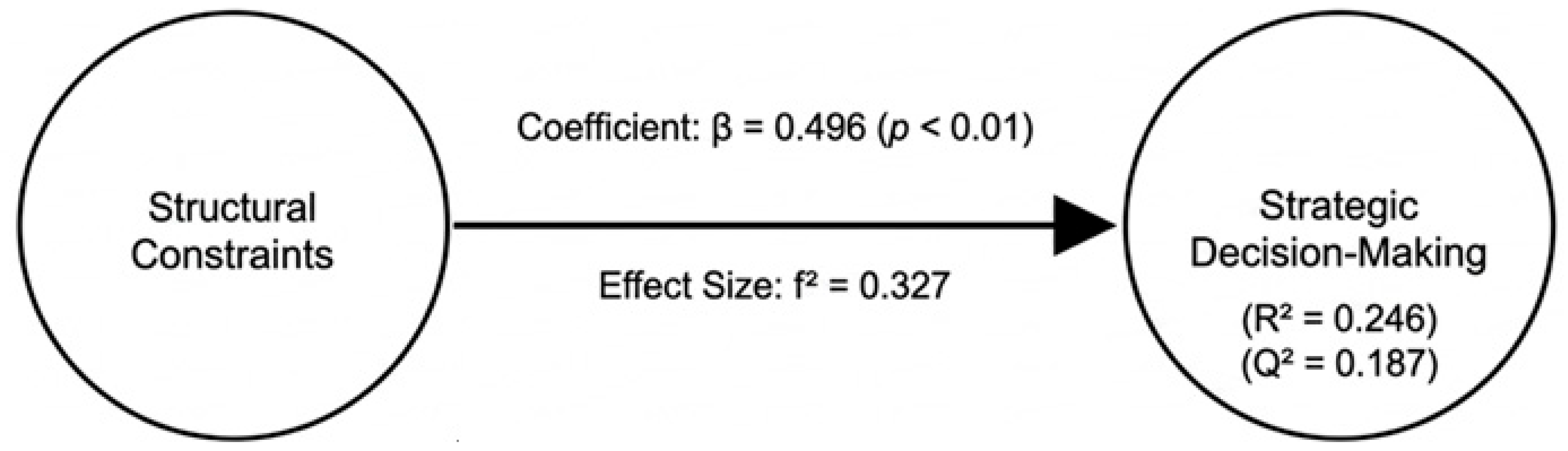
The findings from the structural model indicate a positive and statistically significant relationship between Structural Constraints and Strategic Decisions (β = 0.496; p < 0.01), with a coefficient of determination of R2 = 0.246 in the construct. Therefore, Hypothesis 1 is supported. This suggests a moderate explanatory power, consistent with the complexity of entrepreneurial behavior in emerging and institutionally fragile contexts (Figure 1). Substantively, these findings indicate that, for women entrepreneurs in Ecuador, an intensification of structural constraints is associated with a greater deployment of adaptive strategic responses—focused on adjustment, prioritization, and resource reconfiguration—rather than paralysis or inaction. Constraints such as financial barriers, institutional fragility, informality, caregiving burdens, and insecurity appear to be positively associated with the deployment of adaptive strategic decision-making processes rather than with entrepreneurial paralysis or withdrawal. This finding is consistent with the idea that, in emerging economies, constraints shape a “selection” environment in which those entrepreneurs who remain active and visible (as captured in the sample) are those who mobilize strategic repertoires to sustain their businesses. As a result, the observed relationship may be positively biased (survivorship bias), especially in cross-sectional research designs.
As constraints intensify, women entrepreneurs tend to respond proactively through adaptive strategies, which may reflect resilience and a propensity to pursue innovative solutions under pressure. Rather than suggesting that structural constraints directly generate entrepreneurial success, the findings indicate that women entrepreneurs tend to deploy adaptive strategic responses under conditions of institutional fragility and resource scarcity. The effect size (f2 = 0.327) indicates a moderate-to-large substantive impact of structural constraints on strategic decision-making, highlighting that the observed relationship is not only statistically significant but also meaningful in practical terms (Table 3).
Discriminant validity was assessed using the heterotrait–monotrait ratio (HTMT), yielding a value of 0.485 for the relationship between Structural Constraints and Strategic Decision-Making (Table 4). This value is well below the conservative threshold of 0.85, indicating a clear distinction between constructs.
The tendency to treat women entrepreneurs as a homogeneous category has been widely criticized in the specialized literature. From an intersectional perspective, gender does not operate in isolation; instead, it interacts with dimensions such as social class, ethnicity, territory, educational level, and formalization status, generating differentiated experiences of constraint and agency. In the Ecuadorian context, this heterogeneity is particularly evident, as entrepreneurs operating in urban, highly educated, and formalized sectors do not face the same institutional barriers, nor deploy the same strategic responses, as rural micro-entrepreneurs with lower educational attainment working in informal contexts.
Recent studies on Latin American women entrepreneurs further emphasize the relevance of resource recombination, frugal innovation, and relational capital as adaptive mechanisms for sustaining entrepreneurial activity in volatile and resource-constrained environments (Itani et al., 2025). Consequently, the observed relationship between structural constraints and strategic decision-making should not necessarily be interpreted as purely opportunity-driven behavior, but rather as a contextually embedded adaptive response shaped by unequal institutional and socioeconomic conditions.
This distinction has direct implications for the model proposed in the present study. If structural constraints do not affect all women in the sample uniformly, the estimated path coefficient (β = 0.496) captures an average relationship that may conceal divergent patterns across subgroups. Methodologically, this highlights the relevance of multigroup analyses by sector, educational level, or territory in future research, as well as the inclusion of interaction variables to assess differential effects.
Equally relevant is the distinction between necessity-driven and opportunity-driven entrepreneurship, as established by the Global Entrepreneurship Monitor and extensively documented in the Latin American context (Sindhwani & Dhawan, 2021). In Ecuador, recent GEM data indicate that a significant proportion of female entrepreneurship originates in the absence of formal employment alternatives rather than in the active identification of market opportunities. This structurally conditioned motivation has important implications for the type of strategic decisions adopted: necessity-driven entrepreneurs tend to prioritize short-term adaptive strategies—such as operational reorganization and reliance on informal networks—whereas opportunity-driven entrepreneurs are more likely to engage in innovation, formalization, and expansion-oriented actions.
Failing to incorporate this distinction as a segmentation or control criterion implies assuming that the relationship between constraints and strategic decision-making is homogeneous across all entrepreneurial profiles, which may lead to an overestimation of the strategic agency observed in the sample. Recognizing this heterogeneity does not weaken the study’s findings; rather, it strengthens their explanatory scope by situating them within a more nuanced analytical framework, with greater potential for informing differentiated and context-sensitive public policies.
From the perspectives of organizational resilience and dynamic capabilities, the findings suggest that women entrepreneurs operating in institutionally fragile environments tend to deploy adaptive strategic responses aimed at maintaining business continuity under conditions of uncertainty. These responses include digitalization, networking, diversification, selective formalization, and resource reconfiguration, reflecting processes of anticipation, coping, and adaptation (Soares & Soliman, 2024; Darkow, 2018). This interpretation is particularly relevant in the Ecuadorian context, where high rates of necessity-driven entrepreneurship reinforce a pattern of continuous adaptation under structural pressure (Terán et al., 2019; Valque et al., 2025; Carrasquero-Ferrer et al., 2024, Grijalva, 2025).
Within the Ecuadorian institutional context, these findings are especially relevant, as persistent limitations in financing, fragmented policy implementation, and gender inequalities continue to shape entrepreneurial ecosystems (Menouar, 2025; Goncalves et al., 2025; Aguirre et al., 2024). Rather than suggesting that constraints “benefit” entrepreneurship, the results indicate that women entrepreneurs tend to respond strategically to institutional deficiencies through adaptive and reactive forms of agency. In this sense, the observed relationship may reflect a form of “substitutive institutionalism,” in which informal arrangements, relational capital, and short- to medium-term strategic responses compensate for institutional voids related to financing, support networks, and legal security. This interpretation is consistent with studies highlighting the relevance of informal institutions in shaping female entrepreneurial activity in Latin America and the role of institutional fragility in influencing opportunity recognition processes among women entrepreneurs (Silupu & Reyes, 2023; Rosado-Cubero et al., 2024).
A dimensional analysis reveals that the structural constraints faced by women entrepreneurs are primarily distributed across three domains: financial, institutional, and sociocultural. Financial constraints exhibit the highest perceived burden, with a composite reliability of 0.902, highlighting the centrality of access to credit as a key barrier to female entrepreneurship. Institutional and support-related barriers, also significant (ρc = 0.893), underscore the urgent need for more effective policies in terms of mentoring, advisory services, and capacity building. Sociocultural and care-related gaps, in turn, reflect persistent gender-based structural limitations, with strong internal consistency (ρc = 0.884), emphasizing the need for greater social co-responsibility in caregiving roles.
With respect to strategic decision-making, these are grouped into three well-defined dimensions. Innovation and development (ρc = 0.891) stand out for their orientation toward product and service differentiation as an adaptive mechanism in response to external constraints. Digitalization and the use of technological tools, although exhibiting a lower mean, demonstrate good internal cohesion (ρc = 0.865), suggesting that women entrepreneurs are beginning to adopt these solutions, albeit with certain limitations. Finally, alliances and networks (ρc = 0.876) emerge as a fundamental strategy for overcoming structural barriers, particularly in contexts characterized by weak institutional support.
The findings suggest that reducing structural barriers may strengthen women entrepreneurs’ capacity to deploy adaptive strategic responses related to innovation, formalization, and business continuity. In the Ecuadorian context, this aligns with recent institutional agendas aimed at improving financing, training, digitalization, and market access for women-led ventures (Presidency of the Republic of Ecuador, 2025).
At the ecosystem level, persistent gaps in access to financing, connectivity, and institutional support continue to constrain entrepreneurial development, particularly in vulnerable territories and contexts shaped by caregiving burdens and insecurity (Zogning, 2022). In this regard, integrated support mechanisms combining financial inclusion, technical assistance, digital capabilities, and collaborative networks may contribute to a more enabling entrepreneurial environment.
Similarly, recent studies emphasize the relevance of adaptive capabilities, relational capital, and collaborative resilience as mechanisms that help sustain entrepreneurial activity under conditions of institutional fragility (Tunçalp, 2025). Strengthening support and cooperation networks among women entrepreneurs may therefore enhance business sustainability and strategic flexibility in the Ecuadorian context.
The following recommendations should be interpreted as literature-informed and contextually grounded implications rather than as effects directly tested in the empirical model.
From a practical standpoint, these findings carry significant implications for the Ecuadorian entrepreneurial ecosystem and the design of gender-sensitive public policies. In particular:
  • Differentiated financial support policies: Given that women entrepreneurs perceive lack of financing as a major constraint and prioritize its improvement, it is essential to establish mechanisms that facilitate access to credit. State-backed guarantee programs, low-interest microcredit schemes, or competitive funds exclusively for women-led ventures can help reduce the financing gap. Furthermore, training financial institutions to reduce gender bias and develop tailored financial products (e.g., loans accommodating variable income flows or group-based collateral schemes) would enhance women’s financial inclusion (Mayher et al., 2022; Saxena et al., 2023).
  • Gender-sensitive training and mentorship: The high value placed on training by women entrepreneurs highlights the need for targeted capacity-building programs covering financial management, technology use, and digital marketing. These programs should incorporate mentorship components led by experienced women entrepreneurs, as women tend to benefit significantly from guidance and support networks. While initiatives such as accelerators and businesswomen networks already exist, scaling and disseminating them—especially beyond major urban centers—is critical.
  • Bureaucratic simplification and formalization: Respondents prioritize the reduction of administrative procedures and regulatory burdens. This suggests that reforms in business registration, licensing, and tax obligations for microenterprises could have a particularly positive impact on women-led ventures, which are often smaller in scale. Policies such as one-stop service windows, digitalization of public processes, and temporary fee exemptions for new businesses can facilitate formalization and business growth (Gallegos-Montero et al., 2024; Saha et al., 2023).
  • Strengthening networks and cooperatives: Women entrepreneurs emphasize the importance of integration, cooperation, and engagement with public, private, and academic actors. This indicates a perceived disconnection from innovation ecosystems and broader markets. Promoting women-led clusters, cooperatives, and business associations, as well as platforms that connect women entrepreneurs with large firms (value chain integration) and universities (e.g., for technology transfer), can significantly enhance their opportunities. While women often excel in informal networking, institutional support is required to translate these networks into tangible business outcomes (Dixit & Sinha, 2024; Ríos & Tróchez, 2023).
  • Care services and family-oriented labor policies: Although not directly measured in this model, it is widely recognized that caregiving responsibilities limit women entrepreneurs’ available time and strategic engagement. To fully unlock their strategic potential, policies should include childcare services, flexible working arrangements, childcare subsidies, and other measures that alleviate the double burden faced by women. An environment where caregiving needs are partially addressed would allow women entrepreneurs to focus more effectively on business growth and strategic execution (Robb et al., 2014; Alecchi, 2020; Ávila et al., 2020).

5. Conclusions

This study advances the understanding of female entrepreneurship in emerging economies by providing empirical evidence on how structural constraints shape strategic decision-making in women-led ventures in Ecuador. Using a PLS-SEM model, the findings demonstrate that structural constraints—conceptualized as a multidimensional construct encompassing financial, institutional, and sociocultural dimensions—are positively associated with adaptive strategic responses (β = 0.496; R2 = 0.246). These results suggest an adaptive pattern: women entrepreneurs not only confront obstacles but actively mobilize resources, networks, and capabilities to sustain and grow their businesses within institutionally fragile environments.
From a theoretical standpoint, this study contributes to the entrepreneurship literature by advancing an explanatory perspective in which structural constraints are not conceptualized solely as barriers, but as contextual conditions associated with adaptive strategic responses. By integrating institutional theory, dynamic capabilities, and resilience, the findings provide empirical support for the notion of “entrepreneurship under constraint,” highlighting that strategic agency in emerging contexts is often reactive and contextually embedded rather than purely opportunity-driven.
Ultimately, this study contributes to ongoing discussions on entrepreneurship in contexts of institutional fragility by providing exploratory evidence that structural constraints may be associated with adaptive strategic responses among women entrepreneurs. Rather than suggesting causal effects, the findings highlight the relevance of contextual and institutional conditions in shaping entrepreneurial decision-making processes within emerging economies.

5.1. Limitations

This study presents several methodological and analytical limitations that should be acknowledged. First, the cross-sectional design constrains causal inference: although the theoretical direction of the relationships is well grounded (Constraints → Decisions), the possibility of reciprocal relationships or the influence of omitted variables cannot be ruled out.
Another limitation concerns convergent validity, as the AVE values remained slightly below conventional thresholds. Although internal consistency and discriminant validity indicators were satisfactory, these findings suggest that the constructs capture heterogeneous dimensions of entrepreneurial behavior. Therefore, the results should be interpreted as exploratory and explanatory rather than definitive.

5.2. Future Research

Future research should aim to expand the model toward more integrative frameworks. One promising avenue involves incorporating mediating variables such as individual resilience, dynamic capabilities, or relational resources, which may explain how constraints are translated—or not—into strategic decisions and, subsequently, into organizational performance. This approach would allow for assessing not only adaptive responses but also their associated costs and benefits in terms of sustainability, growth, and entrepreneurs’ well-being.
Additionally, it is recommended to address contextual heterogeneity through multigroup analyses (e.g., urban vs. rural settings, economic sector, business stage) and measurement invariance testing, considering that constraints vary significantly across territories and institutional contexts. Finally, strengthening the robustness of the model through validation techniques such as additional validation techniques would enhance its practical relevance for the design of targeted public policies and more effective support programs.

Author Contributions

Conceptualization, S.C.-F.; methodology, M.G.; formal analysis, S.C.-F.; statistical analysis, N.D.-P.; data curation, S.C.-F.; writing—original draft preparation, S.C.-F.; writing—review and editing, S.C.-F.; project administration, A.H.-A.; funding acquisition, S.C.-F. All authors have read and agreed to the published version of the manuscript.

Funding

This research received no external funding.

Institutional Review Board Statement

The study is based on voluntary participation of adult individuals through an anonymous structured questionnaire, without any form of intervention, experimentation, or collection of sensitive or identifiable personal data. All procedures were conducted in accordance with the ethical principles outlined in the Declaration of Helsinki (1975, revised in 2013). Informed consent was obtained from all participants prior to data collection. Regarding ethical approval, under the current Ecuadorian legal framework, studies based on anonymous surveys, involving no risk to participants and no processing of identifiable or sensitive personal data, do not require formal approval from an Institutional Review Board (IRB) or ethics committee. This is supported by the Constitution of the Republic of Ecuador (2008) and the Organic Law on Personal Data Protection (2021). As the present study does not involve biomedical procedures, vulnerable populations, sensitive data, or any form of risk, formal ethical approval was not required. Nevertheless, the research strictly adhered to fundamental ethical principles, including voluntary participation, informed consent, anonymity, confidentiality, and responsible data management.

Informed Consent Statement

Informed consent was obtained from all subjects involved in the study.

Data Availability Statement

The original contributions presented in this study are included in the article. Further inquiries can be directed to the corresponding author(s).

Conflicts of Interest

The authors declare no conflicts of interest.

References

  1. Aguirre, M., Salazar-Romero, Á. del C., & Lara, A. (2024). Factores determinantes del emprendimiento femenino en Ecuador: Una perspectiva individual y del entorno. European Public & Social Innovation Review, 9, 1–21. [Google Scholar] [CrossRef] [Scilit]
  2. Alecchi, B. A. (2020). Toward realizing the potential of Latin America’s women entrepreneurs: An analysis of barriers and challenges. Latin American Research Review, 55(3), 496–514. [Google Scholar] [CrossRef] [Scilit]
  3. Araya, F., Kuschel, K., & Alsua, C. (2022). Recomendaciones para una política nacional de emprendimiento femenino en Chile. 360 Revista de Ciencias de la Gestión, 7, 1–24. [Google Scholar] [CrossRef] [Scilit]
  4. Ávila, J. A. G., Reinoso, J. R. R., Castillo, D. C. C., & Ochoa, M. E. C. (2020). Factores que inciden en el emprendimiento sostenible de las mujeres ecuatorianas. Pro Sciences Revista de Producción Ciencias E Investigación, 4(37), 97–110. [Google Scholar] [CrossRef] [Scilit]
  5. Buñay-Solano, E., & Ordoñez-Gavilanes. (2022). La actividad emprendedora de la mujer ecuatoriana para el desarrollo social. Caso: Cañar—Ecuador. CIENCIAMATRIA, 8(2), 538–563. [Google Scholar] [CrossRef] [Scilit]
  6. Calle, M., & Tenesaca, J. (2023). Identificación de oportunidades y su impacto en las intenciones de emprendimiento. Ciencias Administrativas, 22, 124. [Google Scholar] [CrossRef] [Scilit]
  7. Carrasquero-Ferrer, S., Vaca Suárez, G., & Pino Rodríguez, J. (2024). Competencias emprendedoras de mujeres en condición de vulnerabilidad de la ciudad de Guayaquil, Ecuador. Revista de la Universidad del Zulia, 15(44), 306–322. [Google Scholar] [CrossRef]
  8. Carvalho, L., & Brito, A. (2024). Empreendedorismo resiliente. Revista Pensamento Contemporâneo em Administração, 18(1), 25–40. [Google Scholar] [CrossRef] [Scilit]
  9. Castiblanco, S. (2018). Emprendimiento informal y género. Sociedad y Economía, 34, 211–228. [Google Scholar] [CrossRef] [Scilit]
  10. Chouhan, K., & Vaishnav, B. (2025). Women entrepreneurs in emerging economies: Barriers, enablers, and policy perspectives. International Journal For Multidisciplinary Research, 7(5), 1–7. [Google Scholar] [CrossRef]
  11. Corrêa, V., Da Silva Brito, F., De Lima, R., & Queiroz, M. (2021). Female entrepreneurship in emerging and developing countries: A systematic literature review. International Journal of Gender and Entrepreneurship, 14(3), 300–322. [Google Scholar] [CrossRef] [Scilit]
  12. Darkow, P. (2018). Beyond “bouncing back”: Towards an integral, capability-based understanding of organizational resilience. Journal of Contingencies and Crisis Management, 27(2), 145–156. [Google Scholar] [CrossRef] [Scilit]
  13. Dixit, D., & Sinha, A. (2024). Entrepreneurial functions performed by women entrepreneurs: Do incubators make a difference? Australian Journal of Management, 50(3), 939–961. [Google Scholar] [CrossRef] [Scilit]
  14. Ejaz, L., Grinevich, V., & Karatas-Ozkan, M. (2023). Women’s informal entrepreneurship through the lens of institutional voids and institutional logics. Gender Work and Organization, 30(4), 1254–1272. [Google Scholar] [CrossRef] [Scilit]
  15. Escobar, L., Iturrieta, P., Varas, L., & Alfaro, C. (2024). Capacidades emprendedoras de mujeres empresarias de mypes chilenas. Multidisciplinary Business Review, 17(2), 17–32. [Google Scholar] [CrossRef] [Scilit]
  16. Fabbricatore, R., Iannario, M., Romano, R., & Vistocco, D. (2021). Component-based structural equation modeling for the assessment of psycho-social aspects and performance of athletes. AStA Advances in Statistical Analysis, 107(1–2), 343–367. [Google Scholar] [CrossRef] [Scilit]
  17. Foss, L., Henry, C., Ahl, H., & Mikalsen, G. H. (2018). Women’s entrepreneurship policy research: A 30-year review of the evidence. Small Business Economics, 53(2), 409–429. [Google Scholar] [CrossRef] [Scilit]
  18. Gallegos-Montero, R., Chávez, M., & Veloz, A. (2024). Impacto del financiamiento y formación en emprendimientos de mujeres en Quito y su contribución. Bastcorp International Journal, 3(2), 248–270. [Google Scholar] [CrossRef] [Scilit]
  19. Goncalves, M., Sartipi, S., & Damavandi, G. (2025). Leadership and entrepreneurial choices: Understanding the motivational dynamics of women entrepreneurs in Iran. Merits, 5(1), 1. [Google Scholar] [CrossRef] [Scilit]
  20. Grijalva, D. (2025). Gender, governance, and resilience: Firms’ performance and tactical responses during the COVID-19 pandemic. Corporate Governance, 26(2), 309–330. [Google Scholar] [CrossRef] [Scilit]
  21. Guillén, J., & Pereira, R. (2022). Gender Entrepreneurship in Latin America: Does the institutional system matter? Journal of Organizational Behavior Research, 7(1), 198–215. [Google Scholar] [CrossRef] [Scilit]
  22. Hair, J., Hult, G., Ringle, C., Sarstedt, M., Danks, N., & Ray, S. (2021). Partial least squares structural equation modeling (PLS-SEM) using R: A workbook. Springer. [Google Scholar] [CrossRef] [Scilit]
  23. Hair, J., Sarstedt, M., Hopkins, L., & Kuppelwieser, V. (2014). Partial least squares structural equation modeling (PLS-SEM). European Business Review, 26(2), 106–121. [Google Scholar] [CrossRef] [Scilit]
  24. Hidrovo, R. (2025). Factores que limitan la oferta de financiamiento a las pymes en Ecuador en la última década. Ciencias Administrativas, 26, 164. [Google Scholar] [CrossRef] [Scilit]
  25. Itani, M., Fawaz, R. S., Fathallah, R., Okazaki, S., & Jamali, D. (2025). Rebellion against resilience? The experience of women entrepreneurs in the context of poly-crisis. International Small Business Journal Researching Entrepreneurship, 43(5), 589–627. [Google Scholar] [CrossRef] [Scilit]
  26. Kamberidou, I. (2020). “Distinguished” women entrepreneurs in the digital economy and the multitasking whirlpool. Journal of Innovation and Entrepreneurship, 9(1), 3. [Google Scholar] [CrossRef] [Scilit]
  27. Lasio, V., Amaya, A., Espinosa, M. P., Mahauad, M. D., & Sarango, P. (2024). Global entrepreneurship monitor ecuador 2023–2024. ESPAE Business School, ESPOL & Universidad Técnica Particular de Loja. Available online: https://www.gemconsortium.org/report/gem-ecuador-2023-2024 (accessed on 5 April 2026).
  28. López, R. A. B., Hidalgo, W. A. H., & Delgado, E. P. M. (2021). Realidad de los microcréditos para los emprendimientos femeninos en la zona noroeste de Guayaquil, Ecuador. Revista Publicando, 8(31), 153–164. [Google Scholar] [CrossRef] [Scilit]
  29. Mallepally, A., & Mallepally, A. (2025). Women entrepreneurs and start-ups: Breaking barriers. International Journal of Advances in Business and Management Research, 3, 86–92. [Google Scholar] [CrossRef] [Scilit]
  30. Martin-Peña, G. (2024). Characterization of attitudes towards entrepreneurship, creativity and innovation in female entrepreneurs of Latin America. Región Científica, 3(2), 2024326. [Google Scholar] [CrossRef] [Scilit]
  31. Martínez, R., Kuschel, K., & Pastor, I. (2021). A contextual approach to women’s entrepreneurship in Latin America: Impacting research and public policy. International Journal of Globalisation and Small Business, 12(1), 83. [Google Scholar] [CrossRef] [Scilit]
  32. Martínez, S. (2022). Entrepreneurship as a multidisciplinary phenomenon: Culture and individual perceptions in business creation. Academia Revista Latinoamericana de Administración, 35(4), 537–565. [Google Scholar] [CrossRef] [Scilit]
  33. Martínez-González, J. A., Álvarez-Albelo, C. D., Mendoza-Jiménez, J., & Kobylinska, U. (2022). Predicting the entrepreneurial behaviour of starting up a new company: A regional study using PLS-SEM and data from the global entrepreneurship monitor. Mathematics, 10(5), 704. [Google Scholar] [CrossRef] [Scilit]
  34. Mayher, C. L., Azar, K., & Andrade, G. (2022). Best practices for the financing of women MSMEs in Latin America and the caribbean: Recommendations for National Development Banks. IDB. [Google Scholar] [CrossRef] [Scilit]
  35. Menouar, R. (2025). National wealth and gender inequality in entrepreneurship: A paradox in high-income economies. International Journal of Scientific Research and Innovative Studies, 4(3), 9–15. [Google Scholar] [CrossRef] [Scilit]
  36. Méndez-Vélez, F., Palomeque-Cantos, R., & Borja-Pozo, C. (2022). Socio-economic evolution of Ecuador: Main economic indicators and social phenomena in recent years. AIP Conference Proceedings, 2709, 090006. [Google Scholar] [CrossRef] [Scilit]
  37. Molina, T., Pérez, S., Morales-Urrutia, X., & Victor, V. (2021). Entrepreneurship: The case of ecuador. In Advances in intelligent systems and computing (pp. 259–273). Springer. [Google Scholar] [CrossRef] [Scilit]
  38. Morais-Storz, M., Platou, R., & Norheim, K. (2018). Innovation and metamorphosis towards strategic resilience. International Journal of Entrepreneurial Behaviour & Research, 24(7), 1181–1199. [Google Scholar] [CrossRef] [Scilit]
  39. Muñoz, E., Sánchez, A., Morales, F., & Lirios, C. (2022). Structural equation model of entrepreneurship in downtown Mexico during the COVID-19 era. Frontiers in Management and Business, 3(1), 194–198. [Google Scholar] [CrossRef] [Scilit]
  40. Nassif, V., & Garçon, M. (2022). The integrative approach in the study of resilience in female entrepreneurship. European Journal of Training and Development, 48(1/2), 162–178. [Google Scholar] [CrossRef] [Scilit]
  41. Noguera, M., Alvarez, C., Merigó, J. M., & Urbano, D. (2015). Determinants of female entrepreneurship in Spain: An institutional approach. Computational and Mathematical Organization Theory, 21(4), 341–355. [Google Scholar] [CrossRef] [Scilit]
  42. Oladipo, O., Platt, K., & Shim, H. (2023). Female entrepreneurs managing from home. Small Business Economics, 61(2), 447–464. [Google Scholar] [CrossRef] [Scilit]
  43. Pita, M., & Costa, J. (2021). Entrepreneurial resilience and gender: Are they connected? Contributions toward entrepreneurship policy-package. In Springer proceedings in mathematics & statistics (pp. 621–631). Springer. [Google Scholar] [CrossRef] [Scilit]
  44. Presidency of the Republic of Ecuador. (2025). Organic law to promote the economy of women entrepreneurs in Ecuador. Official gazette supplement No. 758. Available online: https://www.pwc.ec/es/tax-news/2025/TN10-25.pdf (accessed on 1 April 2026).
  45. Rivera, M., Cisneros, B., & Fernández, J. (2018). Mujeres emprendedoras y el contexto social ecuatoriano. Visión Empresarial, 8, 61. [Google Scholar] [CrossRef] [Scilit]
  46. Ríos, E., & Tróchez, D. (2023). Factores determinantes para la gestión de redes de emprendimiento femenino en Colombia y Perú. Telos: Revista de Estudios Interdisciplinarios en Ciencias Sociales, 25(2), 391–410. [Google Scholar] [CrossRef] [Scilit]
  47. Robb, A., Robb, A., Coleman, S., & Stangler, D. (2014). Sources of economic hope: Women’s entrepreneurship. Social Science Research Network. [Google Scholar] [CrossRef] [Scilit]
  48. Rodríguez, S., & Saiz, J. (2025). Trends and challenges of female entrepreneurship: A bibliographic review. Región Científica, 4(2), 2025475. [Google Scholar] [CrossRef] [Scilit]
  49. Rosado-Cubero, A., Hernández, A., Jiménez, F. J. B., & Freire-Rubio, T. (2024). Does gender affect entrepreneurship? Evidence from Spanish and Argentinian business incubators. Journal of Business Research, 170, 114326. [Google Scholar] [CrossRef] [Scilit]
  50. Saha, A., Megersa, K., & Macdonald, K. (2023). Business licencing reform and gender equality: Evidence from Indonesia. Figshare. [Google Scholar] [CrossRef] [Scilit]
  51. Sanogo, N., & Sall, F. D. (2023). Gender, management style, and the flexibility of informal sector enterprises in the period of Covid-19: The case of agri-food microenterprises in Mali. Journal of Comparative International Management, 26(1), 98–122. [Google Scholar] [CrossRef] [Scilit]
  52. Saxena, C., Khatri, B., & Khan, S. A. (2023). Factors hindering women entrepreneurs’ access to institutional finance. In Advances in business strategy and competitive advantage book series (pp. 101–114). IGI Global. [Google Scholar] [CrossRef] [Scilit]
  53. Sánchez, F. X. P., & Bojica, A. M. (2024). Gender differences in the use of social capital for entrepreneurial activity within contexts of poverty. Entrepreneurship Research Journal, 14(4), 1857–1886. [Google Scholar] [CrossRef] [Scilit]
  54. Silupu, B., & Reyes, S. (2023). Informality as a choice to do legitimate business: Evidence from Peruvian women in times of COVID-19. Management Research The Journal of the Iberoamerican Academy of Management, 22(3), 343–363. [Google Scholar] [CrossRef] [Scilit]
  55. Sindhwani, S., & Dhawan, A. (2021). Are opportunity and necessity based women entrepreneurs any different? Multidisciplinary Business Review, 14(1), 108–119. [Google Scholar] [CrossRef] [Scilit]
  56. Soares, M. P. V., & Soliman, M. (2024). Assessment of business resilience abilities: The case of industry and commerce of Santa Maria—RS. Revista de Administração da UFSM, 17(1), e3. [Google Scholar] [CrossRef] [Scilit]
  57. Teixeira, D., Júnior, C., & De Almeida, M. (2023). The relationship between gender policies and the creation of businesses by women. REGEPE Entrepreneurship and Small Business Journal, 12(3), e2438. [Google Scholar] [CrossRef] [Scilit]
  58. Terán, H. E., Mendoza Vargas, E. Y., Boza Valle, J. A., & Alcívar Saltos, M. E. (2019). Análisis estructural y dinámica de los emprendimientos en la provincia de Los Ríos-Zona Norte. Universidad y Sociedad, 11(2), 104–108. [Google Scholar]
  59. Terjesen, S., & Amorós, J. (2010). Female entrepreneurship in Latin America and the Caribbean: Characteristics, drivers and relationship to economic development. European Journal of Development Research, 22(3), 313–330. [Google Scholar] [CrossRef] [Scilit]
  60. Tunçalp, D. (2025). Entrepreneurial resilience in polycrisis: Adaptation via improvizational action, institutional workarounds, and strategic reconfiguration. Journal of Management & Organization, 32(3), 1–23. [Google Scholar] [CrossRef] [Scilit]
  61. Ubfal, D. (2024). Supporting women-led businesses: Narrative review of recent causal evidence. The World Bank Research Observer, 41(1), 118–156. [Google Scholar] [CrossRef] [Scilit]
  62. Valencia, M., Tejena, P., García, J., & Véliz, D. (2023). Emprendimiento, una oportunidad de vida para la mujer ecuatoriana. Revista San Gregorio, 1(56), 132–145. [Google Scholar] [CrossRef] [Scilit]
  63. Valque, R., Caro, O., Bazán, W., Torres-Armas, E., Vásquez, C., Puerta, C., Valque, R., Caro, O., Bazán, W., Torres-Armas, E., & Vásquez, C. (2025). Influence of socioeconomic factors on female entrepreneurship: An analysis using structural equation modeling (PLS-SEM). Frontiers in Sociology, 10, 1684697. [Google Scholar] [CrossRef] [Scilit] [PubMed]
  64. Vargas, E., Terán, H., & Valle, J. (2019). Financiamiento: Principal reto del microemprendimiento en Ecuador. Revista Científica ECOCIENCIA, 6(6), 1–20. [Google Scholar] [CrossRef] [Scilit]
  65. Vargas, J. (2022). Strategic analysis of organizational learning approaches to dynamic resilient capability. In Practice, progress, and proficiency in sustainability (pp. 317–337). IGI Global. [Google Scholar] [CrossRef] [Scilit]
  66. Venturini, J. V. (2023). Empreendedorismo feminino e inovação na gestão de pequenos negócios: Reflexões a partir de experiências multissetoriais. RCMOS—Revista Científica Multidisciplinar o Saber, 1(1), 1–13. [Google Scholar] [CrossRef] [Scilit]
  67. Wu, J., Li, Y., & Zhang, D. (2019). Identifying women’s entrepreneurial barriers and empowering female entrepreneurship worldwide: A fuzzy-set QCA approach. International Entrepreneurship and Management Journal, 15(3), 905–928. [Google Scholar] [CrossRef] [Scilit]
  68. Zogning, F. (2022). Financial inclusion, inclusive entrepreneurship, and alternative financing options. Journal of Small Business & Entrepreneurship, 35(1), 8–13. [Google Scholar] [CrossRef] [Scilit]
Figure 1. Proposed structural model of the relationship between structural constraints and strategic decision-making in women-led entrepreneurial ventures.
Admsci 16 00256 g001
Table 1. Sociodemographic and Business Characteristics of Women Entrepreneurs in the Sample (N = 110).
VariableCategoryFrequency (%)
Age18–2920.0
30–4445.5
45–5926.4
60+8.2
Educational LevelBasic12.7
Secondary43.6
Higher43.6
Business SectorCommerce24.5
Services62.7
Industry12.7
Years in Operation<1 year18.2
1–3 years40.0
4–10 years41.8
FormalizationYes80.9
No19.1
Table 2. Descriptive statistics of constructs: perceived constraints and strategic decisions.
ConstructDimensionSummary ContentMeanStandard
Deviation
Structural ConstraintsFinancial ConstraintsDifficulty accessing financing4.120.81
Excessive credit requirements3.950.76
Institutional and Support BarriersDifficulty accessing advisory services3.820.79
Sociocultural and Care GapsCare responsibilities hinder entrepreneurship4.250.69
Strategic DecisionsInnovation and DevelopmentIntroduction of new products3.880.83
Digitalization and ToolsUse of digital tools3.710.90
Alliances and NetworksInformal social networks as strategic support4.050.77
Table 3. Measurement and structural model results.
Model ComponentConstruct/PathCronbach’s Alpha (α)Composite Reliability (ρc)AVER2βf2
Measurement modelStructural Constraints0.8850.9020.43
Measurement modelStrategic Decision-Making0.8740.8930.450.246
Structural modelConstraints → Decisions0.4960.327
Note: α = Cronbach’s alpha; ρc = composite reliability; AVE = average variance extracted; R2 = coefficient of determination; β = standardized path coefficient; f2 = effect size. All path coefficients are statistically significant at p < 0.01. Although AVE values were slightly below the conventional threshold of 0.50, internal consistency and discriminant validity indicators remained satisfactory, suggesting that the constructs should be interpreted with appropriate caution given their multidimensional nature.
Table 4. Discriminant Validity (HTMT).
ConstructsHTMT2.5%97.5%
Structural Constraints ↔ Strategic Decisions0.4850.3690.643
HTMT: heterotrait–monotrait ratio.
Disclaimer/Publisher’s Note: The statements, opinions and data contained in all publications are solely those of the individual author(s) and contributor(s) and not of MDPI and/or the editor(s). MDPI and/or the editor(s) disclaim responsibility for any injury to people or property resulting from any ideas, methods, instructions or products referred to in the content.