


Abstract
Global employee work engagement remains critically low, with only 21% of employees engaged worldwide in 2024 and Switzerland ranking near the bottom in Europe at 8%. Existing theories and models that explain employee engagement (Reinforcement Theory, Herzberg’s Two-Factor Theory, Equity Theory, Social Exchange Theory, Expectancy Theory, the Job Characteristics Model, Social Identity Theory, Self-Determination Theory, Conservation of Resource Theory, Psychological Empowerment Theory, Affective Events Theory, and the Job Demands–Resources Model) have been criticized for oversimplifying engagement processes, neglecting cultural and individual differences, and overemphasizing either intrinsic or extrinsic motivators. Addressing these gaps, this study proposes new principles for work engagement that integrate intrinsic and extrinsic motivators, cognitive and environmental variables, and dual employee–organization responsibilities. The framework emphasizes employee contributions (sincere effort, striving for excellence, ownership of meaningful tasks), organizational practices (fair treatment, participation, recognition, meaningful work), and effort–reward alignment as a central mediating mechanism. Moderating factors, including a culture of excellence and shared responsibility, ensure adaptability across diverse employee values, personalities, and motivational orientations. Ten propositions and associated measurement instruments are developed, grounded in established theories while operationalized for the Swiss organizational context, bridging theory and practice. The proposed framework offers a holistic, culturally sensitive, and actionable approach to enhancing engagement, providing both conceptual rigor and practical relevance for scholars and managers aiming to improve employee motivation and performance in complex, knowledge-based workplaces.
1. Introduction
Global work engagement stagnated at just 21% in 2024, with 62% not engaged and 17% actively disengaged (Gallup, 2025). The global employee work engagement rate has shown a gradual upward trend over the past 15 years, starting at a low of 12% in 2009 and peaking at 23% in 2022 and 2023 (Figure 1). Between 2009 and 2016, engagement levels increased slowly but steadily from 12% to 17%, indicating a slow recognition and implementation of engagement initiatives in the workplace. From 2017 to 2019, the growth accelerated, reaching 22% in 2019, likely reflecting a greater emphasis on organizational culture, leadership, and employee well-being. However, 2020 saw a slight dip to 20%, potentially due to the global disruption caused by the COVID-19 pandemic, which affected workplace dynamics, employee morale, and remote work conditions. Post-pandemic recovery seemed promising as engagement rebounded to 23% in 2022 and 2023, suggesting a stronger focus on flexibility, mental health, and hybrid work strategies. However, the drop to 21% in 2024 raises concern that this momentum may be plateauing or that organizations are struggling to maintain long-term engagement improvements.
Figure 1.
Global work engagement.
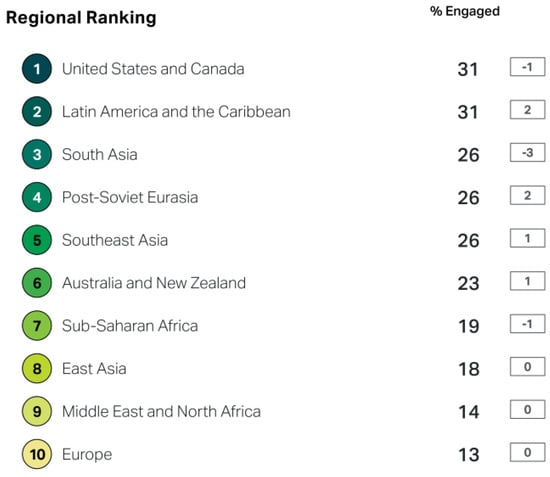
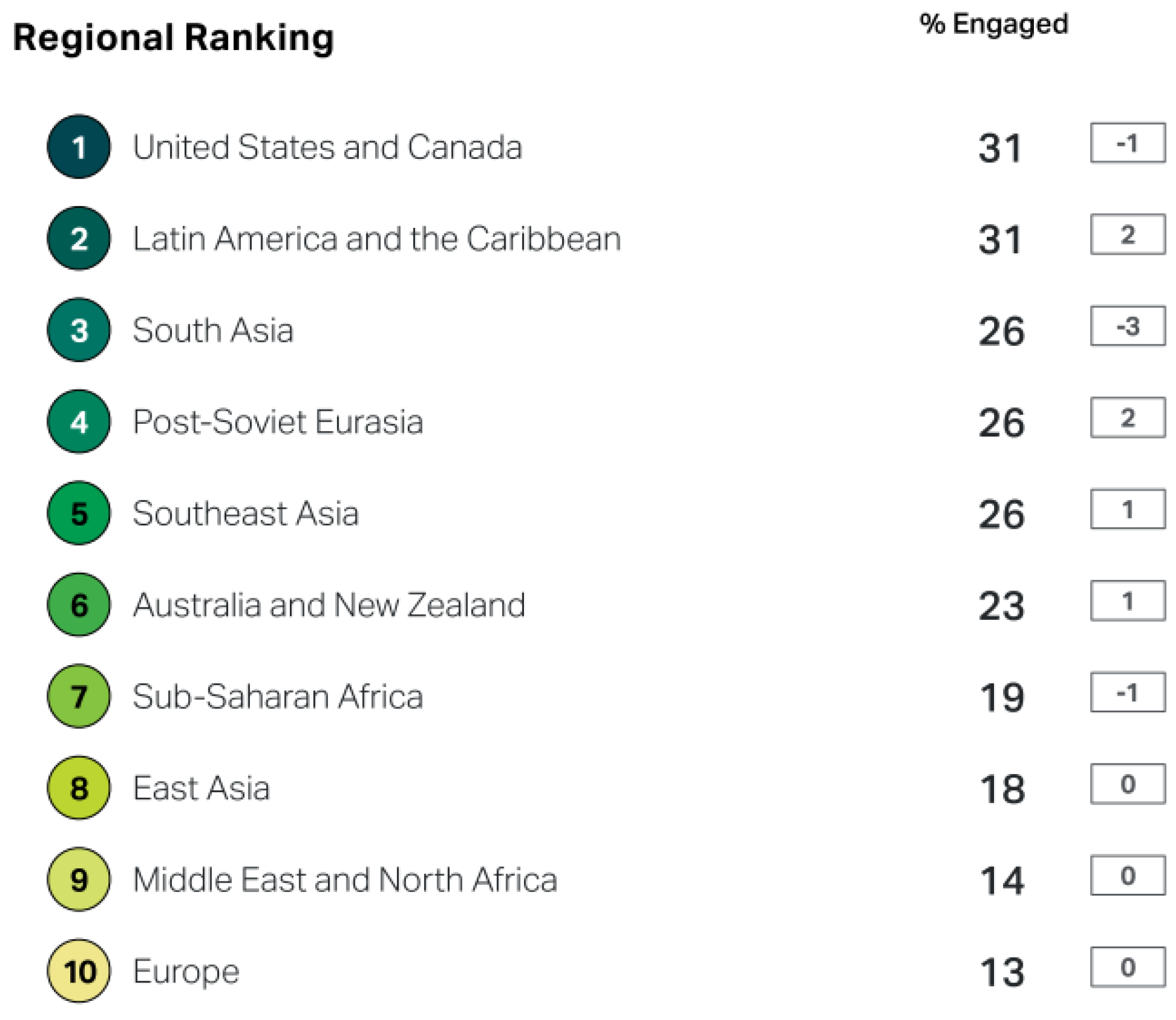
The highest engagement levels were reported in the United States, Canada, Latin America, and the Caribbean at 31%. South Asia, Post-Soviet Eurasia, and Southeast Asia follow with 26% engagement. In contrast, Europe ranks lowest at 13%, aligning with the global average. Notably, South Asia saw a significant drop of 3 percentage points, while Latin America and Post-Soviet Eurasia showed a 2-point increase (Figure 2). Employee work engagement in Europe is at just 13% in 2024, where 73% are not engaged and 15% are actively disengaged (Gallup, 2025).
Figure 2.
Regional ranking of employee work engagement (Gallup, 2025).
In Figure 3, engagement levels in Europe began at 15% in 2011 but experienced a gradual decline to 14% between 2012 and 2015. A notable drop occurred in 2016, bringing engagement down to 12%, where it remained stagnant for several years through 2020. This period of low and stable engagement suggests a lack of significant improvement in workplace motivation or organizational practices worldwide during that time. A modest upward shift began in 2021, with European engagement rising to 13%, a figure that has since remained steady through 2024. Although the increase is minor, it may indicate a slow recovery or renewed focus on employee well-being and engagement initiatives post-2020, possibly influenced by changes in work environments due to the COVID-19 pandemic. Still, the overall trend reflects limited European progress in improving employee engagement over the 14-year period.
Figure 3.
Work engagement by year in Europe.
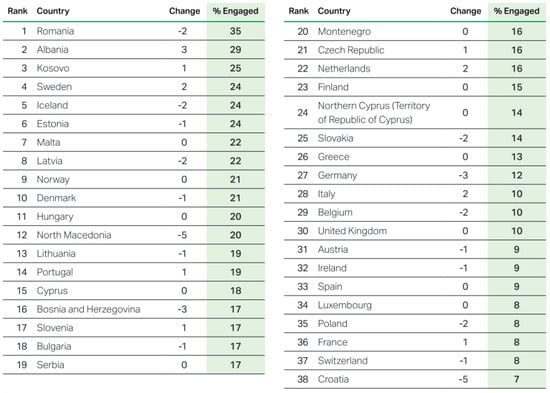
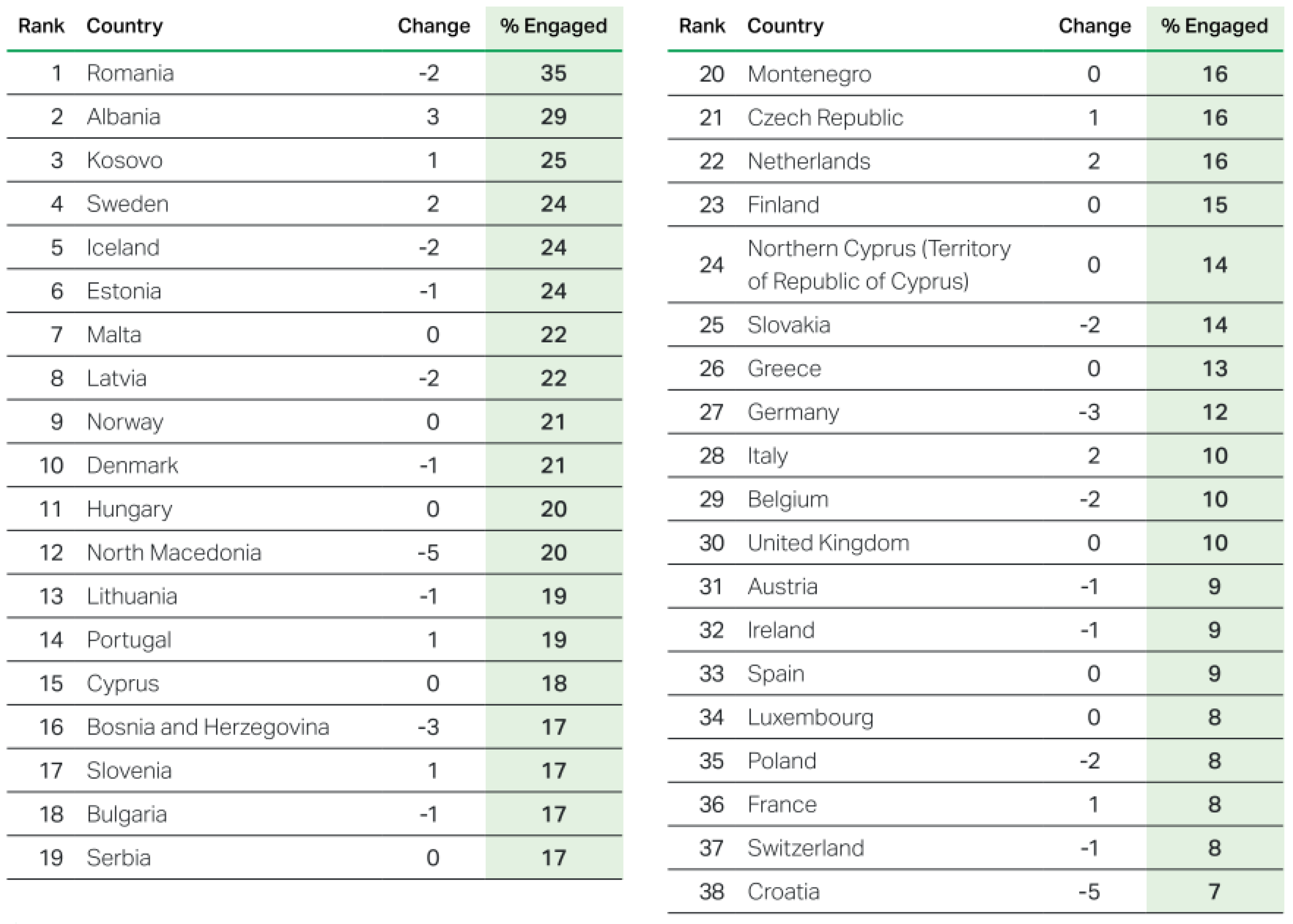
In Switzerland, employee engagement is declining while intention to leave is slightly increasing, according to the Swiss HR-Barometer (2024). This trend suggests that companies in Switzerland should focus on supporting and designing work to maintain a motivated and loyal workforce, even amidst changing needs and living conditions (Swiss HR-Barometer, 2024). Figure 4 reveals that Switzerland ranks near the bottom in employee engagement among 38 European countries, with only 8% of employees reporting being engaged in their work. This places Switzerland at 36th position, just above Croatia (7%) and tied with France, Poland, and Luxembourg. Furthermore, Switzerland experienced a slight decline of 1 percentage point compared to the previous measurement, indicating a downward trend rather than improvement. Despite being one of the most economically developed and prosperous nations in Europe, Switzerland’s low engagement rate highlights a critical disconnect between workplace conditions and employee motivation or satisfaction.
Figure 4.
Employee engagement in Europe (Gallup, 2025).
Although employee work engagement has been extensively examined, most leading theories were developed between 1950 and 2001 (such as Reinforcement Theory, Herzberg’s Two-Factor Theory, Expectancy Theory, Equity Theory, Social Exchange Theory, the Job Characteristics Model, Self-Determination Theory, Conservation of Resources Theory, Affective Events Theory, and the Job Demands–Resources model) informing this construct. Despite the extensive application of established engagement models and theories, employee work engagement levels in European workplaces, specifically in Switzerland, remain persistently low, indicating a clear gap between theoretical prescriptions and practical outcomes. This paradox suggests that existing theories do not fully capture the cognitive, emotional, and contextual complexities of modern work. In particular, prevailing frameworks tend to emphasize isolated motivational drivers, insufficiently account for the reciprocal responsibilities of employees and organizations, and offer limited integrative guidance for sustaining engagement over time. Addressing this gap, the present study proposes a set of new work engagement principles that integrate intrinsic and extrinsic motivators, cognitive and environmental factors, and dual employee–organization responsibilities. These principles are operationalized through ten propositions (P1–P10), which synthesize and extend classical theories into a holistic, principle-based framework designed to explain and support sustainable employee engagement in contemporary European, and specifically Swiss, workplaces.
2. Literature Review
Social exchange theory reliance on perceived reciprocity and mentioned employees consciously evaluate costs and benefits (which may not capture unconscious or emotional influences). This theory focused on individual-level exchanges and overlooked organizational culture (Ahmad et al., 2023). On the other hand, job characteristics model overlooked individual differences in needs, workers, and environmental characteristics and believed that employees respond similarly to core job characteristics (Boonzaier et al., 2001). This model neglected broader organizational, social, and managerial factors such as leadership, teamwork, and fairness. In the same way, all employees respond similarly to workplace context (Schaufeli & Taris, 2013; Bakker & Demerouti, 2007; Scholze & Hecker, 2024). according to job demands–resources model. This model overlooks differences in personality, resilience, and coping strategies by underestimating personal, social, and cultural influences. JD-R model does not reflect fully overlap and reciprocal effect between Health-impairment and motivational processes (Schaufeli & Taris, 2013; Luther et al., 2019).
Extrinsic motivational factors may decline the effect of intrinsic motivational factors based on the principles of reinforcement theory (Troussas et al., 2017), that are responsible for short-term commitments. Therefore, if employees become dependent on continuous reinforcement, their motivation declines once rewards are withdrawn. Because, this theory overlooked cognitive and emotional perspectives (such as fairness, autonomy, and identity) that are important for work engagement. Similarly, expectancy theory overlooked emotional, social, and cognitive factors and focused on extrinsic rewards more that may also underestimate intrinsic motivators (Bardach & Murayama, 2025). One of the principles of expectancy theory that all employee understands the relationship between effort, performance, and rewards, which may not always hold in complex or ambiguous work environments (Lunenburg, 2011). Consequently, though this theory focused on essential cognitive processes in motivation, its effectiveness depends on perception of employees/workers (how they translate their actions into rewards) and cultural and individual differences shape perceptions of expectancy. Therefore, rational decision-making is challenging in many real-world settings. On the other hand, equity theory overlooked differences in perception, values, and sensitivity to fairness and assumes employee make rational comparisons between their input and rewards relative to others (Thierry, 2001). Neglecting procedural and interactional aspects of fairness, transparency, decision making process and respectful treatment, equity theory focuses narrowly on distributive justice (outcomes) (Ahrens, 2019). As a result, this theory may not fully capture cultural variations, as concept of fairness differ across societies. Unlike reinforcement and expectancy theory, psychological empowerment theory focuses on intrinsic motivation (Spreitzer, 1995), rather than external factor (for example, leadership, rewards, or workload) that form work engagement (Monje-Amor et al., 2021). On the other hand, subjective measurement leads to self-repot bias and limited generalizability, though it overlooks personality, experience, and motivational differences by highlighting uniform responses to empowerment initiatives (Zimmerman, 1995).
Some elements such as salary, recognition, etc., of Herzberg’s two-factor theory, may act as both (motivators and hygiene) based on context. This theory neglects cultural, individual and organizational differences (Bassett-Jones & Lloyd, 2005; Osemeke & Adegboyega, 2017) that form satisfactions and work engagement. This theory is not effectively account for broader psychological and social dynamics, because of its dependency on critical incident technique (employees may attribute positive experiences to personal effort while blaming dissatisfaction on external circumstances) (Schneider & Locke, 1971).
Social identity theory overlooks individual motivations and psychological needs and focuses on group membership and intergroup processes (Brown, 2000). The theory does not fully address in-group favoritism, conformity pressures, or resistance to change that are the results of heavily depending on social categorization and identification, and mentions social identity as a primary driver of behavior across contexts (Aharpour, 1999).
Self-determination theory details why employees/workers are motivated (highlighting psychological needs for autonomy, competence, and relatedness; rather than focusing on how organizations can act to sustain motivation in complex workplaces (Forner et al., 2021). This theory provides less emphasize on organizational factors (workload, resources, or norms) (McAnally & Hagger, 2024). Similarly, neglecting the designing of work environments to sustain long-term engagement, and underestimating cognitive, social, and structural determinants critical to understanding complex workplace behaviour, affective events theory primarily highlights short-term affective reactions (H. M. Weiss & Cropanzano, 1996). Additionally, Dependence on individual perception leads to variability, as employees may interpret the same event differently according to their mood or personal values (H. Weiss, 2013).
Interpreting resource loss and gain, conservation of resources theory oversimplifying the interaction of psychological factors specifically motivational, cognitive, and emotional factors (Lanivich, 2015). Because of spanning from individual characteristics to environmental support, there are inconsistencies in operationalization and measurement regarding the definition of resources (Neveu & Bégout, 2025). The complexity of multiple interaction among the variables, originated from resource caravans and passageways, can make hard to operationalize or apply the theory directly in real-world settings, such as organizational interventions or personal development programs (Demerouti, 2025).
3. Methodology
3.1. Research Design
An integrative literature review approach (Torraco, 2005; Snyder, 2019) was chosen because it enables the synthesis of diverse theoretical perspectives spanning seven decades (1950–2025). Unlike systematic reviews, which focus narrowly on empirical findings, or meta-analyses, which aggregate statistical results, integrative literature review allows for critical evaluation and comparison of conceptual and theoretical works. This approach is particularly suitable for this study, which aims to identify limitations in existing work engagement and motivation theories and to propose new principles for an integrative framework.
3.2. Literature Search Strategy
The literature search was conducted across major academic databases, including Web of Science, Scopus, Google Scholar and Religion books. To ensure coverage of classic and contemporary works, the search combined keywords such as work engagement, work motivation, theories of motivation, organizational behaviour theories, psychological empowerment, workplace spirituality and spiritual beliefs. Boolean operators (AND, OR) and truncations were used to refine searches. The time frame of 1950–2025 was selected to capture both the early motivational theories that laid the foundation (Reinforcement Theory, Herzberg’s Two-Factor Theory, Equity Theory, Social Exchange Theory, Expectancy Theory, and the Job Characteristics Model) and the modern frameworks (Social Identity Theory, Self-Determination Theory, Conservation of Resources Theory, Psychological Empowerment, Affective Events Theory, and the Job Demands–Resources Model) that dominate current discourse. Although database coverage varies, the combination of Web of Science, Scopus, Google Scholar, and specialized sources such as Religion Books ensures both breadth and depth of literature, capturing seminal works, contemporary studies, and interdisciplinary insights. Differences in quality control and coverage are acknowledged; therefore, each retrieved source was assessed against the inclusion criteria to ensure conceptual relevance and theoretical rigor.
3.3. Inclusion and Exclusion Criteria
Articles, book chapters, and seminal works were included if they:
- Explicitly proposed, applied, or extended a theory of work engagement.
- Were peer-reviewed or widely recognized seminal works.
- Have demonstrable academic impact.
Excluded were:
- Non-English sources (to maintain consistency of analysis).
- Purely empirical studies without theoretical grounding.
- Practitioner-focused articles without conceptual rigor.
3.4. Analytical Procedure
The analysis was conducted in three stages. First, a descriptive mapping was performed, in which all selected studies were thoroughly read, and key information (including author, year, theoretical assumptions, constructs, and context) was systematically recorded in an Excel spreadsheet. This stage provided a chronological overview of the development of work engagement and motivation theories, tracing the evolution from foundational approaches to contemporary models. Second, a comparative evaluation was undertaken, where each theory was critically examined in terms of its core assumptions, strengths, limitations, and applicability to work engagement. Particular attention was paid to identifying conceptual gaps, outdated assumptions, and areas of insufficient explanatory power. Finally, in the integrative framework development stage, recurring gaps and patterns across the theories were synthesized, and new principles were proposed to address the shortcomings of existing models. This process culminated in the formulation of a comprehensive, integrative framework for understanding employee work engagement.
4. Discussion
4.1. Newly Developed Principles for Employee Work Engagement
The newly proposed work engagement principles effectively overcome many limitations of existing models. Unlike reinforcement, expectancy, and Herzberg’s two-factor theories, newly proposed work engagement principles balance intrinsic and extrinsic motivators, ensuring that employees are not solely dependent on rewards and that engagement is sustained through meaningful work and organizational support. By emphasizing fairness, respect, participation, and responsibility, they address gaps in equity theory, social exchange theory, and the job characteristics model, which often neglect cognitive, emotional, and contextual factors. The dual focus on employee and organizational responsibilities also mitigates limitations in self-determination theory, COR theory, psychological empowerment, and affective events theory, which tend to overemphasize either individual motivation or environmental conditions. Furthermore, by linking effort to meaningful rewards and fostering a culture of excellence, the principles extend the applicability of engagement frameworks to complex, knowledge-based, and culturally diverse work environments, overcoming the oversimplifications and universality issues present in traditional models such as the JD-R model and social identity theory. They also provide a holistic, practical, and adaptable approach to enhancing work engagement across modern workplaces.
- Employees should be encouraged to work sincerely and strive for excellence rather than giving only minimal effort (McDermott et al., 2025; Naz & Rashid, 2025; Ng, 2025).
- They remain more engaged when treated fairly, paid justly, and respected (Nubail & Sulthani, 2025; Vosburg, 2025; Van Til, 2025; Jing, 2025).
- Engagement is further strengthened when organizations encourage participation in decision-making, allowing employees to feel that their voices matter (Sutikno et al., 2025; Muloongo, 2025; Ruble, 2025).
- When workers are entrusted with responsibility and meaningful tasks, their sense of ownership and commitment increases (Shehab, 2025; Dilang & Simanjuntak, 2025; Naz & Rashid, 2025).
- Motivation and sustained engagement grow when there is a clear connection between effort and reward, ensuring that contributions are valued and recognized (Codex Gigas, n.d.; Kayedian & Gaeini, 2025; Aman-Ullah et al., 2025; Marchiori, 2025; Ng, 2025).
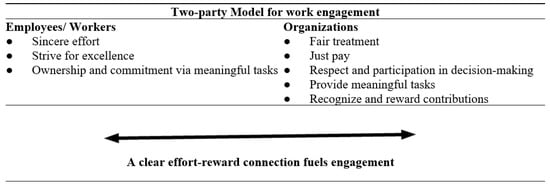
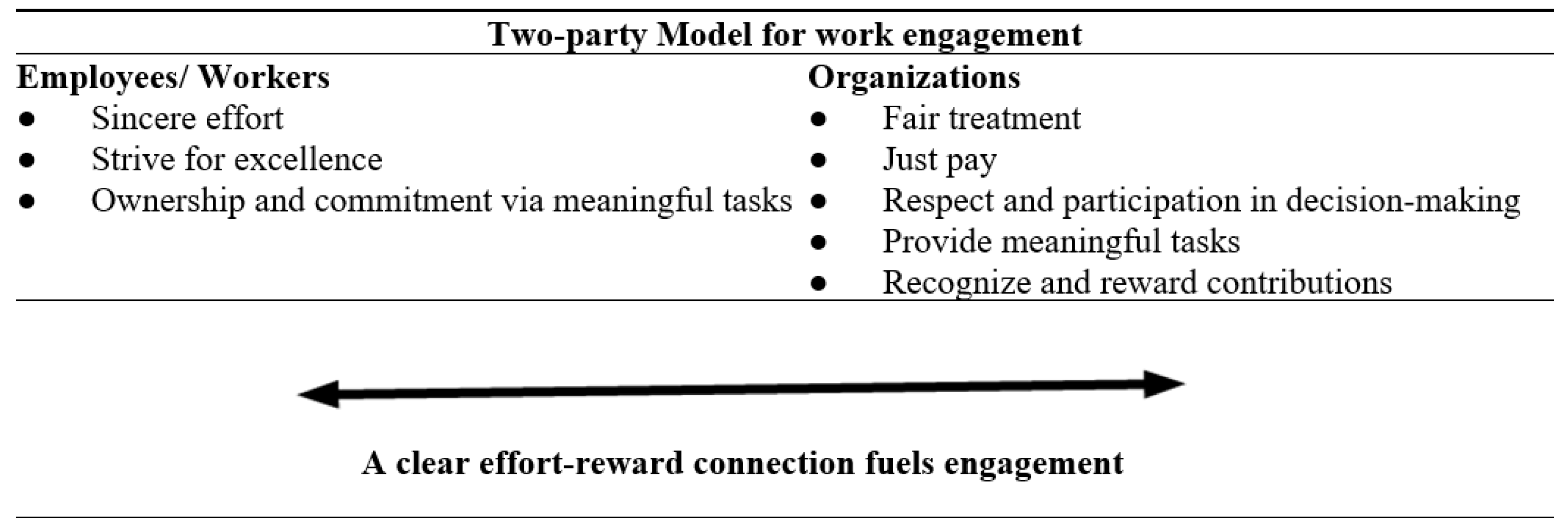
Work engagement is shaped by two parties: employees and organizations (Figure 5). Both share responsibility for sincere effort, with organizations fostering a culture of excellence and employees giving their best. Organizations alone ensure fairness, participation, meaningful responsibilities, and clear links between effort and rewards. Overall, work engagement is enhanced when organizations foster a culture that encourages sincere effort and excellence, ensures fair treatment and respect, promotes participation in decision-making, assigns meaningful responsibilities, and links effort to appropriate rewards. Employees contribute by giving their best in the workplace.
Figure 5.
Newly developed principles for work engagement.
Although the framework critiques traditional engagement models for overlooking individual differences, it does not assume uniform employee motivation. Instead, it adopts a principle-based approach that allows engagement to emerge through diverse motivational pathways. Employees differ in values, personality traits, career orientations, and reward preferences; therefore, engagement may be driven by intrinsic factors such as meaningful work and ownership for some, and by extrinsic factors such as recognition, pay fairness, and career progression for others. Participation in decision-making enables employees to align work roles with personal values, while effort–reward alignment captures individual expectations regarding fairness and reciprocity. Furthermore, the moderating roles of a culture of excellence and shared responsibility shape how employees interpret organizational practices, allowing the framework to remain adaptable across heterogeneous motivational profiles rather than imposing a one-size-fits-all model.
4.2. Executing the Newly Developed Work Engagement Principles in Switzerland
The newly developed work engagement principles can be effectively implemented in Switzerland through a series of concrete, culturally aligned actions. First, to promote sincere effort and excellence, organizations should establish clear performance standards, define roles explicitly, and conduct regular feedback sessions to monitor progress and address challenges. Second, fairness, recognition, and just treatment can be operationalized through transparent compensation structures, equitable promotion criteria, and formal acknowledgment of achievements at departmental or company-wide levels. Third, employee participation in decision-making can be enhanced via joint committees, structured consultations, and systematic feedback mechanisms, reflecting Switzerland’s cultural emphasis on consensus and collaboration. Fourth, meaningful responsibility and ownership can be fostered through job enrichment initiatives, autonomy in task execution, and alignment of assignments with employees’ skills and strengths, which reinforces accountability and empowerment. Finally, linking effort to rewards can be achieved by implementing transparent performance evaluation systems that connect measurable outcomes to recognition, career advancement, or professional development opportunities. Collectively, these steps operationalize the dual-responsibility model of engagement, enabling employees to contribute sincerely while organizations ensure fairness, meaningful work, participatory decision-making, and recognition—creating a practical, culturally grounded approach to enhancing engagement.
4.3. The Development of Propositions Based on Newly Developed Principles of Work Engagement
The newly developed propositions serve a dual purpose. First, they provide a foundational theoretical framework for understanding work engagement by integrating established theories and models such as Reinforcement Theory, Herzberg’s Two-Factor Theory, Equity Theory, Social Exchange Theory, Expectancy Theory, the Job Characteristics Model, Social Identity Theory, Self-Determination Theory, Conservation of Resource Theory, Psychological Empowerment Theory, Affective Events Theory, and the JD-R Model. Second, they function as a contemporary, applied illustration of engagement practices by operationalizing these principles in modern organizational contexts, including culturally specific considerations such as Swiss workplace norms, dual employee–organization responsibility, and adaptive motivational pathways. Thus, the propositions offer both theoretical rigor and practical relevance, bridging scholarly insights and actionable management practices.
Employee-side contributions, including sincere effort and striving for excellence, reflect proactive behaviors through which employees invest energy, initiative, and attention to quality (Frese et al., 1997; Crant, 2000; VandeWalle, 1997; Miller et al., 2002). Such behaviors act as personal resources that enhance psychological and motivational states. Sincere effort involves persistence and focus on task completion, while striving for excellence entails setting high standards and seeking continuous improvement. These contributions are linked to work engagement, as employees who invest effort and pursue excellence experience higher vigor, dedication, and absorption (Schaufeli et al., 2006). Therefore, employee-side contributions are expected to serve as key antecedents of work engagement.
P1: Employee contributions have significant effect on work engagement.
Organizational-side contributions, such as fair treatment, just pay, respect, participation in decision-making, meaningful tasks, and recognition serve as key job resources that shape employees’ motivational and psychological states. Fair treatment reflects perceptions of equity in decisions and interactions (Colquitt, 2001), while just pay captures salary fairness (Heneman & Schwab, 1985), and participation in decision-making emphasizes employee voice (Morrison, 2011). Meaningful tasks and recognition highlight the significance of work and acknowledgment of contributions (Hackman & Oldham, 1975; Schaufeli et al., 2002). Social Exchange Theory suggests that when employees perceive these organizational resources, they reciprocate with positive attitudes and behaviors, including higher work engagement, measured through vigor, dedication, and absorption (Schaufeli et al., 2006). Thus, organizational contributions foster a psychologically supportive and motivating environment, justifying the expectation that employees who experience fairness, respect, meaningful work, and recognition will exhibit greater engagement.
P2: Organizational contributions have significant effect on work engagement.
Expectancy theory (Vroom, 1964) and effort–reward imbalance theory (Siegrist, 1996) suggest that employees’ motivation depends on the perceived alignment between their effort and outcomes. Employees who show initiative and consistently strive for excellence (Frese et al., 1997; Crant, 2000; VandeWalle, 1997; Miller et al., 2002) are more attentive to how performance translates into recognition and rewards. Effort–reward alignment is reflected in perceptions that hard work leads to tangible outcomes, such as pay increases or promotions (Vroom, 1964; Porter & Lawler, 1968; Siegrist, 1996; Colquitt et al., 2001). Thus, employees’ proactive contributions and persistent effort strengthen the perceived linkage between work input and valued outcomes, supporting the proposition that employee contributions act as antecedents to effort–reward alignment.
P3: Employee contributions have significant effect on effort–reward alignment.
Organizational practices that ensure fair pay, consistent procedures, respectful treatment, transparent decision-making, meaningful work, and recognition of contributions shape employees’ perceptions of effort–reward alignment. These are captured in items such as “Decisions at my organization are made fairly” (Colquitt, 2001), “My salary is fair for the work I perform” (Heneman & Schwab, 1985), “My contributions are recognized by my supervisor” (Schaufeli et al., 2002), and “I feel involved in decisions that affect my work” (Morrison, 2011). Drawing on Expectancy Theory (Vroom, 1964) and Effort–Reward Imbalance Theory (Siegrist, 1996), such practices signal that effort leads to meaningful outcomes, reflected in items like “My work efforts are directly reflected in the rewards I receive” (Porter & Lawler, 1968; Siegrist, 1996; Colquitt et al., 2001). When employees perceive fairness and recognition, they are more motivated, engaged, and likely to sustain proactive behaviors. This supports the proposition that organizational contributions enhance perceptions of effort–reward alignment.
P4: Organizational contributions have significant effect on effort–reward alignment.
Effort–reward alignment is a key motivational mechanism that links employee effort to sustained work engagement. Based on expectancy theory (Vroom, 1964) and the effort–reward imbalance framework (Siegrist, 1996), employees who perceive a fair and transparent connection between effort and outcomes exhibit higher vigor, dedication, and absorption (Schaufeli et al., 2006). Fair rewards (such as recognition, pay increases, or promotions) enhance intrinsic motivation and positive affect, encouraging discretionary effort. Measures of effort–reward alignment, including perceptions that effort leads to tangible outcomes, capture this fairness and clarity (Vroom, 1964; Porter & Lawler, 1968; Siegrist, 1996). Strengthening this alignment reinforces the psychological contract, promoting engagement as reflected in items such as “I feel strong and vigorous at my job” and “When I work, I lose myself in my work” (Schaufeli et al., 2006).
P5: Effort–reward alignment has significant effect on work engagement.
Employee and organizational contributions (such as sustained effort, skill development, meaningful tasks, fair treatment, and recognition) form the foundation for work engagement (Frese et al., 1997; Colquitt, 2001; Hackman & Oldham, 1975). Employees who proactively enhance work quality invest cognitive and emotional energy into their roles, while organizations that provide fair treatment and recognition create a supportive environment. However, contributions only foster engagement when employees perceive a clear alignment between effort and reward (Vroom, 1964; Siegrist, 1996; Porter & Lawler, 1968). When effort leads to valued outcomes (recognition, fair pay, or task-related acknowledgment) employees experience greater vigor, dedication, and absorption (Schaufeli et al., 2006). Without this alignment, even high effort or supportive contexts may not translate into engagement. Thus, perceived effort–reward alignment acts as a key mechanism linking contributions to work engagement.
P6: Effort–reward alignment mediates the relationship between employee contributions and work engagement.
P7: Effort–reward alignment mediates the relationship between organizational contributions and work engagement.
A culture of excellence and shared responsibility reinforces high performance standards, continuous improvement, and mutual accountability, fostering collective ownership of outcomes (Peters & Waterman, 1982; Deming, 1986; Katzenbach & Smith, 1993; Frink & Klimoski, 2004). In such environments, employees perceive their efforts as valuable and aligned with organizational goals, amplifying the motivational impact of fair treatment, meaningful tasks, recognition, and effort–reward alignment on work engagement (Schaufeli et al., 2006; Vroom, 1964; Porter & Lawler, 1968). Shared responsibility further strengthens this effect by encouraging mutual accountability, peer support, and collective interpretation of successes and failures (Burke & Saks, 2009). Together, a culture of excellence and shared responsibility moderates the relationship between organizational contributions and engagement, enhancing employees’ vigor, dedication, and absorption.
P8a: A culture of excellence moderates the relationship between employee contributions and work engagement.
P8b: Shared responsibility moderates the relationship between employee contributions and work engagement.
P9a: A culture of excellence moderates the relationship between organizational contributions and work engagement.
P9b: Shared responsibility moderates the relationship between organizational contributions and work engagement.
P10a: A culture of excellence moderates the relationship between effort–reward alignment and work engagement.
P10b: Shared responsibility moderates the relationship between effort–reward alignment and work engagement.
5. Measurements
Table 1 presents the items measuring the dependent variable, work engagement, organized according to the dimensions of vigor, dedication, and absorption, as defined in the Utrecht Work Engagement Scale.
Table 1.
Instrument for dependent variables.
Table 2 summarizes the indicators for the independent variables representing employee and organizational contributions, constructed by synthesizing concepts from Sincere effort, striving for excellence, fair treatment, just pay, respect, participation in decision-making, provision of meaningful tasks, recognition and reward of contributions.
Table 2.
Instrument for independent variables.
Table 3 reports the mediating construct, effort–reward alignment, operationalized based on expectancy theory, performance–reward model, effort–reward imbalance theory, organizational justice theory.
Table 3.
Instrument for mediating variables.
Table 4 presents the moderating constructs, culture of excellence and mutual accountability, which are measured using items derived from established organizational and management theories, capturing practices such as high-performance standards, continuous improvement, innovation, leadership modeling, and collective team responsibility.
Table 4.
Instrument for moderating variables.
6. Theoretical Contribution
This study advances work engagement theory by proposing a principle-based, dual-responsibility framework that reconceptualizes engagement as a co-produced and mechanism-driven phenomenon, rather than a unidirectional outcome of organizational resources or individual motivation. In contrast to dominant variable-centric models (e.g., JD–R, SDT, SET), the framework theorizes engagement as emerging from reciprocal employee and organizational contributions guided by normative principles.
First, the study introduces a principle-based conceptualization of work engagement. Existing models focus on identifying specific predictors or resources that enhance engagement, often assuming their generalizability across contexts. This study shifts the level of abstraction by articulating core engagement principles (such as sincere effort, fairness, participation, meaningful responsibility, and effort–reward linkage) that explain why engagement is sustained across diverse settings, rather than merely which factors predict it.
Second, the framework advances theory by explicitly distinguishing between employee-side contributions (sincere effort and striving for excellence) and organizational-side contributions (fair treatment, just pay, participation, meaningful tasks, and recognition). Unlike traditional models that implicitly position employees as passive recipients of organizational practices, this distinction repositions employees as active agents in engagement creation, addressing a key imbalance in existing engagement theories.
Third, the study makes a novel theoretical contribution by positioning effort–reward alignment as a central mediating mechanism linking contributions to work engagement. While expectancy and effort–reward imbalance theories acknowledge the importance of effort–outcome relationships, engagement research has rarely integrated this mechanism explicitly. By theorizing effort–reward alignment as the process through which both employee and organizational contributions translate into vigor, dedication, and absorption, the framework explains why engagement may not emerge even in high-effort or resource-rich environments.
Fourth, the inclusion of culture of excellence and shared responsibility as moderating conditions extends engagement theory beyond universalistic assumptions. These constructs explain when and under what collective conditions engagement mechanisms are amplified, thereby incorporating meso-level cultural dynamics that are underdeveloped in existing theories and models.
Finally, by contextualizing the framework within Swiss workplace norms, the study demonstrates how engagement principles are enacted within a consensus-oriented, high-trust institutional environment. This contributes to engagement theory by balancing conceptual generalizability with contextual sensitivity.
7. Limitations and Mitigation Strategies
Despite addressing gaps in existing engagement frameworks by integrating intrinsic and extrinsic motivators, the proposed principles present several limitations in the Swiss context. First, the framework may underrepresent broader environmental and organizational influences (such as economic conditions, industry regulations, labor-market dynamics, and organizational culture) that shape engagement outcomes. Second, it assumes broadly positive employee responses to fairness, participation, and meaningful responsibility, whereas Swiss workplaces are highly diverse. Employees differ in values, motivation, and work preferences, with some prioritizing autonomy, precision, or clearly structured reward systems over participatory involvement, as noted in self-determination theory and conservation of resources theory. Third, core constructs such as sincere effort, meaningful responsibility, and fair treatment are inherently subjective, posing challenges for consistent measurement across organizational subgroups, consistent with concerns raised in Herzberg’s two-factor theory and psychological empowerment theory. Finally, the framework has not yet been empirically tested in dynamic, remote, or knowledge-intensive work environments, particularly within multinational or flexible work settings.
These limitations can be mitigated through context-sensitive implementation. Clear operational definitions, standardized indicators, and structured engagement surveys can reduce subjectivity and improve measurement reliability. Fair treatment and recognition may be strengthened through transparent policies, equitable compensation structures, and formal feedback systems, while employee voice can be institutionalized via consultative mechanisms and structured feedback processes aligned with Switzerland’s consensus-oriented work culture. Pilot programs, continuous monitoring, and gradual scaling allow adaptation across diverse and evolving work contexts, reducing resistance from both employees and managers. Overall, grounding engagement initiatives in shared professional norms, accountability, and transparency enhances both feasibility and acceptance while preserving flexibility across organizational settings.
8. Conclusions
Global employee work engagement remained critically low in 2024, with only 21% of employees engaged, 62% not engaged, and 17% actively disengaged, and Switzerland ranking near the bottom in Europe with just 8% engagement (Gallup, 2025). These figures highlight persistent challenges in fostering engagement and underscore the inadequacy of existing theories and models, which are often overly simplistic, culturally insensitive, or narrowly focused on either individual or group-level motivators. Traditional approaches, including Reinforcement and Expectancy theories, Herzberg’s Two-Factor Theory, Equity Theory, Social Exchange Theory, the Job Characteristics Model, Self-Determination Theory, Affective Events Theory, and the JD-R model, fail to capture the full complexity of engagement, particularly in diverse and knowledge-based workplaces.
To address these gaps, this study proposes new principles for work engagement, integrating intrinsic and extrinsic motivators, cognitive and environmental variables, and dual employee–organization responsibilities. The framework emphasizes employee contributions (sincere effort, striving for excellence, ownership of meaningful tasks), organizational practices (fair treatment, meaningful work, participation, recognition), and effort–reward alignment as a key mediating mechanism. Moderating factors, including a culture of excellence and shared responsibility, ensure that engagement pathways remain flexible across diverse employee values, personalities, and motivational orientations.
Furthermore, the study develops ten propositions and corresponding measurement instruments, grounded in established theories such as Expectancy Theory, Effort–Reward Imbalance, Social Exchange Theory, and Job Characteristics Model, while operationalizing them in a Swiss context. This dual focus bridges theory and practice, providing a holistic, culturally relevant, and actionable framework that guides managers in sustaining engagement across complex and dynamic workplaces. Overall, the proposed framework offers both conceptual rigor and practical applicability, addressing critical gaps in existing engagement literature, and paving the way for empirical testing, cross-cultural adaptation, and research-informed organizational strategies to enhance employee engagement globally and within Swiss organizations specifically.
Author Contributions
Conceptualization, D.H. and B.W.; writing—original draft preparation, D.H.; writing—review and editing, Q.Z., B.W. and N.-E.-M.S.J. All authors have read and agreed to the published version of the manuscript.
Funding
This research received no external funding.
Institutional Review Board Statement
Not applicable.
Informed Consent Statement
Not applicable.
Data Availability Statement
All data and sources analyzed in this review are included in the article. Further information can be obtained from the corresponding authors.
Conflicts of Interest
The authors declare no conflict of interest.
References
- Aharpour, S. (1999). Social identity theory and group diversity: An analysis of functions of group identification. University of Kent (United Kingdom). [Google Scholar]
- Ahmad, R., Nawaz, M. R., Ishaq, M. I., Khan, M. M., & Ashraf, H. A. (2023). Social exchange theory: Systematic review and future directions. Frontiers in Psychology, 13, 1015921. [Google Scholar] [CrossRef] [Scilit] [PubMed]
- Ahrens, L. (2019). Theorizing the impact of fairness perceptions on the demand for redistribution. Political Research Exchange, 1(1), 1–17. [Google Scholar] [CrossRef] [Scilit]
- Aman-Ullah, A., Hassan, M., Vargas, S. K., Bisma, M. A., & Nugraha, J. (2025). Does Islamic work ethics matter? A serial mediation study through organizational commitment and employee loyalty. Semarak International Journal of Islamic Studies and Culture, 5(1), 54–68. [Google Scholar] [CrossRef] [Scilit]
- Bakker, A. B., & Demerouti, E. (2007). The job demands-resources model: State of the art. Journal of Managerial Psychology, 22(3), 309–328. [Google Scholar] [CrossRef] [Scilit]
- Bardach, L., & Murayama, K. (2025). The role of rewards in motivation—Beyond dichotomies. Learning and Instruction, 96, 102056. [Google Scholar] [CrossRef] [Scilit]
- Bass, B. M., & Avolio, B. J. (1995). MLQ: Multifactor leadership questionnaire for research: Permission set. Mind Garden. [Google Scholar]
- Bassett-Jones, N., & Lloyd, G. C. (2005). Does Herzberg’s motivation theory have staying power? Journal of Management Development, 24(10), 929–943. [Google Scholar] [CrossRef] [Scilit]
- Boonzaier, B., Ficker, B., & Rust, B. (2001). A review of research on the job characteristics model and the attendant job diagnostic survey. South African Journal of Business Management, 32(1), 11–34. [Google Scholar] [CrossRef] [Scilit]
- Brown, R. (2000). Social identity theory: Past achievements, current problems and future challenges. European Journal of Social Psychology, 30(6), 745–778. [Google Scholar] [CrossRef] [Scilit]
- Burke, L. A., & Saks, A. M. (2009). Accountability in training transfer: Adapting Schlenker’s model of responsibility to a persistent but solvable problem. Human Resource Development Review, 8(3), 382–402. [Google Scholar] [CrossRef] [Scilit]
- Cameron, K. (2009). An introduction to the competing values framework. In Organizational culture white paper. Haworth. [Google Scholar]
- Cameron, K., & Quinn, R. (2010). Organizational culture assessment instrument (OCAI). University of Michigan. [Google Scholar]
- Codex Gigas. (n.d.). The Devil’s bible (13th century). National Library of Sweden, Stockholm. [Google Scholar]
- Colquitt, J. A. (2001). On the dimensionality of organizational justice: A construct validation of a measure. Journal of Applied Psychology, 86(3), 386. [Google Scholar] [CrossRef] [Scilit]
- Colquitt, J. A., Conlon, D. E., Wesson, M. J., Porter, C. O., & Ng, K. Y. (2001). Justice at the millennium: A meta-analytic review of 25 years of organizational justice research. Journal of Applied Psychology, 86(3), 425. [Google Scholar] [CrossRef] [Scilit] [PubMed]
- Cook, K. S., Cheshire, C., Rice, E. R., & Nakagawa, S. (2013). Social exchange theory. In Handbook of social psychology (pp. 61–88). Springer. [Google Scholar]
- Crant, J. M. (2000). Proactive behavior in organizations. Journal of Management, 26(3), 435–462. [Google Scholar] [CrossRef]
- Demerouti, E. (2025). Job demands-resources and conservation of resources theories: How do they help to explain employee well-being and future job design? Journal of Business Research, 192, 115296. [Google Scholar] [CrossRef] [Scilit]
- Deming, W. E. (1986). Out of crisis (pp. 367–388). Centre for Advanced Engineering Study, Massachusetts Institute of Technology. [Google Scholar]
- Dilang, M., & Simanjuntak, F. (2025). The response of the faithful to the issue of global recession. East Asian Journal of Multidisciplinary Research, 4(7), 3185–3200. [Google Scholar] [CrossRef] [Scilit]
- Eisenberger, R., Huntington, R., Hutchison, S., & Sowa, D. (1986). Perceived organizational support. Journal of Applied Psychology, 71(3), 500. [Google Scholar] [CrossRef]
- Flynn, B. B., Schroeder, R. G., & Sakakibara, S. (1994). A framework for quality management research and an associated measurement instrument. Journal of Operations Management, 11(4), 339–366. [Google Scholar] [CrossRef] [Scilit]
- Forner, V. W., Jones, M., Berry, Y., & Eidenfalk, J. (2021). Motivating workers: How leaders apply self-determination theory in organizations. Organization Management Journal, 18(2), 76–94. [Google Scholar] [CrossRef] [Scilit]
- Frese, M., Fay, D., Hilburger, T., Leng, K., & Tag, A. (1997). The concept of personal initiative: Operationalization, reliability and validity in two German samples. Journal of Occupational and Organizational Psychology, 70(2), 139–161. [Google Scholar] [CrossRef] [Scilit]
- Frink, D. D., & Ferris, G. R. (1998). Accountability, impression management, and goal setting in the performance evaluation process. Human Relations, 51(10), 1259–1283. [Google Scholar] [CrossRef] [Scilit]
- Frink, D. D., & Klimoski, R. J. (2004). Advancing accountability theory and practice: Introduction to the human resource management review special edition. Human Resource Management Review, 14(1), 1–17. [Google Scholar] [CrossRef] [Scilit]
- Gallup. (2025). State of the global workplace (pp. 1–142). Employee Engagement Insights for Business Leaders Worldwide. Available online: https://www.gallup.com/workplace/349484/state-of-the-global-workplace.aspx (accessed on 21 September 2025).
- Hackman, J. R., & Oldham, G. R. (1975). Development of the job diagnostic survey. Journal of Applied Psychology, 60(2), 159. [Google Scholar] [CrossRef] [Scilit]
- Hall, A. T., Blass, F. R., Ferris, G. R., & Massengale, R. (2004). Leader reputation and accountability in organizations: Implications for dysfunctional leader behavior. The Leadership Quarterly, 15(4), 515–536. [Google Scholar] [CrossRef] [Scilit]
- Heneman, H. G., III, & Schwab, D. P. (1985). Pay satisfaction: Its multidimensional nature and measurement. International Journal of Psychology, 20(1), 129–141. [Google Scholar] [PubMed]
- Jing, J. (2025). Hierarchical structure of the Qing dynasty—Preface. In Hierarchical structure of the Qing dynasty (pp. 1–69). Springer Nature. [Google Scholar]
- Katzenbach, J. R., & Smith, D. K. (1993). The wisdom of teams: Creating the high-performance organisation, Harvard business school. Harvard Business Press. [Google Scholar]
- Kayedian, M., & Gaeini, A. (2025). An analytical study of louis fry’s spiritual leadership model from the perspective of Quranic teachings. The Quran: Contemporary Studies, 4(11), 6–42. [Google Scholar]
- Lanivich, S. E. (2015). The RICH entrepreneur: Using conservation of resources theory in contexts of uncertainty. Entrepreneurship Theory and Practice, 39(4), 863–894. [Google Scholar] [CrossRef] [Scilit]
- London, M., & Smither, J. W. (2002). Feedback orientation, feedback culture, and the longitudinal performance management process. Human Resource Management Review, 12(1), 81–100. [Google Scholar] [CrossRef] [Scilit]
- Lunenburg, F. C. (2011). Expectancy theory of motivation: Motivating by altering expectations. International Journal of Management, Business, and Ad-ministration, 15(1), 1–6. [Google Scholar]
- Luther, L., Fischer, M. W., Firmin, R. L., & Salyers, M. P. (2019). Clarifying the overlap between motivation and negative symptom measures in schizophrenia research: A meta-analysis. Schizophrenia Research, 206, 27–36. [Google Scholar] [CrossRef] [Scilit]
- Marchiori, E. A. (2025). Business and religion: Comparing strategies and values that both entities share. Springer Nature. [Google Scholar]
- McAnally, K., & Hagger, M. S. (2024). Self-determination theory and workplace outcomes: A conceptual review and future research directions. Behavioral Sciences, 14(6), 428. [Google Scholar] [CrossRef] [Scilit]
- McDermott, S., Fabry, L., Clum, C. S., Arockiam, C., & Mulkey, D. C. (2025). Faith and Christian worldview in the doctor of nursing practice project. Journal of Christian Nursing, 42(4), E53–E59. [Google Scholar] [CrossRef] [Scilit]
- Miller, M. J., Woehr, D. J., & Hudspeth, N. (2002). The meaning and measurement of work ethic: Construction and initial validation of a multidimensional inventory. Journal of Vocational Behavior, 60(3), 451–489. [Google Scholar] [CrossRef] [Scilit]
- Monje-Amor, A., Xanthopoulou, D., Calvo, N., & Vázquez, J. P. A. (2021). Structural empowerment, psychological empowerment, and work engagement: A cross-country study. European Management Journal, 39(6), 779–789. [Google Scholar] [CrossRef] [Scilit]
- Morgeson, F. P., & Humphrey, S. E. (2006). The Work Design Questionnaire (WDQ): Developing and validating a comprehensive measure for assessing job design and the nature of work. Journal of Applied Psychology, 91(6), 1321. [Google Scholar] [CrossRef] [Scilit]
- Morrison, E. W. (2011). Employee voice behavior: Integration and directions for future research. Academy of Management Annals, 5(1), 373–412. [Google Scholar] [CrossRef]
- Muloongo, K. H. (2025). Walking in the light: Biblical insights for daily living: Shining the light of scripture on life’s challenges. WestBow Press. [Google Scholar]
- Naz, S., & Rashid, J. (2025). Analytical study of major themes of the Bhagavad Gita. Journal of World Religions and Interfaith Harmony, 4(1), 310–326. [Google Scholar]
- Neveu, J. P., & Bégout, P. (2025). Measuring motivational patterns: A formal approach of conservation of resources theory. Nonlinear Dynamics, Psychology, and Life Sciences, 29, 431–451. [Google Scholar]
- Ng, T. K. (2025). A summoned life: Vocation in the analects. Journal of Religious Ethics, 53(2), 282–300. [Google Scholar] [CrossRef] [Scilit]
- Nubail, A., & Sulthani, D. A. (2025). The fundamentals of the Quranic message and its timeless nature. Misykat al-Anwar Jurnal Kajian Islam dan Masyarakat, 8(2), 307–322. [Google Scholar] [CrossRef] [Scilit]
- Osemeke, M., & Adegboyega, S. (2017). Critical review and comparism between Maslow, Herzberg and McClelland’s theory of needs. Funai Journal of Accounting, Business and Finance, 1(1), 161–173. [Google Scholar]
- Pearce, C. L., & Sims, H. P., Jr. (2002). Vertical versus shared leadership as predictors of the effectiveness of change management teams: An examination of aversive, directive, transactional, transformational, and empowering leader behaviors. Group Dynamics: Theory, Research, and Practice, 6(2), 172. [Google Scholar] [CrossRef]
- Peters, T. J., & Waterman, R. H., Jr. (1982). In search of excellence. Harper and Row. [Google Scholar]
- Pfeffer, J. (1998). Seven practices of successful organizations. California Management Review, 40(2), 96–124. [Google Scholar] [CrossRef] [Scilit]
- Porter, L. W., & Lawler, E. E. (1968). What job attitudes tell about motivation (pp. 118–126). Harvard Business Review Reprint Service. [Google Scholar]
- Ruble, A. R. (2025). A guide to understanding your sage-ruler: Andrew R. Ruble. Dao, 24, 413–432. [Google Scholar]
- Schaufeli, W. B., Bakker, A. B., & Salanova, M. (2006). Utrecht work engagement scale-9 (UWES-9) [Database record]. APA PsycTests. [Google Scholar]
- Schaufeli, W. B., Salanova, M., González-Romá, V., & Bakker, A. B. (2002). Utrecht work engagement scale-17 [Database record]. APA PsycTests. [Google Scholar]
- Schaufeli, W. B., & Taris, T. W. (2013). A critical review of the job demands-resources model: Implications for improving work and health. In Bridging occupational, organizational and public health: A transdisciplinary approach (pp. 43–68). Springer. [Google Scholar]
- Schneider, J., & Locke, E. A. (1971). A critique of Herzberg’s incident classification system and a suggested revision. Organizational Behavior and Human Performance, 6(4), 441–457. [Google Scholar] [CrossRef] [Scilit]
- Scholze, A., & Hecker, A. (2024). The job demands-resources model as a theoretical lens for the bright and dark side of digitization. Computers in Human Behavior, 155, 108177. [Google Scholar] [CrossRef] [Scilit]
- Senge, P. M. (1990). The art and practice of the learning organization (Vol. 1). Doubleday. [Google Scholar]
- Shehab, A. B. M. I. (2025). The impact of work ethics on the employee’s behavior: A Quranic perspective. Journal of Posthumanism, 5(4), 515–528. [Google Scholar] [CrossRef] [Scilit]
- Siegrist, J. (1996). Adverse health effects of high-effort/low-reward conditions. Journal of Occupational Health Psychology, 1(1), 27. [Google Scholar] [CrossRef]
- Snyder, H. (2019). Literature review as a research methodology: An overview and guidelines. Journal of Business Research, 104, 333–339. [Google Scholar] [CrossRef] [Scilit]
- Spreitzer, G. M. (1995). Psychological empowerment in the workplace: Dimensions, measurement, and validation. Academy of Management Journal, 38(5), 1442–1465. [Google Scholar] [CrossRef] [Scilit]
- Steelman, L. A., Levy, P. E., & Snell, A. F. (2004). The feedback environment scale: Construct definition, measurement, and validation. Educational and Psychological Measurement, 64(1), 165–184. [Google Scholar] [CrossRef] [Scilit]
- Sutikno, A., Dakir, D., & Jasiah, J. (2025). The implementation of total quality management (TQM) from Qur’anic perspective and its problems in schools. Urwatul Wutsqo: Jurnal Studi Kependidikan dan Keislaman, 14(2), 637–656. [Google Scholar] [CrossRef] [Scilit]
- Swiss HR-Barometer. (2024). Sense and nonsense at work (pp. 1–6). Available online: https://www.unilu.ch/en/faculties/faculty-of-economics-and-management/institutes-and-research-centres/center-for-human-resource-management/research/swiss-human-relations-barometer/results/editions/swiss-human-relations-barometer-2022-1/ (accessed on 7 September 2025).
- Thierry, H. (2001). The reflection theory on compensation. In Work motivation in the context of a globalizing economy. Lawrence Erlbaum Associates Publishers. [Google Scholar]
- Torraco, R. J. (2005). Writing integrative literature reviews: Guidelines and examples. Human Resource Development Review, 4(3), 356–367. [Google Scholar] [CrossRef] [Scilit]
- Troussas, C., Krouska, A., & Virvou, M. (2017). Reinforcement theory combined with a badge system to foster student’s performance in e-learning environments. In 2017 8th international conference on information, intelligence, systems & applications (IISA) (pp. 1–6). IEEE. [Google Scholar]
- VandeWalle, D. (1997). Development and validation of a work domain goal orientation instrument. Educational and Psychological Measurement, 57(6), 995–1015. [Google Scholar] [CrossRef] [Scilit]
- Van Til, J. (2025). A reformed psychology of human relations in business: Part II. Pro Rege, 53(4), 20–29. [Google Scholar]
- Vosburg, D. P. (2025). “I thank God we’re rich”: Justifying economic inequality in an evangelical congregation. Journal for the Scientific Study of Religion, 64, 303–316. [Google Scholar] [CrossRef] [Scilit]
- Vroom, V. H. (1964). Work and motivation. Wiley. [Google Scholar]
- Wageman, R. (2001). How leaders foster self-managing team effectiveness: Design choices versus hands-on coaching. Organization Science, 12(5), 559–577. [Google Scholar] [CrossRef] [Scilit]
- Weiss, H. (2013). Affective events theory. In Encyclopedia of management theory (Vol. 2, pp. 29–30). SAGE Publications, Ltd. [Google Scholar]
- Weiss, H. M., & Cropanzano, R. (1996). Affective events theory. Research in Organizational Behavior, 18(1), 1–74. [Google Scholar]
- Zimmerman, M. A. (1995). Psychological empowerment: Issues and illustrations. American Journal of Community Psychology, 23(5), 581–599. [Google Scholar] [CrossRef] [Scilit]





Disclaimer/Publisher’s Note: The statements, opinions and data contained in all publications are solely those of the individual author(s) and contributor(s) and not of MDPI and/or the editor(s). MDPI and/or the editor(s) disclaim responsibility for any injury to people or property resulting from any ideas, methods, instructions or products referred to in the content. |
© 2026 by the authors. Licensee MDPI, Basel, Switzerland. This article is an open access article distributed under the terms and conditions of the Creative Commons Attribution (CC BY) license.