1. Introduction: From Opening the Black Box to Generative Behavioral Explanation in Micro-Foundational HRM
Strategic human resource management (HRM) has produced extensive evidence that coherent HR systems are associated with desirable organizational outcomes (
Saridakis et al., 2017). However, the field still lacks a disciplined account of how HR systems generate and sustain coordinated action in day-to-day work. The core gap is behavioral and temporal: what is missing is an explanation that connects HR system signals to observable interaction episodes and their accumulation over time, rather than treating the intervening process as a residual “black box”.
Micro-foundational HRM has been a prominent response to this gap, aiming to connect HR systems to outcomes through lower-level psychological and behavioral processes. However, much of this work can still leave the coordination problem underexplained: it replaces an opaque “black box” with lists of proximal constructs, without specifying the interactional unit that generates collective coordination or the temporal logic by which it stabilizes. As a result, micro-foundational accounts may remain compatible with multiple, non-equivalent behavioral stories. Recent critiques therefore call for process-explicit theorizing that traces cross-level links through identifiable interaction episodes and their temporal sequencing, rather than relying on static variable associations (
Minbaeva & Navrbjerg, 2023;
van Beurden et al., 2025;
Mitchell & James, 2001;
Mathieu et al., 2019).
This article is a theory-building integrative review, not a descriptive or exhaustive survey. Its purpose is to construct a constrained generative explanation of coordination: a functional architecture that assigns commonly used constructs to distinct explanatory roles and specifies ordering rules that restrict admissible causal claims. The central move is to treat observable interaction episodes as the behavioral engine of coordination and to prevent common substitutions in micro-foundational theorizing (e.g., treating psychological states or downstream outcomes as if they were the engine). On this basis, the article explains how HR system signals become interaction-relevant cues and, through repeated episodes and responses, yield sustained coordinated action.
Here, a generative mechanism refers to a minimal set of behavioral functions and ordering rules that can, in principle, produce and stabilize coordinated action through repeated interaction episodes (
Epstein, 1999,
2006). Specifically, it specifies (i) interpretive gateways that make HR signals interaction-relevant, (ii) episode-level response functions that update expectations and response norms, and (iii) influence-distribution dynamics that determine whether coordination costs are reduced or amplified as work unfolds.
A particularly important case is psychological safety (
A. C. Edmondson & Bransby, 2023). Psychological safety is widely linked to learning, voice, and performance, but recent synthesis work emphasizes that the construct has matured into a broad literature with multiple themes, boundary conditions, and mechanism candidates (
A. C. Edmondson & Bransby, 2023). This growth is an opportunity and a risk. It is an opportunity because psychological safety is a plausible catalyst for open information exchange and adaptive coordination; it is a risk because psychological safety can be treated as an all-purpose explanatory variable, absorbing variance without clarifying how it produces specific collective outcomes. A mechanism-oriented HRM theory therefore needs to position psychological safety not as a stand-alone “good state”, but as one functional component within an action-generating system.
A parallel issue arises in the leadership domain. Contemporary leadership research increasingly recognizes that influence can be distributed across members, yet recent reviews suggest that shared leadership is contingent and can entail role confusion, coordination costs, or motivational tensions under some conditions (e.g.,
Chen & Zhang, 2023). For HRM theory, this matters because leadership is one of the key behavioral pathways through which HR systems are enacted in teams. If influence patterns and response norms are contingent and can turn counterproductive, then a micro-foundational HRM model must include interactional and temporal ordering rules that specify when and why a given pattern of influence distribution will stabilize coordination versus destabilize it (
Bormann & Rowold, 2018).
A further source of explanatory ambiguity is that HR practices do not operate as objective stimuli; they operate through how employees perceive, interpret, and attribute meaning to them. Recent reviews show that “employee perceptions of HR practices” is not monolithic; it can be decomposed into what employees believe is being done, how it is implemented, and why it is implemented (
Wang et al., 2020). Moreover, meta-analytic evidence on HR system strength perceptions suggests that perceived distinctiveness/consistency/consensus may function as an explanatory pathway (mediator) rather than merely as a condition (moderator), depending on the outcome domain (
Bednall et al., 2022). These developments support a shift from describing HR systems as configurations of practices to explaining how HR systems become interaction-relevant cues that shape response norms and influence distributions in real episodes of work (
Boon et al., 2019).
What is new here is a shift in explanatory target and unit: instead of extending mediator chains that often leave the interactional engine and temporal ordering logic implicit, the article specifies (i) a functional architecture that fixes explanatory roles (enabling states, engine episodes, emergent products), (ii) a behavioral unit for the engine defined as response-inclusive influence episodes, and (iii) a recursive updating logic that links response patterns to subsequent enabling conditions and influence dispersion over time. This yields discriminant predictions about coordination trajectories under similar HR conditions, and it clarifies minimal design requirements for testing the mechanism with episode-level and intensive longitudinal evidence. Accordingly, the article proposes a functional architecture for how HR systems may generate sustained coordination. The architecture is designed to (i) reduce construct crowding by assigning distinct functional roles to commonly invoked constructs, (ii) accommodate temporal dynamics by treating coordination as an evolving process rather than a one-shot outcome, and (iii) sharpen boundary claims by specifying how alternative patterns of influence distribution and response norm formation are expected to differ in their downstream implications. Within this architecture, psychological safety is treated as a mechanism-relevant condition that shapes information sharing and interpersonal risk-taking within episodes, while leadership is treated as an influence-distribution function that can be stable, shifting, or conflicted depending on context. HR system perceptions are treated as the upstream interpretive gateway that determines whether HR signals become strong, shared cues capable of shaping convergent action (
Mathieu et al., 2019).
The contributions are threefold: (1) a functional architecture and ordering rules that constrain role assignments in micro-foundational coordination explanations; (2) an episode-level behavioral engine specified as response-inclusive influence episodes, together with discriminant boundaries from adjacent constructs; and (3) a recursive safety–CLB updating mechanism that yields discriminant predictions and minimal empirical design requirements. Together, these contributions move micro-foundational HRM from mediator accumulation toward mechanism specification for sustained coordinated action (
Bowen & Ostroff, 2004).
The remainder of the article is organized to build and constrain one focal mechanism: a recursive safety–collective leadership behavior (CLB) cycle (
Pentland et al., 2012) in which (i) HR system signals become interaction-relevant through employees’ shared interpretations, (ii) psychological safety functions as an enabling condition for response-inclusive influence episodes, and (iii) the response profile to those episodes updates subsequent safety and influence dispersion over time. Here, CLB is introduced as an episodic, role-independent influence attempt that is completed only when it elicits an observable response from others (e.g., uptake, contestation, neglect, or sanction) (
DeRue & Ashford, 2010);
Section 5 formalizes this definition and its conceptual boundaries.
Section 2 clarifies the theory-building review logic and scope boundaries used to support this mechanism construction.
Section 3 specifies why micro-foundational HRM drifts toward a second-order black box unless core constructs are assigned to distinct functional roles within the cycle (
Becker & Gerhart, 1996).
Section 4 formalizes the ordering rules (role assignments and admissible causal directions) that discipline the mechanism.
Section 5 defines CLB as the engine component of the cycle by introducing a necessary–sufficient boundary (influence attempt plus observable response).
Section 6 specifies the recursion (updating) logic that generates divergent coordination trajectories.
Section 7 translates the recursion into discriminant predictions and minimal research design requirements, and the Conclusions summarize implications for HR system design and future research.
Table 1 summarizes how each section contributes to the construction and constraint of the safety–CLB recursive mechanism.
To improve scanability, we summarize the three anchors that the article holds fixed throughout in
Box 1:
Box 1. Three anchors and the predictions they enable.
Unit: CLB is an episode unit (influence attempt + observable response), not a team-level leadership configuration.
Recursion: Safety–CLB operates as an updating cycle, yielding time-ordered predictions about response patterns and regime stabilization.
Minimal design: HR systems matter insofar as they function as interaction-relevant cues; the framework specifies the minimal cue conditions for the cycle to hold.
2. Scope, Review Logic, and Evidence Selection
The scope of this article focuses on evidence that is necessary to functionally specify the proposed recursive safety–CLB mechanism. Specifically, it includes evidence on HR system signals and implementation, interpretive processes (shared HR perceptions and attributions, as well as cue reliability), enabling conditions (psychological safety), and episode-level evidence that renders influence attempts and observable responses analytically tractable in real interaction episodes. Consistent with a theory-building integrative review aimed at mechanism construction and conceptual discrimination, the article does not claim exhaustive coverage; instead, to ensure transparency, it reports traceable selection pathways and explicit exclusion categories.
2.1. Review Purpose: Mechanism Construction and Conceptual Discrimination
The review is organized to construct and defend an explanatory mechanism rather than list all available findings. The theoretical aim is to reduce construct crowding by differentiating (a) enabling psychological safety as a condition from (b) enacted collective leadership behaviors as interactional work, and by specifying how one generates the other over time. This orientation follows recent arguments that theory contributions may take multiple forms (e.g., mechanism theorizing, boundary specification, and discriminant predictions), and that conceptual work should make explicit what kind of theorizing it is doing and what it is not doing (
Cornelissen et al., 2021;
Fisher et al., 2021;
Post et al., 2020).
Because the target is a mechanism rather than an inventory, evidence is treated as functionally relevant insofar as it helps specify (i) generative relations (what produces what through what interactional pathway), (ii) temporal dynamics (how patterns stabilize, escalate, or decay), and (iii) discriminant predictions (how this mechanism differs from rival explanations). In addition, perception/attribution work is incorporated when it specifies how interpretations translate into interactional moves and thus helps constrain the proposed mechanism (
Post et al., 2020;
Fisher et al., 2021).
2.2. Scope Boundaries: What Is In and What Is Out
To make selection constraints explicit, the review is bounded along four dimensions. These boundaries are not post hoc exclusions; they follow directly from the analytic task: specifying an interaction-centered behavioral engine linking psychological safety to CLB.
2.2.1. Domain Boundary: Strategic HRM and Micro-Foundational Explanation
The focal domain is micro-foundational HRM, defined as explanatory work that links HRM to employee perceptions, interaction patterns, and enacted behaviors—rather than only broad correlational “HRM–performance” associations. This boundary aligns with HRM work emphasizing employee interpretations of HR practices and how HR is experienced and enacted in everyday work (
Wang et al., 2020;
van Beurden et al., 2021).
2.2.2. Construct Boundary: Behavior as Interactional Enactment
A central distinction in this article is between psychological safety as an enabling condition and CLB as enacted interactional behavior. Psychological safety is treated as a relationally grounded condition that shapes whether employees speak up, coordinate, and share leadership behaviors; however, extending episode-based safety mechanisms developed most clearly in high-stakes team settings to more routine workplaces is treated here as a testable generalization that generates specific predictions, rather than a settled transfer. Accordingly, the framework is presented as a set of discriminant, empirically adjudicable propositions about episode-level response patterns and their accumulation over time.
2.2.3. Temporal and Level Boundaries
Because the theoretical target is sustained coordinated action, the review prioritizes work that speaks to dynamics over time—such as stabilization, recurrence, and escalation or de-escalation. The relevant time granularity can vary by setting (e.g., within-shift vs. weekly), but the theoretical logic is episode-driven: change is generated by response-inclusive influence episodes and accumulates across episodes into trajectories rather than being tied to a fixed clock time. This choice aligns with contemporary team effectiveness research that conceptualizes teams as dynamic systems and emphasizes explaining how processes and emergent states evolve over time (
Mathieu et al., 2019). In addition, the core explanatory locus in this review is interaction. Multilevel phenomena are treated as emerging from interactional dynamics rather than as simple upward aggregation, and priority is therefore given to work that clarifies emergence pathways and cross-level linkages in a process-compatible manner. Recent multilevel and emergence theorizing similarly underscores the importance of specifying how individual actions accumulate into collective resources and states (
Mathieu et al., 2019;
Ray et al., 2023).
2.2.4. Clarifying What Is Out
Some adjacent domains are intentionally not centered. For example, the review does not attempt to adjudicate the full shared/distributed leadership literature as a standalone field; instead, it selectively uses that literature only when it informs the safety → CLB mechanism and its boundary conditions. Reviews asking when/why shared leadership works are treated as context-setting rather than as primary building blocks (
Chen & Zhang, 2023).
2.3. Evidence Identification: Traceable Pathways Rather than Exhaustive Retrieval
Within these boundaries, the review does not claim comprehensive coverage of all relevant publications. Instead, it prioritizes traceable pathways that reliably retrieve mechanism-relevant work: (a) keyword searching across scholarly discovery services and publisher platforms using terms mapped to the mechanism components; and (b) systematic backward/forward citation chasing from seed papers and recent reviews to locate connected streams of evidence that keyword search may miss. Evidence-synthesis methods note that citation chasing can materially improve retrieval for complex, cross-disciplinary topics, and provide tools and norms for doing it transparently (
Greenhalgh & Peacock, 2005;
Haddaway et al., 2022).
In a theory-building review, the legitimacy test is not coverage but whether the selected evidence types are necessary to specify the focal mechanism and its boundary conditions. Accordingly, inclusion is organized around four evidence types: (i) HR system signal/implementation work that clarifies how intended and enacted HR becomes a shared cue environment; (ii) employee interpretation work on shared HR perceptions/attributions and HR strength as cue reliability; (iii) enabling-condition work that links psychological safety to interpersonal risk-taking in interaction; and (iv) interaction-episode work that makes influence attempts and observable responses analyzable as the behavioral engine. Selection is considered adequate when each evidence type is represented through traceable retrieval pathways and when exclusions are logged by category.
2.3.1. Search Scope and Timeframe
To support transparency, we report the sources consulted and the time window used to assemble the evidence base for this theory-building integrative review. Candidate literature was identified through an iterative process combining (a) targeted keyword searching and citation tracing in Scopus to locate journal-article streams connected to each mechanism component, (b) backward and forward citation chasing from key reviews and focal articles to connect adjacent evidence streams, and (c) bibliographic verification of books and edited volumes (including book chapters) in WorldCat. The literature considered spans 1989 to 2025, and the final search update was conducted on 6 January 2026. Because the goal is mechanism construction rather than exhaustive coverage, transparency is provided through stated sources, timeframe, and role-based inclusion rules rather than full Boolean search strings.
2.3.2. Citation-Chasing Protocol
Citation chasing was organized around three seed sets: (i) foundational reviews on psychological safety and team processes, (ii) shared/collective leadership reviews used primarily to inform boundary conditions, and (iii) HRM reviews focusing on employee perceptions and HRM process mechanisms. For each seed set, we conducted backward and forward citation chasing to expand the pool of candidate sources and connect adjacent evidence streams. Citation chasing was used as a complement to targeted keyword searching, consistent with guidance for complex, cross-disciplinary topics (
Greenhalgh & Peacock, 2005;
Haddaway et al., 2022).
2.4. Role-Based Inclusion Criteria: What Makes a Study “Mechanism-Relevant”
Because the purpose is mechanism specification, inclusion is guided by functional relevance rather than by methodological hierarchy alone. A study is mechanism-relevant if it helps specify the behavioral engine or its temporal dynamics in a way that supports discriminant predictions. Concretely, inclusion is justified by the role each study plays in specifying, constraining, or differentiating the proposed mechanism.
2.4.1. Criterion 1: Contribution to Role Placement Within the Functional Architecture
Priority is given to work that helps assign constructs to distinct roles in the mechanism (enabler vs. enactment vs. stabilizer vs. outcome), thereby reducing construct crowding and improving discriminability. This aligns with guidance that theory contributions require clarity about constructs, their roles, and the form of theorizing being advanced (
Whetten, 1989;
Cornelissen et al., 2021;
Fisher et al., 2021).
2.4.2. Criterion 2: Contribution to Temporal or Interactional Specification
Studies are prioritized when they clarify episode-level dynamics and how those episodes become durable collective patterns (e.g., through coordination routines, repeated voice/speaking-up exchanges, role shifts, and stabilization processes) (
Mathieu et al., 2019;
Ray et al., 2023).
2.4.3. Criterion 3: Potential to Generate Discriminant Predictions
To address the common critique that theory papers are “not testable”, priority was given to work that enables discriminant predictions (e.g., divergence between mean-level safety perceptions and interactional variance; conditions under which safety leads to either shared contribution or deference/centralization) (
Post et al., 2020).
2.4.4. Exclusion Categories
To make the pathway defensible, we used theory-relevant exclusion categories such as: construct mismatch (safety treated as behavior; CLB conflated with outcomes), level mismatch (macro-only associations without emergence logic), outcome-only focus (performance correlations without process), and domain mismatch (leadership fields not informing the safety → CLB mechanism).
2.5. How This Differs from a Systematic Review
This article follows a theory-building review logic in which the transparency of selection pathways, explicit inclusion rules, and conceptual discrimination are treated as the core quality criteria, rather than exhaustive database coverage or effect-size aggregation. The goal here is not effect-size estimation but mechanism construction and conceptual discrimination. Accordingly, we provide scope and selection transparency through stated sources and timeframe, together with role-based inclusion rules that constrain how evidence is assembled for mechanism specification and boundary conditions.
2.6. Summary: Aligning Method, Scope, and Theoretical Ambition
In summary, the review logic is intentionally matched to the article’s theoretical ambition: to build a mechanism-based explanation of how psychological safety activates collective leadership behaviors via interactional dynamics over time. The resulting evidence base is therefore curated for mechanism relevance, temporal specification, and discriminant leverage, rather than for encyclopedic completeness. In the next section, the mechanism architecture and the safety–CLB pathway are developed in detail.
3. The Behavioral-Level Classification Problem: Why Micro-Foundations Drift Toward a Second-Order Black Box
This section diagnoses a behavioral-level classification failure that allows micro-foundations to drift toward a second-order black box, where coordination is “explained” by proliferating proximal constructs while the behavioral functions that generate coordination remain unspecified. This move created a predictable vulnerability: when micro-level constructs proliferate without a principled way to classify the explanatory role each construct plays in generating coordinated action, explanation drifts into a second-order black box. The problem is that the field lacks ordering rules that constrain how constructs can be used in explanations. In the absence of such constraints, functionally different constructs can be treated as interchangeable, and functionally similar constructs can be renamed and multiplied. This resembles the jingle–jangle problem (
Kelley, 1927), but at the level of behavioral explanation rather than measurement validity: when constructs are not tied to distinct behavioral functions, they become interchangeable labels in causal narratives, producing explanations that are empirically confirmable yet mechanism-underspecified.
This section argues that classification failure is a mechanism-level problem. Without clear assignment rules, the literature can appear rich (many constructs, many mediators) while becoming less generative: it becomes harder to derive discriminant predictions about when coordinated action emerges, stabilizes, or collapses. The resulting explanatory style substitutes “adding another mediator” for specifying the behavioral functions through which coordination is produced and sustained.
3.1. Construct Crowding Is a Symptom, Not the Root Cause
A visible symptom of classification failure is construct crowding: multiple constructs are invoked to explain the same behavioral regularities, and the same construct is used to explain qualitatively different behavioral functions. Leadership research provides a clear illustration: construct proliferation has been widely noted, and different “positive” leadership styles often converge on similar behavioral pathways while being treated as distinct explanatory entities (
Decuypere & Schaufeli, 2020).
Micro-foundational HRM faces an analogous risk when constructs such as psychological safety, trust, engagement, empowerment, and voice are positioned as if they were interchangeable levers for coordination. The issue is not whether each construct has empirical correlates. The issue is whether an explanation specifies what functional role the construct plays in the generative chain that produces coordinated action, and what it is not allowed to explain.
Deleting constructs does not solve the problem if the explanatory grammar remains unconstrained. Evidence from broader psychological science suggests that fragmentation is driven not only by “too many measures”, but by construct and measure proliferation that accumulates without alignment to functional distinctions. This implies that the remedy is not a smaller vocabulary per se, but a classification scheme that ties constructs to distinct explanatory roles.
3.2. The Absence of Ordering Rules: Three Recurrent Misplacements
The classification problem becomes most visible in three recurrent misplacements. First, proximal mechanisms are replaced by labels. Instead of specifying what actors do to coordinate action (e.g., how risk is managed, how meaning is aligned, how influence is distributed and enacted), constructs are used as stand-ins for behavior. This creates an illusion of explanation while leaving the generative mechanics implicit (e.g., treating “empowerment” as the mechanism, rather than specifying the behavioral functions through which influence is distributed, negotiated, and enacted in interaction). Second, outcomes are treated as mechanisms. Constructs that are better understood as emergent states or summaries of prior interaction are positioned as causal “drivers” without specifying the interactional pathway that produces them. This is particularly likely when constructs are attractive because they predict many outcomes; breadth of correlates becomes mistaken for explanatory depth. Third, conceptually adjacent constructs are layered as serial mediators without functional separation. This style is institutionally reinforced because each link can be justified with correlational evidence, yet it often produces models that are indistinguishable in their behavioral implications. In the adjacent literature, critical reviews show how closely related concepts can accumulate as “added baggage” rather than added explanatory value when functional distinctions are unclear (
Suddaby, 2010).
These misplacements have a common origin: the field lacks rules that force each construct to earn its place by (a) identifying a unique role in generating behavior and (b) generating discriminant predictions that competing constructs cannot.
3.3. Why Classification Matters: From Measurement Error to Inference Error to Design Error
Classification failure is not a semantic nuisance; it propagates into inference and design. At the inference level, when constructs are misassigned, empirical tests can confirm relationships while the theoretical mechanism remains underdetermined. The same statistical pattern can be “explained” by different stories because the theory permits constructs to float across roles (inputs, mechanisms, emergent states) without constraint. This inflates apparent theoretical support and weakens falsifiability. At the design level, classification failure misguides intervention logic. When a construct is treated as a direct lever rather than an emergent product of interaction, designs drift toward generic “increase X” prescriptions. However, coordination problems are often problems of temporal coupling, mutual expectations, and influence alignment; these require specifying which behavioral functions are disrupted and what behavioral changes would restore them. Without classification, practical prescriptions become broad enough to be unfalsifiable and too diffuse to be implementable.
3.4. What a Solution Requires: Constraints, Not Additional Constructs
What is required is a constrained architecture for explanation: a set of ordering rules that assign constructs to functionally distinct roles and restrict how they may be combined. A useful ordering scheme must do three things. First, it must distinguish inputs (structural conditions, system features, interaction constraints) from mechanisms (behavioral functions that generate coordination) and from emergent states (relatively stable patterns produced by repeated interaction). Second, it must specify admissible causal directions—what can explain what—so that constructs cannot be moved opportunistically to fit data. Third, it must support discriminant predictions, so that competing constructs imply different trajectories or boundary conditions. In short, micro-foundational HRM will not progress by expanding the mediator inventory. It will progress by tightening the explanatory grammar so that constructs are classified by function, and explanations are disciplined by constraints.
4. A Functional Architecture: Ordering Rules for Generative Behavioral Explanation
The key move is to treat theoretical contribution at the behavioral level as constraint-based. Rather than adding further proximal constructs, the proposed architecture is designed to discipline explanation by preventing common slippages—such as treating enabling states as mechanisms or mistaking downstream manifestations for the generative engine itself. It also renders response-contingent interaction patterns an explicit component of explanation rather than an implicit residual.
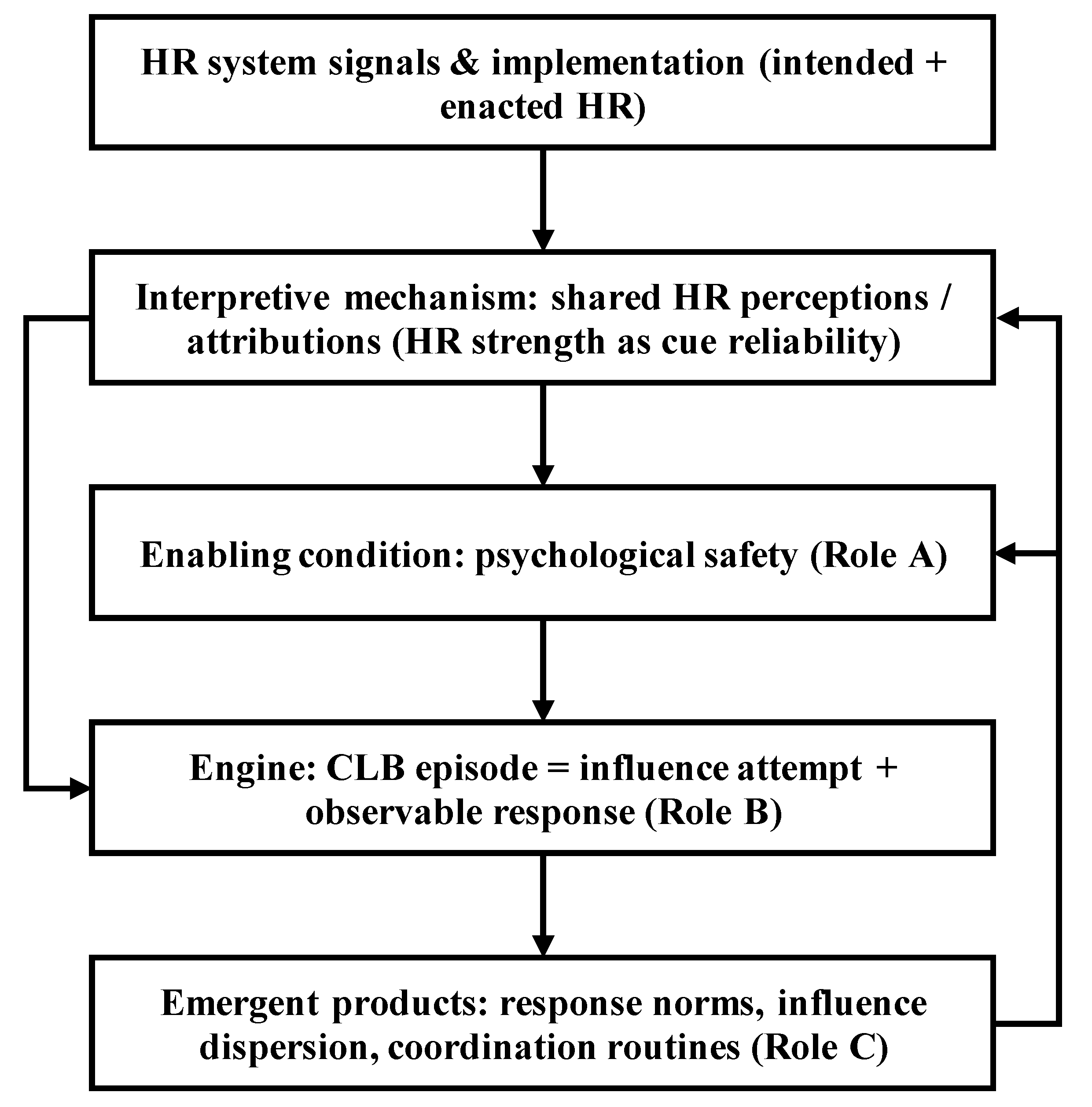
Figure 1 presents the focal process model and illustrates how enabling conditions, behavioral engine episodes, and emergent collective products are linked through admissible causal directions.
Figure 1 summarizes this functional architecture by depicting the admissible causal ordering among enabling conditions (Role A), CLB episodes as the behavioral engine (Role B), and emergent coordination products (Role C).
4.1. The Architecture: Three Functionally Distinct Roles
The core move of this article is to treat theoretical contribution at the behavioral level as constraint-based. The proposed architecture is designed to prevent common theoretical slippages—such as treating enabling states as mechanisms themselves or positioning downstream manifestations as if they were the generative engine—and to render response-contingent interaction patterns an explicit component of explanation rather than an implicit residual.
To this end, the architecture decomposes behavioral explanation into three functionally distinct roles: enabling states (Role A), core interaction episodes (Role B), and emergent coordination products (Role C). Put plainly, Role A refers to readiness conditions that shift whether and how people engage; Role B refers to what people actually do in interaction (moves and responses that generate coordination); and Role C refers to more stable coordination products that accumulate across repeated episodes. In this article, we instantiate these roles with psychological safety as a prototypical enabling state (Role A), response-inclusive influence episodes (CLB) as the engine (Role B), and coordination products such as response norms and influence dispersion (Role C). These roles are not mere relabelings; they constitute constraint-based theoretical positions that any candidate construct must earn by satisfying ordering rules.
Figure 1 presents the focal process model, distinguishing Roles A through C and specifying the admissible causal directions among them.
In this article, psychological safety refers to team psychological safety: a shared belief that the team is safe for interpersonal risk taking. We treat team psychological safety as an enabling state (Role A) that is expressed in, and updated by, interaction episodes over time. Accordingly, the focal construct is distinct from organizational-level safety climate and from interpersonal trust; when we refer to climate, we do so explicitly as a higher-level construct.
4.1.1. Role A: Enabling Psychological States
Enabling states are internal conditions that alter the probability, quality, and stability of interactional behavior. Psychological safety is treated here as an enabling state: it lowers the interpersonal risk threshold for speaking up, experimenting, and engaging in corrective interaction, thereby changing the likelihood and form of enacted behaviors rather than substituting for them (
A. C. Edmondson & Bransby, 2023). This placement aligns with contemporary syntheses that treat psychological safety as a mature construct whose value depends on specifying what it enables and under which boundary conditions (
A. C. Edmondson & Bransby, 2023).
4.1.2. Role B: Core Interactional Behaviors
Core interactional behaviors are the generative operations through which coordination is produced: actions that invite, respond, repair, align, and stabilize joint activity in real-time. This role is intentionally framed in interactional terms, consistent with recent reviews that foreground behavioral sequences and reciprocity as key building blocks of organizational phenomena (
Denis et al., 2012;
Lehmann-Willenbrock, 2025). In the proposed architecture, the “engine” is not a state, attitude, or evaluation; it is a class of observable interpersonal moves and response patterns that transform enabling conditions into coordinated action. Core interactional behaviors can be represented as response-contingent sequences (e.g., invitation to contribute → voiced concern → uptake/repair versus dismissal/sanction), where the explanatory unit is the pattern of moves and responses rather than any single act (
Lehmann-Willenbrock, 2025).
4.1.3. Role C: Emergent Coordination Products
Role C captures downstream products of repeated interaction that are behaviorally instantiated yet more stable than momentary moves: emergent coordination resources such as shared understanding, routines, reliable expectations, and durable regularities of influence and interaction. This role also includes macro-visible patterns that are instantiated in patterned regularities of interaction and influence (e.g., stable influence distributions, durable coordination routines). Contemporary work on organizational structure underscores that “structure” is often instantiated in patterned regularities of interaction and influence, making it crucial to distinguish such emergent products from the generative interactional engine that produces them.
4.2. Ordering Rules: Constraints for Generative Explanation
The architecture is operationalized through ordering rules—constraints that specify what can explain what in a generative account. First, enabling states may shift the likelihood, quality, and persistence of interactional behaviors, but they cannot be treated as the engine itself; for instance, psychological safety can enable speaking up and repair moves, yet it is not equivalent to those enacted behaviors (
A. C. Edmondson & Bransby, 2023). Second, explanations of coordinated action should be routed through interactional behaviors and their response patterns, which force theorists to specify the behavioral operations that translate conditions into coordination and aligns with the interaction-dynamics perspective emphasized in recent reviews (
Lehmann-Willenbrock, 2025). Third, emergent coordination products are explained as downstream products of the engine and, over time, may feedback by stabilizing expectations and interaction scripts; however, any feedback claim must specify which component of C feeds back into which component of A or B and through what observable pathway, thereby avoiding circularity through relabeling. Taken together, these rules deliberately narrow admissible explanations, reducing degrees of freedom in theorizing and increasing discriminant power (
Fisher et al., 2021).
4.3. Why This Architecture Is Especially Useful for Micro-Foundational HRM
Micro-foundational HRM increasingly emphasizes that HR systems operate through how people interpret and respond to HR practices in context, rather than through “content” alone (
van Beurden et al., 2021). At the same time, work on HR system strength shows that employees’ shared perceptions of HR messages (distinctiveness, consistency, consensus) can function either as mediators or moderators, depending on the causal chain being specified (
Bednall et al., 2022). The proposed architecture offers a disciplined way to incorporate these insights without collapsing roles.
In this framing, HR systems and HR messages shape enabling states (Role A) and the situational affordances for interaction (inputs to Role B), while the engine remains the enacted interactional behaviors and response patterns through which coordination is produced. Perceived HR strength is thus not “the mechanism” by default; it must be placed as an enabling condition or as a boundary condition that shapes the reliability of interactional expectations, consistent with the meta-analytic clarification of mediating versus moderating interpretations (
Bednall et al., 2022).
4.4. Mapping Common Constructs to Roles
This section’s goal is not to relabel the literature but to preserve empirical value while preventing role confusion.
4.4.1. Psychological Safety
Placed as an enabling state (Role A). Its explanatory value depends on specifying which interactional behaviors it enables and in what contexts (
A. C. Edmondson & Bransby, 2023).
4.4.2. HRM System Strength/Shared HR Perceptions
Placed as enabling conditions or boundary conditions (Role A) that affect the clarity and reliability of expectations that shape interactional patterns, with role placement depending on whether the argument is mediational or moderational (
Bednall et al., 2022).
4.4.3. Interaction Patterns, Reciprocity, Influence Moves
Placed as core interactional behaviors (Role B). Recent work on dynamic interpersonal processes provides a contemporary foundation for treating sequences and reciprocity as central explanatory units (
Lehmann-Willenbrock, 2025).
4.4.4. Stable Influence Distributions and Structural Regularities
Placed as emergent coordination products (Role C). Contemporary organization research increasingly treats structure as patterned regularity in interaction and influence, which supports this placement (
Feldman & Pentland, 2003).
4.5. Implications for Research: Measurement and Design Aligned to Functional Roles
A functional architecture implies measurement alignment. Enabling states should be measured as states (and modeled as predictors of interactional behavior), while the engine should be measured behaviorally, ideally with designs that capture sequences, reciprocity, and response contingencies rather than single-shot self-reports (
Lehmann-Willenbrock, 2025). Emergent coordination products should be operationalized as downstream outcomes or as slowly changing regularities that can be modeled as emergent states, structures, or resources.
This alignment clarifies why misclassification produces weak inference. If the engine is measured as a state, the mechanism is never observed. If downstream products are treated as the mechanism, the explanatory chain becomes descriptive rather than generative.
4.6. Transition: From Architecture to the Safety–CLB Cycle
The functional architecture and ordering rules provide a scaffold to specify an interaction-centered mechanism without conceptual sprawl. In the next section, we define collective leadership behavior (CLB) as a class of core interactional behaviors (Role B) with distinctive properties and boundaries and use the architecture to specify a recursive safety–CLB cycle in which an enabling state (psychological safety; Role A) alters the probability and quality of CLB enactment (Role B), while repeated enactment produces emergent coordination products (Role C) that can, under specified conditions, feedback to sustain or erode psychological safety over time.
5. Defining Collective Leadership Behavior (CLB): Core Properties and Conceptual Boundaries
Table 2 introduces a compact discriminant map of constructs that are frequently treated as close neighbors of CLB. The purpose is to prevent level and unit-of-analysis slippage: CLB is specified as the episode-level behavioral engine (Role B), whereas constructs such as shared leadership and coordination outcomes describe configurations or products that belong to Role C (or downstream) and therefore cannot substitute for the engine episode. We distinguished CLB from shared leadership. CLB denotes observable, response-inclusive influence episodes (an influence attempt plus an observable response), and it functions as the episode-level behavioral engine (Role B). Shared leadership denotes a distributional property of influence within a team (i.e., how influence is dispersed or centralized across members) and is treated as an emergent coordination product or structural descriptor (Role C), not as a substitute for the episode itself. Where prior work uses “collective leadership” as an umbrella label, we use the more specific labels above to avoid level and unit-of-analysis ambiguity. In related empirical work, collective leadership behavior (CLB) was operationalized as an individual-level behavioral repertoire assessed via self-report (
Fujimoto et al., 2026). The present article defines CLB more narrowly as an episode-level interaction unit (an influence attempt plus an observable response) to enable response-inclusive theorizing and coding; the repertoire view is treated as an individual-level propensity that increases the likelihood and quality of CLB episodes.
Empirically, the boundaries imply measurement alignment. CLB should be captured at the episode level by coding an influence attempt together with an observable response (e.g., uptake, contestation, neglect, sanction). In contrast, shared leadership should be captured as a distributional property across members over a defined window (e.g., dispersion or centralization of influence across a meeting series, shift, or project phase). Boundary cases such as voice and helping qualify as CLB only when they function as coordination-targeting influence attempts and when an observable response is identifiable; frequency counts of voice or supportive helping alone are insufficient for Role B.
5.1. Why a Distinct Behavioral Definition Is Required
Leadership in contemporary teams is commonly conceptualized in at least three ways: as role-based influence associated with formal leaders, as individual leader behaviors that can be aggregated, or as shared leadership defined as a team-level distribution of influence. Each perspective captures important aspects of collective functioning. However, none is sufficient for the present explanatory task: specifying the interactional mechanism through which coordinated collective action is produced and sustained over time.
From a micro-foundational HRM perspective, the central explanatory gap is not whether leadership matters, but how influence attempts are enacted, responded to, and accumulated through interaction episodes. This requires a construct that is event-based, response-dependent, and analytically separable from traits, perceptions, or stabilized team properties. CLB is introduced to occupy this engine role.
5.2. Definition and the Necessary–Sufficient Boundary
5.2.1. Definition
Collective Leadership Behavior (CLB) refers to response-inclusive interaction episodes in which a team member enacts a role-independent influence attempt directed at altering collective direction, collective meaning, or the coordination of interdependent work, and in which the episode is completed only through observable uptake, contestation, neglect, or sanction by others.
5.2.2. Necessary Condition (Boundary Rule)
A behavior qualifies as CLB only if it contains an influence attempt. Influence attempt is treated as a necessary condition and is defined as an enacted move intended to change (i) what the collective does (direction), (ii) how the situation is interpreted (meaning), or (iii) how interdependent actions are aligned (coordination). Such attempts are evidenced by explicit proposals, corrections, reframing moves, or task-structuring interventions in interaction.
5.2.3. Sufficient Condition
An influence attempt constitutes CLB only when it is embedded in an interaction episode that elicits an observable response from others. The response—whether integration, debate, dismissal, or sanction—is not a moderator but a constitutive component of the episode (
DeRue & Ashford, 2010). Influence attempts without response information cannot serve as CLB in the present mechanism because they do not complete the interactional unit through which coordination trajectories are generated.
Illustrative vignette (CLB as a response-inclusive episode). In a project meeting, an analyst proposes, “If we split the rollout into two phases, we can de-risk the launch”, explicitly redirecting the team’s coordination plan (influence attempt). The product lead responds, “That makes sense—let’s adopt the two-phase plan and revise the timeline”, and another member begins updating the task board (uptake/integration). In a different meeting, the same proposal is met with “We’re not revisiting this—stick to your lane”, followed by the analyst being excluded from the next planning thread (sanction). Under the present definition, both episodes qualify as CLB because each consists of an influence attempt plus an observable response; the response category carries the updating input for subsequent safety and later enactment.
5.3. Core Properties That Secure CLB’s Functional Placement
Within this boundary, CLB is characterized by four properties that jointly fix its position as the core interactional engine in the proposed architecture.
5.3.1. Property 1: Role-Independent
CLB is not defined by formal authority or designated leadership roles. Any team member may initiate influence attempts that qualify as CLB. This property aligns with micro-foundational HRM, where systems aim to shape distributed initiative and coordination capacities rather than leader-only action.
5.3.2. Property 2: Interactional and Response-Dependent
CLB is enacted in relation to others and is incomplete without response. Influence becomes consequential through how others take up, contest, ignore, or sanction the attempt. Response dependence is therefore intrinsic to the construct rather than a contextual moderator.
5.3.3. Property 3: Episodic (Event-Based)
CLB occurs as identifiable episodes in ongoing interaction rather than as a stable trait or climate. This episodic nature enables event coding, sequence analysis, and longitudinal modeling of coordination trajectories (
Güntner et al., 2023).
5.3.4. Property 4: Coordination-Relevant Target
CLB is directed at the collective direction, meaning, or coordination of interdependent work. Influence attempts unrelated to collective action fall outside the construct, preventing over-inclusion and preserving explanatory focus.
Together, these properties ensure that CLB functions as an interactional engine: enacted influence in interaction, contingent on response, observable as episodes, and capable of accumulating into durable coordination patterns.
5.4. What CLB Is Not: Boundary Clarifications Against Common Conflations
Because CLB sits adjacent to multiple established constructs, boundary clarity is essential for discriminant theory value. The following clarifications therefore specify what does and does not qualify as CLB under the present necessary–and–sufficient criterion and, where relevant, draw out direct measurement implications.
5.4.1. CLB Versus Shared Leadership as a Structural Property
Shared leadership is typically conceptualized as a team-level distribution of influence or leadership functions and operationalized as relatively durable configurations (e.g., leadership networks or aggregate ratings). Meta-analytic and review evidence emphasizes that its effects are condition-dependent rather than uniformly positive (
Chen & Zhang, 2023;
Wu et al., 2020). Under the present definition, shared leadership as a distributional team property does not qualify as CLB because it is an emergent configuration (an outcome of interaction histories) rather than a response-inclusive influence episode.
CLB is not a relabeling of shared leadership’s process language. The key boundary lies in the unit of explanation: shared leadership describes an emergent distributional outcome, whereas CLB specifies the interactional mechanism—episodic influence attempts and response patterns—that can generate, suppress, or distort such outcomes. A team may exhibit stable “sharedness” while the response contingencies governing influence attempts shift (e.g., toward routinized uptake versus defensive dismissal), thereby altering the engine; conversely, distributional “sharedness” may change without a corresponding change in response contingencies.
Measurement implications follow directly. Shared leadership indicators should not be treated as direct measures of CLB because they capture distributional properties (who influences whom, how much, on average) rather than response-inclusive influence-and-response episodes.
5.4.2. CLB Versus Voice
Voice is commonly defined as discretionary communication intended to improve work or the organization (
Morrison, 2023). In the present framework, voice qualifies as CLB only when it (a) constitutes a coordination-relevant influence attempt and (b) is embedded in a response-inclusive interaction episode (
Morrison, 2023). In other words, “voice” becomes CLB only when it is enacted as an influence attempt directed at direction, meaning, or coordination and when others’ observable uptake, contestation, neglect, or sanction completes the episode.
Voice measured purely as frequency, willingness to speak, or self-reported expression is therefore insufficient to represent CLB because it omits the uptake process through which influence becomes consequential. Voice that is expressed but ignored or sanctioned remains an influence attempt, but its causal role in the mechanism depends on the response pattern rather than on expression alone (
Burris, 2012).
5.4.3. CLB Versus Helping/Backup Behavior and Prosocial Contribution
Helping and backup behaviors contribute to performance and reliability, but they do not qualify as CLB unless they include an influence attempt targeting collective direction, meaning, or coordination (
Porter et al., 2003). Purely supportive helping—assisting without attempting to alter interdependence, task structuring, or collective interpretation—belongs to prosocial contribution rather than to the interactional engine as defined here.
This boundary prevents tautology. If all helpful behavior were treated as leadership, CLB would collapse into “effective teamwork”, eliminating the possibility of discriminant predictions and undermining the mechanism’s explanatory specificity.
5.4.4. CLB Versus Engagement and Other Readiness States
Engagement, commitment, efficacy, and related constructs are enabling psychological states that condition the likelihood and persistence of influence attempts. They are not influence attempts themselves. Treating them as CLB would violate the state–behavior distinction central to the functional architecture and would reintroduce the very role confusion in the ordering rules are designed to prevent. Contemporary motivational theory similarly treats engagement as a proximal state with downstream behavioral consequences rather than as behavior itself (
Bakker et al., 2023).
5.5. Minimal Operational Implications Consistent with the Definition
Although this article is conceptual, definitional credibility requires evident measurability. At the minimum, researchers should be able to (a) identify discrete interaction episodes in which a team member enacts an influence attempt targeting collective direction, meaning, or coordination; (b) code functionally distinct response types to that attempt (e.g., integration, debate, dismissal, sanction), with the specific taxonomy adapted to context but required to preserve functional distinctiveness (
Kauffeld et al., 2018); and (c) track who initiates influence attempts over time to model dispersion, centralization, and trajectory effects. Together, these elements enable discriminant predictions that cannot be derived from aggregate leadership indicators or expression–frequency measures.
5.6. Transition: Positioning CLB Within the Recursive Safety–CLB Mechanism
With CLB defined as episodic, role-independent, response-dependent influence enactment, its relationship with psychological safety can be specified without role confusion. Psychological safety functions as an enabling state that alters the likelihood and form of influence attempts, while collective response patterns to those attempts update safety over time (
A. Edmondson, 1999). This recursive coupling constitutes the engine of divergent coordination trajectories developed in the subsequent sections.
6. The Safety–CLB Cycle as Recursion: A Response-Dependent Mechanism for Sustained Coordination
With CLB defined as the behavioral engine, this section specifies the recursive, response-dependent logic through which responses to influence attempts update subsequent psychological safety and the dispersion of later influence enactment. Rather than treating safety as a stable antecedent or a one-way mediator of “voice → outcomes”, we model safety and CLB as analytically distinct constructs that become coupled through repeated interaction cycles, which can produce divergent coordination trajectories across teams even when HR conditions are broadly similar.
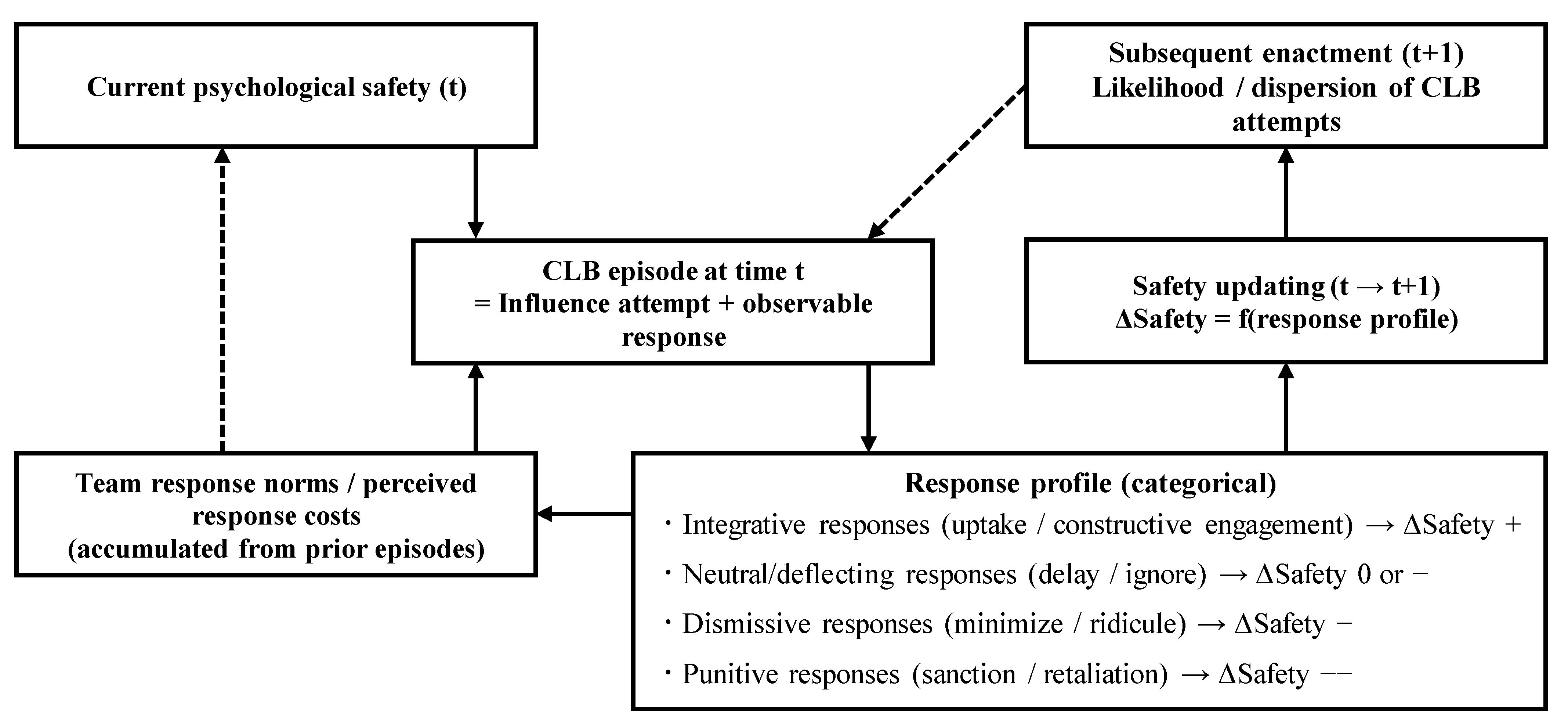
The core analytical move is to specify a minimal recursive unit: an influence attempt and the observable response it elicits. This response-inclusive episode functions as an update event that can shift expectations about interpersonal risk immediately and, through accumulation across multiple episodes, revise subsequent psychological safety; in parallel, it reshapes the likelihood and dispersion of future CLB enactment (e.g., whether influence remains broadly distributed or becomes progressively centralized).
Figure 2 depicts this response-contingent updating logic by showing how response patterns to influence attempts feed forward into subsequent safety—whether observed as immediate post-episode change or as change across short windows of episodes—and, in turn, into subsequent influence attempts and their distribution over time.
This recursion departs from dominant static models and is consistent with recent integrative work that treats psychological safety as interaction-sensitive and dynamically reproduced through social responses to interpersonal risk-taking—particularly voice and influence attempts—rather than as a background climate variable (
A. C. Edmondson & Bransby, 2023). More broadly, it aligns with current calls to move beyond cross-sectional mediation templates toward process accounts that specify the event-level operations by which team functioning stabilizes, escalates, or collapses over time (
Mitchell & James, 2001).
6.1. Why Recursion Is Necessary for Sustained Coordination
Sustained coordination cannot be reduced to the accumulation of individual behaviors or the presence of favorable psychological states. Instead, it depends on whether interactional patterns stabilize in ways that preserve both engagement and alignment over time. Recent syntheses in team dynamics demonstrate that coordination is repeatedly produced, maintained, or eroded through sequences of interaction rather than achieved once and retained (
Maynard et al., 2015;
Marks et al., 2001).
Psychological safety plays a dual role in this process. On the one hand, it conditions individuals’ willingness to initiate influence attempts under uncertainty. On the other hand, it is itself updated through how such attempts are received by others. Empirical reviews over the past five years indicate that safety-related perceptions are highly sensitive to micro-level interactional cues, including acknowledgment, integration, or rejection of input, rather than solely to formal structures or leader intentions (
A. C. Edmondson & Bransby, 2023).
Accordingly, treating psychological safety as either a pure antecedent or a downstream outcome obscures the mechanism by which coordination persists or decays. A recursive framing is therefore helpful to explain why teams operating under similar HR systems and managerial arrangements can diverge sharply in their long-term coordination patterns.
6.2. The Core Recursive Unit: Influence Attempt and Response
The minimal causal unit in the proposed framework is an interaction episode consisting of an influence attempt and the response it elicits. Influence attempts include proposals, questions, challenges, or initiative-taking actions that introduce potential misalignment or uncertainty into collective activity.
Responses to these attempts can be functionally differentiated into a limited set of categories with distinct implications for future interaction (
Bies & Moag, 1986). Integrative responses incorporate the content of the attempt into the joint activity, for example, by adopting the proposal, elaborating it, or assigning follow-up responsibility. Deflective responses acknowledge the attempt without integration, such as through topic shifts, vague agreement, or procedural postponement, preserving surface harmony while leaving alignment unresolved. Punitive or dismissive responses impose social or reputational costs or invalidate the speaker, for example, through ridicule, blame, or status-based rejection.
Recent reviews of shared and distributed leadership consistently note that the effectiveness of influence sharing depends less on the presence of multiple influence sources than on how such influence is responded to within the team (
Chen & Zhang, 2023). This supports a response-dependent rather than actor-centered understanding of collective leadership processes.
6.3. Recursive Coupling of Psychological Safety and CLB
Through repeated cycles of influence and response, teams generate feedback loops that couple psychological safety and CLB. Integrative responses can reinforce safety perceptions, increasing the likelihood that subsequent influence attempts are initiated by a broader range of actors. As these attempts are enacted and integrated, CLB circulates across members, supporting distributed coordination.
Conversely, dismissive or punitive responses can suppress future influence attempts, narrowing the distribution of leadership behaviors and increasing reliance on formal authority. Over time, this contraction reduces opportunities for mutual adjustment and learning, even when formal roles or HR practices nominally encourage participation.
Importantly, this recursion does not imply monotonic amplification. Excessive or poorly timed influence sharing can undermine coordination under certain conditions, such as high time pressure, extreme action or transition episodes, or tightly coupled tasks (
Maynard et al., 2015;
Chen & Zhang, 2023). The safety–CLB cycle is therefore contingent and path-dependent, capable of stabilizing at different equilibria depending on early interactional patterns and contextual constraints.
6.4. Implications for Theorizing Coordination Beyond Linear Mediation
Conceptualizing the safety–CLB relationship as recursive clarifies why linear mediation models often yield inconsistent findings across contexts. Average effects can obscure the fact that identical HR interventions may set in motion divergent coordination trajectories depending on how early influence attempts are handled. This perspective aligns with recent methodological critiques in HRM and leadership research that call for greater attention to temporal sequencing and response heterogeneity (
Bednall et al., 2022;
Wang et al., 2020).
From an HRM perspective, system strength and implementation consistency can shape the base rate of influence attempts by signaling expectations for participation and initiative. However, coordination trajectories are strongly shaped by response patterns that translate HR practices into enacted routines, alongside task time and hierarchical constraints. By foregrounding response patterns as the linking mechanism, the present framework preserves the conceptual distinctiveness of psychological safety and CLB while explaining their sustained co-development.
This recursive view also provides a principled basis for distinguishing CLB from generic shared leadership constructs. Rather than treating leadership as a distributed attribute, it emphasizes enacted coordination as an interactional process shaped by how influence is received, integrated, or rejected over time.
8. Conclusions: Advancing Micro-Foundational HRM Through Generative Behavioral Explanation
This article set out to address a recurring limitation identified in micro-foundational HRM research: although behavioral constructs continue to proliferate, explanations of how HR systems generate sustained, coordinated collective action remain underspecified. Prior work has often relied on correlational associations, static mediation models, or construct expansion, leaving the generative behavioral mechanism implicit (
Jiang et al., 2013). In response, this article advanced a constraint-based approach to explanation that treats behavior as interactional enactment governed by observable ordering rules and response contingencies, thereby enabling discriminant predictions rather than post hoc interpretation. This stance directly answers recent calls for phenomenon-anchored theory that constrains explanation and produces distinguishing implications instead of cumulative construct proliferation (
Fisher et al., 2021).
Within this framework, collective leadership behavior (CLB) was positioned as the core interactional engine through which coordination is assembled, stabilized, or undermined over time. A central contribution lies in reconceptualizing psychological safety not as a distal contextual variable or static climate, but as a recursively generated state that both enables and is updated by interactional responses to influence attempts. By specifying how psychological safety and CLB become coupled through repeated response-dependent interaction cycles, the framework moves beyond linear “safety → voice → outcomes” accounts and clarifies the micro-level operations through which coordination trajectories diverge. This treatment aligns with contemporary syntheses showing that psychological safety research has matured into an established literature whose value now lies in specifying mechanisms and boundary conditions rather than documenting omnibus effects (
A. C. Edmondson & Bransby, 2023).
The framework also clarifies why HR systems should not be evaluated solely by their intended design or formal content. Consistent with process perspectives in HRM, a key determinant is how HR practices are perceived, interpreted, and enacted by employees in day-to-day interactions. Recent reviews demonstrate that employee perceptions of HR practices are multi-component (what is offered, how it is implemented, and why it is interpreted as legitimate) and that these perceptions form a central pathway through which HR systems translate into behavior (
Wang et al., 2020;
van Beurden et al., 2021). Meta-analytic evidence further indicates that HRM system strength can function systematically within the HRM–outcomes chain, including as a mediating pathway rather than merely a moderator (
Bednall et al., 2022). By foregrounding response patterns and enacted regularities, the present framework proposes a mechanism-based account of how HR systems may acquire causal force through interaction, rather than assumption.
Importantly, the discriminant predictions derived from the safety–CLB recursion prevent the theory from collapsing into a generic “more participation is better” account and clarify that the mechanism is most directly applicable to interdependent team settings where influence attempts are feasible and consequential. The model yields the testable prediction that coordination can stabilize under qualitatively different regimes—such as routinized integrative response norms or highly centralized influence patterns—depending on interdependence, discretion, and the rigidity of hierarchical decision rights, and interventions aimed solely at “building safety” or “installing HR practices” may be fragile unless they also change the interactional constraints that govern recurrent enactment. This conclusion is reinforced by recent syntheses in shared leadership research, which emphasize condition dependence, coordination costs, and potential downsides of influence dispersion, thereby supporting the present framework’s boundary-setting between CLB and shared leadership and its emphasis on response patterns rather than mean-level effects (
Chen & Zhang, 2023).
In conclusion, this article advances micro-foundational HRM by replacing construct expansion with functional constraint and explicit generative mechanism specification. By treating psychological safety and collective leadership behavior as co-evolving interactional dynamics, the framework provides a disciplined way to connect HR systems to sustained coordination while generating testable, discriminant implications for research and proposed design principles for practice, with generalization from high-stakes teams to routine workplaces left as an empirical question. In doing so, it answers the core question posed at the outset: not whether HR systems or leadership matter, but how coordinated collective action is produced, maintained, or eroded through observable interactional processes over time.