


Abstract
Employee participation in occupational safety and health depends partly on workers’ representatives, who connect employee concerns with organizational decision-making and preventive action. However, the competencies supporting this formal representative role have received limited attention in organization and management research. Building on earlier qualitative and participatory work that identified 33 competency components and included a preliminary questionnaire to review these components, this study examines the perceived importance of the full set of competencies in a broader sample of Hungarian OSH professionals. An online questionnaire using a five-point importance scale yielded 104 valid responses. Descriptive statistics were used to assess the perceived importance of the previously identified competency components. The highest-rated competencies included knowledge of occupational representation and consultation, familiarity with the workplace, knowledge of the employer’s OSH organization and work processes, adherence to rules, communication, problem-solving, and situational awareness. The findings provide a broader professional appraisal of perceived competency priorities and may inform training, workplace orientation, and organizational support for meaningful employee participation in OSH. Although this research is based on a Hungarian sample, the findings may also inform further research into the competencies that support workers’ representation in OSH in other national contexts.
1. Introduction
Employee participation is an important component of organizational decision-making because it provides mechanisms through which employees can contribute information, concerns, and experience to decisions affecting their work (Morrison, 2023; Mowbray et al., 2015). In occupational safety and health (OSH), participation has a particularly direct organizational function: workers often possess first-hand knowledge of work processes, hazards, operational constraints, and the practical consequences of preventive measures (Copsey et al., 2022). European OSH legislation therefore recognizes information, consultation, and worker representation as formal elements of workplace prevention (Ales, 2018).
From an organizational perspective, workers’ representatives in OSH occupy a distinctive position. They are employees who also perform an elected representative role, connecting workers with management and OSH professionals (Dancsecz et al., 2019; Ales, 2018). Their contribution is related to employee involvement and participation, but it is more institutionalized than individual employee voice because it is supported by defined rights and responsibilities (Ales, 2018; Mowbray et al., 2015). Research on employee involvement and participation has addressed these issues in the context of labor relations and human resource management, while broader organizational research shows that employees’ voices are shaped by organizational relationships, leadership, trust, and the context in which employees raise concerns (Morrison, 2023; Timming, 2012).
Competence may be particularly important for formal employee representatives (García et al., 2017). Research across European organizations has shown that perceived competence is positively associated with the influence of employee representatives in organizational decision-making. Competency models are also widely used in human resource management to connect role requirements with development, performance, and organizational needs (Rodriguez et al., 2002). Nevertheless, the specific competencies required for workers’ representatives in OSH have received limited systematic attention. A systematic review identified occupational safety knowledge and communication as recurring competency areas (Leisztner & Szabo, 2024), while a subsequent qualitative and participatory study identified 33 competency components grouped into three domains: occupational safety knowledge, professional and workplace knowledge, and personal characteristics (Leisztner et al., 2025). The earlier study also included a preliminary questionnaire completed by 11 focus group participants to review the identified competency components.
The present study extends this research by examining the perceived importance of the previously identified competency components among a broader sample of Hungarian OSH professionals. Rather than claiming to identify entirely new competencies or to validate the competency framework psychometrically, it provides a quantitative appraisal of the relative importance attributed to the existing components by a wider professional sample. This focus is relevant to organization studies because formal structures and institutional rights alone do not explain how representative participation is enacted in practice; representatives’ knowledge of the workplace and their ability to interact with organizational actors may also be relevant to consultation and prevention (Copsey et al., 2022; García et al., 2017). By identifying the competency components that respondents value most highly, this study connects OSH representation with employee participation, competency management, and human capital development. The findings may inform further consideration of training, workplace orientation, and organizational support for representative roles.
2. Theoretical Framework
The theoretical framework of the study brings together two complementary perspectives relevant to the role of workers’ representatives in OSH. First, the study considers workers’ representation as an organizational mechanism of employee participation and voice (Timming, 2012; Walters & Wadsworth, 2020). Second, it examines competencies as organizational resources that may enable representatives to perform this role effectively (García et al., 2017; Lyubomirova et al., 2016). The first perspective emphasizes the institutional and organizational context in which representatives communicate workers’ concerns and participate in OSH-related consultation. The second focuses on the knowledge, workplace understanding, and personal capabilities that may support representatives in carrying out these responsibilities. Based on these perspectives, the framework provides a conceptual basis for examining the competency priorities identified in the empirical phase of the study. It does not assume that perceived competency importance directly demonstrates representative effectiveness; rather, it provides a basis for understanding which capabilities OSH professionals consider important for supporting employee participation in OSH.
2.1. Employee Participation, Voice, and Formal Representation
Employee involvement and participation encompass organizational mechanisms through which employees receive information, are consulted, and contribute to workplace decisions. Employee voice research addresses the related question of whether and how employees communicate ideas, suggestions, or concerns that may be useful to the organization (Mowbray et al., 2015). These perspectives overlap in their emphasis on communication and participation, but formal worker representation adds an institutional dimension: representatives are formally authorized to convey collective concerns and participate in defined consultation processes (García et al., 2017; Walters, 2004).
In safety-sensitive settings, employee voice is especially relevant because employees may identify emerging problems before they result in incidents (Tedone et al., 2026). Research on upward voice has shown that participative decision-making, trust, and the safety climate can influence whether concerns are raised (Silla et al., 2020). Workers’ representatives can therefore be understood as part of the organizational infrastructure for employee participation and safety-related voice, although their formal representative role is distinct from the discretionary voice behavior of individual employees (Mowbray et al., 2015; Walters, 2004).
This distinction has practical consequences. Formal rights create opportunities for participation, but they do not by themselves ensure that representatives can understand technical and organizational information, formulate employee concerns, communicate effectively with management, or participate constructively in problem-solving (García et al., 2017). The quality of representation may therefore depend partly on the knowledge, skills, and personal capabilities that representatives bring to the role (García et al., 2017; Leisztner et al., 2025).
2.2. Competencies as Organizational Resources for Representative Participation
Competency-based approaches in human resource management are intended to describe characteristics relevant to successful role performance and to support development and organizational alignment (Rodriguez et al., 2002). For employee representatives, competence is also connected with influence. García et al. found that the perceived competence of employee representatives was positively associated with their influence on organizational decision-making and with more cooperative forms of conflict behavior (García et al., 2017). This makes competency development relevant not only to individual representatives but also to the quality of organizational participation (García et al., 2017; Rodriguez et al., 2002).
In OSH representation, the required capability is likely to be multidimensional. Representatives need sufficient OSH knowledge to understand prevention requirements and participate in consultation, but they also need knowledge of the specific workplace, organization, equipment, and work processes (Leisztner et al., 2025). Occupational safety knowledge is embedded in organizational knowledge-sharing practices (Faragó, 2022; Goodbrand et al., 2021), while effective prevention also depends on understanding risk factors within actual work systems (Erazo-Chamorro et al., 2022). In addition, communication, problem-solving, conflict management, and other interpersonal capabilities can support interaction across the employee management professional interface (García et al., 2017; Leisztner et al., 2025). This interface role is consistent with the organizational concept of boundary spanning, in which individuals connect information and relationships across organizational boundaries (Aldrich & Herker, 1977; Tushman & Scanlan, 1981).
The earlier phase of this research identified 33 competency components and grouped them conceptually into three domains: occupational safety knowledge, professional and workplace knowledge, and personal characteristics (Leisztner et al., 2025). The present study treats these areas as a predetermined conceptual and practical framework, rather than as statistically validated latent constructs. The organizational question is therefore which components practitioners perceive as most important for a representative who must operate within real workplace structures and participation processes.
2.3. Research Question
RQ1. Which of the previously identified competency components are perceived as most important for workers’ representatives in occupational safety and health (OSH) by Hungarian OSH professionals?
3. Materials and Methods
The methodological approach was designed to examine the perceived importance of competency components identified in an earlier phase of the research program (Leisztner et al., 2025). The study adopted a quantitative, cross-sectional design, with the questionnaire serving as the main instrument for data collection (Boncz, 2015). This section describes the relationship of the present study to the preceding research phase, the questionnaire design and data collection procedures, and the statistical methods used to analyze the responses.
3.1. Study Context and Relationship to Previous Research
The study employed a quantitative, cross-sectional questionnaire design (Pregoner, 2024) and constituted a subsequent phase of a broader research program examining the organizational role and competencies of workers’ representatives in occupational safety and health (OSH). The previous phase used expert interviews and participatory procedures to identify 33 competency components and group them conceptually into three domains. It also included a preliminary questionnaire completed by 11 focus group participants to review the identified competency components (Leisztner et al., 2025). The present survey did not repeat that identification process. Instead, it asked a broader sample of OSH professionals to rate the importance of the full competency set on a common five-point scale.
3.2. Questionnaire and Data Collection
The questionnaire consisted mainly of closed-ended items. Each previously identified competency component was rated on a five-point Likert-type importance scale (Tanujaya et al., 2022): 1 = not important at all, 2 = rather unimportant, 3 = neither important nor unimportant, 4 = rather important, and 5 = extremely important. The questionnaire also collected data on respondents’ age group, gender, and level of OSH qualification.
Data were collected using Google Forms between 11 September 2023 and 9 January 2024. The survey was shared in the Hungarian Facebook group ‘Munkavédelmi szakemberek csoportja’ [Occupational Safety Professionals Group], which had 2581 members at the time of data collection. Participation was voluntary. A questionnaire was considered valid if it was fully completed, and no additional exclusion criteria were applied. In total, 104 valid questionnaires were included in the analysis. The number of valid responses corresponds to approximately 4% of the group membership; however, because the number of members who actually saw the invitation cannot be established, this percentage should not be interpreted as a conventional survey response rate.
Before completing the questionnaire, participants received information about the purpose of the research and the handling of their data. Providing personal identifying information was not required for questionnaire completion. Respondents could also provide an email address to receive information about the study results; this was optional. Data were handled in accordance with applicable data protection requirements, including the European Union General Data Protection Regulation (GDPR), where applicable. Data processing and statistical analyses were performed using Microsoft Excel.
3.3. Statistical Analysis
Descriptive statistics constituted the primary basis for answering RQ1. For each competency component, the distribution of ratings, mean, standard deviation, and median were examined. For interpretive summaries, ratings of 4 (‘Rather important’) and 5 (‘Extremely important’) were combined to indicate the proportion of respondents who perceived the competency component as important.
During manuscript preparation and revision, generative AI was used to support manuscript restructuring, language refinement, consistency checking, and bibliographic/reference verification. It was not used for the study design, data collection, statistical analysis, or the generation or modification of research data. All AI-assisted outputs were critically reviewed and verified by the authors.
4. Results
The results are presented in accordance with the research question and the analytical approach described in the Section 3. First, the characteristics of the study sample are summarized. The perceived importance of the previously identified competency components is then examined using response distributions and descriptive statistics.
4.1. Sample Characteristics
The sample comprised 104 respondents. Almost half of the participants were aged 26–45 years (49.0%), followed by those aged 46–65 years (39.4%). The sample included more men (61.5%) than women (38.5%). Regarding occupational safety and health qualification level, 52.9% of respondents held an intermediate-level qualification, while 47.1% held a higher-level qualification (Table 1).
Table 1.
Sample characteristics (N = 104).
4.2. Perceived Importance of Competency Components
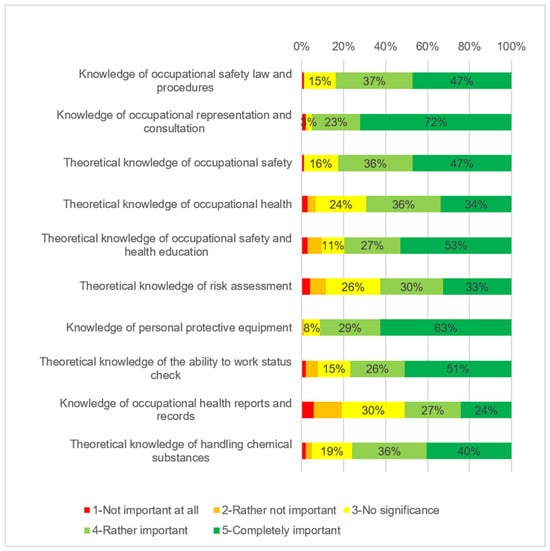
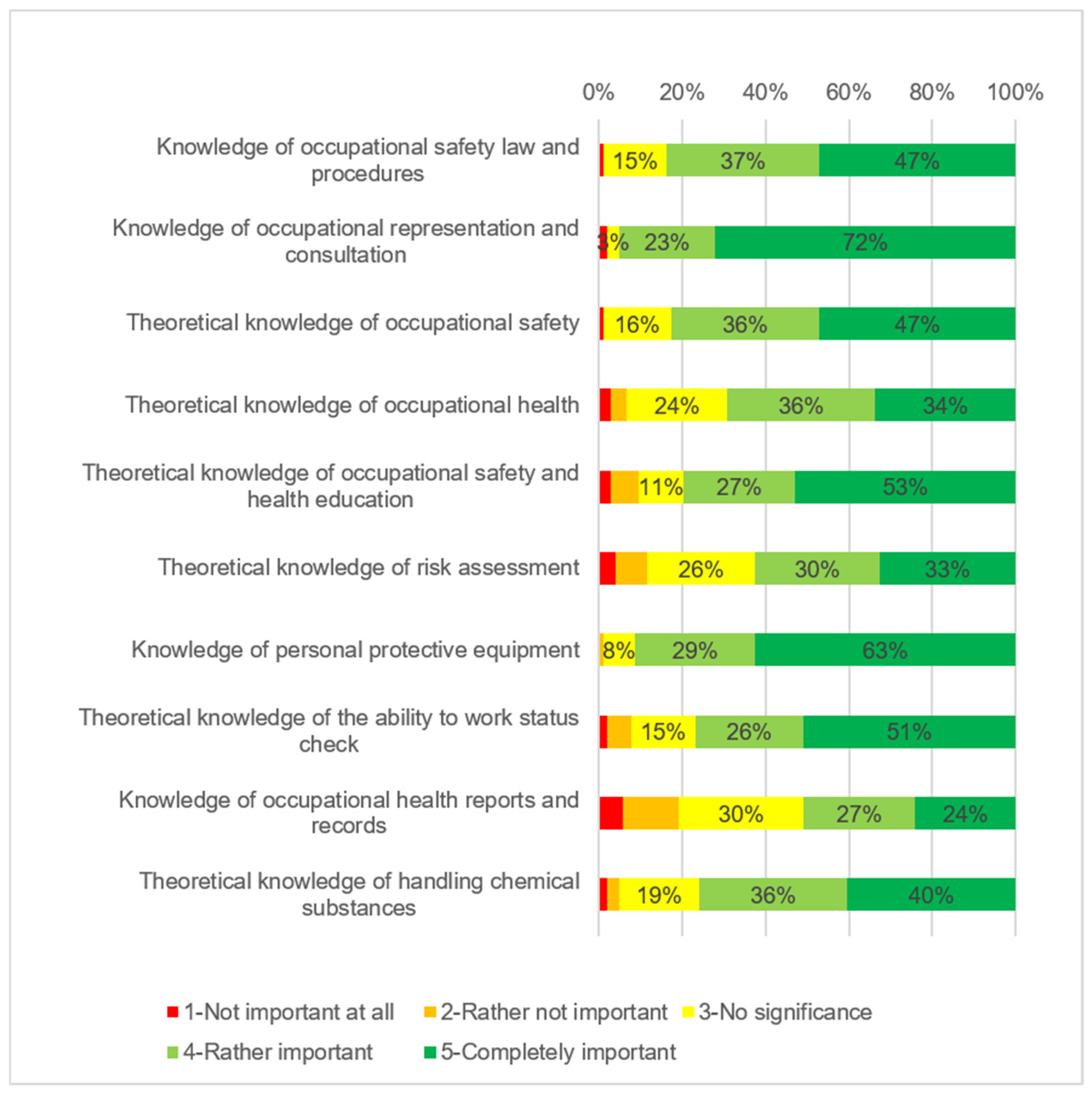
Within the occupational safety knowledge domain, every component was rated as important (i.e., given a rating of 4 or 5) by more than half of the respondents (Figure 1). The highest proportions were observed for knowledge of occupational representation and consultation (95%) and knowledge of personal protective equipment (92%). Knowledge of occupational safety law and procedures (84%), theoretical knowledge of occupational safety (83%), and theoretical knowledge of occupational safety and health education (80%) also received high ratings. Theoretical knowledge of the ability-to-work status check received the lowest proportion of positive ratings in this domain (51%).
Figure 1.
Distribution of importance ratings for occupational safety-knowledge components (N = 104).
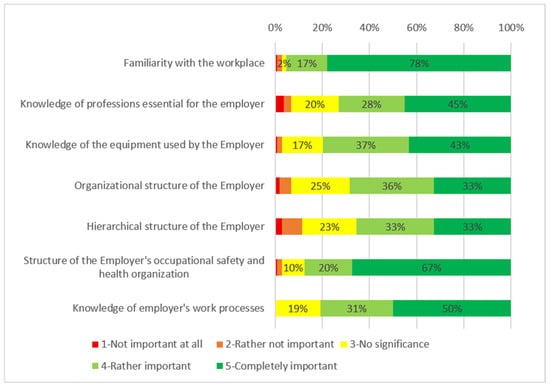
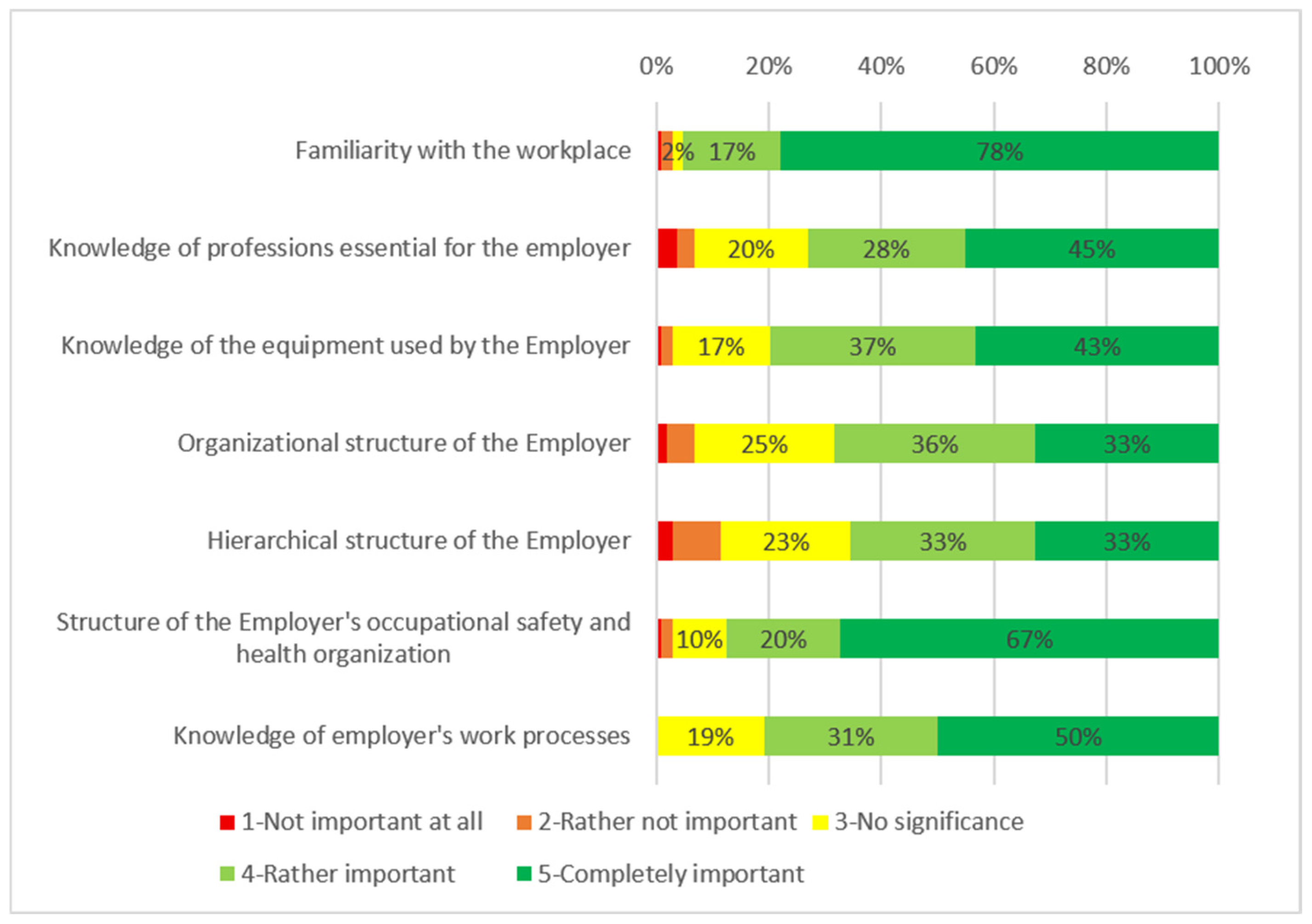
Within the professional and workplace knowledge domain, familiarity with the workplace was rated as important by 95% of respondents, followed by the structure of the employer’s occupational safety and health organization (87%), knowledge of the employer’s work processes (81%), and knowledge of the equipment used by the employer (80%) (Figure 2). The remaining components were also rated as important by more than half of the respondents.
Figure 2.
Distribution of importance ratings for professional and workplace-knowledge components (N = 104).
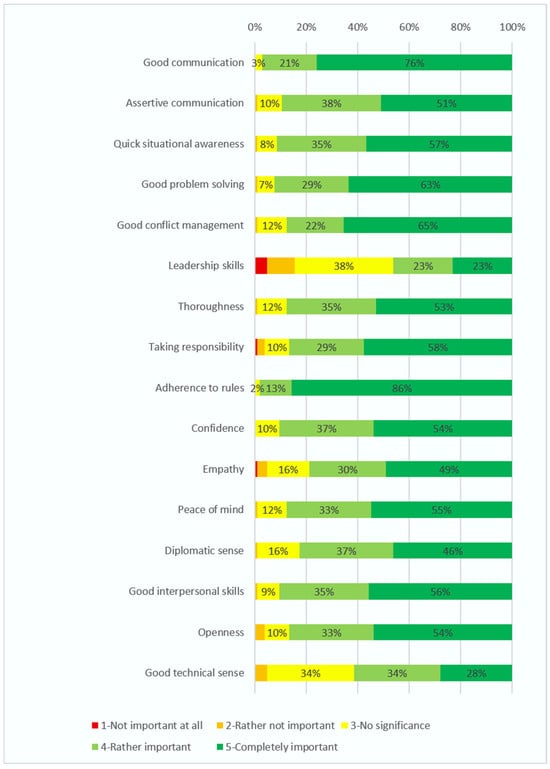
The highest proportions of importance ratings were observed for several personal and interpersonal characteristics (Figure 3). Adherence to rules was rated as important by 98% of respondents, good communication by 97%, good problem-solving by 92%, and quick situational awareness by 91%. Confidence and good interpersonal skills were each rated as important by 90%. Leadership skills were the only characteristic rated as important by fewer than half of the respondents (46%).
Figure 3.
Distribution of importance ratings for personal and interpersonal characteristics (N = 104).
4.3. Descriptive Statistics
The descriptive statistics were consistent with the pattern shown in the response distributions (Table 2, Table 3 and Table 4). The median ratings were 4 or 5 for all competency components except leadership skills, which had a median of 3. The highest mean ratings were observed for adherence to rules (M = 4.84), good communication (M = 4.73), familiarity with the workplace (M = 4.69), knowledge of occupational representation and consultation (M = 4.63), and good problem-solving (M = 4.55). Leadership skills received the lowest mean (M = 3.49) and were the only component with a median of 3.
Table 2.
Descriptive statistics for occupational safety-knowledge components.
Table 3.
Descriptive statistics for professional and workplace-knowledge components.
Table 4.
Descriptive statistics for personal and interpersonal characteristics.
5. Discussion
The main contribution of this study is that it extends earlier competency identification and component review work by examining the full set of 33 components in a broader sample of 104 OSH professionals and interpreting the resulting priorities through an organizational participation lens. The earlier study developed the competency content through expert and focus group work and included a preliminary questionnaire completed by 11 focus-group participants to review the identified components (Leisztner et al., 2025). The present survey therefore does not represent the first prioritization of these components; rather, it provides a broader professional appraisal using a common five-point importance scale. The findings highlight the human capabilities that OSH professionals perceive as important for participation within formal representation structures: although representation provides an institutional channel for consultation, representatives are perceived as needing knowledge, skills, and personal capabilities to make use of this channel.
The ranking of the competency components suggests that the representative role is not perceived primarily as a technical specialist function. The highest-rated components combined knowledge of occupational representation and consultation with workplace familiarity, organizational knowledge, communication, problem-solving, situational awareness, and adherence to rules. This pattern is consistent with the organizational position of representatives as boundary-spanning actors who operate between employees, management, and OSH professionals (Aldrich & Herker, 1977; Tushman & Scanlan, 1981). It also corresponds with previous evidence that the perceived competence of employee representatives is associated with their influence in organizational decision-making (García et al., 2017).
The high rating of knowledge of occupational representation and consultation is particularly relevant from an employee participation perspective. Representatives need to understand the purpose, responsibilities, and boundaries of their role in order to participate meaningfully in consultation processes (Ales, 2018). At the same time, familiarity with the workplace and knowledge of organizational processes were among the most highly rated components. This suggests that general OSH education alone may not fully prepare representatives for their role; workplace-specific and organizational knowledge may also be perceived as important for participation in the employer’s actual work system (Erazo-Chamorro et al., 2022; Leisztner et al., 2025).
Communication and problem-solving capabilities were also among the highest-rated personal characteristics. Research on employee voice emphasizes that employees’ willingness and ability to raise concerns are shaped by organizational relationships and contextual factors (Silla et al., 2020; Tedone et al., 2026). The present findings provide a complementary perspective by indicating that, where organizations rely on formal employee representatives, the capabilities of those representatives are perceived by OSH professionals as important at the employee management interface. However, the present study does not demonstrate a causal relationship between competency levels and employee voice or participation outcomes. Rather, it identifies the capabilities that OSH professionals consider important for representative participation in OSH.
From a human capital development perspective, the three competency domains imply different development needs and organizational responsibilities. Role-specific OSH knowledge can be supported through formal education and continuing training. Workplace and organizational knowledge require structured orientation, access to relevant information, and practical exposure to the employer’s work system. Communication, consultation, conflict management, and problem-solving can be supported through targeted skills development. This differentiated approach is consistent with competency-based perspectives that connect role requirements with employee development and organizational practices (Rodriguez et al., 2002).
The findings have several implications for organizational practice. A shared responsibility approach may be more appropriate than viewing representative competence as solely an individual responsibility. Organizations can support meaningful employee participation in OSH not only by establishing formal representative structures (Dancsecz et al., 2019), but also by ensuring that representatives understand their consultation role, have access to relevant workplace and organizational information, and receive opportunities to develop communication, problem-solving, and conflict management capabilities. Such support does not imply that employee representatives should become OSH professionals. Rather, the aim is to provide the human and organizational conditions that may help representatives communicate employee concerns, understand relevant information, and participate constructively in preventive decision-making.
6. Conclusions
This study shows that, from the perspective of Hungarian OSH professionals, a combination of role-specific OSH knowledge, workplace and organizational knowledge, and personal and interpersonal capabilities is perceived as important for workers’ representation in OSH. The highest perceived priorities were not limited to technical safety knowledge. Knowledge of occupational representation and consultation, familiarity with the workplace, understanding of the employer’s OSH organization and work processes, communication, problem-solving, situational awareness, and adherence to rules were among the most highly rated competency components.
The findings suggest that formal employee participation mechanisms may benefit from deliberate capability development. Training can provide representatives with a common OSH knowledge base and an understanding of consultation processes, while employers can support workplace-specific orientation and access to relevant organizational information. Targeted development of communication, problem-solving, and conflict management capabilities may further support representatives in participating constructively in workplace consultation and preventive decision-making. These implications concern the organizational conditions supporting representative participation rather than the transformation of representatives into OSH professionals.
The study extends earlier competency identification work by providing a broader professional appraisal of the full competency set. Because the earlier review of the identified components involved a much smaller group and a different questionnaire format, the present results should not be treated as a direct replication; their value lies in showing which competencies remain prominent when assessed by a wider professional sample. The results should be interpreted as evidence of perceived competency priorities rather than as statistical validation of a competency model. The study also does not establish that highly rated competencies cause better employee participation, safety voice, or OSH outcomes. Future research should therefore examine the proposed competency structure in larger and more diverse samples and investigate whether representative competencies are associated with observable indicators of participation, influence, safety voice, and OSH performance.
7. Limitations and Future Research
Several limitations should be considered when interpreting the findings. First, participants were recruited through a Hungarian professional Facebook group for OSH specialists using voluntary participation. The sample was therefore self-selected and cannot be considered representative of all Hungarian OSH professionals, workers’ representatives, or organizations. In addition, the platform does not provide information on how many group members actually saw the survey invitation. Consequently, a conventional survey response rate cannot be calculated from the available information.
Second, this study measures OSH professionals’ perceptions of the importance of competency components rather than the actual competencies of workers’ representatives. It also does not directly measure the quality of employee participation, representative influence in organizational decision-making, or subsequent safety outcomes. This distinction limits the extent to which the findings can be interpreted as evidence of effective representative performance. Future research should therefore include workers’ representatives themselves, as well as managers, employees, and other relevant organizational actors, and should examine relationships between perceived competency priorities, directly assessed competencies, and behavioral or organizational outcomes.
Finally, the study was conducted within a single national regulatory and organizational context. The competencies perceived as important for workers’ representatives may be influenced by national OSH legislation, labor relations systems, and organizational participation practices. Cross-national research could therefore examine which competency priorities are broadly transferable and which are shaped by local institutional arrangements. Such research could contribute to the development of competency frameworks that are both empirically grounded and sensitive to different organizational and regulatory contexts.
Supplementary Materials
The following supporting information can be downloaded at https://www.mdpi.com/article/10.3390/admsci16110546/s1, File S1: questionnaire; Table S2: responses.
Author Contributions
Conceptualization, P.L.; methodology, G.S.; software, P.L.; validation, G.S. and F.F.; formal analysis, P.L.; investigation, P.L.; resources, P.L.; data curation, G.S. and T.D.; writing—original draft preparation, P.L.; writing—review and editing, G.S., T.D. and P.L.; visualization, P.L.; supervision, G.S.; project administration, G.S. All authors have read and agreed to the published version of the manuscript.
Funding
This research received no external funding.
Institutional Review Board Statement
The study was conducted in accordance with the Declaration of Helsinki and approved by the Institutional Review Board of Óbuda University (OE-SI-BT,42,21 and 5 February 2021).
Informed Consent Statement
Informed consent was obtained from all subjects involved in the study.
Data Availability Statement
The anonymized minimal dataset supporting the findings of this study is provided in the Supplementary Materials. Additional information is available from the corresponding author on reasonable request.
Acknowledgments
During the preparation of this manuscript, the authors used ChatGPT (OpenAI, GPT-5.6) for the purposes of manuscript restructuring, language refinement, consistency checking, and bibliographic/reference verification. The authors reviewed and edited all AI-assisted outputs and take full responsibility for the content of this publication.
Conflicts of Interest
The authors declare no conflicts of interest.
Abbreviations
The following abbreviations are used in this manuscript:
| GDPR | European Union General Data Protection Regulation |
| OSH | Occupational Safety and Health |
References
- Aldrich, H., & Herker, D. (1977). Boundary spanning roles and organization structure. Academy of Management Review, 2(2), 217–230. [Google Scholar] [CrossRef] [Scilit]
- Ales, E. (2018). Directive 89/391/EEC on the introduction of measures to encourage improvements in the safety and health of workers at work Edoardo. International and European Labour Law, 42, 1210–1242. [Google Scholar] [CrossRef] [Scilit]
- Boncz, I. (2015). Kutatásmódszertani alapismeretek. Available online: https://www.etk.pte.hu/protected/OktatasiAnyagok/%21Palyazati/sport/Kutatasmodszertan_e.pdf (accessed on 14 August 2026).
- Copsey, S., Anyfantis, I., & Buckle, P. (2022). Carrying out participatory ergonomics. EU-OSHA. Available online: https://oshwiki.osha.europa.eu/en/themes/carrying-out-participatory-ergonomics (accessed on 14 August 2026).
- Dancsecz, B., Nagy, I., & Kudász, F. (2019). Worker participation-Hungary. EU-OSHA. Available online: https://oshwiki.osha.europa.eu/en/themes/worker-participation-hungary (accessed on 14 August 2026).
- Erazo-Chamorro, V. C., Arciniega-Rocha, R. P., Rudolf, N., Tibor, B., & Gyula, S. (2022). Safety workplace: The prevention of industrial security risk factors. Applied Sciences, 12(21), 10726. [Google Scholar] [CrossRef] [Scilit]
- Faragó, F. (2022). 2022—A tudás, mint sikertényező a munkavédelemben Magyarországon működő vállalatok tudásmenedzsment gyakorlatának kvalitatív felmérése.pdf. Biztonságtudományi Szemle, 4(4), 115–131. [Google Scholar]
- García, A. B., Munduate, L., Elgoibar, P., Wendt, H., & Euwema, M. (2017). Competent or competitive? How employee representatives gain influence in organizational decision-making. Negotiation and Conflict Management Research, 10(2), 107–125. [Google Scholar] [CrossRef] [Scilit]
- Goodbrand, P., Deng, C., Turner, N., Uggerslev, K., Gordon, J., Martin, K., & McClelland, C. (2021). Exploring safety knowledge sharing among experienced and novice workers. Journal of Safety Research, 79, 125–134. [Google Scholar] [CrossRef] [Scilit]
- Leisztner, P., Faragó, F., & Szabó, G. (2025). The identification of the competency components necessary for the tasks of workers’ representatives in the field of OSH to support their selection and development, as well as to assess their effectiveness. Safety, 11(3), 73. [Google Scholar] [CrossRef] [Scilit]
- Leisztner, P., & Szabo, G. (2024). The competencies and tasks of workers’ representatives in the field of occupational health and safety: A systematic literature review. IETI Transactions on Ergonomics and Safety, 8(2), 29–40. [Google Scholar] [CrossRef]
- Lyubomirova, K., Tabanska-Petkova, M., & Tzacheva, N. (2016). Requirements of and qualifications of health and safety workers’ representatives, literature review. European Journal of Public Health, 26, ckw175-001. [Google Scholar] [CrossRef] [Scilit]
- Morrison, E. (2023). Employee voice and silence: Taking stock a decade later. Annual Review of Organizational Psychology and Organizational Behavior, 10, 79–107. [Google Scholar] [CrossRef] [Scilit]
- Mowbray, P. K., Wilkinson, A., & Tse, H. H. M. (2015). An integrative review of employee voice: Identifying a common conceptualization and research agenda. International Journal of Management Reviews, 17(3), 382–400. [Google Scholar] [CrossRef] [Scilit]
- Pregoner, J. D. (2024). Research approaches in education: A comparison of quantitative, qualitative and mixed methods. IMCC Journal of Science, 4(2), 12. Available online: https://myjournal.imcc.edu.ph/ (accessed on 14 August 2026). [CrossRef] [Scilit]
- Rodriguez, D., Patel, R., Bright, A., Gregory, D., & Gowing, M. (2002). Developing competency models to promote integrated human resource practices. Human Resource Management, 41, 309–324. [Google Scholar] [CrossRef] [Scilit]
- Silla, I., Gracia, F., & Peiro, J. (2020). Upward voice: Participative decision making, trust in leadership and safety climate matter. Sustainability, 12, 3672. [Google Scholar] [CrossRef] [Scilit]
- Tanujaya, B., Prahmana, R. C. I., & Mumu, J. (2022). Likert scale in social sciences research: Problems and difficulties. FWU Journal of Social Sciences, 16(4), 89–101. [Google Scholar] [CrossRef] [Scilit]
- Tedone, A., Mesmer-Magnus, J., Viswesvaran, C. (Vish), & Newkirk, E. (2026). See something, say something: A meta-analytic review of safety voice. International Journal of Management Reviews, 28, e12401. [Google Scholar] [CrossRef] [Scilit]
- Timming, A. (2012). Tracing the effects of employee involvement and participation on trust in managers: An analysis of covariance structures. International Journal of Human Resource Management, 23, 3243–3257. [Google Scholar] [CrossRef] [Scilit]
- Tushman, M. L., & Scanlan, T. J. (1981). Boundary spanning individuals: Their role in information transfer and their antecedents. The Academy of Management Journal, 24(2), 289–305. [Google Scholar] [CrossRef] [Scilit]
- Walters, D. (2004). Worker representation and health and safety in small enterprises in Europe. Industrial Relations Journal, 35(2), 169–186. [Google Scholar] [CrossRef] [Scilit]
- Walters, D., & Wadsworth, E. (2020). Participation in safety and health in European workplaces: Framing the capture of representation. European Journal of Industrial Relations, 26, 75–90. [Google Scholar] [CrossRef] [Scilit]

Disclaimer/Publisher’s Note: The statements, opinions and data contained in all publications are solely those of the individual author(s) and contributor(s) and not of MDPI and/or the editor(s). MDPI and/or the editor(s) disclaim responsibility for any injury to people or property resulting from any ideas, methods, instructions or products referred to in the content. |
© 2026 by the authors. Licensee MDPI, Basel, Switzerland. This article is an open access article distributed under the terms and conditions of the Creative Commons Attribution (CC BY) license.