


Abstract
Latin American research has largely treated managerial skills as a single aggregate, leaving unclear which skills matter for performance in public organizations. This study disaggregates Katz’s technical, human, and conceptual skills and examines their association with public servants’ job performance in Peru’s Tacna Regional Government. A sequential mixed-methods design with quantitative predominance was applied: 213 randomly sampled public servants rated the managerial skills of their immediate managers and reported their own job performance, and 16 managers were interviewed and completed a management instrument proficiency checklist. Technical skills showed no significant relationship with job performance ( = 0.120, p = 0.081), while human skills ( = 0.503, p < 0.001) and conceptual skills ( = 0.525, p < 0.001) demonstrated significant positive associations. In ordinal logistic regression, conceptual skills were the only significant unique predictor (OR = 3.90, p < 0.001); given the strong overlap between human and conceptual skills ( = 0.792), this likely reflects a shared relational–strategic repertoire rather than irrelevant human skills. Results held after marker-variable adjustment and after excluding straight-lining respondents, with a smaller effect. All 16 managers declared knowing or applying formal management instruments. The findings suggest prioritizing interpersonal and strategic-analytical competencies in subnational capacity-building.
1. Introduction
Public sector organizations across Latin America face persistent challenges in translating normative administrative reform into measurable improvements in institutional performance. The Corruption Perceptions Index has maintained a global average of 43 points for twelve consecutive years, with more than two-thirds of countries scoring below 50 (Transparency International, 2024). This stagnation reflects accumulated deficits in the quality of public sector management that regulatory reforms alone cannot resolve. The Organisation for Economic Co-operation and Development and the Inter-American Development Bank have recognized that improving subnational management in Latin America requires the specific strengthening of managerial capacities beyond procedural knowledge, yet this recommendation remains largely unimplemented in regional governments (OECD & IDB, 2024). Evidence from the region points in the same direction: in Chile, merit-selected senior managers have been associated with improvements in internal management practices (Cortázar Velarde et al., 2016), whereas in Peru, subnational governments continue to face structural constraints on fiscal efficiency and governance that place a premium on the managerial capacity of their officials (Morales Rocha et al., 2025). In Peru, regional public administration faces difficulties tied both to personnel selection without appropriate profiles and to the absence of differentiated training programs for senior managers—circumstances that compromise service quality and institutional legitimacy (Cuadra et al., 2023).
A critical methodological gap underlies existing research: most empirical studies analyze managerial skills as a global construct, without disaggregating which dimensions—technical, human, or conceptual—actually predict performance outcomes in public sector contexts (Freitas & Odelius, 2022; Pereda et al., 2014). This aggregation produces misleading policy conclusions. When a non-significant dimension (technical skills) is averaged with significant ones (human and conceptual), the resulting global coefficient blends a non-significant component with substantive ones and can misdirect institutional investment toward operational training. Studies in Ecuadorian universities (Castillo Castillo & Castillo Ortega, 2022), Mexican small firms (Ibarra-Morales et al., 2023; Monge Campas et al., 2025), and Ecuadorian tourism companies (Campoverde et al., 2024) consistently report positive global associations but fail to identify which specific dimensions drive the relationship. Recent Latin American public administration research has examined related questions—servant leadership and work engagement in Chilean public institutions (Villarroel-Nuñez et al., 2026), the measurement of transformational leadership among Peruvian public servants (Pilco-Pezo et al., 2024), and the diffusion of professional expertise within the Chilean civil service (Mikkelsen et al., 2022)—but these studies focus on leadership styles or human resource systems rather than on the specific skill repertoire of public managers. This silence in the literature generates a practical problem: if training resources are allocated uniformly across all three skill dimensions, the potential for return on capacity-building investment in the public sector is substantially diminished. A recent review of performance measurement models in public administration underscores the urgency of precise, multidimensional assessments that distinguish between performance drivers rather than relying on aggregate metrics (Brajer-Marczak, 2020).
This study addresses this gap by applying Katz’s (1974) three-dimensional skills model to the Tacna Regional Government (GRT) in Peru—a subnational institution integrating 476 public servants under multiple contractual modalities, reflecting the structural heterogeneity typical of Peruvian subnational governments. Rather than relying on managers’ self-assessments, the study measures managerial skills through the ratings of the public servants who work directly under each manager, relates them to these servants’ own job performance, and complements the survey with interviews and a proficiency checklist completed by the managers themselves. The study employs a sequential mixed-methods design with quantitative predominance, triangulating quantitative Spearman correlations and ordinal logistic regression with qualitative narratives from 16 managers and a management instrument proficiency checklist.
The central research question is as follows: which dimensions of managers’ skills are associated with the job performance of the public servants they lead in a regional government, and what mechanisms do managers identify as determinants of institutional effectiveness? The study makes three contributions. First, it provides one of the few dimension-level tests of Katz’s model in Latin American subnational public administration, showing that the aggregate association between managerial skills and performance conceals the absence of a significant association for technical skills. Second, it combines two sources of evidence—public servants’ ratings of their managers and managers’ own accounts—which allows the statistical pattern to be interpreted in light of managers’ reported practices. Third, it examines whether the results are robust to common method variance and to the strong overlap between human and conceptual skills, two issues rarely addressed in this literature. The answer carries direct policy relevance: if managers’ technical skills are not associated with staff performance, capacity-building investments for managers may yield greater returns when directed toward interpersonal and strategic-analytical competencies.
The remainder of the paper is organized as follows. Section 2 develops the theoretical framework and hypotheses. Section 3 describes the research design, sample, rating procedure, instruments, remedies for common method bias, and analytical strategy. Section 4 presents the quantitative and qualitative results, including robustness analyses. Section 5 discusses each hypothesis in relation to the theoretical framework and prior evidence and sets out the study’s limitations. Section 6 presents the conclusions and policy implications.
2. Theoretical Framework
2.1. Katz’s Tridimensional Model and Its Public Sector Applications
Managerial skills are defined as the integrated set of capacities, knowledge, and observable behaviors that enable a manager to coordinate and lead teams toward organizational goals (Álvarez et al., 2023; Franklin, 2019). Unlike innate personality traits, they are learnable through training, experience, and continuous feedback, making them actionable targets for institutional capacity-building (Carazas et al., 2021). In the public sector, these competencies acquire particular salience because the public manager must balance technical efficiency with democratic accountability, normative transparency, and citizen-oriented service delivery (Artieda et al., 2021; Vásquez Ortiz, 2022).
The foundational framework is Katz’s (1974) tridimensional model, updated by Chiavenato (2019), which distinguishes three skill types with differential importance according to hierarchical level. Technical skills comprise operational mastery of tools, information systems, procedural manuals, and institutional regulations—critical at operational levels and acquired through formal training and practical experience. Human skills encompass effective communication, teamwork, situational leadership, participative decision-making, and conflict management—forming the nucleus of effective leadership across all organizational levels. Conceptual skills include systemic analysis, strategic planning, complex problem-solving, and decision-making aligned with institutional goals—most critical at middle and senior management levels. The model’s central prediction is that the relevance of technical skills decreases—and that of human and conceptual skills increases—as managers ascend in organizational hierarchy, directly implying that training investments in technical capacity at senior levels yield declining marginal returns.
This prediction has been reinforced by complementary theoretical frameworks. Boyatzis (1982) distinguishes threshold from differentiating competencies, arguing that conceptual and human capabilities—not technical mastery—explain superior managerial performance. Spencer and Spencer (1993) propose an iceberg model in which visible competencies (technical knowledge, observable skills) represent only the surface, while deeper competencies (self-concept, motives, interpersonal traits) have greater performance impact. Mintzberg (2009) identifies ten managerial roles grouped into interpersonal, informational, and decisional categories, all of which presuppose human and conceptual capabilities at senior levels. Goleman (2017) adds emotional intelligence—self-awareness, empathy, and social skills—as fundamental to effective leadership in high-interaction public environments.
Paralleling Katz’s logic, Wu et al. (2015) propose a policy capacity framework distinguishing analytical, operational, and political competencies at individual, organizational, and systemic levels—a conceptual architecture that reinforces the principle that different governance functions require differentiated skill sets. Kruyen and Van Genugten (2020), surveying 901 senior civil servants across Danish central, regional, and local governments, found that the competencies practitioners consider essential span traditional public administration, new public management, and new public governance paradigms, demonstrating that managerial effectiveness in the public sector cannot be reduced to any single skill dimension. At the HRM level, Blom et al. (2020), in a meta-analysis of 476 effect sizes across public, semi-public, and private sectors, found that the effects of HRM practices on individual performance vary significantly across sectors, challenging the assumption that private-sector management models transfer directly to public organizations.
In the public administration literature, Backhaus and Vogel (2022), in a meta-analysis of 486 effect sizes from 151 leadership studies, confirm that active leadership styles robustly associate with performance outcomes across public sector contexts, with Latin American administrative environments exhibiting intermediate effect sizes. Hill and Plimmer (2024) show that, in public organizations, much of the developmental work of performance management—feedback, coaching, and informal goal adjustment—takes place alongside formal, compliance-oriented appraisal systems constrained by competing goals and red tape. Ferozi and Chang (2021), in a study of Afghan public servants, demonstrate that transformational leadership—essentially a human and conceptual skill cluster—positively affects employee performance, with direct implications for managerial development policy in subnational administrations. In Latin America, Villarroel-Nuñez et al. (2026), surveying 428 employees of 22 Chilean public institutions, found that servant leadership was positively related to public service motivation and work engagement, again underlining the weight of relational leadership behaviors in public organizations.
More recent evidence from the public administration literature reinforces these patterns. Šarotar Žižek (2025) documents the ongoing tension between reform requirements and resistance to change in public sector human resource management, emphasizing that competency-based approaches to personnel development are essential for overcoming structural inertia in administrative systems. Martins et al. (2026) propose a governance-sensitive integrative model linking people-centered leadership to organizational commitment and retention in public healthcare, highlighting the role of relational leadership competencies in employee retention and institutional stability. Taken together, these studies emphasize relational and strategic competencies in public management.
Freitas and Odelius (2022) validated a managerial competency scale specifically for public entities in Brazil, confirming that dimensions must be measured differentially to produce precise institutional diagnostics for reform purposes.
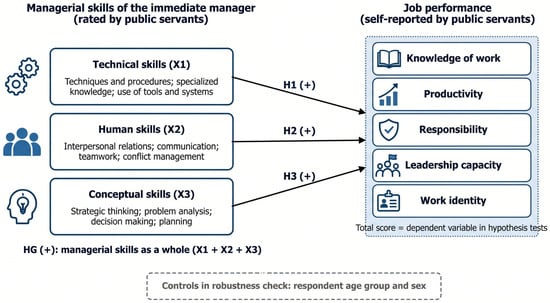
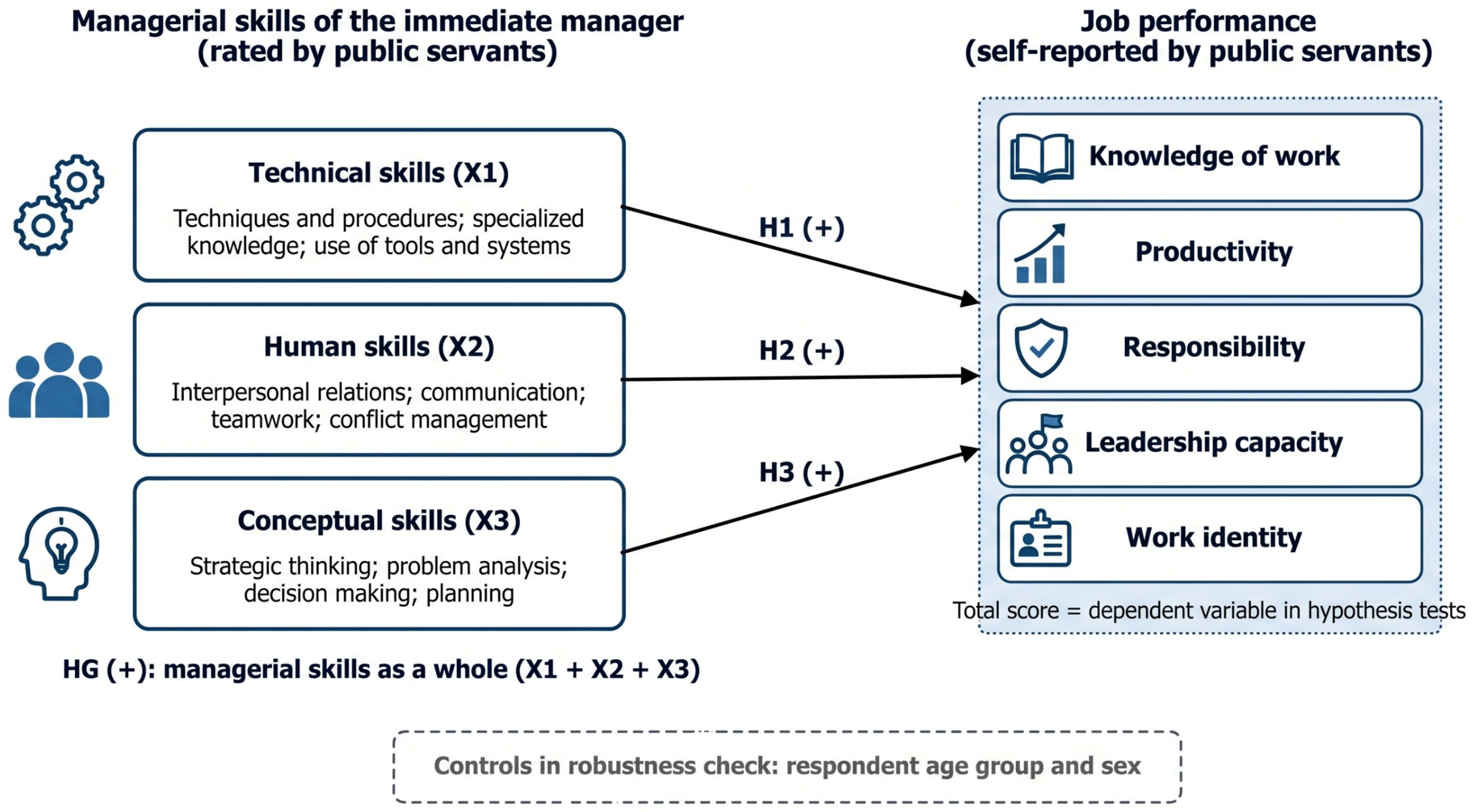
Figure 1 presents the conceptual model of this study, integrating Katz’s three dimensions as independent variables and five performance dimensions as dependent variables. The hypothesis tests use the total job performance score, the five dimensions are examined descriptively in Section 4, and respondents’ age and sex are used as controls in a robustness check (Section 4.4).
Figure 1.
Conceptual model: Relationship between managerial skills and job performance. Source: Prepared by the authors based on Katz (1974), Chiavenato (2019), Goleman (2017), and Campbell et al. (1993).
2.2. Job Performance in the Public Sector
Job performance is defined as the set of measurable behaviors through which employees contribute to organizational objectives, encompassing both task execution and contextual behaviors that sustain institutional climate and cooperation (Campbell & Wiernik, 2015; Chiavenato, 2010). Campbell et al. (1993) propose a multifactorial model distinguishing task performance—specific to the role—from contextual performance—voluntary behaviors that sustain the organizational environment. In the Peruvian public sector, the Civil Service Authority (SERVIR—Autoridad Nacional del Servicio Civil, 2015) establishes four performance dimensions: achievement of objectives, continuous improvement, teamwork, and institutional commitment. For this study, job performance is operationalized across five dimensions following Rodríguez-Marulanda and Lechuga-Cardozo (2019) and Palacios (2024): knowledge of work, productivity, responsibility, leadership capacity, and work identity. In this study, job performance refers to the performance of the public servants who report to each manager, as reported by the servants themselves, whereas managerial skills are those of their immediate managers as observed by these servants.
The mechanism linking managerial skills to employee performance operates primarily through organizational climate: managers with stronger interpersonal and analytical competencies generate environments of greater role clarity, effective communication, and continuous feedback, which are established mediators of individual performance (Robbins & Judge, 2013). Chiquillo et al. (2023) demonstrated that effective communication and leadership in the workplace directly impact employee motivation and climate. Olivos et al. (2023), reviewing human talent management in the Peruvian public sector, underline that public service efficiency depends not only on technical knowledge but also on the development of interpersonal competencies across all organizational levels.
2.3. Research Gap and Hypotheses
The dominant limitation in the Latin American managerial skills literature is the analysis of the construct as a global aggregate. Castillo Castillo and Castillo Ortega (2022) reported a positive association between global managerial skills and performance in an Ecuadorian university faculty—but did not disaggregate which dimension drove the relationship. Ibarra-Morales et al. (2023) found a positive association between global managerial skills and competitiveness in Mexican firms; Campoverde et al. (2024) confirmed similar results in Ecuadorian tourism companies; and Orellana Orellana et al. (2025) documented strategic planning and managerial skills associations with institutional sustainability in Ecuadorian financial cooperatives—all without dimensional disaggregation.
Monge Campas et al. (2025) represent a meaningful partial exception: applying structural equations in Mexican restaurant firms, they found that only teamwork and conflict management—both human skills—had direct effects on operational employee performance, reinforcing Katz’s hierarchical differentiation logic. Pereda et al. (2014), studying 412 Spanish public administration managers, found that innovation orientation—a conceptual competency—and organizational tenure, not technical mastery, were the primary predictors of managerial advancement. Laghari et al. (2021) demonstrated in Pakistani secondary schools that headteachers’ conceptual skills had a significant positive impact on teacher performance.
The present study closes this gap in the context of a Latin American regional government, testing three specific hypotheses alongside a general one:
- HG (General). Managerial skills as a whole relate positively and significantly to job performance.
- H1. Technical skills relate positively and significantly to job performance.
- H2. Human skills relate positively and significantly to job performance.
- H3. Conceptual skills relate positively and significantly to job performance.
Katz’s hierarchical logic suggests that, for managers, the association should be weaker for technical skills than for human and conceptual skills. If H2 and H3 are supported but H1 is not, technical training for managers would be expected to yield lower returns than the development of interpersonal and strategic-analytical competencies.
3. Methodology
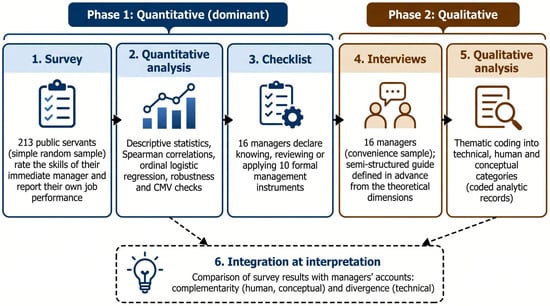
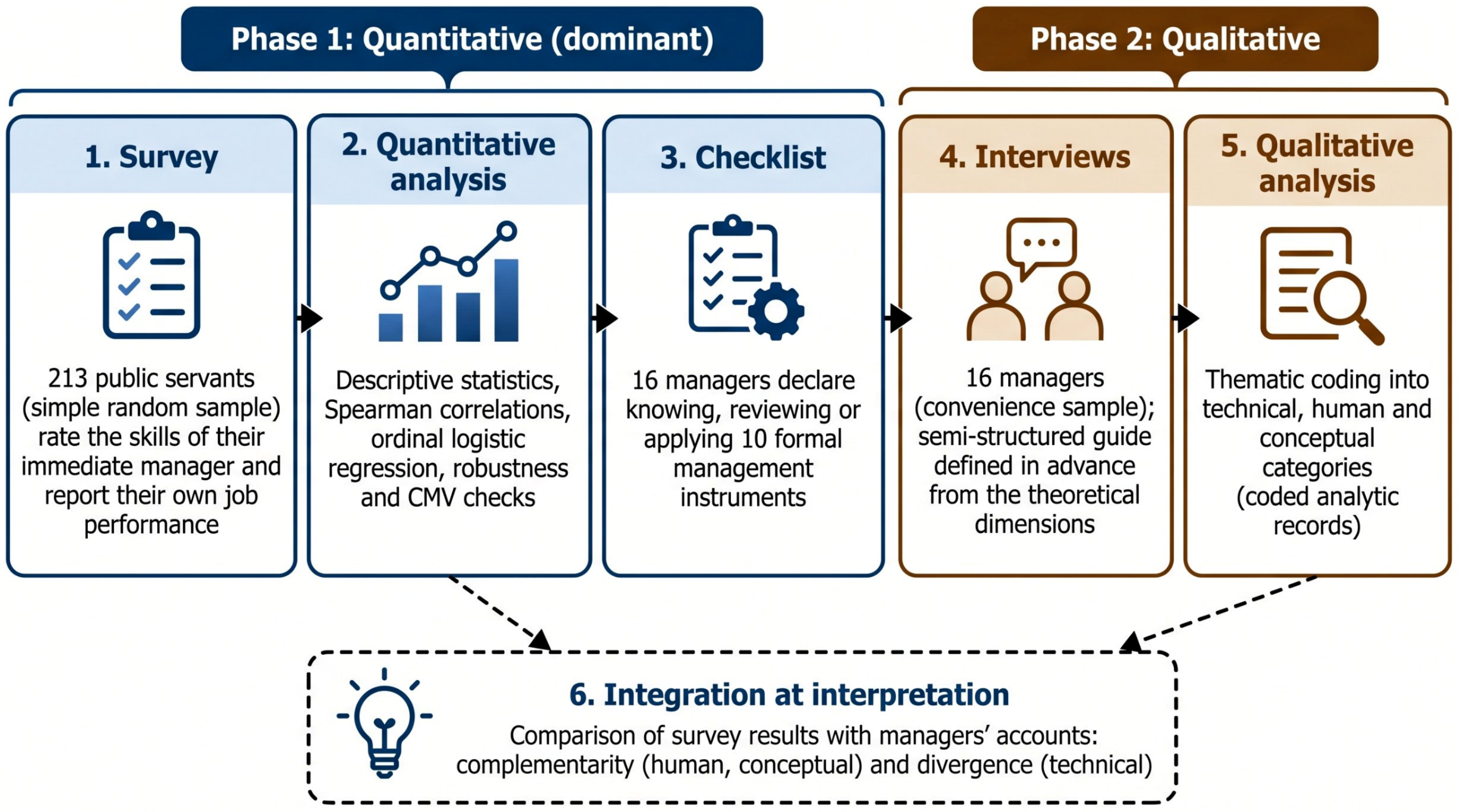
The study adopted a sequential mixed-methods design with quantitative predominance (Creswell & Plano Clark, 2018; Hernández & Mendoza, 2018): the survey was conducted and analyzed first, and the qualitative phase followed. The interview guide was defined in advance from the theoretical dimensions of both variables, so the two phases were integrated during the comparative analysis and interpretation rather than through the design of the qualitative phase. The study is applied and correlational, with a non-experimental, observational, cross-sectional design. Figure 2 presents the sequential structure of the design.
Figure 2.
Sequential mixed-methods design with quantitative predominance and integration at interpretation. Source: Prepared by the authors based on Creswell and Plano Clark (2018).
3.1. Research Site, Sample, and Rating Design
The research site was the Tacna Regional Government (GRT), a subnational institution whose central headquarters integrates 476 public servants under three contractual modalities: administrative services contract (CAS, Legislative Decree N.° 1057), permanent civil service (Legislative Decree N.° 276), and judicial reinstatement. This diversity of modalities reflects the structural heterogeneity of Peruvian regional governments.
For the quantitative phase, the sample size was calculated using the finite population formula with 95% confidence (Z = 1.96), 5% estimation error, and p = q = 0.50, yielding n = 213 public servants, selected by simple random sampling according to their location in the GRT’s departments, sub-departments, and offices. In the sample, 212 respondents (99.5%) were employed under contract and one under the permanent civil service regime, so permanent staff are under-represented relative to the population; 68.5% were women, and respondents were aged 20–29 (28.6%), 30–39 (52.6%), and 40–49 years (18.8%).
Respondents did not assess their own managerial skills. Each public servant completed two questionnaires with different referents: in the Managerial Skills Questionnaire, every item refers to the respondent’s immediate manager (e.g., “My boss communicates fluently, clearly, and concisely”), that is, the head of the area, sub-department, or office to which the respondent belonged; in the Job Performance Questionnaire, every item refers to the respondent’s own work (e.g., “Do you fulfill all the functions and responsibilities inherent to your position?”). Managerial skills are therefore measured at the managerial level through subordinate (upward) ratings—the dominant source of information on managerial behavior in public sector leadership research (Backhaus & Vogel, 2022)—and the study examines whether the skills that public servants observe in their immediate manager are associated with their own job performance. Because the questionnaire did not record respondents’ positions, a small number of respondents with supervisory duties may be included in the sample. Moreover, because respondents of the same work unit rated the same manager, their ratings are not fully independent. Both issues are addressed in Section 5.5.
3.2. Instruments
Two five-point Likert instruments were applied; the first refers to the respondent’s immediate manager and the second to the respondent’s own performance. The Managerial Skills Questionnaire (23 items; 1 = Never, 5 = Always) organized three dimensions—technical (items 1–6, range 6–30), human (items 7–16, range 10–50), and conceptual (items 17–23, range 7–35)—adapted from Castillo (2023), who reported Cronbach’s = 0.975. In the present sample, = 0.959 (technical = 0.938; human = 0.943; conceptual = 0.925). The Job Performance Questionnaire (20 items; 1 = Never, 5 = Always) organized five dimensions of four items each—knowledge of work, productivity, responsibility, leadership capacity, and work identity—designed by Rodríguez-Marulanda and Lechuga-Cardozo (2019) and adapted to the Peruvian public sector by Palacios (2024), who reported = 0.962; in the present sample, = 0.980. Both instruments were validated by three independent expert judges through content validity assessment, which rated both as fully applicable. Item 13 of the Managerial Skills Questionnaire (“My boss makes important decisions unilaterally or partially”) is worded in the opposite direction to the other items. Before the final analysis, three treatments of this item were compared: direct scoring, reverse scoring, and exclusion. Under direct scoring, the item correlated positively with the rest of the scale and internal consistency was highest (human skills = 0.943), whereas reverse scoring produced a negative corrected item–total correlation and lowered to 0.861; exclusion yielded = 0.935. Direct scoring was therefore retained, and Section 4.4 shows that the results do not change under reverse scoring or exclusion. A preliminary internal-consistency check was performed on the first 14 completed questionnaires ( = 0.982 for managerial skills and 0.990 for job performance); because these cases were later included in the final sample, this check is not an independent pilot test.
The classification levels used to categorize managerial skills and job performance scores (see Tables 2 and 3 in Section 4) were defined a priori from the theoretical score range of each scale, using three contiguous intervals of approximately equal width (e.g., total managerial skills: poor 23–53, regular 54–84, good 85–115; total job performance: deficient 20–47, efficient 48–74, very efficient 75–100; four-item performance dimensions: 4–9, 10–15, 16–20), and were not adjusted to the observed distribution. The high internal consistency coefficients—particularly for job performance ( = 0.980)—warrant methodological comment. While confirmatory factor analysis (CFA) could further examine the dimensional structure, the present study relied on instruments previously validated through expert judgment and reliability analysis (Castillo, 2023; Palacios, 2024). Excessively high values may indicate item redundancy; however, in five-point Likert instruments measuring behaviorally proximate constructs across related performance dimensions, strong inter-item correlations are theoretically expected. The five-dimensional structure was retained to maintain comparability with the original validation studies and with the Peruvian public sector performance framework established by SERVIR—Autoridad Nacional del Servicio Civil (2015).
3.3. Common Method Bias: Procedural and Statistical Remedies
Because both instruments were answered by the same respondents at a single point in time, common method variance could inflate the observed associations (Podsakoff et al., 2003, 2012). This concern is particularly relevant in public administration research, where same-source survey designs predominate (George & Pandey, 2017; Jakobsen & Jensen, 2015). Following Podsakoff et al. (2012), remedies were applied both before data collection (ex ante) and after it (ex post).
Ex ante, (i) respondents were guaranteed anonymity and confidentiality in the informed consent and in the questionnaire instructions, and no names or other direct identifiers were recorded with the responses, which reduces evaluation apprehension and socially desirable responding; (ii) managerial skills and job performance were measured with two separate instruments of different origin and, above all, different referents (the immediate manager versus the respondent), which introduces a degree of psychological separation between predictor and criterion, although both were completed in a single session; and (iii) the qualitative phase drew on a different source—the managers themselves—so that the interpretation of the quantitative results does not rest exclusively on subordinate ratings.
Ex post, four procedures were applied. First, Harman’s single-factor test was performed on the 43 items, as is common in survey-based management research (Corvello et al., 2020). Second, because Harman’s test alone cannot rule out common method variance (Podsakoff et al., 2003), the marker-variable technique of Lindell and Whitney (2001) was used as a sensitivity analysis. Following Lindell and Whitney (2001), who propose the smallest observed correlation among the study variables as a conservative proxy for common method variance when no a priori marker is available, the correlation between technical skills and job performance ( = 0.120)—the smallest correlation among the study’s skill and performance scores, obtained from the same respondents, instruments, and response format—was used as the estimate of the common method component (), and all correlations were adjusted as . Because technical skills are themselves a substantive predictor, this adjustment is likely to overcorrect. Third, the analyses were repeated excluding respondents who gave the same answer to every item of either instrument (straight-lining), a response pattern associated with careless or acquiescent responding. Fourth, the pattern of results was examined; this is a weak indication only, because the correlation used as is itself part of that pattern.
3.4. Statistical Analysis
Normality was assessed using the Kolmogorov–Smirnov test with Lilliefors correction. Given the non-normal distributions for both variables (D = 0.124, p < 0.001 for managerial skills; D = 0.114, p < 0.001 for job performance), Spearman’s rank correlation coefficient () was employed with = 0.05, testing one general and three specific hypotheses; 95% confidence intervals were obtained through Fisher’s z transformation.
To identify the independent predictive contribution of each skill dimension while controlling for their inter-correlations, ordinal logistic regression (proportional odds model) was conducted as the primary multivariate analysis, with the three-level job performance classification (deficient, efficient, very efficient) as the dependent variable and standardized (z-score) skill dimension scores as independent variables. Model fit was assessed through log-likelihood, AIC, and pseudo-. Variance inflation factors (VIFs) were computed to assess multicollinearity. Robustness was examined through additional models: (a) adding respondents’ age group and sex as controls; (b) excluding item 13 from the human-skills score; (c) reverse-scoring item 13; (d) combining human and conceptual skills into a single composite to assess the consequences of their overlap; (e) a model with conceptual skills only; (f) a binary logistic regression (very efficient versus other levels), because only two respondents fell in the deficient category; and (g) the main model excluding straight-lining respondents. The discriminant validity of human and conceptual skills was further assessed through their correlation corrected for attenuation.
3.5. Qualitative Phase
A semi-structured interview guide was applied to 16 GRT managers, sub-managers, and area heads selected by convenience sampling, considering availability, voluntary participation, and the exercise of managerial responsibilities. The guide was organized in advance around the theoretical dimensions of managerial skills and job performance and explored: development and application of managerial skills; perceived influence on institutional performance; and strategies for team leadership and complex decision-making. A ten-item management instrument proficiency checklist was additionally applied. Qualitative analysis followed thematic content analysis with a priori and emergent categories: units of meaning were assigned descriptive codes, which were grouped into the categories of technical, human, and conceptual skills. Office names and specific positions were removed to protect participants’ identity. Because the complete verbatim transcripts could not be recovered, the qualitative results are reported as coded analytic records rather than as literal quotations.
3.6. Ethical Compliance
All participants provided prior informed consent guaranteeing anonymity and data confidentiality. The study adhered to the National Code of Scientific Integrity of Universidad Continental and the Personal Data Protection Act N.° 29733 (Peru). Ethics approval was granted by the Institutional Ethics Committee of Scientific Research of Universidad Continental (CIEI-UC; reference: OFICIO N.° 1284-2025-CIEI-UC; date: 9 October 2025). Data were collected after this approval was granted.
4. Results
4.1. Descriptive Results
Table 1 presents the descriptive statistics for both variables. Managerial skills scores ranged from 28 to 115 (M = 85.53, = 12.24), while job performance scores ranged from 20 to 100 (M = 79.06, = 13.62).
Table 1.
Descriptive statistics for managerial skills and job performance (n = 213).
Table 2 presents the distribution of respondents’ ratings of their managers by managerial skills level. The good level predominates overall (55.40%), followed by regular (44.13%), with minimal poor representation (0.47%). Dimensional analysis reveals a differentiated pattern: technical skills present the highest good-level concentration (64.32%), while human and conceptual skills are concentrated at the regular level (54.93% and 57.28%, respectively). This distributional pattern has direct policy meaning: the dimensions with the greatest improvement opportunity—human and conceptual skills—are precisely those showing the strongest correlations with performance.
Table 2.
Distribution of managerial skills levels by dimension (n = 213).
Table 3 presents the job performance distribution. The very efficient level predominates (68.54%), followed by efficient (30.52%). Responsibility (70.42%) and work identity (68.08%) register the highest very efficient concentrations. Leadership capacity (58.22%) and productivity (61.03%) show greater distribution between efficient and very efficient levels, indicating improvement potential in dimensions most directly linked to managerial direction. Because performance was self-reported, these high levels may partly reflect leniency in self-assessment.
Table 3.
Distribution of job performance levels by dimension (n = 213).
4.2. Inferential Results: Spearman Correlations
Table 4 presents the central inferential findings. The general hypothesis (HG) is supported: managerial skills relate positively and significantly to job performance ( = 0.439, 95% CI [0.324, 0.542], p < 0.001). The dimensional disaggregation reveals the differential pattern that constitutes this study’s primary theoretical contribution. H1 is not supported: technical skills show no significant relationship with performance ( = 0.120, p = 0.081; the confidence interval includes zero). H2 is supported: human skills demonstrate a moderate positive relationship ( = 0.503, p < 0.001). H3 is supported: conceptual skills show an association of similar magnitude ( = 0.525, p < 0.001).
Table 4.
Spearman rank correlations: managerial skill dimensions and job performance (n = 213).
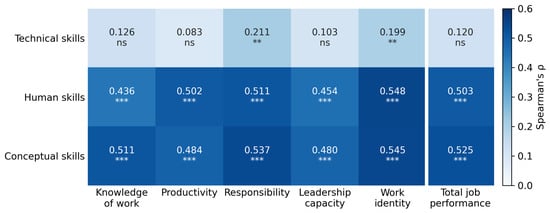
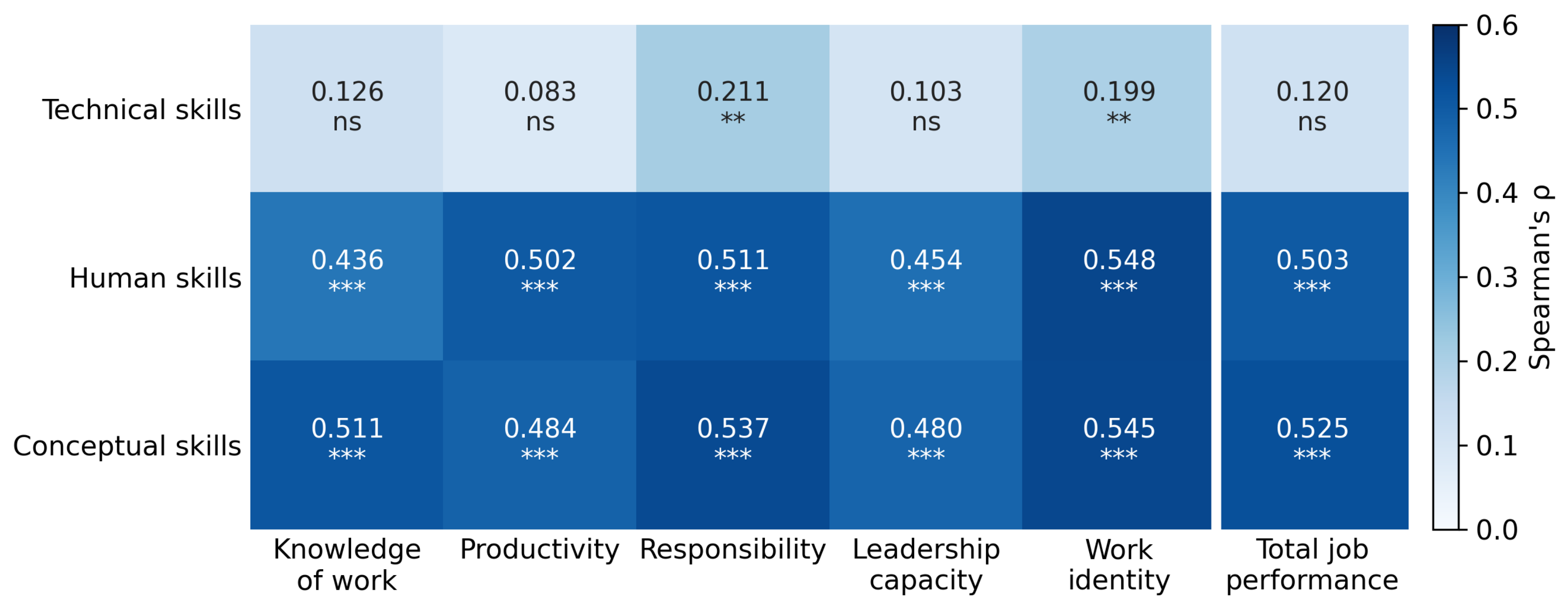
Figure 3 presents a detailed heatmap of Spearman correlations across all skill and performance sub-dimensions. Technical skills show weak correlations with all performance dimensions, reaching significance only for responsibility ( = 0.211, p = 0.002) and work identity ( = 0.199, p = 0.004), while human and conceptual skills exhibit moderate positive associations with every performance dimension, with the strongest associations observed for work identity ( = 0.548 and 0.545, respectively).
Figure 3.
Spearman rank correlations: managerial skill dimensions × job performance dimensions (n = 213). Significance: *** p < 0.001; ** p < 0.01; ns = not significant.
4.3. Ordinal Logistic Regression
To complement the bivariate correlations with a multivariate analysis that simultaneously controls for inter-dimensional collinearity and identifies the independent predictive contribution of each skill dimension, ordinal logistic regression (proportional odds model) was conducted with standardized skill scores as predictors. Table 5 presents the results. VIF values (technical = 1.49; human = 3.78; conceptual = 3.18) remained below the conventional threshold of 5, although the value for human skills indicates substantial shared variance with conceptual skills.
Table 5.
Ordinal logistic regression: managerial skill dimensions predicting job performance level (n = 213).
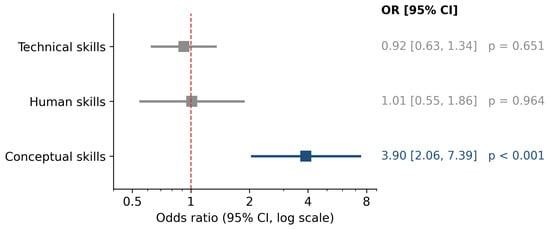
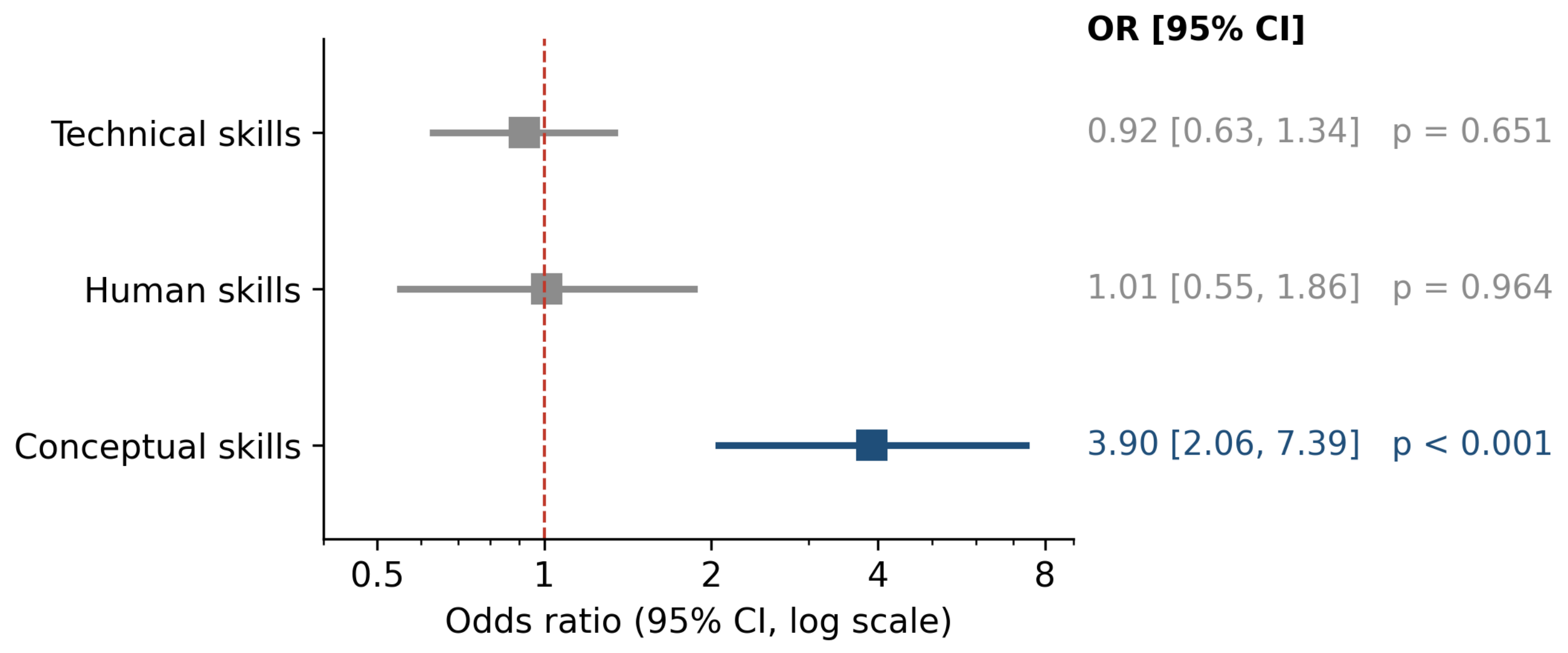
The ordinal regression results refine the bivariate correlational findings, while human skills showed a significant bivariate correlation with performance ( = 0.503), their unique contribution was not significant once conceptual skills were included ( = 0.014, p = 0.964), attributable to the high inter-correlation between the two dimensions ( = 0.792). Conceptual skills emerged as the sole significant unique predictor (OR = 3.90, p < 0.001): for each standard deviation increase in conceptual skills, the odds of being in a higher performance category increased almost fourfold. Technical skills were non-significant and showed a slightly negative coefficient.
Figure 4 presents a forest plot of the ordinal regression odds ratios.
Figure 4.
Forest plot: ordinal logistic regression odds ratios for managerial skill dimensions predicting job performance level (n = 213). Dashed line at OR = 1 represents no effect.
To verify that the result for conceptual skills was not an artifact of the collinearity structure and to test model parsimony, a reduced model including only conceptual skills was estimated. The conceptual-skills-only model yielded = 1.322, SE = 0.209, p < 0.001 (OR = 3.75, 95% CI [2.49, 5.66]), with AIC = 236.5 and pseudo- = 0.186. Compared to the full three-predictor model (AIC = 240.3, pseudo- = 0.187), the parsimonious model achieved a lower AIC with virtually identical explanatory power, indicating that technical and human skills add little predictive information beyond conceptual skills in the multivariate context.
4.4. Robustness Analyses and Common Method Variance
Harman’s single-factor test showed that the first unrotated factor accounted for 48.29% of the total variance of the 43 items, below the conventional 50% threshold, with five factors showing eigenvalues above 1.0. Because this value is close to the threshold and Harman’s test is a weak diagnostic, the marker-variable adjustment was also applied. Table 6 shows that, after removing the estimated common method component ( = 0.120), the associations of global, human, and conceptual skills with job performance decreased by approximately 0.06–0.08 but remained moderate and highly significant ( between 0.363 and 0.461; all p < 0.001). Straight-lining was frequent: 67 respondents (31.5%) gave the same answer to all 20 performance items and 29 (13.6%) to all 23 managerial skills items. Excluding the 75 respondents who straight-lined either instrument (n = 138), the correlations with job performance were 0.342 for global, 0.032 for technical, 0.403 for human, and 0.415 for conceptual skills (all p < 0.001 except technical skills), reproducing the pattern of the full sample.
Table 6.
Spearman correlations with job performance before and after marker-variable adjustment (n = 213).
Table 7 summarizes the alternative ordinal specifications. Controlling for respondents’ age group and sex left the results unchanged (conceptual skills: OR = 3.64, 95% CI [1.89, 7.01]). Excluding item 13 from the human-skills score, or reverse-scoring it, also produced the same pattern (conceptual skills: OR = 3.71, 95% CI [1.98, 6.94], and OR = 3.53, 95% CI [1.92, 6.49], respectively; human skills non-significant in both cases). When human and conceptual skills were combined into a single relational–strategic composite, the composite was a strong predictor (OR = 3.54, 95% CI [2.26, 5.54]), whereas technical skills remained non-significant. A binary logistic model (very efficient versus other levels) produced the same result (conceptual skills: OR = 3.91, 95% CI [2.02, 7.56]), and in the subsample without straight-lining respondents conceptual skills remained the only significant predictor, with a smaller effect (OR = 2.01, 95% CI [1.02, 3.93], p = 0.042).
Table 7.
Robustness of the ordinal logistic regression to alternative specifications (n = 213 unless otherwise stated).
Finally, the Pearson correlation between human and conceptual skills was 0.827 (Spearman = 0.792), and its value corrected for attenuation was 0.886. This indicates that, as perceived by subordinates, the two dimensions overlap substantially and are only partially distinguishable empirically, which must be considered when interpreting their separate coefficients (Section 5.3).
4.5. Management Instrument Proficiency
Table 8 presents the management instrument proficiency checklist results. The checklist employed a binary format (yes/no) to assess whether each manager knew, had reviewed, or routinely applied each institutional document—thus capturing declared awareness and routine use rather than depth of mastery. All 16 managers marked “yes” for the ten formal management instruments—including the Organizational Functions Regulation (ROF), the Organization and Functions Manual (MOF), the Institutional Strategic Plan (PEI), the Institutional Operating Plan (POI), and the Regional Concerted Development Plan (PDRC). This result describes only the managers who completed the checklist, who cannot be matched to the managers rated by the survey respondents; it is therefore used as contextual information rather than as an explanation of the survey results.
Table 8.
Management instrument proficiency checklist results (n = 16 managers).
4.6. Qualitative Findings
The 16 interview records (coded E01–E16) were organized into the categories of technical, human, and conceptual skills. As noted in Section 3.5, they are coded analytic records rather than verbatim quotations.
Regarding the development and application of managerial skills, the records showed differences according to the responsibilities assumed. Some participants concentrated on regulatory and technological command, whereas others gave greater weight to communication, coordination, planning, and problem analysis. E01–E03 described skill development through professional training, regulatory updating, and the use of technical tools, combined with coordination with others; E10–E12 associated it with administrative systems, spreadsheets, project formulation, planning, and analysis of causes; and E13–E16 mentioned communication, budgeting, supervision, analysis, and planning tools, together with continuous training and coordination across areas.
In the technical category, E01, E04, E05, and E07 referred to knowledge of regulations and procedures; E02, E03, E11, and E15 described specialized software, diagnostic equipment, design tools, or management applications; E08, E09, E10, and E14 mentioned administrative systems, data platforms, and computer tools used to process information and control operations; and E06, E12, E13, and E16 referred to document management platforms, spreadsheets, communication systems, and institutional systems. The category grouped codes of regulatory updating, command of procedures, system management, and digital tools, with differences linked to each participant’s activities.
In the human category, E01–E03 related staff leadership to clear communication, dialogue, teamwork, recognition of performance, and the search for agreement when disagreements arose; E04–E06 described working relationships based on respect, objectivity, tolerance, and listening; E07–E09 referred to frequent communication, staff participation, task distribution, and recognition of capabilities to reduce misunderstandings; E10–E12 mentioned respectful treatment, impartiality, empathy, active listening, and assignment of responsibilities according to staff capabilities; and E13–E16 described communication, recognition, respect for opinions, and negotiation. The codes grouped under communication, respect, dialogue, coordination, recognition, and conflict management; no openly contrary positions were identified, and differences appeared only in emphasis. This emphasis on developmental, relational practices is consistent with Ferozi and Chang (2021) and Hill and Plimmer (2024).
In the conceptual category, all records linked planning to institutional objectives and decisions. E01 and E02 connected planning with regulatory compliance, problem prioritization, and assignment of responsibilities, mentioning prior analysis as part of decision-making; E05 and E06 referred to goals, diagnostics, indicators, and review of situations before proposing alternatives; E09 and E10 described technical evaluation, budget monitoring, and indicators linked to the PEI and POI; and E11 and E12 associated planning with public investment, service gaps, budgets, and development plans, mentioning scenario analysis and the review of technical, legal, or social criteria for complex decisions. The category grouped codes of planning, prioritization, diagnosis, scenario analysis, coordination, and decision-making, with applications that differed according to each participant’s functions.
Integrating both phases, the qualitative records complement the quantitative results for human and conceptual skills, for which they describe recurrent relational and planning practices, and diverge for technical skills, which managers described extensively although technical skills showed no significant association with performance in the survey. The qualitative records describe how managers apply their skills; they are not evidence of a causal relationship.
5. Discussion
This section discusses each hypothesis in relation to the theoretical framework in Section 2, integrates the quantitative and qualitative evidence, and sets out the limitations of the study.
5.1. General Hypothesis: Managerial Skills as an Aggregate
The general hypothesis was supported: managerial skills as a whole were positively associated with the job performance of the public servants who report to these managers ( = 0.439). This magnitude is consistent with the meta-analytic evidence of Backhaus and Vogel (2022), who report moderate leadership–performance associations in public organizations and intermediate effect sizes in Latin American administrative environments, and it is in line with the positive global associations reported in Ecuadorian and Mexican studies (Campoverde et al., 2024; Castillo Castillo & Castillo Ortega, 2022; Ibarra-Morales et al., 2023). The aggregate coefficient, however, is the least informative result of the study. It is lower than the coefficients for human ( = 0.503) and conceptual skills ( = 0.525) taken separately, because the global score includes a dimension—technical skills—that is not significantly associated with performance. In other words, the global coefficient averages a non-significant component with two substantive ones and therefore misrepresents all three. This is the central methodological argument for disaggregation: studies that report only the aggregate association cannot tell decision-makers which skills to develop, and they implicitly attribute part of the observed association to technical training.
5.2. H1: Technical Skills
H1 was not supported: managers’ technical skills showed no significant association with total job performance ( = 0.120, p = 0.081; 95% CI [−0.015, 0.250]) and no unique contribution in the multivariate model (OR = 0.92, p = 0.651). The confidence interval does not exclude a small positive association, so the result should be read as the absence of evidence of an association rather than as evidence of no association. Even so, the contrast with human and conceptual skills is consistent with Katz’s (1974) hierarchical logic, according to which the relevance of technical skills declines as managers move up the organizational hierarchy, and with the distinction drawn by Boyatzis (1982) between threshold and differentiating competencies. A plausible interpretation, which the present data cannot test, is that technical mastery behaves as a threshold competency: managers need it to occupy their positions, but beyond that threshold it does not differentiate the performance of their teams, in line with the iceberg model of Spencer and Spencer (1993), in which visible technical knowledge forms only the surface of competence. The checklist, in which all 16 managers declared knowing or applying the formal management instruments, provides contextual support for this reading, although those managers cannot be matched to the managers rated in the survey.
Two qualifications are necessary. First, technical skills were weakly but significantly associated with two specific performance dimensions—responsibility ( = 0.211) and work identity ( = 0.199)—which suggests that a manager’s technical command of procedures may still support compliance-related aspects of staff performance. Second, the result concerns the technical skills of managers as perceived by their staff in a single institution; it says nothing about the importance of technical skills for the staff’s own work, and it should not be generalized to institutions where basic technical proficiency among managers is not yet consolidated.
5.3. H2 and H3: Human and Conceptual Skills and Their Overlap
H2 and H3 were supported at the bivariate level: human ( = 0.503) and conceptual skills ( = 0.525) were both moderately and positively associated with job performance, and these associations remained significant after adjustment for common method variance ( = 0.435 and 0.461). These results are consistent with Mintzberg (2009), whose interpersonal and decisional roles presuppose human and conceptual capabilities; with Goleman (2017), who emphasizes the social and emotional components of effective leadership; and with public sector evidence showing that relational and supportive leadership behaviors are associated with better outcomes (Martins et al., 2026; Villarroel-Nuñez et al., 2026). They also converge with Pereda et al. (2014), who found that a conceptual competency—innovation orientation—rather than technical mastery predicted managerial advancement in Spanish public administration, and with Monge Campas et al. (2025), who found that specific human skills were the only dimensions with direct effects on performance.
The multivariate result requires more cautious interpretation than a simple ranking of the two dimensions. Conceptual skills were the only significant unique predictor, while the unique contribution of human skills was not significant. This does not imply that human skills are unimportant. Human and conceptual skills were highly correlated ( = 0.792; Pearson r = 0.827, or 0.886 after correction for attenuation), and their VIF values (3.78 and 3.18) show that most of their variance is shared. With such overlap, the regression assigns the shared variance to whichever predictor is marginally more strongly related to the outcome, and the separate coefficients become unstable. Two interpretations are compatible with the data. The first is substantive: subordinates may perceive human and conceptual skills as a single relational–strategic repertoire, because the managers who plan, prioritize, and diagnose well are typically the same managers who communicate clearly and build consensus. The second is methodological: subordinate ratings may be affected by a general evaluative impression of the manager (a halo effect), which increases the correlation between dimensions. The robustness analysis supports caution in both cases. When the two dimensions were combined, the composite was a strong predictor (OR = 3.54), which shows that the substantive conclusion—that the relational–strategic repertoire of managers, not their technical mastery, is associated with the performance of their staff—does not depend on separating them.
The qualitative evidence is consistent with this interpretation but cannot settle it. Managers described communication, respect, and teamwork as recurrent practices and connected planning, diagnosis, and prioritization with institutional plans and decisions; the two repertoires appeared side by side in the same records. The finding that conceptual skills “absorb” the effect of human skills should therefore be read as a statement about statistical overlap in this sample rather than about the theoretical redundancy of interpersonal competencies, and the slightly larger bivariate coefficient for conceptual skills ( = 0.525 versus 0.503) does not by itself establish that one dimension is more important than the other.
5.4. Theoretical and Practical Implications
Theoretically, the study is consistent with the hierarchical differentiation proposed by Katz in a setting—a Latin American regional government—where it has rarely been tested at the dimension level. At the same time, it suggests a refinement: for managers’ skills as perceived by their staff, the boundary between human and conceptual skills may be less sharp in practice than in Katz’s original typology, at least from the perspective of subordinates. This is consistent with the policy capacity framework of Wu et al. (2015), in which analytical and political (relational) competencies operate jointly, and with the finding of Kruyen and Van Genugten (2020) that public managers’ essential competencies cannot be reduced to a single dimension. Practically, the results suggest that additional generic training for managers in procedures and formal instruments may yield limited returns for the performance of their teams where managers declare that these are already known, and that development programs could target strategic planning and interpersonal leadership together rather than as separate modules.
5.5. Limitations and Future Research
Several limitations must be acknowledged. First, the cross-sectional design precludes causal inference; the associations reported here should not be read as effects of managers’ skills on staff performance. Second, both questionnaires were answered by the same respondents in a single session, so common method variance cannot be ruled out. The different referents of the two instruments, the Harman test (48.29%, close to the 50% threshold), the marker-variable adjustment, and the analysis without straight-lining respondents reduce but do not eliminate this concern; the adjusted coefficients should be considered the more conservative estimates. Several features of the data point to response styles that may inflate associations: item 13, worded in the opposite direction, was answered in the same direction as the other items, and almost one-third of respondents gave identical answers to all performance items. When these respondents were excluded, the association for conceptual skills in the multivariate model remained significant but was smaller. Third, job performance was self-reported. Self-assessments tend to be lenient—68.54% of respondents rated their performance as very efficient—and are not a substitute for supervisor evaluations or objective indicators. Fourth, managerial skills were measured through subordinates’ perceptions, which may be influenced by a general evaluative impression of the manager and may contribute to the high correlation between human and conceptual skills. Fifth, respondents’ positions were not recorded, so a small number of respondents with supervisory duties may be included; and respondents belonging to the same work unit rated the same manager, so the observations are nested and not fully independent. Because manager identifiers were not recorded with the anonymous responses, it was not possible to aggregate ratings by manager or to estimate multilevel models, and the standard errors reported may be underestimated. Sixth, the high overlap between human and conceptual skills limits the precision with which their separate contributions can be estimated. Seventh, the preliminary reliability check used the first 14 questionnaires of the final sample rather than an independent pilot, and permanent staff were under-represented in the sample. Eighth, the complete verbatim interview transcripts could not be recovered, so the qualitative analysis rests on coded analytic records, which limits its literal verification; the 16 interviewed managers also cannot be matched to the managers rated in the survey. Ninth, the 100% rate in the management instrument checklist reflects declared awareness and routine use of institutional documents, measured in a binary format, not depth of mastery. Finally, the single regional government setting (Tacna, population ∼370,000, southern border region) recommends caution in generalization; results may differ in larger, more complex regional governments such as Lima or Arequipa.
Future research should (i) record the manager rated by each respondent so that ratings can be aggregated and analyzed with multilevel models; (ii) obtain performance measures from a different source, such as supervisors’ evaluations, administrative performance records, or citizen assessments, which would break the common-source link and reduce self-assessment leniency; (iii) test the dimensional structure of the instruments through confirmatory factor analysis, examine the discriminant validity of human and conceptual skills, and revise the wording of item 13; (iv) use longitudinal or quasi-experimental designs to evaluate whether training in interpersonal and strategic competencies improves the performance of their teams; and (v) compare multiple regional governments with different levels of institutional capacity.
6. Conclusions
This study makes three principal contributions to public administration scholarship and reform practice. First, it provides empirical evidence consistent with Katz’s (1974) hierarchical skills model in a Latin American regional government context. Managers’ technical skills were not significantly associated with the job performance of their staff (H1 not supported: = 0.120, p = 0.081), while human and conceptual skills showed significant positive associations (H2 supported: = 0.503; H3 supported: = 0.525; both p < 0.001). In the ordinal logistic regression, conceptual skills were the only significant unique predictor (OR = 3.90, p < 0.001), although the strong overlap between human and conceptual skills means that the two are best understood as a joint relational–strategic repertoire.
Second, the study demonstrates the methodological value of disaggregating managerial skills dimensions in public administration research. Treating the construct as a global aggregate—the predominant practice in the Latin American literature—produces a coefficient that blends a non-significant technical component with substantive human and conceptual components. The disaggregated model suggests where training investment could be directed: toward conceptual and human competencies of managers rather than toward operational-technical skills.
Third, the sequential mixed-methods design demonstrates its analytical value for public administration research. The comparison between public servants’ survey responses and managers’ own accounts showed complementarity for human and conceptual skills and divergence for technical skills, providing a more comprehensive understanding of how managers apply the skills associated with staff performance.
The policy implications are relevant for administrative reform, with the caveats set out in Section 5.5. Regional governments and analogous Latin American subnational institutions could realign their managerial development programs from operational-technical capacity toward the systematic strengthening of interpersonal and strategic-analytical competencies, in alignment with OECD and IDB (2024) recommendations. Concretely: training programs could prioritize participative leadership, communication effectiveness, strategic planning, and organizational complexity management, developed jointly rather than as separate modules; performance evaluation systems could incorporate human and conceptual skill indicators with continuous feedback mechanisms, including upward feedback from subordinates; and capacity-building interventions could differentiate by functional area, recognizing the heterogeneity documented in the qualitative findings.
Author Contributions
Conceptualization, K.V.G.-Q. and J.C.Q.-F.; methodology, J.C.Q.-F.; validation, J.C.Q.-F.; formal analysis, K.V.G.-Q. and J.C.Q.-F.; investigation, K.V.G.-Q.; data curation, K.V.G.-Q.; writing—original draft preparation, K.V.G.-Q.; writing—review and editing, J.C.Q.-F.; visualization, K.V.G.-Q.; supervision, J.C.Q.-F.; project administration, J.C.Q.-F. All authors have read and agreed to the published version of the manuscript.
Funding
This research received no external funding.
Institutional Review Board Statement
The study was conducted in accordance with the Declaration of Helsinki, and approved by the Institutional Ethics Committee of Scientific Research of Universidad Continental (CIEI-UC; reference: OFICIO N.° 1284-2025-CIEI-UC; date: 9 October 2025).
Informed Consent Statement
Informed consent was obtained from all subjects involved in the study. The consent form was distributed to and signed by all participants prior to data collection.
Data Availability Statement
The anonymized survey dataset supporting the quantitative findings of this study (n = 213) and its codebook are openly available in Zenodo at https://zenodo.org/records/23005739 (accessed on 23 September 2026), doi: https://doi.org/10.5281/zenodo.23005739. The complete interview transcripts could not be recovered and are therefore not available; the coded analytic records of the interviews and the aggregated checklist results are reported in the article.
Conflicts of Interest
The authors declare no conflicts of interest.
Abbreviations
The following abbreviations are used in this manuscript:
| GRT | Tacna Regional Government (Gobierno Regional de Tacna) |
| ROF | Organizational Functions Regulation |
| MOF | Organization and Functions Manual |
| PEI | Institutional Strategic Plan |
| POI | Institutional Operating Plan |
| PDRC | Regional Concerted Development Plan |
| CAS | Administrative Services Contract |
| SERVIR | National Civil Service Authority |
| OR | Odds Ratio |
| VIF | Variance Inflation Factor |
| CMV | Common Method Variance |
References
- Artieda, J., Guarnizo, W., Caiza, M., & Vayas, G. (2021). Las habilidades gerenciales en la gestión pública. Revista Investigación y Negocios, 14(24), 149–156. [Google Scholar] [CrossRef]
- Álvarez, D., Montes, J., & Osorio, C. (2023). Habilidades gerenciales como factor de competitividad empresarial. Región Científica, 2(2), 2023109. [Google Scholar] [CrossRef] [Scilit]
- Backhaus, L., & Vogel, R. (2022). Leadership in the public sector: A meta-analysis of styles, outcomes, contexts, and methods. Public Administration Review, 82(6), 986–1003. [Google Scholar] [CrossRef] [Scilit]
- Blom, R., Kruyen, P. M., Van der Heijden, B. I. J. M., & Van Thiel, S. (2020). One HRM fits all? A meta-analysis of the effects of HRM practices in the public, semipublic, and private sector. Review of Public Personnel Administration, 40(1), 3–35. [Google Scholar] [CrossRef] [Scilit]
- Boyatzis, R. E. (1982). The competent manager: A model for effective performance. John Wiley & Sons. [Google Scholar]
- Brajer-Marczak, R. (2020). Review of selected performance measurement models used in public administration. Administrative Sciences, 10(4), 99. [Google Scholar] [CrossRef] [Scilit]
- Campbell, J. P., McCloy, R. A., Oppler, S. H., & Sager, C. E. (1993). A theory of performance. In N. Schmitt, & W. C. Borman (Eds.), Personnel selection in organizations (pp. 35–70). Jossey-Bass. [Google Scholar]
- Campbell, J. P., & Wiernik, B. M. (2015). The modeling and assessment of work performance. Annual Review of Organizational Psychology and Organizational Behavior, 2(1), 47–74. [Google Scholar] [CrossRef] [Scilit]
- Campoverde, J. R., Vicuña, W. G., Urgilés, J. H., & Ochoa, V. A. (2024). Habilidades gerenciales y competitividad en el sector turístico de la provincia del Cañar—Ecuador. Revista Venezolana de Gerencia, 29(Especial 11), 426–438. [Google Scholar] [CrossRef] [Scilit]
- Carazas, E., Zamalloa, T., & Aparicio, M. (2021). Competencias y habilidades gerenciales en las organizaciones empresariales. Revista Kallpay, 4(4). Available online: https://revistas.uandina.edu.pe/index.php/Kallpay/article/view/341 (accessed on 12 March 2025).
- Castillo, J. (2023). Habilidades gerenciales y desempeño laboral de los colaboradores de una institución pública, Lima [Master’s thesis, Universidad César Vallejo]. Available online: https://hdl.handle.net/20.500.12692/111877 (accessed on 12 March 2025).
- Castillo Castillo, D. C., & Castillo Ortega, Y. (2022). Habilidades gerenciales y desempeño laboral de docentes universitarios. Revista Metropolitana de Ciencias Aplicadas, 5(S1), 271–284. [Google Scholar] [CrossRef] [Scilit]
- Chiavenato, I. (2010). Gestión del talento humano (3rd ed.). McGraw-Hill. [Google Scholar]
- Chiavenato, I. (2019). Introduction to the general theory of management (9th ed.). McGraw-Hill. [Google Scholar]
- Chiquillo, J., Amaya, N., & Curiel, R. Y. (2023). Liderazgo y clima laboral en pequeñas y medianas empresas. Revista Venezolana de Gerencia, 28(103), 1295–1311. [Google Scholar] [CrossRef] [Scilit]
- Cortázar Velarde, J. C., Fuenzalida, J., & Lafuente, M. (2016). Merit-based selection of public managers: Better public sector performance? An exploratory study (Technical Note IDB-TN-1054). Inter-American Development Bank. [Google Scholar]
- Corvello, V., Chimenti, M. C., Giglio, C., & Verteramo, S. (2020). An investigation on the use by academic researchers of knowledge from scientific social networking sites. Sustainability, 12(22), 9732. [Google Scholar] [CrossRef] [Scilit]
- Creswell, J. W., & Plano Clark, V. L. (2018). Designing and conducting mixed methods research (3rd ed.). SAGE Publications. [Google Scholar]
- Cuadra, M., Cribilleros, D., Cruzado, R., & Mogollón, S. (2023). Capacitación en el sector público de Perú: Una revisión sistemática. Revista de Climatología, 23, 1566–1576. [Google Scholar] [CrossRef] [Scilit]
- Ferozi, S., & Chang, Y. (2021). Transformational leadership and its impact on employee performance: Focus on public employees in Afghanistan. Transylvanian Review of Administrative Sciences, 17(63), 49–68. [Google Scholar] [CrossRef] [Scilit]
- Franklin, E. B. (2019). Organización de empresas (5th ed.). McGraw-Hill. [Google Scholar]
- Freitas, P. F. P., & Odelius, C. C. (2022). Escala de competências gerenciais para o setor público. Cadernos EBAPE.BR, 20(2), 218–233. [Google Scholar] [CrossRef] [Scilit]
- George, B., & Pandey, S. K. (2017). We know the yin—However, where is the yang? Toward a balanced approach on common source bias in public administration scholarship. Review of Public Personnel Administration, 37(2), 245–270. [Google Scholar] [CrossRef] [Scilit] [PubMed]
- Goleman, D. (2017). Leadership that gets results. In Harvard Business Review Press (Ed.), HBR’s 10 must reads on leadership (pp. 37–58). Harvard Business Review Press. [Google Scholar]
- Hernández, R., & Mendoza, C. (2018). Metodología de la investigación: Las rutas cuantitativa, cualitativa y mixta. McGraw-Hill. [Google Scholar]
- Hill, K., & Plimmer, G. (2024). Employee performance management: The impact of competing goals, red tape, and PSM. Public Personnel Management, 53(3), 458–485. [Google Scholar] [CrossRef] [Scilit]
- Ibarra-Morales, L. E., Campechano-Escalona, E. J., Díaz de Campechano, I. C., & Paredes-Zempual, D. (2023). Habilidades directivas como factor determinante en la competitividad de empresas mexicanas. Revista Venezolana de Gerencia, 28(9), 360–376. [Google Scholar] [CrossRef] [Scilit]
- Jakobsen, M., & Jensen, R. (2015). Common method bias in public management studies. International Public Management Journal, 18(1), 3–30. [Google Scholar] [CrossRef] [Scilit]
- Katz, R. L. (1974). Skills of an effective administrator. Harvard Business Review, 52(5), 90–102. [Google Scholar]
- Kruyen, P. M., & Van Genugten, M. (2020). Opening up the black box of civil servants’ competencies. Public Management Review, 22(1), 118–140. [Google Scholar] [CrossRef] [Scilit]
- Laghari, M. A., Siddiqui, D. A., & Shaheen, A. (2021). Impact of headteachers’ conceptual skills on teacher’s performance at public secondary schools. International Research Journal of Education and Innovation, 2(2), 101–111. [Google Scholar] [CrossRef]
- Lindell, M. K., & Whitney, D. J. (2001). Accounting for common method variance in cross-sectional research designs. Journal of Applied Psychology, 86(1), 114–121. [Google Scholar] [CrossRef] [Scilit] [PubMed]
- Martins, P., Nascimento, G., Campos Fernandes, A., Palma-Moreira, A., & Vieira, P. (2026). People-centered leadership, organizational commitment and retention in public healthcare: A governance-sensitive integrative model. Administrative Sciences, 16(7), 306. [Google Scholar] [CrossRef] [Scilit]
- Mikkelsen, K. S., Schuster, C., Meyer-Sahling, J.-H., & Rojas Wettig, M. (2022). Bureaucratic professionalization is a contagious process inside government: Evidence from a priming experiment with 3000 Chilean civil servants. Public Administration Review, 82(2), 290–302. [Google Scholar] [CrossRef] [Scilit]
- Mintzberg, H. (2009). Managing. Berrett-Koehler Publishers. [Google Scholar]
- Monge Campas, V. G., Jacobo Hernández, C. A., & García García, A. R. (2025). Habilidades directivas y su efecto en el desempeño laboral en empresas restauranteras del noroeste de México. Revista Venezolana de Gerencia, 30(109), 183–199. [Google Scholar] [CrossRef] [Scilit]
- Morales Rocha, J. L., Lauracio Ticona, T., Coyla Zela, M. A., Ramos Rojas, J. T., Serruto Medina, G., Vargas Torres, N. I., & Zeballos Hurtado, N. J. (2025). Impact of social conflicts and fiscal centralization on fiscal efficiency and governance of subnational governments in Peru, 2016–2023. Frontiers in Political Science, 7, 1451195. [Google Scholar] [CrossRef] [Scilit]
- OECD & IDB. (2024). Panorama de las administraciones públicas: América Latina y el Caribe 2024. OECD Publishing. [Google Scholar] [CrossRef] [Scilit]
- Olivos, L. M., Olivos, M. A., Cortez, F., & Campos, J. A. (2023). Perspectivas de la gestión del talento humano en el sector público de Perú. Revista de Ciencias Sociales, 29(1), 277–288. [Google Scholar] [CrossRef] [Scilit]
- Orellana Orellana, E. F., González Veintimilla, M. I., Cárdenas Vivar, N. R., & Viñan, M. B. (2025). Planificación estratégica y habilidades gerenciales de instituciones financieras populares en Ecuador. Revista Venezolana de Gerencia, 30(109), 163–182. [Google Scholar] [CrossRef] [Scilit]
- Palacios, C. (2024). Desempeño laboral y calidad de atención al usuario en un Gobierno Regional del Norte del Perú, 2024 [Master’s thesis, Universidad César Vallejo]. Available online: https://hdl.handle.net/20.500.12692/149582 (accessed on 18 June 2025).
- Pereda, F. J., López-Guzmán, T., & González, F. (2014). Las habilidades directivas como ventaja competitiva. El caso del sector público de la provincia de Córdoba. Intangible Capital, 10(3), 528–561. [Google Scholar] [CrossRef] [Scilit][Green Version]
- Pilco-Pezo, J., Paredes-Saavedra, M., Flores-Paredes, A., & Morales-García, M. (2024). Translation and validation of a transformational leadership scale in Peruvian public servants. Data and Metadata, 3, 357. [Google Scholar] [CrossRef] [Scilit]
- Podsakoff, P. M., MacKenzie, S. B., Lee, J.-Y., & Podsakoff, N. P. (2003). Common method biases in behavioral research: A critical review of the literature and recommended remedies. Journal of Applied Psychology, 88(5), 879–903. [Google Scholar] [CrossRef] [Scilit] [PubMed]
- Podsakoff, P. M., MacKenzie, S. B., & Podsakoff, N. P. (2012). Sources of method bias in social science research and recommendations on how to control it. Annual Review of Psychology, 63, 539–569. [Google Scholar] [CrossRef] [Scilit] [PubMed]
- Robbins, S. P., & Judge, T. A. (2013). Organizational behavior (15th ed.). Pearson. [Google Scholar]
- Rodríguez-Marulanda, K. P., & Lechuga-Cardozo, J. I. (2019). Desempeño laboral de los docentes de la Institución Universitaria ITSA. Revista Escuela de Administración de Negocios, (87), 79–101. [Google Scholar] [CrossRef] [Scilit][Green Version]
- SERVIR—Autoridad Nacional del Servicio Civil. (2015). El servicio civil peruano: Antecedentes, marco normativo actual y desafíos para la reforma. SERVIR. Available online: https://cdn.www.gob.pe/uploads/document/file/1062273/SERVIR_-_El_servicio_civil_peruano.PDF (accessed on 5 February 2025).
- Spencer, L. M., & Spencer, S. M. (1993). Competence at work: Models for superior performance. John Wiley & Sons. [Google Scholar]
- Šarotar Žižek, S. (2025). Human resource management in public administration: The ongoing tension between reform requirements and resistance to change. Administrative Sciences, 15(3), 94. [Google Scholar] [CrossRef] [Scilit]
- Transparency International. (2024). Corruption perceptions index 2023. Available online: https://www.transparency.org/en/cpi/2023 (accessed on 22 January 2025).
- Vásquez Ortiz, J. A. (2022). Competencias gerenciales y gestión pública: Revisión sistemática. IGOBERNANZA, 5(17), 69–89. [Google Scholar] [CrossRef] [Scilit]
- Villarroel-Nuñez, D., Salanova, M., & Acosta-Antognoni, H. (2026). Servant leadership, work engagement, and public service motivation in the Chilean public administration from a gender perspective. Administrative Sciences, 16(4), 171. [Google Scholar] [CrossRef] [Scilit]
- Wu, X., Ramesh, M., & Howlett, M. (2015). Policy capacity: A conceptual framework for understanding policy competences and capabilities. Policy and Society, 34(3–4), 165–171. [Google Scholar] [CrossRef] [Scilit]

Disclaimer/Publisher’s Note: The statements, opinions and data contained in all publications are solely those of the individual author(s) and contributor(s) and not of MDPI and/or the editor(s). MDPI and/or the editor(s) disclaim responsibility for any injury to people or property resulting from any ideas, methods, instructions or products referred to in the content. |
© 2026 by the authors. Licensee MDPI, Basel, Switzerland. This article is an open access article distributed under the terms and conditions of the Creative Commons Attribution (CC BY) license.