


Abstract
Healthcare organizations must sustain the quality of clinical care while accounting for it to patients and families, staff, regulators, funders, and the wider community. Although Total Quality Management (TQM) and the Balanced Scorecard (BSC) are among the most widely adopted management tools globally, how their integration can help healthcare organizations discharge the obligations imposed by clinical governance remains underexplored. Drawing on literature spanning healthcare management, management accounting, clinical governance, public accountability, and organizational resilience, this conceptual paper develops a quality governance framework. The four perspectives of the BSC are reconceptualized as accountability forums, each addressing a distinct constituency. At the same time, top management commitment is separated from the operational enablers of TQM and reconstituted as a strategic leadership layer. An integration model derives its activity set transparently from the management accounting literature while reconstructing it for healthcare, pairing each activity with the indicators through which it becomes visible to a specified forum. The resulting distinction between governance-process and performance indicators allows integration embedded in governance structure to be distinguished from integration adopted in name. The framework then locates the capacities to anticipate, monitor, respond, and learn within this architecture, with the measurement layer supplying monitoring capacity. Conditions under which the framework may distort conduct or conceal disparities are specified, and testable propositions are advanced.
1. Introduction
Healthcare organizations are required to sustain the quality of clinical care while accounting for it to those outside the clinical encounter: patients and their families, the staff who deliver care, regulators, funders, and the wider community. This dual requirement is the substantive concern of clinical governance, understood as a system through which healthcare organizations are held accountable for continuously improving the quality of their services while safeguarding high standards of care (Scally & Donaldson, 1998), and subsequently described as a framework for maintaining clinical standards, strengthening accountability for performance, and supporting continuous improvement (Ghavamabad et al., 2021). In practice, healthcare organizations pursue these aims largely through management tools developed outside the sector, principally Total Quality Management (TQM) and the Balanced Scorecard (BSC), both of which rank among the most widely used management tools globally (Rigby et al., 2023). Yet the literature on these tools and the literature on healthcare governance have developed largely apart. TQM and the BSC have been studied extensively as instruments of operational improvement and strategic measurement; clinical governance has been studied extensively as a structure of accountability. The question of how the former discharge the obligations of the latter—by what mechanism the quality work conducted at the frontline becomes an account on which a governing body can act—has received comparatively little theoretical attention. That question is the subject of this paper.
What is known about the relationship between the two frameworks comes largely from management accounting research, where their compatibility has been debated for some time. Hoque (2003) argued that the two share an orientation toward synchronizing strategy, operations, and employees, and proposed an integrative framework linking TQM activities to BSC dimensions. Modell (2009) found, in a longitudinal field study, that integration in practice unfolds through incremental learning rather than deliberate design, and characterized the two as embodying largely incompatible logics of control: TQM lateral in orientation, the BSC hierarchical. Bobe and Teklay (2025) position the BSC as one component of a broader management control system and report that TQM operates more effectively in combination with other management practices, while noting that the relationship between TQM and management control systems remains understudied in service and public-sector settings. Read through a governance lens, this body of work suggests that each framework performs a partial governance function—TQM operationalizing the day-to-day assurance of quality, the BSC rendering activity visible and reportable to those with oversight responsibility—without either having been explicitly theorized in these terms.
Three gaps follow. The first concerns the sector. Prior work on TQM–BSC integration has been conducted predominantly in manufacturing and private-sector settings, leaving healthcare’s distinctive governance arrangements—dispersed clinical authority, multiple simultaneous accountability forums, and the primacy of patient safety (Jalilvand et al., 2024)—insufficiently examined. The second, and most consequential for the argument developed here, concerns mechanism. Existing integrative frameworks specify which measures belong to which perspective; they do not specify to whom the organization is thereby rendered accountable. A framework that assigns an indicator to the internal process perspective states where the indicator is filed, not which forum it addresses or what that forum may do with it. Comparative studies of hospital boards find precisely this disconnect between the information generated at the frontline and the information actually used to hold organizations to account (Brown, 2019; Martin et al., 2023), and the mechanisms by which frontline quality data might be rendered into a currency of governance-level accountability remain undeveloped. The third concerns resilience. Whether and how the integrated use of TQM and the BSC contributes to sustaining organizational resilience—a demand made unavoidable by the COVID-19 pandemic—has not been addressed, although recent work suggests that resilience is a systemic property of governance structures rather than an attribute of individual interventions (Witter et al., 2023; Ratliff et al., 2025).
These gaps have practical counterparts. Quality improvement activity at the operational level, such as the QC circles characteristic of TQM in Japanese and other healthcare settings, is often pursued vigorously. At the same time, its contribution to organization-wide performance remains opaque—consistent with longstanding findings that TQM initiatives generate substantial operational activity without commensurate economic return (Ittner & Larcker, 1995; Chenhall, 1997). In healthcare, this opacity extends to the case an organization is able to make to funders and regulators for the value of its quality work. Conversely, strategy maps developed through the BSC frequently fail to alter conduct at the frontline, producing nominal adoption and a corresponding failure to discharge accountability in either direction: downward to staff, whose work the scorecard purports to represent, and upward to governing bodies, to whom it purports to report.
This paper argues that TQM and the BSC, when deliberately integrated, constitute a practical mechanism of clinical governance capable of strengthening accountability, strategic leadership, and organizational resilience simultaneously. It makes three contributions, each responding to one of the gaps identified above. First, it reinterprets the core components of both frameworks in governance terms: the four perspectives of the BSC are redefined as accountability forums in the sense of Bovens (2007), each addressing a distinct constituency, and top management commitment—conventionally treated as one predictor of TQM success among several—is separated from the operational enablers and reconstituted as a strategic leadership function anchoring the governance architecture. This is what distinguishes the model from prior integrative frameworks: where Hoque (2003) links activities to measurement categories, the model proposed here links them to accountability relationships, and specifies leadership as a layer rather than an activity. Second, it presents an integration model that derives its activity set transparently from the management accounting literature while reconstructing it for the healthcare context, and that pairs each activity with the indicators through which it becomes visible to a specified forum. For practice, the model offers governing bodies a means of distinguishing integration that is embedded in governance structure from integration adopted in name—a distinction that conventional performance reporting cannot draw. Third, it locates the capacities constitutive of organizational resilience within this architecture, and identifies monitoring, a capacity absent from prevailing accounts of resilience in healthcare, as the contribution the measurement layer makes to sustaining them.
The argument draws on four bodies of literature, each contributing a distinct component. The healthcare literature on TQM and the BSC, identified through citation tracing from recent studies of BSC use in hospitals and through searches restricted to healthcare settings, supplies evidence on how the two frameworks operate in practice. The management accounting literature on TQM and management control systems supplies the account of how they relate as control logics, and the integrative framework the model adapts. The literature on clinical governance and public accountability supplies the constructs through which the integration is reinterpreted—the components of effective governance and the actor–forum conception of accountability. The literature on organizational resilience in healthcare supplies the framing of Section 4. Within each stream, sources were selected for the constructs they contribute rather than for coverage, and no claim to exhaustive treatment is made.
The paper proceeds as follows. Section 2 reviews TQM and the BSC in healthcare and sets out the governance-based reinterpretation of their components. Section 3 develops the integration model. Section 4 examines its implications for organizational resilience, Section 5 the conditions under which the framework may fail or do harm, and Section 6 its limitations and empirical implications. Section 7 concludes.
2. Overview of Total Quality Management (TQM) and Balanced Scorecard (BSC)
2.1. Overview of TQM
TQM is a system implemented by organizational management to achieve customer or patient satisfaction. Quality management approaches in healthcare include, in addition to TQM, Six Sigma, lean management, and the Plan-Do-Check-Act (PDCA) cycle (Aggarwal et al., 2019). Among these, TQM—known variously as continuous quality improvement, quality control, and total quality management—represents an important tool for improving organizational performance (Alzoubi et al., 2019). Within the clinical governance framework introduced above, TQM can be understood as the principal mechanism through which the quality-assurance and risk-management components of governance (Ghavamabad et al., 2021) are operationalized at the level of everyday clinical and operational practice.
The foundational concepts of TQM emerged in the 1950s through the work of W. E. Deming, J. M. Juran, A. V. Feigenbaum, P. B. Crosby, and K. Ishikawa and are widely recognized as having originated in Japan (ASQ, 2025; Bobe & Teklay, 2025). In the 1960s, a strategic shift occurred from the “product-out” orientation—which reflected the interests of manufacturers—toward a “market-in” approach centered on satisfying customer requirements, providing a foundation for sustained competitive advantage (Bobe & Teklay, 2025).
TQM has been characterized in various ways in the prior literature. It is broadly recognized as a cornerstone of organizational excellence across industries, representing a collection of concepts and tools aimed at improving individual, group, and organizational performance (Bobe & Teklay, 2025). TQM is further positioned as an organization-wide philosophy focused on the continuous improvement of products, processes, and services (Ittner & Larcker, 1995; Bobe & Teklay, 2025). When successfully implemented, it provides a competitive advantage by enhancing customer satisfaction through strong customer orientation, employee participation, and process management (Bobe & Teklay, 2025). Read alongside the governance literature, this organization-wide character is significant: for a quality philosophy to function as a governance mechanism rather than a localized initiative, it must be embedded consistently across every level of the organization, from frontline practice to executive oversight (Scally & Donaldson, 1998).
The implementation of TQM fosters a systematic approach to improving processes and outcomes, enabling organizations to meet and exceed customer expectations. Its effects include improvements in product and process quality, gains in operational efficiency, and reductions in waste (Chenhall, 1997; Bobe & Teklay, 2025). From a management accounting perspective, the waste reduction achieved through TQM is particularly significant in terms of the Cost of Quality (COQ). COQ is classified into four categories—prevention costs, appraisal costs, internal failure costs, and external failure costs—and hidden costs arising from external failures, such as customer dissatisfaction, are often difficult to capture through traditional accounting records; reducing these costs through improved quality management is widely held to contribute to enhanced organizational financial performance (Bobe & Teklay, 2025). This cost dimension is itself part of the accountability relationship healthcare organizations bear toward funders and payers, a point developed further in the discussion of the BSC’s financial perspective below.
Five key success factors for TQM implementation in healthcare settings have been identified (Alzoubi et al., 2019): education and training, continuous quality improvement, customer (patient) focus and satisfaction, top management commitment, and teamwork. Alongside these, Alzoubi et al. report a composite category of less frequently cited factors, appearing in 40% of the studies reviewed, which includes human resources focus, leadership and management style, interpersonal relations and communication, and cooperation and participation. Four of the five named factors describe the operational infrastructure of quality governance. Education and training—cited most frequently in the literature—underscore the central importance of building the knowledge and skills that enable staff to participate meaningfully in quality-improvement activities. Continuous quality improvement reflects the sustained, organization-wide commitment to quality enhancement that constitutes the basis for successful TQM. Customer (patient) focus and satisfaction situate the patient at the center of quality management, in keeping with the patient-centered orientation that clinical governance itself is designed to safeguard. Teamwork, in a healthcare environment where interprofessional collaboration is critical, is recognized as a key enabler of TQM success and reflects the cross-functional coordination that governance structures depend upon to translate frontline observations into organizational learning. These factors describe the conditions under which TQM succeeds; they are not themselves the activities through which TQM is conducted, and Section 3.3 sets out how the two relate.
Alzoubi et al. (2019) identify these five factors as co-equal determinants of successful TQM implementation, without differentiating among them by function. This paper contends, however, that the fifth factor—top management commitment—should be distinguished from the preceding four: rather than functioning merely as an operational precondition for TQM, it constitutes an expression of strategic leadership within the organization’s governance structure. The distinction finds support in the TQM literature itself. Powell (1995), examining whether TQM produces competitive advantage, found that its readily imitable components—benchmarking, training, process improvement—did not, whereas the advantage TQM generated was attributable to tacit, organizationally embedded conditions that resist imitation, among which committed leadership is central. It is further consistent with Scally and Donaldson’s (1998) observation that ultimate accountability for clinical governance rests with the organization’s chief executive, supported by regular reporting to the board—reporting described as being of equal importance to monthly financial reports—and with comparative studies of hospital boards, which find that the sustained engagement of senior leadership, rather than the mere availability of quality data, determines whether quality is established as a substantive governance agenda item rather than treated as a routine dashboard exercise (Brown, 2019; Martin et al., 2023). Top management commitment to TQM, understood in this way, is not simply a precondition for successful quality initiatives; it is the mechanism through which frontline quality efforts acquire strategic visibility and legitimacy within the organization’s governance structure—a theme this paper returns to in discussing the role of the BSC.
2.2. Overview of BSC
The BSC is a management system developed by Kaplan and Norton in 1992 (Kaplan & Norton, 1992). It enables organizations to evaluate performance from four perspectives: financial, customer, internal processes, and learning and growth. Read through the accountability lens introduced in Section 1, these four perspectives can be understood as directing an organization’s explanatory and justificatory obligations toward four distinct constituencies: the financial perspective toward funders and payers, who require assurance of fiscal propriety and sustainability; the customer perspective toward patients, their families, and the wider community, who require responsiveness to their care needs; the internal-process perspective toward regulators and accreditation bodies, who require evidence of procedural and clinical integrity; and the learning-and-growth perspective toward the staff who deliver care and the professional bodies to which they belong, who require evidence that the organization is investing in the conditions of professional practice rather than merely drawing upon them.
This last constituency is easily overlooked. Accountability in healthcare is ordinarily conceived as running upward, toward regulators and funders, or outward, toward patients and the public. Yet an organization that reports on the development of its own capability is answering to those whose capability is at issue, and it is answerable to them for the conditions under which they are asked to work. The learning-and-growth perspective is where this downward obligation is discharged, and treating it instead as an internal management matter—a report by the organization to itself—removes staff from the set of parties to whom an account is owed.
This reading is consistent with Bovens’ (2007) conceptualization of accountability as a relationship between an actor and a forum in which the actor is obliged to explain and justify its conduct. The forum may pose questions and impose consequences: each BSC perspective, on this view, corresponds to a distinct accountability forum with its own basis for judgment. It also resonates with the four themes identified in scoping reviews of hospital governance—inclusive governance, commitment to accountability, planning for accountability, and autonomous governance (Jalilvand et al., 2024)—which similarly recognize that a hospital’s accountability obligations are neither singular nor undifferentiated. The BSC further facilitates the visualization of strategy through strategy maps, thereby clarifying the causal relationships among the four perspectives and, by extension, among these several accountability relationships. Importantly, the core of the BSC lies not in control per se but in clarifying organizational strategy and vision (Betto et al., 2022).
According to Hoque (2014), the BSC concept has evolved through six major stages, each associated with a key publication. The first paper, Kaplan and Norton (1992), introduced four perspectives—financial, customer, internal business, and innovation and learning—combining financial and non-financial indicators, and positioned the BSC primarily as a performance measurement tool. Kaplan and Norton (1993) marked a transition from performance measurement toward a broader management tool. The first book, Kaplan and Norton (1996), presented the BSC as a strategic management tool, introduced modifications to the perspectives (e.g., renaming “innovation and learning” to “learning and growth”), and incorporated the concept of causal linkages among indicators based on strategy. Kaplan and Norton (2001) introduced the strategy map as a means of visualizing strategy, while Kaplan and Norton (2004) elaborated on the relationship between strategy maps and intangible assets and emphasized the importance of communicating strategy to all employees. Finally, Kaplan and Norton (2006) addressed methods for strategic alignment and the cascading of strategy using the BSC. In this way, the BSC has evolved through successive stages from a performance measurement tool into what is, in effect, a comprehensive strategic governance system—one whose later stages (communicating strategy to all employees, cascading strategy through the organization) are themselves recognizable as mechanisms for discharging accountability downward as well as upward.
When implementing the BSC in healthcare organizations, the four original perspectives are rarely applied without modification; rather, adjustments are commonly made to reflect each organization’s distinct constellation of stakeholders and accountability obligations. Bohm et al. (2021) found that only approximately 20% of healthcare organizations adopted Kaplan & Norton’s original four perspectives without alteration. In many healthcare settings, perspectives reflecting the distinctive characteristics of healthcare institutions—such as patient care quality—are strategically prioritized over financial considerations, in contrast to for-profit organizations (Betto et al., 2022). Moreover, additional perspectives tailored to the healthcare context, such as those relating to clinical efficiency or community engagement, are sometimes incorporated (Betto et al., 2022). This reflects the fact that BSC implementation in healthcare represents an adaptation of a generic accountability structure to each organization’s specific stakeholder relationships, rather than a straightforward replication of Kaplan & Norton’s original framework.
Regarding the effects of BSC adoption in healthcare, both achievements and challenges have been documented. Amer et al. (2022) found that BSC implementation yielded positive outcomes in terms of patient satisfaction and financial performance, whereas its impact on healthcare staff satisfaction was relatively limited. Read in governance terms, this pattern suggests that BSC adoption in healthcare has tended to strengthen accountability to patients and funders more effectively than it has strengthened the leadership-development and organizational-capacity function of the learning-and-growth perspective—precisely the accountability relationship on which securing frontline staff engagement depends. Additionally, a lack of patient and family involvement in BSC development has been identified as a concern (Bohm et al., 2021), pointing to a further, unresolved gap in the customer-facing accountability relationship. Accordingly, leadership, support, and effective communication by senior management are critical to the successful implementation of the BSC in healthcare settings (Betto et al., 2022).
Effective communication is particularly critical for BSC implementation in healthcare, where ambiguous terminology and interprofessional cognitive gaps frequently undermine strategy execution (Huang & Nemoto, 2022). A series of case studies at a Japanese long-term care hospital demonstrated that utilizing the BSC as a structured communication tool—encompassing strategic, management, and stakeholder communication—was associated with a substantial decline in staff turnover, from 23.6% in 2015 to 3.4% in 2023 (Huang et al., 2023; Guo et al., 2024). Notably, this case also illustrates the leadership dimension of BSC implementation directly: the hospital’s Administrative Director led the cascading of the hospital-level BSC to individual departments through an annual training program, and an external quality-evaluation report subsequently credited the hospital’s executive staff with demonstrating leadership in the hospital’s governance through this process (Huang et al., 2023). This suggests that the BSC’s contribution to organizational learning and growth is realized not through the scorecard itself, but through the leadership practice of the executives who use it to cascade strategy and hold themselves accountable to staff for doing so. This finding directly addresses the limited staff engagement outcomes reported by Amer et al. (2022) and suggests that the communication and leadership functions of the BSC warrant further theoretical elaboration. Accordingly, Guo et al. (2025) proposed an integrated multilayered framework that reconceptualizes the BSC as a constitutive communication mechanism, combining micro-level communication constitutes organization (CCO) theory with macro-level corporate communication theory adapted for healthcare contexts. Notably, the foundational layer of this framework already identifies clinical values—evidence-based care principles and quality standards—as part of the normative content that BSC communication is meant to carry, without specifying the operational source of that content. This paper suggests that TQM, as the organizational mechanism through which such quality standards are continuously generated and revised at the frontline, is a natural candidate to supply this content; the integration model developed in Section 3 can be read as one attempt to specify how.
3. Integrating TQM and BSC
3.1. Functional Differences and Complementarity
A review of the literature reveals that TQM and BSC possess distinctly different characteristics and functions in the context of healthcare management, corresponding to different levels and modes of governance. TQM is a management philosophy oriented toward continuous quality improvement, with its practice focused primarily on defect prevention and quality enhancement in operational processes. As discussed above, four of its core success factors—continuous improvement, customer (patient) orientation, teamwork, and education and training—constitute the operational infrastructure through which frontline quality assurance is carried out, while the fifth, top management commitment, functions as the mechanism through which this operational activity is anchored in strategic leadership (Alzoubi et al., 2019). The BSC, by contrast, is a strategic management system designed to translate an organization’s vision and strategy into concrete objectives and, as argued in Section 2.2, to render the organization accountable to distinct stakeholder groups through its four perspectives; healthcare organizations frequently add or modify these perspectives to reflect their specific missions and accountability relationships (Betto et al., 2022). The BSC is used to visualize causal relationships among objectives through strategy maps and to provide strategic direction—and a corresponding structure of accountability—across the organization.
Before turning to the relationship between the two frameworks, it is worth asking why a governance framework should be the site at which they are integrated. Scally and Donaldson (1998), drawing on the World Health Organization, identify four aspects of clinical quality: professional performance, or technical quality; resource use, or efficiency; risk management, understood as the risk of injury or illness associated with the service provided; and patient satisfaction. The list is instructive less for what it contains than for what it implies about any single management technique. Professional performance and risk management are addressed most directly through the continuous, lateral improvement work that TQM organizes, but neither is thereby rendered visible to those outside the organization. Resource use and patient satisfaction are routinely reported to funders and regulators through performance measurement systems, but such systems supply no mechanism for generating improvement in what they report. Clinical quality, so defined, is not the province of one technique. It requires both the conduct and the account—and the requirement that both be present is what makes governance, rather than either framework alone, the appropriate level of analysis.
TQM and BSC exhibit contrasting orientations in their underlying design philosophies, orientations that map onto two distinct but equally necessary dimensions of governance. As Modell (2009) elaborates, TQM places customer satisfaction as its overriding design priority and adopts a lateral control orientation that emphasizes cross-functional process management and non-financial performance measures—a mode of coordination well suited to the peer-based, organization-wide diffusion of quality practice. The BSC, in contrast, is fundamentally hierarchical in orientation, combining financial and non-financial indicators linked through causal chains and cascaded strategic objectives—a mode of coordination well suited to rendering activity visible and reportable to governance bodies. These differences in design philosophy have led some scholars to characterize the two frameworks as embodying largely incompatible logics of control (Modell, 2009). This paper suggests that, when read against Scally and Donaldson’s (1998, p. 61) observation that effective governance must be simultaneously “rigorous in its application, organisation-wide in its emphasis, accountable in its delivery, [and] developmental in its thrust,” the two logics are better understood as partial solutions than as competitors: TQM’s lateral orientation supplies the organization-wide, developmental thrust, while the BSC’s hierarchical orientation supplies the rigor and accountability that a lateral system alone cannot guarantee.
Nevertheless, TQM and BSC are not inherently opposed. Hoque (2003) argued that the two frameworks share a common orientation and that their integrated use can yield complementary functions. Specifically, the quality culture and foundation for continuous improvement provided by TQM support the achievement of BSC’s strategic objectives. In contrast, the strategic alignment and goal clarification afforded by BSC help prevent TQM improvement activities from drifting away from the organization’s strategic priorities (Hoque, 2003). Read in governance terms, this complementarity addresses precisely the disconnect identified in Section 1: TQM alone generates frontline quality data without a structure through which that data can be rendered into a currency of governance-level accountability. At the same time, the BSC alone risks becoming a governance-facing reporting exercise disconnected from the operational activity it is meant to represent. Bobe and Teklay (2025) further suggest that TQM is more effective when combined with other management practices, implying the potential for integration with the BSC as one component of the broader governance and control architecture of the organization.
It should be noted, however, that this complementarity does not emerge automatically. As demonstrated by Modell’s (2009) field study, TQM and BSC frequently operate as two independent, parallel tracks in practice, and organic integration between the two is unlikely to arise without deliberate coordination. This finding underscores the value of presenting a concrete framework and set of measurement indicators capable of functioning as an operational mechanism of quality governance—one that deliberately connects TQM activities to the accountability structure provided by the BSC, rather than leaving their alignment to chance. Table 1 systematically organizes the insights from these prior studies, presenting the key characteristics and relationships between the two frameworks.
Table 1.
Comparison of TQM and BSC.
3.2. Synergistic Effects of Integration
The integrated operation of TQM and BSC enables healthcare organizations to establish a meaningful link between frontline improvement and organizational performance—or, in governance terms, between the operational conduct that TQM generates and the accountability forums to which the BSC directs it. Hoque (2003) analyzed the relationship between TQM and BSC and proposed an integrative framework connecting the two. Central to the argument developed in that study is the role of the BSC in translating the goals pursued by TQM—such as quality improvement and customer satisfaction—into concrete financial and non-financial indicators, thereby providing feedback and motivation to employees. As Hoque (2003) concludes, organizations require both the sense of direction for improvement generated through TQM and the performance indicators provided by BSC to control employees and processes. In other words, TQM functions as the “engine” that generates the driving force for frontline improvement, while BSC serves as the “compass” that indicates the direction to be pursued; only through the combination of both can sustained competitive advantage and high organizational performance be realized. This paper suggests that the same relationship can be read as one of accountability rather than control alone: the engine supplies the conduct that must be explained and justified, while the compass supplies the forums—financial, patient, regulatory, and leadership—to which that conduct is rendered accountable, in the sense elaborated in Section 2.2.
It should be noted, however, that Hoque’s (2003) framework was developed within the context of management accounting research and does not directly reflect the distinctive characteristics of healthcare organizations. In healthcare settings, patient safety and quality of care are accorded the highest priority—unlike in for-profit organizations (Betto et al., 2022)—and the perspectives of the BSC are frequently adjusted to reflect each organization’s mission (Bohm et al., 2021). The limitation runs deeper than the choice of indicators, however. As the following section shows, the activity set itself carries the imprint of its manufacturing origins, and adapting the framework to healthcare therefore requires reconstructing what counts as a TQM activity in the first place, not merely substituting healthcare indicators for industrial ones.
3.3. Deriving the TQM Activities for the Healthcare Context
Hoque (2003) identifies eight key TQM-related activities and links each to one or more BSC dimensions. These eight activities were not developed independently: they correspond closely to the twelve TQM factors identified by Powell (1995) in a study of manufacturing and service firms. Committed leadership, closer customer relationships, closer supplier relationships, benchmarking, increased training, an open organization and employee empowerment, a zero-defects mentality, and process improvement together account for Hoque’s activity set, almost item for item. The lineage is visible in the terminology itself: Hoque retains Powell’s “zero-defects” formulation and describes one activity as “manufacturing innovation,” a category that has no direct healthcare counterpart.
This provenance matters for two reasons. First, it explains why benchmarking appears among the activities although it does not figure among the five predictors of TQM success most frequently reported in the healthcare literature (Alzoubi et al., 2019). Benchmarking entered the framework from the management accounting and general management literature, where it functions as the comparative-measurement practice through which continuous improvement is disciplined. Second, it explains why teamwork—identified by Alzoubi et al. (2019) as one of the five predictors—has no distinct place in Hoque’s scheme: Powell’s factor set treats employee involvement under the headings of open organization and employee empowerment, framings that emphasize the relaxation of hierarchy rather than the interprofessional collaboration that characterizes clinical work.
Adapting the framework to healthcare, therefore, requires more than simply substituting indicators. Table 2 sets out the derivation of the activity set used in this paper. Each of Hoque’s eight activities is assigned a position in the model, and each is related to the predictors identified in the healthcare TQM literature. Three modifications follow from this exercise. Executive commitment is removed from the activity set and reconstituted as an anchoring layer, for the reasons set out in Section 2.1 and developed in Section 3.5. Supplier relationships are reinterpreted as inter-organizational relationships and regional care networks, a translation that reflects both the procurement dependencies common to hospitals and the referral networks through which healthcare organizations divide function within a region; the resilience implications of this activity are taken up in Section 4. Open culture and employee empowerment are reconstituted as cross-functional improvement teams, the form in which employee involvement is institutionalized in healthcare quality work and the position at which teamwork enters the model. Internal process improvement is merged with benchmarking, since in healthcare the two are operationally inseparable: process standardization is pursued through comparison against external and internal reference points.
Table 2.
Derivation of the TQM activities in the integration model.
3.4. The Integration Model
Table 3 presents the integration model. Each row links a TQM activity to the measurement indicators through which it becomes observable, and to the BSC perspective that constitutes the accountability forum before which those indicators are placed. The third column names both the perspective and the constituency it addresses, since it is the latter that distinguishes the model from a performance measurement scheme: the perspectives are not categories into which indicators are sorted but relationships that the organization must sustain. In the terms introduced in Section 2.2, Table 3 specifies the quality-related content that a BSC functioning as a constitutive communication mechanism (Guo et al., 2025) must carry, rather than leaving that content unspecified.
Table 3.
Integration Model of TQM Activities and BSC Perspectives.
A1. Strengthening patient relationships. Patient focus and satisfaction is among the most frequently reported predictors of TQM success in healthcare (Alzoubi et al., 2019), and patient satisfaction scores and complaint volumes are correspondingly standard components of healthcare scorecards (Bohm et al., 2021; Amer et al., 2022). Read as accountability evidence rather than as performance data, these indicators discharge the organization’s obligation to explain itself to patients and families, and—because relationship quality bears on referral flows and reputation—to funders as well. To these conventional indicators the model adds a third: the extent of patient and family participation in the design of quality indicators themselves. Batalden et al. (2016) argue that healthcare services are co-produced rather than delivered, and Manalili et al. (2022) document the mechanisms through which patient participation is institutionalized in quality improvement work. If patients are co-producers of the service, their participation in determining what is measured is a condition of the accountability relationship rather than an optional refinement of it.
A2. Inter-organizational relationships and regional care networks. Hospitals depend on external organizations for pharmaceutical and device supply and, in most health systems, for the referral and transfer arrangements through which regional division of function is achieved. Endaryono et al. (2025) conceptualize this dependency as network capability—the ability to build and exploit inter-organizational connections in order to access resources held by other organizations—and identify it as a determinant of organizational resilience. Referral and back-referral rates, the number of partner institutions, and the time required to arrange inter-hospital transfer make the density and responsiveness of these networks visible. The proportion of critical supplies for which alternative sources have been secured makes visible the redundancy on which continuity of service depends under disruption; this indicator is taken up again in Section 4, where the anticipatory capacity it represents is examined. These indicators are placed before regulators and regional health authorities, which set the terms of regional service planning, and before funders, for whom network position bears on financial sustainability.
A3. Benchmarking and process standardization. Continuous quality improvement is the second most frequently reported predictor in the healthcare TQM literature (Alzoubi et al., 2019), and it is pursued in practice through comparison and standardization. Average length of stay and readmission rates are the conventional comparative indicators (Amer et al., 2022; Betto et al., 2022). To these the model adds two pathway-based indicators. A clinical pathway is a standardized management plan specifying patient goals and the corresponding sequence and timing of staff actions required to achieve them efficiently (Panella et al., 2003). Pathway coverage—the proportion of case types for which pathways have been developed—indicates the reach of standardization, while the adherence rate indicates the degree to which standardization is realized in practice. Non-adherence remains a persistent challenge; even after thorough implementation efforts, adherence levels often leave considerable room for improvement (Van De Klundert et al., 2010). Placed before regulators and accreditation bodies, these indicators evidence the procedural integrity that conditions continued trust in the organization; placed before funders, they evidence the operational efficiency—including the cost reductions associated with shorter stays—that underpins continued resource allocation.
A4. Quality management. Incident reports, hospital-acquired infection rates, and other adverse-event indicators are among the measures through which healthcare organizations account for the safety of care. Comparative studies of hospital boards show that such measures enter governance-level quality reporting, including reporting to board quality committees (Brown, 2019; Martin et al., 2023). These measures occupy an unusual position among the indicators in the model, in that they simultaneously address patients, to whom the organization is accountable for their safety, and regulators, to whom it is accountable for the integrity of clinical processes—and in that a rising value may indicate either deteriorating safety or improving detection. This ambiguity is not a defect of the indicators but a property of the relationship they serve. It is precisely the kind of ambiguity that an accountability forum must interpret rather than mechanically score, and it anticipates the limits discussed in Section 5.
A5. Cross-functional improvement teams. Teamwork is identified as a predictor of TQM success in healthcare (Alzoubi et al., 2019), and in Japanese and other healthcare settings it is institutionalized through quality circles and interprofessional improvement groups. The number of improvement proposals submitted, the number of active improvement projects, and the interprofessional participation rate indicate the extent of frontline involvement; staff satisfaction belongs here rather than with leadership, since it registers the experience of those who participate. Whether such participation occurs at all, however, depends on conditions the indicators do not directly capture. Psychological safety—the shared belief that a team is a safe environment for interpersonal risk-taking—is consistently associated with the reporting and improvement behaviors on which quality work depends (O’donovan & Mcauliffe, 2020), and has been found to operate at the level of the individual improvement team, shaping learning behavior and thereby the extent to which improvement activity is actually implemented (Albritton et al., 2019). This activity marks the point at which the accountability relationship in the model runs downward, toward staff, rather than upward toward external forums.
A6. Staff education and training. Education and training is the most frequently reported predictor in the healthcare TQM literature (Alzoubi et al., 2019). Training participation rates and the number of staff holding relevant qualifications indicate investment in capability; turnover rates indicate whether that capability is retained. Addressed to staff and to professional bodies through the learning and growth perspective, these indicators account for the organization’s investment in the conditions of professional practice.
It should be emphasized that the correspondences presented in Table 3 are not intended to describe the actual practices of any specific healthcare organization, but rather to offer a conceptual integration model grounded in prior research—one that functions as a mechanism of quality governance rather than merely as a performance-measurement device.
3.5. The Strategic Leadership Layer as an Anchoring Structure
Top management commitment occupies an anomalous position in the TQM literature. It appears alongside education, continuous improvement, patient focus, and teamwork as one predictor among several (Alzoubi et al., 2019), yet it is not an activity in the same sense as the others. Powell’s (1995) findings bear directly on this point: the readily imitable components of TQM—benchmarking, training, process improvement—were not found to produce competitive advantage, whereas the advantage TQM did generate was attributable to tacit, organizationally embedded conditions that resist imitation. Committed leadership belongs to the latter category. Treating it as one row among several misrepresents its function.
In the model presented here, top management commitment is accordingly removed from the activity set and reconstituted as the strategic leadership layer that anchors the architecture as a whole (Figure 1). This is consistent with Scally and Donaldson’s (1998) observation that ultimate accountability for clinical governance rests with the chief executive, supported by regular reporting to the board—reporting they describe as being of equal importance to monthly financial reports—and with comparative studies of hospital boards finding that the sustained engagement of senior leadership, rather than the mere availability of quality data, determines whether quality is established as a substantive governance agenda item (Brown, 2019; Martin et al., 2023).
Figure 1.
Quality governance architecture: an integrated TQM–BSC model. Note: Activity labels A1–A6 correspond to the rows of Table 3, where the associated measurement indicators are specified. Each BSC perspective is treated as a distinct accountability forum in the sense of Bovens (2007). The strategic leadership layer is measured through governance-process indicators rather than performance indicators. Source: Compiled by the author based on Hoque (2003) and Bovens (2007).
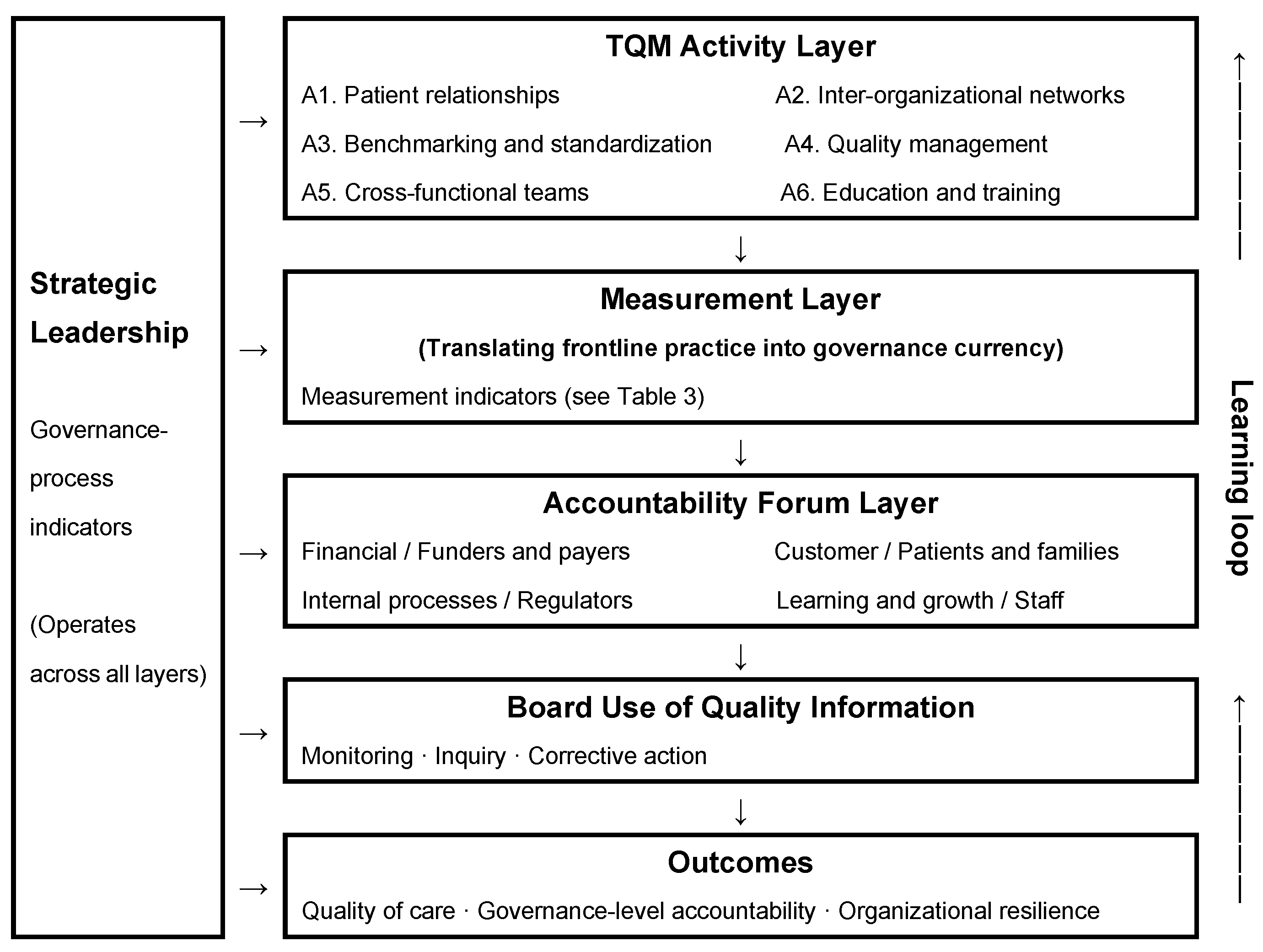
The layer is deliberately excluded from Table 3, because the indicators associated with it are of a different kind. They are not performance indicators but governance-process indicators: the authority and standing of the board quality committee; the share of board agenda time devoted to quality; the coverage of the BSC cascade to departmental level; and the closed-loop rate of corrective actions—that is, the proportion of issues raised at board level that are traceable to a documented resolution. These record whether the governance structure exists and operates, not how the organization performed.
The distinction has a consequence for what the model can detect. Because governance-process indicators are logically independent of performance indicators, an organization may score well on the latter while scoring poorly on the former. This is the condition under which integration has been adopted in name but not embedded in the governance structure—a distinction that a model treating leadership as one activity among others cannot draw. Nor is the distinction merely descriptive. Where a scorecard is maintained as a formal reporting mechanism without being communicatively enacted—indicators measured but not interpreted or connected to organizational meaning by those who produce them—its constitutive function has been argued to erode over time. In contrast, organizations sustaining active use are hypothesized to exhibit greater communicative resilience (Nemoto, 2026). On this account, nominal adoption is not a stable state in which an organization derives less benefit from an intact structure, but a trajectory along which the structure itself decays. Section 6 returns to this distinction in specifying how the framework might be tested empirically.
4. Organizational Resilience and Quality Governance
4.1. Resilience as a Systemic Property
The claim that TQM–BSC integration contributes to organizational resilience requires care in its formulation, because the concept of resilience is contested in precisely the respect that matters here. Witter et al. (2023) take issue with the treatment of resilience as a measurable endpoint, locating it instead in the resources a system holds and the interactions through which they are brought to bear; what admits of measurement, on this account, is what follows from resilience rather than resilience itself. The distinction is not merely terminological. Indicators of system function—service coverage, availability of essential medicines—establish that a system is performing, but not how that performance is achieved, nor who bears the burden of achieving it. Availability of a medicine may rest on a supply chain with built-in redundancy, or on frontline staff negotiating informally with neighboring facilities; the two are indistinguishable at the level of the output indicator, and only the first is resilience in any meaningful sense.
Two implications follow for the argument developed here. First, the appropriate unit of analysis is the governance structure rather than any single activity or indicator, since it is the structure that determines how function is sustained. This is the sense in which the integration model bears on resilience: not because any TQM activity is resilience-producing in itself, but because the architecture set out in Figure 1 specifies how disruption becomes visible, to whom, and with what consequence. Second, what the model can be said to measure is the effect of resilience, not resilience itself—and the indicators must be chosen to distinguish structural redundancy from burden displaced onto those least able to refuse it. Section 6 returns to this second requirement.
4.2. Locating Resilience Capacities Within the Model
Resilience engineering identifies four abilities that a system must possess. Hollnagel (2011) describes these as knowing what to do—responding to regular and irregular disruptions; knowing what to look for—monitoring that which may become a threat; knowing what to expect—anticipating developments and disturbances further ahead; and knowing what has happened—learning from experience. Hollnagel is explicit that although the relative weight of the four cannot be determined in the abstract, none of them may be omitted if a system is to be resilient. The high reliability organization literature reaches a convergent position from a different starting point, distinguishing anticipation, which forestalls disturbance, from containment, which absorbs it once it has occurred, and locating both within the continuous attentional practice that Sutcliffe (2011) terms mindful organizing.
The healthcare resilience literature has largely adopted a threefold rather than fourfold scheme. Ratliff et al. (2025), in a scoping review of organizational resilience in healthcare, identify reactive capacity—absorbing, adapting, and transforming in response to difficulty; proactive capacity—anticipation, preparation, and planning in advance of it; and reflection, through which an organization learns what worked and what did not. The correspondence with three of Hollnagel’s four cornerstones is close. Monitoring, however, does not appear as a distinct capacity. It is treated as implicit in the other three rather than as an ability requiring its own organizational arrangements.
This omission is consequential, and it is the point at which the integration model contributes to the resilience literature rather than borrowing from it. Monitoring is not a residual of anticipation and response; it is the continuous production of information about system state, and it requires an indicator stream, a schedule, and a forum before which the stream is placed. That is precisely what the measurement layer of the integration model supplies. An organization may possess extensive anticipatory capacity and considerable adaptive capability and still fail to detect that a disturbance is under way—or detect it at the frontline while the governing body remains unaware. Table 4 locates each of the four capacities within the model and specifies the observable effects through which each may be examined.
Table 4.
Resilience capacities, their location in the integration model, and observable effects.
4.3. The Learning Loop and Continuous Governance Adjustment
The feedback path in Figure 1, running from the board’s use of quality information back to the activity layer, is not a schematic convenience. Duvald et al. (2025), studying hospital governance through the COVID-19 pandemic, found that hospitals continuously adjusted their governance structures and strategies in response to new procedural and information-sharing demands, with respondents describing repeated adjustment over the course of the disruption rather than a single reorganization at its onset. Resilience, on this evidence, is not the deployment of a prepared structure but the capacity to revise structure while operating.
The integration model accommodates this in a specific way. Because the measurement layer renders frontline conduct legible to governance forums, and because the activity layer is where corrective decisions take effect, the loop between them is the mechanism through which structural revision occurs without loss of accountability. A governance structure that adjusts without a measurement layer adjusts blind; one that measures without a loop records disruption without responding to it. This is also where the model’s learning capacity is located, and it is worth noting that learning appears here as a structural property—the presence of a return path—rather than as an attribute of individuals.
4.4. What the Framework Does and Does Not Support
Two limits should be stated. First, the observable effects specified in Table 4 are effects, in Witter et al.’s (2023) sense, and their presence does not establish that resilience obtains; a hospital may recover an elective backlog quickly by displacing the cost onto staff whose turnover then rises. This is why the final column includes indicators of burden alongside indicators of recovery, and why the two must be read together rather than separately. Second, the model specifies where resilience capacities are located within a governance architecture, not how much of each is required. Hollnagel’s (2011) observation that the relative weight of the four abilities cannot be determined in the abstract applies with equal force here; the balance remains a matter for empirical investigation; Section 6 sets out broader empirical implications of the framework.
5. Boundary Conditions
5.1. The Dysfunctions of Performance Measurement
The argument advanced in this paper is that measurement renders frontline conduct accountable to governance forums. It does not follow that more measurement produces more accountability. Mannion and Braithwaite (2012), reviewing the experience of national performance measurement in the English NHS, identify twenty dysfunctional consequences grouped under four headings: poor measurement, comprising measurement fixation, tunnel vision, myopia, ossification, anachronism, and the privileging of the quantifiable; misplaced incentives and sanctions, comprising complacency, silo-creation, over- and undercompensation, insensitivity, and increased inequality; breach of trust, comprising misrepresentation, gaming, misinterpretation, bullying, erosion of trust, and reduced staff morale; and politicization of performance systems.
Several of these bear directly on the integration model. Tunnel vision—attention to the measured dimensions of performance at the expense of the unmeasured—is a structural risk of any scheme that specifies a finite indicator set, and the model specifies one. Ossification, in which an excessively rigid measurement system inhibits the adoption of improved practice, is a particular risk where indicators are cascaded to departmental level, since cascading multiplies the cost of revision. Gaming and misrepresentation are risks wherever indicators condition consequences, and the closed-loop corrective action rate proposed in Section 3.5 as a governance-process indicator is not exempt: a board may close loops on paper.
Mannion and Braithwaite (2012) attach mitigations to each dysfunction, and three are directly implementable within the architecture proposed here. Ossification is countered by treating the indicator set as provisional: what is measured must change as clinical practice, available technology, and the pathways through which care is organized change, and the removal of measures that no longer serve is as much a governance responsibility as their addition. Short-term process measures must be accompanied by longer-term outcome measures, which the resilience effects specified in Table 4 partly supply. And the effects of measurement on those measured must themselves be monitored—which is why staff satisfaction and turnover appear in the model as indicators rather than as background conditions.
5.2. Whether the Indicators Can Be Trusted
A governance architecture that renders conduct accountable through indicators depends on those indicators being trustworthy, and this cannot be assumed. Kahn et al. (2016) propose a harmonized framework organizing data quality into three categories. Conformance asks whether data values are represented in accordance with the formatting, relational, and computational definitions specified for them; completeness asks whether the expected data attributes are present, a question about the presence of attributes rather than about the values they hold; and plausibility asks whether recorded values are believable. Two assessment contexts cut across these: verification examines whether data meet the constraints specified for them, while validation examines whether they align with external benchmarks and with expectations derived from knowledge of the domain.
The distinction between verification and validation matters for the argument here, because the two answer different questions. A pathway adherence rate may be internally consistent, complete, and correctly formatted, and still not measure what the governing body takes it to measure—if, for instance, adherence is recorded at the point of pathway assignment rather than at completion. Indicators of this kind are fit for the purpose of demonstrating procedural compliance while being poor representations of clinical process. A governance forum that treats verification as sufficient will receive data that are accurate and misleading at once.
Two implications follow. The first is that the provenance of indicators is a governance question. Where an indicator originates, how it is constructed, and what it can and cannot support are properties that a board must know in order to interrogate the indicator rather than merely receive it. The second is that transparency about the limits of an indicator sustains rather than undermines the legitimacy of the account it supports. An account that acknowledges what its evidence cannot establish is more credible, not less, than one that presents indicators as though they were the phenomena they represent.
5.3. Equity as a Cross-Cutting Requirement
Increased inequality appears in Mannion and Braithwaite’s (2012) typology as a consequence of misplaced incentives, and the mechanism is one that Fiscella et al. (2000) had already identified in the design of quality measurement itself. Aggregate quality indicators can conceal systematic differences in the care received by patients differing in socioeconomic position, race, and ethnicity; an organization whose overall satisfaction scores and readmission rates are satisfactory may be performing markedly worse for some groups than for others. Reported in aggregate, such indicators discharge accountability to funders and regulators while withholding from patients and communities the information most relevant to them.
The requirement that follows is one of disaggregation rather than addition. The indicators specified in Table 3 should be stratified by relevant sociodemographic characteristics wherever the data permit, particularly those in A1 and A2, where access and responsiveness are at issue. This paper does not propose equity as a fifth BSC perspective. A separate perspective would locate equity in a single row of the scorecard and thereby permit the remaining rows to be read as though equity were not at stake in them, which is precisely the effect that disaggregation is intended to prevent. Equity is better understood as a property of how every indicator is reported than as a category of indicator.
This requirement also connects to the caution raised in Section 4.1. Witter et al. (2023) observe that resilience strategies may sustain system function by displacing its costs onto less powerful actors, and warn against a conception of resilience that is blind to the distribution of that burden. Stratified reporting is the mechanism through which such displacement becomes visible to the forums that would otherwise be told only that function was maintained.
5.4. Implementation Burden and the Limits of What Governance Should Measure
The architecture set out in this paper is demanding. Six activities, their associated indicators, four accountability forums, a set of governance-process indicators, and the resilience effects specified in Table 4 together constitute a substantial reporting apparatus, and the burden of producing it falls disproportionately on clinical staff whose time is thereby diverted from care. Bureaucratization and the moral distress that accompanies measurement experienced as surveillance are not incidental risks of such a scheme; they are its characteristic failure mode.
Three design commitments follow. The first concerns sequence: the framework is better introduced through a single service line, with indicators co-designed with frontline staff and with patients, and extended only after the routines that support it have proved sustainable. Simultaneous organization-wide implementation maximizes both the reporting burden and the probability that the indicators selected will prove ill-suited to the work they describe. The second concerns pruning. If indicators are added without a corresponding discipline of removal, the apparatus grows monotonically, and ossification follows; governance review should therefore track whether obsolete indicators are being retired, rather than allowing new measures to accumulate without corresponding removal. The third concerns the purpose to which the information is put. Psychological safety, identified in Section 3.4 as a condition of the improvement participation that A5 measures, is degraded where measurement is experienced as a basis for sanction (O’donovan & Mcauliffe, 2020). A governance structure that uses quality information primarily to hold individuals to account will, over time, degrade the reporting on which its own information depends. The learning loop in Figure 1 returns information to the activity layer; whether it returns as inquiry or as sanction determines whether the loop sustains itself.
6. Limitations and Empirical Implications
6.1. Limitations
Five limitations qualify the framework advanced here. First, this is a conceptual study based on a literature review and does not involve empirical investigation of specific healthcare organizations. The integration model presented in Table 3, the derivation set out in Table 2, and the governance-based reinterpretation of TQM and the BSC advanced throughout constitute a proposal grounded in prior research; their empirical validation remains a task for future inquiry.
Second, the activity set is inherited. As Section 3.3 documents, the six activities derive from Hoque’s (2003) eight, which in turn correspond closely to Powell’s (1995) twelve TQM factors, derived from manufacturing and service firms. The adaptation undertaken here reinterprets those activities for healthcare and reinstates one that the manufacturing framing had marginalized, but it cannot identify activities absent from the source frameworks altogether. Practices distinctive to healthcare quality work—morbidity and mortality review, credentialing and privileging, or the management of clinical variation across professional groups—have no counterpart in either lineage and are therefore not represented. A framework derived inductively from healthcare practice rather than adapted from industrial TQM would likely yield a different activity set, and comparison of the two would be informative. Relatedly, although the activity set developed here is derived from TQM, the governance logic may extend beyond TQM as the source of quality-related content. Whether other quality-improvement methodologies, such as Lean or Six Sigma, or customer-feedback approaches, such as SERVQUAL or Voice of the Customer, generate different indicator sets—and whether those differences alter how information is used within accountability forums—remains a question for future research.
Third, the unit of analysis is the individual organization, and this sits uneasily with the concept of resilience the paper invokes. Witter et al. (2023) argue that resilience emerges from systemic resources and interactions, and that analysis confined to organizational boundaries will misattribute to an organization what is in fact a property of its position within a wider system. The framework mitigates this only partially. A2 brings inter-organizational relationships within the model, and Table 4 includes indicators of where the burden of continuity falls, but the governance architecture described remains that of a single organization accountable to forums beyond it. The system-level question—whether the resilience of one hospital is achieved at the expense of another—cannot be posed within it.
Fourth, the central claim of Section 3.5 is argued rather than demonstrated. That governance-process indicators distinguish embedded integration from superficial adoption follows from the logical independence of those indicators from performance indicators; it does not follow that the distinction will prove empirically detectable, or that the four indicators proposed are the ones that detect it. The claim is offered as a testable proposition, and Section 6.2 specifies what would test it.
Fifth, sources were identified primarily through citation tracing rather than systematic search, as Section 1 describes, and no claim to exhaustive coverage of the four streams the argument draws upon is made. Relatedly, much of the prior research referenced here concerns manufacturing firms, private-sector organizations, and healthcare governance arrangements documented predominantly in a small number of national systems; careful interpretation is required in applying its findings to healthcare systems with differing governance and accountability traditions.
6.2. Empirical Implications
Three propositions follow from the framework, each corresponding to a limitation identified above and each specifying what would count as evidence against it.
Proposition 1.
Healthcare organizations in which TQM and the BSC are deliberately integrated, in the manner set out in Table 3, exhibit stronger governance-level accountability than organizations in which the two frameworks operate as parallel tracks. The dependent construct requires operationalization in terms of board conduct rather than board output: the depth of inquiry recorded when quality data are presented, the interval between an issue being raised and a documented resolution, and the pattern of escalation when resolution does not occur. Board minutes and quality committee records are the natural data source, and comparative case studies across organizations differing in their integration arrangements are the natural design. The proposition is falsified if organizations with integrated frameworks display board conduct indistinguishable from those without.
Proposition 2.
The strength of top management commitment, reconceptualized here as a strategic-leadership function, moderates the extent to which TQM-generated quality data are translated into governance-level accountability through the BSC. This is the proposition that bears on the limitation identified as fourth above, since it presumes that the governance-process indicators proposed in Section 3.5 capture something distinct from performance. Testing it requires organizations that vary on those indicators while holding performance broadly constant—a condition more readily met across national systems with differing governance traditions than within one. Comparative field research spanning systems in which hospital boards differ in composition, authority, and statutory obligation would establish both whether the moderation holds and where the boundaries of the model lie.
Proposition 3.
The degree to which TQM–BSC integration is embedded within an organization’s governance structure predicts the maintenance of service continuity under disruption, and does so without displacing the burden of continuity onto frontline staff. The second clause is essential and is what distinguishes this proposition from a conventional performance hypothesis. Following Witter et al. (2023), continuity achieved through staff absorbing strain is not resilience, and a design that measures only recovery will not detect the difference. The effects specified in Table 4 accordingly pair indicators of continuity—backlog recovery, boarding, reporting continuity—with indicators of burden, principally turnover and morale trajectories following disruption. Longitudinal designs exploiting variation in the timing of board-level integration initiatives are appropriate where such variation exists, and the post-pandemic period offers unusual scope for examining organizations that adjusted governance structures under sustained disruption (Duvald et al., 2025). The proposition is falsified if embedded integration predicts continuity but is accompanied by burden indicators no better than those of organizations lacking it.
Text-based analysis of board minutes and quality reports is relevant to all three propositions, since each concerns what governing bodies do with quality information rather than what quality information reports. Realist approaches to evaluation, which seek to establish which mechanisms operate in which contexts to produce which outcomes, are well suited to the comparative designs proposed for Propositions 1 and 2, given that the framework’s central claims concern mechanisms rather than average effects.
7. Conclusions
This paper set out to answer a question that the literature on quality management and on healthcare governance have largely left to one another: by what mechanism does the quality work conducted at the frontline become an account on which a governing body can act? The answer developed here is that TQM and BSC, when deliberately integrated, constitute such a mechanism—under a reading that departs from convention in two respects. The four perspectives of the BSC are treated not as categories into which indicators are sorted but as accountability forums, each addressing a constituency to which the organization owes an account; on this reading, assigning an indicator to a perspective is an act of address rather than of classification. And top management commitment, conventionally listed among the predictors of TQM success, is separated from the operational enablers and reconstituted as a strategic leadership layer anchoring the architecture. The indicators appropriate to that layer record whether a governance structure exists and operates rather than how the organization performed, and it is this distinction that allows integration embedded in governance structure to be distinguished from integration adopted in name.
The contribution this locates is as much in the governance and accountability literature as in the TQM–BSC integration literature. Clinical governance has been extensively specified as a set of principles, and accountability extensively theorized as a relation between actor and forum, but the question of what supplies the substantive content of the account—what a healthcare organization actually says when it answers for the quality of its care—has attracted less attention than the structures through which the answering occurs. TQM supplies content that the governance structure would otherwise lack; the BSC supplies the channels through which that content reaches the forums entitled to receive it; neither, operating alone, discharges the obligation imposed by clinical governance.
Two qualifications belong to the framework rather than following it. The first is that a system rendering conduct accountable through indicators can also distort that conduct, displace the burden of continuity onto those least able to refuse it, and conceal disparities beneath satisfactory aggregates; the design commitments set out in Section 5 are part of the proposal, not caveats appended to it. The second is that the framework specifies where the capacities constitutive of resilience reside within a governance architecture, not how much of each is required, and its central claims remain propositions rather than findings. Whether an organization possesses those capacities is not established by asking whether it has adopted TQM or the BSC. It is established by asking what its governing body knows, when it comes to know it, and what follows.
Funding
This work was supported by JSPS KAKENHI Grant Number JP24K22650 and Maki Makoto Foundation Research Grant A Number 2024005.
Institutional Review Board Statement
Not applicable. This study is based entirely on publicly available published literature and did not involve human participants or personal data.
Informed Consent Statement
Not applicable.
Data Availability Statement
No new data were created or analyzed in this study. Data sharing is not applicable to this article.
Acknowledgments
This study is a modified version of a presentation from the 22nd Annual Meeting of the Japan Association for Healthcare Balanced Scorecard Studies. The author received valuable comments from Kazunori Ito (Tokyo International University) and Masaya Saito (Inuyama Chuo General Hospital).
Conflicts of Interest
The author declares no conflicts of interest.
Abbreviations
| TQM | Total Quality Management |
| BSC | Balanced Scorecard |
| PDCA | Plan-Do-Check-Act |
| COQ | Cost of Quality |
| CCO | Communication Constitutes Organization |
References
- Aggarwal, A., Aeran, H., & Rathee, M. (2019). Quality management in healthcare: The pivotal desideratum. Journal of Oral Biology and Craniofacial Research, 9(2), 180–182. [Google Scholar] [CrossRef] [Scilit] [PubMed]
- Albritton, J. A., Fried, B., Singh, K., Weiner, B. J., Reeve, B., & Edwards, J. R. (2019). The role of psychological safety and learning behavior in the development of effective quality improvement teams in Ghana: An observational study. BMC Health Services Research, 19, 385. [Google Scholar] [CrossRef] [Scilit] [PubMed]
- Alzoubi, M. M., Kadir Shahar, H., Abdul Manaf, R., Ariffin, A. A., & Zaid M, A.-H. (2019). Total quality management in the health-care context: Integrating the literature and directing future research. Risk Management and Healthcare Policy, 12, 167–177. [Google Scholar] [CrossRef] [Scilit] [PubMed]
- Amer, F., Hammoud, S., Khatatbeh, H., Lohner, S., Boncz, I., & Endrei, D. (2022). The deployment of balanced scorecard in health care organizations: Is it beneficial? A systematic review. BMC Health Services Research, 22(1), 65, (Correction in 2022, BMC Health Services Research, 22, 65). [Google Scholar] [CrossRef] [Scilit] [PubMed]
- ASQ. (2025). Total quality management. Available online: https://asq.org/quality-resources/total-quality-management (accessed on 7 October 2025).
- Batalden, M., Batalden, P., Margolis, P., Seid, M., Armstrong, G., Opipari-Arrigan, L., & Hartung, H. (2016). Coproduction of healthcare service. BMJ Quality & Safety, 25(7), 509–517. [Google Scholar] [CrossRef] [Scilit] [PubMed]
- Betto, F., Sardi, A., Garengo, P., & Sorano, E. (2022). The evolution of balanced scorecard in healthcare: A systematic review of Its design, implementation, use, and review. International Journal of Environmental Research and Public Health, 19(16), 10291. [Google Scholar] [CrossRef] [Scilit] [PubMed]
- Bobe, B. J., & Teklay, B. (2025). Integrating total quality management and management control systems: A systematic literature review and proposed integrative framework. Journal of Accounting & Organizational Change, 21(7), 56–89. [Google Scholar] [CrossRef] [Scilit]
- Bohm, V., Lacaille, D., Spencer, N., & Barber, C. E. (2021). Scoping review of balanced scorecards for use in healthcare settings: Development and implementation. BMJ Open Quality, 10(3), e001293. [Google Scholar] [CrossRef] [Scilit] [PubMed]
- Bovens, M. (2007). Analysing and assessing accountability: A conceptual framework. European Law Journal, 13(4), 447–468. [Google Scholar] [CrossRef] [Scilit]
- Brown, A. (2019). Understanding corporate governance of healthcare quality: A comparative case study of eight Australian public hospitals. BMC Health Services Research, 19(1), 725. [Google Scholar] [CrossRef] [Scilit] [PubMed]
- Chenhall, R. H. (1997). Reliance on manufacturing performance measures, total quality management and organizational performance. Management Accounting Research, 8(2), 187–206. [Google Scholar] [CrossRef] [Scilit]
- Duvald, I., Obel, B., Lohse, C., Kirkegaard, H., & Burton, R. M. (2025). Organizational resilience in emergency healthcare: Lessons from the COVID-19 pandemic in five Danish hospitals. Social Science & Medicine, 366, 117728. [Google Scholar] [CrossRef] [Scilit] [PubMed]
- Endaryono, T., Kurniawan, H. T., & Tjiptoherijanto, P. (2025). Strategic leadership and organizational resilience capabilities on the healthcare system of Indonesia. International Journal of Healthcare Management, 18(4), 892–901. [Google Scholar] [CrossRef] [Scilit]
- Fiscella, K., Franks, P., Gold, M. R., & Clancy, C. M. (2000). Inequality in quality: Addressing socioeconomic, racial, and ethnic disparities in health care. JAMA, 283(19), 2579–2584. [Google Scholar] [CrossRef] [Scilit] [PubMed]
- Ghavamabad, L. H., Vosoogh-Moghaddam, A., Zaboli, R., & Aarabi, M. (2021). Establishing clinical governance model in primary health care: A systematic review. Journal of Education and Health Promotion, 10(1), 338. [Google Scholar] [CrossRef] [Scilit] [PubMed]
- Guo, F., Huang, Y. S., & Nemoto, M. (2024). Reimagining hospital management: The balanced scorecard as a catalyst for employee retention and organizational excellence. Frontiers in Public Health, 12, 1485683. [Google Scholar] [CrossRef] [Scilit] [PubMed]
- Guo, F., Huang, Y. S., & Nemoto, M. (2025). Reconceptualizing the balanced scorecard as a communication mechanism in healthcare. Frontiers in Public Health, 13, 1623204. [Google Scholar] [CrossRef] [Scilit] [PubMed]
- Hollnagel, E. (2011). Prologue: The scope of resilience engineering. In E. Hollnagel, J. Pariès, D. Woods, & J. Wreathall (Eds.), Resilience engineering in practice: A guidebook (pp. xxix–xxxix). Ashgate. [Google Scholar] [CrossRef] [Scilit]
- Hoque, Z. (2003). Total quality management and the balanced scorecard approach: A critical analysis of their potential relationships and directions for research. Critical Perspectives on Accounting, 14(5), 553–566. [Google Scholar] [CrossRef] [Scilit]
- Hoque, Z. (2014). 20 years of studies on the balanced scorecard: Trends, accomplishments, gaps and opportunities for future research. The British Accounting Review, 46(1), 33–59. [Google Scholar] [CrossRef] [Scilit]
- Huang, Y. S., Ito, K., & Nemoto, M. (2023). Sustainable communication management using the balanced scorecard: Evidence from a Japanese hospital based on corporate communication theory. Sustainability, 15(13), 10111. [Google Scholar] [CrossRef] [Scilit]
- Huang, Y. S., & Nemoto, M. (2022). Communication tool in management accounting: Adapting Jakobson’s (1960) communication model. Humanities and Social Sciences Communications, 9(1), 316. [Google Scholar] [CrossRef] [Scilit]
- Ittner, C. D., & Larcker, D. F. (1995). Total quality management and the choice of information and reward systems. Journal of Accounting Research, 33, 1–34. [Google Scholar] [CrossRef] [Scilit]
- Jalilvand, M. A., Raeisi, A. R., & Shaarbafchizadeh, N. (2024). Hospital governance accountability structure: A scoping review. BMC Health Services Research, 24(1), 47. [Google Scholar] [CrossRef] [Scilit] [PubMed]
- Kahn, M. G., Callahan, T. J., Barnard, J., Bauck, A. E., Brown, J., Davidson, B. N., Estiri, H., Goerg, C., Holve, E., Johnson, S. G., Liaw, S.-T., Hamilton-Lopez, M., Meeker, D., Ong, T. C., Ryan, P., Shang, N., Weiskopf, N. G., Weng, C., Zozus, M. N., & Schilling, L. (2016). A harmonized data quality assessment terminology and framework for the secondary use of electronic health record data. eGEMs (Generating Evidence & Methods to Improve Patient Outcomes), 4(1), 18. [Google Scholar] [CrossRef] [Scilit] [PubMed]
- Kaplan, R. S., & Norton, D. P. (1992). The balanced scorecard: Measures that drive performance. Harvard Business Review, 70(1), 71–79. [Google Scholar] [PubMed]
- Kaplan, R. S., & Norton, D. P. (1993). Putting the balanced scorecard to work. Harvard Business Review, 71(5), 134–147. [Google Scholar] [CrossRef] [Scilit]
- Kaplan, R. S., & Norton, D. P. (1996). The balanced scorecard: Translating strategy into action. Harvard Business School Press. [Google Scholar]
- Kaplan, R. S., & Norton, D. P. (2001). The strategy-focused organization: How balanced scorecard companies thrive in the new business environment. Harvard Business School Press. [Google Scholar]
- Kaplan, R. S., & Norton, D. P. (2004). Strategy maps: Converting intangible assets into tangible outcomes. Harvard Business School Press. [Google Scholar]
- Kaplan, R. S., & Norton, D. P. (2006). Alignment: Using the balanced scorecard to create corporate synergies. Harvard Business School Press. [Google Scholar]
- Manalili, K., Siad, F. M., Antonio, M., Lashewicz, B., & Santana, M. J. (2022). Codesigning person-centred quality indicators with diverse communities: A qualitative patient engagement study. Health Expectations, 25(5), 2188–2202. [Google Scholar] [CrossRef] [Scilit] [PubMed]
- Mannion, R., & Braithwaite, J. (2012). Unintended consequences of performance measurement in healthcare: 20 salutary lessons from the English National Health Service. Internal Medicine Journal, 42(5), 569–574. [Google Scholar] [CrossRef] [Scilit] [PubMed]
- Martin, J., Khurshid, Z., Moore, G., Carton, M., Fitzsimons, J. J., Henry, C., & Flynn, M. A. (2023). Applying a new approach to the governance of healthcare quality at board level. International Journal of Health Governance, 28(1), 55–67. [Google Scholar] [CrossRef] [Scilit]
- Modell, S. (2009). Bundling management control innovations: A field study of organisational experimenting with total quality management and the balanced scorecard. Accounting, Auditing & Accountability Journal, 22(1), 59–90. [Google Scholar] [CrossRef] [Scilit]
- Nemoto, M. (2026). Organizational dedifferentiation: Neural gradient axes and communication hierarchy in healthcare organizations. Frontiers in Communication, 11, 1852950. [Google Scholar] [CrossRef] [Scilit]
- O’donovan, R., & Mcauliffe, E. (2020). A systematic review of factors that enable psychological safety in healthcare teams. International Journal for Quality in Health Care, 32(4), 240–250. [Google Scholar] [CrossRef] [Scilit] [PubMed]
- Panella, M., Marchisio, S., & Di Stanislao, F. (2003). Reducing clinical variations with clinical pathways: Do pathways work? International Journal for Quality in Health Care, 15(6), 509–521. [Google Scholar] [CrossRef] [Scilit] [PubMed]
- Powell, T. C. (1995). Total quality management as competitive advantage: A review and empirical study. Strategic Management Journal, 16(1), 15–37. [Google Scholar] [CrossRef] [Scilit]
- Ratliff, H. C., Lee, K. A., Buchbinder, M., Kelly, L. A., Yakusheva, O., & Costa, D. K. (2025). Organizational resilience in healthcare: A scoping review. Journal of Healthcare Management, 70(3), 165–188. [Google Scholar] [CrossRef] [Scilit] [PubMed]
- Rigby, D., Bilodeau, B., & Ronan, K. (2023, January 31). Management tools & trends 2023. Available online: https://www.bain.com/insights/management-tools-and-trends-2023/ (accessed on 3 November 2024).
- Scally, G., & Donaldson, L. J. (1998). Clinical governance and the drive for quality improvement in the new NHS in England. BMJ, 317(7150), 61–65. [Google Scholar] [CrossRef] [Scilit] [PubMed]
- Sutcliffe, K. M. (2011). High reliability organizations (HROs). Best Practice & Research Clinical Anaesthesiology, 25(2), 133–144. [Google Scholar] [CrossRef] [Scilit] [PubMed]
- Van De Klundert, J., Gorissen, P., & Zeemering, S. (2010). Measuring clinical pathway adherence. Journal of Biomedical Informatics, 43(6), 861–872. [Google Scholar] [CrossRef] [Scilit] [PubMed]
- Witter, S., Thomas, S., Topp, S. M., Barasa, E., Chopra, M., Cobos, D., Blanchet, K., Teddy, G., Atun, R., & Ager, A. (2023). Health system resilience: A critical review and reconceptualisation. The Lancet Global Health, 11(9), e1454–e1458. [Google Scholar] [CrossRef] [Scilit] [PubMed]

Disclaimer/Publisher’s Note: The statements, opinions and data contained in all publications are solely those of the individual author(s) and contributor(s) and not of MDPI and/or the editor(s). MDPI and/or the editor(s) disclaim responsibility for any injury to people or property resulting from any ideas, methods, instructions or products referred to in the content. |
© 2026 by the author. Licensee MDPI, Basel, Switzerland. This article is an open access article distributed under the terms and conditions of the Creative Commons Attribution (CC BY) license.