


Abstract
The growing accumulation of microplastics in marine ecosystems, coupled with the presence of emerging contaminants such as pharmaceuticals, represents an environmental problem that has received little attention to date. The present study evaluates the potential of microplastics to act as transport vectors for pharmaceuticals through their adsorption onto two plastic polymers widely used today: polyethylene terephthalate (PET) and medium-density polyethylene (MDPE) in seawater. As a control, the same experiments were conducted in ultrapure water (Milli-Q). Both plastics were exposed to a mixture of 29 pharmaceuticals belonging to different therapeutic classes over a 28-day period, with sampling conducted at various time intervals. The identification, quantification, and characterization of the compounds were performed using ultra-high-performance liquid chromatography coupled with mass spectrometry detection. Statistical analysis was performed using R-Studio software. Outcomes reveal that the type of polymer significantly influences adsorption, with MDPE being more efficient than PET. In contrast, the type of water and the therapeutic class of the drugs were not identified as determining factors. Furthermore, a positive, albeit moderate, correlation was observed between the hydrophobicity of the pharmaceutical and its adsorption efficiency on MDPE. These findings suggest that hydrophobic interactions play a key role in the adsorption of drugs onto microplastics, providing a solid foundation for future research, such as predictive models or mitigation strategies in aquatic ecosystems.
1. Introduction
Since the start of large-scale production in the 1950s, plastics have become essential materials for the global economy [1]. Due to their versatility, low cost, and wide range of applications, production has increased exponentially over recent years. The rapid growth in plastic production has created a significant challenge in managing plastic waste [2,3]. As a result of the inadequate regulation of plastic waste management, a considerable portion of this waste ends up in aquatic ecosystems, where it has colonized a wide variety of habitats, ranging from Antarctic regions [1] to the deepest parts of the ocean [4]. This lack of regulation together with the poor management of wastewater means that the amount of these materials in the oceans already reaches between 75 and 199 million tons in 2021 [5], while rivers contain another 109 million tons [2].
These alarming figures are expected to double in the coming decades, which would endanger not only marine ecosystems but also all of the ecosystem services they provide, thereby affecting the food chain, economy, and human health, amongst other areas. Plastic debris can be taken up by marine organisms either through direct ingestion of the environment or via the consumption of other animals that have previously accumulated it. This process facilitates the bioaccumulation and trophic transfer of microplastics (MPs) throughout the food chain, ultimately reaching humans through the consumption of seafood [6]. Several studies have reported the presence of MPs in human biological samples, including feces [7], blood [8], and placenta [9]. According to this scientific literature, prolonged exposure to these MPs has been suggested to contribute to histopathological alterations and potential dysfunction in multiple systems, including the digestive, respiratory, cardiovascular, immune, reproductive, and endocrine systems [10], although further evidence is needed to confirm these effects. In addition to the toxic effects of polymers on the environment, it is important to note that these materials contain a wide variety of added chemical compounds (additives), which are incorporated during their manufacture to improve their properties, increase their durability, and optimize the production process [11]. These additives include various types, such as colorants, thermal and light stabilizers, antioxidants, biocides, fillers, plasticizers, and flame retardants, with the latter two being the most common [12]. These additives are not irreversibly bound to the polymer matrix, so physical or chemical degradation can cause them to detach and subsequently disperse into the air, water, or even food products [13]. This poses health risk, as many of these compounds are harmful to health, such as bisphenol A (BPA), which acts as an estrogen agonist and has been linked to diseases such as breast, prostate, and ovarian cancer, in addition to affecting fetal development [14,15].
One important point to note is that these manufactured products whose surfaces have degraded due to physical or chemical action cannot only release the additives associated with them but can also become vectors for the transport of other types of emerging contaminants (ECs), such as pharmaceuticals that are capable of adsorbing onto the surface of the material [16]. Once these compounds enter the marine environment, they can interact with polymers present in both the water column and sediments, leading to the formation of a complex that is even more harmful to the environment [17]. These interactions are influenced by the physicochemical properties of the polymer, such as particle size, structure, and the presence of functional groups, as well as by environmental conditions such as pH, temperature, and salinity [18]. Given the exponential increase in their consumption in recent years and the poor management of their waste, pharmaceuticals now also emerge amongst these compounds. Previous studies have focused on describing the different types of interactions that can occur between MPs and organic contaminants [17,18,19]. Among these, hydrophobic interactions appear to be the predominant adsorption mechanism, according to several experimental studies [20]. In this context, microplastics could act as potential adsorbents and carriers of substances of particular concern in aquatic environments and, therefore, constitute a factor to be considered in the environmental fate of micropollutants.
On the other hand, the presence of these pharmaceuticals in water bodies is often associated with a range of adverse effects, including short- and long-term toxicity, endocrine disruption, and bioaccumulation in marine organisms [21]. According to recent data from the European Commission Directive (EU) 2025/439 [22], certain pharmaceuticals, such as fluoxetine and propranolol, have been classified as substances of particular concern in aquatic environments due to their high concentration in the environment or their potential toxicity to aquatic organisms. A study conducted by López Serna et al. [23] has revealed that angiotensin receptor blockers (such as valsartan and irbesartan), omeprazole, lipid regulators, and antidepressants represent pharmaceuticals with the highest characterization factor values related to human health. On the other hand, omeprazole and antidepressants (such as amitriptyline) present the highest carbon sinks in terms of ecotoxicity. The main classes of drugs currently consumed are those that act on the nervous system (analgesics and anxiolytics), the cardiovascular system (antihypertensives, beta-blockers, and anticoagulants), and the digestive system and metabolism (lipid regulators and proton pump inhibitors) [24]. In this context, the aim of the present study is to investigate whether certain widely used plastics can act as vectors or carriers of pharmaceuticals through their adsorption onto the plastic surface in aquatic environments. Specifically, the existence of significant differences in pharmaceutical adsorption are examined as a function of the type of plastic polymer (polyethylene terephthalate versus medium-density polyethylene) and water type (ultrapure or seawater), whilst comparing whether certain therapeutic classes show a greater affinity to MPs than others.
2. Materials and Methods
2.1. Chemicals and Reagents
Ultrapure water was purified by a Milli-Q Plus® purification system (Millipore, Madrid, Spain). Seawater was collected off the coast of Salobreña, Granada (Spain), in September 2024 (36°43′53.9″ N; 3°35′27.2″ W). The physicochemical properties of the seawater used in the study are presented in the Supplementary Material (Table S1). LC-MS methanol (MeOH) was obtained from Prolabo Chemicals (Barcelona, Spain). Polyethylene terephthalate (PET), medium-density polyethylene (MDPE), hydrazoic acid sodium salt (sodium azide, p.a. ≥99.0%), methanoic acid (formic acid, >98%) used as additive in the aqueous phase, and pure standards of the pharmaceuticals were purchased from Sigma Aldrich (Madrid, Spain). Stock solutions of each compound were prepared in ultrapure water (100 µg mL−1) and stored at 4 °C until use. Mixtures of the compounds of interest at different concentrations were prepared immediately before use by diluting the stock solutions with water or at the initial mobile phase. All solutions were stored in the dark to prevent photodegradation. The full list of examined drugs and their main physicochemical properties [25], are presented in Table 1.
Table 1.
Properties of examined drugs according to therapeutic family and general characteristics.
2.2. Instrumentation and Software
An Acquity UHPLC™ chromatographic system (Waters, Manchester, UK) equipped with a binary solvent manager was used for chromatographic separation. The analytes were detected using a single quadrupole (QDA) mass spectrometer (Waters, Milford, MA, USA). The stationary phase was an Acquity UPLC® BEH C18 column (100 mm × 2.1 mm inner diameter, 1.7 μm particle size). Other laboratory equipment was also used, including a vortex mixer (IKA, Staufen, Germany), Spectrafuge TM 24D centrifuge from Labnet International, Inc. (Edison, NJ, USA), and an orbital shaker. All statistical analyses were performed using RStudio software (4.5.0).
2.3. Adsorption Experiment
Before beginning the adsorption experiment, the possibility that the drugs under study might adsorb onto or degrade on the surface of the stirring tubes—made of glass—was ruled out. To this end, control tubes containing only the pharmaceutical solution (prepared in ultrapure water or seawater) were subjected to the exact experimental conditions described below. The outcomes showed minimal loss of the analytical signal and, therefore, a negligible decrease in the concentration of the compounds in the solution (0.2 to 1.4%), indicating that there were no losses due to adsorption or degradation of the compounds under study, nor was the presence of microorganisms observed.
The multi-standard working solution was prepared through a two-step dilution process. First, a primary stock solution containing the 29 target pharmaceuticals at a concentration of 100 µg mL−1 each was prepared by weighing 10 mg of each individual compound into a single 100 mL volumetric flask and making up the volume with deionized water. Second, to prepare the experimental solution for the sorption assays, a 7.10 mL aliquot of this multi-standard stock solution was transferred directly into an experimental glass tube and diluted with the corresponding matrix (Milli-Q water or seawater) to a final volume of 50 mL, resulting in an initial concentration of 14.2 µg/mL for each analyte. It is important to note that most of the compounds dissolved easily. In some cases, where slightly lower solubility was observed, the solution was heated softly (to 40 °C) and treated with ultrasound (for 5 min) to ensure complete dissolution of these analytes, resulting in a completely transparent solution. Next, the microplastics (2.5 g of PET or MDPE, ground and sieved to <0.5 mm) were added to the glass tubes, along with 50 mL of the drug solution containing all the analytes under study at a final concentration of 14.2 μg mL−1. Three replicates were prepared for each type of plastic and medium. This resulted in the following treatments: PET + Milli-Q, PET + seawater, MDPE + Milli-Q, and MDPE + seawater. Sodium azide (10 ng mL−1) was added to prevent bacterial growth and the degradation of compounds during the experiment. The tubes were then kept at room temperature under constant agitation (rotary shaker at 13.3 rpm), and samples were collected at predetermined time points: days 0, 1, 2, 3, 4, 7, 14, and 28. Approximately 1 mL of supernatant was extracted from each tube at each sampling point, striving to minimize the amount of plastic removed from the original bottle, and centrifuged in an Eppendorf centrifuge (Fisher Scientific S.L., Madrid, Spain) at 13,500 rpm (16,300× g) for 5 min to sediment the suspended plastic particles. The supernatant was filtered (through a 0.2 μm nylon filter). Next, 700 μL of the sample was taken and mixed with 300 μL of MeOH. Vials were prepared for analysis with the initial composition of the mobile phase and to a final concentration of approximately 10 μg mL−1. All vials were kept refrigerated at 4 °C until the time of chromatographic analysis.
2.4. Ultra-High Performance Liquid Chromatography-Mass Spectrometry Analysis
Chromatographic separation of compounds was performed using an Acquity UPLC® BEH C18 column (100 mm x 2.1 mm i.d., 1.7 µm particle size). A gradient mobile phase consisting of 0.1% (v/v) formic acid in water (solvent A) and methanol (solvent B) was used. The optimized gradient was: 0–1 min, 30% B; 1–6 min, 30–80% B; 6–9 min, 80% B; 9–9.5 min, 80–30% B; 9.5–12 min, 30% B (total run 12 min). The flow rate was 0.3 mL min−1, the injection volume 10 µL, and the column temperature 40 °C. Selected Ion Monitoring (SIM) was used for operation of the simple quadrupole mass spectrometer. ESI was performed in positive ion mode. The parameters set on the mass spectrometer for analysis and elaboration of the resulting chromatograms are provided as Supplementary Material (Tables S2 and S3 and Figure S1, see footnote).
2.5. Statistical Analysis
All statistical analyses were performed using R-Studio software (R v4.5.0). To evaluate differences in adsorption efficiency between the two types of plastic (PET and MDPE) and the two types of water (Milli-Q water and seawater), the normality of the data and the homogeneity of variances were assessed using the Shapiro–Wilk and Levene tests, respectively. Depending on whether these assumptions were met, parametric Student’s t-tests or nonparametric Wilcox tests were applied independently to each pharmaceutical compound. Differences in adsorption efficiency among therapeutic classes were evaluated using the same procedure to verify the pertinent assumptions underpinning statistical testing. Since assumptions regarding normality and homogeneity of variances were not consistently met, the nonparametric Kruskal–Wallis test was used. This analysis was performed independently for each experimental treatment, and significant differences (p < 0.05) were subjected to paired Wilcox tests with Bonferroni correction. Finally, the relationship between the compound’s hydrophobicity, expressed as log Kow, and adsorption efficiency was evaluated using a correlation analysis with the cor.test function.
3. Results
3.1. Calibration Parameters
Once the compounds were characterized, calibration curves were prepared for each compound in the working range of 0.1 to 20.0 μg mL−1. In all cases, results obtained from the calibration curve revealed two clearly distinct linear ranges: the first, from 0.1 to 2.0 μg mL−1, and the second, from 2.0 to 20.0 μg mL−1. This segmentation in the linearity of the analytical response necessitated the establishment of two linear ranges for each compound. The most appropriate function for calculating the concentration of the drug adsorbed onto the MP samples at any given time depends on the value of the chromatographic peak area obtained. Table 2 shows the main calibration parameters for each compound, including: slope (b), Pearson correlation coefficient (r) and limit of quantification (LOQ).
Table 2.
Calibration parameters for each drug: slope (b), Pearson correlation coefficient (r) and limit of quantification (LOQ).
Obtained outcomes show excellent linearity in all cases, with correlation coefficient (r) values greater than 0.99. LOQs were between 0.1 and 0.5 μg mL−1. The method was further characterized by limit of detection (LOD) determination, recovery studies and precision assessment. LOD values ranged from 0.03 to 0.15 μg mL−1. Recovery values for all compounds approached 100% (between 88.2 and 109.3%), and the precision, expressed as %RSD, was always less than 15%, thus making the method precise.
3.2. Adsorption of Compounds to Microplastics
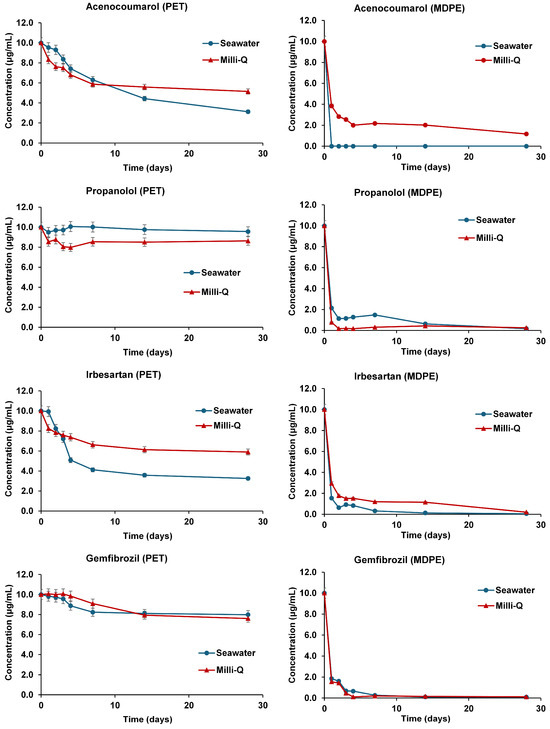
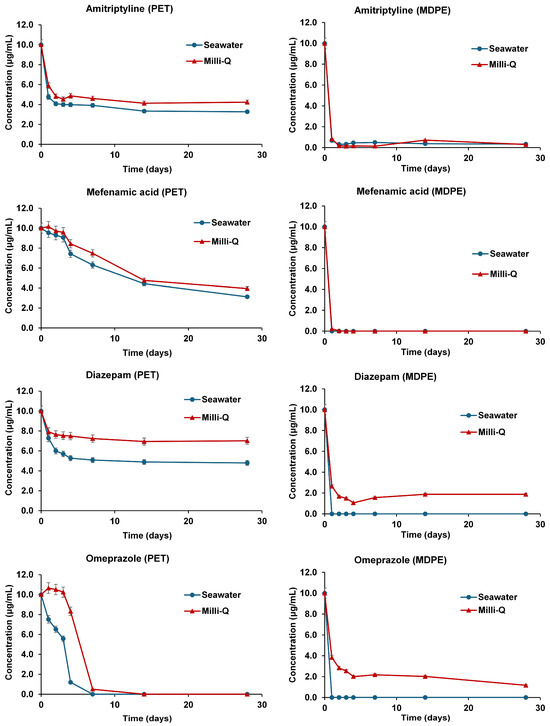
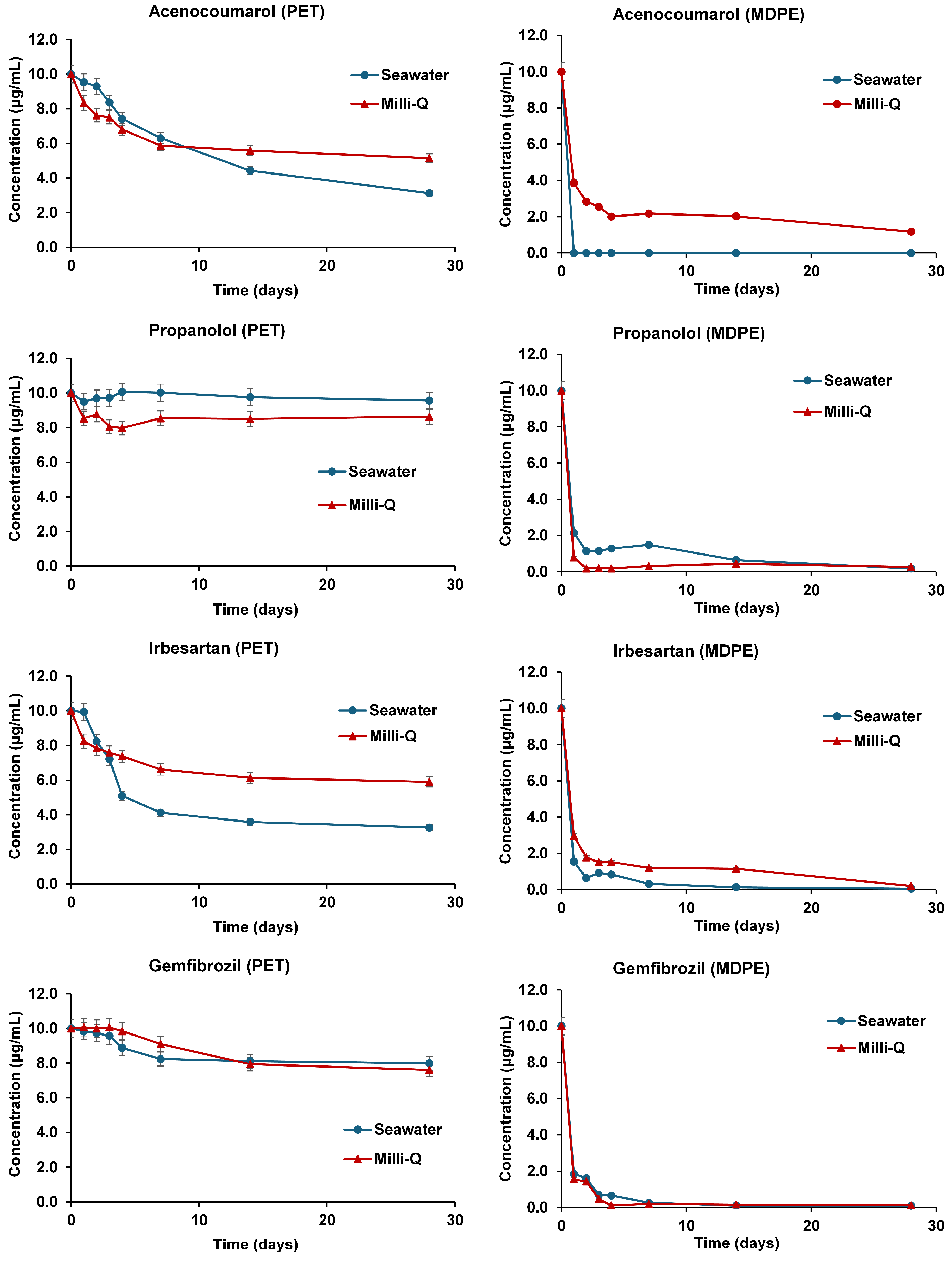
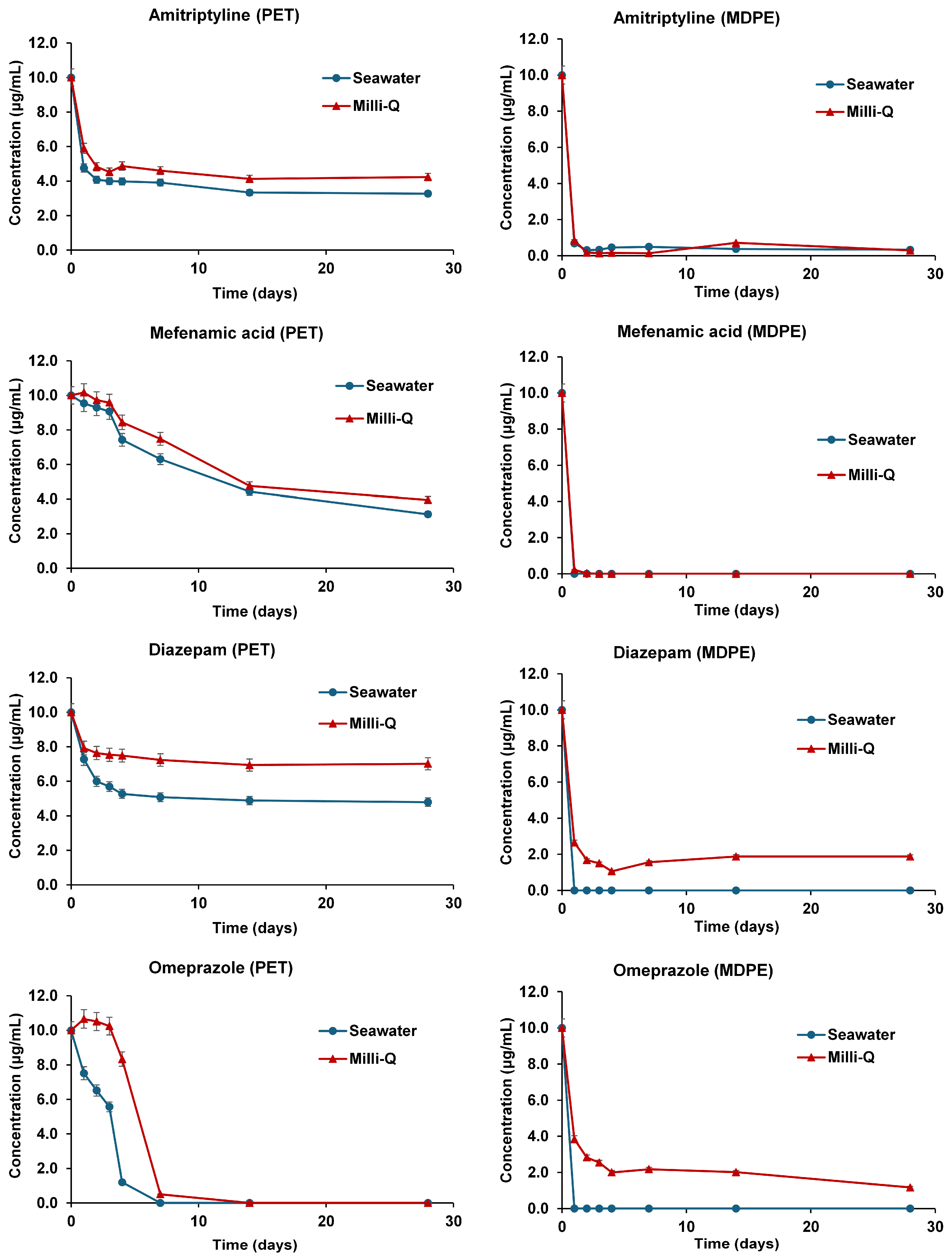
Figure 1 reflects the results obtained from the adsorption experiment, plotting the concentration in water as a function of time. The figure presents 8 selected compounds, chosen to illustrate the different adsorption behaviors observed over the 28-day duration of the experiment in both ultrapure water and seawater. The examples include cases where adsorption was practically negligible, complete, and intermediate. The selection covers all therapeutic families studied and represents the diversity of adsorption patterns observed in this work.
Figure 1.
Adsorption of selected contaminants during the 28 days of the experiment. Changes in concentration in the aqueous medium over time are shown. The selected compounds represent each of the pharmaceutical families studied. The graphs for all the other compounds studied are included in the Supplementary Material (Figure S2).
3.3. Statistical Analysis
First, it was assessed whether there were significant differences in adsorption efficiency, defined as the percentage of the concentration that decreases due to absorption of the compound, based on the type of plastic (PET vs. MDPE) and water (Milli-Q vs. seawater). To do this, the assumptions of normality and homoscedasticity were tested using the Shapiro–Wilk test and Levene’s test, respectively. The results obtained are provided as Supplementary Material (Table S4). A p-value > 0.05 in both cases indicates that these assumptions are met, after which a parametric Student’s t-test can be applied. If any of the assumptions are not met, nonparametric tests are used, such as the Wilcox signed-rank test. This procedure was carried out individually for each drug. Furthermore, to assess whether there were significant differences in adsorption efficiency among the different therapeutic classes, the same procedures were applied to verify compliance with the assumptions of normality and homoscedasticity. Since these conditions were not met in all cases, the nonparametric Kruskal–Wallis test was chosen instead of analysis of variance (ANOVA). This analysis was performed independently for each experimental treatment and, in cases where a p-value < 0.05 was obtained, multiple pairwise comparisons were conducted using the Wilcox signed-rank test with Bonferroni correction. Furthermore, to determine whether the hydrophobicity of the compounds, measured by the log Kow value, was related to their adsorption capacity on the microplastic, a correlation test was performed using the cor.test function. Table 3 presents the statistical outcomes obtained for each drug following analyses to determine differences in adsorption efficiency between the two types of plastic (PET vs. MDPE) and the two types of water (Milli-Q vs. seawater).
Table 3.
Statistical outcomes obtained for each drug from analyses to determine whether there are significant differences in adsorption between different types of plastics and water.
To assess differences between therapeutic classes, the Kruskal–Wallis test was applied when parametric assumptions were not met. For cases where outcomes were significant (p < 0.05), pairwise comparisons were performed using Wilcox tests with Bonferroni correction. Additionally, the correlation between compound hydrophobicity (log Kow) and adsorption capacity was tested using the cor.test function.
4. Discussion
The present study examined three key factors influencing pharmaceutical adsorption onto microplastics: the effect of plastic type (PET vs. MDPE), water matrix (ultrapure vs. seawater), and compound properties (therapeutic class and hydrophobicity). The outcomes reveal significant differences in adsorption behavior depending on these factors, with distinct patterns observed across the 29 pharmaceuticals studied.
4.1. Effect of Plastic Type and Water Matrix
After performing individual analyses for each compound, it was observed that 19 of the 29 compounds analyzed showed significant differences in adsorption as a function of the type of polymer, as reflected in the p-values shown in Table 3. In all cases, adsorption was higher on MDPE compared to PET. This pattern was common to drugs belonging to various therapeutic families, suggesting uniform behavior across pharmacological classes. Among the compounds that exhibited this trend, mefenamic acid (from the NSAIDs group), propranolol (from the BB group), gemfibrozil (from the HL group), and amitriptyline (from the ANS group) emerged. It is important to note that all of these results refer to relative performance under mixed competitive conditions.
Several studies have indicated that pharmaceutical adsorption on microplastics depends largely on the type of polymer. The physicochemical properties of polymers play a key role in determining the mechanisms that govern contaminant sorption on their surfaces. In the present study, the polymers used have different properties, with PET being polar, due to its ester functional groups, with a semi-crystalline structure, whilst MDPE is nonpolar with higher crystallinity [19]. Polymer polarity can substantially affect contaminant–polymer interactions. Low polarity in polymers results in greater hydrophobicity, which enhances their adsorption capacity [26]. Conversely, higher crystallinity in polymers reduces this capacity, as they exhibit a greater affinity for amorphous regions due to their larger free volume [19].
The influence of polymer type on contaminant sorption has been demonstrated for a wide range of organic pollutants. Razanajatovo et al. [27] evaluated the sorption and desorption of sulfamethoxazole, propranolol and sertraline by polyethylene microplastics in laboratory models. Findings suggest that the sorption process of the pharmaceuticals may be adequately described by their hydrophobicity and electrostatic interactions. Xu et al. [28] analyzed the adsorption capacity and behavior of PBDEs by testing four different MPs (PET, PP, PS, and PA) using kinetic and isothermal models under various environmental conditions. According to these authors, differences in sorption capacity values (6.41 ng g−1 for BDE-47, 12.83 ng g−1 for BDE-99, and 14.42 ng g−1 for BDE-153) confirmed the influence of crystallinity, specific surface area, and surface structures of the polymer types in the MPs used. For instance, Mejías et al. [29] observed significant differences in the adsorption of macrolide antibiotics between PET and polyethylene microplastics, highlighting the role of hydrophobic interactions and the surface properties of polymers. Similarly, Moura et al. [30] reported that the adsorption of various drugs varied significantly among different polymers and increased with plastic aging. These findings support the idea that physicochemical characteristics such as hydrophobicity, crystallinity, and surface structure significantly influence the adsorption of contaminants onto microplastics.
Kalaronis et al. [31] recently demonstrated the importance of polymer and surface properties by investigating the adsorption of a mixture of seven drugs onto virgin and UV-aged PET microplastics. Their results showed that drug uptake varied substantially between the different compounds, and that hydrophobicity contributed to these differences in adsorption capacity, although other interactions also played a role. In the present study, the consistently higher adsorption observed on MDPE compared to PET for compounds showing significant differences could therefore be associated with the more hydrophobic and nonpolar nature of MDPE. However, these differences should not be attributed exclusively to hydrophobicity, as the polymer’s crystallinity, surface structure, and the specific chemical characteristics of the drugs may also contribute to the observed adsorption patterns.
In terms of differences in adsorption based on the aqueous medium, present analyses revealed that only 6 of the 29 compounds had p-values < 0.05 (Table 3), indicating significant differences between Milli-Q water and seawater. Unlike what was observed for polymer type, this analysis did not reveal a clear trend toward a specific medium. For example, acetaminophen (NSAID) showed higher adsorption efficiency in seawater, while atenolol (BB) showed significantly higher adsorption in Milli-Q water. These results suggest that the influence of the aqueous medium on adsorption depends more on the individual properties of each compound.
Li et al. [32] studied the adsorption of five antibiotics onto five plastic materials (PM) in freshwater and seawater systems. These authors found that adsorption capacities varied depending on the specific antibiotic, type of plastic, and environmental conditions (e.g., ionic strength and pH). The polyamide exhibited a high affinity for amoxicillin, tetracycline, and ciprofloxacin in the freshwater system, possibly due to hydrogen bonding. In this study, all the antibiotics evaluated showed greater adsorption in freshwater than in seawater. A review of the scientific literature suggests that the primary binding mechanisms are hydrogen bonding, hydrophobic interactions, van der Waals forces, and electrostatic interactions. Klavins et al. [33] obtained similar results, observing that drug adsorption on microplastics varied between freshwater and seawater conditions depending on the compound, as did Liu et al. [34], who observed that the adsorption of hydrophilic organic contaminants on aged PS and PVC decreased dramatically as salinity increased. Elizalde-Velázquez et al. [35] observed that the sorption of NSAIDs onto microplastics in synthetic seawater decreased slightly compared to the sorption coefficients (Kd) obtained with freshwater (pH = 6.9).
A thorough review of the available literature reveals inconsistent findings regarding the effect of salinity on organic compound sorption. Some studies report negligible effects of salinity on sorption behavior [34,36,37,38,39], which aligns with our observations showing no clear differences in pharmaceutical adsorption between ultrapure water and seawater. Conversely, other studies have found that salinity either promotes [36,40] or inhibits [32,41] the sorption process. These contradictory findings suggest that the influence of salinity may be compound-specific or dependent on experimental conditions.
This compound-dependent behavior can be further contextualized in light of findings reported by Kalaronis et al. [31], who observed a clear decrease in the adsorption of seven drugs on both virgin PET and UV-aged PET when the aqueous matrix was changed from distilled water to wastewater and seawater. The authors attributed the lower adsorption observed in seawater to the combined effects of its higher salinity and the presence of dissolved organic matter, which could interfere with the interaction between drugs and the microplastic surface. In contrast, in the present study, only six of the 29 drugs examined showed significant differences between Milli-Q water and seawater, and no consistent trend was observed. The discrepancy between the two studies may be related to differences in drug mixtures, polymer characteristics, water composition, and experimental conditions. Thus, these results suggest that the effect of seawater on drug sorption cannot be generalized and may depend largely on the specific drug–polymer combination, as well as on the physicochemical characteristics of the aqueous matrix, such as temperature or pH, although the influence of these properties was not evaluated in the present study.
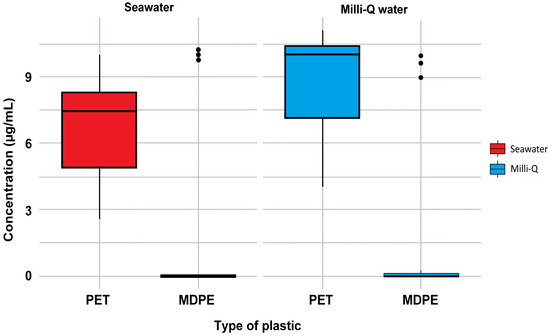
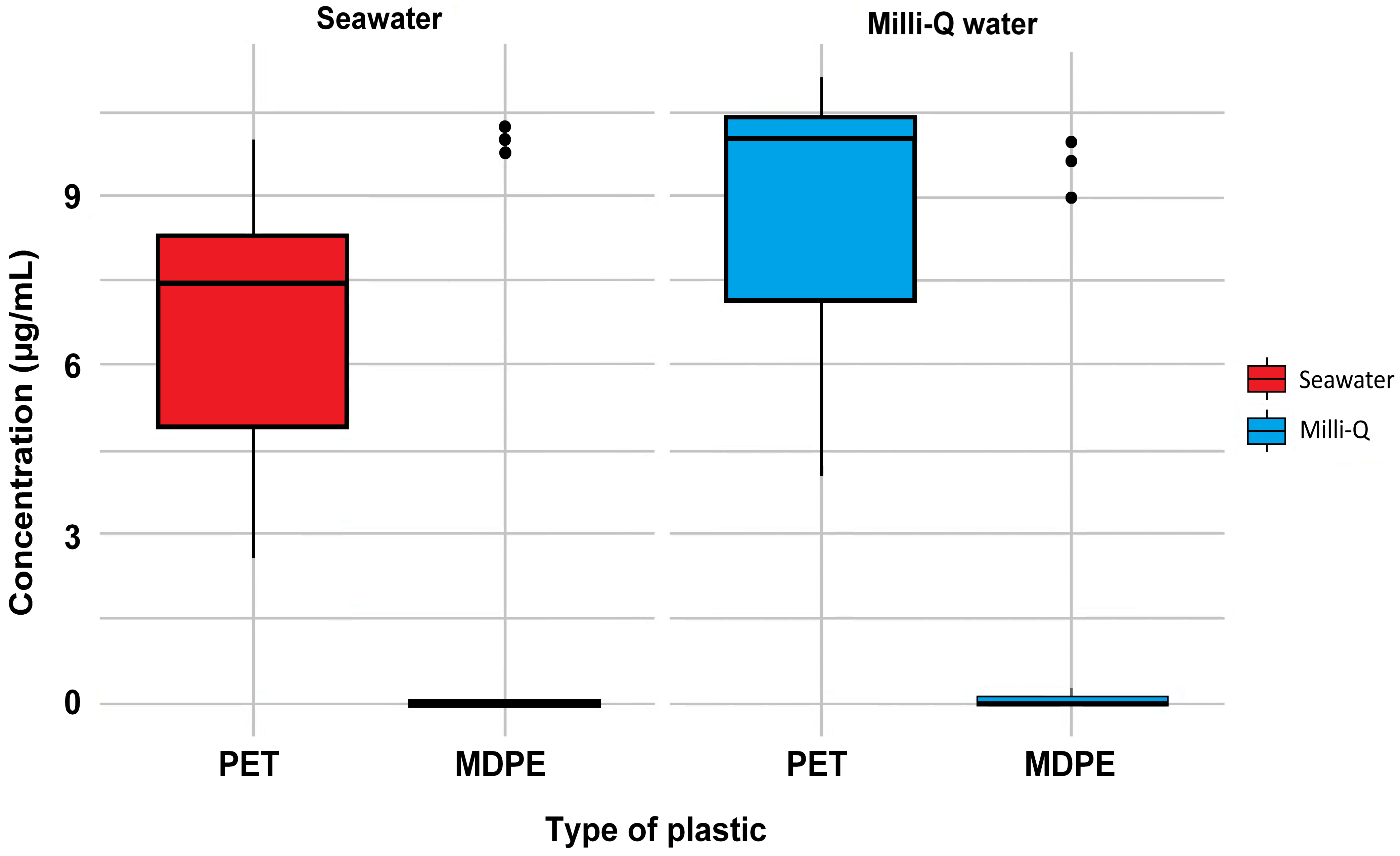
Figure 2 shows the results obtained for mefenamic acid. In this figure, the error bars for the two polymers (PET and MDPE) did not overlap, indicating significant differences in adsorption between the two materials. On the other hand, the error bars associated with the type of water (Milli-Q and seawater) did overlap, which corroborates the statistical results obtained, indicating that there are no significant differences between the two media.
Figure 2.
Adsorption of mefenamic acid according to the type of microplastic and water (seawater or Milli-Q). The black dots in the figure are outliers in the box plot.
4.2. Sorption Efficiency of the Drugs Depending on Therapeutic Classes
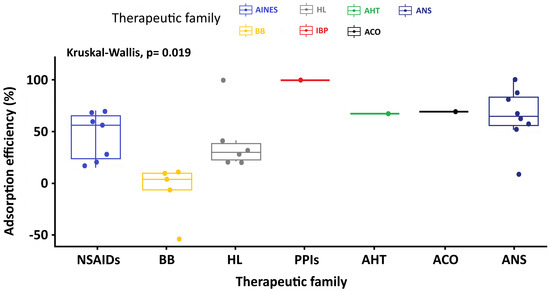
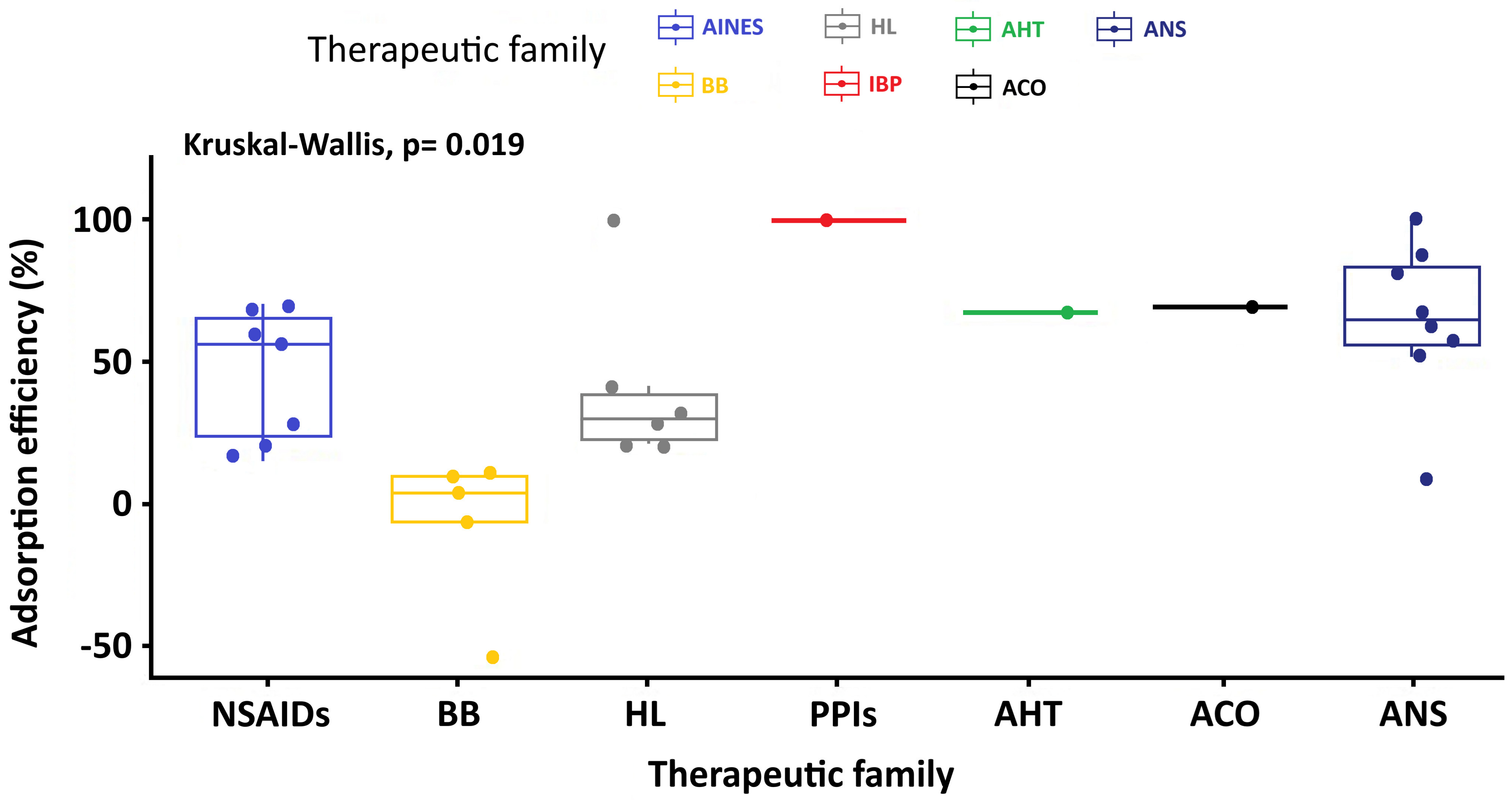
One of the main objectives of the present study was to evaluate whether there were significant differences in adsorption among the various selected therapeutic classes, based on their physicochemical characteristics. Overall, when analyzing the data, no statistically significant differences in adsorption efficiency were observed between the drug groups. However, in the treatment involving the PET polymer in seawater (Figure 3), some significant differences were detected (p < 0.05), suggesting that, under certain experimental conditions, the nature of the compounds could influence their interaction with microplastics. However, this pattern was not consistently observed in the other treatments, suggesting that adsorption behavior cannot be generalized based solely on therapeutic classification.
Figure 3.
Adsorption efficiency by therapeutic family (PET + seawater).
Several studies have noted that the adsorption of drugs onto microplastics does not necessarily follow clear patterns based on therapeutic or chemical classes. For example, Wu et al. [37] investigated the sorption of various pharmaceutical and personal care products onto polyethylene and found that adsorption was closely related to individual molecular properties—particularly hydrophobicity—rather than to the classification of the compounds. Similarly, Hüffer and Hofmann [26] demonstrated that both sorbent (e.g., polymer composition and physical state) and sorbate properties (e.g., hydrophobicity) play a key role in determining sorption behavior. Furthermore, similar trends have been described for other contaminants, such as PFAS [42], where hydrophobic interactions and environmental conditions, including salinity and pH, significantly influence adsorption processes. This study also notes that, when adsorption mechanisms are considered, hydrophobic interactions increase the adsorption affinity of longer-chain compounds. These findings are consistent with the results obtained in the present study, in which no significant differences were generally observed among therapeutic classes, although significant differences were observed under specific experimental conditions—such as PET in seawater.
The absence of a consistent pattern based on therapeutic class may also be related to the simultaneous presence of multiple drugs in the experimental system. Wang et al. [43] investigated the sorption of sulfamethoxazole, propranolol, and sertraline onto polyethylene microplastics and demonstrated that the drugs can undergo competitive, multilayer sorption when present simultaneously. These authors emphasized that interactions between coexisting contaminants can alter the availability of sorption sites and that, therefore, experiments with a single solute may not fully represent the behavior of drug mixtures in environmental systems. In the present study, the simultaneous exposure of microplastics to 29 drugs may also have contributed to the heterogeneous adsorption patterns observed among the compounds and could partly explain why therapeutic classification alone was insufficient for predicting adsorption efficiency.
4.3. Hydrophobicity and Adsorption
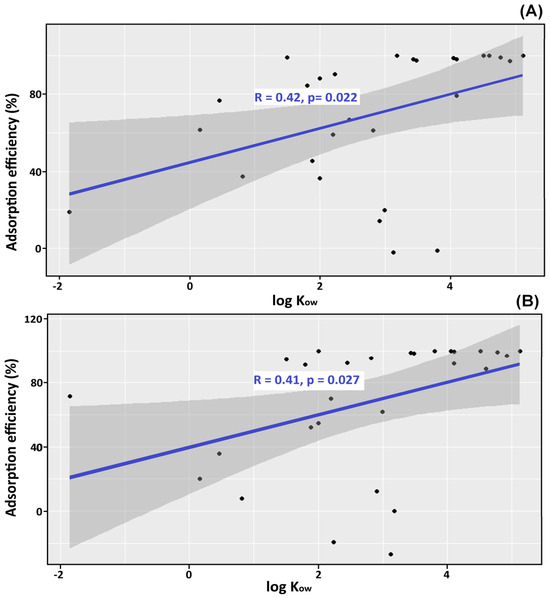
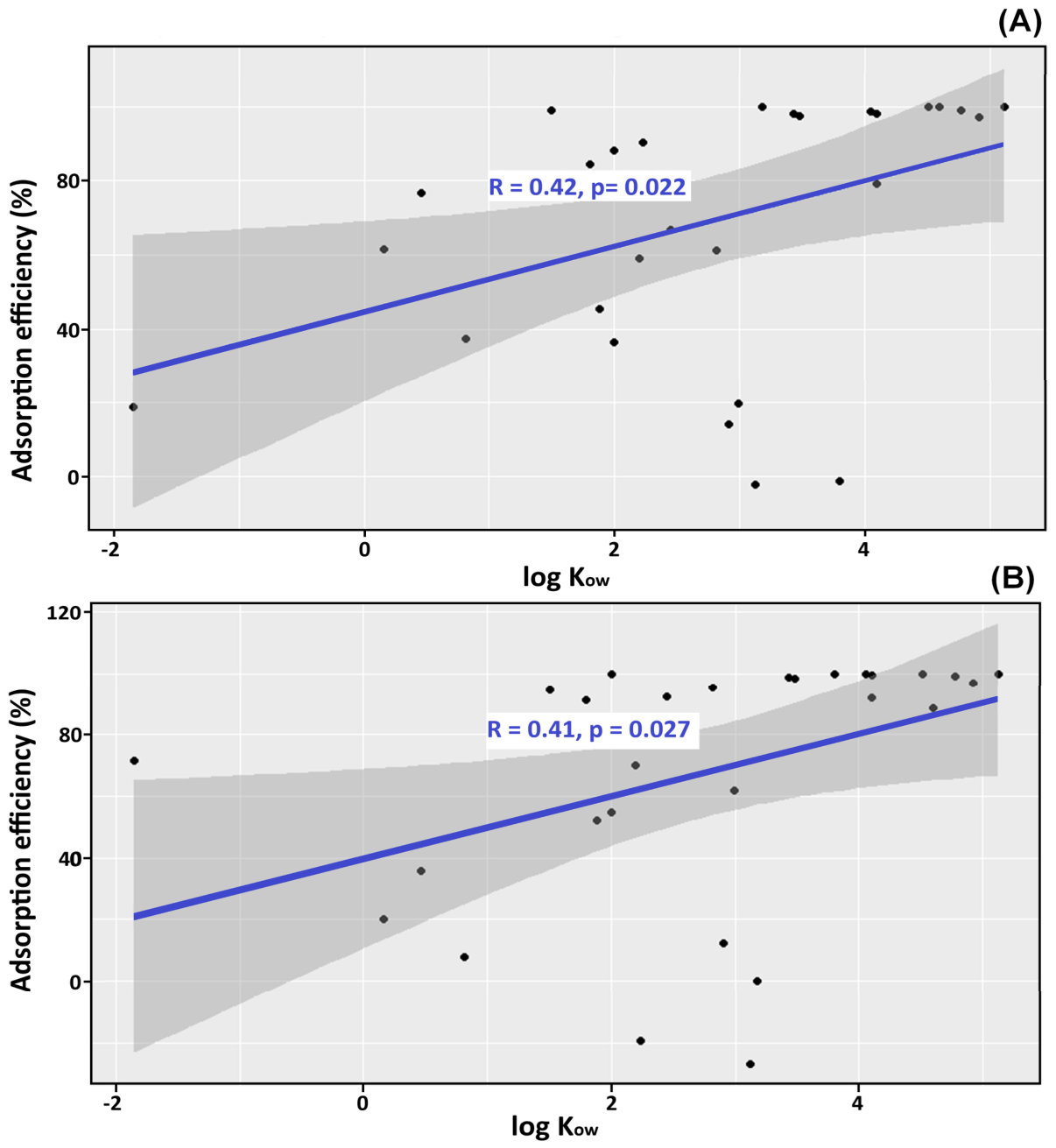
Regarding the relationship between the drug’s hydrophobicity and adsorption, correlational analysis indicated that p-values < 0.05 were obtained only in experiments conducted with MDPE (Figure 4), providing robust evidence of a correlation between the compound’s hydrophobicity, represented by its log Kow, and its adsorption efficiency. In the case of PET, no such evidence was produced.
Figure 4.
(A) Adsorption efficiency on MDPE + Milli-Q water vs. log Kow. (B) Adsorption efficiency on MDPE + seawater vs. log Kow. The black dots represent individual data points from the experimental data. The gray bands surrounding the blue line represent the confidence interval for the regression line, with a 95% probability.
In both experiments with MDPE, an approximate R value of 0.4 was obtained, indicating a positive, albeit moderate, correlation. The previously published scientific literature has described similar trends, in which the sorption of pharmaceuticals and other organic contaminants onto microplastics increases with the hydrophobicity of the compounds, particularly in the case of hydrophobic polymers such as polyethylene. For example, Wu et al. [37] observed that the adsorption of various pharmaceuticals and personal care products onto polyethylene waste was positively correlated with their log Kow values, although the correlation was moderate due to the influence of other molecular properties. Similarly, Velzeboer et al. [44] reported that compounds with higher log Kow values exhibited stronger sorption onto microplastics due to enhanced hydrophobic interactions. Other studies have also noted that, although hydrophobicity plays an important role in the adsorption process, its predictive power is limited, since adsorption is simultaneously influenced by factors such as molecular structure, ionization state, and environmental conditions [20,32,45]. These findings are consistent with the results obtained in the present study, in which hydrophobicity helped explain the variability in adsorption in the MDPE treatments but did not fully determine the adsorption behavior of all compounds.
The results obtained by Kalaronis et al. [31] provide further evidence that hydrophobicity alone cannot fully explain the adsorption of drugs onto PET. Although the most hydrophobic compound analyzed in their study, diclofenac, exhibited the highest adsorption capacity on virgin PET, other compounds did not always follow the expected order based solely on their log Kow values. For example, metronidazole exhibited greater adsorption than ketoprofen despite its lower hydrophobicity, suggesting that other interactions may contribute to the sorption process. These mechanisms may include electrostatic interactions, hydrogen bonding, π–π interactions, steric effects, molecular size, and differences in the polymer’s surface properties. Similarly, in the present study, the moderate correlation observed between log Kow and adsorption onto MDPE indicates that hydrophobicity is an important factor contributing to drug sorption, but not the sole determinant of it.
5. Conclusions
The findings of the present study demonstrate that the type of polymer has a significant effect on the adsorption efficiency of drugs. Of the two plastics studied, higher adsorption was observed in MDPE, suggesting that the polymer’s physicochemical characteristics, such as its high hydrophobicity or medium crystallinity, play a decisive role in the retention of organic contaminants. Unlike the type of polymer, the aqueous medium did not show a systematic influence on adsorption. Outcomes suggest that the influence of water on adsorption mechanisms depends primarily on the individual properties of each compound, such as its degree of ionization or its chemical stability in different environments. Thus, the aqueous medium did not produce a systematic effect on adsorption across the pharmaceuticals investigated. However, this does not exclude a potential influence of salinity, pH, or other matrix components on individual pharmaceutical–microplastic interactions. However, it should be noted that this can modulate interactions depending on the drug, such as competition with seawater cations for adsorption sites.
Analysis according to therapeutic class revealed no significant differences in behavior across pharmacological groups. However, significant differences were detected with regards to PET treatment with seawater, suggesting that, under certain experimental conditions, structural properties common to some drugs (such as the presence of aromatic rings or polar groups) influence their interaction with plastic microparticles. However, this trend was not observed in other treatments, so a conclusive relationship cannot be established overall. This could be due to the existence of considerable structural variability within the same therapeutic family, or to the unequal number of drugs studied from each family.
Correlational outcomes demonstrated a positive relationship between the hydrophobicity of the pharmaceuticals and their adsorption efficiency in both experiments involving the MDPE polymer. This finding supports the initial hypothesis that hydrophobic compounds have a greater affinity for other hydrophobic polymers, such as MDPE, due to their nonpolar nature. Although a moderate correlation was observed, it should be noted that log Kow is not the sole determining factor, although it could be used as a predictive tool in future studies.
6. Study Implications and Limitations
The present findings expand our understanding of the role of polymers as potential carriers of endocrine disruptors (EDs), such as pharmaceuticals, and specifically highlight the influence of polymer type and hydrophobicity. However, the present study has certain limitations that must be considered. A significant limitation pertains to the use of virgin polymers, whereas environmental microplastics are subject to weathering processes that can substantially alter their surface properties. Stapleton et al. [46] noted that weathering generally increased the sorption capacity of microplastics for antibiotics, with increases of up to 171%, primarily as a result of the formation of fractures, cracks, and increased porosity. Similarly, Kalaronis et al. [31] demonstrated that UV aging altered the surface morphology and chemical properties of PET, producing cracks, pitting, and an increase in oxygen-containing functional groups and, generally, improved the adsorption capacity of the aged material. However, the effect of aging was not identical for all drugs, indicating that changes in surface properties may affect individual drug-polymer interactions differently. The adsorption efficiencies described in the present study, therefore, should be considered a baseline for unaged PET and MDPE. Nevertheless, further studies with environmentally aged polymers are required to assess whether these results can be extrapolated to weathered microplastics.
Furthermore, factors such as temperature changes, polymer aging, and competitive interactions between compounds—which could influence real-world environmental conditions—were not considered. Despite these limitations, the present findings provide a basis for future research that applies more complex environmental conditions and more comprehensively evaluates adsorption mechanisms and their ecotoxicological impact.
Supplementary Materials
The following supporting information can be downloaded at https://www.mdpi.com/article/10.3390/environments13090499/s1. Table S1: Physicochemical properties of the seawater; Table S2: Instrumental parameters of the mass spectrometer; Table S3: List of study compounds with the values of their corresponding SIR mode characteristics: molecular ion mass (m/z), retention time (tr), and cone voltage (CV); Table S4: Normality (Shapiro–Wilk test) and homoscedasticity (Levene’s test) outcomes for each drug across plastic materials (PET, MDPE) and water matrices (Milli-Q, Seawater); Figure S1: UHPLC-MS chromatogram showing all peaks corresponding to the compounds studied: carvedilol (1), atenolol (2), nadolol (3), metoclopramide (4), metoprolol (5), omeprazole (6), propranolol (7), meloxicam (8), irbesartan (9), diazepam (10), amitriptyline (11), methotrexate (12), clonazepam (13), bromazepam (14), alprazolam (15), clorazepate (16), carbamazepine (17), fluoxetine (18), ketoprofen (19), sacubitril/valsartan (20), clofibrate (21), gemfibrozil (22), acetaminophen (23), empaglifozin (24), acenocoumarol (25), diclofenac (26), flufenamic acid (27), meclofenamic acid (28), and mefenamic acid (29). Figure S2: Adsorption of contaminants during the experiment. Supplement to Figure 1.
Author Contributions
Conceptualization, B.S.-G., L.R. and A.Z.-G.; methodology, M.C.-S., Ú.G.-G. and A.Z.-G.; validation, Ú.G.-G. and A.Z.-G.; formal analysis, M.C.-S., B.S.-G. and A.Z.-G.; investigation, M.C.-S., B.S.-G. and Ú.G.-G.; data curation, M.C.-S., L.R. and A.Z.-G.; writing—original draft preparation, M.C.-S. and B.S.-G.; writing—review and editing, A.Z.-G.; visualization, Ú.G.-G. and A.Z.-G.; supervision, A.Z.-G.; project administration, L.R. and A.Z.-G.; funding acquisition, L.R. and A.Z.-G. All authors have read and agreed to the published version of the manuscript.
Funding
This research was funded by Consejería de Universidad, Investigación e Innovación and by the ERDF Andalusia Program 2021–2027 (Project C-EXP-047-UGR23). The authors are grateful to the Spanish Ministry of Education, Culture and Sports for the collaboration fellowship granted to Marta Cabrera Sola (25CO1/006653).
Data Availability Statement
The original contributions presented in this study are included in the article. Further inquiries can be directed to the corresponding author.
Acknowledgments
We would also like to thank SERVAMARIS (https://servamaris.com/#ec, accessed on 19 July 2026), a nonprofit organization dedicated to the protection of the marine environment, for its collaboration in the development of this project.
Conflicts of Interest
The authors declare no conflicts of interest. The authors declare that they have no known competing financial interests or personal relationships that could have appeared to influence the work reported in this paper.
Abbreviations
The following abbreviations are used in this manuscript:
| MDPE | Medium-density polyethylene |
| MPs | Microplastics |
| PET | Polyethylene terephthalate |
| UHPLC-MS | Ultra-high-performance liquid chromatography-mass spectrometry |
References
- Barnes, D.K.; Galgani, F.; Thompson, R.C.; Barlaz, M. Accumulation and fragmentation of plastic debris in global environments. Philos. Trans. R. Soc. B Biol. Sci. 2009, 364, 1985–1998. [Google Scholar] [CrossRef] [Scilit]
- Balabantaray, S.R.; Singh, P.K.; Pandey, A.K.; Chaturvedi, B.K.; Sharma, A.K. Forecasting global plastic production and microplastic emission using advanced optimised discrete grey model. Environ. Sci. Pollut. Res. 2023, 30, 123039–123054. [Google Scholar] [CrossRef] [Scilit]
- Geyer, R. Production, use, and fate of synthetic polymers. In Plastic Waste and Recycling; Letcher, T.M., Ed.; Academic Press: London, UK, 2020; pp. 13–32. [Google Scholar] [CrossRef] [Scilit]
- Van Cauwenberghe, L.; Vanreusel, A.; Mees, J.; Janssen, C.R. Microplastic pollution in deep-sea sediments. Environ. Pollut. 2013, 182, 495–499. [Google Scholar] [CrossRef] [Scilit]
- McGlade, J.; Samy Fahim, I.; Green, D.; Landrigan, P.; Andrady, A.; Costa, M.; Geyer, R.; Gomes, R.; Tan Shau Hwai, A.; Jambeck, J.; et al. From Pollution to Solution: A Global Assessment of Marine Litter and Plastic Pollution; United Nations Environment Programme: Nairobi, Kenya, 2021; Available online: https://research.usc.edu.au/esploro/outputs/report/From-Pollution-to-Solution-A-Global/99584903702621 (accessed on 19 July 2026).
- Miller, M.E.; Hamann, M.; Kroon, F.J. Bioaccumulation and biomagnification of microplastics in marine organisms: A review and meta-analysis of current data. PLoS ONE 2020, 15, e0240792. [Google Scholar] [CrossRef] [Scilit]
- Schwabl, P.; Köppel, S.; Königshofer, P.; Bucsics, T.; Trauner, M.; Reiberger, T.; Liebmann, B. Detection of various microplastics in human stool: A prospective case series. Ann. Intern. Med. 2019, 171, 453–457. [Google Scholar] [CrossRef] [Scilit]
- Leslie, H.A.; van Velzen, M.J.M.; Brandsma, S.H.; Vethaak, A.D.; Garcia-Vallejo, J.J.; Lamoree, M.H. Discovery and quantification of plastic particle pollution in human blood. Environ. Int. 2022, 163, 107199. [Google Scholar] [CrossRef] [Scilit]
- Ragusa, A.; Svelato, A.; Santacroce, C.; Catalano, P.; Notarstefano, V.; Carnevali, O.; Papa, F.; Rongioletti, M.C.A.; Baiocco, F.; Draghi, S.; et al. Plasticenta: First evidence of microplastics in human placenta. Environ. Int. 2021, 146, 106274. [Google Scholar] [CrossRef] [Scilit]
- Zhao, B.; Rehati, P.; Yang, Z.; Cai, Z.; Guo, C.; Li, Y. The potential toxicity of microplastics on human health. Sci. Total Environ. 2024, 912, 168946. [Google Scholar] [CrossRef] [Scilit]
- Megill, C.; Shaw, K.; Knauer, K.; Seeley, M.; Lynch, J. Plastic additives in the ocean: Use of a comprehensive dataset for meta-analysis and method development. Chemosphere 2024, 358, 142172. [Google Scholar] [CrossRef] [Scilit]
- Seewoo, B.J.; Goodes, L.M.; Mofflin, L.; Mulders, Y.R.; Wong, E.V.; Toshniwal, P.; Brunner, M.; Alex, J.; Johnston, B.; Elagali, A.; et al. The plastic health map: A systematic evidence map of human health studies on plastic-associated chemicals. Environ. Int. 2023, 181, 108225. [Google Scholar] [CrossRef] [Scilit]
- Zimmermann, L.; Dierkes, G.; Ternes, T.A.; Völker, C.; Wagner, M. Benchmarking the in vitro toxicity and chemical composition of plastic consumer products. Environ. Sci. Technol. 2019, 53, 11467–11477. [Google Scholar] [CrossRef] [Scilit]
- Gao, H.; Yang, B.J.; Li, N.; Feng, L.M.; Shi, X.Y.; Zhao, W.H.; Liu, S.J. Bisphenol A and hormone-associated cancers: Current progress and perspectives. Medicine 2015, 94, e211. [Google Scholar] [CrossRef] [Scilit]
- Wu, P.; Cai, Z.; Jin, H.; Tang, Y. Adsorption mechanisms of five bisphenol analogues on PVC microplastics. Sci. Total Environ. 2019, 650, 671–678. [Google Scholar] [CrossRef] [Scilit]
- Bollaín Pastor, C.; Vicente Agulló, D. Presencia de microplásticos en aguas y su potencial impacto en la salud pública [Presence of microplastics in water and the potential impact on public health. Rev. Esp. Salud Public. 2019, 93, e201908064. [Google Scholar]
- Wu, P.; Huang, J.; Zheng, Y.; Yang, Y.; Zhang, Y.; He, F.; Chen, H.; Quan, G.; Yan, J.; Li, T.; et al. Environmental occurrences, fate, and impacts of microplastics. Ecotoxicol. Environ. Saf. 2019, 184, 109612. [Google Scholar] [CrossRef] [Scilit]
- Rafa, N.; Ahmed, B.; Zohora, F.; Bakya, J.; Ahmed, S.; Ahmed, S.F.; Mofijur, M.; Chowdhury, A.A.; Almomani, F. Microplastics as carriers of toxic pollutants: Source, transport, and toxicological effects. Environ. Pollut. 2024, 343, 123190. [Google Scholar] [CrossRef] [Scilit]
- Fu, L.; Li, J.; Wang, G.; Luan, Y.; Dai, W. Adsorption behavior of organic pollutants on microplastics. Ecotoxicol. Environ. Saf. 2021, 217, 112207. [Google Scholar] [CrossRef] [Scilit]
- Wang, F.; Wong, C.S.; Chen, D.; Lu, X.; Wang, F.; Zeng, E.Y. Interaction of toxic chemicals with microplastics: A critical review. Water Res. 2018, 139, 208–219. [Google Scholar] [CrossRef] [Scilit]
- Luo, Y.; Guo, W.; Ngo, H.H.; Nghiem, L.D.; Hai, F.I.; Zhang, J.; Liang, S.; Wang, X.C. A review on the occurrence of micropollutants in the aquatic environment and their fate and removal during wastewater treatment. Sci. Total Environ. 2014, 473–474, 619–641. [Google Scholar] [CrossRef] [Scilit]
- European Commission. Commission Implementing Decision (EU) 2025/439 of 28 February 2025 establishing a watch list of substances for monitoring at Union level in the field of water policy, in accordance with Directive 2008/105/EC of the European Parliament and of the Council. Off. J. Eur. Union 2025, L,3.3.2025, 1–6. [Google Scholar]
- López Serna, R.; Pérez Elvira, S.I.; Bolado Rodríguez, S.; Irusta Mata, R.; Ortiz de García, S.; Marín de Jesús, D.F.; García Encina, P.A. Tratamiento de Contaminantes Emergentes en Sistemas de Tratamiento de Aguas Residuales y Lodos. In XIII Congreso Español de Tratamiento de Aguas; Universidad de Valladolid: Valladolid, Spain, 2018; Available online: http://uvadoc.uva.es/handle/10324/31411 (accessed on 19 July 2026).
- Farmaindustria. Volume of Medications Sold Through Pharmacies in Spain in 2022, by Therapeutic Group (in Thousands of Units); Statista: New York, NY, USA, 2024; Available online: https://www.farmaindustria.es/web/wp-content/uploads/sites/2/2025/03/111124_MemEST2024_Farmaindustria.pdf (accessed on 19 July 2026).
- Khan, S.; Naushad, M.; Govarthanan, M.; Iqbal, J.; Alfadul, S.M. Emerging contaminants of high concern for the environment: Current trends and future research. Environ. Res. 2022, 207, 112609. [Google Scholar] [CrossRef] [Scilit]
- Hüffer, T.; Hofmann, T. Sorption of non-polar organic compounds by micro-sized plastic particles in aqueous solution. Environ. Pollut. 2016, 214, 194–201. [Google Scholar] [CrossRef] [Scilit]
- Razanajatovo, R.M.; Ding, J.; Zhang, S.; Jiang, H.; Zou, H. Sorption and desorption of selected pharmaceuticals by polyethylene microplastics. Mar. Pollut. Bull. 2018, 136, 516–523. [Google Scholar] [CrossRef] [Scilit]
- Xu, P.; Ge, W.; Chai, C.; Zhang, Y.; Jiang, T.; Xia, B. Sorption of polybrominated diphenyl ethers by microplastics. Mar. Pollut. Bull. 2019, 145, 260–269. [Google Scholar] [CrossRef] [Scilit]
- Mejías, C.; Martín, J.; Martín-Pozo, L.; Santos, J.L.; Aparicio, I.; Alonso, E. Adsorption of macrolide antibiotics and metabolites onto polyethylene terephthalate and polyethylene microplastics in aquatic environments. Antibiotics 2024, 13, 408. [Google Scholar] [CrossRef] [Scilit]
- Moura, D.S.; Pestana, C.J.; Moffat, C.F.; Gkoulemani, N.; Hui, J.; Irvine, J.T.S.; Lawton, L.A. Aging microplastics enhances the adsorption of pharmaceuticals in freshwater. Sci. Total Environ. 2024, 912, 169467. [Google Scholar] [CrossRef] [Scilit]
- Kalaronis, D.; Evgenidou, E.; Kyzas, G.Z.; Bikiaris, D.N.; Lambropoulou, D.A. Assessing the adsorption of a diverse range of pharmaceuticals to virgin and aged poly(ethylene terephthalate) microplastics in different environmental matrices. Environ. Sci. Pollut. Res. Int. 2024, 31, 50804–50819. [Google Scholar] [CrossRef] [Scilit]
- Li, J.; Zhang, K.; Zhang, H. Adsorption of antibiotics on microplastics. Environ. Pollut. 2018, 237, 460–467. [Google Scholar] [CrossRef] [Scilit]
- Klavins, M.; Klavins, L.; Stabnikova, O.; Stabnikov, V.; Marynin, A.; Ansone-Bertina, L.; Mezullis, M.; Vaseashta, A. Interaction between microplastics and pharmaceuticals depending on the composition of aquatic environment. Microplastics 2022, 1, 520–535. [Google Scholar] [CrossRef] [Scilit]
- Liu, G.; Zhu, Z.; Yang, Y.; Sun, Y.; Yu, F.; Ma, J. Sorption behavior and mechanism of hydrophilic organic chemicals virgin and aged microplastics in freshwater and seawater. Environ. Pollut. 2019, 246, 26–33. [Google Scholar] [CrossRef] [Scilit]
- Elizalde-Velázquez, A.; Subbiah, S.; Anderson, T.A.; Green, M.J.; Zhao, X.; Cañas-Carrell, J. Sorption of three common non-steroidal anti-inflammatory drugs (NSAIDs) to microplastics. Sci. Total Environ. 2020, 715, 136974. [Google Scholar] [CrossRef] [Scilit]
- Bakir, A.; Rowland, S.J.; Thompson, R.C. Transport of persistent organic pollutants by microplastics in estuarine conditions. Estuar. Coast. Shelf Sci. 2014, 140, 14–21. [Google Scholar] [CrossRef] [Scilit]
- Wu, C.; Zhang, K.; Huang, X.; Liu, J. Sorption of pharmaceuticals and personal care products to polyethylene debris. Environ. Sci. Pollut. Res. 2016, 23, 8819–8826. [Google Scholar] [CrossRef] [Scilit]
- Xu, B.; Liu, F.; Brookes, P.C.; Xu, J. Microplastics play a minor role in tetracycline sorption in the presence of disolved organic matter. Environ. Pollut. 2018, 240, 87–94. [Google Scholar] [CrossRef] [Scilit]
- Li, Y.; Li, M.; Li, Z.; Yang, L.; Liu, X. Effects of particle size and solution chemistry on triclosan sorption on polystyrene microplastics. Chemosphere 2019, 231, 308–314. [Google Scholar] [CrossRef] [Scilit]
- Guo, X.; Pang, J.; Chen, S.; Jia, H. Sorption properties of tylosin on four different microplastics. Chemosphere 2018, 209, 240–245. [Google Scholar] [CrossRef] [Scilit]
- Wang, F.; Shih, K.M.; Li, X.Y. The partition behavior of perfluorooctanesulfonate (PFOS) and perfluorooctanesulfonamide (FOSA) on microplastics. Chemosphere 2015, 119, 841–847. [Google Scholar] [CrossRef] [Scilit]
- Llorca, M.; Schirinzi, G.; Martínez, M.; Barceló, M.; Farré, M. Adsorption of perfluoroalkyl substances on microplastics under environmental conditions. Environ. Pollut. 2018, 235, 680–691. [Google Scholar] [CrossRef] [Scilit]
- Wang, Z.; Ding, J.; Razanajatovo, R.M.; Huang, J.; Zheng, L.; Zou, H.; Wang, Z.; Liu, J. Sorption of selected pharmaceutical compounds on polyethylene microplastics: Roles of pH, aging, and competitive sorption. Chemosphere 2022, 307, 135561. [Google Scholar] [CrossRef] [Scilit]
- Velzeboer, I.; Kwadijk, C.J.A.F.; Koelmans, A.A. Strong Sorption of PCBs to nanoplastics, microplastics, carbon nanotubes, and fullerenes. Environ. Sci. Technol. 2014, 48, 4869–4876. [Google Scholar] [CrossRef] [Scilit]
- Wang, L.; Yang, H.; Guo, M.; Wang, Z.; Zheng, X. Adsorption of antibiotics on different microplastics (MPs): Behavior and mechanism. Sci. Total Environ. 2023, 863, 161022. [Google Scholar] [CrossRef] [Scilit]
- Stapleton, M.J.; Ansari, A.J.; Hai, F.I. Antibiotic sorption onto microplastics in water: A critical review of the factors, mechanisms and implications. Water Res. 2023, 233, 119790. [Google Scholar] [CrossRef] [Scilit]

Disclaimer/Publisher’s Note: The statements, opinions and data contained in all publications are solely those of the individual author(s) and contributor(s) and not of MDPI and/or the editor(s). MDPI and/or the editor(s) disclaim responsibility for any injury to people or property resulting from any ideas, methods, instructions or products referred to in the content. |
© 2026 by the authors. Licensee MDPI, Basel, Switzerland. This article is an open access article distributed under the terms and conditions of the Creative Commons Attribution (CC BY) license.