


Abstract
Urban freshwater ecosystems are exposed to multiple anthropogenic pressures, but their effects on macroinvertebrate communities may vary depending on waterbody type and surrounding land use structure. This study analysed macroinvertebrate communities in three waterbody types of the Belgrade functional urban area. Land use was classified into agricultural, artificial, and semi-natural areas, and evaluated using LUI and HHI indices. A total of 187 macroinvertebrate taxa were recorded, indicating high diversity despite the urban setting. Community composition differed among waterbody types, with non-wadeable rivers characterised by a high proportion of Oligochaeta, wadeable rivers by a greater contribution of insects, and canals by the dominance of crustaceans. Land use further influenced community structure: semi-natural areas were associated with a higher proportion of crustaceans, artificial areas with Chironomidae, and agricultural areas with Oligochaeta. Alpha diversity was highest in wadeable rivers, while beta diversity showed that compositional differences were driven by species turnover. SPEAR indices indicated stress-related differences among waterbody types. CCA showed that community variation was associated with conductivity, temperature, oxygen saturation, pH, BOD, TOC, AOX, and phosphate. Overall, macroinvertebrate communities in the Belgrade urban area are shaped by the combined effects of waterbody type, land use structure, and local environmental conditions.
1. Introduction
Freshwater ecosystems are among the most threatened environments worldwide, experiencing rapid biodiversity loss due to increasing anthropogenic pressure [1]. Anthropogenic pressures in the urban and suburban waters of Belgrade arise primarily from the discharge of untreated municipal wastewater, industrial and agricultural runoff, fishing, and recreational activities [2]. These impacts are further intensified by flow regulation, drainage and pumping, dredging, and the removal of aquatic and riparian vegetation, creating a complex multistressor environment, particularly in sanitary protection zones [3]. Benthic macroinvertebrates are widely used as bioindicators in these systems because they respond sensitively to changes in habitat structure, water quality, and hydrological regime, and reflect environmental conditions over time [4,5,6]. In recent decades, land use changes have emerged as one of the key drivers of freshwater degradation [7,8].
Land use (LU) alters aquatic ecosystems through multiple, interacting pathways, including changes in hydrology, habitat condition, and the input of nutrients and contaminants [9,10]. Urbanisation increases wastewater discharges, elevating nutrient concentrations and altering flow regimes. This leads to loss of habitat heterogeneity and reduces the number of sensitive taxa such as Ephemeroptera, Plecoptera, and Trichoptera, resulting in lower macroinvertebrate diversity [11]. Agricultural LU similarly affects water bodies by altering riparian vegetation, increasing sediment and nutrient inputs, and introducing pesticides, with documented shifts towards more tolerant macroinvertebrate communities [12]. In contrast, catchments with higher proportions of forest or other low intensity land uses often retain more complex habitats and better water quality. In addition, it tends to support richer and more sensitive macroinvertebrate communities, although these relationships can be influenced by geology and regional characteristics [13].
Recent studies show that LU patterns can influence macroinvertebrate communities both directly, through physical habitat alteration, and indirectly, through effects on water chemistry [9,14]. Other studies suggest that LU may explain a substantial proportion of the variability in macroinvertebrate diversity, and that urban and cropland areas often have strong negative effects on community composition [15]. These effects are not limited to local diversity patterns but may also influence compositional heterogeneity among sites [16]. In this context, beta diversity provides a useful framework for describing the degree of compositional heterogeneity among sites, while its components help identify whether this heterogeneity is mainly driven by species turnover or by differences in species richness [17]. Thus, environmental degradation may cause the disappearance of sensitive taxa and greater presence of tolerant ones, leading to high species replacement. Alternatively, strong disturbance may result mainly in species loss without equivalent replacement. Broad-scale assessments therefore emphasise that LU can restructure both local alpha diversity and regional beta diversity of freshwater macroinvertebrates [15,18,19]. Understanding how different LU types affect macroinvertebrate communities is essential for effective monitoring.
Belgrade functional urban area (FUA) covers approximately 3234 km2 and has about 1.8 million inhabitants. It is the most densely populated and socio-economically important area in Serbia [20]. Running waters in the Belgrade FUA are exposed to various types and intensities of anthropogenic pressure [21,22,23]. Some of them flow through industrial zones, agricultural land, and/or urban areas, often receiving precipitation drainage and wastewater discharges from surrounding rural and suburban settlements [11,24].
Knowing that the macroinvertebrates are reliable indicators for ecological status assessment [9,15,25], we compare their response to different waterbody types (WBT), as well as to different LU classes in Belgrade FUA. Specifically, we attempt to: (1) classify different LU types across various WBT in Belgrade FUA; (2) analyse how WBT and LU structure macroinvertebrate communities; (3) assess diversity of macroinvertebrates in different WBT and LU; and (4) estimate main environmental drivers of community variation.
2. Materials and Methods
2.1. Study Area
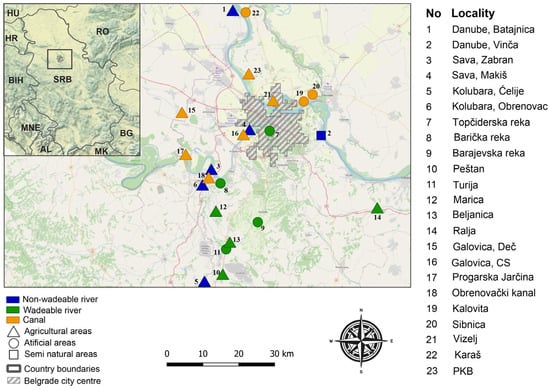
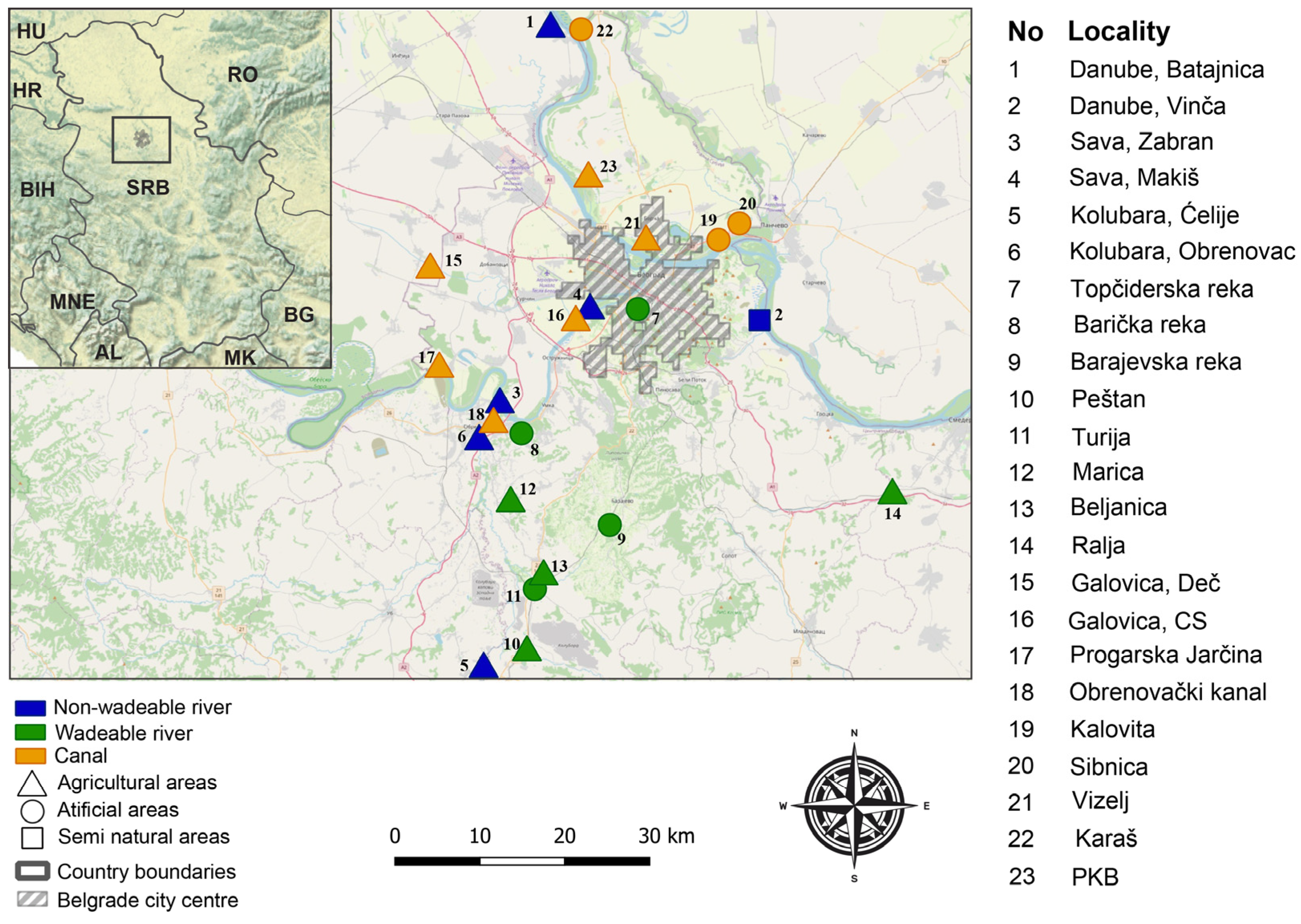
Macroinvertebrate samples were collected at 23 sites in 2024 during high and low water level regimes (May and September), all within Belgrade FUA (Figure 1). Sites were classified into three waterbody categories based on the waterbody typology [26,27] non-wadeable rivers (WBT1), defined as large rivers that cannot be crossed by foot, with the depths over 1.5 m approximately (Danube, Sava, and Kolubara); wadeable rivers (WBT2), defined as smaller rivers that can be crossed by foot, up to 1.5 m depth (Topčiderska reka, Barička reka, Barajevska reka, Peštan, Turija, Marica, Beljanica, and Ralja); and canals—artificial water bodies (WBT3) (Galovica, Progarska Jarčina, Obrenovački kanal, Kalovita, Sibnica, Vizelj, Karaš, and the Agricultural Plant Belgrade canal system—PKB).
Figure 1.
Sampling site localities.
2.2. Sample Collecting
Macroinvertebrate samples were collected using a benthic hand net (25 × 25 cm frame, 500 μm mesh size) following multihabitat sampling methodology (MHS) using the AQUEM protocol [26]. At each study site, 20 subsamples were collected from the littoral zone at depths up to 1.5 m across all available microhabitats in proportion to their availability [28]. All subsamples collected at a given site were subsequently pooled together and preserved in the field with 70% ethanol, appropriately labelled, and transported to laboratories for further analysis. All macroinvertebrate taxa were sorted and then identified morphologically to the lowest possible taxonomic level on a Nikon SMZ800N stereomicroscope (magnification 10–80×), Nikon Corporation, Tokyo, Japan and a ZEISS Axio Lab.A1 light microscope (1000× magnification), Carl Zeiss Microscopy GmbH, Jena, Germany, using appropriate identification keys.
2.3. Environmental Variables
The following physicochemical parameters were measured monthly throughout the year, and the resulting values were averaged for each sampling site. Water temperature (T) [29], pH [30], conductivity [31], dissolved oxygen (O2; mg/L O2)), oxygen saturation (O2%) [32], nitrite concentration (NO2; mg/L N) [33] and nitrate concentration (NO3; mg/L N) [34] were measured using Horiba W-23XD multiparametric probe (HORIBA Instruments Corporation, Irvine, CA, USA) in the field. The biochemical oxygen demand (BOD5; mg/L O2) [35], total phosphates (TP; mg/L P) [36], total nitrogen (TN; mg/L N) [37], suspended particles (SM; mg/L) [38], ammonium ions (NH4; mg/L N) [39] and chlorides (Cl; mg/L Cl) [40], sulfates (SO4−2; mg/L), orthophosphates (OrtoP; mg/L Cl PO43−) [41], total organic carbon TOC (mg/L) and adsorbable organic halides (AOX; mg/L) [42] were measured in the laboratory of the Institute of Public Health, Belgrade, Serbia.
Spatial analyses were performed in QGIS 3.34.12—Prizren [43] using the CORINE 2018 land cover vector dataset, released in 2020 [44] and point data representing the study sites, both projected in the EPSG:3035 coordinate reference system. Buffer zones were generated around each locality and used to extract corresponding CORINE land cover classes through spatial overlay operations. Since rivers of different sizes vary in their capacity for self-purification and their ability to receive and assimilate runoff from the surrounding catchment, different buffer zone widths were assigned to rivers of different sizes. Thus, the buffer zone classification was based on previous studies [45]. Accordingly, for all WBT wider than 10 m, the radius of the buffer zones was equal to five times the river width, while for WBT < 10 m, the radius of the buffer zones was 50 m, to ensure proportional representation of surrounding habitats relative to WBT. The resulting spatial features were processed to obtain individual polygons, after which spatial joins were applied to associate land cover attributes with each locality. Polygon areas were calculated in square metres, and the final outputs were exported for subsequent statistical and spatial analyses. Additionally, sites were grouped according to the dominant LU into three categories: agricultural (LU1), artificial (LU2), and semi-natural areas (LU3).
2.4. Land Use Analyses
The LUI and HHI indices provided complementary information on LU conditions around the investigated localities. To describe the intensity or type of LU pressure, the Land Use Index (LUI) was used, while the Herfindahl–Hirschman Index (HHI) was used to describe the degree of LU dominance or heterogeneity around each locality.
LUI [46] and HHI [47] were calculated for each study site and river section using land use data exported from QGIS, according to the following formula:
where pi is the percentage of different LU types, and wi is the weight score of a different LU type. Land use categories were assigned weights of 1, 3, or 5, representing low, intermediate, and high potential pressure on aquatic ecosystems, respectively. Thus, higher LUI values indicate a greater proportional contribution of land use categories expected to exert higher pressure [48,49,50].
where pi is the percentage of the i-th land use category, T is the total land use area within the analysed buffer, and si is the proportional share of that category. Higher HHI values indicate dominance of one or few LU categories, whereas lower values indicate a more even distribution among several LU categories.
LUI = ∑pi×wi
HHI = ∑si2, si = pi/T, T = ∑pi
2.5. Community Descriptors and Data Analyses
The ASTERICS software package Version 3.1.1. [26] was used for the analyses of macroinvertebrate community composition and calculations of Species at risk index (SPEAR index): SPEAR pesticides, SPEAR organic and SPEAR %. Higher values of SPEAR pesticides indicate greater pesticide impact intensity. Less negative values of SPEAR organic reflect stronger impact of organic pollution stress, while SPEAR percentage (SPEAR %) indicates the presence of sensitive species in total community [51].
The FLORA software Version 2013 [52] was used to analyze alpha and beta diversity components of macroinvertebrate communities in different types of water as well as localities that are under different types of LU. Alpha diversity was assessed through taxa richness, Shannon entropy, and the Equitability index, while total beta diversity was defined by two additive components: the taxa turnover, which is independent of the difference in taxa richness, and the variation in taxa composition resulting from nestedness [18].
Cluster analyses based on Ward’s method [53] with Chord distance were used to group macroinvertebrate communities in different types of water as well as localities that are under different types of LU. MANOVA was used to find a combination of species that maximally extracted clusters of macroinvertebrate communities [54]. Differences in community composition among water body types (WBTs) were assessed using one-way PERMANOVA based on Bray–Curtis dissimilarities of taxon abundances, with 9999 permutations. Following a significant overall effect, pairwise comparisons among WBTs were conducted with Bonferroni correction. Homogeneity of multivariate dispersion among WBTs was assessed using PERMDISP. Additionally, the effects of WBT, land use (LU), and their interaction on community composition were tested using two-way PERMANOVA, based on the same Bray–Curtis dissimilarity matrix and 9999 permutations. Analyses were performed in PAST software Version 5.3.
Detrended correspondence analysis (DCA) was applied to identify major compositional gradients and to assess differences among water body types, as well as localities under different types of LU.
The stepwise forward selection (FS) procedure [55] was used to detect environmental variables with statistically significant effects on the macroinvertebrate communities. The statistical significance of the hypothesis that species communities are independent of the selected environmental variable was assessed using the non-parametric Monte Carlo permutation test (999 permutations, p < 0.05). The effects of environmental variables on the faunistic differentiation of communities were assessed using canonical correspondence analysis (CCA) using FLORA software Version 2013 [52]. To reduce the influence of dominant taxa, abundance data were log-transformed as log(x + 1) before all analyses, where x denotes the number of individuals recorded.
3. Results
Land cover analysis identified a total of 16 CORINE Land Cover classes across all the studied water bodies (Table 1). The highest number of classes (all 10 of them) was recorded in large, non-wadeable rivers (WBT1), with the lower number of classes (six and eight, respectively) found in small wadeable rivers (WBT2) and canals (WBT3) (Table 1).
Table 1.
CORINE Land Cover classes (in three resolutions) across the studied sites in the Belgrade urban area.
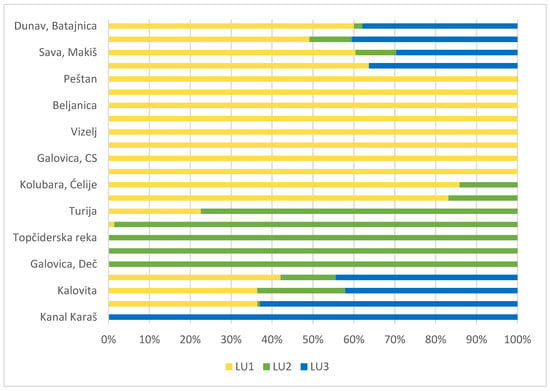
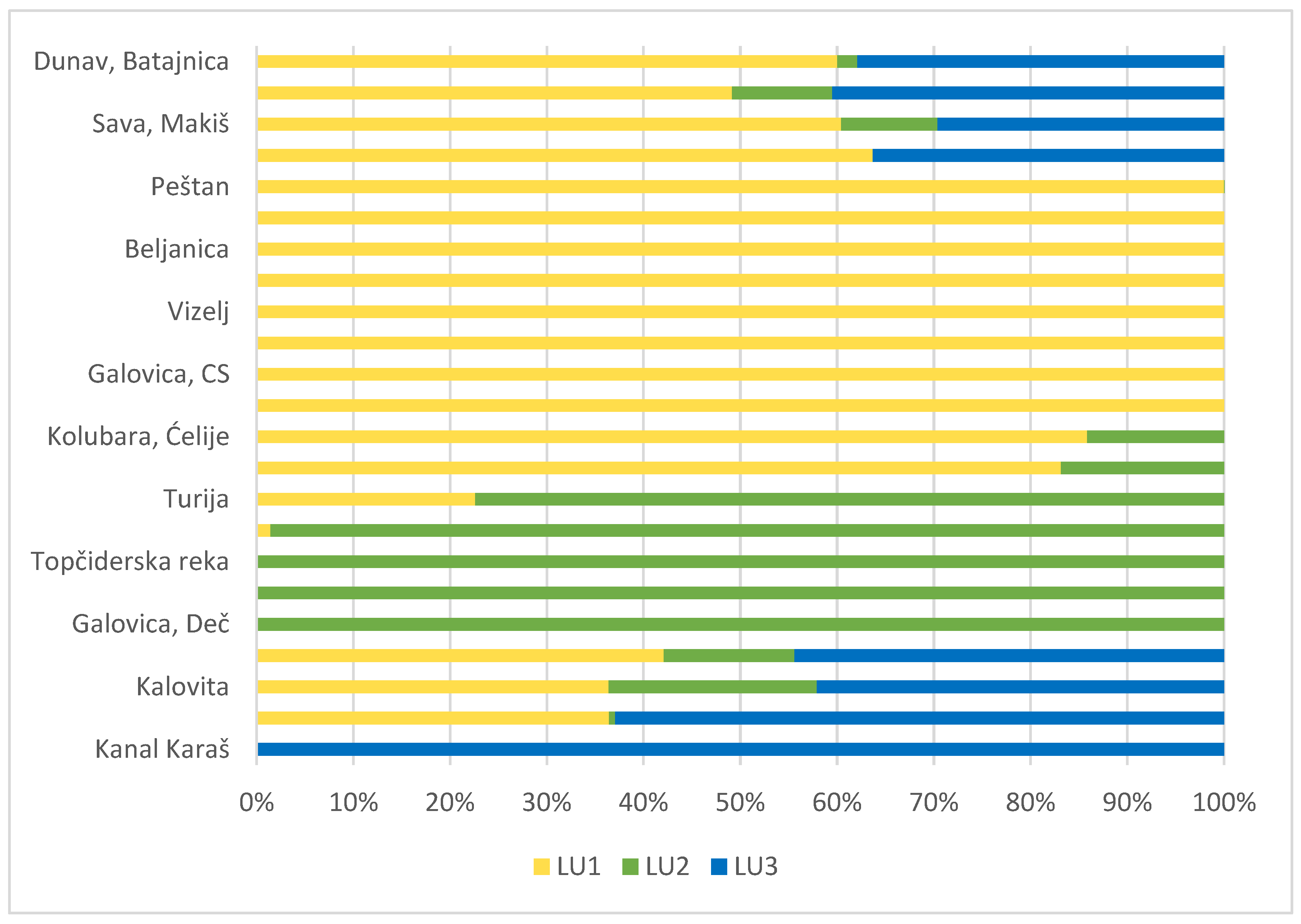
All 16 CORINE Land Cover classes were grouped into three higher land use classes: agricultural, artificial and semi-natural. The percentage of these LU classes is shown in Figure 2. Agricultural land was the dominant LU type in the Belgrade urban zone. Artificial land use dominated on five sites: Topčiderska, Barajevska, Barička reka and Turija (WBT2), and Galovica, Deč (WBT3), while semi-natural land use was the dominant LU type in Kalovita, Sibnica, Karaš kanal (WBT3) and Dunav, Vinča (WBT1).
Figure 2.
Percentage of dominant LU classes (LU1—agricultural, LU2—artificial, and LU3—semi-natural areas) at each study site.
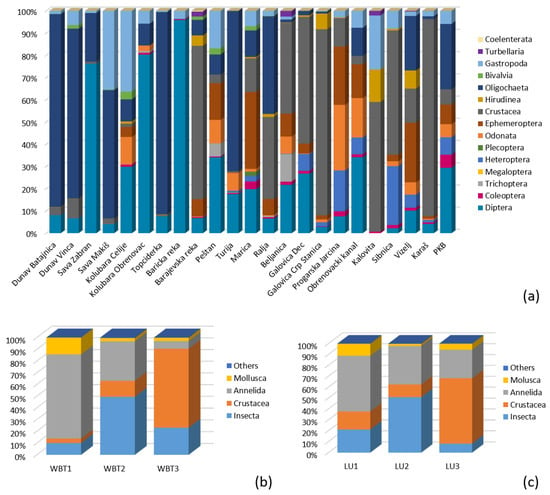
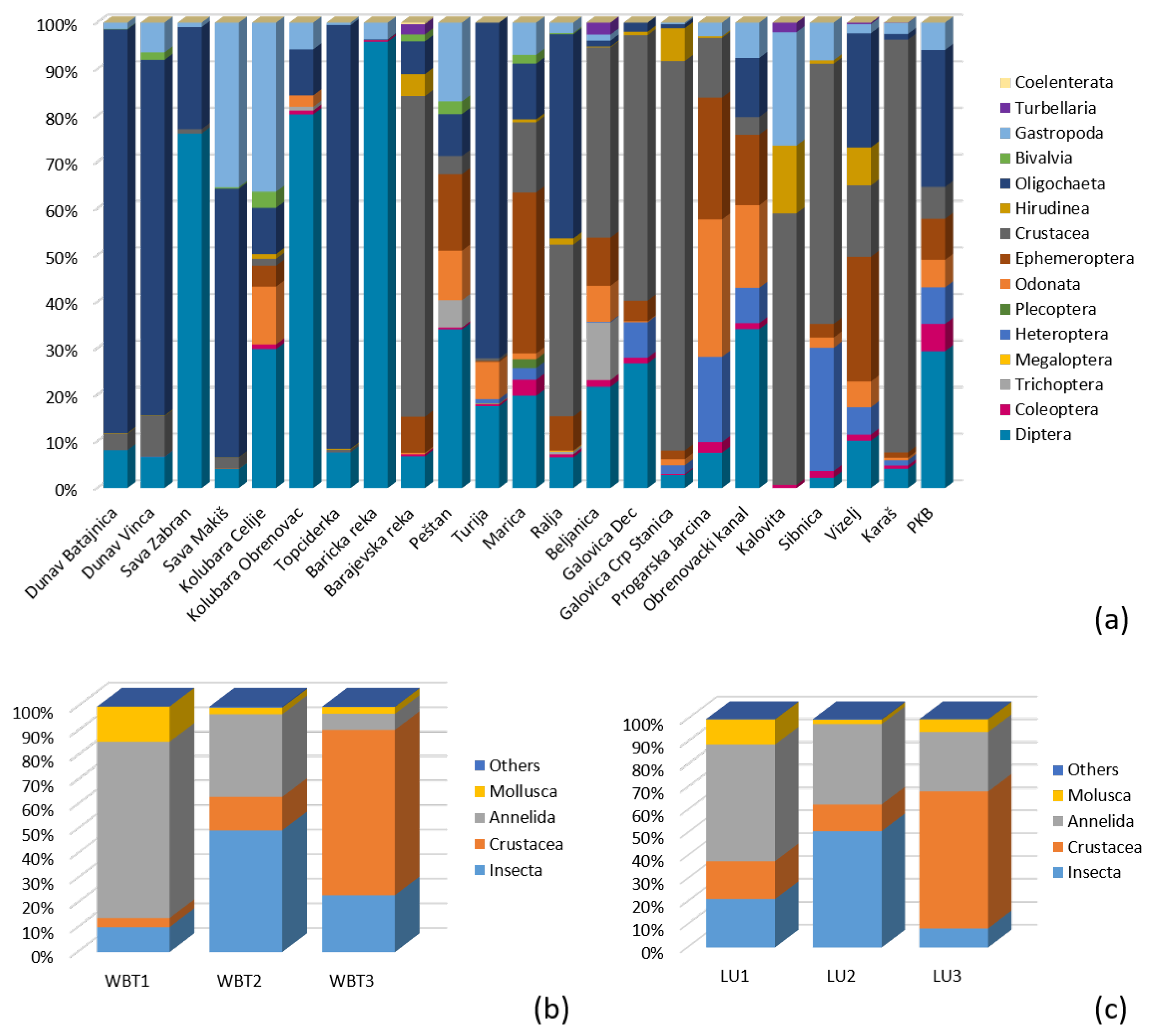
During the research, a total of 187 taxa were recorded in all types of water bodies in the Belgrade urban area. The presence of different taxonomic groups and their abundance at each study site are shown in Figure 3a. In non-wadeable rivers (WBT1), a total of 71 taxa were recorded, with Oligochaeta as the most dominant and abundant group (71.76%; n = 5147), with Limnodrilus hoffmeisteri Claparede, 1862 as the dominant species. Subdominant groups were Mollusca (14.38%, n = 1031) and Insecta (10.09%, Diptera 9.47%, n = 679). In the wadeable river (WBT2), a total of 119 taxa were recorded. The most dominant and abundant group were Insecta (49.42%, n = 4553), followed by Oligochaeta (33.14%, n = 3053) and Crustacea (16.64%, n = 1257), while in canals (WBT3, n = 94 taxa) those were crustacean (67.44%; n = 2759), followed by insect groups (23.05%, n = 943) (Figure 3b). The highest percentage of EPT taxa was recorded in WBT3 (5.89%), followed by WBT2 (4.88%) and WBT1 (0.15%).
Figure 3.
Macroinvertebrate community composition in Belgrade urban area (a) Different taxonomic groups and their abundance at each study site; (b) Percentage of precipitation of a taxonomic groups in different water body types (WBT1—non-wadeable rivers, WBT2— wadeable rivers, WBT3—canals), (c) Percentage of precipitation of a taxonomic groups in localities under different land use influence (LU1—agricultural, LU2—artificial, and LU3—semi natural areas).
The highest number of taxa was recorded in water bodies that are under the strongest influence of agricultural land (n = 163), followed by semi-natural land (66), and artificial land (60). The most dominant group in the semi-natural land was Crustacea (59.86%), while in agricultural areas that were Oligochaeta (50.05%), and in artificial surfaces Diptera, mostly Chironomidae (47.67%) (Figure 3c). The percentage of EPT taxa was highest in LU1 (5.91%), followed by LU2 (1.23%) and LU3 (0.79%).
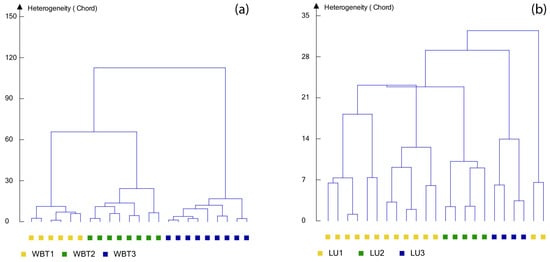
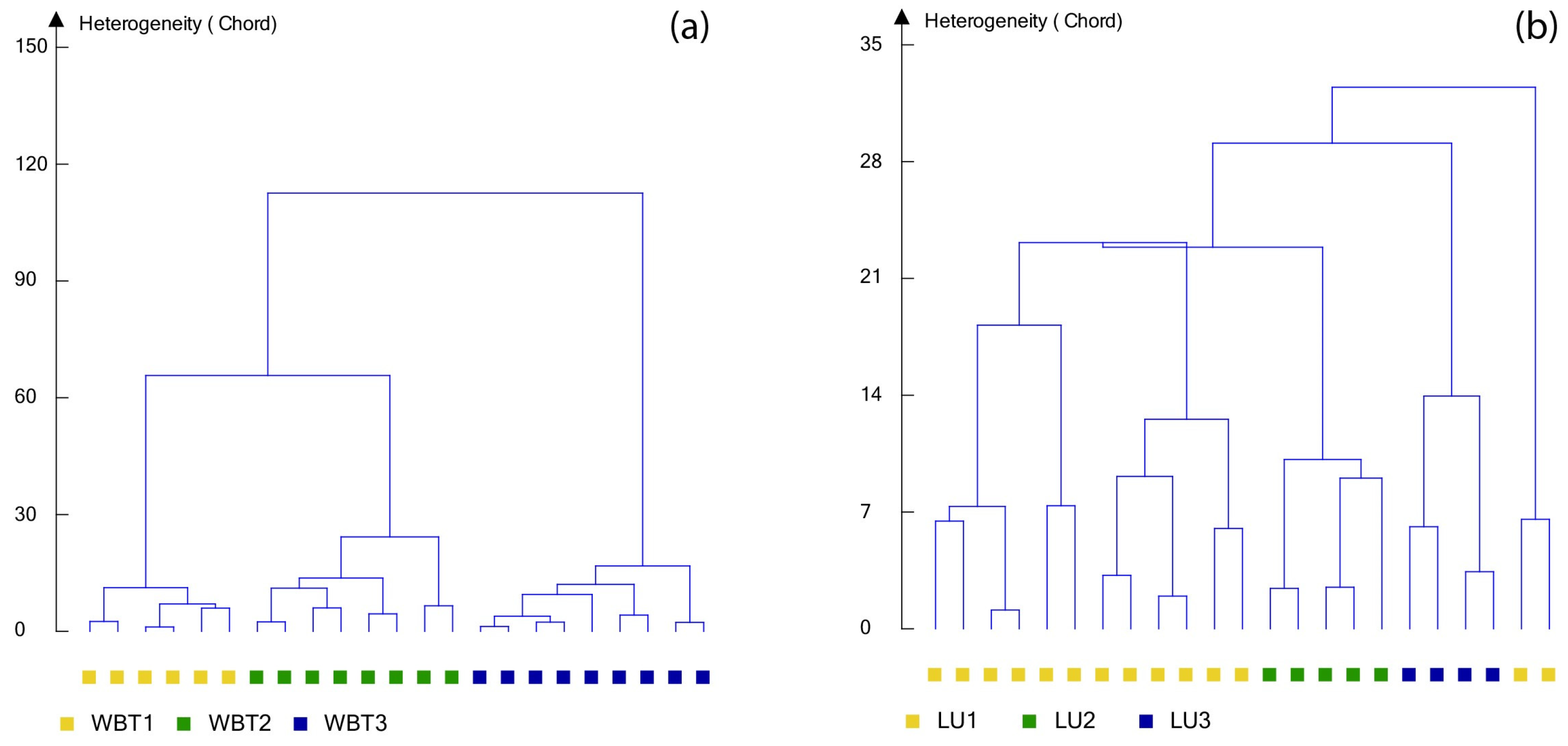
The cluster analyses based on the similarity of taxa composition with respect to waterbody types divided the communities into three main clusters (Figure 4a). The taxa composition with respect to different LU influences was also divided into three clusters. However, a small overlap could be observed for semi-natural areas (LU3) and certain non-wadeable rivers under agricultural influence (LU1) (Figure 4b).
Figure 4.
Hierarchical cluster analyses of the macroinvertebrate communities in relation to (a) water body types (WBT1—non-wadeable rivers, WBT2—wadeable rivers, WBT3—canals) and (b) land use influence (LU1—agricultural, LU2—artificial, and LU3—semi-natural areas).
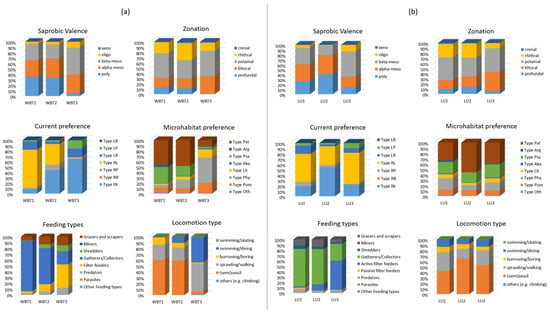
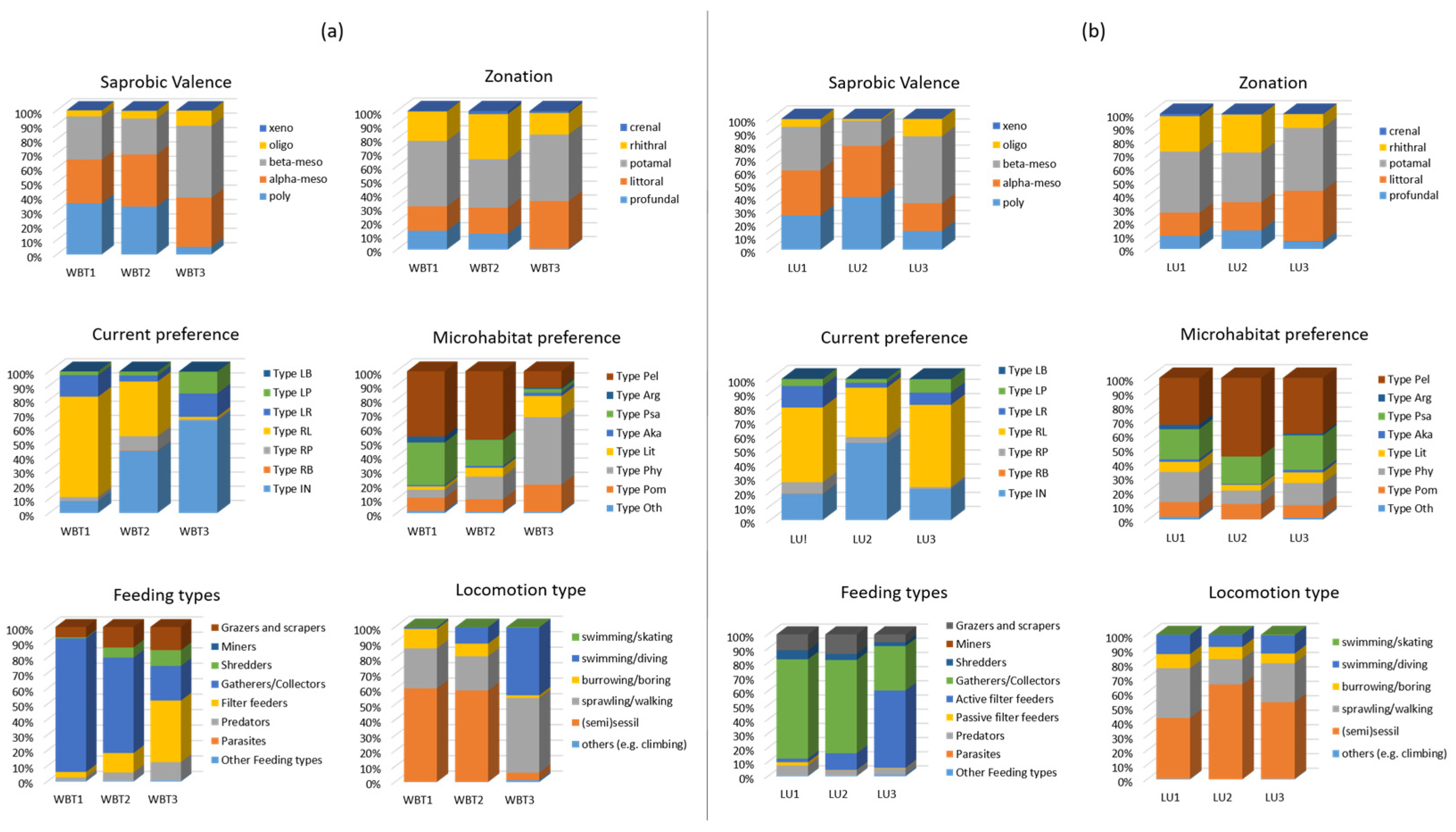
Certain functional groups of macroinvertebrate communities vary across different waterbody types and land use influence, providing valuable ecological insights.
Thus, across different WBT types, functional groups of macroinvertebrate communities differ significantly (Figure 5a). All functional groups of macroinvertebrates in canals showed that these communities were uniquely different from those in non-wadeable and wadeable rivers. Marked differences were also evident between non-wadeable and wadeable rivers in regard to current preference and feeding types.
Figure 5.
Macroinvertebrate community structure in relation to (a) water body types (WBT1—non-wadeable rivers, WBT2—wadeable rivers, WBT3—canals) and (b) land use influence (LU1—agricultural, LU2—artificial, and LU3—semi-natural areas).
Functional groups of macroinvertebrate communities across different LU types have shown greater uniformity (Figure 5b). Regarding saprobic conditions, flow, microhabitat preference, and locomotion type, communities in semi-natural and agricultural areas were more like each other than those in the artificial areas, although the differences were not significant. When the community was observed according to zonation preferences and feeding types, semi-natural areas showed distinction from agricultural and artificial areas.
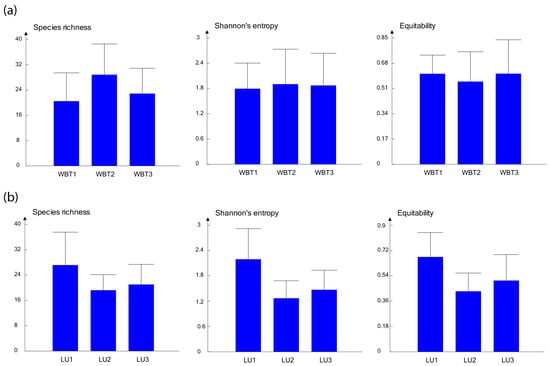
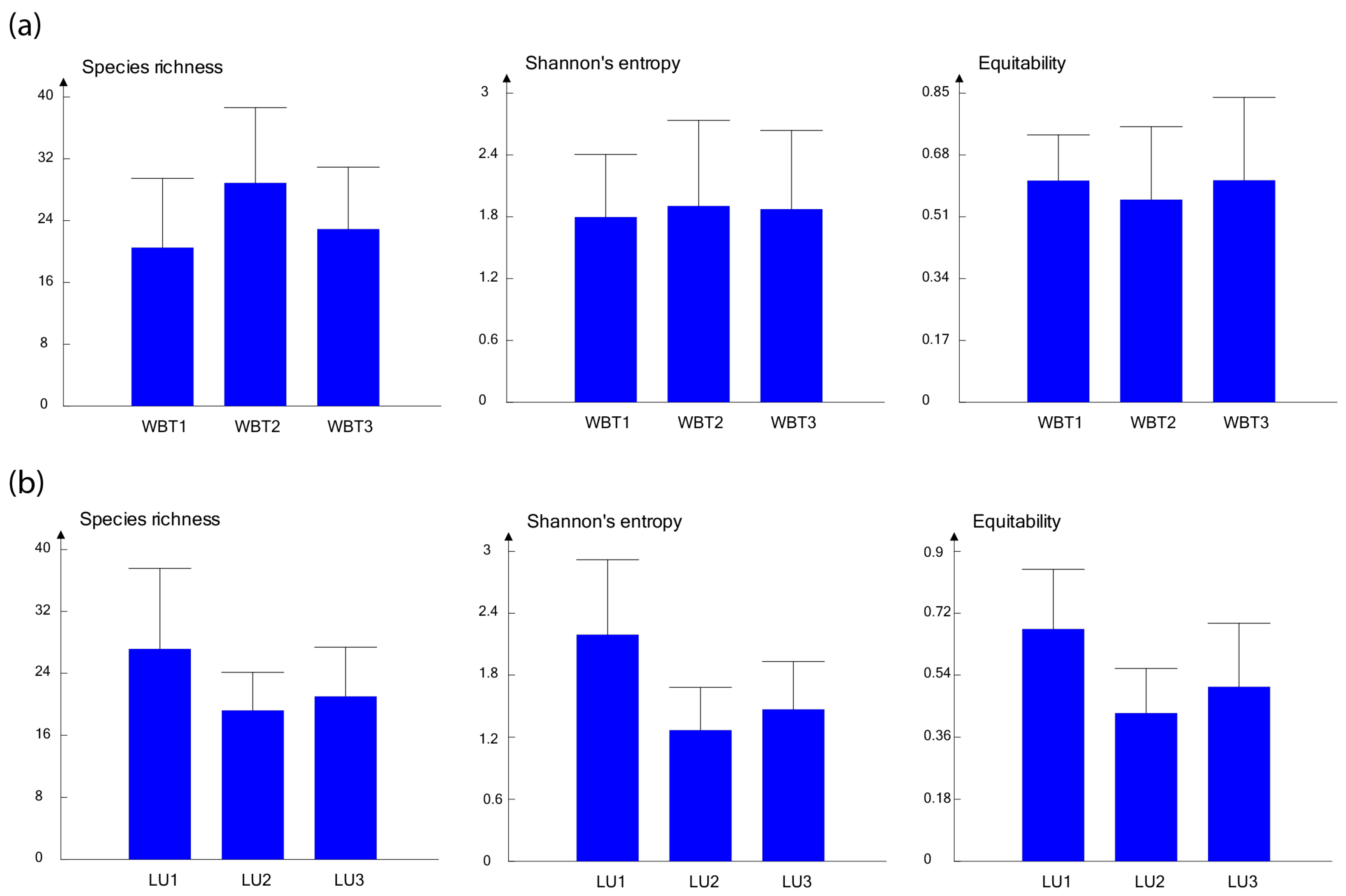
The alpha diversity of macroinvertebrates differs among different WBT’s (Figure 6a). Thus, species richness and Shannon–Wiener index were higher in wadeable rivers, while equitability was lower. In non-wadeable rivers, slightly lower species richness was observed.
Figure 6.
The alpha diversity components of macroinvertebrates in different (a) water body types (WBT1—non-wadeable rivers, WBT2—wadeable rivers, WBT3—canals) and under different (b) land use influences (LU1—agricultural, LU2—artificial, and LU3—semi-natural areas). Bars represent average values while lines indicate the variance in each group of assemblages.
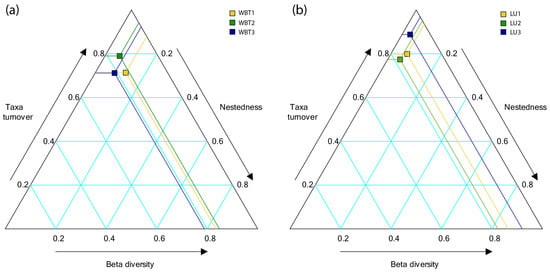
Agricultural land exhibits significantly higher taxonomic alpha diversity than artificial and semi-natural land. Statistical differences could be observed in Shannon diversity (p = 0.028) and Equitability (p = 0.036). All alpha diversity components were slightly higher in semi-natural land than those in artificial land (Figure 6b). Beta diversity was similar across different water body types, although both of their components differed (Figure 7a). The changes in total taxonomic beta diversity among different LU types were primarily dominated by taxa turnover components (Figure 7b). The value of beta diversity was the highest in seminatural land.
Figure 7.
The beta diversity components of macroinvertebrates across different (a) water body types (WBT1—non-wadeable rivers, WBT2—wadeable rivers, WBT3—canals) and under different (b) land use influence (LU1—agricultural, LU2—artificial, and LU3—semi-natural areas).
MANOVA showed clear separation of macroinvertebrate communities in different WBT’s (Figure 8a) as well as in sites under different LU influence (Figure 8b).
Figure 8.
Separation of macroinvertebrate communities in different (a) water body types (WBT1—non-wadeable rivers, WBT2—wadeable rivers, WBT3—canals) and under different (b) land use influence (LU1—agricultural, LU2—artificial, and LU3—semi-natural areas).
Community composition differed significantly among water body types (WBTs) (one-way PERMANOVA, Bray–Curtis dissimilarity, 9999 permutations, pseudo F2,20 = 2.613, p = 0.0196). Water body type explained 20.7% of the total variation in community composition (R2 = 0.207). Bonferroni-corrected pairwise comparisons showed a significant difference in community composition only between WBT2 and WBT3 (padj = 0.0048). No significant differences were found between WBT1 and WBT2 (padj = 1.000) or between WBT1 and WBT3 (padj = 0.1512).
Multivariate dispersion (PERMDISP) did not differ significantly among WBTs (F2,20 = 0.723, p = 0.4922). Bonferroni-corrected pairwise PERMDISP comparisons were also nonsignificant (all padj ≥ 0.7497).
Two-way PERMANOVA indicated that community composition differed significantly among water body types (WBTs) (pseudo F2,14 = 2.197, R2 = 0.207, p = 0.034). In contrast, land use (LU) had no significant effect on community composition (pseudo F2,14 = 1.199, R2 = 0.113, p = 0.2746). The interaction between WBT and LU was not significant (pseudo F4,14 = 0.104, R2 = 0.020, p = 0.8942).
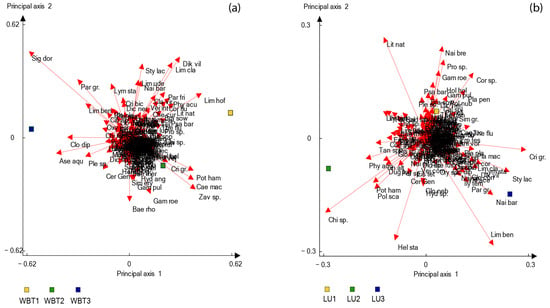
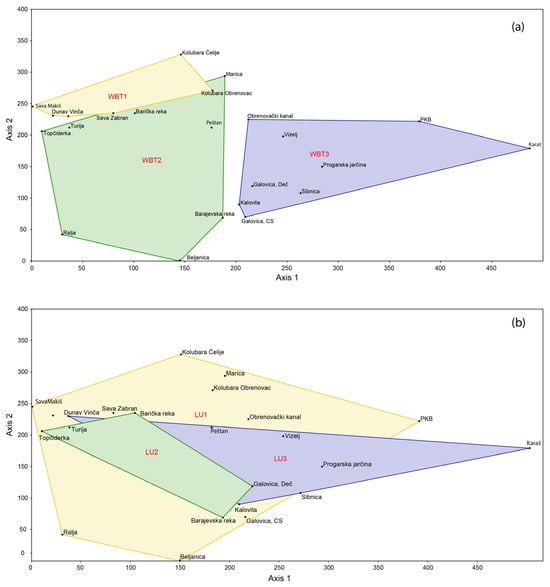
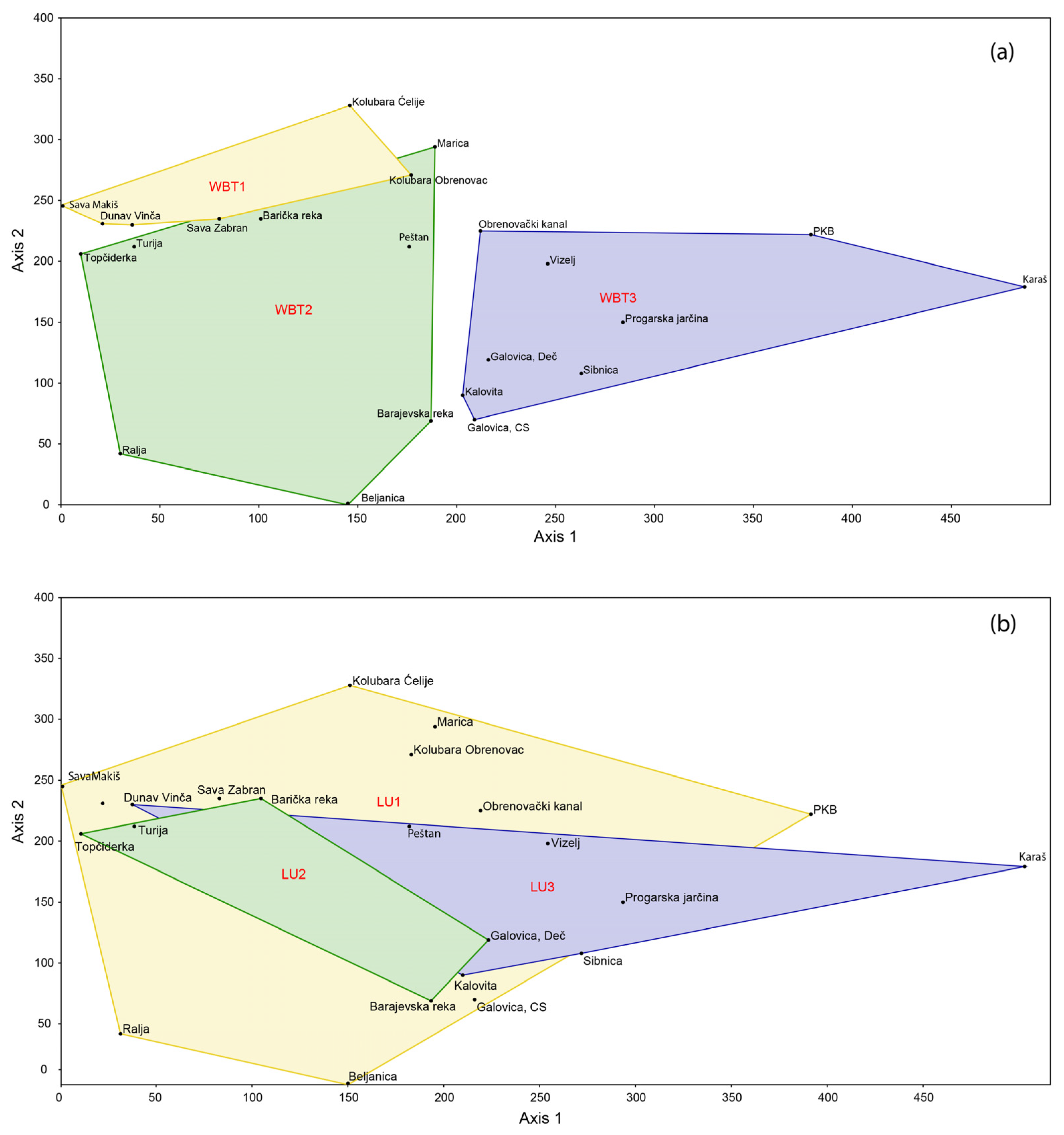
The analysis of communities, grouped according to WBT using DCA, showed three distinct groups of localities (Figure 9a). Non-wadeable rivers, wadeable rivers and canals formed three distinct clusters along the first ordination axis, indicating differences in community composition among these WBT types in the Belgrade urban area. Canals showed the most divergent communities, while wadeable rivers occupied an intermediate position between non-wadeable rivers and canals, reflecting their transitional hydromorphological characteristic. On the other hand, the analysis of communities grouped by LU influence on the waterbody was not as clear and it showed large overlap of polygons representing these groups (Figure 9b).
Figure 9.
Detrended correspondence analysis (DCA) of macroinvertebrate communities showed grouping of the communities in different (a) water body types (WBT1—non-wadeable rivers, WBT2—wadeable rivers, WBT3—canals) and under different (b) land use influence (LU1—agricultural, LU2—artificial, and LU3—semi-natural areas).
Non-wadeable rivers generally had more heterogeneous surrounding land use (lower HHI values), while wadeable rivers had more homogeneous LU influence (showed the highest LUI and HHI values). Canals, however, showed intermediate but variable conditions, with some sites strongly dominated by single LU classes (Tab 2). SPEAR indices varied among the three WBTs. Non-wadeable rivers had the lowest mean SPEARpesticides value (3.17 ± 5.14) and SPEAR percentage (18.97% ± 11.36), while wadeable rivers and canals showed higher values, with mean SPEARpesticides values of 8.35 ± 7.75 and 8.11 ± 6.16, respectively. The highest individual SPEARpesticides values were recorded in Obrenovački kanal (19.63), Peštan (18.77), Marica (18.45), and Progarska Jarčina (15.02), whereas values of 0 were recorded in Dunav Vinča, Sava Zabran, Topčiderka, and Kalovita. SPEARorganic values were negative at all sites and were lowest in non-wadeable rivers, indicating differences in stress-related community structure among waterbody types (Table 2).
Table 2.
Values of the analysed indices: Land Use Index (LUI), Herfindahl–Hirschman Index (HHI) and Species at risk (SPEAR).
Forward selection analysis (Table 3) identified fourteen environmental variables as significant for faunistic differentiation of the analysed urban water bodies.
Table 3.
Results of the forward selection analysis, * p < 0.05.
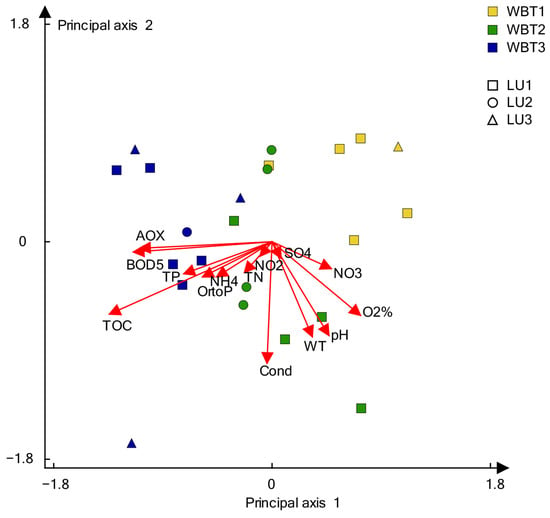
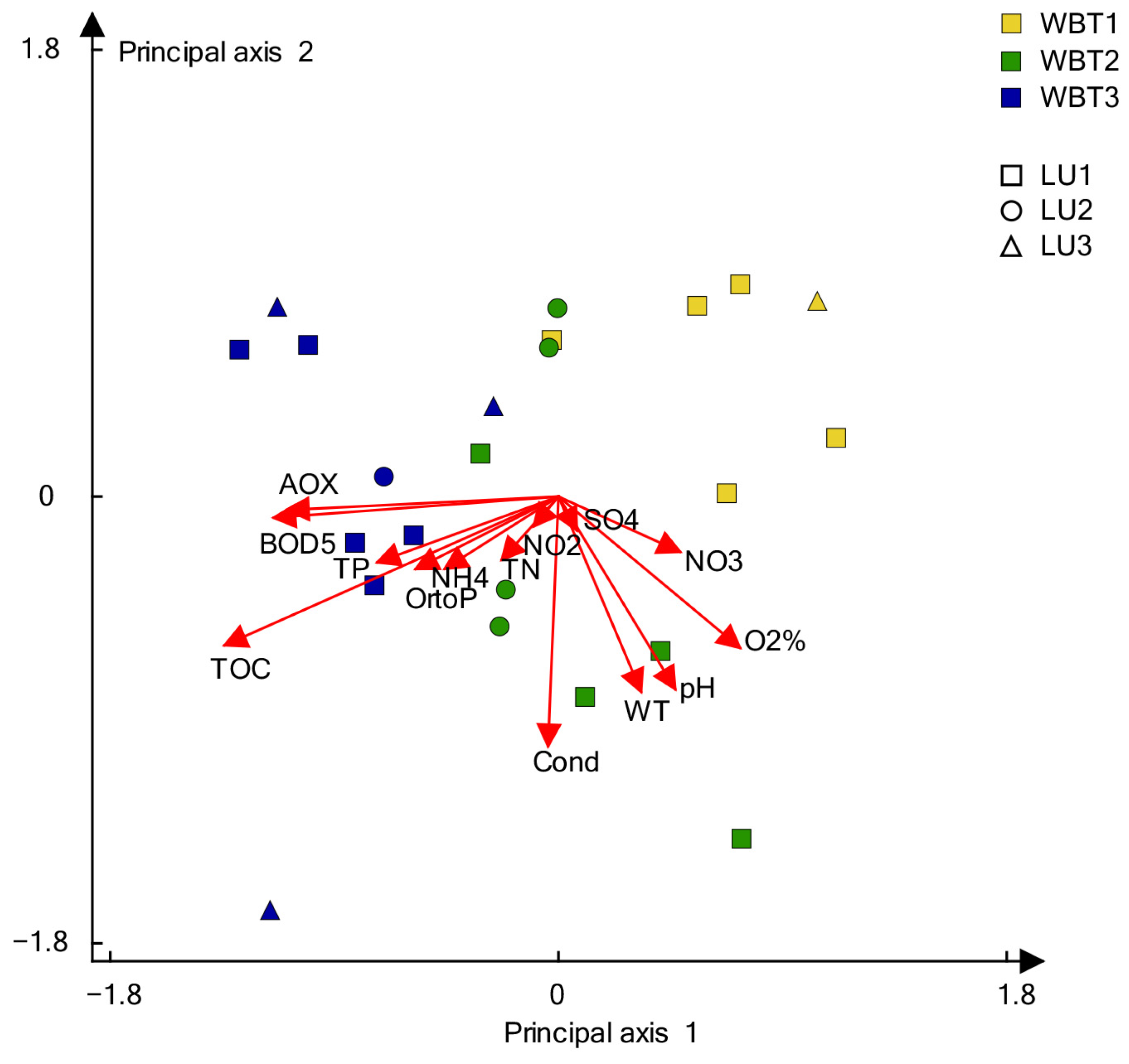
Canonical correspondence analysis (CCA) showed that macroinvertebrate communities from wadeable river sites that were under agricultural influence were differentiated with respect to conductivity, water temperature, oxygen saturation and pH. Canals were clearly defined by biological oxygen demand (BOD), total organic carbon (TOC), adsorbable organic halogens (AOX) and phosphates (total phosphates and orthophosphates). The importance of other environmental variables was lower (Figure 10). The first two CCA axes explained 24.6% of the variation in the fitted data obtained by multiple regressions.
Figure 10.
Canonical correspondence analysis (CCA) of community in relation to different water body types (WBT1—non-wadeable rivers, WBT2—wadeable rivers, WBT3—canals), different land use influence (LU1—agricultural, LU2—artificial, and LU3—semi-natural areas), as well as significant environmental variables.
4. Discussion
Although macroinvertebrate communities were analysed within a large urban area, overall taxonomic richness was high, with 187 identified taxa. This relatively high diversity likely reflects the broad range of habitat types included in the study, such as non-wadeable rivers, wadeable rivers and canals. These waterbody types differ in hydromorphological characteristics, substrate composition, flow conditions, connectivity, and degree of artificial modification, all of which can increase habitat heterogeneity and provide ecological niches for different taxa. Both taxonomic diversity and community structure were strongly associated with waterbody type, suggesting that habitat characteristics played an important role in shaping macroinvertebrate communities. Habitat heterogeneity is widely recognised as a key driver of macroinvertebrate diversity and distribution in freshwater ecosystems [19,56,57].
Although all investigated sites were located within an urbanised landscape and were exposed to different degrees of anthropogenic pressure, the results showed pronounced spatial variability in LU structure. The classification of LU across different waterbody types showed that the wider Belgrade urban area was dominated by three main LU classis/types—agricultural, artificial and semi-natural areas. Agricultural land represented the dominant LU type across the study area, especially in the peripheral parts. Large, non-wadeable rivers were exposed to all three LU categories, with a slight dominance of agricultural land in their surroundings. Wadeable rivers were more frequently associated with artificial and agricultural LU influence, while canals showed more variable conditions, ranging from sites dominated by artificial surfaces to sites influenced by semi-natural LU. This pattern was further supported by the LU indices. Non-wadeable rivers generally had more heterogeneous surrounding land use, as shown by lower HHI values, whereas wadeable rivers showed the highest LUI and HHI values. This could indicate stronger LU pressure and more homogeneous surrounding land use, as suggested by [47,48]. Canals showed intermediate but highly variable conditions, with some sites strongly dominated by a single LU class.
Both waterbody type and land use strongly structured macroinvertebrate communities, which was confirmed by cluster analysis and MANOVA. The clearest separation was observed among non-wadeable rivers, wadeable rivers and canals, indicating that waterbody type was a major determinant of community composition. Non-wadeable rivers were characterised by the dominance of Oligochaeta, while wadeable rivers had a higher contribution of insects, mainly Chironomidae, and canals were dominated by crustaceans. Popović et al. [3] showed differentiation of chironomid communities in different WBTs in the same area. These differences likely reflect contrasts in hydromorphology, flow regime, substrate composition, habitat complexity and degree of artificial modification [58]. It also reflects the presence of deposits of large lowland rivers and their tolerance of environmental stressors [59]. Functional composition of the communities showed a similar pattern. Thus, non-wadeable rivers were dominated by rheo-limnophilous taxa and gatherer-collectors. This suggests the importance of slow-flowing depositional habitats and fine organic material [60]. In contrast, wadeable rivers showed a more balanced representation of flow preference groups and feeding types, while canals were characterised by a higher contribution of limnophilous, swimming and filter-feeding taxa, reflecting their more lentic or artificial character [19].
Land use further modified these patterns. The differences in community structure were observed in relation to the dominant LU type. Sites influenced mainly by semi-natural LU had a higher proportion of crustaceans. This suggests more favourable or heterogeneous habitat conditions and lower levels of anthropogenic disturbance, all of which are known to support more diverse and less tolerant macroinvertebrate assemblages [9,22,61]. In contrast, sites under stronger artificial or urban influence were dominated by Chironomidae, which may reflect increased organic enrichment, habitat simplification or other urban-related stressors [3,62]. At sites where agricultural LU was dominant, Oligochaeta were the most abundant group, indicating possible effects of fine sediment accumulation, nutrient enrichment and organic matter inputs [59]. Overall, these patterns suggest that although urban pressure affects all investigated sites, the dominant surrounding LU type may further modify macroinvertebrate community composition by favouring different tolerant or opportunistic taxa. Significant differences in the distribution of dominant species among different LU types were already observed in other studies [13,17,63]. Artificial and urban LU are commonly associated with habitat simplification, wastewater inputs, altered hydrology and organic enrichment, while agricultural areas are often linked with sediment and pesticide inputs, as well as nutrients such as nitrogen and phosphorus that can provide a food source for macroinvertebrates [9,11,64]. Therefore, the dominance of Chironomidae and Oligochaeta in more disturbed settings is consistent with their ecological tolerance and ability to persist under degraded conditions [3,59]. Macroinvertebrate diversity differed among both WBT and LU categories. Species richness and Shannon diversity were highest in wadeable rivers, suggesting that these systems provided more favourable habitat conditions [19,65]. In contrast, non-wadeable rivers showed slightly lower richness, probably reflecting the dominance of a few highly abundant groups, particularly Oligochaeta Limnodrilus hoffmeisteri, indicating organic pollution [66,67]. In relation to LU, agricultural sites showed the highest alpha diversity, followed by semi-natural and artificial sites. However, this result should be interpreted carefully, because agricultural landscapes may include a mixture of habitat conditions and waterbody types, and higher richness does not necessarily indicate better ecological status [22,61,68]. The highest density of macroinvertebrates in agricultural sites was previously reported also by Wang et al. [13] and Bufebo et al. [63], who, however, found highest species richness in semi-natural areas. In the present study, the lack of significant differences in species richness among the LU groups suggests that the observed differences between these groups are not primarily driven by variation in the number of species, but rather by differences in their abundances and overall community structure. Beta diversity provided additional insight into spatial community heterogeneity. Although total beta diversity was similar among waterbody types, its components differed, indicating that different processes contributed to community variation. Across LU types, beta diversity was mainly driven by species turnover, suggesting that differences among communities were primarily caused by the replacement of taxa among sites rather than only by nested species loss. The highest beta diversity recorded in semi-natural areas may reflect greater habitat heterogeneity and more variable local conditions within this LU type. In urban and peri-urban landscapes, species turnover may be driven by a combination of natural habitat gradients, local environmental filtering and anthropogenic pressures [17,18].
SPEAR indices supported these patterns, revealing lower sensitivity and higher organic stress in non-wadeable rivers, and greater pesticide pressures in wadeable rivers and canals, with site-specific variations. Other studies also observed a negative association between lower SPEAR pesticide scores and macroinvertebrates [69,70]. Notably, Obrenovački kanal, PKB, and Peštan were identified as pollution hotspots, likely due to intensive runoff. Organic stress was prominent at Galovica, CS and nearby sites, suggesting that wastewater inputs and reduced flow significantly affect canals. Overall, pesticides and organic pollution were key stressors, but both LU and WBT mediated their effects. Poyntz-Wright et al. [69] found that ammonia and BOD concentrations have a negative correlation with SPEAR pesticide scores, and that LU through industry, urbanisation, and farming increases levels of ammonia and BOD in rivers. Although Dunav and Sava are exposed to certain LU pressures, particularly from agriculture, their larger water volume may buffer the effects of nutrient and organic inputs to a certain degree [25,65,71]. Medium and small rivers, such as the Kolubara, Marica, and Ralja, appear more sensitive to surrounding pressures due to lower flow and reduced dilution capacity. Increased BOD, nitrogen, phosphate, and AOX values may indicate organic enrichment, nutrient loading, and local wastewater or agricultural inputs, placing these systems mainly in moderate ecological condition. Canals, including Kalovita, Vizelj, and Galovica, were the most vulnerable water bodies. Their slow flow, water retention, and limited self-purification capacity favour the accumulation of organic matter, nutrients, and toxic compounds. Consequently, canals were more vulnerable to low dissolved oxygen conditions, eutrophication, and chemical contamination, which may explain their poorer ecological status compared to rivers. The relatively low percentage of variation explained by the first two CCA axes indicates that community structure was likely influenced by multiple interacting factors, including water chemistry, habitat type, hydromorphology, local substrate conditions, and surrounding LU. This is consistent with the findings of Wang et al. [13] and Miserendino et al. [72], whose research revealed changes in macroinvertebrate community structure influenced by physicochemical parameters and LU changes.
Overall, in the Belgrade urban area, water body type was the primary driver of community composition, explaining 20.7% of the variation, whereas land use accounted for a smaller and non-significant proportion of the variation (11.3%). The non-significant interaction between water body type and land use further suggests that differences among water body types were largely consistent across land use categories.
5. Conclusions
The study demonstrates that macroinvertebrate communities in the Belgrade FUA were shaped by the combined influence of WBT, LU structure and local environmental gradients. Waterbody type exerted a strong influence on taxonomic and functional community composition, while LU modified communities through different pressure pathways. Agricultural influence was associated with high proportions of Oligochaeta, artificial surfaces with Chironomidae dominance, and semi-natural areas with a greater contribution of crustaceans. These findings highlight the importance of considering both hydromorphological typology and surrounding LU configuration when assessing ecological status and planning management measures in urban freshwater ecosystems; in other words, a holistic approach is needed for the proper management of urban and suburban freshwaters. They also suggest that management actions in urban areas should not focus only on pollution reduction, but also on maintaining habitat heterogeneity, improving riparian zones and reducing diffuse agricultural and urban inputs.
Author Contributions
Conceptualization, J.Đ., N.P. and B.T.; methodology, J.Đ., N.P. and B.T.; software, J.Đ. and N.P.; validation, B.T. and M.P.; formal analysis, J.Đ. and N.P.; investigation, J.Đ., N.P. and B.T.; data curation, J.Đ., N.P. and B.T.; writing—original draft preparation, J.Đ. and N.P.; writing—review and editing, B.T. and M.P.; visualisation, J.Đ., N.P. and B.T.; supervision, M.P.; project administration, N.P.; funding acquisition, N.P. All authors have read and agreed to the published version of the manuscript.
Funding
This research was funded by the Ministry of Science, Technological Development and Innovation of the Republic of Serbia, Contract No. 451-03-33/2026-03/200007.
Data Availability Statement
The data presented in this study are available on request from the corresponding author.
Acknowledgments
We would like to express our gratitude to the Public Health Institute of Belgrade for providing physical and chemical data used in this paper. The content of this study is in line with following United Nations (UN) Sustainable Development Goals, under the frame of the UN Agenda for Sustainable Development (Transforming our World: The 2030 Agenda for Sustainable Development—UN, 2015): Goal 6: Clean water and sanitation (6.3; 6.5; 6.6; 6.a and 6.b) and Goal 13: Climate action (13.1 and 13.2).
Conflicts of Interest
The authors declare no conflicts of interest. The funders had no role in the design of the study; in the collection, analyses, or interpretation of data; in the writing of the manuscript; or in the decision to publish the results.
References
- Albert, J.S.; Destouni, G.; Duke-Sylvester, S.M.; Magurran, A.E.; Oberdorff, T.; Reis, R.E.; Winemiller, K.O.; Ripple, W.J. Scientists’ Warning to Humanity on the Freshwater Biodiversity Crisis. Ambio 2021, 50, 85–94. [Google Scholar] [CrossRef] [Scilit] [PubMed]
- Živadinovic, I.; Ilijevic, K.; Gržetic, I.; Popovic, A. Long-Term Changes in the Eco-Chemical Status of the Danube River in the Region of Serbia. J. Serbian Chem. Soc. 2010, 75, 1. [Google Scholar] [CrossRef] [Scilit]
- Popović, N.; Marinković, N.; Čerba, D.; Raković, M.; Đuknić, J.; Paunović, M. Diversity Patterns and Assemblage Structure of Non-Biting Midges (Diptera: Chironomidae) in Urban Waterbodies. Diversity 2022, 14, 187. [Google Scholar] [CrossRef] [Scilit]
- Chen, B.; Ji, Q.; Yao, Y.; Zhang, Z.; Lin, Y. Impacts of Land Use and Water Quality on Macroinvertebrate Diversity Under Human Disturbance in the Lake Chaohu Basin, China. Ecol. Evol. 2025, 15, e72415. [Google Scholar] [CrossRef] [Scilit] [PubMed]
- Bonada, N.; Prat, N.; Resh, V.H.; Statzner, B. Developments in Aquatic Insect Biomonitoring: A Comparative Analysis of Recent Approaches. Annu. Rev. Entomol. 2006, 51, 495–523. [Google Scholar] [CrossRef] [Scilit] [PubMed]
- Nguyen, H.H.; Welti, E.A.R.; Haubrock, P.J.; Haase, P. Long-Term Trends in Stream Benthic Macroinvertebrate Communities Are Driven by Chemicals. Environ. Sci. Eur. 2023, 35, 108. [Google Scholar] [CrossRef] [Scilit]
- Wang, X.; Li, J.; Tan, L.; Yao, J.; Zheng, Y.; Shen, Q.; Tan, X. The Impact of Land Use on Stream Macroinvertebrates: A Bibliometric Analysis for 2010–2021. Environ. Monit. Assess. 2023, 195, 613. [Google Scholar] [CrossRef] [Scilit] [PubMed]
- Shen, M.; van Klink, R.; Xu, W.; Sagouis, A.; Chase, J.M. Land Use Influences on Freshwater Biodiversity. Glob. Ecol. Biogeogr. 2026, 35, e70230. [Google Scholar] [CrossRef] [Scilit]
- Allan, J.D. Landscapes and Riverscapes: The Influence of Land Use on Stream Ecosystems. Annu. Rev. Ecol. Evol. Syst. 2004, 35, 257–284. [Google Scholar] [CrossRef] [Scilit]
- Feld, C.K.; Fernandes, M.R.; Ferreira, M.T.; Hering, D.; Ormerod, S.J.; Venohr, M.; Gutiérrez-Cánovas, C. Evaluating Riparian Solutions to Multiple Stressor Problems in River Ecosystems—A Conceptual Study. Water Res. 2018, 139, 381–394. [Google Scholar] [CrossRef] [Scilit] [PubMed]
- Walsh, C.J.; Roy, A.H.; Feminella, J.W.; Cottingham, P.D.; Groffman, P.M.; Morgan, R.P. The Urban Stream Syndrome: Current Knowledge and the Search for a Cure. J. N. Am. Benthol. Soc. 2005, 24, 706–723. [Google Scholar] [CrossRef]
- Schürings, C.; Globevnik, L.; Lemm, J.U.; Psomas, A.; Snoj, L.; Hering, D.; Birk, S. River Ecological Status Is Shaped by Agricultural Land Use Intensity across Europe. Water Res. 2024, 251, 121136. [Google Scholar] [CrossRef] [Scilit] [PubMed]
- Wang, N.; Zhang, J.; Zhao, C.; Gao, Y.; Dong, J.; Gao, X.; Yuan, H.; Zhu, P.; Li, X. Effects of Different Land Use Types on Macroinvertebrate Community Structure and Diversity in the Middle Reaches of the Yellow River Basin. Ecol. Indic. 2025, 179, 114259. [Google Scholar] [CrossRef] [Scilit]
- Johnson, R.K.; Furse, M.T.; Hering, D.; Sandin, L. Ecological Relationships between Stream Communities and Spatial Scale: Implications for Designing Catchment-level Monitoring Programmes. Freshw. Biol. 2007, 52, 939–958. [Google Scholar] [CrossRef] [Scilit]
- Feld, C.K. Response of Three Lotic Assemblages to Riparian and Catchment-scale Land Use: Implications for Designing Catchment Monitoring Programmes. Freshw. Biol. 2013, 58, 715–729. [Google Scholar] [CrossRef] [Scilit]
- Ma, Y.; Yu, Z.; Jia, S.; Wu, N.; Yin, K.; Wang, Y.; Giesy, J.P.; Jin, X. Multiple Anthropogenic Stressors Influence the Taxonomic and Functional Homogenization of Macroinvertebrate Communities on the Mainstream of an Urban-Agricultural River in China. J. Environ. Manag. 2023, 341, 118017. [Google Scholar] [CrossRef] [Scilit] [PubMed]
- Bürgés, J.; Gál, B.; Szivák, I.; Karadi-Kovacs, K.; Boda, P.; Bohus, A.; Padisák, J.; Selmeczy, G.B.; Schmera, D. Urbanization and Stream Identity Shape Beta Diversity and Its Components: Evidence from Stream-Dwelling Macroinvertebrate Assemblages. Hydrobiologia 2026, 853, 3197–3215. [Google Scholar] [CrossRef] [Scilit]
- Baselga, A. Partitioning the Turnover and Nestedness Components of Beta Diversity. Glob. Ecol. Biogeogr. 2010, 19, 134–143. [Google Scholar] [CrossRef] [Scilit]
- Heino, J.; Melo, A.S.; Siqueira, T.; Soininen, J.; Valanko, S.; Bini, L.M. Metacommunity Organisation, Spatial Extent and Dispersal in Aquatic Systems: Patterns, Processes and Prospects. Freshw. Biol. 2015, 60, 845–869. [Google Scholar] [CrossRef] [Scilit]
- SORS. First Results of the 2022 Census of Population, Households and Dwellings—Press Release; SORS: Belgrade, Serbia, 2022.
- Gavrilović, L.; Dukić, D. Reke Srbije; Zavod za Udžbenike i Nastavna Sredstva: Beograd, Serbia, 2002; p. 218.
- Petsch, D.K.; Blowes, S.A.; Melo, A.S.; Chase, J.M. A Synthesis of Land Use Impacts on Stream Biodiversity across Metrics and Scales. Ecology 2021, 102, e03498. [Google Scholar] [CrossRef] [Scilit] [PubMed]
- Camana, M.; Ortega, J.C.G.; Brejão, G.L.; Melo, A.S.; Dias, M.S.; Becker, F.G. A Global Meta-Analysis of the Effects of Land Use on the Diversity of Stream Fish and Macroinvertebrates. Aquat. Sci. 2024, 86, 86. [Google Scholar] [CrossRef] [Scilit]
- Vörösmarty, C.; McIntyre, P.; Gessner, M.; Dudgeon, D.; Prusevich, A.; Green, P.; Glidden, S.; Bunn, S.; Sullivan, C.; Liermann, R. Global Threats to Human Water Security and River Biodiversity. Nature 2010, 467, 555–561. [Google Scholar] [CrossRef] [Scilit] [PubMed]
- Hering, D.; Borja, A.; Carstensen, J.; Carvalho, L.; Elliott, M.; Feld, C.K.; Heiskanen, A.-S.; Johnson, R.K.; Moe, J.; Pont, D. The European Water Framework Directive at the Age of 10: A Critical Review of the Achievements with Recommendations for the Future. Sci. Total Environ. 2010, 408, 4007–4019. [Google Scholar] [CrossRef] [Scilit] [PubMed]
- AQEM Consortium. AQEM Consortium Manual for the Application of the AQEM System: A Comprehensive Method to Assess European Streams Using Benthic Macroinvertebrates, Developed for the Purpose of the Water Framework Directive, Version 1.0; AQEM Consortium: Vienna, Austria, 2002.
- Graf, W.; Csányi, B.; Leitner, P.; Paunović, M.; Huber, T.; Szekeres, J.; Claudia, N.; Borza, P. Macroinvertebrates. In Joint Danube Survey 3: A Comprehensive Analysis of Danube Water Quality; ICPDR: Vienna, Austria, 2015; pp. 81–99. [Google Scholar]
- Hering, D.; Moog, O.; Sandin, L.; Verdonschot, P.F.M. Overview and Application of the AQEM Assessment System. Hydrobiologia 2004, 516, 1–20. [Google Scholar] [CrossRef] [Scilit]
- U.S. EPA. Method 170.1; Temperature (Thermometric). Temperature (Thermometric). U.S. Environmental Protection Agency: Washington, DC, USA, 1971.
- SRPS EN ISO 10523:2016; Water Quality—Determination of PH (ISO 10523:2008). Institute for Standardization of Serbia: Belgrade, Serbia, 2016.
- SRPS EN 27888:2009; Water Quality—Determination of Electrical Conductivity (ISO 7888:1985). Institute for Standardization of Serbia: Belgrade, Serbia, 2009.
- HACH Method 10360; Dissolved Oxygen and Oxygen Saturation, Direct Measurement. Hach Company: Loveland, CO, USA, 2011.
- SRPS EN 26777:2009; Water Quality—Determination of Nitrite—Molecular Absorption Spectrometric Method (ISO 6777:1984). Institute for Standardization of Serbia: Belgrade, Serbia, 2009.
- SMEWW, 24th Ed., Method 4500-NO3-B; Nitrate. American Public Health Association: Washington, DC, USA; American Water Works Association: Washington, DC, USA; Water Environment Federation: Washington, DC, USA, 2023.
- SRPS EN 1899-2:2009; Water Quality—Determination of Biochemical Oxygen Demand after n Days (BODn)—Part 2: Method for Undiluted Samples. Institute for Standardization of Serbia: Belgrade, Serbia, 2009.
- SRPS EN ISO 6878:2008; Water Quality—Determination of Phosphorus—Ammonium Molybdate Spectrometric Method (ISO 6878:2004). Institute for Standardization of Serbia: Belgrade, Serbia, 2008.
- SRPS EN ISO 20236:2022; Water Quality—Determination of Total Organic Carbon (TOC), Dissolved Organic Carbon (DOC), Total Bound Nitrogen (TNb) and Dissolved Bound Nitrogen (DNb) after High Temperature Catalytic Oxidative Combustion (ISO 20236:2018). Institute for Standardization of Serbia: Belgrade, Serbia, 2022.
- SMEWW, 20th Ed., Method 2540 D; Total Suspended Solids Dried at 103–105 °C. American Public Health Association: Washington, DC, USA; American Water Works Association: Washington, DC, USA; Water Environment Federation: Washington, DC, USA, 1998.
- P-V-2/B; Determination of Ammonium Ions. Standard Methods for Testing the Hygienic Quality of Drinking Water. Federal Institute for Health Protection: Belgrade, Serbia, 1990.
- SRPS ISO 9297-1:2007; Water Quality—Determination of Chloride—Silver Nitrate Titration with Chromate Indicator (Mohr’s Method). Institute for Standardization of Serbia: Belgrade, Serbia, 2007.
- U.S. EPA Method 300.1; Determination of Inorganic Anions in Drinking Water by Ion Chromatography. U.S. Environmental Protection Agency: Cincinnati, OH, USA, 1999.
- SRPS EN ISO 9562:2008; Water Quality—Determination of Adsorbable Organically Bound Halogens (AOX) (ISO 9562:2004). Institute for Standardization of Serbia: Belgrade, Serbia, 2008.
- QGIS Association. QGIS Geographic Information System (Version 3.34.12 “Prizren”); QGIS Association: Beaverton, OR, USA, 2023; Available online: https://www.qgis.org (accessed on 15 April 2026).
- Copernicus Land Monitoring Service; European Environment Agency (EEA). CORINE Land Cover 2018 (Vector), Europe, 6-Yearly—Version 2020_20u1, May 2020; Copernicus Land Monitoring Service: Copenhagen, Denmark; European Environment Agency (EEA): Copenhagen, Denmark, 2019. [CrossRef]
- Vilenica, M.; Tubić, B.; Žganec, K.; Brigić, A.; Ružanović, L.; Popović, N.; Paunović, M. Assessment of Taxonomic and Functional Diversity of Mayfly Assemblages Along the Course of a Large European River. Aquat. Conserv. Mar. Freshw. Ecosyst. 2025, 35, e70139. [Google Scholar] [CrossRef] [Scilit]
- Zhao, N.; Yao, Z.; Chen, W.; Sang, C.; Li, Z.; Niu, X.; Gao, F. A Study of Macroinvertebrate Community Structure and Diversity in Response to Land Use Type in the Yiluo River Basin. Environ. Res. 2024, 255, 119157. [Google Scholar] [CrossRef] [Scilit] [PubMed]
- Zagorskas, J. GIS-Based Modelling and Estimation of Land Use Mix in Urban Environment. Int. J. Educ. Learn. Syst. 2016, 1, 284–293. [Google Scholar]
- Flo, E.; Garcés, E.; Camp, J. Land Uses Simplified Index (LUSI): Determining Land Pressures and Their Link with Coastal Eutrophication. Front. Mar. Sci. 2019, 6, 18. [Google Scholar] [CrossRef] [Scilit]
- Bonzongo, J.-C.J.; Donkor, A.K.; Attibayeba, A.; Gao, J. Linking Landscape Development Intensity within Watersheds to Methyl-Mercury Accumulation in River Sediments. Ambio 2016, 45, 196–204. [Google Scholar] [CrossRef] [Scilit] [PubMed]
- Hermans, S.; Gautam, A.; Lewis, G.D.; Neale, M.; Buckley, H.L.; Case, B.S.; Lear, G. Exploring Freshwater Stream Bacterial Communities as Indicators of Land Use Intensity. Environ. Microbiome 2024, 19, 45. [Google Scholar] [CrossRef] [Scilit] [PubMed]
- Beketov, M.A.; Liess, M. An Indicator for Effects of Organic Toxicants on Lotic Invertebrate Communities: Independence of Confounding Environmental Factors over an Extensive River Continuum. Environ. Pollut. 2008, 156, 980–987. [Google Scholar] [CrossRef] [Scilit] [PubMed]
- Karadžić, B. FLORA: A Software Package for Statistical Analysis of Ecological Data. Water Res. Manag. 2013, 3, 45–54. [Google Scholar]
- Ward, J.H., Jr.; Hook, M.E. Application of an Hierarchical Grouping Procedure to a Problem of Grouping Profiles. Educ. Psychol. Meas. 1963, 23, 69–81. [Google Scholar] [CrossRef] [Scilit]
- Bray, J.H.; Maxwell, S.E. Multivariate Analysis of Variance; SAGE Publications: Thousand Oaks, CA, USA, 1985. [Google Scholar]
- James, G.; Witten, D.; Hastie, T.; Tibshirani, R. An Introduction to Statistical Learning: With Applications in R, 1st ed.; Springer: New York, NY, USA, 2013; Volume 103. [Google Scholar]
- Agra, J.; Cornelissen, T.; Viana-Junior, A.B.; Callisto, M. A Global Synthesis and Meta-analysis of the Environmental Heterogeneity Effects on the Freshwater Biodiversity. Oikos 2024, 2024, e10186. [Google Scholar] [CrossRef] [Scilit]
- Aleixo, M.H.F.; Possamai, L.C.; de Castro, K.S.P.; Yofukuji, K.Y.; Cardozo, A.L.P.; Fugi, R. Habitat Complexity versus Habitat Heterogeneity: Invertebrates Prefer Macrophyte Stands with Intermediate Biomass and High Functional Diversity. Freshw. Biol. 2024, 69, 1278–1291. [Google Scholar] [CrossRef] [Scilit]
- Allan, J.D.; Castillo, M.M. Stream Ecology: Structure and Function of Running Waters; Springer: Berlin/Heidelberg, Germany, 2007. [Google Scholar]
- Atanacković, A.; Popović, N.; Marinković, N.; Tomović, J.; Đuknić, J.; Stanković, J.; Paunović, M. Effects of Environmental Factors on the Distribution and Diversity of Aquatic Oligochaetes. Water 2023, 15, 3873. [Google Scholar] [CrossRef] [Scilit]
- Tachet, H.; Richoux, P.; Bournaud, M.; Usseglio-Polatera, P. Invertébrés Deau Douce Systématique, Biologie, Écologie; Tachet, H., Ed.; CNRS Editions: Paris, France, 2010. [Google Scholar]
- Feld, C.K.; Birk, S.; Eme, D.; Gerisch, M.; Hering, D.; Kernan, M.; Maileht, K.; Mischke, U.; Ott, I.; Pletterbauer, F. Disentangling the Effects of Land Use and Geo-Climatic Factors on Diversity in European Freshwater Ecosystems. Ecol. Indic. 2016, 60, 71–83. [Google Scholar] [CrossRef] [Scilit]
- Khudhair, N.; Yan, C.; Liu, M.; Yu, H. Effects of Habitat Types on Macroinvertebrates Assemblages Structure: Case Study of Sun Island Bund Wetland. BioMed Res. Int. 2019, 2019, 2650678. [Google Scholar] [CrossRef] [Scilit] [PubMed]
- Bufebo, B.; Elias, E.; Getu, E. Abundance and Diversity of Soil Invertebrate Macro-Fauna in Different Land Uses at Shenkolla Watershed, South Central Ethiopia. J. Basic Appl. Zool. 2021, 82, 11. [Google Scholar] [CrossRef] [Scilit]
- Crowson, M.; Pettorelli, N.; Isaac, N.J.B.; Norris, K.; Wade, A.J. Quantifying the Relative Importance of Agricultural Land Use as a Predictor of Catchment Nitrogen and Phosphorus Concentrations. Sci. Total Environ. 2024, 954, 176589. [Google Scholar] [CrossRef] [Scilit] [PubMed]
- Vannote, R.L.; Minshall, G.W.; Cummins, K.W.; Sedell, J.R.; Cushing, C.E. The River Continuum Concept. Can. J. Fish. Aquat. Sci. 1980, 37, 130–137. [Google Scholar] [CrossRef] [Scilit]
- Verdonschot, P.F.M. Integrated Ecological Assessment Methods as a Basis for Sustainable Catchment Management. Hydrobiologia 2000, 422, 389–412. [Google Scholar] [CrossRef] [Scilit]
- Atanacković, A.D.; Šporka, F.; Csányi, B.; Vasiljević, B.M.; Tomović, J.M.; Paunović, M.M. Oligochaeta of the Danube River—A Faunistical Review. Biologia 2013, 68, 269–277. [Google Scholar] [CrossRef] [Scilit]
- Johnson, R.K.; Angeler, D.G. Effects of Agricultural Land Use on Stream Assemblages: Taxon-Specific Responses of Alpha and Beta Diversity. Ecol. Indic. 2014, 45, 386–393. [Google Scholar] [CrossRef] [Scilit]
- Poyntz-Wright, I.P.; Harrison, X.A.; Johnson, A.; Zappala, S.; Tyler, C.R. Pesticide Pollution Associations with Riverine Invertebrate Communities in England. Sci. Total Environ. 2023, 903, 166519. [Google Scholar] [CrossRef] [Scilit] [PubMed]
- Ganatra, A.A.; Kandie, F.J.; Fillinger, U.; McOdimba, F.; Torto, B.; Brack, W.; Liess, M.; Hollert, H.; Becker, J.M. Calibration of the SPEARpesticides Bioindicator for Cost-Effective Pesticide Monitoring in East African Streams. Environ. Sci. Eur. 2021, 33, 58. [Google Scholar] [CrossRef] [Scilit]
- Birk, S.; Bonne, W.; Borja, A.; Brucet, S.; Courrat, A.; Poikane, S.; Solimini, A.; Van De Bund, W.; Zampoukas, N.; Hering, D. Three Hundred Ways to Assess Europe’s Surface Waters: An Almost Complete Overview of Biological Methods to Implement the Water Framework Directive. Ecol. Indic. 2012, 18, 31–41. [Google Scholar] [CrossRef] [Scilit]
- Miserendino, M.L. Distribución Altitudinal de Especies de Trichoptera En Un Sistema Fluvial En Patagonia. Ecol. Austral 1999, 9, 28–34. [Google Scholar]

Disclaimer/Publisher’s Note: The statements, opinions and data contained in all publications are solely those of the individual author(s) and contributor(s) and not of MDPI and/or the editor(s). MDPI and/or the editor(s) disclaim responsibility for any injury to people or property resulting from any ideas, methods, instructions or products referred to in the content. |
© 2026 by the authors. Licensee MDPI, Basel, Switzerland. This article is an open access article distributed under the terms and conditions of the Creative Commons Attribution (CC BY) license.