


Abstract
Anaerobic digestion (AD) is a common waste management method for producing renewable energy from biogas. However, animal manures typically have low C/N ratios, which can limit biogas recovery. This study aims to optimize biogas production through the co-digestion of goat manure (GM) with high-C/N lignocellulosic rice husk (RH) and sludge as the inoculum. Characterization of the substrate and inoculum revealed a low GM C/N ratio (GM = 21.3), whereas RH has a high-C/N (RH = 107.3). The volatile solids-to-total solids (VS/TS) ratios were around 82–85% for GM and RH. Batch experiments were conducted at different organic loading rates, with an inoculum-to-substrate ratio of 2:1 (mL:g), at 36 ± 1 °C for 65 days. This study investigates optimizing biomethane recovery by using serum-bottle biomethane potential (BMP) and compares kinetic performance and yields across different GM-to-RH ratios with the characteristics of the influent and effluent. The highest BMP values (mL CH4/gVS) occurred at 100% GM (245.1), followed by 90% GM (233.6) and 30% GM (232.5), indicating a strong synergy between GM and RH at specific mixing ratios. Kinetic modeling using both the modified Gompertz and first-order models effectively described digestion dynamics, allowing for estimation of potential lag phases and maximum production rates. These models aligned well with experimental data across substrates, aiding process design. Overall, the results show that strategic co-digestion of GM with RH can maximize methane recovery, with defined substrate ratios and a clear understanding of the kinetics essential for scale-up and sustainable biogas production.
1. Introduction
Greenhouse gas (GHG) emissions from agriculture are influenced by manure management practices, particularly the storage of large volumes of untreated manure in open lagoons. These practices can promote anaerobic decomposition and uncontrolled methane production while creating water-quality concerns. Anaerobic digestion (AD) is one mitigation option that involves the stabilization of manure in a controlled system and the capture of biogas for energy generation, usually through combustion to generate electricity [1]. AD uptake occurs at the intersection of climate mitigation and renewable energy production, offering additional co-benefits, such as improved waste stabilization and reduced dependence on fossil fuels in rural communities.
The need for improved manure management is amplified by the consolidation of animal agriculture into concentrated animal feeding operations (CAFOs). Approximately 54% of confined farm animals are raised within just 5% of U.S. animal agriculture enterprises [2], and USEPA estimates there are about 18,800 CAFOs nationwide [2]. This rapid expansion has raised serious concerns about animal welfare and public health, particularly among workers and residents living near these facilities. Large-scale manure storage, heavy chemical inputs, and high-density confinement are common practices in industrial livestock production systems, which can result in exposure pathways through the air and water, and environmental damage [2]. The health effects of CAFO emissions on employees have been well characterized, but the health effects on surrounding communities are less well understood, underscoring the importance of interventions to reduce emissions and improve waste handling.
Accordingly, co-digestion, processing manure with other organic wastes, has been developed to increase methane yields and reduce net GHG emissions by improving feedstock balance and degradability. Manure management is estimated by the USEPA to account for approximately 15% of total agricultural GHG emissions, indicating the mitigation potential of improved treatment systems. Agricultural residues such as rice straw (RS) and rice husk (RH), as well as food waste and other animal manures, can be co-digested with livestock manure (including goat manure) to enhance biogas production [3]. Global rice production was estimated at 760 million tons in 2017, and approximately 1.5 tons of RH were generated per ton of rice, implying around 1 billion tons of RS were produced in that year [4]. Currently, rice residues are disposed of by feeding animals, incorporating into products, landfill disposal, or burning. However, incomplete combustion produces harmful pollutants like CO, PAHs, VOCs, and NOx that damage air quality [4]. Therefore, using these residues as co-digestion feedstocks can address both waste diversion and energy goals.
In addition to waste diversion, AD offers a proven pathway to renewable energy generation with increasing yet underexplored deployment potential. The U.S. already has thousands of biogas-producing facilities, and analysts estimate much more capacity could be achieved with improved financial and policy support. However, AD expansion is limited due to social, technical, and economic barriers that may include capital costs, operational complexity, and feedstock logistics [5,6]. Although agriculture is a smaller contributor to total U.S. GHG emissions than sectors like transportation and industry, methane and nitrous oxide emissions from manure are disproportionately important because of their high climate impact and the fact that they can often be addressed through targeted changes in technology and management. Thus, to achieve the energy benefits of AD, the performance and reliability of digesters need to be improved.
The efficiency of AD depends on the biological stability of the microbial community and operational conditions that determine both the amount and quality of biogas produced. Biogas can also be used for electricity generation, heating or cooking, or upgraded for use as a vehicle fuel, offering flexible pathways for on-farm energy services. AD of organic waste could produce considerable amounts of methane [7], and biogas-to-electricity conversions could be scaled to satisfy household energy demand. For example, the average U.S. residential electricity use is about 805 kWh per month [8], and estimates like ~1 m3 of biogas producing ~2.14 kWh highlight the scale of gas production required for meaningful energy replacement [9]. However, the performance of AD is highly sensitive to the process parameters because digestion is governed by multi-step anaerobic degradation kinetics, which depend on substrate and conditions.
In particular, the primary factors impacting digester efficiency include temperature regime, pH and alkalinity control, C/N ratio, mixing intensity, organic loading rate, hydraulic retention time, moisture and solids content, and the presence of inhibitors or toxic compounds [10]. Further, the methanogenesis process in AD depends on the pretreatment [11], feeding regimes [12], substrate variability, and fluctuations [13]. Co-digestion can help optimize several of these parameters, such as the C/N ratio and biodegradability, but it also introduces variability in feedstock supply and composition that must be managed to maintain stable microbial activity. However, methanogens primarily degrade high lignocellulosic RH components into volatile fatty acids [14]. Meanwhile, GM supplies readily degradable low C/N substrates that feed acetoclastic, hydrogenotrophic pathways [15].
Anaerobic digestion performance strongly depends on degradation kinetics. Sequential hydrolysis [16], acidogenesis [16,17], acetogenesis [18], and methanogenesis [18] are the main steps that determine both the rate and biogas formation [19]. Accordingly, kinetic models such as Gompertz and first-order equations are most commonly used to determine methane production, estimate lag phases, and maximum biomethane production rates. However, the degradability is often limited by substrate imbalance [20] and structural complexity [21] when the sole substrate. Therefore, co-digestion provides a synergistic effect to overcome that issue. Previous studies evaluating manure-based co-digestion with lignocellulosic wastes improve biodegradability, reduce process instability, and increase biomethane recovery.
Beyond biomass-to-biomethane conversion, manure management is also driven by nutrient dynamics, pathogen risks, and regulations. Manure is rich in essential plant nutrients N, P, K, and micronutrients, but mismanagement can lead to nutrient losses and increased emissions, including nitrous oxide from nitrogen transformations in soils. Methane is also emitted naturally from livestock enteric fermentation, where microorganisms break down carbohydrates during digestion, and manure is an important source of national methane and nitrous oxide inventories. Also, livestock manures may contain several pathogens, including E. coli, Listeria, Salmonella, Cryptosporidium, and Giardia, which can cause serious illness and add to concerns about environmental releases [22]. Therefore, building on these considerations, this study aimed to determine the optimum mixing ratios of goat manure and rice husk co-digestion to produce maximum biogas production and to optimize a lab-scale bioreactor to utilize the best mixing ratio for anaerobic digestion.
2. Experimental
2.1. Substrate and Inoculum Collection and Preparation
Goat manure (GM) and rice husk (RH) were used as substrates in this study. Goat manure was collected from the International Goat Research Center at Prairie View A&M University (PVAMU), while the rice husk was collected from Gulf Pacific Co. (Houston, TX, USA). GM was dried at 80 °C for 24 h before mechanical grinding. Briefly, GM was ground using a mechanical grinder (LHB dual refiner Model 6SM-14A (Taizhou, China) and then sieved through a 2 mm mesh to reduce particle size. The dried and ground GM was stored in a Ziploc bag and stored at 4 °C before use. RH was dried at 105 °C for 48 h. RH was also ground to a finer size and sieved to obtain uniform 2 mm particles. The sieved portions were stored in Ziploc bags before use.
Activated sludge (Moisture content = 96%, TS = 3.9%, VS = 1.9%) was used as inoculum in this study. The activated sludge was collected from the wastewater treatment anaerobic digester at the Prairie View Wastewater Treatment Plant (PVWTP). The activated sludge contained typical microorganisms such as Amoeba, Rotifer, Crawling Free-Swimmer, Flagellate, Bulk-Liquid Free-Swimmer, and Nematode [23]. The digester at PVWTP operates at 36 ± 1 °C, the same temperature used in the biochemical methane potential test. The inoculum was degassed until no significant biogas was produced and then stored in a dry, closed container before use.
2.2. Substrate Characterization
The elemental composition of carbon (C), hydrogen (H), nitrogen (N), sulfur (S), and oxygen (O) in the pure feedstocks was determined using the Organic Elemental Analyzer “Vario Macro Cube”(Elementar, Ronkonkoma, NY, USA). 2,5-Bis(5-tert-butyl-2-benzo-oxazol-2-yl)thiophene (BBOT) was used as the standard (C = 72.5%, H = 6.1%, N = 6.5%, O = 7.4%, S = 7.5%) for elemental analysis of C, H, N, S, and O.
The moisture content, total solids (TS), volatile solids (VS), and pH were determined using standard methods for the examination of water and wastewater, as outlined by the American Public Health Association. Briefly, 1.00 g of each GM and RH substrate was placed in an evaporating dish and dried at 105 °C for 24 h. The TS was calculated as follows (Equation (1)).
is the weight of a dish, is the weight of the dish and the wet sample, and is the weight of the dried residue and the dish.
After initiating the total solids test, the residue left was combusted in a muffle furnace at 550 °C for 1 h. The volatile solids were calculated as follows (Equation (2))
is the weight of the dried residue and the dish after ignition to 550 °C.
2.3. Biochemical Methane Potential (BMP) Assays
All experiments were conducted in 0.25 L serum bottles in triplicate. The experimental design parameters are mentioned in Table 1. Briefly, a250 mL of 36 batch reactor serum bottles that contained blanks; mono-digestions of dried GM (100% GM + 0% RH) and dried RH (0% GM + 100% RH); and co-digestions for varied ratios of GM: RH (90:10, 80:20, 70:30, 60:40, 50:50, 40:60, 30:70, 20:80, and 10:90) were used. In total, 20 mL of inoculum (activated sludge) and 20 mL of anaerobic medium nutrients were mixed, and a 100 mL working volume was achieved by adding DI water, with 150 mL of headspace in each serum bottle. The organic loading rate was 10 g of total solids, dried at 105 °C (10% w/v). The blanks contained inoculum, nutrients for anaerobic medium, and DI water, but no substrates. The biomethane volumes were converted to dry gas volume at STP by multiplying by a dry biomethane factor of 0.838, as described by Richards et al. [24].
Table 1.
Experimental design parameters for GM and RH co-digestion.
2.4. Reaction Kinetics
A first-order kinetic model and a modified Gompertz model were used to compare and determine the most efficient method for batch anaerobic co-digestion of GM and RH. The rate-limiting step in anaerobic digestion was identified as the hydrolysis phase. The first-order kinetic model can accurately estimate BMP, as described in the study of Parameswaran and Rittmann (2024) [25], where G(t) is the cumulative methane yield (mL/gVS) at time (t), and G0 is the methane potential (mL/gVS) of the substrate. k is the first-order degradation rate constant, which is the methane production rate constant per day.
The modified Gompertz equation can be utilized to simulate the anaerobic digestion process [26,27], where Rmax is the highest methane production rate, λ is the duration of the lag phase in days, and t is the time of the fermentation period. The Gompertz parameters, especially the lag phase (λ), are essential in determining the efficiency of anaerobic digestion [28].
2.5. Process Efficacy and Modeling
The theoretical maximum methane yield (TMY) was computed using Boyle’s equation. a, b, c, and d are the elemental compositions of the GM and RH substrates (Equations (5) and (6)). Biodegradability (BD) in each GM: RH mixture was calculated using Equation (7), where EMY and TMY are the experimental biomethane yield after 65 days and the theoretical maximum methane yield, respectively.
The synergetic effect index (SEI) was calculated for anaerobic digestion using Equation (8). EMYCO represents the cumulative methane yield recorded from the co-digestion process. EMYGM represents the cumulative value from the mono-digestion experiments on goat manure. EMYRH represents the cumulative value of the mono-digestion experiments on rice husk.
2.6. Influent and Effluent Analysis
The COD, alkalinity (TNT plus 870), volatile acids (TNT plus 872), phosphorus (TNT plus 846), nitrate (TNT plus 836), and ammonia (TNT plus 832) were analyzed using standard HACH kits (Loveland, CO, USA).
The COD tests were performed by diluting each sample 10-fold with DI water. In total, 2 mL of the diluted samples was transferred to digestion solution vials, with a testing range of 20–1500 mg L−1, using HACH method 8000. Alkalinity measurements were performed using HACH method 10239 using TNT plus 870 vials. Volatile acid measurements were performed using HACH method 10240 with TNT plus 872 vials. Phosphorus measurements were performed using HACH method 10214 with TNT plus 846 vials; nitrate concentrations were measured using HACH method 10206 with TNT plus 836 vials; and ammonia concentrations were measured using HACH method 10205 with TNT plus 832 vials.
3. Results and Discussion
3.1. Substrate and Inoculum Characterization
Goat manure (GM) and rice husk (RH) were characterized by measuring moisture content, total solids (TS), volatile solids (VS), ash content (%), C (%), H (%), N (%), and S (%) (Table 2). The C/N ratio strongly influences biogas generation. GM and RH have different C/N ratios. The higher C/N ratio in RH and high silica content [29] can slow nitrogen availability to microbes and potentially reduce biogas yield unless balanced with digestible carbon sources, whereas the lower C/N in GM could support more rapid microbial growth but may risk ammonia inhibition if not managed. Table 2 lists the VS/TS ratio, empirical formulas, and specific elemental compositions, which help estimate biodegradability and methane potential. The experimental C/N values (GM ~21.3 vs. RH ~107.3) suggest that GM may contribute more readily to methane production per unit mass, whereas RH may require co-digestion or pretreatment to optimize microbial activity and prevent volatile fatty acid buildup.
Table 2.
Characteristics of GM and RH.
3.2. Biochemical Methane Production
Rice straw (RS) is widely used in parts of Asia and North America as a feedstock for AD. In addition, GM is known to be an excellent feedstock material for AD due to its high total nitrogen and its stability [30]. A study by Zhang et al. (2013) discussed a comparative study of anaerobic co-digestion of GM with five different substrates, including RS [30]. They found that a ratio of 50% GM and 50% RS yielded 15,698 mL after 55 days of fermentation with a 1 L total volume bioreactor, demonstrating that RS, if co-digested with GM, increases its fermentation stability and biogas production [30]. In addition, Zhang et al. (2013) stated that the co-digestion of GM and RS produced higher biogas than mono-digestion of GM [30]. A study by Zhao et al. (2014) investigated the synergetic effect on the co-digestion of RS and sewage slurry. The results showed that the co-digestion of sewage slurry and RS yielded the highest biogas production of 338.0 mL gVS−1 [31].
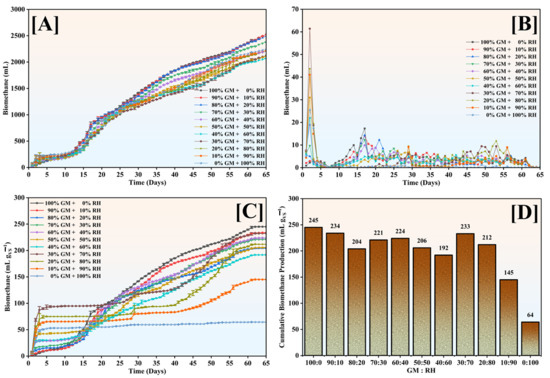
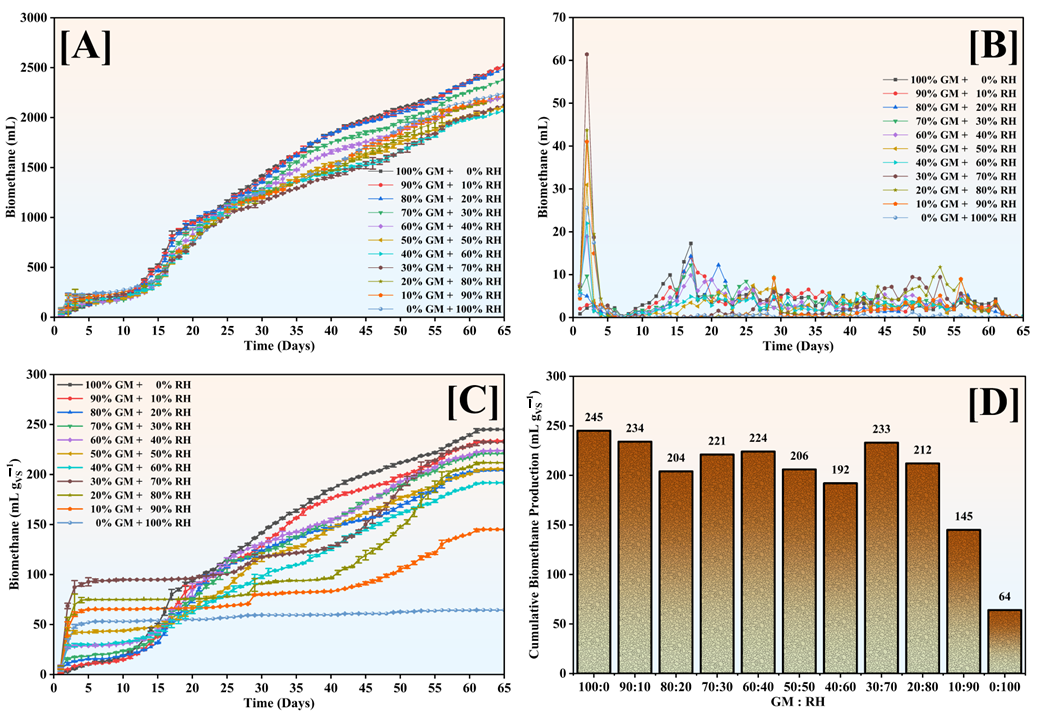
Biomethane yields from the anaerobic co-digestion of GM and RH were measured using the liquid displacement method and reported as daily and cumulative yields (Figure 1). Biomethane production was active from the first day in all samples. The experimental biomethane yields (EMY) for GM and RH were 245.1 and 64.4 mL gVS−1, respectively. The EMY for co-digestion of GM and RH were 233.6, 204.4, 221.1, 223.8, 205.7, 191.9, 232.5, 211.8, and 145.0, respectively, for GM:RH digester ratios of 90:10, 80:20, 70:30, 60:40, 50:50, 40:60, 30:70, 20:80, and 10:90. A study by Al-Zuhairi et al. (2026) investigated the co-digestion of only potato peel waste and chicken manure, resulting in values of 25 and 55 mL gVS−1, respectively, and 205.3 mL gVS−1 was the highest biomethane production for a potato peel waste:chicken manure ratio of 70:30 [32]. These observed biomethane productions reflect the complex interplay between substrate availability, microbial community dynamics, and process conditions during anaerobic co-digestion of GM and RH. The daily and cumulative biomethane yields show relatively rapid production in the first days, followed by a more gradual accumulation as hydrolysis, acidogenesis, and methanogenesis progress. GM yielded significantly higher cumulative biomethane production than RH. The EMY values and reported C/N ratios suggest that GM digestions operate closer to an optimal nutrient balance, which enables steady microbial activity. Also, RH-imbalanced C/N can lead to steady methane production, particularly in later phases. This could be due to the dilution of nitrogen-rich GM from RH, which reduces ammonia-related inhibition and supports steady methanogenic activity as digestion progresses [33,34].
Figure 1.
(A) Cumulative biomethane production over 65 days in mL, (B) daily biomethane production over 65 days, (C) cumulative biomethane production as mL/gVS, and (D) total cumulative biomethane production after 65 days in mL/gVS.
3.3. Reaction Kinetics
The first-order kinetic model is used for digestion in complex waste systems. Also, the first-order kinetic model can be used when the rate is limited by the particulate substrate surface, with no interference from the biodegradability factor. Also, it provides useful information on the overall degradation rate and the maximum biomethane production [35]. The rate constants (k) ranged from 0.002 to 0.444 d−1, with the largest k observed during mono-digestion of RH, indicating that RH led to the fastest biomethane production under first-order assumptions. The R2 values reflect how well the first-order kinetic model describes biomethane production. The strongest fits occur at 70:30 and 40:60 GM:RH ratios, while the weakest fit occurs at 30:70 and 10:90 GM:RH ratios. RMSE indicates substantial deviations between the first-order kinetic model and EMY. Conversely, lower RMSE values were observed for the 70:30 and 40:60 GM:RH mixtures, suggesting more reliable first-order kinetic fits and consistent methane yields for these combinations.
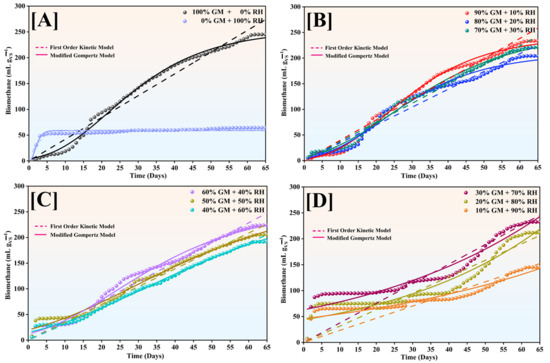
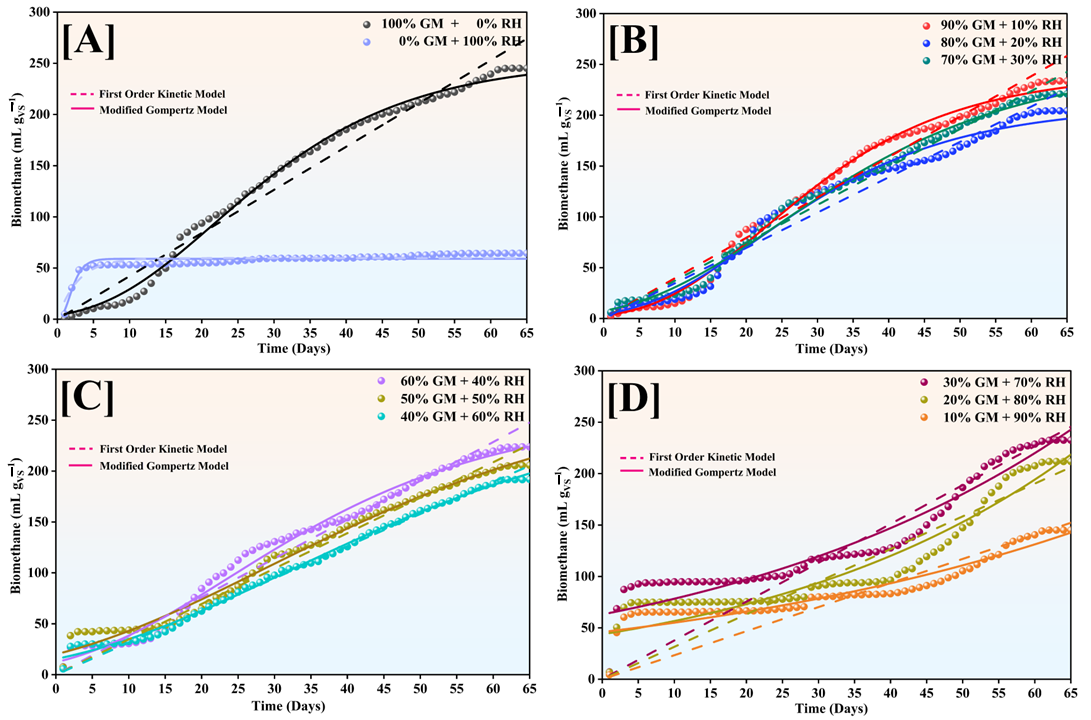
The modified Gompertz model parameters, Rmax, G0, and λ, are reported in Table S2. The predicted cumulative biogas yield (CMY) was determined using the modified Gompertz model, as shown in Figure 2. The R2 values for co-digestion of GM and RH were between 0.993 and 0.778, while the mono-digestions of GM and RH were 0.995 and 0.787. The Rmax for the different mixing ratios ranged from 1.90 to 5.96 mL gVS−1 d−1, while the mono-digestions of GM and RH were 6.22 and 17.24 mL gVS−1 d−1, respectively. This explained that higher GM content reflects faster microbial conversion of readily degradable substrates. Also, Rmax decreased with increasing RH content, indicating slower hydrolysis of lignocellulosic components. Moreover, the lag phase (λ) becomes longer for RH-rich mixtures, which implies an extended period for the microbial community to adapt.
Figure 2.
Experimental and modified Gompertz kinetic model predicted biomethane production for GM and RH ratios of (A) 100:0 and 0:100, (B) 90:10, 80:20, and 70:30, (C) 60:40, 50:50, and 40:60, and (D) 30:70, 20:80, and 10:90.
According to the first-order kinetics, mono-digestion of RH shows the fastest methane production. Conversely, the Gompertz model highlights a slower digestion rate and longer lag phase (λ) with a lower maximum production rate (Rmax). This discrepancy arises because the first-order model captures the immediate and simple exponential decay of the substrate into methane. This can appear rapid for the mono-digestion of RH due to its readily degradable fractions under the tested conditions. However, the Gompertz model accounts for the microbial growth and substrate utilization dynamics, including the initial adaptation period and the eventual saturation in production rate. In other words, RH alone yields rapid initial first-order kinetics, while RH-rich mixtures exhibit slower, more extended kinetics with longer adaptation and lower ultimate production rates per the Gompertz fit.
The methane production curves of the RH-rich profiles (30:70, 20:80, 10:90) show a biphasic lag instead of a lengthy lag (Figure 2D). In particular, the biogas output shows a steep initial increase, then a plateau in the intermediate range, and a clear acceleration in the biogas production around days 25–35. The two-stage pattern suggests that the system is not just characterized by a considerable initial lag period before continuous biogas generation. The first phase, instead, is indicative of rapid hydrolysis and an accelerated initial methanogenesis from easily degradable fractions. Later, the following plateau indicates a transient rate constraint as the microbial population degrades more refractory fractions. The late-stage spike around days 25–35 indicates a second wave of methane production, as the microbial consortia gain access to slower-degrading lignocellulosic matter in rice husk. This allows for greater activity after the first substrates are metabolized. Such dynamics are explained by kinetic behavior with multiple substrate pools of differing degradability and the biphasic pattern. This underlines the intricate interaction between substrate composition, the activity of the inoculum, and the methanogenic pathways, rather than a simple, uniformly long lag phase.
3.4. Biodegradability and Synergetic Effect Index
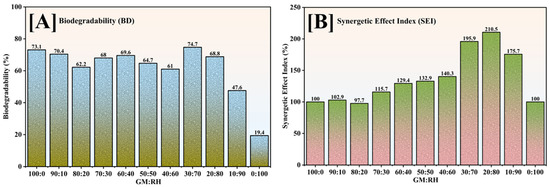
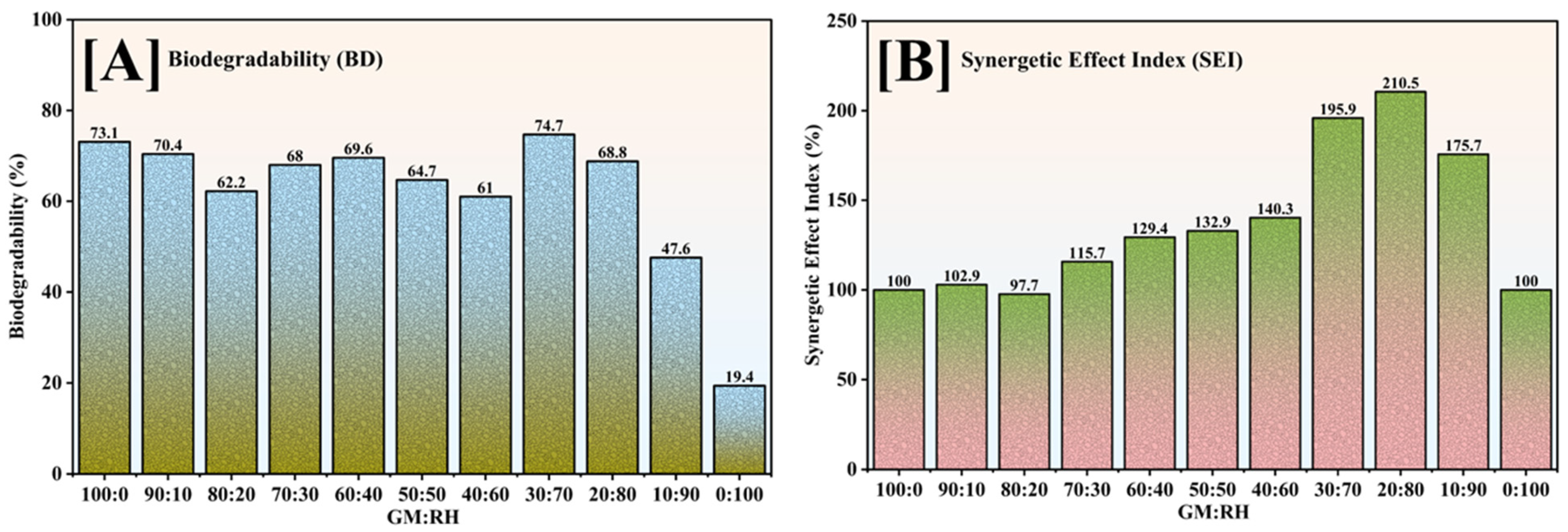
Biodegradability in the co-digestion of GM and RH reflects the proportion of each substrate that anaerobic microbes can convert into biomethane, with GM providing readily degradable organics and RH providing more recalcitrant, lignocellulosic carbon. BD values here reflect the fraction of the substrate mixture degraded to biomethane during anaerobic digestion. Higher BD values indicate more complete, efficient digestion. Table S3 reports the EMY, TMY, BD (%), SEI (%), and C/N ratios of each GM:RH composition.
As RH content increases up to 30:70, the degradability remains moderately high, with values ranging from about 60 to 70% (Figure 3A). This indicates that RH is roughly 70%; the mixture remains fairly biodegradable, with GM providing readily degradable organic matter and nutrients that can enhance microbial activity. However, RH contributes lignocellulosic components that are harder to break down but can be supported by the readily degradable fractions. A sharp drop in BD% was observed as the RH content increased from 70% to 100% (Figure 3A). This indicates that lignocellulosic RH lacks readily biodegradable organics and often lacks sufficient nutrients, leading to poor biomethane production. Also, its highly lignocellulosic content, with substantial lignin and silica content, limits hydrolysis and microbial accessibility, resulting in low biodegradability despite its high theoretical potential [36,37].
Figure 3.
(A) Biodegradability and (B) synergetic effect index of different ratios of GM and RH.
3.5. Influent and Effluent Analysis
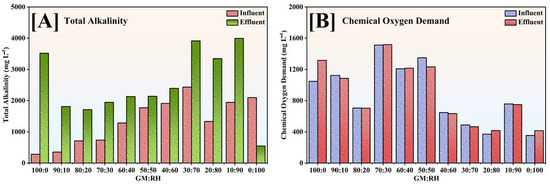
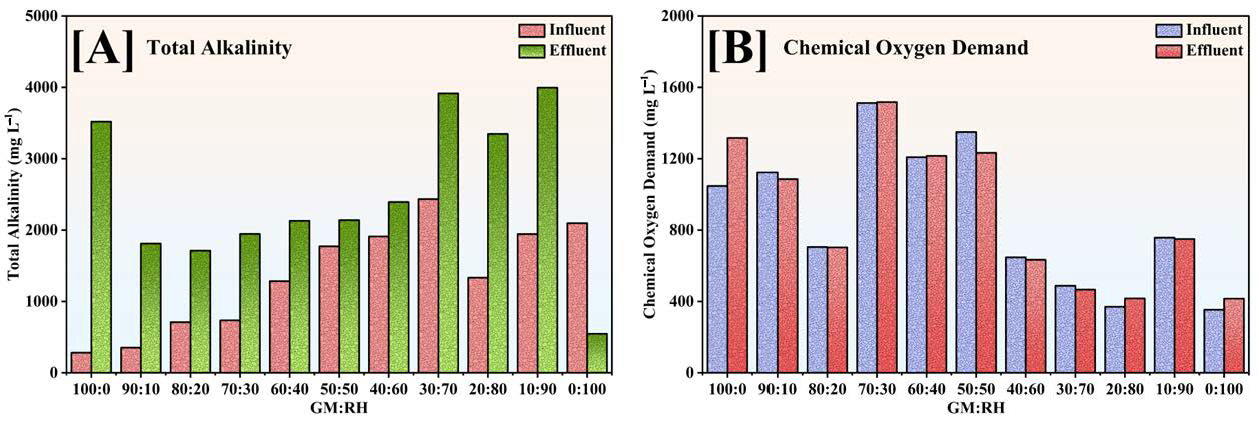
Higher quantities of RH in the GM:RH mixture tend to increase the influent alkalinity, while the relationship with the effluent alkalinity is more complicated. For RH-rich feeds, influent alkalinity was relatively high, and the associated effluent alkalinity was also high, indicating that a strong buffering capability entered the digester and persisted through digestion. Also, higher RH combinations of 60:40 and 50:50 had lower influent alkalinity, indicating that the system’s buffering capability balances microbial activity and acid generation. The general trend for the pattern found is that higher GM content tends to increase influent buffering potential. Moreover, the digester’s capacity to maintain stable pH (Table S4) and alkalinity in the effluent is a function of the complex interaction between the substrate composition and the system’s buffering capacity, with immediate consequences for methane stability and reactor design.
The COD values of the influent and effluent increased with increasing GM content in the feed, which means that GM-rich mixes supplied more organic matter to the digester (Figure 4B). Although the influent COD is highest with larger GM fractions, the effluent COD stays high in these combinations but does not increase correspondingly. This indicates a larger proportion of the organic material is converted to biomethane. Higher RH reduced influent COD but still resulted in considerable effluent COD, suggesting slower or incomplete decomposition. Generally, the data show that increased GM content adds to the biodegradable substrate for digestion, thus increasing the COD removal potential, whereas higher RH content may slow down the immediate biodegradability (Figure 3A) and result in lower removal efficiency, indicating that substrate balance is important for improving methane yield and process stability.
Figure 4.
(A) Total alkalinity and (B) chemical oxygen demand in influent and effluent samples for different ratios of GM and RH.
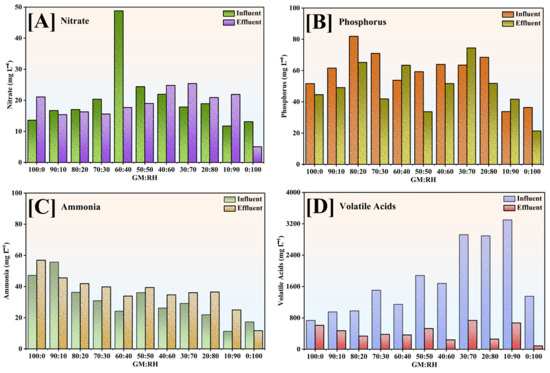
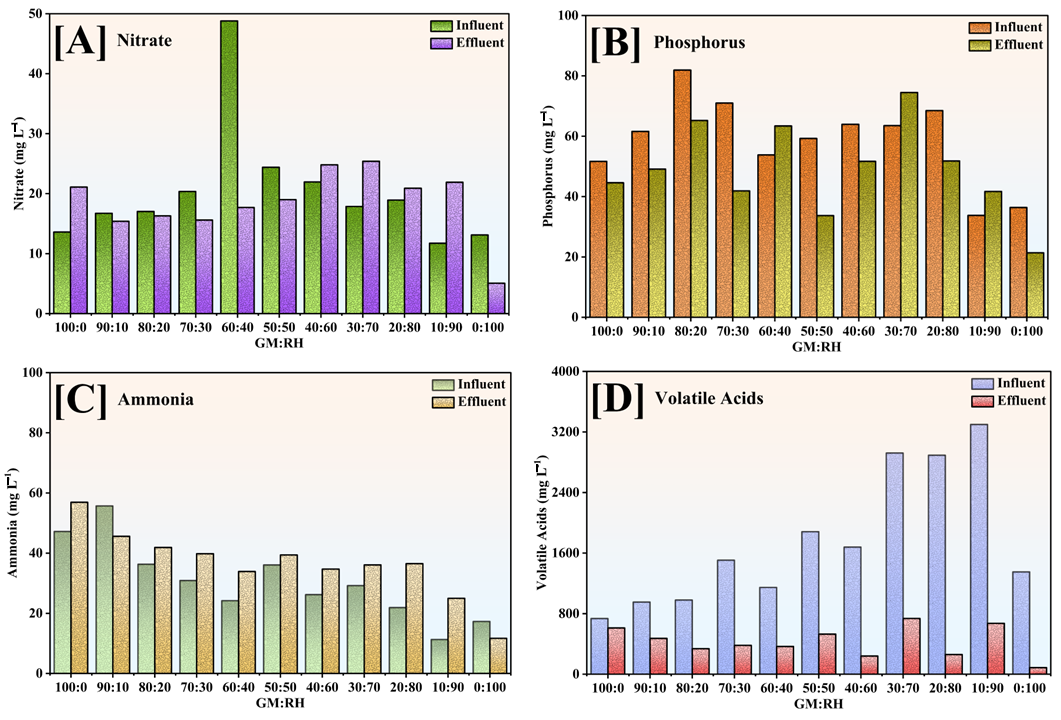
Water-soluble nitrate concentrations in the influent and effluent across the GM:RH mixtures indicate a general tendency toward increased nitrate in the influent at equal proportions of GM and RH contents, reflecting the higher nitrogen intake from GM in the presence of RH (Figure 5A) [3]. For RH-rich combinations, nitrate concentrations in the effluent remain quite high, indicating that a substantial amount of nitrate is not removed during digestion. This trend indicates that co-digestion with RH can maintain methane production, but nitrate removal is incomplete under such conditions. Therefore, higher proportions of RH may require additional control of nitrification/denitrification or longer retention times to increase nitrogen removal and protect downstream environments.
Figure 5.
The initial and remaining concentrations of (A) nitrate, (B) phosphate, (C) ammonia, and (D) volatile acids in the influent and effluent.
Figure 5B shows the phosphorus concentrations in the influent and effluent across the GM:RH compositions. A higher phosphorus release was observed with equal GM and RH fractions. In the influent, mixes with higher GM at 80:20 led to higher phosphorus burdens until the GM fraction reached 20:80. Phosphorus was still present in the effluent across all mixes, and some mixtures exhibited much lower phosphate levels, indicating incomplete digestion. Overall, this trend suggests that the reactor can remove some phosphorus, particularly as GM loading increases. Furthermore, phosphate is present in the effluent, indicating possible accumulation in the system or restricted microbial uptake, which has consequences for effluent management and the need to address downstream phosphorus removal options.
In the GM:RH compositions, effluent ammonia concentrations consistently exceed influent ammonia concentrations due to microbial ammonia generation during digestion (Figure 5A). The results showed a clear trend. Combinations with increasing GM fractions increased ammonia in both the influent and the effluent. However, the magnitude tends to decrease as the RH fraction increases. This suggests that higher RH concentration might restrict the generation and release of ammonia. This tendency generally suggests that, in the presence of higher GM fractions, improvements in ammonia generation from anaerobic digestion need to be carefully balanced against nitrogen control in downstream applications.
The volatile acid content in the influent rose with higher RH fractions, reflecting greater lignocellulosic organic substrate and faster fermentation potential during digestion (Figure 5D). In the effluent, volatile acid levels are consistently lower than in the influent across most compositions, indicating that the anaerobic digestion process consumes a portion of the volatile acids and converts them into biomethane. Overall, the trend reveals that higher RH content increases the initial volatile acid load, but the anaerobic digester’s ability to reduce volatile acids depends on the balance between substrate degradability and kinetics.
4. Conclusions
In the United States, waste management practices are regulated through a combination of federal oversight and state permissions. These requirements may include controls on water discharges, air emissions, solid waste handling, and facility siting. Integrating goat manure with rice husk in well-managed anaerobic digestion can reduce agricultural greenhouse gas emissions, improve waste management, and expand energy generation.
This study shows that co-digestion of goat dung with rice husk can be strategically applied to maximize biomethane recovery. Moreover, this combination enhanced the stability of the whole anaerobic digestion system. The biomethane production at 100% GM was 245.1 mL CH4 gVS−1, showing high performance. However, kinetic modeling successfully described the lag phases and production rates, demonstrating the relevance of rice husk leftovers. Both the modified Gompertz and first-order kinetic models can be used to develop accurate scale-up systems. However, secondary downstream treatment is required to prevent environmental contamination.
Further studies on the performance of continuous-flow reactors, long-term stability with fluctuating feedstock supplies, process optimization, and microbial community dynamics analysis would be helpful for practical implementation. Research into effective mixing approaches, temperature control, and pH/alkalinity control in real digesters will also help translate bench-scale kinetics into reliable industrial-scale performance. Furthermore, life-cycle and techno-economic studies would be conducted to estimate GHG reductions, energy outputs, and economic viability under different regional and feedstock-availability scenarios.
Supplementary Materials
The following supporting information can be downloaded at https://www.mdpi.com/article/10.3390/environments13080433/s1: Table S1: First-order kinetic model parameters of GM and RH. Table S2: Gompertz kinetic model parameters of GM and RH. Table S3: Biodegradability, synergetic effect index, and C/N ratio of GM and RH co-digestions. Table S4: Effluent final pH.
Author Contributions
R.R.K.: Conceptualization, Writing—Original Draft, Methodology, Funding acquisition, Supervision, Reviewing and Editing; M.N.S.: Methodology, Investigation; P.M.R.: Writing—Original Draft, Reviewing and Editing. All authors have read and agreed to the published version of the manuscript.
Funding
This work was supported by the USDA-CBG program (Award No. 2018-38821-27750), and partial support was received from the NSF CREST Center for Energy and Environmental Sustainability (CEES) at Prairie View A&M University (NSF Award #1914692).
Data Availability Statement
The original contributions presented in this study are included in the article/supplementary material. Further inquiries can be directed to the corresponding author.
Acknowledgments
The authors greatly acknowledge Harjinder Kaur and Hongbo Du for their guidance in this project. The authors acknowledge the Center for Energy & Environmental Sustainability, Prairie View A&M University, and the Department of Chemistry, Prairie View A&M University.
Conflicts of Interest
The authors declare no conflict of interest.
References
- Krich, K.; Augenstein, D.; Batmale, J.; Benemann, J.; Rutledge, B.; Salour, D. Biomethane from Dairy Waste, a Sourcebook for the Production and Use of Renewable Natural Gas; California Institute for Energy and Environment (CIEE): Berkeley, CA, USA, 2005. [Google Scholar]
- Greger, M.; Koneswaran, G. The public health impacts of concentrated animal feeding operations on local communities. Fam. Community Health 2010, 33, 11–20. [Google Scholar] [CrossRef] [Scilit] [PubMed]
- Kaur, H.; Kommalapati, R.R. Process Optimization and Biomethane Recovery from Anaerobic Digestion of Agro-Industry Wastes. Energies 2023, 16, 6484. [Google Scholar] [CrossRef] [Scilit]
- Satlewal, A.; Agrawal, R.; Bhagia, S.; Das, P.; Ragauskas, A.J. Rice straw as a feedstock for biofuels: Availability, recalcitrance, and chemical properties. Biofuels Bioprod. Biorefining 2018, 12, 83–107. [Google Scholar] [CrossRef] [Scilit]
- Linville, J.L.; Shen, Y.; Wu, M.M.; Urgun-Demirtas, M. Current state of anaerobic digestion of organic wastes in North America. Curr. Sustain./Renew. Energy Rep. 2015, 2, 136–144. [Google Scholar] [CrossRef] [Scilit]
- Shen, Y.; Linville, J.L.; Urgun-Demirtas, M.; Mintz, M.M.; Snyder, S.W. An overview of biogas production and utilization at full-scale wastewater treatment plants (WWTPs) in the United States: Challenges and opportunities towards energy-neutral WWTPs. Renew. Sustain. Energy Rev. 2015, 50, 346–362. [Google Scholar] [CrossRef] [Scilit]
- Angelidaki, I.; Ellegaard, L.; Ahring, B.K. Applications of the anaerobic digestion process. Biomethanation II 2003, 82, 1–33. [Google Scholar] [CrossRef] [Scilit] [PubMed]
- Debs, L.; Metzinger, J. A comparison of energy consumption in American homes by climate region. Buildings 2022, 12, 82. [Google Scholar] [CrossRef] [Scilit]
- Suhartini, S.; Lestari, Y.P.; Nurika, I. Estimation of methane and electricity potential from canteen food waste. In IOP Conference Series: Earth and Environmental Science; IOP Publishing: Bristol, UK, 2019. [Google Scholar]
- Abdelgadir, A.; Chen, X.; Liu, J.; Xie, X.; Zhang, J.; Zhang, K.; Wang, H.; Liu, N. Characteristics, process parameters, and inner components of anaerobic bioreactors. BioMed Res. Int. 2014, 2014, 841573. [Google Scholar] [CrossRef] [Scilit] [PubMed]
- Li, X.; Yan, Y.-J.; Wu, H.-M.; Gadow, S.I.; Jiang, H.; Kong, Z.; Hu, Y. Enhancing mesophilic methanogenesis in oleate-rich environments through optimized micro-aeration pretreatment. Waste Manag. 2025, 193, 171–179. [Google Scholar] [CrossRef] [Scilit] [PubMed]
- Chang, H.; Yin, Q.; He, K.; De Vrieze, J.; Wu, G. Feeding regime selectively enriching acetoclastic methanogens to enhance energy production in anaerobic digestion systems. Biochem. Eng. J. 2025, 220, 109764. [Google Scholar] [CrossRef] [Scilit]
- Tongco, J.V.; Park, S.H.; Kim, S.I.; Hwang, S. Influence of Fluctuating Food Waste Concentrations on Horizontal Anaerobic Reactor Performance and Biogas Output. Energies 2025, 18, 5064. [Google Scholar] [CrossRef] [Scilit]
- Liu, J.; Zuo, X.; Peng, K.; He, R.; Yang, L.; Liu, R. Biogas and volatile fatty acid production during anaerobic digestion of straw, cellulose, and hemicellulose with analysis of microbial communities and functions. Appl. Biochem. Biotechnol. 2022, 194, 762–782. [Google Scholar] [CrossRef] [Scilit] [PubMed]
- Subramanian, K.; Suresh, K. Metabolic and biochemical pathways for anaerobic digestion. In Anaerobes and Waste Conversion Technologies; Springer: Berlin/Heidelberg, Germany, 2024; pp. 3–25. [Google Scholar]
- Lin, C.-Y.; Chai, W.S.; Lay, C.-H.; Chen, C.-C.; Lee, C.-Y.; Show, P.L. Optimization of hydrolysis-acidogenesis phase of swine manure for biogas production using two-stage anaerobic fermentation. Processes 2021, 9, 1324. [Google Scholar] [CrossRef] [Scilit]
- Jiang, M.; Qiao, W.; Wang, Y.; Zou, T.; Lin, M.; Dong, R. Balancing acidogenesis and methanogenesis metabolism in thermophilic anaerobic digestion of food waste under a high loading rate. Sci. Total Environ. 2022, 824, 153867. [Google Scholar] [CrossRef] [Scilit] [PubMed]
- Bonk, F.; Popp, D.; Weinrich, S.; Sträuber, H.; Becker, D.; Kleinsteuber, S.; Harms, H.; Centler, F. Determination of microbial maintenance in acetogenesis and methanogenesis by experimental and modeling techniques. Front. Microbiol. 2019, 10, 166. [Google Scholar] [CrossRef] [Scilit] [PubMed]
- Rawoof, S.A.A.; Kumar, P.S.; Vo, D.-V.N.; Subramanian, S. Sequential production of hydrogen and methane by anaerobic digestion of organic wastes: A review. Environ. Chem. Lett. 2021, 19, 1043–1063. [Google Scholar] [CrossRef] [Scilit]
- Yin, Q.; He, K.; Collins, G.; De Vrieze, J.; Wu, G. Microbial strategies driving low concentration substrate degradation for sustainable remediation solutions. npj Clean Water 2024, 7, 52. [Google Scholar] [CrossRef] [Scilit]
- Yang, L.; Liu, Y.; Li, C.; Li, P.; Zhang, A.; Liu, Z.; Wang, Z.; Wei, C.; Yang, Z.; Li, Z. Optimizing carbon sources regulation in the biochemical treatment systems for coal chemical wastewater: Aromatic compounds biodegradation and microbial response strategies. Water Res. 2024, 256, 121627. [Google Scholar] [CrossRef] [Scilit] [PubMed]
- Bicudo, J.R.; Goyal, S.M. Pathogens and manure management systems: A review. Environ. Technol. 2003, 24, 115–130. [Google Scholar] [CrossRef] [Scilit] [PubMed]
- Rodrigo, P.M.; Sims, E.M.; Kommalapati, R.R. Application of Hybrid Ceramic Membranes for Microplastic and Nanoplastic Separation and Improved Wastewater Treatment. Microplastics 2025, 4, 76. [Google Scholar] [CrossRef] [Scilit]
- Richards, B.K.; Cummings, R.J.; White, T.E.; Jewell, W.J. Methods for kinetic analysis of methane fermentation in high solids biomass digesters. Biomass Bioenergy 1991, 1, 65–73. [Google Scholar] [CrossRef] [Scilit]
- Parameswaran, P.; Rittmann, B.E. Feasibility of anaerobic co-digestion of pig waste and paper sludge. Bioresour. Technol. 2012, 124, 163–168. [Google Scholar] [CrossRef] [Scilit] [PubMed]
- Lay, J.-J.; Li, Y.-Y.; Noike, T. Effect of moisture content and chemical nature on methane fermentation characteristics of municipal solid wastes. Doboku Gakkai Ronbunshu 1996, 1996, 101–108. [Google Scholar] [CrossRef] [Scilit] [PubMed]
- Lay, J.-J.; Li, Y.-Y.; Noike, T. Influences of pH and moisture content on the methane production in high-solids sludge digestion. Water Res. 1997, 31, 1518–1524. [Google Scholar] [CrossRef] [Scilit]
- Kafle, G.K.; Kim, S.H.; Sung, K.I. Ensiling of fish industry waste for biogas production: A lab scale evaluation of biochemical methane potential (BMP) and kinetics. Bioresour. Technol. 2013, 127, 326–336. [Google Scholar] [CrossRef] [Scilit] [PubMed]
- Abeysinghe, H.P.; Sullivan, E.P.; Rodrigo, P.M.; Pittman, C.U.; Mlsna, T. Synthesis of Fe3O4-modified rice husk biochar for As (V) remediation by adsorption: Is sodium silicate formation involved? SSRN Electron. J. 2024. [Google Scholar] [CrossRef] [Scilit]
- Zhang, T.; Liu, L.; Song, Z.; Ren, G.; Feng, Y.; Han, X.; Yang, G. Biogas production by co-digestion of goat manure with three crop residues. PLoS ONE 2013, 8, e66845. [Google Scholar] [CrossRef] [Scilit] [PubMed]
- Zhao, M.; Wang, Y.; Zhang, C.; Li, S.; Huang, Z.; Ruan, W. Synergistic and Pretreatment Effect on Anaerobic Co-Digestion from Rice Straw and Municipal Sewage Sludge. BioResources 2014, 9, 5871–5882. [Google Scholar] [CrossRef] [Scilit]
- Al-Zuhairi, F.K.; Shakor, Z.M.; Majdi, H.S.; AbdulRazak, A.A.; Al-Shathr, A.; Al-Shafei, E.N. Biogas and Biomethane Production via Anaerobic Digestion: Experimental Analysis and Modeling Using Hybrid ANN-GA Optimization. Sustain. Chem. Environ. 2026, 13, 100315. [Google Scholar] [CrossRef] [Scilit]
- Bay, T.; Vural, B.B.; Gökçek, Ö.B. Highly efficient biomethane production from chicken manure and municipal organic solid waste using magnetite: Converting waste into energy. Biodegradation 2026, 37, 27. [Google Scholar] [CrossRef] [Scilit] [PubMed]
- Chuenchart, W.; Surendra, K.C.; Khanal, S.K. Understanding anaerobic co-digestion of organic wastes through meta-analysis. ACS ES T Eng. 2024, 4, 1177–1192. [Google Scholar] [CrossRef] [Scilit]
- Díaz, J.P.; Reyes, I.P.; Lundin, M.; Horváth, I.S. Co-digestion of different waste mixtures from agro-industrial activities: Kinetic evaluation and synergetic effects. Bioresour. Technol. 2011, 102, 10834–10840. [Google Scholar] [CrossRef] [Scilit] [PubMed]
- Raposo, F.; De la Rubia, M.A.; Fernández-Cegrí, V.; Borja, R. Anaerobic digestion of solid organic substrates in batch mode: An overview relating to methane yields and experimental procedures. Renew. Sustain. Energy Rev. 2012, 16, 861–877. [Google Scholar] [CrossRef] [Scilit]
- Li, Y.; Park, S.Y.; Zhu, J. Solid-state anaerobic digestion for methane production from organic waste. Renew. Sustain. Energy Rev. 2011, 15, 821–826. [Google Scholar] [CrossRef] [Scilit]

Disclaimer/Publisher’s Note: The statements, opinions and data contained in all publications are solely those of the individual author(s) and contributor(s) and not of MDPI and/or the editor(s). MDPI and/or the editor(s) disclaim responsibility for any injury to people or property resulting from any ideas, methods, instructions or products referred to in the content. |
© 2026 by the authors. Licensee MDPI, Basel, Switzerland. This article is an open access article distributed under the terms and conditions of the Creative Commons Attribution (CC BY) license.