


Abstract
Environmental governance plays a critical role in shaping the effectiveness of sustainability certification implementation in perennial plantation systems, particularly in oil palm plantation landscapes associated with forest transformation and socio-ecological risks. In Indonesia, the Indonesian Sustainable Palm Oil (ISPO) scheme functions as a mandatory certification system aimed at strengthening environmental accountability. However, variations in implementation outcomes suggest that compliance alone does not guarantee effective certification implementation. This study examines how internal governance mechanisms shape ISPO implementation within a specific plantation organizational context by focusing on the transition from compliance-oriented practices to sustainability-oriented commitment. Using survey data from an ISPO-certified plantation in West Kalimantan and applying partial least squares structural equation modeling (PLS-SEM), the study tests a mediation model linking green training effectiveness, sustainable work environment, and environmental compliance transparency to certification outcomes through corporate environmental commitment. The results show that Corporate Environmental Commitment fully mediates the effects of Green Training Effectiveness and Sustainable Work Environment on ISPO Implementation Success, indicating that organizational conditions contribute to certification effectiveness only when they are translated into governance commitment. In contrast, Environmental Compliance Transparency does not significantly influence commitment formation or certification outcomes. These findings suggest that effective certification implementation depends less on procedural compliance and more on the internalization of environmental priorities into organizational governance routines. The study contributes to the environmental governance literature by demonstrating that sustainability certification effectiveness emerges through governance internalization processes rather than through organizational practices alone.
1. Introduction
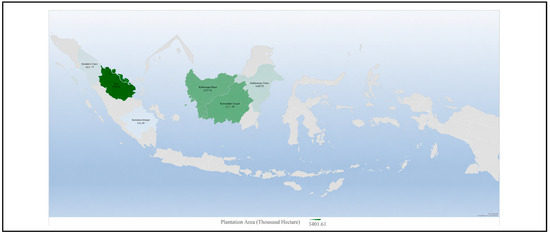
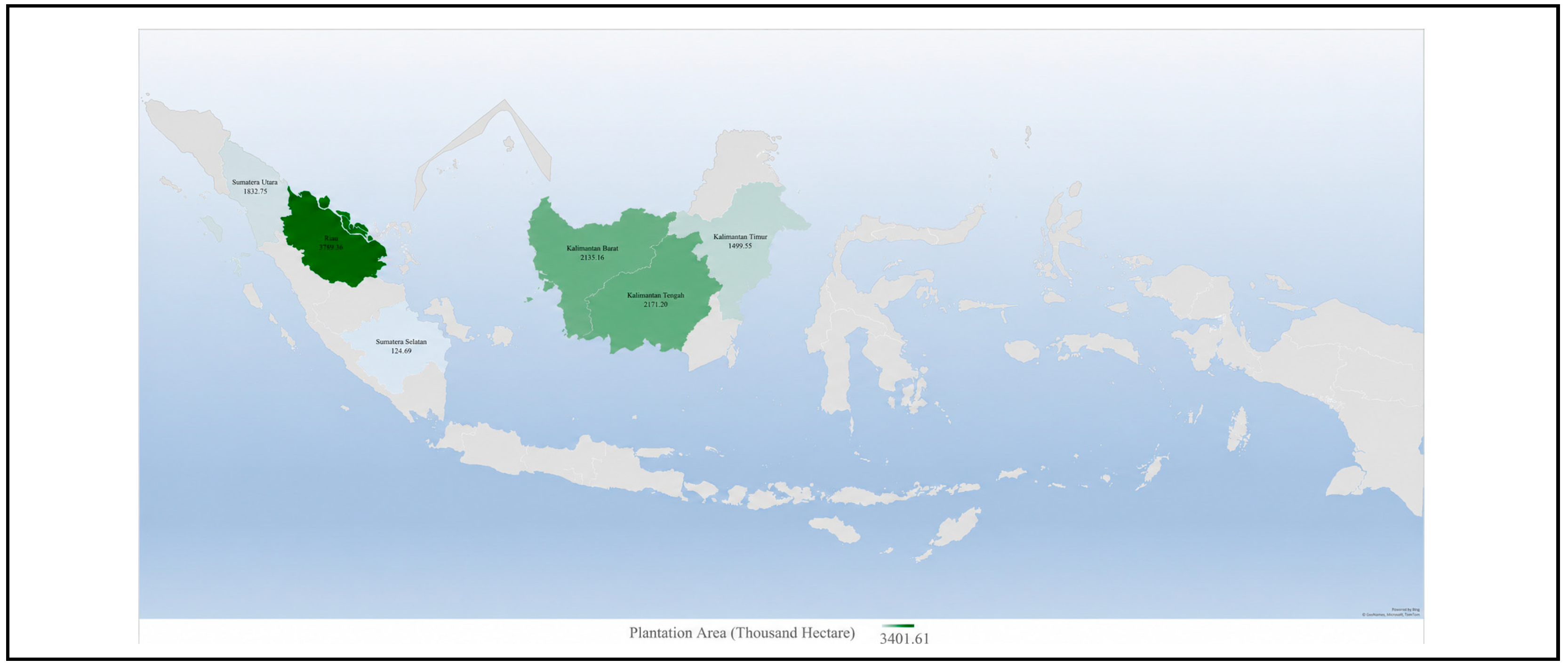
Oil palm production represents one of the most prominent perennial plantation systems shaping contemporary tropical landscapes, particularly in Indonesia, where plantation expansion has transformed large areas of forest-related environments into managed agricultural landscapes. The sector plays a strategic role in national economic development through export revenues, employment generation, and rural livelihoods [1,2,3]. Based on 2023 data from Statistics Indonesia (BPS), the six provinces with the largest oil palm plantation areas are Riau (3401.61 thousand hectares), Central Kalimantan (2171.00 thousand hectares), West Kalimantan (2133.41 thousand hectares), East Kalimantan (1490.95 thousand hectares), North Sumatra (1352.23 thousand hectares), and South Sumatra (1241.09 thousand hectares) [4] (see Figure 1). This confirms that Sumatra and Kalimantan remain the main areas for oil palm plantations, where production activities are directly linked to forest ecosystems and the social environment.
Figure 1.
Distribution of the Largest Oil Palm Plantation Areas in Indonesia in 2023 (thousands of hectares). Source: [4]; map visualization processed using Microsoft Bing Maps and OpenStreetMap contributors.
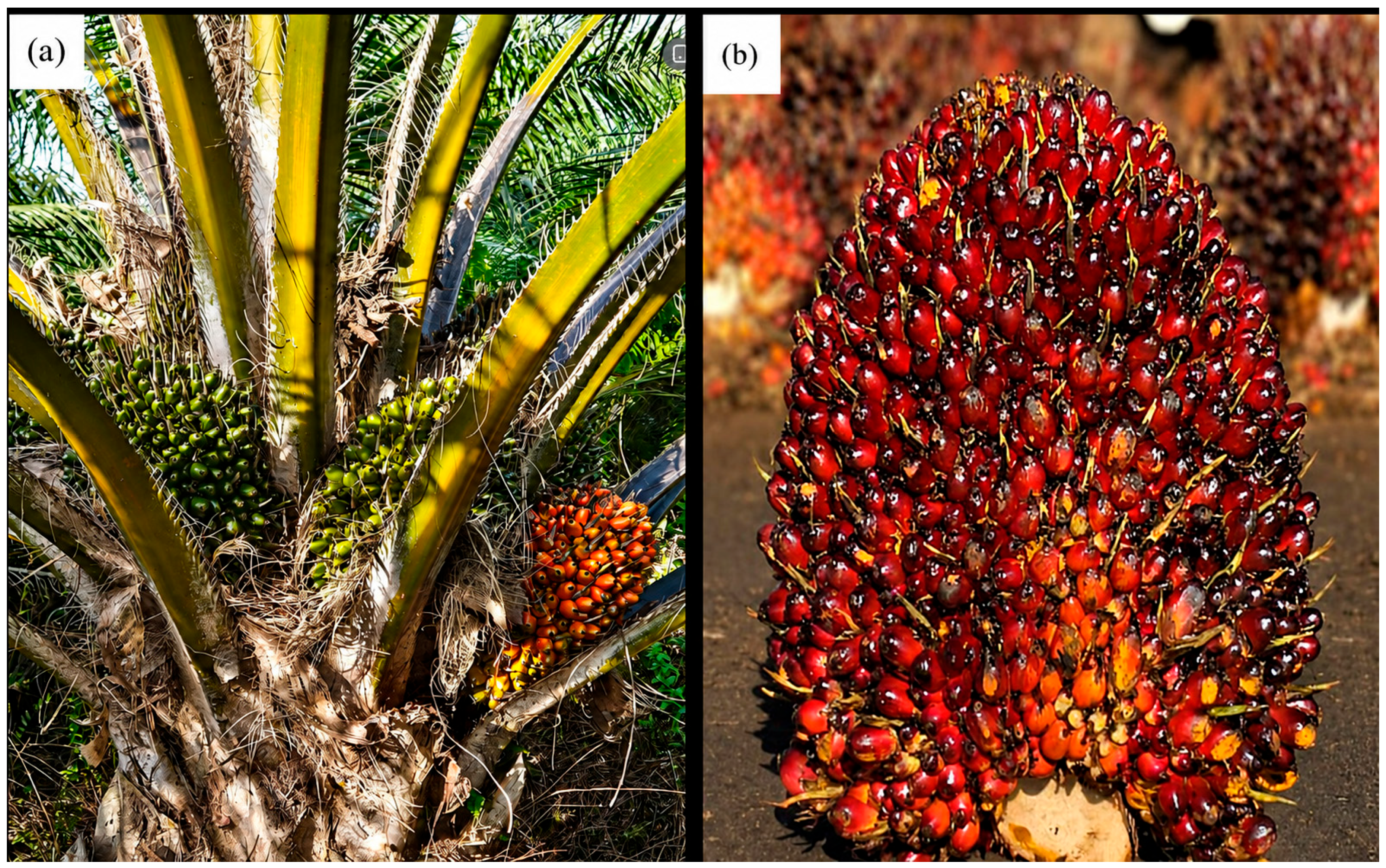
The oil palm (Elaeis guineensis), as seen in Figure 2 (consisting of a tree (a) and a fresh fruit bunch (b)), is the fundamental component supporting the plantation commodity system. This plant produces fresh fruit bunches (FFB), which serve as the primary raw material for crude palm oil production [5]. Besides their importance in agriculture, oil palm plantations operate within intensive monoculture systems characterized by simplified ecological structures and reduced biodiversity, creating environmental vulnerabilities that necessitate strong governance mechanisms. These biological and ecological conditions highlight the importance of companies adapting their governance systems to the environmental conditions within perennial plantation systems. On the other hand, the expansion and increase in palm oil production continues to attract global attention due to issues of deforestation, biodiversity loss, land conflicts, and environmental damage, requiring producers to demonstrate clear and responsible environmental governance [6,7]. Recent research highlights the growing importance of institutional and governance systems in supporting the transition to sustainability in sectors that rely on natural resources [8].
Figure 2.
(a) Oil palm (Elaeis guineensis) with fruit bunch development under plantation conditions; (b) Fresh fruit bunches that have been harvested as the main ingredient in the production of crude palm oil.
Sustainability certification serves as a crucial governance mechanism for overseeing the implementation of environmental standards within forest-based commodity systems. Within the palm oil industry, sustainability certification functions within a wider governance structure, encompassing both regulatory mandates and voluntary initiatives. Various certification systems and regulations exhibit diverse principles, objectives, and implementation strategies, thereby reflecting distinct methodologies for upholding environmental accountability and sustainability [5] (refer to Table 1). Previous studies have identified transparency, environmental accountability, peatland protection, biodiversity conservation, and deforestation prevention as key governance dimensions commonly used to evaluate sustainability certification systems in the palm oil sector [6,9,10,11]. These dimensions are frequently employed to assess the environmental credibility and governance orientation of certification schemes operating within plantation landscapes. While international schemes tend to be voluntary and market-incentive-based, national systems such as ISPO are mandatory and part of domestic regulations. These differences highlight the critical importance of internal corporate governance capabilities, as companies must consistently implement existing standards into their daily operational practices to achieve consistent implementation of sustainability standards. Certification is used not only to demonstrate compliance to external parties but also to improve how companies manage their operations by incorporating environmental standards into their work processes and decision-making [12,13].
Table 1.
Comparative Overview of Governance Principles in Oil Palm Certification Systems.
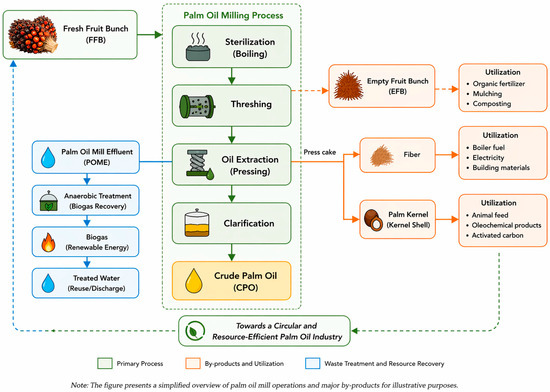
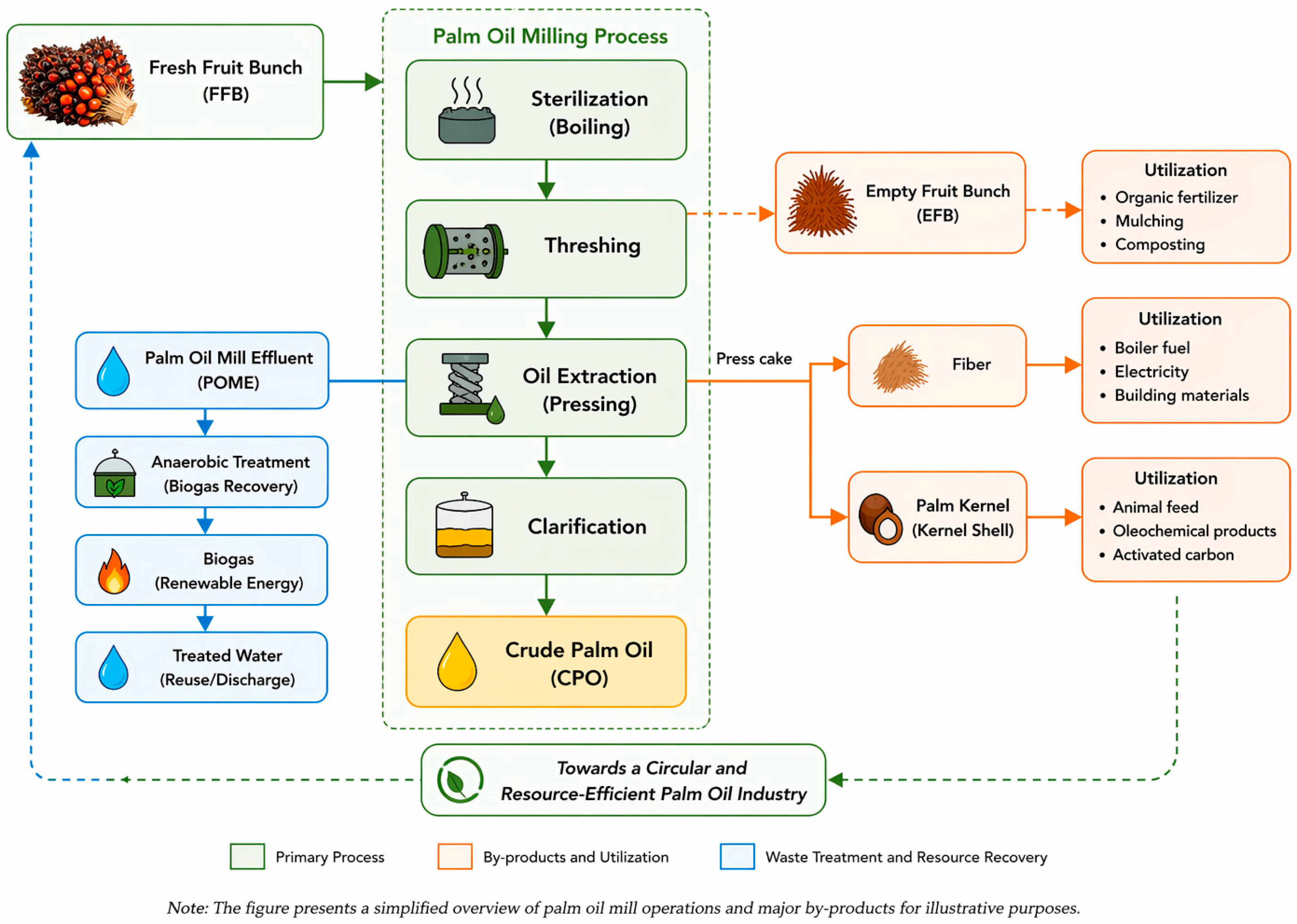
From an environmental governance perspective, certification systems function as mechanisms that align organizational behavior with the consistent implementation of sustainability standards at the landscape level where certification implementation outcomes depend on the consistency of implementation across geographically dispersed plantation units. Differences in certification outcomes indicate that companies differ in how they implement standards into their internal systems [15]. Therefore, the effectiveness of certification depends largely on a company’s ability to translate standards into daily work practices. Previous research indicates that sustainability is more likely to be achieved if environmental values are already part of a company’s internal coordination, monitoring, and control systems [16,17,18,19,20,21]. Therefore, certification extends beyond procedural compliance and represents a dynamic governance process that requires managing risks, being ready for audits, and constantly improving. Moreover, the production process is closely linked to sustainability management in oil palm plantations, as shown in Figure 3. The conversion of fresh fruit bunches into crude palm oil encompasses several crucial phases, including sterilization, threshing, pressing, and clarification, each of which generates diverse waste and by-products [5]. This underscores the fact that sustainability challenges are present not only during cultivation but also throughout the entire production chain. Therefore, to ensure consistent certification implementation and governance effectiveness across operational processes, companies need to use a comprehensive approach to managing their processes.
Figure 3.
Simplified schematic of crude palm oil (CPO) production from fresh fruit bunches (FFB), highlighting key processing stages and by-product valorization within a circular resource framework.
In Indonesia, the Indonesian Sustainable Palm Oil (ISPO) certification serves as a compulsory national framework, intended to bolster environmental governance and harmonize sustainability practices throughout the oil palm sector. Distinct from voluntary international certification programs, ISPO is uniformly applicable to all producers, thereby functioning as a regulatory tool integrated within the wider system of Good Corporate Governance (GCG) [6]. Functionally, ISPO operates as a compliance-driven environmental management system, necessitating that firms establish structured audit procedures, pinpoint non-conformities, and execute corrective measures systematically. Notwithstanding this regulatory structure, the outcomes of ISPO implementation exhibit heterogeneity, with diverse levels of compliance and certification coverage evident across firms and regions, especially among smallholders and medium-scale operators [11,22,23,24,25,26]. These discrepancies suggest that regulatory mandates alone may be insufficient to ensure consistent certification implementation within plantation organizational settings.
Consequently, a critical gap remains in understanding how internal governance mechanisms influence the effectiveness of sustainability certification implementation within plantation systems. While prior studies have emphasized external standards, regulatory frameworks, and transparency, limited attention has been given to how internal governance capabilities enable the transition from compliance-oriented practices to sustainability-oriented commitment. This gap is particularly important in plantation landscapes, where certification implementation outcomes depend not only on regulatory enforcement but also on the consistency of internal implementation across operational units. To address this limitation, this study adopts an organizational governance perspective to examine how certification is implemented within a specific plantation setting, moving from the perspective of certification as an external regulatory obligation to its conceptualization as an internal governance process integrated into a firm’s operational framework. In this study, corporate environmental commitment (CEC) is positioned as a central governance capability through which environmental objectives are integrated into managerial decision-making, resource allocation, and operational routines. Rather than treating organizational practices as direct determinants of certification outcomes, this study conceptualizes green training effectiveness (GTE), sustainable work environment (SWE), and environmental compliance transparency (ECT) as governance-enabling conditions that contribute to the formation of corporate environmental commitment. Accordingly, green training effectiveness is expected to strengthen corporate environmental commitment by aligning employee capabilities and environmental awareness with organizational objectives [27,28,29,30], a sustainable work environment is anticipated to reinforce commitment by creating supportive institutional conditions for consistent environmental behavior [21,31], and environmental compliance transparency is expected to facilitate commitment by enhancing clarity and shared understanding of regulatory expectations [6]. In turn, corporate environmental commitment is expected to exert a positive influence on ISPO implementation success by embedding environmental priorities into organizational governance routines. Furthermore, corporate environmental commitment is proposed to mediate the relationships between these organizational conditions and certification outcomes, reflecting the internalization process through which compliance is transformed into sustained governance practice.
By adopting a mediation perspective, this study advances understanding of sustainability certification as a governance process within oil palm plantation landscapes, where certification effectiveness depends on the integration of environmental standards into organizational systems. Theoretically, the findings suggest that certification effectiveness is shaped not only by formal standards but also by governance capabilities that support consistent implementation. Empirically, the study provides evidence from an ISPO-certified plantation in Indonesia, offering context-specific insight into how internal governance processes influence certification implementation within a large-scale plantation setting. These findings contribute to ongoing discussions on sustainability certification and the role of organizational governance in supporting certification outcomes within plantation systems.
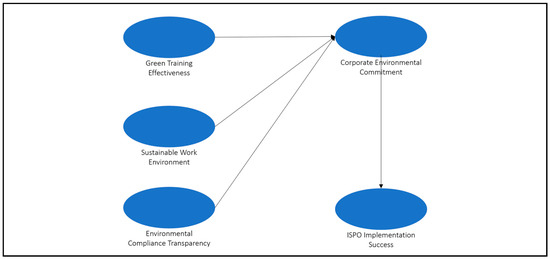
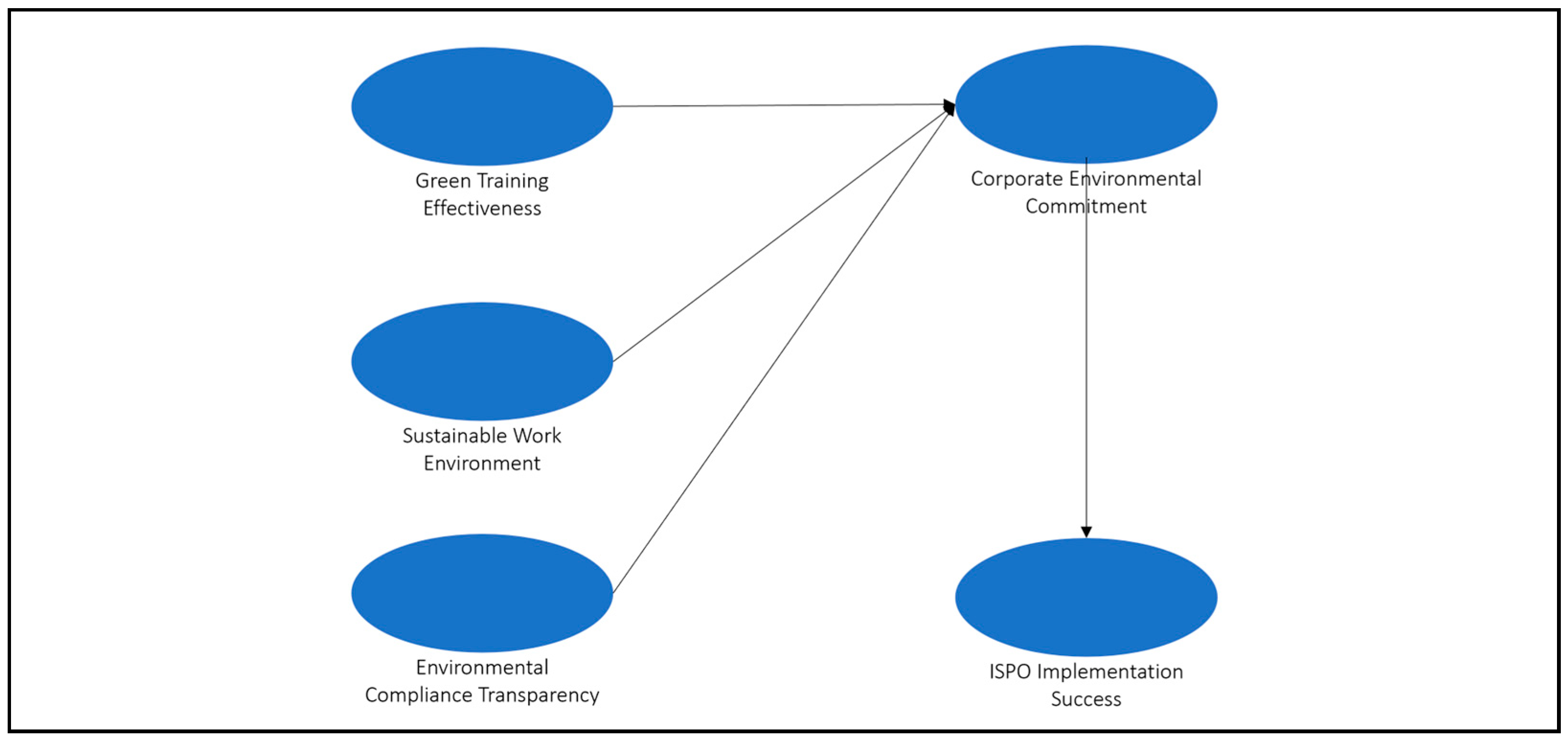
Building on this perspective, the study proposes a governance-focused mediation model in which green training effectiveness, sustainable work environment, and environmental compliance transparency influence ISPO implementation success through corporate environmental commitment. Drawing on environmental management system (EMS) principles, the model emphasizes the integration of planning, implementation, monitoring, and corrective actions as governance processes that support certification implementation. This framework provides the basis for examining how internal organizational conditions are translated into effective ISPO implementation through governance commitment, as illustrated in Figure 4. Based on this conceptualization, the study proposes that green training effectiveness, sustainable work environment, and environmental compliance transparency influence corporate environmental commitment (H1–H3). Corporate environmental commitment influences ISPO implementation success (H4). Furthermore, corporate environmental commitment is proposed to mediate the relationships between these organizational conditions and ISPO implementation success (H5–H7).
Figure 4.
Research framework.
2. Materials and Methods
2.1. Research Design and Empirical Context
This study uses a quantitative research design to assess how internal organizational factors influence certification implementation effectiveness within a plantation context in oil palm plantation management. The study adopts an analytical generalization approach, focusing on an in-depth examination of governance mechanisms within a single certified plantation rather than aiming for statistical generalization across the industry. The research focuses on PT Agrina Sawit Perdana. This specific context is noteworthy because it illustrates a substantial plantation system operating within forested areas, where environmental governance is closely intertwined with certification requirements and operational practices. Within these plantation settings, the application of ISPO extends beyond mere compliance; it encompasses continuous processes such as audit preparation, environmental monitoring, problem identification, and subsequent corrective actions. The implementation of ISPO is not only used as an environmental management tool, but also as an important part of GCG in the palm oil plantation sector. This empirical setting has received ISPO certification based on an audit conducted by an independent certification body, PT Mutu Agung Lestari Tbk. (a company located in Kota Depok, Indonesia, which operates in the field of testing, inspection, and certification), which is accredited by the National Accreditation Committee/KAN of Indonesia. Therefore, the chosen case study provides a relevant context for examining how governance processes become part of organizational routines, and how this affects the effectiveness of sustainability certification. Instead of striving for statistical generalization across the entire industry, this study aims to produce analytical insights into the governance processes at work within a certified plantation setting. The selected plantation setting also provides an appropriate context for examining the mediating role of Corporate Environmental Commitment. In large-scale plantation systems, environmental standards are implemented across multiple operational units, making governance integration a critical prerequisite for certification effectiveness. Consequently, Corporate Environmental Commitment is expected to function as the mechanism through which organizational conditions are translated into consistent certification implementation practices across the plantation landscape.
2.2. Population, Sampling, and Data Collection
The study included a group of 500 employees involved in ISPO-related activities. These activities encompassed environmental management, operational compliance, audit preparation, and the implementation of corrective actions. To ensure that participants had the necessary knowledge and experience with certification implementation, we used a purposive sampling method. Purposive sampling was intentionally used to capture informed perspectives on governance processes rather than general employee perceptions. The minimum sample size was calculated using the Slovin formula, incorporating a 10% margin of error, which yielded a final sample of 84 respondents. The sample size is also considered adequate for PLS-SEM analysis based on minimum sample size recommendations for predictive models. This sampling approach also emphasizes the depth of contextual comprehension rather than probabilistic representativeness, a strategy well-suited for investigating firm-level governance processes within a particular institutional context. Data were collected using structured self-administered questionnaires distributed in person and online. The respondent profile mirrors the operational framework of plantation systems. The majority of the participants were men (89.29%), which is consistent with the workforce structure of plantations and mills. Most of the respondents were aged 31 to 50 (60.71%), followed by those aged 20 to 30 (36.90%). Regarding education, half of the participants had a high school diploma, and 42.86% held a bachelor’s degree. Work experience was mainly relevant to employees with 1 to 5 years of experience (59.52%), followed by those with more than 10 years (22.62%) and those with 6 to 10 years (17.86%). Therefore, the sample represents people directly involved in the operational and governance aspects of ISPO implementation. Participation in the survey was voluntary, and the respondents were informed about the study’s purpose. All responses were kept anonymous and used only for academic research.
2.3. Construct Measurement
Multi-item scales, informed by the existing literature and adapted to the particular setting of ISPO implementation and oil palm plantation activities, were utilized to evaluate the constructs. This measurement approach aimed to clarify the impact of internal organizational elements on governance processes within the operational structure of the plantations. A five-point Likert scale, with endpoints ranging from “strongly disagree” to “strongly agree,” was employed. Green training effectiveness (GTE) captures employees’ perceptions of the relevance and usefulness of environmental training as a mechanism for strengthening environmental capability and awareness [31,32,33,34]. Sustainable work environment (SWE) reflects the extent to which workplace conditions support environmentally responsible practices through safety, facilities, supervisory support, and operational clarity [19,20]. Environmental compliance transparency (ECT) assesses the clarity and openness of internal communication related to audits, regulatory requirements, and environmental performance [11,21,35,36]. Corporate environmental commitment (CEC) represents the extent to which environmental priorities are embedded in organizational policies, decision-making, and resource allocation [19,34,37]. ISPO implementation success (SCS) captures the perceived consistency and effectiveness of certification practices within operational routines [24,26,38]. This study focuses on governance processes and positions ISPO implementation success as perceived governance effectiveness rather than direct environmental performance. Accordingly, the construct reflects internal governance outcomes instead of externally verified ecological indicators such as emissions reduction or biodiversity improvement, acknowledging the limitations associated with perception-based measures. This distinction is important because objective environmental indicators (e.g., GHG emissions, biodiversity indices, soil and water quality) are not directly captured in the current dataset. Therefore, the findings should be interpreted as reflecting internal governance effectiveness rather than externally validated certification implementation outcomes.
2.4. Analytical Approach
To empirically examine the proposed governance-based model, this study employs partial least squares structural equation modeling (PLS-SEM), which is suitable for analyzing complex mediation relationships and predictive models with relatively small sample sizes [39,40,41]. The analytical approach is designed to assess how internal organizational conditions are translated into certification implementation effectiveness through governance processes. The analysis follows a two-stage procedure. First, the measurement model is evaluated to assess reliability and validity using Cronbach’s alpha, composite reliability (CR), and average variance extracted (AVE) [40,42]. Convergent validity is confirmed when factor loadings surpass 0.70 and AVE values exceed 0.50. Discriminant validity is then assessed through a cross-loading approach, which investigates whether each indicator exhibits a stronger association with its designated construct than with other constructs. This approach is especially pertinent in models that incorporate closely related governance constructs, as it facilitates the evaluation of indicator-level distinctiveness within a unified conceptual framework. Discriminant validity is confirmed when each measurement item exhibits its strongest association with the intended construct, compared to its associations with all other constructs in the model. Following this, the structural model is evaluated by analyzing path coefficients, employing bootstrapping techniques, and assessing explanatory power, all with the objective of understanding the relationships between the constructs.
Mediation analysis is conducted to examine whether corporate environmental commitment functions as the central mechanism linking organizational conditions to certification outcomes. To assess potential multicollinearity, variance inflation factor (VIF) values were examined at the inner model level. Given the self-reported nature of the data, VIF values were interpreted as indicators of collinearity rather than as a direct test of common method bias (CMB). Potential CMB cannot be fully ruled out; however, procedural remedies such as anonymity assurance and voluntary participation were implemented to reduce response bias. Some VIF values exceeded commonly recommended thresholds, indicating a high degree of association among governance-related constructs. This condition reflects the conceptual proximity of the constructs, which represent interrelated dimensions of an integrated environmental governance system rather than fully independent theoretical domains. Given the explanatory nature of the model, multicollinearity is interpreted with caution, and the results are evaluated based on the overall structural relationships rather than isolated parameter estimates. The structural model’s performance is assessed using the coefficient of determination (R2) to measure its explanatory power, effect size (f2) to evaluate the influence of each exogenous construct, and predictive relevance (Q2), which is calculated through the blindfolding procedure. These metrics provide a comprehensive assessment of the model’s capacity to explain and predict outcomes. The structural model specifies that organizational factors (GTE, SWE, ECT) influence corporate environmental commitment (CEC), which in turn determines ISPO implementation success (SCS). This perspective is consistent with contemporary research in Partial Least Squares Structural Equation Modeling (PLS-SEM).
3. Results
3.1. Assessment of the Measurement Model
Table 2 presents the measurement model’s strong reliability and convergent validity for all constructs. Cronbach’s alpha (CA) and composite reliability (CR) confirm internal consistency reliability, with each value exceeding the recommended threshold of 0.70. In particular, CA values above 0.90 suggest a high level of internal consistency, which reflects the robustness of construct measurement rather than its redundancy. Furthermore, composite reliability values span from 0.934 to 0.973, which further corroborates the measurement model’s stability. Convergent validity is confirmed through outer loadings and Average Variance Extracted (AVE). All indicator loadings surpassed the 0.70 threshold, and the average variance extracted (AVE) values were above 0.50. This suggests that the constructs effectively account for a significant portion of the variance present in their associated indicators. Consequently, these findings validate the measurement model’s capacity to serve as a dependable foundation for investigating governance-related relationships within the ISPO implementation framework.
Table 2.
Reliability and Validity Results.
Discriminant validity was primarily assessed using cross-loading analysis to examine the distinctiveness of each construct at the indicator level. The results indicate that all indicators load highest on their respective constructs compared to other constructs in the model, supporting indicator-level discriminant validity. Therefore, discriminant validity should be interpreted with caution. At the indicator level, the constructs remain empirically distinguishable, although the elevated HTMT values indicate substantial conceptual proximity among governance-related dimensions within the model. The constructs in this study represent closely interconnected aspects of an integrated governance system, where theoretical overlap is expected. Therefore, discriminant validity is interpreted within the context of theoretical coherence, where constructs remain empirically distinguishable at the indicator level while being conceptually interrelated within the governance framework. This approach aligns with recent perspectives in PLS-SEM that emphasize the importance of theoretical justification when evaluating discriminant validity in models with conceptually overlapping constructs. The cross-loading outcomes, presented in Table 3, demonstrate that all measurement items possess the highest loadings on their respective constructs when contrasted with other constructs within the model, thus validating indicator-level discriminant validity. Despite the presence of some cross-loadings with comparatively high values across conceptually related constructs, this observation is theoretically expected, considering the interconnected nature of governance processes within oil palm plantation systems. In these contexts, organizational conditions, corporate environmental commitment, and certification outcomes represent closely interconnected dimensions of a unified environmental management system, rather than entirely independent domains.
Table 3.
Discriminant Validity Assessment.
The results indicate that although the constructs are empirically separable at the indicator level, they represent highly interconnected governance mechanisms that work together to influence certification implementation effectiveness. Consequently, discriminant validity should be regarded as acceptable but limited, given the conceptual integration of governance-related constructs and the elevated HTMT values observed in the model. The observed overlap among several governance-related constructs should be interpreted in light of the theoretical structure of the model. Green training effectiveness, sustainable work environment, corporate environmental commitment, and certification implementation success represent complementary governance dimensions that are expected to co-evolve within organizational settings. Consequently, relatively high correlations among these constructs may reflect substantive theoretical relationships rather than measurement redundancy alone. Nevertheless, the findings should be interpreted with appropriate caution, particularly when assessing the magnitude of individual path coefficients within a highly integrated governance framework.
3.2. Structural Model Assessment
The structural model demonstrates considerable explanatory and predictive capacity in elucidating the relationship between internal organizational factors and certification implementation effectiveness within oil palm plantation governance frameworks. The coefficient of determination (R2), as presented in Table 4, suggests that corporate environmental commitment and ISPO implementation success are effectively accounted for by the model, thereby underscoring the significance of governance-based mechanisms in influencing certification efficacy. Furthermore, the substantial interdependence among the constructs accentuates the systemic character of environmental governance within plantation settings, where training, the work environment, and organizational commitment operate as mutually reinforcing components. The model’s integrated structure accounts for the observed high correlations and multicollinearity. This supports the idea that sustainability certification is a coordinated governance process, rather than a collection of separate practices. Effect size analysis (f2) presented in Table 5 indicates that corporate environmental commitment significantly influences ISPO implementation success, with a very large effect size (f2 = 0.810). This underscores its pivotal function as the primary governance capability connecting organizational factors to certification results. Furthermore, the effectiveness of green training (f2 = 0.359) and a sustainable work environment (f2 = 0.253) show moderate to strong effects on a company’s commitment to the environment. These results suggest that improving skills and providing a supportive work environment help strengthen this commitment. In contrast, the effect of environmental compliance transparency is small (f2 = 0.012), which implies that simply providing information is not enough to achieve internal governance goals. The predictive relevance, as shown in Table 6 and measured by Stone–Geisser’s Q2, yields values of 0.681 for corporate environmental commitment and 0.693 for ISPO implementation success. These results indicate that the model has a strong ability to predict outcomes. The combined results suggest that the effectiveness of sustainability certification implementation in plantation settings is strongly influenced by internal governance structures rather than by individual organizational practices alone.
Table 4.
Coefficient of determination (R2).
Table 5.
Effect size (f2).
Table 6.
Predictive Relevance.
3.3. Hypothesis Testing
The hypothesis testing results (Table 7) provide clear support for the proposed governance-based mediation model. Corporate environmental commitment (CEC) demonstrates a robust and statistically significant positive influence on ISPO implementation success (SCS) (β = 0.697; p < 0.001), thereby corroborating its function as the primary mechanism through which sustainability certification is enacted within plantation systems. Regarding the precursors of corporate environmental commitment, the effectiveness of green training (GTE) demonstrates a noteworthy positive influence (β = 0.517; p < 0.001), suggesting that the cultivation of environmental capabilities fosters the establishment of organizational commitment. Similarly, a sustainable work environment (SWE) shows a considerable positive effect (β = 0.432; p = 0.001), which implies that supportive operational conditions strengthen governance practices. Conversely, environmental compliance transparency (ECT) does not reveal a significant correlation with corporate environmental commitment (β = 0.040; p = 0.496), thereby suggesting that transparency by itself does not foster enhanced internal commitment. Furthermore, mediation analysis shows that corporate environmental commitment fully explains how green training effectiveness and a sustainable work environment affect the success of ISPO implementation. The indirect effects of GTE (β = 0.361; p = 0.001) and SWE (β = 0.301; p = 0.009) are statistically significant. In contrast, the indirect effect of environmental compliance transparency is not statistically significant (β = 0.028; p = 0.504). This pattern supports a full mediation structure in which organizational conditions influence certification outcomes only through the development of corporate environmental commitment. Overall, the results indicate that ISPO implementation success is not directly driven by individual organizational practices, but by the extent to which these practices are internalized into coherent governance routines embodied in corporate environmental commitment. This pattern reinforces the interpretation that certification implementation effectiveness in plantation systems is driven by internal governance integration rather than isolated organizational practices.
Table 7.
Hypothesis Testing Results.
4. Discussion
4.1. Rethinking Governance Effectiveness in Plantation Systems: Commitment Formation, Enabling Conditions, and the Limits of Transparency
These findings provide empirical support for the governance-oriented mediation model within the examined plantation organizational context proposed in this study. The results indicate that corporate environmental commitment (CEC) plays a decisive role in shaping ISPO implementation success by functioning as the key governance capability through which certification implementation effectiveness is realized within oil palm plantation organizational settings. Rather than operating as a procedural compliance requirement, sustainability certification emerges as an ongoing governance process in which environmental priorities are embedded into organizational routines, decision-making structures, and resource allocation. From an environmental governance perspective, this finding reinforces the view that formal standards alone are insufficient to improve the effectiveness of sustainability certification implementation in forest-related commodity systems. In plantation settings marked by spatial separation, operational intricacy, and persistent environmental hazards, the efficacy of certification hinges on the reliability of internal coordination and enforcement protocols. This perspective resonates with existing scholarship, which underscores that environmental standards are effectively translated into consistent governance implementation only when underpinned by robust governance capabilities [19,34]. Furthermore, it contributes to wider discussions concerning certification credibility by demonstrating that certification implementation effectiveness is contingent upon the degree to which firms transcend symbolic compliance and adopt embedded governance practices [7,43]. Although environmental outcomes are not directly measured, governance effectiveness is widely recognized as a precursor to more consistent implementation of environmental standards. Expanding upon this core finding, the function of organizational conditions as enabling mechanisms is subsequently explored. It should be noted that the findings reflect perceived governance effectiveness within the studied organizational context rather than directly measured environmental outcomes. Consequently, the results should be interpreted as evidence of how internal governance processes support certification implementation rather than as proof of specific ecological improvements.
The pronounced impacts of green training effectiveness and sustainable work environment on corporate environmental commitment suggest that these organizational conditions serve as enabling mechanisms for governance internalization. Rather than directly affecting certification results, both elements contribute to building commitment, which then drives successful implementation. The mediation results support this idea, suggesting that sustainability certification works through an indirect process. This process involves changing organizational conditions into governance capability. By enhancing employees’ understanding of environmental standards, green training helps align their actions with the organization’s sustainability goals. Within plantation environments, where operational decisions exert a direct influence on operational implications for certification implementation, training is essential for mitigating informational disparities and solidifying collective understandings regarding adherence to regulations [27,28,29,30]. Similarly, a sustainable work environment provides the necessary institutional conditions for consistent environmental behavior by reducing the conflicts between productivity goals and compliance requirements. Supervisory support, procedural clarity, and adequate facilities contribute to a governance environment in which environmental standards can be implemented more effectively [21,31]. From a governance standpoint, these findings indicate that training and workplace conditions are necessary but not sufficient drivers of certification success. Their impact materializes only when they are internalized into organizational commitment, which then coordinates behavior across different operational units. This reinforces the view of sustainability certification as a system-level governance process.
In contrast to expectations, environmental compliance transparency does not exhibit a significant effect on corporate environmental commitment or certification outcomes. This finding highlights the limitations of governance methods that rely on information to influence internal behavior within established plantation systems. While transparency is widely recognized as a cornerstone of environmental governance and accountability [6,36], its primary function appears to be external rather than internal. Transparency improves the visibility of compliance processes and enhances legitimacy in the eyes of regulators and stakeholders, but it does not necessarily alter incentive structures or enforcement dynamics within firms. In operational contexts characterized by hierarchical structures and routine-based decision-making, behavioral change is more strongly driven by leadership commitment and institutional discipline than by information availability alone [17]. This result suggests that transparency should be understood as a complementary condition rather than a primary driver of certification implementation effectiveness. Without strong internal governance, having information alone is not enough to ensure consistent certification implementation through internal governance integration. This finding adds to current discussions about the effectiveness of certification systems, highlighting the need to balance transparency with good management practices.
A possible explanation for the non-significant relationship between Environmental Compliance Transparency and Corporate Environmental Commitment is that transparency primarily functions as an informational and accountability mechanism rather than a behavioral transformation mechanism [44,45]. In plantation organizations with established governance systems, compliance-related information may already be routinely communicated through formal procedures and operational practices, making transparency a fundamental organizational condition rather than a distinct driver of environmental commitment. Environmental disclosure is generally intended to reduce information asymmetry and strengthen accountability to stakeholders [46], while the development of environmental commitment often depends on broader organizational factors. In particular, leadership reinforcement, organizational culture, and managerial support play a central role in shaping environmental values and behaviors within organizations [47,48]. Therefore, transparency may contribute most effectively to governance outcomes when it is complemented by organizational mechanisms that translate environmental information into shared priorities, collective responsibility, and sustained behavioral commitment.
4.2. Full Mediation and the Internalization of Sustainability Governance
The mediation model provides further insight into how sustainability governance operates within plantation systems. The findings indicate that organizational factors do not directly translate into certification outcomes. Instead, their influence emerges when they are embedded within corporate environmental commitment, which serves as the mechanism linking organizational practices to certification implementation effectiveness. This result supports the view that sustainability certification functions as an ongoing governance process in which commitment aligns organizational activities with environmental objectives.
The significant indirect effects of green training effectiveness and sustainable work environment suggest that these organizational conditions contribute to ISPO implementation success only through corporate environmental commitment. This finding highlights the importance of internalizing organizational conditions into governance routines before they can generate meaningful certification outcomes. Such a pattern is consistent with the logic of environmental management systems (EMS), where effective certification implementation depends on the integration of planning, implementation, monitoring, and corrective action processes. Within this framework, corporate environmental commitment acts as a coordinating mechanism that connects organizational practices with certification requirements. When environmental standards are systematically incorporated into operational procedures, organizations can reduce uncertainty, improve consistency, and enhance the efficiency of compliance processes [49].
From an environmental economics perspective, the findings also underscore the relationship between certification effectiveness and the integration of regulatory incentives and compliance-related costs into organizational systems [12,34]. Organizations with stronger governance frameworks appear better positioned to respond to regulatory requirements and transform them into standardized operational practices. This process may contribute to greater operational efficiency while supporting more consistent certification implementation. The findings therefore suggest that the effectiveness of certification systems depends not only on the design of external standards and regulations but also on the extent to which these standards are embedded within internal governance processes and everyday organizational practices.
4.3. Novel Insights into Environmental Governance in Plantation Landscapes: From Compliance to Commitment
The findings contribute to the understanding of environmental governance within organizational-level certification implementation in plantation-based systems by providing additional insight into how certification implementation effectiveness is shaped by internal governance processes. The results suggest that sustainability certification should not be viewed solely as a regulatory compliance instrument but also as an organizational governance process embedded within everyday managerial practices. Previous studies have commonly approached certification schemes such as ISPO as external accountability mechanisms designed to enforce environmental standards [6,9], with particular emphasis on regulatory compliance, audit procedures, and institutional pressures as the primary drivers of certification implementation effectiveness. The present findings indicate that certification implementation effectiveness is more closely associated with internal governance dynamics operating within plantation landscapes. Rather than being understood as an externally imposed requirement, certification implementation appears to be enacted through organizational routines and governance practices. This perspective is particularly relevant in plantation systems, where certification outcomes depend not only on formal rules but also on the consistency of implementation across geographically dispersed and operationally complex units [7,19]. The results therefore highlight the importance of integrating governance processes into organizational routines and coordinating implementation across operational units to achieve effective certification outcomes.
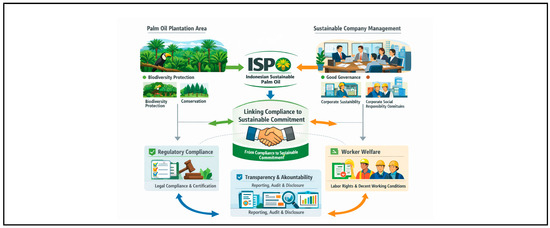
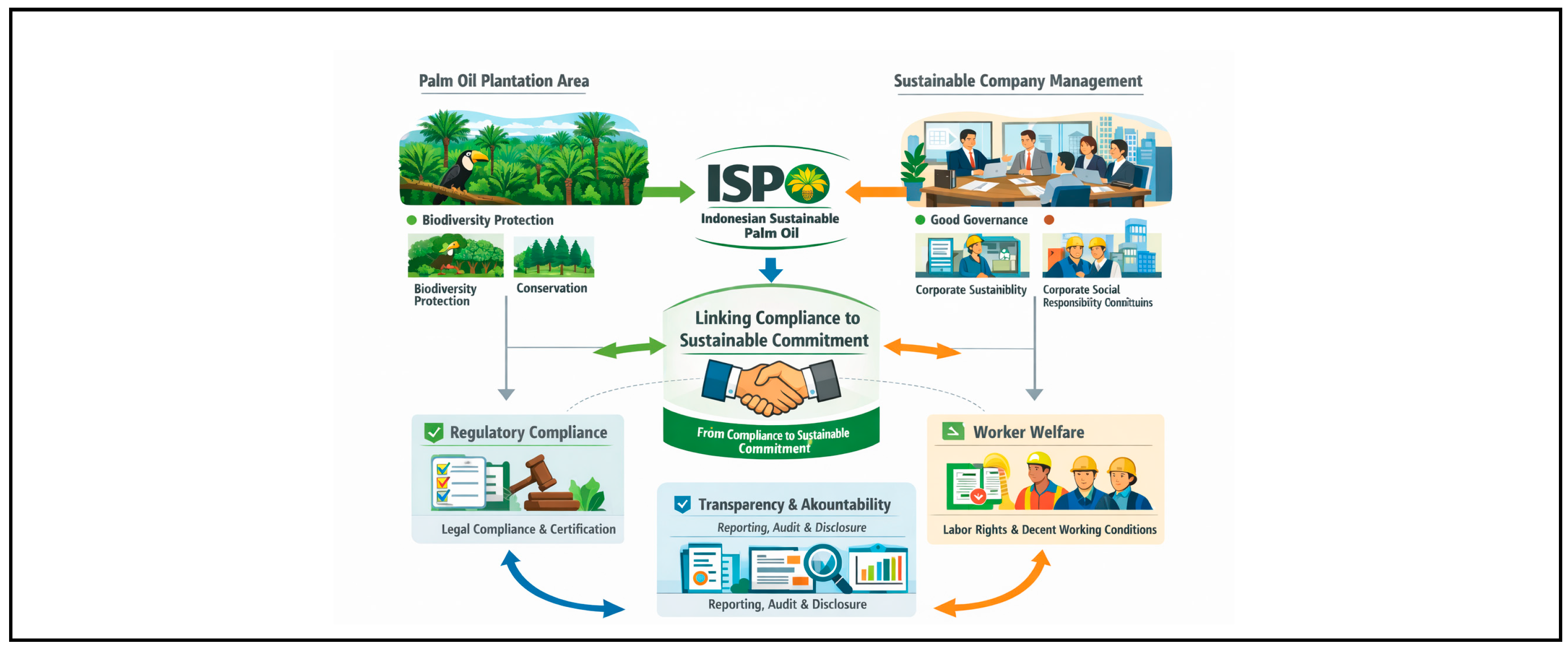
Figure 5 presents a conceptual representation of environmental governance within oil palm plantation landscapes by linking ecological contexts, particularly trees and forests, with organizational governance mechanisms involving human actors. Biodiversity protection and conservation form the environmental foundation upon which sustainability challenges emerge within plantation systems [6,7]. These landscape-level conditions are translated into internal governance processes through ISPO, which functions as both a regulatory and institutional interface. Within organizations, governance dimensions such as regulatory compliance, worker welfare, and transparency operate as interconnected mechanisms that collectively influence corporate environmental commitment. The circular structure illustrated in the figure reflects the empirical finding that certification implementation effectiveness is not determined by isolated organizational practices but by the extent to which governance processes are harmonized, internalized, and consistently implemented across operational units [19]. From a tree–forests–people perspective, the figure highlights how certification governance is strengthened through the alignment of ecological systems and organizational governance structures, illustrating certification as a governance integration process linking environmental conditions with organizational capabilities.
Figure 5.
Integrated scheme linking regulatory compliance to certification governance effectiveness in palm oil management (developed by the authors).
The findings further support governance-oriented interpretations of corporate environmental commitment that have been discussed in environmental management and EMS research [34,37]. Within the present study, corporate environmental commitment functions as a governance capability that connects organizational conditions with certification implementation outcomes. The results suggest that commitment serves as an important mechanism through which environmental standards are translated into organizational action within the examined plantation context. Certification implementation effectiveness therefore depends not only on formal compliance mechanisms but also on the extent to which environmental values become embedded within organizational routines. The findings imply that certification assessments may benefit from greater attention to how environmental practices are integrated into daily operations rather than being evaluated solely through procedural compliance indicators. This perspective extends previous approaches by emphasizing how commitment shapes decision-making, resource allocation, and behavioral coordination within plantation systems. By establishing corporate environmental commitment as the link between organizational conditions and certification outcomes, the study provides additional insight into how governance effectiveness is achieved through the development of coordinated organizational capabilities rather than through isolated interventions.
The mediation results also contribute to a more process-oriented understanding of sustainability governance. Much of the existing literature assumes that organizational practices, such as training initiatives and workplace conditions, directly influence environmental performance. While such relationships are important, they often overlook the internal mechanisms through which organizational inputs are translated into sustainability outcomes. The findings demonstrate that the effects of green training effectiveness and sustainable work environment on ISPO implementation success are fully mediated by corporate environmental commitment. This result suggests that organizational conditions contribute to certification outcomes only when they are transformed into shared governance commitments that influence organizational behavior. The findings build upon previous research on environmental management practices [29,31] by showing that the effectiveness of such practices depends on their integration into broader governance structures. Consequently, the results shift attention from the implementation of individual practices toward the governance processes through which those practices become institutionalized and sustained within plantation systems [17,18].
Another important finding concerns the role of environmental compliance transparency. The environmental governance literature frequently identifies transparency as a central component of accountability and assumes that improved information disclosure contributes directly to governance effectiveness [6]. However, the present findings indicate that transparency does not significantly influence corporate environmental commitment or ISPO implementation success. Although transparency remains an important governance element, its effectiveness appears to depend on the presence of complementary organizational mechanisms capable of transforming information into coordinated action. This observation is particularly relevant in plantation environments characterized by hierarchical structures, operational complexity, and geographically dispersed activities, where information alone may be insufficient to influence organizational behavior. The findings therefore suggest that effective environmental governance depends not only on transparency but also on the extent to which governance processes are coordinated, internalized, and consistently implemented throughout the organization.
More broadly, the study provides additional insight into environmental governance within tropical plantation landscapes by linking organizational practices with certification implementation outcomes. Previous studies have often examined institutional arrangements and organizational practices separately, whereas the present findings demonstrate the importance of considering their interaction. Using evidence from an ISPO-certified plantation in Indonesia, the study illustrates how internal governance capabilities influence certification implementation effectiveness within environmentally sensitive and highly regulated production systems. This context-specific perspective highlights the interconnected nature of environmental, organizational, and spatial dimensions of governance [7] and provides a clearer understanding of how certification implementation is sustained through the interaction between organizational action and broader governance conditions.
Taken together, the findings provide a more integrated understanding of how sustainability certification operates within plantation systems. The results highlight the central role of corporate environmental commitment in connecting organizational conditions with certification implementation outcomes while also demonstrating the limited influence of transparency when it is not supported by broader governance mechanisms. By examining these relationships within an ISPO-certified plantation context, the study illustrates how certification implementation effectiveness, as perceived by organizational actors, depends on the alignment of organizational practices, governance processes, and environmental objectives. These insights contribute to ongoing discussions on environmental governance and may support efforts to strengthen the design and implementation of sustainability certification in forest-related production systems.
4.4. Implications for Plantation Governance and Sustainability Certification Systems
The study’s findings provide context-specific implications for organizational governance and certification implementation within oil palm plantation settings. Initially, the results indicate that enhancing the efficacy of sustainability certification necessitates a heightened focus on bolstering internal governance capacities within companies. The findings suggest that, within organizational contexts, regulatory frameworks such as ISPO should go beyond merely establishing standards and monitoring compliance. Greater emphasis is needed on strengthening internal governance systems that enable the consistent implementation of environmental standards across organizational routines. Moreover, the findings underscore the importance of aligning capacity-building efforts, such as training programs, with overall governance goals. The most significant impact of investments in training and workplace improvements comes from their ability to build organizational commitment and coordination methods, which are essential for maintaining consistent adherence to standards. Thirdly, the limited impact of transparency suggests that policy measures should go beyond information disclosure toward strengthening governance mechanisms that shape organizational behavior. They should focus on the basic governance structures that influence how organizations behave. This study, within a wider context, enhances our understanding of sustainability certification as a governance tool in systems that produce perennial plantation systems. The certification implementation outcomes observed in these systems are contingent upon the interplay between extant regulations and the unique capacities of individual firms. In plantation settings, which are closely linked to forest ecosystems and social-environmental factors, the effectiveness of certification depends on how well governance processes are integrated into organizational structures. Moreover, these findings contribute to current global discussions about the credibility of sustainability certification. They emphasize that the credibility of certification systems depends not only on having standards but also on the governance structures that manage their practical application. This study should be understood as an organizational environmental governance analysis within a certification regime, rather than as an evaluation of ecological outcomes, as the findings are based on perception-driven measures of certification implementation effectiveness.
5. Limitations and Future Research Directions
Several limitations should be considered when interpreting this study. Because this research is based on a single company’s case study, the ability to apply these findings to other plantation settings or institutional contexts is limited. This study provides a thorough examination of governance practices within an ISPO-certified organization. This sampling strategy may introduce positive bias, as respondents are directly involved in sustainability implementation and may evaluate outcomes more favorably. Future studies should employ random sampling across organizational levels to assess the extent to which certification-related governance practices are embedded beyond specialized roles. To enhance the external validity of these results, subsequent research should encompass a broader spectrum of companies spanning diverse geographical regions. The study also exhibits relatively high inter-construct correlations, as reflected in elevated VIF and HTMT values. While this condition is theoretically consistent with the integrated nature of governance constructs, it may limit the empirical distinctiveness of certain variables. Future research is encouraged to refine construct operationalization or employ alternative measurement approaches to improve discriminant validity. Longitudinal studies would provide a more comprehensive understanding of how environmental commitment develops and influences certification outcomes in the long run. The use of a single plantation case limits the generalizability of the findings beyond the examined organizational context. Therefore, the results should be interpreted as analytical insights into governance processes rather than as representative evidence of industry-wide certification effectiveness. The use of self-reported data may introduce potential response bias, particularly in organizational contexts where certification compliance and governance performance are closely monitored. This study does not incorporate objective environmental performance indicators, such as greenhouse gas emissions, biodiversity measures, or soil and water quality, which limits the ability to directly assess ecological impact. Although statistical and conceptual considerations were applied, future research may incorporate objective indicators or mixed-method approaches to enhance robustness. As a result, the findings should be interpreted as reflecting governance effectiveness rather than direct environmental impact. Future studies may also explore additional governance mechanisms, such as leadership styles, organizational culture, or digital monitoring systems, to further advance the understanding of sustainability governance in plantation landscapes.
6. Conclusions
This study demonstrates that, within the examined organizational context, the effectiveness of sustainability certification implementation is primarily determined by the strength of internal environmental governance rather than by the presence of formal compliance mechanisms alone. Focusing on the Indonesian Sustainable Palm Oil (ISPO) scheme, the findings show that corporate environmental commitment functions as the central governance capability through which organizational conditions are translated into consistent certification outcomes. The results also highlight that training effectiveness and supportive work environments contribute to certification success only when they are internalized into coherent governance routines. Ultimately, this study demonstrates that certification implementation effectiveness in plantation landscapes depends not on stricter compliance enforcement, but on the ability of organizations to embed environmental governance into their core operational system. The findings should be interpreted as reflecting perceived governance effectiveness within the examined organizational setting rather than directly measured environmental outcomes such as biodiversity conservation, emissions reduction, or land-use impacts.
Theoretically, this study advances the literature by providing organization-level insights into governance mechanisms within certification implementation processes. It presents a governance-based mediation perspective, illustrating that the efficacy of certification stems from the integration of environmental standards into harmonized organizational practices. By viewing corporate environmental commitment as an operational governance capability rather than merely an attitudinal construct, this study deepens understanding of how certification implementation is sustained in perennial plantation systems. Consequently, from an organizational and contextual perspective, the results indicate that enhancing the effectiveness of certification systems like ISPO necessitates a shift from compliance enforcement to governance strengthening. Regulatory structures should encompass not only the establishment of standards and monitoring protocols but also the cultivation of firm-specific governance proficiencies, thereby ensuring the consistent application of environmental practices. This necessitates the promotion of integrated training programs, the fortification of internal coordination mechanisms, and the encouragement of organizational frameworks that facilitate the internalization of sustainability objectives.
From a managerial standpoint, the research underscores the significance of integrating environmental priorities into fundamental organizational processes. Plantation companies need to build internal commitment by ensuring that training, workplace environments, and operational activities support sustainability objectives. Training and better workplace conditions need to be considered as core parts of a unified governance system. Such a system is essential to support ongoing compliance and certification implementation effectiveness, instead of treating these efforts as unrelated actions. In practical terms, plantation firms may operationalize governance integration by establishing cross-functional sustainability committees, incorporating environmental objectives into routine performance evaluations, and regularly assessing the effectiveness of environmental training programs across operational units. Regulators may further support this process by encouraging certification assessments that evaluate not only procedural compliance but also the extent to which environmental responsibilities are embedded within organizational coordination, monitoring, and decision-making processes. The findings also indicate that while transparency efforts are essential for external accountability, they are insufficient to instigate internal governance alignment and behavioral consistency absent strong governance structures. Essentially, this study highlights that the future effectiveness of sustainability certification in plantation settings depends not on more rigorous compliance protocols, but on an organization’s ability to embed environmental governance within its core operational procedures.
Author Contributions
Conceptualization, A.W.K. and M.C.; methodology, A.W.K. and M.C.; software, M.C. and A.W.K.; validation, M.C., D.T. and C.H.P.; formal analysis, M.C. and A.W.K.; investigation, D.T. and C.H.P.; resources, A.W.K.; data curation, A.W.K. and M.C.; writing—original draft preparation, M.C.; writing—review and editing, D.T. and C.H.P.; visualization, C.H.P. and D.T.; supervision, D.T. and C.H.P.; project administration, C.H.P. and A.W.K. All authors have read and agreed to the published version of the manuscript.
Funding
This research received no external funding.
Institutional Review Board Statement
Ethical review and approval were waived for this study because it involved a non-invasive survey with adult participants and did not include sensitive personal data. The research design, including the questionnaire instrument, was reviewed and assessed on 3 October 2025 by qualified academic reviewers in accordance with the institutional academic procedures of the university. The study adhered to general ethical principles for research involving human participants, including voluntary participation, anonymity, and confidentiality.
Informed Consent Statement
Informed consent was obtained from all subjects involved in the study. Participation was voluntary, and respondents were informed about the purpose of the study, anonymity, and the use of data for academic research only.
Data Availability Statement
The data presented in this study are openly available in Zenodo at: https://zenodo.org/records/18227682, (accessed on 14 January 2026).
Acknowledgments
The authors used ChatGPT (GPT-5.5) solely for language editing, including grammar, clarity, and sentence structure refinement. In addition, ChatGPT-assisted image generation and enhancement tools were used to create Figure 3 and Figure 5 as illustrative visualizations of the processes discussed in this study. These tools were also employed to improve the figures’ visual quality and resolution.
Conflicts of Interest
The authors declare no conflicts of interest.
Abbreviations
The following abbreviations are used in this manuscript:
| AVE | Average Variance Extracted |
| CA | Cronbach’s Alpha |
| CEC | Corporate Environmental Commitment |
| CPO | Crude Palm Oil |
| CR | Composite Reliability |
| ECT | Environmental Compliance Transparency |
| FFB | Fresh Fruit Bunch |
| GCG | Good Corporate Governance |
| GHG | Greenhouse Gas |
| GTE | Green Training Effectiveness |
| HTMT | Heterotrait-monotrait Ratio |
| ISPO | Indonesian Sustainable Palm Oil |
| ISCC | International Sustainability and Carbon Certification |
| MSPO | Malaysian Sustainable Palm Oil |
| PLS-SEM | Partial Least Squares-Structural Equation Modeling |
| RSPO | Roundtable on Sustainable Palm Oil |
| SCS | ISPO Implementation Success |
| SWE | Sustainable Work Environment |
| VIF | Variance Inflation Factor |
References
- Reich, C.; Musshoff, O. Oil palm smallholders and the road to certification: Insights from Indonesia. J. Environ. Manag. 2025, 375, 124303. [Google Scholar] [CrossRef] [Scilit] [PubMed]
- Hariyanti, F.; Syahza, A.; Zulkarnain; Nofrizal. Economic transformation based on leading commodities through sustainable development of the oil palm industry. Heliyon 2024, 10, e25674. [Google Scholar] [CrossRef] [Scilit]
- Parveez, G.K.A.; Kamil, N.N.; Zawawi, N.Z.; Ong-Abdullah, M.; Rasuddin, R.; Loh, S.K.; Selvaduray, K.R.; Hoong, S.S.; Idris, Z. Oil Palm Economic Performance in Malaysia and R&D Progress In 2021. J. Oil Palm. Res. 2022, 34, 185–218. [Google Scholar]
- BPS-Statistics Indonesia. The Largest Area of Oil Palm Plantations in Indonesia in 2023 (Thousands of Hectares) 2025. Available online: https://www.bps.go.id/en/statistics-table/2/MTMxIzI=/plantation-area-by-province.html (accessed on 29 March 2026).
- Alhaji, A.M.; Almeida, E.S.; Carneiro, C.R.; da Silva, C.A.; Monteiro, S.; Coimbra, J.S. Palm Oil (Elaeis guineensis): A Journey through Sustainability, Processing, and Utilization. Foods 2024, 13, 2814. [Google Scholar] [CrossRef] [Scilit] [PubMed]
- Abdul Majid, N.; Ramli, Z.; Md Sum, S.; Awang, A.H. Sustainable Palm Oil Certification Scheme Frameworks and Impacts: A Systematic Literature Review. Sustainability 2021, 13, 3263. [Google Scholar] [CrossRef] [Scilit]
- Ostfeld, R.; Reiner, D.M. Seeing the forest through the palms: Developments in environmentally sustainable palm oil production and zero-deforestation efforts. Front. Sustain. Food Syst. 2024, 8, 1398877. [Google Scholar] [CrossRef] [Scilit]
- Nugraha, H.; Purwanto, E.; Christian, M.; Rembulan, G.D. The Evolution of Research in Agricultural Technology and Rural Development: A Bibliometric Analysis. J. Glob. Innov. Agric. Sci. 2026, 14, 175–192. [Google Scholar] [CrossRef] [Scilit]
- Ngan, S.L.; Er, A.C.; Yatim, P.; How, B.S.; Lim, C.H.; Ng, W.P.Q.; Chan, Y.H.; Lam, H.L. Social Sustainability of Palm Oil Industry: A Review. Front. Sustain. 2022, 3, 855551. [Google Scholar] [CrossRef] [Scilit]
- Kasim, E.; Stöhr, J.; Herzig, C. Promoting sustainable palm oil in supply chain strategy: A food business case study. Qual. Res. Organ. Manag. An. Int. J. 2021, 16, 550–571. [Google Scholar] [CrossRef] [Scilit]
- Hutagalung, B.; Asmarantaka, R.W.; Adhi, A.K. Marketing Analysis of Indonesian Sustainable Palm Oil (ISPO) and non-ISPO Certified Independent Palm Oil in Batanghari Regency, Jambi Province, Indonesia. Agro. Bali. Agric. J. 2024, 7, 56–69. [Google Scholar] [CrossRef] [Scilit]
- De Rosa, M.; Schmidt, J.; Pasang, H. Industry-driven mitigation measures can reduce GHG emissions of palm oil. J. Clean. Prod. 2022, 365, 132565. [Google Scholar] [CrossRef] [Scilit]
- Rossi, C.; Shen, L.; Junginger, M.; Wicke, B. Sustainability certification of bio-based products: Systematic literature review of socio-economic impacts along the supply chain. J. Clean. Prod. 2024, 468, 143079. [Google Scholar] [CrossRef] [Scilit]
- Darkwah, D.O.; Ong-Abdulllah, M. Sustainability of the Oil Palm Industry; Kamyab, H., Ed.; IntechOpen: London, UK, 2021. [Google Scholar] [CrossRef] [Scilit]
- Christian, M.; Yulita, H.; Gularso, K.; Wibowo, S.; Muzammil, M.; Oktafalia, S. Halal Certification and Its Relationship to Business Value: A Perspective of Fish Salting SMEs. E3S Web Conf. 2024, 595, 1014. [Google Scholar] [CrossRef] [Scilit]
- Christian, M.; Purwanto, E.; Muzammil, O.M.; Yulita, H. Eco-Friendly Shopping Bags and The Younger Generation in Urban Areas: Can Environmental Consciousness and Attitude Influence Green Buying Decision? IOP Conf. Ser. Earth Environ. Sci. 2025, 1488, 12028. [Google Scholar] [CrossRef] [Scilit]
- Dioba, A.; Kroker, V.; Dewitte, S.; Lange, F. Barriers to Pro-Environmental Behavior Change: A Review of Qualitative Research. Sustainability 2024, 16, 8776. [Google Scholar] [CrossRef] [Scilit]
- Foster, B.; Muhammad, Z.; Yusliza, M.Y.; Faezah, J.N.; Johansyah, M.D.; Yong, J.Y.; Ul-Haque, A.; Saputra, J.; Ramayah, T.; Fawehinmi, O. Determinants of Pro-Environmental Behaviour in the Workplace. Sustainability 2022, 14, 4420. [Google Scholar] [CrossRef] [Scilit]
- Henriques, I.; Mouro, C.; Duarte, A.P. Green Organizational Climate’s Promotion of Managers’ Organizational Citizenship Behavior for the Environment: Evidence from the Portuguese Hospitality Context. Sustainability 2024, 16, 9611. [Google Scholar] [CrossRef] [Scilit]
- Liu, F.; Qi, M. Enhancing Organizational Citizenship Behaviors for the Environment: Integrating Social Identity and Social Exchange Perspectives. Psychol. Res. Behav. Manag. 2022, 15, 1901–1914. [Google Scholar] [CrossRef] [Scilit]
- Raza, A.; Farrukh, M.; Iqbal, M.K.; Farhan, M.; Wu, Y. Corporate social responsibility and employees’ voluntary pro-environmental behavior: The role of organizational pride and employee engagement. Corp. Soc. Responsib. Environ. Manag. 2021, 28, 1104–1116. [Google Scholar] [CrossRef] [Scilit]
- Kurnia, A.; Nugroho, A.; Anhar, A.; Hamid, A.H. Level of Readiness for Implementing ISPO Certification on Smallholder Palm Oil Plantations Compared with ISPO Certified Plantations in Aceh. IOP Conf. Ser. Earth Environ. Sci. 2025, 1477, 12008. [Google Scholar] [CrossRef] [Scilit]
- Ningsih, V.Y.; Setiawan, B.; Asmara, R.; Andriani, R.D. ISPO Certification and the Sustainable Development Goals: Readiness of Independent Smallholders in Indonesia (South Sumatra). Trans. Chin. Soc. Agric. Mach. 2025, 56, 37–55. [Google Scholar] [CrossRef] [Scilit]
- Pasimura, I.; Afrizal, A.; Novarino, W. Impact of Indonesian Sustainable Palm Oil (ISPO) Certification to Environmental Behavior of Palm Oil Plantation Companies. Int. J. Agric. Syst. 2022, 10, 26–43. [Google Scholar] [CrossRef] [Scilit]
- Rosyani; Edison; Ulma, R.; Aziz, M. Study of sustainability status of the implementation of ISPO (Indonesian Sustainable Palm Oil) in plasma farmers oil palm plantation. IOP Conf. Ser. Earth Environ. Sci. 2021, 716, 12114. [Google Scholar] [CrossRef] [Scilit]
- Zainuddin, A.; Muchlis, F.; Destiarni, R.P.; Jamil, A.S.; Meilin, A.; Amalia, D.N.; Aziz, M.A. Implementation Strategy of Indonesia Sustainable Palm Oil (ISPO) Certification: A’WOT Analysis Approach. J. Ilmu Pertan. Indones. 2025, 30, 500–512. [Google Scholar] [CrossRef] [Scilit]
- Amrutha, V.N.; Geetha, S.N. A systematic review on green human resource management: Implications for social sustainability. J. Clean. Prod. 2020, 247, 119131. [Google Scholar] [CrossRef] [Scilit]
- Mahdy, F.; Alqahtani, M.; Binzafrah, F. Imperatives, Benefits, and Initiatives of Green Human Resource Management (GHRM): A Systematic Literature Review. Sustainability 2023, 15, 4866. [Google Scholar] [CrossRef] [Scilit]
- Aftab, J.; Abid, N.; Cucari, N.; Savastano, M. Green human resource management and environmental performance: The role of green innovation and environmental strategy in a developing country. Bus. Strateg. Environ. 2023, 32, 1782–1798. [Google Scholar] [CrossRef] [Scilit]
- Yong, J.Y.; Yusliza, M.Y.; Ramayah, T.; Chiappetta Jabbour, C.J.; Sehnem, S.; Mani, V. Pathways towards sustainability in manufacturing organizations: Empirical evidence on the role of green human resource management. Bus. Strateg. Environ. 2020, 29, 212–228. [Google Scholar] [CrossRef] [Scilit]
- Paillé, P.; Mejía-Morelos, J.H.; Amara, N.; Norrin, H. Greening the workplace through supervisory behaviors: Assessing what really matters to employees. Int. J. Hum. Resour. Manag. 2022, 33, 1754–1781. [Google Scholar] [CrossRef] [Scilit]
- Hameed, Z.; Khan, I.U.; Islam, T.; Sheikh, Z.; Naeem, R.M. Do green HRM practices influence employees’ environmental performance? Int. J. Manpow. 2020, 41, 1061–1079. [Google Scholar] [CrossRef] [Scilit]
- Amjad, F.; Abbas, W.; Zia-Ur-Rehman, M.; Baig, S.A.; Hashim, M.; Khan, A.; Rehman, H.-U. Effect of green human resource management practices on organizational sustainability: The mediating role of environmental and employee performance. Environ. Sci. Pollut. Res. 2021, 28, 28191–28206. [Google Scholar] [CrossRef] [Scilit] [PubMed]
- Ren, S.; Jiang, K.; Tang, G. Leveraging green HRM for firm performance: The joint effects of CEO environmental belief and external pollution severity and the mediating role of employee environmental commitment. Hum. Resour. Manag. 2022, 61, 277. [Google Scholar] [CrossRef] [Scilit]
- Muisyo, P.K.; Qin, S.; Ho, T.H.; Julius, M.M.; Barisoava Andriamandresy, T. Implications of GHRM on organisational citizenship behaviour: The mediating role of enablers of green culture. Int. J. Manpow. 2021, 43, 719–741. [Google Scholar] [CrossRef] [Scilit]
- Sansome, K.; Wilkie, D.; Conduit, J. Beyond information availability: Specifying the dimensions of consumer perceived brand transparency. J. Bus. Res. 2024, 170, 114358. [Google Scholar] [CrossRef] [Scilit]
- Kanwal, S.; Al Mamun, A.; Wu, M.; Bhatti, S.M.; Ali, M.H. Corporate social responsibility: A Driver for green organizational climate and workplace pro-environmental behavior. Heliyon 2024, 10, e38987. [Google Scholar] [CrossRef] [Scilit]
- Okarda, B.; Purnomo, H.; Juniyanti, L.; Kusumadewi, S.D.; Nadhira, S. Indonesian palm oil towards sustainability: A system dynamic approach. IOP Conf. Ser. Earth Environ. Sci. 2024, 1379, 12037. [Google Scholar] [CrossRef] [Scilit]
- Hair, J.; Alamer, A. Partial Least Squares Structural Equation Modeling (PLS-SEM) in second language and education research: Guidelines using an applied example. Res. Methods Appl. Linguist. 2022, 1, 100027. [Google Scholar] [CrossRef] [Scilit]
- Hair, J.F.; Howard, M.C.; Nitzl, C. Assessing measurement model quality in PLS-SEM using confirmatory composite analysis. J. Bus. Res. 2020, 109, 101–110. [Google Scholar] [CrossRef] [Scilit]
- Sarstedt, M.; Hair, J.F.; Pick, M.; Liengaard, B.D.; Radomir, L.; Ringle, C.M. Progress in partial least squares structural equation modeling use in marketing research in the last decade. Psychol. Mark. 2022, 39, 1035–1064. [Google Scholar] [CrossRef] [Scilit]
- Benitez, J.; Henseler, J.; Castillo, A.; Schuberth, F. How to perform and report an impactful analysis using partial least squares: Guidelines for confirmatory and explanatory IS research. Inf. Manag. 2020, 57, 103168. [Google Scholar] [CrossRef] [Scilit]
- Martínez-Vázquez, R.M.; Milán-García, J.; de Pablo Valenciano, J. Challenges of the Blue Economy: Evidence and research trends. Environ. Sci. Eur. 2021, 33, 61. [Google Scholar] [CrossRef] [Scilit]
- Ahmad, H.; Yaqub, M.; Lee, S.H. Environmental-, social-, and governance-related factors for business investment and sustainability: A scientometric review of global trends. Environ. Dev. Sustain. 2024, 26, 2965–2987. [Google Scholar] [CrossRef] [Scilit] [PubMed]
- Wei, M.; Wang, Y.; Giamporcaro, S. The impact of ownership structure on environmental information disclosure: Evidence from China. J. Environ. Manag. 2024, 352, 120100. [Google Scholar] [CrossRef] [Scilit] [PubMed]
- Xu, H.; Fu, Y.; Li, Y.; Zhang, G.; Bi, S. Environmental information disclosure and green transformation: Evidence from Chinese manufacturing enterprises. Heliyon 2024, 10, e38402. [Google Scholar] [CrossRef] [Scilit]
- Ahmed, R.R.; Akbar, W.; Aijaz, M.; Channar, Z.A.; Ahmed, F.; Parmar, V. The role of green innovation on environmental and organizational performance: Moderation of human resource practices and management commitment. Heliyon 2023, 9, e12679. [Google Scholar] [CrossRef] [Scilit] [PubMed]
- Sarhan, A.A.; Gerged, A.M. Do corporate anti-bribery and corruption commitments enhance environmental management performance? The moderating role of corporate social responsibility accountability and executive compensation governance. J. Environ. Manag. 2023, 341, 118063. [Google Scholar] [CrossRef] [Scilit]
- Bakkass, S.; Hassani, N.S.A.; Ben Hachmi, M.K.; El Hilali, A. Implementation of an environmental management system (ISO 14001) on an underground gallery construction site in Casablanca Morocco. Clean. Waste Syst. 2025, 11, 100259. [Google Scholar] [CrossRef] [Scilit]


Disclaimer/Publisher’s Note: The statements, opinions and data contained in all publications are solely those of the individual author(s) and contributor(s) and not of MDPI and/or the editor(s). MDPI and/or the editor(s) disclaim responsibility for any injury to people or property resulting from any ideas, methods, instructions or products referred to in the content. |
© 2026 by the authors. Licensee MDPI, Basel, Switzerland. This article is an open access article distributed under the terms and conditions of the Creative Commons Attribution (CC BY) license.