


Abstract
The European Union produces approximately 8 million tons (dry matter) of sewage sludge annually. Conventional management approaches, such as landfilling and incineration, pose significant environmental concerns, including greenhouse gas emissions and pollutant dispersion. This study evaluates the environmental sustainability of an innovative sludge recovery pathway, Hydrothermal Dewatering (HTD), developed and validated within the LIFE FREEDOM project. A Life Cycle Assessment (LCA) was conducted on a pilot plant treating 1000 tons of sewage sludge. The quantitative results reveal that the HTD process generates a total climate change impact of 8.95 × 10⁴ kg CO2 eq per functional unit (1000 t). The heating and reaction phase represents the main environmental hotspot, accounting for 92.9% of the overall single-score impact. Crucially, comparative analyses indicate that the HTD process exhibits statistically comparable aggregated impacts to incineration and landfilling, while demonstrating distinct environmental advantages in specific midpoint categories. Furthermore, the assessment of the solid residue (HTD-cake) as a 10 wt% substitute for natural clay in brick manufacturing confirmed the absence of environmental burden shifting. Overall, the findings quantitatively validate HTD as a viable and competitive alternative to traditional end-of-life options.
1. Introduction
Wastewater treatment plants generate large quantities of sewage sludge whose management represents huge environmental and economic challenges for utilities and municipalities globally [1].
Current estimates indicate that the European Union alone accounts for approximately 8 million tons (as dry matter) of sewage sludge production per year. Traditionally, nearly 50% of European sludge is processed into biosolids and recovered in agriculture, whereas the remaining fraction is disposed of via incineration or landfilling [2]. These current sewage sludge management approaches pose significant environmental issues, such as the possible presence of heavy metals [3], persistent organic pollutants (POPs) [4], and microplastics [5,6,7], which may pollute food supplies, along with the potential emissions of greenhouse gases due to transportation over long distances and with landfilling [1].
The recovery of biosolids in agriculture is governed by an evolving legislative framework. While the European Directive 86/278/EEC [8] provides a baseline, many countries have adopted much stricter national thresholds for pollutants and pathogens to ensure soil safety. The transition from ‘waste’ to ‘biosolids’ requires stabilized products that can meet these rigorous legal requirements, particularly concerning heavy metals and emerging organic contaminants [9].
The increasing demand for advanced and sustainable sludge-treatment solutions is driven by multiple converging factors: rising waste volumes due to urbanization, stricter environmental regulations concerning contaminants, and the urgent need to recover valuable resources from waste streams.
Within the framework of the circular economy, the transition of wastewater treatment plants into resource recovery facilities requires innovative approaches to manage residual streams. Recent research has highlighted the dual benefit of valorizing industrial sludges and ashes, not only for waste reduction but also for improving the environmental profile of building materials. For instance, the use of industrial waste-derived materials, such as hearth ash, as filters for wastewater treatment and their subsequent integration into mortars has been shown to offer eco-efficient alternatives to traditional construction methods [10]. Similarly, addressing the challenge of sewage sludge disposal requires sustainable pathways to transform this massive waste stream into valuable secondary raw materials.
In this context, hydrothermal technologies have emerged as promising alternatives for the conversion of wet biogenic waste streams. Unlike conventional thermochemical processes, which require energy-intensive pre-drying of the feedstock, hydrothermal-based processes explicitly utilize the water naturally contained in sewage sludge as a reaction medium, subjecting the biomass to high temperatures and pressures. This feature enables the direct processing of wet feedstocks (with dry matter content up to 15%) inside a continuous flow tubular reactor. By exploiting these hydrothermal physical conditions, these technologies are able to convert the organic matrix into valuable resources without the need for energy-intensive pre-drying steps typically associated with other thermal valorisation methods. Specifically, depending on the severity of the applied conditions (temperature and pressure), the process can be tuned to produce different outputs. Higher parameters promote Hydrothermal Liquefaction (HTL), yielding a liquid bio-crude suitable for refinery applications [11]. Conversely, moderate conditions promote Hydrothermal Dewatering (HTD), favoring the production of a sanitized, solid carbonaceous residue known as “hydrochar” or “cake”. This solid residue has demonstrated significant potential for valorisation, ranging from use as a fuel in cement kilns to application as a raw material in the manufacturing of bricks and alkaline cements [12].
Despite the theoretical potential, the transition from laboratory scale to industrial application remains a critical challenge for hydrothermal sludge treatments. To fill this gap, this article focuses on a technological solution developed and validated at a demonstration scale within the LIFE FREEDOM project, funded by the European Union [13]. The proposed Hydrothermal Dewatering (HTD) system is a fully operational, continuous-flow pilot plant integrated directly into a real-world industrial environment. The demonstration plant was installed at the municipal wastewater treatment plant of Cassano d’Adda (Milan, Italy), which treats the equivalent of approximately 4000 t/year of sewage sludge [14].
Over the course of the project, the HTD technology successfully advanced from a Technology Readiness Level (TRL) of 6 to a TRL of 9 (system proven in an operational environment). The project demonstrated the industrial-scale feasibility of the technology, aiming to overcome the limitations of traditional management by significantly reducing the volume of waste destined for disposal. However, transitioning to this scale involves technical complexities, such as continuous pumping of viscous fluids and high-pressure depressurization, that directly influence the overall impact.
While several studies have demonstrated the potential of hydrothermal treatments to improve energy recovery yields, the recent literature emphasizes that the true environmental viability of these technologies relies heavily on integrated, system-level circular processes and industrial symbiosis. Specifically concerning Hydrothermal Carbonization (HTC), recent reviews underscore the necessity to assess the environmental implications of recovering both the solid hydrochar and the nutrient-rich process water in a combined approach, rather than in isolation [15,16]. Furthermore, implementing and validating these multiple by-product recovery pathways requires moving beyond standard metrics, utilizing Life Cycle Assessment (LCA) as a foundational tool to comprehensively evaluate cross-sectoral trade-offs [17]. However, the environmental performance of HTD-based sludge treatment at a demonstration scale is still insufficiently explored compared to traditional end-of-life solutions. To address this gap, this work presents the complete LCA study of the innovative sewage sludge treatment developed within the LIFE FREEDOM project, following ISO 14040 and 14044 standards [18,19]. The study quantifies the potential environmental impacts associated with the HTD-based process using primary data collected from the pilot plant operations, and compares these impacts with those of the two most common sludge end-of-life options currently employed in Europe: incineration and landfilling. Within this systemic framework, the present study aims to establish the robust environmental profile of the process, providing the necessary data to support future integrated optimizations and industrial symbiosis applications.
2. Materials and Methods
Life Cycle Assessment Framework: LCA was applied according to the ISO 14040 and 14044 [18,19], with its constituting phases, which are detailed hereafter.
Goal and Scope Definition: The goal of this study was to quantify the potential environmental impacts associated with the innovative treatment of waste sewage sludge implemented through the FREEDOM technology. The assessment was performed to evaluate the environmental performance of the process and to support its comparison with conventional end-of-life treatment options, specifically incineration and landfilling.
Functional Unit and Function of the System: The functional unit (FU) was defined as the treatment of 1000 t of waste sewage sludge, corresponding to the estimated annual processing capacity of the FREEDOM plant during the project duration. This value was calculated assuming a discontinuous operation of 8 h per day over 220 days per year, with an average processing rate of 0.57 t h−1, resulting in approximately 1000 t of sludge treated per year. Based on the mass balance of the pilot plant outputs, the input sludge has an estimated average Dry Matter (DM) content of 24.7%, equating to 247 t of dry matter. All material and energy flows considered in the study were normalized to this functional unit. The function of the system is the environmentally sustainable treatment of sewage sludge while generating valuable co-products in the form of a solid cake and recovered process water.
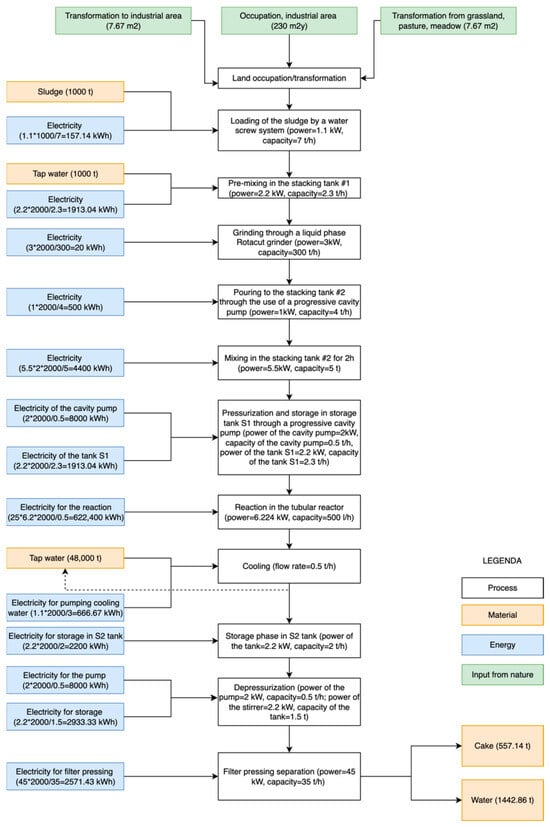
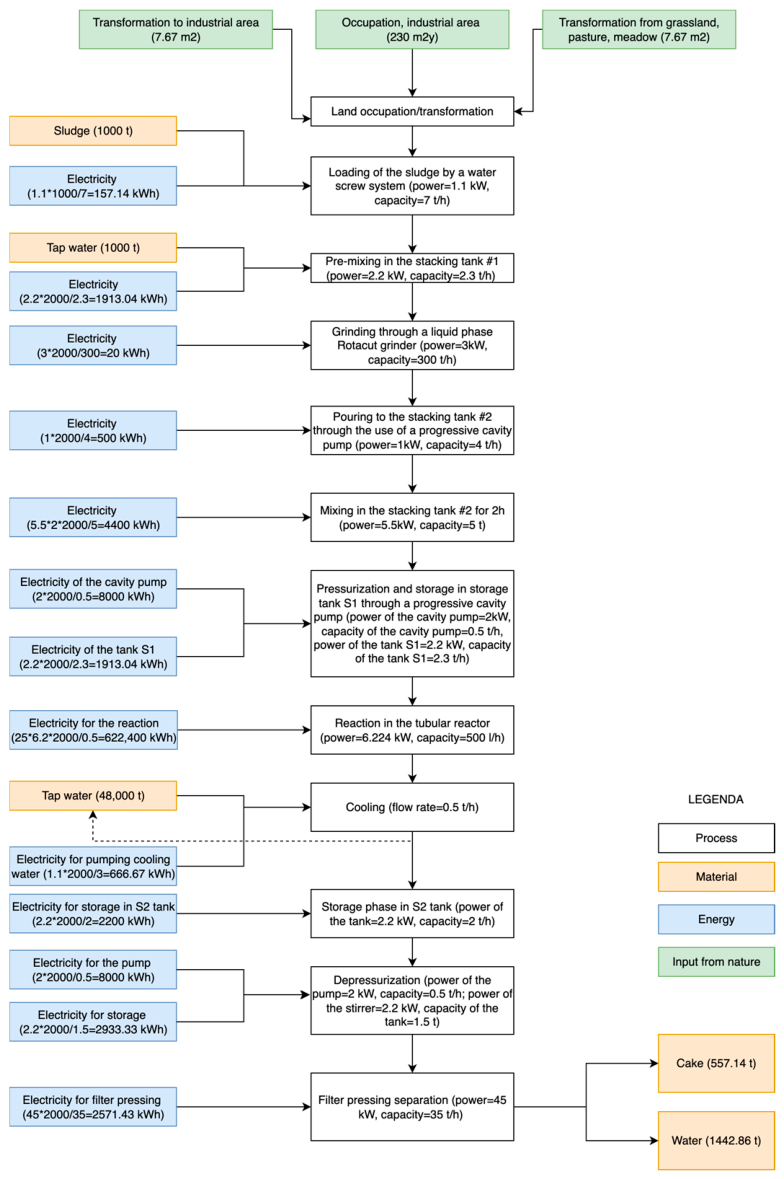
The system boundaries are illustrated in Figure 1, focusing on the treatment stage within the FREEDOM plant. The system includes land occupation and transformation associated with plant installation, as well as all operational phases of the process. Specifically, the model accounts for sludge loading, pre-mixing, grinding, pumping and transfer operations, mixing and pressurization, hydrothermal treatment in a tubular reactor, cooling, depressurization, and solid–liquid separation through filter pressing.
Figure 1.
Flowchart of the LCA model.
Regarding the specific operating conditions, although the FREEDOM plant was originally engineered for 350–365 °C and 200 bar, severe component abrasion necessitated a shift to milder Hydrothermal Dewatering (HTD) conditions to ensure operational stability. By reducing intensity to mitigate mechanical wear, the specific hydrochar cakes and process data for this study were obtained at operating temperatures of 220–250 °C and pressures of 50–60 bar, with a standardized residence time of exactly 30 min in the reactor [13].
All electricity inputs required for process operations (pumps, mixers, grinders, reactor heating, and auxiliary equipment) were included within the system boundaries, together with the consumption of tap water for process operations and cooling. The outputs of the system consist of the treated sludge and the associated co-products (cake and recovered water), while emissions to air, water, and soil were accounted for indirectly through the corresponding background datasets.
Life Cycle Inventory and Impact Assessment: Foreground data (energy consumption, water use, and outputs) were collected directly from the FREEDOM pilot plant in Cassano d’Adda (Italy) during its 2024 operations. This ensures high technological representativeness for the HTD process. Background data were sourced from the Ecoinvent database (EID v3.10), selecting datasets that best reflect the specific technologies used [20,21]. The study is specifically tailored to the Italian context: background data were prioritized for Italy (IT) or, where unavailable, for Europe (RER) to maintain regional consistency. Due to the multi-output nature of the FREEDOM treatment, resulting in the production of a solid carbonaceous residue (cake) and recovered process water, an attributional LCA approach was adopted. Accordingly, the APOS (Allocation at the Point of Substitution) system model was applied, using mass-based allocation between the primary function of the system (waste sewage sludge treatment) and the associated co-products [22]. When specific datasets were not available in the Ecoinvent database, custom datasets were developed using Ecoinvent subprocesses. All inventories and calculations were implemented using SimaPro software (version 9.6.0.1) [23]. The overall LCA model was subdivided into several sub-processes, consistent with the process layout and mass and energy balances shown in Figure 1. Detailed inventory data for each sub-process are provided in the Supplementary Materials, Tables S1–S31. Furthermore, to provide a clear and immediate overview of the system’s mass and energy balances, the aggregated quantitative input and output data required for the functional unit (1000 t of sewage sludge) are summarized in Table 1. The 48,000 t of cooling water represents an internal recirculation flow within a closed-loop system.
Table 1.
Aggregated Life Cycle Inventory (LCI) for the treatment of 1000 t of waste sewage sludge.
The life cycle impact assessment (LCIA) was carried out using the Environmental Footprint (EF) 3.1 method, adapted to the specific scope of the study. Environmental impacts were first evaluated at the midpoint level, and subsequently aggregated through normalization and weighting to obtain endpoint indicators and single-score results, expressed in environmental points (Pt).
Cake residue-based clay brick manufacturing: The material used for brick production consisted of the solid fraction of the hydrothermal product, here referred to as HTD cake, obtained through mechanical separation following the sludge transformation step at the FREEDOM plant. This solid fraction was then dried and milled to <125 µm before being incorporated into the clay mixture.
Bricks were manufactured in an industrial brick factory in Robecco Pavese (Italy) using commercial A33A clay. The mixtures were prepared by replacing 10 wt% of the clay with HTD cake, processed through slip preparation, dried, and fired using the factory’s standard 24 h firing cycle (maximum temperature 940 °C, with controlled heating and cooling ramps). No modifications to the industrial process were required. The resulting samples were subsequently characterized by X-ray diffraction and scanning electron microscopy to assess their phase composition and microstructural features. Scanning Electron Microscopy (SEM) investigations were performed using a Tescan FE-SEM (Mira 3XMU-series; Tescan, Brno, Czech Republic) equipped with an EDAX energy-dispersive spectrometer (Apollo XL silicon drift detector energy-dispersive X-ray spectrometer—SDD-EDS; EDAX Inc., Mahwah, NJ, USA).
A practical application example was developed to illustrate how the solid product from the FREEDOM plant can be effectively valorised. A brick produced using 10 wt% HTD cake was selected as a representative case study, enabling the environmental performance of the plant to be linked to a tangible, market-relevant material. The HTD cake is the solid material obtained by mechanical filtration of the hydrothermal product to separate the liquid from the solid phase and, due to its content of silicates, phosphates and iron oxides, constitutes a technically suitable secondary raw material capable of partially substituting natural clays. Further details concerning the development and characterization of these bricks are discussed in a dedicated article currently in preparation.
The brick was manufactured in an industrial brick factory in Robecco Pavese (Italy), using a commercial clay, widely employed in the regional ceramic industry. The cake replaced clay on a weight basis while maintaining the standard industrial workflow, ensuring that the case study reflects realistic production conditions. The used firing cycle ensures the complete transformation of the clayey fraction and full oxidation of the residual organic matter in the cake, allowing the material to sinter properly without requiring modifications to the kiln or process parameters.
3. Results and Discussion
3.1. Life Cycle Impact Assessment (LCIA)
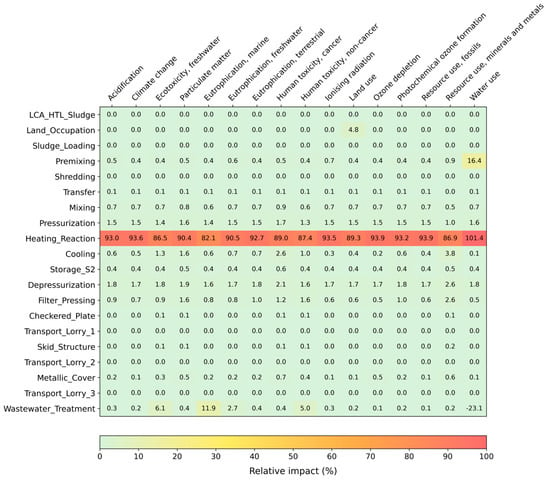
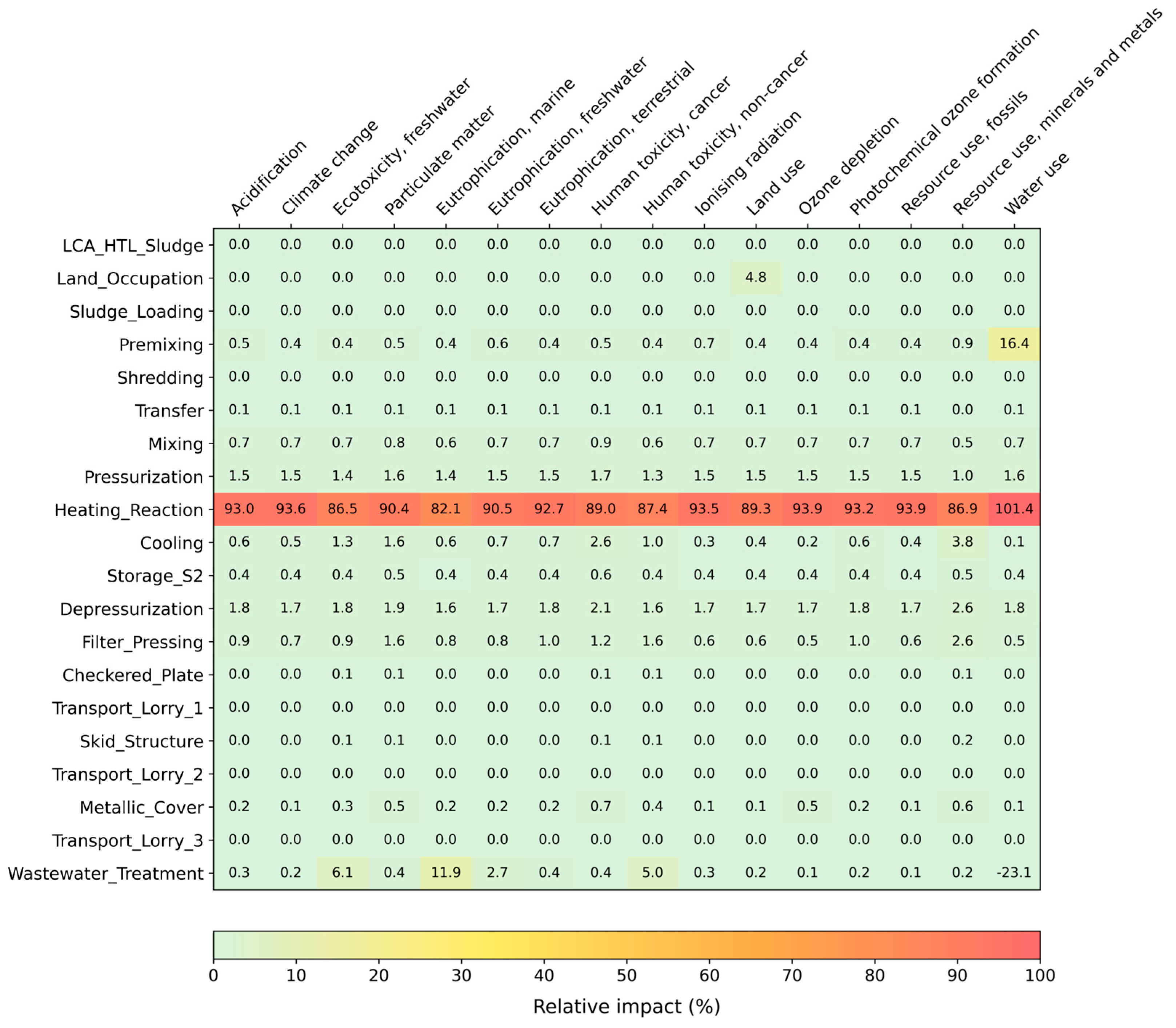
The potential environmental impacts associated with the treatment of 1000 t of waste sewage sludge were quantified at the midpoint level, using characterization results from the EF 3.1 method. The complete characterization results are reported in Table 2, while Figure 2 illustrates the relative contribution of the different process stages across all EF 3.1 midpoint categories. These midpoint indicators represent the potential environmental impacts directly attributable to the system under study.
Table 2.
Characterization results associated with the treatment of 1000 t of waste sewage sludge (EF 3.1 method).
Figure 2.
Characterization results associated with the treatment of 1000 t of waste sewage sludge, expressed as relative percentage contributions to 16 environmental categories (EF 3.1 method).
As shown in Figure 2, the heating of the sludge, corresponding to the HTD reaction step, clearly represents the most impactful phase to most of the impact categories assessed. This phase requires significant energy input and therefore drives the majority of the environmental burdens associated with the system.
For the Climate change impact category (total impact: 8.95 × 10⁴ kg CO2 eq), fossil CO2 emissions account for 85.7% of the burden. These emissions are primarily driven by the electricity required for the sludge heating process. Specifically, within the fossil CO2 share, electricity from natural gas combined-cycle power plants and natural-gas combined-cycle cogeneration contributes 16.5% and 15.5%, respectively.
To provide a comprehensive damage-oriented evaluation, midpoint results were normalized and weighted to calculate an aggregated single score. This study adopted the Normalization and Weighting factors defined by the European Commission’s Joint Research Centre (JRC) for the EF 3.1 method, based on a global reference region (Table 3) [24].
Table 3.
Normalization and weighting factors for the EF 3.1 method as implemented in SimaPro.
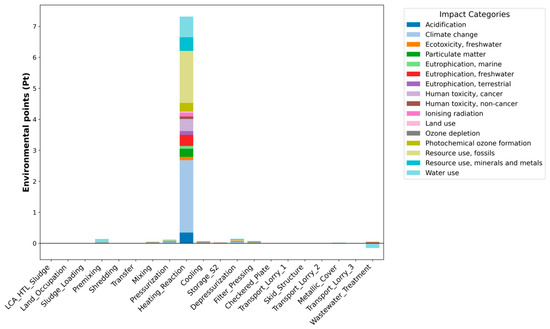
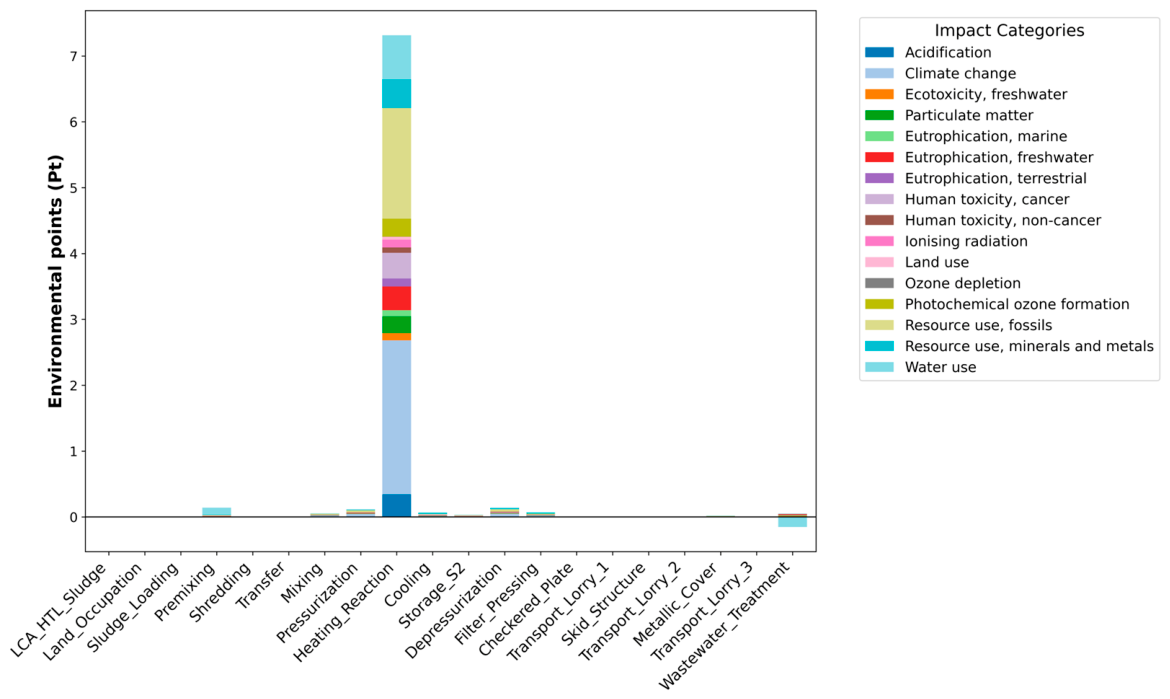
The single-score results, expressed in environmental points (Pt), are summarized in Figure 3, with the detailed numerical data provided in Table S32 (Supplementary Materials). As evident from these results, the heating–reaction phase is the dominant contributor to the total environmental impact of the FREEDOM treatment system. Specifically, this phase accounts for 92.9% of the overall impact (7.32 Pt), followed by the premixing phase (1.80%) and the pressurization and storage phase (1.51%).
Figure 3.
The contributions to the environmental impacts associated with the treatment of 1000 t of waste sewage sludge (EF 3.1 method).
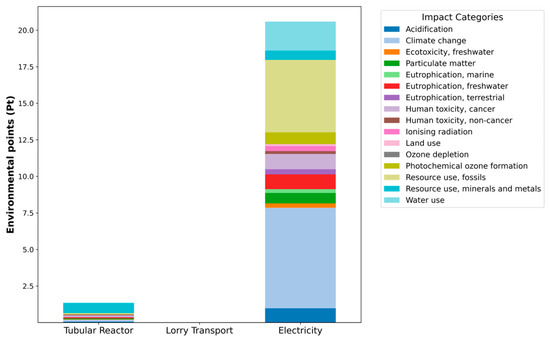
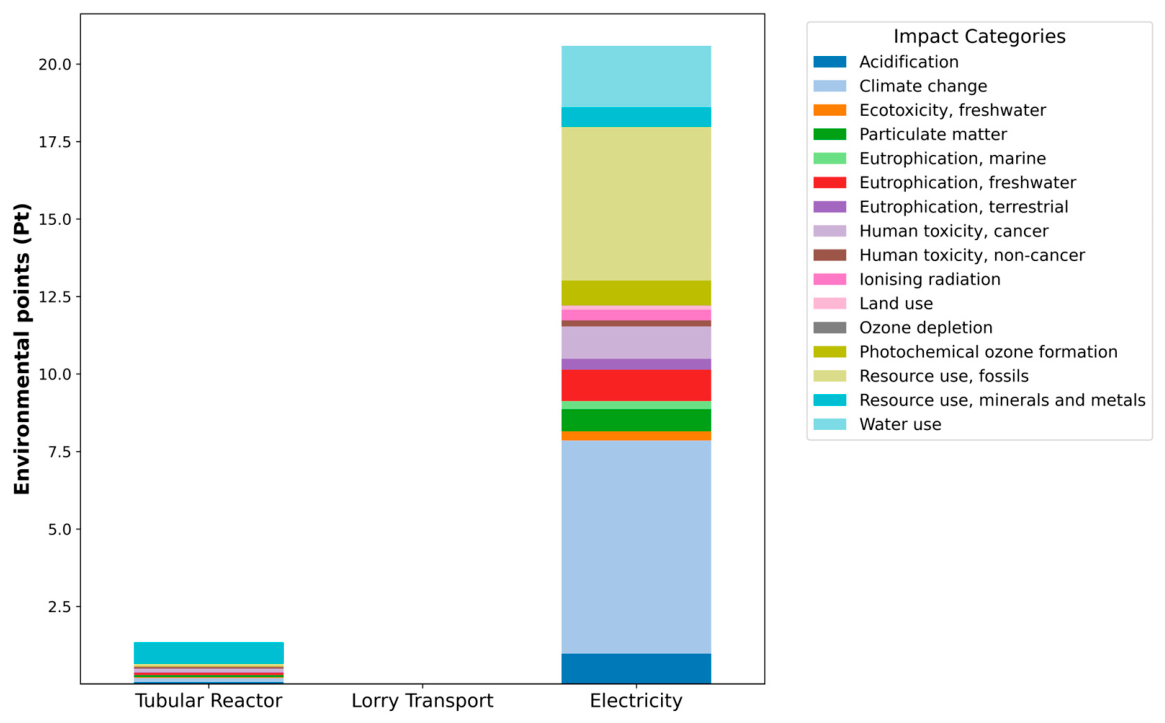
In order to better investigate the main contributors within the heating–reaction phase, a detailed single-score breakdown was calculated and presented in Figure 4. This analysis shows that the electricity employed for performing the HTD reaction is the primary responsible, followed by the tubular stainless steel reactor. These components represent the main drivers of the environmental burden associated with the process.
Figure 4.
Detailed single-score contribution analysis of the heating–reaction phase (EF 3.1 method).
3.2. Comparative and Uncertainty Analyses
To evaluate the environmental performance of the FREEDOM technology relative to conventional end-of-life options for waste sewage sludge, a comparative LCA was conducted. The FREEDOM treatment was compared with two end-of-life options commonly used for waste sewage sludge, namely incineration and landfilling. Although these represent disposal routes still prevalent in Italy, the landfill option not only entails significant environmental impacts, as confirmed by the results of this study, but is also subject to increasing regulatory restrictions at the European level, which promote its definitive phase-out in favor of energy and material recovery processes. The Landfill Directive (1999/31/EC) [25], as amended by Directive (EU) 2018/850 [26] within the framework of the Circular Economy Package, imposes strict targets for reducing the landfilling of municipal waste to a maximum of 10% by 2035. Consequently, landfilling should not be considered a ‘viable’ long-term solution but rather a regressive benchmark. Its inclusion in this study serves to quantify the environmental benefits achieved by transitioning toward advanced hydrothermal treatments. The shift away from landfilling is not merely an environmental preference but a legal necessity, as landfill disposal is being progressively banned across European countries [9].
For this purpose, the following Ecoinvent datasets were used as reference systems: “Raw sewage sludge {CH}| treatment of raw sewage sludge, municipal incineration FAE | APOS, U” for incineration, and “Sewage sludge, 75% water, WWT, WW, average {Europe without Switzerland}| treatment of sewage sludge, 75% water, WWT, WW, average, sanitary landfill | APOS, U” for landfilling. To ensure comparative validity, the HTD process (estimated 24.7% DM) was compared against these incineration and landfilling benchmarks at 25% DM (75% water content).
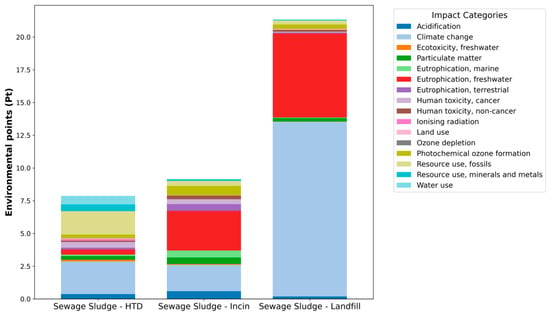
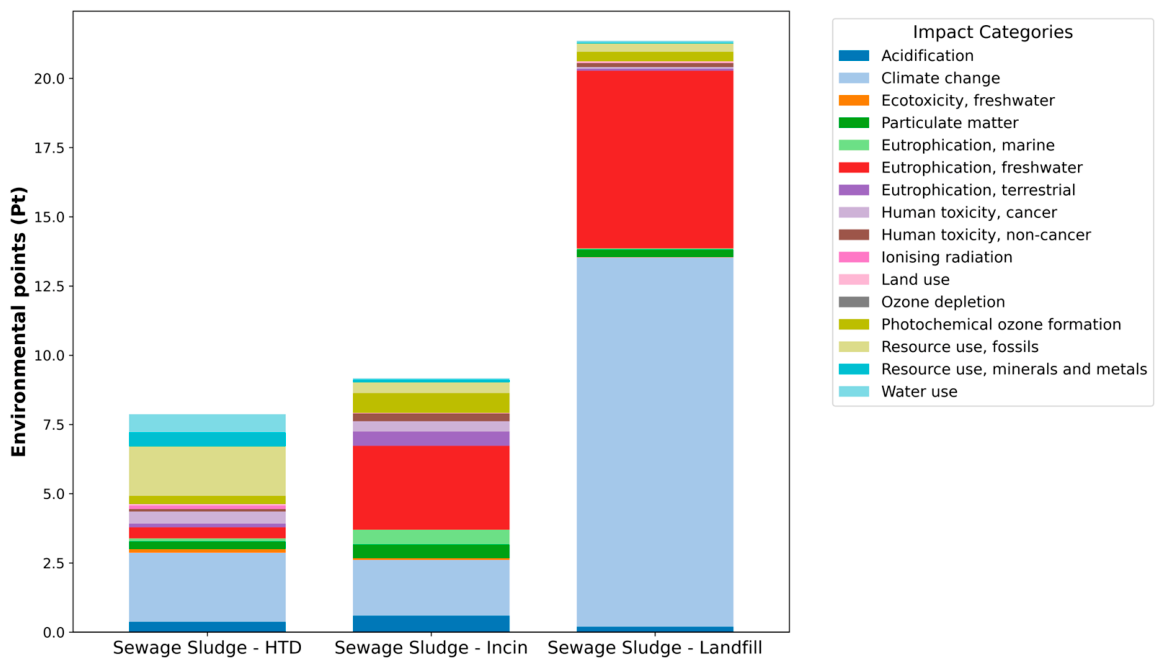
The comparative LCA results, referred to 1000 t of treated sewage sludge, are presented in Figure 5.
Figure 5.
Comparative single score results for the treatment of 1000 t of sewage sludge. The HTD scenario is compared against the incineration scenario and the landfill scenario (EF 3.1 method).
While the deterministic results display a lower baseline single score for the FREEDOM technology compared to both incineration and landfilling, this preliminary trend requires statistical validation to robustly assess its potential as a competitive and sustainable alternative for sewage sludge management.
The significant disparity between the HTD process and landfilling is rooted in the distinct physical and chemical dynamics of these disposal routes. As evidenced by the single score results, the landfill scenario is overwhelmingly dominated by the Climate Change impact category. This high environmental burden is primarily caused by uncontrolled fugitive methane (CH4) emissions, characterized by a high Global Warming Potential (GWP), originating from the anaerobic decomposition of wet organic matter. The plausibility of such a high impact is confirmed by existing LCA literature, demonstrating that sewage sludge landfilling generates the highest global warming impacts among conventional treatments due to these specific gaseous releases [27]. In contrast, hydrothermal technologies stabilize carbon into a solid residue (hydrochar) and drastically reduce transportation needs by processing sludge on-site. This allows for remarkable GHG savings compared to traditional baselines [16,28].
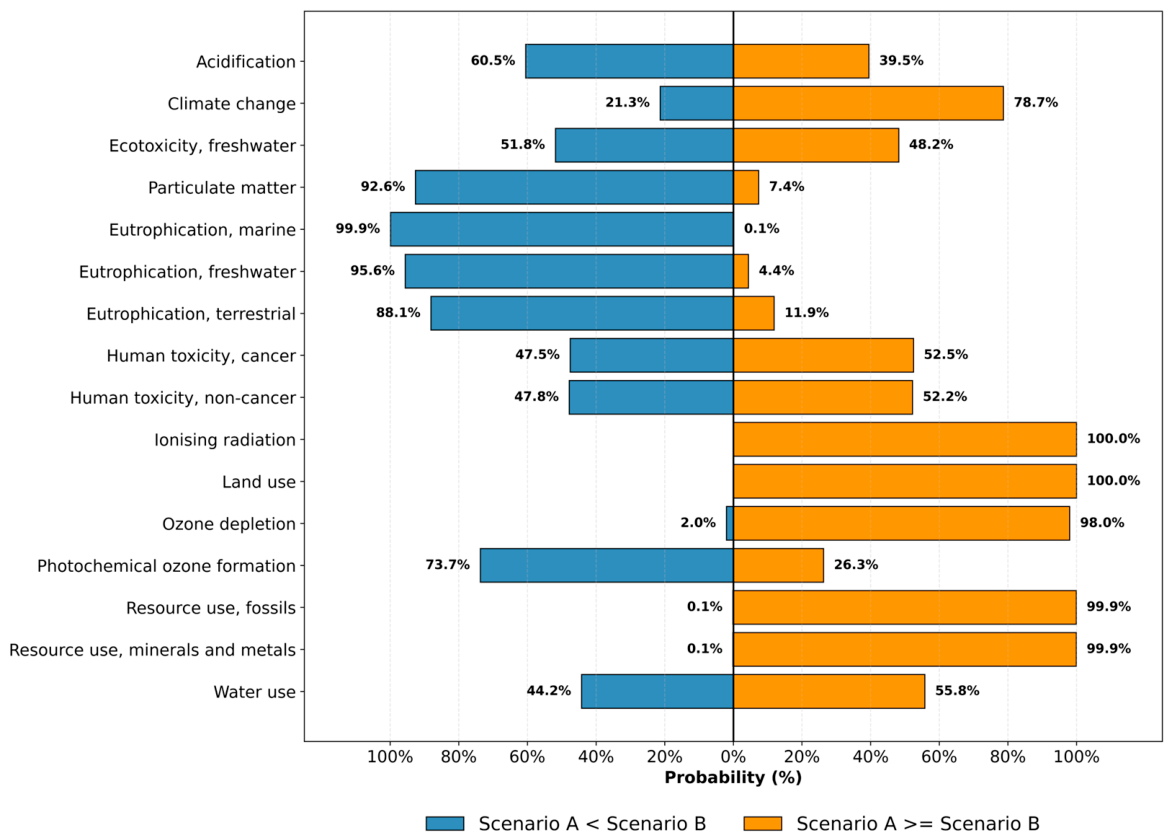
To evaluate the robustness of the results, an uncertainty analysis was performed using Monte Carlo (MC) simulation within SimaPro 9.6.0.1, as it is one of the most widely applied stochastic methods for assessing the influence of uncertainties associated with the Life Cycle Inventory (LCI). In this study, the MC simulation was performed by adopting 1000 runs and a 95% confidence interval (CI) for each calculation, applying the modified EF 3.1 (adapted) method, and considering the uncertainties related to the Ecoinvent database processes.
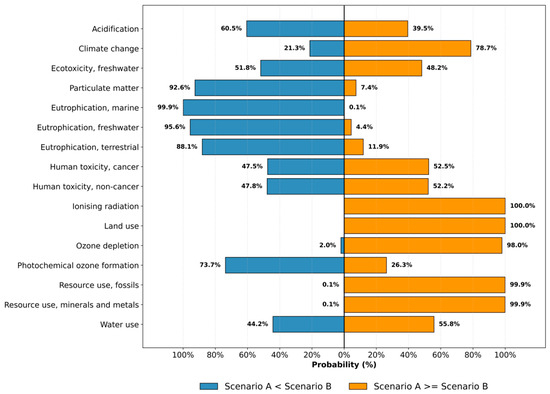
The comparison between the FREEDOM treatment (product system A) and the incineration scenario (product system B) is illustrated in Figure 6. The MC results reveal a clear trade-off between the two alternatives, with statistically significant advantages varying by category. Scenario A demonstrates a statistically significant environmental benefit in Eutrophication, marine and Eutrophication, freshwater. Conversely, Scenario B performs statistically significantly better in Ionising radiation; Land use; Resource use, fossils; Resource use, minerals and metals; and Ozone depletion. For the remaining impact categories, the differences are not statistically significant at the 95% confidence level.
Figure 6.
Uncertainty analysis of the characterization results for the comparison between the FREEDOM treatment (Scenario A) and the incineration scenario (Scenario B) (EF 3.1 method).
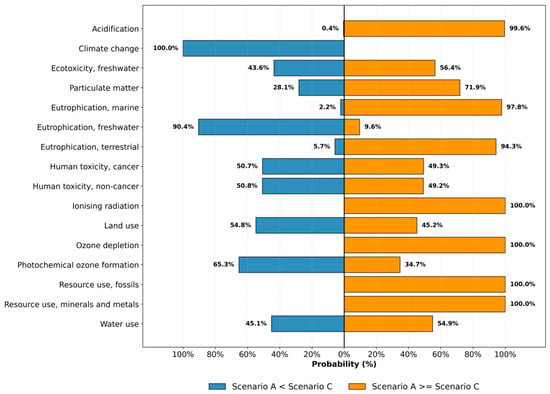
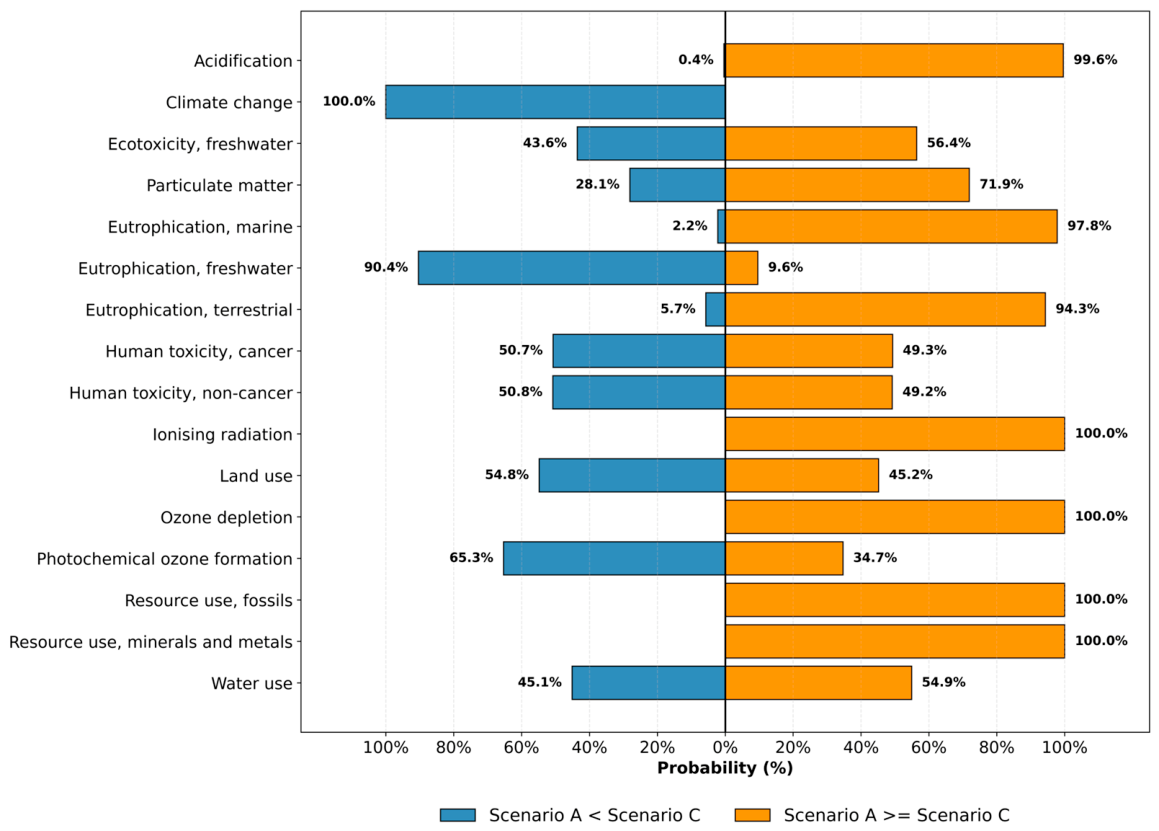
When comparing the FREEDOM treatment (Scenario A) with the landfilling alternative (Scenario C), modeled using the dataset “Sewage sludge, 75% water, WWT, WW, average {Europe without Switzerland}| treatment of sewage sludge, 75% water, WWT, WW, average, sanitary landfill | APOS, U”, the results are shown in Figure 7. The FREEDOM system demonstrates a significant environmental advantage in Climate change, outperforming landfilling. On the other hand, Scenario C presents a statistically significant advantage in Ionising radiation; Ozone depletion; Resource use, fossils; Resource use, minerals and metals; Acidification; and Eutrophication, marine. For the remaining impact categories, the observed differences are not statistically significant.
Figure 7.
Uncertainty analysis of the characterization results for the comparison between the FREEDOM treatment (Scenario A) and the landfill scenario (Scenario C) (EF 3.1 method).
In addition to the characterization, an uncertainty analysis simulation was also conducted on the aggregated single-score results for both comparisons (reported in Figures S1 and S2). Based on these single-score comparisons, the product systems cannot be considered significantly different at a 95% confidence level.
This statistical insignificance at the single-score level represents a key boundary condition of this comparative assessment, stemming from the inherent uncertainty propagation that occurs during the transition from midpoint to endpoint indicators within the EF 3.1 method. The inclusion of normalization factors and weighting coefficients introduces additional variance, causing the 95% confidence intervals to overlap. These findings highlight the fundamental importance of adopting a comprehensive, multi-indicator approach in LCA rather than focusing on a single overarching metric. While the FREEDOM technology offers a crucial and statistically validated breakthrough in mitigating the Climate change category compared to landfilling, it introduces opposite shifts in resource deployment and specific indicators. Therefore, the overall environmental viability of the FREEDOM process is shaped by specific category trade-offs rather than an absolute single-score superiority.
3.3. Sensitivity Analysis
To evaluate the robustness of the LCA results, a sensitivity analysis was performed. This analysis focuses on key parameters: electricity grid mix, reactor lifetime, sludge moisture content and heat recovery. Four alternative scenarios were developed in SimaPro without altering the core foreground logic of the FREEDOM technology.
Electricity Grid Mix Scenario: In the benchmark LCA, the Italian national grid mix was used to model all the energy inputs, using the Ecoinvent dataset “Electricity, medium voltage {IT}| market for electricity, medium voltage | APOS, U”. To assess the potential environmental benefits of implementing the FREEDOM technology in a region with a higher penetration of renewable energy, a sensitivity scenario was modeled by substituting the Italian grid mix with the Danish grid mix, using the dataset “Electricity, medium voltage {DK}| market for electricity, medium voltage | APOS, U”. Denmark was selected as a representative “green” European scenario.
Reactor Lifetime Scenario: To simulate a commercial scale-up, a sensitivity analysis was performed by modifying the reactor lifetime. The benchmark discontinuous pilot-scale operation (1760 h/year for a 30-year lifetime) was replaced with continuous industrial-scale parameters (7920 h/year with a 15-year equipment lifetime). These values were adopted as a reference for commercial HTL plants processing sewage sludge, allowing us to accurately estimate the infrastructural allocation of the FREEDOM reactor under standard 24/7 market conditions [16]. Maintaining the plant’s nominal flow rate (0.5 t/h), this adjustment treats a vastly larger volume of sludge over the reactor’s lifecycle.
Sludge Moisture Scenario: The thermal energy required to heat the biomass to the target reaction temperature represents the primary environmental hotspot of the HTD process. In the benchmark pilot-scale model, to ensure the pumpability of the sludge during preliminary testing, the functional unit of 1000 t of sewage sludge was diluted with an equal mass of water (2000 t total). However, the plant is equipped with a high-pressure progressive cavity pump specifically designed to handle viscous fluids with a dry matter content up to 15%. To simulate an optimized industrial scenario, we modeled the system assuming the sludge enters the reactor directly at the target 15% Total Solids (TS) without any external water addition, an integration approach aligned with industrial modeling [28].
Heat Recovery Scenario: In the FREEDOM pilot plant configuration, the heating–reaction step operates without heat integration, representing the primary thermodynamic and environmental hotspot of the entire process due to the direct electrical energy required to heat the sludge to the target reaction temperature. To mitigate this burden, a Heat Recovery Scenario was conceptualized, integrating an internal slurry-to-slurry heat exchanger (HE) operating as a continuous counter-current system. Under this configuration, the cold incoming sewage sludge is passively pre-heated by directly recovering the sensible heat from the hot treated effluent exiting the continuous HTD reactor. According to hydrothermal literature, continuous large-scale systems can realistically achieve thermal recovery efficiencies ranging between 60% and 80% [28,29]. In this sensitivity analysis, a thermal recovery efficiency of 70% was adopted, which reduces the net electricity demand required for the reaction phase compared to the pilot baseline. The modeling of the heat exchanger infrastructure and the corresponding reduction in energy inputs were implemented within the SimaPro framework, keeping the remaining core foreground logic of the FREEDOM technology unaltered.
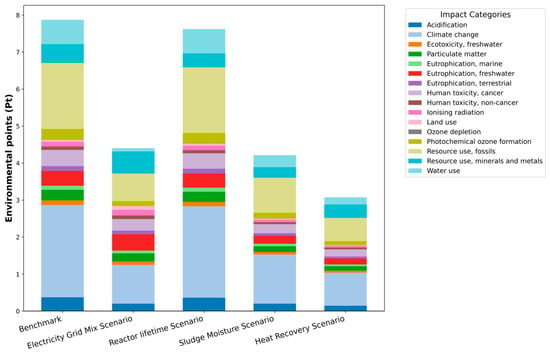
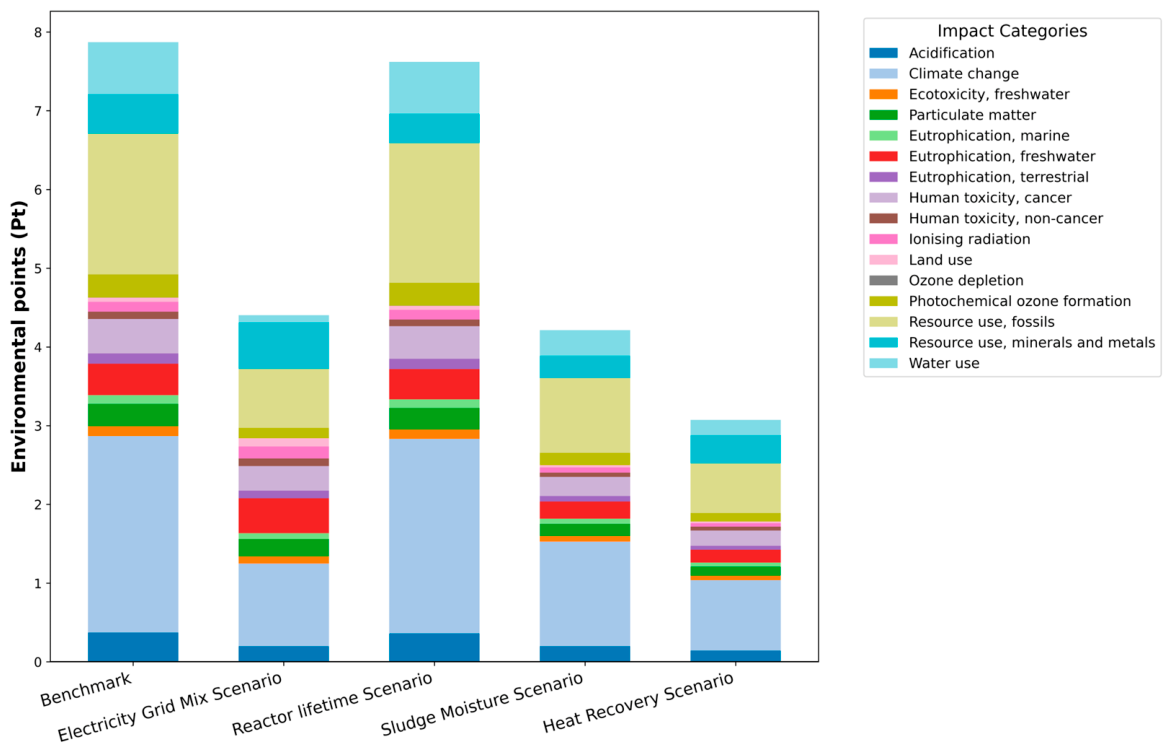
The outcomes of these alternative scenarios are compared with the benchmark in Figure 8.
Figure 8.
Comparative single score results for the treatment of 1000 t of sewage sludge. The benchmark scenario is compared with four sensitivity analyses: Electricity Grid Mix, Reactor Lifetime, Sludge Moisture and Heat Recovery scenarios (EF 3.1 method).
The Single Score results of the sensitivity analysis highlight how the optimization of key parameters influences the system’s environmental profile. In the Electricity Grid Mix Scenario, an overall lower impact is observed compared to the benchmark, confirming the expectation that a grid mix with a higher share of renewable energy helps mitigate environmental impacts, especially concerning energy consumption. The Reactor Lifetime Scenario demonstrates that applying industrial-scale operational parameters enables a more efficient dilution of infrastructural impacts per functional unit, effectively amortizing the reactor’s material weight compared to the benchmark. Additionally, the Sludge Moisture Scenario indicates that, by limiting the mass of dilution water entering the system, the thermal energy required for heating is reduced, resulting in lower impacts. Finally, the Heat Recovery Scenario emerges as the most effective optimization strategy. Thermochemical conversions of wet biomass inherently demand massive amounts of thermal energy to reach high operational temperatures and pressures. Without energy integration, this thermal requirement inevitably becomes the dominant environmental hotspot of the entire life cycle. As emphasized by the literature, hydrothermal carbonization and related sludge technologies represent a sustainable alternative to traditional end-of-life options if energy integration and heat recovery pathways are robustly optimized [27]. In this regard, current industrial models treat internal thermal integration not as an optional upgrade, but as a baseline standard specification for a viable industrial-scale configuration [28]. Ultimately, these findings underline that heat recovery must be viewed as a fundamental requirement for the environmental viability of hydrothermal treatments at an industrial scale.
Direct Emissions Scenario: Regarding direct gaseous emissions, it is important to note that while the HTD reactor operates as a hermetically sealed system during the reaction phase, gaseous products (primarily CO2) can be released during the depressurization and storage of the treated products. In the LIFE FREEDOM pilot plant, these gases are currently not monitored nor captured due to the absence of a dedicated abatement scrubber, a typical limitation of pilot-scale configurations. Based on literature regarding hydrothermal processes, gas formation is driven by secondary reactions like decarboxylation, typically generating a gaseous phase accounting for 2–5% by weight of the dry input sludge [16]. This fraction is predominantly composed of CO2, while NH3 remains largely dissolved in the aqueous phase due to its high solubility [15,28]. For this study, we assumed a conservative emission factor based on a 15% dry matter (DM) content of the input sludge and a 3.5% gas yield, resulting in 5.25 kg of CO2 emitted per ton of wet sludge. To evaluate the impact of these emissions, an additional sensitivity analysis was conducted, and the results are included in the Supplementary Materials (Figure S3).
As demonstrated in this sensitivity check, the inclusion of these direct CO2 emissions in the post-treatment and storage phases naturally increases the absolute impact of the process. However, the overall environmental profile of the HTD system remains favorable, continuing to outperform landfilling while maintaining its comparability with incineration. While pilot-scale limitations in gas recovery do not invalidate these core outcomes, they highlight the critical need to integrate proper gas monitoring and abatement systems in future industrial scale-ups.
The sensitivity analysis conducted in this study provides a robust evaluation of the system’s environmental profile under different operational and geographical assumptions, effectively anticipating the impact of alternative electricity grid mixes, heat recovery and continuous industrial operations. To further enhance the sustainability of the HTD process in future scale-up phases, there is significant potential in adopting dynamic Life Cycle Assessment (LCA) frameworks. Implementing dynamic LCA models coupled with process simulation allows for accurately capturing temporal variability, such as daily or seasonal fluctuations in the renewable energy mix, and adapting to evolving operational conditions [17]. Implementing such advanced evaluation tools would enable continuous, real-time process optimization, maximizing the environmental benefits and energy efficiency of the technology throughout its industrial lifespan.
3.4. Physical and Environmental Performance of Solid Cake Valorisation
To evaluate the feasibility of the solid residue valorisation, the HTD cake was tested as a partial substitute in clay brick manufacturing. From a physical standpoint, the brick incorporating 10 wt% cake exhibits an apparent density of 1.4 g/cm3, compared with 1.8 g/cm3 for the benchmark sample without cake. This decrease is attributed to the formation of fine, stable microporosity, generated by the release of gases from the small amount of residual organic matter still present in the cake after hydrothermal treatment. Despite the increase in porosity, the ceramic body remains cohesive and mechanically stable.
SEM observations (Figure S4) show a coherent ceramic matrix, where high-temperature transformation products of the clay minerals form a continuous network among the grains. Moreover, oxides and phosphates supplied by the cake promote the formation of phases that enhance intergranular cohesion during sintering. Silicate grains (quartz and feldspars) appear well integrated within this matrix, and the fine micropores are homogeneously distributed.
Leaching tests performed on the brick sample demonstrate that all monitored elements fall well below European regulatory limits for landfill acceptance (2003/33/EC) [30] and, where relevant, for drinking-water thresholds. These findings are broadly consistent with the literature, in which bricks incorporating higher proportions of industrial sludge have been shown to meet recognized leaching-related safety criteria when properly fired. This indicates that sludge-derived ceramics can achieve environmentally acceptable performance under appropriate processing conditions [31].
Our results for the HTD-cake brick are consistent with recent investigations into the stabilization and repurposing of waste-derived mineral matrices. Industrial residues such as hearth ash can be effectively repurposed both as filtering media for wastewater treatment and as partial substitutes in construction materials, successfully managing heavy metal content while enhancing overall sustainability [10]. This aligns with our observations, suggesting that the FREEDOM cake, when integrated at 10 wt% into the clay matrix, can contribute to a stable and environmentally safe product, while minimizing potential secondary leaching risks.
Having demonstrated the technical and chemical feasibility of this application, an additional LCA was performed to verify that such integration does not lead to significantly higher environmental impacts. The analysis aimed to assess whether the replacement of 10 wt% of clay with the obtained cake leads to burden shifting across the life cycle phases.
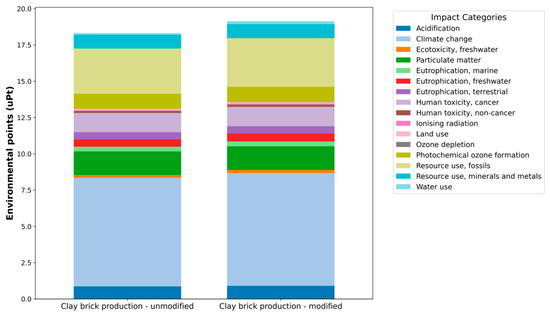
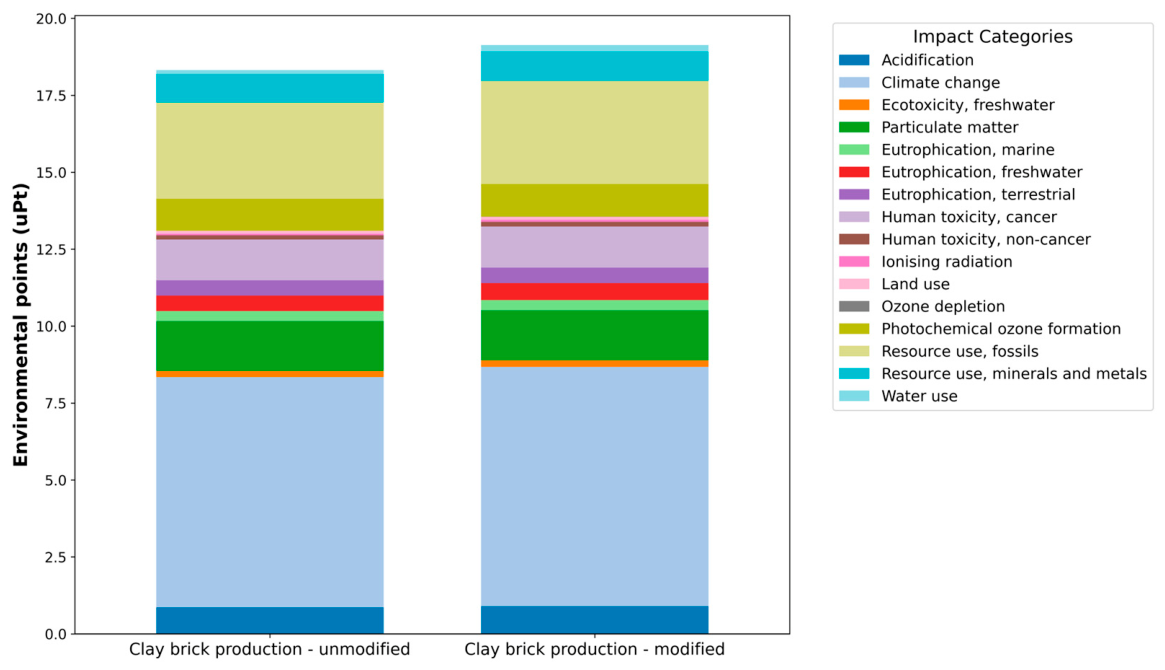
For this purpose, the Ecoinvent dataset “Clay brick {RoW}| clay brick production, extruded | APOS, U” was modified by substituting 10 wt% of the clay input with the solid cake produced by the FREEDOM process. From a modeling perspective, the energy for milling and drying the cake is inherently included in this benchmark industrial dataset, which accounts for the mechanical processing of the entire raw mixture and utilizes recovered waste heat from the kiln for the drying phase. A comparison between the modified and unmodified datasets was carried out, with the single-score results, referred to the production of 1 kg of clay brick, reported in Figure 9, with the detailed numerical data provided in Table S33.
Figure 9.
Single score comparison among the production of 1 kg of clay brick and 1 kg of clay brick with 10% substitution of clay by FREEDOM cake (EF 3.1 method).
As shown in Figure 9, only minor and negligible increments were observed between the two scenarios. These minimal variations underline that the incorporation of the cake co-product in clay brick manufacturing does not introduce any meaningful additional environmental burdens. Consequently, when evaluating the downstream valorisation of the solid residue, the overall results continue to demonstrate the substantial absence of environmental burden shifting. This conclusion is further supported by a Monte Carlo uncertainty analysis (Figure S5). Despite the slight numerical variations in the updated inventory datasets, the probability distribution between the two product systems remains close to 50% across most impact categories. This statistical indistinguishability confirms that the 10 wt% substitution of clay with FREEDOM cake does not cause any significant environmental burden shifting.
4. Conclusions
LCA was employed in this study to quantitatively evaluate the environmental performance of the innovative FREEDOM technology for the treatment of sewage sludge. The comparative quantitative results indicate that the FREEDOM process exhibits statistically comparable aggregated impacts to conventional sludge management options, while demonstrating distinct environmental advantages in specific midpoint categories. Notably, the hydrothermal technology provides a robust mitigation pathway for critical indicators such as Climate change and eutrophication. However, the comprehensive uncertainty analysis highlights important category-specific trade-offs at the midpoint level. While the technology outperforms landfilling by mitigating fugitive methane emissions, conventional pathways still exhibit statistically lower impacts in specific indicators related to land use and resource deployment. Furthermore, due to uncertainty propagation during the endpoint characterization phase, the overall differences are attenuated at the aggregated single-score level, with overlapping confidence intervals. These findings demonstrate that, under these assumptions, the environmental viability of the hydrothermal technology is defined by specific multi-indicator trade-offs rather than an absolute, single-score superiority over traditional baselines. To overcome these limitations, the expanded sensitivity analysis demonstrates that the environmental profile of the hydrothermal process can be significantly optimized under alternative operational assumptions. Specifically, transitioning to renewable energy grids, implementing continuous industrial-scale operations, and integrating heat recovery systems represent promising mitigation options to substantially improve the environmental profile of the technology upon scale-up.
The FREEDOM technology also serves as a promising alternative to overcome the legislative and environmental bottlenecks associated with traditional biosolids land application. By transforming sludge into a stabilized, mineral-rich hydrochar (HTD-cake) that safely immobilizes heavy metals, the process addresses the legal pressure to reduce the environmental footprint of waste management while maximizing resource recovery within the circular economy framework. In addition, the environmental assessment of the solid cake co-product, tested as a partial substitute for clay in construction materials, showed that its utilization leads to negligible numerical increments without introducing significant burden shifting along the life cycle. The integration of the cake into clay brick manufacturing therefore represents a viable valorisation pathway. Overall, the findings confirm the potential of the FREEDOM technology as a sustainable alternative for sewage sludge management, supporting both impact reduction and resource recovery.
Despite these promising results, this study presents certain limitations that should be acknowledged. Firstly, the life cycle inventory relies on primary data obtained from a pilot-scale demonstration plant. Secondly, the dataset geography is specifically tailored to the Italian context, which may influence the generalizability of the results to regions with different energy grid mixes. To support future commercial deployment, the implementation of dynamic LCA frameworks coupled with process simulations should be explored to capture temporal and operational variability.
Finally, since decision-making in sewage sludge management typically involves multiple dimensions, circular systems must balance environmental, economic, and social aspects; therefore, the integration of LCA with Techno-Economic Analysis (TEA) and Multi-Criteria Decision Analysis (MCDA) frameworks is essential to comprehensively evaluate trade-offs and guide technology selection. Combining LCA and TEA provides critical insights for design specifications and highlights opportunities for synergies with existing industrial infrastructures, effectively supporting policy-making and the commercial deployment of the technology.
Supplementary Materials
The following supporting information can be downloaded at: https://www.mdpi.com/article/10.3390/environments13060325/s1, Figure S1: Uncertainty analysis of the single score results for the comparison between the FREEDOM treatment (Scenario A) and the incineration scenario (Scenario B) (EF 3.1 method); Figure S2:Uncertainty analysis of the single score results for the comparison between the FREEDOM treatment (Scenario A) and the landfill scenario (Scenario C) (EF 3.1 method); Figure S3: Comparative single score results for the treatment of 1000 t of sewage sludge. The HTD scenario with estimated direct emissions is compared against the incineration and landfilling scenarios (EF 3.1 method); Figure S4: SEM micrograph of the 10 wt% cake incorporating clay brick; Figure S5: Uncertainty analysis of the characterization results for the comparison between the production of 1 kg of conventional clay brick (Scenario A) and 1 kg of clay brick with 10 wt% substitution of clay by FREEDOM cake (Scenario B) (EF 3.1 method). Table S1: Contributions to the LCI for the modelling of 230 m2a of land use associated with one year of life of the HTL plant; Table S2: Contributions to the LCI for the production of 1 p of the water screw system. It is used for the transport of the wastewater to be treated by the HTL plant and is made of AISI304L steel for a total weight of 300 kg.; Table S3: Contributions to the LCI for the loading of 1000 t of sludge through the water screw system. The power of the loading system is 1.1 kW.; Table S4: LCI considered for the modelling of 1 p of the stacking tank #1 used for the premixing process. The stacking tank #1 that has a capacity of 2.3 m3 and is entirely made of AISI 304 stainless steel.; Table S5: LCI considered for the modelling of 1 p of the premixing phase employing the stacking tank #1 as modelled according to the inventory previously reported in Table S4; Table S6: LCI considered for the modelling of 1 p of the Rotacut grinder; Table S7: LCI considered for the modelling of 1 p of the grinding process employing the Rotacut grinder as modelled according to the inventory previously reported in Table S6; Table S8: LCI considered for the modelling of 1 p of the progressive cavity pump; Table S9: LCI considered for the modelling of 1 p of the pouring process employing the progressive cavity pump as modelled according to the inventory previously reported in Table S8; Table S10: LCI considered for the modelling of 1 p of the stacking tank #2 used for the mixing process. The capacity of the stacking tank #2 is 5 m3; Table S11: LCI considered for the modelling of 1 p of the mixing phase employing the stacking tank #2 as modelled according to the inventory previously reported in Table S10; Table S12: LCI considered for the modelling of 1 p of the connecting pipe used during the pressurization and storage phase. The connecting pipe is 2 m long and 2 mm thick. The external diameter of the pipe was considered to be 5.08 cm; Table S13: LCI considered for the modelling of 1 p of the pressurizing and storage phase employing the connecting pipe as modelled according to the inventory previously reported in Table S12; Table S14: LCI considered for the modelling of 1 p of tubular reactor made of stainless steel. The length of the reactor is 150 m. The external diameter of the tubular reactor is 0.0889 m, the internal diameter is 0.06664 m, and the thickness is 0.01113 m. The tubular reactor is also constituted by 100 flanges of stainless steel. The tubular reactor is also marked with 25 heating cables of 34 m each. Further components of the tubular reactor that were considered in its modelling are 25 thyristors, 1 pressure sensor (Cerabar S PMP75) and 14 temperature sensors (THERM TM131). The total power of the reactor is 6224 W, and its capacity is 0.5 t/h; Table S15: LCI considered for the modelling of 1 p of the reaction phase employing the tubular reactor as modelled according to the inventory previously reported in Table S14; Table S16: LCI considered for the modelling of 1 p of internal tubular reactor to be employed in the cooling phase; Table S17: LCI considered for the modelling of 1 p of external tubular reactor to be employed in the cooling phase; Table S18: LCI considered for the modelling of 1 p of the Caleffi flow switch to be employed in the cooling phase; Table S19: LCI considered for the modelling of 1 p of valve for water regulation; Table S20: LCI considered for the modelling of 1 p of the water adduction pipe system; Table S21: LCI considered for the modelling of 1 p of the cooling phase employing the jacketed tubular reactor as modelled according to the inventories previously reported in Tables S16 and S17, and employing the Caleffi flow switch, the valve for water regulation and the water adduction pipe system modelled according to the inventories previously reported in Tables S18–S20, respectively; Table S22: LCI considered for the modelling of 1 p of the storage phase S2; Table S23: LCI considered for the modelling of 1 p of Demister used in the depressurization phase; Table S24: LCI considered for the modelling of 1 p of the depressurization phase; Table S25: LCI considered for the modelling of 1 p of the filter press used in the filter pressing phase; Table S26: LCI considered for the modelling of 1 p of the HDPE container for the final storage of the obtained cake; Table S27: LCI considered for the modelling of 1 p of the filter pressing phase; Table S28: LCI considered for the modelling of 1 p of the stainless steel sheet; Table S29: LCI considered for the modelling of 1 p of the galvanized stainless steel skid; Table S30: LCI considered for the modelling of 1 p of the tarp with its metallic structure; Table S31: LCI considered for the modelling of the treatment of 1000 t/y of sludge by the HTL treatment; Table S32: Detailed single score results associated with the treatment of 1000 t of sludge by the FREEDOM plant: Table S33: Detailed single score results associated with the production of 1 kg of clay brick by the unmodified dataset and the dataset in which 10 wt% of input clay was substituted with the cake produced as co-product by the innovative FREEDOM treatment.
Author Contributions
Conceptualization, F.C.; Software, R.R.; Investigation, S.C.T. and M.P.R.; Resources, A.M.F.; Data curation, D.C., M.S., A.P. and F.C.; Writing—original draft, D.C.; Writing—review & editing, D.C., S.C.T. and A.M.F.; Supervision, A.M.F. and R.R.; Project administration, F.C.; Funding acquisition, F.C. All authors have read and agreed to the published version of the manuscript.
Funding
Financial support for this work was provided by the European Union through the LIFE program, specifically under Grant Agreement LIFE19 ENV/IT/00165.
Data Availability Statement
The original contributions presented in this study are included in the article/Supplementary Material. Further inquiries can be directed to the corresponding author.
Acknowledgments
The authors would like to acknowledge Martina Spina for the help in data collection.
Conflicts of Interest
Authors Mattia Sbaffi, Annalisa Polledri and Fabio Cella were employed by the Agrosistemi S.r.l. The remaining authors declare that the research was conducted in the absence of any commercial or financial relationships that could be construed as a potential conflict of interest.
References
- Krause, M.J.; Bronstein, K.E. Estimating National Sludge Generation and Disposal from US Drinking Water and Wastewater Treatment Plants. J. Clean. Prod. 2024, 453, 142121. [Google Scholar] [CrossRef] [Scilit] [PubMed]
- Egle, L.; Marschinski, R.; Jones, A.; Yunta Mezquita, F.; Schillaci, C.; Huygens, D. Feasibility Study in Support of Future Policy Developments of the Sewage Sludge Directive (86/278/EEC); Publications Office of the European Union: Luxembourg, 2023. [Google Scholar] [CrossRef]
- Smith, S. A Critical Review of the Bioavailability and Impacts of Heavy Metals in Municipal Solid Waste Composts Compared to Sewage Sludge. Environ. Int. 2009, 35, 142–156. [Google Scholar] [CrossRef] [Scilit] [PubMed]
- Buta, M.; Hubeny, J.; Zieliński, W.; Harnisz, M.; Korzeniewska, E. Sewage Sludge in Agriculture—The Effects of Selected Chemical Pollutants and Emerging Genetic Resistance Determinants on the Quality of Soil and Crops—A Review. Ecotoxicol. Environ. Saf. 2021, 214, 112070. [Google Scholar] [CrossRef] [Scilit] [PubMed]
- Mahon, A.M.; O’Connell, B.; Healy, M.G.; O’Connor, I.; Officer, R.; Nash, R.; Morrison, L. Microplastics in Sewage Sludge: Effects of Treatment. Environ. Sci. Technol. 2017, 51, 810–818. [Google Scholar] [CrossRef] [Scilit] [PubMed]
- Corradini, F.; Meza, P.; Eguiluz, R.; Casado, F.; Huerta-Lwanga, E.; Geissen, V. Evidence of Microplastic Accumulation in Agricultural Soils from Sewage Sludge Disposal. Sci. Total Environ. 2019, 671, 411–420. [Google Scholar] [CrossRef] [Scilit] [PubMed]
- Li, X.; Chen, L.; Mei, Q.; Dong, B.; Dai, X.; Ding, G.; Zeng, E.Y. Microplastics in Sewage Sludge from the Wastewater Treatment Plants in China. Water Res. 2018, 142, 75–85. [Google Scholar] [CrossRef] [Scilit] [PubMed]
- European Commission. Council Directive 86/278/EEC of 12 June 1986 on the Protection of the Environment, and in Particular of the Soil, When Sewage Sludge Is Used in Agriculture; European Commission: Brussels, Belgium, 1986; Volume L 181, pp. 6–12. [Google Scholar]
- Collivignarelli, M.; Abbà, A.; Frattarola, A.; Carnevale Miino, M.; Padovani, S.; Katsoyiannis, I.; Torretta, V. Legislation for the Reuse of Biosolids on Agricultural Land in Europe: Overview. Sustainability 2019, 11, 6015. [Google Scholar] [CrossRef] [Scilit]
- El Hafidi, E.M.; Mortadi, A.; Lizoul, B.; Hairch, Y.; Mghaiouini, R.; Sabor, A.; Mnaouer, K.; Chahid, E.G.; Jebbari, S.; El Moznine, R.; et al. Assessment of Sand and Hearth Ash Filtration for Wastewater Treatment and Novel Monitoring via Complex Conductivity. Euro-Mediterr. J. Environ. Integr. 2025, 10, 1137–1148. [Google Scholar] [CrossRef] [Scilit]
- Christopher Selvam, D.; Devarajan, Y.; Raja, T. Sewage Sludge as a Sustainable Feedstock for Biodiesel: Advances in Conversion Technologies and Catalytic Applications. Results Eng. 2025, 25, 104000. [Google Scholar] [CrossRef] [Scilit]
- Fernández-Jiménez, A.; Maltseva, O.; Palomo, A.; Marian, N.M.; Sturini, M.; Riccardi, M.P.; Zema, M.; Tarantino, S.C. Valorisation of Inorganic Fractions of Waste Generated by Hydrothermal Treatment of Sewage Sludge in Alkaline Cement. Sustainability 2025, 17, 5413. [Google Scholar] [CrossRef] [Scilit]
- LIFE FREEDOM Project. LIFE FREEDOM—Layman’s Report. Available online: https://webgate.ec.europa.eu/life/publicWebsite/project/LIFE19-ENV-IT-000165/solving-treatment-of-wastewater-sewage-sludge-with-new-htl-technology-to-produce-hydrocarbons-asphalts-and-fertilizers (accessed on 25 March 2026).
- LIFE FREEDOM Project. Final Report. Available online: https://webgate.ec.europa.eu/life/publicWebsite/project/LIFE19-ENV-IT-000165/solving-treatment-of-wastewater-sewage-sludge-with-new-htl-technology-to-produce-hydrocarbons-asphalts-and-fertilizers (accessed on 25 March 2026).
- Ogunleye, A.; Flora, J.; Berge, N. Life Cycle Assessment of Hydrothermal Carbonization: A Review of Product Valorization Pathways. Agronomy 2024, 14, 243. [Google Scholar] [CrossRef] [Scilit]
- Karka, P.; Johannsen, I.; Papadokonstantakis, S. Hydrothermal Liquefaction Integrated with Wastewater Treatment Plants—Life Cycle Assessment and Technoeconomic Analysis of Process System Options. Sustain. Energy Fuels 2024, 8, 3438–3451. [Google Scholar] [CrossRef] [Scilit]
- Kiskira, K.; Plakantonaki, S.; Gerolimos, N.; Kalkanis, K.; Sfyroera, E.; Coelho, F.; Priniotakis, G. Life Cycle Optimization of Circular Industrial Processes: Advances in By-Product Recovery for Renewable Energy Applications. Clean Technol. 2026, 8, 5. [Google Scholar] [CrossRef] [Scilit]
- ISO 14040; Environmental Management—Life Cycle Assessment—Principles and Framework. International Organization for Standardization: Geneva, Switzerland, 2006.
- ISO 14044:2006; Environmental Management—Life Cycle Assessment—Requirements and Guidelines. International Organization for Standardization: Geneva, Switzerland, 2006.
- Weidema, B.P.; Bauer, C.; Hischier, R.; Mutel, C.; Nemecek, T.; Reinhard, J.; Vadenbo, C.O.; Wernet, G. Overview and Methodology—Data Quality Guideline for the Ecoinvent Database Version 3; The Ecoinvent Centre: St. Gallen, Switzerland, 2013. [Google Scholar]
- Wernet, G.; Bauer, C.; Steubing, B.; Reinhard, J.; Moreno-Ruiz, E.; Weidema, B. The Ecoinvent Database Version 3 (Part I): Overview and Methodology. Int. J. Life Cycle Assess. 2016, 21, 1218–1230. [Google Scholar] [CrossRef] [Scilit]
- Ekvall, T.; Azapagic, A.; Finnveden, G.; Rydberg, T.; Weidema, B.P.; Zamagni, A. Attributional and Consequential LCA in the ILCD Handbook. Int. J. Life Cycle Assess. 2016, 21, 293–296. [Google Scholar] [CrossRef] [Scilit]
- SimaPro B.V. SimaPro 9.5. Available online: https://support.simapro.com/en/articles/504757-release-notes-simapro-desktop#h_aa801e4b93 (accessed on 25 March 2026).
- Andreasi Bassi, S.; Biganzoli, F.; Ferrara, N.; Amadei, A.; Valente, A.; Sala, S.; Ardente, F. Updated Characterisation and Normalisation Factors for the Environmental Footprint 3.1 Method; Publications Office: Luxembourg, 2023. [Google Scholar]
- European Union. Council Directive 1999/31/EC of 26 April 1999 on the Landfill of Waste; European Union: Luxembourg, 1999; Volume 182, pp. 1–19. [Google Scholar]
- European Union. Directive (EU) 2018/850 of the European Parliament and of the Council of 30 May 2018 Amending Directive 1999/31/EC on the Landfill of Waste; European Union: Luxembourg, 2018; Volume L 150, pp. 108–120. [Google Scholar]
- Wang, N.-Y.; Shih, C.-H.; Chiueh, P.-T.; Huang, Y.-F. Environmental Effects of Sewage Sludge Carbonization and Other Treatment Alternatives. Energies 2013, 6, 871–883. [Google Scholar] [CrossRef] [Scilit]
- Mannarino, G.; Caffaz, S.; Gori, R.; Lombardi, L. Environmental Life Cycle Assessment of Hydrothermal Carbonization of Sewage Sludge and Its Products Valorization Pathways. Waste Biomass Valorization 2022, 13, 3845–3864. [Google Scholar] [CrossRef] [Scilit] [PubMed]
- Lucian, M.; Fiori, L. Hydrothermal Carbonization of Waste Biomass: Process Design, Modeling, Energy Efficiency and Cost Analysis. Energies 2017, 10, 211. [Google Scholar] [CrossRef] [Scilit]
- European Union. Council Decision 2003/33/EC of 19 December 2002 Establishing Criteria and Procedures for the Acceptance of Waste at Landfills Pursuant to Article 16 of and Annex II to Directive 1999/31/EC; European Union: Luxembourg, 2003; Volume L 11, pp. 27–49. [Google Scholar]
- Detho, A.; Kadir, A.A.; Shayuti, A.; Rahim, B.A.; Ghazouani, N.; Mabrouk, A.; Elhag, A.B.; Rassem, H.H. Improvement of Engineering Properties and Environmental Impact of Fired Clay Bricks Utilizing Industry Sludge Waste. Sci. Rep. 2025, 15, 4820. [Google Scholar] [CrossRef] [Scilit] [PubMed]

Disclaimer/Publisher’s Note: The statements, opinions and data contained in all publications are solely those of the individual author(s) and contributor(s) and not of MDPI and/or the editor(s). MDPI and/or the editor(s) disclaim responsibility for any injury to people or property resulting from any ideas, methods, instructions or products referred to in the content. |
© 2026 by the authors. Licensee MDPI, Basel, Switzerland. This article is an open access article distributed under the terms and conditions of the Creative Commons Attribution (CC BY) license.