


Abstract
Graphene-based aerogels (GAs) exhibit outstanding performance in the adsorption of organic contaminants. Consequently, numerous studies have investigated the use of GAs for this purpose. In this work, the synthesis methods commonly used to produce GAs are first briefly described, and their key characteristics are summarized. Subsequently, GAs are classified according to the modifications applied to improve their adsorption properties toward organic pollutants. Furthermore, the quantitative relationships between surface area, density, surface chemistry, and adsorption performance for organic contaminants are systematically reviewed. The analysis revealed that the adsorption of two representative organic contaminants, toluene and methylene blue, is not dependent on the surface area of GAs. In contrast, GAs with lower density exhibit an improved adsorption capacity for toluene. Additionally, the relationship between the surface chemistry of GAs and their adsorption capacity toward methylene blue was analyzed considering the concentration of carboxylic sites. The available data suggests a potential correlation between the concentration of carboxylic groups on the surface of GAs and their adsorption capacity for methylene blue. This observation is supported by the analysis of methylene blue species in aqueous solution and the pH at the point of zero charge of GAs, which indicate that the interaction occurs mainly through electrostatic attractions resulting from the deprotonation of acidic surface sites. Finally, several opportunity areas and future research directions regarding the use of GAs for pollutant adsorption are discussed.
1. Introduction
The rapid growth of the world’s population, industrialization, and urbanization over the past few decades are closely linked to the significant increase in environmental pollution of air, water, and soil, which has seriously endangered human health and the ecological balance [1,2,3]. Organic pollutants, such as insoluble oils, organic solvents, and commercial soluble dyes from oil exploitation and chemical leaks from various industries, are the main sources of contamination in water [4,5] and are considered persistent environmental pollutants that are difficult to degrade through natural processes [6]. Thus, reducing environmental pollution is an important challenge that has attracted significant attention [7].
Accordingly, many studies have been conducted to develop more efficient, low-cost, and reusable methods for wastewater treatment and other emerging applications [8]. One of the most interesting techniques for environmental remediation is adsorption, due to its high efficiency, ease of operation, cost-effectiveness, and green features [9,10]. However, most adsorbents lack suitable manipulation as they are in powder form, limiting their separation from water. In this sense, a wide variety of three-dimensional (3D) materials have been used as adsorbents including hydrogels, foams, carbon monoliths, and aerogels. The latter includes silica aerogels [11] and carbon aerogels [12] among others. Within carbon aerogels, graphene-based aerogels (GAs) have emerged as promising adsorbents [13,14,15]. These materials can be used to remove organic pollutants via adsorption, oil/water separations, and efficient CO2 separation based on their fascinating properties inherited from graphene [16].
Graphene is a widely known carbon-based material that has attracted significant attention due to its high mechanical, thermal, and electrical properties, as well as its large surface area, which serves as an anchoring surface [17,18,19]. These outstanding properties of graphene favor the adsorption of pollutants. Graphene exhibits a hydrophobic nature that is ideal for various applications, including oil and organic solvent sorption [20,21,22,23]. Moreover, graphene can be tailored for different applications [24,25]. For instance, graphene oxide (GO) is the oxidized counterpart of graphene that contains many functional groups over its surface (e.g., carbonyl, carboxyl, hydroxyl, and epoxy groups). These functional groups confer a negative charge on GO, making it water-soluble and enhancing its interactions with ions and molecules [26]. On the other hand, GO can be reduced to form reduced graphene oxide (rGO). The latter is mainly used for oil sorption, as it confers enhanced hydrophobicity by eliminating these functional groups [27,28].
Unfortunately, graphene also shows some disadvantages that reduce its performance. The tendency for graphene layers to agglomerate, driven by van der Waals forces and strong π–π stacking interactions, is an important disadvantage because it reduces surface area [29,30]. In particular, pristine graphene suffers from poor dispersion in solvents, limiting its processability and applications. In contrast, GO sheets exhibit better dispersibility due to their oxygen-rich groups [31]. However, the stability of GO colloidal suspensions makes their continuous practical applications difficult, given their difficulty in separating from water [32] and their limited recyclability, which is of great importance [33,34]. Therefore, materials that can overcome the drawbacks are wanted, and one of the major prospects is GAs, which inherit GO’s properties. GAs are highly porous materials comprising graphene sheets connected by van der Waals interactions and π–π stacking interactions [35,36]. These materials have unique and attractive properties, including ultralow density (of a few mg/cm3 or even <1 mg/cm3) [37], which is even lighter than that of air (1.18 mg/cm3), super elasticity (can recover completely after 90% compression) [28], super compressibility, large specific surface area (approximately 33–1230 m2/g) [25,38], excellent thermal and chemical stabilities, great electrical conductivity (~1 × 10² S/cm) [34], good optical absorption [39,40], extremely low thermal activity [41], and excellent mechanical properties [42,43,44,45,46,47,48,49]. GAs have an excellent adsorption capacity due to the interconnected 3D porous structure, large surface area, low bulk density, and ability to sustain fast electron transfer in the 3D lattice, which provide available surfaces for ion adsorption [50].
Furthermore, GAs facilitate the easy stacking of GO, transforming it into a 3D porous structure consisting of networked micro-, meso-, and macropores with a hierarchical morphology that can form macroscopic arrangements, allowing ease of use, separation from water, and the diffusion of organic molecules and oils [51,52]. From another perspective, the risk of nanotoxicity is evaded by using graphene macroscopic arrangements [53,54].
Nevertheless, GAs are usually susceptible to structural damage because of the fragility of their porous structure. The loss of driving forces during the synthesis process is the main factor influencing this fragility. In this sense, various methods have been investigated to fortify the GAs’ structures, such as the usage of crosslinkers [55], incorporation of other carbon materials (e.g., carbon nanotubes) [56,57], addition of nanoparticles [58,59], and the doping of graphene layers [28,60], or the combination of them [30,61]. Alternatively, GAs’ modifications can influence other important properties related to GA performance, such as the surface area, pore size, charge transfer between atoms, and local chemical properties [28,62]. GAs’ modifications can be achieved using multiple approaches, some of which are so versatile that they allow simultaneous crosslinking, doping, and reduction. Others allow a more suitable control of the porous structure.
This paper describes the main synthesis methods of GAs, showing their main benefits and drawbacks for the GA design. GAs are classified according to their modifications, and their main functionalities are briefly described. Often the adsorption capacity of GAs toward organic contaminants is related to surface area and porous structure while the surface chemistry is studied qualitatively. Although it is known that surface chemistry influences various properties of adsorbents—such as surface charge, affinity toward contaminants, and hydrophobicity—the role of surface chemistry on the adsorption capacity of GAs is not considered. In this sense, this work provides a quantitative evaluation of the properties of GAs and their capacity to adsorb organic contaminants, such as organic solvents and dyes. Furthermore, this review quantitatively analyzed, for the first time, the role of surface chemistry in GAs’ adsorption capacity for dyes.
2. Literature Review Methodology
A pertinent literature review was conducted herein based on the inclusion and exclusion criteria considering the publication date, research topic, and impact of the subject in the current world to ensure that the data are: (1) updated, considering that GAs have rapidly evolved in the past decade; (2) relevant, recognizing how useful GA applications are in removing environmental pollutants; and (3) specific, holding the information focus on the research topic. Accordingly, scientific databases (e.g., Google Scholar, Web of Science, and Science Direct) were consulted to obtain relevant information. The literature review was carefully conducted by searching for publications, reviewing them, and separating them according to the inclusion–exclusion criteria.
The information review began by exploring databases using keywords and Boolean operators, such as “3D graphene”, “graphene aerogels”, “graphene aerogels AND adsorption”, “graphene aerogels AND pollution”, and “graphene aerogels AND adsorption AND pollution.” We searched for these key concepts in article titles, abstracts, and keywords through research tools in various databases. Values of surface area, density, pore volume, and adsorption capacity of numerous GAs were collected for posterior discussion. Specific Boolean strings were used in the scientific databases to collect data on concentrations of active sites, such as “graphene aerogel OR graphene hydrogel AND graphene sponge OR 3D graphene structure AND methylene blue AND boehm titration” and “graphene aerogel AND methylene blue adsorption AND carboxylic sites AND meq/g OR mmol/g”.
3. GA Synthesis Methods
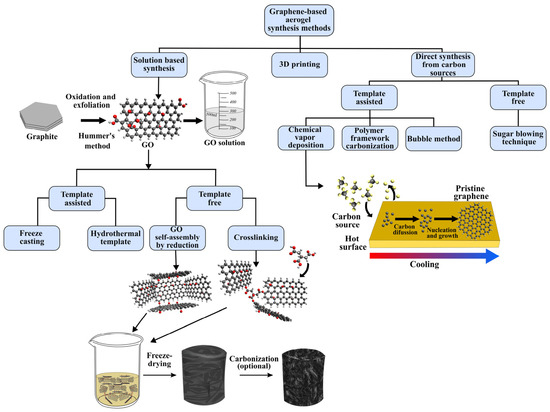
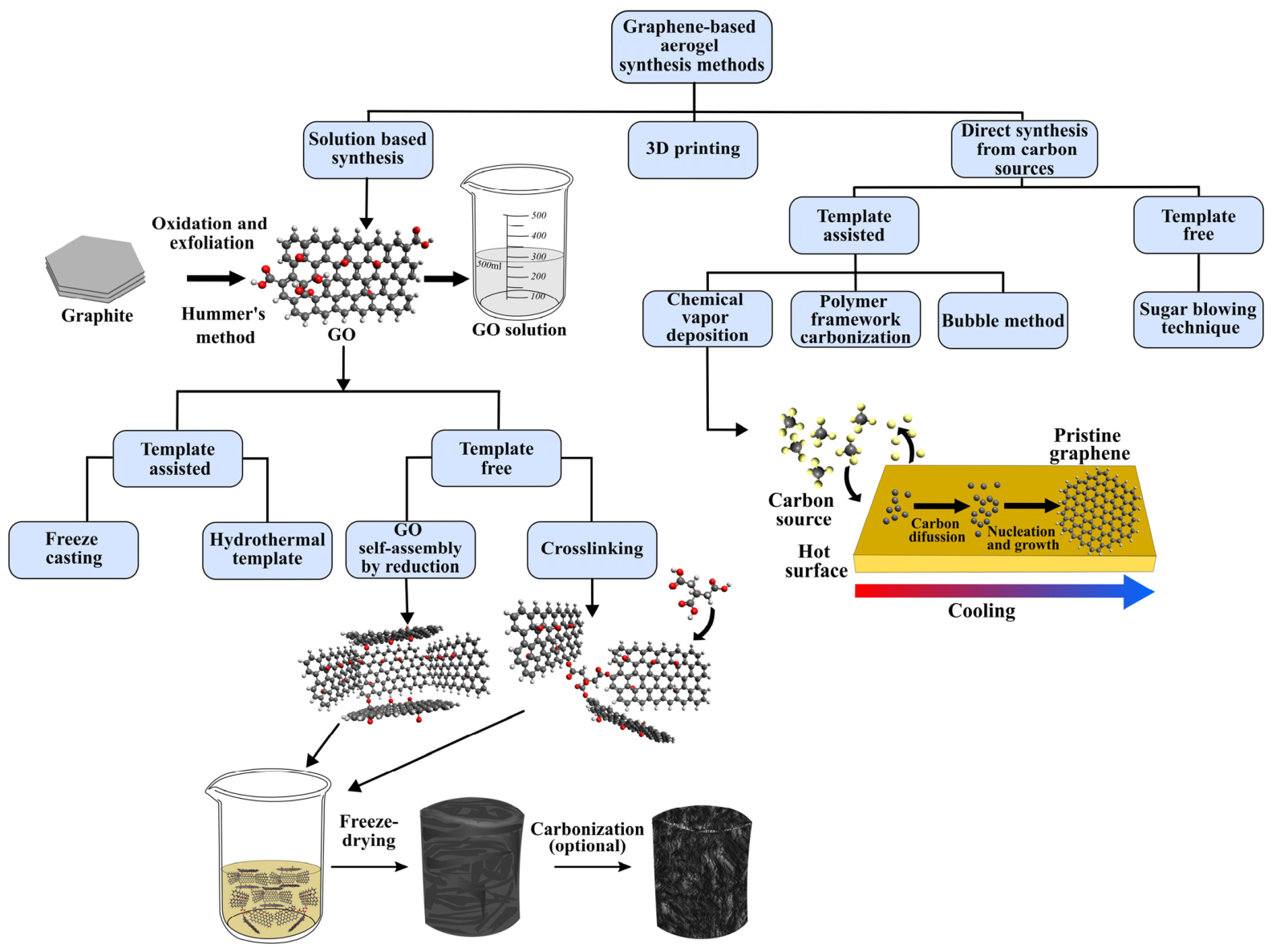
Many methods can be used to synthesize GAs. They are classified into two main categories: solution-based and direct syntheses from carbon sources (Figure 1). Solution-based methods possess numerous advantages (e.g., low manufacturing cost, high fabrication yield, and potential for industrialization), but lack control over porous distribution in most cases [50,63,64]. Nonetheless, solution-based synthesis methods are the most utilized ones for GA synthesis [61,65]. Therefore, this section will only briefly describe solution-based methods. Direct synthesis from carbon sources methods allow for better control of the porous structure in terms of size, distribution, and density, although they are usually more expensive [66,67,68,69,70]. Lately, 3D printing has become a solid alternative to the synthesis of GAs, as it allows scaling up the process and controlling the architecture. However, in direct ink printing, specific rheological conditions for GO inks are required. Table 1 summarizes the fundamental advantages and disadvantages of the GA synthesis methods.
Figure 1.
Outline of the main synthesis methods of GAs. Figure generated by the authors.
Table 1.
Advantages and disadvantages of some synthesis methods of GAs. Table generated by the authors.
3.1. Solution-Based Synthesis
In the case of solution-based synthesis, the GA synthesis begins with the preparation of GO dispersions via chemical oxidation and exfoliation of graphite powder, following the modified Hummers method in almost all cases [60,89]. After preparing the GO dispersions, two approaches are used: template-assisted and template-free. This section briefly describes both approaches and summarizes the most important steps and characteristics.
3.1.1. Freeze Casting
Freeze casting is a simple and environmentally friendly technique that uses isolation-induced templating of GO in a solidifying solvent to form a stable dispersion, which, when frozen, accumulates ice crystals between the GO sheets due to phase separation during ice freezing. The GO dispersion is then evacuated from the increasing solvent crystals during the freeze-drying process. The solvent is removed by sublimation at ice temperature. Consequently, a highly porous structure consisting of many graphene layers is formed [83]. The GO aerogel porosity can be adjusted by varying GO dispersion concentration and container size during the lyophilization process [90,91].
3.1.2. Hydrothermal Template
In this synthesis method, a 3D structure is formed via hydrothermal processing using porous foam-like templates. Various materials are used as templates, including Ni [92], polymer foams [93], and commercial sponges [79,94]. The templates are submerged in GO dispersion and subjected to the hydrothermal process, which promotes the stacking of graphene layers over the templates. After the 3D GO structure formation, the template is removed by chemical etching or burning. This synthesis method is considered cost-ineffective, in part because of the sacrificial template and high-temperature operation, and in part because of the lack of control over the final morphology.
3.1.3. GO Self-Assembly by Reduction
The self-assembly by reduction strategy is a convenient and scalable alternative for producing GAs. The preparation of GAs with this technique is possible due to the predominance of oxygen-containing functional groups on GO sheets, including carboxyl, hydroxyl, and aldehyde groups [47,95]. However, the assembly of 3D GO structures from a GO suspension is a major challenge due to the stability conferred by the negatively charged functional groups on the GO layers, which give rise to electrostatic repulsions [33,34]. In this regard, reducing agents are needed to remove oxygen-containing functional groups partially, thereby enabling better interaction between the GO layers. The GO reduction can be done by hydrothermal processes or by using chemical-reducing or crosslinking agents to obtain the self-assembly of a 3D structure [74,96]. This process is considered a classical approach for constructing GAs through noncovalent interactions, such as hydrogen bonds, hydrophobic interactions, van der Waals forces, and π–π stacking between graphene sheets [97,98].
The chemical process generally starts with the addition of reductants to a GO suspension in a vessel. The reductants are then oxidized and form hydrogen bonds with the partially reduced GO layers. The GO layers eventually stack, a process known as gelation. Lastly, a GO hydrogel is formed. Meanwhile, the hydrothermal reduction in GO is achieved through a simple, low-cost, one-step method with high yield, in which high temperature and pressure arrange the GO layers into a 3D structure. This phenomenon is ascribed to the deletion of oxygen-containing functional groups, which diminishes the electrostatic repulsions [47,66,74]. The reduction process offers some extra features. For example, the entire process can be performed in a single step; morphology is regulated by GO concentration, treatment temperature, and time; and, most importantly, this method enables new features to be added to the GO layers, such as doping with N and S atoms [28,99]. Furthermore, some chemical compounds can act as reductants and crosslinkers simultaneously, including thiourea and L-ascorbic acid [28,61]. Once a hydrogel is formed, it is subjected to freeze-drying or even carbonization. Freeze-drying is a process in which a hydrogel is dried by sublimation at low pressure, and the porous structure is formed by the spaces left by the crystals after sublimation. Some authors have shown that solvent exchange with tert-butanol rather than water before freeze-drying can reduce capillary stress and damage to the porous structure caused by ice crystal growth [100,101]. The purpose of the carbonization process is to reduce the GO layers further, making the aerogels more hydrophobic, as suggested for oil and organic solvent sorption.
3.1.4. Crosslinking
Crosslinking is one of the most widely used methods for producing GAs due to its benefits, including the abundance of crosslinkers and the functionalities they provide to GAs. The process is initiated by incorporating crosslinkers into a GO solution. The GO layers interact with the crosslinkers, and the latter eventually induce the self-assembly of the GO layers by preserving the driving forces, such as hydrogen bonds, van der Waals forces, and covalent bonds [102]. Conservation of the driving forces results in the consolidation of the final GAs, leading to enhanced mechanical and thermal stability. Several crosslinkers have been reported in the literature, including polyacrylic acid, polyvinyl alcohol, and chitosan [54,103,104].
This method, along with reduction, is often considered a one-pot process because the reduction and subsequent self-assembly are carried out concurrently. Several crosslinkers have been implemented, including ammonium citrate, polydopamine, thiourea, and metal ions [28,30,51]. Ren et al. showed that thiourea could act as a precursor of S and N for graphene layer doping, serving as a reducing agent and a crosslinker [28].
3.2. Direct Synthesis from Carbon Sources
In contrast to GAs fabricated with an initial GO dispersion, this approach uses carbon sources for the GA synthesis. Template-free methods provide precise control over the porous structure of GAs [66], but their manufacturing costs are higher than those of solution-based methods. These methods include chemical vapor deposition [84,105,106,107,108], the bubble method [85], polymer framework carbonization [67,109], and sugar blowing [87].
3.3. 3D Printing as Novel Approach
3D printing is a constitutive process of printing successive layers of materials following a computer-generated design to create 3D structures, which represents a useful methodology for manufacturing GAs with high-resolution arbitrary architectures and stretch-dominated designs [110,111]. The graphene-based structures fabricated using this technique display favorable electrical conductivity, large surface area, low density, and good mechanical properties. Moreover, these properties can be controlled by adjusting the microstructure, GO concentration, filament density, etc.; therefore, GAs elaborated with this technique can be employed in various applications.
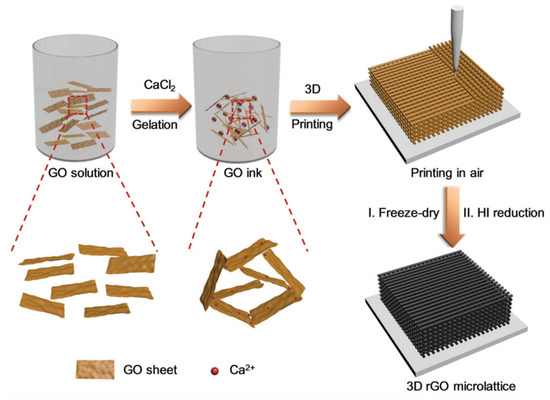
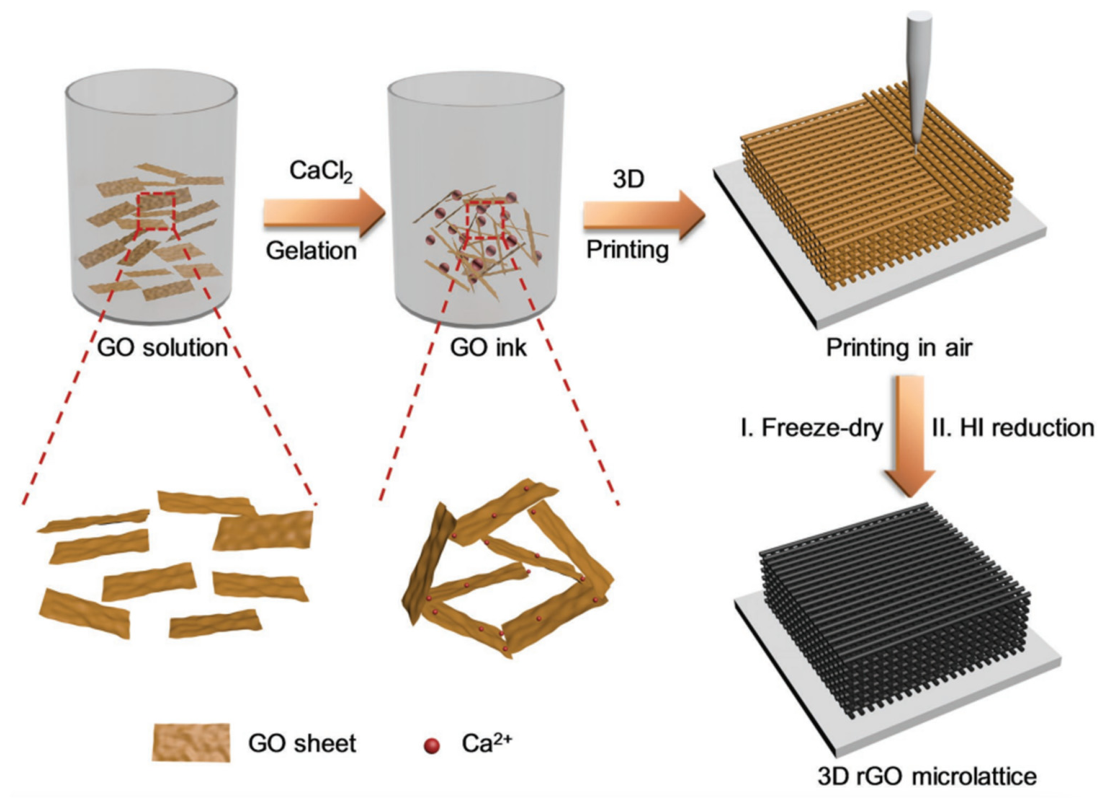
To fabricate 3D-printed GAs by direct ink writing, a GO ink is first formulated. Then, a previously designed 3D model is printed. However, the GO ink must have high viscosity and shear-thinning behavior for adequate flow through fine nozzles [88,112,113]. For that reason, the proper apparent viscosity of the GO inks can be achieved by adding a small amount of polymer, silica fillers, or particles to prevent graphene flake agglomeration, thereby preserving the shear-thinning behavior and ensuring appropriate printability [88,114,115]. Another barrier is premature drying, which can promote the collapse of 3D structures and obstruct micronozzles; hence, the humidity of the GO inks must be controlled during the 3D printing process. In this regard, the 3D printing process is performed in a solvent that is immiscible with the GO inks [88]. Figure 2 shows a schematic illustration of the 3D printing process of GAs by direct ink writing.
Figure 2.
Schematic illustration of the 3D printing process of GAs with micro lattices. The illustration shows the preparation of a GO ink based on Ca2+ ions as gelling agents. Reproduced with permission from Ref. [116].
4. Classification of GAs According to Their Modifications
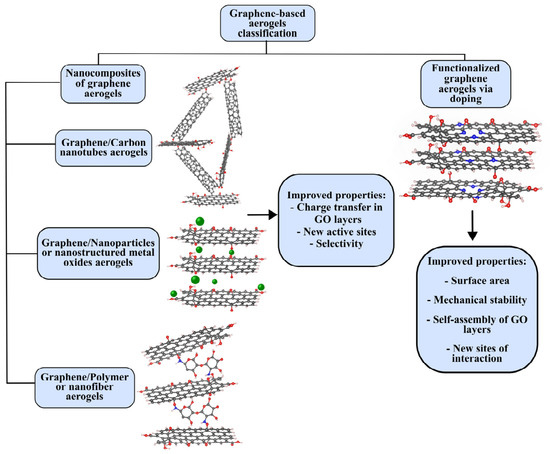
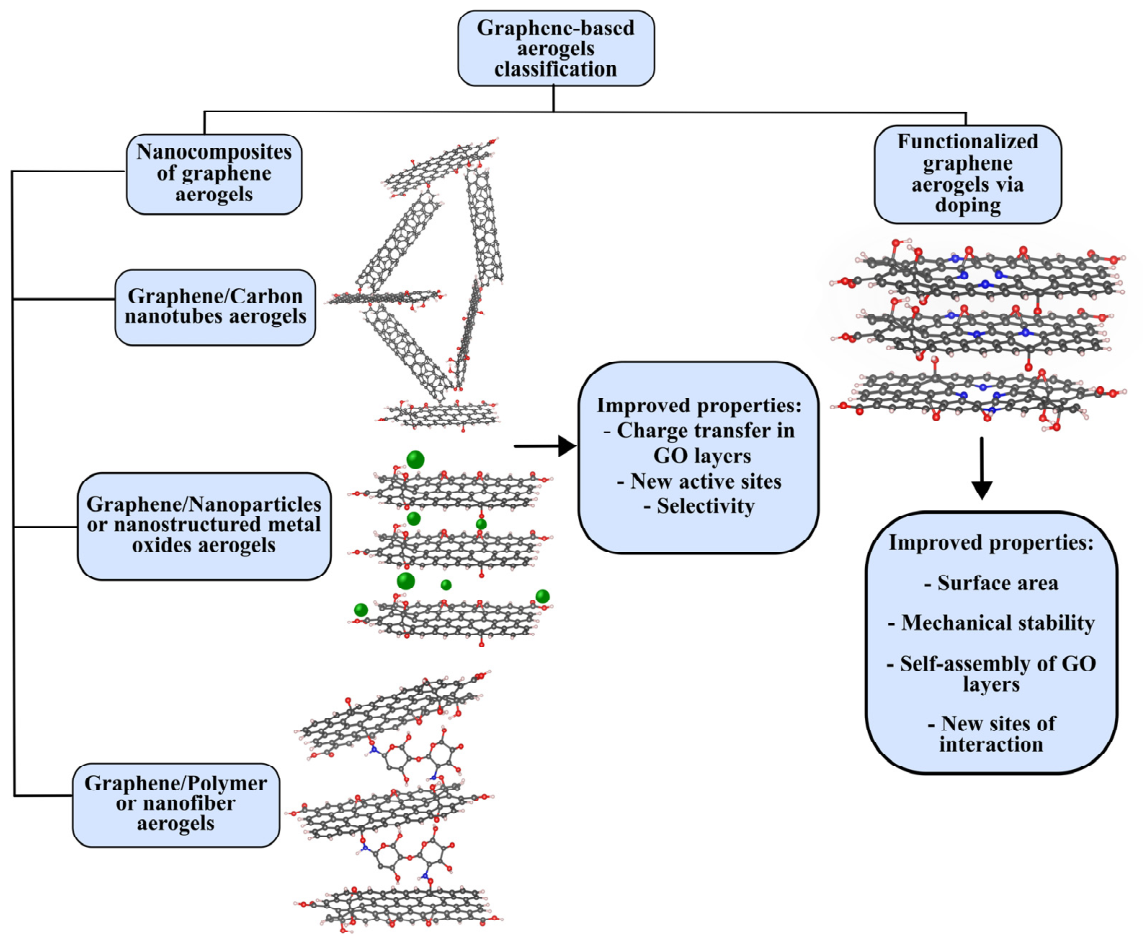
The GAs capacity to adsorb organic contaminants is directly influenced by their physicochemical properties, which are determined by the synthesis process and subsequent modifications. GAs have shown excellent adsorption capacity for various contaminants due to their interconnected 3D porous structures, large surface areas, and plentiful surface oxygen groups [20,22,44,45,74,76,83,117,118]. Another advantage of GAs is their facile manipulation, as they are in monolith form and can be easily separated from water. However, pristine GAs exhibit a significant disadvantage: they tend to deform and lose their 3D intrinsic network under high compression due to strong inter-sheet attractive forces [119]. In this regard, the incorporation of various materials during the synthesis of GAs to improve properties such as surface area, mechanical stability, electronic distribution, and interaction sites has been extensively investigated. In this section, the GAs are classified into two groups: Nanocomposites of GAs and functionalized graphene aerogels via doping. Figure 3 shows the classification of GAs and the properties improved.
Figure 3.
Classification of GAs according to their modifications. Figure generated by the authors.
4.1. GAs Nanocomposites
This group includes incorporating carbon nanotubes, nanoparticles, nanostructured metal oxides, polymers, and nanofibers into GAs during synthesis to enhance properties such as surface area, mechanical stability, GO layer self-assembly, and new sites for contaminant interaction.
4.1.1. Graphene/Carbon Nanotubes Aerogels
In the case of GAs conjugated to carbon nanotubes, they are designed to increase surface area and enhance mechanical stability. Adorning GAs with carbon nanotubes is a popular strategy, as carbon nanotubes possess a high surface area (100–600 m2/g) [120,121]. Additionally, carbon nanotubes possess a high elastic modulus comparable to that of diamonds; therefore, their inclusion can increase the GA surface area and confer structural stability. The reason for the enhanced stability is as follows: when carbon nanotubes are combined with graphene layers, they resemble joists and studs; that is, the carbon nanotubes are linked to the graphene layers, allowing load transfer [122] and electron transport [123].
4.1.2. Graphene Decorated by Nanoparticles/Nanostructured Metal Oxides Aerogels
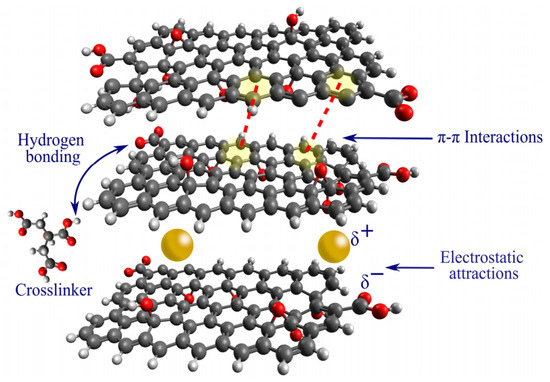
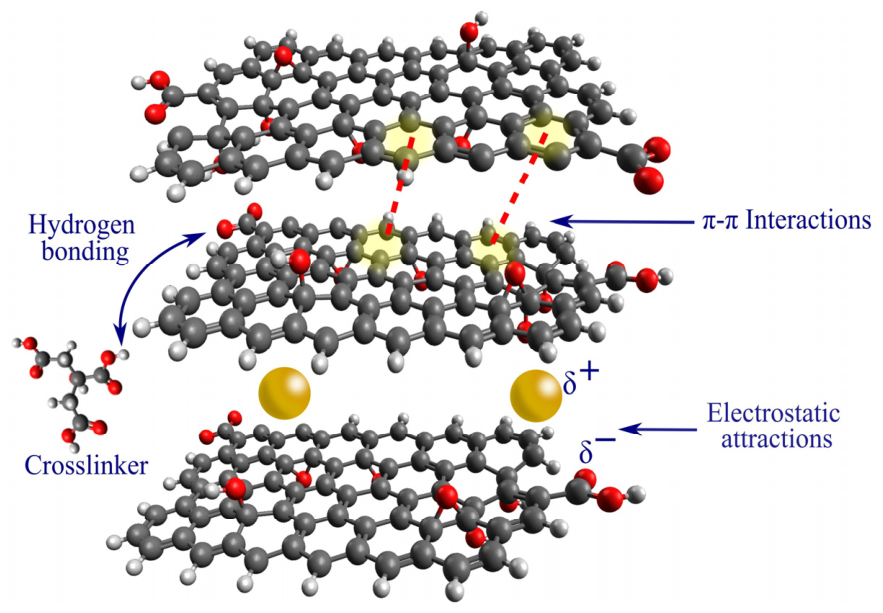
Various methods have been explored to enhance the interaction between graphene layers (e.g., GO self-assembly). For example, when nanoparticles anchor to graphene layers, they are prone to interact with the graphene’s functional groups and contaminants via electrostatic attractions due to the charge difference. A schematic illustration of the interactions between nanoparticles and GO layers is shown in Figure 4. These interactions include π–π interactions, electrostatic attractions, and hydrogen bonding. Nanoparticle incorporation also contributes to the formation of micro- and mesopores [4,124].
Figure 4.
Schematic representation of the interaction between graphene sheets as well as their interaction with nanoparticles and crosslinkers. Figure generated by the authors.
Nanostructured metal oxides have been used as crosslinkers because they tend to reside between the GO layers. Even nanostructured metal oxides possess interlayers that facilitate pollutant adsorption [125]. Additionally, nanostructured metal oxide sheets can simultaneously absorb and promote self-assembly and reduction [65], in addition to being abundant, inexpensive, and eco-friendly.
4.1.3. Graphene/Polymer or Nanofiber Aerogels
The inclusion of polymers and nanofibers into GAs is usually employed to enhance their mechanical stability and flexibility [23,55,71], as this is strongly related to the GA’s reusability in oil/organic solvent sorption, since adequate structural stability can guarantee GA performance across several cycles. Additionally, when nanofibers are added to GAs, they entangle with the GO layers, generating a networked, open-porous structure [55]. Nanofibers also act as spacers, preventing the graphene layer agglomeration and guaranteeing the accessibility of pollutants.
4.2. Functionalized GAs via M-Doping (M = N, S, and B)
Doping can modulate charge transfer between graphene layer atoms and confer local chemical properties. Hence, one alternative for functionalizing the GA structure is to dope graphene layers with other atoms [62]. GA doping is usually performed using hydrothermal methods, in which an M-containing molecule (M = N, S, N/S, and N/B) is added into a GO solution. This molecule serves not only as a heteroatom source but also as a reductant. In this regard, many molecules have been used (e.g., pyrrole [60,62,81], urea [54], tetraethylenetetramine [81], and melamine [99,126]) for N-doped GAs. 1-Cystine [127] and SO3H [26] molecules have been utilized in S-doped GAs. Some works have also studied the co-doping of GAs with N/S or N/B using thiourea [28] and BN(OH)x [128], and their influence on other properties.
5. Property–Performance Relationships of GAs for Organic Pollutant Adsorption
The capacity of GAs for adsorbing organic contaminants is often attributed to various properties, including surface area, porous structure, and surface chemistry. In fact, in many studies, characterization techniques commonly focus on obtaining the Brunauer–Emmett–Teller surface area to relate it directly to adsorption capacity. However, it is known that the adsorption of a contaminant is influenced by the characteristics of the contaminant (e.g., molecular dimensions, charge, species, and concentration) and by those of the adsorbent (e.g., specific surface area, density, porosity, surface chemistry, and charge). Therefore, in this section, a quantitative analysis of the surface area, density, and surface chemistry of various GAs was performed to relate them to their adsorption capacity for two representative organic solvent and dye molecules, toluene and methylene blue, since they are common adsorbates investigated in the literature [24,25,54,78,122,123,129,130,131].
5.1. Role of Surface Area on the Adsorption Capacity of GAs
5.1.1. Methylene Blue
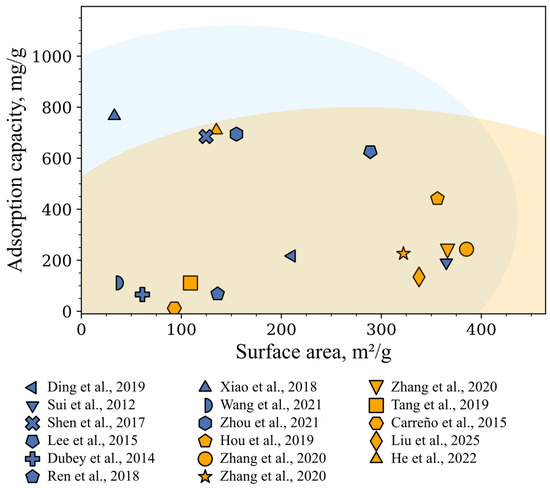
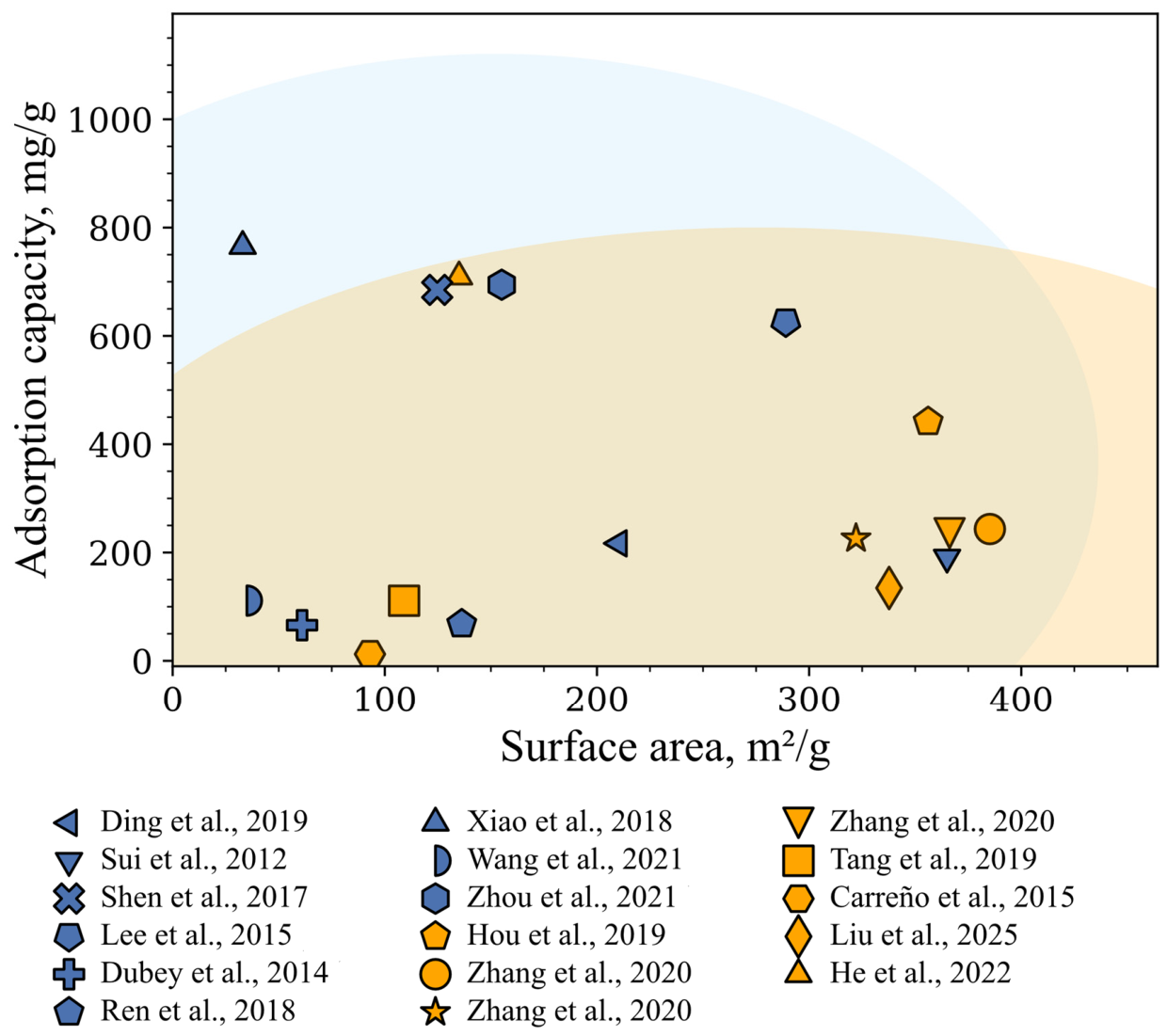
Carbon-based adsorbents such as activated carbons, xerogels, and GAs are characterized by graphene basal planes rich in aromatic rings, which can interact with the aromatic rings of organic contaminants via π electrons. Therefore, it is assumed that a large surface area would increase the number of aromatic rings available for interaction and, consequently, the capacity to adsorb organic contaminants. Figure 5 shows the adsorption capacity of a series of GAs for methylene blue as a function of surface area. According to the figure, there is no clear relationship; that is, a GA with a large surface area does not necessarily exhibit a high adsorption capacity for methylene blue. To corroborate this trend, data of rhodamine B adsorption on various GAs were also collected [4,132,133,134,135,136]. Figure 5 also shows the adsorption capacity of some GAs toward rhodamine B as a function of surface area. It appears that there is no improvement in adsorption capacity with increasing GA surface area. Therefore, it is possible to infer that surface area does not influence the adsorption of methylene blue and rhodamine B on GAs.
Figure 5.
Role of surface area in the capacity for adsorbing methylene blue and rhodamine B of a set of GAs. The blue markers represent methylene blue adsorbed on GAs while the orange markers represent rhodamine B adsorbed in GAs. The colored ellipses are only visual guides. Data adapted from Ding et al., 2019 [54], Sui et al., 2012 [78], Shen et al., 2017 [122], Lee et al., 2015 [123], Dubey et al., 2014 [129], Ren et al., 2018 [130], Xiao et al., 2018 [25], Wang et al., 2021 [131], Zhou et al., 2021 [24], Hou et al., 2019 [4], Zhang et al., 2020 [132], Tang et al., 2019 [133], Carreño et al., 2015 [134], Liu et al., 2025 [135], and He et al., 2022 [136]. Figure generated by the authors.
5.1.2. Toluene
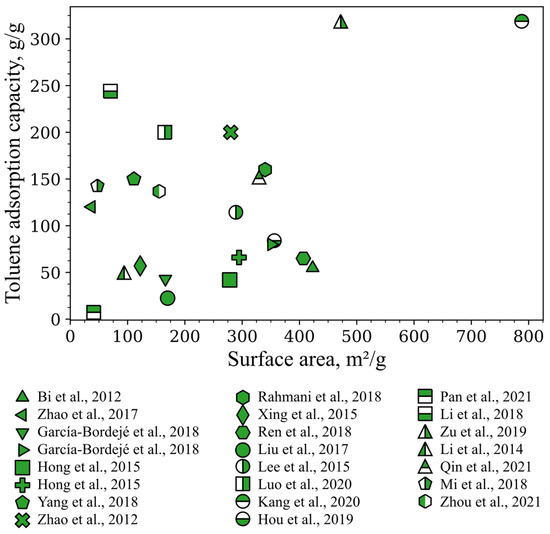
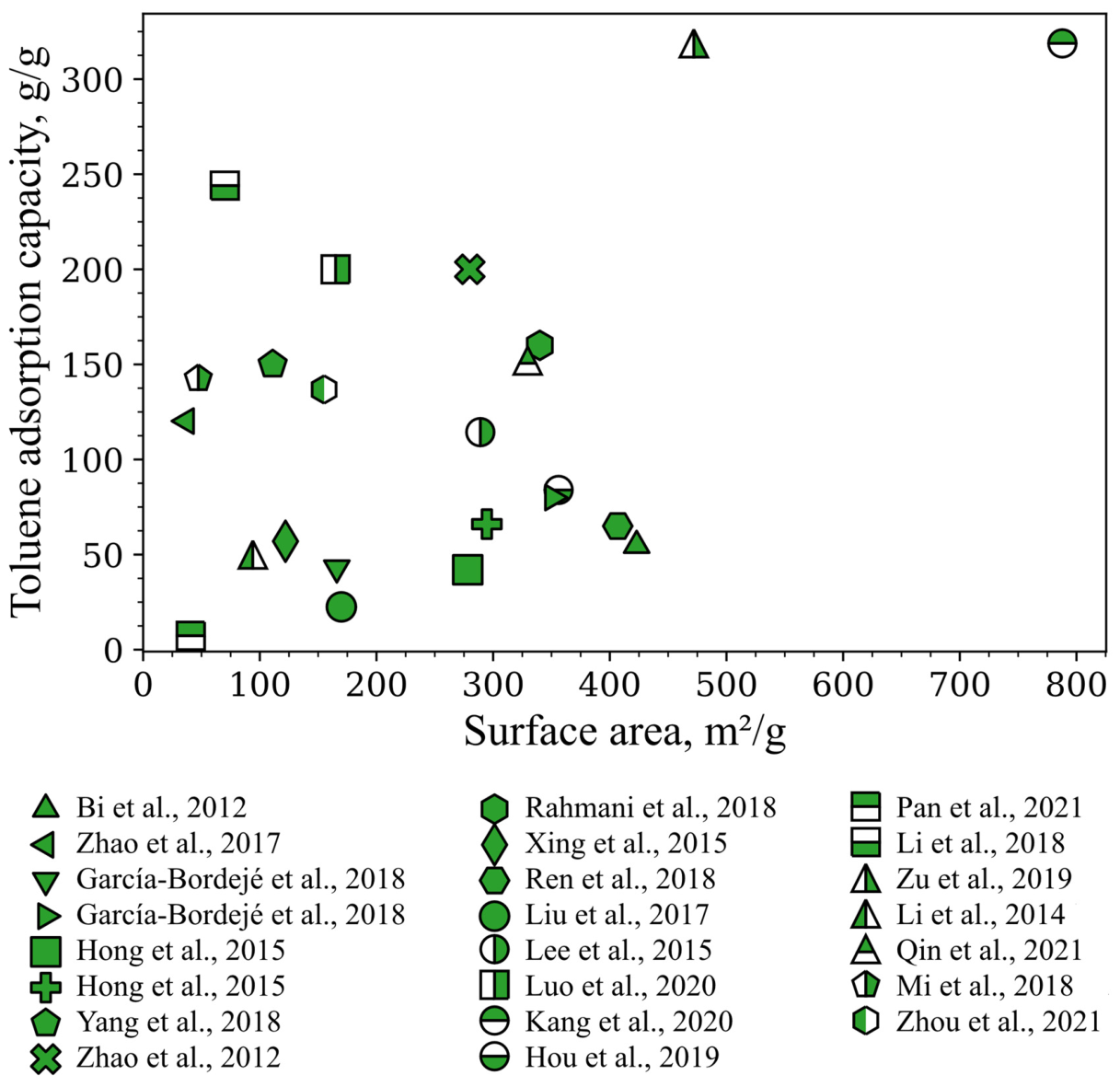
The adsorption capacity toward toluene versus surface area is graphed in Figure 6. It is observed that this set of GAs have a wide variety of surface areas and there is no clear relationship with the capacity for adsorbing toluene [4,20,21,23,24,25,28,29,30,37,45,60,62,71,74,79,117,118,123,126,128,137,138,139]. For example, GAs with surface area in the range 300–400 m2/g show similar capacity to GAs with surface area in the range 50–150 m2/g.
Figure 6.
Toluene adsorption capacity of a series of GAs as function of surface area. Data adapted from Bi et al., 2012 [20], Zhao et al., 2017 [45], García-Bordejé et al., 2018 [74], Hong et al., 2015 [117], Yang et al., 2018 [118], Zhao et al., 2012 [62], Rahmani et al., 2018 [60], Xing et al., 2015 [126], Ren et al., 2018 [28], Liu et al., 2017 [128], Lee et al., 2015 [123], Luo et al., 2020 [137], Kang et al., 2020 [30], Hou et al., 2019 [4], Pan et al., 2021 [23], Li et al., 2018 [79], Zu et al., 2019 [71], Li et al., 2014 [21], Qin et al., 2021 [29], Mi et al., 2018 [138], and Zhou et al., 2021 [24]. Figure generated by the authors.
5.2. Influence of GAs Densities on Their Capacity for Toluene Adsorption
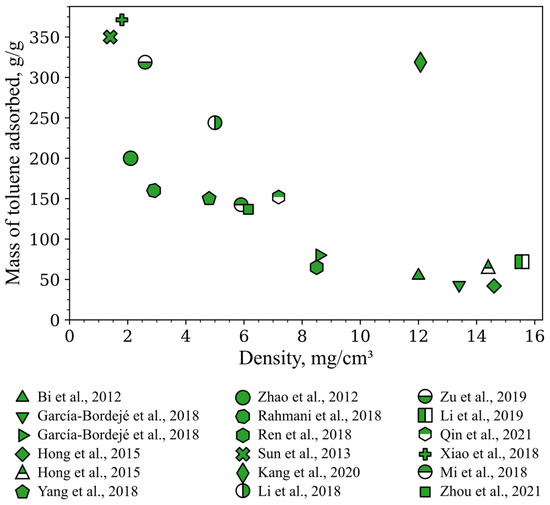
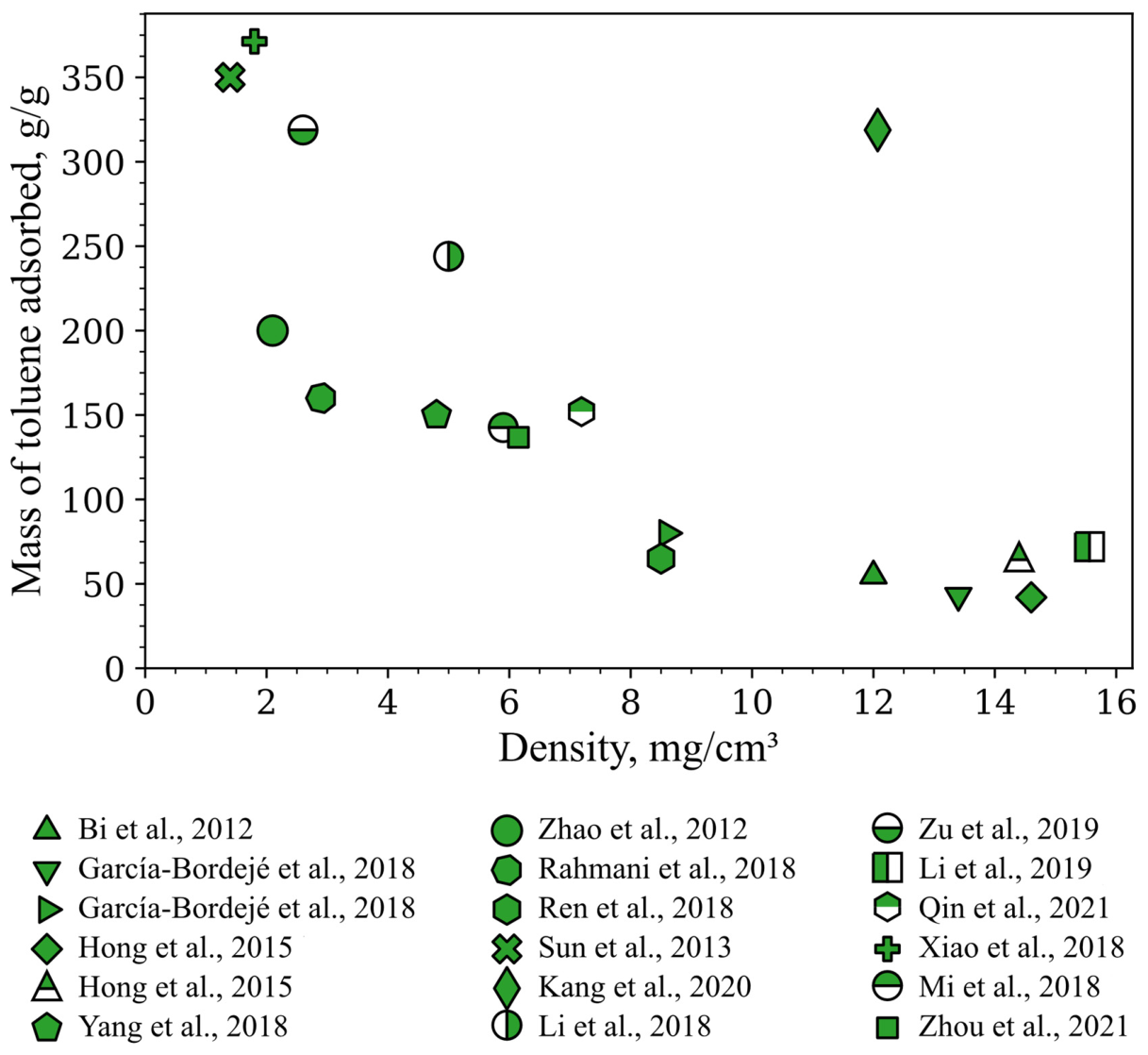
Figure 7 depicts an inverse relationship between the adsorption capacity of GAs toward toluene and their density. GAs with lower density, that is, with higher void fraction, adsorb a higher mass of toluene. On the other hand, this would indicate that the density of GAs is a key property in the rational design of GAs for removing organic solvents and oils, and that the adsorption mechanism of toluene on GAs is pore filling. However, the lower the density, the higher the tendency to low elastic moduli [37,122,140]; thus, GAs should have a low bulk density but should be elastic enough to avoid collapse.
Figure 7.
Toluene adsorption capacity of GAs as function of density. It is observed that GAs with lower density have a higher adsorption capacity toward toluene. Data adapted from Bi et al., 2012 [20], García-Bordejé et al., 2018 [74], Hong et al., 2015 [117], Yang et al., 2018 [118], Zhao et al., 2012 [62], Rahmani et al., 2018 [60], Ren et al., 2018 [28], Sun et al., 2013 [37], Kang et al., 2020 [30], Li et al., 2018 [79], Zu et al., 2019 [71], Li et al., 2019 [139], Qin et al., 2021 [29], Xiao et al., 2018 [25], Mi et al., 2018 [138], and Zhou et al., 2021 [24]. Figure generated by the authors.
It is worth noting that the effect of GA density was discussed only for toluene, since the adsorption of oils and organic solvents is controlled by pore filling. In contrast, the adsorption of dyes on GAs is primarily governed by surface interactions, such as electrostatic interactions, as discussed below.
5.3. Influence of GAs Surface Chemistry on Their Capacity for Methylene Blue Adsorption
In contrast to the adsorption of toluene on GAs in which the main mechanism is pore filling. The adsorption of methylene blue on GAs is controlled by surface interactions as it exists as different species depending on the solution pH, these species affect the interaction with GAs.
In an effort to establish a relationship between surface chemistry and the capacity of GAs to adsorb methylene blue, data on concentrations of active sites on the surface of GAs were sought, particularly using the Boehm titration method, as it is a simple method that allows for the quantification of carboxylic, phenolic, lactonic, and basic sites concentrations in carbon-based materials [141,142,143]. In most studies of methylene blue adsorption on GAs, the surface chemistry of the latter is qualitatively characterized by X-ray photoelectron spectroscopy, and in only a few cases are the concentrations of active sites quantified.
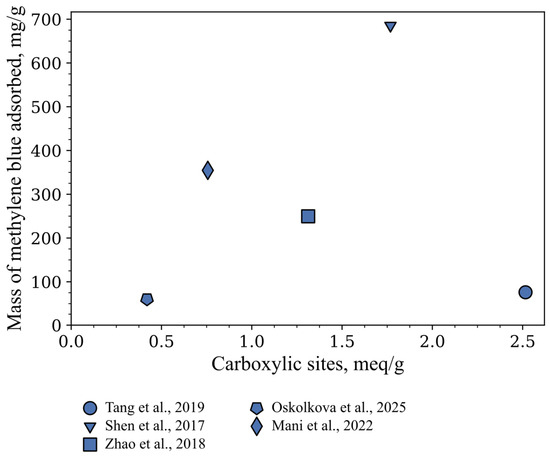
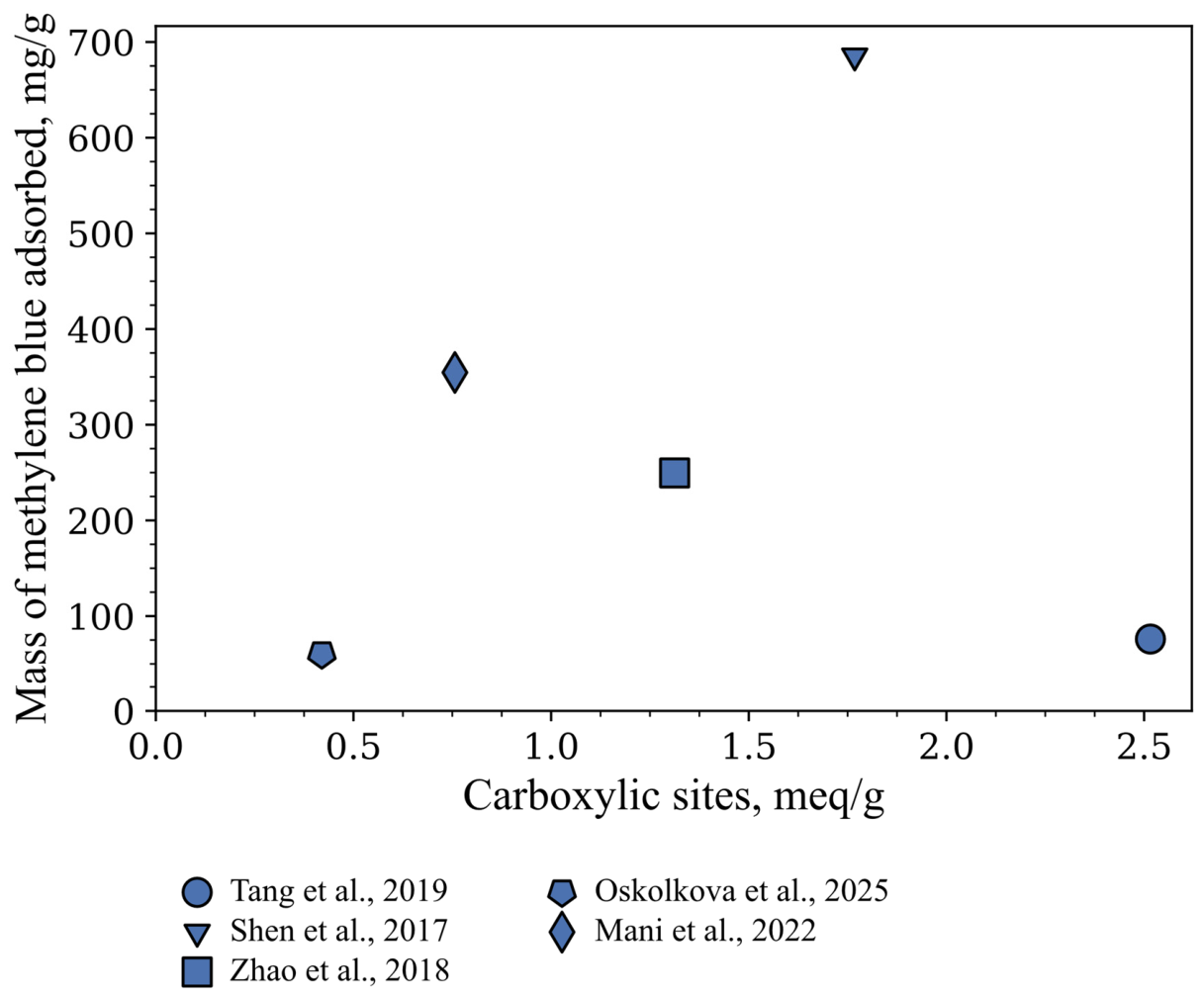
According to our research, only five studies quantified the concentrations of active surface sites on GAs, all of which reported the concentrations of carboxylic sites and the capacity to adsorb methylene blue [122,133,144,145,146]. Figure 8 reveals that the concentration of carboxylic sites could increase the capacity to adsorb methylene blue. In fact, some studies have found that increasing the concentration of acidic sites improves the adsorption capacity of methylene blue in carbon-based materials [147]. However, the lack of data quantifying the surface-active sites on GAs limits the establishment of a solid relationship for these materials.
Figure 8.
Adsorption capacity of GAs as function of carboxylic site concentration. Data adapted from Tang et al., 2019 [133], Shen et al., 2017 [122], Zhao et al., 2018 [144], Oskolkova et al., 2025 [145], and Mani et al., 2022 [146]. Figure generated by the authors.
Comprehensive Overview of Methylene Blue Adsorption Mechanism in GAs
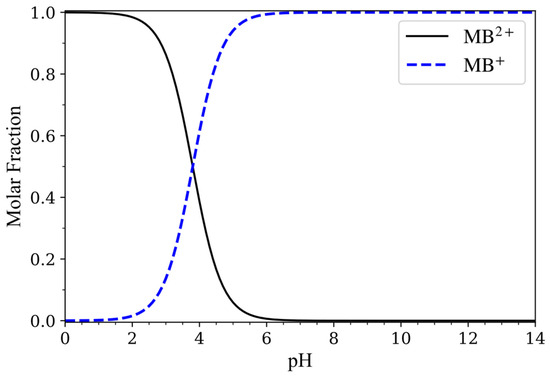
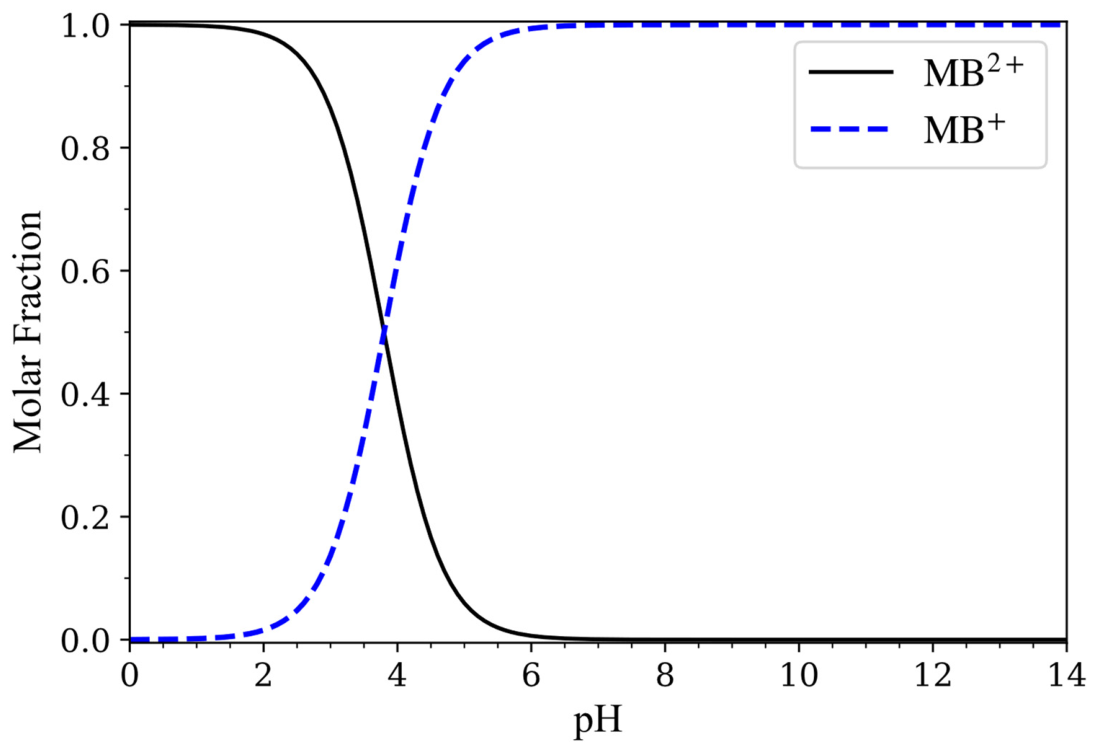
Organic contaminants are present in aqueous solutions as distinct species depending on the pH of the solution and the functional groups’ ionization states. The typical species distribution diagram of methylene blue in Figure 9 shows two species in aqueous solution. Below pH = 4, methyelene blue2+ is the predominant species, while above pH = 4, methylene blue1+ is the predominant species. On the other hand, the pH at the point of zero charge (pHPZC) is the pH at which the material has zero charge; pHPZC is influenced by the concentrations of oxygen functional groups on the surface of adsorbents [148]. Often, pHPZC is shown in a charge-distribution graph, indicating that at pH < pHPZC a material is positively charged, whereas at pH > pHPZC it is negatively charged. This relates to the deprotonation of surface acidic sites on GAs. For example, the –COOH group deprotonates –COOH− at pH > pHPZC; therefore, carboxylic sites can interact with methylene blue via electrostatic attraction. Additionally, some authors have measured the zeta potential of GAs solutions at different pH values to assess the material’s apparent charge [133]. For instance, Zhao and collaborators studied the adsorption of methylene blue on a series of poly(ethyleneimine) GAs [144]. Subsequently, they performed zeta potential measurements, which revealed that all poly(ethyleneimine) GAs exhibited a positive charge below pH 10 and a negative charge above. Note that at this pH methylene blue is positively charged (see Figure 9). Therefore, the methylene blue adsorption experiments were conducted at pH 10.5 to ensure electrostatic attraction between the poly(ethyleneimine) GAs and methylene blue, indicating that the adsorption mechanism of methylene blue on poly(ethyleneimine) GAs was electrostatic. This result is consistent with other works of methylene blue adsorption on GAs and carbon-based materials [149,150]. It should be noted that electrostatic attractions can be affected by the presence of other ions or contaminants that compete for adsorption sites. This effect is commonly studied using solutions with different ionic strengths. Furthermore, organic contaminants in aqueous solution can be adsorbed on GAs through hydrogen bonding, π–π interactions with aromatic ring, and hydrophobic interactions.
Figure 9.
Species distribution diagram of methylene blue. Figure generated by the authors.
6. Conclusions
Graphene-based aerogels are highly promising materials for adsorbing organic contaminants because they π graphene’s outstanding properties. There is a wide variety of methods for synthesizing graphene-based aerogels, the most common being solution-based. However, new approaches such as 3D printing have been explored.
Graphene-based aerogels have certain disadvantages, including the fragility of their porous structure. Accordingly, numerous methods have been explored to modify the properties of graphene-based aerogels. Some of these methods include the incorporation of nanoparticles, carbon nanotubes, polymers, and nanofibers, as well as the doping of graphene layers during hydrothermal synthesis.
Due to the lack of comparative analysis between properties and the adsorption capacity of GAs, the latter is commonly attributed to surface area and porous structure. In contrast, the surface chemistry is studied only qualitatively. In this sense, a quantitative analysis of the influence of surface area, density, and surface chemistry on the adsorption capacity toward two representative molecules was conducted. The analyses revealed that surface area does not have a significant effect on the capacity to adsorb toluene or methylene blue. It was found that GAs with lower density exhibit a better adsorption capacity toward toluene.
Meanwhile, data collected to study the effect of carboxylic sites concentrations on the adsorption capacity of GAs toward methylene blue suggest a potential relationship. Although the lack of quantitative characterization of active sites on graphene-based aerogels makes it difficult to establish the previous relationship, the analysis of the species distribution of methylene blue and the pH at the point of zero charge of GAs, as well as the reported mechanism (i.e., electrostatic attractions) of methylene blue on GAs and carbonaceous materials, supports it. Hence, the rational design of GAs for the adsorption of organic solvents and dyes should consider previous relationships, as well as the nature of the organic contaminants to be adsorbed, including the species in the aqueous solution and the pH at the point of zero charge.
7. Challenges and Limitations
Despite the important role of surface chemistry in adsorption processes, quantitative characterizations of active sites in GAs are rarely performed. Boehm’s titration method is used to quantify active sites (oxygenated groups) on carbon-based materials; nonetheless, functional groups introduced by doping are seldom quantified. Therefore, techniques that allow for relating the adsorption capacity of GAs quantitatively to these functionalities are required.
Future research should conduct a comprehensive evaluation of adsorption mechanisms, considering the nature of the adsorbates and the effect of operating conditions—such as solution pH, temperature, and ionic strength—as well as to assess the performance of GAs under realistic conditions, such as multicomponent solutions that represent actual wastewater conditions. Furthermore, the selective functionalization of the GA surface could be studied using different approaches, including chemical oxidation, physical reactivation, or doping to control the concentrations of active sites and, consequently, also modify the pH at the point of zero charge. One challenge in using GAs for water decontamination is scaling up the process due to the synthesis of graphene oxide, as it must be produced cost-effectively and in reasonable quantities. Furthermore, while the use of GAs for water decontamination has been explored under batch conditions, it is necessary to evaluate their performance in continuous-flow systems to assess their potential for treating contaminated water. In this sense, the use of 3D-printed GAs with designed channels for the continuous-flow adsorption of organic pollutants could be explored to assess the potential for scaling up GAs for water treatment.
Author Contributions
Conceptualization, J.A.M.-E., G.R.-P., D.I.M. and H.C.-M.; methodology, J.A.M.-E., G.R.-P., D.I.M., H.C.-M., J.N.-A., R.M.-O. and M.J.R.-C.; formal analysis, J.A.M.-E., G.R.-P., D.I.M. and H.C.-M.; investigation, J.A.M.-E., G.R.-P., D.I.M., H.C.-M., J.N.-A., R.M.-O. and M.J.R.-C.; writing—original draft preparation, J.A.M.-E., G.R.-P., D.I.M. and H.C.-M.; writing—review and editing, D.I.M. and H.C.-M.; visualization, J.A.M.-E. and G.R.-P.; supervision, D.I.M. and H.C.-M. All authors have read and agreed to the published version of the manuscript.
Funding
The APC was funded by Tecnológico Nacional de México.
Data Availability Statement
No new data were created or analyzed in this study.
Acknowledgments
The authors appreciate the resources provided by Tecnológico de Monterrey for access to multiple databases used during the literature review. J.A. Martínez-Espinosa and G. Ruiz-Pulido would like to thank Secretariat of Science, Humanities, Technology and Innovation (SECIHTI) for the scholarship provided for doctoral studies.
Conflicts of Interest
The authors declare no conflicts of interest.
References
- Zhang, F.; Li, Y.-H.; Li, J.-Y.; Tang, Z.-R.; Xu, Y.-J. 3D Graphene-Based Gel Photocatalysts for Environmental Pollutants Degradation. Environ. Pollut. 2019, 253, 365–376. [Google Scholar] [CrossRef] [Scilit]
- Wei, X.-N.; Ou, C.-L.; Fang, S.-S.; Zheng, X.-C.; Zheng, G.-P.; Guan, X.-X. One-Pot Self-Assembly of 3D CdS-Graphene Aerogels with Superior Adsorption Capacity and Photocatalytic Activity for Water Purification. Powder Technol. 2019, 345, 213–222. [Google Scholar] [CrossRef] [Scilit]
- Qu, J.; Chen, J. Pathways toward a Pollution-Free Planet and Challenges. Front. Environ. Sci. Eng. 2024, 18, 67. [Google Scholar] [CrossRef] [Scilit]
- Hou, P.; Xing, G.; Tian, L.; Zhang, G.; Wang, H.; Yu, C.; Li, Y.; Wu, Z. Hollow Carbon Spheres/Graphene Hybrid Aerogels as High-Performance Adsorbents for Organic Pollution. Sep. Purif. Technol. 2019, 213, 524–532. [Google Scholar] [CrossRef] [Scilit]
- Hasanpour, M.; Hatami, M. Photocatalytic Performance of Aerogels for Organic Dyes Removal from Wastewaters: Review Study. J. Mol. Liq. 2020, 309, 113094. [Google Scholar] [CrossRef] [Scilit]
- Aguilar-Pérez, K.M.; Avilés-Castrillo, J.I.; Ruiz-Pulido, G. Nano-Sorbent Materials for Pharmaceutical-Based Wastewater Effluents—An Overview. Case Stud. Chem. Environ. Eng. 2020, 2, 100028. [Google Scholar] [CrossRef] [Scilit]
- Awewomom, J.; Dzeble, F.; Takyi, Y.D.; Ashie, W.B.; Ettey, E.N.Y.O.; Afua, P.E.; Sackey, L.N.A.; Opoku, F.; Akoto, O. Addressing Global Environmental Pollution Using Environmental Control Techniques: A Focus on Environmental Policy and Preventive Environmental Management. Discov. Environ. 2024, 2, 8. [Google Scholar] [CrossRef] [Scilit]
- Nishat, A.; Yusuf, M.; Qadir, A.; Ezaier, Y.; Vambol, V.; Ijaz Khan, M.; Ben Moussa, S.; Kamyab, H.; Sehgal, S.S.; Prakash, C.; et al. Wastewater Treatment: A Short Assessment on Available Techniques. Alex. Eng. J. 2023, 76, 505–516. [Google Scholar] [CrossRef] [Scilit]
- Pruna, A.; Cárcel, A.C.; Barjola, A.; Benedito, A.; Giménez, E. Tailoring the Performance of Graphene Aerogels for Oil/Organic Solvent Separation by 1-Step Solvothermal Approach. Nanomaterials 2019, 9, 1077. [Google Scholar] [CrossRef] [Scilit] [PubMed]
- Tran, H.N. Adsorption Technology for Water and Wastewater Treatments. Water 2023, 15, 2857. [Google Scholar] [CrossRef] [Scilit]
- Lamy-Mendes, A.; Lopes, D.; Girão, A.V.; Silva, R.F.; Malfait, W.J.; Durães, L. Carbon Nanostructures—Silica Aerogel Composites for Adsorption of Organic Pollutants. Toxics 2023, 11, 232. [Google Scholar] [CrossRef] [Scilit] [PubMed]
- Gallegos-Suárez, E.; Pérez-Cadenas, A.F.; Maldonado-Hódar, F.J.; Carrasco-Marín, F. On the Micro- and Mesoporosity of Carbon Aerogels and Xerogels. The Role of the Drying Conditions during the Synthesis Processes. Chem. Chem. Eng. Eng. J. 2012, 181–182, 851–855. [Google Scholar] [CrossRef] [Scilit]
- Jiang, Y.; Chowdhury, S.; Balasubramanian, R. Nitrogen and Sulfur Codoped Graphene Aerogels as Absorbents and Visible Light-Active Photocatalysts for Environmental Remediation Applications. Environ. Pollut. 2019, 251, 344–353. [Google Scholar] [CrossRef] [Scilit] [PubMed]
- Gorgolis, G.; Pastra, N.; Kotsidi, M.; Paterakis, G.; Koutroumanis, N.; Tsakonas, C.; Galiotis, C. Graphene Aerogels as Efficient Adsorbers of Water Pollutants and Their Effect of Drying Methods. Sci. Rep. 2024, 14, 8029. [Google Scholar] [CrossRef] [Scilit]
- Liu, Z.; Gao, B.; Zhao, P.; Fu, H.; Kamali, A.R. Magnetic Luffa/Graphene/CuFe2O4 Sponge for Efficient Oil/Water Separation. Sep. Purif. Technol. 2024, 337, 126347. [Google Scholar] [CrossRef] [Scilit]
- Hou, S.; Wu, X.; Lv, Y.; Jia, W.; Guo, J.; Wang, L.; Tong, F.; Jia, D. Ultralight, Highly Elastic and Bioinspired Capillary-Driven Graphene Aerogels for Highly Efficient Organic Pollutants Absorption. Appl. Surf. Sci. 2020, 509, 144818. [Google Scholar] [CrossRef] [Scilit]
- Zhuo, H.-Y.; Zhang, X.; Liang, J.-X.; Yu, Q.; Xiao, H.; Li, J. Theoretical Understandings of Graphene-Based Metal Single-Atom Catalysts: Stability and Catalytic Performance. Chem. Rev. 2020, 120, 12315–12341. [Google Scholar] [CrossRef] [Scilit]
- Urade, A.R.; Lahiri, I.; Suresh, K.S. Graphene Properties, Synthesis and Applications: A Review. JOM 2023, 75, 614–630. [Google Scholar] [CrossRef] [Scilit]
- Prusty, K.; Barik, S.; Swain, S.K. A Corelation Between the Graphene Surface Area, Functional Groups, Defects, and Porosity on the Performance of the Nanocomposites. In Functionalized Graphene Nanocomposites and Their Derivatives; Elsevier: Amsterdam, The Netherlands, 2019; pp. 265–283. [Google Scholar] [CrossRef] [Scilit]
- Bi, H.; Xie, X.; Yin, K.; Zhou, Y.; Wan, S.; He, L.; Xu, F.; Banhart, F.; Sun, L.; Ruoff, R.S. Spongy Graphene as a Highly Efficient and Recyclable Sorbent for Oils and Organic Solvents. Adv. Funct. Mater. 2012, 22, 4421–4425. [Google Scholar] [CrossRef] [Scilit]
- Li, R.; Chen, C.; Li, J.; Xu, L.; Xiao, G.; Yan, D. A Facile Approach to Superhydrophobic and Superoleophilic Graphene/Polymer Aerogels. J. Mater. Chem. A 2014, 2, 3057–3064. [Google Scholar] [CrossRef] [Scilit]
- Zhao, Y.; Sun, T.; Liao, W.; Wang, Y.; Yu, J.; Zhang, M.; Yu, Z.; Yang, B.; Gui, D.; Zhu, C.; et al. Amphiphilic Graphene Aerogel with High Oil and Water Adsorption Capacity and High Contact Area for Interface Reaction. ACS Appl. Mater. Interfaces 2019, 11, 22794–22800. [Google Scholar] [CrossRef] [Scilit]
- Pan, Z.; Guan, Y.; Liu, Y.; Cheng, F. Facile Fabrication of Hydrophobic and Underwater Superoleophilic Elastic and Mechanical Robust Graphene/PDMS Sponge for Oil/Water Separation. Sep. Purif. Technol. 2021, 261, 118273. [Google Scholar] [CrossRef] [Scilit]
- Zhou, Y.; Gao, Y.; Wang, H.; Xia, M.; Yue, Q.; Xue, Z.; Zhu, J.; Yu, J.; Yin, W. Versatile 3D Reduced Graphene Oxide/Poly(Amino-Phosphonic Acid) Aerogel Derived from Waste Acrylic Fibers as an Efficient Adsorbent for Water Purification. Sci. Total Environ. 2021, 776, 145973. [Google Scholar] [CrossRef] [Scilit] [PubMed]
- Xiao, J.; Lv, W.; Song, Y.; Zheng, Q. Graphene/Nanofiber Aerogels: Performance Regulation towards Multiple Applications in Dye Adsorption and Oil/Water Separation. Chem. Eng. J. 2018, 338, 202–210. [Google Scholar] [CrossRef] [Scilit]
- Zhang, Z.; Huang, J.; Dong, Z.; Luo, B.; Liu, Y.; Dai, Y.; Cao, X.; Wang, Y.; Hua, R.; Liu, Y. Ultralight Sulfonated Graphene Aerogel for Efficient Adsorption of Uranium from Aqueous Solutions. J. Radioanal. Nucl. Chem. 2019, 321, 1045–1055. [Google Scholar] [CrossRef] [Scilit]
- Zhan, W.; Yu, S.; Gao, L.; Wang, F.; Fu, X.; Sui, G.; Yang, X. Bioinspired Assembly of Carbon Nanotube into Graphene Aerogel with “Cabbagelike” Hierarchical Porous Structure for Highly Efficient Organic Pollutants Cleanup. ACS Appl. Mater. Interfaces 2018, 10, 1093–1103. [Google Scholar] [CrossRef] [Scilit]
- Ren, X.; Guo, H.; Ma, X.; Hou, G.; Chen, L.; Xu, X.; Chen, Q.; Feng, J.; Si, P.; Zhang, L.; et al. Improved Interfacial Floatability of Superhydrophobic and Compressive S, N Co-Doped Graphene Aerogel by Electrostatic Spraying for Highly Efficient Organic Pollutants Recovery from Water. Appl. Surf. Sci. 2018, 457, 780–788. [Google Scholar] [CrossRef] [Scilit]
- Qin, W.; Zhu, W.; Ma, J.; Yang, Y.; Tang, B. Carbon Fibers Assisted 3D N-Doped Graphene Aerogel on Excellent Adsorption Capacity and Mechanical Property. Colloids Surf. A Physicochem. Eng. Asp. 2021, 608, 125602. [Google Scholar] [CrossRef] [Scilit]
- Kang, W.; Cui, Y.; Qin, L.; Yang, Y.; Zhao, Z.; Wang, X.; Liu, X. A Novel Robust Adsorbent for Efficient Oil/Water Separation: Magnetic Carbon Nanospheres/Graphene Composite Aerogel. J. Hazard. Mater. 2020, 392, 122499. [Google Scholar] [CrossRef] [Scilit]
- Ahmad, S.; Siddiqi, W.A.; Ahmad, S. Facile Hydrophilic Chitosan and Graphene Oxide Modified Sustainable Non-Woven Fabric Composite Sieve Membranes (NWF@Cs/Gx): Antifouling, Protein Rejection, and Oil-Water Emulsion Separation Studies. Chem. Eng. Res. Des. 2022, 181, 220–238. [Google Scholar] [CrossRef] [Scilit]
- Sun, B.; Zhang, Y.; Li, R.; Wang, K.; Xiao, B.; Yang, Y.; Wang, J.; Zhu, L. New Insights into the Colloidal Stability of Graphene Oxide in Aquatic Environment: Interplays of Photoaging and Proteins. Water Res. 2021, 200, 117213. [Google Scholar] [CrossRef] [Scilit]
- Arabkhani, P.; Asfaram, A. Development of a Novel Three-Dimensional Magnetic Polymer Aerogel as an Efficient Adsorbent for Malachite Green Removal. J. Hazard. Mater. 2020, 384, 121394. [Google Scholar] [CrossRef] [Scilit] [PubMed]
- Ahmad, S.Z.N.; Wan Salleh, W.N.; Ismail, A.F.; Yusof, N.; Mohd Yusop, M.Z.; Aziz, F. Adsorptive Removal of Heavy Metal Ions Using Graphene-Based Nanomaterials: Toxicity, Roles of Functional Groups and Mechanisms. Chemosphere 2020, 248, 126008. [Google Scholar] [CrossRef] [Scilit] [PubMed]
- Lei, J.; Liu, Z. The Structural and Mechanical Properties of Graphene Aerogels Based on Schwarz-Surface-like Graphene Models. Carbon 2018, 130, 741–748. [Google Scholar] [CrossRef] [Scilit]
- Diao, S.; Liu, H.; Chen, S.; Xu, W.; Yu, A. Oil Adsorption Performance of Graphene Aerogels. J. Mater. Sci. 2020, 55, 4578–4591. [Google Scholar] [CrossRef] [Scilit]
- Sun, H.; Xu, Z.; Gao, C. Multifunctional, Ultra-Flyweight, Synergistically Assembled Carbon Aerogels. Adv. Mater. 2013, 25, 2554–2560. [Google Scholar] [CrossRef] [Scilit]
- Sui, Z.-Y.; Meng, Q.-H.; Li, J.-T.; Zhu, J.-H.; Cui, Y.; Han, B.-H. High Surface Area Porous Carbons Produced by Steam Activation of Graphene Aerogels. J. Mater. Chem. A 2014, 2, 9891–9898. [Google Scholar] [CrossRef] [Scilit]
- Fu, Y.; Wang, G.; Ming, X.; Liu, X.; Hou, B.; Mei, T.; Li, J.; Wang, J.; Wang, X. Oxygen Plasma Treated Graphene Aerogel as a Solar Absorber for Rapid and Efficient Solar Steam Generation. Carbon 2018, 130, 250–256. [Google Scholar] [CrossRef] [Scilit]
- Fu, Y.; Wang, G.; Mei, T.; Li, J.; Wang, J.; Wang, X. Accessible Graphene Aerogel for Efficiently Harvesting Solar Energy. ACS Sustain. Chem. Eng. 2017, 5, 4665–4671. [Google Scholar] [CrossRef] [Scilit]
- Yue, C.; Feng, J.; Feng, J.; Jiang, Y. Low-Thermal-Conductivity Nitrogen-Doped Graphene Aerogels for Thermal Insulation. RSC Adv. 2016, 6, 9396–9401. [Google Scholar] [CrossRef] [Scilit]
- Tao, X.; Zhou, Y.; Xu, K.; Wu, Y.; Mi, J.; Li, Y.; Liu, Q.; Cheng, X.; Zhao, N.; Shi, H.; et al. Bifunctional Material with Organic Pollutant Removing and Antimicrobial Properties: Graphene Aerogel Decorated with Highly Dispersed Ag and CeO2 Nanoparticles. ACS Sustain. Chem. Eng. 2018, 6, 16907–16919. [Google Scholar] [CrossRef] [Scilit]
- Wang, H.; Yuan, X.; Zeng, G.; Wu, Y.; Liu, Y.; Jiang, Q.; Gu, S. Three Dimensional Graphene Based Materials: Synthesis and Applications from Energy Storage and Conversion to Electrochemical Sensor and Environmental Remediation. Adv. Colloid Interface Sci. 2015, 221, 41–59. [Google Scholar] [CrossRef] [Scilit]
- Dong, S.; Xia, L.; Guo, T.; Zhang, F.; Cui, L.; Su, X.; Wang, D.; Guo, W.; Sun, J. Controlled Synthesis of Flexible Graphene Aerogels Macroscopic Monolith as Versatile Agents for Wastewater Treatment. Appl. Surf. Sci. 2018, 445, 30–38. [Google Scholar] [CrossRef] [Scilit]
- Zhao, X.; Yao, W.; Gao, W.; Chen, H.; Gao, C. Wet-Spun Superelastic Graphene Aerogel Millispheres with Group Effect. Adv. Mater. 2017, 29, 1701482. [Google Scholar] [CrossRef] [Scilit]
- Chandrasekaran, S.; Campbell, P.G.; Baumann, T.F.; Worsley, M.A. Carbon Aerogel Evolution: Allotrope, Graphene-Inspired, and 3D-Printed Aerogels. J. Mater. Res. 2017, 32, 4166–4185. [Google Scholar] [CrossRef] [Scilit]
- Mao, J.; Iocozzia, J.; Huang, J.; Meng, K.; Lai, Y.; Lin, Z. Graphene Aerogels for Efficient Energy Storage and Conversion. Energy Environ. Sci. 2018, 11, 772–799. [Google Scholar] [CrossRef] [Scilit]
- Hong, P.N.; Minh, D.N.; Hung, N.V.; Minh, P.N.; Khoi, P.H. Carbon Nanotube and Graphene Aerogels—The World’s 3D Lightest Materials for Environment Applications: A Review. Int. J. Mater. Sci. Appl. 2017, 6, 277–283. [Google Scholar] [CrossRef] [Scilit]
- Chowdhury, S.; Jiang, Y.; Muthukaruppan, S.; Balasubramanian, R. Effect of Boron Doping Level on the Photocatalytic Activity of Graphene Aerogels. Carbon 2018, 128, 237–248. [Google Scholar] [CrossRef] [Scilit]
- Jung, S.M.; Kim, D.W.; Jung, H.Y. Which Is the Most Effective Pristine Graphene Electrode for Energy Storage Devices: Aerogel or Xerogel? Nanoscale 2019, 11, 17563–17570. [Google Scholar] [CrossRef] [Scilit]
- Zhan, W.; Gao, L.; Fu, X.; Siyal, S.H.; Sui, G.; Yang, X. Green Synthesis of Amino-Functionalized Carbon Nanotube-Graphene Hybrid Aerogels for High Performance Heavy Metal Ions Removal. Appl. Surface Sci. 2019, 467–468, 1122–1133. [Google Scholar] [CrossRef] [Scilit]
- Dong, Q.; Wang, J.; Duan, X.; Tan, X.; Liu, S.; Wang, S. Self-Assembly of 3D MnO2/N-Doped Graphene Hybrid Aerogel for Catalytic Degradation of Water Pollutants: Structure-Dependent Activity. Chem. Eng. J. 2019, 369, 1049–1058. [Google Scholar] [CrossRef] [Scilit]
- Cohignac, V.; Landry, M.J.; Boczkowski, J.; Lanone, S. Autophagy as a Possible Underlying Mechanism of Nanomaterial Toxicity. Nanomaterials 2014, 4, 548–582. [Google Scholar] [CrossRef] [Scilit]
- Ding, Y.; Tian, Z.; Li, H.; Wang, X. Efficient Removal of Organic Dyes Using a Three-Dimensional Graphene Aerogel with Excellent Recycling Stability. New Carbon Mater. 2019, 34, 315–324. [Google Scholar] [CrossRef] [Scilit]
- Lin, Y.-Z.; Zhong, L.-B.; Dou, S.; Shao, Z.-D.; Liu, Q.; Zheng, Y.-M. Facile Synthesis of Electrospun Carbon Nanofiber/Graphene Oxide Composite Aerogels for High Efficiency Oils Absorption. Environ. Int. 2019, 128, 37–45. [Google Scholar] [CrossRef] [Scilit] [PubMed]
- Zhao, D.; Yu, L.; Liu, D. Ultralight Graphene/Carbon Nanotubes Aerogels with Compressibility and Oil Absorption Properties. Materials 2018, 11, 641. [Google Scholar] [CrossRef] [Scilit]
- Afroze, J.D.; Tong, L.; Abden, M.J.; Yuan, Z.; Chen, Y. Hierarchical Honeycomb Graphene Aerogels Reinforced by Carbon Nanotubes with Multifunctional Mechanical and Electrical Properties. Carbon 2021, 175, 312–321. [Google Scholar] [CrossRef] [Scilit]
- Sahoo, B.B.; Kumar, N.; Panda, H.S.; Panigrahy, B.; Sahoo, N.K.; Soam, A.; Mahanto, B.S.; Sahoo, P.K. Self-Assembled 3D Graphene-Based Aerogel with Au Nanoparticles as High-Performance Supercapacitor Electrode. J. Energy Storage 2021, 43, 103157. [Google Scholar] [CrossRef] [Scilit]
- Neskoromnaya, E.A.; Burakov, A.E.; Melezhik, A.V.; Babkin, A.V.; Burakova, I.V.; Kurnosov, D.A.; Tkachev, A.G. Synthesis and Evaluation of Adsorption Properties of Reduced Graphene Oxide Hydro- and Aerogels Modified by Iron Oxide Nanoparticles. Inorg. Mater. Appl. Res. 2020, 11, 467–475. [Google Scholar] [CrossRef] [Scilit]
- Rahmani, Z.; Rashidi, A.M.; kazemi, A.; Samadi, M.T.; Rahmani, A.R. N-Doped Reduced Graphene Oxide Aerogel for the Selective Adsorption of Oil Pollutants from Water: Isotherm and Kinetic Study. J. Ind. Eng. Chem. 2018, 61, 416–426. [Google Scholar] [CrossRef] [Scilit]
- Ghazitabar, A.; Naderi, M.; Fatmehsari Haghshenas, D. A Facile Chemical Route for Synthesis of Nitrogen-Doped Graphene Aerogel Decorated by Co3O4 Nanoparticles. Ceram. Int. 2018, 44, 23162–23171. [Google Scholar] [CrossRef] [Scilit]
- Zhao, Y.; Hu, C.; Hu, Y.; Cheng, H.; Shi, G.; Qu, L. A Versatile, Ultralight, Nitrogen-Doped Graphene Framework. Angew. Chem. Int. Ed. 2012, 51, 11371–11375. [Google Scholar] [CrossRef] [Scilit] [PubMed]
- Long, S.; Wang, H.; He, K.; Zhou, C.; Zeng, G.; Lu, Y.; Cheng, M.; Song, B.; Yang, Y.; Wang, Z.; et al. 3D Graphene Aerogel Based Photocatalysts: Synthesized, Properties, and Applications. Colloids Surf. A Physicochem. Eng. Asp. 2020, 594, 124666. [Google Scholar] [CrossRef] [Scilit]
- Kasar, A.K.; Tian, S.; Xiong, G.; Menezes, P.L. Graphene Aerogel and Its Composites: Synthesis, Properties and Applications. J. Porous Mater. 2022, 29, 1011–1025. [Google Scholar] [CrossRef] [Scilit]
- Wang, S.; Wang, X.; Shi, X.; Meng, C.; Sun, C.; Wu, Z.-S. A Three-Dimensional Polyoxometalate/Graphene Aerogel as a Highly Efficient and Recyclable Absorbent for Oil/Water Separation. New Carbon Mater. 2021, 36, 189–197. [Google Scholar] [CrossRef] [Scilit]
- Huang, J.; Zhang, B.; He, M.; Huang, X.; Yin, G.; Cui, Y. Preparation of Anisotropic Aerogels with Pristine Graphene by Heat Flow and Study of Their Effects on Heat Transfer in Paraffin. Nanomaterials 2019, 9, 1622. [Google Scholar] [CrossRef] [Scilit]
- Song, W.-L.; Li, X.; Fan, L.-Z. Biomass Derivative/Graphene Aerogels for Binder-Free Supercapacitors. Energy Storage Mater. 2016, 3, 113–122. [Google Scholar] [CrossRef] [Scilit]
- Hamedani, Y.; Macha, P.; Bunning, T.J.; Naik, R.R.; Vasudev, M.C. Plasma-Enhanced Chemical Vapor Deposition: Where We Are and the Outlook for the Future. In Chemical Vapor Deposition—Recent Advances and Applications in Optical, Solar Cells and Solid State Devices; IntechOpen: London, UK, 2016. [Google Scholar] [CrossRef] [Scilit]
- Ning, J.; Xu, X.; Liu, C.; Fan, D.L. Three-Dimensional Multilevel Porous Thin Graphite Nanosuperstructures for Ni(OH)2-Based Energy Storage Devices. J. Mater. Chem. A 2014, 2, 15768–15773. [Google Scholar] [CrossRef] [Scilit]
- Lin, Y.; Liu, F.; Casano, G.; Bhavsar, R.; Kinloch, I.A.; Derby, B. Pristine Graphene Aerogels by Room-Temperature Freeze Gelation. Adv. Mater. 2016, 28, 7993–8000. [Google Scholar] [CrossRef] [Scilit]
- Zu, G.; Kanamori, K.; Nakanishi, K.; Lu, X.; Yu, K.; Huang, J.; Sugimura, H. Superelastic Multifunctional Aminosilane-Crosslinked Graphene Aerogels for High Thermal Insulation, Three-Component Separation, and Strain/Pressure-Sensing Arrays. ACS Appl. Mater. Interfaces 2019, 11, 43533–43542. [Google Scholar] [CrossRef] [Scilit]
- Zhao, X.-R.; Xu, X.; Teng, J.; Zhou, N.; Zhou, Z.; Jiang, X.-Y.; Jiao, F.-P.; Yu, J.-G. Three-Dimensional Porous Graphene Oxide-Maize Amylopectin Composites with Controllable Pore-Sizes and Good Adsorption-Desorption Properties: Facile Fabrication and Reutilization, and the Adsorption Mechanism. Ecotoxicol. Environ. Saf. 2019, 176, 11–19. [Google Scholar] [CrossRef] [Scilit]
- Xu, Z.; Zhou, H.; Tan, S.; Jiang, X.; Wu, W.; Shi, J.; Chen, P. Ultralight Super-Hydrophobic Carbon Aerogels Based on Cellulose Nanofibers/Poly(Vinyl Alcohol)/Graphene Oxide (CNFs/PVA/GO) for Highly Effective Oil–Water Separation. Beilstein J. Nanotechnol. 2018, 9, 508–519. [Google Scholar] [CrossRef] [Scilit]
- García-Bordejé, E.; Víctor-Román, S.; Sanahuja-Parejo, O.; Benito, A.M.; Maser, W.K. Control of the Microstructure and Surface Chemistry of Graphene Aerogels via pH and Time Manipulation by a Hydrothermal Method. Nanoscale 2018, 10, 3526–3539. [Google Scholar] [CrossRef] [Scilit]
- Scott, S.M.; Hu, T.; Yao, T.; Xin, G.; Lian, J. Graphene-Based Sorbents for Iodine-129 Capture and Sequestration. Carbon 2015, 90, 1–8. [Google Scholar] [CrossRef] [Scilit]
- Wang, F.; Wang, Y.; Zhan, W.; Yu, S.; Zhong, W.; Sui, G.; Yang, X. Facile Synthesis of Ultra-Light Graphene Aerogels with Super Absorption Capability for Organic Solvents and Strain-Sensitive Electrical Conductivity. Chem. Eng. J. 2017, 320, 539–548. [Google Scholar] [CrossRef] [Scilit]
- Han, Z.; Tang, Z.; Shen, S.; Zhao, B.; Zheng, G.; Yang, J. Strengthening of Graphene Aerogels with Tunable Density and High Adsorption Capacity towards Pb2+. Sci. Rep. 2014, 4, 5025. [Google Scholar] [CrossRef] [Scilit] [PubMed]
- Sui, Z.; Meng, Q.; Zhang, X.; Ma, R.; Cao, B. Green Synthesis of Carbon Nanotube–Graphene Hybrid Aerogels and Their Use as Versatile Agents for Water Purification. J. Mater. Chem. 2012, 22, 8767–8771. [Google Scholar] [CrossRef] [Scilit]
- Li, C.; Jiang, D.; Liang, H.; Huo, B.; Liu, C.; Yang, W.; Liu, J. Superelastic and Arbitrary-Shaped Graphene Aerogels with Sacrificial Skeleton of Melamine Foam for Varied Applications. Adv. Funct. Mater. 2018, 28, 1704674. [Google Scholar] [CrossRef] [Scilit]
- Zhu, W.; Jiang, X.; Liu, F.; You, F.; Yao, C. Preparation of Chitosan—Graphene Oxide Composite Aerogel by Hydrothermal Method and Its Adsorption Property of Methyl Orange. Polymers 2020, 12, 2169. [Google Scholar] [CrossRef] [Scilit]
- Liang, Q.; Luo, H.; Geng, J.; Chen, J. Facile One-Pot Preparation of Nitrogen-Doped Ultra-Light Graphene Oxide Aerogel and Its Prominent Adsorption Performance of Cr(VI). Chem. Eng. J. 2018, 338, 62–71. [Google Scholar] [CrossRef] [Scilit]
- Wan, W.; Zhang, R.; Li, W.; Liu, H.; Lin, Y.; Li, L.; Zhou, Y. Graphene–Carbon Nanotube Aerogel as an Ultra-Light, Compressible and Recyclable Highly Efficient Absorbent for Oil and Dyes. Environ. Sci. Nano 2016, 3, 107–113. [Google Scholar] [CrossRef] [Scilit]
- Wang, C.; Chen, X.; Wang, B.; Huang, M.; Wang, B.; Jiang, Y.; Ruoff, R.S. Freeze-Casting Produces a Graphene Oxide Aerogel with a Radial and Centrosymmetric Structure. ACS Nano 2018, 12, 5816–5825. [Google Scholar] [CrossRef] [Scilit]
- Shi, L.; Chen, K.; Du, R.; Bachmatiuk, A.; Rümmeli, M.H.; Xie, K.; Huang, Y.; Zhang, Y.; Liu, Z. Scalable Seashell-Based Chemical Vapor Deposition Growth of Three-Dimensional Graphene Foams for Oil–Water Separation. J. Am. Chem. Soc. 2016, 138, 6360–6363. [Google Scholar] [CrossRef] [Scilit] [PubMed]
- Zhang, X.; Zhang, T.; Wang, Z.; Ren, Z.; Yan, S.; Duan, Y.; Zhang, J. Ultralight, Superelastic, and Fatigue-Resistant Graphene Aerogel Templated by Graphene Oxide Liquid Crystal Stabilized Air Bubbles. ACS Appl. Mater. Interfaces 2019, 11, 1303–1310. [Google Scholar] [CrossRef] [Scilit]
- Yang, H.; Li, Z.; Sun, G.; Jin, X.; Lu, B.; Zhang, P.; Lin, T.; Qu, L. Superplastic Air-Dryable Graphene Hydrogels for Wet-Press Assembly of Ultrastrong Superelastic Aerogels with Infinite Macroscale. Adv. Funct. Mater. 2019, 29, 1901917. [Google Scholar] [CrossRef] [Scilit]
- Wang, X.; Zhang, Y.; Zhi, C.; Wang, X.; Tang, D.; Xu, Y.; Weng, Q.; Jiang, X.; Mitome, M.; Golberg, D.; et al. Three-Dimensional Strutted Graphene Grown by Substrate-Free Sugar Blowing for High-Power-Density Supercapacitors. Nat. Commun. 2013, 4, 2905. [Google Scholar] [CrossRef] [Scilit] [PubMed]
- Zhu, C.; Han, T.Y.-J.; Duoss, E.B.; Golobic, A.M.; Kuntz, J.D.; Spadaccini, C.M.; Worsley, M.A. Highly Compressible 3D Periodic Graphene Aerogel Microlattices. Nat. Commun. 2015, 6, 6962. [Google Scholar] [CrossRef] [Scilit] [PubMed]
- Vekhande, H.N.; Bagawade, J.A. Synthesis and Characterization of Graphene Oxide Using a Modified Hummers Method for Enhanced Quality and Yield. Fuller. Nanotub. Carbon Nanostruct. 2026, 34, 251–257. [Google Scholar] [CrossRef] [Scilit]
- Jayanthi, S.; Eswar, N.K.; A. Singh, S.; Chatterjee, K.; Madras, G.; K. Sood, A. Macroporous Three-Dimensional Graphene Oxide Foams for Dye Adsorption and Antibacterial Applications. RSC Adv. 2016, 6, 1231–1242. [Google Scholar] [CrossRef] [Scilit]
- Saeed, M.U.; Weng, Y.-K.; Bahzad, M.; Shin, S.; Aaron, D.S.; Kihm, K.D. Structural Formation and Pore Control of Freeze-Cast Directional Graphene Aerogel (DGA). ACS Appl. Mater. Interfaces 2024, 16, 425–434. [Google Scholar] [CrossRef] [Scilit]
- Yin, S.; Wu, Y.-L.; Hu, B.; Wang, Y.; Cai, P.; Tan, C.K.; Qi, D.; Zheng, L.; Leow, W.R.; Tan, N.S.; et al. Three-Dimensional Graphene Composite Macroscopic Structures for Capture of Cancer Cells. Adv. Mater. Interfaces 2014, 1, 1300043. [Google Scholar] [CrossRef] [Scilit]
- Yao, H.-B.; Ge, J.; Wang, C.-F.; Wang, X.; Hu, W.; Zheng, Z.-J.; Ni, Y.; Yu, S.-H. A Flexible and Highly Pressure-Sensitive Graphene–Polyurethane Sponge Based on Fractured Microstructure Design. Adv. Mater. 2013, 25, 6692–6698. [Google Scholar] [CrossRef] [Scilit] [PubMed]
- Stolz, A.; Le Floch, S.; Reinert, L.; Ramos, S.M.M.; Tuaillon-Combes, J.; Soneda, Y.; Chaudet, P.; Baillis, D.; Blanchard, N.; Duclaux, L.; et al. Melamine-Derived Carbon Sponges for Oil-Water Separation. Carbon 2016, 107, 198–208. [Google Scholar] [CrossRef] [Scilit]
- Chen, X.; Lai, D.; Yuan, B.; Fu, M.-L. Fabrication of Superelastic and Highly Conductive Graphene Aerogels by Precisely “Unlocking” the Oxygenated Groups on Graphene Oxide Sheets. Carbon 2020, 162, 552–561. [Google Scholar] [CrossRef] [Scilit]
- Gorgolis, G.; Galiotis, C. Graphene Aerogels: A Review. 2D Mater. 2017, 4, 032001. [Google Scholar] [CrossRef] [Scilit]
- Liu, L.; Yan, F.; Li, M.; Zhang, M.; Xiao, L.; Ao, Y. Self-Assembly of Graphene Aerogel on Carbon Fiber for Improvement of Interfacial Properties with Epoxy Resin. Mater. Lett. 2018, 218, 44–46. [Google Scholar] [CrossRef] [Scilit]
- Yuan, Z.; Xiao, X.; Li, J.; Zhao, Z.; Yu, D.; Li, Q. Self-Assembled Graphene-Based Architectures and Their Applications. Adv. Sci. 2018, 5, 1700626. [Google Scholar] [CrossRef] [Scilit]
- Ren, H.; Shi, X.; Zhu, J.; Zhang, Y.; Bi, Y.; Zhang, L. Facile Synthesis of N-Doped Graphene Aerogel and Its Application for Organic Solvent Adsorption. J. Mater. Sci. 2016, 51, 6419–6427. [Google Scholar] [CrossRef] [Scilit]
- Zhou, L.; Yang, Z.; Yang, J.; Wu, Y.; Wei, D. Facile Syntheses of 3-Dimension Graphene Aerogel and Nanowalls with High Specific Surface Areas. Chem. Phys. Lett. 2017, 677, 7–12. [Google Scholar] [CrossRef] [Scilit]
- Sehaqui, H.; Zhou, Q.; Berglund, L.A. High-Porosity Aerogels of High Specific Surface Area Prepared from Nanofibrillated Cellulose (NFC). Compos. Sci. Technol. 2011, 71, 1593–1599. [Google Scholar] [CrossRef] [Scilit]
- Tang, G.; Jiang, Z.-G.; Li, X.; Zhang, H.-B.; Dasari, A.; Yu, Z.-Z. Three Dimensional Graphene Aerogels and Their Electrically Conductive Composites. Carbon 2014, 77, 592–599. [Google Scholar] [CrossRef] [Scilit]
- Ha, H.; Shanmuganathan, K.; Ellison, C.J. Mechanically Stable Thermally Crosslinked Poly(Acrylic Acid)/Reduced Graphene Oxide Aerogels. ACS Appl. Mater. Interfaces 2015, 7, 6220–6229. [Google Scholar] [CrossRef] [Scilit]
- Hsan, N.; Dutta, P.K.; Kumar, S.; Bera, R.; Das, N. Chitosan Grafted Graphene Oxide Aerogel: Synthesis, Characterization and Carbon Dioxide Capture Study. Int. J. Biol. Macromol. 2019, 125, 300–306. [Google Scholar] [CrossRef] [Scilit]
- Singh, E.; Chen, Z.; Houshmand, F.; Ren, W.; Peles, Y.; Cheng, H.-M.; Koratkar, N. Superhydrophobic Graphene Foams. Small 2013, 9, 75–80. [Google Scholar] [CrossRef] [Scilit]
- Sultanov, F.R.; Daulbayev, C.; Bakbolat, B.; Mansurov, Z.A.; Urazgaliyeva, A.A.; Ebrahim, R.; Pei, S.S.; Huang, K.-P. Microwave-Enhanced Chemical Vapor Deposition Graphene Nanoplatelets-Derived 3D Porous Materials for Oil/Water Separation. Carbon Lett. 2020, 30, 81–92. [Google Scholar] [CrossRef] [Scilit]
- Mecklenburg, M.; Schuchardt, A.; Mishra, Y.K.; Kaps, S.; Adelung, R.; Lotnyk, A.; Kienle, L.; Schulte, K. Aerographite: Ultra Lightweight, Flexible Nanowall, Carbon Microtube Material with Outstanding Mechanical Performance. Adv. Mater. 2012, 24, 3486–3490. [Google Scholar] [CrossRef] [Scilit]
- Lei, Y.; Chen, F.; Luo, Y.; Zhang, L. Synthesis of Three-Dimensional Graphene Oxide Foam for the Removal of Heavy Metal Ions. Chem. Phys. Lett. 2014, 593, 122–127. [Google Scholar] [CrossRef] [Scilit]
- Zhang, Y.; Fan, W.; Huang, Y.; Zhang, C.; Liu, T. Graphene/Carbon Aerogels Derived from Graphene Crosslinked Polyimide as Electrode Materials for Supercapacitors. RSC Adv. 2014, 5, 1301–1308. [Google Scholar] [CrossRef] [Scilit]
- M. Hensleigh, R.; Cui, H.; S. Oakdale, J.; C. Ye, J.; G. Campbell, P.; B. Duoss, E.; M. Spadaccini, C.; Zheng, X.; A. Worsley, M. Additive Manufacturing of Complex Micro-Architected Graphene Aerogels. Mater. Horiz. 2018, 5, 1035–1041. [Google Scholar] [CrossRef] [Scilit]
- Guo, B.; Liang, G.; Yu, S.; Wang, Y.; Zhi, C.; Bai, J. 3D Printing of Reduced Graphene Oxide Aerogels for Energy Storage Devices: A Paradigm from Materials and Technologies to Applications. Energy Storage Mater. 2021, 39, 146–165. [Google Scholar] [CrossRef] [Scilit]
- García-Tuñon, E.; Barg, S.; Franco, J.; Bell, R.; Eslava, S.; D’Elia, E.; Maher, R.C.; Guitian, F.; Saiz, E. Printing in Three Dimensions with Graphene. Adv. Mater. 2015, 27, 1688–1693. [Google Scholar] [CrossRef] [Scilit] [PubMed]
- Tran, T.S.; Dutta, N.K.; Choudhury, N.R. Poly(Ionic Liquid)-Stabilized Graphene Nanoinks for Scalable 3D Printing of Graphene Aerogels. ACS Appl. Nano Mater. 2020, 3, 11608–11619. [Google Scholar] [CrossRef] [Scilit]
- Zhu, C.; Liu, T.; Qian, F.; Chen, W.; Chandrasekaran, S.; Yao, B.; Song, Y.; Duoss, E.B.; Kuntz, J.D.; Spadaccini, C.M.; et al. 3D Printed Functional Nanomaterials for Electrochemical Energy Storage. Nano Today 2017, 15, 107–120. [Google Scholar] [CrossRef] [Scilit]
- Wang, Y.; Zhang, Y.; Wang, S.; Guan, Y.; Zhang, Y. A 3D Printed Synergistic Aerogel Microreactor toward Stable and High-Efficiency Photocatalytic Degradation. Mater. Today Chem. 2021, 22, 100566. [Google Scholar] [CrossRef] [Scilit]
- Jiang, Y.; Xu, Z.; Huang, T.; Liu, Y.; Guo, F.; Xi, J.; Gao, W.; Gao, C. Direct 3D Printing of Ultralight Graphene Oxide Aerogel Microlattices. Adv. Funct. Mater. 2018, 28, 1707024. [Google Scholar] [CrossRef] [Scilit]
- Hong, J.-Y.; Sohn, E.-H.; Park, S.; Park, H.S. Highly-Efficient and Recyclable Oil Absorbing Performance of Functionalized Graphene Aerogel. Chem. Eng. J. 2015, 269, 229–235. [Google Scholar] [CrossRef] [Scilit]
- Yang, S.; Shen, C.; Chen, L.; Wang, C.; Rana, M.; Lv, P. Vapor–Liquid Deposition Strategy To Prepare Superhydrophobic and Superoleophilic Graphene Aerogel for Oil–Water Separation. ACS Appl. Nano Mater. 2018, 1, 531–540. [Google Scholar] [CrossRef] [Scilit]
- Xiang, Y.; Liu, L.; Li, T.; Dang, Z. Compressible, Amphiphilic Graphene-Based Aerogel Using a Molecular Glue to Link Graphene Sheets and Coated-Polymer Layers. Mater. Des. 2016, 110, 839–848. [Google Scholar] [CrossRef] [Scilit]
- Birch, M.E.; Ruda-Eberenz, T.A.; Chai, M.; Andrews, R.; Hatfield, R.L. Properties That Influence the Specific Surface Areas of Carbon Nanotubes and Nanofibers. Ann. Occup. Hyg. 2013, 57, 1148–1166. [Google Scholar] [CrossRef] [Scilit] [PubMed]
- Soares, O.S.G.P.; Rocha, R.P.; Órfão, J.J.M.; Pereira, M.F.R.; Figueiredo, J.L. Mechanothermal Approach for N-, S-, P-, and B-Doping of Carbon Nanotubes: Methodology and Catalytic Performance in Wet Air Oxidation. C 2019, 5, 30. [Google Scholar] [CrossRef] [Scilit]
- Shen, Y.; Zhu, X.; Zhu, L.; Chen, B. Synergistic Effects of 2D Graphene Oxide Nanosheets and 1D Carbon Nanotubes in the Constructed 3D Carbon Aerogel for High Performance Pollutant Removal. Chem. Eng. J. 2017, 314, 336–346. [Google Scholar] [CrossRef] [Scilit]
- Lee, B.; Lee, S.; Lee, M.; Jeong, D.H.; Baek, Y.; Yoon, J.; Kim, Y.H. Carbon Nanotube-Bonded Graphene Hybrid Aerogels and Their Application to Water Purification. Nanoscale 2015, 7, 6782–6789. [Google Scholar] [CrossRef] [Scilit]
- Dong, D.; Guo, H.; Li, G.; Yan, L.; Zhang, X.; Song, W. Assembling Hollow Carbon Sphere-Graphene Polylithic Aerogels for Thermoelectric Cells. Nano Energy 2017, 39, 470–477. [Google Scholar] [CrossRef] [Scilit]
- Liu, J.; Ge, X.; Ye, X.; Wang, G.; Zhang, H.; Zhou, H.; Zhang, Y.; Zhao, H. 3D Graphene/δ-MnO2 Aerogels for Highly Efficient and Reversible Removal of Heavy Metal Ions. J. Mater. Chem. A 2016, 4, 1970–1979. [Google Scholar] [CrossRef] [Scilit]
- Xing, L.-B.; Hou, S.-F.; Zhou, J.; Zhang, J.-L.; Si, W.; Dong, Y.; Zhuo, S. Three Dimensional Nitrogen-Doped Graphene Aerogels Functionalized with Melamine for Multifunctional Applications in Supercapacitors and Adsorption. J. Solid State Chem. 2015, 230, 224–232. [Google Scholar] [CrossRef] [Scilit]
- Zhao, L.; Yu, B.; Xue, F.; Xie, J.; Zhang, X.; Wu, R.; Wang, R.; Hu, Z.; Yang, S.-T.; Luo, J. Facile Hydrothermal Preparation of Recyclable S-Doped Graphene Sponge for Cu2+ Adsorption. J. Hazard. Mater. 2015, 286, 449–456. [Google Scholar] [CrossRef] [Scilit] [PubMed]
- Liu, Y.; Xiang, M.; Hong, L. Three-Dimensional Nitrogen and Boron Codoped Graphene for Carbon Dioxide and Oils Adsorption. RSC Adv. 2017, 7, 6467–6473. [Google Scholar] [CrossRef] [Scilit]
- Dubey, S.P.; Dwivedi, A.D.; Kim, I.-C.; Sillanpaa, M.; Kwon, Y.-N.; Lee, C. Synthesis of Graphene–Carbon Sphere Hybrid Aerogel with Silver Nanoparticles and Its Catalytic and Adsorption Applications. Chem. Eng. J. 2014, 244, 160–167. [Google Scholar] [CrossRef] [Scilit]
- Ren, F.; Li, Z.; Tan, W.-Z.; Liu, X.-H.; Sun, Z.-F.; Ren, P.-G.; Yan, D.-X. Facile Preparation of 3D Regenerated Cellulose/Graphene Oxide Composite Aerogel with High-Efficiency Adsorption towards Methylene Blue. J. Colloid Interface Sci. 2018, 532, 58–67. [Google Scholar] [CrossRef] [Scilit]
- Wang, Z.; Song, L.; Wang, Y.; Zhang, X.-F.; Yao, J. Construction of a Hybrid Graphene Oxide/Nanofibrillated Cellulose Aerogel Used for the Efficient Removal of Methylene Blue and Tetracycline. J. Phys. Chem. Solids 2021, 150, 109839. [Google Scholar] [CrossRef] [Scilit]
- Zhang, Y.; Li, K.; Liao, J. Facile Synthesis of Reduced-Graphene-Oxide/Rare-Earth-Metal-Oxide Aerogels as a Highly Efficient Adsorbent for Rhodamine-B. Appl. Surf. Sci. 2020, 504, 144377. [Google Scholar] [CrossRef] [Scilit]
- Tang, S.; Xia, D.; Yao, Y.; Chen, T.; Sun, J.; Yin, Y.; Shen, W.; Peng, Y. Dye Adsorption by Self-Recoverable, Adjustable Amphiphilic Graphene Aerogel. J. Colloid Interface Sci. 2019, 554, 682–691. [Google Scholar] [CrossRef] [Scilit]
- Carreño, N.L.V.; Escote, M.T.; Valentini, A.; McCafferty, L.; Stolojan, V.; Beliatis, M.; Mills, C.A.; Rhodes, R.; Smith, C.T.G.; Silva, S.R.P. Adsorbent 2D and 3D Carbon Matrices with Protected Magnetic Iron Nanoparticles. Nanoscale 2015, 7, 17441–17449. [Google Scholar] [CrossRef] [Scilit] [PubMed]
- Liu, H.; Gao, B.; Liu, Z.; Lan, X.; Zhang, H.; Wang, M.; Shen, W.; Liu, W. ZIF-67 Immobilised on Honeycomb Pore Structure of Magnetic Graphene Aerogel for Enhanced Removal of Rhodamine B from Wastewater. Diam. Relat. Mater. 2025, 160, 113025. [Google Scholar] [CrossRef] [Scilit]
- He, Z.; Qin, M.; Han, C.; Bai, X.; Wu, Y.; Yao, D.; Zheng, Y. Pectin/Graphene Oxide Aerogel with Bamboo-like Structure for Enhanced Dyes Adsorption. Colloids Surf. A Physicochem. Eng. Asp. 2022, 652, 129837. [Google Scholar] [CrossRef] [Scilit]
- Luo, Z.; Wang, X.; Yang, D.; Zhang, S.; Zhao, T.; Qin, L.; Yu, Z.-Z. Photothermal Hierarchical Carbon Nanotube/Reduced Graphene Oxide Microspherical Aerogels with Radially Orientated Microchannels for Efficient Cleanup of Crude Oil Spills. J. Colloid Interface Sci. 2020, 570, 61–71. [Google Scholar] [CrossRef] [Scilit]
- Mi, H.-Y.; Jing, X.; Politowicz, A.L.; Chen, E.; Huang, H.-X.; Turng, L.-S. Highly Compressible Ultra-Light Anisotropic Cellulose/Graphene Aerogel Fabricated by Bidirectional Freeze Drying for Selective Oil Absorption. Carbon 2018, 132, 199–209. [Google Scholar] [CrossRef] [Scilit]
- Li, J.; Zhong, H.; Zhang, J.; Li, X.; Duan, Y.; Jiang, D. Organosilicon Chains Strengthened Flexible Graphene Aerogel with Improved Compression Modulus and Tunable Functionality. Diam. Relat. Mater. 2019, 95, 91–98. [Google Scholar] [CrossRef] [Scilit]
- Wu, Y.; Yi, N.; Huang, L.; Zhang, T.; Fang, S.; Chang, H.; Li, N.; Oh, J.; Lee, J.A.; Kozlov, M.; et al. Three-Dimensionally Bonded Spongy Graphene Material with Super Compressive Elasticity and near-Zero Poisson’s Ratio. Nat. Commun. 2015, 6, 6141. [Google Scholar] [CrossRef] [Scilit]
- Schönherr, J.; Buchheim, J.R.; Scholz, P.; Adelhelm, P. Boehm Titration Revisited (Part I): Practical Aspects for Achieving a High Precision in Quantifying Oxygen-Containing Surface Groups on Carbon Materials. C 2018, 4, 21. [Google Scholar] [CrossRef] [Scilit]
- Fidel, R.B.; Laird, D.A.; Thompson, M.L. Evaluation of Modified Boehm Titration Methods for Use with Biochars. J. Environ. Qual. 2013, 42, 1771–1778. [Google Scholar] [CrossRef] [Scilit]
- Martínez-Espinosa, J.A.; Leyva-Ramos, R.; Medina, D.I.; Aragón-Piña, A.; Villela-Martínez, D.E.; Carrales-Alvarado, D.H. Chlorphenamine Adsorption on Commercial Activated Carbons: Effect of Operating Conditions and Surface Chemistry. Environ. Sci. Pollut. Res. 2023, 30, 113382–113393. [Google Scholar] [CrossRef] [Scilit]
- Zhao, Q.; Zhu, X.; Chen, B. Stable Graphene Oxide/Poly(Ethyleneimine) 3D Aerogel with Tunable Surface Charge for High Performance Selective Removal of Ionic Dyes from Water. Chem. Eng. J. 2018, 334, 1119–1127. [Google Scholar] [CrossRef] [Scilit]
- Oskolkova, O.; Gnatovskaya, V.; Trush, D.; Vylivok, E.; Khomutova, E.; Fershtat, L.; Larin, A. Novel Insights into the Structure and Reduction of Graphene Oxide: A Case of Thiourea. Materials 2025, 18, 5135. [Google Scholar] [CrossRef] [Scilit]
- Mani, S.K.; Bhandari, R. Microwave-Assisted Synthesis of Self-Assembled Network of Graphene Oxide-Polyethylenimine-Polyvinyl Alcohol Hydrogel Beads for Removal of Cationic and Anionic Dyes from Wastewater. J. Mol. Liq. 2022, 345, 117809. [Google Scholar] [CrossRef] [Scilit]
- Leão, M.B.; Vendrame, L.F.O.; Fagan, S.B.; Zanella, I.; Jauris, I.M.; Bordin, J.R.; Matos, C.F. de Combining Multi-Scale Simulations and Experiments to Unveil the Adsorption of Methylene Blue in Graphene Tridimensional-Based Materials. Mol. Syst. Des. Eng. 2023, 8, 666–680. [Google Scholar] [CrossRef] [Scilit]
- Carrales-Alvarado, D.H.; Ocampo-Pérez, R.; Leyva-Ramos, R.; Rivera-Utrilla, J. Removal of the Antibiotic Metronidazole by Adsorption on Various Carbon Materials from Aqueous Phase. J. Colloid Interface Sci. 2014, 436, 276–285. [Google Scholar] [CrossRef] [Scilit] [PubMed]
- Salazar-Rabago, J.J.; Leyva-Ramos, R.; Rivera-Utrilla, J.; Ocampo-Perez, R.; Cerino-Cordova, F.J. Biosorption Mechanism of Methylene Blue from Aqueous Solution onto White Pine (Pinus durangensis) Sawdust: Effect of Operating Conditions. Sustain. Environ. Res. 2017, 27, 32–40. [Google Scholar] [CrossRef] [Scilit]
- Liu, H.; Tian, X.; Xiang, X.; Chen, S. Preparation of Carboxymethyl Cellulose/Graphene Composite Aerogel Beads and Their Adsorption for Methylene Blue. Int. J. Biol. Macromol. 2022, 202, 632–643. [Google Scholar] [CrossRef] [Scilit] [PubMed]

Disclaimer/Publisher’s Note: The statements, opinions and data contained in all publications are solely those of the individual author(s) and contributor(s) and not of MDPI and/or the editor(s). MDPI and/or the editor(s) disclaim responsibility for any injury to people or property resulting from any ideas, methods, instructions or products referred to in the content. |
© 2026 by the authors. Licensee MDPI, Basel, Switzerland. This article is an open access article distributed under the terms and conditions of the Creative Commons Attribution (CC BY) license.