Review

Insect Frass as a Fertilizing Product: Composition, Agronomic Performance, Environmental Risks, and Regulatory Context


Research & Development, Quality Control and Testing Services, QLAB Private Company, 57008 Thessaloniki, Greece
*
Author to whom correspondence should be addressed.
Environments 2026, 13(5), 233; https://doi.org/10.3390/environments13050233
Submission received: 16 March 2026 / Revised: 16 April 2026 / Accepted: 17 April 2026 / Published: 22 April 2026

Abstract

Insect farming generates frass as a co-product alongside insect biomass, creating interest in its valorization within circular bioeconomy strategies and in its use as a fertilizer, soil improver, or plant biostimulant. This review adopts a claim-led framework linking product classification, composition, post-treatment, microbiological safety, environmental risks, and the evidence required to support specific agronomic claims, with particular emphasis on the EU regulatory context. Evidence from incubation, pot, greenhouse, and field studies, together with regulatory and technical sources, show that frass is a heterogeneous material whose performance depends on insect species, rearing substrate, product fraction, soil conditions, application rate, and processing history. Its relevance is increasing, particularly in regions where insect farming is expanding under established regulatory and industrial frameworks, including the European Union, North America, and parts of Asia. Across the reviewed evidence, the most scientifically and regulatorily defensible current positioning of frass is as a product-specific fertilizer or soil improver, whereas broader biostimulant or plant-protection claims require stronger product-level evidence. The review further concludes that safe and credible deployment depends on transparent characterization, appropriate hygienization and storage, contaminant screening where relevant, and claim-specific alignment with the applicable regulatory route.

1. Introduction

Industrial insect rearing is increasingly positioned within circular bioeconomy systems that convert organic side-streams into insect biomass and co-products [1,2]. A direct consequence of scale-up is the generation of substantial quantities of frass, a heterogeneous residue produced during rearing whose composition and downstream utility vary with insect species, feed substrate, and production system [2,3,4]. Under the European Union (EU) law, frass is defined, for the purposes of derived-product rules, as a mixture of insect excrements with feeding substrate and parts of dead insects, and its treatment and placing on the market were aligned with processed-manure rules under the 2021 amendment to Regulation (EU) No 142/2011 [5,6]. Agronomic interest in frass stems from its potential to supply plant nutrients and organic matter, yet its performance must be evaluated against the substantial variability introduced by insect species, rearing substrate, physicochemical properties, and post-production handling [3,4,7,8]. At the same time, its market deployment is shaped by intersecting legal regimes, including ABP and hygiene requirements that constrain eligible substrates and processing routes, fertilizing product and biostimulant frameworks that govern placing on the market and associated claims, and plant protection product (PPP) law when pesticidal or disease control claims are made [5,6,9,10]. In the EU context, this analysis is also informed by Commission Regulation (EU) 2025/1377, which further amended Regulation (EU) No 142/2011 regarding placing on the market and imports of certain ABPs and derived products and introduced standard transformation parameters for composting or biogas transformation of frass [6].
Recent reviews have examined insect frass from several important but distinct perspectives, including its role in sustainable agriculture, its function in agrifood by-product upcycling, its chemical and microbiological safety, its contribution to soil health, its broader potential to promote plant growth and plant health, and abiotic and biotic crop-stress mitigation [2,3,11,12,13,14]. Taken together, however, these reviews leave less explicit guidance on a central question for market deployment: not whether frass can be agronomically useful, but what minimum characterization, post-treatment, safety verification, and experimental evidence are required to support a specific product claim under the relevant legal category [3,4]. The same material may be positioned as a fertilizer, soil improver, or plant biostimulant and, where claims relate to the suppression of plant diseases or to pesticidal activity, as a product approaching the plant protection domain [6,9,10]. The present review, therefore, adopts a claim framework that links intended function, product definition, material heterogeneity, post-treatment, microbiological safety, and evidentiary burden [3,4]. Its contribution is not another broad summary of reported benefits, but an evaluation of when a given frass material can be defended scientifically and positioned coherently within the applicable regulatory route [3,4,5,6,9,10]. Accordingly, the review evaluates not only whether positive agronomic effects have been reported, but whether the available studies meet the evidentiary threshold appropriate to fertilizer, soil improver, plant biostimulant, or plant-protection claims [4,9,10].
Recent years have seen a rapid expansion of insect farming, driven by demand for sustainable protein sources and improved resource efficiency in agri-food systems. Global insect biomass production has been estimated at approximately 200,000 tonnes annually, with the majority currently directed toward animal feed applications [15]. Market projections indicate continued strong growth, with the insect protein sector expected to expand substantially over the coming decade, supported by increasing adoption in feed, food, and organic waste bioconversion systems [16].
Industrial insect production is not limited to protein generation but also includes additional value chains such as waste bioconversion, chitin extraction, and other bio-based products [16]. A direct consequence of this expansion is the increasing generation of frass as a co-product. Although precise global estimates remain limited, studies indicate that frass is produced in substantial quantities proportional to feed input and insect biomass output, and its production is expected to increase significantly with further industrial scale-up [13,17]. This development reinforces the need to evaluate frass not only as a residue but as a potential fertilizing material whose agronomic performance, safety, and regulatory classification must be assessed in relation to its production context. The development of insect farming is not uniform across regions but is concentrated in areas with established regulatory frameworks and industrial investment. The European Union represents one of the most advanced regions, supported by a well-defined regulatory environment for insect production and derived products. Similarly, North America and parts of Asia, including China and Southeast Asia, have shown significant growth in insect farming, driven by demand for alternative protein sources and organic waste valorization [16,18].
In these regions, the expansion of industrial insect production is directly associated with increasing quantities of frass, highlighting the need for its effective management and valorization. As insect farming continues to scale globally, frass is expected to become an increasingly relevant co-product within agricultural input markets, particularly in systems aiming to integrate nutrient recycling and circular bioeconomy principles.
A central challenge for evidence-based deployment is that frass in scientific literature encompasses materials with wide ranges in moisture, electrical conductivity (EC)/salinity, ash fraction, carbon-to-nitrogen ratio, and mineral N forms, reflecting differences in insect biology, diet, residual feed content, separation method, and post-treatment history. This heterogeneity helps explain divergent agronomic outcomes and limits direct transferability of results across frass products unless species, substrate, stabilization history, and key physicochemical properties are sufficiently comparable [3,4,8]. In nitrogen-equivalent applications, black soldier fly frass (BSFF) resulted in ryegrass growth comparable to ammonium nitrate in a controlled study, consistent with a rapidly acting fertilizer effect under those conditions [7]. Conversely, a 103-day incubation–pot study showed that net N release from frass is highly feedstock-dependent, and that some frass materials can induce prolonged net immobilization (>70 days) with limited short-term plant growth [8]. Accordingly, a recurring debate is whether frass should be framed primarily as an organic fertilizer (nutrient supply as the dominant pathway) or as a biologically interactive amendment in which bioactive compounds and microbial associations contribute to plant responses [3,4,13,14]. As emphasized in recent studies, frass is frequently discussed as having biostimulant potential; however, the available evidence indicates that any biostimulant responses are contingent on material composition, processing, and the receiving soil-crop context, and therefore should not be generalized without product-specific characterization and claim framing consistent with the applicable fertilizer/biostimulant regulatory category [3,4,13,14].
Environmental acceptability further depends on safety endpoints and the performance of post-treatments intended to mitigate biological hazards [3,5,19,20]. EU harmonization explicitly aimed to align requirements for frass treatment and placing on the market with those for processed manure [5]. However, empirical studies evaluating the EU reference heat treatment (70 °C for 60 min) have indicated that, while reductions in selected vegetative indicators/pathogens can occur, overall viable counts may remain high and bacterial endospores are not substantially reduced; this supports linking hygienization claims to the specific microbiological criteria applied at market placement and to storage controls that limit recontamination [19,20]. Evidence on chemical hazards in frass is comparatively limited; available syntheses suggest that occurrence and profiles of contaminants (e.g., heavy metals, pesticide residues, veterinary drugs, and mycotoxins) depend strongly on feed substrates, insect species, and process hygiene, and that the fate of these hazards following soil application remains insufficiently characterized for robust environmental risk assessment [2,3].
Against this backdrop, the present review examines insect frass primarily within an EU-centered regulatory architecture and does not treat it simply as another organic amendment of potential agronomic value [5,6,9,10]. Rather, it examines frass as a heterogeneous product class whose interpretation, performance, and admissible claims depend on the alignment among composition, nutrient release behavior, post-treatment, microbiological safety, and the relevant regulatory route for market placement [3,4,8,19,20]. On this basis, the review focuses on: (i) regulatory classification and governance determined by the function claimed for the product [5,6,9,10]; (ii) compositional determinants of nutrient availability and soil interactions [3,4,8]; (iii) agronomic performance and its constraints [3,4,7,8]; and (iv) processing and safety considerations relevant to environmental protection [3,5,6,19,20]. The central argument developed here is that wider deployment of frass requires characterization at the level of the individual product, transparent and legally coherent framing of claims, and post-treatment and storage strategies linked to explicit microbiological and hazard control objectives, rather than extrapolation from the generic term frass alone [3,5,8,19,20]. This review distinguishes between frass as a production residue, frass as a fertilizing material, and frass as a marketable product subject to claim-specific regulatory and evidentiary requirements.
Quantitative estimation of frass production at scale remains challenging due to the lack of standardized reporting across insect production systems. Frass generation is closely linked to feed input, substrate conversion efficiency, and insect growth performance, and therefore varies significantly among species and rearing conditions. In general, insect production systems convert only a fraction of the input substrate into insect biomass, with the remaining material, including excreta and residual feed, contributing to frass output. As a result, substantial quantities of frass are generated alongside insect biomass in industrial systems. However, the absence of harmonized mass balance data limits the ability to derive generalized estimates of frass production per insect or per unit of biomass. Future studies should therefore aim to provide standardized yield metrics to support process scaling and valorization strategies. This review proceeds from the premise that insect frass should be treated as a heterogeneous product class whose most scientifically and regulatorily defensible current positioning is as a fertilizer or soil improver, whereas broader biostimulant or plant-protection claims require stronger product-specific evidence. Its aims are to evaluate composition, mechanisms of action, agronomic efficiency, circular bioeconomy pathways, environmental risks, and the regulatory conditions governing scientifically defensible product claims.

2. Materials and Methods: Literature Search and Screening

This review provides a structured narrative synthesis of peer-reviewed evidence on insect frass used as a fertilizing product, covering composition, agronomic performance, processing, and hygienization, environmental and biological risks, and the EU regulatory context. Literature searches were conducted in Web of Science Core Collection and Scopus, with Google Scholar used only as a supplementary source to improve recall. The review period covered publications from 1 January 2000 to March 2026. Search terms combined frass-related concepts with agronomic, processing, safety, contaminant, and claim-related terms and were refined using insect names commonly represented in the literature, including Hermetia illucens and Tenebrio molitor. A representative search structure was: (“insect frass” OR “frass” OR “insect manure” OR “larval residue” OR “insect excreta”) AND (“fertili” OR “amend” OR “yield” OR “biomass” OR “nutrient uptake” OR “mineralization” OR “nitrif*” OR “pathogen*” OR “hygien*” OR “phytotoxic*” OR “electrical conductivity” OR “contaminant*” OR “heavy metal*” OR “pesticide*” OR “mycotoxin*” OR “veterinary drug*”).
Records were deduplicated before screening at the title/abstract and full-text levels. Studies were included when frass, whether fresh, processed, stabilized, composted, or blended, was clearly described and at least one relevant endpoint was reported. Eligible endpoints included nutrient composition, pH, EC, soil nutrient dynamics, crop responses, microbial safety, contaminants, and processing or hygienization performance. Non-frass studies, poorly defined residues, and non-traceable marketing sources were excluded. Extracted descriptors included insect species, processing state, application rate, comparator, study setting and duration, and main outcomes and limitations. Evidence was categorized by study type and comparator, with nutrient-equivalent comparisons prioritized where available. Mechanistic claims beyond direct nutrient supply were interpreted more cautiously unless supported by appropriate controls or mechanistic evidence. Regulatory sources were selected separately and were limited to binding EU legislation and directly relevant implementing acts, with non-EU official guidance used only for contextual comparison.
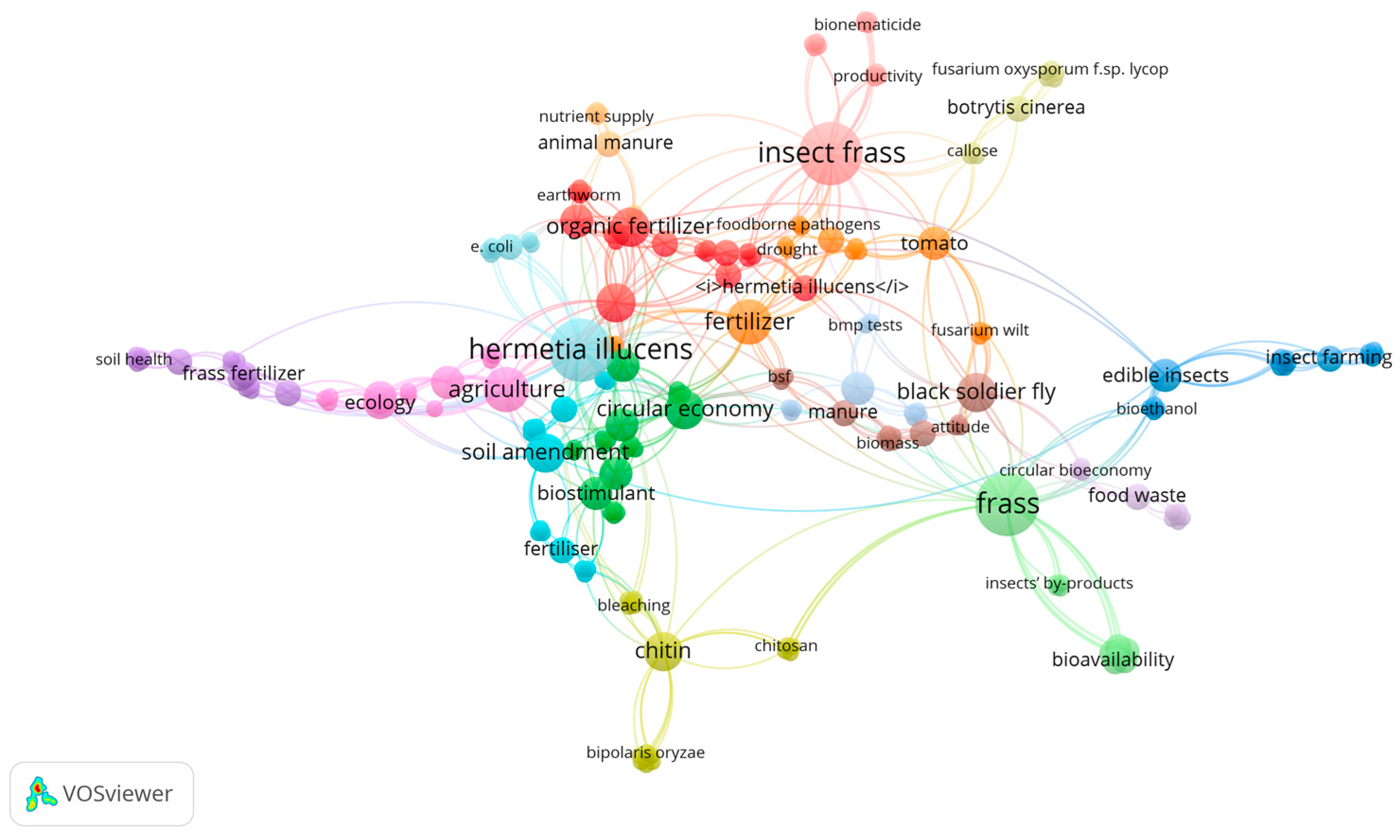
In addition to the structured narrative synthesis, a complementary bibliometric analysis was performed using VOSviewer software (version 1.6.20) (Centre for Science and Technology Studies, Leiden University, The Netherlands) to visualize thematic relationships within the literature included in this review. A keyword co-occurrence network was generated from the bibliographic records of the selected studies in order to identify dominant themes, thematic clustering, and the overall structure of the research field (Figure 1). Node size reflects keyword frequency, link strength reflects co-occurrence intensity, and colors indicate clusters of related terms. Because the included studies were heterogeneous in design, endpoints, and reporting units, this analysis was used only as a descriptive mapping tool and was interpreted in support of, rather than in place of, the critical qualitative synthesis.
The keyword co-occurrence map indicates that the literature is organized around a central core dominated by insect frass, frass, and Hermetia illucens, with closely connected agronomic terms such as fertilizer, organic fertilizer, soil amendment, and agriculture. Additional clusters connect this core to circular-bioeconomy themes, plant-defense and pathogen-related terms, and safety-oriented topics, including hygiene and foodborne risk. Overall, the map supports the interpretation that current research is centered mainly on black soldier fly-derived frass and its agricultural use, while broader valorization and safety themes remain present but less developed.
During the preparation of the manuscript, ChatGPT (OpenAI; model: GPT-5.4 Thinking) was used to support drafting and to improve the language, clarity, and readability of the text. Its use was restricted to editorial assistance and did not involve the generation or analysis of primary data, statistical analysis, scientific decision-making, or independent reference validation. All literature screening, source selection, interpretation of findings, citation verification, and final editing were conducted by the authors.

3. Legislative and Regulatory Framework

The regulatory positioning of insect frass depends first on the legal status of the material and then on the function claimed for the marketed product. In the EU, this sequence is decisive. Frass enters regulation through the ABPs framework, not through the fertilizing law in the first instance. Commission Regulation (EU) 2021/1925 inserted a legal definition of frass into Regulation (EU) No 142/2011 and aligned its treatment and placing on the market with the requirements applicable to processed manure [5,21]. Commission Regulation (EU) 2025/1377 further amended that framework by introducing standard transformation parameters for composting and biogas transformation of frass [6]. Consequently, regulatory assessment must begin with the permissibility of the rearing substrate, the applicable hygienization or transformation route, and the relevant endpoint in the ABPs chain, rather than with agronomic performance alone [5,6,21,22].
Once the relevant ABPs requirements have been met, the regulatory route depends on the product claim. Regulation (EU) 2019/1009 governs CE-marked EU fertilizing products, but it does not apply to ABPs or derived products that remain subject to Regulation (EC) No 1069/2009 when made available on the market, nor does it apply to PPPs within the scope of Regulation (EC) No 1107/2009 [9,10]. Within Regulation (EU) 2019/1009, a plant biostimulant is defined functionally, namely as a product that stimulates plant nutrition processes independently of the product’s nutrient content. This distinction is central for frass. Where the intended function is nutrient supply or soil improvement, the relevant route is fertilizing law; where the marketed claim concerns disease suppression, pesticidal activity, or another plant protection function, the relevant route is plant protection law rather than fertilizing law [1,9].
Outside the EU, the available official sources support heterogeneity rather than a single comparable pathway. In Canada, fertilizers and supplements are regulated federally, and some fertilizers and most supplements require pre-market assessment and registration by the Canadian Food Inspection Agency. In the United States, fertilizer and soil-amendment oversight is primarily state-based, with the Association of American Plant Food Control Officials providing model bills, official terms, and uniform policy material used by state regulators. By contrast, U.S. Environmental Protection Agency registration is relevant where a product is marketed with pesticidal claims. It is therefore more accurate to characterize non-EU regulatory pathways for insect frass as contingent on the applicable legal framework and the nature of the claim being made, rather than as reflecting a uniform international model [23,24,25].
Scientific evidence explains why regulatory classification cannot be separated from processing and characterization. Van Looveren et al. showed that heat treatment at 70 °C for 60 min strongly reduced inoculated Salmonella and Clostridium perfringens, but produced only limited reductions in total microbial counts and did not eliminate bacterial endospores [20]. De Volder et al. further showed that compliance with EU microbiological safety requirements depends on the interaction of temperature, residence time, frass type, and storage conditions, rather than on nominal treatment conditions alone [19]. In parallel, compositional studies report substantial variability in nutrient concentrations and physicochemical properties across insect species, substrates, and production systems, indicating that frass cannot be treated as chemically uniform input. Reviews of frass valorization therefore converge on a practical conclusion: defensible fertilizer or soil improver positioning requires product characterization and verified compliance with hygiene and market requirements, whereas plant biostimulant claims require evidence for a biostimulant function as legally defined and should not be inferred from general growth-promotion observations alone [2,7,8,13,19,20,26].

4. Market Positioning, Specification Requirements, and Forecast Uncertainty

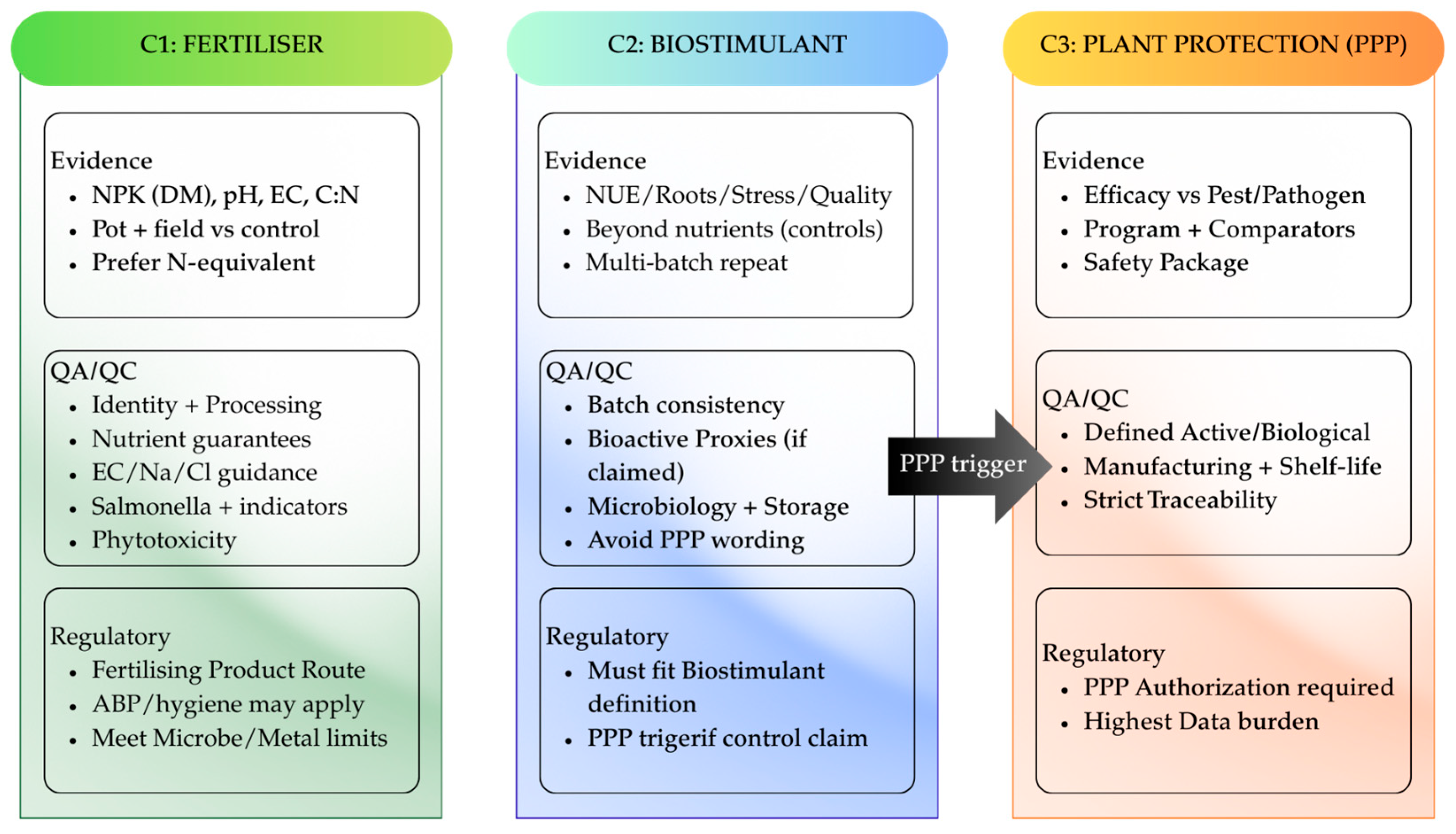
Industrial insect production has expanded primarily in feed-oriented systems and in the conversion of organic side streams, which has increased interest in frass valorization as a co-product rather than an internal residue stream [2,18]. This development is consistent with the circular bioeconomy logic of insect production, whereby organic substrates are converted into insect biomass while a residual nutrient and organic matter fraction may be returned to soil through frass application [2]. Within agricultural input markets, the most defensible positioning of frass is as an organic fertilizer and/or soil improver. A general plant biostimulant designation is not supported by the present evidence base, because frass is chemically and biologically heterogeneous and reported plant responses are often compatible with nutrient supply, organic matter input, and microbially mediated soil effects rather than with a demonstrated biostimulant mode of action [11,13,27]. Where biostimulant positioning is considered, it should therefore be supported by evidence for characterized constituents or verified effects that cannot be explained by nutrient supply alone [4,13]. A claim-led regulatory decision framework for insect frass products, including the corresponding evidence and QA/QC requirements, is summarized in Figure 2.
Market credibility depends on the product specification definition. Available studies show substantial variation in nitrogen, phosphorus, potassium, pH, EC, carbon to nitrogen ratio, moisture, and microbiological composition across insect species, feed substrates, and processing conditions [26,27,28]. This variability precludes treating frass as a uniform commodity and requires product characterization. Accordingly, credible market positioning should rely on transparent declarations of nutrient content on a stated basis, organic matter or VS where relevant, carbon to nitrogen ratio, pH, EC, moisture, and hygienic status. These descriptors are not only a labelling matter. They are necessary for comparability across products, for agronomic interpretation, and for user confidence [4,26,28]. Recent methodological work has further emphasized the need for standardized descriptors and harmonized analytical practice to improve comparability among frass studies and support more reliable product evaluation [4].
Adoption is further conditioned by safety and processing. Reviews consistently identify microbiological, chemical, and physical hazards as central constraints on frass valorization and show that these risks depend on the rearing substrate, insect species, hygiene management, and storage conditions [2]. Primary studies have demonstrated that heat treatment can reduce recoverable microbial indicators and pathogens, but they also show that microbiological compliance depends on the interaction of treatment conditions and subsequent storage behavior rather than on nominal heating alone [19,20]. In parallel, agronomic studies have indicated that fertilizer function may be retained after processing where nutrient content is conserved, yet the magnitude and direction of crop and soil responses remain product and context-dependent [8,28]. Moisture reduction, stabilization, and densification may improve storage stability, transport, handling, and field application practicality, but these operational gains should not be interpreted as evidence of agronomic equivalence among frass products [4,28].
Quantitative statements on market size and growth require greater caution than the agronomic literature. Because evidence does not currently provide harmonized frass sales datasets, auditable trade statistics, or reproducible time series, this review does not attempt formal market sizing. Scientific evidence is therefore not yet sufficient for deterministic global valuation or robust Compound Annual Growth Rate (CAGR) forecasting. The most defensible outlook is conditional: the addressable market for frass is likely to expand as insect farming scales, but durable adoption will depend on whether producers can supply materials with reproducible specifications, validated hygienic quality, and claims that do not exceed the evidence base [2,4,18]. At present, frass is more accurately described as an emerging co-product market with plausible growth potential than as a mature market that can already be forecast with confidence.

5. Frass Composition

5.1. Chemical Composition (Nitrogen, Phosphorus, and Potassium (NPK), Organic Matter, C:N, Macro/Micronutrients)

Insect frass marketed as an organic fertilizer is chemically heterogeneous. Its nutrient density, organic matter fraction and salinity are shaped by (i) insect species, (ii) the nutrient profile and mineral additives of the rearing substrate, and (iii) downstream handling (e.g., drying/heat treatment, storage and maturation), which can shift specific characteristics, including plant mineral N pools (e.g., NH4+-N) and microbial activity indicators, with implications for soil application [27,28]. Cross-study comparisons also require caution because pH, EC, mineral N, and plant-available P were not measured under identical extraction and analytical conditions in the available literature [28,29].
Available evidence indicates that the chemical composition of frass is strongly species-dependent, reflecting differences in insect metabolism, feeding behavior, and substrate conversion efficiency. Comparative studies have shown substantial variability in nutrient concentrations, carbon-to-nitrogen ratios, and mineral nitrogen forms among species such as Hermetia illucens, Tenebrio molitor, and orthopteran insects (Table 1) [28,30]. However, cross-study comparability remains limited due to differences in analytical methods, substrate composition, and processing conditions. As a result, species-specific trends should be interpreted with caution, and standardized characterization approaches are needed to enable more robust comparisons across frass types.

5.1.1. Macronutrients (NPK) and Plant-Available Fractions

Primary studies consistently show that frass can contain agronomically relevant N, P, and K, but the magnitude and form of these nutrients vary substantially among products. In mealworm frass, Houben et al. reported, on a dry matter basis, organic C of 393 g kg−1, total N of 50 g kg−1, total P of 20 g kg−1, and total K of 17 g kg−1, with pH 5.8 and EC 5.3 dS m−1 [29]. In a laboratory comparison of black soldier fly (BSF), yellow mealworm (YMW), and Jamaican field cricket frass, Praeg and Klammsteiner found marked species differences in plant nutrient pools, with NH4+-N reaching approximately 7000 μg g−1 total solids, nitrite and nitrate-N up to approximately 150 μg g−1 total solids, and plant P slightly above 20 mg g−1 total solids [28]. In the nine species comparison by Beesigamukama et al., all frass materials contained relevant macronutrients, but nutrient concentrations and potential supply capacities differed sharply among species [30]. Comparative work against poultry litter likewise shows that frass advantages are nutrient-specific rather than universal: Amorim et al. found higher mean C and N in mealworm frass, but lower mean K, Ca, S, and micronutrients than poultry litter. The defensible conclusion is therefore not that frass possesses a fixed NPK profile, but that NPK must be reported product by product and, where possible, together with plant fractions rather than total concentrations alone [27,28,29,30].

5.1.2. Organic Matter, Carbon Content and C:N Ratio

Frass typically contains substantial organic carbon originating from undigested feed residues, exuviae and associated microbial biomass, but the functional implications depend strongly on C:N and salinity. Houben et al. showed that mealworm frass contained a large labile C fraction and mineralized rapidly under incubation, indicating that at least some frass products can release nutrients quickly [29]. By contrast, Gärttling and Schulz, in their compilation of BSF frass analyses, described frass as a nutrient-rich fertilizer with substantial variability, a relatively high C:N ratio, and low shares of ammonium N, all of which point to limited immediate N release in many BSF products [26]. Praeg and Klammsteiner reinforce the point that C:N is product-specific rather than intrinsic to frass, reporting values of approximately 15.1 in BSF frass, 10.9 in mealworm frass, and 6.4–6.8 in cricket frass [28]. Likewise, Beesigamukama et al. reported total organic carbon values spanning 24% to 50% across nine insect species [30]. Taken together, these studies show that organic matter should not be treated as a generic positive attribute; its agronomic meaning depends on carbon quality, nitrogen form, C:N ratio, and subsequent processing.

5.1.3. Secondary Nutrients and Salinity

Frass can also supply secondary nutrients, but salinity is a recurrent quality constraint. Beesigamukama et al. reported calcium concentrations ranging from 0.3% to 3.5% across nine insect species, together with broad differences in Mg and S supply potential [30]. Praeg and Klammsteiner observed EC values in the approximate range of 4.1 to 5.1 mS cm−1 across three commercial frass types, whereas Beesigamukama et al. found that all nine frass fertilizers exceeded 6 mS cm−1 and explicitly associated high EC and salt concentrations with poor germination performance in most materials [28,30]. Houben et al. also reported a relatively elevated EC for mealworm frass. This evidence supports a more cautious formulation: salinity is not a peripheral parameter but a core product specification variable that should accompany nutrient claims, especially where frass is proposed for salt-sensitive crops, low-buffering substrates, or nursery systems. Where EC is high, post-treatment, such as maturation, leaching, or composting, may be necessary before agronomic [28,29,30].

5.1.4. Micronutrients

Micronutrients are present in frass at concentrations that may contribute to plant nutrition, with marked variation among insect species and production systems. In Beesigamukama et al., frass fertilizers from nine edible insect species contained approximately 128–4460 mg kg−1 Mn, 436–43,333 mg kg−1 Fe, 13.8–208 mg kg−1 Zn, 4.3–30.6 mg kg−1 Cu, and 5.8–118 mg kg−1 B [30]. Mealworm frass characterized by Houben et al. also contained Zn and Cu at approximately 94.2 and 10 mg kg−1, respectively [29]. These data support describing frass as a multi-nutrient organic input, but the agronomic relevance of its micronutrient content should be interpreted against soil-test status, crop demand, application rate, and product-specific contaminant screening rather than as an intrinsic advantage.

5.1.5. Contaminants and Chemical Safety Considerations

Beyond nutrient composition, contaminants and pollutant characterization should be treated as a distinct analytical requirement. The currently available literature indicates that data on chemical contaminants in frass remain limited and that contaminant occurrence depends on feed substrate, contaminant type, and insect species, while transmission to crops and the environment after frass application is still insufficiently characterized [3]. Mycotoxins, heavy metals, pesticide residues, dioxins/dioxin-like compounds, and residues of veterinary drugs are the principal hazard groups discussed in the current evidence base, but direct frass datasets remain uneven across these categories.
Available primary studies support a product-specific interpretation rather than a generic one. In BSFL systems reared on vegetable and butchery wastes, toxic elements in larvae remained below EU maximum values for feed materials, yet frass composition still varied substantially, and the V100 frass showed the highest concentrations of As, Cd, and Pb among the tested treatments [31]. By contrast, in the mealworm frass studied by Amorim et al., As, Cd, Cr, and Pb were nearly absent relative to poultry litter [27]. Likewise, Gómez-Brandón et al. reported the absence of Salmonella spp. and heavy-metal levels within permissible limits for the frass fertilizers studied [32]. Taken together, these results do not support blanket safety assumptions for frass, but they do support the need for contaminant screening linked to substrate origin and production system.
Among organic contaminants, mycotoxins currently have the clearest frass-specific evidence base. Ivanova et al. showed that BSFL exposed to feed containing 29 mg deoxynivalenol kg−1 had low deoxynivalenol concentrations in larvae but high deoxynivalenol concentrations in frass, and concluded that such frass should be excluded from downstream agricultural or feed use [33]. Veterinary drug residues also deserve explicit consideration, because experimental evidence shows that several veterinary drugs and their metabolites can be detected in larvae and frass after exposure via substrate [34]. Accordingly, pollutant-related assessment should be treated as a product-specific requirement, and nutrient or micronutrient composition should be reported separately from targeted contaminant screening [3,34].

5.2. Bioactive Components (Chitin, Peptides, Hormones)

Evidence for biological activity beyond direct nutrient supply should be framed more narrowly than is common in the recent review literature. The most defensible position is that some frass materials may co-deliver microorganisms, particles rich in chitin, and labile organic fractions capable of altering rhizosphere processes. However, the literature does not justify treating all frass products as biologically equivalent. This distinction matters because several reviews discuss frass together with exuviae or broader insect residual streams rather than purified frass alone [4,11,13].

5.2.1. Chitin and Chitin-Rich Structures

Chitin is a β-(1→4)-linked polymer of N-acetyl-D-glucosamine and is a major structural component of arthropod exoskeletons; insect production residual streams therefore represent a plausible chitin input pathway to soils when frass/exuviae are applied on land [35]. Nurfikari and de Boer showed that insect production residual streams are credible chitin sources, and Barragán-Fonseca et al. emphasized that frass and exuviae may together influence plant growth and health [13,35]. Independent chitin studies also support biological plausibility: Takagi et al. reported systemic disease resistance in rice against Bipolaris oryzae after chitin supplementation of soil, and Riseh et al. synthesized broader evidence that chitin can activate plant defense pathways. What these studies do not establish is that commercial frass products routinely contain chitin in quantified, bioavailable, and agronomically effective concentrations. A more accurate formulation is therefore that chitinous fractions may contribute to plant defense responses when exuviae material is present and remains biologically accessible after processing, but that contribution must be demonstrated analytically for the material under study rather than presumed [13,35,36,37].

5.2.2. Peptides, Including Antimicrobial Peptides (AMPs)

Insect AMPs are a well established component of insect innate immunity [38]. However, that body of evidence should not be transferred directly to frass. The frass studies cited in this section focus on bulk composition, nutrient fractions, salinity, microbial communities, and processing effects; they do not provide targeted identification or quantification of AMPs in frass matrices after rearing, hygienization, and storage. For that reason, AMP agronomic effects should not be presented as an established property of frass products. At present, the strongest defensible statement is that AMP involvement remains hypothetical unless supported by matrix chemical detection and bioactivity assays performed on the frass product itself [28,29,38].

5.2.3. Hormone-like Effects

Claims of direct phytohormone delivery should likewise be restrained. The review literature more consistently supports indirect effects mediated by nutrient release, microbial activity, and rhizosphere modification than routine product detection of auxins, cytokinins, or gibberellins in frass. Poveda and Barragán-Fonseca et al. both discuss frass in relation to plant growth promotion and plant health, but the mechanistic basis is broad and not reducible to verified phytohormone content in frass itself [11,13]. The more recent synthesis by Jiang et al. emphasizes the combined roles of physicochemical properties, bioactive compounds, and beneficial microorganisms in BSF frass. In manuscript terms, the scientifically stronger wording is that frass may influence hormone plant traits indirectly through nutritional and microbiome pathways, whereas direct hormone activity should not be claimed without compound measurements in the product under study [11,12,13].

5.3. Microbial Communities and Functional Traits

Frass contains microbial communities derived from the insect gut, the rearing substrate, and post-excretion handling, but the available evidence shows that these communities are highly dependent on species and processing. Praeg and Klammsteiner found significant differences in microbial community composition among BSF, mealworm, and cricket frass and showed that heat treatment reduced microbial activity and biomass while altering hygienic indicators. At the same time, soil amended with frass exhibited reactivation of microbial activity, including large increases in respiration. This finding should be interpreted precisely: elevated microbial respiration indicates biological reactivation after organic input, not proof of a beneficial plant growth-promoting or disease-suppressive function per se. As a result, microbial functionality in frass should be discussed as a testable property requiring taxonomic, functional, and agronomic validation, rather than as an automatic co-benefit of frass application [12,28].
Table 1. Selected chemical and physicochemical characteristics of insect frass reported in the literature.
Species, Substrate, and Analytical BasisChemical CharacteristicsPhysicochemical CharacteristicsMicronutrient and Trace Element CharacteristicsInterpretive NoteStudy
Frass from food/feed insect speciesOverall mean: N 3.30%, P 1.30%, K 1.96%; species means included BSFL N 2.95%, YMW N 4.53%, HC N 4.52%Overall mean C/N 13.1, overall mean pH 7.39; species means: BSFL C/N 13.8, pH 7.78; YMW C/N 10.8, pH 6.10; HC C/N 12.3, pH 6.51Not used here as a micronutrient source table, but as a cross-study benchmarkUseful as a broad reference frame, but not as a product specification because the underlying studies differ in species, substrates, and analytical methodsSafitri et al. [3]
Tenebrio molitor frass; wheat-bran diet; dry matter basisOrganic C 393 g kg−1, total N 50 g kg−1, total P 20 g kg−1, total K 17 g kg−1pH 5.8, EC 5.3 dS m−1; soluble C fraction 49.3% of organic C; hemicellulose-like 31%, cellulose-like 15.2%, lignin-like 4.4%Cu 10 mg kg−1, Zn 94.2 mg kg−1Illustrates a nutrient-rich frass with a large labile-C fraction and rapid mineralization potentialHouben et al. [29]
Fresh and heat-treated frass from BSF, YMW, and Jamaican field cricket; values reported on total solids basisNH4+-N up to 6988.55 μg g−1 TS (BSF); NO2+NO3-N up to ~150 μg g−1 TS; plant-available P > 20 mg g−1 TS in BSF frassFresh-frass pH 6.24–7.66; post-treatment EC 4.55–5.09; C:N ~15.20 (BSF), 10.93 (YMW), 6.38–6.82 (JFC)Not a micronutrient-focused paper; major contribution is nutrient-form and species comparisonShows that species identity, more than heat treatment, strongly shapes nutrient form and likely fertilizer behaviorPraeg & Klammsteiner [28]
Air-dried frass from nine edible insect species; n = 3Total organic C 24.1–49.6%; ammonium 0.01–56.1 mg kg−1; nitrates 0.01–361.7 mg kg−1; N, P, and K varied markedly among species; H. illucens had the highest N and K concentrations, while G. bimaculatus had the highest P concentrationpH 4.6–8.3; EC 6.7–25.1 mS cm−1; C/N 13.2–22.9; germination index ranged from 5.8% to 267.1%Mn 128–4460 mg kg−1, Fe 436–43,333 mg kg−1, Zn 13.8–208 mg kg−1, Cu 4.3–30.6 mg kg−1, B 5.8–73.2 mg kg−1, Na 170.7–7623.3 mg kg−1Strong variability; many materials were saline and/or phytotoxic before further stabilization, so this dataset is particularly useful for maturity and salinity screeningBeesigamukama et al. [30]
Two oven-dried commercial BSFL frass products (A and B)Total N 3.6–3.9%, total P 1.3–1.6%, total C 44.4–44.7%, K 2.5%; NH4+-N 1392.0–2721.3 mg kg−1, NO3-N 20.3–50.4 mg kg−1; authors note that 98% of mineral N was NH4+pH 6.92–8.54, EC 8.08–11.84 mS cm−1; frass extract mean pH 8.13, EC 10.92 mS cm−1Fe 664.7–1236.0 mg kg−1, Zn 101.7–205.8 mg kg−1, Ca 16.2–26.0 g kg−1, Mg 1.2–5.5 g kg−1Demonstrates substantial between-product variability within BSFL frass itself; ammonium dominance and salinity are agronomically importantSalomon et al. [39]
Frass from T. molitor, G. mellonella, H. illucens, and A. domesticus; dried and sieved materials compared with Eisenia fetida vermicompostAcross frass types: C 34.8–41.9%, N 2.9–6.4%, P 0.77–1.44%, K 0.99–3.02%, Ca 0.19–2.21%, Mg 0.15–0.66%, Na 0.03–0.60%, S 0.21–0.53%, Si 0.04–1.32%Frass from G. mellonella, A. domesticus, and especially T. molitor had pH < 7, whereas H. illucens was slightly alkaline; except for A. domesticus, frass EC values were similar to EFV (2.30–5.77 dS m−1); T. molitor and A. domesticus showed GI < 30Highest trace levels in A. domesticus included Fe 871 ppm, Cu 66.2 ppm, Mn 473 ppm, Zn 587 ppm, Cd 0.17 ppm, Pb 1.03 ppm; G. mellonella was richest in B 756 ppm; H. illucens had the lowest Cd (0.04 ppm)Particularly useful for species-to-species formulation comparisons and for linking chemistry with phytotoxicity/ecotoxicity outcomesCastillo et al. [40]
BSFL frass from four substrates: control, V100, V50B50, and V75B25Frass mineral profile varied strongly with substrate: As 0.72–5.10 μg kg−1, Cd 0.32–1.52 μg kg−1, Pb 5.33–43.17 μg kg−1, Ca 20.34–333.80 mg kg−1, P 57.42–192.40 mg kg−1, K 127.40–1227.0 mg kg−1, Mg 23.69–95.83 mg kg−1pH and EC were not reported as the main focus; the study is primarily a mineral/heavy-metal distribution paperThe V100 frass had the highest As, Cd, Pb, K, and Mg; the control group had the highest Se, Zn, Ca, and PBest used to demonstrate that substrate composition can materially alter frass mineral and heavy-metal profile, even within the same insect speciesAddeo et al. [31]

6. Mechanisms of Action as Fertilizer, Biostimulant, and Plant Defense

Across the current literature, the agronomic effects of frass are explained by three interacting pathways: nutrient supply, microbial mediation, and elicitor responses linked chiefly to residues containing chitin and related biological molecules. That conceptual framework is now well established, but the evidence base remains uneven because many studies do not separate nutrient effects from biological effects with nutrient controls, salinity controls, or active-fraction comparisons. For this reason, improved crop performance should be attributed first to fertilizer action unless study design demonstrates an effect beyond nutrient supply [11,13,28].

6.1. Fertilizer Function: Nutrient Pools and Transformation Kinetics

6.1.1. Mineral and Organic Nitrogen Dynamics

Nitrogen remains the most consistently supported mechanism underlying the agronomic performance of frass. In a comparative laboratory study, Praeg and Klammsteiner reported pronounced variation among BSF, YMW, and Jamaican field cricket frass, with nutrient concentrations reaching up to 7000 μg NH4+-N g−1 total solids, 150 μg NO2–NO3-N g−1 total solids, and 20 mg available P g−1 total solids. Those values show that frass chemistry is product-specific and that the mineral N pool can be substantial in some products [28].
The soil response to frass is also consistent with rapid biological turnover rather than uniformly slow nutrient release. Watson et al. applied frass at 2.5% and 5% (w/w) in a 28-day incubation and measured increases in microbial biomass, carbon mineralization, and nitrification; in a separate 56-day incubation, the same study also evaluated metal bioavailability in a contaminated substrate [41]. Houben et al., working with mealworm frass and barley, likewise concluded that frass had high fertilizer potential, with N, P, and K concentrations comparable to farmyard manure and, in some respects, poultry manure [29]. Together, these studies indicate that frass commonly delivers a readily cycling nutrient fraction that can enter active microbial turnover soon after.
Field evidence points in the same direction. Beesigamukama et al. compared BSF fertilizer with a commercial organic fertilizer and urea at 0, 2.5, 5, and 7.5 t ha−1 and at 0, 30, 60, and 100 kg N ha−1 to establish nitrogen fertilizer equivalence for maize. Maize grown in plots treated with BSF frass had greater chlorophyll concentration and stronger N uptake than the commercial organic comparator at equivalent rates, indicating that N supply and N-release synchrony are major determinants of crop response under field conditions [17]. On that basis, frass should not be described as a uniformly slow-release fertilizer; rather, its N behavior depends on insect species, feed substrate, processing history, and soil conditions [17,28].

6.1.2. Phosphorus and Potassium Responses

The evidence for P and K supply is also robust, although it is mechanistically less distinctive than N. Houben et al. found increased P and K uptake with mealworm frass in barley. Antoniadis et al., in a 60-day spinach pot experiment using 0, 0.25, 0.5, and 1% frass plus a mineral NPK control, reported that soil organic matter increased from 2.7% in the unamended control to 3.2% at 1% frass. The same study found enhanced plant N uptake with increasing frass rate, while nitrogen use efficiency remained statistically unchanged, indicating that crop response was primarily linked to added nutrient supply rather than to an efficiency gain beyond fertilization [29,42].
These data support a conservative interpretation. Frass can function effectively as an organic NPK fertilizer and as a source of organic matter, but apparent gains in nutrient-use efficiency should not be presented as evidence of a biostimulant effect unless the comparison treatment is equivalent to NPK. This distinction is not semantic. It determines whether the observed response can be explained by macronutrient balance alone or whether a separate biological mechanism is required [42,43].

6.1.3. Reactive Organic Matter, Salinity, and Micronutrient Dynamics

Frass is also a reactive organic amendment, and that property has two consequences that deserve more explicit treatment. First, labile organic substrates can stimulate microbial turnover and short-term nutrient transformation. Second, some frass products carry high EC, which can confound interpretation if not controlled. Watson et al. reported high EC across frass types, mildly acidic to neutral pH, and C:N ratios between 11 and 16, alongside altered microbial processes and metal bioavailability. In practical terms, this means that improved plant performance after frass application may reflect a combination of nutrient supply, short-term microbial stimulation, and product chemistry rather than a distinct biostimulant effect [41].
Salinity and formulation must be controlled when the mechanism is discussed. Where EC is high or where mineral N is concentrated in the ammonium pool, any claim of improved root growth, nutrient uptake, or stress tolerance requires a comparator matched not only for N, P, and K, but also for ionic load. Without that control, the mechanism remains unresolved [28,41].

6.2. Effects on Plant Growth Pathways Beyond Direct Fertilization

6.2.1. Rhizosphere Restructuring and Microbial Mediation

Literature does support the view that frass can restructure the rhizosphere, but most of this evidence remains correlative. Van de Zande et al. compared frass and exuviae from three insect species at three concentrations against synthetic fertilizer and showed that the amendments changed rhizosphere bacterial community composition while also affecting shoot growth and shoot C:N ratio in a Brassica system. Watson et al. similarly reported changes in microbial biomass and soil process rates after frass addition. These are relevant findings, but they do not on their own establish causality between community shift and plant response [41,44].
That distinction is important because at least two mechanisms can generate the same observation. Frass may introduce viable microorganisms, or it may stimulate resident soil microbiota through the addition of labile carbon and nutrients. Praeg and Klammsteiner help separate these mechanisms: heat treatment reduced microbial activity, microbial biomass, and viable counts in the frass, yet much of the fertilizer value remained, and soil-biological responses were not eliminated after application. Accordingly, rhizosphere change should not be described as proof of inoculation by beneficial microorganisms unless live-versus-inactivated comparisons are performed under nutrient conditions [28].

6.2.2. The Role of Chitinous Residues as Selective Substrates and Elicitors

Chitin is one of the most plausible non-nutritional mechanisms associated with frass, but literature supports it more strongly as a selective microbial substrate than as a universally demonstrated plant elicitor. In a non-frass system, De Tender et al. showed that substrate amended with chitin shifted the lettuce rhizobiome toward higher abundance of taxa and functions linked to chitin degradation, siderophore production, and N cycling [45]. Barragán-Fonseca et al. and Poveda interpreted insect frass and exuviae through this same lens, arguing that insect residues may promote plant growth and health by modifying rhizosphere functioning and, in some systems, priming plant defense [11,13].
Recent work with frass extracts enriched with chitin provides stronger system evidence. Kisaakye et al. reported that BSF frass extracts fortified with chitin suppressed Meloidogyne incognita egg hatchability by 42%, achieved 95% juvenile mortality and up to 100% paralysis in vitro, and reduced gall development by up to 85% in spinach relative to the control. Those results support the view that frass fractions containing chitin can contribute to plant-protection outcomes. They do not, however, justify treating chitin as the universal active principle of frass, because the tested product was a fortified extract rather than unmodified frass and because nutrient, microbial, and elicitor effects were not fully disentangled [46].

6.2.3. Heat Treatment, Hygienization, and Retention of Agronomic Function

Heat treatment is central to the mechanism because it partially separates microbial viability from fertilizer performance. Praeg and Klammsteiner found that hygienization reduced microbial activity, microbial biomass, and viable counts of Escherichia coli and Salmonella spp., while leaving the main nutritional properties largely intact. This result is important for two reasons. First, it shows that much of frass’s fertilizer value is not dependent on live microbiota. Second, it shows that a loss of viable microbes does not imply a loss of all downstream soil-biological effects after application [28].
From a regulatory and product-claims perspective, this distinction matters. The present evidence base supports fertilizer claims more strongly than broad biostimulant or plant-defense claims, because fertilizer function is retained more consistently across processing conditions. If a producer wishes to claim microbial or elicitor activity, the burden of proof should be higher and should include nutrient controls, live-versus-inactivated comparisons, or fractionation of the active material. Without such evidence, hygienized frass should be discussed primarily as a fertilizer product with potentially variable ancillary biological effects [13,28].

6.2.4. Plant Defense, Disease Suppression, and Antimicrobial Activity

Defense claims require the most careful treatment because improved plant health can result indirectly from improved nutrition and vigor. Blakstad et al. offer one of the clearest mechanistic studies available. Using 2% sterilized mealworm frass, they observed significant tomato growth promotion, found no induction of local root callose deposition in Arabidopsis under the tested conditions, and reported systemic defense activation against Botrytis cinerea. The main conclusion is therefore not that frass is generically a defense elicitor, but that non-living frass components can contribute to defense priming in at least some pathosystems [47].
Stronger agronomic evidence is now available in maize. Mutyambai et al. used a nutrient design in which N was standardized, and P and K were topped up to maintain equivalent supply across treatments. Their field trial followed a randomized complete block design with three replicates, and the authors tested normality and homogeneity of variance before ANOVA. Under those conditions, BSFF fertilizer increased maize growth, upregulated genes related to defense, and enhanced resistance to Spodoptera frugiperda. This is one of the more convincing studies showing that defense responses can persist after nutrient supply is controlled, although the causal agent within frass was still not isolated [43].
The evidence for disease suppression is also stronger than a simple in vitro antimicrobial narrative. Arabzadeh et al. amended tomato substrate at 10% (v:v) with BSF from two larval diets and showed that frass derived from the Gainesville diet reduced Fusarium oxysporum f. sp. lycopersici root colonization and disease severity more than frass from the fruit/vegetable/bakery/brewery diet or a commercial compost. Crucially, that stronger suppression persisted after pasteurization at 7 °C for 1 h, indicating that the effect could not be attributed exclusively to viable microorganisms in untreated frass [48,49].
Vitti et al. further showed that seed priming with 10% pasteurized Hermetia illucens frass extract reduced damping-off caused by Fusarium sporotrichioides in durum wheat. Damping-off incidence fell from 85.0 ± 4.08% in the infected control to 53.75 ± 4.79% with frass extract alone, and the combined frass extract plus Trichoderma afroharzianum T22 treatment reduced damping-off to 47.50 ± 2.89%. The same study also reported increased antioxidant activity and isolated Paenibacillus polymyxa from the frass extract, which showed antifungal activity in vitro. These findings are relevant, but they should be described as formulation-specific because the tested material was a pasteurized aqueous extract rather than bulk frass [49].
In vitro antimicrobial studies should be treated even more narrowly. Arabzadeh et al. found that BSF frass extracts inhibited several fungal and oomycete pathogens, but also showed that the antagonistic effect was associated with microorganisms, particularly Bacillus velezensis, rather than with a stable, freely soluble antimicrobial compound. The manuscript should therefore avoid characterizing antimicrobial activity as an intrinsic chemical property of frass unless activity is retained after sterile microfiltration or the active metabolites are isolated and identified [48].

6.3. Synthesis, Implications, and Evidence Standard

The present literature supports a clear hierarchy of confidence. Fertilizer action is the best-substantiated general mechanism. Rhizosphere restructuring is plausible and moderately supported, but in most studies it is not disentangled from nutrient and substrate effects. Defense priming and disease suppression are supported in selected systems, particularly where sterilized frass, pasteurized frass, nutrient controls, or assays based on extract have been used, but these responses remain product-specific rather than generic. Methodologically, the field is still dominated by short-term incubations and pot studies; field-scale studies with rigorous nutrient matching and mechanism controls remain limited [17,42,43,44].
Mechanistically, positive effects on plant growth and, under some field conditions, yield are most plausibly observed when frass acts primarily as a nutrient source and when nutrient release is reasonably synchronized with crop demand [17,50]. By contrast, negative or weak responses are commonly associated with high electrical conductivity, concentrated ammonium, or feedstock-dependent nitrogen immobilization, which can constrain germination, nutrient uptake, and early crop growth [8,28,39,41]. Reported plant responses should therefore not be generalized as uniformly beneficial effects of frass, but interpreted as conditional outcomes of nutrient form, product chemistry, processing history, and crop–soil context [8,28,51].
Claims concerning biostimulant function, induced resistance, or disease suppression should be supported by a higher evidential standard that includes nutrient comparisons and direct tests of the active fraction. This approach would improve reproducibility, reduce over-claiming, and better align environmental management with the quality of the available evidence [13,28,41].

7. Agronomic Efficiency

A credible evaluation of insect frass as a fertilizer requires benchmarking against mineral fertilizers or established organic amendments on a nutrient basis, together with explicit attention to dose, mineral-N form, EC, and processing history. On that basis, the current literature supports a restrained but positive conclusion. Frass can function as an agronomically effective nutrient source, particularly where rates are aligned with crop demand and where product chemistry does not create germination or salt constraints. However, the substitution value of frass is not universal. The evidence base remains dominated by maize field studies, greenhouse and pot trials, and a smaller set of forage and substrate experiments, with substantial heterogeneity in feedstock, insect species, processing, and rate expression. For that reason, agronomic claims should be anchored in nutrient comparisons and should distinguish clearly between direct substitution, complementary use in integrated nutrient management, and biological effects that extend beyond nutrient supply. Representative agronomic studies illustrating these contrasts across crops, systems, comparator designs, and processing histories are summarized in Table 2.

7.1. Crop Productivity and Substitution Value

The strongest field evidence for agronomic efficiency remains in maize. In Kenyan field trials, BSFF fertilizer increased maize yield and nitrogen efficiency relative to comparator fertilizers, and when compared on a nitrogen basis, 100 kg N ha−1 supplied as BSFF fertilizer produced grain yields of approximately 5.7–6.2 t ha−1, with reported nitrogen fertilizer equivalence values of 102–114% relative to urea [17,50]. These findings indicate that, under the tested field conditions, frass can act as an agronomically effective N source rather than merely as a low organic amendment. Even so, the authors themselves show that performance depends on rate and season, and the evidence should not be generalized beyond comparable soils, crops, and management regimes.
Integrated nutrient studies provide additional, but different, evidence. In tomato, kale, and French bean, Anyega et al. found that combining composted BSF fertilizer with mineral NPK increased yields relative to sole NPK by 22–135% in tomato, 20–27% in kale, and 38–50% in French bean. These results are agronomically important, but they support complementarity more strongly than one-to-one substitution, because the best-performing treatments combined organic and mineral inputs rather than replacing mineral nutrition entirely. The practical implication is that frass fertilizers may be most useful as part of integrated nutrient management where they contribute carbon, nutrients, and soil biological stimulation, while mineral fertilizers continue to provide precise balancing of crop demand [52].
Evidence from greenhouse and substrate systems is promising but less transferable to field recommendations. Chavez et al. reported that BSF frass increased lettuce and arugula productivity relative to unfertilized peat and the amended with vermicompost in a peat greenhouse system, with the highest frass proportion tested (40% v/v) producing the greatest lettuce fresh and dry biomass under the reported conditions [57]. By contrast, Fuertes-Mendizábal et al. showed in lettuce that mealworm frass can improve aerial biomass at low inclusion rates, whereas rates of 2.5% or higher impaired plant performance, particularly root growth, in association with changes in substrate microbiology [58]. These studies taken together show that frass can perform well in controlled substrates, but also that agronomic efficiency in soilless or low-buffering media is highly rate-sensitive and cannot be inferred from field data alone.
Neutral outcomes are equally important for a balanced appraisal. In a two-year bermudagrass field study, Ashworth et al. found that mealworm frass, poultry litter, and ammonium nitrate produced broadly similar cumulative forage biomass, while all fertilized treatments modestly outperformed the unfertilized control [59]. In a greenhouse ryegrass experiment, Mirabello et al. observed similar biomass among frass, poultry litter, and NPK at the first harvest, but higher biomass under NPK at the second harvest despite higher N uptake in the frass treatment. Lower P and K uptake under frass was interpreted as a likely constraint on continued biomass accumulation [54]. These studies are important because they show that frass can maintain production and improve some soil indicators without necessarily producing a yield advantage.

7.2. Plant Nutrition and Efficiency of Nutrient Use

Assessment of plant nutrition should not rely on biomass alone. At a minimum, studies should report tissue nutrient concentrations together with nutrient uptake, because biomass gains can dilute nutrient concentrations without reducing total acquisition. Where possible, plant nutritional status should also be interpreted alongside Soil–Plant Analysis Development (SPAD) or chlorophyll indices and soil mineral-N data. Houben et al. provide a useful benchmark: mealworm frass contained substantial nutrient concentrations, approximately 50 g N kg−1, 20 g P kg−1, and 17 g K kg−1, but also a relatively high EC of 5.3 dS m−1. Under nutrient-equivalent pot conditions, barley biomass and N, P, and K uptake were comparable to mineral NPK, yet the authors were careful not to infer identical nutrient dynamics from similar biomass alone [29].
More recent work reinforces the need to separate nutrient sufficiency from dose escalation. In tomato, Salomon et al. characterized a commercial black soldier fly larvae (BSFL) frass product in which mineral N was dominated by NH4+-N and showed that shoot biomass plateaued between 150 and 250 kg N ha−1, whereas arbuscular mycorrhizal colonization was almost completely inhibited at rates ≥100 kg N ha−1. The agronomic significance is clear: once crop growth is no longer N-limited, further increases in frass N may add salinity or ammonium stress and reduce beneficial symbioses without improving biomass. Agronomic efficiency should therefore be interpreted using both productivity and biological co-indicators, particularly where frass products are rich in NH4+ or electrically conductive [39].
Ainta et al. provide a useful example of how nutrient uptake metrics clarify the interpretation of frass performance. In Chinese kale, the combined treatment consisting of 50% chemical fertilizer and 50% mealworm frass gave the highest reported nutrient uptakes for N, P, and K, while frass alone produced lower uptakes, especially for P and K. The study also reported a positive association between SPAD values and N uptake, supporting the use of chlorophyll indices as conservative indicators of improved N status rather than as evidence of non-nutritional stimulation. This type of paired chemical and physiological measurement should become standard in frass agronomy studies [60].
Nutrient interpretation benefits from parallel measurement of soil nutrient pools. Wang et al. showed that fresh BSFL frass and frass composts derived from pig and chicken manure increased soil available N, P, and K, NO3-N, and enzyme activities, together with maize seedling growth and seedling N and K accumulation. Frass composts tended to produce higher available N and NO3-N than the corresponding fresh frass treatments. These results support a practical inference that plant nutritional outcomes should be read together with mineral-N dynamics and processing history, rather than inferred from application rate alone [51].

7.3. Soil Responses Relevant to Agronomic Efficiency

Soil responses matter because agronomic efficiency is partly determined by nutrient release, microbial processing, and soil-function trajectories after application. In a controlled incubation and pot framework using seven BSF frass materials, Gebremikael et al. found that frass consistently increased microbial biomass C and enzyme activities, but nitrogen dynamics were highly contingent on feedstock and product properties. Net N immobilization persisted for more than 70 days, and only 4–20% of applied N was released by the end of a 103-day incubation. These data support a cautious interpretation: frass can improve soil biological functioning, but short-term crop response may remain constrained unless nutrient release is synchronized with crop demand [8].
Field evidence indicates that these soil responses can translate into measurable changes in soil fertility. In the bermudagrass study, repeated application of mealworm frass increased soil C, N, P, K, and Mg relative to ammonium nitrate while maintaining forage production at a comparable level [59]. Likewise, Wang et al. observed shifts in soil community structure and increases in urease, phosphatase, and sucrase activity after fresh frass and application of frass compost, even though bacterial richness did not increase significantly. These outcomes suggest that frass can function not only as a nutrient source, but also as a biologically active amendment capable of altering the soil resource environment. However, the direction and agronomic value of these changes remain conditional on frass type, processing, and baseline soil constraints [51].

7.4. Integration into Crop Production Systems

From an agricultural valorization perspective, the main benefit of frass lies in its conversion from an insect-rearing co-product into a usable fertilizing material that can return nutrients and organic matter to soil [2,61]. Current evidence indicates four main valorization benefits: partial substitution for mineral N under nutrient-equivalent field conditions [17,50]; complementary use in integrated nutrient-management systems [44]; improvement of selected soil fertility indicators and biological activity [8,51,59]; and contribution to nutrient recycling within circular bioeconomy systems [2,61]. However, these benefits depend on product characterization, processing history, salinity, mineral-N form, and crop–soil context.
The current evidence supports three practical integration pathways. First, in annual field crops, frass can partially substitute for mineral N where field studies have demonstrated nutrient performance and acceptable synchrony, as in maize under the conditions tested by Beesigamukama et al. [17,50]. Second, in horticultural systems and peat substrates, frass should be used cautiously and application rate should be optimized, because EC, NH4+ load, and germination sensitivity can constrain performance despite positive biomass responses at lower rates [57,58]. Third, in forage systems, repeated application may be justified where the management objective includes maintenance of yield together with improvement of soil chemical indicators, as shown by Ashworth et al. [59].
Processing history is central to system integration. Preliminary field evidence from Madagascar indicates that composting fresh BSF frass reduced NH4+-N by 63%, improved germination, and delivered the best agronomic performance among the treatments tested, but the study was conducted at a single site and over a single season and should therefore be interpreted cautiously [55]. More generally, the agronomic implication is that fresh frass and composted frass should not be treated as interchangeable products. Processing modifies phytotoxicity risk, nutrient form, and field usability, and these differences should be reported explicitly in both experiments and commercial specifications.
The evidence base also has clear limitations. Long-term, multi-site field trials remain scarce; rate expression is inconsistent across studies; nutrient controls are not universal; and many experiments report biomass without enough information on nutrient balances, salinity, or mineral-N speciation. For practice, this means that frass should be applied on a nutrient basis, with particular attention to EC, NH4+-N, and seed-zone placement. For policy and product evaluation, agronomic dossiers should require at least: nutrient composition on a dry-matter basis, EC, pH, mineral-N form, processing history, and evidence from nutrient comparisons before broad substitution claims are made. These recommendations concern agronomic evaluation. However, because practical deployment also depends on validated hygienization and storage conditions, the principal studies relevant to the microbiological compliance of processed frass are summarized in Table 3.

8. Circular Bioeconomy Role of Frass

In terms of circular bioeconomy, frass should be evaluated as a co-product of insect bioconversion rather than as an automatic sustainability benefit. Systems of insect rearing can upcycle organic side streams into larval biomass and a residual frass stream, and this side stream is generated in substantial quantities. Recent literature reviews indicate that approximately 2–4 t of frass may be co-generated per ton of edible insect produced, while BSFL systems treating food waste often generate frass in excess of one-third of the initial substrate mass. Frass can therefore contribute to nutrient-loop closure, but only where the material can be characterized, handled, and valorized without creating offsetting burdens through instability, storage losses, emissions, or costly post-treatment [2,61,62].

8.1. Nutrient Recycling and Fertilizer Substitution as the Primary Circular Pathway

The strongest evidence for the circular role of frass remains nutrient recycling through agricultural use. However, fertilizer substitution should be defined functionally rather than rhetorically. In a field study for nutrients on maize, BSFF fertilizer achieved higher nitrogen fertilizer equivalence than a commercial organic fertilizer at equivalent N application rates, especially at 30 and 60 kg N ha−1, but its N release was not fully synchronized with early crop demand. The authors estimated that 2–16 kg mineral N ha−1 would still be required between early vegetative growth and silking to compensate for temporary N deficits. This is important because the industrial production of ammonia remains highly energy- and carbon-intensive, consuming approximately 1–2% of global energy output and contributing about 1% of global carbon emissions. Accordingly, frass deserves substitution credit only when nutrient, plant fractions, and agronomic equivalence have been demonstrated under nutrient conditions [50,63].
This pathway is nevertheless conditional on product quality. Reviews of BSFL frass derived from food waste report wide ranges in pH (5.6–8.0), moisture content (30–72%), and C:N ratio (8:1–27:1), and they emphasize that food-waste-derived frass may remain wet, rich in ammonium, and biologically immature after harvest. Lopes et al. likewise describe BSF frass as biologically unstable and argue that post-processing is often required before soil application can be considered reliable. The circular value of land application is therefore greatest where frass is sufficiently stabilized, analytically characterized, and managed within realistic storage and transport constraints, rather than assumed to be directly field-ready by virtue of origin alone [61,64].

8.2. Secondary Valorization Routes: Anaerobic Digestion and Bioethanol

Where direct fertilizer use is constrained, secondary valorization routes can still contribute to a cascading model of circular bioeconomy. Hénault-Ethier et al. note that agriculture, horticulture, and retail remain the main current markets for frass, whereas biomethanization, composting, and biochar production are emerging alternatives. For AD, Wedwitschka et al. reported specific methane yields of 201 ± 9 to 287 ± 37 mL CH4 g−1 volatile solids (VS) across six BSF frass samples, while semi-continuous digestion of pilot-plant frass yielded 167 ± 15 mL CH4 g−1 VS. These values are comparable to the range reported for conventional livestock manures, but the same study showed that substrate composition strongly influences performance and that high nitrogen content must be managed to maintain process stability. AD should therefore be regarded as a technically plausible but sensitive to feedstock route whose circular value depends on local digester access, co-substrate availability, and the agronomic usability of the resulting digestate [2,65].
Bioethanol production from frass is currently best interpreted as an exploratory route rather than a mainstream circular pathway. In a laboratory case study using house cricket frass, Psarianos et al. reported ethanol concentrations of 12.56 g L−1 from frass hydrolysate alone and 30.57 g L−1 when frass hydrolysate was combined with sugar beet molasses. However, the same study emphasized the limitations of laboratory scale and the need for broader sustainability and scale-up assessment. On the present evidence base, bioethanol should therefore be framed as a contingent, site-specific cascade option rather than a general alternative to fertilizer valorization [66].

8.3. Environmental Performance and Methodological Constraints

The environmental performance of frass cannot presently be inferred reliably from insect life cycle assessments (LCAs) alone. Salomone et al. assessed a pilot bioconversion plant in which 10 t of food waste produced 300 kg of dried larvae and 3346 kg of compost. On a functional unit of 1 t food waste treated, the process resulted in 30.2 kg CO2-eq global warming potential, 215.3 MJ energy use, and 0.661 m2a land use. The study concluded that savings of land use were the main comparative advantage, whereas energy demand remained a major burden and estimates of global warming were still affected by uncertainty. Mertenat et al. similarly assessed a BSF waste-treatment facility rather than frass as a fertilizer product and found that direct emissions of greenhouse gas were 47 times lower than those of windrow composting; at the facility level, composting had roughly double the global warming potential of the BSF treatment system on a functional unit of 1 t wet biowaste. In that system, residue post-treatment and electricity were the dominant contributors. These studies are important, but they quantify facility performance rather than the environmental profile of frass as a distinct fertilizing product [67,68].
This distinction is methodologically decisive. Egas et al., in a review of 48 documents covering standards, guidelines, and studies on bio-based fertilizer LCAs, showed that many assessments do not justify the choice between attributional and consequential LCA and do not align functional units, allocation rules, biogenic carbon handling, or end-of-life assumptions. More recent comparative work has started to address this weakness. Bouhzam et al. compared composts, biofertilizers, and biostimulants on nutrient functional units and found that digestate was the most favorable option for climate impacts per ton of N and K, whereas vermicompost performed best for P; insect frass ranked among the lower-impact options, but its relative position remained sensitive to nutrient basis and assumptions underlying mineral fertilizer equivalence. For frass, environmental claims should therefore specify whether the analysis is facility-level or product-level and should use nutrient functional units whenever fertilizer substitution is invoked [69,70].

8.4. Economic and Governance Conditions for Circular Deployment

A limited but relevant economic signal is available for circular deployment of frass. In a modeled Italian agri-food by-product system, integration of local side streams into BSFL rearing reduced waste generation by 52% relative to reference composting and increased BSFL production value by 47-fold within the specific territorial scenario. However, these gains were explicitly context-dependent and relied on proximity to by-product suppliers, regional feedstock availability, and the possibility of valorizing both larvae and frass within the same local network. Economic constraints remain equally important. Wet frass often requires drying, maturation, or other post-treatment to improve handling, storage stability, and agronomic safety, yet the costs of these operations remain insufficiently quantified in the literature. Financial viability should therefore not be inferred from waste diversion alone. Rather, it depends on whether frass can be converted into a stable, marketable product without disproportionate downstream logistics and processing costs. Evidence from laboratory-scale bioethanol production further supports this caution, with reported production costs of €2.42–€3.22 L−1, indicating that non-agronomic valorization routes remain exploratory and highly site-specific at present [61,64,66,71].

8.5. Implications for Policy and Practice

For policy and practice, the main implication is that frass should not be credited as a circular solution solely because it originates from waste valorization. Evidence supports a more disciplined approach. First, product claims should be claim-specific and supported by a minimum analytical dossier including insect species, rearing substrate, material definition, dry-matter basis, total and nutrient fractions available to plants, salinity or EC, stability or maturity indicators, and relevant safety screening. Second, where climate or substitution benefits are claimed, assessments should be reported on nutrient functional units with transparent system boundaries and explicit substitution assumptions. Third, the most evidence-based circular pathway at present is localized fertilizer use under product-specific quality control; energy recovery is better treated as a secondary option for frass streams that are too wet, unstable, or logistically difficult to market directly. These recommendations follow from the current agronomic, process, and LCA literature, which is promising but still limited by weak comparability, sparse post-treatment cost data, and a lack of product-level LCAs for frass itself [50,61,64,69,70].

9. Other Uses and Valorization Pathways

Beyond direct agronomic use, the literature supports five evidenced but unevenly developed valorization routes for frass: (i) AD for biogas or biomethane, (ii) thermochemical upgrading to hydrochar, biocrude, or biochar functional materials, (iii) use as a substrate in solid-state fermentation (SSF), (iv) recovery of chitin and chitosan from frass fractions rich in chitin, and (v) use of frass nutrient extracts for microalgal cultivation. At present, AD is the best developed non-agronomic route. By contrast, most thermochemical, polymer-recovery, fermentation, and microalgal applications remain supported mainly by laboratory-scale proof-of-concept studies rather than by pilot- or commercial-scale deployment. This distinction should be made explicit to avoid overstating pathway maturity [72,73,74,75,76].

9.1. AD (Biogas/Biomethane)

AD is the most technically credible alternative to direct land application when frass is unsuitable for immediate fertilizer use. In a laboratory-scale study of six BSF frass samples, Wedwitschka et al. reported specific methane yields of 201 ± 9 to 287 ± 37 mL CH4 g−1 VS in batch biochemical methane potential tests and 167 ± 15 mL CH4 g−1 VS under semi-continuous CSTR (continuous stirred-tank reactor) operation. A dedicated review by Dal Magro et al., based on 11 studies, reported a broad range of 44–668 m3 biogas t−1 VS and 26–502 m3 methane t−1 VS, with outcomes strongly shaped by substrate composition, insect species, digestion conditions, and the use of co-substrates. These data indicate real energy potential, but they also show that frass cannot yet be treated as a standardized AD feedstock [65,72].
Process optimization remains exploratory. Dong et al. evaluated Fe3O4 nanoparticles of different mean particle sizes during the AD of BSF frass and frass–corn straw mixtures. Under their inoculum-free batch conditions, the ~184 nm treatment increased average gas production from 209.43 to 238.15 mL g−1 VS for pure frass and from 261.64 to 285.98 mL g−1 VS for frass–straw co-digestion, whereas smaller particles were neutral or inhibitory. The same study reported higher microbial diversity in the ~184 nm condition, with a Shannon index of 1.81 versus 1.36 in the blank, and identified Methanocorpusculum, Methanosarcina, and Methanomassiliicoccus among the dominant methanogenic taxa. These findings are mechanistically interesting, but they remain specific to one substrate origin and one laboratory configuration. They have not yet established a general additive strategy for industrial frass digestion [77].

9.2. Thermochemical Upgrading to Biochar, Hydrochar, and Functional Carbon Materials

Thermochemical conversion has been investigated mainly as a route to high-value carbon materials rather than as a bulk waste-treatment option. In a widely cited pyrolysis study, Yang et al. converted Tenebrio molitor frass into biochar and reported a maximum adsorption capacity of 1738.6 mg g−1 for malachite green using wheat-straw mealworm frass biochar pyrolyzed at 800 °C [78]. In a second study, Shi et al. prepared KOH-activated T. molitor frass biochars and reported that the best-performing material (TMFBC-750A) adsorbed 155.08 mg g−1 thiacloprid, 195.86 mg g−1 nitenpyram, and 325.81 mg g−1 dinotefuran [79]. These are strong laboratory results, but they are equilibrium capacities obtained under controlled conditions and should not be interpreted as direct evidence of treatment performance in complex real effluent.
Frass has been used as a precursor for catalytic materials. He et al. fabricated an iron-loaded, mealworm-frass-based biochar for photo-assisted Fenton oxidation and explicitly coupled material development with an environmental assessment [80]. More recently, Zohar et al. applied hydrothermal processing to BSF frass at 200–300 °C and reported conversion to hydrochar and biocrude, with EROI values of 2.4–3.0 and hydrochar mass recovery decreasing from 38.1% at 200 °C to approximately 29.7% at 300 °C [76]. Together, these studies show that frass can serve as a carbon precursor for adsorbents, catalysts, and thermochemical products. The critical limitation is that these routes are materially intensive and sensitive to processing conditions, energy demand, and chemical inputs. Any claim of environmental superiority, therefore, requires route-specific life-cycle and cost assessment rather than demonstration of technical feasibility alone.

9.3. Bioprocessing via SSF

Frass has also been examined as a low-cost substrate for enzyme production. Muñoz-Seijas et al. used Tenebrio molitor frass in SSF with Aspergillus uvarum MUM 08.01 and reported 65 U g−1 protease activity on frass alone. Activity increased by 52% when frass was mixed 1:1 (w/w) with brewer’s spent grain, reached 152 U g−1 under optimized small-scale conditions, and increased further to 202.2 U g−1 in tray-reactor scale-up [73]. This is one of the clearer examples of frass entering a biorefinery-type pathway. Even so, the evidence remains limited to a single fungal system and one product class. The route is promising, but it is still exploratory with respect to substrate standardization, contamination control, and downstream purification economics.

9.4. Recovery of Chitin and Chitosan

The recovery of chitin and chitosan should be discussed with careful separation between frass evidence and exuviae evidence. Tao et al. reported direct extraction of chitin and chitosan from mealworm frass produced during the biodegradation of polystyrene or shrimp-shell waste and concluded that both polymers could be isolated at high purity, with physicochemical properties comparable to commercial products. The study is important because it demonstrates that frass itself, not only insect cuticle, can function as a biopolymer feedstock under defined conditions [75].
By contrast, the often-cited values of 17% residual biomass after purification, 85% chitin content, and 14% chitin yield relative to initial biomass come from BSF pupal exuviae, not from frass. Hahn et al. generated those values from a separate residue stream that is closely related to insect production but materially distinct from frass. That distinction matters because exuviae are more directly enriched in cuticular chitin and therefore may support higher and more reproducible polymer recovery than mixed frass matrices [81].

9.5. Frass-Derived Nutrient Extracts for Microalgal Cultivation

Among aqueous, non-soil nutrient-recovery routes, microalgal cultivation is supported by one clear primary study. Steinrücken et al. showed that extracts of insect frass could support the growth of Chlorella vulgaris and yielded biomass with a protein content of about 40% of dry weight, comparable to a control medium based on commercial fertilizers. The study further showed that the nitrogen in the frass medium consisted predominantly of dissolved organic nitrogen, of which 71–78% was consumed by the microalgae. Dissolved organic carbon promoted the growth of algae-associated bacteria, but microalgal performance was not impaired. This is a promising demonstration of nutrient recovery into microbial biomass rather than direct soil return. At the same time, it remains a single-species, controlled-cultivation study and does not yet justify broader claims regarding frass as a general medium for microbial or microalgal bioprocessing [74].

10. Environmental Risks: Occurrence of PTEs and Organic Pollutants

10.1. Potentially Toxic Elements (PTEs)

PTEs in insect frass should be interpreted as a product-specific safety issue, not as an inherent property of frass as a generic material class. The available evidence remains limited, but it consistently shows that PTE occurrence varies with feed substrate, insect species, and contaminant type, while post-application transfer to crops and the wider environment remains insufficiently characterized. Safitri et al., therefore, caution against broad safety generalizations and support case-by-case evaluation of frass intended for agricultural use [3].
Primary studies confirm this variability. In black soldier fly systems, Addeo et al. showed that the vegetable substrate (V100) yielded the highest As, Cd, and Pb concentrations in frass, while Cd showed the highest larval bioaccumulation factor overall (8.52 in V50B50) and Pb bioaccumulation was greatest in V100. However, toxic-element concentrations in larvae remained below EU maximum values for feed materials [31]. By contrast, Amorim et al. reported that in the tested samples of mealworm frass, As and Pb were not detected and Cd and Cr were present only at very low concentrations (0.2 and 0.1 mg kg−1) relative to poultry litter [27]. Gómez-Brandón et al. further found that heavy-metal levels in frass fertilizers from eight edible insect species were within permissible limits for organic fertilizers, although strong interspecific variation remained and frass from Oryctes rhinoceros showed the highest concentrations across nearly all measured heavy metals [32].

10.2. Organic Pollutants: Mycotoxins, Pesticide Residues, and Veterinary Drug Residues

Current evidence indicates that organic pollutants in insect frass are not a marginal issue, although the available dataset remains uneven across hazard groups. Safitri et al. identify mycotoxins, pesticide residues, and veterinary drugs among the principal chemical hazards relevant to frass valorization and stress that post-application transfer to crops and the environment is still insufficiently characterized [3].
Among these contaminants, mycotoxins have the strongest frass-specific evidence base. Safitri et al. report that in BSFL, YMW, and lesser mealworm, compounds such as aflatoxins, zearalenone, deoxynivalenol, ochratoxin A, and fumonisins are often not expected to accumulate in larvae, but are regularly detected in excreta or residual frass; in BSFL, frass concentrations have been reported at 0 to 3.9-fold those of the original substrate [3]. This pattern is reinforced by Ivanova et al., who exposed BSFL to feed containing 29 mg deoxynivalenol kg−1 and found that larval growth remained unaffected and deoxynivalenol in larvae remained low, whereas frass became heavily contaminated, reaching 15.8 mg kg−1 after one day and 28.5 mg kg−1 after eight days. They therefore concluded that, under such contamination conditions, frass use downstream appears contraindicated [33].
Evidence for pesticide residues is weaker and should be interpreted cautiously. Safitri et al. note that few studies have directly examined pesticide residues in frass, although their review and accompanying sample data show that residues may persist or be excreted into frass, sometimes at concentrations higher than in the corresponding substrate [3]. Hénault-Ethier et al. similarly note that only a limited number of studies have examined whether insects promote pesticide biodegradation in organic waste [2].
Veterinary drug residues are particularly relevant where insects are reared on manure or other animal-derived residual streams. Van Dongen et al. showed that transfer from spiked substrate to BSFL occurred for all tested compounds, averaging 19.2% for oxytetracycline, 12% for enrofloxacin, 9.5% for narasin, 8.1% for eprinomectin, 4.2% for toltrazuril, 3.9% for salinomycin, and 0.2% for sulfamethoxazole. Metabolites of enrofloxacin, sulfamethoxazole, and toltrazuril were detected in both larvae and frass, and only oxytetracycline and eprinomectin significantly reduced larval weight and/or survival [34].

10.3. Post-Application Uncertainty and Environmental Risk Interpretation

Post-application environmental risk from insect frass remains governed by product heterogeneity and context dependence, rather than by any single generic property of “frass”. The strongest current conclusion is therefore methodological: environmental interpretation must extend beyond nutrient composition to include feedstock origin, post-treatment history, soil conditions, and application rate. Safitri et al. explicitly note that evidence on the transfer and accumulation of hazards in crops, soil, and water after frass application is still limited, and that future risk assessment should address both hazard occurrence in frass and its fate after land application [3].
A first uncertainty concerns short-term nutrient and carbon dynamics in soil. Watson et al. showed that frass amendments stimulated microbial C and N mineralisation, but responses differed by frass type and dose. Notably, 2.5% buffalo-worm and mealworm frass caused substantial nitrite accumulation, indicating that nitrification bottlenecks may occur under certain formulations or soil conditions, whereas black soldier fly frass did not produce measurable nitrite build-up in the same system. The same study also showed reduced extractable Zn, Cu, Cd, and Ni in amended contaminated substrate, suggesting immobilisation through sorption and complexation rather than simple removal of risk [41].
A second uncertainty concerns microbial reactivation after treatment and after soil incorporation. Praeg and Klammsteiner found strong differences among fresh frasses in moisture, C:N ratio, ammonium, nitrate and microbial activity; heat treatment reduced microbial activity and viable pathogen indicators, but did not eliminate all uncertainty regarding soil response. After soil application, microbial respiration increased markedly—up to 25-fold—showing that apparent stabilization at the product stage does not prevent strong post-application biological activity. The authors also emphasised that their findings were obtained at laboratory scale and over the short term, and therefore require field validation [28].
A third uncertainty is species-specific phytotoxicity and acute ecotoxicity. Castillo et al. demonstrated that frass is not a uniform input: T. molitor and A. domesticus were phytotoxic under the tested extract conditions (%GI < 30), whereas H. illucens and G. mellonella were not. Dilution substantially reduced risk; for T. molitor, the germination index increased to 50.7% at 1:2 dilution and 67.1% at 1:5, while ecotoxicity remained low overall but highest in T. molitor (about 1.47 TU). These findings support dose control and blending as practical mitigation strategies [40].

11. Conclusions and Future Perspective

Insect frass can function as an organic fertilizer and, in some systems, as a soil improver; however, it should not be treated as a uniform product class. Its agronomic performance depends strongly on insect species, rearing substrate, processing history, hygienization, moisture content, EC, and the balance between mineral and organic nutrient fractions. Under field and controlled conditions, BSF frass has improved maize growth, yield, and nitrogen use efficiency, while pot studies with other frass types have shown beneficial effects on crop growth and soil properties. These outcomes are encouraging, but they remain product-specific and management-dependent, and they do not justify broad claims of fertilizer equivalence without product-level characterization and appropriate comparators.
A consistent technical message across the literature is that total nutrient content is insufficient to predict performance. Frass may contain agronomically relevant mineral N, but it also carries organic N and labile organic matter that can modify mineralization dynamics after application. In practice, this means that rate, timing, and placement are likely to determine whether frass improves nutrient synchrony or, conversely, contributes to early nutrient imbalance, salinity stress, or inconsistent crop response. The most defensible agronomic position is therefore not blanket substitution for mineral fertilizer, but product-specific management, including rate optimization, timing relative to crop demand, and, where appropriate, blending with mineral fertilizers or other organic amendments to improve synchrony and reduce formulation-related risks. In practice, any substantial change in rearing substrate should trigger renewed batch sampling and targeted chemical characterization, because frass composition and contaminant occurrence are substrate-dependent. Until compliance with the relevant jurisdictional thresholds is verified, frass may be more appropriately used as a blended component of a broader organic fertilization strategy rather than as a stand-alone input.
The regulatory framework leads to the same conclusion. In the EU, frass is regulated first through the ABPs framework, and its legal treatment and placing on the market were aligned with processed-manure rules under Commission Regulation (EU) 2021/1925, with further amendment through Commission Regulation (EU) 2025/1377. Once those requirements are met, the regulatory route depends on the product claim. Where the claimed function is nutrient supply or soil improvement, the fertilizing-product law is the relevant route; where claims concern disease suppression or pesticidal action, the plant protection law becomes relevant. Regulation (EU) 2019/1009 is especially important because it defines a plant biostimulant functionally, as stimulating plant nutrition processes independently of nutrient content. On the current evidence base, frass is supported more strongly as a fertilizer or soil-improving input than as a generally validated biostimulant or PPP.
Microbiological safety remains a separate and non-negotiable condition for market credibility. The available primary evidence shows that heat treatment can reduce microbiological indicators and suppress some vegetative pathogens, but it does not guarantee universal microbiological stability across frass types or storage conditions. More recent work further shows that compliance depends not only on nominal treatment conditions, but also on post-treatment handling and storage. Hygienization claims should therefore be linked to validated process control, measurable microbiological criteria, and storage conditions that minimize recontamination and microbial rebound, rather than to temperature–time labels alone.
The evidence for biological functions beyond fertilization is promising but still conditional. Plant-defense and disease-suppression effects have now been reported in selected systems, including nutrient-controlled maize experiments and studies using sterilized or pasteurized frass materials and frass extracts. However, these responses remain formulation-specific and are not yet sufficiently consistent to justify generalized product claims across frass categories. At present, such effects should be framed as plausible but contingent, pending wider multi-context validation and stronger mechanistic separation of nutrient, microbial, and elicitor-mediated effects.
Environmental safety should also be interpreted as product-specific rather than assumed from the generic term frass. The evidence reviewed indicates that the occurrence of potentially toxic elements and organic pollutants depends mainly on feed substrate, insect species, and processing history, while post-application behavior in soil–plant systems remains insufficiently characterized. Accordingly, nutrient composition alone is not sufficient for environmental assessment; product-level evaluation should also include targeted contaminant screening and consideration of the receiving soil context before broad safety claims are made.
Future progress depends less on demonstrating that frass can work than on making its performance predictable, comparable, and environmentally accountable. Research priorities should therefore shift toward replicated multi-site field trials with nutrient-equivalent comparators, dry-matter-based reporting, and standardized descriptors that include total and mineral N, P, and K, C:N ratio, pH, EC, moisture, and processing history. Environmental endpoints also need much more consistent attention, especially those linked to nitrogen and phosphorus losses, because circular nutrient recovery is only defensible when agronomic gains are not offset by burdens to air or water quality. For policy and practice, the immediate implication is clear: frass should presently be regulated, labeled, and recommended primarily on the basis of verified fertilizer value, product characterization, and hygienization status. Claims concerning biostimulant function, induced resistance, or disease suppression should be made more cautiously and supported by a higher evidential standard than is currently common in the literature.

Author Contributions

Conceptualization: T.S. and G.S.; Methodology: G.S., M.P. and C.M.; Investigation: G.S., M.P., C.M., I.G., G.D., I.D., V.T. and T.S.; Visualization: M.P.; Writing—original draft: G.S., M.P. and C.M.; Writing—review and editing: All authors. All authors have read and agreed to the published version of the manuscript.

Funding

This research was co-financed by the European Union and Greek national funds through the Programme Competitiveness 2021–2027, under the Research–Innovate action, for the project Integrated Biorefinery Approach for the Production of Biofertilisers and Biostimulants from Biogas Plants Digestate (BioFer; funding application code: ΕΚΠΑΡ03-0080250).

Data Availability Statement

No new experimental data were generated or analyzed in this study. Data sharing is not applicable to this article.

Acknowledgments

The authors acknowledge the use of ChatGPT (OpenAI; model: GPT-5.4 Thinking) during manuscript preparation for assistance with drafting and improving the language and readability of the text. All AI-assisted content was carefully reviewed, revised, and validated by the authors, who take full responsibility for the final version of the manuscript.

Conflicts of Interest

The Authors were employed by the QLAB Private Company. All authors declare that the research was conducted in the absence of any commercial or financial relationships that could be construed as a potential conflict of interest.

Abbreviations

The following abbreviations are used in this manuscript:
ABPanimal by-products
AMPsantimicrobial peptides
BSFblack soldier fly
BSFFblack soldier fly frass
BSFLblack soldier fly larvae
CSTRcontinuous stirred-tank reactor
ECelectrical conductivity
EUEuropean Union
LCAlife cycle assessment
NPKnitrogen, phosphorus, and potassium
PPPplant protection product
PTEspotentially toxic elements
SPADSoil–Plant Analysis Development
SSFsolid-state fermentation
VSvolatile solids
YMWyellow mealworm

References

  1. Meijer, N.; Safitri, R.A.; Tao, W.; Hoek-Van den Hil, E.F. European Union Legislation and Regulatory Framework for Edible Insect Production–Safety Issues. Animal 2025, 19, 101468. [Google Scholar] [CrossRef] [PubMed]
  2. Hénault-Ethier, L.; Quinche, M.; Reid, B.; Hotte, N.; Fortin, A.; Normandin, É.; Renaud, G.D.L.R.; Zadeh, A.R.; Deschamps, M.H.; Vandenberg, G. Opportunities and Challenges in Upcycling Agri-Food Byproducts to Generate Insect Manure (Frass): A Literature Review. Waste Manag. 2024, 176, 169–191. [Google Scholar] [CrossRef] [PubMed]
  3. Safitri, R.A.; Vandeweyer, D.; Deruytter, D.; Meijer, N.; Coudron, C.L.; Banach, J.L.; Van der Fels-Klerx, H.J. Exploring Potential Uses of Insect Frass for Agricultural Production Considering Its Nutrients, and Chemical and Microbiological Safety. J. Insects Food Feed 2024, 11, 167–190. [Google Scholar] [CrossRef]
  4. Lopes, I.G.; Gómez-Brandón, M.; Praeg, N.; Claeys, J.; Yakti, W.; Bitterlich, M.; Jones, J.J.; Geilfus, C.M.; Klammsteiner, T. BugBook: Critical Considerations for Evaluating and Applying Insect Frass. J. Insects Food Feed 2025, 11, 1–28. [Google Scholar] [CrossRef]
  5. European Commission. Commission Regulation (EU) 2021/1925 of 5 November 2021 amending certain Annexes to Regulation (EU) No 142/2011 as regards the requirements for placing on the market of certain insect products and the adaptation of a containment method. Off. J. Eur. Union 2021, L 393, 4–14. [Google Scholar]
  6. European Commission. Commission Regulation (EU) 2025/1377 of 15 July 2025 amending and correcting Regulation (EU) No 142/2011 as regards certain requirements for the placing on the market and imports of animal by-products and derived products not intended for human consumption. Off. J. Eur. Union 2025, L, 2025/1377. [Google Scholar]
  7. Klammsteiner, T.; Turan, V.; Juárez, M.F.D.; Oberegger, S.; Insam, H. Suitability of Black Soldier Fly Frass as Soil Amendment and Implication for Organic Waste Hygienization. Agronomy 2020, 10, 1578. [Google Scholar] [CrossRef]
  8. Gebremikael, M.T.; Wickeren, N.; Hosseini, P.S.; De Neve, S. The Impacts of Black Soldier Fly Frass on Nitrogen Availability, Microbial Activities, C Sequestration, and Plant Growth. Front. Sustain. Food Syst. 2022, 6, 795950. [Google Scholar] [CrossRef]
  9. European Parliament and Council. Regulation (EC) No 1107/2009 of the European Parliament and of the Council of 21 October 2009 concerning the placing of plant protection products on the market and repealing Council Directives 79/117/EEC and 91/414/EEC. Off. J. Eur. Union 2009, L 309, 1–50. [Google Scholar]
  10. European Parliament and Council. Regulation (EU) 2019/1009 of the European Parliament and of the Council of 5 June 2019 laying down rules on the making available on the market of EU fertilising products and amending Regulations (EC) No 1069/2009 and (EC) No 1107/2009 and repealing Regulation (EC) No 2003/2003. Off. J. Eur. Union 2019, L 170, 1–114. [Google Scholar]
  11. Poveda, J. Insect Frass in the Development of Sustainable Agriculture. A Review. Agron. Sustain. Dev. 2021, 41, 5. [Google Scholar] [CrossRef]
  12. Jiang, S.-Y.; Shen, K.-W.; Brandón, M.G.; Lu, S.-B.; Tomberlin, J.K.; Tang, X.-T.; Wang, H.; Xiang, F.-M.; Chen, X.-X.; Zhang, Z.-J. Using Black Soldier Fly Larval Frass to Restore Soil Health. Bioresour. Technol. 2025, 432, 132701. [Google Scholar] [CrossRef]
  13. Barragán-Fonseca, K.Y.; Nurfikari, A.; Van De Zande, E.M.; Wantulla, M.; Van Loon, J.J.A.; De Boer, W.; Dicke, M. Insect Frass and Exuviae to Promote Plant Growth and Health. Trends Plant Sci. 2022, 27, 646–654. [Google Scholar] [CrossRef]
  14. Zunzunegui, I.; Martín-García, J.; Santamaría, Ó.; Poveda, J. Insect Frass as an Agricultural Resource against Abiotic and Biotic Crop Stresses: Mechanisms of Action and Possible Negative Effects. Appl. Sci. 2025, 15, 3606. [Google Scholar] [CrossRef]
  15. Van Huis, A. Insects as Food and Feed, a New Emerging Agricultural Sector: A Review. J. Insects Food Feed 2020, 6, 27–44. [Google Scholar] [CrossRef]
  16. Huis, A.V.; Itterbeeck, J.V.; Klunder, H.; Mertens, E.; Halloran, A.; Muir, G.; Vantomme, P. Edible Insects: Future Prospects for Food and Feed Security; Food and Agriculture Organization: Rome, Italy, 2013. [Google Scholar]
  17. Beesigamukama, D.; Mochoge, B.; Korir, N.K.; Fiaboe, K.K.M.; Nakimbugwe, D.; Khamis, F.M.; Subramanian, S.; Dubois, T.; Musyoka, M.W.; Ekesi, S.; et al. Exploring Black Soldier Fly Frass as Novel Fertilizer for Improved Growth, Yield, and Nitrogen Use Efficiency of Maize under Field Conditions. Front. Plant Sci. 2020, 11, 574592. [Google Scholar] [CrossRef]
  18. Sogari, G.; Oddon, S.B.; Gasco, L.; van Huis, A.; Spranghers, T.; Mancini, S. Recent Advances in Insect-Based Feeds: From Animal Farming to the Acceptance of Consumers and Stakeholders. Animal 2023, 17, 100904. [Google Scholar] [CrossRef]
  19. De Volder, A.; De Smet, J.; Frooninckx, L.; Deruytter, D.; Ceusters, J.; Vandeweyer, D. Heat Treatment and Storage of Frass From Black Soldier Fly Larvae and Yellow Mealworm Production: Compliance with EU Regulation on Microbiological Quality and Safety. MicrobiologyOpen 2025, 14, e70020. [Google Scholar] [CrossRef]
  20. Van Looveren, N.; Vandeweyer, D.; Van Campenhout, L. Impact of Heat Treatment on the Microbiological Quality of Frass Originating from Black Soldier Fly Larvae (Hermetia illucens). Insects 2021, 13, 22. [Google Scholar] [CrossRef] [PubMed]
  21. European Commission. Commission Regulation (EU) No 142/2011 of 25 February 2011 implementing Regulation (EC) No 1069/2009 of the European Parliament and of the Council laying down health rules as regards animal by-products and derived products not intended for human consumption and implementing Council Directive 97/78/EC as regards certain samples and items exempt from veterinary checks at the border under that Directive. Off. J. Eur. Union 2011, L 54, 1–254. [Google Scholar]
  22. European Parliament and Council. Regulation (EC) No 1069/2009 of the European Parliament and of the Council of 21 October 2009 laying down health rules as regards animal by-products and derived products not intended for human consumption and repealing Regulation (EC) No 1774/2002 (Animal by-products Regulation). Off. J. Eur. Union 2009, L 300, 1–33. [Google Scholar]
  23. Association of American Plant Food Control Officials (AAPFCO). Statements of Uniform Interpretation and Policy (SUIP). Available online: https://www.aapfco.org/pdf/suip.pdf (accessed on 16 April 2026).
  24. Assosiation of American Plant Food Control Officials (AAPFCO). AAPFCO—The Model for Fertilizer Regulation in North America. Available online: https://www.aapfco.org/ (accessed on 16 April 2026).
  25. U.S. Government Publishing Office. United States Code, 2023 Edition, Title 7—Agriculture, Chapter 6—Insecticides and Environmental Pesticide Control. Subchapter I—Insecticides. Sec.121 to 134. Available online: https://www.govinfo.gov/content/pkg/USCODE-2023-title7/html/USCODE-2023-title7-chap6.htm (accessed on 16 April 2026).
  26. Gärttling, D.; Schulz, H. Compilation of Black Soldier Fly Frass Analyses. J. Soil Sci. Plant Nutr. 2022, 22, 937–943. [Google Scholar] [CrossRef]
  27. Amorim, H.C.S.; Ashworth, A.J.; Arsi, K.; Rojas, M.G.; Morales-Ramos, J.A.; Donoghue, A.; Robinson, K. Insect Frass Composition and Potential Use as an Organic Fertilizer in Circular Economies. J. Econ. Entomol. 2024, 117, 1261–1268. [Google Scholar] [CrossRef]
  28. Praeg, N.; Klammsteiner, T. Primary Study on Frass Fertilizers from Mass-Reared Insects: Species Variation, Heat Treatment Effects, and Implications for Soil Application at Laboratory Scale. J. Environ. Manag. 2024, 356, 120622. [Google Scholar] [CrossRef]
  29. Houben, D.; Daoulas, G.; Faucon, M.-P.; Dulaurent, A.-M. Potential Use of Mealworm Frass as a Fertilizer: Impact on Crop Growth and Soil Properties. Sci. Rep. 2020, 10, 4659. [Google Scholar] [CrossRef]
  30. Beesigamukama, D.; Subramanian, S.; Tanga, C.M. Nutrient Quality and Maturity Status of Frass Fertilizer from Nine Edible Insects. Sci. Rep. 2022, 12, 7182. [Google Scholar] [CrossRef]
  31. Addeo, N.F.; Scivicco, M.; Vozzo, S.; Bovera, F.; Asiry, K.A.; Alqurashi, S.; Cacciola, N.A.; Severino, L. Mineral Profile and Heavy Metals Bioaccumulation in Black Soldier Fly (Hermetia illucens, L.) Larvae and Frass across Diverse Organic Substrates. Ital. J. Anim. Sci. 2024, 23, 179–188. [Google Scholar] [CrossRef]
  32. Gómez-Brandón, M.; Beesigamukama, D.; Probst, M.; Klammsteiner, T.; Su, J.-Q.; Zhu, Y.-G.; Tanga, C.M. Microbial Composition and Bioremediation in Frass Fertilizers from Insect-Based Agri-Food Waste Valorization. J. Environ. Manag. 2025, 386, 125774. [Google Scholar] [CrossRef] [PubMed]
  33. Ivanova, L.; Dhaoui, N.; Tukun, F.-L.; Byhrø, E.; Fæste, C.K. Multi-Mycotoxin Method Applicable for the Safety Assessment of Waste-Fed Black Soldier Fly (Hermetia illuscens) Larvae on the Way to Circular Bioeconomics. Talanta 2026, 302, 129432. [Google Scholar] [CrossRef]
  34. Van Dongen, K.C.W.; De Lange, E.; Van Asseldonk, L.L.M.; Zoet, L.; Van Der Fels-Klerx, H.J. Safety and Transfer of Veterinary Drugs from Substrate to Black Soldier Fly Larvae. Animal 2024, 18, 101214. [Google Scholar] [CrossRef]
  35. Nurfikari, A.; de Boer, W. Chitin Determination in Residual Streams Derived from Insect Production by LC-ECD and LC-MS/MS Methods. Front. Sustain. Food Syst. 2021, 5, 795694. [Google Scholar] [CrossRef]
  36. Riseh, R.S.; Vazvani, M.G.; Vatankhah, M.; Kennedy, J.F. Chitin-Induced Disease Resistance in Plants: A Review. Int. J. Biol. Macromol. 2024, 266, 131105. [Google Scholar] [CrossRef]
  37. Takagi, M.; Hotamori, K.; Naito, K.; Matsukawa, S.; Egusa, M.; Nishizawa, Y.; Kanno, Y.; Seo, M.; Ifuku, S.; Mine, A.; et al. Chitin-Induced Systemic Disease Resistance in Rice Requires Both OsCERK1 and OsCEBiP and Is Mediated via Perturbation of Cell-Wall Biogenesis in Leaves. Front. Plant Sci. 2022, 13, 1064628. [Google Scholar] [CrossRef]
  38. Dho, M.; Candian, V.; Tedeschi, R. Insect Antimicrobial Peptides: Advancements, Enhancements and New Challenges. Antibiotics 2023, 12, 952. [Google Scholar] [CrossRef]
  39. Salomon, M.J.; Cavagnaro, T.R.; Burton, R.A. Potential of Black Soldier Fly Larvae Frass (BSFL) as a Novel Fertilizer: Impacts on Tomato Growth, Nutrient Uptake, and Mycorrhizal Formation. Plant Soil 2025, 513, 417–434. [Google Scholar] [CrossRef]
  40. Castillo, P.; Sáez-Tovar, J.A.; Andreu-Rodríguez, F.J.; Estrada-Medina, H.; Marhuenda-Egea, F.C.; Bustamante, M.Á.; Martínez-Sánchez, A.; Martínez-Sabater, E.; Orden, L.; Barranco, P.; et al. Could Insect Frass Be Used as a New Organic Fertilizer in Agriculture? Nutritional Composition, Nature of Organic Matter, Ecotoxicity, and Phytotoxicity of Insect Excrement Compared to Eisenia Fetida Vermicompost. Insects 2026, 17, 142. [Google Scholar] [CrossRef]
  41. Watson, C.; Schlösser, C.; Vögerl, J.; Wichern, F. Excellent Excrement? Frass Impacts on a Soil’s Microbial Community, Processes and Metal Bioavailability. Appl. Soil Ecol. 2021, 168, 104110. [Google Scholar] [CrossRef]
  42. Antoniadis, V.; Molla, A.; Grammenou, A.; Apostolidis, V.; Athanassiou, C.G.; Rumbos, C.I.; Levizou, E. Insect Frass as a Novel Organic Soil Fertilizer for the Cultivation of Spinach (Spinacia oleracea): Effects on Soil Properties, Plant Physiological Parameters, and Nutrient Status. J. Soil Sci. Plant Nutr. 2023, 23, 5935–5944. [Google Scholar] [CrossRef]
  43. Mutyambai, D.M.; Mutua, J.M.; Jalloh, A.A.; Beesigamukama, D.; Kessler, A.; Subramanian, S.; Dubois, T.; Ekesi, S.; Tanga, C.M. Insect Frass Fertilizer Upregulates Maize Defence Genes and Resistance against an Invasive Herbivore Pest. Sci. Rep. 2025, 15, 29978. [Google Scholar] [CrossRef] [PubMed]
  44. van de Zande, E.M.; Wantulla, M.; van Loon, J.J.A.; Dicke, M. Soil Amendment with Insect Frass and Exuviae Affects Rhizosphere Bacterial Community, Shoot Growth and Carbon/Nitrogen Ratio of a Brassicaceous Plant. Plant Soil 2024, 495, 631–648. [Google Scholar] [CrossRef]
  45. De Tender, C.; Mesuere, B.; Van der Jeugt, F.; Haegeman, A.; Ruttink, T.; Vandecasteele, B.; Dawyndt, P.; Debode, J.; Kuramae, E.E. Peat Substrate Amended with Chitin Modulates the N-Cycle, Siderophore and Chitinase Responses in the Lettuce Rhizobiome. Sci. Rep. 2019, 9, 9890. [Google Scholar] [CrossRef]
  46. Kisaakye, J.; Beesigamukama, D.; Haukeland, S.; Subramanian, S.; Thiongo, P.K.; Kelemu, S.; Tanga, C.M. Chitin-Enriched Insect Frass Fertilizer as a Biorational Alternative for Root-Knot Nematode (Meloidogyne incognita) Management. Front. Plant Sci. 2024, 15, 1361739. [Google Scholar] [CrossRef] [PubMed]
  47. Blakstad, J.I.; Strimbeck, R.; Poveda, J.; Bones, A.M.; Kissen, R. Frass from Yellow Mealworm (Tenebrio Molitor) as Plant Fertilizer and Defense Priming Agent. Biocatal. Agric. Biotechnol. 2023, 53, 102862. [Google Scholar] [CrossRef]
  48. Arabzadeh, G.; Delisle-Houde, M.; Vandenberg, G.W.; Deschamps, M.-H.; Dorais, M.; Derome, N.; Tweddell, R.J. Suppressive Effect of Black Soldier Fly Larvae Frass on Fusarium Wilt Disease in Tomato Plants. Insects 2024, 15, 613. [Google Scholar] [CrossRef]
  49. Vitti, A.; Coviello, L.; Falabella, P.; Mang, S.M.; Scieuzo, C.; Iannielli, F.; Ronga, D.; Nuzzaci, M. Exploring the Agronomic Traits, Antioxidant and Antifungal Properties of Hermetia illucens Frass Extract in Durum Wheat (Triticum durum Desf.). BMC Plant Biol. 2025, 25, 1075. [Google Scholar] [CrossRef]
  50. Beesigamukama, D.; Mochoge, B.; Korir, N.; Musyoka, M.W.; Fiaboe, K.K.M.; Nakimbugwe, D.; Khamis, F.M.; Subramanian, S.; Dubois, T.; Ekesi, S.; et al. Nitrogen Fertilizer Equivalence of Black Soldier Fly Frass Fertilizer and Synchrony of Nitrogen Mineralization for Maize Production. Agronomy 2020, 10, 1395. [Google Scholar] [CrossRef]
  51. Wang, X.; Ma, Y.; Cao, Y.; Wang, Q.; Wu, N.; Xu, X. Fertilizing Effects of Black Soldier Fly Larval Frass Composts Sourced from Pig and Chicken Manure on Soil Microbial Community and Maize Seedling Growth. J. Soil Sci. Plant Nutr. 2025, 25, 27–39. [Google Scholar] [CrossRef]
  52. Anyega, A.O.; Korir, N.K.; Beesigamukama, D.; Changeh, G.J.; Nkoba, K.; Subramanian, S.; van Loon, J.J.A.; Dicke, M.; Tanga, C.M. Black Soldier Fly-Composted Organic Fertilizer Enhances Growth, Yield, and Nutrient Quality of Three Key Vegetable Crops in Sub-Saharan Africa. Front. Plant Sci. 2021, 12, 680312. [Google Scholar] [CrossRef]
  53. Foughar, M.; Arrobas, M.; Rodrigues, M.Â. Mealworm Larvae Frass Exhibits a Plant Biostimulant Effect on Lettuce, Boosting Productivity beyond Just Nutrient Release or Improved Soil Properties. Horticulturae 2024, 10, 711. [Google Scholar] [CrossRef]
  54. Mirabello, L.; Dulaurent, A.-M.; Roisin, C.; Albert, B.; Houben, D. Comparative Effects of Black Soldier Fly Frass, Poultry Litter, and NPK Fertilizer on Plant Growth, Soil Microbial Activity and Earthworm Biomass. J. Soil Sci. Plant Nutr. 2025, 25, 8231–8240. [Google Scholar] [CrossRef]
  55. Solofondranohatra, C.L.; Ony, C.A.; Burza, S.; Fisher, B.L. Preliminary Field Evaluation of Black Soldier Fly Frass as an Organic Fertilizer on Maize (Zea mays L.) Growth and Yield in Southeastern Madagascar. Front. Sustain. Food Syst. 2025, 9, 1673188. [Google Scholar] [CrossRef]
  56. Grzanka, M.; Sobiech, Ł.; Radzikowska-Kujawska, D.; Sawinska, Z.; Kowalczewski, P.Ł.; Świtek, S.; Skrzypczak, G.; Kardasz, P. The Influence of Hermetia illucens L. Frass on the Health, Stress, and Development of Barley. J. Plant Prot. Res. 2024, 64, 394–401. [Google Scholar] [CrossRef]
  57. Chavez, M.Y.; Uchanski, M.; Tomberlin, J.K. Impacts of Black Soldier Fly, Hermetia illucens, Larval Frass on Lettuce and Arugula Production. Front. Sustain. Food Syst. 2024, 8, 1399932. [Google Scholar] [CrossRef]
  58. Fuertes-Mendizábal, T.; Salcedo, I.; Huérfano, X.; Riga, P.; Estavillo, J.M.; Ávila Blanco, D.; Duñabeitia, M.K. Mealworm Frass as a Potential Organic Fertilizer in Synergy with PGP-Based Biostimulant for Lettuce Plants. Agronomy 2023, 13, 1258. [Google Scholar] [CrossRef]
  59. Ashworth, A.J.; Amorim, H.C.S.; Drescher, G.L.; Moore, P.A., Jr.; Rojas, M.G.; Morales-Ramos, J.; Donoghue, A.M. Insect Frass Fertilizer as Soil Amendment for Improved Forage and Soil Health in Circular Systems. Sci. Rep. 2025, 15, 3024. [Google Scholar] [CrossRef]
  60. Ainta, P.; Attasopa, K.; Khongdee, N.; Chima, R.; Wongchomphu, I.; Riko, Y.Y.; Pota, N.; Khuendee, T.; Iamthongin, N.; Chromkaew, Y. Mealworm Frass-Based Biofertilizer Improves Soil Nutrient Profile and Chinese Kale Growth Parameters towards Sustainable Agriculture. Appl. Biol. Chem. 2026, 69, 1. [Google Scholar] [CrossRef]
  61. Basri, N.E.A.; Azman, N.A.; Ahmad, I.K.; Suja, F.; Jalil, N.A.A.; Amrul, N.F. Potential Applications of Frass Derived from Black Soldier Fly Larvae Treatment of Food Waste: A Review. Foods 2022, 11, 2664. [Google Scholar] [CrossRef] [PubMed]
  62. Van Huis, A.; Oonincx, D.G.A.B. The Environmental Sustainability of Insects as Food and Feed. A Review. Agron. Sustain. Dev. 2017, 37, 43. [Google Scholar] [CrossRef]
  63. Ye, D.; Tsang, S.C.E. Prospects and Challenges of Green Ammonia Synthesis. Nat. Synth. 2023, 2, 612–623. [Google Scholar] [CrossRef]
  64. Lopes, I.G.; Yong, J.W.H.; Lalander, C. Frass Derived from Black Soldier Fly Larvae Treatment of Biodegradable Wastes. A Critical Review and Future Perspectives. Waste Manag. 2022, 142, 65–76. [Google Scholar] [CrossRef]
  65. Wedwitschka, H.; Gallegos Ibanez, D.; Jáquez, D.R. Biogas Production from Residues of Industrial Insect Protein Production from Black Soldier Fly Larvae Hermetia illucens (L.): An Evaluation of Different Insect Frass Samples. Processes 2023, 11, 362. [Google Scholar] [CrossRef]
  66. Psarianos, M.; Schneider, R.; Altuntas, Ö.; Dimopoulos, G.; Taoukis, P.; Schlüter, O.K. Bioethanol Production from Edible Insect Excreta: A Case Study on Frass from House Crickets. Biofuel Res. J. 2024, 11, 2211–2224. [Google Scholar] [CrossRef]
  67. Salomone, R.; Saija, G.; Mondello, G.; Giannetto, A.; Fasulo, S.; Savastano, D. Environmental Impact of Food Waste Bioconversion by Insects: Application of Life Cycle Assessment to Process Using Hermetia illucens. J. Clean. Prod. 2017, 140, 890–905. [Google Scholar] [CrossRef]
  68. Mertenat, A.; Diener, S.; Zurbrügg, C. Black Soldier Fly Biowaste Treatment–Assessment of Global Warming Potential. Waste Manag. 2019, 84, 173–181. [Google Scholar] [CrossRef]
  69. Egas, D.; Azarkamand, S.; Casals, C.; Ponsá, S.; Llenas, L.; Colón, J. Life Cycle Assessment of Bio-Based Fertilizers Production Systems: Where Are We and Where Should We Be Heading? Int. J. Life Cycle Assess. 2023, 28, 626–650. [Google Scholar] [CrossRef]
  70. Bouhzam, I.; Azarkamand, S.; Puig, R.; Bala, A.; Fullana-i-Palmer, P.; Sazdovski, I.; Mazurenko, B.; Mir, S.; Sani, M.N.H.; Lopes, I.G.; et al. Assessing Environmental Impacts of Various Biofertilizers in Europe: A Step toward Circular Economy Transition. Sustain. Prod. Consum. 2025, 56, 460–476. [Google Scholar] [CrossRef]
  71. Cattaneo, A.; Meneguz, M.; Dabbou, S.; Tambone, F.; Scaglia, B. Local Circular Economy: BSF Insect Rearing in the Italian Agri-Food Industry. Waste Manag. 2024, 179, 234–244. [Google Scholar] [CrossRef]
  72. Dal Magro, A.; Lovarelli, D.; Bacenetti, J.; Guarino, M. The Potential of Insect Frass for Sustainable Biogas and Biomethane Production: A Review. Bioresour. Technol. 2024, 412, 131384. [Google Scholar] [CrossRef] [PubMed]
  73. Munoz-Seijas, N.; Fernandes, H.; Outeirino, D.; Morán-Aguilar, M.G.; Domínguez, J.M.; Salgado, J.M. Potential Use of Frass from Edible Insect Tenebrio Molitor for Proteases Production by Solid-State Fermentation. Food Bioprod. Process. 2024, 144, 146–155. [Google Scholar] [CrossRef]
  74. Steinrücken, P.; Müller, O.; Böpple, H.; Kleinegris, D.M.M. Insect Frass as a Fertilizer for the Cultivation of Protein-Rich Chlorella vulgaris. Bioresour. Technol. Rep. 2024, 25, 101686. [Google Scholar] [CrossRef]
  75. Tao, Q.; Wang, X.; Du, R.; Leong, C.M.; Lui, M.Y. Sustainable Extraction and Characterization of Chitin and Chitosan from Insect Frass. ACS Sustain. Chem. Eng. 2025, 13, 13331–13339. [Google Scholar] [CrossRef]
  76. Zohar, M.; Halali, N.; Posmanik, R. Enhancing Energy Efficiency and Waste Valorization of Black Soldier Fly Frass by Hydrothermal Processing. Biomass Bioenergy 2026, 206, 108649. [Google Scholar] [CrossRef]
  77. Dong, X.; Dong, A.; Liu, J.; Qadir, K.; Xu, T.; Fan, X.; Liu, H.; Ji, F.; Xu, W. Impact of Iron Oxide on Anaerobic Digestion of Frass in Biogas and Methanogenic Archaeal Communities’ Analysis. Biology 2024, 13, 536. [Google Scholar] [CrossRef]
  78. Yang, S.-S.; Chen, Y.; Kang, J.-H.; Xie, T.-R.; He, L.; Xing, D.-F.; Ren, N.-Q.; Ho, S.-H.; Wu, W.-M. Generation of High-Efficient Biochar for Dye Adsorption Using Frass of Yellow Mealworms (Larvae of Tenebrio Molitor Linnaeus) Fed with Wheat Straw for Insect Biomass Production. J. Clean. Prod. 2019, 227, 33–47. [Google Scholar] [CrossRef]
  79. Shi, Y.; Wang, S.; Xu, M.; Yan, X.; Huang, J.; Wang, H. Removal of Neonicotinoid Pesticides by Adsorption on Modified Tenebrio Molitor Frass Biochar: Kinetics and Mechanism. Sep. Purif. Technol. 2022, 297, 121506. [Google Scholar] [CrossRef]
  80. He, L.; Yang, S.-S.; Bai, S.-W.; Pang, J.-W.; Liu, G.-S.; Cao, G.-L.; Zhao, L.; Feng, X.-C.; Ren, N.-Q. Fabrication and Environmental Assessment of Photo-Assisted Fenton-like Fe/FBC Catalyst Utilizing Mealworm Frass Waste. J. Clean. Prod. 2020, 256, 120259. [Google Scholar] [CrossRef]
  81. Hahn, T.; Tafi, E.; von Seggern, N.; Falabella, P.; Salvia, R.; Thomä, J.; Febel, E.; Fijalkowska, M.; Schmitt, E.; Stegbauer, L.; et al. Purification of Chitin from Pupal Exuviae of the Black Soldier Fly. Waste Biomass Valorization 2022, 13, 1993–2008. [Google Scholar] [CrossRef]
Figure 1. VOSviewer keyword co-occurrence map of the literature included in this review. Node size reflects keyword occurrence frequency, line thickness indicates the strength of co-occurrence links, and colors represent thematic clusters of related terms.
Environments 13 00233 g001
Figure 2. Claim-led regulatory decision tree for insect frass products: evidence and QA/QC requirements.
Environments 13 00233 g002
Table 2. Agronomic studies on insect frass.
Crop/SystemFrass Material and ProcessingComparator DesignMain OutcomesMain LimitationsStudy
Tomato, kale, and French bean; greenhouse and fieldBSF composted frass fertilizer Sole BSFF fertilizer, sole mineral NPK, conventional organic fertilizers, and BSFF fertilizer and NPK; fertilizers applied on an N-equivalent basis of 371 kg N ha−1; integrated BSFF fertilizer + NPK treatment supplied 1.24 t ha−1 BSFF fertilizer + 322.3 kg ha−1 NPKIntegrated BSFF fertilizer and NPK produced the highest N uptake and agronomic N use efficiency across crops; the authors recommended the integrated treatment rather than an unrestricted replacement claimHigh N input relative to many field systems; crop- and site-specific; not a low-input validation studyAnyega et al. [52]
Lettuce in pots over two crop cycles, followed by residual-effect oatsMealworm frass compared with BSFF and mineral fertilizer treatmentsPot experiment; two lettuce cycles; mealworm frass, BSF frass, mineral fertilizer, and control; apparent N recovery used to interpret short-term reactivityMealworm frass mineralized rapidly, with apparent N recovery of 37.4% over two lettuce cycles; the highest average lettuce dry matter yield was 12.8 g plant−1 in the first cycle and 9.8 g plant−1 in the second cycle; the authors interpreted the response as exceeding a simple nutrient-release effectPot study; mechanistic basis of the reported biostimulant-like effect remains unresolved; no field validationFoughar et al. [53]
Ryegrass; greenhouse pot studyCommercial BSF frassFrass and poultry litter at 5 t ha−1; mineral NPK at nutrient-equivalent level to frass; untreated controlAt the first harvest, biomass was similar across frass, poultry litter, and NPK; by the second harvest, NPK produced the highest biomass, followed by poultry litter and frass; N uptake in the frass treatment was 1.5-fold higher than in NPK at the second harvest, but P and K uptake were lower; frass-treated soils showed the highest microbial activity and earthworm biomassPot study; strong soil-biota signal but limited direct extrapolation to field-scale fertilizer substitutionMirabello et al. [54]
Maize; field trial in acidic sandy clay soil, southeastern MadagascarFresh BSFF and composted BSFFFresh BSFF, composted BSFF, cattle manure, and unfertilized control; all fertilizer treatments applied at 43 kg N ha−1Fresh frass strongly reduced germination (19.4%), whereas composted frass maintained high germination (91.7%) and delivered the highest total grain yield (1.98 t ha−1); composted frass also showed the highest agronomic N efficiency, approximately 46 kg grain kg−1 NSingle site and one season; only three field replicates; fresh vs. composted comparison is highly relevant but not yet multi-environment validatedSolofondranohatra et al. [55]
Spring barley; greenhouse, optimal and drought conditionsHermetia illucens frass-based fertilizerControl, cattle manure, and two doses of frass-based fertilizerFrass-based fertilization improved barley vigor and physiological performance relative to control and cattle manure, especially under drought; endpoints included chlorophyll fluorescence, gas exchange, and soil–atmosphere CO2 exchangeStress-physiology study rather than field agronomic substitution study; yield evidence is limitedGrzanka et al. [56]
Table 3. Hygienization and storage studies relevant to microbiological compliance of processed frass.
MaterialHygienization/Storage DesignMain Microbiological FindingsRegulatory InterpretationMain LimitationStudy
Fresh BSFL frassReference heat treatment: 70 °C for 60 minHeat treatment caused only a small reduction in total microbial counts; bacterial endospores were not reduced; Enterobacteriaceae fell below detection; inoculated Salmonella became undetectable in 25 g; inoculated vegetative Clostridium perfringens fell below detectionSupports the reference treatment for vegetative pathogens and indicator organisms, but not for spore reductionNo storage phase; one frass matrix; total count reduction was modestVan Looveren et al. [20]
BSFL and YMW frassHeat treatments from 50 to 80 °C for 15 to 90 min, with storage up to 2 weeks at 4 °C or 26–28 °C before and after reference treatmentUntreated BSFL frass did not comply with EU criteria, whereas some untreated YMW frass samples did; the reference treatment achieved compliance for BSFL and YMW frass; storage after treatment did not increase bacterial counts; some milder treatments gave comparable E. coli reductions in BSFL frassThe 70 °C for 60 min benchmark remains the robust default, but matrix-specific validation may justify milder treatment in some casesShort storage window; not a full hazard analysis across all microbial groups; treatment optimization remains matrix-dependentDe Volder et al. [19]
Disclaimer/Publisher’s Note: The statements, opinions and data contained in all publications are solely those of the individual author(s) and contributor(s) and not of MDPI and/or the editor(s). MDPI and/or the editor(s) disclaim responsibility for any injury to people or property resulting from any ideas, methods, instructions or products referred to in the content.