


Abstract
Aquaculture sustainability in rapidly urbanizing regions is increasingly threatened by heavy metal contamination originating from complex anthropogenic land-use patterns. This study used an integrated model to evaluate the molecular-to-human health continuum in hybrid catfish (Clarias gariepinus × Clarias macrocephalus) sourced from Pathum Thani, Thailand’s primary aquaculture hub. We integrated geospatial land-use data with heavy-metal quantification, oxidative-stress biomarkers, and transcriptional profiling to assess how canal-specific water quality modulates fish health and consumer risk. The results revealed significant spatial heterogeneity in metal concentrations, corresponding to the province’s 27% urban–industrial land-use footprint. While water quality generally met regulatory limits, a pronounced aqueous–biotic discrepancy, “bioaccumulation paradox” was identified at certain sites, where muscle and hepatic tissues exhibited lead (Pb), chromium (Cr), and nickel (Ni) levels that substantially exceeded international safety standards. Biochemical and molecular analyses provided functional evidence of physiological distress, specifically significantly elevated malondialdehyde (MDA) levels, and the transcriptional modulation of cat, cyp1a, gpx, met, tnf, and star genes indicated that chronic metal exposure overwhelmed antioxidant defenses and induced potential endocrine disruption. Moreover, human health risk assessments revealed that the hazard index (HI) and target cancer risk (TR) exceeded unacceptable thresholds at multiple hotspots, indicating that Cr is a primary carcinogenic driver. These findings highlight a “GAP Paradox,” where farm-level certifications are insufficient to mitigate risks posed by the surrounding canal network. This study presents vital evidence-based risk profiles that necessitate a transition to a spatially based regulatory framework, incorporating geospatial land-use monitoring into national food safety policies to protect both aquaculture viability and public health.
1. Introduction
Rapid industrialization and agricultural intensification have profoundly altered global aquatic ecosystems, leading to the widespread re-lease of persistent heavy metals, mainly from anthropogenic sources such as runoff, industrial discharge, and landfill leachate [1]. Due to their persistence, even trace concentrations can cause toxicity and bioaccumulate in aquatic organisms [2]. This poses significant food safety risks through fish consumption, necessitating rigorous toxicological monitoring to ensure consumer safety [3]. Thailand is a major aquaculture producer in Southeast Asia, with an annual total output exceeding 0.9 million tons. According to the Department of Fisheries (DoF), freshwater systems account for 43% of this volume and are vulnerable to heavy metal contamination driven by diverse anthropogenic pressures [4]. Within this national framework, Pathum Thani Province serves as a vital center for hybrid catfish (Clarias gariepinus (Burchell, 1822) × C. macrocephalus (Günther, 1864)) farming [5,6], specifically recognized for maintaining the country’s highest proportion of good aquaculture practice (GAP) certified farms. During the 2023–2024 period, the province’s 990 farms, 150 of which were GAP certified, produced approximately 10,495 tons of catfish, valued at 367.3 million THB [7]. Previous investigations in this region, which utilized advanced toxicological assessments, have highlighted the critical link between environmental quality and fish health, demonstrating that heavy metal accumulation in catfish is strongly influenced by the specific canal systems supplying the ponds [7,8]. Despite the strategic importance of Pathum Thani as a distribution hub for major markets such as Talad Thai, with irrigation canals potentially introducing land-use-derived contaminants into aquaculture ponds.
Heavy metal contamination affects both fish health and human food safety. While essential metals such as copper (Cu) and zinc (Zn) are required in trace amounts, elevated levels, along with non-essential metals cadmium (Cd), lead (Pb), nickel (Ni), arsenic (As), and mercury (Hg), are toxic even at low concentrations [9]. By contrast, nonessential metals such as Cd, Pb, Ni, arsenic (As), and mercury (Hg) are harmful even at trace levels. Reports from Thailand have documented fish exceeding safety limits for Hg and As [9]. Catfish are benthic feeders that are particularly vulnerable to sediment-associated contaminants, and in catfish, metal exposure induces oxidative stress through reactive oxygen species (ROS), leading to physiological impairment [3]. Metal accumulation in liver and muscle promotes biomagnification, making fish both bioindicators and major exposure pathways, this is a critical concern in Thailand, where fish is a major source of protein, consistent with international health guidelines [10,11]. Chronic exposure through contaminated fish is linked to hepatic, neurological, and carcinogenic effects [3]. Consequently, the bioaccumulation of these persistent pollutants in commercially valuable species, such as hybrid catfish, poses a critical food safety challenge that requires rigorous health risk assessments, including the target hazard quotient (THQ) and cancer risk (TR) indices.
Although fish are widely used as bioindicators of heavy metal contamination, integrated assessments combining geospatial data, molecular biomarkers, and human health risk remain limited [7,12]. This study examined how canal-specific water quality, shaped by surrounding land-use patterns, influences metal bioaccumulation, oxidative stress responses, and human health risks in hybrid catfish aquaculture systems. We hypothesized that localized metal contamination drives differential oxidative stress and gene expression responses that align with bioaccumulation patterns and health risk indices in edible muscle. Fish were sampled across multiple canal systems (5, 11, 13, and 14), with water and tissue metal concentrations, oxidative stress markers, and gene expression responses evaluated. Dependent variables included metal concentrations in water and tissues, oxidative stress markers, and transcriptional responses. By integrating geospatial analysis with molecular toxicology, this study provides a novel evidence-based framework for improving aquaculture risk assessment and regulatory monitoring in Thailand.
2. Materials and Methods
2.1. Study Site and Specimen Collection
A total of 42 hybrid catfish (Clarias gariepinus × C. macrocephalus) were obtained in August 2025 from Tethong Fish Farm, Pathum Thani, Thailand (14°13′23.1″ N, 100°53′34.5″ E) and used as experimental animals for this study. Six fish per pond (n = 6 per treatment; total n = 42) were sampled, with pond identity nested within canal of origin. The farm was selected because it is a prominent aquaculture hub that supplies catfish to numerous regional consumers. Fish and water samples were collected from various sections of the farm and subsequently labeled by source canal (Canals 5, 11, 13, 14, and Nakornnayok (NYC) (Figure S1). For each pond, three independent water samples were collected from spatially distributed points to reflect average pond conditions at the time of fish sampling. A schematic summary of the research design is presented in Figure S2. Following collection, each fish was anesthetized on ice and humanely euthanized by spinal cord severance. The liver and muscle tissues needed for subsequent analyses were aseptically dissected and stored at −20 °C until required for use. All procedures were conducted under the ethical supervision of the Kasetsart University Animal Experiment Committee (approval nos. ACKU65-SCI-003, ACKU66-SCI-006, and ACKU66-SCI-014) and complied with the ARRIVE Guidelines for Animal Research (https://arriveguidelines.org, accessed on 4 December 2025).
2.2. Land Use Classification and Spatial Framework
Land-use data for Pathum Thani Province were obtained from the 2021 dataset developed by the Land Development Department (LDD) of Thailand. This geospatial dataset, derived from field surveys, aerial photography, and satellite imagery, provides a detailed representation of land conditions at a scale of 1:25,000. For this study, land use was categorized into 14 distinct classes, including urban areas, industrial sites, and various agricultural zones (e.g., paddy fields, vegetable farms, and aquaculture land). This classification adhered to the fundamental geographic data standards (FGDS), ensuring the positional accuracy required for high-resolution mapping. These categories established a spatial framework for planning water quality monitoring and coordinating sampling activities across the study area.
2.3. Heavy Metal Extraction and Quantification
Extraction of heavy metals was conducted via microwave-assisted acid digestion, following USEPA Method 3052 [13]. Fish tissues were digested in a cold, premixed solution of H2O2 (30%) and concentrated H2SO4 at a 3:1 (v/v) ratio, which was then sonicated at 40 °C for 15 min to achieve complete clarity. The resulting digestates were diluted to a specific volume with 2% HNO3 and passed through a 0.22 μm membrane filter. Similarly, water samples collected from the fishponds were filtered through a 0.22 μm membrane and stabilized with 2% HNO3 before analysis. The concentrations of the target heavy metals were determined using inductively coupled plasma-optical emission spectroscopy (ICP-OES) on a PerkinElmer Avio 200 spectrometer (PerkinElmer, Shelton, CT, USA). The instrumental parameters were configured for specific emission wavelengths, including 205.5 nm (Cr), 228.8 nm (Cd), 220.3 nm (Pb), 231.6 nm (Ni), 213.8 nm (Zn), 238.2 nm (Fe), and 259.3 nm (Mn). Metal concentrations were calculated from calibration curves spanning 5–1000 ppb, all of which exhibited linearity coefficients (r2) exceeding 0.99.
2.4. Tissue Homogenization and Oxidative Stress Assays
Liver tissues selected for antioxidant assessment were prepared by homogenizing 50 mg of each specimen in 1 mL of phosphate-buffered saline (0.1 M, pH 7.4). The resulting homogenates were centrifuged at 1100× g for 10 min at 4 °C to separate the cellular debris. The supernatants, which contained the target biomarkers for analysis, were then collected and stored at –20 °C until further processing. All assays were performed under controlled conditions, with centrifugation steps conducted at 4 °C and enzymatic reactions carried out at room temperature (25 °C). All reagents were of analytical grade and obtained from Sigma-Aldrich Limited (St Louis, MO, USA). Total protein concentration in tissue homogenates was determined using the Bradford method with bovine serum albumin as the calibration standard. Enzyme activities and lipid peroxidation indices were subsequently normalized to protein content.
2.4.1. Catalase (CAT) Activity
The CAT activity was determined according to the method established by [14], which uses hydrogen peroxide degradation as a measure of enzymatic function. Briefly, 100 μL of sample supernatant was combined with 2.5 mL of 50 mM phosphate buffer (pH 5.0) and 0.4 mL of 5.9 mM H2O2. The absorbance of the reaction mixture was monitored at 240 nm and recorded at 30 s intervals for 2 min. The enzyme activity was subsequently calculated against a CAT standard and expressed as units/min/mg protein.
2.4.2. Superoxide Dismutase (SOD) Activity
SOD activity was determined using an adaptation of the protocol described by [14], which measures inhibition of nitroblue tetrazolium reduction. A 100 μL volume of sample supernatant was added to 1 mL of a reaction mixture, which contained 0.1 mM xanthine, 0.025 mM nitroblue tetrazolium, 0.1 mM disodium EDTA, and xanthine oxidase in a 60 mM sodium carbonate buffer (pH 10.2). The absorbance of this mixture was monitored at 560 nm and recorded at 30 s intervals for 2 min. The final SOD activity was calculated against a standard curve and expressed as units/min/mg of protein.
2.4.3. Reduced Glutathione (GSH) Content
GSH content was quantified using a modified version of the method described by [15], which relies on a reaction with Ellman’s reagent. Initially, 1 mL of sample supernatant was mixed with an equal volume of 4% (w/v) sulfosalicylic acid to precipitate proteins during a 1 h incubation at 4 °C. Following centrifugation at 1100× g for 20 min, a 100 μL aliquot of the resulting supernatant was combined with 2.9 mL of 100 mM phosphate buffer (pH 7.4) containing 100 mM 5,5′-dithiobis (2-nitrobenzoic acid) (DTNB). The absorbance of the mixture at 412 nm was used to calculate GSH levels from a standard curve. The results were expressed as nmol/mg protein.
2.4.4. Glutathione Reductase (GR) Activity
The GR activity was determined according to the method described by Sahreen et al. (2017), which monitors NADPH oxidation, as described by [16]. A 100 μL volume of sample supernatant was mixed with 100 μL of 0.1 M phosphate buffer (pH 7.6), 100 μL of 1 mM oxidized glutathione, and 100 μL of 0.1 mM NADPH, which acted as the essential cofactor for the enzymatic reaction. This mixture was incubated, during which the absorbance was recorded at 340 nm. GR activity, calculated using a molar extinction coefficient of 6.22 × 10³ M−1 cm−1, was expressed as μM NADPH oxidized/min/mg protein.
2.4.5. Glutathione Peroxidase (GPx) Activity
GPx activity was determined using the procedure described by [16], which employed a coupled reaction with glutathione reductase. A reaction mixture was prepared by combining 100 μL of sample supernatant with 1.49 mL of 0.1 M phosphate buffer (pH 7.4), 100 μL of 1 mM EDTA, 100 μL of 1 mM sodium azide, 50 μL of 1 U/mL glutathione reductase, 50 μL of 1 mM glutathione, 100 μL of 0.2 mM NADPH, and 10 μL of 0.25 mM H2O2. This mixture, incubated, enabled monitoring of NADPH oxidation at 340 nm. GPx activity was calculated using a molar extinction coefficient of 6.22 × 10³ M−1 cm−1, which yielded results expressed as μM NADPH oxidized/min/mg protein.
2.4.6. Malondialdehyde (MDA) Content
MDA levels, a primary indicator of lipid peroxidation, were determined using the thiobarbituric acid reactive substances (TBARS) assay, following the methods of [6]. A 100 μL aliquot of sample supernatant was mixed with 450 μL of 0.85% (w/v) saline, 1 mL of 10% (w/v) trichloroacetic acid (TCA), and 200 μL of 0.67% (w/v) thiobarbituric acid (TBA). This mixture was boiled for 30 min to facilitate the formation of MDA–TBA adducts, then cooled, diluted with 2 mL of distilled water, and centrifuged at 1100× g for 10 min. The absorbance of the resulting supernatant, measured at 532 nm, was used to determine MDA content using a 1,1,3,3-tetramethoxypropane (TMP) standard curve. The final results were expressed as nmol/mg protein.
2.4.7. Nitric Oxide (NO) Content
Nitric oxide (NO) levels, assessed by measuring the accumulation of stable nitrite (NO2−) and nitrate (NO3−) metabolites, were determined using a modified Griess assay, following the method of [17]. The absorbance of the reaction product, which was measured at 540 nm using a Jenway 6405 spectrophotometer (Keison Products, Essex, UK), was used to quantify total NO production. Results were calculated against a sodium nitrite standard curve and expressed as μmol/L.
2.5. RNA Isolation and Gene Expression Analysis
Total RNA was extracted from tissue samples using TRIzol Reagent (Invitrogen, Carlsbad, CA, USA) according to the manufacturer’s protocol. The RNA yield and purity were determined spectrophotometrically using a NanoDrop™ system (Thermo Fisher Scientific, Waltham, MA, USA). Subsequently, complementary DNA (cDNA) was synthesized using the iScript™ cDNA Synthesis Kit (Bio-Rad, Hercules, CA, USA), which served as the template for qPCR analysis on a QuantStudio 5 system (Applied Biosystems, Foster City, CA, USA). The expression of six target genes, cat, cyp1a, gpx, met, tnf, and star, was analyzed using β-actin as the internal reference gene to normalize expression levels. The primer sequences for all target genes (Table S1), were used in 10 μL reaction volumes containing 2× KAPA SYBR FAST qPCR master mix (Kapa Biosystems, Cape Town, South Africa). The thermal cycling profile comprised an initial denaturation at 95 °C for 30 s, followed by 50 cycles of 95 °C (15 s), 58 °C (30 s), and 95 °C (1 min), and concluded with a final extension at 55 °C for 1 min. The specificity of the amplification was verified using a dissociation protocol (55–95 °C in 0.5 °C increments), which enabled melting-curve analysis. All reactions were performed in biological and technical triplicates; threshold cycle (CT) values were then used to calculate ΔCT for the target genes. To evaluate assay reliability, intra- and inter-plate repeatability were assessed by processing samples in triplicate across multiple qPCR plates [18]. For each plate, mean cycle threshold (CT) values were derived from these triplicates, which served as the basis for calculating the overall mean, standard deviation (SD), and coefficient of variation (%CV). The stability of β-actin expression across sampling groups was evaluated by comparing Ct variability among ponds. Inter-assay variability, which was determined by comparing calibrator CT values across different runs, and intra-assay variability, which was calculated from replicate measurements within a single plate, both remained below 2.5%. In accordance with established benchmarks where a %CV below 10% is considered acceptable [19], all results in the present study demonstrated high reproducibility and effective normalization of plate-to-plate variation.
2.6. Human Health Risk Assessment
Potential health risks to consumers were evaluated using target hazard quotients (THQs) and target cancer risks (TRs), which represent non-carcinogenic and carcinogenic risks associated with heavy metal exposure, respectively. These indices, calculated from the concentrations of heavy metals in edible fish muscle, followed the standardized health risk assessment framework established by the US EPA. THQ was employed to estimate the risk of chronic systemic toxicity, whereas TR was used to determine the probability of developing cancer over the lifetime of seafood consumption.
2.6.1. Non-Carcinogenic Risk Assessment
Non-carcinogenic risks were evaluated using the THQ, which is defined as the ratio between the chronic daily intake (CDI) and oral reference dose (RfD) for each specific heavy metal. The RfD, which represents the maximum daily exposure level unlikely to cause adverse health effects over a lifetime, was sourced from the values (Table S2). The CDI (mg/kg/day) was calculated using the following equation:
where C (contaminant concentration, mg/kg or mg/L); IR (ingestion rate, kg/day or L/day); EF (exposure frequency, days/year); ED (exposure duration, years); BW (body weight, kg); AT (averaging time, days) [20]; IR is the ingestion rate, which was estimated at 0.0215 kg/day for average consumers [11]; BW is the mean body weight, which was adjusted for Thai men (57 kg) and women (50 kg); and AT is the averaging time (EF × ED).
The THQ for each heavy metal was then calculated as:
A THQ ≤ 1 indicates that there is no significant non-carcinogenic risk, whereas a THQ > 1 suggests that adverse health effects may occur. To account for the cumulative impact of multiple metals, individual THQ values were summed to calculate the hazard index (HI), which provides a measure of the total non-carcinogenic risk:
HI = HQCr + HQCd + HQPb + HQNi + HQZn + HQFe + HQMn
2.6.2. Carcinogenic Risk Assessment
Carcinogenic risk was evaluated as the incremental probability of an individual developing cancer over their lifetime owing to exposure to carcinogenic metals through seafood consumption. This risk was quantified as the TR and was calculated using the following equation:
TR = EDI × CSF × 10−3
In this model, CSF denotes the oral cancer slope factor (mg/kg/day−1), as reported by [19], and EDI denotes the estimated daily intake (EDI) of heavy metals. The EDI (mg/kg/d) was calculated using the following formula:
where C is the average metal concentration in the hybrid catfish (mg/kg wet weight), IR is the ingestion rate, which was set according to [21] guidelines, and BW is the mean body weight, which was adjusted for Thai men (57 kg) and women (50 kg) based on USEPA standards [20].
2.7. Statistical Analysis
All experimental data were expressed as the mean ± standard error of the mean (SEM). The normality of the data distribution, as assessed using the Kolmogorov–Smirnov and Shapiro–Wilk tests, was verified, indicating its suitability for parametric analysis. Significant differences between groups were analyzed using one-way analysis of variance (ANOVA), followed by Tukey’s post hoc test for multiple comparisons. All statistical procedures were performed using SPSS version 27 (IBM Corp., Armonk, NY, USA) with a threshold of p < 0.05 to define statistical significance.
3. Results
3.1. Land Use Characterization of Pathum Thani Province
Geospatial analysis of Pathum Thani Province (1520.81 km2), which is located within the rapidly developing Bangkok metropolitan area, revealed a significant transition from traditional agriculture to industrialization. Land use classification results indicated that agricultural land remained the dominant category, totaling 908.72 km2 (59.75%) and including key sectors such as paddy fields, mixed orchards, and aquaculture land. By contrast, urbanized and built-up areas, which comprise residential zones, government offices, transportation infrastructure, and landfills, accounted for 370.69 km2 (24.37%) of the total area. Industrial areas, specifically categorized as factories and manufacturing zones, covered 39.44 km2 (2.59%), representing a significant potential source of heavy metal discharge into the surrounding watershed. The remaining landscape consisted of marshes and swamps (140.91 km2; 9.27%), water bodies (55.66 km2; 3.66%), and mining operations (5.39 km2; 0.35%). These findings demonstrate that spatial variation in land-use intensity, particularly urban–industrial proximity to agricultural zones, acts as a key upstream driver of contamination patterns through irrigation networks in aquaculture systems.
3.2. Spatial Distribution and Quantification of Heavy Metals in Pond Water
The heavy metal concentrations in the pond water exhibited significant spatial variation (p < 0.05) across sampling sites (Table 1). While Cr and Cd remained below the detectable limits in all ponds, Pb was identified only in Ponds 13, 14 B, and Nakornnayok (NYC), which showed mean concentrations (0.0162–0.0229 ppm) within the permissible limits for aquaculture. Similarly, Ni was detected exclusively in Pond NYC at a trace level (0.001 ppm), which also met safety standards (Table 1). By contrast, significant elevations were observed in Zn, Fe, and Mn, particularly in Pond 14A. This site recorded concentrations of Zn (15.76 ppm), Fe (83.99 ppm), and Mn (56.64 ppm), which were significantly higher than those at all other locations (p < 0.05) and exceeded the water safety thresholds established by the WHO and USEPA. Conversely, metals including Pb, Ni, Zn, Fe, and Mn were undetectable in ponds 5A, 5B, and 11. Spatial heterogeneity in waterborne metal concentrations reflects surrounding land-use activities, whereby canal-specific inputs serve as primary exposure pathways shaping bioaccumulation and biological responses in cultured fish.
Table 1.
Heavy metal concentrations in water samples and the standard limits of heavy metals according to water safety guidelines.
3.3. Accumulation Profiles of Heavy Metals in Hybrid Catfish Muscle
Heavy metal accumulation in the muscle tissues of the hybrid catfish exhibited significant interpond variation (Table 2), with several elements exceeding international safety standards (Table S3). Chromium (Cr) was identified in fish from Ponds 5A, 5 B, 11, and 14A, reaching a peak concentration in Pond 11 (27.40 mg/kg), which substantially exceeded the WHO-permissible limit. By contrast, Cadmium (Cd) was detected exclusively in Pond 14A (0.32 mg/kg), which remained below regulatory thresholds.
Table 2.
Heavy metal concentrations in muscle tissues of hybrid catfish (mg/kg wet weight).
Lead (Pb) levels were significantly elevated in Pond 14A (2.08 mg/kg), exceeding the WHO, FAO, and Thai-MPH limits, whereas levels at the other locations were within safe ranges (0.012–0.022 mg/kg). Nickel (Ni) exhibited a similar pattern, with Pond 11 (4.40 mg/kg) and Pond 14A (3.15 mg/kg) exceeding the WHO guideline value of 0.5–1.0 mg/kg. Zinc (Zn) and iron (Fe) were the predominant metals in all muscle samples. The highest Zn concentration was observed in Pond 14A (130.29 mg/kg), which was significantly higher than that in Ponds 11, 5A, and 5 B (p < 0.05). Similarly, Fe levels reached 483.55 mg/kg in Pond 14A, which was significantly higher than those at all other sites and exceeded the WHO/FAO standards in all ponds except 13, 14B, and NYC. Manganese (Mn) concentrations were significantly higher in Ponds 11 and 14A (56.14 and 55.69 mg/kg, respectively), which exceeded the WHO limits in four of the seven sampled ponds (Table S3).
3.4. Hepatic Accumulation of Heavy Metals and Tissue-Specific Burden
The concentrations of heavy metals in the liver tissues across all sampling sites were generally higher than those observed in the muscle tissues (Table S4). Cr levels were significantly elevated (p < 0.05) in fish from Ponds 14A (11.61 mg/kg) and 11 (10.42 mg/kg), whereas values were significantly lower in Ponds 5A, 5B, and NYC (6.96 to 0.004 mg/kg). Similarly, Cd concentrations ranged from 3.40 to 4.12 mg/kg in Ponds 5A, 5B, 11, and 14A, which were significantly higher than the levels recorded in Pond NYC. Pb sequestration peaked in Pond 11 (17.30 mg/kg), followed by Pond 14A (10.49 mg/kg), while Pond 13 exhibited the lowest mean concentration (0.016). Ni exhibited a similar distribution, with the highest concentration in Pond 11 (18.06 mg/kg), which was significantly higher than values recorded at other locations (0.002–9.10 mg/kg). Zn was the most abundant metal in hepatic tissues, with a peak concentration in Pond 14A (365.80 mg/kg), significantly higher than in Pond 11 (345.50 mg/kg) and at other sites. Both Fe and Mn showed significant hepatic elevations in Pond 14A, which had the highest concentrations of both elements (4.91 mg/kg and 39.31 mg/kg, respectively). These findings, which highlight the liver as the primary site for metal sequestration, confirm a significant tissue-specific burden compared to the muscle profiles previously described. This pattern indicates that tissue-specific metal accumulation reflects environmental exposure gradients, linking canal-derived contamination to internal metal burden in cultured catfish.
3.5. Evaluation of Oxidative Damage and Antioxidant Defense Systems
Oxidative stress biomarkers exhibited significant spatial variation (p < 0.05) among the sampling ponds (Table S5). CAT activity was significantly higher in fish from Pond 5A (194.56 U/mg), followed by those from Pond 14A (174.25 U/mg), whereas the lowest activity was recorded in Ponds 13 and NYC. By contrast, SOD activity peaked in fish from Pond NYC (6663.60 U/mg), which also showed elevated levels in Ponds 14B and 13. Regarding non-enzymatic defenses, GSH levels were highest in Pond 11 (11.04 µmol/g), whereas concentrations were minimal in Ponds 13 and NYC. The activities of glutathione-related enzymes also varied, with GR peaking in Pond 5B (4.33 U/mg), while GPx activity was significantly higher in Pond 5A (0.13 U/mg) than in other locations. Markers of oxidative damage followed a distinct pattern. MDA levels, which indicate lipid peroxidation, were significantly elevated in Pond 14A, followed by Ponds 5A and 5 B. Similarly, NO levels were highest in fish from Pond 5B, which were significantly higher than those in Ponds 13 and 14B (Table S5). The observed biomarker alterations indicate that site-specific metal exposure translates into measurable physiological stress, highlighting oxidative stress responses as a mechanistic bridge between environmental contamination and fish health impairment.
3.6. Differential Gene Expression Profiles in Response to Metal Exposure
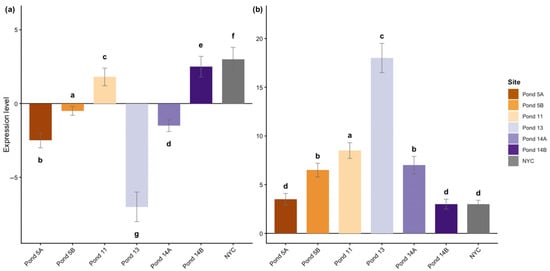
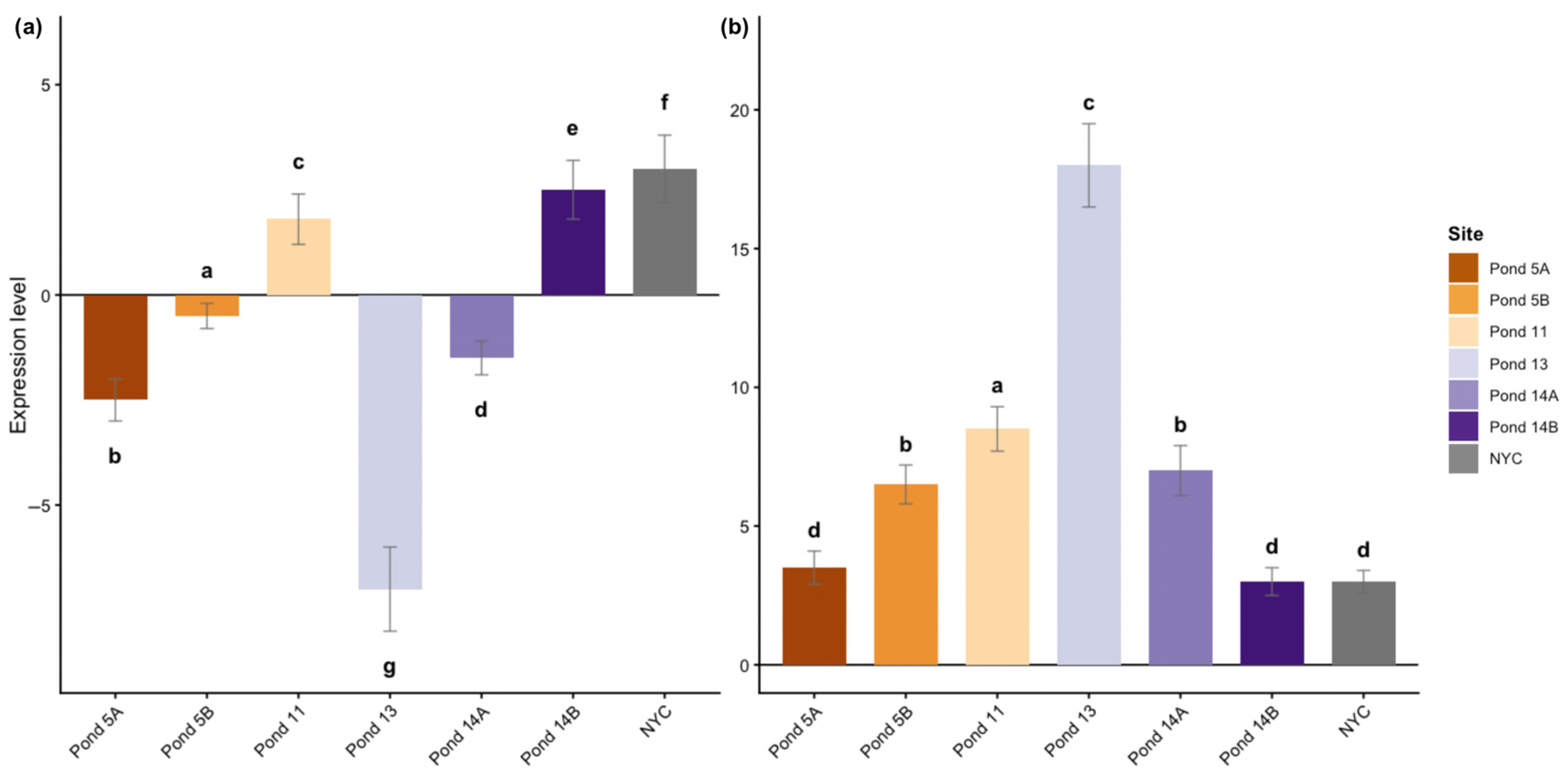
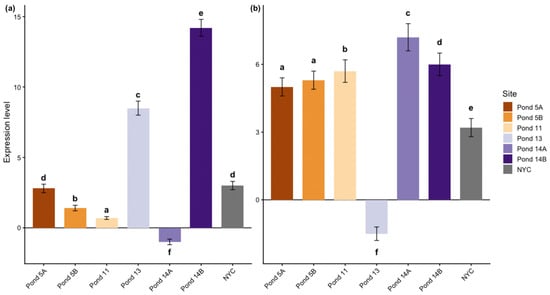
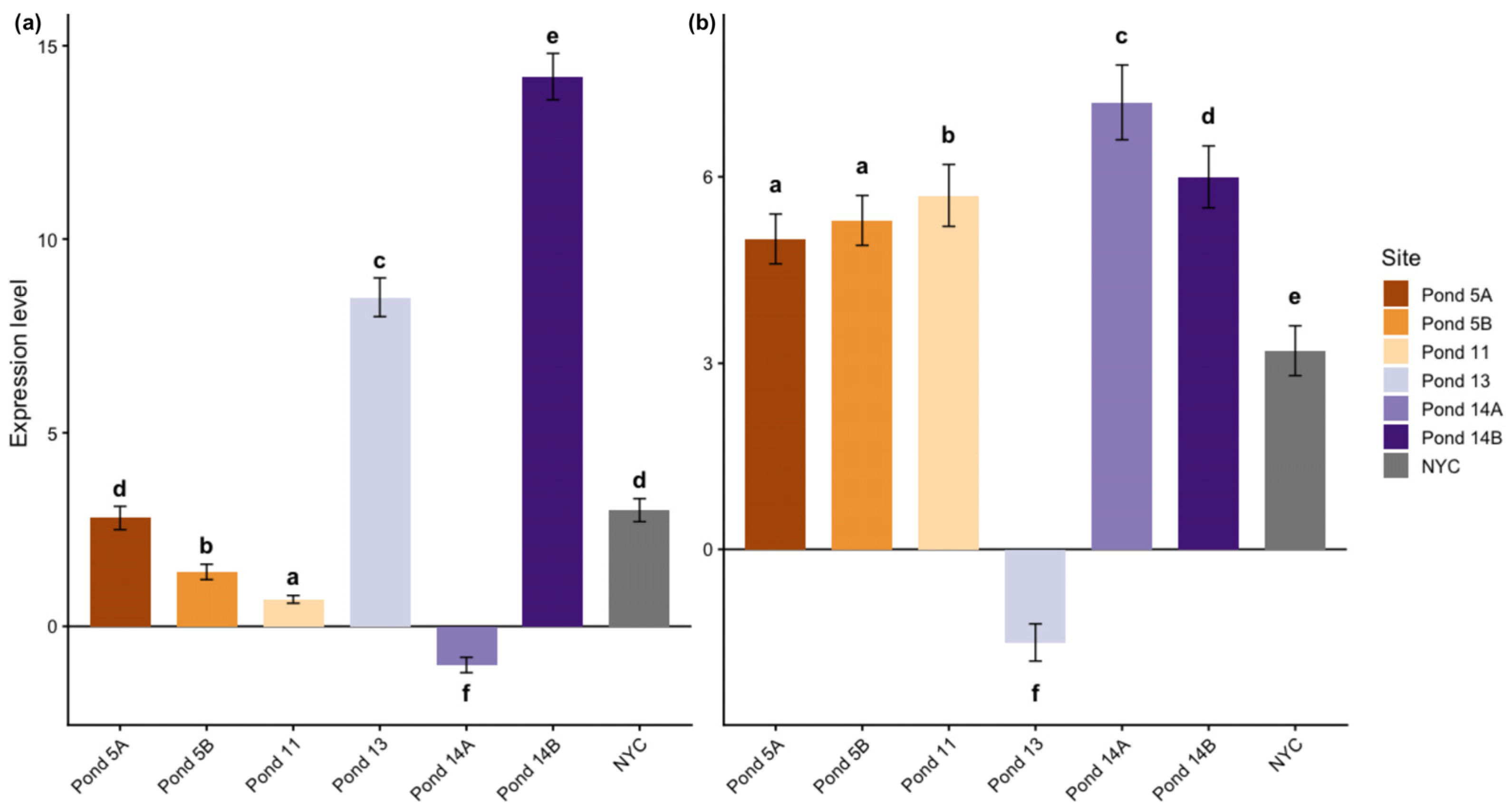
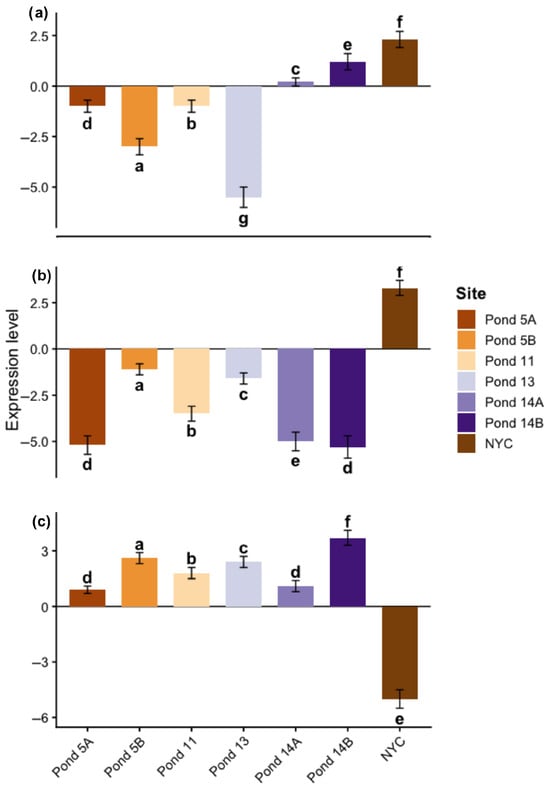
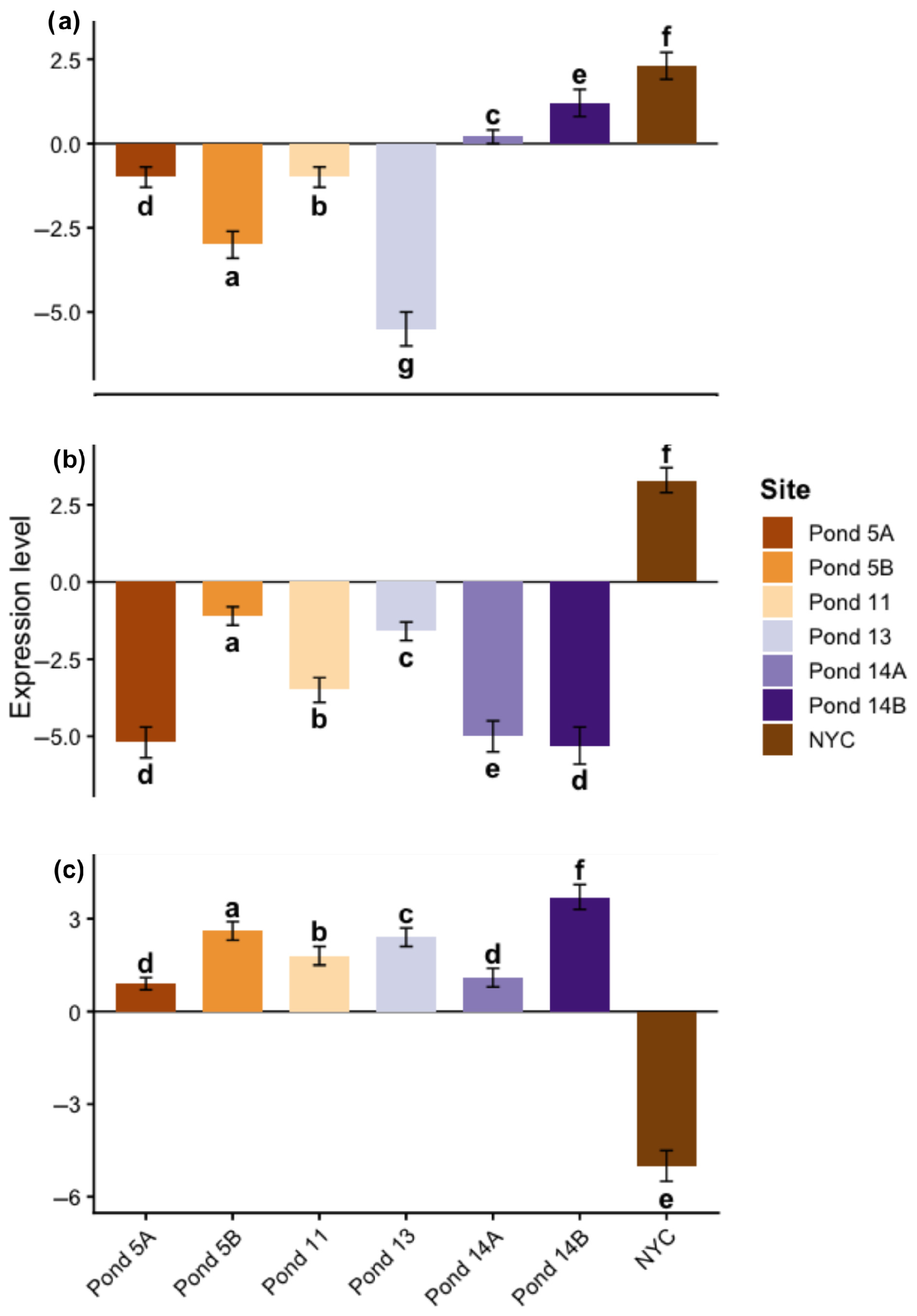
The mRNA expression levels of target genes, calculated as ΔCt values normalized to the β-actin reference gene, exhibited significant spatial variation across all sampling sites (p < 0.05). The expression of cat, which encodes the primary antioxidant enzyme catalase, was significantly higher in fish from Pond 13 than in those from the other sites, whereas the lowest transcript levels were recorded in Ponds 14B and NYC (Figure 1). By contrast, cyp1a expression, which is typically associated with the detoxification of organic pollutants and metals, was the lowest in Pond 13 but was significantly upregulated in Ponds 5A, 14 B, and NYC (Figure 1). In the glutathione system, gpx showed the lowest expression in Pond 14B, whereas Pond 14 recorded the highest levels. Similarly, gst expression was comparable across most sites, except at Pond 13, which exhibited a significant increase (Figure 2). The metallothionein gene (met), which plays a critical role in metal sequestration, reached its highest expression in Pond 13, significantly exceeding levels observed in Ponds 14, 14B, and NYC. Pro-inflammatory and steroidogenic responses also varied; tnf expression was reduced considerably in Ponds 14B, 5 B, and 13 compared to that in Pond NYC (Figure 3), whereas star expression, which regulates cholesterol transport for steroidogenesis, was significantly increased in fish from Ponds 5A, 14A, and 14 B (Figure 3).
Figure 1.
Expression levels of antioxidant and detoxification genes in the liver of hybrid Clarias gariepinus across sampling sites. (a) Relative expression of cat (catalase); (b) relative expression of cyp1a (cytochrome P450 1A). Expression levels were quantified by quantitative real-time PCR (qPCR) and normalized to β-actin as a housekeeping gene. Data are presented as mean ± standard deviation. Bars with different superscript letters indicate significant differences among sampling sites (p < 0.05).
Figure 2.
Expression levels of antioxidant and detoxification genes in the liver of hybrid Clarias gariepinus across sampling sites. (a) Relative expression of gst (glutathione S-transferase); (b) relative expression of gpx (glutathione peroxidase). Expression levels were quantified by quantitative real-time PCR (qPCR) and normalized to β-actin as a housekeeping gene. Data are presented as mean ± standard deviation. Bars with different superscript letters indicate significant differences among sampling sites (p < 0.05).
Figure 3.
Expression levels of antioxidant and detoxification genes in the liver of hybrid Clarias gariepinus across sampling sites. (a) Relative expression of met (metallothionein); (b) relative expression of tnf (tumor necrosis factor); (c) Relative expression of star (steroidogenic acute regulatory protein). Expression levels were quantified by quantitative real-time PCR (qPCR) and normalized to β-actin as a housekeeping gene. Data are presented as mean ± standard deviation. Bars with different superscript letters indicate significant differences among sampling sites (p < 0.05).
3.7. Evaluation of Non-Carcinogenic and Carcinogenic Risks to Human Consumers
The non-carcinogenic risk indices exhibited marked variations across the sampling ponds and were consistently higher in women than in men (Table 3). Cr was identified as the primary contributor to the total hazard at most sites, whereas the risks from Cd and Pb were negligible or absent, except in Pond 14A. The highest cumulative non-carcinogenic risk was observed in Pond 11, with HI values of 3.282 for men and 3.741 for women. These values, which significantly exceeded the safety threshold of HI = 1, indicate a very high risk of chronic systemic toxicity. Similarly, Pond 14A had HI values (0.983–1.121) that exceeded the risk category for women. In contrast, Ponds 5A and 5B showed moderate values, whereas ponds 13, 14B, and NYC exhibited HI levels that were well within acceptable limits. The lifetime target cancer risk (TR) mirrored the non-carcinogenic patterns, with the highest probabilities observed at Pond 11 (6.1 × 10⁻³ to 7.0 × 10⁻³) and Pond 14A (2.6 × 10⁻³ to 2.9 × 10⁻³). These figures, which substantially exceeded the USEPA acceptable threshold of 10−6 to 10−4, suggest a significant carcinogenic concern. Conversely, Ponds 13, 14B, and NYC exhibited negligible to acceptable TR levels (≤4.1 × 10⁻⁷), indicating a low probability of cancer development from food consumption at these sites. Collectively, these results identified Ponds 11 and 14A as priority locations requiring immediate risk mitigation and intervention. Collectively, these results demonstrate that spatial variation in metal accumulation in edible tissues translates into variable human health risks, emphasizing the need for integrated environmental and food safety assessments in aquaculture systems.
Table 3.
Health risk assessment indices of heavy metal exposure.
4. Discussion
The findings of this study demonstrate the complex interplay between anthropogenic land use, aquatic contamination, and multilevel biological responses of hybrid catfish in Pathum Thani. By integrating geospatial data with molecular toxicology and health risk indices, this study demonstrates that irrigation canals act as key conduits of heavy metal exposure, linking land-use dynamics to biological stress and human health risks in aquaculture systems.
4.1. Geospatial Drivers of Trace Metal Heterogeneity in Canal-Fed Systems
The significant spatial variation in heavy metal concentrations across the sampled ponds reflects the complex mosaic of anthropogenic influences in Pathum Thani Province. Although agricultural land remains the dominant category (59.75%), the rapid expansion of urban (24.37%) and industrial (2.59%) sectors, as revealed by the geospatial analysis, has created a high-risk environment for freshwater aquaculture. The extreme concentrations of Zn, Fe, and Mn observed in Pond 14A, which exceeded the WHO and USEPA safety thresholds, were characteristic of localized impacts from manufacturing zones and landfills. These pollutants are likely transported through irrigation networks that connect anthropogenic sources to aquaculture systems, creating localized contamination hotspots despite generally low aqueous metal concentrations [24].
The significantly elevated Zn and Fe levels in Pond 14A constitute a critical physiological threat; even in the absence of toxic metals, such concentrations can disrupt metal homeostasis and reduce respiratory efficiency [25]. Such chronic exposure can impair growth, immune function, and population stability, ultimately affecting pond productivity [10]. Moreover, the absence of detectable metals in certain ponds, along with significant elevations in others, underscores the role of localized point sources rather than diffuse regional inputs [26]. The marked variability among ponds indicates dominance of localized point sources over diffuse regional inputs [27]. This suggests that guideline-based water assessments may underestimate chronic ecological risks in pond systems. Therefore, the proximity of industrial sectors to GAP-certified aquaculture land remains a critical challenge, necessitating the incorporation of biotic metal analyses along with water quality assessments to ensure the long-term sustainability of pond aquaculture systems.
4.2. Tissue-Specific Partitioning and the Aqueous-Biotic Accumulation Discrepancy
Tissue-specific metal accumulation confirmed the liver as the main site of sequestration, while muscle remains the key indicator of consumer safety. The contrast between low pond-water concentrations and high muscle burdens indicates accumulation pathways not fully explained by water concentrations alone [28]. This discrepancy was most evident in Pond 11, which exhibited undetectable water-borne metals despite harboring peak concentrations of Cr, Pb, and Ni (Table S4). This pattern suggests contributions from sediment-associated exposure and contaminated feed inputs, common in benthic-feeding species [10]. The exceedance of the WHO, FAO, and Thai-MPH permissible limits for Pb and Cd in fish harvested from Ponds 11 and 14A is of particular concern, given that muscle tissue is the primary exposure route, and elevated Pb and Cd levels pose significant chronic health risks, including neurotoxicity and nephrotoxicity [29,30].
Although regulatory thresholds for Cr and Ni are not fully harmonized, the concentrations detected in this study exceed the background levels commonly reported for uncontaminated freshwater species (Table 2), rendering them ecotoxicologically significant [31]. Both Cr and Ni can induce oxidative stress and disrupt metabolic pathways, ultimately impairing growth and immune competence [32]. Additionally, the elevated Zn and Fe concentrations in Pond 14A muscle reflect a clear exposure–accumulation pathway; although essential, excessive concentrations can disrupt redox balance and induce tissue toxicity [31]. This confirms that even in facilities that uphold good aquaculture practices (GAP), the sequestration of persistent metals in benthic environments poses a serious challenge to maintaining the chemical integrity of the food supply [3].
4.3. Redox Homeostasis Disruption and Metal-Induced Oxidative Pathogenesis
Higher metal levels in liver than muscle tissues highlight the central role of the liver in pollutant uptake, sequestration, and biotransformation. This toxicokinetic function is reflected in elevated Cd, Pb, Ni, and Cr concentrations, particularly in Ponds 11 and 14 [33]. A. Hepatic accumulation is primarily mediated by metallothioneins (MTs), which are cysteine-rich proteins that chelate metal ions to protect against metal toxicity [34]. However, our results suggest that a sustained influx of metals can saturate this sequestration capacity, subsequently releasing free metal ions, exacerbating cellular toxicity and disrupting mitochondrial function [35]. Moreover, high Zn and Fe levels observed in Pond 14A may further exacerbate oxidative stress through metal-catalyzed redox reactions [36]. The resulting biochemical profiles indicated oxidative distress, with a clear shift from compensatory adaptation to cellular injury. In Pond 14A, elevated MDA levels alongside altered antioxidant enzyme activity indicate a shift from adaptive response to oxidative damage [10,31]. Moreover, the peak GSH levels in Pond 11 and high SOD activity in Pond NYC represent essential adaptive responses. Increases in GSH and SOD suggest compensatory antioxidant responses; however, concurrent elevation of NO and inflammatory markers indicates dysregulated stress signaling [37].
At the molecular level, gene expression patterns (cat, gpx, cyp1a, Met) reflect coordinated antioxidant and detoxification responses, with potential metabolic costs to growth and reproduction [38,39]. Suppression of the star gene further suggests potential endocrine disruption affecting reproductive capacity [40]. Consequently, oxidative stress and gene-expression pathways serve as vital early-warning indicators of sublethal metal toxicity in high-value aquaculture systems [41].
4.4. Toxicological Risk Assessment and the Regulatory Challenges of the Gap Framework
The human health risk assessment showed significant spatial variation in both non-carcinogenic and carcinogenic risks, reflecting localized metal mobility and anthropogenic pressures across Pathum Thani. Non-carcinogenic risk (HI > 1) was identified in Ponds 5A, 5B, 11, and 14A, with Pond 11 showing a particularly elevated HI (3.741 for women), far exceeding the USEPA safety threshold of 1.0 and indicating a high likelihood of adverse health effects from chronic exposure [42]. Although Zn, Fe, Cr, and Ni contributed substantially to this burden, Mn emerged as the dominant risk driver in Pond 11, Mn emerged as a dominant contributor, with elevated TR values exceeding the USEPA and WHO acceptable risk range (10−6–10−4) linked to neurological and carcinogenic risk, primarily driven by Cr and Ni [42,43]. Such elevated risks are particularly alarming, given Pathum Thani’s role as a primary supplier for major wholesale markets such as Talad Thai [7]. These results reveal a “GAP Paradox,” where compliance with farm-level standards does not preclude contamination driven by external environmental inputs. This gap stems from standards that emphasize farm management and antibiotic control while overlooking geospatial risks from surrounding irrigation networks, where canal-borne industrial and agricultural discharges in Pathum Thani compromise fish safety beyond farmers’ control.
Consequently, an integrated, spatially informed regulatory approach combining geospatial analysis with toxicological risk assessment is essential for ensuring aquaculture safety [44]. This aligns with global concerns highlighted in the FAO State of World Fisheries and Aquaculture (SOFIA) reports, which emphasize that sustainable aquaculture development requires integrated environmental management beyond farm-level practices. As aquaculture systems increasingly operate within anthropogenically modified landscapes, external environmental pressures such as urbanization and industrial activities may undermine certification-based sustainability frameworks, reinforcing the need for spatially informed environmental governance [45].
4.5. Study Limitations and Practical Implications for Aquaculture Management
Although this study provides a comprehensive molecular-to-human health assessment, certain limitations must be acknowledged. First, our analysis of heavy metal concentrations was conducted at a single time point, which may not capture seasonal fluctuations in canal water quality that are common in Thailand’s monsoon-driven climates. Moreover, although the liver and muscle were prioritized for their metabolic and dietary significance, future research should incorporate sediment analysis to clarify the “benthic paradox” observed at sites such as Pond 11. Additionally, expanding transcriptional profiling to include a broader array of growth-related and immune-response genes would further elucidate the long-term trade-offs between detoxification and aquaculture productivity. Although six biological replicates per pond align with comparable ecotoxicological studies, the moderate sample size may limit statistical power under high variability. Thus, significant differences should be interpreted alongside effect sizes and spatial consistency. As ponds were connected within a shared irrigation network, complete independence cannot be assumed; they were treated as spatial observational units. Future studies should incorporate temporal replication and mixed-effects models, with pond identity as a random factor, to account for hierarchical environmental structure. Despite these limitations, the practical implications of this study are significant for the sustainability of Thailand’s freshwater systems. Our findings provide a scientific basis for developing spatial management zones that enable regulators to identify high-risk aquaculture clusters based on proximity to industrial land use. These results suggest that the GAP certification framework should be updated to include mandatory site-specific water and biotic screenings of farms located within urban industrial mosaics. By integrating geospatial land-use data with these early warning molecular biomarkers, policymakers can implement more precise mitigation strategies, such as advanced canal filtration or sediment remediation, to safeguard both the economic viability of Pathum Thani’s fish farms and the health of the millions of consumers who rely on them.
5. Conclusions
This study addresses a key knowledge gap by demonstrating how site-specific canal water quality influences the physiological health and food safety of hybrid catfish in Thailand’s major aquaculture region. Localized heavy metal contamination, shaped by surrounding land-use patterns, induced differential hepatic gene expression and oxidative stress that closely matched metal bioaccumulation in edible muscle. Integrating geospatial land-use analysis with molecular biomarkers revealed contamination hotspots near industrial and urban areas, where both non-carcinogenic (HI) and carcinogenic (TR) risks exceeded acceptable thresholds. Elevated MDA levels and altered expression of cat, cyp1a, and star provide functional evidence that chronic metal exposure overwhelms antioxidant defenses and disrupts metabolic homeostasis. Sampling location across the canal network emerged as a decisive factor affecting fish health and consumer safety, underscoring the “GAP Paradox,” whereby farm-level certifications fail when surrounding environments are compromised. Canal-specific water quality directly influenced heavy metal bioaccumulation in hybrid catfish, linking environmental contamination to food safety outcomes. Spatial variations in metal exposure were reflected in biomarker responses, including elevated MDA levels and altered expression of cat, cyp1a, and star, indicating oxidative stress and physiological disruption. The alignment between water quality, tissue contaminant burdens, and molecular responses corresponded with elevated non-carcinogenic and carcinogenic risks. As the first study in this region to integrate land-use data with molecular toxicology, these findings delineate a clear pathway linking canal water quality, bioaccumulation, biomarker activation, and consumer health risk, supporting spatially informed regulation, environmental monitoring, and long-term sustainability of aquaculture and public health protection.
Supplementary Materials
The following supporting information can be downloaded at: https://www.mdpi.com/article/10.3390/environments13040231/s1. Table S1. List of primer sequences of target genes investigated [46,47,48]; Table S2. Oral reference doses and cancer slope factors for heavy metals applied in human health risk assessment [19,48,49]; Table S3: Maximum permissible limit (MPL) of heavy metals (mg/kg) in fish muscles according to national and international guideline values [50,51,52,53]; Table S4. Heavy metal concentrations in liver tissues of hybrid catfish (mg/kg wet weight); Table S5. Oxidative stress enzymatic activities in hybrid catfish in Pathum Thani. Figure S1. Land use and land cover classification map of the study area, showing the locations of sampling sites. The map illustrates the spatial distribution of major land use categories, including rice paddies, urban and residential areas, industrial zones, aquaculture ponds, water bodies, forest patches, and agricultural lands. Rice paddies represent the dominant land use type across the study area, followed by urban settlements and mixed vegetation. Sampling sites are distributed across various heterogeneous land use types, allowing for the assessment of environmental influences on the study variables. Provincial boundaries are indicated for geographic reference. Figure S2. A schematic summary of the research design.
Author Contributions
Conceptualization, U.U., W.S. (Worapong Singchat) and K.S.; methodology, U.E. and E.E.; validation, U.U., W.S. (Worapong Singchat), C.S. and K.S.; formal analysis, T.P. and A.C.; investigation, A.U. and W.S. (Weekit Sirisaksoontorn); resources, W.S. (Worapong Singchat) and K.S.; data curation, U.U., W.S. (Worapong Singchat) and S.J.; writing—original draft preparation, U.U., W.S. (Worapong Singchat), and K.S.; writing—review and editing, U.U., W.S. (Worapong Singchat), T.P., A.C., E.E., U.E., S.J., A.U., W.S. (Weekit Sirisaksoontorn), C.S. and K.S.; visualization, A.C. and T.P.; supervision, K.S. and W.S. (Worapong Singchat); project administration, K.S. All authors have read and agreed to the published version of the manuscript.
Funding
This study was supported by through the National Research Council of Thailand: High—Potential Research Team Grant Program (N42A660605), awarded to W.S. (Worapong Singchat), T.P., and K.S.; National Research Council of Thailand (NRCT) (N42A660897), awarded to S.J.; the Program Management Unit for Human Resources and Institutional Development and Innovation (PMU—B) (Contract No. B13F670053), awarded to W.S. (Worapong Singchat), U.U., E.E., U.E., T.P., and K.S.; the Program Management Unit for Competitiveness (PMU—C) under the Global Partnership Program (Contract No. C23F670224), awarded to W.S. (Worapong Singchat), T.P., S.J., and K.S.; the Program Management Unit on Area Based Development (PMU—A) (Contract No. A11F680039), awarded to W.S. (Worapong Singchat), T.P., S.J., and K.S.; a grant from Kasetsart University Research and Development Institute (Contract No. FF(KU) 61.69) awarded to W.S. (Worapong Singchat) and K.S.; the International SciKU Branding (ISB), Faculty of Science, Kasetsart University awarded to W.S. (Worapong Singchat), T.P., and K.S. No funding source was involved in the study design, collection, analysis, and interpretation of the data, writing of the report, or decision to submit the article for publication.
Data Availability Statement
Data will be made available on request.
Acknowledgments
We would like to express our deepest gratitude to Thesethong Fish Breeding Farm (Jae Maew) for their generous collaboration and assistance; the Phu Sing Research and Training Center at Kalasin University; and the Kalasin Fish Hatchery Farm (Betagro Public Company Limited) for providing valuable information on African catfish, bighead catfish, and hybrid catfish, as well as essential support. We also sincerely thank the Faculty of Science, Kasetsart University (6501.0901.1/336), for providing research facilities.
Conflicts of Interest
The authors declare no conflicts of interest.
References
- Ogidi, O.I.; Akpan, U.M. Aquatic biodiversity loss: Impacts of pollution and anthropogenic activities and strategies for conservation. In Biodiversity in Africa: Potentials, Threats and Conservation; Izah, S.C., Ed.; Springer: Singapore, 2022; Volume 29. [Google Scholar]
- Choudhury, F.N.; Rahman, M.M. Source and distribution of heavy metals and their effects on human health. In Heavy Metal Toxicity; Kumar, N., Ed.; Springer: Cham, Switzerland, 2024. [Google Scholar]
- Taslima, K.; Al-Emran, M.; Rahman, M.S.; Hasan, J.; Ferdous, Z.; Rohani, M.F.; Shahjahan, M. Impacts of heavy metals on early development, growth and reproduction of fish: A review. Toxicol. Rep. 2022, 9, 858–868. [Google Scholar] [CrossRef] [Scilit]
- Sampantamit, T.; Ho, L.; Lachat, C.; Sutummawong, N.; Sorgeloos, P.; Goethals, P. Aquaculture production and its environmental sustainability in Thailand: Challenges and potential solutions. Sustainability 2020, 12, 2010. [Google Scholar] [CrossRef] [Scilit]
- Burchell, W.J. Travels in the Interior of Southern Africa; Longman, Hurst, Rees, Orme, and Brown: London, UK, 1822. [Google Scholar]
- Günther, A. XLII.—Descriptions of three new species of fishes in the collection of the British Museum. Ann. Mag. Nat. Hist. 1864, 14, 374–376. [Google Scholar] [CrossRef] [Scilit]
- Srikulnath, K.; Budi, T.; Panthum, T.; Sinthuvanich, C.; Haileselasie, T.H.; Kuldilok, K.; Singchat, W. Sustainable aquaculture in Thailand: Balancing economic growth and ecological integrity with North African catfish integration. Aquac. Res. 2025, 2025, 2688051. [Google Scholar] [CrossRef] [Scilit]
- Paankhao, N.; Sangsawang, A.; Kantha, P.; Paankhao, S.; Promsee, K.; Soontara, C.; Kongsriprapan, S.; Srisapoome, P.; Kumwan, B.; Meachasompop, P.; et al. Antioxidant and antibacterial efficiency of the ethanolic leaf extract of kratom (Mitragyna speciosa (Korth.) Havil) and its effects on growth, health, and disease resistance against Edwardsiella tarda infection in Nile tilapia (Oreochromis niloticus). Fish Shellfish. Immunol. 2024, 152, 109771. [Google Scholar] [CrossRef] [Scilit]
- Busamongkol, A.; Srinuttrakul, W.; Kewsuwan, P.; Judprasong, K. Evaluation of toxic and trace metals in Thai fish by INAA. Ener. Proc. 2014, 56, 80–84. [Google Scholar] [CrossRef] [Scilit]
- Oros, A. Bioaccumulation and trophic transfer of heavy metals in marine fish: Ecological and ecosystem-level impacts. J. Xenobiot. 2025, 15, 59. [Google Scholar] [CrossRef] [Scilit]
- Prabakaran, K.; Sompongchaiyakul, P.; Bureekul, S.; Wang, X.; Charoenpong, C. Heavy metal bioaccumulation and risk assessment in fishery resources from the Gulf of Thailand. Mar. Pollut. Bull. 2024, 198, 115864. [Google Scholar] [CrossRef] [Scilit]
- Sakonnakron, S.P.N.; Iamtrakul, P.; Chaisamak, P. Intelligent exchange mechanism of agriculture sector for sustainable economic transaction development in Pathum Thani, Thailand. IOP Conf. Ser. Earth Environ. Sci. 2021, 738, 012052. [Google Scholar] [CrossRef] [Scilit]
- Al-Ghouti, M.A.; Khan, M.; Nasser, M.S.; Al Saad, K.; Heng, O.E. A novel method for metals extraction from municipal solid waste using a microwave-assisted acid extraction. J. Clean. Prod. 2021, 287, 125039. [Google Scholar] [CrossRef] [Scilit]
- Maehly, A.C. The assay of catalases and peroxidases. In Methods of Biochemical Analysis; Glick, D., Ed.; John Wiley & Sons: New York, NY, USA, 1954; pp. 357–424. [Google Scholar]
- Jollow, D.J.; Mitchell, J.R.; Zampaglione, N.; Gillette, J.R. Bromobenzene-induced liver necrosis: Protective role of glutathione and evidence for 3,4-bromobenzene oxide as the hepatotoxic metabolite. Pharmacology 1974, 11, 151–169. [Google Scholar] [CrossRef] [Scilit] [PubMed]
- Sahreen, S.; Khan, M.R.; Khan, R.A.; Alkreathy, H.M. Protective effects of Carissa opaca fruits against CCl4-induced oxidative kidney lipid peroxidation and trauma in rat. Food Nutr. Res. 2015, 59, 28438. [Google Scholar] [CrossRef] [Scilit] [PubMed]
- Zahedi, S.G.; Koohdani, F.; Qorbani, M.; Nasli-Esfahani, E.; Aghasi, M.; Khoshamal, H.; Keshavarz, A.; Sotoudeh, G. Effects of green cardamom supplementation on serum levels of hs-CRP, dimethylarginine, nitric oxide, and blood pressure in patients with type 2 diabetes: A randomized, double-blind, placebo-controlled clinical trial. J. Herb. Med. 2022, 32, 100555. [Google Scholar] [CrossRef] [Scilit]
- Hanneman, S.K.; Cox, C.D.; Green, K.E.; Kang, D.H. Estimating intra- and inter-assay variability in salivary cortisol. Biol. Res. Nurs. 2011, 13, 243–250. [Google Scholar] [CrossRef] [Scilit]
- Mohammadi, A.A.; Zarei, A.; Majidi, S.; Ghaderpoury, A.; Hashempour, Y.; Saghi, M.H.; Ghaderpoori, M. Carcinogenic and non-carcinogenic health risk assessment of heavy metals in drinking water of Khorramabad, Iran. MethodsX 2019, 6, 1642–1651. [Google Scholar] [CrossRef] [Scilit]
- United States Environmental Protection Agency. Exposure Factors Handbook; U.S. Environmental Protection Agency: Washington, DC, USA, 2011.
- World Health Organization. GHE: Life Expectancy and Healthy Life Expectancy; WHO: Geneva, Switzerland, 2022. [Google Scholar]
- World Health Organization. Guidelines for Drinking-Water Quality, 4th ed.; Incorporating the first addendum; World Health Organization: Geneva, Switzerland, 2017. [Google Scholar]
- United States Environmental Protection Agency. Regulation Development for Drinking Water Contaminants: National Primary Drinking Water Regulations and National Secondary Drinking Water Regulations; U.S. Environmental Protection Agency: Washington, DC, USA, 2017.
- Ain, S.N.U.; Abbasi, A.M.; Ajab, H.; Khan, S.; Yaqub, A. Assessment of arsenic in Mangifera indica (mango) contaminated by artificial ripening agent: Target hazard quotient (THQ), health risk index (HRI) and estimated daily intake (EDI). Food Chem. Adv. 2023, 3, 100468. [Google Scholar] [CrossRef] [Scilit]
- Peng, J.; Fan, R.; Ren, Y.; Yang, Y.; Zhang, X.; Wang, S.; Cheng, B. Distribution and bioaccumulation of prometryn in simulated aquatic ecosystems. Front. Environ. Sci. 2025, 12, 1511658. [Google Scholar] [CrossRef] [Scilit]
- Kumar, N.; Krishnani, K.K.; Singh, N.P. Effect of zinc on growth performance and cellular metabolic stress of fish exposed to multiple stresses. Fish Physiol. Biochem. 2020, 46, 315–329. [Google Scholar] [CrossRef] [Scilit]
- Singh, G.; Sharma, S. Heavy metal contamination in fish: Sources, mechanisms, and consequences. Aquat. Sci. 2024, 86, 107. [Google Scholar] [CrossRef] [Scilit]
- Pandey, C.; Thiske, S.; Bhatia, G.S.; Ali, M.; Guru, G.S. Hydrological and limnological factors influencing aquaculture on pond: A review. J. Informetr. 2025, 19, 410–447. [Google Scholar]
- Essien, U.B.; Essien, E.A.; Okechukwu, B.N.; Merenini, I.F.; Yogesh, K.; Ensafy, M.; Uzoma, O. Heavy metals composition in fish species from Oron River Metropolis, Akwa Ibom State, Nigeria. J. Mater. Sci. Res. Rev. 2025, 8, 223–233. [Google Scholar] [CrossRef] [Scilit]
- Abdel-Kader, H.H.; Mourad, M.H. Carcinogenic and human risk assessments, trace element concentrations, proximate composition, and liver antioxidants of three commercial tilapia fish species from Manzalah Wetland, Egypt. Egypt. J. Aquat. Biol. Fish. 2022, 26, 1–24. [Google Scholar] [CrossRef] [Scilit]
- Satarug, S.; Gobe, G.C.; Vesey, D.A.; Phelps, K.R. Cadmium and lead exposure, nephrotoxicity, and mortality. Toxics 2020, 8, 86. [Google Scholar] [CrossRef] [Scilit] [PubMed]
- Jomova, K.; Alomar, S.Y.; Valko, R.; Nepovimova, E.; Kuca, K.; Valko, M. The role of redox-active iron, copper, manganese, and redox-inactive zinc in toxicity, oxidative stress, and human diseases. EXCLI J. 2025, 24, 880–954. [Google Scholar]
- Bhat, R.A.; Alam, A.; Jha, D.N.; Kumar, V.; Kumar, J.; Thakur, V.R.; Das, B.K. Fate and effects of heavy metals in fishes: Antioxidant defense system, miRNA/gene expression response, and histopathological reproductive manifestations. Biol. Trace Elem. Res. 2025, 203, 4326–4346. [Google Scholar] [CrossRef] [Scilit]
- Nichols, J.W.; Arnot, J.A.; Barron, M.G. Toxicokinetics in fishes. In Toxicology of Fishes; CRC Press: Boca Raton, FL, USA, 2024; pp. 3–59. [Google Scholar]
- Mona, M.M.; Younis, M.L.; Atlam, A.I. Evaluation of freshwater heavy metals accumulation effect on oxidative stress, metallothionein biosynthesis and histopathology of Procambarus clarkii (Girard, 1985) collected from three locations in the Delta region, Egypt. BMC Zool. 2023, 8, 21. [Google Scholar] [CrossRef] [Scilit]
- Souza-Arroyo, V.; Fabián, J.J.; Bucio-Ortiz, L.; Miranda-Labra, R.U.; Gómez-Quiroz, L.E.; Gutiérrez-Ruiz, M.C. The mechanism of cadmium-induced toxicity and cellular response in the liver. Toxicology 2022, 480, 153339. [Google Scholar] [CrossRef] [Scilit]
- Garza-Lombó, C.; Posadas, Y.; Quintanar, L.; Gonsebatt, M.E.; Franco, R. Neurotoxicity linked to dysfunctional metal ion homeostasis and xenobiotic metal exposure: Redox signaling and oxidative stress. Antioxid. Redox Signal. 2018, 28, 1669–1703. [Google Scholar] [CrossRef] [Scilit]
- Kolawole, T.A.; Palacios, J.; Husaini, D.C.; Nwokocha, C.R. Inflammation and oxidative stress biomarkers in heavy metal toxicity: Bridging the gap to personalized clinical interventions. J. Appl. Toxicol. 2025, 45, 2546–2579. [Google Scholar] [CrossRef] [Scilit]
- Cannea, F.B.; Padiglia, A. Antioxidant defense systems in plants: Mechanisms, regulation, and biotechnological strategies for enhanced oxidative stress tolerance. Life 2025, 15, 1293. [Google Scholar] [CrossRef] [Scilit]
- Zhang, J.; Bao, Z.; Guo, J.; Su, X.; Zou, Y.; Guo, H. Comparative transcriptome analysis of the hepatopancreas from Macrobrachium rosenbergii exposed to the heavy metal copper. Animals 2024, 14, 1117. [Google Scholar] [CrossRef] [Scilit]
- Ma, W.; Zeng, W.; Zhang, D.; Zhou, Y.; Huang, Y.; Hong, Y. Oxidative stress in aquaculture: Pathogenic mechanisms and preventive strategies in farmed aquatic animals. Curr. Issues Mol. Biol. 2025, 47, 873. [Google Scholar] [CrossRef] [Scilit]
- Ullah, R.; Ghayyur, S.; Samad, S.U.; Arshad, S.M.; Ghayyur, S.; Shah, R.; Arif, S. Integrated biomarker responses and multivariate assessment of polyethylene microplastics toxicity in the endemic freshwater fish Tor putitora. Environ. Geochem. Health 2026, 48, 68. [Google Scholar] [CrossRef] [Scilit] [PubMed]
- Eid, M.H.; Eissa, M.; Mohamed, E.A. New approach into human health risk assessment associated with heavy metals in surface water and groundwater using Monte Carlo method. Sci. Rep. 2024, 14, 1008. [Google Scholar] [CrossRef] [Scilit] [PubMed]
- Vesković, J.; Onjia, A. Exposure and toxicity factors in health risk assessment of heavy metal(loid)s in water. Water 2025, 17, 2901. [Google Scholar] [CrossRef] [Scilit]
- Food and Agriculture Organization of the United Nations. The State of World Fisheries and Aquaculture 2024; FAO: Rome, Italy, 2024. [Google Scholar]
- Guo, J.; Pu, Y.; Zhong, L.; Wang, K.; Duan, X.; Chen, D. Lead impaired immune function and tissue integrity in yellow catfish (Pelteobagrus fulvidraco) by mediating oxidative stress, inflammatory response and apoptosis. Ecotoxicol. Environ. Saf. 2021, 226, 112857. [Google Scholar] [CrossRef] [Scilit]
- Ibor, O.R.; Eni, G.; Andem, A.B.; Bassey, I.U.; Arong, G.A.; Asor, J.; Regoli, F.; Arukwe, A. Biotransformation and oxidative stress responses in relation to tissue contaminant burden in Clarias gariepinus exposed to simulated leachate from a solid waste dumpsite in Calabar, Nigeria. Chemosphere 2020, 253, 126630. [Google Scholar] [CrossRef] [Scilit]
- U.S. Environmental Protection Agency. Integrated Risk Information System (IRIS); U.S. Environmental Protection Agency: Washington, DC, USA, 2013.
- World Health Organization. Evaluation of Joint FAO/WHO Expert Committee on Food Additives (JECFA); WHO: Geneva, Switzerland, 2019. [Google Scholar]
- World Health Organization. Heavy Metals: Environmental Aspects; Environmental Health Criteria; WHO: Geneva, Switzerland, 1989. [Google Scholar]
- Food and Agriculture Organization of the United Nations. Compilation of legal limits for hazardous substances in fish and fishery products. FAO Fish. Circ. 1983, 764. Available online: http://www.fao.org/docrep/014/q5114e/q5114e.pdf (accessed on 25 February 2026).
- United States Environmental Protection Agency. Guidance for Assessing Chemical Contaminant Data for Use in Fish Advisories: Risk Assessment and Fish Consumption Limits; Office of Science and Technology and Office of Water: Washington, DC, USA, 2000.
- Thai Ministry of Public Health. Notification of the Ministry of Public Health No. 98 (February 16, B.E. 2529). Thai R. Gov. Gaz. 1986, 103, 23. Available online: https://exfood.fda.moph.go.th/law/data/announ_moph/V.English/P414_E.pdf (accessed on 25 February 2026).

Disclaimer/Publisher’s Note: The statements, opinions and data contained in all publications are solely those of the individual author(s) and contributor(s) and not of MDPI and/or the editor(s). MDPI and/or the editor(s) disclaim responsibility for any injury to people or property resulting from any ideas, methods, instructions or products referred to in the content. |
© 2026 by the authors. Licensee MDPI, Basel, Switzerland. This article is an open access article distributed under the terms and conditions of the Creative Commons Attribution (CC BY) license.