


Abstract
Landfill leachate membrane concentrate (LLMC) is a high-salinity and high-organic wastewater stream that poses significant treatment challenges to conventional evaporation technologies. This study investigated the treatment performance and operating costs of a low-temperature atmospheric evaporation (LTAE) system for LLMC treatment under mild operating conditions. The effects of key operational parameters—including evaporation temperature (60–95 °C), pH (5–11), air–liquid mass ratio (A/L = 0.5–10), and concentration factor (CF = 5–20)—were systematically evaluated based on condensate quality parameters (UV254, CODCr, and NH3–N). Results demonstrated that the LTAE system achieved a higher concentration ratio (CF = 20) compared to the on-site mechanical vapor compression (MVC) system (CF ≈ 10). The optimal operating conditions for meeting effluent discharge standards were determined to be 70 °C, pH: 5, A/L = 5 and CF = 20. Under these conditions, the condensate contained ~5.6 mg/L NH3–N and ~91.6 mg/L CODCr, while the concentrate reached ~4200 mg/L NH3–N and ~38,000 mg/L CODCr, indicating that some organic matter and ammonia nitrogen escaped from the system and a gas scrubbing unit is recommended to minimize secondary pollution. Within the experimental range, the system achieved the highest KcA = 22,871.25 kW/(m3·°C) and the highest KdA reached 6.52 kg/m3·s. Economic analysis revealed a specific energy consumption of 110.5 kWh/t of freshwater produced. Despite the relatively high energy consumption, the LTAE system demonstrates considerable potential for the advanced treatment of high-organic wastewater, offering enhanced freshwater recovery under mild thermal conditions. This study provides theoretical and data support for the application of LTAE technology in LLMC treatment and similar challenging organic wastewater.
1. Introduction
Landfill leachate (LL) is a type of wastewater with a complex composition and high pollutant concentration [1]. Its water quality exhibits significant fluctuations depending on various factors, including annual precipitation, runoff, infiltration, evaporation, transpiration, ambient temperature, waste composition and density, initial moisture content, landfill depth and landfill age [2]. Owing to the high concentration of recalcitrant pollutants in LL, a single biological or physiochemical process hardly meets the ever-stringent discharge standards. Membrane processes, including microfiltration (MF), ultrafiltration (UF), nanofiltration (NF), and reverse osmosis (RO), in combination with biological treatment technologies, have been extensively employed in the treatment of LL [3,4]. However, the landfill leachate membrane concentrates (LLMC) generated from these membrane separation processes account for approximately 15–30% of the total leachate volume. Compared with raw LL, LLMC exhibit higher concentrations of organic matter, lower biodegradability, and higher conductivity resulting from elevated ion concentrations, all of which pose significant challenges for disposal [5,6,7,8,9,10].
The quality of LLMC varies depending on the LL quality and the type of membrane employed (e.g., NF or RO). In general, LLMC are characterized by five groups of pollutants: (i) major pollutants (COD, BOD5, BOD5/COD, TOC, TN, NH3-N, etc.), (ii) inorganic salt ions (chloride, nitrate, sulfate, etc.), (iii) heavy metals, (iv) humic substances (HS), and (v) xenobiotic organics (aromatic compounds, halogenated hydrocarbons, endocrine-disrupting chemicals, etc.) [11]. Existing treatment strategies for LLMC treatment primarily include recirculation, advanced oxidation, and evaporation [12,13,14]. In addition, recent studies have explored the recovery of valuable substances from the LLMC, such as HS [15]. Despite the cost-effectiveness and operational convenience of LLMC recirculation, this approach can lead to the accumulation of contaminants in the leachate, reaching elevated concentrations—particularly volatile fatty acids (VFAs), NH3-N, and COD. Such accumulation can adversely affect membrane process performance, inducing fouling and scaling, which in turn increases the energy consumption of LL treatment [16]. Advanced oxidation processes applied for LLMC treatment include ultraviolet radiation (UV)-based processes (UV/O3/H2O2), Fenton-based processes (H2O2/Fe2+), chemical oxidation (e.g., ozonation or H2O2 oxidation), photo-Fenton processes, and electrochemical processes. However, these methods primarily target the oxidation of organic constituents and are often integrated with other technologies to achieve comprehensive remediation of LLMC pollution. A current challenge in recovering HS from LLMC is the lack of chemically robust (i.e., pH-resistant) membranes with high selectivity [17]. Evaporation has been considered as one of the most effective processes due to its high efficiency in volume reduction and contaminant disposal [18]. Figure 1 illustrates the dominant advanced treatment process flow for LLMC. Table 1 comparatively summarizes the advantages and limitations of commonly used evaporation technologies, including mechanical vapor compression (MVC), submerged combustion evaporation (SCE), membrane distillation (MD), and interfacial evaporation (IE). Due to the simultaneous presence of high concentrations of organic matter and salts in LLMC, the application of high-temperature evaporation methods, such as MVC and SCE, is prone to issues including equipment corrosion, scaling [19,20], secondary pollution [21,22], and operational instability. In contrast, low-temperature evaporation can effectively mitigate these challenges [23,24]. Membrane distillation (MD), typically operated at relatively low temperatures (45~60 °C), shows potential in this regard, yet its large-scale application remains constrained by persistent membrane fouling [25,26]. Interfacial evaporation (IE) (operational temperature: 40~50 °C), frequently integrated with solar energy utilization, is highly dependent on weather conditions, and existing studies suggest its limited effectiveness in separating organic contaminants [27,28]. As a result, these technologies are not well suited for the treatment of LLMC, which are characterized by high concentrations of organic pollutants. Thus, there is an ongoing need to develop low-temperature, efficient, and stable treatment technologies specifically tailored for LLMC.
Figure 1.
Advanced treatment process flow of LLMC.
Table 1.
Comparison of commonly used evaporation techniques.
Based on the above discussion, low-temperature atmospheric evaporation (LTAE) is a technology with great potential for application. The principle of the LTAE system is based on achieving a phase transition in water between 50 °C and 95 °C without reaching the boiling point. Additionally, its direct gas–liquid contact heat exchange mechanism eliminates inter-wall fouling, enhancing long-term operational efficiency. Previously, most studies on LTAE technology were primarily focused on brackish water or seawater desalination. Desalination technologies are categorized into thermal-based such as LTAE and multi-effect desalination (MED), as well as membrane-based such as RO and electrodialysis (ED). LTAE desalination systems are appealing as they offer advantages such as low investment cost, simple configuration, low operating temperature, applicability to high seawater concentration [33] and the ability to be driven by low-grade energy sources [34]. Most research has concentrated on improving energy-efficient freshwater production [35,36] and on the effective utilization of low-grade waste heat from heating systems [37], ventilation and air conditioning units [38,39] and solar PV panels [40] to enable simultaneous freshwater production via a hybrid LTAE process. Furthermore, several studies have investigated the efficacy of the LTAE process for treating high-salinity wastewater, demonstrating its high separation efficiency. For instance, Haoming Li [41] developed a predictive model for the treatment of high-salt industrial wastewater using the LTAE process, focusing on its mass and heat transfer coefficients. Similarly, Ravichandran Santosh et al. [42] reported that a single-stage LTAE process achieved approximately 99.9% removal of toxic ions, including sodium, chloride, and boron, from membrane distillation (MD) concentrates. Despite these advancements, critical knowledge gaps remain concerning the treatment efficiency, optimal operating parameters, and economic viability of the LTAE process when applied to organic wastewater.
Therefore, the principal objective of the present study was to evaluate the technical feasibility and efficiency of LLMC treatment, which contains high-organic and high-salty concentrations. Since the LTAE process has been proven to be effective in removing salts from wastewater [43,44], the main focus of this study was to examine its treatment efficiency for organic substances and volatile substances (e.g., ammonia nitrogen, NH3–N) from wastewater. Chemical oxygen demand (COD), NH3–N in the condensate under different evaporation conditions were analyzed to determine whether the contents of various pollutants meet the discharge standards. in China. Since humic acid (HA) contributed most significantly to COD in LLMC [45], UV-visible absorption spectra analysis was employed to evaluate the HA removal efficiency of the LTAE process. And the mass and heat transfer mechanisms as well as an economic calculation were discussed. By systematically addressing the aforementioned aspects, this work establishes a foundational basis for advancing the practical application of LATE in the treatment of LLMC. The proposed approach offers a promising alternative for the advanced treatment of high-concentration organic wastewater, combining operational stability, high pollutant separation efficiency, and mild thermal conditions.
2. Materials and Methods
2.1. Wastewater Sample
The raw LLMC used in this study were collected from an operating municipal solid waste landfill located in Hunan Province, China. The LLMC refer to the concentrated stream generated by the on-site NF membrane system and subsequently undergo a series of treatment processes, including coagulation–precipitation, Fenton oxidation, MVC, and solidification/stabilization. Wastewater samples for this study were collected from the effluent of the Fenton oxidation unit. The main characteristics of the samples were as follows: pH: 4–5, CODCr: 1760~2100 mg/L, UV254: 240~265 mg/L, NH3–N: 198~278 mg/L, and total dissolved solids (TDS) = 13,800~14,560 mg/L.
2.2. Experimental Set-Up
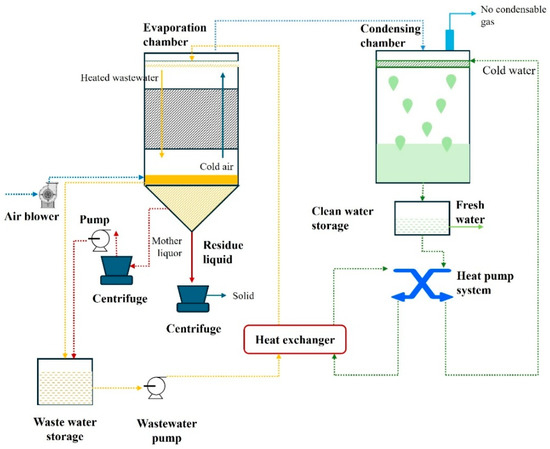
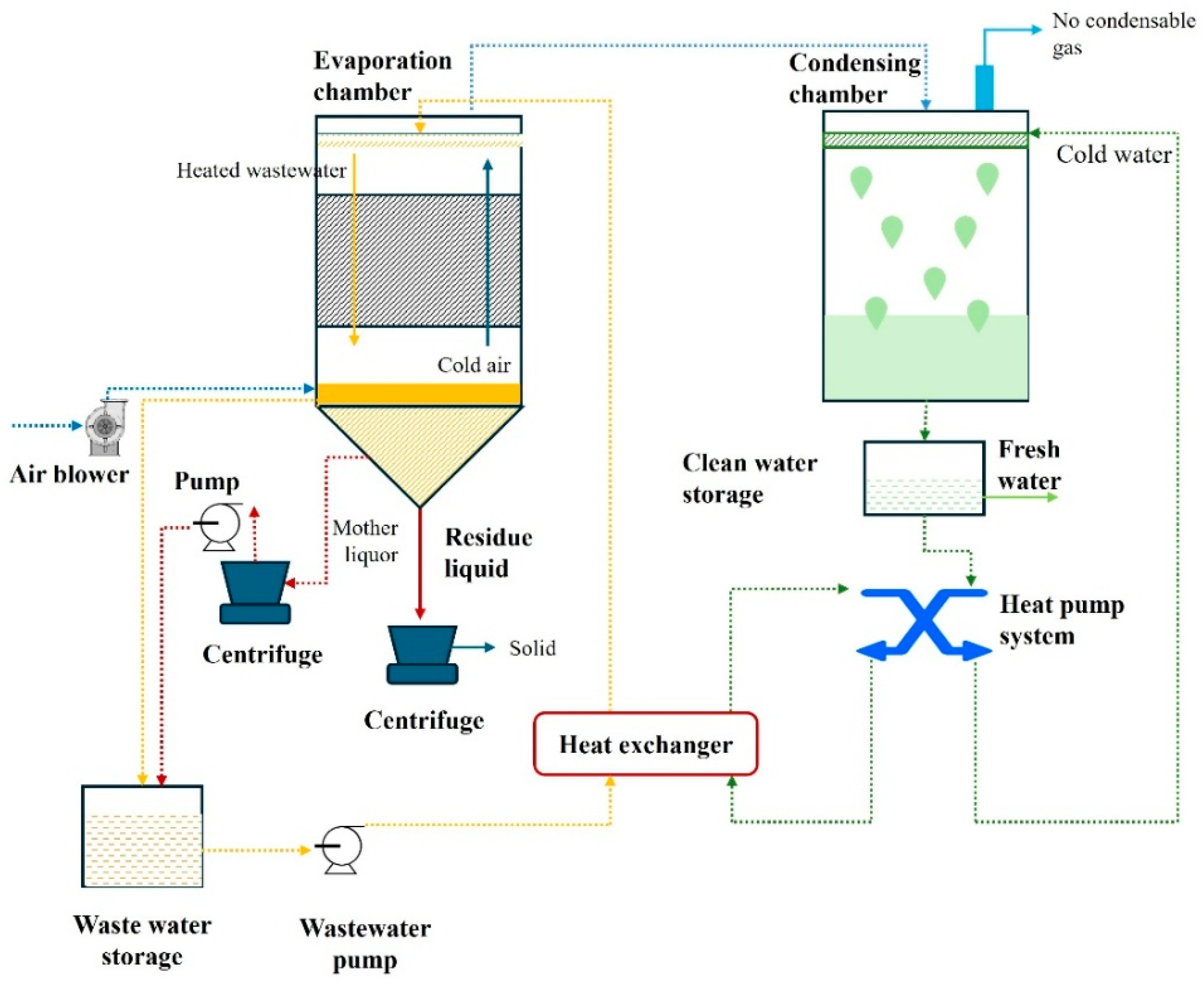
Figure 2 presents the schematic diagram of the laboratory-scale LTAE unit. The system comprises an evaporation chamber, a heat pump system, a condensing chamber, a heat exchanger and a circulating system. The evaporation chamber includes an evaporation tower (350 mm × 350 mm × 2800 mm) packed with PVC fillers (320 mm × 320 mm × 2000 mm, specific surface area: 200 m2/m3, inter-packing spacing: 6 mm), a gas distribution device and a liquid distribution device. In this study, a nozzle-type distributor was arranged at the top of the tower; it can evenly distribute the liquid sprayed down. A water collector (320 mm × 320 mm × 150 mm) constructed from curved PVC was installed above the evaporation chamber. This component exploits the differential centrifugal forces acting on gas and liquid phases to effectively separate entrained droplets, thereby ensuring that only dry vapor proceeds into the condensing chamber. A centrifugal separator was arranged at the bottom of the evaporator to separate organic matter, salts and other solids from the concentrated liquid. After separation, the concentrated liquid was injected into the heated part by a screw pump for circulation evaporation. The circulating system consists of a liquid tank and a circulating pump. The maximum wind speed of the selected fan can reach 5.5 m3/s. Tap water was used as cooling water in the condensing chamber. At the same time, the inlet and outlet of the evaporation chamber were equipped with temperature and humidity probes to monitor the state of air and water, and an anemometer was set in the circulating air duct to monitor the circulating wind speed. There was some auxiliary equipment, such as flow control valves. In addition, the non-condensable gases were vented from the condensation chamber through an outlet port located at the top.
Figure 2.
Schematic of LTAE experimental system. (Yellow arrow: wastewater; blue arrow: air; green arrow: condensate water; red arrow: mother liquor after evaporation).
2.3. Experimental Process
A total of 50 L wastewater was loaded into the feed liquid tank. The wastewater was first heated to a certain temperature (50~95 °C) through a heat exchanger and then entered the top of evaporation chamber. The flow rate was adjusted using a control valve. The blower was opened, the air volume was adjusted, and a certain amount of air was transported to the evaporation chamber. The cold air entered the bottom of evaporation tower, where it underwent direct counter-current contact with the descending wastewater, facilitating simultaneous heat and mass transfer. When the cold air contacted the hot wastewater, the air temperature rose and the saturation moisture content increased. As a result, the air carried more water vapor and then entered the condensation chamber. The hot air containing saturated water vapor met the cold water (20~50 °C) sprayed from the top of the condensation system and recondensed into water droplets, thus generating purified water and that was transported out of the system. The concentrated liquid was returned to the feed liquid tank through the outlet at the bottom of the tower and was continuously circulated. As the concentration of wastewater kept increasing and reached saturation, the salt that had reached the saturation solubility precipitates out from the solution to form solid particles, and the final separation of the solids from the solution was achieved through a solid–liquid separator. The liquid level in the feed liquid tank was kept unchanged by the peristaltic pump. The concentration factor (CF) was calculated as the ratio of the initial volume of liquid added to the evaporation chamber to the final volume of concentrate remaining in the evaporation chamber after evaporation, as defined by Yue et al. [46].
The influent temperature, pH, CF and circulating wastewater and air flow rates were systematically adjusted to investigate their effects on freshwater quality, as quantified by measuring UV254, CODCr and NH3–N in the condensate.
2.4. Analytical Methods
The UV254, CODCr and NH3–N concentration in the influent, effluent, and concentrated liquid were all tested. All indicators were measured in triplicate following the same procedure, with the average value used for analysis, and the error bars in the figures represent the standard deviation of these replicate measurements. The separation performance was evaluated by the pollutant separation rate (R, %), calculated as: , where and are the contaminant concentrations in the distillate and feed, respectively. This metric quantifies the efficiency of the evaporation process in retaining contaminants within the concentrate.
All samples were filtered through a 0.45 µm filter membrane (Tianjin Jinteng Laboratory Equipment Co., Ltd., Tianjin, China). The CODCr and NH3–N were measured by a multi-parameter bench photometer (DR2800, HACH, Loveland, CO, USA). The pH value was measured using a portable pH meter (FE20, METTLER TOLEDO, Columbus, OH, USA). The UV-Vis spectra of each sample were measured using an ultraviolet-visible spectrometer (PerkinElmer Lambda 365, Shanghai, China) at wavelength of 254 nm and a scan interval of 1 nm [47].
3. Results and Discussion
3.1. Effect of Evaporation Temperature on Condensate Water Quality
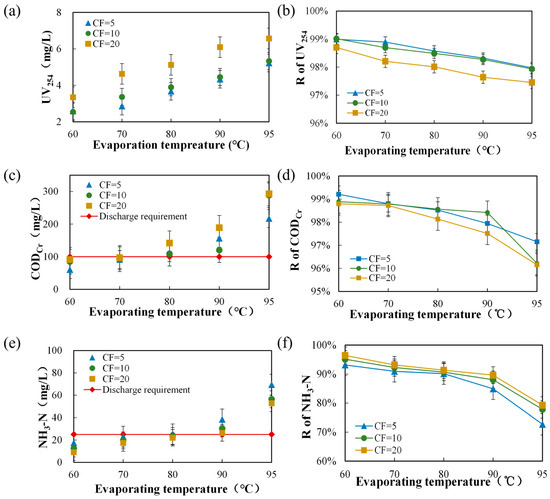
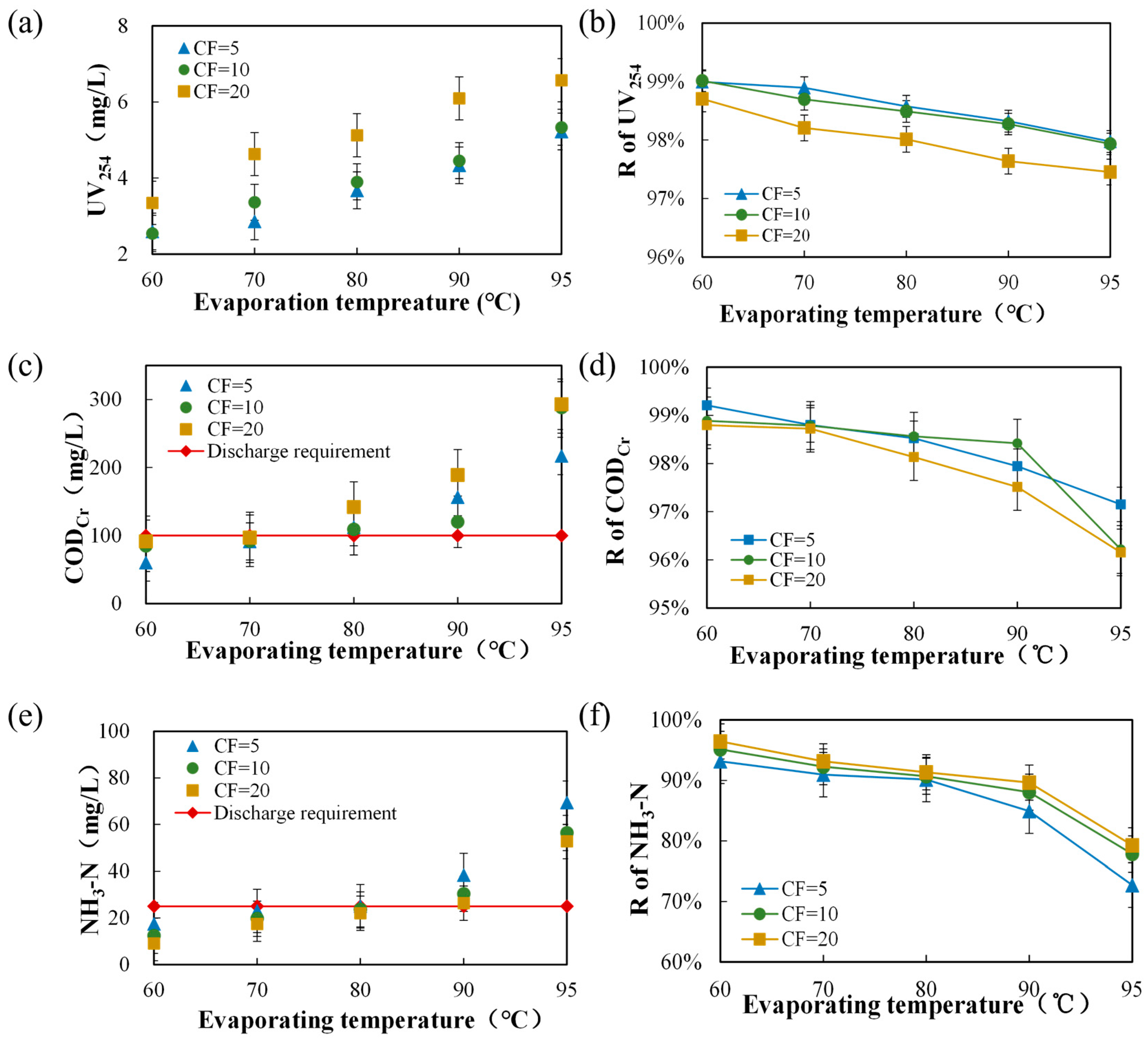
As the evaporation temperature increases, the intensified movement of materials leads to a reduction in the separation efficiency of CODCr, HA, and NH3-N in the LLMC (Figure 3). At 60 °C, the pollutant separation rates of HA and CODCr all reached 99%. However, when the evaporation temperature was raised to 95 °C, the pollutant separation rates of HA and CODCr declined to 97% and 96%. The boiling point of HA under atmospheric pressure is 1425 °F (773.9 °C), substantially higher than the experimental temperature range. Therefore, HA was not transferred into the condensate via volatilization, but rather through liquid entrainment. With increasing evaporation temperature, the intensified material agitation promoted greater entrainment and subsequent HA carryover into the condensate. Meanwhile when the liquid temperature in the evaporator did not reach the evaporation temperature of high-boiling-point organic matter, the higher the liquid temperature in the evaporator, the more intense the molecular diffusion of organic matter, and the easier it was to transfer organic matter to the condensate water. This explains the slight increase in CODCr concentration at higher temperatures. Notably, when the evaporation temperature exceeds 70 °C, the CODCr in the effluent begins to surpass 100 mg/L, exceeding the limit specified in the Standard for Pollution Control on the Landfill site of municipal solid waste (GB 16889-2024). The NH3-N content in the condensate was relatively low due to the acidic nature (pH: 4–5) of the pretreated LLMC (Figure 3e,f). This was because at pH values below six, most ammonia in wastewater existed as NH4+ [48], and was hard to volatilize into the condensate water. Notably, when the temperature exceeded 70 °C, the NH3-N concentration in effluent samples also failed to meet the discharge requirement. Therefore, for practical applications, maintaining the evaporation temperature at or below 70 °C is recommended to ensure compliance with effluent requirements.
Figure 3.
Effect of evaporation temperature on freshwater quality: ((a) UV254 concentration in the condensate, (b) pollutant separation rate of UV254, (c) CODCr concentration in the condensate, (d) pollutant separation rate of CODCr, (e) NH3–N concentration in the condensate, (f) pollutant separation rate of NH3–N).
3.2. Effect of pH on Condensate Water Quality
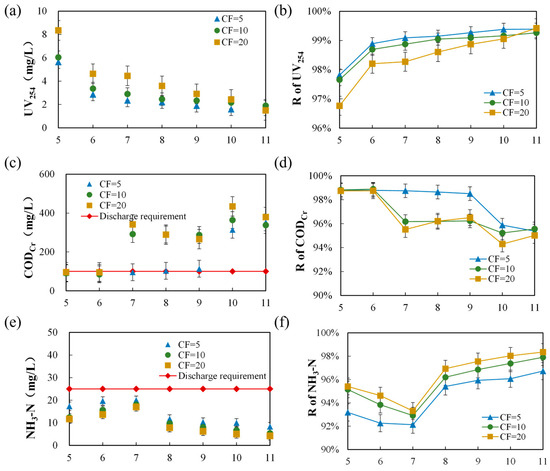
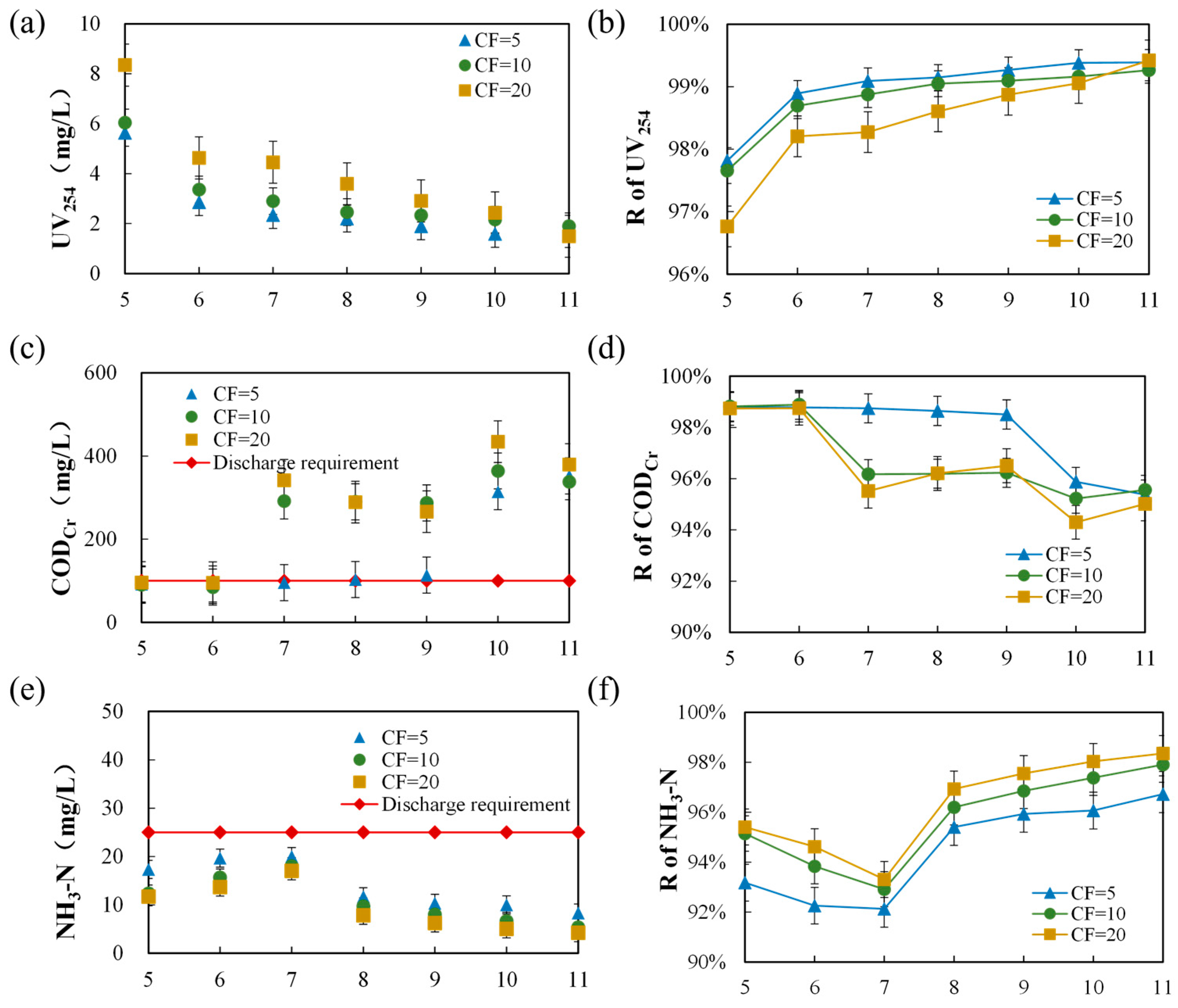
An increase in pH may result in effluent CODCr exceeding the permissible limit (Figure 4). At a concentration factor (CF) of five, as the pH increased from five to 11, the humic acid (HA) content in the effluent gradually decreased, whereas the CODCr content showed a progressive increase. The concentration of HA in the effluent decreases with increasing pH. This is attributed to the increased solubility of HA under alkaline conditions [49], along with the fact that the experimental temperature remains below its boiling point, resulting in greater retention of HA in the concentrate and reduced migration into the effluent. During pH adjustment via alkali addition, alkaline conditions promote the decomposition of large-molecule organic substances into smaller molecules or volatile intermediates [50,51], leading to the volatilization of some organic compounds into the condensate. Consequently, the concentration of CODCr in the effluent increases with increasing pH. Furthermore, when the influent pH is higher than seven, the CODCr in the effluent exceeds 100 mg/L, surpassing the emission limit. For practical applications, maintaining an influent pH lower than seven is essential to ensure that the effluent CODCr concentration complies with the effluent quality standards.
Figure 4.
Effect of pH on freshwater quality (Evaporation temperature: ~60 °C): ((a) UV254 concentration in the condensate, (b) pollutant separation rate of UV254, (c) CODCr concentration in the condensate, (d) pollutant separation rate of CODCr, (e) NH3-N concentration in the condensate, (f) pollutant separation rate of NH3-N).
The pH value significantly impacted the proportion of free ammonia and ammonium, as shown in Equations (1) and (2) [52].
where [NH3] is the free ammonia concentration; [NH3 + NH4+] represents the total ammonia concentration, [H+] is the hydrogen ion concentration, and Ka is the acid ionization constant of ammonia. It could be inferred that when pH values increase to higher than seven, the equilibrium was shifted to the left side of Equation (2) [53]. Consequently, a larger quantity of NH3 is produced in the wastewater, and more NH3 volatilizes from the system during evaporation, especially at higher CF corresponding to extended evaporation times. Hence, evaporation under acidic conditions leads to reduced NH3–N concentrations in the effluent. Therefore, within the experimental range, a pH of five was identified as the most suitable condition for the LTAE process.
3.3. Effect of Air–Liquid Mass Ratio on Condensate Water Quality
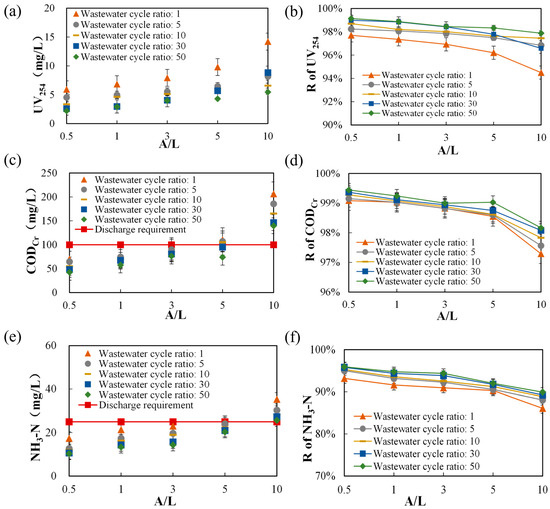
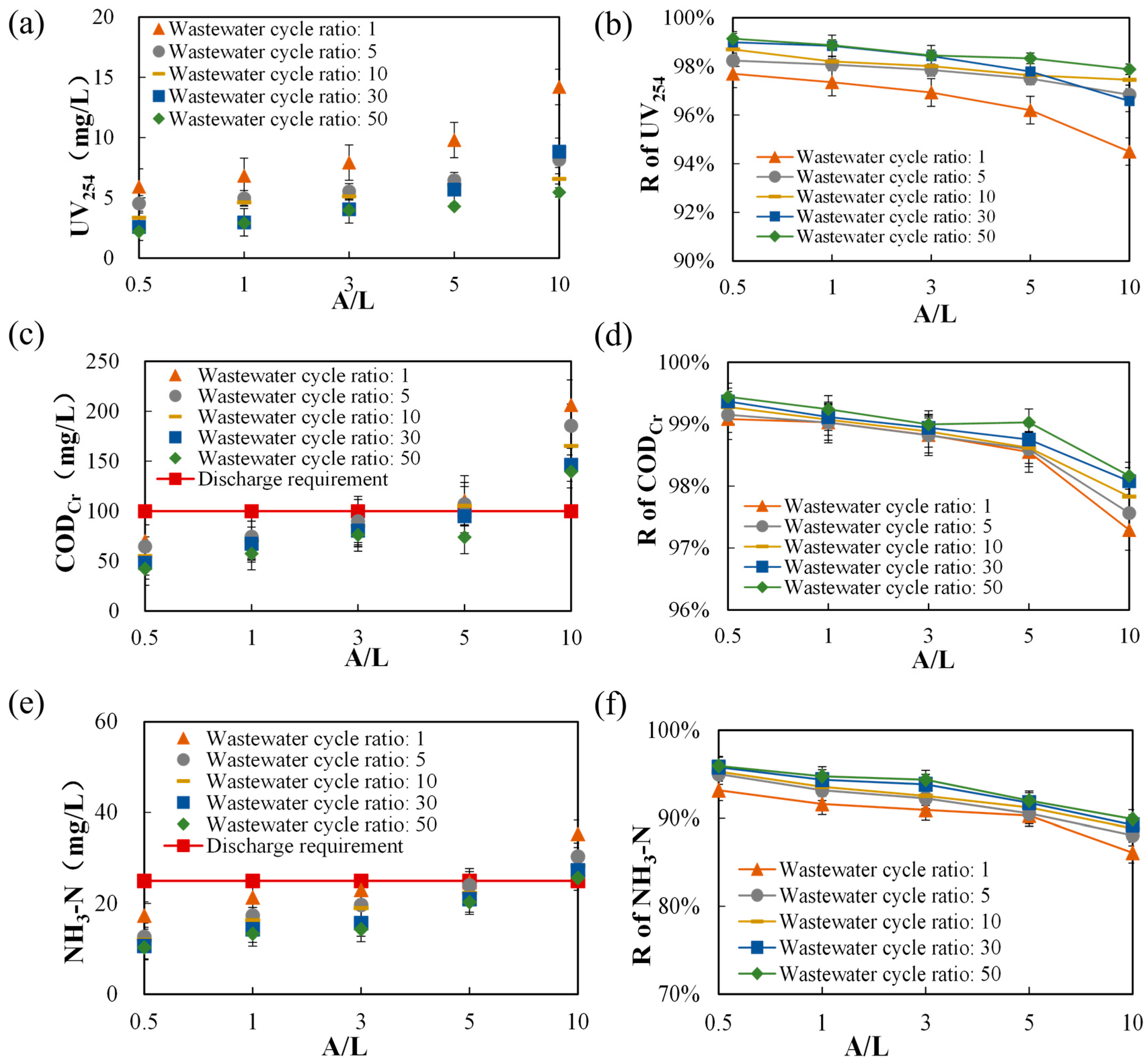
Figure 5 clearly demonstrates an inverse relationship between A/L and pollutant separation efficiency for HA, CODCr and NH3-N, a trend that was consistently observed across different water circulation ratios. The water treatment capacity of the LTAE device was 500 L/d, and the wastewater cycle ratio was set at 1 time, 5 times, 10 times, 30 times and 50 times, corresponding to circulating wastewater flow rate of 0.02, 0.1, 0.21, 0.63 and 1.04 m3/h respectively. Under different conditions of circulating water volume, set A/L= 0.5, 1, 3, 5 and 10 respectively. In other words, depending on the circulating water flow and the A/L value, the intake air of the system ranges from 0.01 m3/h to 20.8 m3/h.
Figure 5.
Effect of air-liquid ratio and water cycle ratio on freshwater quality (evaporation temperature: ~60 °C, CF = 20, pH = 5): ((a) UV254 concentration in the condensate, (b) pollutant separation rate of UV254, (c) CODCr concentration in the condensate, (d) pollutant separation rate of CODCr, (e) NH3-N concentration in the condensate, (f) pollutant separation rate of NH3-N).
When A/L exceeded five, the CODCr concentration began to surpass 100 mg/L, failing to meet the discharge requirement. Even though the pollutant separation rate of NH3-N decreased as A/L increased, the concentration in the condensate remained below 25 mg/L in all cases, complying with emission requirements. During the LTAE process, the cold air contacted hot wastewater directly for heat and mass exchange, and the air carried water vapor away from the wastewater in the evaporation chamber. Hence, when A/L was higher, the air flow was higher, resulting in the phenomenon of liquid entrainment and a certain amount of spray water droplets being carried away by the circulating air, and then discharged with the condensate [54]. Based on the test results, in order to ensure the effluent quality, the A/L value should be ≤5.
3.4. Effect of Concentration Factor on Condensate Water Quality
Based on experimental results of Section 3.1, Section 3.2 and Section 3.3, when wastewater sample was concentrated 20 times, the concentration of HA, CODCr and NH3-N in the condensate were all meeting the discharge standard. These findings indicate that the LTAE process can achieve a 20-fold material concentration while the on-site MVC system can only achieve approximately 10 times the concentration.
Based on the above experimental results, under optimized conditions (temperature ≈ 60 °C, pH = 5, A/L = 5) and at a 20-fold concentration ratio, the concentrations of NH3-N and CODCr in the effluent were measured as ~5.6 mg/L and ~91.6 mg/L, respectively. Meanwhile, the corresponding concentrate within the system exhibited high pollutant loads, with NH3-N and CODCr concentrations reaching ~4200 mg/L and ~38,000 mg/L, respectively. During the experiment, the average influent concentrations of LLMC were approximately 213 mg/L for NH3–N and 1915 mg/L for CODCr. Based on mass balance calculations, approximately 54.5 mg/L of NH3–N and 208.4 mg/L of CODCr volatilized from the system during evaporation. Accordingly, incorporating a gas scrubbing unit is recommended to minimize secondary pollution.
3.5. Discussion on Heat and Mass Transfer Model of LTAE
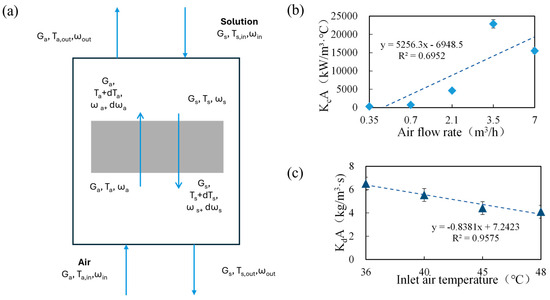
The LTAE system selected in this research can be compared to a countercurrent packing tower to study the principles of heat and mass exchange in direct contact between gas and liquid. To facilitate an analysis of the heat and mass transfer efficiency, we developed a simplified two-dimensional model of the system, as illustrated in Figure 6a. The discussion in this section is based on the following assumptions [55,56]:
Figure 6.
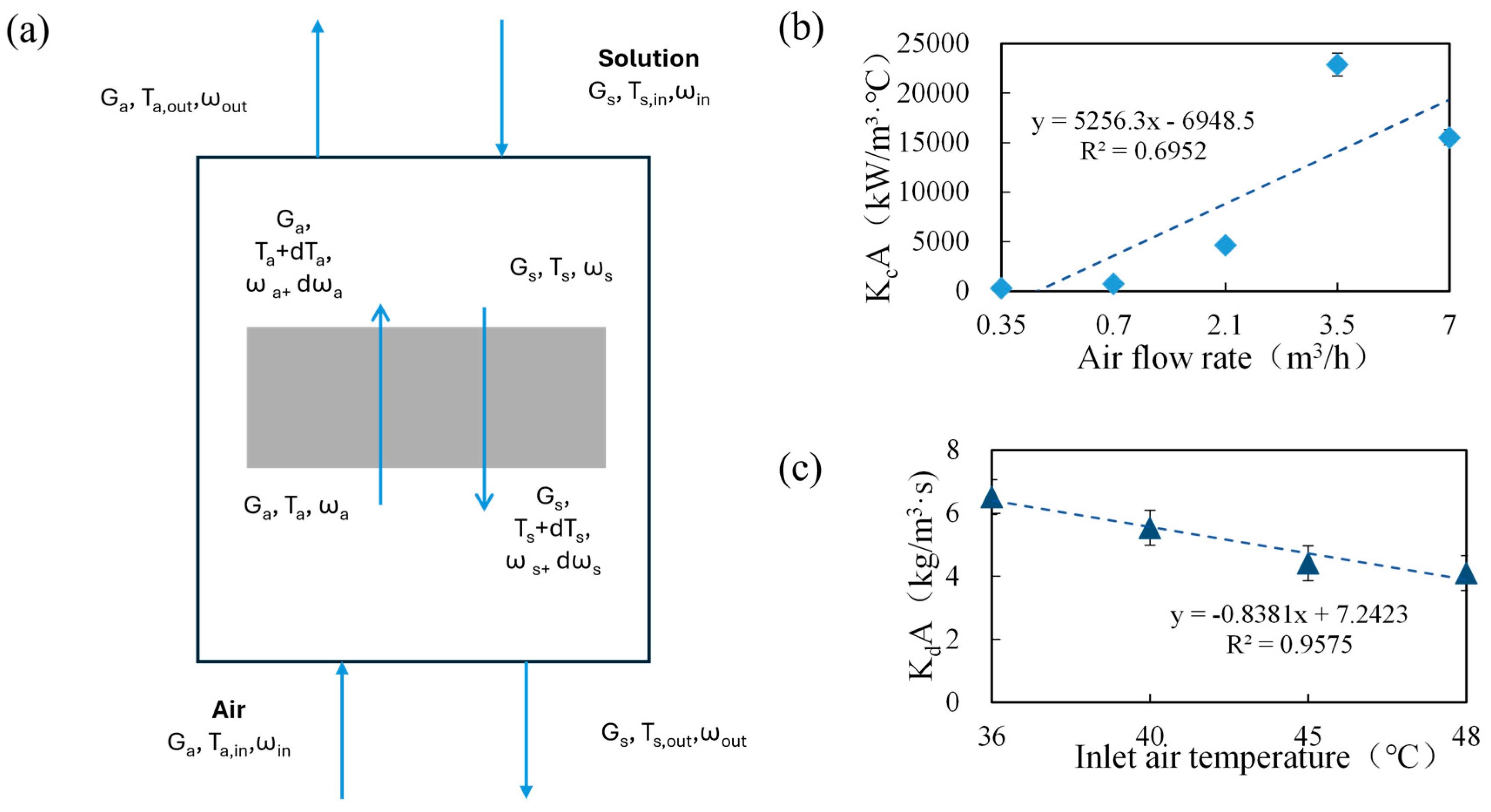
LTAE gas–liquid mass transfer model and heat/mass transfer coefficient: ((a) LTAE mass transfer model, (b) volumatic heat transfer coefficient, and (c) volumatic mass transfer coefficient).
- The process is assumed to be in a steady state.
- The system is insulated.
- Both kinetic and potential terms in the energy equations are neglected.
- In the fill region, the gas–liquid distribution is assumed to be uniform.
- Pressure losses are ignored in the components.
The KcA can be determined based on the enthalpy changes in inlet and outlet gas, which include contributions from both sensible and latent heat, representing the actual heat transfer. The calculation follows Equation (3) [57]:
The volumetric mass transfer coefficient (KdA) is calculated based on the mass of evaporated water, representing the actual mass transfer, as expressed in Equation (4) [57]. As indicated by Equation (4), the inlet air temperature significantly influences the mass transfer coefficient of the system.
Based on the above equations, the KcA and KdA of the system were examined by varying the air flow rate and inlet temperature. The evaporation temperature of water was maintained at 60 °C, while the inlet temperature of the wastewater was heated to 62 °C. Under different air flow rates, the measured temperature of the wastewater in the evaporation chamber was reduced to 37~45 °C. The gas phase completed the process of increasing in temperature and humidifying, and the inlet gas temperature was 36 °C (ambient temperature). When the different air flows were set, the outlet gas temperature was different, which was between 55 °C and 60 °C, with the detailed gas phase conditions (inlet/outlet) presented in Table 2.
Table 2.
The water and gas states in the evaporation chamber under different A/L conditions.
By varying the intake temperature, the outlet air temperature increased to 56~60 °C, accompanied by an increase in enthalpy. The thermodynamic states of the gas at the inlet and outlet of the evaporation chamber under different inlet air temperatures are summarized in Table 3.
Table 3.
Gas parameters under different temperatures of intake air in evaporation chamber.
Figure 6b shows that KcA exhibited an initial increase followed by a subsequent decrease. Across the tested air flow range of 0.35 m3/h to 7 m3/h, the KcA increased from 304.18 kW/(m3·°C) to a maximum of 22,871.25 kW/(m3·°C) at an air flow of 3.5 m3/h, after which it decreased to 15,523.18 kW/(m3·°C). The first enhancement occurred because the higher air flow introduced more air into the system, improving the gas–liquid mass ratio and expanding the gas–liquid contact area, thereby enhancing the system’s ability to carry away more water vapor [58]. Additionally, the increase in air volume leads to the increase in the relative motion velocity of the gas–liquid phase, and the degree of turbulence intensifies, which further increases the gas–liquid interphase contact probability [59,60], and enhances KcA. However, excessively high air flow resulted in inadequate gas–liquid contact time within the evaporation chamber, which inhibited the effective removal of heat from the wastewater and consequently lowered the overall system efficiency. Based on the test results, an optimal air flow rate of 3.5 m3/h is recommended.
At a constant evaporation temperature, the KdA t of the system exhibited a linear relationship with the intake air temperature (R2 = 0.9575), decreasing as the intake air temperature increased (Figure 6c). According to Equation (4), KdA of LATE process is mainly related to the temperature difference between air and wastewater. When maintaining constant wastewater evaporation conditions, this parameter is mainly influenced by the inlet air temperature. In this test process, the inlet air temperature was controlled at four levels: 36 °C, 40 °C, 45 °C and 50 °C, resulting in corresponding outlet air temperature of 60 °C, 58 °C, 57 °C and 56 °C. The calculated KdA was 6.52 kg/m3·s, 5.55 kg/m3·s, 4.42 kg/m3·s and 4.10 kg/m3·s, respectively. This was because the generation of fresh water in the LTAE system was driven by the moisture content difference in wastewater and air. Lower intake air temperature created a larger temperature differential between gas and liquid phase, thereby enhancing the mass transfer driving force and consequently increasing KdA.
3.6. Economic Analysis
The net water yield of the system was 500 L/d = 0.021 t/h. The heat required for the evaporation of this amount of water was calculated as follows:
R1 = K × m1 = 2400 kJ/kg × 0.5 t/d = 1,200,000 kJ/d
With the evaporation temperature set at 60 °C and the wastewater cooling temperature set at 25 °C, a 15% margin was considered.
The circulating wastewater flow rate required was m1 = R1/(Cpm · Δt) = 1,200,000/(3.3 × 25 × 1000) × 1.15 = 16.73 t/d = 0.7 t/h
The mother liquor circulation flow rate was set at 30% of the circulating wastewater. Thus, the flow rate Q2 = Q1 × 0.3 = 0.21 t/h
The required circulating air volume was: Q3 = Q1 × 5 = 3.5 m3/h (A/L = 5)
According to the law of energy conservation, the heat carried away by the condensed fresh water equals the heat absorbed during water evaporation, which is R1.
The required circulating fresh water flow rate was:
Q4 = R1/(Cpm · Δt) = 1,200,000/(4.18 × 25 × 1000) × 1.15 = 0.55 t/h
Assuming a temperature rise of 12 °C for the circulating fresh water, the heat to be supplied by the compression heat pump was calculated as:
R2 = Q4 × Cpm × Δt/1000/3600 = 7.66 kW
With the Coefficient of Performance (COP) of the compressor assumed to be 4, the compressor power: P5 = R4/4 = 1.92 kW
A summary of the system’s power consumption and the energy consumption per ton of water treated is provided in the Table 4. The detailed calculation process is provided in the Supplementary Materials.
Table 4.
Energy consumption for equipment operation.
Compared to the LTAE system, MVC remains relatively energy-efficient, with reported electrical energy consumption ranging from 7 to 55.4 kWh/m3 of feed, depending on the influent TDS [61,62,63]. The MVC system achieves latent heat recovery by compressing vapor to increase its temperature and enthalpy [64], resulting in relatively low energy consumption. In contrast, the higher energy consumption of the LTAE system can be attributed to three main factors: (1) the absence of a latent heat recovery mechanism; (2) the occurrence of evaporation under cooling conditions, which incurs certain heat losses; and (3) the reliance on gas flow to remove moisture, where the evaporation rate is closely governed by gas–liquid contact, and the inherently slow evaporation process further exacerbates heat loss. However, in practical applications, it is possible to flexibly utilize on-site steam or hot water as supplementary energy sources [65], which can significantly reduce overall electricity consumption. If a waste incineration power plant is located near the landfill site, it would be worthwhile to consider utilizing the residual heat from the condensers and flue gases during the incineration process, as well as combusting the landfill gas collected from the landfill site, to generate steam or hot water.
3.7. Implications and Prospects for LLMC Treatment
The water quality of LLMC is complex, characterized by high organic matter content, high salinity, and poor biodegradability, posing significant challenges in practical treatment processes. The LTAE technology validated in this study offers a novel approach for LLMC treatment. Unlike conventional high-temperature evaporation, the LTAE system operates under mild conditions (≤70 °C, ambient pressure), effectively mitigating the risks of scaling and corrosion. In this study, the system maintained stable operation at a concentration factor of 20, and the distillate quality met the discharge standard (CODCr ≤ 91.6 mg/L, NH3–N ≤ 5.6 mg/L), demonstrating the favorable adaptability of LTAE for treating complex wastewater.
In practical engineering applications, various low-grade heat sources are often available onsite. For instance, landfills typically generate substantial amounts of landfill gas, which can be combusted or utilized in combined heat and power systems to provide thermal energy. Waste heat resources are also commonly present in leachate treatment systems. If low-grade heat sources such as landfill gas, industrial waste heat, or solar energy can be harnessed as supplementary energy for the LTAE system, electricity consumption could be significantly reduced, thereby enhancing overall economic viability.
Notably, mass balance calculations revealed that approximately 54.5 mg/L of NH3–N and 208.4 mg/L of CODCr were volatilized into the gas phase during evaporation. Therefore, it is recommended to incorporate a gas treatment unit (e.g., acid scrubbers, activated carbon adsorption, or biological scrubbers) into the system design to further treat the non-condensable gases, ensuring no risk of secondary pollution.
In summary, the LTAE technology, characterized by its mild operating conditions, stable operational performance, and strong adaptability to complex water quality, provides a feasible pathway for the efficient treatment of LLMC. Future research should further explore efficient integration schemes of LTAE with low-grade heat sources, as well as synergistic optimization with other treatment processes (e.g., advanced oxidation, resource recovery), to facilitate the practical application of this technology in engineering practice.
4. Conclusions
This paper investigates the treatment efficiency and operating costs associated withLLMC—a wastewater characterized by high organic pollutant content and high salinity—using a novel LTAE system under mild operating conditions. Experimental results demonstrate that the LTAE system achieves a higher concentration ratio (CF = 20) for LLMC compared to the on-site MVC system currently in use. Key operational parameters were systematically evaluated, leading to the following findings:
- An increase in evaporation temperature intensifies the movement of materials, leading to a deterioration in effluent water quality. Within the experimental range investigated, the optimal evaporation temperature was determined to be 70 °C.
- Under unadjusted acidic conditions, both CODCr and NH3-N levels in the effluent complied with the discharge standard.
- Under the experimental conditions, the system achieved optimal heat and mass transfer efficiency at A/L = 5 and an intake air temperature of 36 °C, with corresponding coefficients of KcA = 22,871.25 kW/(m3·°C) and KdA = 6.52 kg/(m3·s).
- According to theoretical calculations, the energy consumption per ton of water evaporated by the LTAE system was 110.5 kWh.
In summary, the low-temperature atmospheric evaporation (LTAE) process demonstrates considerable potential for the advanced treatment of LLMC. While this study specifically focused on the effects of operational parameters on condensate quality and heat and mass transfer efficiency, further investigation is warranted to develop strategies for enhancing energy efficiency and to explore synergistic optimization with other treatment processes. Subsequent research addressing these aspects will be crucial for optimizing the practical implementation of LTAE technology in full-scale LLMC treatment applications.
Supplementary Materials
The following supporting information can be downloaded at: https://www.mdpi.com/article/10.3390/environments13040215/s1.
Author Contributions
L.L.: Conceptualization, Methodology, Writing—original draft, Writing—review and editing. M.W.: Data curation, Methodology. X.W.: Data curation. H.W.: Supervision. Y.S. Supervision, Data curation. All authors have read and agreed to the published version of the manuscript.
Funding
This research was financially supported by the Aerospace Kaitian Environmental Protection Co., Ltd. This study focuses on solving the difficult problems of practical engineering projects. The Aerospace Kaitian’s financial support is gratefully acknowledged.
Data Availability Statement
Data will be made available on request.
Conflicts of Interest
Lu Liu and Yilu Sun were employed by the Key Laboratory of Environmental Biotechnology. The authors declare that this study received funding from Kaitian Environmental Protection Co., Ltd. The funder was not involved in the study design, collection, analysis, interpretation of data, the writing of this article, or the decision to submit it for publication.
Nomenclature
| LL | Landfill leachate |
| LLMC | Landfill leachate membrane concentrates |
| LTAE | Low-temperature atmospheric evaporation |
| Ga | air flow rate, kg·h−1 |
| Gs | solution flow rate, kg·h−1 |
| Ta,in | temperature of inlet air, °C |
| Ta,out | temperature of outlet air, °C |
| Ts,in | temperature of inlet wastewater, °C |
| Ts,out | temperature of outlet wastewater, °C |
| ωa | moisture content of air, kg·kg−1 |
| hs | moisture content of air in equilibrium with the solution state, kg·kg−1 |
| ha,in | enthalpy of inlet air, kJ·kg−1 |
| ha,out | enthalpy of outlet air, kJ·kg−1 |
| V | packing volume, m3 |
| W | amount of evaporated water, m3·h−1 |
| He,in | humidity content of saturated air corresponding to inlet air temperature, kg·kg−1 |
| Ha,in | moisture content of the inlet air, kg·kg−1 |
| He,out | moisture content of saturated air corresponding to the outlet air temperature, kg·kg−1 |
| Ha,out | moisture content of the outlet air, kg·kg−1 |
| K | molar evaporation enthalpy of wastewater, 2400 kJ·kg−1 |
| Cpm | specific heat capacity of water at constant pressure: wastewater: 3.3 kJ/kg·°C freshwater: 4.18 kJ/kg·°C |
| Δt | temperature difference |
| R | latent heat of evaporation, kJ |
| Q | flow rate, m3/h |
| H | pump head, m |
| P | pump power, kW |
References
- Renou, S.; Givaudan, J.G.; Poulain, S.; Dirassouyan, F.; Moulin, P. Landfill leachate treatment: Review and opportunity. J. Hazard. Mater. 2008, 150, 468–493. [Google Scholar] [CrossRef] [Scilit]
- Abdel-Shafy, H.I.; Ibrahim, A.M.; Al-Sulaiman, A.M.; Okasha, R.A. Landfill leachate: Sources, nature, organic composition, and treatment: An environmental overview. Ain Shams Eng. J. 2024, 15, 102293. [Google Scholar] [CrossRef] [Scilit]
- Nanda, S.; Berruti, F. Municipal solid waste management and landfilling technologies: A review. Environ. Chem. Lett. 2021, 19, 1433–1456. [Google Scholar] [CrossRef] [Scilit]
- Teng, C.; Zhou, K.; Peng, C.; Chen, W. Characterization and treatment of landfill leachate: A review. Water Res. 2021, 203, 117525. [Google Scholar] [CrossRef] [Scilit]
- Li, J.Y.; Zhao, L.; Qin, L.L.; Tian, X.; Wang, A.; Zhou, Y.; Meng, L.; Chen, Y. Removal of refractory organics in nanofiltration concentrates of municipal solid waste leachate treatment plants by combined Fenton oxidative-coagulation with photo—Fenton processes. Chemosphere 2016, 146, 442–449. [Google Scholar] [CrossRef] [Scilit]
- Wang, Y.J.; Li, X.Y.; Zhen, L.M.; Zhang, H.; Zhang, Y.; Wang, C. Electro-Fenton treatment of concentrates generated in nanofiltration of biologically pretreated landfill leachate. J. Hazard. Mater. 2012, 229, 115–121. [Google Scholar] [CrossRef] [Scilit] [PubMed]
- Li, X.Y.; Zhu, W.; Wu, Y.; Wang, C.; Zheng, J.; Xu, K.; Li, J. Recovery of potassium from landfill leachate concentrates using a combination of cation-exchange membrane electrolysis and magnesium potassium phosphate crystallization. Sep. Purif. Technol. 2015, 144, 1–7. [Google Scholar] [CrossRef] [Scilit]
- Qiao, M.; Zhao, X.; Wei, X.Y. Characterization and treatment of landfill leachate membrane concentrate by Fe2+/NaClO combined with advanced oxidation processes. Sci. Rep. 2018, 8, 12525. [Google Scholar] [CrossRef] [Scilit]
- Hendrych, J.; Hejralova, R.; Krouzek, J.; Spacek, P.; Sobek, J. Stabilisation/solidification of landfill leachate concentrate and its residue obtained by partial evaporation. Waste Manag. 2019, 95, 560–568. [Google Scholar] [CrossRef] [Scilit]
- Wang, Y.; Meng, G.; Shan, M.; Wang, D.; Bai, Z.; Zhou, X.; Lv, Y.; Bai, J. Treatment of high-ammonia-nitrogen landfill leachate nanofiltration concentrate using an Fe-loaded Ni-foam-based electro-Fenton cathode. J. Environ. Chem. Eng. 2020, 8, 104243. [Google Scholar] [CrossRef] [Scilit]
- Chen, W.; Gu, Z.; Wen, P.; Li, Q. Degradation of refractory organic contaminants in membrane concentrates from landfill leachate by a combined coagulation-ozonation process. Chemosphere 2019, 217, 411–422. [Google Scholar] [CrossRef] [Scilit] [PubMed]
- He, R.; Wei, X.-M.; Tian, B.-H.; Su, Y.; Lu, Y.-L. Characterization of a joint recirculation of concentrated leachate and leachate to landfills with a microaerobic bioreactor for leachate treatment. Waste Manag. 2015, 46, 380–388. [Google Scholar] [CrossRef] [Scilit]
- Ren, X.; Song, K.; Xiao, Y.; Chen, W.; Liu, D. Constituent transformation mechanism of concentrated leachate after incineration at different temperatures. Environ. Sci. Pollut. Res. 2019, 26, 34613–34621. [Google Scholar] [CrossRef] [Scilit] [PubMed]
- Ren, X.; Song, K.; Xiao, Y.; Zong, S.; Liu, D. Effective treatment of spacer tube reverse osmosis membrane concentrated leachate from an incineration power plant using coagulation coupled with electrochemical treatment processes. Chemosphere 2020, 244, 125479. [Google Scholar] [CrossRef] [Scilit]
- Wei, S.; Fu, A.; Li, H.; Dong, W.; Sun, F.; Wang, H.; Xing, D.Y.; Wang, Y. Accurate separation and recovery of humic substances from landfill leachate concentrate by triethanolamine-based loose nanofiltration membranes. Adv. Membr. 2025, 5, 100137. [Google Scholar] [CrossRef] [Scilit]
- Keyikoglu, R.; Karatas, O.; Rezania, H.; Kobya, M.; Vatanpour, V.; Khataee, A. A review on treatment of membrane concentrates generated from landfill leachate treatment processes. Sep. Purif. Technol. 2021, 259, 118182. [Google Scholar] [CrossRef] [Scilit]
- Lim, Y.J.; Goh, K.; Nadzri, N.; Wang, R. Thin-film composite (TFC) membranes for sustainable desalination and water reuse: A perspective. Desalination 2025, 599, 118451. [Google Scholar] [CrossRef] [Scilit]
- Zhang, L.; Wang, X.; Yue, D. Effect of submerged combustion evaporation on Cd complexation potential of organic matter in municipal solid waste landfill leachate. Environ. Pollut. 2020, 267, 115573. [Google Scholar] [CrossRef] [Scilit] [PubMed]
- Zhang, L.; Lavagnolo, M.C.; Bai, H.; Pivato, A.; Raga, R.; Yue, D. Environmental and economic assessment of leachate concentrate treatment technologies using analytic hierarchy process. Resour. Conserv. Recycl. 2019, 141, 474–480. [Google Scholar] [CrossRef] [Scilit]
- Bai, Z.; Wang, Y.; Shan, M.; Lv, Y.; Meng, G.; Zhu, S.; Pan, D. Study on anti-scaling of landfill leachate treated by evaporation method. Water Sci. Technol. 2021, 84, 122–134. [Google Scholar] [CrossRef] [Scilit]
- Yuan, Q.; Huang, Y.; Chi, J.; Wu, W.; Qi, E. Effective treatment of leachate concentrate from waste incineration plant by combination of coagulation and direct contact evaporation. Chemosphere 2024, 349, 140880. [Google Scholar] [CrossRef] [Scilit] [PubMed]
- Yuan, Q.; Huang, Y.; Chi, J.; Wu, W.; Qi, E. Gas-liquid contact evaporation of concentrate leachate from disk-tube reverse osmosis treatment in waste incineration plant. Environ. Pollut. 2024, 343, 123271. [Google Scholar] [CrossRef] [Scilit] [PubMed]
- Tzen, E.; Zaragoza, G.; Padilla, D.-C.A. 3.16—Solar Desalination. In Comprehensive Renewable Energy, 2nd ed.; Letcher, T.M., Ed.; Elsevier: Oxford, UK, 2022; pp. 590–637. [Google Scholar]
- Pandit, R.R.; Deshmukh, S.S.; Khatod, K.J.; Katekar, V.P.; Malwe, P.D.; Chan, C.K.; Shaik, F.; Sundar, L.S.; Naik, N. Efficiency, cost, and carbon footprint considerations in analysing hybrid solar thermal-photovoltaic desalination systems. Desalination Water Treat. 2026, 325, 101606. [Google Scholar] [CrossRef] [Scilit]
- Shi, J.; Dang, Y.; Qu, D.; Sun, D. Effective treatment of reverse osmosis concentrate from incineration leachate using direct contact membrane distillation coupled with a NaOH/PAM pre-treatment process. Chemosphere 2019, 220, 195–203. [Google Scholar] [CrossRef] [Scilit]
- Hou, C.; Guo, Q.; Wong, N.H.; Sunarso, J.; Li, Z.; Song, X.; Song, P.; Peng, Y. Preparation of a fouling-resistant Teflon/PVDF composite membrane and its application to treat nanofiltration brine from landfill leachates. Process Saf. Environ. Prot. 2022, 168, 535–543. [Google Scholar] [CrossRef] [Scilit]
- Li, J.; Cao, Y.; Ding, K.; Ye, J.; Li, F.; Ma, C.; Lv, P.; Xu, Y.; Shi, L. Research progress of industrial wastewater treatment technology based on solar interfacial adsorption coupled evaporation process. Sci. Total Environ. 2024, 931, 172887. [Google Scholar] [CrossRef] [Scilit] [PubMed]
- Han, X.; Ding, S.; Hu, H.; Wang, S. Recent advances in structural regulation and optimization of high-performance solar-driven interfacial evaporation systems. J. Mater. Chem. A 2022, 10, 18509–18541. [Google Scholar] [CrossRef] [Scilit]
- Tucker, C.I.; Bartholomew, T.V.; Dudchenko, A.V.; Mauter, M.S. Component innovations for lower cost mechanical vapor compression. Water Res. 2024, 260, 121950. [Google Scholar] [CrossRef] [Scilit]
- Wang, J.; Deng, Z.; Liu, Q.; Liu, Y.; Wang, S. Fluid dynamics and energy efficiency of submerged combustion process for treating wastewater with high salinity and COD concentration. Case Stud. Therm. Eng. 2024, 56, 104262. [Google Scholar] [CrossRef] [Scilit]
- Soumbati, Y.; Bouatou, I.; Abushaban, A.; Belmabkhout, Y.; Necibi, M.C. Review of membrane distillation for desalination applications: Advanced modeling, specific energy consumption, and water production cost. J. Water Process Eng. 2025, 71, 107296. [Google Scholar] [CrossRef] [Scilit]
- Kadhim, S.A.; Rasheed, R.H.; Hussein, A.K.; Rashid, F.L.; Ashour, A.M.; Al-Ghezi, M.K.; Bouabidi, A.; Sathyamurthy, R.; Ibrahim, O.A.A.-M. Floating solar stills: A state-of-art review. Renew. Sustain. Energy Rev. 2026, 229, 116652. [Google Scholar] [CrossRef] [Scilit]
- Wang, B.; Shen, J.; Chen, Y.; Zhu, W. Performance evaluation of a novel humidification-dehumidification desalination system operated by a heat pump. Energy Convers. Manag. 2023, 293, 117523. [Google Scholar] [CrossRef] [Scilit]
- Qasem, N.A.A.; Zubair, S.M.; Abdallah, A.M.; Elbassoussi, M.H.; Ahmed, M.A. Novel and efficient integration of a humidification-dehumidification desalination system with an absorption refrigeration system. Appl. Energy 2020, 263, 114659. [Google Scholar] [CrossRef] [Scilit]
- Zhang, Y.; Zhu, C.G.; Zhang, H.; Zheng, W.; You, S.; Zhen, Y. Experimental study of a humidification-dehumidification desalination system with heat pump unit. Desalination 2018, 442, 108–117. [Google Scholar] [CrossRef] [Scilit]
- Zhang, Y.; Zhang, H.; Zheng, W.D.; You, S.J.; Wang, Y.R. Numerical investigation of a humidification-dehumidification desalination system driven by heat pump. Energy Convers. Manag. 2019, 180, 641–653. [Google Scholar] [CrossRef] [Scilit]
- Rostamzadeh, H.; Namin, A.S.; Ghaebi, H.; Amidpour, M. Performance assessment and optimization of a humidification dehumidification (HDH) system driven by absorption-compression heat pump cycle. Desalination 2018, 447, 84–101. [Google Scholar] [CrossRef] [Scilit]
- Santosh, R.; Lee, H.-S.; Kim, Y.-D. A comprehensive review on humidifiers and dehumidifiers in solar and low-grade waste heat powered humidification-dehumidification desalination systems. J. Clean. Prod. 2022, 347, 131300. [Google Scholar] [CrossRef] [Scilit]
- DLawal, U.; Antar, M.A.; Khalifa, A.; Zubair, S.M.; Al-Sulaiman, F. Experimental investigation of heat pump driven humidification-dehumidification desalination system for water desalination and space conditioning. Desalination 2020, 475, 114199. [Google Scholar]
- Anand, B.; Shankar, R.; Murugavelh, S.; Rivera, W.; Prasad, K.M.; Nagarajan, R. A review on solar photovoltaic thermal integrated desalination technologies. Renew. Sustain. Energy Rev. 2021, 141, 110787. [Google Scholar] [CrossRef] [Scilit]
- Li, H.; Wang, H.; Liu, Q.; Tan, Y.; Jiang, N.; Lin, Y. Evaporation process for treating high-salinity industrial wastewater at low temperatures and ambient pressure. Desalination Water Treat. 2016, 57, 27048–27060. [Google Scholar] [CrossRef] [Scilit]
- Santosh, R.; Lee, H.-S.; Ji, H.; Kim, Y.-D. Effect of thermal characteristics on the chemical quality of real-brine treatment through hydrophilic fiber-based low-grade heat-powered humidification-dehumidification process. Water Res. 2023, 233, 119771. [Google Scholar] [CrossRef] [Scilit]
- Gao, P.; Zhang, M.; Du, Y.; Cheng, B.; Zhang, D. Study on bubble column humidification and dehumidification system for coal mine wastewater treatment. Water Sci. Technol. 2018, 77, 1909–1919. [Google Scholar] [CrossRef] [Scilit]
- Liu, J.; Sun, Y.; Yv, S.; Wang, J.; Hu, K. Design and Experimental Study on a New Closed-Cycle Desalination System Based on Ambient Temperature. Processes 2020, 8, 1131. [Google Scholar] [CrossRef] [Scilit]
- Jiang, F.; Qiu, B.; Sun, D. Advanced degradation of refractory pollutants in incineration leachate by UV/Peroxymonosulfate. Chem. Eng. J. 2018, 349, 338–346. [Google Scholar] [CrossRef] [Scilit]
- Yue, D.; Xu, Y.; Mahar, R.B.; Liu, F.; Nie, Y. Laboratory-scale experiments applied to the design of a two-stage submerged combustion evaporation system. Waste Manag. 2007, 27, 704–710. [Google Scholar] [CrossRef] [Scilit]
- Qin, H.D.; Chen, H.L. Pretreatment of concentrated leachate by the combination of coagulation and catalytic ozonation with Ce/AC catalyst. Water Sci. Technol. 2016, 73, 511–519. [Google Scholar] [CrossRef] [Scilit]
- Maghfiroh, M.; Park, N.; Chang, H.; Jung, J.; Ahn, K.; Lim, H.; Kim, W. Water spray reactor for ammonia removal via air stripping: An evaluation on mass transfer and process efficiency. J. Environ. Chem. Eng. 2022, 10, 108498. [Google Scholar] [CrossRef] [Scilit]
- Ndjeumi, C.C.; Bilo’o, P.Z.; Anombogo, G.A.M.; Maicaneanu, A.S.; Sieliechi, J.M.; Kamga, R. Assessment of the crystallochemical properties of the natural and modified clays in the organic matter removal during the water treatment process. Case Stud. Chem. Environ. Eng. 2024, 10, 100787. [Google Scholar] [CrossRef] [Scilit]
- Wang, Q.; Xin, W.; Shao, Z.; Usman, M.; Li, J.; Shang, P.; Kou, Y.; El-Din, M.G.; Chen, C. Role of pretreatment type and microbial mechanisms on enhancing volatile fatty acids production during anaerobic fermentation of refinery waste activated sludge. Bioresour. Technol. 2023, 381, 129122. [Google Scholar] [CrossRef] [Scilit] [PubMed]
- Tao, X.; Qiu, S.; Yan, S.; Zhang, G.; Zou, W.; Lv, L.; Liang, J. From waste to resource: A strategy from carbide slag to enhance volatile fatty acid production in sludge fermentation. J. Water Process Eng. 2026, 83, 109716. [Google Scholar] [CrossRef] [Scilit]
- Bonmatı, A.; Flotats, X. Air stripping of ammonia from pig slurry: Characterisation and feasibility as a pre- or post-treatment to mesophilic anaerobic digestion. Waste Manag. 2003, 23, 261–272. [Google Scholar] [CrossRef] [Scilit]
- Alhelal, I.I.; Loetscher, L.H.; Sharvelle, S.; Reardon, K.F. Nitrogen recovery from anaerobic digestate via ammonia stripping and absorbing with a nitrified solution. J. Environ. Chem. Eng. 2022, 10, 107826. [Google Scholar] [CrossRef] [Scilit]
- Liu, J.; Wang, J. Experimental study on the mechanism and efficiency of a closed-cycle low-temperature evaporation system for treating high salt and high organic matter wastewater. J. Water Process Eng. 2024, 58, 104926. [Google Scholar] [CrossRef] [Scilit]
- Chen, J.; Han, D.; He, W.; Liu, Y. Numerical investigation on supersaturation phenomenon of humid air in the humidification process. Fluid Phase Equilibria 2021, 538, 113008. [Google Scholar] [CrossRef] [Scilit]
- Behzadi-Sarok, M.; Saidi, M.H. Thermal investigation of humidification process using the Poppe method, a semi-analytical method. Int. J. Thermofluids 2025, 29, 101369. [Google Scholar] [CrossRef] [Scilit]
- Li, H.; Ren, H.Y.; Liu, Y.Z. Performance analysis of heat and mass transfer, thermodynamic and economic of high gravity direct contact evaporation system. Desalination 2023, 565, 116892. [Google Scholar] [CrossRef] [Scilit]
- Li, H.; Ren, H.; Liu, Y. Construction of high gravity direct contact evaporation system and research of evaporation performance. Desalination 2022, 542, 116087. [Google Scholar] [CrossRef] [Scilit]
- Fang, S.; Mu, L. Heat and mass transfer analysis during gas-liquid separation in an evaporator device for desalination. Desalination 2020, 486, 114430. [Google Scholar] [CrossRef] [Scilit]
- Cheng, S.-Y.; Liu, Y.-Z.; Qi, G.-S. Experimental study of CO2 capture enhanced by coal fly ash-synthesized NH2-MCM-41 coupled with high gravity technology. Chem. Eng. J. 2020, 400, 125946. [Google Scholar] [CrossRef] [Scilit]
- Bhojwani, S.; Topolski, K.; Mukherjee, R.; Sengupta, D.; El-Halwagi, M.M. Technology review and data analysis for cost assessment of water treatment systems. Sci. Total Environ. 2019, 651, 2749–2761. [Google Scholar] [CrossRef] [Scilit] [PubMed]
- Schwantes, R.; Chavan, K.; Winter, D.; Felsmann, C.; Pfafferott, J. Techno-economic comparison of membrane distillation and MVC in a zero liquid discharge application. Desalination 2018, 428, 50–68. [Google Scholar] [CrossRef] [Scilit]
- Cole, G.M.; Robbins, C.A.; Grauberger, B.M.; Garland, S.; Tong, T.; Bandhauer, T.M.; Quinn, J.C. Optimization of mobile oil and gas produced water treatment unit deployment logistics to achieve economic feasibility. Resour. Conserv. Recycl. 2022, 181, 106249. [Google Scholar] [CrossRef] [Scilit]
- Zhang, H.; Chen, H.; Wei, Q.; Zhang, Z.; Fang, M.; Yang, J.; Qi, F.; Tao, H.; Wang, R.; He, M. Study on mechanical vapor compression regeneration performance and process optimization of MEA absorbent solution. Therm. Sci. Eng. Prog. 2025, 66, 104065. [Google Scholar] [CrossRef] [Scilit]
- Rooholamini, S.; Salimi, M.; Amirfakhraei, A.; Amidpour, M.; Pedram, M.Z.; Zarei, T. Advances in sustainable adsorption desalination configuration, materials, and challenges: A state-of-the-art review. Clean. Eng. Technol. 2025, 26, 100946. [Google Scholar] [CrossRef] [Scilit]



Disclaimer/Publisher’s Note: The statements, opinions and data contained in all publications are solely those of the individual author(s) and contributor(s) and not of MDPI and/or the editor(s). MDPI and/or the editor(s) disclaim responsibility for any injury to people or property resulting from any ideas, methods, instructions or products referred to in the content. |
© 2026 by the authors. Licensee MDPI, Basel, Switzerland. This article is an open access article distributed under the terms and conditions of the Creative Commons Attribution (CC BY) license.