Review

Synergistic Mechanisms in the Acidithiobacillus ferrooxidans and thiooxidans Consortium: A Comprehensive Review


by
Hugo Ramírez-Aldaba
1,
Estela Ruiz-Baca
1,*,
Miguel Ángel Escobedo-Bretado
1,
Emily García-Montiel
2,
Pablo Jaciel Adame-Soto
1 and
René H. Lara
1,*
1
Facultad de Ciencias Químicas, Universidad Juárez del Estado de Durango (UJED), Veterinaria S/N, Durango 34120, Mexico
2
Facultad de Ciencias Forestales, Universidad Juárez del Estado de Durango (UJED), Río Papaloapan S/N, Valle del Sur, Durango 34120, Mexico
*
Authors to whom correspondence should be addressed.
Environments 2026, 13(4), 216; https://doi.org/10.3390/environments13040216

Submission received: 6 March 2026 / Revised: 8 April 2026 / Accepted: 10 April 2026 / Published: 14 April 2026

Abstract

In bioleaching processes, the use of microbial consortia establishes a favourable environment that supports the growth and activity of multiple microorganisms, thereby enhancing their synergistic interactions during leaching. Mineral dissolution efficiency is consistently higher in consortia than in monocultures. Acidithiobacillus thiooxidans and Acidithiobacillus ferrooxidans exhibit metabolic complementarity and synchrony, including interactions with thermophilic microorganisms. Bioleaching is typically conducted under highly acidic conditions (pH 1–2), where microorganisms utilize essential resources such as nutrients and oxygen, while tolerating elevated concentrations of heavy metals. This review aims to examine the characteristics and current applications of microbial consortia, with particular emphasis on their interactions with heavy metals, the behaviour of their exopolysaccharides (EPS) under toxic conditions, their role in bioremediation across diverse environmental systems, and their potential for industrial implementation. Microbial consortia represent a high-value biotechnological tool in both mining and environmental remediation. Their synergistic interactions enable enhanced efficiency in the bioleaching of sulphide minerals, promoting the mobilization of both economically valuable and contaminant metals, and significantly outperforming individual cultures. Consequently, microbial consortia constitute a versatile, resilient, and eco-efficient platform for metal recovery and the mitigation of environmental liabilities. This review focuses on the applications of bacterial consortia in bioleaching processes and highlights their potential for emerging and future use.

Graphical Abstract

1. Introduction: Chemoautotrophic and Heterotrophic Microorganisms

Bacteria are prokaryotic microorganisms typically ranging from 0.5 to 5 µm in size and exhibiting diverse morphologies, including coccoid (spherical), bacillary (rod-shaped), curved, and filamentous forms. They are ubiquitous across the biosphere, inhabiting aquatic and terrestrial environments, as well as extreme habitats characterized by high temperature, acidity, or radiation, including radioactive waste sites [1,2,3]. Based on their metabolic strategies and sources of carbon and energy, bacteria can be broadly classified as heterotrophs or autotrophs. Heterotrophic bacteria utilize organic compounds as their carbon source, whereas autotrophic bacteria fix carbon dioxide to meet their cellular carbon requirements [4]. In terms of energy metabolism, organisms that derive energy from chemical compounds are classified as chemotrophs. Within this group, chemolithotrophs obtain energy through the oxidation of inorganic electron donors, such as elemental sulphur, reduced nitrogen compounds, ferrous iron, and ammonia. In contrast, chemoorganotrophs derive both energy and carbon from organic compounds [5,6].
Sugio, et al. [7], also reported the use of bacteria as biological control agents, functioning as ecological pesticides with minimal adverse effects on humans, animals, and soil systems. Bioleaching is a process that enables the extraction of minerals from deposits through the use of living organisms, primarily microorganisms. This approach is currently encompassed within the field of biohydrometallurgy, which employs microbial activity to oxidize and recover metals of economic value [8]. Compared with conventional pyrometallurgical processes, bioleaching offers several advantages, including lower operational costs, improved process control, and reduced environmental impact, as it minimizes the use of chemical reagents [9]. In the bioleaching of sulphide minerals, chemolithotrophic microorganisms play a central role. Notably, species within the genus Thiobacillus, particularly Thiobacillus ferrooxidans (currently reclassified as Acidithiobacillus ferrooxidans), have been extensively investigated in both fundamental and applied studies, including their physiology, energy metabolism, growth dynamics, and bioleaching kinetics [10]. A systematic literature review was conducted to identify studies focusing on bacterial consortia composed of Acidithiobacillus thiooxidans and Acidithiobacillus ferrooxidans, as well as their applications in bioleaching and biometallurgical processes. The databases consulted included Dialnet, SciELO, Scopus, ScienceDirect, Web of Science, and Google Scholar. An initial total of 200 articles was identified. The selection process involved screening titles and abstracts, followed by full-text evaluation. Of these, 132 articles met the inclusion criteria and were incorporated into the analysis. The review methodology was based on the PRISMA guidelines [11].

2. Taxonomy and Phylogenetic Analysis of the Genus Acidithiobacillus

The genus Acidithiobacillus comprises a group of acidophilic, chemolithotrophic, and Gram-negative bacteria of considerable importance in biotechnological processes and applications. These microorganisms belong to the domain Bacteria and are classified within the phylum Proteobacteria, class Acidithiobacillia, order Acidithiobacillales, and family Acidithiobacillaceae. The number of recognized species previously assigned to the genus Thiobacillus has progressively increased, largely driven by advances in molecular and genomic approaches [12,13,14].
Initially, the genus comprised a limited number of species, mainly Acidithiobacillus ferrooxidans, Acidithiobacillus thiooxidans, Acidithiobacillus caldus, and Acidithiobacillus albertensis, which are considered the classical representatives of the group. Subsequently, phylogenetic and genomic studies expanded this number. For instance, Nuñez, et al. [15] reported seven validly described species, including Acidithiobacillus ferrivorans, Acidithiobacillus ferridurans, and Acidithiobacillus ferriphilus.
More recently, taxonomic updates of the genus Acidithiobacillus have incorporated the description of additional species, increasing the total to approximately ten validated species in current databases. Among the most recently described taxa are Acidithiobacillus sulfuriphilus, Acidithiobacillus ferrianus, and Acidithiobacillus acidisediminis [16,17]. This expansion reflects the metabolic versatility and adaptive diversity of the genus, as well as the growing relevance of phylogenetic approaches based on 16S rRNA gene sequences and whole-genome analyses for accurate taxonomic delineation. In this context, phylogenetic reconstruction not only enables the confirmation of evolutionary relationships among species but also facilitates the association of these relationships with specific functional traits.
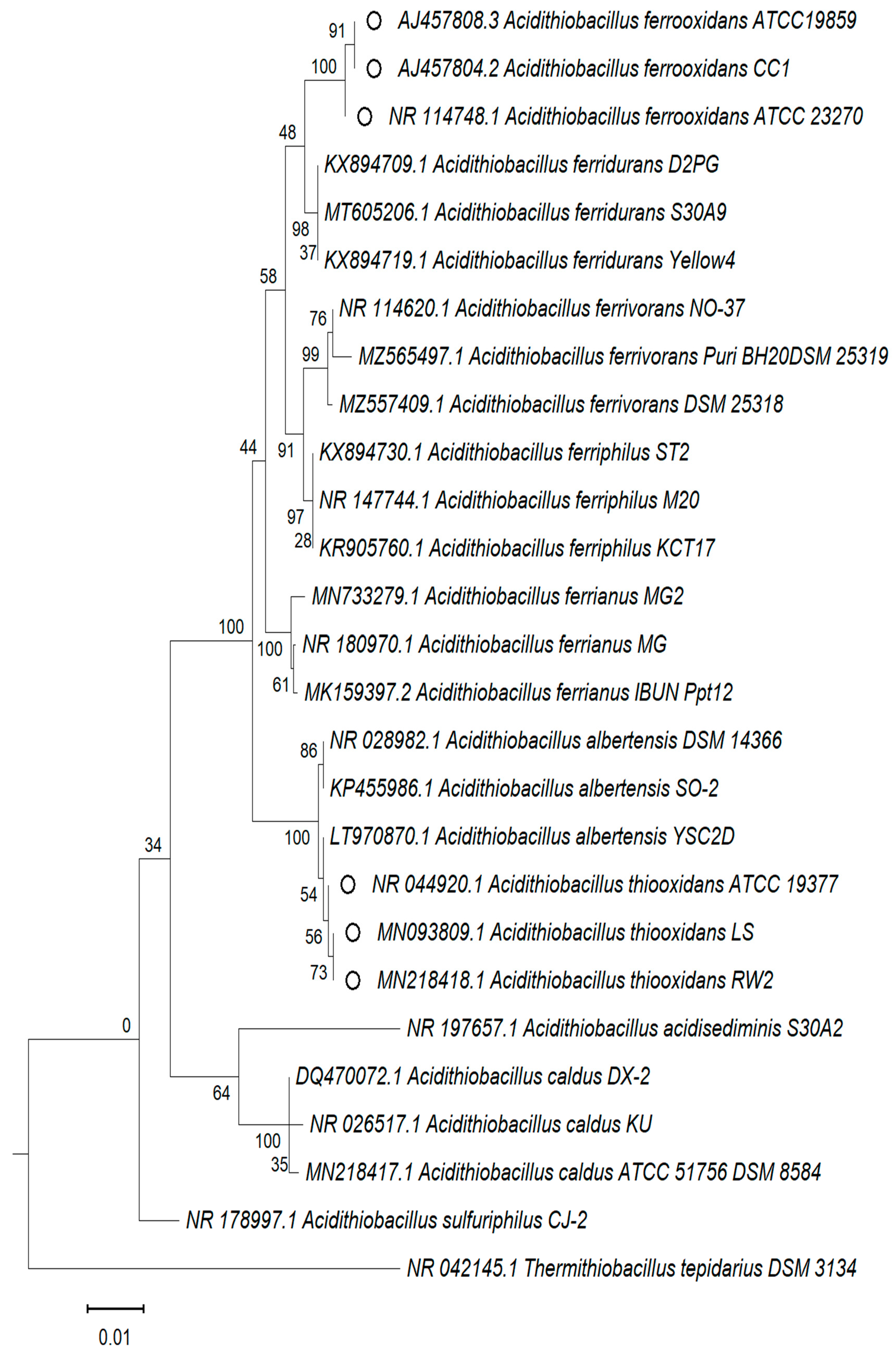
To investigate the evolutionary relationships among species within the genus, phylogenetic reconstruction was performed based on 16S rRNA gene sequences (Table S1). The analysis included 27 nucleotide sequences retrieved from the GenBank database. Reference sequences corresponding to different species of the genus were selected based on sequence quality and taxonomic reliability. The sequences were subsequently aligned using the MUSCLE multiple sequence alignment algorithm, and the phylogenetic tree was constructed using the Maximum Likelihood method based on the Tamura–Nei model [18]. Statistical support for tree topology was assessed through bootstrap analysis (1000 replicates).
The resulting phylogenetic tree (Figure 1) shows the clustering of Acidithiobacillus species into well-defined clades, reflecting their evolutionary relationships and metabolic differentiation. Notably, Acidithiobacillus ferrooxidans clusters with iron-oxidizing species such as Acidithiobacillus ferridurans and Acidithiobacillus ferriphilus, forming a coherent lineage associated with iron oxidation. In contrast, Acidithiobacillus thiooxidans groups within a distinct clade together with sulfur-oxidizing species such as Acidithiobacillus albertensis and Acidithiobacillus caldus, showing a clear separation from iron-oxidizing bacteria [15]. This clustering reflects their metabolic specialization in the oxidation of reduced sulfur compounds. Overall, these groupings suggest a strong correlation between phylogeny and metabolic diversity within the genus.

3. Microorganisms in the Presence of Sulphides

Sulphur-reducing microorganisms (SRMs) comprise a metabolically diverse group of anaerobic prokaryotes belonging to multiple families and genera. These microorganisms utilize oxidized sulphur compounds as terminal electron acceptors, leading to the production of hydrogen sulphide, and may grow under heterotrophic conditions. SRMs are widely distributed in anoxic environments enriched in sulphur compounds, including mineral sulphide deposits, soils, sludge, estuarine and marine sediments, sewage systems, geothermal areas, and freshwater ecosystems [19]. Microbial transformations of sulphur compounds play a fundamental role in mineral dissolution processes, particularly in bioleaching systems. Species such as Acidithiobacillus ferrooxidans and Acidithiobacillus thiooxidans are commonly detected in mine drainage waters and in industrial environments associated with mineral extraction. These microorganisms are frequently associated with sulphide minerals, including pyrite (FeS2) [9] and arsenopyrite (FeAsS), where they contribute to oxidative dissolution mechanisms. The principal bacteria involved in the oxidation of sulphide minerals are summarized in Table 1 [20].
These microorganisms are extensively applied in mining operations involving reduced sulphur and iron compounds, particularly in processes such as mineral bioleaching and tailings treatment. Among them, A. thiooxidans and A. ferrooxidans are of particular importance due to their widespread use in the mining and metallurgical industries. Both species are mesophilic chemolithoautotrophs that play a central role in sulphide mineral oxidation processes [23]. The family Acidithiobacillaceae, within the class Gammaproteobacteria, is characterized by its adaptation to highly acidic environments. Members of this family derive energy from the oxidation of inorganic substrates and fix carbon via CO2 assimilation, while simultaneously mobilizing metals and metalloids under extreme physicochemical conditions. Their metabolic activity is supported by electron donors such as ferrous iron (Fe2+), hydrogen sulphide (H2S), and elemental sulphur (S0) [21,22,24,25]. Acidophilic microorganisms can be further classified according to their optimal growth temperatures. Mesophiles typically grow between 30 and 40 °C, moderate thermophiles between 40 and 60 °C, and extreme thermophiles above 70 °C [26]. Within this classification, Lipman, et al. [27] consider A. thiooxidans and A. ferrooxidans to be mesophilic species. In contrast, Leptospirillum ferrooxidans is moderately thermophilic, and species of the genus Sulfobacillus spp. are classified as extreme thermophiles.

3.1. Acidithiobacillus thiooxidans

A. thiooxidans is a key microorganism involved in the oxidation of sulphur compounds and the dissolution of sulphide minerals in acidic environments. It was originally isolated from sulphide-containing rocks and phosphate-rich compost by Lipman, et al. [27] and subsequently described as Thiobacillus thiooxidans by Waksman and Joffe [28]. This species is typically cultivated in acidic liquid media, exhibiting optimal growth within a pH range of 3–4, although it can grow at values as low as pH 1.0. Despite this broad tolerance to acidity, growth is inhibited at pH values above 6.0 or below 0.5. The optimal temperature range for growth under natural conditions is approximately 28–30 °C, whereas exposure to temperatures above 55–60 °C is detrimental [29]. Although it is not commonly found in untreated soils, its presence can be enhanced by adding elemental sulphur, which serves as an energy source. Carbon is assimilated from atmospheric CO2 to support cellular growth [30]. A. thiooxidans is an obligately aerobic, mesophilic, and acidophilic bacterium. This microorganism derives energy from the oxidation of reduced inorganic sulphur compounds, including elemental sulphur (S0), polysulphides (Sn2−), and a variety of sulphide minerals such as sphalerite (ZnS), arsenopyrite (FeAsS), and chalcopyrite (CuFeS2) [31]. In biomining applications, A. thiooxidans plays a critical role in the bioleaching of sulphide minerals, contributing to the recovery of refractory metals such as gold, copper, cobalt, and nickel. Its metabolic activity is associated with the oxidation of sulphur compounds, which supports energy generation and drives key processes including biofilm formation, oxygen consumption, and carbon dioxide fixation. Furthermore, monitoring redox potential provides valuable insight into the biochemical mechanisms and kinetics underlying mineral bioleaching systems [32].
A. thiooxidans is a bacterium that is easily found in different places around the world, distributed as shown in Table 2 below:
The primary energy source for its growth is the oxidation of elemental sulfur, as well as thiosulfate compounds. This exothermic oxidation leads to the formation of sulfuric acid. The oxidation rate reaches its maximum at a concentration of 10 g/100 cm3, with marked bacterial growth observed after 5 days, evidenced by prominent turbidity in the medium, indicating active development and reproduction [39]. These microorganisms typically form a layer of a compound called exopolysaccharides (EPS), which adheres to the mineral surface and facilitates oxidation or reduction reactions [34]. A. thiooxidans and A. ferrooxidans are used in biomining as a catalyst to solubilize metal sulphides, generating sulphuric acid for proton attack and maintaining iron in an oxidized ferric state (Fe3+) susceptible to oxidative attack of minerals containing copper, nickel, and zinc, among other soluble metal sulphides that are widely used in industry [36].

3.2. Acidithiobacillus ferrooxidans

A. ferrooxidans is a Gram-negative, acidophilic bacterium capable of thriving under highly acidic conditions. It is recognized for its ability to oxidize both iron and reduced sulphur compounds, making it a key microorganism in biomining and bioleaching processes. This species can mobilize a wide range of elements, including Li, P, V, Cr, Fe, Ni, Cu, Zn, Ga, As, Mo, W, Pb, and U [40]. It was initially isolated from acidic environments associated with mining activities, including pyrite deposits and acid mine drainage (AMD) systems [41]. Due to its tolerance to high metal concentrations, A. ferrooxidans can successfully colonize mineral-rich environments and contribute to microbial succession within stable ecological niches (biotopes), which has also positioned it as a model organism in extremophile research and astrobiology [40]. Optimal growth is typically observed within a pH range of 1.3–1.5. In addition, this microorganism is capable of fixing atmospheric nitrogen and assimilating it in the form of ammonia, thereby contributing to nutrient cycling in oligotrophic environments [40]. The oxidation of ferrous iron (Fe2+) and reduced sulphur compounds constitutes the primary energy-generating mechanism in A. ferrooxidans, leading to the production of ferric iron (Fe3+) and sulphuric acid. These products, in turn, promote the mobilization of toxic elements such as arsenic, lead, and cadmium. Under anaerobic conditions, A. ferrooxidans can also reduce ferric iron and elemental sulphur, while maintaining its capacity for CO2 fixation and nitrogen assimilation in nutrient-limited, acidic environments [42,43,44]. This microorganism is capable of aerobically oxidizing sulphide minerals such as pyrite (FeS2), even in environments where ferrous iron concentrations may reach up to 0.1 M. Elevated levels of Fe2+ can induce oxidative stress through Fenton-type reactions, potentially causing damage to cellular components such as DNA and proteins. Therefore, understanding the mechanisms by which A. ferrooxidans regulates the uptake and utilization of micronutrients and energy sources in metal-rich environments—particularly those containing arsenic, copper, and mercury—is of critical importance [45].
At the cellular level, iron oxidation is initiated at the outer membrane via electron transfer mediated by cytochrome c proteins, particularly Cyc2. Electrons derived from Fe2+ oxidation are subsequently transferred to the inner membrane, where they enter the electron transport chain (ETC), driving energy conservation processes [46]. Under both aerobic and anaerobic conditions, the oxidation of Fe2+ and sulphide minerals results in the generation of Fe3+ and sulphuric acid, which are key agents in mineral dissolution. These processes can be represented by the following reactions:
4Fe2+ + O2 + 4H+ → 4Fe3+ + 2H2O + 4e
2H2 + O2 → 2H2O + 4e
S2− + 2H2O + 2O2 → SO42− + 4H+ + 4e
2CO2 + O2 + 4H+ → 2HCOOH + 2H2O − 4e
2NADH + O2 + 2H+ → 2NAD+ + 2H2O + 4e
These equations describe the aerobic oxidation pathways of iron (Fe), hydrogen (H), and reduced sulphur compounds (S), coupled with CO2 fixation and NADH oxidation, as well as the associated reactions resulting in water formation, as presented in Equations (1) and (3).

4. The Consortium A. thiooxidans and A. ferrooxidans: An Alternative to Be Explored

Bioleaching represents a key method for metal recovery within the field of biohydrometallurgy. In this process, microorganisms mediate the solubilization of reduced and oxidized sulphur- and iron-containing compounds, converting them into soluble sulphates that are more amenable to downstream processing and exhibit reduced environmental impact [47]. Among the most widely utilized acidophilic microorganisms are A. thiooxidans and A. ferrooxidans, both of which play a central role in enhancing metal recovery efficiencies. The principal advantages of bioleaching include low operational costs, reduced energy requirements, high metal solubilization efficiency, and improved environmental sustainability compared with conventional extraction methods [47,48].
The combined use of these microorganisms in mixed cultures or consortia has been consistently shown to enhance the efficiency of sulphide mineral bioleaching [49]. A. ferrooxidans primarily catalyzes the oxidation of ferrous iron (Fe2+) to ferric iron (Fe3+), which acts as a strong oxidizing agent for metal sulphides, whereas A. thiooxidans is mainly responsible for the oxidation of elemental sulphur and reduced sulphur compounds. This complementary metabolic activity promotes the dissolution and solubilization of sulphide minerals, particularly in environments such as acid mine drainage (AMD). Mixed cultures of these species have demonstrated significantly higher metal recovery rates than monocultures, particularly in copper bioleaching processes. The application of mixed bacterial cultures for the recovery of indium (In) and tin (Sn) from liquid crystal display (LCD) waste derived from electronic devices such as tablets, computers, and televisions. Using a pulp density of 1% in an iron–sulphur medium, bioleaching efficiencies of 98.2% for tin and 94.7% for indium were achieved. These values were significantly higher than those obtained using individual bacterial strains. In related studies, complete indium recovery (100%) was achieved within 15 days using adapted A. thiooxidans, demonstrating the effectiveness of sulphur-based bioleaching systems compared with purely chemical leaching approaches [50].
Mixed cultures of A. thiooxidans and A. ferrooxidans have also been applied to the treatment of landfill leachates, enabling the recovery of heavy metals and the evaluation of municipal solid waste as a potential nutrient source for microbial growth [51]. In these systems, leachate substrates—often pretreated by reverse osmosis—are supplemented with elemental sulphur and inoculated with bacterial consortia. This approach has enabled the selective removal of metals such as cadmium, copper, chromium, mercury, lead, nickel, and zinc, with reported bioleaching efficiencies of up to 80%. Investigated the use of pure and mixed cultures (1:1 ratio) of these microorganisms for the treatment of printed circuit board (PCB) waste. The study evaluated bacterial adaptation to electronic waste matrices and their efficiency in metal recovery. A maximum tolerance of 15 g/L of PCB material was observed, with recovery efficiencies reaching 86% for copper and 100% for both zinc and nickel after 25 days of treatment.
Three culture media were employed: a 9K medium for A. ferrooxidans, a modified 9K medium for A. thiooxidans, and a combined medium for mixed cultures, as summarized in Table 3.
The incorporation of ammonium sulphate (NH4)2SO4 into the culture medium—particularly at a concentration of 4 g/L in consortium systems, exceeding that used in standard 9K and modified 9K media for A. ferrooxidans and A. thiooxidans, respectively—reflects the increased metabolic demand associated with higher cell densities in mixed cultures. In such systems, both species compete for a common nitrogen source, which constitutes a limiting factor for biomass synthesis. Therefore, a concentration of 4 g/L ensures sufficient nitrogen availability during the exponential growth phase [52,53,54]. Additionally, the presence of sulphate (SO42−) contributes to maintaining pH stability within the optimal range for microbial growth. Mixed cultures represent synergistic systems in which metabolic interactions enhance bio-oxidative performance beyond that observed in monocultures. The increase in ammonium sulphate concentration from 0.4 to 4 g/L does not exert inhibitory effects on A. ferrooxidans, which exhibits notable halotolerance compared to other acidophilic microorganisms. Previous studies have demonstrated tolerance to concentrations of up to 15 g/L without significant inhibition of biomass production or iron oxidation rates. Furthermore, A. thiooxidans contributes to the detoxification of intermediate sulphur compounds, thereby enhancing the overall tolerance of the consortium to elevated salinity levels. A concentration of 4 g/L (approximately 30 mM) remains well below the osmotic stress threshold reported for extremophilic microorganisms [53,54,55]. Experimental results indicate that the recovery of heavy metals and other hazardous elements is significantly enhanced in mixed cultures, supporting the hypothesis that diffusion through the solid matrix constitutes the dominant mechanism governing mass transfer. These findings further suggest that the physicochemical stability of resin-encapsulated materials plays a critical role in controlling diffusion processes [56]. In addition to acidophilic consortia, native microbial systems incorporating Pseudomonas putida and Saccharomyces cerevisiae have been investigated for the removal of chromium (Cr), a non-biodegradable heavy metal commonly present in industrial effluents from tanning, fertilizer production, pigment manufacturing, and wood preservation processes. Chromium exists primarily in two oxidation states: trivalent Cr (III), which is an essential micronutrient, and hexavalent Cr (VI), which is highly toxic due to its ability to penetrate biological membranes and induce DNA damage, resulting in mutagenic and carcinogenic effects [57,58]. Castillo-Cotrina and Chipana-Laura [59] reported the isolation of acidophilic microbial consortia from solid mineral samples, landfill leachates, and sludge using modified 9K media. Successive subculturing (four cycles) was employed to reduce the adaptation phase and accelerate entry into exponential growth. The resulting consortia consisted primarily of A. thiooxidans, A. ferrooxidans, and Leptospirillum ferrooxidans. Among these, A. thiooxidans exhibited the fastest initial adhesion to mineral surfaces, reaching peak cell densities during the second reactivation phase. Cell concentrations exceeding 107 cells/mL were observed, consistent with previously reported values [60]. These findings indicate that such consortia can effectively colonize sulphide-rich substrates, including arsenopyrite, when cultivated in 9K-type media.
Native microbial consortia create favourable microenvironments that enhance microbial growth and activity through synergistic interactions. These interactions promote metabolic complementarity, including coordination with thermophilic species such as Sulfobacillus spp., thereby improving overall bioleaching performance. The consortium formed by A. thiooxidans and A. ferrooxidans is particularly effective in the biological oxidation of iron and sulphur minerals, owing to its ability to function at extremely low pH values (≈1) and its chemolithoautotrophic metabolism [61]. This consortium has demonstrated high efficiency in the bioleaching of valuable metals—including copper and tin—from sulphide minerals, electronic waste, and liquid crystal display (LCD) materials [62,63]. Under optimized conditions involving iron and sulphur supplementation, recovery efficiencies of up to 94% for indium and tin have been reported, surpassing those achieved by monocultures. These findings highlight the potential of pre-adapted consortia for large-scale metal recovery through economically viable and environmentally sustainable processes that minimize the use of chemical reagents. The enhanced performance of the consortium is attributed to the complementary roles of A. ferrooxidans, which oxidizes Fe2+ to Fe3+, and A. thiooxidans, which generates sulphuric acid through sulphur oxidation, thereby promoting metal solubilization [64].
Cadmium (Cd2+) is a highly toxic heavy metal commonly found in soils contaminated by mining and industrial activities. Bioleaching using acidophilic consortia represents a promising strategy for the remediation of cadmium-contaminated environments. Cadmium exposure disrupts cellular homeostasis and induces oxidative stress. Species of the genus Acidithiobacillus exhibit notable resistance and adaptability to heavy metals, while maintaining their capacity to oxidize iron and sulphur. However, elevated cadmium concentrations can inhibit Fe2+ oxidation by A. ferrooxidans, primarily due to increased metabolic energy demands associated with stress adaptation. Similarly, A. thiooxidans may exhibit reduced sulphur oxidation efficiency under such conditions, potentially affecting acid generation and altering biofilm structure and EPS composition, thereby limiting catalytic activity. Further research is required to elucidate the mechanisms of cadmium uptake and resistance [65,66]. Despite these limitations, the synergistic activity of A. ferrooxidans and A. thiooxidans facilitates cadmium solubilization through combined iron oxidation and acid production. The maintenance of low pH conditions by A. thiooxidans enhances microbial colonization and overall leaching efficiency, outperforming monoculture systems [67].
The application of soil amendments such as biochar has been proposed to further enhance cadmium removal. Biochar, produced from the pyrolysis of agricultural residues or biomass, improves soil properties and microbial stability. Its use involves soil conditioning, followed by inoculation with adapted microbial consortia under controlled conditions (low pH, temperatures up to 35 °C, and supplementation with Fe2+ and elemental sulphur). Studies have demonstrated that biochar can improve metal adsorption and microbial activity, achieving reductions of up to 52.55% in heavy metal content in crops such as lettuce, compared with 44% using A. ferrooxidans alone [64]. Despite its advantages, biochar application may inhibit microbial activity if not properly pretreated, and optimization of consortium composition and adaptation protocols remains necessary for different cadmium concentrations [68]. Cadmium is of particular concern as a model contaminant due to its long biological half-life (15–30 years in humans) and strong bioaccumulation potential, in contrast to metals such as arsenic and chromium, which exhibit shorter persistence in biological systems. Cadmium can mimic essential divalent cations such as Ca2+ and Zn2+, disrupting enzymatic and physiological processes. It acts as a systemic toxin, affecting multiple organs, including the kidneys (nephrotoxicity), bones (demineralization), lungs (carcinogenic effects via inhalation), and liver (oxidative damage) [67,68,69]. Currently, cadmium exposure remains widespread due to its presence in the food chain—particularly in crops grown in contaminated soils—and its use in industrial applications such as nickel–cadmium batteries and plastics [70]. These characteristics underscore the importance of developing efficient, sustainable bioleaching-based remediation strategies.

5. The Bacterial Consortium and Biofilm Under Heavy Metal Stress

Biofilms are structured microbial communities attached to biotic or abiotic surfaces and embedded within a self-produced extracellular matrix composed primarily of exopolysaccharides (EPS), along with proteins, lipids, and extracellular nucleic acids [71]. EPS plays a central role in biofilm integrity by promoting both adhesion to surfaces and cohesion between cells. Surface-associated proteins contribute to metal binding and the development of three-dimensional architectures, while extracellular DNA (eDNA) enhances structural stability and facilitates horizontal gene transfer [72]. Biofilm formation results in spatially and temporally heterogeneous microbial communities, as described by Flemming and Wingender [73]. The EPS matrix immobilizes cells in proximity, promoting intense intercellular interactions, including genetic exchange and the establishment of synergistic micro-consortia. Additionally, the matrix protects against environmental stressors such as desiccation, biocides, antibiotics, ultraviolet radiation, and heavy metals, while also serving as a slowly biodegradable nutrient reservoir.
Biofilm development proceeds through distinct stages, including initial reversible and irreversible adhesion, microcolony formation, maturation into complex structures, and eventual dispersion for colonization of new niches. During this process, microbial-induced corrosion (MIC) may occur as a result of metabolic by-products, particularly sulphuric acid, leading to substrate degradation and the formation of concentration gradients of key chemical species that sustain metabolic activity [74]. Initial adhesion is governed by physicochemical interactions between cells and surfaces, including electrostatic forces, van der Waals interactions, and hydrophobic effects.
As biofilms develop, microbial proliferation leads to the formation of microcolonies embedded within an increasingly organized EPS matrix. This matrix facilitates intercellular adhesion and accelerates structural development. Mature biofilms are characterized by complex architectures influenced by cellular appendages such as pili, flagella, and fimbriae, as well as the glycocalyx. External factors, including shear forces and surface-active compounds, further influence biofilm morphology and stability [75].
Under extreme environmental conditions, particularly in acidic environments enriched with heavy metals, biofilms provide enhanced protection against toxicity. Sarkar and Bhattacharjee [76] reported that species within the genus Acidithiobacillus have developed adaptive mechanisms to modulate EPS composition and regulate stress-response gene expression. These mechanisms involve both passive protection through matrix composition and active cellular responses, enabling persistence and metabolic activity under adverse conditions [77].

5.1. Interaction Between A. thiooxidans and A. ferrooxidans

The co-cultivation of A. thiooxidans and A. ferrooxidans enhances EPS production, thereby improving metal solubilization and sustaining respiratory activity under heavy metal stress conditions [78]. Consortium-based growth induces differential gene expression associated with cell adhesion, metal resistance, nutrient transport, and intercellular communication.
Transcriptomic analyses indicate that A. ferrooxidans modulates its metabolic pathways in response to sulphur metabolites produced by A. thiooxidans, while A. thiooxidans benefits from microenvironmental changes driven by ferric iron production. This metabolic interdependence promotes biofilm maturation and increases tolerance to toxic metals such as cadmium [78,79]. Consequently, microbial consortia exhibit higher redox activity and enhanced metal leaching efficiencies compared to monocultures.
Within mixed biofilms, A. ferrooxidans primarily facilitates initial surface colonization, whereas A. thiooxidans contributes to EPS synthesis and matrix development. This division of functional roles results in structurally stable biofilms with greater metabolic diversity and increased resistance to environmental stressors [80].
EPS are complex, high-molecular-weight biopolymers composed predominantly of polysaccharides and proteins (75–90%), along with extracellular DNA and lipids. Their porous, gel-like structure forms a hydrated matrix that supports the development of microenvironments with distinct physicochemical conditions. Extracellular DNA plays a structural role by acting as a nucleating agent in polysaccharide polymerization and contributing to matrix stability through amyloid-like interactions. Beyond biofilm function, EPS components have applications in biotechnology, including flocculation processes for heavy metal removal, as well as roles as emulsifying, thickening, and stabilizing agents [80].
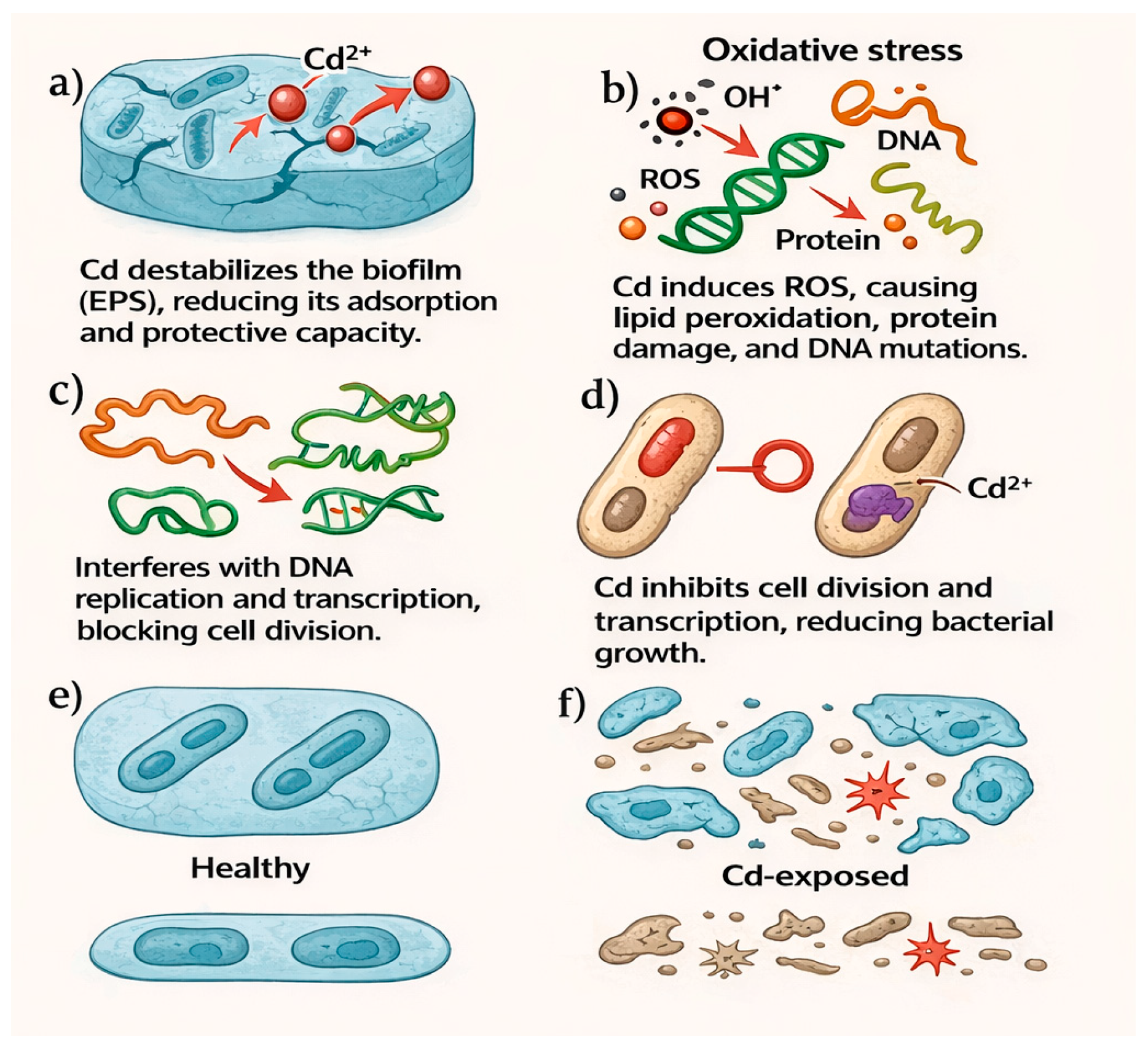
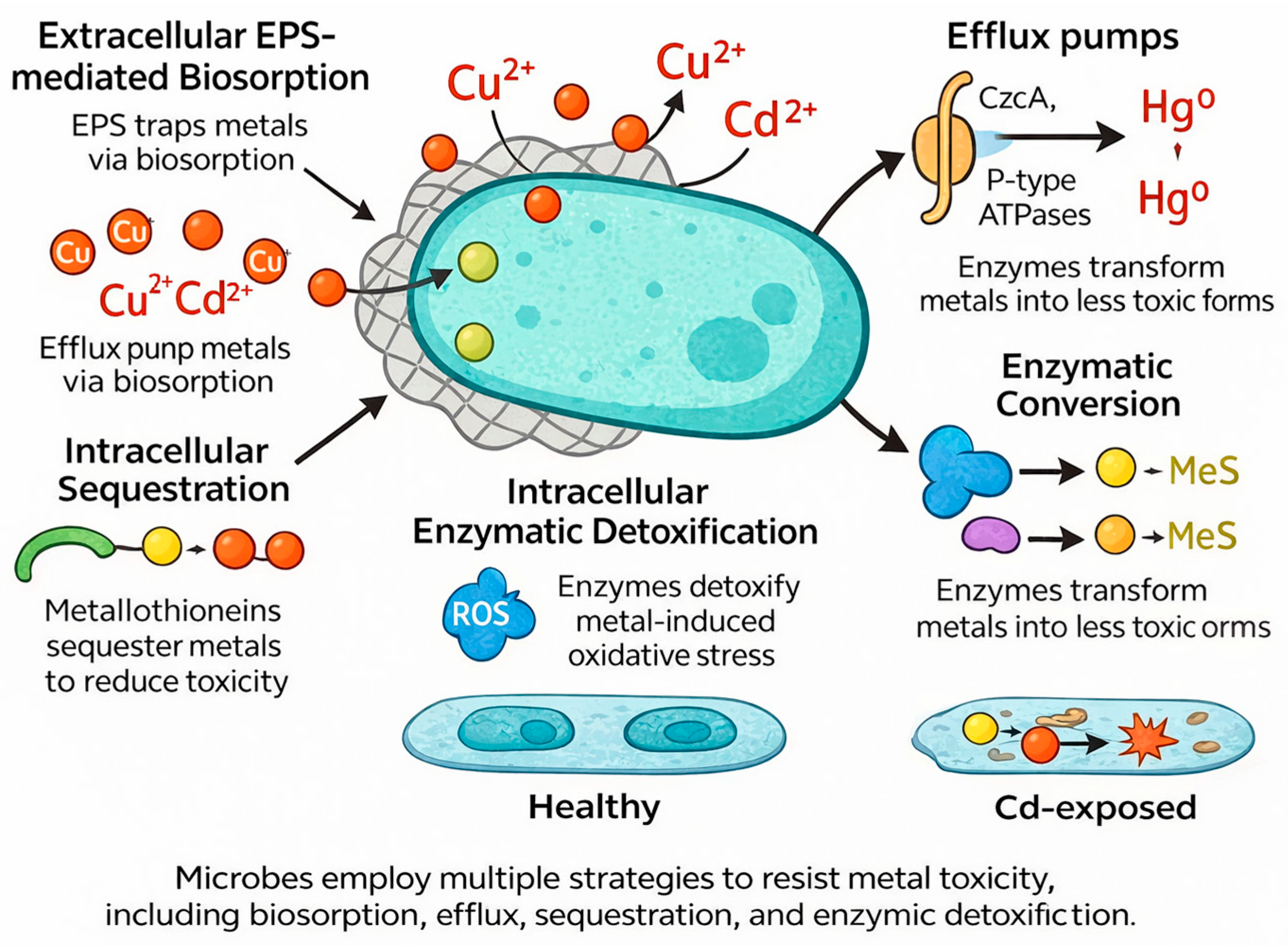
Cadmium (Cd2+), a highly toxic heavy metal, significantly alters EPS structure and function. Its presence induces oxidative stress and damages essential biomolecules, impairing protein synthesis, nucleic acid integrity, and overall cellular metabolism. Although EPS matrices can adsorb protons and certain metal ions, cadmium exposure destabilizes these structures. Spectroscopic analyses (e.g., FTIR) have demonstrated that Cd2+ competes with essential metal ions such as Fe2+ and Cu2+ for binding sites within the EPS matrix, thereby reducing its metal-binding capacity (Figure 2). Furthermore, cadmium promotes the fragmentation of polymer networks, increasing permeability to reactive oxygen species (ROS) and exacerbating cellular damage [81].
In A. ferrooxidans, exposure to cadmium concentrations ≥ 50 μM has been shown to reduce nitrogenase activity by up to 70%, thereby impairing nitrogen metabolism and overall energy balance. At the molecular level, cadmium interferes with DNA replication by binding to phosphate groups in the DNA backbone, forming adducts that inhibit polymerase activity and suppress cell division. Additionally, cadmium exposure disrupts the transcription of essential genes, further compromising cellular viability.

5.2. Heavy Metals

Heavy meta ls are a group of elements characterized by relatively high atomic mass and density that accumulate in soils, groundwater, and surface waters. Their persistence, non-biodegradability, and tendency to bioaccumulate result in significant adverse effects on ecosystems and human health. These elements are associated with biodiversity loss, environmental instability, and soil degradation [82]. From a biological perspective, elements are commonly classified into three categories based on their physiological roles and toxicity. Group (i) includes essential elements that are required in trace amounts and are relatively non-toxic under normal conditions; this group comprises Fe, Mn, Zn, Cu, Co, Ni, and Mo. Group (ii) includes elements that are essential but become toxic at elevated concentrations. Group (iii) consists of non-essential and highly toxic elements, such as Hg, Pb, and Cd [83]. This classification reflects the dual role of several metals, which are indispensable at low concentrations but harmful when present in excess.
Bacteria are capable of forming biofilms in environments contaminated with metals and metalloids such as lead (Pb), chromium (Cr), arsenic (As), cadmium (Cd), and nickel (Ni), all of which are persistent pollutants with well-documented toxicological effects. While some metals, including Co, Cu, Fe, and Mn, function as essential micronutrients in trace quantities, they become toxic at higher concentrations [84]. For instance, certain bacterial species can tolerate copper concentrations in the range of 2–8 mM and zinc concentrations between 0.5 and 5 mM, whereas metals such as cadmium and mercury exhibit high toxicity even at relatively low (millimolar) concentrations.
Elevated concentrations of heavy metals induce oxidative stress in microbial cells by disrupting membrane integrity, damaging DNA, and inhibiting enzymatic activity. Metals such as chromium, arsenic, and cadmium interfere with DNA repair mechanisms and promote the generation of reactive oxygen species (ROS), which can lead to mutagenic and carcinogenic effects in higher organisms. Additionally, heavy metals impair enzyme function by interfering with enzyme–substrate interactions and altering the structure of active sites [85,86].
The persistence and toxicity of heavy metals present major challenges for remediation strategies, as these elements cannot be degraded through biological or thermal processes in the same manner as organic pollutants. Nevertheless, various bacterial species have evolved adaptive mechanisms that enable survival and metabolic activity under high metal concentrations [87]. These mechanisms include metal efflux systems, enzymatic detoxification, and sequestration within cellular or extracellular structures.
Representative metal-resistant bacteria include Pseudomonas aeruginosa, Escherichia coli, Bacillus subtilis, Cupriavidus metallidurans (formerly Ralstonia metallidurans), and Staphylococcus aureus, as well as species within the genus Thiobacillus. These organisms can tolerate elevated metal concentrations by modulating protein structure, nucleic acid stability, osmotic balance, and oxidative phosphorylation pathways. Lemire and Harrison [87,88] demonstrated that cadmium exposure in Pseudomonas aeruginosa leads to significant membrane damage, increased permeability, and leakage of intracellular contents due to disruption of cell wall integrity.
The consortium of A. thiooxidans and A. ferrooxidans exhibits enhanced redox capacity and higher metal leaching efficiency compared to individual strains. However, heavy metals such as Pb, Cr, As, Cd, and Ni can exert detrimental effects on the structure and function of biofilms formed by Acidithiobacillus spp., influencing their metabolic activity and stability, as summarized in Table 4 [88].
Bacteria, whether present as individual strains or as part of microbial consortia, have evolved a range of intracellular and extracellular mechanisms to tolerate and adapt to environments contaminated with high concentrations of heavy metals. Under such metal stress conditions, these adaptive strategies enable the maintenance of cellular function and metabolic activity. As reported by Bramhachari and Nagaraju [123], these mechanisms include both cellular and extracellular responses, as illustrated in Figure 3.
This classification comprises five principal mechanisms of bacterial resistance to heavy metals:
Extracellular barrier (biosorption): Heavy metals are adsorbed at the cell surface or within extracellular polymeric substances (EPS). This mechanism operates as a physicochemical barrier, where negatively charged functional groups—such as carboxyl, hydroxyl, and phosphate moieties—interact with positively charged metal cations. As a result, metals (e.g., Pb2+, Cu2+) are immobilized at the cell surface, limiting their translocation across the cell membrane and preventing cytoplasmic toxicity [124].
Active transport (efflux systems): Bacteria employ membrane-associated transport systems, including efflux pumps, to actively export toxic metal ions from the cytoplasm to the extracellular environment. This energy-dependent process reduces intracellular metal concentrations and prevents the accumulation of toxic levels. Specialized transport proteins recognize and expel metal ions that have entered the cell, thereby maintaining cellular homeostasis.
Extracellular sequestration and precipitation: Microorganisms can release extracellular compounds, including proteins and phosphate-containing molecules, that bind or precipitate heavy metals in the surrounding environment. These interactions result in the formation of insoluble or less bioavailable metal complexes, thereby reducing metal uptake. In many cases, metals are converted into precipitated forms that are unable to interact with membrane transport systems [125].
Intracellular sequestration: Once internalized, heavy metals may be detoxified through binding to intracellular metal-chelating proteins, such as metallothioneins. These cysteine-rich proteins form stable complexes with metal ions (e.g., Cd2+, Cu2+), effectively sequestering them in an inert form and preventing interference with essential cellular processes, including DNA replication and protein synthesis [126].
Reduction and enzymatic transformation: Bacteria can enzymatically convert metal ions into less toxic or less bioavailable forms through redox reactions. This mechanism involves changes in oxidation state mediated by specific enzymes located in the cytoplasm or periplasm. For example, highly toxic hexavalent chromium (Cr6+) can be reduced to the less toxic trivalent form (Cr3+), which is typically less soluble and less mobile in the environment [127].
The adsorption of heavy metals by extracellular polymeric substances (EPS) is primarily mediated by interactions between metal cations and negatively charged functional groups, including carboxyl (–COOH), hydroxyl (–OH), carbonyl (C=O), phosphate (–PO4), and amine (–NH2) groups. These interactions enable EPS to function as a physicochemical barrier and biosorbent, facilitating the immobilization and removal of metal ions. In this context, the biofilm matrix may exhibit surfactant-like properties that enhance metal sequestration. For example, polysaccharides produced by Zoogloea spp. have been reported to effectively adsorb metal ions such as cadmium, lead, and chromium [128]. Similarly, Liu and Fang [129] highlighted that biofilm matrices contain ionizable functional groups capable of binding and sequestering heavy metals. In marine environments, Marinobacter spp. contribute to the accumulation of copper and lead within trophic systems through EPS-mediated interactions. Likewise, Pseudomonas aeruginosa immobilizes lead within its EPS matrix via electrostatic interactions between metal cations and negatively charged polymeric components, representing a key resistance mechanism [130].
Enterobacter cloacae has demonstrated the capacity to remove Cr (VI) and Cd2+ through distinct biochemical pathways. Chromium removal occurs via dissimilatory enzymatic reduction, in which soluble and highly toxic Cr (VI) is reduced to Cr (III) by chromate reductases (ChrR). The resulting Cr (III) is less soluble and precipitates as chromium hydroxide. In the case of cadmium, removal is mediated by the precipitation of inorganic phosphate compounds released by the bacterium, which react with Cd2+ at the cell surface to form insoluble cadmium phosphate complexes [131].
Species such as Pseudomonas putida and Pseudomonas fluorescens exhibit high efficiency in the removal of Cd2+, Cu2+, and Zn2+, owing to their metabolic versatility and capacity to form robust biofilms. These organisms employ multiple resistance mechanisms, including tripartite efflux systems driven by the proton motive force, which actively expel metal ions from the cytoplasm. In addition, they produce EPS enriched in acidic and pyruvate-containing functional groups that act as high-affinity metal-binding sites. In P. fluorescens, copper can also be chelated by siderophore-like compounds produced under low-stress conditions, further enhancing metal sequestration [132].
The consortium of A. thiooxidans and A. ferrooxidans represents one of the most efficient biological systems for the removal of metals and metalloids, due to its complementary metabolic capabilities. A. ferrooxidans catalyzes the oxidation of ferrous iron (Fe2+) to ferric iron (Fe3+) via a periplasmic electron transport chain involving proteins such as rusticyanin, cytochrome c-type proteins, and cytochrome c oxidase. The ferric iron produced acts as a strong oxidizing agent, attacking sulphide minerals such as pyrite and arsenopyrite, thereby disrupting metal–sulphur bonds and releasing metals into solution:
4Fe2+ + O2 + 4H+ → 4Fe3+ + 2H2O + 4e
Concurrently, A. thiooxidans oxidizes elemental sulphur (S0) and reduced sulphur compounds to sulphuric acid, preventing the formation of passivating sulphur layers on mineral surfaces. This process maintains acidic conditions, enhances mineral dissolution, and facilitates the mobilization and subsequent precipitation of heavy metals, while keeping iron in solution [132]. In arsenic-contaminated systems, microbial oxidation of arsenite (As3+) to arsenate (As5+) is mediated by arsenite oxidase enzymes. Arsenate, being less toxic and more stable, readily reacts with ferric iron to form scorodite (FeAsO4·2H2O), an insoluble mineral that precipitates and effectively removes arsenic from aqueous systems [133].
Extremophilic archaea such as Halobacterium noricense and Halobacterium spp. also exhibit the capacity to remove Cd2+ and Mn2+ under hypersaline conditions (NaCl concentrations of approximately 3–4 M). In such environments, cells expend significant energy to maintain osmotic balance, and metal transport systems exhibit high selectivity to prevent interference from abundant Na+ and K+ ions. These organisms utilize ATP-driven transmembrane pumps to export metal cations, while their protein structures—rich in acidic amino acids such as aspartate and glutamate—remain stable under high ionic strength conditions characteristic of halophilic cytoplasm [134].
Overall, a wide range of microorganisms capable of EPS production and biofilm formation contribute to the removal of heavy metals from soil and aquatic environments. These systems enhance metal–microbe interactions and highlight the potential of extremophilic microorganisms in bioremediation applications. However, further research is required to elucidate the underlying metabolic pathways and genomic determinants governing these processes. Advanced approaches, including meta proteomics and functional genomics, are expected to provide deeper insights into the genes, proteins, and metabolites involved in biofilm formation and metal resistance. Such knowledge will improve the understanding of extremophile ecology and support the development of efficient strategies for the bioremediation of metal-contaminated environments (Table 5) [135].

6. Application of the Consortium A. thiooxidans and A. ferrooxidans

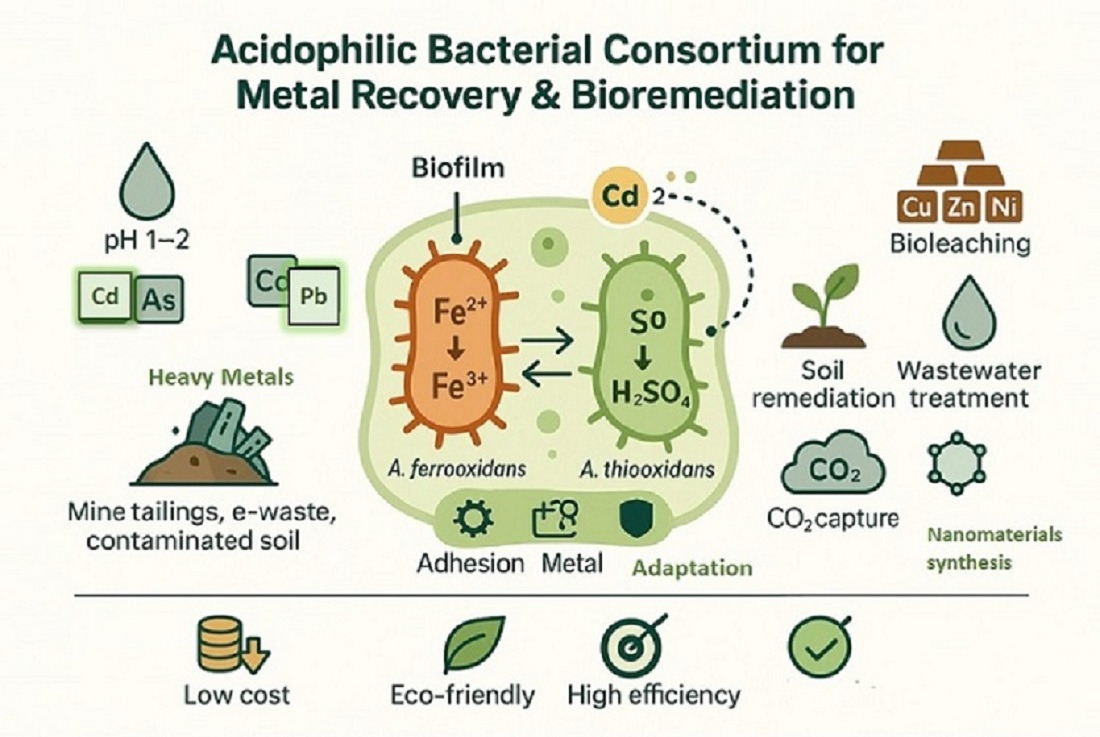
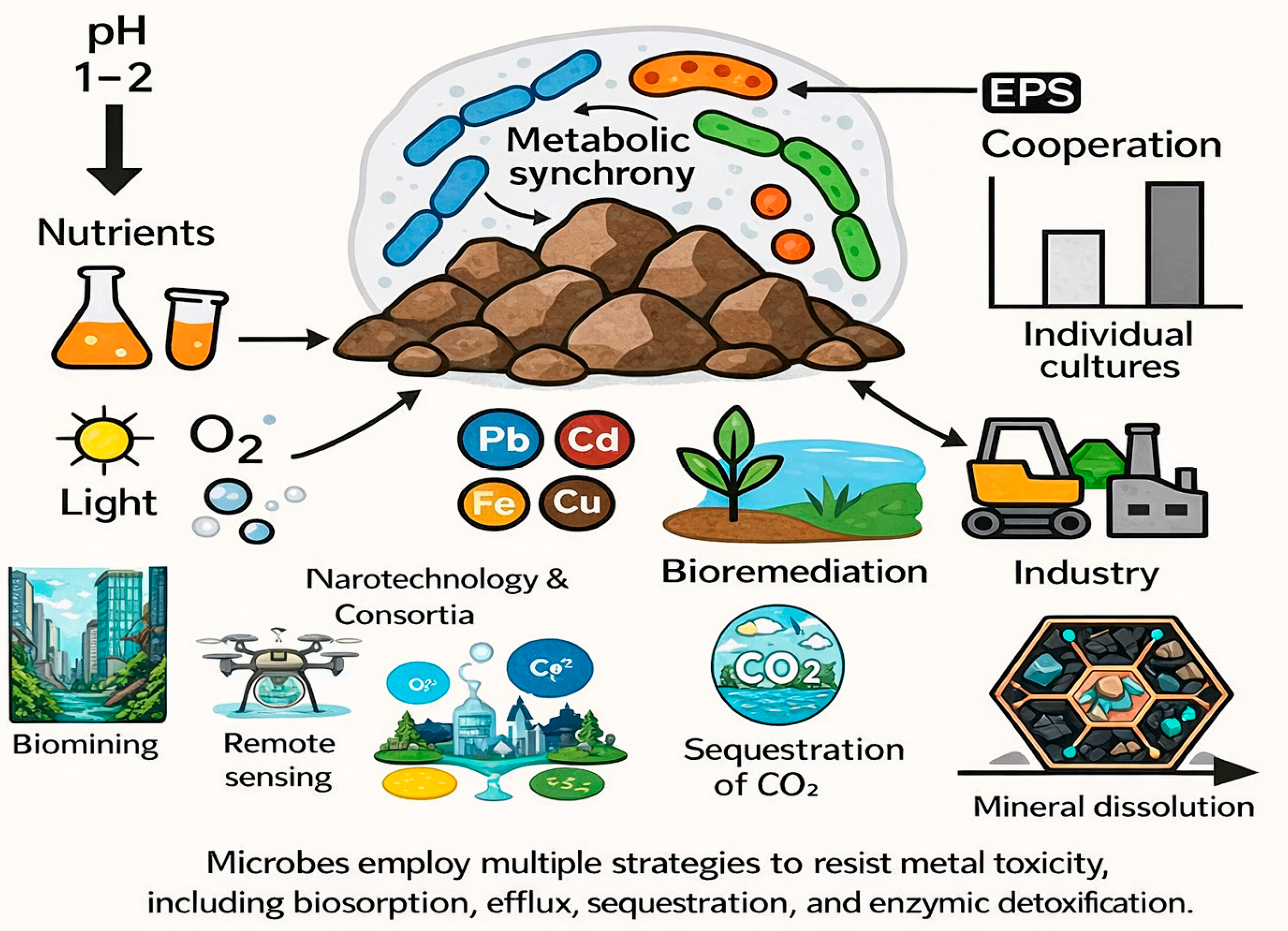
The bacterial consortium composed of A. thiooxidans and A. ferrooxidans exhibits a broad range of applications that extend beyond conventional bioleaching and bioremediation processes. This consortium plays a key role in oxidative transformations of sulphur and iron species, as well as in the bioleaching of economically relevant metals, including gold, nickel, and uranium. Emerging applications include soil and water remediation, treatment of acid mine drainage (AMD), and the recovery of valuable metals from electronic waste as shown in Figure 4. These expanding areas of application highlight the versatility and biotechnological potential of this consortium, as discussed in the following sections.

6.1. Urban Biomining

The rapid global expansion of electrification and digitalization has led to a significant increase in lithium-ion battery waste, which contains high concentrations of critical metals such as lithium, cobalt, and nickel. The recovery of these elements from secondary sources is commonly referred to as “urban mining” [139]. In this context, the application of microbial consortia composed of A. thiooxidans and A. ferrooxidans is emerging as an environmentally sustainable, cost-effective, and scalable alternative to conventional extraction methods, reducing reliance on primary mineral resources [140].
The use of bacterial consortia represents a promising biotechnological approach for the management and valorization of lithium-ion battery waste. In addition, the integration of digital technologies—such as digital twins—into biomining processes offers opportunities to optimize metal recovery through real-time monitoring, predictive modelling, and process control. The incorporation of artificial intelligence and microbial engineering enables dynamic adjustment of operational parameters, improving process efficiency, recovery yields, and economic performance.
Species within the genus Acidithiobacillus, widely used in bioleaching under acidic conditions, have also demonstrated potential for the recovery of rare earth elements (REEs) from both mineral sources and electronic waste. These acidophilic microorganisms exhibit high tolerance to REEs, with structural features of the cell wall and outer membrane playing a key role in metal interaction and resistance. Compared with model organisms such as Escherichia coli, Acidithiobacillus spp. display enhanced resilience under extreme conditions.
Recent advances in microbial engineering have enabled the expression of REE-binding proteins, such as lanmodulin (LanM), in Acidithiobacillus. Lanmodulin is characterized by high stability, strong selectivity for lanthanides, and resistance to acidic and high-temperature environments, without significant interference from calcium ions. Despite these advantages, the application of Acidithiobacillus in REE recovery remains challenging due to the co-dissolution of non-target metals, which can complicate downstream separation processes. Nevertheless, this approach shows considerable promise for near-term technological development [137].
Biomining within a circular economy framework focuses on the replacement of primary raw materials with secondary resources derived from waste streams. These include metal-contaminated soils, industrial residues, mine tailings, mining wastes, and low-grade ores, as well as electronic waste and catalytic materials containing heavy metals and REEs. Such secondary resources have the potential to supply a substantial proportion of global raw material demand.
A. ferrooxidans was the first microorganism applied in biomining processes, with its use reported as early as 1951 [138]. Its well-established capacity for iron and sulphur oxidation has supported its widespread adoption in industrial bioleaching systems. In large-scale copper extraction operations, particularly in Chile, consortia combining A. ferrooxidans and A. thiooxidans have demonstrated enhanced performance, achieving recovery efficiencies of up to 70% compared with alternative microbial systems [139].
Industrial-scale bioleaching has also been successfully implemented in other regions. In Finland, sulphide bioleaching technologies are used for the recovery of nickel and cobalt, with annual production reaching approximately 1000 tons of nickel and 20 tons of cobalt. In Canada, bioleaching processes are applied to recover nickel, uranium, zinc, copper, cobalt, and REEs from polymetallic sulphide ores.
One of the most significant technological developments in this field is the BIOX® process, developed by Metso Outotec. This process employs agitated biooxidation tanks for the treatment of refractory gold ores and is currently implemented in more than 13 industrial plants worldwide. Over 781 tons of gold have been recovered using this technology, which relies primarily on mesophilic microorganisms operating at approximately 40 °C, followed by thermophilic oxidation stages at around 65 °C. The BIOX® process has been successfully applied for over three decades. Similarly, biooxidation technologies based on chemolithotrophic microbial consortia have been developed in Russia under the BioNORD® process, which reported gold recovery of approximately 30 tons in 2017 [140].

6.2. Biological Sequestration of CO2

Mistry et al. [141] reported that atmospheric concentrations of carbon dioxide (CO2), a major greenhouse gas, continue to increase as a result of anthropogenic activities. The application of biological systems for CO2 capture and utilization offers a sustainable alternative for mitigating emissions while enabling the production of value-added products such as bioplastics and biofuels.
Within this context, members of the phylum Proteobacteria have attracted considerable attention due to their capacity for CO2 sequestration through diverse metabolic pathways. Among α-proteobacteria, species such as Xanthobacter flavus, Oligotropha carboxidovorans, Rhodobacter capsulatus, and Rhodobacter sphaeroides fix CO2 via the Calvin–Benson–Bassham (CBB) cycle. Similarly, β-proteobacteria—including Herbaspirillum autotrophicum and Ralstonia eutropha—utilize the same pathway for carbon fixation. In addition, several γ-proteobacteria, such as Hydrogenovibrio marinus, A. thiooxidans, and A. ferrooxidans, have demonstrated the ability to capture CO2 under chemolithoautotrophic conditions.
La et al. [142] proposed a novel system for a sustainable carbon cycle in which chemical energy derived from waste resources is harnessed to drive CO2 reduction and the production of environmentally benign ammonium sulphate. This system is based on sulphur-oxidizing bacteria (SOB), specifically a strain designated AZ11, isolated from soil for hydrogen sulphide (H2S) removal. This chemolithoautotrophic microorganism fixes CO2 via the CBB pathway, using reduced sulphur compounds as an energy source.
Among sulphur-oxidizing microorganisms, which are generally classified as acidophilic, neutrophilic, or alkaliphilic, the genus Acidithiobacillus remains the most extensively studied. The proposed system integrates real-time monitoring using pH and oxidation–reduction potential (ORP) sensors to regulate acidification and maintain optimal conditions for carbon fixation. Controlled CO2 feeding prevents excessive acidification, which could otherwise inhibit microbial activity.
Experimental validation using stirred bioreactors over a 14-day period demonstrated carbon fixation rates of up to 4.4 g CO2 L−1, comparable to those achieved in high-productivity algal systems. However, a key advantage of this bacterial system lies in its operation under highly acidic conditions, reducing contamination risks and simplifying process control.
Comparative genomic analysis between the AZ11 strain and known Acidithiobacillus species revealed less than 82% chromosomal DNA homology, indicating that AZ11 represents a previously uncharacterized species. This finding suggests the existence of novel chemolithoautotrophic bacteria with enhanced potential for CO2 bioconversion, potentially surpassing the efficiency of conventional cyanobacterial systems.

6.3. Applications in Nanotechnology and Consortia

The use of bacterial consortia for the biosynthesis of fluorescent semiconductor nanoparticles, commonly referred to as quantum dots (QDs), represents an environmentally sustainable approach with significant economic potential. In particular, the biosynthesis of cadmium sulphide (CdS) QDs has been demonstrated using acidophilic bacteria of the genus Acidithiobacillus. These nanomaterials are produced by exposing cells of A. ferrooxidans, A. thiooxidans, and A. caldus to sublethal concentrations of Cd2+ in the presence of thiol-containing compounds such as cysteine and glutathione.
During incubation, the fluorescence of bacterial cells shifts from green to red, corresponding to the nucleation and growth of CdS nanocrystals characteristic of QDs. The presence of cysteine and glutathione is closely associated with hydrogen sulphide (H2S) production, which plays a key role in QD formation. Notably, QDs synthesized by acidophilic bacteria exhibit exceptional stability under highly acidic conditions. Their optical properties, including absorbance and fluorescence, remain stable at pH 2.0, whereas QDs produced by conventional chemical methods or by mesophilic microorganisms typically lose fluorescence below pH 4.5–5.0 [143].
Iravani [144] reported that several bacterial species have evolved defense mechanisms to withstand stress induced by heavy metals and metalloids, enabling survival and growth under elevated concentrations of these ions. Examples include Pseudomonas stutzeri and Pseudomonas aeruginosa, which exhibit high tolerance to metal stress. Similarly, A. ferrooxidans and Sulfolobus acidocaldarius have been shown to reduce ferric iron (Fe3+) to ferrous iron (Fe2+) when grown in the presence of elemental sulphur, while A. thiooxidans is also capable of iron reduction under low pH conditions.
In addition to QD biosynthesis, A. thiooxidans has demonstrated the ability to mediate the formation of gold nanoparticles through metabolic transformation processes. In the presence of gold(I) thiosulphate, this compound is initially dissociated into Au(I) ions and thiosulphate (S2O32−). The thiosulphate serves as an energy source, while Au(I) ions are subsequently reduced intracellularly to elemental gold. During the late stationary phase of growth, these intracellular gold nanoparticles are released and accumulate on the cell surface. Over time, these particles can further transform in the surrounding medium into nanoscale structures, including gold nanowires and rhomboidal morphologies.

6.4. Synthetic Multispecies Consortia

Synthetic microbial consortia are increasingly recognized not merely as alternatives for metal bioremediation, but as integrated platforms for the comprehensive treatment of industrial waste streams containing both organic and inorganic pollutants [145]. The concept of multispecies synthetic consortia opens new avenues for the efficient treatment of complex and heterogeneous effluents.
Based on metagenomic analyses of landfill environments and pilot-scale wastewater treatment systems, a four-member consortium has been proposed, comprising A. thiooxidans and A. ferrooxidans as the acidophilic core, Pseudomonas putida for the degradation of aromatic compounds (e.g., phenols and BTEX), and Candida acidothermophila, an acid-tolerant yeast capable of metabolizing intermediate organic acids. Transcriptomic studies have demonstrated that P. putida and the yeast component modulate the expression of acid resistance genes in Acidithiobacillus spp., thereby contributing to pH stabilization and preventing the accumulation of toxic organic intermediates [145].
Metabolic interactions within the consortium exhibit a high degree of functional complementarity. A. thiooxidans and A. ferrooxidans promote acidification through the oxidation of sulphur and iron compounds, while P. putida utilizes organic carbon released during the degradation of metal–organic complexes. Concurrently, C. acidothermophila metabolizes low-molecular-weight organic acids, effectively contributing to substrate recycling and closing the metabolic loop. These cooperative interactions enhance overall system stability and process efficiency.
Artificial microbial consortia thus represent a promising frontier for the treatment of complex waste matrices and the degradation of recalcitrant compounds. However, further research is required to elucidate the mechanisms of intercellular communication and to characterize the metabolic networks that govern these systems. A deeper understanding of these interactions will be critical for optimizing the design and performance of engineered consortia for environmental applications, including the transformation and immobilization of heavy metals.
A complementary strategy to enhance bioleaching efficiency involves the modulation of quorum-sensing (QS) systems. A synthetic QS agonist, N-(3-thiolactone)-dodecylamine (Y3), has been developed to stimulate biofilm formation in A. thiooxidans. This compound, a structural analogue of N-acyl-homoserine lactones (AHLs), exhibits greater stability and activity than naturally occurring signalling molecules. QS is a cell density-dependent communication mechanism that regulates key physiological processes, including EPS production and biofilm development.
The addition of Y3 to A. thiooxidans cultures induces a strong transcriptional response in genes associated with EPS synthesis and biofilm architecture, resulting in more robust and structured biofilms. This enhanced biofilm formation significantly improves mineral colonization and accelerates the solubilization of heavy metals from sulphide ores such as pentlandite. Consequently, the application of synthetic QS modulators represents a highly effective strategy for improving bioleaching performance, supporting the development of more efficient and sustainable approaches in green hydrometallurgy and the recovery of metals from low-grade resources [146].

6.5. Remote Sensors and the Use of Encapsulated Consortium

Corami [147] reported the application of remote sensing technologies and unmanned aerial vehicles (UAVs) to monitor microbial distribution across mining deposits and tailings, defined as solid residues generated during mineral extraction and processing. In this approach, calcium alginate microspheres (200–300 µm in diameter) were used as carriers for the encapsulation and targeted delivery of microbial consortia to inaccessible areas. Each microsphere contained approximately 108 cells of the A. thiooxidansA. ferrooxidans consortium.
Deployment was performed using fixed-wing drones equipped with real-time kinematic (RTK) positioning systems and a flight endurance of approximately 2 h. A total of 1 kg of microspheres was distributed over a 5 × 5 m grid across a compacted tailings deposit. Environmental monitoring was achieved using low-power Internet of Things (IoT) sensors (LoRaWAN nodes) integrated into anchor beacons, covering a radius of up to 500 m and recording parameters such as pH, temperature, and Fe3+ concentration at 15 min intervals [148]. The integration of remote sensing, UAVs, and IoT technologies enables high-resolution monitoring and controlled deployment of microbial systems. Beyond mining applications, this approach shows potential in precision agriculture, where encapsulated bacterial consortia could be applied for soil conditioning, pest control, or enhancement of crop productivity. The relatively low operational cost further supports its scalability and future implementation.

6.6. The Life Cycle of Microbial Biomining

Life Cycle Assessment (LCA) has emerged as a critical tool for quantitatively evaluating the environmental performance of microbial biomining processes in comparison with conventional mining technologies. Case studies conducted in Chile have demonstrated copper recovery efficiencies of up to 72% from volcanic tailings, encompassing all stages of the process, including slurry preparation, microbial cultivation, bioleaching, effluent treatment, and copper concentrate recovery [149].
LCA analyses indicate that biomining can significantly reduce environmental impacts, including energy consumption, greenhouse gas emissions, and the generation of hazardous by-products. Additionally, the evaluation of microbial lifespan and metabolic activity provides further insight into process optimization. Overall, biomining represents a more sustainable alternative to traditional extraction methods, aligning with circular economy principles and environmental management strategies.

6.7. Treatment of Water Contaminated with Heavy Metals

The application of microbial consortia represents an emerging and effective strategy for the treatment of landfill leachates and heavy metal–contaminated water. Under controlled conditions, removal efficiencies of up to 80% have been reported for metals such as Cd, Cu, Cr, Hg, Pb, Ni, and Zn. These processes typically involve pre-treatment steps, including reverse osmosis, and the supplementation of elemental sulphur to enhance microbial activity.
The effectiveness of this approach is primarily attributed to the synergistic interaction between A. thiooxidans and A. ferrooxidans. A. thiooxidans promotes rapid acidification of the medium through sulphur oxidation, while A. ferrooxidans facilitates the oxidation of metal species, generating soluble forms that can be subsequently recovered or immobilized. In addition to metal removal, these systems have demonstrated potential for the treatment of other toxic compounds, including cyanide, thereby contributing to compliance with environmental discharge regulations.
Despite these advances, further optimization is required to fully exploit these systems. Key parameters such as dissolved oxygen concentration, temperature, and microbial density must be carefully controlled to maximize efficiency and ensure process stability [150].

7. Challenges and Limitations

Although the consortium of Acidithiobacillus thiooxidans and Acidithiobacillus ferrooxidans has significant biotechnological potential, certain challenges and limitations must be taken into account before its large-scale implementation. Among the most important factors limiting the consortium’s sustainability and stability under industrial conditions are variations in pH, temperature, oxygen availability, and metal concentrations, which can affect microbial interactions and reduce process efficiency. Furthermore, maintaining a balanced metabolic cooperation between sulfur- and iron-oxidising populations over long operational periods remains a significant technical challenge, especially in continuous systems such as biomining or wastewater treatment [151]. It is well known that A. ferrooxidans relies heavily on the oxidation of ferrous iron under aerobic conditions, while A. thiooxidans depends on reduced sulfur compounds, and imbalances in substrate availability or oxygen gradients can disrupt their metabolic complementarity and lead to a decrease in overall efficiency [152]. Maintaining the consortium can become difficult, particularly in bioreactors or bioleaching piles, where competitive interactions for the substrate may occur, or due to the accumulation or dissolution of toxic intermediate compounds, or changes in the microbial community.
The formation of a robust and structured biofilm—vital for mineral fixation and electron transfer—is affected by surface tension, available nutrients, and the toxicity of certain metals, making process control more difficult.
From an economic perspective, biomining and bioremediation processes, which are typically profitable when considered separately, exhibit slower kinetics compared to conventional chemical extraction methods, which can increase operating time as well as infrastructure costs—such as bioreactors, aeration systems, and metal recovery processes—and may limit competitiveness at an industrial scale. From a kinetic standpoint, the bioleaching and bioremediation processes carried out by this consortium are slower than those using pyrometallurgy or hydrometallurgy, as they require longer residence times in a bioreactor, thereby increasing costs. The volumes to be processed are larger, and yet biomining remains a highly profitable area for the recovery of low-grade metals [153].
There are environmental considerations that involve a complex balance of advantages and disadvantages, as microbial systems help reduce energy consumption, greenhouse gas emissions, and the use of hazardous chemical reagents, supporting their classification as environmentally sustainable technologies. On the other hand, the generation of acidic effluents, the potential mobilization of toxic metals, and the risks associated with uncontrolled bioleaching processes can pose environmental problems if not properly managed. The unintended mobilization of toxic elements such as arsenic, cadmium, and lead during bioleaching can, in some cases, further exacerbate environmental risks and requires robust containment and treatment strategies [154].
Furthermore, the co-dissolution of elements that are not the primary target during bioleaching can complicate metal recovery and increase the need for secondary treatment processes. Taken together, these limitations highlight the need to improve process control, microbial engineering strategies, and integrated system designs to enhance the robustness, economic viability, and environmental safety of this consortium before its industrial implementation. This co-dissolution increases the complexity and cost of metal recovery, requiring additional chemical or electrochemical treatments to achieve the desired purity levels [155].
In summary, although the A. thiooxidansA. ferrooxidans consortium offers advantages for sustainable metal recovery and environmental remediation; its practical implementation is limited by challenges related to environmental sensitivity, metabolic balance, kinetic limitations, economic costs, and environmental risks. This consortium will therefore require integrated strategies that combine process optimization, systems biology, and engineering [156].

8. Future Directions

The mechanisms underlying the interactions between heavy metals (e.g., cadmium, lead, and zinc), extracellular polymeric substances (EPS), and biofilm architecture in acidophilic microbial consortia remain only partially understood and require further investigation. In particular, the genetic and proteomic determinants regulating EPS biosynthesis during microbial colonization are still largely unresolved. A comprehensive characterization of the genes and proteins involved in EPS production would provide critical insights into how structural composition and functional properties can be modulated under metal stress conditions. Such knowledge would enable the optimization of EPS-mediated adaptation mechanisms and improve the efficiency of metal biosorption processes. Therefore, further research integrating genomics, proteomics, and metabolomics approaches is essential to advance the understanding of heavy metal detoxification and to support the development of practical applications based on bacterial consortia.

9. Conclusions

The consortium composed of A. thiooxidans and A. ferrooxidans represents a viable, efficient, and sustainable biotechnological platform with broad applicability, ranging from metal extraction in mining operations to the remediation of contaminated environments. Its synergistic capacity to oxidize sulphide minerals and mobilize heavy metals under extreme acidic conditions highlights its potential for application in soils and effluents contaminated with elements such as As, Cd, Pb, U, and Se.
Future research should prioritize the kinetic and nutritional optimization of these consortia, as well as their adaptation to site-specific contaminated matrices. Particular attention should be given to the regulation of biofilm formation under metal stress conditions and the role of EPS in facilitating microbial colonization and system stability. In addition, the integration of these biological systems into pilot-scale and industrial bioprocesses represents a critical step toward their large-scale implementation.
Within the consortium, A. ferrooxidans primarily catalyzes the oxidation of ferrous iron (Fe2+) to ferric iron (Fe3+), while A. thiooxidans contributes through the oxidation of reduced sulphur compounds, generating sulphuric acid that enhances the solubilization of metals such as copper, zinc, and cadmium. The inclusion of cadmium as a target contaminant is particularly relevant due to its high toxicity, mobility in acidic environments, and persistence in the environment.
Recent studies indicate that A. ferrooxidans exhibits relatively high tolerance to cadmium, activating resistance mechanisms such as metal efflux systems, active transport, and intracellular sequestration. In contrast, the oxidative activity of A. thiooxidans may be partially inhibited in the presence of Cd2+; however, its role in maintaining low pH conditions remains essential for sustaining overall consortium performance. These findings highlight that system efficiency depends not only on the tolerance of individual species but also on their functional complementarity and metabolic synergy. The application of auxiliary materials, such as biochar, has further demonstrated potential for enhancing bioleaching processes in contaminated soils. Biochar contributes to initial metal adsorption and improves the physicochemical stability of the microbial environment, thereby supporting consortium activity. Previous studies have reported significant improvements in cadmium removal efficiency and increased nutrient bioavailability in soils when microbial consortia are combined with treated biochar.

Supplementary Materials

The following supporting information can be downloaded at: https://www.mdpi.com/article/10.3390/environments13040216/s1, Table S1: Reference sequences retrieved from GenBank used for phylogenetic analysis of Acidithiobacillus species.

Author Contributions

Conceptualization, H.R.-A., E.R.-B. and R.H.L.; methodology, H.R.-A., E.R.-B. and R.H.L.; validation, M.Á.E.-B., E.R.-B. and R.H.L.; formal analysis, H.R.-A., E.R.-B. and R.H.L.; investigation, H.R.-A. and P.J.A.-S.; resources, H.R.-A.; data curation, H.R.-A., E.R.-B.; writing—original draft preparation, H.R.-A. and E.R.-B.; writing—review and editing, H.R.-A., E.R.-B., R.H.L. and E.G.-M.; visualization, H.R.-A. and E.R.-B.; supervision, M.Á.E.-B., E.R.-B. and R.H.L.; funding acquisition, H.R.-A. All authors have read and agreed to the published version of the manuscript.

Funding

This research received no external funding.

Data Availability Statement

No new experimental data were generated in this study. Publicly available sequence data were used for phylogenetic analysis.

Acknowledgments

H.R.-A. thanks the Secretaría de Ciencia, Humanidades, Tecnología e Innovación (SECIHTI) for the postdoctoral fellowship granted. We are grateful to the Science and Technology Council of Durango State (COCyTED) for their valuable support. During the preparation of this work, the authors used Gemini 3.0 & Canva® free tools in order to construct the schematic model proposed in Figure 2, Figure 3 and Figure 4. After using this tool/service, the authors reviewed and edited the content as needed and take full responsibility for the content of the published article.

Conflicts of Interest

The authors declare that they have no competing financial interests or personal relationships that could have appeared to influence the work reported in this paper.

References

  1. Dodd, M.S.; Papineau, D.; Grenne, T.; Slack, J.F.; Rittner, M.; Pirajno, F.; O’Neil, J.; Little, C.T. Evidence for early life in Earth’s oldest hydrothermal vent precipitates. Nature 2017, 543, 60–64. [Google Scholar] [CrossRef]
  2. Kelly, D.P. Introduction to the chemolithotrophic bacteria. In The Prokaryotes: A Handbook on Habitats, Isolation, and Identification of Bacteria; Springer: Berlin/Heidelberg, Germany, 1981; pp. 997–1004. [Google Scholar]
  3. Irrgang, N.; Monneron-Enaud, B.; Möckel, R.; Schlömann, M.; Höck, M. Economic feasibility of the co-production of indium from zinc sulphide using bioleaching extraction in Germany. Hydrometallurgy 2021, 200, 105566. [Google Scholar] [CrossRef]
  4. Xu, X.J. Microbial ecology in the age of genomics and metagenomics: Concepts, tools, and recent advances. Mol. Ecol. 2006, 15, 1713–1731. [Google Scholar] [CrossRef]
  5. Moreno, J.R.; Gorriti, M.F.; Flores, M.R.; Albarracín, V.H. Microbiología Ambiental y Ecología Microbiana en el Estudio de Microorganismos en Ambientes Extremos. 2012. Available online: https://ri.conicet.gov.ar/handle/11336/17162 (accessed on 1 April 2026).
  6. Groudev, S. Use of heterotrophic microorganisms in mineral biotechnology. Eng. Life Sci. 1987, 7, 299–306. [Google Scholar] [CrossRef]
  7. Sugio, T.; Domatsu, C.; Munakata, O.; Tano, T.; Imai, K. Role of a ferric ion-reducing system in sulfur oxidation of Thiobacillus ferrooxidans. Appl. Environ. Microbiol. 1985, 49, 1401–1406. [Google Scholar] [CrossRef] [PubMed]
  8. Cozma, P.; Bețianu, C.; Hlihor, R.-M.; Simion, I.M.; Gavrilescu, M. Bio-recovery of metals through biomining within circularity-based solutions. Processes 2024, 12, 1793. [Google Scholar] [CrossRef]
  9. Baker, B.J.; Banfield, J.F. Microbial communities in acid mine drainage. FEMS Microbiol. Ecol. 2003, 44, 139–152. [Google Scholar] [CrossRef]
  10. Kumar, M.; Zeyad, M.T.; Choudhary, P.; Paul, S.; Chakdar, H.; Rajawat, M.V.S. Thiobacillus. In Beneficial Microbes in Agro-Ecology; Elsevier: Amsterdam, The Netherlands, 2020; pp. 545–557. [Google Scholar]
  11. Gusenbauer, M.; Gauster, S.P. How to search for literature in systematic reviews and meta-analyses: A comprehensive step-by-step guide. Technol. Forecast. Soc. Change 2025, 212, 123833. [Google Scholar] [CrossRef]
  12. Williams, K.P.; Kelly, D.P. Proposal for a new class within the phylum Proteobacteria, Acidithiobacillia classis nov., with the type order Acidithiobacillales, and emended description of the class Gammaproteobacteria. Int. J. Syst. Evol. Microbiol. 2013, 63, 2901–2906. [Google Scholar] [CrossRef]
  13. Hedrich, S.; Schlömann, M.; Johnson, D.B. The iron-oxidizing proteobacteria. Microbiology 2011, 157, 1551–1564. [Google Scholar] [CrossRef] [PubMed]
  14. Kelly, D.P.; Wood, A.P. Reclassification of some species of Thiobacillus to the newly designated genera Acidithiobacillus gen. nov., Halothiobacillus gen. nov. and Thermithiobacillus gen. nov. Int. J. Syst. Evol. Microbiol. 2000, 50, 511–516. [Google Scholar] [CrossRef]
  15. Nuñez, H.; Moya-Beltrán, A.; Covarrubias, P.C.; Issotta, F.; Cárdenas, J.P.; González, M.; Atavales, J.; Acuña, L.G.; Johnson, D.B.; Quatrini, R. Molecular systematics of the genus Acidithiobacillus: Insights into the phylogenetic structure and diversification of the taxon. Front. Microbiol. 2017, 8, 30. [Google Scholar] [CrossRef]
  16. Li, X.-T.; Liang, Z.-L.; Huang, Y.; Jiang, Z.; Yang, Z.-N.; Zhou, N.; Liu, Y.; Liu, S.-J.; Jiang, C.-Y. Acidithiobacillus acidisediminis sp. nov., an acidophilic sulphur-oxidizing chemolithotroph isolated from acid mine drainage sediment. Int. J. Syst. Evol. Microbiol. 2024, 74, 005868. [Google Scholar] [CrossRef]
  17. Negero, B.O. Comparative genome and protein analysis for Acidithiobacillus ferrooxidans strains in terms of heavy metal binding as an application for biomining. Res. Sq. 2025. [Google Scholar] [CrossRef]
  18. Tamura, K.; Stecher, G.; Peterson, D.; Filipski, A.; Kumar, S. MEGA6: Molecular evolutionary genetics analysis version 6.0. Mol. Biol. Evol. 2013, 30, 2725–2729. [Google Scholar] [CrossRef] [PubMed]
  19. Tonietti, L.; Esposito, M.; Cascone, M.; Barosa, B.; Fiscale, S.; Muscari Tomajoli, M.T.; Sbaffi, T.; Santomartino, R.; Covone, G.; Cordone, A.; et al. Unveiling the bioleaching versatility of Acidithiobacillus ferrooxidans. Microorganisms 2024, 12, 2407. [Google Scholar] [CrossRef]
  20. Wang, R.; Lin, J.-Q.; Liu, X.-M.; Pang, X.; Zhang, C.-J.; Yang, C.-L.; Gao, X.-Y.; Lin, C.-M.; Li, Y.-Q.; Li, Y.; et al. Sulfur oxidation in the Acidophilic Autotrophic Acidithiobacillus spp. Front. Microbiol. 2019, 9, 3290. [Google Scholar] [CrossRef]
  21. Rekadwad, B.N.; Li, W.-J.; Gonzalez, J.M.; Punchappady Devasya, R.; Ananthapadmanabha Bhagwath, A.; Urana, R.; Parwez, K. Extremophiles: The species that evolve and survive under hostile conditions. 3 Biotech 2023, 13, 316. [Google Scholar] [CrossRef]
  22. Kaksonen, A.H.; Petersen, J. The future of biomining: Towards sustainability in a metal-demanding world. In Biomining Technologies: Extracting and Recovering Metals from Ores and Wastes; Springer: Berlin/Heidelberg, Germany, 2022; pp. 295–314. [Google Scholar]
  23. Mandolini, E.; Probst, M.; Peintner, U. Methods for studying bacterial–fungal interactions in the microenvironments of soil. Appl. Sci. 2021, 11, 9182. [Google Scholar] [CrossRef]
  24. Vera, M.; Schippers, A.; Hedrich, S.; Sand, W. Progress in bioleaching: Fundamentals and mechanisms of microbial metal sulfide oxidation–Part A. Appl. Microbiol. Biotechnol. 2022, 106, 6933–6952. [Google Scholar] [CrossRef]
  25. Merino, N.; Aronson, H.S.; Bojanova, D.P.; Feyhl-Buska, J.; Wong, M.L.; Zhang, S.; Giovannelli, D. Living at the extremes: Extremophiles and the limits of life in a planetary context. Front. Microbiol. 2019, 10, 780. [Google Scholar] [CrossRef]
  26. Lipman, J.G.; Waksman, S.A.; Joffe, J.S. The oxidation of sulfur by soil microorganisms: I. Soil Sci. 1921, 12, 475–490. [Google Scholar] [CrossRef]
  27. Waksman, S.A.; Joffe, J. Microörganisms concerned in the oxidation of sulfur in the soil II. Thiobacillus thiooxidans, a new sulfur-oxidizing organism isolated from the soil. J. Bacteriol. 1922, 7, 239–256. [Google Scholar] [CrossRef] [PubMed]
  28. Waksman, S.A.; Starkey, R.L. On the growth and respiration of sulfur-oxidizing bacteria. J. Gen. Physiol. 1923, 5, 285–310. [Google Scholar] [CrossRef] [PubMed]
  29. Banerjee, I.; Burrell, B.; Reed, C.; West, A.C.; Banta, S. Metals and minerals as a biotechnology feedstock: Engineering biomining microbiology for bioenergy applications. Curr. Opin. Biotechnol. 2017, 45, 144–155. [Google Scholar] [CrossRef]
  30. Huang, S.; Li, H.; Ma, L.; Liu, R.; Li, Y.; Wang, H.; Lu, X.; Huang, X.; Wu, X.; Liu, X. Insertion sequence contributes to the evolution and environmental adaptation of Acidithiobacillus. BMC Genom. 2023, 24, 282. [Google Scholar] [CrossRef]
  31. Hansford, G.; Vargas, T. Chemical and electrochemical basis of bioleaching processes. Hydrometallurgy 2001, 59, 135–145. [Google Scholar] [CrossRef]
  32. Urbieta, M.S.; González Toril, E.; Aguilera, A.; Giaveno, M.A.; Donati, E. First prokaryotic biodiversity assessment using molecular techniques of an acidic river in Neuquén, Argentina. Microb. Ecol. 2012, 64, 91–104. [Google Scholar] [CrossRef]
  33. Natarajan, K. Microbial aspects of acid mine drainage and its bioremediation. Trans. Nonferrous Met. Soc. China 2008, 18, 1352–1360. [Google Scholar] [CrossRef]
  34. Kamimura, K.; Higashino, E.; Moriya, S.; Sugio, T. Marine acidophilic sulfur-oxidizing bacterium requiring salts for the oxidation of reduced inorganic sulfur compounds. Extremophiles 2003, 7, 95–99. [Google Scholar] [CrossRef]
  35. Jones, D.S.; Albrecht, H.L.; Dawson, K.S.; Schaperdoth, I.; Freeman, K.H.; Pi, Y.; Pearson, A.; Macalady, J.L. Community genomic analysis of an extremely acidophilic sulfur-oxidizing biofilm. ISME J. 2012, 6, 158–170. [Google Scholar] [CrossRef] [PubMed]
  36. Khan, S.; Haq, F.; Hasan, F.; Saeed, K.; Ullah, R. Growth and biochemical activities of Acidithiobacillus thiooxidans collected from black shale. J. Microbiol. Res. 2012, 2, 78–83. [Google Scholar] [CrossRef]
  37. Quatrini, R.; Escudero, L.V.; Moya-Beltrán, A.; Galleguillos, P.A.; Issotta, F.; Acosta, M.; Cárdenas, J.P.; Nuñez, H.; Salinas, K.; Holmes, D.S.; et al. Draft genome sequence of Acidithiobacillus thiooxidans CLST isolated from the acidic hypersaline Gorbea salt flat in northern Chile. Stand. Genom. Sci. 2017, 12, 84. [Google Scholar] [CrossRef]
  38. Yang, L.; Zhao, D.; Yang, J.; Wang, W.; Chen, P.; Zhang, S.; Yan, L. Acidithiobacillus thiooxidans and its potential application. Appl. Microbiol. Biotechnol. 2019, 103, 7819–7833. [Google Scholar] [CrossRef] [PubMed]
  39. Slowik, G.P.; Richer, R.; Stryjska, A.Z.; Dabrowski, P. Bacteria Acidithiobacillus ferrooxidans, terrestrial analogue of extraterrestrial microorganisms? Int. J. Astrobiol. 2024, 23, e22. [Google Scholar] [CrossRef]
  40. Valdés, J.; Pedroso, I.; Quatrini, R.; Dodson, R.J.; Tettelin, H.; Blake, R.; Eisen, J.A.; Holmes, D.S. Acidithiobacillus ferrooxidans metabolism: From genome sequence to industrial applications. BMC Genom. 2008, 9, 597. [Google Scholar] [CrossRef]
  41. Bramhachari, P.; Nagaraju, G.P. Extracellular polysaccharide production by bacteria as a mechanism of toxic heavy metal biosorption and biosequestration in the marine environment. In Marine Pollution and Microbial Remediation; Springer: Singapore, 2017; pp. 67–85. [Google Scholar] [CrossRef]
  42. Rawlings, D.E. Characteristics and adaptability of iron-and sulfur-oxidizing microorganisms used for the recovery of metals from minerals and their concentrates. Microb. Cell Fact. 2005, 4, 13. [Google Scholar] [CrossRef]
  43. Silverman, M.P.; Lundgren, D.G. Studies on the chemoautotrophic iron bacterium Ferrobacillus ferrooxidans: I. An improved medium and a harvesting procedure for securing high cell yields. J. Bacteriol. 1959, 77, 642–647. [Google Scholar] [CrossRef]
  44. Rowe, O.F.; Sánchez-España, J.; Hallberg, K.B.; Johnson, D.B. Microbial communities and geochemical dynamics in an extremely acidic, metal-rich stream at an abandoned sulfide mine (Huelva, Spain) underpinned by two functional primary production systems. Environ. Microbiol. 2007, 9, 1761–1771. [Google Scholar] [CrossRef]
  45. Tapia, J.; Dueñas, A.; Cheje, N.; Soclle, G.; Patiño, N.; Ancalla, W.; Tenorio, S.; Denos, J.; Taco, H.; Cao, W.; et al. Bioleaching of heavy metals from printed circuit boards with an acidophilic iron-oxidizing microbial consortium in stirred tank reactors. Bioengineering 2022, 9, 79. [Google Scholar] [CrossRef]
  46. Jensen, A.B.; Webb, C. Ferrous sulphate oxidation using Thiobacillus ferrooxidans: A review. Process Biochem. 1995, 30, 225–236. [Google Scholar] [CrossRef]
  47. Tuovinen, O.; Niemelä, S.; Gyllenberg, H. Tolerance of Thiobacillus ferrooxidans to some metals. Antonie Van Leeuwenhoek 1971, 37, 489–496. [Google Scholar] [CrossRef]
  48. Bergey, D.H. Bergey’s Manual of Determinative Bacteriology; Lippincott Williams & Wilkins: Philadelphia, PA, USA, 1994. [Google Scholar]
  49. Mostafavi, M.; Mirazimi, S.; Rashchi, F.; Faraji, F.; Mostoufi, N. Bioleaching and kinetic investigation of WPCBs by A. ferrooxidans, A. thiooxidans and their mixtures. J. Chem. Pet. Eng. 2018, 52, 81–91. [Google Scholar] [CrossRef]
  50. Willner, J.; Fornalczyk, A.; Saternus, M.; Sedlakova-Kadukova, J.; Gajda, B. LCD panels bioleaching with pure and mixed culture of Acidithiobacillus. Physicochem. Probl. Miner. Process. 2022, 58, 15–23. [Google Scholar] [CrossRef]
  51. Park, Y.J.; Fray, D.J. Recovery of high purity precious metals from printed circuit boards. J. Hazard. Mater. 2009, 164, 1152–1158. [Google Scholar] [CrossRef] [PubMed]
  52. Castillo-Cotrina, D.; Chipana-Laura, V.; Clavijo-Koc, C.; Castellanos-Cabrera, R. Cinética de crecimiento de consorcios microbianos acidófilos en cultivo sumergido para biolixiviantes. Ecol. Apl. 2024, 23, 103–112. [Google Scholar] [CrossRef]
  53. Wang, J.; Bai, J.; Xu, J.; Liang, B. Bioleaching of metals from printed wire boards by Acidithiobacillus ferrooxidans and Acidithiobacillus thiooxidans and their mixture. J. Hazard. Mater. 2009, 172, 1100–1105. [Google Scholar] [CrossRef]
  54. Johnson, D.B. Biomining—Biotechnologies for extracting and recovering metals from ores and waste materials. Curr. Opin. Biotechnol. 2014, 30, 24–31. [Google Scholar] [CrossRef]
  55. Adetunji, A.I.; Oberholster, P.J.; Erasmus, M. Bioleaching of Metals from E-Waste Using Microorganisms: A Review. Minerals 2023, 13, 828. [Google Scholar] [CrossRef]
  56. Fu, P.; Chang, F.; Yuan, D.; Wang, Y.; Fan, Y.; Kang, Y.; Zhou, L.; Yang, C.; Bi, W.; Qin, J.; et al. Biochar-induced alterations in Acidithiobacillus ferrooxidans activity and its impact on Cd (II) and As (III) adsorption from acid mine drainage. Biochar 2024, 6, 28. [Google Scholar] [CrossRef]
  57. Yang, X.; Zhang, Z.; Zhang, J.; Wu, X.; Luo, W.; Mu, G. Effect of biochar and Acidithiobacillus ferrooxidans on heavy metal content in soil and lettuce. Soil Sediment Contam. Int. J. 2023, 32, 910–925. [Google Scholar] [CrossRef]
  58. Donlan, R.M.; Costerton, J.W. Biofilms: Survival mechanisms of clinically relevant microorganisms. Clin. Microbiol. Rev. 2002, 15, 167–193. [Google Scholar] [CrossRef] [PubMed]
  59. Khan, Z.; Elahi, A.; Bukhari, D.A.; Rehman, A. Cadmium sources, toxicity, resistance and removal by microorganisms-A potential strategy for cadmium eradication. J. Saudi Chem. Soc. 2022, 26, 101569. [Google Scholar] [CrossRef]
  60. Yang, Y.; Hassan, M.F.; Ali, W.; Zou, H.; Liu, Z.; Ma, Y. Effects of cadmium pollution on human health: A narrative review. Atmosphere 2025, 16, 225. [Google Scholar] [CrossRef]
  61. Renu, K.; Chakraborty, R.; Myakala, H.; Koti, R.; Famurewa, A.C.; Madhyastha, H.; Vellingiri, B.; George, A.; Gopalakrishnan, A.V. Molecular mechanism of heavy metals (Lead, Chromium, Arsenic, Mercury, Nickel and Cadmium)-induced hepatotoxicity–A review. Chemosphere 2021, 271, 129735. [Google Scholar] [CrossRef] [PubMed]
  62. Wang, R.; Sang, P.; Guo, Y.; Jin, P.; Cheng, Y.; Yu, H.; Xie, Y.; Yao, W.; Qian, H. Cadmium in food: Source, distribution and removal. Food Chem. 2023, 405, 134666. [Google Scholar] [CrossRef]
  63. Flemming, H.-C.; van Hullebusch, E.D.; Neu, T.R.; Nielsen, P.H.; Seviour, T.; Stoodley, P.; Wingender, J.; Wuertz, S. The biofilm matrix: Multitasking in a shared space. Nat. Rev. Microbiol. 2023, 21, 70–86. [Google Scholar] [CrossRef]
  64. Berne, C.; Ellison, C.K.; Ducret, A.; Brun, Y.V. Bacterial adhesion at the single-cell level. Nat. Rev. Microbiol. 2018, 16, 616–627. [Google Scholar] [CrossRef]
  65. Zhao, F.; Wang, S. Bioleaching of electronic waste using extreme acidophiles. In Electronic Waste Management and Treatment Technology; Elsevier: Amsterdam, The Netherlands, 2019; pp. 153–174. [Google Scholar] [CrossRef]
  66. Pal, M.K.; Lavanya, M. Microbial influenced corrosion: Understanding bioadhesion and biofilm formation. J. Bio- Tribo-Corros. 2022, 8, 76. [Google Scholar] [CrossRef]
  67. Ramakrishnan, R.; Singh, A.K.; Singh, S.; Chakravortty, D.; Das, D. Enzymatic dispersion of biofilms: An emerging biocatalytic avenue to combat biofilm-mediated microbial infections. J. Biol. Chem. 2022, 298, 102352. [Google Scholar] [CrossRef]
  68. Sarkar, A.; Bhattacharjee, S. Biofilm-mediated bioremediation of xenobiotics and heavy metals: A comprehensive review of microbial ecology, molecular mechanisms, and emerging biotechnological applications. 3 Biotech 2025, 15, 78. [Google Scholar] [CrossRef]
  69. Flemming, H.-C.; Wingender, J. The biofilm matrix. Nat. Rev. Microbiol. 2010, 8, 623–633. [Google Scholar] [CrossRef]
  70. Wang, L.; Yin, S.; Wu, A.; Chen, W. Synergetic bioleaching of copper sulfides using mixed microorganisms and its community structure succession. J. Clean. Prod. 2020, 245, 118689. [Google Scholar] [CrossRef]
  71. Khan, S.; Zhang, R.; Wang, X.; Duan, J.; Etim, I.-I.N.; Mathivanan, K.; Wang, C. Harnessing bacterial power: Advanced strategies and genetic engineering insights for biocorrosion control and inhibition. npj Mater. Degrad. 2025, 9, 74. [Google Scholar] [CrossRef]
  72. Wilderer, P.; Characklis, W. Structure and Function of Biofilms; Wiley: Chichester, UK, 1989; 387p. [Google Scholar]
  73. Hernández-Caricio, C.; Ramírez, V.; Martínez, J.; Quintero-Hernández, V.; Baez, A.; Munive, J.-A.; Nora, R.-M. Los metales pesados en la historia de la humanidad, los efectos de la contaminación por metales pesados y los procesos biotecnológicos para su eliminación: El caso de Bacillus como bioherramienta para la recuperación de suelos. Alianzas Tend. BUAP 2022, 7, 1–68. [Google Scholar] [CrossRef]
  74. Shah, S.B. Heavy metals in the marine environment—An overview. In Heavy Metals in Scleractinian Corals; Springer: Cham, Switzerland, 2021; pp. 1–26. [Google Scholar] [CrossRef]
  75. Seraj, F.; Rahman, T. Heavy metals, metalloids, their toxic effect and living systems. Am. J. Plant Sci. 2018, 9, 2626–2643. [Google Scholar] [CrossRef]
  76. Inobeme, A. Effect of heavy metals on activities of soil microorganism. In Microbial Rejuvenation of Polluted Environment: Volume 3; Springer: Singapore, 2021; pp. 115–142. [Google Scholar] [CrossRef]
  77. Alrashed, M.; Tabassum, H.; Almuhareb, N.; Almutlaq, N.; Alamro, W.; Alanazi, S.T.; Alenazi, F.K.; Alahmed, L.B.; Al Abudahash, M.M.; Alenzi, N.D. Assessment of DNA damage in relation to heavy metal induced oxidative stress in females with recurrent pregnancy loss (RPL). Saudi J. Biol. Sci. 2021, 28, 5403–5407. [Google Scholar] [CrossRef]
  78. Kim, W.; Kim, D.; Back, S.; Lee, Y.-s.; Abari, A.H.; Kim, J. Removal of Ni2+ and Cd2+ by surface display of polyhistidine on Bacillus subtilis spore using CotE anchor protein. Biotechnol. Bioprocess Eng. 2019, 24, 375–381. [Google Scholar] [CrossRef]
  79. Lemire, J.A.; Harrison, J.J.; Turner, R.J. Antimicrobial activity of metals: Mechanisms, molecular targets and applications. Nat. Rev. Microbiol. 2013, 11, 371–384. [Google Scholar] [CrossRef]
  80. Bellenberg, S.; Barthen, R.; Boretska, M.; Zhang, R.; Sand, W.; Vera, M. Manipulation of pyrite colonization and leaching by iron-oxidizing Acidithiobacillus species. Appl. Microbiol. Biotechnol. 2015, 99, 1435–1449. [Google Scholar] [CrossRef]
  81. Mateos, L.M.; Villadangos, A.F.; De la Rubia, A.G.; Mourenza, A.; Marcos-Pascual, L.; Letek, M.; Pedre, B.; Messens, J.; Gil, J.A. The arsenic detoxification system in corynebacteria: Basis and application for bioremediation and redox control. In Advances in Applied Microbiology; Elsevier: Amsterdam, The Netherlands, 2017; Volume 99, pp. 103–137. [Google Scholar] [CrossRef]
  82. Liu, R.; Liu, S.; Bai, X.; Liu, S.; Liu, Y. Biooxidation of arsenopyrite by Acidithiobacillus ferriphilus QBS 3 exhibits arsenic resistance under extremely acidic bioleaching conditions. Biology 2025, 14, 550. [Google Scholar] [CrossRef]
  83. Han, X.; Hu, Y.; Yue, Y.; Ding, Y.; Cao, B.; Shi, L.; Liu, J. Biofilm engineering through c-di-GMP tuning boosts bioleaching efficiency and arsenic tolerance in Acidithiobacillus ferrooxidans. Appl. Environ. Microbiol. 2026, 92, e02288-25. [Google Scholar] [CrossRef]
  84. Klock, J.-H.; Wieland, A.; Seifert, R.; Michaelis, W. Extracellular polymeric substances (EPS) from cyanobacterial mats: Characterisation and isolation method optimisation. Mar. Biol. 2007, 152, 1077–1085. [Google Scholar] [CrossRef]
  85. Hossain, S.T.; Mallick, I.; Mukherjee, S.K. Cadmium toxicity in Escherichia coli: Cell morphology, Z-ring formation and intracellular oxidative balance. Ecotoxicol. Environ. Saf. 2012, 86, 54–59. [Google Scholar] [CrossRef] [PubMed]
  86. Nnaji, N.D.; Anyanwu, C.U.; Miri, T.; Onyeaka, H. Mechanisms of heavy metal tolerance in bacteria: A review. Sustainability 2024, 16, 11124. [Google Scholar] [CrossRef]
  87. Barik, A.; Biswal, D.; Arun, A.; Balasubramanian, V. Biodetoxification of heavy metals using biofilm bacteria. In Environmental and Agricultural Microbiology: Applications for Sustainability; Wiley Scriver: Beverly, MA, USA, 2021; pp. 39–61. [Google Scholar] [CrossRef]
  88. Zhang, X.; She, S.; Dong, W.; Niu, J.; Xiao, Y.; Liang, Y.; Liu, X.; Zhang, X.; Fan, F.; Yin, H. Comparative genomics unravels metabolic differences at the species and/or strain level and extremely acidic environmental adaptation of ten bacteria belonging to the genus Acidithiobacillus. Syst. Appl. Microbiol. 2016, 39, 493–502. [Google Scholar] [CrossRef]
  89. Chen, S.-Y.; Wu, J.-Q.; Sung, S. Effects of sulfur dosage on continuous bioleaching of heavy metals from contaminated sediment. J. Hazard. Mater. 2022, 424, 127257. [Google Scholar] [CrossRef]
  90. Karthik, C.; Barathi, S.; Pugazhendhi, A.; Ramkumar, V.; Thi, N.B.D.; Arulselvi, P. Evaluation of Cr (VI) reduction mechanism and removal by Cellulosimicrobium funkei strain AR8, a novel haloalkaliphilic bacterium. J. Hazard. Mater. 2017, 333, 42–53. [Google Scholar] [CrossRef] [PubMed]
  91. Mohapatra, R.K.; Pandey, S.; Thatoi, H.; Panda, C.R. Reduction of chromium (VI) by marine bacterium Brevibacillus laterosporus under varying saline and pH conditions. Environ. Eng. Sci. 2017, 34, 617–626. [Google Scholar] [CrossRef]
  92. Ahemad, M. Bacterial mechanisms for Cr (VI) resistance and reduction: An overview and recent advances. Folia Microbiol. 2014, 59, 321–332. [Google Scholar] [CrossRef] [PubMed]
  93. Johnson, D.B.; Hedrich, S.; Pakostova, E. Indirect redox transformations of iron, copper, and chromium catalyzed by extremely acidophilic bacteria. Front. Microbiol. 2017, 8, 211. [Google Scholar] [CrossRef]
  94. Li, L.; Liu, Z.; Meng, D.; Liu, X.; Li, X.; Zhang, M.; Tao, J.; Gu, Y.; Zhong, S.; Yin, H. Comparative genomic analysis reveals the distribution, organization, and evolution of metal resistance genes in the genus Acidithiobacillus. Appl. Environ. Microbiol. 2019, 85, e02153-18. [Google Scholar] [CrossRef] [PubMed]
  95. Wyszkowska, J.; Borowik, A.; Kucharski, M.a.; Kucharski, J. Effect of cadmium, copper and zinc on plants, soil microorganisms and soil enzymes. J. Elem. 2013, 18, 769–796. [Google Scholar] [CrossRef]
  96. Liu, J.; Qiu, H.; Tan, D.; Zhang, Y.; Yang, Y. DNA N6-methyladenine modifications of Acidithiobacillus ferrooxidans response to copper stress. PLoS ONE 2025, 20, e0337584. [Google Scholar] [CrossRef]
  97. Almárcegui, R.J.; Navarro, C.A.; Paradela, A.; Albar, J.P.; von Bernath, D.; Jerez, C.A. New copper resistance determinants in the extremophile Acidithiobacillus ferrooxidans: A quantitative proteomic analysis. J. Proteome Res. 2014, 13, 946–960. [Google Scholar] [CrossRef]
  98. Vargas-Straube, M.J.; Beard, S.; Norambuena, R.; Paradela, A.; Vera, M.; Jerez, C.A. High copper concentration reduces biofilm formation in Acidithiobacillus ferrooxidans by decreasing production of extracellular polymeric substances and its adherence to elemental sulfur. J. Proteom. 2020, 225, 103874. [Google Scholar] [CrossRef]
  99. Orell, A.; Navarro, C.A.; Arancibia, R.; Mobarec, J.C.; Jerez, C.A. Life in blue: Copper resistance mechanisms of bacteria and archaea used in industrial biomining of minerals. Biotechnol. Adv. 2010, 28, 839–848. [Google Scholar] [CrossRef] [PubMed]
  100. Giovanella, P.; Cabral, L.; Bento, F.M.; Gianello, C.; Camargo, F.A.O. Mercury (II) removal by resistant bacterial isolates and mercuric (II) reductase activity in a new strain of Pseudomonas sp. B50A. New Biotechnol. 2016, 33, 216–223. [Google Scholar] [CrossRef]
  101. Liu, Y.; Gu, C.; Liu, H.; Zhou, Y.; Nie, Z.; Wang, Y.; Chen, L.; Xia, J. Fe/S redox-coupled Mercury transformation mediated by Acidithiobacillus ferrooxidans ATCC 23270 under aerobic and/or Anaerobic conditions. Microorganisms 2023, 11, 1028. [Google Scholar] [CrossRef]
  102. de Godoi Pereira, M.; Freitas, D.C.; de Souza Neta, L.C.; dos Santos, A.V.; Ribeiro, J.N.; Ribeiro, A.V.F.N. Sulfur, Aluminum, Arsenic, Cadmium, Lead, Mercury, and Nickel in Marine Ecosystems: Accumulation, Distribution, and Environmental Effects. In Marine Pollution: Current Status, Impacts, and Remedies; Bentham Science Publishers: Sharjah, United Arab Emirates, 2019; Volume 1, pp. 68–90. [Google Scholar]
  103. Gao, X.-Y.; Liu, X.-J.; Fu, C.-A.; Gu, X.-F.; Lin, J.-Q.; Liu, X.-M.; Pang, X.; Lin, J.-Q.; Chen, L.-X. Novel strategy for improvement of the bioleaching efficiency of Acidithiobacillus ferrooxidans based on the AfeI/R quorum sensing system. Minerals 2020, 10, 222. [Google Scholar] [CrossRef]
  104. Khan, H.; Singh, R.D.; Tiwari, R.; Gangopadhyay, S.; Roy, S.K.; Singh, D.; Srivastava, V. Mercury exposure induces cytoskeleton disruption and loss of renal function through epigenetic modulation of MMP9 expression. Toxicology 2017, 386, 28–39. [Google Scholar] [CrossRef] [PubMed]
  105. Jan, R.; Khan, M.A.; Asaf, S.; Lubna; Lee, I.-J.; Kim, K.M. Metal resistant endophytic bacteria reduces cadmium, nickel toxicity, and enhances expression of metal stress related genes with improved growth of Oryza sativa, via regulating its antioxidant machinery and endogenous hormones. Plants 2019, 8, 363. [Google Scholar] [CrossRef] [PubMed]
  106. Macomber, L.; Hausinger, R.P. Mechanisms of nickel toxicity in microorganisms. Metallomics 2011, 3, 1153–1162. [Google Scholar] [CrossRef] [PubMed]
  107. Mulrooney, S.B.; Hausinger, R.P. Nickel uptake and utilization by microorganisms. FEMS Microbiol. Rev. 2003, 27, 239–261. [Google Scholar] [CrossRef]
  108. Syed, A.; Zeyad, M.T.; Mohammad, S.; Elgorban, A.M.; Alkhulaifi, M.M.; Ansari, I.A. Heavy metals induced modulations in growth, physiology, cellular viability, and biofilm formation of an identified bacterial isolate. ACS Omega 2021, 6, 25076–25088. [Google Scholar] [CrossRef]
  109. Simons, T. The role of anion transport in the passive movement of lead across the human red cell membrane. J. Physiol. 1986, 378, 287–312. [Google Scholar] [CrossRef]
  110. Suwalsky, M.; Villena, F.; Norris, B.; Cuevas, Y.; Sotomayor, C.; Zatta, P. Effects of lead on the human erythrocyte membrane and molecular models. J. Inorg. Biochem. 2003, 97, 308–313. [Google Scholar] [CrossRef]
  111. Wang, Y.-W.; Cao, A.; Jiang, Y.; Zhang, X.; Liu, J.-H.; Liu, Y.; Wang, H. Superior antibacterial activity of zinc oxide/graphene oxide composites originating from high zinc concentration localized around bacteria. ACS Appl. Mater. Interfaces 2014, 6, 2791–2798. [Google Scholar] [CrossRef]
  112. Vallee, B.; Falchuk, K. Zinc and gene expression. Philos. Trans. R. Soc. Lond. B Biol. Sci. 1981, 294, 185–197. [Google Scholar] [CrossRef]
  113. Prasad, A.S. Zinc and gene expression. In Biochemistry of Zinc; Biochemistry of the Elements; Springer: Boston, MA, USA, 1993; Volume 11, pp. 55–76. [Google Scholar]
  114. Harrison, J.J.; Ceri, H.; Turner, R.J. Multimetal resistance and tolerance in microbial biofilms. Nat. Rev. Microbiol. 2007, 5, 928–938. [Google Scholar] [CrossRef]
  115. Gadd, G.M. Microbial influence on metal mobility and application for bioremediation. Geoderma 2004, 122, 109–119. [Google Scholar] [CrossRef]
  116. Silver, S.; Phung, L.T. A bacterial view of the periodic table: Genes and proteins for toxic inorganic ions. J. Ind. Microbiol. Biotechnol. 2005, 32, 587–605. [Google Scholar] [CrossRef]
  117. Lehninger, A. Role of metal ions in enzyme systems. Physiol. Rev. 1950, 30, 393–429. [Google Scholar] [CrossRef]
  118. Bhaskar, P.; Bhosle, N.B. Bacterial extracellular polymeric substance (EPS): A carrier of heavy metals in the marine food-chain. Environ. Int. 2006, 32, 191–198. [Google Scholar] [CrossRef]
  119. Liu, H.; Fang, H.H. Characterization of electrostatic binding sites of extracellular polymers by linear programming analysis of titration data. Biotechnol. Bioeng. 2002, 80, 806–811. [Google Scholar] [CrossRef]
  120. De, J.; Ramaiah, N.; Vardanyan, L. Detoxification of toxic heavy metals by marine bacteria highly resistant to mercury. Mar. Biotechnol. 2008, 10, 471–477. [Google Scholar] [CrossRef] [PubMed]
  121. Ohtake, H.; Fujii, E.; Toda, K. Reduction of toxic chromate in an industrial effluent by use of a chromate-reducing strain of Enterobacter cloacae. Environ. Technol. 1990, 11, 663–668. [Google Scholar] [CrossRef]
  122. Rohwerder, T.; Gehrke, T.; Kinzler, K.; Sand, W. Bioleaching review part A: Progress in bioleaching: Fundamentals and mechanisms of bacterial metal sulfide oxidation. Appl. Microbiol. Biotechnol. 2003, 63, 239–248. [Google Scholar] [CrossRef] [PubMed]
  123. Ramírez-Aldaba, H.; Valles, O.P.; Vazquez-Arenas, J.; Rojas-Contreras, J.A.; Valdez-Pérez, D.; Ruiz-Baca, E.; Meraz-Rodríguez, M.; Sosa-Rodríguez, F.S.; Rodríguez, Á.G.; Lara, R.H. Chemical and surface analysis during evolution of arsenopyrite oxidation by Acidithiobacillus thiooxidans in the presence and absence of supplementary arsenic. Sci. Total Environ. 2016, 566, 1106–1119. [Google Scholar] [CrossRef]
  124. Sharma, A.; Vaishnav, A.; Jamali, H.; Srivastava, A.K.; Saxena, A.K.; Srivastava, A.K. Halophilic bacteria: Potential bioinoculants for sustainable agriculture and environment management under salt stress. In Plant-Microbe Interaction: An Approach to Sustainable Agriculture; Springer: Berlin/Heidelberg, Germany, 2017; pp. 297–325. [Google Scholar]
  125. Kaushik, S.; Alatawi, A.; Djiwanti, S.R.; Pande, A.; Skotti, E.; Soni, V. Potential of extremophiles for bioremediation. In Microbial Rejuvenation of Polluted Environment: Volume 1; Springer: Singapore, 2021; pp. 293–328. [Google Scholar] [CrossRef]
  126. Iyer, A.; Mody, K.; Jha, B. Accumulation of hexavalent chromium by an exopolysaccharide producing marine Enterobacter cloaceae. Mar. Pollut. Bull. 2004, 49, 974–977. [Google Scholar] [CrossRef]
  127. Zhang, W.; Chen, L.; Liu, D. Characterization of a marine-isolated mercury-resistant Pseudomonas putida strain SP1 and its potential application in marine mercury reduction. Appl. Microbiol. Biotechnol. 2012, 93, 1305–1314. [Google Scholar] [CrossRef]
  128. Poirier, I.; Hammann, P.; Kuhn, L.; Bertrand, M. Strategies developed by the marine bacterium Pseudomonas fluorescens BA3SM1 to resist metals: A proteome analysis. Aquat. Toxicol. 2013, 128, 215–232. [Google Scholar] [CrossRef] [PubMed]
  129. Li, Q.; Wang, C.; Li, B.; Sun, C.; Deng, F.; Song, C.; Wang, S. Isolation of Thiobacillus spp. and its application in the removal of heavy metals from activated sludge. Afr. J. Biotechnol. 2012, 11, 16336–16341. [Google Scholar]
  130. Pathak, A.; Dastidar, M.; Sreekrishnan, T. Bioleaching of heavy metals from sewage sludge by indigenous iron-oxidizing microorganisms using ammonium ferrous sulfate and ferrous sulfate as energy sources: A comparative study. J. Hazard. Mater. 2009, 171, 273–278. [Google Scholar] [CrossRef] [PubMed]
  131. Ko, M.-S.; Park, H.-S.; Kim, K.-W.; Lee, J.-U. The role of Acidithiobacillus ferrooxidans and Acidithiobacillus thiooxidans in arsenic bioleaching from soil. Environ. Geochem. Health 2013, 35, 727–733. [Google Scholar] [CrossRef]
  132. Mandl, M.M.; Lerchbammer, R.; Gerold, E. Bioleaching of lithium-ion battery black mass: A comparative study on Gluconobacter oxydans and Acidithiobacillus thiooxidans. Metals 2025, 15, 1112. [Google Scholar] [CrossRef]
  133. Showalter, A.R.; Szymanowski, J.E.; Fein, J.B.; Bunker, B.A. An x-ray absorption spectroscopy study of Cd binding onto a halophilic archaeon. J. Phys. Conf. Ser. 2016, 712, 012079. [Google Scholar] [CrossRef]
  134. Naik, S.; Furtado, I. Equilibrium and kinetics of adsorption of Mn2+ by haloarchaeon Halobacterium sp. GUSF (MTCC3265). Geomicrobiol. J. 2014, 31, 708–715. [Google Scholar] [CrossRef]
  135. Heydarian, A.; Mousavi, S.M.; Vakilchap, F.; Baniasadi, M. Application of a mixed culture of adapted acidophilic bacteria in two-step bioleaching of spent lithium-ion laptop batteries. J. Power Sources 2018, 378, 19–30. [Google Scholar] [CrossRef]
  136. Naseri, T.; Mousavi, S.M. Improvement of Li and Mn bioleaching from spent lithium-ion batteries, using step-wise addition of biogenic sulfuric acid by Acidithiobacillus thiooxidans. Heliyon 2024, 10, e37447. [Google Scholar] [CrossRef] [PubMed]
  137. Cheng, J.; Lu, T.; Huang, S.; Li, G.; Wang, J.; Kong, F.; Cheng, Q.; Zhang, Y. Recovery of cobalt from spent lithium-ion batteries as the dopant of TiO2 photocatalysts for boosting ciprofloxacin degradation. J. Clean. Prod. 2021, 316, 128279. [Google Scholar] [CrossRef]
  138. Zhang, S.; Shen, Y. Urban Biomining of Rare Earth Elements: Current Status and Future Opportunities. ACS Environ. Au 2025, 6, 46–65. [Google Scholar] [CrossRef] [PubMed]
  139. Temple, K.L.; Colmer, A.R. The autotrophic oxidation of iron by a new bacterium: Thiobacillus ferrooxidans. J. Bacteriol. 1951, 62, 605–611. [Google Scholar] [CrossRef]
  140. Dopson, M.; Okibe, N. Biomining microorganisms: Diversity and modus operandi. In Biomining Technologies: Extracting and Recovering Metals from Ores and Wastes; Springer: Berlin/Heidelberg, Germany, 2022; pp. 89–110. [Google Scholar]
  141. Nguyen, T.H.; Won, S.; Ha, M.-G.; Nguyen, D.D.; Kang, H.Y. Bioleaching for environmental remediation of toxic metals and metalloids: A review on soils, sediments, and mine tailings. Chemosphere 2021, 282, 131108. [Google Scholar] [CrossRef]
  142. Mistry, A.N.; Ganta, U.; Chakrabarty, J.; Dutta, S. A review on biological systems for CO2 sequestration: Organisms and their pathways. Environ. Prog. Sustain. Energy 2019, 38, 127–136. [Google Scholar] [CrossRef]
  143. La, Y.H.; Lee, K.-S.; Kim, T.-W.; Song, J.Y. A bacteria-based carbon sequestration and waste recycling system. Sci. Rep. 2022, 12, 10236. [Google Scholar] [CrossRef]
  144. Iravani, S. Bacteria in nanoparticle synthesis: Current status and future prospects. Int. Sch. Res. Not. 2014, 2014, 359316. [Google Scholar] [CrossRef]
  145. Ulloa, G.; Collao, B.; Araneda, M.; Escobar, B.; Álvarez, S.; Bravo, D.; Pérez-Donoso, J. Use of acidophilic bacteria of the genus Acidithiobacillus to biosynthesize CdS fluorescent nanoparticles (quantum dots) with high tolerance to acidic pH. Enzym. Microb. Technol. 2016, 95, 217–224. [Google Scholar] [CrossRef] [PubMed]
  146. Anik, M.A.; Rahman, A.; Hoque, M.I.; Wasi, A.T.; Shafikul Islam, M.; Ahsan, M.M.; Bappy, M.M. Biotwinmine: Digital Twin-Based Optimization of Biomining for Sustainable Rare Earth Element Production. Available online: https://ssrn.com/abstract=5258720 (accessed on 1 April 2026).
  147. Corami, A. Sustainable Remediation Methods for Mining Wastes. In Sustainable Management of Mining Waste and Tailings; CRC Press: Boca Raton, FL, USA, 2024; pp. 254–288. [Google Scholar]
  148. Tang, D.; Xi, Y.; Song, W.; Li, M.; Liu, Y.; Lin, Y.; Zhang, R.; Mao, A. Design and synthesis of quorum-sensing agonist for improving biofilm formation and the application of Acidithiobacillus thiooxidans in bioleaching. Front. Microbiol. 2024, 15, 1465633. [Google Scholar] [CrossRef]
  149. Cao, Z.; Yan, W.; Ding, M.; Yuan, Y. Construction of microbial consortia for microbial degradation of complex compounds. Front. Bioeng. Biotechnol. 2022, 10, 1051233. [Google Scholar] [CrossRef] [PubMed]
  150. Watzel, R. Minerals for future technologies: How Germany copes with challenges. Geol. Soc. Lond. Spec. Publ. 2023, 526, 13–24. [Google Scholar] [CrossRef]
  151. Wołowiec, M.; Komorowska-Kaufman, M.; Pruss, A.; Rzepa, G.; Bajda, T. Removal of heavy metals and metalloids from water using drinking water treatment residuals as adsorbents: A review. Minerals 2019, 9, 487. [Google Scholar] [CrossRef]
  152. Baby, R.; Hussein, M.Z.; Abdullah, A.H.; Zainal, Z. Nanomaterials for the treatment of heavy metal contaminated water. Polymers 2022, 14, 583. [Google Scholar] [CrossRef]
  153. Vera, M.; Schippers, A.; Sand, W. Progress in bioleaching: Fundamentals and mechanisms of bacterial metal sulfide oxidation—Part A. Appl. Microbiol. Biotechnol. 2013, 97, 7529–7541. [Google Scholar] [CrossRef]
  154. Rawlings, D.E.; Johnson, D.B. The microbiology of biomining: Development and optimization of mineral-oxidizing microbial consortia. Microbiology 2007, 153, 315–324. [Google Scholar] [CrossRef]
  155. Watling, H.R. Review of biohydrometallurgical metals extraction from polymetallic mineral resources. Minerals 2014, 5, 1–60. [Google Scholar] [CrossRef]
  156. Brune, K.D.; Bayer, T.S. Engineering microbial consortia to enhance biomining and bioremediation. Front. Microbiol. 2012, 3, 203. [Google Scholar] [CrossRef] [PubMed]
Figure 1. Phylogenetic tree of the genus Acidithiobacillus based on 16S rRNA gene sequences. The tree was rooted using Thermithiobacillus tepidarius DSM 3134 as an outgroup. Evolutionary analyses were conducted in MEGA6 [18].
Environments 13 00216 g001
Figure 2. Toxic effect of cadmium on the Acidithiobacillus consortium. (a) Cd destabilizes the EPS, (b) also induces ROS causing lipid peroxidation, protein damage, and DNA mutations, (c) Cd interferes with DNA replication, (d) and inhibits cell division and transcription, (e) Healthy cell, (f) Cd-exposed cell.
Environments 13 00216 g002
Figure 3. Metal resistance mechanisms in Acidithiobacillus spp.
Environments 13 00216 g003
Figure 4. Potential biotechnological applications of microbial consortium formed by A. thiooxidans and A. ferrooxidans.
Environments 13 00216 g004
Table 1. Microorganisms associated with mineral sulphides and their development [21,22].
MicroorganismsGrowth by Oxidation ofSource
C
TemperatureAcidity
Fe2+S2−CO2Temp °CpH
Bacteria
Acidithiobacillus ferrooxidans++++20 to 351.5 to 2.5
Acidithiobacillus thiooxidans++20 to 351.5 to 2.5
Leptospirillum ferrooxidans++301.2 to 2.0
Sulfobacillus thermotolerans+++45 to 603.0
Archaea
Acidianus brierleyi++++45 to 750.0 to 1.0
Metallosphaera sedula++++50 to 800.0 to 1.0
Sulfolobus acidocaldarius+++60 to 803.0
Acidianus archae++++60 to 803.0
Metallosphaera archaea++++60 to 802.5
Fungi
Aspergillus niger 10 to 452.0 to 3.5
Penicillium simplicissimum 5 to 352.0 to 3.5
Table 2. Natural distribution of A. thiooxidans.
Natural DistributionReference
Hot springs, lakes, and volcanic craters[33]
Acid mine drainage[34]
Seawater[35]
Caves and sulphide shales[36,37]
Sewer pipes, uranium, coal, and copper mines[38]
Table 3. Culture media used for the growth of A. thiooxidans, A. ferrooxidans, and mixed culture or consortium.
9K Medium
A. ferrooxidans
9Km Medium
A. thiooxidans
Consortia Mixed Medium. Media for A. ferrooxidans and A. thiooxidans Culture Mix
ReagentsQuantity (g/L)ReagentsQuantity (g/L)ReagentsQuantity (g/L)
(NH4)2SO43(NH4)2SO40.4(NH4)2SO44
KCl0.1KCl0.25KCl0.10
K2HPO40.5K2HPO43K2HPO40.5
MgSO4·7H2O0.5MgSO4·7H2O0.5MgSO4·7H2O0.5
Ca (NO3)20.01FeSO4·7H2O0.01CaCl20.13
FeSO4·7H2O14 Ca (NO3)20.01
FeSO4·7H2O14
(NH4)2SO44
Source: [43,44,50].
Table 4. Effects of heavy metals on Acidithiobacillus spp.
Heavy MetalEffects on BacteriaReference
Arsenic (As)Enzyme deactivation/induction of oxidative stress
Increased production of exopolysaccharides as a resistance mechanism
[89,90,91,92,93]
Cadmium (Cd)Damage to proteins and nucleic acids prevents cell division and transcription
Oxidative damage to biomolecules, such as proteins, lipids, and nucleic acids
[94,95,96,97,98]
Chromium (Cr)Inhibits microbial growth and activity/elongation of the latency phase, oxidative stress[99,100,101,102,103]
Copper (Cu)Inhibition of enzymatic activities, inhibition of cell division[104,105,106,107,108]
Mercury (Hg)Causes cell rupture, antimicrobial effects, and disruption of membrane integrity
Changes in the composition and structure of the cell matrix
[109,110,111,112,113]
Nickel (Ni)Enzyme inhibition and membrane disruption[114,115,116,117,118]
Lead (Pb)Disruption of cellular respiration inhibits growth in high concentrations[119]
Zinc (Zn)Modification of cell membrane integrity/inhibition of protein synthesis
Modification of gene expression associated with vital cellular functions
[120,121,122]
Table 5. EPS-forming bacteria with heavy metal removal capacity.
BacteriaMetals RemovedReference
Marinobacter spp.Pb2+, Cu2+[128]
Pseudomonas aeruginosaPb2+[130]
Enterobacter cloacaeCr (VI), Cd2+[136]
Pseudomonas putidaHg[137]
Pseudomonas fluorescensCd2+, Cu2+, Zn2+[138]
Acidithiobacillus ferrooxidans-Acidithiobacillus thiooxidansFe2+, SOx, S°, As(V)
Cu2+, Zn2+, Fe2+, Al, Li, Cd2+
[139]
Halobacterium noricense
Halobacterium spp.
Cd2+
Mn2+
[140]
Disclaimer/Publisher’s Note: The statements, opinions and data contained in all publications are solely those of the individual author(s) and contributor(s) and not of MDPI and/or the editor(s). MDPI and/or the editor(s) disclaim responsibility for any injury to people or property resulting from any ideas, methods, instructions or products referred to in the content.