
Applying Artificial Intelligence (AI) Innovative Tools for Ecological Research and Monitoring of Transitional Water Ecosystems: A Systematic Review

 ,
,  , ,
, ,  , , , ,
  , and
, and 
Abstract
1. Introduction
1.1. Historical Development of AI
1.2. Why a Review on AI Applied to Transitional Water Ecosystems?
- high-dimensional predictor spaces arising from remote sensing, multi-sensor platforms, and omics-derived variables;
- missing, irregularly sampled, or noisy observations, particularly in long-term monitoring programs;
- limited labeled data, especially for biological states or rare events (e.g., hypoxia, harmful algal blooms);
- complex response surfaces that violate linearity, normality, and independence assumptions commonly required by classical statistical models.
1.3. Origins of ML and DL in Relation to Statistics
Evolution of AI in Transitional Water Ecosystems
2. ML and DL in Transitional Water Ecosystem Research
2.1. ML
2.2. DL
2.3. Advantages and Disadvantages of AI Applications
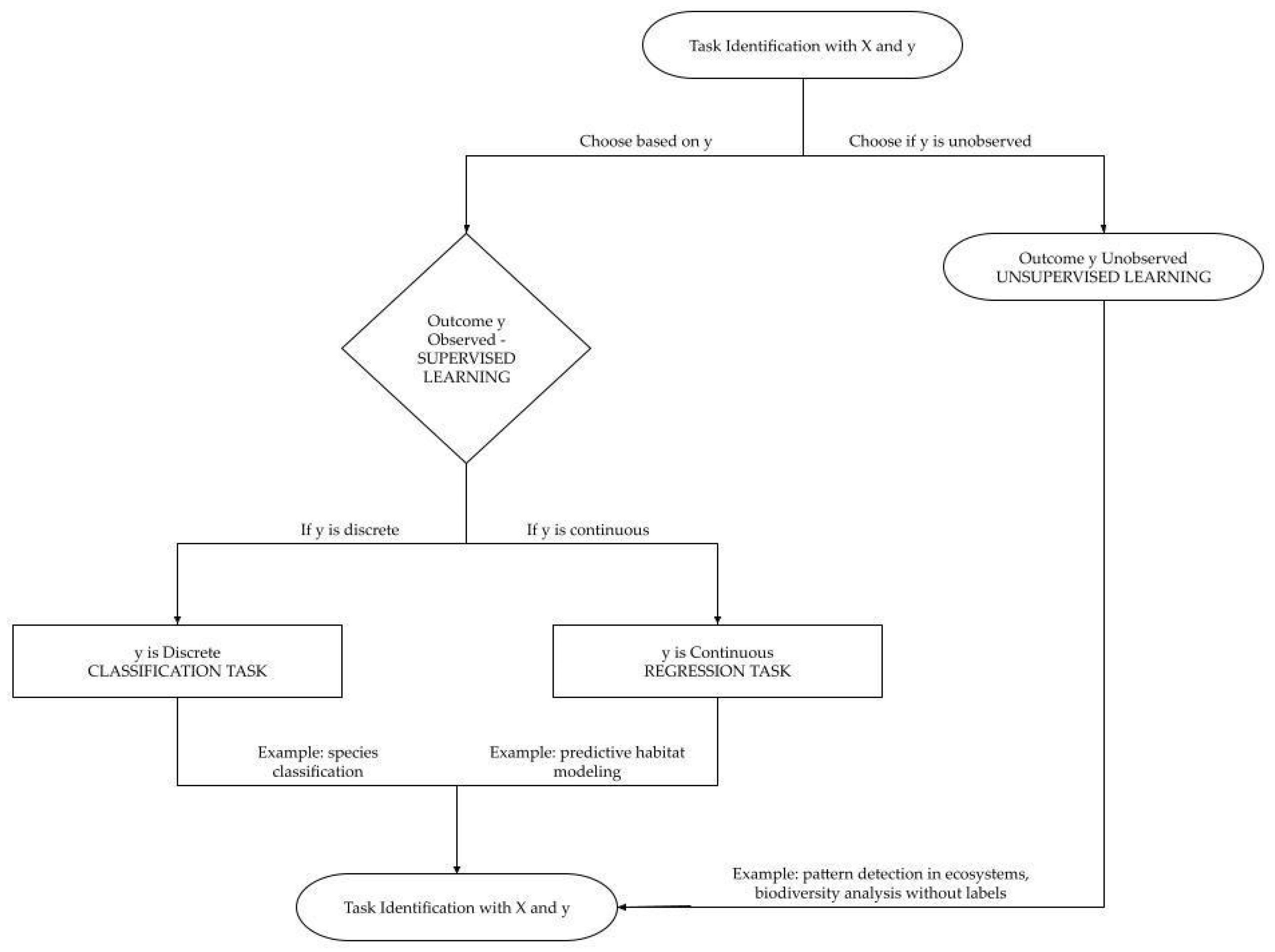
2.4. Supervised and Unsupervised Learning
2.4.1. Supervised Learning
- What can be done
- Improve Classification Accuracy in Ecological Research: Supervised learning techniques such as Decision Trees, Random Forest, and SVMs have been successfully used to classify ecological datasets, improving prediction accuracy and efficiency [65].
- Optimize Model Selection and Hyperparameter Tuning: A comparative study of supervised learning algorithms has shown that tuning hyperparameters can significantly impact model performance, making it essential for improving prediction outcomes [66].
- Apply Supervised Learning to Predict Ecological Events: Machine learning models have been applied to predict ecological phenomena, such as mass mortality events in marine ecosystems, demonstrating the practical application of supervised learning in conservation research [67].
- Enhance Model Generalization and Adaptability: Studies suggest that incorporating multi-modal data in supervised learning models can improve generalization and adaptability in diverse ecological applications.
- Leverage Ensemble Learning for Improved Performance: Combining multiple supervised learning models using ensemble techniques such as bagging and boosting can enhance ecological modeling outcomes by reducing variance and bias [68].
- Use Supervised Learning for Real-time Monitoring: AI-driven models are increasingly being integrated with remote sensing and environmental monitoring systems to enable real-time ecological assessments [69].
- How can it be done
- Choosing the Right Algorithm: Different supervised learning algorithms, such as Decision Trees, Random Forest, ANN models, and SVM models, can be applied to ecological datasets. Each method has unique advantages depending on the type and structure of the data [65].
- Data Preprocessing and Feature Selection: To improve accuracy, supervised models require proper data cleaning, normalization, and feature selection. Methods such as Principal Component Analysis (PCA) and Recursive Feature Elimination (RFE) help refine datasets before model training [70].
- Hyperparameter Tuning for Optimization: Model performance can be enhanced through hyperparameter tuning techniques like Grid Search, Random Search, or Bayesian Optimization, ensuring that models generalize well to new ecological data [70].
- Training with Labeled Data: Supervised learning requires a sufficient amount of labeled data for effective model training. Large-scale datasets, such as GPS telemetry data in ecological studies, improve classification accuracy [71].
- Evaluating Model Performance: Performance evaluation metrics, such as Accuracy, Precision, Recall, F1-score, and Area Under the Curve (AUC), help assess the reliability of supervised learning models in ecological research [70].
- Using Ensemble Learning for Robust Predictions: Combining multiple models using ensemble learning techniques, such as Bagging, Boosting (e.g., XGBoost), and Stacking, enhances prediction stability and reduces errors [70].
- Applying Supervised Learning to Real-world Ecological Problems: Supervised learning models are used to classify animal behavioral states from environmental variables, predict species distribution, and analyze biodiversity conservation strategies [70].
2.4.2. Unsupervised Learning
- What can be done
- Clustering Ecological Data: Unsupervised learning techniques such as density-based clustering (DBSCAN) and k-means clustering have been successfully used to identify ecological patterns in marine environments [72].
- Detecting Anomalies in Ecosystems: Unsupervised learning is effective in anomaly detection, identifying unusual ecological events such as extreme climate conditions and pollution spikes without the need for labeled training data [73].
- Dimensionality Reduction for Complex Ecological Models: Techniques like t-SNE and PCA help in reducing high-dimensional ecological data, making it easier to visualize and interpret complex environmental interactions [72].
- Identifying Hidden Structures in Biodiversity: Unsupervised learning methods have been applied to analyze plankton community structures and nutrient flux patterns, leading to new insights in marine biodiversity research [72].
- Feature Extraction for Environmental Monitoring: Unsupervised neural networks have been used to extract meaningful features from satellite and sensor data, enhancing environmental monitoring efforts [74].
- Improving Conservation Strategies: By clustering species distribution data, unsupervised learning has been instrumental in helping conservationists identify priority areas for protection [75].
- How can it be done
- Preprocessing and Feature Selection: Before applying unsupervised learning, datasets should be preprocessed to remove noise, handle missing values, and standardize data for better clustering and pattern detection [76].
- Choosing the Right Clustering Algorithm: Different clustering methods, such as k-means, hierarchical clustering, and density-based clustering (DBSCAN), are commonly used in ecological studies to classify species or environmental regions [72].
- Using Dimensionality Reduction Techniques: PCA and t-SNE are valuable tools for reducing high-dimensional ecological data, making it easier to visualize and analyze underlying patterns [77].
- Anomaly Detection for Ecological Monitoring: Unsupervised learning models are effective in detecting anomalies in environmental data, such as pollution events or habitat degradation, by identifying deviations from normal patterns [73].
- Leveraging DL for Unsupervised Feature Extraction: Deep learning models, such as autoencoders, can automatically learn features from large ecological datasets, enhancing species identification and habitat classification [77].
- Evaluating Model Performance: Unlike supervised learning, unsupervised models require different validation techniques, such as silhouette scores and clustering validity indices, to assess the quality of the detected patterns [78].
2.5. Evaluating and Improving AI Models
2.5.1. Model Evaluation
2.5.2. Error Diagnosis and Analysis
2.5.3. Model Optimization and Tuning
2.5.4. Feature Analysis
2.5.5. Interpretability and Explainability
2.5.6. A/B Testing and Continuous Monitoring
3. Scope and Objective
4. Materials and Methods
4.1. Review Design and Reporting Framework
4.2. Eligibility Criteria
- Population/system: the study addressed transitional water ecosystems (e.g., coastal lagoons, estuaries, deltas, coastal wetlands, or clearly transitional aquatic environments);
- Intervention/method: the study applied AI approaches, with a specific focus on ML and/or DL, including hybrid or ensemble strategies, to ecological or environmental datasets;
- Outcomes/aims: the study targeted ecological research and/or monitoring objectives in transitional waters (e.g., assessment, forecasting, mapping, biodiversity evaluation, pollution detection, habitat characterization, or closely related management applications);
- Document type and source: peer-reviewed publications indexed in Scopus providing sufficient methodological detail for extraction and classification, including journal articles, review papers, and peer-reviewed conference proceedings;
- Language: English-language publications;
- Accessibility: full text available.
- Studies not focused on transitional waters (e.g., exclusively open-ocean, purely freshwater, or terrestrial systems without a transitional component);
- Papers not implementing AI/ML/DL methods (e.g., purely descriptive studies, conceptual perspectives without implementation, or exclusively mechanistic modelling without an AI component);
- Excluded document types: non-peer-reviewed or non-research content (e.g., editorials, commentaries, meeting abstracts) and other records lacking sufficient methodological detail for robust extraction; additionally, records outside the eligible document types above (e.g., book notes, short communications without methods) were excluded during eligibility assessment;
- Records without accessible full text and/or insufficient information to classify AI task/model/application domain.
4.3. Information Source and Search Strategy
4.4. Study Selection Process (PRISMA 2020)
4.5. Data Extraction and Coding Scheme
4.6. Quality Assessment and Risk of Bias
- clarity of study objectives and ecological context;
- transparency of dataset description and preprocessing;
- appropriateness of AI model selection relative to research question;
- robustness of validation strategy (e.g., cross-validation, external validation, spatio-temporal independence);
- reporting of performance metrics and uncertainty measures.
4.7. Synthesis Methods
4.8. PRISMA-Style Flow Diagram
5. Results
5.1. Classification of Types of AI Tasks
- Regression
- Classification
- Clustering
- Other AI Tasks and Their Exclusion from This Study
- Reinforcement Learning, which optimizes decision-making in dynamic environments but requires simulated scenarios beyond the scope of this research.
- Anomaly Detection, which is valuable for identifying rare ecological events, but is less applicable to structured datasets such as those used in this study.
- Generative AI, which synthesizes new data, is primarily beneficial for model training augmentation rather than direct ecological analysis [83].
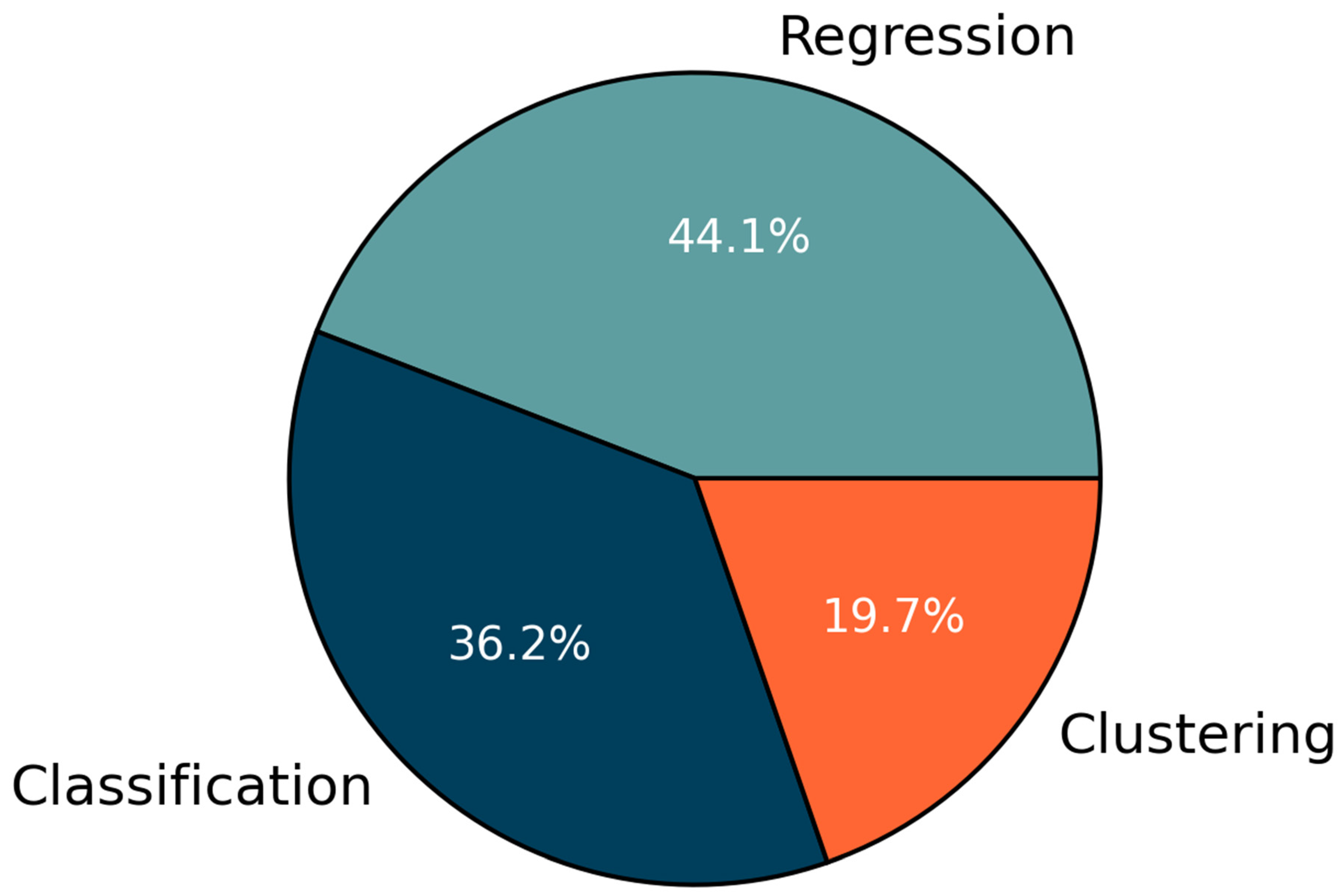
- Findings on AI Task Type Distribution
- Regression (44.1%)—Used primarily for environmental forecasting, such as predicting pollution levels, climate trends, and species population dynamics.
- Classification (36.2%)—Applied extensively in species identification, habitat categorization, and environmental monitoring, leveraging decision trees, neural networks, and SVMs.
- Clustering (19.7%)—Used for grouping ecological data, identifying environmental patterns, and defining ecosystem boundaries through unsupervised learning techniques.
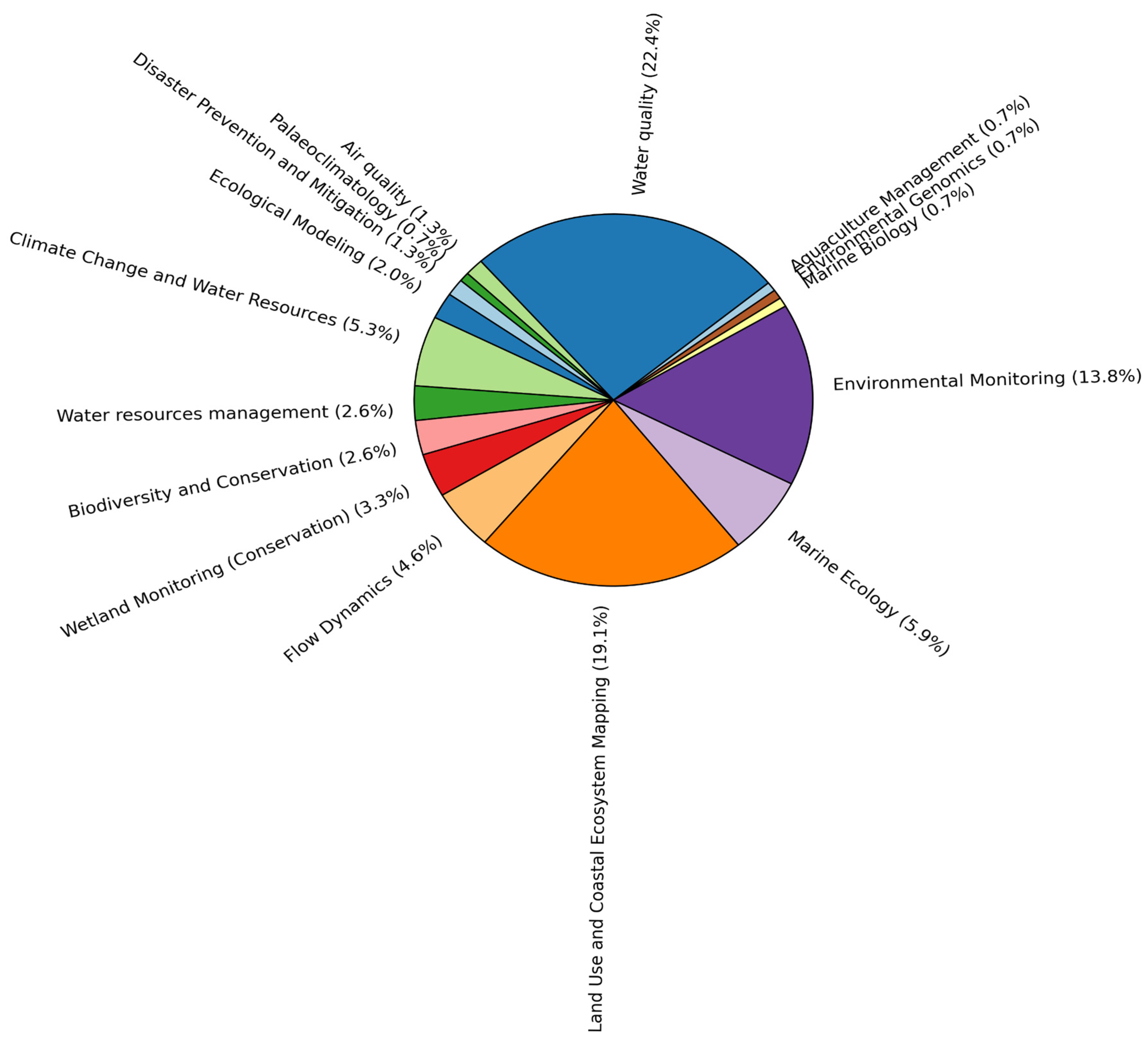
5.2. Research Topics
- Water Quality Monitoring
- Land Use and Coastal Ecosystem Mapping
- Marine Ecology and Environmental Monitoring
- Climate Change and Ecosystem Responses
- Other Specialized Topics
- Findings on Research Topics
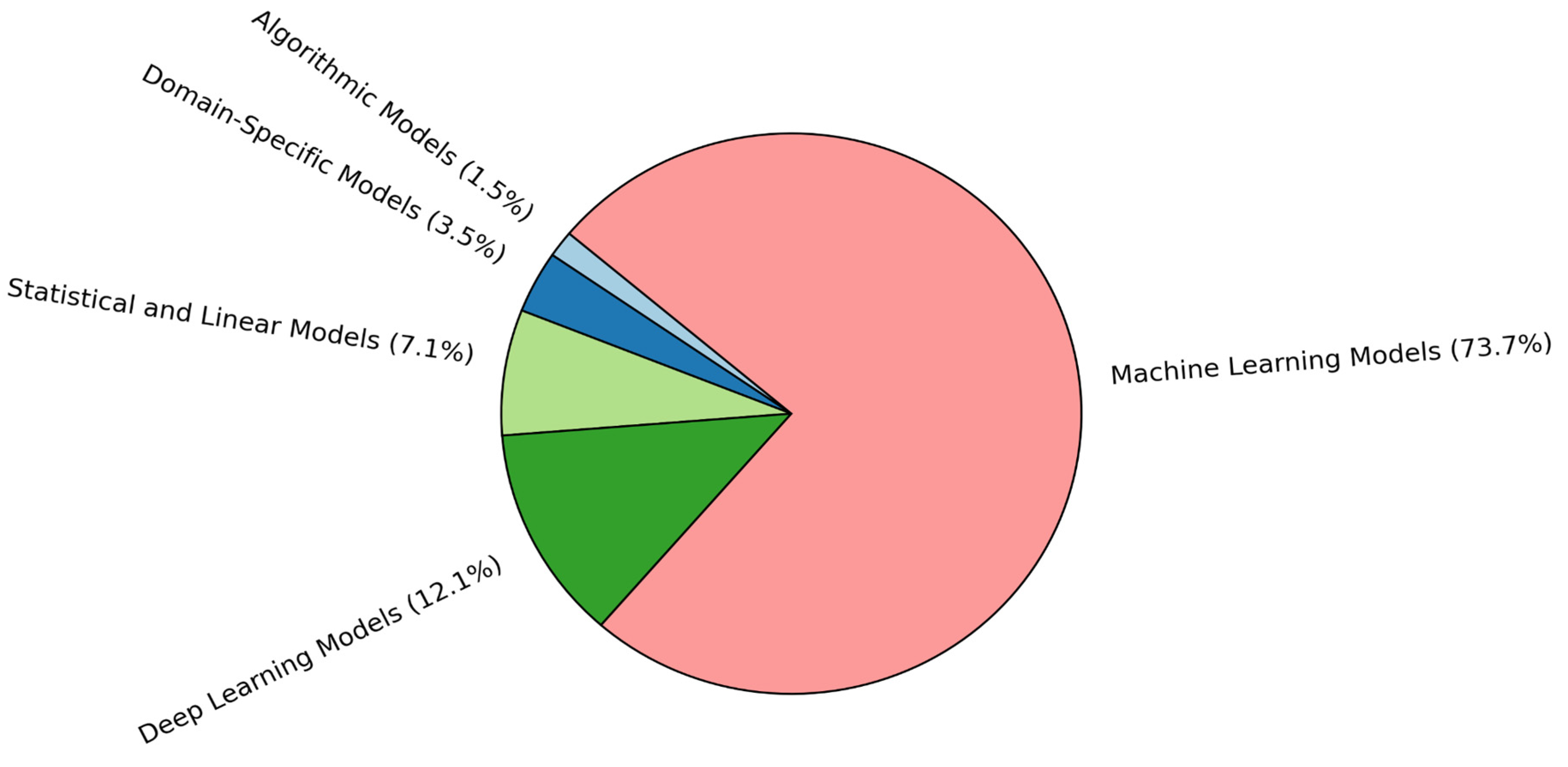
5.3. Distribution of AI Model Types
- ML Models
- DL Models
- Statistical and Linear Models
- Other Specialized AI Models
- AI Model Type Distribution and Trends
- Findings on AI Task Type Distribution
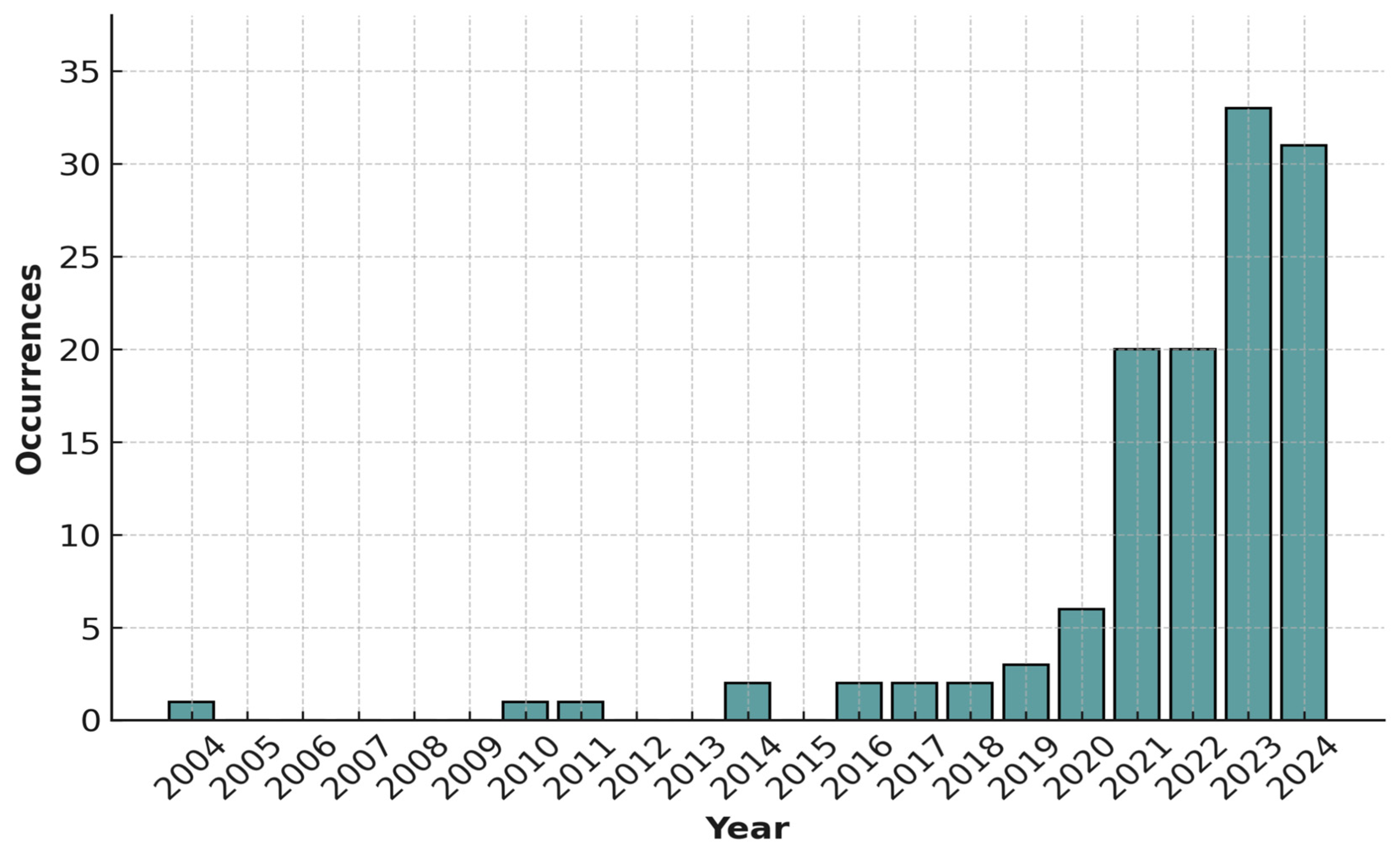
5.4. Temporal Distribution of Publications
- Trends in AI Research Over Time
- Advancements in computational power, particularly the accessibility of GPUs and cloud computing, which have facilitated the adoption of ML and DL approaches.
- An increase in high-quality environmental datasets, made available through remote sensing satellites and sensor networks, enabling the training of more sophisticated AI models.
- A growing emphasis on climate change research, leading to increased funding and international collaboration on AI-driven ecological monitoring.
- Key Periods of Growth and Innovation
- Before 2015: the use of AI in ecological research was minimal, with a strong reliance on traditional statistical models and early ML methods like Decision Trees and Regression models.
- 2015–2019: A steady rise in publications, with increased experimentation using SVMs and RF models for species distribution modeling and environmental classification.
- 2020–2024: A substantial increase in AI publications, driven by the rise of DL methodologies such as CNN models for remote sensing, as well as hybrid AI approaches integrating ML with ecological models.
- Impact of AI on Environmental Research Priorities
- Early AI applications (before 2015) were primarily focused on species monitoring and environmental forecasting, relying on structured datasets with limited computational requirements.
- Recent studies (2020–2024) have expanded to real-time monitoring, anomaly detection, and predictive modeling, enabled by DL and big data analytics.
- A parallel trend in XAI has emerged to enhance model interpretability, addressing concerns about the transparency and reliability of AI models in ecological decision-making.
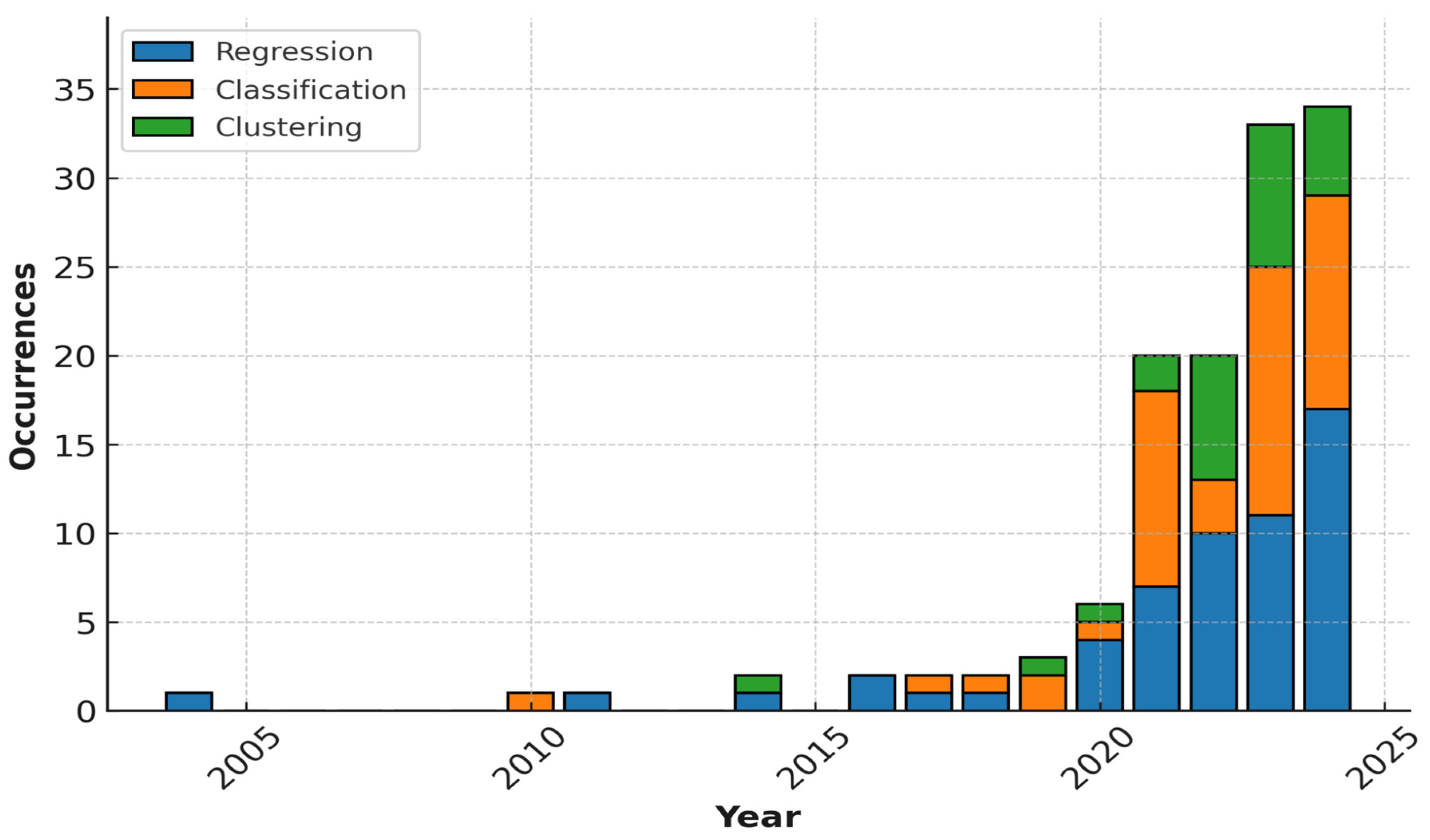
5.5. Temporal Trends and AI Task Types Combination
- Historical Evolution of AI Task Types
- Factors Influencing the Shift in AI Task Types
- Enhanced computational capabilities, including cloud computing and GPUs, have facilitated the training of complex models.
- The growing availability of high-resolution environmental data, especially from satellite imagery and remote sensing, has expanded analytical possibilities.
- The demand for real-time ecological monitoring has increased, necessitating models that can detect anomalies and identify environmental patterns.
- Escalating concerns over climate change and biodiversity loss have fueled the adoption of advanced AI-driven analytical approaches.
- AI Task Type Combinations Over Time
- Before 2015: Regression models were dominant, supporting species distribution and pollution forecasting.
- 2015–2019: Classification tasks emerged, used in species identification and land use mapping.
- 2020–2024: Increased use of clustering methods was observed, primarily as part of exploratory analyses or hybrid workflows combining deep-learning-based feature extraction with traditional unsupervised techniques, rather than as a direct consequence of deep learning adoption.
6. Discussions
6.1. Shift in AI Model Adoption
- Advances in computational power and DL, allowing for more complex, high-dimensional analyses.
- The increasing complexity of ecological research, necessitating sophisticated analytical approaches.
- Greater adoption of clustering models, particularly in remote sensing, habitat mapping, and pollution assessment.
6.2. Trends in AI Model Type Distribution
- Traditional ML methods, such as RF models, SVMs, and Gradient Boosting, remain widely used due to their robustness and their perceived transparency, although most high-performing approaches lack intrinsic interpretability in ecological applications.
- The rising adoption of DL models, particularly CNNs and RNN models, suggests that researchers are increasingly leveraging high-dimensional data, such as satellite imagery and sensor-based time-series data.
6.3. AI and Global Environmental Concerns
- Climate change and habitat degradation have catalyzed innovation in AI applications, particularly in predictive modeling and ecosystem monitoring.
- The expanding volume of AI-driven ecological publications not only marks technological advancements but also underscores the increasing urgency for effective environmental monitoring and management strategies.
6.4. Challenges and Future Directions
- Model Interpretability—The increasing complexity of AI models necessitates XAI techniques to ensure transparency in ecological decision-making.
- Data Quality and Availability—AI models require large-scale, high-quality datasets, which remain limited in some ecological contexts.
- Computational Constraints—While AI models provide significant advantages, their high computational costs and energy consumption pose sustainability concerns.
- Enhancing XAI methods to improve model transparency and stakeholder trust.
- Developing standardized AI frameworks to facilitate cross-study comparability and model reproducibility.
- Integrating AI with ecological domain expertise, ensuring that AI-generated insights align with real-world conservation priorities.
7. Conclusions and Recommendations
7.1. Key Findings and Implications
- Advancements in AI-driven Environmental Monitoring
- AI’s Role in Conservation and Sustainable Practices
- Climate Change Mitigation and AI
- Challenges in AI-driven Environmental Research
- a.
- Data Availability and Bias: Many AI models depend on high-quality datasets, yet access to consistent, standardized ecological data remains a challenge [86].
- b.
- Computational Costs: Deep learning models require significant computational resources, leading to concerns over energy consumption and sustainability [84].
- c.
- Model Interpretability: The need for XAI is growing, as complex models often lack transparency, making it difficult for policymakers and conservationists to rely on AI-based decisions [102].
7.2. Recommendations for Future Research and Policy
- Enhancing AI Transparency and Explainability
- Improving Data Accessibility and Standardization
- Integrating AI with Traditional Ecological Knowledge (TEK)
- Ensuring Ethical and Sustainable AI Use
7.3. Conclusions
Author Contributions
Funding
Data Availability Statement
Acknowledgments
Conflicts of Interest
Abbreviations
Appendix A
Summary of Reviewed Studies

| Paper # | Regression | Classification | Clustering | Articles | Topic | Model Type | Year |
|---|---|---|---|---|---|---|---|
| 1 | X | Neural Network-Based Light Attenuation Model for Monitoring Seagrass Health [105] | Marine Ecology and Environmental Monitoring: Monitoring seagrass health and assessing light attenuation in coastal and estuarine environments. This can be further classified under coastal ecology and water quality monitoring. | Machine Learning Models, Neural Networks | 2004 | ||
| Problem Type: Regression: The study focuses on modeling the light attenuation coefficient using different water quality parameters to monitor seagrass health. This type of problem is a regression problem since it aims to predict a continuous value—the light attenuation coefficient. Approach: The study uses regression techniques to predict the vertical light attenuation coefficient, which is crucial for monitoring seagrass health. Various AI models, including neural networks, linear regression, model trees, and SVMs, are compared to identify the most effective approach. Topic: The study uses neural network-based models (MLP, GRNN) to estimate the light attenuation coefficient from 13 water quality parameters. These models are compared with traditional linear regression models, model trees, and SVMs. Models Used: The study uses neural network-based models (MLP, GRNN) to estimate the light attenuation coefficient from 13 water quality parameters. These models are compared with traditional linear regression models, model trees, and SVMs. Publication Year: The article was published in 2004. | |||||||
| 2 | X | Transcriptome Profiles: Diagnostic Signature of Dolphin Populations [106] | Marine Biology and Environmental Genomics: Understanding dolphin population structure and the environmental impact on health through transcriptomic profiling. This can be further categorized under species population monitoring and environmental stress response. | Machine Learning Models, Genomic Analysis Tools | 2010 | ||
| Problem Type: The problem addressed is a classification problem, aiming to determine the geographic origin of dolphin populations using transcriptomic data. Approach: The study used cDNA microarrays to analyze gene expression, and ANN models to classify individuals and discern population differences. Topic: Population genetics and the impact of environmental factors on dolphin populations in different coastal areas. Models Used: ANN models and cDNA microarray analysis. Publication Year: 2010 | |||||||
| 3 | X | Application of a Random Forest algorithm to predict spatial distribution of the potential yield of Ruditapes philippinarum in the Venice lagoon, Italy [107] | Marine Ecology and Aquaculture Management: The focus is on sustainable aquaculture of Manila clams, classified under marine ecology and aquaculture management. | Machine Learning Models | 2011 | ||
| Problem Type: The study addresses a regression problem, predicting the yield of Manila clams. Approach: A Random Forest algorithm was employed to develop a model that predicts clam yield based on a set of environmental factors. The model was calibrated using a training dataset and validated with independent data. Topic: The main topic is marine ecology and aquaculture management, with a focus on the Venice Lagoon. Models Used: Random Forest. Publication Year: 2011 | |||||||
| 4 | X | X | Field characterization and data integration to define the hydraulic heterogeneity of a shallow granular aquifer at a sub-watershed scale [108] | Groundwater and Hydrogeology: Specifically, aquifer characterization, which can also be categorized under water pollution (water quality) (due to the leachate plume). | Machine Learning Models | 2014 | |
| Problem Type: The study involves both regression and clustering. Regression is used for estimating hydraulic properties, while clustering is used to identify distinct hydrofacies units. Approach: A combination of cone penetrometer tests (CPT), soil moisture and resistivity measurements (SMR), and relevance vector machines (RVM) was used to characterize aquifer heterogeneity and predict hydraulic properties. Topic: Hydrogeology, specifically characterizing a shallow granular aquifer to better understand groundwater flow and contaminant transport. Models Used: Relevance Vector Machines (RVM). Year of Publication: 2014 | |||||||
| 5 | X | A Statistical Algorithm for Estimating Chlorophyll Concentration in the New Caledonian Lagoon [109] | Marine Ecology and Water Quality: Specifically focusing on the health of lagoon ecosystems, including coral reefs and phytoplankton biomass estimation. This falls under water quality monitoring and marine ecosystem health. | Machine Learning Models Statistical Models | 2016 | ||
| Problem Type: The study deals with a regression problem to estimate chlorophyll-a concentration. Approach: A statistical algorithm combining a log-linear model and SVM for low and high chlorophyll concentration scenarios. The models were trained on match-up data from 2002–2010. Topic: The study is related to marine ecology and aims to improve the estimation of chlorophyll concentration in optically complex waters. Models Used: SVM and log-linear models, compared to the NASA OC3 algorithm. Year of Publication: 2016 | |||||||
| 6 | X | Developments in Earth observation for the assessment and monitoring of inland, transitional, coastal and shelf-sea waters [110] | Water Quality and Environmental Monitoring: The focus is on monitoring water quality using EO, which can be categorized under water pollution and environmental assessment. | Machine Learning Models Statistical Models | 2016 | ||
| Problem Type: The paper deals with a regression problem, focused on estimating different water quality parameters using remote sensing. Approach: The approach combines satellite remote sensing, empirical algorithms, physics-based models, and machine learning techniques to assess water quality over large geographic areas such as the Danube-Black Sea system. Topic: The study is about water quality monitoring and environmental assessment of inland, coastal, and shelf-sea water systems. Models Used: Neural networks, empirical models, and other remote sensing algorithms. Year of Publication: 2016 | |||||||
| 7 | X | Climate reconstructions based on postglacial macrofossil assemblages from four river systems in southwestern Alberta [111] | Palaeoclimatology and Environmental Monitoring: The focus is on palaeoclimatic reconstruction and ecological assessment of riverine systems in Alberta, which falls under climate change studies and ecological history. | Machine Learning Models | 2017 | ||
| Problem Type: The study involves a regression problem that uses macrofossil data to estimate temperature and precipitation over different periods. Approach: The MAXENT model was used for climate niche modelling and predicting the climatic optima of indicator taxa. The study used macrofossil data from various river systems to derive temperature and precipitation trends since the end of the Pleistocene. Topic: Palaeoclimatic reconstruction using macrofossil analysis to understand ecological changes in southwestern Alberta. Models Used: MAXENT (Maximum Entropy Modelling). Year of Publication: 2017 | |||||||
| 8 | X | Multi-temporal Land Use Mapping of Coastal Wetlands Area using Machine Learning in Google Earth Engine [112] | Land Use and Coastal Ecosystem Mapping: The study falls under coastal ecosystem monitoring and land use mapping, with an emphasis on coastal wetland management and understanding land use changes over time. | Machine Learning Models Tree-Based Models SVMs | 2017 | ||
| Problem Type: Classification problem aimed at mapping land use in coastal wetland areas. Approach: The study utilizes Google Earth Engine (GEE) with ten different machine learning algorithms to perform multi-temporal land use mapping of the Segara Anakan Lagoon, using various satellite images from Landsat and ASTER GDEM. Topic: Land use mapping and coastal wetland analysis. Models Used: Fast Naive Bayes, CART (Classification and Regression Tree) RF models, GMO Max Entropy, Perceptron (Multi-Class Perceptron), Winnow, Voting SVM, Margin SVM, Pegasos (Primal Estimated Sub-Gradient Solver for SVM), IKPamir (Intersection Kernel Passive Aggressive Method for Information Retrieval, SVM) Year of Publication: 2017 | |||||||
| 9 | X | X | Machine learning predictions of trophic status indicators and plankton T dynamic in coastal lagoons [113] | Water Quality and Marine Ecology: The focus is on monitoring and assessing eutrophication and plankton dynamics in a coastal lagoon, falling under water pollution and marine ecosystem health. | Machine Learning Models | 2018 | |
| Problem Type: The study involves both regression (for predicting trophic index values) and classification (to understand the dynamics of plankton and the controlling mechanisms in the lagoon). Approach: The Random Forest (RF) model was used to predict the trophic index (TRIX) of the lagoon using available environmental data. The model also classified plankton dynamics to determine whether they were driven by nutrient availability (bottom-up) or grazing pressures (top-down). Topic: The study focuses on eutrophication assessment and plankton dynamics in the Ghar El Melh Lagoon, a coastal Mediterranean lagoon. Models Used: Random Forest (RF). Year of Publication: 2018. | |||||||
| 10 | X | Supervised machine learning in predicting multiphase flow regimes in horizontal pipes [114] | Flow Dynamics and Petroleum Engineering: The focus is on predicting multiphase flow regimes in pipelines, which falls under flow assurance and petroleum engineering. | Machine Learning Models Tree-Based Models SVM Neural Network Models | 2019 | ||
| Problem Type: Classification problem aimed at predicting the flow regime in multiphase flow scenarios. Approach: Several supervised machine learning algorithms were compared to predict the flow regimes. The best performing model was Random Forest, with high accuracy and efficient training time. Topic: The study focuses on multiphase flow prediction for the petroleum industry, specifically predicting the flow regimes in horizontal pipes containing air, water, and oil. Models Used: Random Forest, Decision Tree, Logistic Regression, SVM, Neural Network MLP. Year of Publication: 2019 | |||||||
| 11 | X | X | Hyperspectral change detection in wetland and water-body areas [115] | Wetland Conservation and Water Quality: The focus is on environmental monitoring, specifically detecting changes in wetland and water body areas, falling under water pollution and wetland conservation. | Machine Learning Models Hybrid Models | 2019 | |
| Problem Type: The study involves both classification (classifying pixels as changed or unchanged) and change detection using hyperspectral imagery. Approach: The proposed method involves three main steps: image differencing, pseudo training data generation using an Expectation Maximization (EM) algorithm, and classification with a Random Forest classifier to produce a change map. Topic: Wetland and water body monitoring using hyperspectral change detection to observe changes over time in the Shadegan wetland. Models Used: Random Forest classifier, with pseudo training data generated using the Expectation Maximization (EM) algorithm. Year of Publication: 2019 | |||||||
| 12 | X | Prediction of algal chlorophyll-a and water clarity in monsoon-region reservoir using machine learning approaches [116] | Water Quality and Eutrophication Management: This falls under water pollution monitoring and eutrophication management for reservoirs. | Machine Learning Models Statistical Models | 2020 | ||
| Problem Type: The study involves a regression problem, predicting chlorophyll-a and water clarity (Secchi depth) in a reservoir. Approach: The researchers used MLR, SVM, and ANN to predict chlorophyll-a concentration and water clarity. The models were validated using cross-validation, with SVM showing the best performance in terms of predictive accuracy, based on metrics like RMSE, MAE, and R2. Topic: The study focuses on water quality and eutrophication management in a monsoon-region reservoir. Models Used: MLR, SVM, ANN. Year of Publication: 2020 | |||||||
| 13 | X | Using Machine-Learning Algorithms for Eutrophication Modeling: Case Study of Mar Menor Lagoon (Spain) [117] | Water Pollution and Eutrophication: This study falls under water pollution monitoring and eutrophication management for coastal lagoons. | Machine Learning Models | 2020 | ||
| Problem Type: The study involves a regression problem, predicting chlorophyll-a concentrations in the Mar Menor Lagoon. Approach: The researchers used MLNN and SVR models with various feature selection algorithms to predict Chl-a concentrations. The models were trained and validated with daily data collected from water quality campaigns. Topic: Eutrophication modeling in the Mar Menor Lagoon, focusing on improving the understanding of nutrient dynamics to manage eutrophication. Models Used: MLNN and SVR. Year of Publication: 2020 | |||||||
| 14 | X | X | Optimum Design of a Seawater Intrusion Monitoring Scheme Based on the Image Quality Assessment Method [118] | Groundwater Monitoring and Coastal Management: The focus is on seawater intrusion in coastal aquifers, falling under water pollution and groundwater monitoring. | Machine Learning Models, Optimization Models: Genetic Algorithm, Hybrid Models | 2020 | |
| Problem Type: The study involves regression using KELM to estimate the groundwater model and optimization with a genetic algorithm to optimize the monitoring well locations. Approach: The methodology includes building a numerical simulation model for groundwater, using KELM as a surrogate to reduce computational load, and employing a genetic algorithm to optimize the monitoring scheme. Topic: The study focuses on seawater intrusion monitoring and optimization of groundwater monitoring networks. Models Used: KELM (Kernel Extreme Learning Machine) and Genetic Algorithm. Year of Publication: 2020 | |||||||
| 15 | X | X | Pinna nobilis in the Mar Menor coastal lagoon: A story of colonization and uncertainty [119] | Biodiversity and Conservation: The study falls under species monitoring and conservation in the context of environmental change and habitat degradation. Specifically, it focuses on the effects of environmental factors on the population of a vulnerable species. | Machine Learning Models Tree-Based Models | 2020 | |
| Problem Type: The study involves classification to predict presence or absence and regression to estimate the probability of occurrence of Pinna nobilis in the Mar Menor lagoon. Approach: Random Forest models were employed to estimate the spatial distribution of P. nobilis across different time periods and identify the main environmental factors affecting its colonization. Topic: The study focuses on species distribution of the Mediterranean fan mussel and the environmental impact on its population in the Mar Menor lagoon. Models Used: Random Forest for classification and regression tasks. Year of Publication: 2020 | |||||||
| 16 | X | SuperFish: A Mobile Application for Fish Species Recognition Using Image Processing Techniques and Deep Learning [120] | Biodiversity and Conservation: The focus is on fish species recognition to aid in marine conservation, fisheries management, and ecotourism. It falls under species identification and environmental monitoring. | Machine Learning Models Deep Learning Models Hybrid Models | 2021 | ||
| Problem Type: The study deals with a classification problem to identify fish species from images. Approach: The approach involves a combination of traditional image processing steps (such as grayscale conversion, Gaussian blur, and contour extraction) followed by classification using various machine learning classifiers and deep learning (Inception-v3) models. The dataset included 1520 images representing 38 different fish species. Topic: The study focuses on the development of a mobile application for fish species recognition to support marine conservation, fisheries management, and ecotourism in Mauritius. Models Used: k-Nearest Neighbour (kNN), SVM models (SVMs), Neural Networks, Decision Trees, Random Forest, Inception-v3 deep learning model. Year of Publication: 2021 | |||||||
| 17 | X | Using sentinel-2 satellite imagery to develop microphytobenthos-based water quality indices in estuaries [121] | Water Quality Monitoring and Ecosystem Assessment: The focus is on water pollution and ecosystem health, specifically using intertidal vegetation as indicators for water quality in estuaries. | Machine Learning Models | 2021 | ||
| Problem Type: Classification problem involving the identification of intertidal vegetation types, including microphytobenthos and green macroalgae, using satellite imagery. Approach: The study used a Random Forest classifier applied to Sentinel-2 images to create a map of different vegetation types in French estuaries. NDVI was used as a proxy for vegetation biomass, and Sentinel-2’s spatial resolution allowed for detailed mapping. Topic: The study focuses on water quality assessment in estuaries, using microphytobenthos as a bio-indicator for environmental monitoring. Models Used: Random Forest classifier. Year of Publication: 2021 | |||||||
| 18 | X | Mapping Spatial Distribution and Biomass of Intertidal Ulva Blooms Using Machine Learning and Earth Observation [122] | Water Quality and Marine Ecology: Focuses on macroalgal blooms and eutrophication in estuarine environments, falling under water pollution monitoring and coastal ecosystem health. | Machine Learning Models Hybrid Models | 2021 | ||
| Problem Type: The study involves classification for mapping spatial distribution and regression for estimating biomass. Approach: The approach uses earth observation data (Sentinel-1/2 and Landsat) for mapping and NDVI for delineation of Ulva blooms. An ANN model is employed to predict biomass quantity using radar and optical reflectance data. Topic: Monitoring and management of macroalgal blooms in Irish estuaries to assess water quality and ecological status. Models Used: ANN. Year of Publication: 2021 | |||||||
| 19 | X | Mapping and Quantification of the Dwarf Eelgrass Zostera noltei Using a Random Forest Algorithm on a SPOT 7 Satellite Image [123] | Biodiversity Monitoring and Conservation: The focus is on seagrass monitoring and environmental conservation in coastal areas, falling under habitat conservation and ecosystem health monitoring. | Machine Learning Models Tree-Based Models | 2021 | ||
| Problem Type: Classification problem involving the use of Random Forest to classify habitats in the coastal lagoon. Approach: The approach involves using SPOT 7 satellite imagery and applying a Random Forest classifier to map the different types of habitats. Vegetation indices like NDVI were used to help in differentiating the habitats. Topic: The study focuses on seagrass monitoring and the mapping of dwarf eelgrass (Zostera noltei) in the Merja Zerga coastal lagoon to assess the impacts of environmental changes. Models Used: Random Forest Classifier. Year of Publication: 2021 | |||||||
| 20 | X | X | Modeling fragmentation probability of land-use and land-cover using the bagging, random forest and random subspace in the Teesta River Basin, Bangladesh [124] | Land-Use and Environmental Management: The focus is on land-use and land-cover fragmentation and landscape ecology. It falls under environmental monitoring and land-use change analysis | Machine Learning Models Ensemble Models | 2021 | |
| Problem Type: The study involves classification for categorizing LULC types and regression for modeling fragmentation probability. Approach: The researchers used Bagging, RF, RSS, and their ensemble model to predict landscape fragmentation probability. They utilized remote sensing and GIS tools, with sensitivity analysis to understand the most influential parameters for modeling. Topic: The study focuses on landscape fragmentation and LULC change modeling in the Teesta River Basin, aiming to understand the environmental impacts of fragmentation and guide regional planning. Models Used: Bagging, Random Forest (RF), Random Subspace (RSS), and an Ensemble Model. Year of Publication: 2021 | |||||||
| 21 | X | Applying Limnological Feature-Based Machine Learning Techniques to Chemical State Classification in Marine Transitional Systems [125] | Water Quality (Water Pollution and Quality Monitoring): The study addresses water pollution, specifically focusing on chemical state classification and eutrophication in marine ecosystems | Machine Learning Models Tree-Based Models | 2021 | ||
| Problem Type: The study is a classification problem, aimed at classifying chemical states (eutrophication and contamination levels) in marine transitional systems. Approach: Machine learning models (LDA, CTree, NB, SVM) were applied to data related to nutrient, dissolved oxygen, chlorophyll-a, trace metals, and polycyclic aromatic hydrocarbons to produce chemical status classifications. The feature-based approach enabled the classification of the chemical state of estuarine and lagoon waters. Topic: The study is about water quality classification in marine transitional systems. Models Used: Linear Discriminant Analysis (LDA), Classification Tree (CTree), Naive Bayesian (NB), SVM Year of Publication: 2021 | |||||||
| 22 | X | X | Integration of artificial intelligence–based LULC mapping and prediction for estimating ecosystem services for urban sustainability: past to future perspective [126] | Urban Expansion and Environmental Monitoring: The study falls under urban sustainability and land-use change analysis. It focuses on assessing the impacts of urban expansion on natural resources and ecosystem services | Machine Learning Models Hybrid Models | 2021 | |
| Problem Type: Classification for LULC mapping using SVM, and regression for predicting future LULC using ANN-CA. Approach: The study used SVM to classify LULC maps over different years and ANN-CA for future prediction. It also used RF and CART for sensitivity analysis. The future ESV was calculated based on the predicted LULC. Topic: The study focuses on urban sustainability and the dynamics of land-use change in the context of urban expansion in Saudi Arabia. Models Used: SVM, ANN-Cellular Automata (ANN-CA), Random Forest (RF), Classification and Regression Tree (CART). Year of Publication: 2021 | |||||||
| 23 | X | A new approach to monitor water quality in the Menor sea (Spain) using satellite data and machine learning methods [127] | Water Quality and Marine Ecology: The study addresses water pollution by monitoring chlorophyll-a, an indicator of water quality and eutrophication in coastal areas | Machine Learning Models Deep Learning Models Hybrid Models | 2021 | ||
| Problem Type: The study involves a regression problem for predicting chlorophyll-a concentration using satellite data. Approach: Sentinel-2 data is used along with machine learning models (RF, SVMRadial, ANN, and DNN) to estimate chl-a concentration in a cost-effective manner, providing near-real-time information. The models were evaluated under different feature selection scenarios, and RF achieved the best performance. Topic: The study focuses on water quality monitoring in the Menor Sea, specifically by estimating chlorophyll-a concentrations to track eutrophication. Models Used: Random Forest, SVMRadial, ANN, and DNN. Year of Publication: 2021 | |||||||
| 24 | X | Classification of Boulders in Coastal Environments Using Random Forest Machine Learning on Topo-Bathymetric LiDAR Data [128] | Coastal Erosion and Habitat Monitoring: The focus is on coastal erosion prevention and the monitoring of marine habitats through the classification of boulders that contribute to natural coastal defenses and marine ecosystem health | Machine Learning Models Tree-Based Models | 2021 | ||
| Problem Type: Classification problem involving the detection and classification of boulders in coastal environments using topo-bathymetric LiDAR data. Approach: A Random Forest classifier was used to analyze the LiDAR data. The study involved preprocessing the data to generate a point cloud of the seabed, followed by applying Random Forest to classify boulders based on different features extracted from the point cloud. Topic: The study focuses on boulder mapping in coastal areas to assess and manage natural coastal protection and habitat services. Models Used: Random Forest (RF) Year of Publication: 2021 | |||||||
| 25 | X | Effect of changing weather conditions on Eastern Mediterranean coastal lagoon fishery [129] | Environmental Monitoring (Climate Change) and Fisheries: The study falls under climate change impact on fisheries and coastal ecosystems, focusing on the effects of changing weather conditions on fishery yields | Machine Learning Models Statistical Models | 2021 | ||
| Problem Type: Regression problem involving the use of GLMs to model the effect of weather conditions on fishery catches. Approach: The study used Random Forest to select important predictors, followed by GLMs to predict fish catch. The models incorporated variables such as sea water temperature, maximum air temperature, wind speed, and cloudy days. Topic: The study focuses on the impact of climate change on coastal lagoon fisheries, analyzing how weather variations affect fishery yields. Models Used: Random Forest and Generalized Linear Models (GLMs). Year of Publication: 2021 | |||||||
| 26 | X | X | Factors controlling iodine enrichment in a coastal plain aquifer in the North Jiangsu Yishusi Plain, China [130] | Water Quality (Water Pollution and Hydrogeochemistry): The study focuses on the enrichment of iodine in groundwater, which is related to water quality and pollution in coastal aquifers | Machine Learning Models Statistical Models | 2021 | |
| Problem Type: The study involves both classification (RF model) and regression (factor analysis) to understand and predict iodine concentrations in groundwater. Approach: The researchers used RF to identify important factors affecting iodine levels, and FA to understand the hydrogeochemical relationships. The study aims to identify the sources and geochemical processes of iodine in a coastal aquifer. Topic: The study focuses on iodine enrichment in groundwater in the North Jiangsu Yishusi Plain, China, and examines the hydrogeochemical processes controlling this phenomenon. Models Used: Random Forest (RF) and Factor Analysis (FA). Year of Publication: 2021 | |||||||
| 27 | X | The application of game theory-based machine learning modelling to assess climate variability effects on the sensitivity of lagoon ecosystem parameters [131] | Environmental Monitoring (Climate Change Impact) and Ecosystem Sensitivity: The study addresses the impact of climate variability on lagoon ecosystems, specifically focusing on how changes in wind speed and temperature affect ecological sensitivity in coastal areas | Machine Learning Models Tree-Based Models Hybrid Models | 2021 | ||
| Problem Type: The study involves a classification problem for modeling ecological parameters and sensitivity analysis using machine learning models. Approach: Multiple machine learning models, including RF, GBM, XGB, LR, SVC, and DT, were used to classify the ecological sensitivity of various parameters. The SHAP analysis was employed to assess the sensitivity of these parameters to year-to-year weather fluctuations, focusing on the influence of wind speed and air temperature on different biological and chemical components of the lagoon ecosystem. Topic: The study focuses on climate variability and its effects on the sensitivity of lagoon ecosystems, specifically targeting the Vistula Lagoon in the South Baltic. Models Used: RF, GBM, XGB, LR, SVC, DT, and SHAP. Year of Publication: 2021 | |||||||
| 28 | X | Machine Learning Modeling Techniques for Forecasting the Trophic Level in a Restored South Mediterranean Lagoon Using Chlorophyll-a [132] | Water Quality (Water Pollution) and Marine Ecology (Eutrophication): The study focuses on water quality monitoring and eutrophication in coastal lagoons, specifically addressing the ecological status of a lagoon impacted by anthropogenic activities. | Machine Learning Models Hybrid Models | 2021 | ||
| Problem Type: Regression was used to predict Chl-a concentrations in the North Lagoon of Tunis. Approach: The study used a NARX neural network to predict Chl-a concentrations, using key predictor variables identified through Random Forest feature selection. Data spanning from 1989 to 2018 were used for training, validation, and testing. Topic: The study addresses eutrophication in a coastal lagoon, focusing on the impact of urbanization and nutrient accumulation on water quality. Models Used: NARX Neural Network and Random Forest. Year of Publication: 2021 | |||||||
| 29 | X | X | Zoning Seagrass Protection in Lap An Lagoon, Vietnam Using a Novel Integrated Framework for Sustainable Coastal Management [133] | Coastal Ecosystem Monitoring (Sustainable Coastal Management): The study addresses seagrass conservation in coastal lagoons, focusing on environmental protection and sustainable management practices | Machine Learning Models Decision-Making Models Hybrid Models | 2021 | |
| Problem Type: The study includes detection/segmentation (mapping seagrass using satellite imagery) and classification (ranking seagrass zones based on priority for conservation). Approach: The study integrated CatBoost for seagrass mapping and used MCE, fuzzy logic, and AHP to classify protection zones in a GIS framework. Topic: The research focuses on seagrass protection zoning in Lap An Lagoon, Vietnam, using an integrated framework to aid sustainable coastal management. Models Used: CatBoost, MCE, Fuzzy Logic, and AHP. Year of Publication: 2021 | |||||||
| 30 | X | X | Satellite Multi/Hyper Spectral HR Sensors for Mapping the Posidonia oceanica in South Mediterranean Islands [134] | Coastal Ecosystem Monitoring: The study focuses on seagrass conservation and coastal habitat monitoring, particularly assessing the distribution and health of Posidonia oceanica in the context of anthropogenic impacts and climate change | Machine Learning Models Hybrid Models | 2021 | |
| Problem Type: The study involves detection/segmentation (to map the extent of seagrass) and regression (to estimate parameters like LAI). Approach: A combination of advanced machine learning algorithms was used to process satellite EO data for mapping and monitoring. The study integrated high-resolution (HR) multispectral and hyperspectral satellite sensors like Sentinel-2 MSI and PRISMA. Topic: Monitoring the Posidonia oceanica seagrass meadows in the South Mediterranean Islands to assess their health and extent under the impact of anthropogenic activities and climate change. Models Used: Random Forest, Gaussian Process Regressor, Kernel Ridge, Linear SVM, Partial Least Square, Support Vector Machine, and Maximum Likelihood. Year of Publication: 2021 | |||||||
| 31 | X | On the runup parameterisation for reef-lined coasts [135] | Coastal Flooding and Resilience: The study focuses on predicting coastal flooding by modeling wave runup for reef-lined coasts, addressing the impact of changing sea levels and storm conditions on coastal vulnerability. | Machine Learning Models Hybrid Models | 2022 | ||
| Problem Type: Regression was used to predict wave runup on reef-lined coasts. Approach: The study used a genetic programming approach to derive new parameterisations that consider wave conditions, reef geometry, and other hydrodynamic parameters. The SWASH model was used for simulating wave conditions and generating training data. Topic: The focus is on coastal flooding and the prediction of wave runup on reef-lined coasts, which is crucial for coastal resilience and mitigation planning. Models Used: Genetic Programming (GP) and SWASH numerical model. Year of Publication: 2022 | |||||||
| 32 | X | Soft-ANN based correlation for air-water two-phase flow pressure drop estimation in a vertical mini-channel [136] | Fluid Dynamics and Pressure Drop Analysis: The study addresses pressure drop estimation in two-phase flow systems, which is important in various applications such as refrigeration, chemical engineering, and fluid transport systems | Machine Learning Models | 2022 | ||
| Problem Type: The study is a regression problem aimed at predicting the pressure drop in air-water two-phase flow. Approach: The authors used an ANN model to estimate the frictional pressure drop in vertical mini-channels, incorporating dimensionless inputs like the Air-Reynolds number, Water-Reynolds number, and the ratio of air to water inertial forces. The ANN model was compared against existing correlations, showing superior performance. Topic: The focus is on estimating pressure drops in two-phase flow within vertical mini-channels to improve the accuracy of pressure drop predictions in fluid systems. Models Used: ANN. Year of Publication: 2022 | |||||||
| 33 | X | Unsupervised Optical Classification of the Seabed Color in Shallow Oligotrophic Waters from Sentinel-2 Images: A Case Study in the Voh-Koné-Pouembout Lagoon (New Caledonia) [137] | Coastal Mapping and Habitat Classification: The study focuses on seabed mapping and classification, which falls under coastal habitat monitoring. The goal is to provide insights into seabed color variability and its ecological impact | Machine Learning Models Hybrid Models | 2022 | ||
| Problem Type: The study involves clustering for seabed classification. Approach: The authors used Sentinel-2 satellite imagery along with the Lyzenga correction algorithm to preprocess the data, followed by k-means clustering for unsupervised classification of the seabed spectral data. Topic: The study aims to map and classify seabed colors in a tropical lagoon setting to improve understanding of the distribution of different seabed types and their impact on water quality. Models Used: k-means clustering and Lyzenga correction. Year of Publication: 2022 | |||||||
| 34 | X | Towards hybrid modeling of the global hydrological cycle [138] | Hydrological Cycle and Water Resources: The focus is on global hydrological cycle modeling, which falls under the category of water resources management and hydrological modeling | Hybrid Models | 2022 | ||
| Problem Type: The study addresses a regression problem focused on predicting different components of the global hydrological cycle. Approach: The study uses a hybrid modeling approach that combines neural networks (LSTM) with physical hydrological equations. The model, named H2M, simulates the global hydrological cycle by leveraging observational data to train the machine learning components, which replace some uncertain parameters in traditional models. Topic: The study aims to model the global hydrological cycle by predicting components like snow storage, soil moisture, and groundwater storage with a focus on maintaining physical consistency. Models Used: LSTM neural networks and traditional hydrological models. Year of Publication: 2022 | |||||||
| 35 | X | Coastal Wetland Responses to Sea Level Rise: The Losers and Winners Based on Hydro-Geomorphological Settings [139] | Coastal Erosion and Habitat Shifts: The topic focuses on coastal wetland dynamics in response to sea level rise, which fits into the broader category of coastal habitat changes and sea level rise impacts | Tree-Based Models | 2022 | ||
| Problem Type: The study is a classification problem where a RF model is used to classify different types of wetlands and predict their responses to sea level rise. Approach: The study uses machine learning (RF) to model wetland distribution based on the hydro-geomorphological settings of the study area, which is located in the Manning River estuary in New South Wales, Australia. Predictions were made under three sea level rise scenarios: low, moderate, and high. Topic: The study investigates the impact of sea level rise on the distribution of coastal wetlands, focusing on the winners (e.g., mangroves) and losers (e.g., freshwater swamps) of different wetland types under future scenarios. Models Used: Random Forest. Year of Publication: 2022 | |||||||
| 36 | X | X | Assessing the Spatiotemporal Heterogeneity of Terrestrial Temperature as a Proxy to Microclimate and Its Relationship With Urban Hydro-Biophysical Parameters [140] | Urban Climate and Air Temperature: The study is related to urban climate modeling and the impact of urbanization on temperature, which fits into the broader category of air pollution and urban heat islands | Tree-Based Models | 2022 | |
| Problem Type: The study involves classification using Random Forest for LULC and regression to assess the relationship between LST and biophysical parameters. Approach: The research uses machine learning (Random Forest) for classification and advanced statistical techniques (Pearson’s correlation, Moran’s I) to explore relationships. Topic: The study focuses on the effects of urbanization on microclimate, specifically analyzing how different land types contribute to urban heat islands. Models Used: Random Forest. Year of Publication: 2022 | |||||||
| 37 | X | Modelling Arctic coastal plain lake depths using machine learning and Google Earth Engine [141] | Climate Change and Water Resources: The study focuses on Arctic hydrology, particularly the effects of climate change on lake depths, which falls under climate change impact on freshwater resources | Machine Learning Models Tree-Based Models | 2022 | ||
| Problem Type: The study is a regression problem focused on predicting lake depths using remote sensing data. Approach: Satellite imagery from Landsat-8 was used along with machine learning algorithms (RF, CART, and SVM) on Google Earth Engine (GEE) to predict bathymetric data. Random Forest was found to be the best-performing model. Topic: The focus is on lake depth modeling in the Arctic coastal plain, a region significantly affected by climate-induced changes, to better understand the effects of warming on water bodies. Models Used: Random Forest, CART, and SVMs. Year of Publication: 2022 | |||||||
| 38 | X | Using a clustering algorithm to identify patterns of valve-gaping behaviour in mussels reared under different environmental conditions [142] | Coastal Habitat Monitoring and Behavioral Ecology: The study is related to coastal ecosystem monitoring, focusing on behavioral ecology of bivalves, specifically how mussels adapt their valve-gaping to varying environmental conditions in coastal ecosystems | Machine Learning Models | 2022 | ||
| Problem Type: Clustering was used to analyze valve-gaping behavior in mussels. Approach: The k-means clustering algorithm was applied to time series data of mussel valve-gaping. Three rounds of clustering were conducted to explore daily variations, relationships with environmental factors like temperature, oxygen saturation, and chlorophyll levels, and intra-daily oscillatory patterns. Topic: The research aims to understand the physiological and behavioral adaptations of mussels, particularly valve-gaping behavior, in response to changing environmental conditions in transitional coastal ecosystems. Models Used: k-means clustering. Year of Publication: 2022 | |||||||
| 39 | X | Smart Cameras for Coastal Monitoring [143] | Coastal Monitoring and Management: The topic falls under coastal erosion monitoring, shoreline management, and beach usage analysis to aid in sustainable coastal management. | Machine Learning Models | 2022 | ||
| Problem Type: The study involves detection/segmentation for shoreline monitoring and beach usage tracking. Approach: A smart camera system integrated with machine learning and image processing techniques was deployed to quantify beach usage and track shoreline changes. The system is intended for long-term, continuous data collection that can aid in operational coastal management and provide insights into the morphological impacts of coastal processes. Topic: The study focuses on coastal monitoring, specifically for shoreline change detection and beach usage analysis, aimed at informing sustainable coastal management strategies. Models Used: The study utilizes machine learning algorithms combined with image processing, though the specific models are not detailed. Year of Publication: 2022 | |||||||
| 40 | X | Near-infrared spectroscopy for prediction of potentially toxic elements in soil and sediments from a semiarid and coastal humid tropical transitional river basin [144] | Water Quality (Water Pollution): The study deals with contamination in river basins, specifically focusing on monitoring toxic elements in soils and sediments that may affect water quality | Machine Learning Models Chemometric Models | 2022 | ||
| Problem Type: Regression for predicting PTE concentrations. Approach: Near-infrared (NIR) spectroscopy combined with chemometric models, including Random Forest and Partial Least Squares (PLS), to predict the concentrations of elements such as Al, Ti, Fe, La, and others. Topic: Monitoring potentially toxic elements in soils and sediments from the Ipojuca river basin, which is exposed to pollutants from agricultural and industrial activities. Models Used: Random Forest and Partial Least Squares regression. Year of Publication: 2022 | |||||||
| 41 | X | Recurrent neural networks for water quality assessment in complex coastal lagoon environments: A case study on the Venice Lagoon [145] | Water Quality (Water Pollution): Specifically focused on eutrophication, which is one of the most common forms of water pollution affecting coastal environments | Neural Network-Based Models Tree-Based Models | 2022 | ||
| Problem Type: Regression Approach: The study employs RNN variants (RNN, LSTM, GRU), CNN hybrids, and RF models to predict eutrophication based on water quality parameters. Topic: Eutrophication prediction in the Venice Lagoon, focusing on assessing water quality deterioration. Models Used: RNN models (RNN, LSTM, GRU), CNN-RNN hybrids, Random Forest. Year of Publication: 2022 | |||||||
| 42 | X | X | Monitoring System of the Mar Menor Coastal Lagoon (Spain) and Its Watershed Basin Using the Integration of Massive Heterogeneous Data [146] | Water Quality (Water Pollution): The study deals with monitoring nutrient runoff, oxygen levels, and the ecological state of the lagoon, which is directly related to water quality and pollution | Machine Learning Models | 2022 | |
| Problem Type: Detection and monitoring of the environmental state. Approach: The study integrates a large volume of heterogeneous data (from sensors, satellite imagery, and hydrological networks) using a distributed and scalable system. The data are analyzed using classical and advanced data processing methods, including Machine Learning, for predictive and monitoring purposes. Topic: Environmental monitoring of the Mar Menor coastal lagoon. Models Used: Machine Learning techniques (specific models not mentioned). Year of Publication: 2022 | |||||||
| 43 | X | X | Quantitative evaluation of the roles of ocean chemistry and climate on ooid size across the Phanerozoic: Global versus local controls [147] | Marine Sedimentology: Focuses on carbonate grain types (ooids) in shallow marine environments and the influence of environmental conditions on their growth. | Machine Learning Models Stochastic Models | 2022 | |
| Problem Type: Detection/Segmentation using machine learning and Monte Carlo simulations. Approach: The study utilized a CNN-based segmentation method to measure ooid sizes in petrographic images and used Monte Carlo simulations to explore the impact of different physicochemical parameters on ooid size. Topic: The study evaluates the roles of ocean chemistry, climate, and local environmental conditions on ooid growth across the Phanerozoic. Models Used: Fully Convolutional Networks (FCN) for segmentation and Monte Carlo simulations for parameter analysis. Year of Publication: 2022 | |||||||
| 44 | X | X | X | Invited Review: Ecosystem services provided by grasslands in the Southeast United States [148] | Sustainable Agriculture and Ecosystem Services: The study addresses the contribution of grasslands to ecosystem services, which falls under the category of sustainable land management and ecosystem services | Machine Learning Models | 2022 |
| Problem Type: Detection and monitoring of ecosystem services. Approach: Use of remote sensing, machine learning, and artificial intelligence to assess ecosystem services. Topic: Ecosystem services provided by grasslands in the southeastern United States, with a focus on their importance for sustainable agroecosystems. Models Used: Remote sensing, machine learning, and artificial intelligence (specific models not mentioned). Year of Publication: 2022 | |||||||
| 45 | X | Scaling in size, time and risk—The problem of huge extrapolations and remedy by asymptotic matching [149] | Structural Engineering: Specifically related to concrete structures, fracture mechanics, creep and shrinkage, and structural safety. | Physics-based Theoretical Models | 2023 | ||
| Problem Type: Scaling extrapolation related to structural size, time, and failure probabilities. Approach: Uses asymptotic matching and other theoretical methods rather than AI or machine learning, emphasizing physics-based models. Topic: Scaling of structural strength, creep and shrinkage of concrete, and the challenges of making predictions over large time and size scales. Models Used: Primarily theoretical models, including asymptotic analysis and fracture mechanics. Machine learning and deep learning are mentioned but noted as inadequate for this type of problem. Year of Publication: 2023 | |||||||
| 46 | X | Estimation of Chl-a in highly anthropized environments using machine learning and remote sensing [150] | Hydrological and Water Resource Management: Specifically related to streamflow prediction, hydroelectric power management, and flood mitigation in the Amazon and Savanna regions. | Tree-based Models Distance-based Models Neural Networks Kernel-based Models | 2023 | ||
| Problem Type: Regression (streamflow prediction). Approach: Used machine learning models to predict streamflow using rainfall data estimated by remote sensing and gauge stations. Topic: Streamflow prediction in the Brazilian Savanna and Amazon biomes to aid reservoir operations, hydroelectric power production, and flood mitigation. Models Used: Random Forest (RF), ANN, SVM, K-Nearest Neighbor (kNN). Year of Publication: 2023 | |||||||
| 47 | X | X | Rirsk analysis of coastal areas: AN AI-based perspective using SAR DATA [151] | Coastal Flooding and Risk Management: The study falls under coastal erosion and flood risk analysis. It specifically addresses coastal vulnerability due to subsidence and extreme flooding events | Tree-Based Models | 2023 | |
| Problem Type: The study includes both detection/segmentation (for detecting subsidence and flooded areas) and binary classification (to classify pixels as “changed” or “unchanged”). Approach: The approach involves using SAR data from Sentinel-1 to conduct a Change Detection analysis and evaluate subsidence and flooding events in the Venice Lagoon. The Small Baseline Subset (SBAS) technique was used for interferometric analysis, and Random Forest was applied for the change detection classification. Topic: The study focuses on risk analysis of coastal areas by evaluating the effects of subsidence and flooding in the Venice Lagoon using SAR data and machine learning. Models Used: Random Forest (RF), used for change detection. Year of Publication: 2023 | |||||||
| 48 | X | X | Machine and deep learning methods for Detection and Mapping of coastal wetlands of Crozon Peninsula (Brittany, France) used metric and sub-metric spatial resolution [152] | Coastal Wetlands Monitoring and Conservation: The study is related to coastal wetlands mapping, focusing on the use of remote sensing and machine learning techniques to detect and classify different wetland types. | Tree-Based Models Deep Learning Models | 2023 | |
| Problem Type: The study involves detection/segmentation and classification. It uses RF and CNN models to map wetland areas and classify various land cover types. Approach: The research used Sentinel-1 and Sentinel-2 images, combined with a Random Forest classifier and CNN to perform pixel-based and object-based classifications. The best results were achieved with the pixel-based Random Forest classification (kappa = 0.89, overall accuracy = 0.90, F1-score = 0.90). Topic: Mapping and classification of coastal wetlands for better understanding and preservation of these ecosystems. Models Used: Random Forest (RF) and CNN. Year of Publication: 2023 | |||||||
| 49 | X | Machine Learning for Detection of Macroalgal Blooms in the Mar Menor Coastal Lagoon Using Sentinel-2 [153] | Water Quality (Water Pollution): The study is related to water pollution caused by eutrophication, which results in macroalgal blooms due to excess nutrient input | Machine Learning Models Explainability Tool | 2023 | ||
| Problem Type: Detection and clustering. Approach: The approach combines satellite remote sensing using Sentinel-2 imagery, followed by machine learning techniques, including K-Means clustering and CART classification. Topic: Detection of macroalgal blooms in the Mar Menor coastal lagoon. Models Used: K-Means Clustering, CART for classification, and SHAP values for model interpretability. Year of Publication: 2023 Models Used: The study employs several machine learning models:
| |||||||
| 50 | X | X | Ensemble habitat suitability modeling for predicting optimal sites for eelgrass (Zostera marina) in the tidal lagoon ecosystem: Implications for restoration and conservation [154] | Coastal Restoration and Conservation: Focuses on the restoration and conservation of eelgrass in coastal lagoon environments. | Machine Learning Models Tree-based Models Statistical Models Profile-based Models | 2023 | |
| Problem Type: The study addresses both classification and regression tasks for habitat suitability assessment. Approach: Ensemble habitat suitability model (EHM) was developed by combining results from ten models to predict the optimal sites for eelgrass conservation and restoration. Topic: Habitat suitability modeling for eelgrass (Zostera marina) in the tidal lagoon ecosystem. Models Used: Profile, regression, classification, and machine learning models, with machine learning models like RF, ANN, and GBM providing the best results. Year of Publication: 2023 | |||||||
| 51 | X | A sophisticated model for rating water quality [155] | Water Quality (Water Pollution) and Coastal Management: The topic fits into categories like water pollution, coastal water quality assessment, and environmental monitoring for coastal and transitional waterbodies | Machine Learning Models Tree-based Models | 2023 | ||
| Problem Type: Regression problem for water quality prediction. Approach: The study develops the Irish Water Quality Index (IEWQI) to assess water quality using indicators like salinity, dissolved oxygen, and nutrient levels. It employs RF for feature selection and MLR for sensitivity analysis. Topic: Coastal and transitional water quality assessment. Models Used: Random Forest for indicator selection and Multilinear Regression for sensitivity analysis. Year of Publication: 2023 | |||||||
| 52 | X | Vegetation Dynamic in a Large Floodplain Wetland: The Effects of Hydroclimatic Regime [156] | Floodplain Wetland Dynamics: This study falls under the macro category of wetland management and conservation with a focus on vegetation dynamics. It could be categorized alongside topics such as wetland habitat transition and riverine ecosystem conservation | Machine Learning Models | 2023 | ||
| Problem Type: Classification. Approach: The study used Landsat imagery and machine learning algorithms (RF) to classify four wetland habitats and employed GAMM to understand their dynamics over 34 years. Topic: Vegetation dynamics in a large floodplain wetland (East Dongting Lake) under the influence of hydroclimatic regime changes. Models Used: Random Forest for habitat classification and GAMM for investigating habitat dynamics. Year of Publication: 2023 | |||||||
| 53 | X | X | A REVIEW AND TEST OF SHORELINE EXTRACTION TECHNIQUES [157] | Coastal Erosion and Management: The study addresses the monitoring and management of coastal areas through shoreline extraction, making it relevant to coastal erosion and land–sea boundary mapping | Machine Learning Models Statistical Models Unsupervised Learning Models | 2023 | |
| Problem Type: The study addresses both classification (using supervised and unsupervised methods) and detection/segmentation (for shoreline extraction). Approach: The study utilizes satellite images (Sentinel-1 and Sentinel-2) to extract shorelines using various classification techniques, including Random Forest, Maximum Likelihood, Minimum Distance, and K-means clustering. The accuracy of each method was validated against manually extracted shorelines. Topic: The study focuses on shoreline extraction from satellite remote sensing data for coastal monitoring and management. Models Used: Random Forest, Maximum Likelihood, Minimum Distance, K-means. Year of Publication: 2023 | |||||||
| 54 | X | Coastal landscape classification using convolutional neural network and remote sensing data in Vietnam [158] | Coastal Landscape Management: The topic falls under coastal landscape classification and sustainable coastal management | Deep Learning Models | 2023 | ||
| Problem Type: Classification of coastal landscapes. Approach: The authors used CNN models (CvNet) with remote sensing data from ALOS, NOAA, and multi-temporal Landsat satellite images to classify various coastal landscapes in Vietnam. The study included data preparation, CNN model training, and application for coastal landscape recognition. Topic: Coastal landscape classification in Vietnam. Models Used: CNN (CvNet) with different optimizers. Year of Publication: 2023 | |||||||
| 55 | X | Machine learning classification of Austin Chalk chemofacies from high-resolution x-ray fluorescence core characterization [159] | Reservoir Characterization and Geochemistry: The study falls into reservoir characterization with a focus on understanding geochemistry, depositional environments, and reservoir quality in unconventional reservoirs | Deep Learning Models | 2023 | ||
| Problem Type: Classification problem for chemofacies. Approach: The approach involves developing a semi-supervised chemofacies clustering using XRF core characterization, and then using a deep neural network model to predict chemofacies across multiple cores. Topic: Chemofacies classification in the Austin Chalk Group to better understand depositional environments and reservoir quality. Models Used: Deep Neural Network. Year of Publication: 2023 | |||||||
| 56 | X | Research progress and prospects of hyperspectral remote sensing for global wetland from 2010 to 2022 [160] | Wetland Monitoring: The study addresses topics such as wetland vegetation classification, mangrove monitoring, salt marsh vegetation, and global wetland changes under coastal and aquatic ecosystems. | Machine Learning Models Deep Learning Models | 2023 | ||
| Problem Type: Classification, focusing on wetland vegetation, mangroves, and salt marshes. Approach: Utilizes hyperspectral remote sensing with machine learning models for information extraction, feature extraction, and classification. Topic: Monitoring and mapping wetland ecosystems, focusing on vegetation and soil properties. Models Used: RF models, Decision Trees, SVMs, DL models. Year of Publication: 2023 | |||||||
| 57 | X | Prediction of environmental factors responsible for chlorophyll a induced hypereutrophy using explainable machine learning [161] | Water Quality (Water Pollution), particularly related to nutrient enrichment and hypereutrophic conditions | Tree-based Models | 2023 | ||
| Problem Type: Classification, aimed at predicting the transition between eutrophic and hypereutrophic states. Approach: The study uses the XGBoost model combined with SHAP to explain which environmental factors influence the water body’s state. The model includes environmental parameters such as nutrient levels, phytoplankton concentrations, and physical factors. Topic: Understanding and predicting the factors responsible for hypereutrophy in the Vistula Lagoon. Models Used: XGBoost for classification, combined with SHAP for interpretability. Year of Publication: 2023 | |||||||
| 58 | X | Deep Learning-Based Time Series Forecasting Models Evaluation for the Forecast of Chlorophyll a and Dissolved Oxygen in the Mar Menor [162] | Water Quality (Water Pollution): Specifically focusing on hypoxia and eutrophication events in the Mar Menor coastal lagoon. | Machine Learning Models Deep Learning Models Hybrid Models | 2023 | ||
| Problem Type: Regression Approach: The study used deep learning models to predict the weekly levels of chlorophyll a and dissolved oxygen in the Mar Menor, a coastal lagoon. The prediction was done using environmental monitoring data obtained from sensors and agro-climatic stations. Topic: Coastal lagoon monitoring, specifically targeting water quality parameters to assess hypoxia and eutrophication. Models Used: Time2Vec (BiLSTM and Transformer), CNN-BiLSTM, MDN-BiLSTM, TCN-BiLSTM, and Seq2Seq, among others. Year of Publication: 2023 | |||||||
| 59 | X | Spatiotemporal characteristics of ozone and the formation sensitivity over the Fenwei Plain [163] | Air pollution; it focuses on surface ozone levels and pollution control strategies. | Tree-based Models | 2023 | ||
| Problem Type: Regression Approach: The study uses a deep forest machine learning model to estimate ozone concentrations across the Fenwei Plain using high-resolution satellite and meteorological data. Topic: Investigation of ozone pollution in the Fenwei Plain, its drivers, and formation regimes using deep learning and satellite data. Models Used: Deep forest model (DF21). Year of Publication: 2023. | |||||||
| 60 | X | A comprehensive review of water quality indices for lotic and lentic ecosystems [164] | Water Quality (Water Pollution): The study falls under the category of assessing the quality of water resources and the impact of pollution on freshwater ecosystems. | Machine Learning Models Tree-Based Models Hybrid Model | 2023 | ||
| Problem Type: Classification Approach: Using various water quality indices to assess the water quality of lotic and lentic ecosystems, while incorporating machine learning models to improve accuracy and reduce uncertainty. Topic: Water quality assessment in freshwater ecosystems (lotic and lentic). Models Used: XGB, RF, SVM, KNN, ANN, GNB. Year of Publication: 2023. | |||||||
| 61 | X | A hyperspectral inversion framework for estimating absorbing inherent optical properties and biogeochemical parameters in inland and coastal waters [165] | Water Quality (Water Pollution): The study focuses on monitoring inland and coastal water quality, including parameters like chlorophyll-a, total suspended solids, and dissolved organic matter | Hybrid Model | 2023 | ||
| Problem Type: Regression, involving the estimation of multiple biogeochemical parameters and inherent optical properties. Approach: The study uses Mixture Density Networks (MDNs) to estimate parameters from hyperspectral satellite imagery. Topic: Remote estimation of optical properties and biogeochemical parameters in inland and coastal waters. Models Used: Mixture Density Networks. Year of Publication: 2023 | |||||||
| 62 | X | Modeling the spatiotemporal heterogeneity of land surface temperature and its relationship with land use land cover using geo-statistical techniques and machine learning algorithms [166] | Urban Heat Island: Studying urban heat island effects in urban areas. Urban Expansion Climate Change: Impact of urban growth on land surface temperature. | Machine Learning Models Geospatial Models Hybrid Models | 2022 | ||
| Problem Type: Detection/segmentation of LST clusters based on urban biophysical factors. Approach: The study employed geospatial, statistical, and machine learning methods, including SVM, LISA, MWA, and PCP. Topic: Impact of urban expansion on land surface temperature in Abha-Khamis Mushyet, Saudi Arabia, from 1990 to 2020. Models Used: SVM, Local Indicator of Spatial Associations (LISA), Mono-Window Algorithm (MWA), and Parallel Coordinate Plot (PCP). Year of Publication: 2023. | |||||||
| 63 | X | Improving ecological indicators of arid zone deserts through simulation [167] | Water Resources and Ecosystem Monitoring: The study focuses on monitoring ecological indicators in arid zones, including soil moisture, latent heat, and gross primary productivity, which aligns with broader topics like water resources management and ecosystem monitoring. | Hybrid Models Land Surface Models (LSMs) | 2023 | ||
| Problem Type: Regression and simulation of ecological indicators. Approach: Combination of deep learning for data reconstruction, ecological simulation, and data assimilation. Topic: Improving ecological indicators in arid zones (Yarkant River Basin). Models Used: LSTM, Noah-MP, HRLDAS, GLDAS, EnKF. Year of Publication: 2023 | |||||||
| 64 | X | X | Predicting priority management areas for land use/cover change in the transboundary Okavango basin based on machine learning [168] | Land Use Change and Planning: Focuses on land use/cover change, management areas, and planning in a transboundary region. Water Resources and Basin Management: Part of the study relates to ensuring sustainable water resources in the Okavango basin, which includes land management for maintaining water availability. | Machine Learning Models Hybrid Model | 2023 | |
| Problem Type: The study uses a combination of classification and detection approaches to model LULC change and determine PMAs in the Okavango basin. Approach: An ensemble of machine learning models is applied, using social-ecological data and LULC change transitions derived from satellite images to predict susceptible areas. Topic: Predicting areas susceptible to land use/cover change in the Okavango basin to guide transboundary land use planning. Models Used: Random Forest, Gradient Boosting Models, MaxEnt, Classification Tree Analysis, ANN. Year of Publication: 2023 | |||||||
| 65 | X | Spatio-Temporal Dynamics of Total Suspended Sediments in the Belize Coastal Lagoon [169] | Water Quality (Water Pollution): Monitoring suspended sediment levels, their sources, and their impact on coastal lagoon ecosystems. Coastal Management: Addressing the effects of anthropogenic activities on coastal water quality and contributing to sustainable coastal management strategies. | Machine Learning Models Deep Learning Model Time-Series Analysis Model | 2023 | ||
| Problem Type: Regression and time-series analysis for TSS estimation and anomaly detection. Approach: The study used machine learning models (RF, XGB, and DNN) to estimate TSS concentrations from Sentinel-2 satellite data and employed Bayesian methods for identifying temporal anomalies. Topic: Understanding the spatio-temporal dynamics of TSS in the Belize Coastal Lagoon. Models Used: RF, XGB, DNN, and BCD. Year of Publication: 2023 | |||||||
| 66 | X | Evaluating the use of machine learning algorithms in environmental sensing for energy saving [170] | Coastal Management: The study focuses on the efficient management of sensors to protect and understand coastal ecosystems. Water Quality (Water Pollution): Monitoring variables like chlorophyll and turbidity is directly related to assessing water quality and pollution levels | Tree-Based Models Linear Models Hybrid Models Deep Learning Model | 2023 | ||
| Problem Type: Regression, focusing on predicting future values of chlorophyll and turbidity. Approach: Several machine learning models were evaluated to predict the chlorophyll and turbidity values sensed by smart buoys in the Mar Menor lagoon. The study aims to reduce energy usage by predicting the sensed values, thus allowing the buoy to operate intermittently. Topic: Environmental sensing and energy saving in coastal lagoons using machine learning. Models Used: LR, Lasso, Elastic Net, KNN, SVM, MLP, CART, AdaBoosting, Gradient Boosting, Random Forest, Extra Tree. Year of Publication: 2023 | |||||||
| 67 | X | X | Prediction model of type and band gap for photocatalytic g-GaN-based van der Waals heterojunction of density functional theory and machine techniques [171] | Photocatalysis: Focused on hydrogen production from water splitting | Machine Learning Models Tree-based Models | 2023 | |
| Problem Type: Classification and regression models were used for predicting heterojunction types and band gap values. Approach: Machine learning was applied to classify and predict characteristics of 2D vdW heterostructures. The models utilized descriptors based on chemical composition, structural features, and computational calculations. Topic: Photocatalysis for hydrogen generation through water splitting using 2D g-GaN-based vdW heterojunctions. Models Used: SVM, Adaboost, Random Forest, and XGBoost. Year of Publication: 2023 | |||||||
| 68 | X | X | Venice lagoon chlorophyll-a evaluation under climate change conditions: A hybrid water quality machine learning and biogeochemical-based framework [172] | Water Quality (Water Pollution) with a specific focus on the effects of climate change on eutrophication and water quality in coastal lagoon environments. | Hybrid Model Machine Learning Models Tree-Based Models | 2023 | |
| Problem Type: Classification (Chl-a values into classes) and regression (predicting future Chl-a variations). Approach: Hybrid modeling using Random Forest and Multi-Layer Perceptron for classification and SHYFEM-BFM biogeochemical projections for future scenarios. Topic: Evaluating the impact of climate change on chlorophyll-a concentrations in the Venice Lagoon. Models Used: RF, MLP, and SHYFEM-BFM. Year of Publication: 2023 | |||||||
| 69 | X | X | A hybrid modeling approach for detecting seasonal variations in inland Green-Blue Ecosystems [173] | Ecosystem Monitoring: Specifically, the study deals with monitoring inland Green-Blue Ecosystems, which includes aspects related to aquatic and terrestrial ecosystems. Water Resources: Given the focus on the influence of water and groundwater presence, it can also be categorized under water management and climate impact on ecosystems. | Hybrid Model Machine Learning Models Deep Learning Model | 2024 | |
| Problem Type: Classification and detection. Approach: Hybrid modelling approach combining deep learning (CNN with U-Net and ResNet-34) and traditional machine learning models (SVM and DT). Topic: Detecting and mapping seasonal variations in inland Green-Blue Ecosystems (GBE) in a Mediterranean climate zone using satellite data. Models Used: CNN, SVM, and Decision Trees. Year of Publication: 2024 (published online in December 2023). | |||||||
| 70 | X | Predictive modeling of nitrogen and phosphorus concentrations in rivers using a machine learning framework: A case study in an urban-rural transitional area in Wenzhou China [174] | Water Quality (Water Pollution), specifically focusing on nutrient pollution (e.g., nitrogen and phosphorus) in aquatic systems caused by urban and agricultural runoff | Machine Learning Models Ensemble Models Neural Network-Based Models | 2024 | ||
| Problem Type: Regression. Approach: Use of Random Forest regression to model the spatiotemporal distribution of nitrogen and phosphorus in the river system, comparing its performance to other machine learning methods. Topic: Water quality monitoring, specifically focused on nitrogen and phosphorus pollution in an urban-rural transitional watershed. Models Used: Random Forest, Decision Tree Regression, AdaBoost Regression, K-Nearest Neighbor, ANN, Support Vector Regression. Year of Publication: 2024 | |||||||
| 71 | X | Data-driven modelling for assessing trophic status in marine ecosystems using machine learning approaches [175] | Water Quality (Water Pollution) as it deals with assessing nutrient levels in marine environments and their effects, specifically eutrophication | Machine Learning Models Tree-based Models Regression Models | 2024 | ||
| Problem Type: Regression (focused on predicting chlorophyll a concentration) Approach: Development of the Assessment Trophic Status Index (ATSI) model incorporating machine learning methods to enhance the accuracy of eutrophication assessment in marine ecosystems. Topic: Assessing trophic status in coastal and transitional waters (eutrophication). Models Used: XGBoost, DNN, RF, DT, ExT, KNN, SVM, GNB, MLR. Year of Publication: 2024 | |||||||
| 72 | X | Toward a Digital Twin: combining sensing, machine learning, and data visualization for the effective management of a coastal lagoon environment [176] | Water Quality (Water Pollution): The study focuses on the prediction of chlorophyll and turbidity, indicators of water quality, and aims to monitor and mitigate eutrophication in coastal environments. Coastal Management: The Digital Twin framework for Mar Menor represents a novel approach to managing and preserving coastal ecosystems. | Machine Learning Models Tree-Based Models Hybrid Models | 2024 | ||
| Problem Type: The study tackles a regression problem focusing on predicting chlorophyll and turbidity values in the Mar Menor lagoon. Approach: The approach includes integrating IoT sensors with machine learning models to create a Digital Twin for monitoring, predicting, and visualizing the lagoon’s environmental status. Topic: Coastal lagoon management and monitoring with a focus on eutrophication and water quality. Models Used: Several machine learning models were used, including tree-based models like Random Forest and Gradient Boosting, as well as other algorithms like SVM, KNN, and MLP. Year of Publication: 2024 | |||||||
| 73 | X | Mapping surface sediment characteristics in enclosed shallow-marine environments using spatially balanced designs and the random forest algorithm [177] | Coastal erosion and sediment dynamics, as it focuses on mapping sediment characteristics and understanding factors influencing sediment deposition and movement, which are related to coastal changes. | Machine Learning Models | 2024 | ||
| Problem Type: Classification and Regression Approach: Machine Learning-based sediment classification and prediction using Random Forest and spatial sampling designs. Topic: Mapping and predicting seafloor sediment characteristics in Port Phillip Bay, Australia. Models Used: Random Forest algorithm Year of Publication: 2024 | |||||||
| 74 | X | How to disentangle sea-level rise and a number of other processes influencing coastal foods? [178] | Coastal Flooding: The study’s main focus is understanding and predicting coastal flooding events and their contributing factors | Machine Learning Models | 2024 | ||
| Problem Type: Detection/Segmentation of various contributing phenomena to coastal flooding. Approach: Application of a decomposition method to sea-level data combined with machine learning-based hindcasting and operational modeling. Topic: Disentangling the factors leading to coastal flooding in Venice, specifically addressing why the flood in November 2019 was underestimated. Models Used: Machine learning for hindcasting, operational modeling. Year of Publication: 2024 | |||||||
| 75 | X | Streamflow prediction based on machine learning models and rainfall estimated by remote sensing in the Brazilian Savanna and Amazon biomes transition [179] | Water Resources Management: Streamflow prediction. Flood Management: Specifically aimed at mitigating floods. Hydropower Production: Managing reservoir operations for hydroelectric power plants. | Machine Learning Models Tree-Based Models Hybrid Models | 2024 | ||
| Problem Type: Regression, focusing on predicting streamflow for managing hydrological systems and reservoir operations. Approach: Various machine learning models were used to predict streamflow, including kNN, SVM, RF, and ANN. The models took time-lagged streamflow and average rainfall (from rain gauges and remote sensing products) as inputs. The Random Forest model showed the best performance in terms of accuracy. Topic: Streamflow prediction in the Brazilian Savanna and Amazon biomes transition, primarily for flood mitigation and efficient reservoir operation of hydroelectric plants. Models Used: kNN, SVM, RF, and ANN. Year of Publication: 2024 | |||||||
| 76 | X | Estimating four-decadal variations of seagrass distribution using satellite data and deep learning methods in a marine lagoon [180] | Coastal Ecosystem Monitoring: The study falls under coastal ecosystem monitoring, specifically focusing on seagrass distribution in coastal lagoons. | Deep Learning Models Machine Learning Models | 2024 | ||
| Problem Type: Detection/Segmentation Approach: Utilizes deep learning models (UNet and SegNet) for detecting seagrass from Landsat satellite imagery. Topic: Monitoring the distribution and health of seagrass in Swan Lake over four decades. Models Used: UNet and SegNet, with SegNet providing the best results. Year of Publication: 2024 | |||||||
| 77 | X | Unsupervised clustering of catalogue-driven features for characterizing temporal evolution of labquake stress [181] | Seismic research category, specifically focusing on earthquake forecasting and stress evolution in fault zones. | Machine Learning Models Tree-Based Models Graph-Based Models | 2023 | ||
| Problem Type: Unsupervised clustering. Approach: Extraction of catalogue-driven features from labquake experiments and clustering them using K-means to characterize different stages of stress evolution. Topic: Temporal evolution of labquake stress. Models Used: K-means, GMM, hierarchical clustering, spectral clustering. Year of Publication: 2024 | |||||||
| 78 | X | X | Artificial Neural Networks for Mapping Coastal Lagoon of Chilika Lake, India, Using Earth Observation Data [182] | Environmental monitoring and biodiversity conservation, specifically focusing on coastal ecosystem monitoring of Chilika Lake, which can also be classified under coastal habitat mapping and climate change impact assessment | Tree-Based Model Support Vector Model Neural Network Model | 2024 | |
| Problem Type: Classification of land cover types. Approach: Multispectral satellite images from Landsat 8–9 were used, processed using machine learning techniques (ANN, Random Forest, SVM) to classify and analyze environmental changes in Chilika Lake. Topic: Environmental monitoring of the Chilika Lake coastal lagoon, focusing on biodiversity, habitat changes, and climate impacts. Models Used: ANN (MLP), Random Forest, SVM. Year of Publication: 2024 | |||||||
| 79 | X | Towards better predicting the settling velocity of film-shaped microplastics based on experiment and simulation data [183] | Water Quality (Water Pollution), specifically focusing on microplastic pollution in aquatic environments and modeling their settling behavior. | Tree-Based Model Support Vector Model Automated Machine Learning Hybrid Models | 2024 | ||
| Problem Type: Regression problem for predicting settling velocity. Approach: Empirical formula and machine learning models for predicting the settling velocity of microplastics using both experimental and simulation data. Topic: Settling velocity prediction of film-shaped microplastics in aquatic environments. Models Used: SVR, TPOT, XGBoost, Random Forest, Ensemble Learning. Year of Publication: 2024 | |||||||
| 80 | X | Identification of the Structure of Liquid–Gas Flow in a Horizontal Pipeline Using the Gamma-Ray Absorption and a Convolutional Neural Network [184] | Industrial process control and fluid mechanics, focusing on the monitoring and classification of multiphase flow regimes | Deep Learning Models | 2024 | ||
| Problem Type: Classification of flow regimes. Approach: Use of gamma-ray absorption to gather data on liquid–gas flow and applying a CNN (VGG-16) for classification. Topic: Identification of liquid–gas flow structures in pipelines. Models Used: VGG-16 CNN. Year of Publication: 2024 | |||||||
| 81 | X | Reservoir horizontal principle stress prediction using intelligent fusion model based on physical model constraints: a case study of Daji Block, Eastern Ordos Basin, North China [185] | Reservoir geomechanics and oil and gas exploration, specifically focusing on stress prediction in shale formations and reservoir management | Tree-Based Models Support Vector Model Linear Regression Models Hybrid Models | 2024 | ||
| Problem Type: Regression to predict horizontal principal stress and rock mechanical parameters. Approach: Use of laboratory test data combined with multiple machine learning models to create an intelligent fusion model for predicting stress and mechanical parameters. Topic: Prediction of horizontal principal stress in transitional shale reservoirs in the Ordos Basin, China. Models Used: KNN, SVM, DT, RF, XGB, MLR, and Fusion Model. Year of Publication: 2024 | |||||||
| 82 | X | X | Flow Regime Classification Using Orientation-Independent Layered Spectral Clustering [186] | Nuclear thermal-hydraulics and reactor safety and focuses on fluid dynamics, specifically flow regime identification in two-phase flows | Clustering Models Layered Hybrid Approach | 2023 | |
| Problem Type: Classification and clustering. Approach: The study uses spectral clustering with a layered structure to classify flow regimes in inclined two-phase flows. This unsupervised approach helps avoid the subjectivity found in traditional classification techniques. Topic: Objective identification of inclined flow regimes in two-phase flows, focusing on overcoming subjectivity and inclination-based variability in traditional classification methods. Models Used: Layered Spectral Clustering. Year of Publication: 2023 | |||||||
| 83 | X | X | A Multi-Factor Analysis Linking Environmental Stressors with Presence of Per- and Polyfluoroalkyl Substances (PFAS) in a Coastal Lagoon [187] | Water Quality (Water Pollution) and environmental monitoring, focusing specifically on the presence and behavior of Per- and Polyfluoroalkyl Substances (PFAS) in aquatic environments. | Tree-Based Models | 2024 | |
| Problem Type: Classification and Regression. Approach: Use of the CART algorithm to predict the occurrence of PFAS in the Indian River Lagoon based on environmental stressors. Topic: Investigating PFAS occurrence in a coastal lagoon and identifying key environmental stressors associated with PFAS presence. Models Used: Classification and Regression Trees (CART). Year of Publication: 2024 | |||||||
| 84 | X | Seagrasses on the move: Tracing the multi-decadal species distribution trends in lagoon meadows using Landsat imagery [188] | Coastal ecosystem monitoring and environmental change assessment, focusing specifically on biodiversity and seagrass dynamics in a coastal lagoon. | Tree-Based Models | 2024 | ||
| Problem Type: Classification (community and species levels). Approach: Seasonal multispectral satellite images (Landsat 5 and Landsat 8) combined with Random Forest to classify seagrass meadows and monitor changes over time. Topic: Multi-decadal monitoring of seagrass distribution in the Grado and Marano lagoon (Northeast Italy). Models Used: Random Forest (RF). Year of Publication: 2024 | |||||||
| 85 | X | Estimating hourly air temperature in an Amazon-Cerrado transitional forest in Brazil using Machine Learning regression models [189] | Climate modeling and environmental monitoring, focusing specifically on temperature prediction in a tropical forest ecosystem | Tree-Based Models Support Vector Model Neural Network Model | 2024 | ||
| Problem Type: Regression. Approach: The study used several machine learning models to predict hourly air temperature in the Amazon-Cerrado region, comparing their performance across both dry and rainy seasons. Topic: Predicting air temperature in an Amazon-Cerrado transitional forest. Models Used: Random Forest, Gradient Boosting Regressor, Support Vector Regressor, Multilayer Perceptron. Year of Publication: 2024 | |||||||
| 86 | X | Using shell shape analysis based on landmarks to trace the geographical origin of the common cockle (Cerastoderma edule) [190] | Traceability and food safety, focusing on seafood origin determination and environmental monitoring related to cockle harvesting in coastal systems | Tree-Based Models Support Vector Model Neural Network Model Statistical Approaches | 2024 | ||
| Problem Type: Classification. Approach: Landmark-based geometric morphometric analysis of cockle shells, using various machine learning models for classification. Topic: Determining the geographical origin of common cockle (Cerastoderma edule) from coastal systems in Portugal. Models Used: LDA, CVA, PCA, bgPCA, PLSD, CRT, LR, RF, GB, KNN, SVM, NNET. Year of Publication: 2024 | |||||||
| 87 | X | X | Joint mining of fluid knowledge and multi-sensor data for gas–water two-phase flow status monitoring and evolution analysis [191] | Fluid dynamics and process monitoring, specifically focusing on industrial process monitoring and two-phase flow analysis in gas-water systems | Machine Learning Models | 2024 | |
| Problem Type: Classification and regression. Approach: Multi-task learning (MTL) framework to jointly mine sensor data and fluid properties, supplemented by SEDA for latent properties and Rank SVM for monitoring flow status. Topic: Real-time monitoring and analysis of gas-water two-phase flow statuses. Models Used: Multi-Task Learning (MTL), Sparse Exponential Discriminant Analysis (SEDA), Rank SVM. Year of Publication: 2024 | |||||||
| 88 | X | X | Supervised image classification model for coral bleaching detection using a bi-temporal sentinel-2 image stack [192] | Coastal ecosystem monitoring and environmental change assessment, specifically focusing on coral reef monitoring and climate change impact on marine ecosystems. | Tree-Based Models | 2024 | |
| Problem Type: Classification and detection/segmentation. Approach: Using Sentinel-2 satellite images for pre- and post-bleaching events to apply a supervised Random Forest classifier for change detection. Topic: Detection of coral bleaching in Sekisei Lagoon, Japan. Models Used: Random Forest. Year of Publication: 2024 | |||||||
| 89 | X | Enhancing estuary salinity prediction: A Machine Learning and Deep Learning based approach [193] | Water quality prediction and environmental monitoring, specifically focusing on salt wedge intrusion in estuarine environments and salinity prediction for sustainable ecosystem management | Tree-Based Models Neural Network Model Deep Learning Model | 2024 | ||
| Problem Type: Regression. Approach: Machine learning and deep learning models were trained on data collected from the Po River estuary to predict salinity levels and compare them with a physics-based model. Topic: Estuary salinity prediction to address salt wedge intrusion in the Po River estuary. Models Used: Random Forest, Least-Squares Boosting, ANN, LSTM. Year of Publication: 2024 | |||||||
| 90 | X | X | A settling velocity formula for irregular shaped microplastic fragments based on new shape factor: Influence of secondary motions [194] | Microplastic pollution Water Pollution Environmental Modeling | Numerical/Mathematical Modeling (Primary method) Deep Learning Models Tree-based Machine Learning Models Regression-based Machine Learning Models | 2024 | |
| Problem Type: Primarily Regression; Secondary Classification Approach: Developed a new explicit mathematical formula based on numerical simulations and physical experiments to predict microplastic settling velocities. Topic: The research focuses on environmental pollution by microplastics in water environments, specifically examining the settling velocities of irregular-shaped microplastic fragments. Understanding settling velocity is crucial for predicting microplastic migration, distribution, and environmental fate. Models Used: Mathematical and numerical modeling; Machine Learning methods (SVR, RF, CNN) for comparison only Year of Publication: 2024 | |||||||
| 91 | X | X | On the use of hydrodynamic modelling and random forest classifiers for the prediction of hypoxia in coastal lagoons [195] | Water Pollution Coastal Ecosystems Management Environmental Modeling Climate Change Impacts | Machine Learning Models Numerical Modeling Interpretability Techniques | 2024 | |
| Problem Type: Classification (dissolved oxygen levels classification), Forecasting (hypoxic events) Approach: Integrated use of hydrodynamic numerical models and Random Forest classifiers, validated with field observations Topic: Prediction and forecasting of hypoxia in eutrophic coastal lagoons Models Used: Random Forest classifiers, SHAP analysis Year of Publication: 2024 | |||||||
| 92 | X | X | Performances of three representative snow depth products originated from passive microwave sensors over the Mongolian Plateau [196] | Snow Monitoring Climate and Environmental Management Remote Sensing Applications Disaster Prevention and Mitigation Water Resource Management | Machine Learning Models Empirical and Semi-Empirical Remote Sensing Models Assimilation and Bayesian Models Hybrid Models | 2024 | |
| Problem Type: Regression (continuous snow depth prediction); Detection (presence/absence of snow). Approach: Comparative validation of snow depth products derived from passive microwave sensors, involving Random Forest machine learning integrated with physical snow models. Topic: Evaluation and validation of snow depth retrieval methods on the Mongolian Plateau. Models Used: Machine Learning (Random Forest), empirical satellite-based algorithms, Bayesian assimilation algorithms integrated with in situ measurements. Year of Publication: 2024 | |||||||
| 93 | X | Comparing modeled predictions of coral reef diversity along a latitudinal gradient in Mozambique [197] | Marine Biodiversity Conservation Environmental Modeling Climate Change Impact Coastal Ecosystems Management | Tree-based Machine Learning Models | 2024 | ||
| Problem Type: Primarily Regression (continuous prediction of biodiversity metrics: number of fish species and coral taxa). Approach: Boosted Regression Tree models trained on regional (WIO) and local (Mozambique-specific) environmental data. Topic: Predictive modeling of coral reef biodiversity along the Mozambican coastline. Models Used: Boosted Regression Trees (machine learning). Year of Publication: 2024 | |||||||
| 94 | X | Construction of a Real-Time Forecast Model with Deep Learning Techniques for Coastal Engineering and Processes: Nested in a Basin Scale Suite of Models [198] | Coastal and Estuarine Hydrodynamics Environmental Modeling Climate Change and Coastal Risk Management | Deep Learning Model | 2024 | ||
| Problem Type: Regression (real-time forecasting of water level, salinity, temperature, and velocity fields) Approach: Deep learning-based approach (CNN) integrated with numerical hydrodynamic models (Delft3D) Topic: Coastal hydrodynamic forecasting for coastal engineering and environmental management Models Used: Deep Learning Models (CNN), Numerical Hydrodynamic models (Delft3D) Year of Publication: 2024 | |||||||
| 95 | X | Long-term water quality assessment in coastal and inland waters: An ensemble machine-learning approach using satellite data [199] | Water Pollution Monitoring Environmental and Resource Management Remote Sensing Applications Harmful Algal Bloom (HAB) Management Climate Change and Ecosystem Health | Machine Learning Models | 2024 | ||
| Problem Type: Regression (estimation of Chl-a, aCDOM(440), turbidity); implicit detection (Harmful Algal Blooms indirectly via water quality estimation) Approach: Ensemble ML models trained on optical remote sensing data from satellites (MODIS-Aqua, Sentinel-2 MSI, PlanetScope), validated with in situ measurements Topic: Water quality assessment using satellite remote sensing in coastal and inland waters Models Used: Ensemble ML models (SVR, RF, GBDT, XGBoost, AdaBoost, Extra Trees, LightGBM, CatBoost) Year of Publication: 2024 | |||||||
| 96 | X | Kolmogorov-Zurbenko filter coupled with machine learning to reveal multiple drivers of surface ozone pollution in China from 2015 to 2022 [200] | Air Pollution Environmental Health Climate Change and Meteorological Impact Environmental Modeling and Management | Machine Learning Models Deep Learning Models Explainability Techniques Hybrid Models | 2024 | ||
| Problem Type: Regression (Predicting continuous ozone levels using meteorological and anthropogenic factors). Approach: Integration of Machine Learning with KZ filtering and SHAP for interpretability to separate meteorological effects from anthropogenic-driven ozone trends. Topic: Identifying and quantifying drivers of ozone pollution in China and revealing anthropogenic-driven ozone trends. Models Used: Decision Tree, Random Forest, XGBoost, ANN, MLP, coupled with SHAP interpretability. (XGBoost selected as primary model) Year of Publication: 2024 |
| Types AI Tasks | Occurrences |
|---|---|
| Regression | 56 |
| Classification | 46 |
| Clustering | 25 |
| Topics | Occurrences |
|---|---|
| Marine Ecology | 9 |
| Environmental Monitoring | 21 |
| Marine Biology | 1 |
| Environmental Genomics | 1 |
| Aquaculture Management | 1 |
| Water quality | 34 |
| Air quality | 2 |
| Palaeoclimatology | 1 |
| Land Use and Coastal Ecosystem Mapping | 29 |
| Flow Dynamics | 7 |
| Wetland Monitoring (Conservation) | 5 |
| Eutrophication Management | 2 |
| Groundwater Monitoring | 1 |
| Biodiversity and Conservation | 4 |
| Urban Expansion | 1 |
| Habitat Monitoring | 2 |
| Habitat Classification | 1 |
| Water resources management | 4 |
| Urban Climate and Air Temperature | 1 |
| Climate Change and Water Resources | 8 |
| Behavioral Ecology | 1 |
| Sustainable Agriculture and Ecosystem Services | 1 |
| Structural Engineering | 1 |
| Reservoir Characterization and Geochemistry | 1 |
| Photocatalysis | 1 |
| Traceability and food safety | 1 |
| Seismic Monitoring | 1 |
| Climate modeling | 1 |
| Model Types | Occurrences |
|---|---|
| Machine Learning Models | 146 |
| Deep Learning Models | 24 |
| Statistical and Linear Models | 14 |
| Domain-Specific Models | 7 |
| Algorithmic Models | 3 |
| Decision and Explainability Models | 2 |
| Graph and Profile-Based Models | 2 |
| Year | Occurrences |
|---|---|
| 2024 | 31 |
| 2023 | 33 |
| 2022 | 20 |
| 2021 | 20 |
| 2020 | 6 |
| 2019 | 3 |
| 2018 | 2 |
| 2017 | 2 |
| 2016 | 2 |
| 2015 | 0 |
| 2014 | 2 |
| 2013 | 0 |
| 2012 | 0 |
| 2011 | 1 |
| 2010 | 1 |
| 2009 | 0 |
| 2008 | 0 |
| 2007 | 0 |
| 2006 | 0 |
| 2005 | 0 |
| 2004 | 1 |
| Regression | Classification | Clustering | |
|---|---|---|---|
| 2004 | 1 | 0 | 0 |
| 2005 | 0 | 0 | 0 |
| 2006 | 0 | 0 | 0 |
| 2007 | 0 | 0 | 0 |
| 2008 | 0 | 0 | 0 |
| 2009 | 0 | 0 | 0 |
| 2010 | 0 | 1 | 0 |
| 2011 | 1 | 0 | 0 |
| 2012 | 0 | 0 | 0 |
| 2013 | 0 | 0 | 0 |
| 2014 | 1 | 0 | 1 |
| 2015 | 0 | 0 | 0 |
| 2016 | 2 | 0 | 0 |
| 2017 | 1 | 1 | 0 |
| 2018 | 1 | 1 | 0 |
| 2019 | 0 | 2 | 1 |
| 2020 | 4 | 1 | 1 |
| 2021 | 7 | 11 | 2 |
| 2022 | 10 | 3 | 7 |
| 2023 | 11 | 14 | 8 |
| 2024 | 17 | 12 | 5 |
| total | 56 | 46 | 25 |
References
- Rajaraman, V. John McCarthy—Father of Artificial Intelligence. Resonance 2014, 19, 198–207. [Google Scholar] [CrossRef]
- Jordan, M.I.; Mitchell, T.M. Machine learning: Trends, perspectives, and prospects. Science 2015, 349, 255–260. [Google Scholar] [CrossRef]
- Mitchell, T.M. Machine learning and data mining. Commun. ACM 1999, 42, 30–36. [Google Scholar] [CrossRef]
- Deo, R.C. Machine learning in medicine. Circulation 2015, 132, 1920–1930. [Google Scholar] [CrossRef]
- Geurts, P.; Irrthum, A.; Wehenkel, L. Supervised learning with decision tree-based methods in computational and systems biology. Mol. Biosyst. 2009, 5, 1593–1605. [Google Scholar] [CrossRef]
- Bahrammirzaee, A. A comparative survey of artificial intelligence applications in finance: Artificial neural networks, expert systems, and hybrid intelligent systems. Neural Comput. Appl. 2010, 19, 1165–1195. [Google Scholar] [CrossRef]
- Tao, F.; Qi, Q.L.; Liu, A.; Kusiak, A. Data-driven smart manufacturing. J. Manuf. Syst. 2018, 48, 157–169. [Google Scholar] [CrossRef]
- Mishra, M.; Nayak, J.; Naik, B.; Abraham, A. Deep learning in electrical utility industry: A comprehensive review of a decade of research. Eng. Appl. Artif. Intell. 2020, 96, 104000. [Google Scholar] [CrossRef]
- Anderson, E.F.; McLoughlin, L.; Liarokapis, F.; Peters, C.; Petridis, P.; de Freitas, S. Developing serious games for cultural heritage: A state-of-the-art review. Virtual Real. 2010, 14, 255–275. [Google Scholar] [CrossRef]
- Joshi, A. Machine Learning and Artificial Intelligence; Springer: Cham, Switzerland, 2020. [Google Scholar]
- Breiman, L. Statistical modeling: The two cultures (with comments and a rejoinder by the author). Stat. Sci. 2001, 16, 199–231. [Google Scholar] [CrossRef]
- Ghahramani, Z. Unsupervised learning. In Advanced Lectures on Machine Learning; Bousquet, O., von Luxburg, U., Rätsch, G., Eds.; Springer: Berlin/Heidelberg, Germany, 2004; pp. 72–112. [Google Scholar] [CrossRef]
- Hamblin, S. On the practical usage of genetic algorithms in ecology and evolution. Methods Ecol. Evol. 2013, 4, 184–194. [Google Scholar] [CrossRef]
- Mundry, R.; Sommer, C. Discriminant function analysis with nonindependent data: Consequences and an alternative. Anim. Behav. 2007, 74, 965–976. [Google Scholar] [CrossRef]
- Reich, D.; Price, A.L.; Patterson, N. Principal component analysis of genetic data. Nat. Genet. 2008, 40, 491–492. [Google Scholar] [CrossRef]
- Sorensen, D.; Gianola, D. Likelihood, Bayesian, and MCMC Methods in Quantitative Genetics; Springer: New York, NY, USA, 2002. [Google Scholar] [CrossRef]
- Goodfellow, I.; Bengio, Y.; Courville, A. Deep Learning; MIT Press: Cambridge, MA, USA, 2016; Available online: https://www.deeplearningbook.org/ (accessed on 16 March 2026).
- LeCun, Y.; Bengio, Y.; Hinton, G. Deep learning. Nature 2015, 521, 436–444. [Google Scholar] [CrossRef] [PubMed]
- Aodha, O.M.; Gibb, R.; Barlow, K.E.; Browning, E.; Firman, M.; Freeman, R.; Harder, B.; Kinsey, L.; Mead, G.R.; Newson, S.E.; et al. Bat detective—Deep learning tools for bat acoustic signal detection. PLoS Comput. Biol. 2018, 14, e1005995. [Google Scholar] [CrossRef]
- Gray, P.C.; Fleishman, A.B.; Klein, D.J.; McKown, M.W.; Bézy, V.S.; Lohmann, K.J.; Johnston, D.W. A convolutional neural net- work for detecting sea turtles in drone imagery. Methods Ecol. Evol. 2019, 10, 345–355. [Google Scholar] [CrossRef]
- Guirado, E.; Tabik, S.; Rivas, M.L.; Alcaraz-Segura, D.; Herrera, F. Automatic whale counting in satellite images with deep learning. bioRxiv 2018. [Google Scholar] [CrossRef]
- Lasseck, M. Audio-based bird species identification with deep convolutional neural networks. In Working Notes of CLEF 2018; CEUR Workshop Proceedings; CEUR-WS.org: Aachen, Germany, 2018; Volume 2125, Available online: https://ceur-ws.org/Vol-2125/paper_140.pdf (accessed on 16 March 2026).
- Tabak, M.A.; Norouzzadeh, M.S.; Wolfson, D.W.; Sweeney, S.J.; Vercauteren, K.C.; Snow, N.P.; Halseth, J.M.; Salvo, P.A.D.; Lewis, J.S.; White, M.D.; et al. Machine learning to classify animal species in camera trap images: Applications in ecology. Methods Ecol. Evol. 2019, 10, 585–590. [Google Scholar] [CrossRef]
- Dunker, S.; Motivans, E.; Rakosy, D.; Boho, D.; Mäder, P.; Hornick, T.; Knight, T.M. Pollen analysis using multispectral imaging flow cytometry and deep learning. New Phytol. 2020, 229, 593–606. [Google Scholar] [CrossRef]
- Graving, J.M.; Chae, D.; Naik, H.; Li, L.; Koger, B.; Costelloe, B.R.; Couzin, I.D. Fast and robust animal pose estimation. bioRxiv 2019. [Google Scholar] [CrossRef]
- Mathis, A.; Mamidanna, P.; Cury, K.M.; Abe, T.; Murthy, V.N.; Mathis, M.W.; Bethge, M. DeepLabCut: Markerless pose estimation of user-defined body parts with deep learning. Nat. Neurosci. 2018, 21, 1281–1289. [Google Scholar] [CrossRef]
- Ott, T.; Lautenschlager, U. GinJinn2: Object detection and segmentation for ecology and evolution. bioRxiv 2021. [Google Scholar] [CrossRef]
- Pereira, T.D.; Aldarondo, D.E.; Willmore, L.; Kislin, M.; Wang, S.S.-H.; Murthy, M.; Shaevitz, J.W. Fast animal pose estima- tion using deep neural networks. Nat. Methods 2019, 16, 117–125. [Google Scholar] [CrossRef] [PubMed]
- Desjardins-Proulx, P.; Laigle, I.; Poisot, T.; Gravel, D. Ecological interactions and the Netflix problem. PeerJ 2017, 5, e3644. [Google Scholar] [CrossRef] [PubMed]
- Rammer, W.; Seidl, R. A scalable model of vegetation transitions using deep neural networks. Methods Ecol. Evol. 2019, 10, 879–890. [Google Scholar] [CrossRef]
- Reichstein, M.; Camps-Valls, G.; Stevens, B.; Jung, M.; Denzler, J.; Carvalhais, N. Deep learning and process understanding for data-driven Earth system science. Nature 2019, 566, 195–204. [Google Scholar] [CrossRef]
- Chen, R.T.Q.; Rubanova, Y.; Bettencourt, J.; Duvenaud, D. Neural ordinary differential equations. arXiv 2019. [Google Scholar] [CrossRef]
- Rackauckas, C.; Ma, Y.; Martensen, J.; Warner, C.; Zubov, K.; Supekar, R.; Skinner, D.; Ramadhan, A.; Edelman, A. Universal differential equations for scientific machine learning. arXiv 2021. [Google Scholar] [CrossRef]
- Chen, D.; Xue, Y.; Gomes, C.P. End-to-end learning for the deep multivariate Probit model. arXiv 2018, arXiv:1803.08591. [Google Scholar]
- Elith, J.; Leathwick, J.R. Species distribution models: Ecological explanation and prediction across space and time. Annu. Rev. Ecol. Evol. Syst. 2009, 40, 677–697. [Google Scholar] [CrossRef]
- Jones, J.; Harris, E.; Febriansah, Y.; Adiwijaya, A.; Hikam, I. AI for Sustainable Development: Applications in Natural Resource Management, Agriculture, and Waste Management. Int. Trans. Artif. Intell. 2024, 2, 143–149. [Google Scholar] [CrossRef]
- Wilkinson, D.P.; Golding, N.; Guillera-Arroita, G.; Tingley, R.; McCarthy, M.A. A comparison of joint species distribution models for presence–absence data. Methods Ecol. Evol. 2019, 10, 198–211. [Google Scholar] [CrossRef]
- Orfanidis, S.; Papathanasiou, V.; Sabetta, L.; Pinna, M.; Gigi, V.; Gounaris, S.; Tsiagga, E.; Nakou, K.; Theodosiou, T.H. Benthic macrophyte communities as bioindicators of transitional and coastal waters: Relevant approaches and tools. Trans. Waters Bull. 2007, 1, 45–49. [Google Scholar] [CrossRef]
- Biraghi, C.; Lotfian, M.; Carrion, D.; Brovelli, M. AI in Support to Water Quality Monitoring. Int. Arch. Photogramm. Remote Sens. Spat. Inf. Sci. 2021, XLIII-B4-2021, 167–174. [Google Scholar] [CrossRef]
- Arias-Real, R.; Delgado-Baquerizo, M.; Sabater, S.; Gutiérrez-Cánovas, C.; Valencia, E.; Aragón, G.; Cantón, Y.; Datry, T.; Giordani, P.; Medina, N.G.; et al. Unfolding the dynamics of ecosystems undergoing alternating wet-dry transitional states. Ecol. Lett. 2024, 27, e14488. [Google Scholar] [CrossRef]
- Dushoff, J.; Kain, M.P.; Bolker, B.M. I can see clearly now: Reinterpreting statistical significance. Methods Ecol. Evol. 2019, 10, 756–759. [Google Scholar] [CrossRef]
- Gelman, A.; Loken, E. The statistical crisis in science: Data-dependent analysis—A “garden of forking paths”—Explains why many statistically significant comparisons don’t hold up. Am. Sci. 2014, 102, 460–466. [Google Scholar] [CrossRef]
- Hartig, F.; Barraquand, F. The evidence contained in the P-value is context dependent. Trends Ecol. Evol. 2022, 37, 569–570. [Google Scholar] [CrossRef]
- Muff, S.; Nilsen, E.B.; O’Hara, R.B.; Nater, C.R. Rewriting results sections in the language of evidence. Trends Ecol. Evol. 2022, 37, 203–210. [Google Scholar] [CrossRef]
- Metropolis, N.; Rosenbluth, A.W.; Rosenbluth, M.N.; Teller, A.H.; Teller, E. Equation of state calculations by fast computing machines. J. Chem. Phys. 1953, 21, 1087–1092. [Google Scholar] [CrossRef]
- Clark, J.S. Why environmental scientists are becoming Bayesians. Ecol. Lett. 2005, 8, 2–14. [Google Scholar] [CrossRef]
- Grimm, V.; Revilla, E.; Berger, U.; Jeltsch, F.; Mooij, W.M.; Railsback, S.F.; Thulke, H.-H.; Weiner, J.; Wiegand, T.; DeAngelis, D.L. Pattern-oriented modeling of agent-based complex systems: Lessons from ecology. Science 2005, 310, 987–991. [Google Scholar] [CrossRef] [PubMed]
- Shmueli, G. To explain or to predict? Stat. Sci. 2010, 25, 289–310. [Google Scholar] [CrossRef]
- Efron, B. Bootstrap methods: Another look at the jackknife. In Breakthroughs in Statistics: Methodology and Distribution; Kotz, S., Johnson, N.L., Eds.; Springer: Berlin/Heidelberg, Germany, 1992; pp. 569–593. [Google Scholar] [CrossRef]
- Stone, M. Cross-validatory choice and assessment of statistical predictions. J. R. Stat. Soc. Ser. B (Methodol.) 1974, 36, 111–133. [Google Scholar] [CrossRef]
- Roberts, D.R.; Bahn, V.; Ciuti, S.; Boyce, M.S.; Elith, J.; Guillera-Arroita, G.; Hauenstein, S.; Lahoz-Monfort, J.J.; Schröder, B.; Thuiller, W.; et al. Cross-validation strategies for data with temporal, spatial, hierarchical, or phylogenetic structure. Ecography 2017, 40, 913–929. [Google Scholar] [CrossRef]
- Lee, S.; Kim, J.; Lee, G.; Hong, J.; Bae, J.H.; Lim, K.J. Prediction of Aquatic Ecosystem Health Indices through Machine Learning Models Using the WGAN-Based Data Augmentation Method. Sustainability 2021, 13, 10435. [Google Scholar] [CrossRef]
- Wang, Z.; Zhang, J.; Hua, P.; Cui, Y.; Lu, C.; Wang, X.; Chen, Q.; Krebs, P. Filling in missing pieces in the co-development of artificial intelligence and environmental science. Innov. Geosci. 2023, 1, 10007. [Google Scholar] [CrossRef]
- Marrable, D.; Barker, K.; Tippaya, S.; Wyatt, M.; Bainbridge, S.; Stowar, M.; Larke, J. Accelerating species recognition and labelling of fish from underwater video with machine-assisted deep learning. Front. Mar. Sci. 2022, 9, 944582. [Google Scholar] [CrossRef]
- Han, B.; Varshney, K.; LaDeau, S.; Subramaniam, A.; Weathers, K.; Zwart, J. A synergistic future for AI and ecology. Proc. Natl. Acad. Sci. USA 2023, 120, e2220283120. [Google Scholar] [CrossRef]
- Kim, K.; Park, J. A Survey of Applications of Artificial Intelligence Algorithms in Eco-environmental Modelling. Environ. Eng. Res. 2009, 14, 102–110. [Google Scholar] [CrossRef]
- Hu, Y.; Li, N.; Jiang, Y.; Bao, X.; Li, X. Research progress on coupling artificial intelligence and eco-environmental models. Ying Yong Sheng Tai Xue Bao J. Appl. Ecol. 2023, 34, 257–263. [Google Scholar] [CrossRef]
- Silva, M.; Silva, J.; Delabrida, S.; Bianchi, A.; Ribeiro, S.; Silva, J.; Oliveira, R. Wearable Edge AI Applications for Ecological Environments. Sensors 2021, 21, 5082. [Google Scholar] [CrossRef] [PubMed]
- Zorins, A. Understanding the Essence of Artificial Intelligence: Towards Ecological Safety of AI in Human Society. In Proceedings of the 21st International Conference on Computer Systems and Technologies; Association for Computing Machinery: New York, NY, USA, 2020. [Google Scholar] [CrossRef]
- Cutler, D.R.; Edwards, T.C.; Beard, K.H.; Cutler, A.; Hess, K.T.; Gibson, J.; Lawler, J.J. Random forests for classification in ecology. Ecology 2007, 88, 2783–2792. [Google Scholar] [CrossRef]
- Liaw, A.; Wiener, M. Classification and regression by randomForest. R News 2002, 2, 18–22. [Google Scholar]
- Díaz-Uriarte, R.; Alvarez de Andrés, S. Gene selection and classification of microarray data using random forest. BMC Bioinform. 2006, 7, 3. [Google Scholar] [CrossRef]
- Rodriguez-Galiano, V.F.; Ghimire, B.; Rogan, J.; Chica-Olmo, M.; Rigol-Sanchez, J.P. An assessment of the effectiveness of a random forest classifier for land-cover classification. ISPRS J. Photogramm. Remote Sens. 2012, 67, 93–104. [Google Scholar] [CrossRef]
- Davis, R.L., II; Greene, J.K.; Dou, F.; Jo, Y.-K.; Chappell, T.M. A Practical Application of Unsupervised Machine Learning for Analyzing Plant Image Data Collected Using Unmanned Aircraft Systems. Agronomy 2020, 10, 633. [Google Scholar] [CrossRef]
- Siraj-Ud-Doula, M.; Alam, M. Ecological data analysis based on machine learning algorithms. arXiv 2018. [Google Scholar] [CrossRef]
- Narula, P. Analysis of Common Supervised Learning Algorithms Through Application. Adv. Comput. Intell. Int. J. (ACII) 2023, 10, 29–48. [Google Scholar] [CrossRef]
- Crisci, C.; Ghattas, B.; Perera, G. A review of supervised machine learning algorithms and their applications to ecological data. Ecol. Model. 2012, 240, 113–122. [Google Scholar] [CrossRef]
- Reddy, Y.; Varma, N. Review on Supervised Learning Techniques. In Emerging Research in Data Engineering Systems and Computer Communications; Advances in Intelligent Systems and Computing; Springer: Berlin/Heidelberg, Germany, 2020; pp. 577–587. [Google Scholar] [CrossRef]
- Guo, Q.; Jin, S.; Li, M.; Yang, Q.; Xu, K.; Ju, Y.; Zhang, J.; Xuan, J.; Liu, J.; Su, Y.; et al. Application of deep learning in ecological resource research: Theories, methods, and challenges. Sci. China Earth Sci. 2020, 63, 1457–1474. [Google Scholar] [CrossRef]
- Bergen, S.; Huso, M.; Duerr, A.; Braham, M.; Schmuecker, S.; Miller, T.; Katzner, T. A review of supervised learning methods for classifying animal behavioural states from environmental features. Methods Ecol. Evol. 2022, 14, 189–202. [Google Scholar] [CrossRef]
- Qin, X.; Wu, M.; Lock, T.; Kallenbach, R. DA: Ecological and Evolutionary Inference Using Supervised Discriminant Analysis. arXiv 2020. [Google Scholar] [CrossRef]
- Sonnewald, M.; Dutkiewicz, S.; Hill, C.; Forget, G. Elucidating ecological complexity: Unsupervised learning determines global marine eco-provinces. Sci. Adv. 2020, 6, eaay4740. [Google Scholar] [CrossRef] [PubMed]
- Usama, M.; Qadir, J.; Raza, A.; Arif, H.; Yau, K.; Elkhatib, Y.; Hussain, A.; Al-Fuqaha, A. Unsupervised Machine Learning for Networking: Techniques, Applications and Research Challenges. IEEE Access 2017, 7, 65579–65615. [Google Scholar] [CrossRef]
- Shanmuganathan, S. Self-Organising Maps for Integrating Data Across Environmental, Social and Economic Conditions. 2013. Available online: https://www.semanticscholar.org/paper/Self-organising-maps-for-integrating-data-across-Shanmuganathan-Sallis/d37b29a2867345de76fee1e8af81e5e03f00b5ca (accessed on 16 March 2026).
- Kanevski, M. Unsupervised learning of Swiss population spatial distribution. PLoS ONE 2021, 16, e0246529. [Google Scholar] [CrossRef]
- Elsaadouny, M.; Barowski, J.; Rolfes, I. Unsupervised Learning Implementation for SAR Images Clustering. In Proceedings of the 2021 International Conference on Electromagnetics in Advanced Applications (ICEAA), Honolulu, HI, USA, 9–13 August 2021; p. 104. [Google Scholar] [CrossRef]
- Raina, R.; Madhavan, A.; Ng, A. Large-scale deep unsupervised learning using graphics processors. In Proceedings of the 26th Annual International Conference on Machine Learning; Association for Computing Machinery: New York, NY, USA, 2009; pp. 873–880. [Google Scholar] [CrossRef]
- Bundzel, M.M.; Sincak, P. Combining gradient and evolutionary approaches to the artificial neural networks training according to principles of support vector machines. In Proceedings of the 2006 IEEE International Joint Conference on Neural Networks (IJCNN); IEEE: New York NY, NSA, 2006; pp. 2068–2074. [Google Scholar] [CrossRef]
- Xu, C.; Jackson, S.A. Machine learning and complex biological data. Genome Biol. 2019, 20, 76. [Google Scholar] [CrossRef]
- Bodner, K.; Fortin, M.; Molnár, P. Making predictive modelling ART: Accurate, reliable, and transparent. Ecosphere 2020, 11, e03160. [Google Scholar] [CrossRef]
- Semeraro, T.; Titocci, J.; Liberatore, L.; Monti, F.; Cazzetta, A.; Pinna, M.; Shokri, M.; Basset, A. A Machine Learning Framework for Assessing the Sensitivity of Regional Ocean Productivity to Climate Change. Environments 2026, 13, 137. [Google Scholar] [CrossRef]
- Yamashita, Y.; Ito, H.; Wakabayashi, K.; Kobayashi, M.; Morishima, A. HAEM: Obtaining Higher-Quality Classification Task Results with AI Workers. In Proceedings of the 14th ACM Web Science Conference 2022; Association for Computing Machinery: New York, NY, USA, 2022. [Google Scholar] [CrossRef]
- Theofanos, M. AI Use Taxonomy; National Institute of Standards and Technology (NIST): Gaithersburg, MD, USA, 2024. [CrossRef]
- Chapman, M. Governing AI Applications To Monitoring and Managing Our Global Environmental Commons. In Proceedings of the 2022 AAAI/ACM Conference on AI, Ethics, and Society; Association for Computing Machinery: New York, NY, USA, 2022. [Google Scholar] [CrossRef]
- Yang, C.; Kuo, C.; Chen, S.; Liu, H.; Cheng, F.; Hsieh, Y.; Chue, J.; Wu, C.; Huang, C. AI-EMS: An Environmental Monitoring System with AI Prediction. In Proceedings of the 2023 IEEE SENSORS, Vienna, Austria, 29 October–1 November 2023; pp. 1–4. [Google Scholar] [CrossRef]
- Russo, P.; Ciaccio, F. Recent advances in AI for enhanced environmental monitoring and preservation. In Proceedings of the 2023 IEEE International Workshop on Metrology for the Sea; Learning to Measure Sea Health Parameters (MetroSea), La Valletta, Malta, 4–6 October 2023; pp. 127–132. [Google Scholar] [CrossRef]
- Sharma, S.; Paranjape, V. A Data-Driven Framework for Environmental Monitoring: Integrating Machine Learning and Analytics. Int. J. Innov. Res. Comput. Commun. Eng. 2023, 12, 10423–10432. [Google Scholar] [CrossRef]
- Nneamaka, C.C.; Biu, P.; Umoh, A.; Obaedo, B.; Adegbite, A.; Abatan, A. Reviewing the role of AI in environmental monitoring and conservation: A data-driven revolution for our planet. World J. Adv. Res. Rev. 2024, 21, 161–171. [Google Scholar] [CrossRef]
- Shuford, J. Interdisciplinary Perspectives: Fusing Artificial Intelligence with Environmental Science for Sustainable Solutions. J. Artif. Intell. Gen. Sci. (JAIGS) 2024, 1, 106–123. [Google Scholar] [CrossRef]
- Miller, T.; Cembrowska-Lech, D.; Kisiel, A.; Krzemińska, A.; Kozlovska, P.; Jawor, M.; Kołodziejczak, M.; Durlik, I. Harnessing AI for Environmental Resilience: Mitigating Heavy Metal Pollution and Advancing Sustainable Practices in Diverse Spheres. Grail Sci. 2023, 14, 151–156. [Google Scholar] [CrossRef]
- Panduman, Y.; Funabiki, N.; Fajrianti, E.; Fang, S.; Sukaridhoto, S. A Survey of AI Techniques in IoT Applications with Use Case Investigations in the Smart Environmental Monitoring and Analytics in Real-Time IoT Platform. Information 2024, 15, 153. [Google Scholar] [CrossRef]
- Arowolo, M.; Aaron, W.; Kugbiyi, A.; Eteng, U.; Iloh, D.; Aguma, C.; Olagunju, A. Integrating AI enhanced remote sensing technologies with IOT networks for precision environmental monitoring and predictive ecosystem management. World J. Adv. Res. Rev. 2024, 23, 2156–2166. [Google Scholar] [CrossRef]
- Qi, Y. The Impact of Artificial Intelligence on Environmental Protection. Highlights Sci. Eng. Technol. 2024, 96, 152–156. [Google Scholar] [CrossRef]
- Haupt, S.; Gagne, D.; Hsieh, W.; Krasnopolsky, V.; McGovern, A.; Marzban, C.; Moninger, W.; Lakshmanan, V.; Tissot, P.; Williams, J. The History and Practice of AI in the Environmental Sciences. Bull. Am. Meteorol. Soc. 2022, 103, E1351–E1370. [Google Scholar] [CrossRef]
- Ryo, M.; Angelov, B.; Mammola, S.; Kass, J.; Benito, B.; Hartig, F. [Final version available] Explainable Artificial Intelligence enhances the ecological interpretability of black-box species distribution models. EcoEvoRxiv 2020, 43, 1–7. [Google Scholar] [CrossRef]
- Rillig, M.; Mansour, I.; Hempel, S.; Bi, M.; König-Ries, B.; Kasirzadeh, A. How widespread use of generative AI for images and video can affect the environment and the science of ecology. Ecol. Lett. 2024, 27, e14397. [Google Scholar] [CrossRef]
- Hassan, F.; Ilo, H.; Afolabi, N.; Akintola, K. Modelling Environmental Tree Species Volume using some selected Skewed Distributions. Int. J. Adv. Stat. Probab. 2024, 11, 29–36. [Google Scholar] [CrossRef]
- Komori, O.; Eguchi, S.; Ikeda, S.; Okamura, H.; Ichinokawa, M.; Nakayama, S. An asymmetric logistic regression model for ecological data. Methods Ecol. Evol. 2015, 7, 249–260. [Google Scholar] [CrossRef]
- Hasan, H.; Ettyem, S.; Hameed, W.; Hussien, N.; Diame, H.; Al-Tameemi, A. Environmental and Financial Asset Optimization through Multi-Restoration Informed by AI Systems for Optimizing Ecosystem Functioning. In Proceedings of the 2023 Annual International Conference on Emerging Research Areas: International Conference on Intelligent Systems (AICERA/ICIS), Kanjirapally, India, 16–18 November 2023; pp. 1–6. [Google Scholar] [CrossRef]
- Hegde, N.; Bargavi, D. Smart Conservation: Integrating AI for Enhanced Wildlife Monitoring. Int. Res. J. Comput. Sci. 2024, 11, 62–67. [Google Scholar] [CrossRef]
- Lohani, N. AI-based Environmental Sustainability: Transforming Conservation Efforts. Int. J. Multidiscip. Res. 2024, 6, 16997. [Google Scholar] [CrossRef]
- Adanma, U.; Ogunbiyi, E. Artificial intelligence in environmental conservation: Evaluating cyber risks and opportunities for sustainable practices. Comput. Sci. IT Res. J. 2024, 5, 1178–1209. [Google Scholar] [CrossRef]
- Swami, N. Applying AI to conservation challenges. In Data Science Applied to Sustainability Analysis; Elsevier: Amsterdam, The Netherlands, 2021; pp. 17–28. [Google Scholar] [CrossRef]
- Akter, S. Harnessing Technology for Environmental Sustainability: Utilizing AI to Tackle Global Ecological Challenges. Artif. Intell. Gen. Sci. (JAIGS) 2024, 2, 49–57. [Google Scholar] [CrossRef]
- Ressom, H.; Natarajan, P.; Srirangam, S.; Musavi, M.T.; Virnstein, R.W.; Morris, L.J.; Tweedale, W. Neural network based light attenuation model for monitoring seagrass health. IEEE Int. Conf. Neural Netw. Conf. Proc. 2004, 3, 2489–2493. [Google Scholar] [CrossRef]
- Mancia, A.; Warr, G.W.; Almeida, J.S.; Veloso, A.; Wells, R.S.; Chapman, R.W. Transcriptome profiles: Diagnostic signature of dolphin populations. Estuar. Coasts 2010, 33, 919–929. [Google Scholar] [CrossRef]
- Vincenzi, S.; Zucchetta, M.; Franzoi, P.; Pellizzato, M.; Pranovi, F.; De Leo, G.A.; Torricelli, P. Application of a Random Forest algorithm to predict spatial distribution of the potential yield of Ruditapes philippinarum in the Venice lagoon, Italy. Ecol. Model. 2011, 222, 1471–1478. [Google Scholar] [CrossRef]
- Margiotta, S.; Marini, G.; Fay, S.; D’Onghia, F.M.; Liso, I.S.; Parise, M.; Pinna, M. Hydro-Stratigraphic Conditions and Human Activity Leading to Development of a Sinkhole Cluster in a Mediterranean Water Ecosystem. Hydrology 2021, 8, 111. [Google Scholar] [CrossRef]
- Wattelez, G.; Dupouy, C.; Mangeas, M.; Lefèvre, J.; Touraivane; Frouin, R. A statistical algorithm for estimating chlorophyll concentration in the New Caledonian lagoon. Remote Sens. 2016, 8, 45. [Google Scholar] [CrossRef]
- Tyler, A.N.; Hunter, P.D.; Spyrakos, E.; Groom, S.; Constantinescu, A.M.; Kitchen, J. Developments in Earth observation for the assessment and monitoring of inland, transitional, coastal and shelf-sea waters. Sci. Total Environ. 2016, 572, 1307–1321. [Google Scholar] [CrossRef]
- Bolton, M.S.; Beaudoin, A.B. Climate reconstructions based on postglacial macrofossil assemblages from four river systems in southwestern Alberta. Can. Water Resour. J. 2017, 42, 289–305. [Google Scholar] [CrossRef]
- Farda, N.M. Multi-temporal land use mapping of coastal wetlands area using machine learning in Google Earth Engine. IOP Conf. Ser. Earth Environ. Sci. 2017, 98, 012042. [Google Scholar] [CrossRef]
- Béjaoui, B.; Ottaviani, E.; Barelli, E.; Ziadi, B.; Dhib, A.; Lavoie, M.; Gianluca, C.; Turki, S.; Solidoro, C.; Aleya, L. Machine learning predictions of trophic status indicators and plankton dynamic in coastal lagoons. Ecol. Indic. 2018, 95, 765–774. [Google Scholar] [CrossRef]
- Alhashem, M. Supervised machine learning in predicting multiphase flow regimes in horizontal pipes. In Proceedings of the Society of Petroleum Engineers—Abu Dhabi International Petroleum Exhibition and Conference 2019 (ADIPEC 2019), Abu Dhabi, United Arab Emirates, 11–14 November 2019. [Google Scholar] [CrossRef]
- Ahangarha, M.; Seydi, S.T.; Shahhoseini, R. Hyperspectral change detection in wetland and water-body areas based on machine learning. Int. Arch. Photogramm. Remote Sens. Spat. Inf. Sci. —ISPRS Arch. 2019, XLII-4/W18, 19–24. [Google Scholar] [CrossRef]
- Mamun, M.; Kim, J.-J.; Alam, M.A.; An, K.-G. Prediction of algal chlorophyll-a and water clarity in monsoon-region reservoir using machine learning approaches. Water 2020, 12, 30. [Google Scholar] [CrossRef]
- Jimeno-Sáez, P.; Senent-Aparicio, J.; Cecilia, J.M.; Pérez-Sánchez, J. Using machine-learning algorithms for eutrophication modeling: Case study of Mar Menor lagoon (Spain). Int. J. Environ. Res. Public Health 2020, 17, 1189. [Google Scholar] [CrossRef]
- Fan, Y.; Lu, W.; Miao, T.; Li, J.; Lin, J. Optimum design of a seawater intrusion monitoring scheme based on the image quality assessment method. Water Resour. Manag. 2020, 34, 2485–2502. [Google Scholar] [CrossRef]
- Marrocco, V.; Zangaro, F.; Sicuro, A.; Pinna, M. A scaling down mapping of Pinna nobilis (Linnaeus, 1758) through the combination of scientific literature, NATURA 2000, grey literature and citizen science data. Nat. Conserv. 2019, 33, 21–31. [Google Scholar] [CrossRef]
- Pudaruth, S.; Nazurally, N.; Appadoo, C.; Kishnah, S.; Chady, F.; Vinayaganidhi, M.; Mohammoodally, I.; Ally, Y.A. SuperFish: A mobile application for fish species recognition using image processing techniques and deep learning. Int. J. Comput. Digit. Syst. 2021, 10, 1157–1165. [Google Scholar] [CrossRef]
- Oiry, S.; Barillé, L. Using Sentinel-2 satellite imagery to develop microphytobenthos-based water quality indices in estuaries. Ecol. Indic. 2021, 121, 107184. [Google Scholar] [CrossRef]
- Karki, S.; Bermejo, R.; Wilkes, R.; Monagail, M.M.; Daly, E.; Healy, M.; Hanafin, J.; McKinstry, A.; Mellander, P.-E.; Fenton, O.; et al. Mapping spatial distribution and biomass of intertidal Ulva blooms using machine learning and Earth observation. Front. Mar. Sci. 2021, 8, 633128. [Google Scholar] [CrossRef]
- Benmokhtar, S.; Robin, M.; Maanan, M.; Bazairi, H. Mapping and quantification of the dwarf eelgrass Zostera noltei using a random forest algorithm on a SPOT 7 satellite image. ISPRS Int. J. Geo-Inf. 2021, 10, 313. [Google Scholar] [CrossRef]
- Talukdar, S.; Eibek, K.U.; Akhter, S.; Ziaul, S.; Towfiqul Islam, A.R.M.; Mallick, J. Modeling fragmentation probability of land-use and land-cover using the bagging, random forest and random subspace in the Teesta River Basin, Bangladesh. Ecol. Indic. 2021, 126, 107612. [Google Scholar] [CrossRef]
- Concepcion, R., II; Dadios, E.; Bandala, A.; Caçador, I.; Fonseca, V.F.; Duarte, B. Applying limnological feature-based machine learning techniques to chemical state classification in marine transitional systems. Front. Mar. Sci. 2021, 8, 658434. [Google Scholar] [CrossRef]
- Bindajam, A.A.; Mallick, J.; Talukdar, S.; Islam, A.R.M.T.; Alqadhi, S. Integration of artificial intelligence–based LULC mapping and prediction for estimating ecosystem services for urban sustainability: Past to future perspective. Arab. J. Geosci. 2021, 14, 1887. [Google Scholar] [CrossRef]
- Gómez, D.; Salvador, P.; Sanz, J.; Casanova, J.L. A new approach to monitor water quality in the Menor sea (Spain) using satellite data and machine learning methods. Environ. Pollut. 2021, 286, 117489. [Google Scholar] [CrossRef] [PubMed]
- Hansen, S.S.; Ernstsen, V.B.; Andersen, M.S.; Al-Hamdani, Z.; Baran, R.; Niederwieser, M.; Steinbacher, F.; Kroon, A. Classification of boulders in coastal environments using random forest machine learning on topo-bathymetric lidar data. Remote Sens. 2021, 13, 4101. [Google Scholar] [CrossRef]
- Cerim, H.; Özdemir, N.; Cremona, F.; Öğlü, B. Effect of changing in weather conditions on Eastern Mediterranean coastal lagoon fishery. Reg. Stud. Mar. Sci. 2021, 48, 102006. [Google Scholar] [CrossRef]
- Wei, W.; Nghiem, A.; Ma, R.; Sun, Z.; Gong, X.; Zhou, A.; Prommer, H. Factors controlling iodine enrichment in a coastal plain aquifer in the North Jiangsu Yishusi Plain, China. J. Contam. Hydrol. 2021, 243, 103894. [Google Scholar] [CrossRef]
- Kruk, M.; Artiemjew, P.; Paturej, E. The application of game theory-based machine learning modelling to assess climate variability effects on the sensitivity of lagoon ecosystem parameters. Ecol. Inform. 2021, 66, 101462. [Google Scholar] [CrossRef]
- Hadid, N.B.; Goyet, C.; Chaar, H.; Maiz, N.B.; Guglielmi, V.; Shili, A. Machine learning modeling techniques for forecasting the trophic level in a restored South Mediterranean lagoon using chlorophyll-a. Wetlands 2021, 41, 111. [Google Scholar] [CrossRef]
- Ha, N.T.; Pham, T.D.; Tran, T.T.H. Zoning seagrass protection in Lap An Lagoon, Vietnam using a novel integrated framework for sustainable coastal management. Wetlands 2021, 41, 122. [Google Scholar] [CrossRef]
- Borfecchia, F.; Micheli, C.; De Cecco, L.; Sannino, G.; Struglia, M.V.; Di Sarra, A.G.; Gomez, C.; Mattiazzo, G. Satellite multi/hyper spectral HR sensors for mapping the Posidonia oceanica in south Mediterranean islands. Sustainability 2021, 13, 13715. [Google Scholar] [CrossRef]
- Franklin, G.L.; Torres-Freyermuth, A. On the runup parameterisation for reef-lined coasts. Ocean Model. 2022, 169, 101929. [Google Scholar] [CrossRef]
- Manuel, B.-M.J.; Manuel R-Á, J.; Martín, P.-N.; Manuel, B.-F.J. Soft-ANN based correlation for air-water two-phase flow pressure drop estimation in a vertical mini-channel. Proc. Inst. Mech. Eng. Part C J. Mech. Eng. Sci. 2022, 236, 1430–1442. [Google Scholar] [CrossRef]
- Wattelez, G.; Dupouy, C.; Juillot, F. Unsupervised optical classification of the seabed color in shallow oligotrophic waters from Sentinel-2 images: A case study in the Voh-Koné-Pouembout Lagoon (New Caledonia). Remote Sens. 2022, 14, 836. [Google Scholar] [CrossRef]
- Kraft, B.; Jung, M.; Körner, M.; Koirala, S.; Reichstein, M. Towards hybrid modeling of the global hydrological cycle. Hydrol. Earth Syst. Sci. 2022, 26, 1579–1614. [Google Scholar] [CrossRef]
- Wen, L.; Hughes, M.G. Coastal wetland responses to sea level rise: The losers and winners based on hydro-geomorphological settings. Remote Sens. 2022, 14, 1888. [Google Scholar] [CrossRef]
- Mallick, J.; Alsubih, M.; Ahmed, M.; Almesfer, M.K.; Kahla, N.B. Assessing the spatiotemporal heterogeneity of terrestrial temperature as a proxy to microclimate and its relationship with urban hydro-biophysical parameters. Front. Ecol. Evol. 2022, 10, 878375. [Google Scholar] [CrossRef]
- Chen, H.; Yunus, A.P.; Nukapothula, S.; Avtar, R. Modelling Arctic coastal plain lake depths using machine learning and Google Earth Engine. Phys. Chem. Earth 2022, 126, 103138. [Google Scholar] [CrossRef]
- Bertolini, C.; Capelle, J.; Royer, E.; Milan, M.; Witbaard, R.; Bouma, T.J.; Pastres, R. Using a clustering algorithm to identify patterns of valve-gaping behaviour in mussels reared under different environmental conditions. Ecol. Inform. 2022, 69, 101659. [Google Scholar] [CrossRef]
- Drummond, C.; Blacka, M.; Harley, M.; Brown, W. Smart cameras for coastal monitoring. In Proceedings of the Australasian Coasts and Ports 2021, Online, 11–13 April 2022; pp. 390–396. [Google Scholar]
- Jamil Maia, A.; Cabral Nascimento, R.; Jacques Agra Bezerra da Silva, Y.; Williams Araújo do Nascimento, C.; de Sousa Mendes, W.; Germano Veras Neto, J.; Coelho de Araújo Filho, J.; Tiecher, T.; Jacques Agra Bezerra da Silva, Y. Near-infrared spectroscopy for prediction of potentially toxic elements in soil and sediments from a semiarid and coastal humid tropical transitional river basin. Microchem. J. 2022, 179, 107544. [Google Scholar] [CrossRef]
- Aslan, S.; Zennaro, F.; Furlan, E.; Critto, A. Recurrent neural networks for water quality assessment in complex coastal lagoon environments: A case study on the Venice Lagoon. Environ. Model. Softw. 2022, 154, 105403. [Google Scholar] [CrossRef]
- López-Andreu, F.J.; López-Morales, J.A.; Atenza Juárez, J.F.; Alcaraz, R.; Hernández, M.D.; Erena, M.; Domínguez-Gómez, J.A.; García Galiano, S. Monitoring system of the Mar Menor coastal lagoon (Spain) and its watershed basin using the integration of massive heterogeneous data. Sensors 2022, 22, 6507. [Google Scholar] [CrossRef] [PubMed]
- Koeshidayatullah, A.; Trower, E.J.; Li, X.; Mukerji, T.; Lehrmann, D.J.; Morsilli, M.; Al-Ramadan, K.; Payne, J.L. Quantitative evaluation of the roles of ocean chemistry and climate on ooid size across the Phanerozoic: Global versus local controls. Sedimentology 2022, 69, 2486–2506. [Google Scholar] [CrossRef]
- Dubeux, J.C.B., Jr.; Jaramillo, D.; Santos, E.R.S.; Garcia, L.; Queiroz, L.D. Invited review: Ecosystem services provided by grasslands in the Southeast United States. Appl. Anim. Sci. 2022, 38, 648–659. [Google Scholar] [CrossRef]
- Bažant, Z.P.; Nguyen, H.T.; Dönmez, A.A. Scaling in size, time and risk—The problem of huge extrapolations and remedy by asymptotic matching. J. Mech. Phys. Solids 2023, 170, 105094. [Google Scholar] [CrossRef]
- Gimenez, J.G.; Martinez-Espana, R.; Cano, J.-C.; Cecilia, J.M. Estimation of chlorophyll-a in highly anthropized environments using machine learning and remote sensing. In Proceedings of the 19th International Conference on Intelligent Environments (IE 2023), Uniciti, Mauritius, 27–30 June 2023. [Google Scholar] [CrossRef]
- Mastro, P.; Pepe, A. Risk analysis of coastal areas: An AI-based perspective using SAR data. In Proceedings of the International Geoscience and Remote Sensing Symposium (IGARSS 2023), Pasadena, CA, USA, 16–21 July 2023; pp. 742–745. [Google Scholar] [CrossRef]
- Le Guillou, A.; Niculescu, S.; Schmullius, C. Machine and deep learning methods for detection and mapping of coastal wetlands of Crozon Peninsula (Brittany, France) used metric and sub-metric spatial resolution. In Proceedings of the Earth Resources and Environmental Remote Sensing/GIS Applications XIV, Amsterdam, The Netherlands, 3–6 September 2023; Volume 12734, p. 1273406. [Google Scholar] [CrossRef]
- Medina-López, E.; Navarro, G.; Santos-Echeandía, J.; Bernárdez, P.; Caballero, I. Machine learning for detection of macroalgal blooms in the Mar Menor coastal lagoon using Sentinel-2. Remote Sens. 2023, 15, 1208. [Google Scholar] [CrossRef]
- Yang, X.; Zhang, X.; Zhang, P.; Bidegain, G.; Dong, J.; Hu, C.; Li, M.; Zhang, Z.; Guo, H. Ensemble habitat suitability modeling for predicting optimal sites for eelgrass (Zostera marina) in the tidal lagoon ecosystem: Implications for restoration and conservation. J. Environ. Manag. 2023, 330, 117108. [Google Scholar] [CrossRef]
- Uddin, M.G.; Nash, S.; Rahman, A.; Olbert, A.I. A sophisticated model for rating water quality. Sci. Total Environ. 2023, 868, 161614. [Google Scholar] [CrossRef] [PubMed]
- Jing, L.; Zeng, Q.; He, K.; Liu, P.; Fan, R.; Lu, W.; Lei, G.; Lu, C.; Wen, L. Vegetation dynamic in a large floodplain wetland: The effects of hydroclimatic regime. Remote Sens. 2023, 15, 2614. [Google Scholar] [CrossRef]
- Angelini, R.; Angelats, E.; Luzi, G.; Ribas, F.; Masiero, A.; Mugnai, F. A review and test of shoreline extraction techniques. Int. Arch. Photogramm. Remote Sens. Spat. Inf. Sci. —ISPRS Arch. 2023, XLVIII-1/W, 17–24. [Google Scholar] [CrossRef]
- Giang, T.L.; Bui, Q.T.; Nguyen, T.D.L.; Dang, V.B.; Truong, Q.H.; Phan, T.T.; Nguyen, H.; Ngo, V.L.; Tran, V.T.; Yasir, M.; et al. Coastal landscape classification using convolutional neural network and remote sensing data in Vietnam. J. Environ. Manag. 2023, 335, 117537. [Google Scholar] [CrossRef] [PubMed]
- Larson, T.E.; Loucks, R.G.; Sivil, J.E.; Hattori, K.E.; Zahm, C.K. Machine learning classification of Austin Chalk chemofacies from high-resolution x-ray fluorescence core characterization. AAPG Bull. 2023, 107, 907–927. [Google Scholar] [CrossRef]
- Sun, W.; Liu, W.; Wang, Y.; Zhao, R.; Huang, M.; Wang, Y.; Yang, G.; Meng, X. Research progress and prospects of hyperspectral remote sensing for global wetland from 2010 to 2022. Natl. Remote Sens. Bull. 2023, 27, 1281–1299. [Google Scholar] [CrossRef]
- Kruk, M. Prediction of environmental factors responsible for chlorophyll a-induced hypereutrophy using explainable machine learning. Ecol. Inform. 2023, 75, 102005. [Google Scholar] [CrossRef]
- López-Andreu, F.J.; López-Morales, J.A.; Hernández-Guillen, Z.; Carrero-Rodrigo, J.A.; Sánchez-Alcaraz, M.; Atenza-Juárez, J.F.; Erena, M. Deep learning-based time series forecasting models evaluation for the forecast of chlorophyll a and dissolved oxygen in the Mar Menor. J. Mar. Sci. Eng. 2023, 11, 1473. [Google Scholar] [CrossRef]
- Ren, H.H.; Cheng, Y.; Wu, F.; Gu, Z.L.; Cao, J.J.; Huang, Y.; Xue, Y.G.; Cui, L.; Zhang, Y.W.; Chow, J.C.; et al. Spatiotemporal characteristics of ozone and the formation sensitivity over the Fenwei Plain. Sci. Total Environ. 2023, 881, 163369. [Google Scholar] [CrossRef]
- Mogane, L.K.; Masebe, T.; Msagati, T.A.M.; Ncube, E. A comprehensive review of water quality indices for lotic and lentic ecosystems. Environ. Monit. Assess. 2023, 195, 926. [Google Scholar] [CrossRef]
- O’Shea, R.E.; Pahlevan, N.; Smith, B.; Boss, E.; Gurlin, D.; Alikas, K.; Kangro, K.; Kudela, R.M.; Vaičiūtė, D. A hyperspectral inversion framework for estimating absorbing inherent optical properties and biogeochemical parameters in inland and coastal waters. Remote Sens. Environ. 2023, 295, 113706. [Google Scholar] [CrossRef]
- Bindajam, A.A.; Mallick, J.; Talukdar, S.; Shahfahad Shohan, A.A.A.; Rahman, A. Modeling the spatiotemporal heterogeneity of land surface temperature and its relationship with land use land cover using geo-statistical techniques and machine learning algorithms. Environ. Sci. Pollut. Res. 2023, 30, 106917–106935. [Google Scholar] [CrossRef]
- Wang, J.; Xue, L.; Xiang, C.; Li, X.; Xie, L. Improving ecological indicators of arid zone deserts through simulation. Ecol. Model. 2023, 485, 110506. [Google Scholar] [CrossRef]
- Kavhu, B.; Mashimbye, Z.E.; Luvuno, L. Predicting priority management areas for land use/cover change in the transboundary Okavango basin based on machine learning. Heliyon 2023, 9, e22762. [Google Scholar] [CrossRef]
- Sangiorgio, F.; Pinna, M.; Basset, A. Inter- and intra-habitat variability of plant detritus decomposition in a transitional environment (Lake Alimini, Adriatic Sea). Chem. Ecol. 2004, 20, 353–366. [Google Scholar] [CrossRef]
- Delnevo, G.; Tumedei, G.; Ghini, V.; Prandi, C. Evaluating the use of machine learning algorithms in environmental sensing for energy saving. In Proceedings of the NETus 2023—Proceedings of the 2023 Workshop on Networked Sensing Systems for a Sustainable Society, Madrid, Spain, 6 October 2023; pp. 201–206. [Google Scholar]
- Zhao, Z.; Shen, Y.; Zhu, H.; Zhang, Q.; Zhang, Y.; Yang, X.; Liang, P.; Chen, L. Prediction model of type and band gap for photocatalytic g-GaN-based van der Waals heterojunction of density functional theory and machine learning techniques. Appl. Surf. Sci. 2023, 640, 158400. [Google Scholar] [CrossRef]
- Zennaro, F.; Furlan, E.; Canu, D.; Aveytua Alcazar, L.; Rosati, G.; Solidoro, C.; Aslan, S.; Critto, A. Venice lagoon chlorophyll-a evaluation under climate change conditions: A hybrid water quality machine learning and biogeochemical-based framework. Ecol. Indic. 2023, 157, 111245. [Google Scholar] [CrossRef]
- Almeida, B.; Cabral, P. A hybrid modelling approach for detecting seasonal variations in inland green-blue ecosystems. Remote Sens. Appl. Soc. Environ. 2024, 33, 101121. [Google Scholar] [CrossRef]
- Xue, J.; Yuan, C.; Ji, X.; Zhang, M. Predictive modeling of nitrogen and phosphorus concentrations in rivers using a machine learning framework: A case study in an urban-rural transitional area in Wenzhou, China. Sci. Total Environ. 2024, 910, 168521. [Google Scholar] [CrossRef]
- Uddin, M.G.; Nash, S.; Rahman, A.; Dabrowski, T.; Olbert, A.I. Data-driven modelling for assessing trophic status in marine ecosystems using machine learning approaches. Environ. Res. 2024, 242, 117755. [Google Scholar] [CrossRef]
- Delnevo, G.; Tumedei, G.; Ghini, V.; Prandi, C. Toward a digital twin: Combining sensing, machine learning, and data visualization for the effective management of a coastal lagoon environment. In Proceedings of the—IEEE Consumer Communications and Networking Conference (CCNC 2024), Las Vegas, NV, USA, 6–9 January 2024. [Google Scholar] [CrossRef]
- Dalby, O.; Kennedy, D.M.; McCarroll, R.J.; Young, M.; Ierodiaconou, D. Mapping surface sediment characteristics in enclosed shallow-marine environments using spatially balanced designs and the random forest algorithm. Earth Surf. Process. Landf. 2024, 49, 2884–2897. [Google Scholar] [CrossRef]
- Orlić, M.; Pasarić, M. How to disentangle sea-level rise and a number of other processes influencing coastal floods? Rend. Lincei 2024, 35, 371–380. [Google Scholar] [CrossRef]
- de Sousa, M.F., Jr.; Uliana, E.M.; Aires, R.V.U.; Rápalo, L.M.C.; da Silva, D.D.; Moreira, M.C.; Lisboa, L.; da Silva Rondon, D. Streamflow prediction based on machine learning models and rainfall estimated by remote sensing in the Brazilian Savanna and Amazon biomes transition. Model. Earth Syst. Environ. 2024, 10, 1191–1202. [Google Scholar] [CrossRef]
- Wang, L.; Liang, H.; Wang, S.; Sun, D.; Li, J.; Zhang, H.; Yuan, Y. Estimating four-decadal variations of seagrass distribution using satellite data and deep learning methods in a marine lagoon. Sci. Total Environ. 2024, 919, 170936. [Google Scholar] [CrossRef]
- Karimpouli, S.; Kwiatek, G.; Martínez-Garzón, P.; Dresen, G.; Bohnhoff, M. Unsupervised clustering of catalogue-driven features for characterizing temporal evolution of labquake stress. Geophys. J. Int. 2024, 237, 755–771. [Google Scholar] [CrossRef]
- Lemenkova, P. Artificial neural networks for mapping coastal lagoon of Chilika Lake, India, using Earth observation data. J. Mar. Sci. Eng. 2024, 12, 709. [Google Scholar] [CrossRef]
- Fanini, L.; Defeo, O.; Elliott, M.; Paragkamian, S.; Pinna, M.; Salvo, V.S. Coupling beach ecology and macroplastics litter studies: Current trends and the way ahead. Mar. Pollut. Bull. 2021, 173, 112951. [Google Scholar] [CrossRef] [PubMed]
- Hanus, R.; Zych, M.; Ochał, P.; Augustyn, M. Identification of the structure of liquid–gas flow in a horizontal pipeline using the gamma-ray absorption and a convolutional neural network. Appl. Sci. 2024, 14, 4854. [Google Scholar] [CrossRef]
- Lin, H.; Liu, X.; Xiong, J.; Liang, L.; Wu, J.; Li, B. Reservoir horizontal principle stress prediction using intelligent fusion model based on physical model constraints: A case study of Daji Block, Eastern Ordos Basin, North China. Acta Geophys. 2024, 72, 2565–2579. [Google Scholar] [CrossRef]
- Kang, D.; Ryan, D.; Kim, S. Flow regime classification using orientation-independent layered spectral clustering. In Proceedings of the 20th International Topical Meeting on Nuclear Reactor Thermal Hydraulics (NURETH 2023), Washington, DC, USA, 20–25 August 2023; pp. 5148–5159. [Google Scholar] [CrossRef]
- Santiago Borrés, S.E.; Kumar, S.; Bonzongo, J.C.; Deliz Quiñones, K.Y.; Jutla, A. A multi-factor analysis linking environmental stressors with presence of per- and polyfluoroalkyl substances (PFAS) in a coastal lagoon. ACS EST Water 2024, 4, 3464–3474. [Google Scholar] [CrossRef]
- Cingano, P.; Vuerich, M.; Petruzzellis, F.; Orzan, L.; Trotta, G.; Casolo, V.; Asquini, E.; Bacaro, G.; Boscutti, F. Seagrasses on the move: Tracing the multi-decadal species distribution trends in lagoon meadows using Landsat imagery. Ecol. Inform. 2024, 82, 102685. [Google Scholar] [CrossRef]
- Maionchi, D.D.O.; Silva, J.G.D.; Balista, F.A.; Junior, W.A.M.; Paulo, S.R.D.; Paulo, I.J.C.D.; Biudes, M.S. Estimating hourly air temperature in an Amazon-Cerrado transitional forest in Brazil using machine learning regression models. Theor. Appl. Climatol. 2024, 155, 7827–7843. [Google Scholar] [CrossRef]
- Martins, I.R.; Chainho, P.; Goulding, T.; Samarão, J.; Rufino, M.M. Using shell shape analysis based on landmarks to trace the geographical origin of the common cockle (Cerastoderma edule). Food Control 2024, 166, 110662. [Google Scholar] [CrossRef]
- Wu, W.; Tan, C.; Zhang, S.; Dong, F. Joint mining of fluid knowledge and multi-sensor data for gas–water two-phase flow status monitoring and evolution analysis. Adv. Eng. Inform. 2024, 62, 102687. [Google Scholar] [CrossRef]
- Narciso, G.A.M.; Tamondong, A.M.; Blanco, A.C.; Nakamura, T.; Nadaoka, K. Supervised image classification model for coral bleaching detection using a bi-temporal Sentinel-2 image stack. Int. Arch. Photogramm. Remote Sens. Spat. Inf. Sci. 2024, XLVIII-4/W8-2023, 395–401. [Google Scholar] [CrossRef]
- Saccotelli, L.; Verri, G.; De Lorenzis, A.; Cherubini, C.; Caccioppoli, R.; Coppini, G.; Maglietta, R. Enhancing estuary salinity prediction: A machine learning and deep learning based approach. Appl. Comput. Geosci. 2024, 23, 100173. [Google Scholar] [CrossRef]
- Bozzeda, F.; Zangaro, F.; Colangelo, M.A.; Pinna, M. Relationships between size and abundance in beach plastics: A power-law approach. Mar. Pollut. Bull. 2021, 173, 113005. [Google Scholar] [CrossRef]
- Simonetti, I.; Lubello, C.; Cappietti, L. On the use of hydrodynamic modelling and random forest classifiers for the prediction of hypoxia in coastal lagoons. Sci. Total Environ. 2024, 951, 175424. [Google Scholar] [CrossRef]
- Chang, S.; Chen, H.; Pan, J.; Jiang, L. Performances of three representative snow depth products originated from passive microwave sensors over the Mongolian Plateau. Int. J. Digit. Earth 2024, 17, 2395871. [Google Scholar] [CrossRef]
- McClanahan, T.R.; Sola, E. Comparing modeled predictions of coral reef diversity along a latitudinal gradient in Mozambique. Front. Ecol. Evol. 2024, 12, 1450383. [Google Scholar] [CrossRef]
- Habib, M.A.; Zarillo, G.A. Construction of a real-time forecast model with deep learning techniques for coastal engineering and processes: Nested in a basin scale suite of models. J. Mar. Sci. Eng. 2024, 12, 1152. [Google Scholar] [CrossRef]
- Karthick, M.; Shanmugam, P.; Saravana Kumar, G. Long-term water quality assessment in coastal and inland waters: An ensemble machine-learning approach using satellite data. Mar. Pollut. Bull. 2024, 209, 117036. [Google Scholar] [CrossRef] [PubMed]
- Yao, T.; Ye, H.; Wang, Y.; Zhang, J.; Guo, J.; Li, J. Kolmogorov-Zurbenko filter coupled with machine learning to reveal multiple drivers of surface ozone pollution in China from 2015 to 2022. Sci. Total Environ. 2024, 949, 175093. [Google Scholar] [CrossRef] [PubMed]


| Model | Overview | Applications |
|---|---|---|
| Linear Regression | Linear regression predicts a dependent variable based on its linear relationship with one or more independent variables, forming the basis of many statistical analyses. | It is commonly used to model and predict continuous outcomes, such as estimating population growth rates based on environmental factors or assessing the impact of habitat changes on species distributions. |
| Logistic Regression | Logistic regression addresses classification tasks with two possible outcomes by estimating the probability that data belong to a specific category. | Ecologists frequently use this approach to forecast species distributions under diverse environmental conditions and to predict occurrences of wildlife disease outbreaks. |
| Decision Trees | Decision trees partition data into branches at decision nodes based on feature values to predict outcomes. | They are effective in both classification and regression tasks, such as categorizing habitat types based on physical characteristics or predicting species richness across different ecological zones. |
| RF | RF are an ensemble method that aggregates predictions from multiple decision trees to improve predictive performance and mitigate overfitting. | They are used for complex classification and regression problems, including modeling biodiversity patterns across landscapes or assessing the impact of climate change on species distributions. RF is widely used for its ability to model non-linear relationships and complex interactions among predictors; however, it is not intrinsically interpretable, and ecological interpretation requires the use of post hoc, model-agnostic explainability techniques. |
| SVM models | SVM models are powerful classifiers that identify a hyperplane which maximizes the margin between classes. | They are applied to various classification problems, such as differentiating between invasive and native species based on morphological or genetic features, distinguishing among types of plankton, or assessing habitat suitability for specific species. Their ability to handle high-dimensional data and perform well with limited training samples makes them particularly valuable in ecological studies. |
| Neural Networks and DL | Neural networks consist of interconnected nodes (neurons) arranged in layers, allowing them to capture intricate, non-linear patterns. Deep learning involves deeper, multi-layer networks, enhancing their analytical power. | These techniques are widely utilized in ecological studies to process large datasets. They are particularly effective for tasks involving image analysis, like species identification from camera traps, and modeling complex ecological dynamics. Notable DL Architectures: CNN models: are particularly well-suited for analyzing data with a grid-like topology (e.g., images). They automatically extract relevant features, making them ideal for tasks such as species identification from underwater imagery or habitat mapping using satellite data. RNN models and LSTM models: RNN models are designed for sequential data and can maintain state information across time steps, making them useful for analyzing time series data. LSTMs, a specialized type of RNN, effectively capture long-term dependencies, making them particularly adept at forecasting ecological events such as algal blooms or monitoring water quality over time. |
| Gradient Boosting Machines (GBM) | GBMs build ensembles of predictors sequentially, with each new predictor correcting errors made by its predecessors, thus enhancing overall prediction accuracy. | They are effective in various ecological forecasting and modeling tasks, such as predicting changes in ecosystem services under different management scenarios or varying environmental conditions. |
| Model | Overview | Applications |
|---|---|---|
| K-Means Clustering | K-Means is one of the most straightforward and widely used unsupervised learning algorithms. It partitions data into a predetermined number (k) of distinct clusters based on feature similarity. | It is commonly applied to ecological niche identification, grouping species according to habitat preferences, and analyzing biodiversity patterns. |
| Hierarchical Clustering | Hierarchical clustering generates a tree-like structure (dendrogram) of clusters rather than a single partition, which is useful for revealing hierarchical relationships among species or habitats. | This technique is employed in phylogenetic analysis, vegetation classification, and studies of genetic diversity within and across species. |
| PCA | PCA reduces the dimensionality of environmental data while retaining most of the variation present in the dataset, thereby simplifying complex datasets for easier interpretation. | It is used to visualize genetic variation across populations, analyze environmental gradients that affect species distribution, and reduce the complexity of large ecological datasets. |
| Self-Organizing Maps (SOMs) | SOMs represent unsupervised neural networks that transform complex input data into simplified, lower-dimensional visualizations. | SOMs are valuable in ecological classification tasks, mapping spatial patterns of species, and tracking temporal variations in environmental conditions. |
| Independent Component Analysis (ICA) | ICA separates a multivariate signal into additive, statistically independent components, making it a valuable tool for blind signal separation. | It is used in the analysis of remote sensing data, disentangling mixed signals in acoustic ecology, and examining complex environmental datasets. |
| DBSCAN (Density-Based Spatial Clustering of Applications with Noise) | BSCAN groups data points that are closely packed together while identifying points in low-density regions as outliers. | It is ideal for detecting spatial patterns, such as clusters of biodiversity hotspots or analyzing the spatial distribution of species under varying environmental conditions. |
Disclaimer/Publisher’s Note: The statements, opinions and data contained in all publications are solely those of the individual author(s) and contributor(s) and not of MDPI and/or the editor(s). MDPI and/or the editor(s) disclaim responsibility for any injury to people or property resulting from any ideas, methods, instructions or products referred to in the content. |
© 2026 by the authors. Licensee MDPI, Basel, Switzerland. This article is an open access article distributed under the terms and conditions of the Creative Commons Attribution (CC BY) license.
Share and Cite
Cazzetta, A.; Zangaro, F.; Marcucci, F.; Julius, O.T.; Rainò, M.; Shauer, M.; Massaro, R.; Semeraro, T.; Basset, A.; Pinna, M. Applying Artificial Intelligence (AI) Innovative Tools for Ecological Research and Monitoring of Transitional Water Ecosystems: A Systematic Review. Environments 2026, 13, 193. https://doi.org/10.3390/environments13040193
Cazzetta A, Zangaro F, Marcucci F, Julius OT, Rainò M, Shauer M, Massaro R, Semeraro T, Basset A, Pinna M. Applying Artificial Intelligence (AI) Innovative Tools for Ecological Research and Monitoring of Transitional Water Ecosystems: A Systematic Review. Environments. 2026; 13(4):193. https://doi.org/10.3390/environments13040193
Chicago/Turabian StyleCazzetta, Armando, Francesco Zangaro, Francesca Marcucci, Olumide Temitope Julius, Marco Rainò, Mahallelah Shauer, Roberto Massaro, Teodoro Semeraro, Alberto Basset, and Maurizio Pinna. 2026. "Applying Artificial Intelligence (AI) Innovative Tools for Ecological Research and Monitoring of Transitional Water Ecosystems: A Systematic Review" Environments 13, no. 4: 193. https://doi.org/10.3390/environments13040193
APA StyleCazzetta, A., Zangaro, F., Marcucci, F., Julius, O. T., Rainò, M., Shauer, M., Massaro, R., Semeraro, T., Basset, A., & Pinna, M. (2026). Applying Artificial Intelligence (AI) Innovative Tools for Ecological Research and Monitoring of Transitional Water Ecosystems: A Systematic Review. Environments, 13(4), 193. https://doi.org/10.3390/environments13040193