


Abstract
Municipal solid waste management remains a critical environmental and public-health challenge in Lebanon. This study evaluates the management of 1 tonne of incoming municipal solid waste from the Tripoli/Al-Fayhaa system using a SimaPro 8 model with IMPACT 2002+. Five scenarios were compared: open dumping (S0), incineration with residue landfilling (S1), glass and metal recovery followed by incineration (S2), controlled landfilling (S3), and pyrolysis-gasification (S4). Local characterization showed 48.28% organics and 23.86% plastics. Open dumping produced the highest aggregated impact of municipal solid waste (5.63 Pt t−1), whereas S3 (0.82 Pt t−1) and S4 (0.86 Pt t−1) were the lowest-scoring modeled alternatives. The corrected climate-change midpoint result for S1 was 128.33 kg CO2 eq t−1 versus 485.1 kg CO2 eq t−1 municipal solid waste for S0, corresponding to a 73.5% reduction. Because the available model records incompletely document background inventory, landfill methane management, and energy-recovery credits, controlled-technology rankings are interpreted as model-specific. A prospective S5 pathway combining source separation, material recovery, anaerobic digestion, digestate post-composting, energy recovery, and controlled residual disposal is proposed for future harmonized modeling. The most robust recommendation is to phase out uncontrolled dumping and quantitatively evaluate integrated biological recovery of organics.
1. Introduction
Municipal solid waste (MSW) management is increasingly framed as a resource-management and circular-economy challenge rather than solely as a disposal problem. Recent life cycle assessment (LCA) research emphasizes that environmental performance depends strongly on local waste composition, source-separation practices, recovery efficiencies, energy-substitution assumptions, landfill-gas management, and the treatment route selected for the organic fraction [1,2]. In cities with a high biodegradable fraction, integrated systems combining material recovery with composting and/or anaerobic digestion (AD) are increasingly evaluated alongside thermal treatment and controlled landfilling.
Lebanon continues to face structural constraints in municipal solid-waste management, including limited source separation, dependence on disposal, land scarcity, and uneven treatment capacity. A previous Lebanese LCA demonstrated that the ranking of waste-management alternatives can change substantially when recycling, composting, landfill-gas recovery, and energy recovery are incorporated, highlighting the importance of integrated rather than single-technology solutions [3]. The Tripoli/Al-Fayhaa case is particularly relevant because the local waste stream contains both a high biodegradable fraction and a substantial plastic fraction, while the city has historically relied on disposal-dominated management.
According to a 2010 study by the Urban Community of Al-Fayhaa (UCF), per capita waste generation in the area was approximately 302 kg inhabitant−1 year−1 [4]. Tripoli’s dumpsite was established as an uncontrolled disposal site and was originally intended to accommodate waste to a maximum height of 25 m. It subsequently developed into a large accumulation of unsorted refuse adjacent to the Abu Ali River [5]. A sorting facility operated by BATCO was originally tasked with processing incoming waste; however, its role diminished considerably over time, and large volumes of potentially recyclable material were ultimately discarded at the dumpsite. Annual waste generation reached approximately 148,465 tonnes in 2015, while the height of accumulated waste increased from about 30 m in 2013 to approximately 50 m by 2019, twice the site’s original design height. The dumpsite was closed on 9 February 2019, and a sanitary landfill was subsequently constructed nearby.
Life cycle assessment (LCA) is now widely used to compare MSW systems because it captures burdens and credits across treatment, recovery, energy, and final-disposal stages. Recent reviews stress that scenario definition, database choice, allocation/substitution rules, treatment efficiencies, and uncertainty analysis are decisive for interpretation [1,6]. Recent case studies in developing- and emerging-economy settings also show that combinations of recycling, composting, AD, incineration, gasification, and controlled landfilling can outperform disposal-dominated systems, although the optimal configuration remains context-specific [7,8,9].
The recent literature has moved toward integrated resource-recovery scenarios. Shrestha et al. [7] compared material recovery, composting, AD, landfilling, and incineration in a developing-country municipal context and found substantial benefits from combining recycling with biological treatment. Ouedraogo et al. [8] likewise reported strong environmental advantages for an integrated configuration involving recycling, gasification, and AD. For the organic fraction specifically, recent reviews conclude that AD and composting are the most frequently assessed biological pathways and that energy and fertilizer-substitution credits can materially influence their life-cycle performance [6]. A 2025 Dhaka study further showed that high-organic municipal waste can favor scenarios with extensive composting relative to landfill-dominated management [9]. Similar findings have been reported for other organic-rich waste streams: in Algeria, the current disposal-dominated baseline was identified as the worst-performing scenario [10], and in Sri Lanka, business-as-usual management dominated by open dumping produced the highest greenhouse-gas emissions, whereas an integrated scenario combining anaerobic digestion, composting, refuse-derived fuel production, and enhanced recycling converted the studied cities into net carbon sinks [11].
Despite the severity of this problem, no site-specific comparative LCA has previously been reported for the Tripoli/Al-Fayhaa municipal solid-waste system. This represents an important evidence gap. Tripoli combines a high biodegradable fraction (48.28%), substantial plastic content (23.86%), mixed-waste collection, and a long history of uncontrolled disposal. Because of this combination, results from other cities cannot be directly transferred to local decision making.
The aim of this study is therefore to quantify and compare the life-cycle environmental performance of alternative MSW-management strategies for Tripoli. The comparison uses locally measured waste composition and a functional unit of 1 tonne of incoming MSW, and it is intended to provide an evidence base for the transition away from open dumping. The specific objectives are to: (i) characterize the physical composition of Tripoli’s MSW and use it as a common foreground inventory for all scenarios; (ii) evaluate five management scenarios using IMPACT 2002+ at the midpoint, damage-category, and single-score levels: open dumping (S0), incineration with residue landfilling (S1), glass and metal recovery followed by incineration (S2), controlled landfilling (S3), and pyrolysis-gasification (S4); (iii) identify the waste fractions and processes that contribute most to the environmental impacts, with particular attention to plastics and to the effect of recycling; (iv) interpret the resulting scenario rankings critically, in light of the recent MSW-LCA literature and the documented limitations of the model; and (v) propose a prospective integrated biological resource-recovery scenario (S5), combining material recovery, anaerobic digestion, and digestate post-composting, as a basis for future harmonized modeling.
By addressing these objectives, the study provides the first comparative LCA evidence for Tripoli to support municipal and national decision-makers in Lebanon. It also contributes an Eastern Mediterranean case study of organic- and plastic-rich MSW to the international MSW-LCA literature.
2. Materials and Methods
2.1. General Approach
This study uses a SimaPro 8 model to compare the environmental performance of alternative municipal solid-waste (MSW) management scenarios for Tripoli. Because each treatment pathway involves different environmental burdens and potential recovery credits, all scenarios are evaluated on a common functional-unit basis. The objective is to support comparative interpretation within the assumptions of the model rather than to identify a universally optimal treatment technology.
The analysis follows the four standard LCA stages: goal and scope definition, life-cycle inventory (LCI), life-cycle impact assessment (LCIA), and interpretation, in accordance with ISO 14040 and ISO 14044 [12,13]. The model was developed in SimaPro 8 and evaluated using IMPACT 2002+ [14]. This method is retained to preserve comparability with the original model outputs, while the recent literature is used to contextualize the findings and identify methodological limitations and priorities for model updating.
2.2. Goal and Scope
The goal of the study is to compare the life-cycle environmental performance of alternative management strategies for municipal solid waste generated within the Tripoli/Al-Fayhaa system. The functional unit (FU) is defined as the management of 1 tonne of as-received incoming MSW, using the locally characterized waste composition reported in Section 2.3.
The system boundary covers management of the functional unit from receipt of the mixed MSW at the treatment/disposal system through material recovery, treatment, residue management, and final disposal. Upstream production and consumption stages that generated the waste are outside the system boundary. Collection and transport were excluded from the model because treatment facilities were assumed to be co-located at, or to have equivalent transport requirements to, the disposal site. Accordingly, the present study is more precisely described as an LCA of the waste-management system rather than a full product cradle-to-grave assessment.
2.3. Description of Scenarios and System Boundaries
Five waste-management scenarios (S0–S4) were modeled, and a sixth scenario (S5) is proposed as a prospective extension (Table 1). All scenarios share the same functional unit, namely the management of 1 tonne of incoming MSW with the locally measured composition given in Table 1. The system boundary begins when the mixed waste is received at the treatment/disposal site and ends with the final disposal of residues or the recovery of materials. Waste generation and collection/transport lie outside the boundary for all scenarios, as explained in Section 2.2. Within the boundary, each scenario includes the treatment or disposal processes; their associated inputs; direct emissions to air, water, and soil; and the management of process residues.
Table 1.
Waste-management scenarios assessed in this study. S0–S4 were modeled in SimaPro 8 with IMPACT 2002+ for 1 tonne of incoming MSW (composition in Table 2); S5 is a prospective scenario that was not modeled and has no numerical result.
Table 2.
Physical composition of MSW sampled at the Tripoli dumpsite (Al-Fayhaa), expressed as percentage by mass and as the equivalent mass per tonne of MSW (the functional unit of this study).
The baseline scenario (S0) reflects the historical practice at the Tripoli dumpsite, where mixed MSW was deposited without sorting or engineered emission control. Emissions from the waste are released directly to the environment, and neither materials nor energy are recovered. S0 therefore serves as the reference against which the controlled alternatives are compared.
Three of the scenarios involve thermal treatment. Under S1, the mixed waste is incinerated without prior sorting or material recovery, and the final incineration residues are landfilled. S2 adds an upstream sorting step at the storage/treatment site, where glass and metals, which together account for 4.32% of the incoming waste, are recovered for recycling. The model accounts for the avoided burdens associated with recycling glass, ferrous metals, and aluminum. The remaining residual waste, consisting mainly of organics, plastics, and paper/cardboard, is then incinerated and its residues landfilled. S2 therefore differs from S1 only in the prior recovery of glass and metals. The third thermal route, S4, converts the mixed waste by pyrolysis-gasification, a process that consumes electricity during operation.
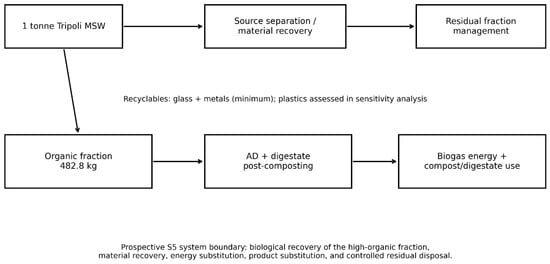
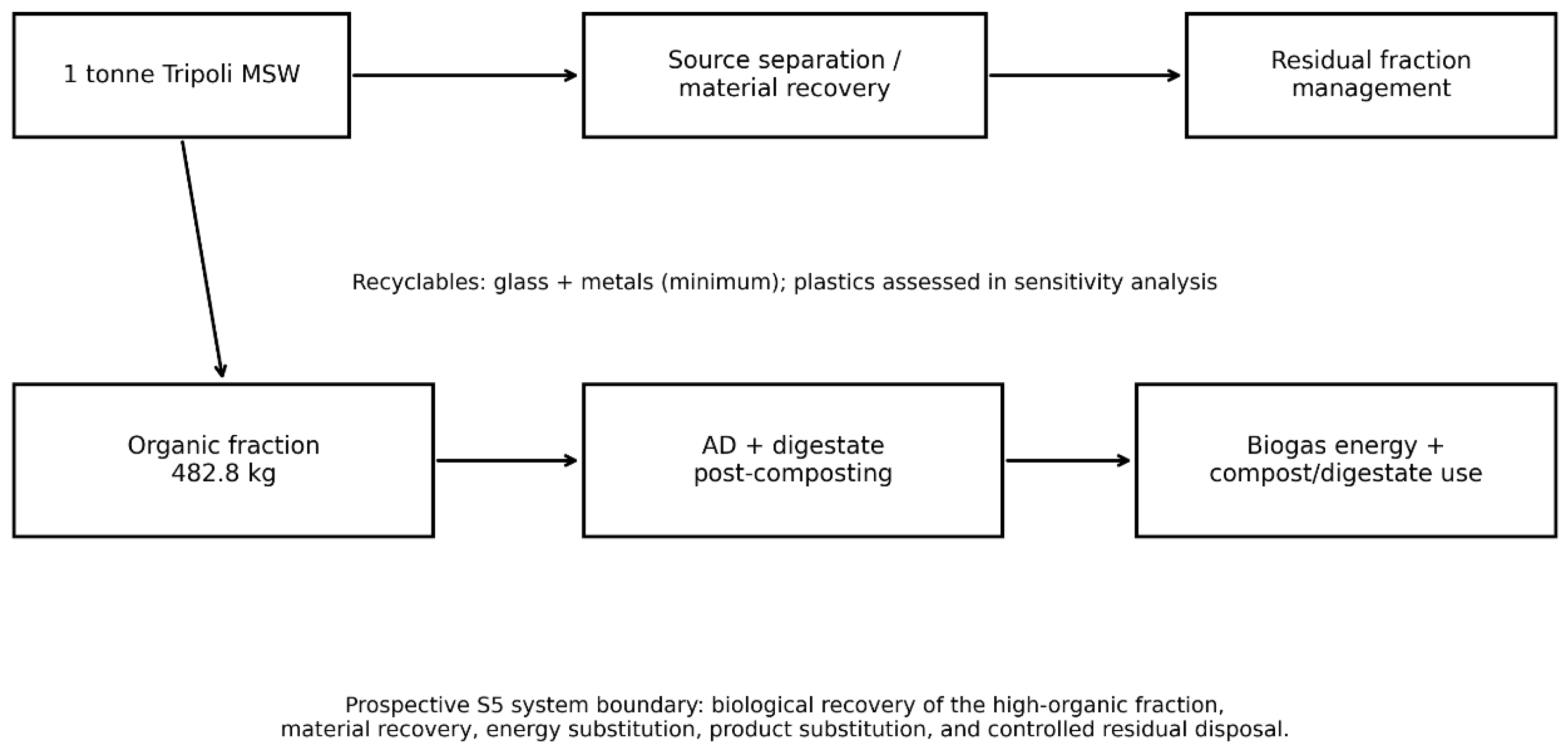
Controlled landfilling is represented by S3, in which the mixed waste is disposed of using the landfill process of the SimaPro model. Finally, S5 combines material recovery with biological treatment of the organic fraction. It is described in Section 2.7 and Figure 1; it was not simulated in SimaPro and is therefore not assigned any numerical result.
Figure 1.
Proposed system boundary for prospective Scenario S5 (integrated biological resource recovery).
2.4. Life Cycle Inventory
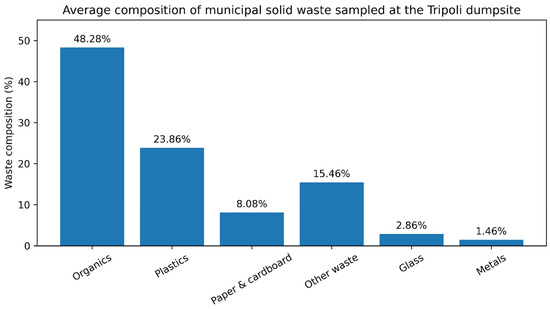
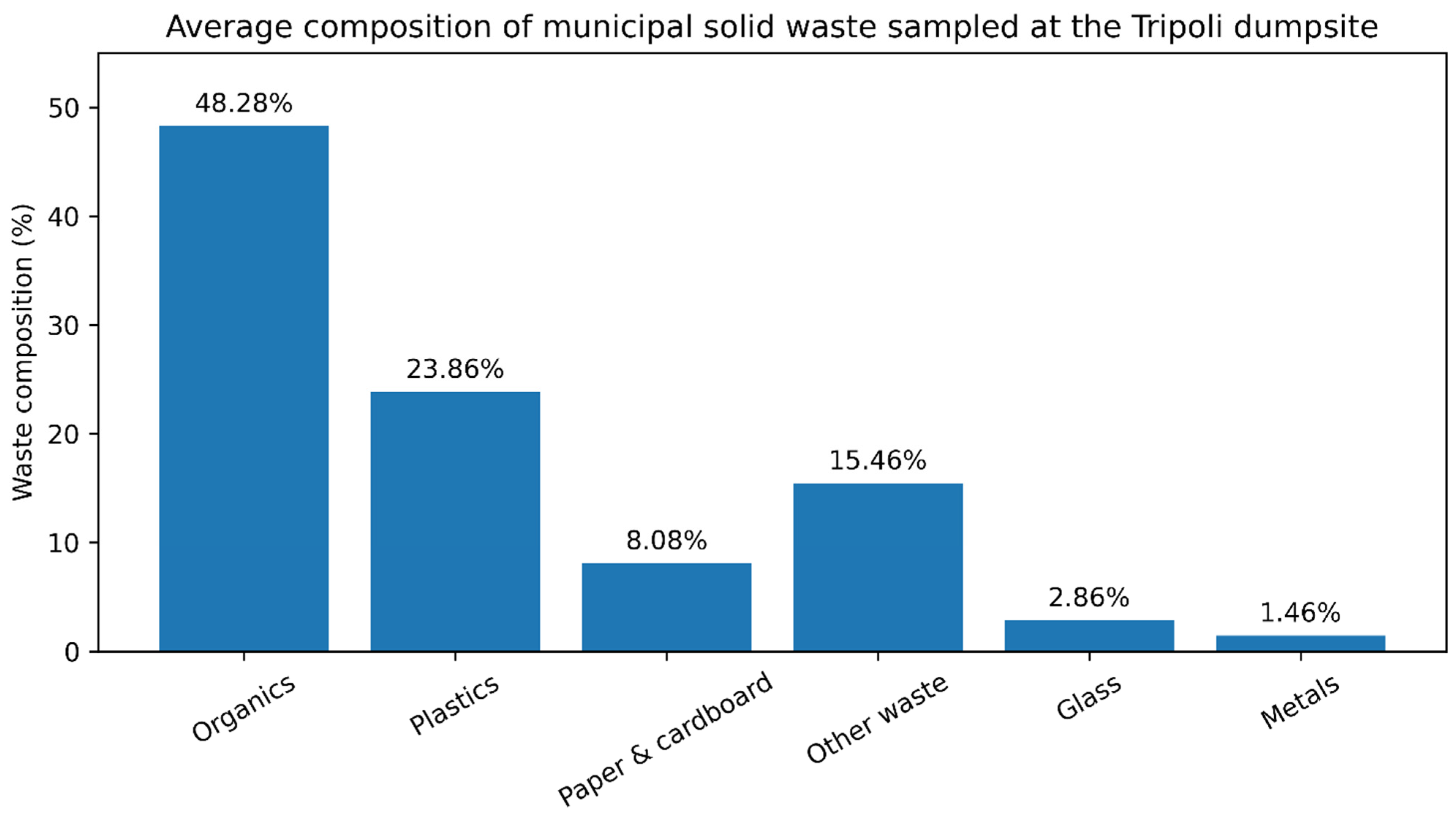
Primary foreground data comprised locally measured waste composition and site information obtained from Al-Fayhaa municipality and on-site reports. The composition basis is 48.28% organics (482.8 kg t−1), 23.86% plastics (238.6 kg t−1), 8.08% paper/cardboard (80.8 kg t−1), 15.46% other waste (154.6 kg t−1), 2.86% glass (28.6 kg t−1), and 1.46% metals (14.6 kg t−1), as shown in Figure 2. The exact background LCI database/version, some unit-process identifiers, detailed landfill methane-management assumptions, detailed energy-recovery/substitution assumptions for the thermal routes, and complete sensitivity ranges were not fully available for the present analysis. These elements are therefore not reconstructed or inferred and are treated as reproducibility and interpretation limitations, particularly for close scenario rankings.
Figure 2.
Average physical composition (% by mass) of municipal solid waste sampled at the Tripoli dumpsite, grouped into six main categories: organic waste (48.28%), plastics (23.86%), other waste (15.46%), paper and cardboard (8.08%), glass (2.86%), and metals (1.46%). “Other waste” includes bulky waste, diapers, textiles, Tetra Pak, construction and demolition material, WEEE, medical waste, leather, wood, and other special waste streams. The full breakdown is given in Table 2.
MSW sampling and physical composition analysis were carried out at the Tripoli dumpsite. The average composition was 48.28% organic waste, 23.86% plastic, 8.08% paper/cardboard, 15.46% other waste, 2.86% glass, and 1.46% metals. The full breakdown by waste fraction, including bulky waste, is presented in Table 2. The composition is used consistently as the foreground waste basis for all modeled scenarios.
2.5. Life Cycle Impact Assessment
The LCIA method used in the model was IMPACT 2002+, which links inventory flows to fifteen midpoint categories and four damage categories: human health, ecosystem quality, climate change, and resources. IMPACT 2002+ is retained to preserve comparability with the original SimaPro outputs. Interpretation in this manuscript considers midpoint indicators, damage-category results, and aggregated single scores jointly. Because single-score results incorporate normalization and weighting, they are used as a synthesis of model outputs rather than as the sole basis for technology selection.
2.6. Interpretation
Interpretation focused on comparative scenario performance across midpoint, damage-category, and single-score results. Unless otherwise stated, percentages reported as ‘normalized’ in Section 3 refer to scenario values expressed relative to the highest value within the relevant comparison (set to 100%); they should not be confused with the internal normalization factors used by IMPACT 2002+. Sensitivity analysis was considered in the original model development; however, complete numerical records of the parameter ranges and resulting changes in scenario rankings were not available for the present analysis. Therefore, quantitative sensitivity results are not reported. Key parameters recommended for sensitivity testing in future model refinement include landfill-gas generation and capture, energy-recovery credits, recycling rates, organic-waste diversion, electricity demand, and product-substitution credits, as these assumptions can materially influence MSW-LCA results and scenario rankings.
2.7. Proposed Model Extension: Integrated Biological Resource-Recovery Scenario
S5 is presented as a prospective model extension and was not included in the SimaPro simulations (Figure 1). Accordingly, no numerical LCIA, damage-category, or single-score result is assigned to S5 in the present study. Its purpose is to define a biologically based resource-recovery pathway for subsequent modeling under harmonized inventory data, system boundaries, allocation/substitution rules, and LCIA settings. S5 is therefore not proposed as the optimal option for Tripoli; it is presented as a candidate pathway whose performance relative to S0–S4 remains to be quantified.
S5 was not included in the numerical comparison. A result for S5 that is directly comparable with S0–S4 would require the same background database, allocation and substitution rules, and energy-credit assumptions as the modeled scenarios, which were not fully available for the present analysis (Section 2.4). S5 is nevertheless included because organics account for 48.28% of Tripoli’s MSW, while none of the modeled scenarios includes biological treatment of this fraction.
To address the high organic fraction of Tripoli’s MSW, a prospective sixth scenario (S5) was developed as a SimaPro-ready modeling protocol comprising source separation and material recovery; biological treatment of the 482.8 kg organic fraction per functional unit through anaerobic digestion followed by digestate post-composting; recovery of biogas for useful energy; beneficial use of quality-compliant compost/digestate as a substitute for conventional soil amendments; and controlled treatment/disposal of residuals. Glass and metals are recovered at minimum, while plastic recovery is proposed as a sensitivity parameter because plastics represent 23.86% of the local waste stream. This configuration is consistent with the recent integrated MSW and biowaste LCA literature [6,7,8,15,16]. Recent case studies further report that anaerobic digestion achieved considerably greater environmental savings than centralized composting [17], and full-scale composting and anaerobic digestion plants treating the organic fraction of MSW have been compared in a developing-country context [18]. A numerical IMPACT 2002+ result for S5 would require implementation of a complete inventory using the same harmonized LCI database, system boundaries, allocation rules, and LCIA settings applied to the comparative scenarios. S5 is therefore presented as a prospective, literature-supported extension rather than as an observed LCIA result.
3. Results and Discussion
Results are presented thematically, beginning with the overall comparative performance of the five modeled scenarios, followed by category-specific analyses of climate change, human health and toxicity, resource depletion and ecosystem quality, the effect of recycling, and the contribution of individual waste fractions. Supporting figures and tables that provide additional scenario-level detail are presented in the Supplementary Materials.
3.1. Overall Environmental Performance of the Five Scenarios
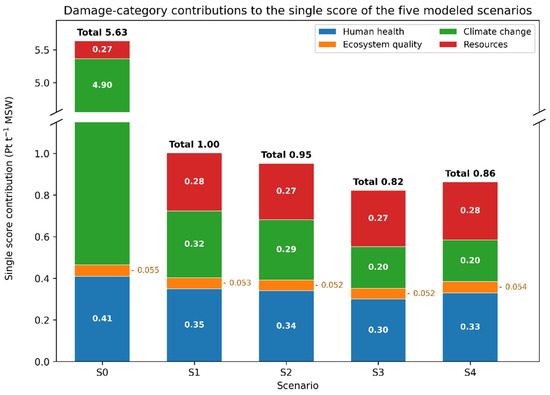
The aggregated single-score results provide a useful overview of the five scenarios when interpreted together with the midpoint and damage-category indicators (Table 3, Figure 3). Open dumping (S0) produced by far the highest aggregated impact, at 5.63 Pt t−1 MSW, substantially exceeding all controlled alternatives and identifying uncontrolled disposal as the least favorable option in the model. Incineration without upstream material recovery (S1) and glass/metal recovery followed by incineration (S2) yielded totals of 1.00 and 0.95 Pt t−1 MSW, respectively (Supplementary Tables S1 and S2). Landfilling (S3) and pyrolysis-gasification (S4) were the two lowest-scoring scenarios in the model, at 0.82 and 0.86 Pt t−1 MSW, respectively. The difference between S3 and S4 is only 0.04 Pt t−1 MSW (approximately 4.9% relative to S3) and should not be interpreted as a robust technology ranking because complete sensitivity information and several key background assumptions could not be recovered.
Table 3.
IMPACT 2002+ damage-category and aggregated single-score results for the five archived scenarios, reported per tonne of MSW.
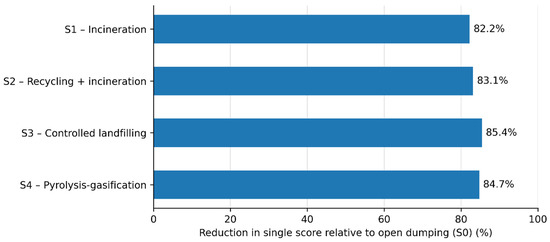
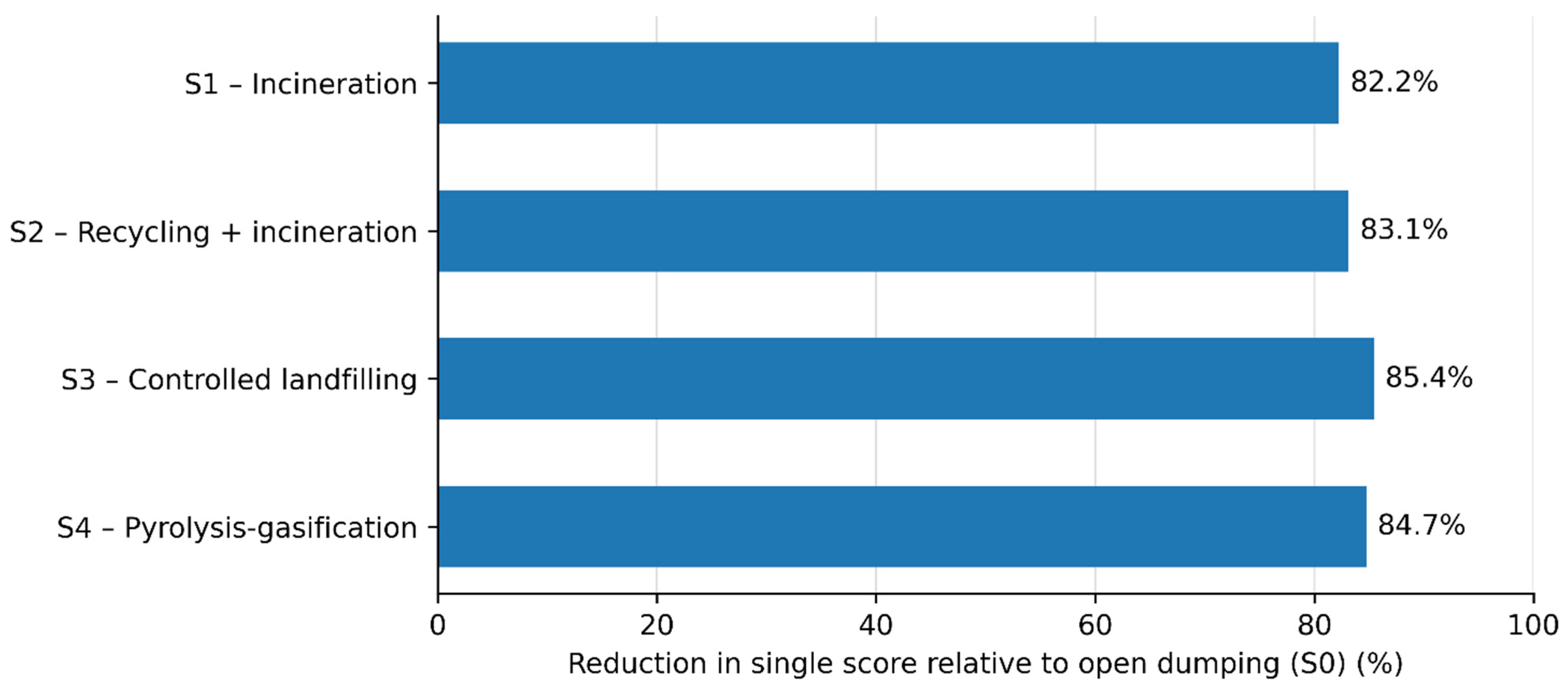
Figure 3.
Reduction in the aggregated single score (IMPACT 2002+) of scenarios S1–S4 relative to open dumping (S0), calculated from the single-score values in Table 3 as (S0 − Sx)/S0 × 100. All controlled scenarios reduce the single score by more than 80% compared with open dumping.
The disadvantage of uncontrolled dumping is consistent with recent LCA evidence showing that unmanaged or disposal-dominated systems can generally be improved by introducing controlled treatment, material recovery, biological treatment, and/or useful energy recovery [1,9,10,11]. By contrast, the exact ranking among controlled alternatives is highly sensitive to local waste composition and to assumptions regarding methane generation and capture, energy substitution, recycling credits, treatment efficiency, and residual management.
This overall pattern is supported by the midpoint and damage-category results shown in Figure 4. S0 was the highest-impact scenario in many of the comparisons, particularly for the climate-related damage score. The relative percentages shown in these comparisons are normalized to the maximum scenario value within each indicator; they are not direct ratios of midpoint quantities reported in different physical units.
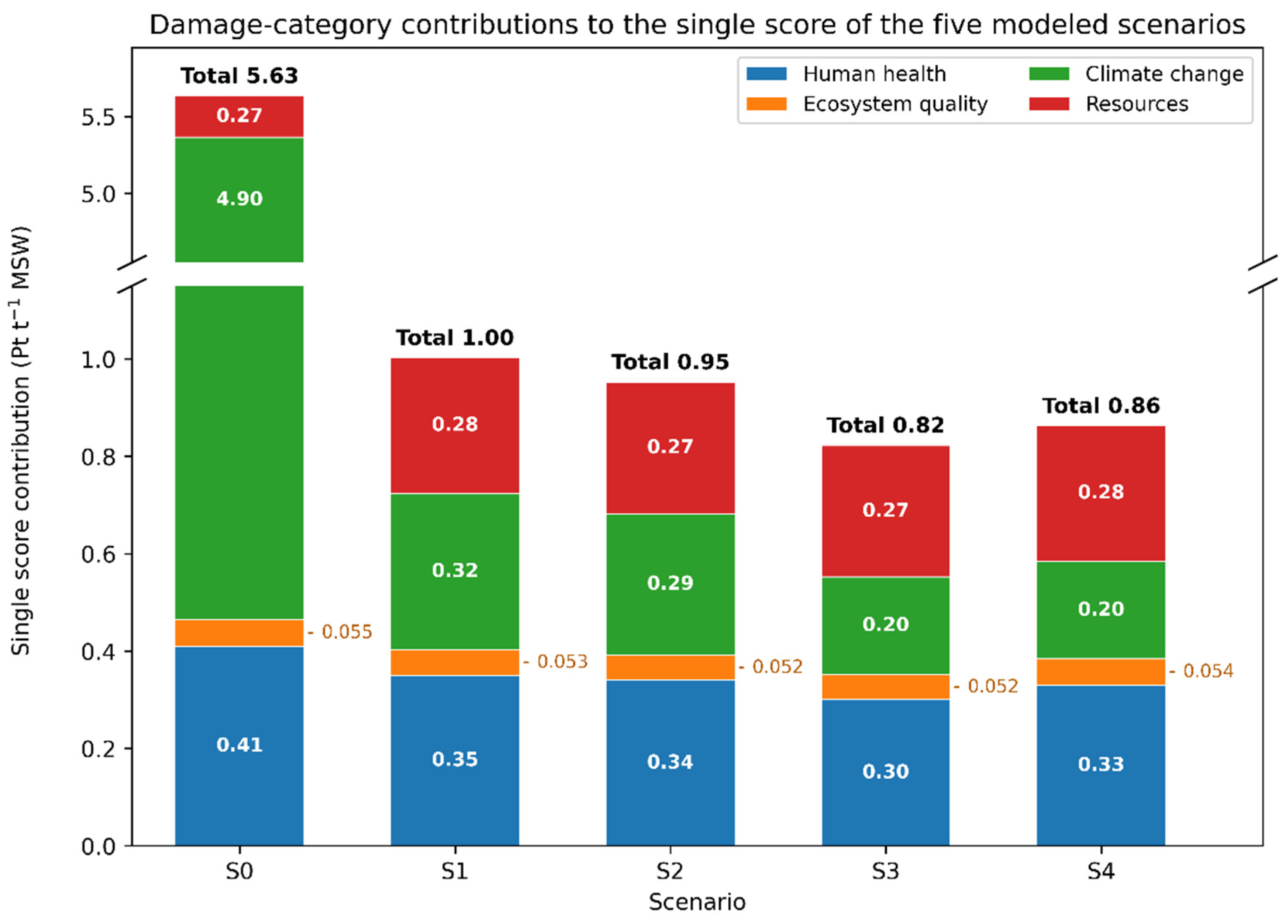
Figure 4.
IMPACT 2002+ damage-category contributions for the five modeled scenarios. Data labels show the contribution of each damage category and the total single score (Pt t−1 MSW); the y-axis is interrupted between 1.15 and 4.55 Pt t−1 MSW to allow the smaller contributions to be displayed.
3.2. Climate Change and Global Warming
Climate change was among the most differentiated impact categories across the scenarios. Open dumping (S0) generated a midpoint climate-change burden of 485.1 kg CO2 eq t−1 MSW (Table 4). Incineration without recycling (S1) generated 128.33 kg CO2 eq t−1 MSW, corresponding to approximately 26.5% of the S0 midpoint value, or a 73.5% reduction relative to S0. This corrected value confirms that S1 performs substantially better than open dumping for the midpoint climate-change indicator in the model. The climate-related values reported elsewhere in mPt or as normalized percentages represent damage-category or relative comparison outputs and should not be directly equated with the midpoint values expressed in kg CO2 eq. Recycling of glass and metals before incineration (S2), landfilling (S3), and pyrolysis-gasification (S4) also showed lower climate-related damage-category contributions than S0 in the model outputs; however, comparison across indicators must retain the original units and aggregation level.
Table 4.
Damage-category results for Scenario 0 (S0), converted to a 1-tonne MSW functional unit.
The comparatively favorable climate performance of S3 within the model should be interpreted cautiously. Recent studies frequently report poorer landfill climate performance when methane generation, oxidation, capture, flaring, and energy recovery are modeled explicitly, whereas AD, composting, recycling, and energy-recovery systems can perform substantially better depending on substitution assumptions [6,9,19]. A detailed landfill LCA also showed that the longevity of landfill-gas collection is the main contributor to landfill climate-change impacts [20]. Because detailed landfill methane-management assumptions were not fully available for the present analysis, the result should be interpreted within the boundaries and inventory assumptions of the SimaPro model rather than as evidence of a universal climate advantage of landfilling.
Across the damage-category and midpoint comparisons, S0 remained a dominant contributor to several impact categories. For climate-related comparisons, care is required to distinguish physical midpoint results (kg CO2 eq t−1 MSW) from IMPACT 2002+ damage scores (mPt or Pt) and from values normalized relative to the maximum scenario. Respiratory organics, terrestrial acidity, and aquatic acidification also showed substantial contributions from S0, while the controlled scenarios displayed different relative patterns depending on the indicator. These results therefore support scenario-level comparison only when the same indicator, unit, and aggregation level are used.
3.3. Human Health and Toxicity-Related Impacts
Among the fifteen midpoint categories evaluated for the baseline scenario, aquatic ecotoxicity showed the largest reported value, at 154,410 kg TEG water t−1 MSW, followed by terrestrial ecotoxicity at 43,980 kg TEG soil t−1 MSW (Table 5). The model attributes these impacts largely to contaminant releases associated with unmanaged disposal. Ionizing radiation (34,560 Bq C-14 eq t−1 MSW) and respiratory effects were smaller contributors within the S0 midpoint profile. This pattern is broadly consistent with previous MSW-LCA studies identifying uncontrolled disposal and landfilling as important contributors to toxicity-related impacts when leachate and metal releases are represented [21]. Because the underlying unit-process records are incomplete, specific causal attribution to individual metals should be interpreted cautiously unless directly supported by the available inventory.
Table 5.
Midpoint impact-category results for Scenario 0 (S0), converted to a 1-tonne MSW functional unit.
In the incineration-related analyses, polyethylene emerged as an important contributor to human-health damage scores. Under the non-recycled incineration sub-model, polyethylene contributed 7 mPt t−1 MSW to human health (Supplementary Figure S1); this value declined to 4 mPt t−1 MSW in the corresponding recycling sensitivity comparison (Supplementary Figure S4). In S2, recovery of aluminum produced a substantial avoided human-health impact, contributing to a net human-health credit of −9.51 mPt t−1 MSW from the recycling process itself (Supplementary Table S2, Figure S5). This finding is consistent with earlier studies reporting substantial avoided burdens from aluminum recycling because of displaced primary production [21,22]. Pyrolysis-gasification (S4) exhibited a human-health damage score of 330 mPt t−1 MSW in the model output (Supplementary Figure S11). These damage-score values should be interpreted within the IMPACT 2002+ weighting framework and should not be compared numerically with midpoint indicators expressed in physical units.
The comparative damage-category results (Figure 4) identify S0 as the maximum human-health contributor in the normalized comparison (100%), followed by S1 (83%), S2 (81%), S4 (80%), and S3 (72%). These percentages express each scenario relative to the maximum value for that damage-category comparison; they are not absolute probabilities or shares of total human-health burden. Carcinogen and ionizing-radiation indicators showed a different relative pattern, illustrating the importance of evaluating category-specific results rather than relying only on a single aggregated ranking.
3.4. Resource Depletion and Ecosystem Quality
Resource depletion under S0 was reported at 40,550 MJ t−1 MSW overall (Table 4), driven primarily by non-renewable energy use (40,360 MJ t−1 MSW), with a smaller contribution from mineral extraction (190 MJ surplus t−1 MSW) (Table 5). S2 produced a net resource damage-category benefit of −8.80 mPt t−1 MSW (Supplementary Table S2), reflecting avoided virgin-material extraction through glass and metal recycling. This interpretation is consistent with previous studies showing that material recovery can provide substantial resource-depletion benefits through displacement of primary production [21,22,23]. Because midpoint and damage-category indicators use different units, their magnitudes are discussed separately rather than compared directly.
Within the damage-category outputs, S3 showed comparatively low resource and ecosystem-quality scores, at 2.25 mPt t−1 MSW and 0.7 mPt t−1 MSW, respectively (Supplementary Figure S9), while S4 showed a resource score of 280 mPt t−1 MSW (Supplementary Figure S11). The relative mineral-extraction comparison again indicated a benefit for S2 associated with recycling. These results are model-specific and depend on the underlying inventory and substitution assumptions, particularly the treatment of recovered materials and energy.
3.5. Effect of Recycling on Environmental Performance
Two comparisons are used to illustrate the environmental effect of recycling. The first is a supplementary sensitivity/sub-model comparison of incineration without and with upstream recycling; it is not an additional formal scenario and is therefore referred to here as the ‘incineration recycling sensitivity comparison’ rather than as ‘S1 recycled’. The second is the formal scenario comparison between S1 (incineration without prior glass/metal recovery) and S2 (glass/metal recovery followed by incineration of the residual waste). This terminology avoids confusion between the five primary scenarios and the supplementary recycling analysis.
In the incineration recycling sensitivity comparison, polyethylene was the dominant contributor across several damage-category outputs, including climate change (65 mPt t−1 MSW) and human health (7 mPt t−1 MSW) in the non-recycled sub-model (Supplementary Figures S1 and S2). A network analysis using a 1% cut-off identified polyethylene as the largest single contributor, accounting for 43.9% of the total network result. With recycling included, the polyethylene contributions declined to 60 mPt t−1 MSW for climate change and 4 mPt t−1 MSW for human health (Supplementary Figures S3 and S4). In the corresponding relative comparison, the normalized global-warming indicator decreased from 100% to 75% and the non-carcinogen indicator from 100% to 68%. These relative values refer to the recycling sensitivity comparison and should not be interpreted as the formal S1-versus-S2 scenario ranking. Small increases in carcinogen and terrestrial-ecotoxicity indicators suggest that recycling processes can also introduce burdens associated with collection, sorting, and reprocessing, partially offsetting avoided impacts in specific categories.
The formal comparison between S2 (glass and metal recovery followed by incineration) and S1 (incineration without this recovery step) shows a similar but more targeted benefit. Network analysis of S2 (Supplementary Figure S6) indicated avoided impacts associated with aluminum, glass, and iron/steel recycling, while polyethylene remained a dominant burden. The aggregated single score for S2 (0.95 Pt t−1 MSW) was only modestly lower than that of S1 (1.00 Pt t−1 MSW) (Table 3). Within the model, recovery limited to glass and metals therefore improves performance but does not substantially alter the overall environmental profile of an incineration-based system when most plastics and organics remain in the residual waste stream.
Recent integrated-system studies support this interpretation: recycling generally provides important avoided-burden benefits, but the largest improvements often arise when material recovery is combined with treatment of the biodegradable fraction and, where appropriate, energy recovery [7,8,9].
3.6. Contribution of Individual Waste Fractions
A recurring finding across the treatment-based modeled scenarios was the disproportionate contribution of polyethylene (plastic film) to several impact results, consistent with its substantial share of the local waste composition. In thermal treatment systems, plastics can contribute significantly to fossil CO2 emissions and to other air-pollutant-related burdens, depending on combustion conditions and emission-control assumptions [24,25]. In the network analyses, polyethylene was the largest single contributor for S1 (43.9%) and S2 (50.9%; Supplementary Figure S6) and contributed approximately 220 mPt t−1 MSW in the S4 network output (Supplementary Figure S12). These findings reinforce the importance of source separation and plastic recovery before thermal treatment, while the exact pollutant profile should be interpreted only to the extent supported by the underlying inventory model.
The recent waste-to-energy and MSW LCA literature confirms that plastic-rich residual streams strongly influence thermal-treatment impacts and energy potential, reinforcing the importance of source separation before incineration, gasification, or pyrolysis [1,26]. Recent comparative assessments of gasification-, pyrolysis-, and incineration-based energy-from-waste configurations likewise show that their environmental and economic performance depends on the process configuration and final products [27].
In the landfilling scenario, the network analysis showed that the aggregated solid-waste process accounted for 60.1% of the total network result (Supplementary Figures S7 and S8). In the pyrolysis-gasification scenario, the solid-waste process accounted for 91.1% of the network result, with the remaining 8.94% attributed to electricity consumption during processing (Supplementary Figure S10). Taken together, the network results indicate that the residual mixed-waste composition, particularly the plastic fraction, strongly influences treatment performance. This supports evaluating enhanced source separation in future model updates, especially because plastic recovery was not comprehensively explored in the formal S2 scenario.
3.7. Synthesis and Comparative Interpretation
Across the five modeled scenarios, open dumping was found to be the least favorable option in the model. Landfilling has the lowest aggregated single score (0.82 Pt t−1 MSW), while pyrolysis-gasification is close (0.86 Pt t−1 MSW). The absolute difference is only 0.04 Pt t−1 MSW (approximately 4.9% relative to S3). Because complete parameter ranges and scenario-rank uncertainty could not be recovered, this difference cannot be considered robust. S3 and S4 should therefore be interpreted as a comparably low-scoring group within the model rather than as evidence of a definitive technology hierarchy. Incomplete landfill methane assumptions and inconsistent treatment of avoided-energy credits further limit generalization.
Taken together, the results indicate that uncontrolled dumping generates by far the greatest aggregated environmental burden in the model and is unsuitable as a long-term management option for Tripoli. The numerical advantage of S3 over S4 is too small to support a general conclusion that landfilling is environmentally superior to pyrolysis-gasification or other controlled treatment technologies. Technology selection should instead be based on a harmonized model that consistently represents methane generation and capture, emissions, energy and material recovery credits, residual management, land requirements, and local operating conditions.
The divergence between the Tripoli ranking and recent integrated-system studies is scientifically important. Recent evidence increasingly supports evaluating systems that divert organics from disposal through composting and/or AD, combine biological treatment with material recovery, and explicitly account for useful energy and product substitution [6,7,8,9]. The literature suggests that an S5-type configuration may improve climate and resource-recovery performance relative to untreated organic-waste disposal; however, its direction and magnitude of benefit, IMPACT 2002+ score, and rank cannot be established for Tripoli without a new harmonized SimaPro run.
Economic aspects, including the investment and operating costs of the alternative management options and their environmental return over time, were outside the scope of this environmental LCA. Integrating life-cycle costing or an environmental return-on-investment analysis with the harmonized model is recommended for future work, as illustrated by previous Lebanese studies that linked LCA results with economic considerations [3,27,28].
From a practical perspective, these results should be read against the actual waste-management situation in Tripoli. The uncontrolled dumpsite was closed in February 2019, and a sanitary landfill was subsequently constructed nearby (Section 1); the transition away from open dumping (S0) towards a controlled-disposal configuration comparable to S3 has therefore already begun, and the present results support this shift. The historical experience of the BATCO sorting facility, whose role diminished over time while large volumes of potentially recyclable material were discarded at the dumpsite (Section 1), shows that the availability of sorting infrastructure alone does not guarantee effective material recovery. Likewise, the feasibility of an S5-type system would depend on operational conditions that lie outside the scope of an environmental LCA, including source-separation practices, which remain limited in Lebanon; the reliable operation of treatment facilities; outlets for recovered energy and compost/digestate; and institutional and financial capacity. These practical factors should therefore be assessed together with a harmonized quantitative model of S5 before a long-term technology portfolio is selected for Tripoli.
4. Conclusions
This study compared five modeled MSW-management scenarios for Tripoli using a waste-management LCA with a functional unit of 1 tonne of incoming MSW and the IMPACT 2002+ method. Open dumping was by far the most environmentally damaging option in the model. Among the controlled alternatives, S3 had the lowest aggregated single score and S4 was close behind; however, their small numerical difference cannot be considered robust without complete uncertainty and sensitivity information. Interpretation is particularly constrained by incompletely documented landfill methane-management assumptions and inconsistent energy-recovery credits across thermal scenarios. For the climate-change midpoint indicator, the corrected S1 result is 128.33 kg CO2 eq t−1 MSW compared with 485.1 kg CO2 eq t−1 MSW for S0, corresponding to an approximately 73.5% reduction for S1 relative to open dumping. The recent literature indicates that integrated systems combining source separation, recycling, biological treatment of organics, and useful recovery of energy and nutrients can materially alter scenario performance. Because 48.28% of Tripoli’s waste is organic, the proposed S5, material recovery plus anaerobic digestion and digestate post-composting, should be prioritized for a new, harmonized model run. Until that analysis is completed, S5 remains a prospective, literature-supported extension, and no numerical IMPACT 2002+ score is claimed. Beyond its numerical results, this study provides the first locally based LCA evidence for Tripoli’s MSW system, documents the model assumptions that constrain the ranking of controlled options, and defines a harmonized modeling protocol for biological treatment of the organic fraction. The most robust policy conclusion is therefore to phase out uncontrolled dumping, strengthen source separation and plastics recovery, and quantitatively evaluate biological treatment of the organic fraction before selecting a long-term technology portfolio.
Supplementary Materials
The following supporting information can be downloaded at: https://www.mdpi.com/article/10.3390/environments13100553/s1, Supplementary Tables S1 and S2 and Figures S1–S12 are provided in the accompanying supplementary file. Supplementary Tables S1 and S2 present the damage-category results and single-score contributions for the assessed municipal solid waste management scenarios. Supplementary Figures S1–S12 provide the corresponding SimaPro outputs, including characterization, weighting, single-score, and process-network results for the evaluated scenarios.
Author Contributions
Conceptualization, Y.J.; methodology, Y.J.; software, Y.J. and A.N.; validation, Y.J. and A.N.; formal analysis, Y.J. and A.N.; investigation, Y.J.; data curation, Y.J.; writing—original draft preparation, Y.J.; writing—review and editing, Y.J. and A.N.; supervision, Y.J.; project administration, Y.J. All authors have read and agreed to the published version of the manuscript.
Funding
This research received no external funding.
Data Availability Statement
The study is based on SimaPro outputs, local waste-characterization data, and supporting files retained by the authors. Additional underlying files may be made available by the corresponding author, subject to the availability and completeness of the available records.
Conflicts of Interest
The authors declare no conflicts of interest.
References
- Nurzhan, A.; Ruan, X.; Chen, D. A review of life cycle assessment application in municipal waste management: Recent advances, limitations, and solutions. Sustainability 2025, 17, 302. [Google Scholar] [CrossRef] [Scilit]
- Ceraso, A.; Cesaro, A. Life cycle sustainability assessment of municipal solid waste management systems: A review. J. Environ. Manag. 2024, 368, 122143. [Google Scholar] [CrossRef] [Scilit] [PubMed]
- Maalouf, A.; El-Fadel, M. Life cycle assessment for solid waste management in Lebanon: Economic implications of carbon credit. Waste Manag. Res. 2019, 37, 14–26. [Google Scholar] [CrossRef] [Scilit] [PubMed]
- UN-Habitat. Tripoli City Profile. Available online: https://reliefweb.int/report/lebanon/tripoli-city-profile-2016 (accessed on 4 September 2026).
- Ecocentra. What’s Happening in Tripoli’s Dumpsite? Available online: https://ecocentra.wordpress.com/2017/12/06/whats-happening-at-tripolis-dumpsite/ (accessed on 4 September 2026).
- Serafini, L.F.; Praça, P.J.G.M.; González-Andrés, F.; Gonçalves, A. Life cycle approach as a tool for assessing municipal biowaste treatment units: A systematic review. Waste Manag. Res. 2025, 43, 1509–1524. [Google Scholar] [CrossRef] [Scilit] [PubMed]
- Shrestha, P.P.; Ghimire, A.; Dangi, M.B.; Urynowicz, M.A. Development of a municipal solid waste management life cycle assessment tool for Banepa Municipality, Nepal. Sustainability 2023, 15, 9954. [Google Scholar] [CrossRef] [Scilit]
- Ouedraogo, A.S.; Kumar, A.; Frazier, R.; Sallam, K.A. Comparative life cycle assessment of landfilling with sustainable waste management methods for municipal solid wastes. Environments 2024, 11, 248. [Google Scholar] [CrossRef] [Scilit]
- Joarder, S.M.; Mamtaz, R. Assessment of environmental sustainability of solid waste management system of Dhaka city through life cycle analysis. Sci. Rep. 2025, 15, 36560. [Google Scholar] [CrossRef] [Scilit] [PubMed]
- Cheniti, H.; Kerboua, K.; Sekiou, O.; Aouissi, H.A.; Benselhoub, A.; Mansouri, R.; Zeriri, I.; Barbari, K.; Blazevska Gilev, J.; Bouslama, Z. Life Cycle Assessment of Municipal Solid Waste Management within Open Dumping and Landfilling Contexts: A Strategic Analysis and Planning Responses Applicable to Algeria. Sustainability 2024, 16, 6930. [Google Scholar] [CrossRef] [Scilit]
- Bandaranayaka, D.T.; Wei, Y.; de Alwis, A.; Danthurebandara, M.; Herath, G.; Gajanayake, P. Scenario-Based Life Cycle Assessment of Municipal Waste GHG Emissions and Mitigation Potential in Sri Lanka. Environments 2026, 13, 130. [Google Scholar] [CrossRef] [Scilit]
- ISO 14040:2006; Environmental Management—Life Cycle Assessment—Principles and Framework. International Organization for Standardization: Geneva, Switzerland, 2006.
- ISO 14044:2006; Environmental Management—Life Cycle Assessment—Requirements and Guidelines. International Organization for Standardization: Geneva, Switzerland, 2006.
- Jolliet, O.; Margni, M.; Charles, R.; Humbert, S.; Payet, J.; Rebitzer, G.; Rosenbaum, R. IMPACT 2002+: A new life cycle impact assessment methodology. Int. J. Life Cycle Assess. 2003, 8, 324–330. [Google Scholar] [CrossRef] [Scilit]
- Peng, H.; Mu, L.; Song, Y.; Su, H.; Cheng, Z.; Li, R.; Chen, G. Life cycle assessment of the integrating system of anaerobic digestion and aerobic composting for treating rural organic solid waste. Environ. Technol. Innov. 2025, 40, 104487. [Google Scholar] [CrossRef] [Scilit]
- Ashraf, A.I.; Mohareb, E.; Vahdati, M. Environmental life cycle assessments of decentralized municipal solid waste management: A novel waste-to-compost approach. Discov. Sustain. 2025, 6, 138. [Google Scholar] [CrossRef] [Scilit]
- Ramalho, J.C.M.; Calmon, J.L.; Colvero, D.A.; Vieira, D.; Bravo, A. Life cycle assessment of municipal solid waste management strategies for midsized metropolitan areas in developing countries. J. Mater. Cycles Waste Manag. 2025, 27, 638–653. [Google Scholar] [CrossRef] [Scilit]
- Weligama Thuppahige, R.T.; Babel, S. Assessment of the environmental sustainability of municipal solid waste valorization by anaerobic digestion and by composting in Sri Lanka. Environ. Technol. 2026, 47, 1088–1101. [Google Scholar] [CrossRef] [Scilit] [PubMed]
- Çetinkaya, A.; Bilgili, L. Life cycle assessment of energy production from municipal solid waste: İstanbul case. Environ. Res. Technol. 2024, 7, 537–546. [Google Scholar] [CrossRef] [Scilit]
- Wang, Y.; Levis, J.W.; Barlaz, M.A. Life-Cycle Assessment of a Regulatory Compliant U.S. Municipal Solid Waste Landfill. Environ. Sci. Technol. 2021, 55, 13583–13592. [Google Scholar] [CrossRef] [Scilit] [PubMed]
- Yay, A.S.E. Application of life cycle assessment (LCA) for municipal solid waste management: A case study of Sakarya. J. Clean. Prod. 2015, 94, 284–293. [Google Scholar] [CrossRef] [Scilit]
- Banar, M.; Cokaygil, Z.; Ozkan, A. Life cycle assessment of solid waste management options for Eskisehir, Turkey. Waste Manag. 2009, 29, 54–62. [Google Scholar] [CrossRef] [Scilit] [PubMed]
- Paes, M.X.; Gianelli, B.F.; Kulay, L.A.; de Medeiros, G.A. Life cycle assessment applied to municipal solid waste management: A case study. Environ. Nat. Resour. Res. 2014, 4, 169–177. [Google Scholar] [CrossRef] [Scilit]
- Ashworth, D.C.; Elliott, P.; Toledano, M.B. Waste incineration and adverse birth and neonatal outcomes: A systematic review. Environ. Int. 2014, 69, 120–132. [Google Scholar] [CrossRef] [Scilit] [PubMed]
- Verma, R.; Vinoda, K.S.; Papireddy, M.; Gowda, A.N.S. Toxic pollutants from plastic waste—A review. Procedia Environ. Sci. 2016, 35, 701–708. [Google Scholar] [CrossRef] [Scilit]
- Chicaiza-Ortiz, C.; Peñafiel-Arcos, P.; Herrera-Feijoo, R.J.; Ma, W.; Logroño, W.; Tian, H.; Yuan, W. Waste-to-energy technologies for municipal solid waste management: Bibliometric review, life cycle assessment, and energy potential case study. J. Clean. Prod. 2024, 480, 143993. [Google Scholar] [CrossRef] [Scilit]
- Park, M.-J.; Yun, S.; Jeong, D.-W.; Won, W. Upcycling municipal solid waste: Scenario-based techno-economic evaluation and life cycle assessment. Energy 2025, 329, 136786. [Google Scholar] [CrossRef] [Scilit]
- Rehan, M.; Shahzad, K.; Ali, N.; Nizami, A.-S. Municipal solid waste gasification for resilient energy systems: Advancing sustainable crisis preparedness in the wake of COVID-19. Front. Bioeng. Biotechnol. 2025, 13, 1691738. [Google Scholar] [CrossRef] [Scilit] [PubMed]

Disclaimer/Publisher’s Note: The statements, opinions and data contained in all publications are solely those of the individual author(s) and contributor(s) and not of MDPI and/or the editor(s). MDPI and/or the editor(s) disclaim responsibility for any injury to people or property resulting from any ideas, methods, instructions or products referred to in the content. |
© 2026 by the authors. Licensee MDPI, Basel, Switzerland. This article is an open access article distributed under the terms and conditions of the Creative Commons Attribution (CC BY) license.