


Abstract
Mercury pollution in aquatic systems across the United States is a major environmental health concern for both humans and wildlife. Mercury exposure causes neurological, cardiovascular, and kidney damage. Exposure can negatively impact brain development in children or during pregnancy. Early reports indicate that mercury contamination in fish species is problematic for the lakes of northern Mississippi. The level of mercury contamination in fish in central Mississippi lakes and their threat to public health are unknown. In this study, we assessed the mercury levels of major fish species from a central Mississippi lake, Calling Panther Lake, to determine their consumption hazards for both humans and piscivorous wildlife. Largemouth bass (Micropterus salmoides), black crappie (Pomoxis nigromaculatus), and channel catfish (Ictalurus punctatus) had mercury levels exceeding the 0.2 mg/kg WHO permissible limit, indicating mercury consumption risks for adults consuming an 8.0 oz serving size. All fish were within safe EPA limits for a 4.0 oz serving, except the black crappie. Health hazard assessments indicated mercury health risks for children. The meta-analysis of major freshwater game fish determined that mercury problems were consistent across the southeastern United States, creating consumption hazards for both piscivorous birds and piscivorous animals. All major freshwater game fish species had levels above the safe limits for wildlife consumption, suggesting mercury hazards for piscivorous wildlife in the southeast, with largemouth bass being a primary concern. Overall, our results found mercury concerns at Calling Panther Lake, Mississippi, for both humans and piscivorous wildlife, warranting future studies throughout central Mississippi to determine environmental health impacts across the region. Mercury levels in major freshwater game fish across the southeastern United States are a concern for both piscivorous birds and piscivorous animals, warranting future biomagnification studies throughout the southeastern United States.
1. Introduction
Pollution in the aquatic systems across the United States is a major health concern for humans, domesticated animals, and wildlife [1,2]. Mercury is a major pollutant of human and wildlife health concern. Mercury is a powerful toxic metal that can cause neurological, cardiovascular, and kidney damage [3,4]. Exposure during pregnancy can negatively impact brain development, leading to birth defects [3,4]. Mercury pollution comes from many sources, including the burning of fossil fuels, atmospheric decomposition, mining activity, industrial processing, waste runoff, and the illegal dumping of mercury containing products such as fluorescent light bulbs and batteries [5,6]. Mercury can bioaccumulate in the food chain, particularly in fish, causing consumption risks to humans and animals [7,8]. Recent reports indicate that mercury contamination in northern Mississippi lakes are a concern for both people and wildlife [9,10,11]. Also, recent fish studies on the Mississippi River indicate further mercury concerns [8,12,13]. However, mercury levels in the fish of central Mississippi and their threat to human and wildlife health are unknown. In this study, we measured mercury concentrations and determined fish consumption hazards for both humans and piscivorous birds from central Mississippi lake, Calling Panther Lake. The levels of toxic metals, such as mercury, in Calling Panther Lake are currently unknown. Accurately measuring the level of mercury in lake water is extremely difficult due to the high level of suspended solids and the low detection limits of toxic metals in water samples [8,9,10,11,13]. Since aquatic organisms bioaccumulate toxic metals, we used fish as sentinels for surveying mercury pollution in Calling Panther Lake. Identifying fish species that bioaccumulate mercury, could potentially spawn future studies in other lakes across central Mississippi that harbor similar species of concern. Mercury contamination in fish also poses significant health hazards to piscivorous wildlife, where mercury biomagnifies up the food web [14,15]. A meta-analysis was performed to compile mercury level data in major freshwater game fish species across the southeastern United States to determine the mercury risk to piscivorous birds and piscivorous animals.
2. Methods
2.1. Survey Site Location
Calling Panther Lake is a 404-acre (163 ha) freshwater lake located in Copiah County, central Mississippi, USA, and is about 5 miles west of the city of Crystal Springs [16] (Figure 1). It has dense submerged timber and deep creek channels, and is also a popular destination for camping, boating, fishing, picnicking, hunting, and hiking. Calling Panther Lake is prized for its trophy game fish and hosts many fishing tournaments year-round [16]. Calling Panther Lake also serves as a home for many piscivorous bird species, including nesting bald eagles, America’s national bird and symbol of the United States. Map images were created in QGIS software using methods as previously described [8].
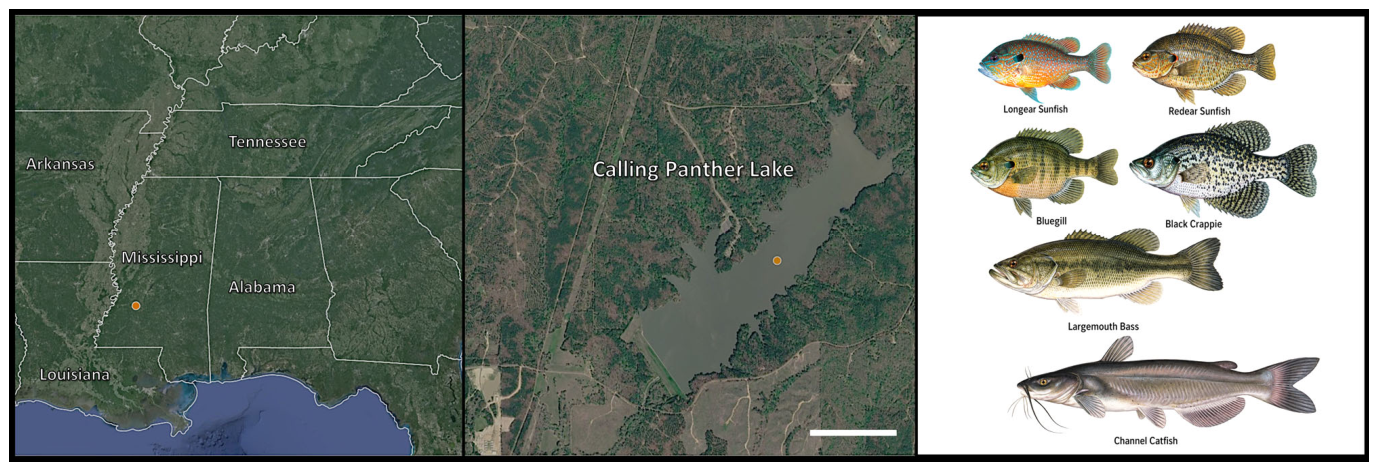
Figure 1.
The left panel displays the location of Calling Panther Lake (orange circle) within the United States of America, denoting Mississippi and its surrounding states. The middle panel shows an image of Calling Panther Lake (scale bar: 550 m, 0.342 miles). The right panel displays standard taxonomic illustrations of the game fish species collected in this study.
2.2. Sample Collection and Digestion
All major Calling Panther Lake game fish species (n = 83) were collected by professional anglers and researchers using rod and reel with a residential Mississippi Department of Fish and Wildlife fishing license during the Fall 2025 and Spring 2026 fishing seasons. Species included the longear sunfish (Lepomis megalotis), redear sunfish (Lepomis microlophus), bluegill (Lepomis macrochirus), largemouth bass (Micropterus salmoides), black crappie (Pomoxis nigromaculatus), and channel catfish (Ictalurus punctatus) (Figure 1). Fish samples were fileted using autoclaved sterilized stainless-steel instruments removing axial muscle tissues commonly consumed by humans (Figure 2). For mercury analysis, 5.0 g of fish tissue (wet weight), 0.5 g of dried soil or sediment, or 10 mL of lake water was placed in digestion tubes (Environmental Express) with lids on, predigested at room temperature overnight using 5.0 mL of concentrated nitric acid (analytical grade, Fisher Scientific, Waltham, MA, USA), and then digested for 30 min at 90 °C using a heat block (Environmental Express, Hotblock 150, Charleston, SC, USA) as previously described [8,17]. To reduce mercury loss prior to analysis, 2.0 ppm gold chloride was added in addition to the nitric acid during the digestion procedure using methods previously described [8,17,18]. After cooling, 2.5 to 5.0 mL of H2O2 (30%, analytical grade, Fisher Scientific) was added until each solution stopped reacting. The solutions were filtered using ashless filter paper (Whatman, Fisher Scientific, Waltham, MA, USA) and brought to a 30 mL volume with 5% nitric acid prior to analysis.
2.3. ICP-OES Mercury Analysis
Samples were analyzed on an ICP-OES 5800 (Agilent Technologies, Santa Clara, CA, USA) using certified standards (10 ppm Hg standard, Agilent Technologies) and certified reference materials (10 ppm Hg standard, Cole-Parmer SPEX CertiPrep, Vernon Hills, IL, USA) and subject to QA-QC analysis with laboratory control samples, method blanks, certified reference materials, continuing calibration verification every 10 samples, and matrix spikes all within a 10% error margin as outlined in EPA method 200.7 and the methods previously described [8,17,18,19]. The matrix spike recovery was 105% and the certified reference material percent error was 1.1%. The instrument limit of detection (LOD, 0.001) and limit of quantitation (LOQ,0.003) and the method detection limits (MDL, 0.015) for fish samples, (MDL, 0.010) water, (MDL, 0.018) and sediment and soils were calculated in Microsoft Excel using methods as previously described [8]. ICP-OES settings were axial mode, an RF power of 1.4 kW, a 0.8 nebulizer flow, a 15 plasma flow, a 1.5 Aux flow, with a 20 s read time, and Hg (194.164 nm) [8]. Metal concentrations in ppm (mg/kg) were calculated by taking the MEAN for each group of fish samples; graphs and tables were created in Microsoft Excel and Microsoft PowerPoint.
2.4. Human and Wildlife Health Consumption Hazard Assessments
Permissible limits for mercury contamination were cited from standards set by the U.S. Food and Drug Administration (FDA) [10], U.S. Environmental Protection Agency (EPA) [20,21,22,23], and the World Health Organization (WHO) [8,24,25,26], where total mercury is assumed to be 100% methylmercury. The human health hazard assessment was performed using methods and equations as previously describe to determine health risks associated with consuming the fish muscle tissue [8,10,13,27,28,29,30]. Consumption hazard scores for each sample, also known as margin of exposure, were calculated using the human hazard score equation, where MC was the metal concentration (mg/kg), CR was the consumption rate (kg/day, one 4.0 oz or 8.0 oz meal of fish per week), BW was the body weight in kg (70 kg adult and 18 kg child) [10], and RfD was the reference dose for mercury at 0.1 μg/kg/day. A consumption hazard score of >1.0 is considered a health risk and unsafe for human consumption. A meta-analysis, using published data, was performed to create tables of mercury levels in bluegill (Lepomis macrochirus), largemouth bass (Micropterus salmoides), black crappie (Pomoxis nigromaculatus), white crappie (Pomoxis annularis), and channel catfish (Ictalurus punctatus), as reported from the southeastern states of the United States. Inclusion criteria were based upon published data on mercury levels in major freshwater game fish muscle tissue as reported from Alabama, Arkansas, Florida, Georgia, Kentucky, Louisiana, Mississippi, North Carolina, South Carolina, and Tennessee from 1990 to 2026, which were found using search engines: Sci-Finder, PubMed, and Google Scholar. The permissible limits for mercury contamination for piscivorous birds was set at 0.15 mg/kg based on reproductive harm estimates [15,30,31,32]. Safe limits for piscivorous animals were estimated at 0.10 mg/kg, the common standard for mercury risks in animals [29]. Wildlife consumption hazards were calculated using the mean mercury level reported for each fish species across the southeastern United States, using the wildlife hazard score equation. A consumption hazard score of ≥1.0 was considered a health risk and unsafe for wildlife consumption.
Hazard Score ≥ 1.0 Indicates Health Risk
| |
3. Results
Figure 1 shows the location of Calling Panther Lake of central Mississippi within the United States of America and the fish species collected for this study: longear sunfish (Lepomis megalotis), redear sunfish (Lepomis microlophus), bluegill (lepomis macrochirus), largemouth bass (Micropterus salmoides), black crappie (Pomoxis nigromaculatus), and channel catfish (Ictalurus punctatus). Table 1 displays the length (in), weight (lb), and n-value of the fish species tested for this study. Figure 2 displays the workflow of methods used starting with fish sampling and ending with the ICP-OES analysis for mercury levels. Table 2 displays the mercury level (mg/kg) in the muscle tissue of each fish species, compared to the permissible limits for human consumption set by WHO and the EPA as well as the FDA Action Level for mercury in fish. Also shown are the safe limits of mercury levels in fish for piscivorous bird and animal consumption. Table 2 also shows that the levels of mercury in soil, sediment, and water were below the method detection limit. The results of mercury consumption hazards for each fish species are shown in Table 3 for adults and Table 4 for children. Figure 3 displays sensitivity analysis, where hazard scores were calculated based on fish consumption portion size (oz) and individual body weight (kg) for largemouth bass, channel catfish, and black crappie. Mercury levels reported in major freshwater game fish species across the southeastern United States were organized into tables displaying mercury levels, location data, and scientific references for each fish species, with Table 5 for largemouth bass (Micropterus salmoides), Table 6 for black crappie (Pomoxis nigromaculatus), Table 7 for white crappie (Pomoxis annularis), Table 8 for channel catfish (Ictalurus punctatus), and Table 9 for bluegill (Lepomis macrochirus). Table 10 shows the MEAN mercury concentrations (mg/kg) of major freshwater game fish across the southeastern United States and their consumption hazard scores for piscivorous bird and animals.
In Figure 1, the left panel displays the location of Calling Panther Lake (orange circle) within the United States of America, denoting Mississippi and its surrounding states. The middle panel shows an image of Calling Panther Lake (scale bar: 550 m, 0.342 miles). The right panel displays taxonomic images of the game fish species collected in this study.
Figure 2.
Workflow diagram displaying methods of fish sampling, sample preparation, sample digestion, and ICP-OES sample analysis.
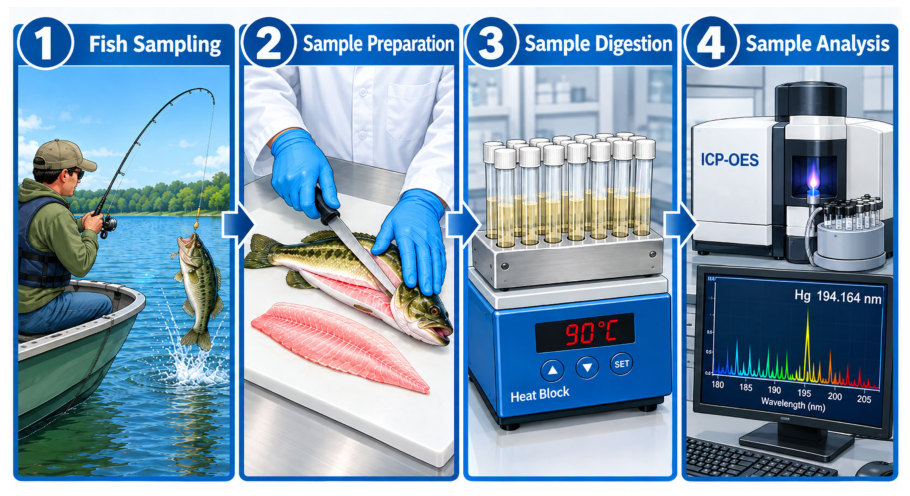
Table 1.
Fish Species Collected.
Table 1 displays the fish species collected, the MEAN ± STDEV length (in), MEAN ± STDEV whole-body weight (lb), and n-values.
Table 2.
Mercury Levels at Calling Panther Lake of Central Mississippi.
Table 2 shows the MEAN ± SE (mg/kg) level of mercury in fish samples tested, the permissible limits for human consumption recommended by the WHO (8.0 oz of fish) and EPA/FDA (4.0 oz of fish), the safe limits for consumption by piscivorous birds and animals, and the MEAN ± SE (ppm) levels of mercury in the water, sediment, and soil samples collected at Calling Panther Lake, where levels below the method detection limit were indicated as not detected (ND).
Table 3.
Adult Consumption Hazard Analysis.
Table 3 shows the consumption hazard scores for an average adult (70 kg) eating one 4.0 oz or 8.0 oz meal of fish once a week. Consumption hazard scores of ≥ 1.0 indicate a mercury consumption hazard, indicating that the fish are not safe to eat.
Table 4.
Child Consumption Hazard Analysis.
Table 4 shows the consumption hazard scores for an 18 kg child eating one 4.0 oz or 8.0 oz meal of fish once a week. Consumption hazard scores of ≥ 1.0 indicate a mercury consumption hazard, indicating that the fish are not safe to eat.
Figure 3.
The sensitivity analysis displaying mercury hazard scores based upon fish consumption portion size (oz) and individual body weight (kg) for (A) largemouth bass and channel catfish and (B) black crappie. Highlighted in blue are hazard scores of ≥1.0, indicating a mercury consumption hazard.
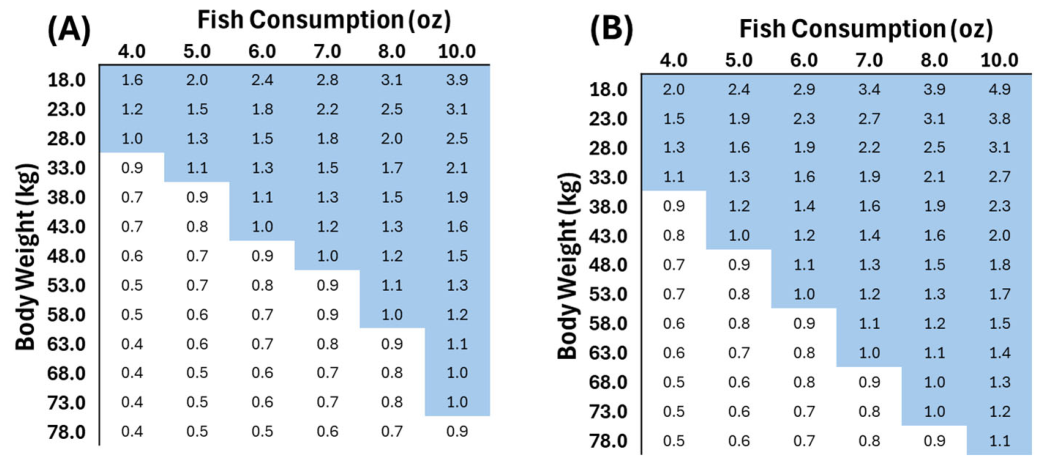
Table 5.
Mercury Levels in Largemouth Bass of the Southeastern United States.
Table 5 shows average mercury concentrations (mg/kg) reported in largemouth bass (Micropterus salmoides) from freshwater systems in the southeastern United States: Alabama [33], Florida [34], Louisiana [35], Mississippi [10], North Carolina [36], South Carolina [37], and South Carolina and Georgia [38].
Table 6.
Mercury Levels in Black Crappie of the Southeastern United States.
Table 6 shows average mercury concentrations (mg/kg) reported in black crappie (Pomoxis nigromaculatus) from freshwater systems in the southeastern United States: Louisiana [35], Mississippi, North Carolina [36], South Carolina [39], and South Carolina and Georgia [40].
Table 7.
Mercury Levels in White Crappie of the Southeastern United States.
Table 7 shows average mercury concentrations (mg/kg) reported in white crappie (Pomoxis annularis) from freshwater systems in the southeastern United States: Louisiana [13], Mississippi [8,10], and South Carolina and Georgia [40].
Table 8.
Mercury Levels in Channel Catfish of the Southeastern United States.
Table 8 shows average mercury concentrations (mg/kg) reported in channel catfish (Ictalurus punctatus) from freshwater systems in the southeastern United States: Louisiana [13], Mississippi [8,10], North Carolina [36], and South Carolina and Georgia [40].
Table 9.
Mercury Levels in Bluegill of the Southeastern United States.
Table 9 shows average mercury concentrations (mg/kg) reported in bluegill (Lepomis macrochirus) from freshwater systems in the southeastern United States: Louisiana [41], Mississippi, North Carolina [36], and South Carolina and Georgia [40].
Table 10.
Wildlife Consumption Hazard Analysis.
Table 10 shows the MEAN± SE mercury concentrations (mg/kg) of freshwater game fish species across the southeastern United States and consumption hazard scores for piscivorous bird and animals. Consumption hazard scores of ≥1.0 indicate a mercury consumption hazard, indicating that the fish are not safe to eat. * These mercury levels are an estimate, where spatial and temporal level variations are excepted across multiple regions.
4. Discussion
Americans enjoy recreational fishing, with catching and consuming fish being a deeply rooted tradition and popular outdoor pastime celebrated across the United States, especially in the state of Mississippi. The early detection and surveillance of emerging contaminants, such as mercury in fish, are key to protecting public safety and the health of the environment [3,4,8,13]. Mercury poisoning from consuming contaminated fish can cause nervous system damage, kidney damage, and developmental delays in children [1,3,4,7]. Mercury consumption also poses hazards to wildlife via biomagnification, causing the nervous tissue damage, reproductive harm, and immune dysfunction of top predatory animals and fish-eating species [1,2,3,15,24,25,26,29,30,31,32]. Previous reports have indicated that mercury is a major environmental health concern in fish species from lakes in northern Mississippi and the Mississippi River, creating consumption hazards for both humans and wildlife [8,9,10,11,13]. However, little is known about mercury levels in fish from lakes of central Mississippi. In this study, we examined fish mercury levels and determined consumption hazards for both humans and piscivores from the central Mississippi lake, Calling Panther Lake (Figure 1).
Our results indicated that mercury levels for all fish species were below the FDA action level of 1.0 mg/kg and within the EPA limits of 0.3 mg/kg, except black crappie (Table 2). However, largemouth bass, black crappie, and channel catfish had levels above the 0.2 mg/kg WHO permissible limit, indicating that an 8.0 oz serving of these fish were a possible human consumption hazard (Table 2). Consumption hazard scores further supported these findings, with the adult consumption of an 8.0 oz serving of largemouth bass, black crappie, and channel catfish resulting in hazard scores of ≥1.0 (Table 3). However, an adult consuming a 4.0 oz serving of any of the fish species tested posed no mercury health risk; therefore, our recommendation for adults was to avoid consuming more than 4.0 oz of fish at a time. Health hazard assessment results for child fish consumption had differing results, with the child consumption of an 8.0 oz serving of any of the fish species posing a mercury health hazard (Table 4). Even consuming 4.0 oz of redear sunfish, largemouth bass, black crappie, or channel catfish posed a mercury health risk for children. These calculations do vary based upon body weight, meal frequency, and methylmercury factions; however, to reduce mercury consumption risks, our recommendations for children and pregnant women is to limit their consumption of these fish. This is based upon the sensitivity analyses shown in Figure 3, where lower weight individuals such as children were at greater risk as compared to heavier weight individuals. Mercury consumption risk also increased with consumption portion sizes for largemouth bass, black crappie, and channel catfish (Figure 3). Lakes in northern Mississippi reported similar mercury concerns, where Sardis, Enid, and Grenada Lakes’ bass and crappie were reported to have mercury levels above safe human consumption limits for adults [11]. Other studies also reported mercury consumption hazards for largemouth bass, white crappie, and channel catfish in Sardis, Enid, and Grenada lakes, especially for children [10]. To our knowledge, there are no current fish consumption advisories issued for Calling Panther Lake. However, Mississippi is not the only state with mercury concerns; fish consumption advisories have been issued for all 50 states including states neighboring Mississippi [20,21,22,23,27,28,42].
Largemouth bass had mercury levels of 0.25 mg/kg at Calling Panther Lake, Mississippi, which were similar to reported levels in Enid Lake and Sardis Lake of northern Mississippi and mirrored the statewide average of 0.32 mg/kg in Louisiana (Table 5). Other southeastern states reported much higher levels ranging from 0.59 to 1.31 mg/kg (Table 5). Mercury levels in black crappie were much higher at Calling Panther Lake as compared to other southern states such as Louisiana and North and South Carolina (Table 6). Mercury levels in white crappie, reported across the southeastern United States (Table 7), were much lower than those found in black crappie at Calling Panther Lake (Table 6). This could be due to the fact that white and black crappie reduced direct food source competition by favoring different habitats and shifting their diets at different life stages [43,44]. Mercury levels of 0.24 mg/kg in the channel catfish of Calling Panther Lake were on par with reports in Enid Lake and Sardis Lake in northern Mississippi and with reports in Louisiana and North and South Carolina (Table 8). Mercury levels in bluegill were much lower at Calling Panther Lake, Mississippi, as compared to reports from Louisiana and North and South Carolina (Table 9). Taken together, mean mercury levels hovered around 0.2 mg/kg for black crappie, white crappie, channel catfish, and bluegill based on combined reports across the southeastern United States (Table 10). However, largemouth bass had mean levels of 0.6 mg/kg, indicating major concerns for this freshwater game fish species (Table 10). Recent reports agree with this analysis and found mercury contamination in largemouth bass across the southeastern United States, posing a health risk to this important game fish species that could be economically detrimental to the recreational fishing industry [45].
Mercury pollution also poses significant health hazards to piscivorous wildlife, where mercury biomagnified in the food chain, resulting in higher levels in top predatory species [14,15]. Evidence of mercury biomagnification was present in our results, where the larger predatory fish of Calling Panther Lake had elevated levels as compared to the smaller fish species tested (Table 2). Black crappie, channel catfish, and largemouth bass bioaccumulated mercury at higher levels as compared to the other species tested (Table 2), indicating that these fish were probable sentinel species. Recent studies have shown that these predatory fish species have high niche overlap and compete for the same food resources, thus having similar diets, which explain the common mercury levels [46]. Spatial modeling studies, using the largemouth bass, predict widespread mercury contamination and adverse health effects to fish populations across the southeastern United States due to the atmospheric deposition of organic mercury [45]. A total of 2050 models predict that global mercury levels in lake fish will continue to rise due to complex relationships between anthropogenic mercury emissions and ecosystem feedback, thus increasing mercury exposure to both humans and wildlife through the consumption of contaminated fish [47]. Mercury exposure is known to cause tissue damage, reproductive harm, and immune dysfunction to piscivores [1,2,3,15,24,25,26,29,30,31,32]. Our results indicated that consumption of redear sunfish, largemouth bass, black crappie, or channel catfish posed a mercury hazard for piscivorous animals and the consumption of largemouth bass, black crappie, or channel catfish presented a mercury hazard for piscivorous birds, such as the nesting bald eagles at Calling Panther Lake (Table 2) [48,49]. Mercury levels in freshwater game fish vary spatially and temporally across multiple regions of the southeastern United States (Table 5, Table 6, Table 7, Table 8 and Table 9). Based upon averaged mercury levels, the consumption hazard score for major freshwater game fish across the southeastern United States posed a significant risk to piscivorous birds and piscivorous animals (Table 10). Reports across the USA indicated that mercury exposure was a major concern for piscivorous birds including the bald eagle [30,31,50,51,52,53,54,55,56]. Mercury fish contamination across the Americas is also a major concern for piscivorous animals [3,15,32]. Mercury bioaccumulation is a problem for the American alligator (Alligator mississippiensis) and the alligator snapping turtles (Macrochelys temminckii) [57,58]. Mink and otters have been used as bioindicators for mercury leaking into terrestrial ecosystems [59,60]. The population decline in mink and river otter populations across the southeastern United States has been linked to toxic contaminants such as mercury [61,62]. Taken together, our results indicate mercury concerns at Calling Panther Lake, Mississippi, for both humans and wildlife consuming these fish. This data warrants future studies of the lakes and bodies of water of central Mississippi to determine mercury risks throughout the region. Based on the estimated mercury levels in major freshwater game fish across the southeastern United States, mercury is also a concern for both piscivorous birds and piscivorous animals, warranting future environmental health studies across the southeast.
Author Contributions
J.W.III: Writing—Original Draft Preparation, Data Curation, Investigation, and Formal Analysis; M.H.: Data Curation, Investigation, and Formal Analysis; M.A.: Resources, Data Curation, Investigation, and Formal Analysis; S.R.: Data Curation, Investigation, Writing—Review and Editing, and Formal Analysis; M.F.: Conceptualization, Project Administration, and Funding Acquisition; S.E.: Data Curation, Investigation, and Formal Analysis; T.S.: Conceptualization, Project Administration, and Funding Acquisition; and S.H.: Writing—Review and Editing, Conceptualization, Data Curation, Investigation, Formal Analysis, Supervision, Project Administration, and Funding Acquisition. All authors have read and agreed to the published version of the manuscript.
Funding
This work was supported (in part) by the Mississippi INBRE, funded by an Institutional Development Award (IDeA) from the National Institute of General Medical Sciences of the National Institutes of Health, under grant number P20GM103476. This work is also supported (in part) by the National Science Foundation HBCU-UP Implementation Project, Award # 2510537.
Data Availability Statement
The original contributions presented in this study are included in the article. Further inquiries can be directed to the corresponding author.
Acknowledgments
During the preparation of this manuscript, the authors used OpenAI’s ChatGPT (GPT-4o) for the purposes of image generation of the Graphical Abstract and Workflow Diagram. The authors have reviewed and edited the output and take full responsibility for the content of this publication.
Conflicts of Interest
The authors declare no conflicts of interest.
References
- Wang, Q.; Kim, D.; Dionysiou, D.D.; Sorial, G.A.; Timberlake, D. Sources and remediation for mercury contamination in aquatic systems—A literature review. Environ. Pollut. 2004, 131, 323–336. [Google Scholar] [CrossRef] [Scilit]
- Ibrahem, L.I.; Majeed, N.M.; Obaid, S.M.H.; Hashim, R.A. Mercury pollution and its impact on aquatic organisms. GSC Adv. Res. Rev. 2025, 22, 200–206. [Google Scholar] [CrossRef] [Scilit]
- Souza, M.C.O.; Barbosa, F.; Domingo, J.L. Mercury contamination in a changing climate: One health approaches to human, wildlife, and ecosystem protection. Chemosphere 2026, 394, 144821. [Google Scholar] [CrossRef] [Scilit]
- Zulaikhah, S.T.; Wahyuwibowo, J.; Pratama, A.A. Mercury and its effect on human health: A review of the literature. Int. J. Public Health Sci. (IJPHS) 2020, 9, 103. [Google Scholar] [CrossRef] [Scilit]
- Gworek, B.; Bemowska-Kałabun, O.; Kijeńska, M.; Wrzosek-Jakubowska, J. Mercury in Marine and Oceanic Waters—A Review. Water Air Soil Pollut. 2016, 227, 371. [Google Scholar] [CrossRef] [Scilit]
- Camargo, J.A. Which source of mercury pollution? Nature 1993, 365, 302. [Google Scholar] [CrossRef] [Scilit]
- Ray, S.; Vashishth, R. From water to plate: Reviewing the bioaccumulation of heavy metals in fish and unraveling human health risks in the food chain. Emerg. Contam. 2024, 10, 100358. [Google Scholar] [CrossRef] [Scilit]
- Hearst, S.; Selby, T.; Kazery, J.; Everman, S.; Feng, M.; Sisson, L.; Nwaiwu, C.; Cevallos, A.; Lock, J.; Sinclair, M. Fish as environmental sentinels for metal contaminants of human health concern in the Lower Mississippi River Basin. J. Trace Elem. Med. Biol. 2025, 87, 127593. [Google Scholar] [CrossRef] [Scilit]
- Dash, P.; Silwal, S.; Ikenga, J.O.; Pinckney, J.L.; Arslan, Z.; Lizotte, R.E. Water quality of four major lakes in Mississippi, USA: Impacts on human and aquatic ecosystem health. Water 2015, 7, 4999–5030. [Google Scholar] [CrossRef] [Scilit]
- Wolff, S.; Brown, G.; Chen, J.; Meals, K.; Thornton, C.; Brewer, S.; Cizdziel, J.V.; Willett, K.L. Mercury concentrations in fish from three major lakes in north Mississippi: Spatial and temporal differences and human health risk assessment. J. Toxicol. Environ. Health Part A 2016, 79, 894–904. [Google Scholar] [CrossRef] [Scilit]
- Huggett, D.B.; Steevens, J.A.; Allgood, J.C.; Lutken, C.B.; Grace, C.A.; Benson, W.H. Mercury in sediment and fish from North Mississippi Lakes. Chemosphere 2001, 42, 923–929. [Google Scholar] [CrossRef] [Scilit]
- Garbarino, J.R.; Hayes, H.C.; Roth, D.A.; Antweiler, R.C.; Brinton, T.I.; Taylor, H.E. Contaminants in the Mississippi River: Heavy Metals in the Mississippi River; US Geological Survey: Denver, CO, USA, 1995; Volume 1133.
- Watanabe, K.H.; Desimone, F.W.; Thiyagarajah, A.; Hartley, W.R.; Hindrichs, A.E. Fish tissue quality in the lower Mississippi River and health risks from fish consumption. Sci. Total Environ. 2003, 302, 109–126. [Google Scholar] [CrossRef] [Scilit]
- Wathen, J.B.; Lazorchak, J.M.; Olsen, A.R.; Batt, A. A national statistical survey assessment of mercury concentrations in fillets of fish collected in the U.S. EPA national rivers and streams assessment of the continental USA. Chemosphere 2015, 122, 52–61, Correction in Chemosphere 2015, 127, 143. https://doi.org/10.1016/j.chemosphere.2015.01.030. [Google Scholar] [CrossRef] [Scilit]
- Canham, R.; González-Prieto, A.M.; Elliott, J.E. Mercury Exposure and Toxicological Consequences in Fish and Fish-Eating Wildlife from Anthropogenic Activity in Latin America. Integr. Environ. Assess. Manag. 2021, 17, 13–26. [Google Scholar] [CrossRef] [Scilit]
- Hall, E.P.; Bonvechio, T.F.; Shaw, S.L.; Allen, M.S.; Brown, J.; Pugh, L. Using Specialized Angling to Assess a Trophy Florida Bass Fishery at Calling Panther Lake, Mississippi. N. Am. J. Fish. Manag. 2019, 39, 589–595. [Google Scholar] [CrossRef] [Scilit]
- Kazery, J.A.; Garteiser, J.W.; Cockrell, C.M.; Doubert, A.D.; Ervin, J.E.; Brown, M.S.; Burns, K.E.; Hearst, S.M. Internal and external spatial analysis of trace elements in local crayfish. Environ. Technol. 2024, 46, 1215–1228. [Google Scholar] [CrossRef] [Scilit]
- Lallo, J. Sample Preparation Method for Mercury Analysis in Reagent Chemicals by ICP-OES. Spectroscopy 2015, 30, 8–17. [Google Scholar]
- EPA. EPA Method 200.7, Revision 4.4: Determination of Metals and Trace Elements in Water and Wastes by Inductively Coupled Plasma-Atomic Emission Spectrometry; U.S. Environmental Protection Agency: Washington, DC, USA, 1994; Volume 19.
- Cleary, B.M.; Romano, M.E.; Chen, C.Y.; Heiger-Bernays, W.; Crawford, K.A. Comparison of Recreational Fish Consumption Advisories Across the USA. Curr. Environ. Health Rep. 2021, 8, 71–88. [Google Scholar] [CrossRef] [Scilit]
- U.S. EPA. Guidelines for Eating Fish that Contain Mercury. 2026. Available online: https://www.epa.gov/mercury/guidelines-eating-fish-contain-mercury (accessed on 1 August 2026).
- FDA. Advice About Eating Fish; U.S. Food & Drug Administration: Silver Spring, MD, USA, 2024.
- EPA. Technical Information on Development of FDA/EPA Advice About Eating Fish for Those Who Might Become or Are Pregnant or Breastfeeding and Children Ages 1–11 Years; U.S. Food & Drug Administration: Silver Spring, MD, USA, 2022.
- Bozorgzadeh, E.; Pasdaran, A.; Ebrahimi-Najafabadi, H. Determination of toxic heavy metals in fish samples using dispersive micro solid phase extraction combined with inductively coupled plasma optical emission spectroscopy. Food Chem. 2021, 346, 128916. [Google Scholar] [CrossRef] [Scilit]
- El-Moselhy, K.M.; Othman, A.I.; Abd El-Azem, H.; El-Metwally, M.E.A. Bioaccumulation of heavy metals in some tissues of fish in the Red Sea, Egypt. Egypt. J. Basic Appl. Sci. 2014, 1, 97–105. [Google Scholar] [CrossRef] [Scilit]
- Mensoor, M.; Said, A. Determination of heavy metals in freshwater fishes of the tigris river in Baghdad. Fishes 2018, 3, 23. [Google Scholar] [CrossRef] [Scilit]
- U.S. EPA. Guidance for Assessing Chemical Contaminant Data for Use in Fish Advisories Volume 1 Fish Sampling and Analysis, 3rd ed.; United States Environmental Protection Agency: Washington, DC, USA, 2000; Volume 1.
- U.S. EPA. Guidance for Assessing Chemical Contaminant Data for Use in Fish Advisories, Volume 2: Risk Assessment and Fish Consumption Limits, 3rd ed.; United States Environmental Protection Agency: Washington, DC, USA, 2000; Volume 1.
- Yeardley, R.B.; Lazorchak, J.M.; Paulsen, S.G. Elemental fish tissue contamination in northeastern U.S. Lakes: Evaluation of an approach to regional assessment. Environ. Toxicol. Chem. 1998, 17, 1875–1884. [Google Scholar] [CrossRef]
- Fuchsman, P.C.; Brown, L.E.; Henning, M.H.; Bock, M.J.; Magar, V.S. Toxicity reference values for methylmercury effects on avian reproduction: Critical review and analysis. Environ. Toxicol. Chem. 2017, 36, 294–319. [Google Scholar] [CrossRef] [Scilit]
- Ackerman, J.T.; Peterson, S.H.; Herzog, M.P.; Yee, J.L. Methylmercury Effects on Birds: A Review, Meta-Analysis, and Development of Toxicity Reference Values for Injury Assessment Based on Tissue Residues and Diet. Environ. Toxicol. Chem. 2024, 43, 1195–1241. [Google Scholar] [CrossRef] [Scilit]
- Eagles-Smith, C.A.; Wiener, J.G.; Eckley, C.S.; Willacker, J.J.; Evers, D.C.; Marvin-DiPasquale, M.; Obrist, D.; Fleck, J.A.; Aiken, G.R.; Lepak, J.M.; et al. Mercury in western North America: A synthesis of environmental contamination, fluxes, bioaccumulation, and risk to fish and wildlife. Sci. Total Environ. 2016, 568, 1213–1226. [Google Scholar] [CrossRef] [Scilit]
- Dharampal, P.S.; Findlay, R.H. Mercury levels in largemouth bass (Micropterus salmoides) from regulated and unregulated rivers. Chemosphere 2017, 170, 134–140. [Google Scholar] [CrossRef] [Scilit]
- Lange, T.R.; Royals, H.E.; Connor, L.L. Mercury accumulation in largemouth bass (Micropterus salmoides) in a Florida Lake. Arch. Environ. Contam. Toxicol. 1994, 27, 466–471. [Google Scholar] [CrossRef] [Scilit]
- Katner, A.; Sun, M.H.; Suffet, M. An evaluation of mercury levels in Louisiana fish: Trends and public health issues. Sci. Total Environ. 2010, 408, 5707–5714. [Google Scholar] [CrossRef] [Scilit]
- Sackett, D.K.; Aday, D.D.; Rice, J.A.; Cope, W.G. A Statewide Assessment of Mercury Dynamics in North Carolina Water Bodies and Fish. Trans. Am. Fish. Soc. 2009, 138, 1328–1341. [Google Scholar] [CrossRef] [Scilit]
- Peles, J.D.; Glenn, T.C.; Brant, H.A.; Wall, A.K.; Jagoe, C.H. Mercury concentrations in largemouth bass (Micropterus salmoides) from five South Carolina reservoirs. Water Air Soil Pollut. 2006, 173, 151–162. [Google Scholar] [CrossRef] [Scilit]
- Paller, M.H.; Littrell, J.W. Long-term changes in mercury concentrations in fish from the middle Savannah River. Sci. Total Environ. 2007, 382, 375–382. [Google Scholar] [CrossRef] [Scilit][Green Version]
- Sackett, D.K.; Cope, W.G.; Rice, J.A.; Aday, D. The influence of fish length on tissue mercury dynamics: Implications for natural resource management and human health risk. Int. J. Environ. Res. Public Health 2013, 10, 638–659. [Google Scholar] [CrossRef] [Scilit]
- Burger, J.; Gaines, K.F.; Gochfeld, M. Ethnic differences in risk from mercury among Savannah River fishermen. Risk Anal. 2001, 21, 533–544. [Google Scholar] [CrossRef] [Scilit]
- Dupre, T.P.; Granier, T.J.; Keife, S.; Marino, R.; O’Rourke, S.; Partridge, C.; Schultz, D.L.; Mandhare, K.; Beck, J.N. Variation of mercury concentration in fish taken from Lake Boeuf, Southeastern Louisiana. Microchem. J. 1999, 61, 156–164. [Google Scholar] [CrossRef] [Scilit]
- Stahl, L.L.; Snyder, B.D.; McCarty, H.B.; Kincaid, T.M.; Olsen, A.R.; Cohen, T.R.; Healey, J.C. Contaminants in fish from U.S. rivers: Probability-based national assessments. Sci. Total Environ. 2023, 861, 160557. [Google Scholar] [CrossRef] [Scilit]
- Andree, S.R.; Wahl, D.H. Effects of turbidity on foraging of juvenile black and white crappies. Ecol. Freshw. Fish. 2019, 28, 123–131. [Google Scholar] [CrossRef] [Scilit]
- Ellison, D.G. Trophic Dynamics of a Nebraska Black Crappie and White Crappie Population. N. Am. J. Fish. Manag. 1984, 4, 355–364. [Google Scholar] [CrossRef] [Scilit]
- Seymour, R.D.; Drenner, R.W.; Chumchal, M.M. Potential Health Risks of Methylmercury Contamination to Largemouth Bass in the Southeastern United States. Environ. Toxicol. Chem. 2023, 42, 1755–1762. [Google Scholar] [CrossRef] [Scilit]
- Bentley, J.L.; Tyszko, S.M.; Conroy, J.D.; Ludsin, S.A. Determining ecological niche overlap between reservoir Blue Catfish and other sport fishes using stable isotopes and stomach contents. N. Am. J. Fish. Manag. 2026, vqag058. [Google Scholar] [CrossRef] [Scilit]
- Gull, H.; Lee, J.H.; Lee, H.; Angot, H.; Kwon, S.Y. Future mercury levels in fish: Model vs. observational predictions under different policy scenarios. Biogeosciences 2026, 23, 3387–3406. [Google Scholar] [CrossRef] [Scilit]
- Thompson, C.M.; Nye, P.E.; Schmidt, G.A.; Garcelon, D.K. FORAGING ECOLOGY OF BALD EAGLES IN A FRESHWATER TIDAL SYSTEM. J. Wildl. Manag. 2005, 69, 609–617. [Google Scholar] [CrossRef] [Scilit]
- Dykstra, C.R.; Karasov, W.H.; Meyer, M.W.; Warnke, D.K. Daily energy expenditure of nestling Bald Eagles in northern Wisconsin. Condor 2001, 103, 175–179. [Google Scholar] [CrossRef] [Scilit]
- Wood, P.B.; White, J.H.; Steffer, A.; Wood, J.M.; Facemire, C.F.; Percival, H.F. Mercury Concentrations in Tissues of Florida Bald Eagles. J. Wildl. Manag. 1996, 60, 178. [Google Scholar] [CrossRef] [Scilit]
- Jagoe, C.H.; Bryan, A.L.; Brant, H.A.; Murphy, T.M.; Brisbin, I.L. Mercury in bald eagle nestlings from South Carolina, USA. J. Wildl. Dis. 2002, 38, 706–712. [Google Scholar] [CrossRef] [Scilit][Green Version]
- Blanchong, J.A.; Reiter-Marolf, W.J.; Dinsmore, S.J. Mercury exposure in bald eagles (Haliaeetus leucocephalus) admitted for rehabilitation in Iowa, USA. J. Wildl. Dis. 2017, 53, 393–395. [Google Scholar] [CrossRef] [Scilit]
- Eleftheriou, A.; Murphy, L.; Welte, S. EVALUATION of LEAD and MERCURY PREVALENCE in BALD EAGLES (Haliaeetus leucocephalus) from the MID-ATLANTIC UNITED STATES. J. Zoo Wildl. Med. 2017, 48, 910–914. [Google Scholar] [CrossRef] [Scilit]
- Bechard, M.J.; Perkins, D.N.; Kaltenecker, G.S.; Alsup, S. Mercury contamination in idaho bald eagles, Haliaeetus leucocephalus. Bull. Environ. Contam. Toxicol. 2009, 83, 698–702. [Google Scholar] [CrossRef] [Scilit]
- Dykstra, C.R.; Route, W.T.; Williams, K.A.; Meyer, M.W.; Key, R.L. Trends and patterns of PCB, DDE, and mercury contamination in bald eagle nestlings in the upper Midwest. J. Great Lakes Res. 2019, 45, 252–262. [Google Scholar] [CrossRef] [Scilit]
- DeSorbo, C.R.; Burgess, N.; Todd, C.; Evers, D.; Bodaly, R.; Massey, B.; Mierzykowski, S.; Persico, C.; Gray, R.; Hanson, W.; et al. Mercury concentrations in bald eagles across an impacted watershed in Maine, USA. Sci. Total Environ. 2018, 627, 1515–1527. [Google Scholar] [CrossRef] [Scilit]
- Rosenbaum, D.; Montaña, C.G.; Zhang, Y.; Chumchal, M.M.; Saenz, D.; Schalk, C.M. Intraspecific Variation in Mercury Contamination of Alligator Snapping Turtles (Macrochelys temminckii). Environ. Toxicol. Chem. 2024, 43, 1903–1913. [Google Scholar] [CrossRef] [Scilit]
- Jagoe, C.H.; Arnold-Hill, B.; Yanochko, G.M.; Winger, P.V.; Brisbin, I.L. Mercury in alligators (Alligator mississippiensis) in the southeastern United States. Sci. Total Environ. 1998, 213, 255–262. [Google Scholar] [CrossRef] [Scilit]
- Fortin, C.; Beauchamp, G.; Dansereau, M.; Larivière, N.; Bélanger, D. Spatial variation in mercury concentrations in wild mink and river otter carcasses from the James Bay territory, Québec, Canada. Arch. Environ. Contam. Toxicol. 2001, 40, 121–127. [Google Scholar] [CrossRef] [Scilit]
- Evans, R.D.; Addison, E.M.; Villeneuve, J.Y.; MacDonald, K.S.; Joachim, D.G. Distribution of inorganic and methylmercury among tissues in mink (Mustela vison) and otter (Lutra canadensis). Environ. Res. 2000, 84, 133–139. [Google Scholar] [CrossRef] [Scilit]
- Osowski, S.L.; Brewer, L.W.; Baker, O.E.; Cobb, G.P. The decline of mink in Georgia, North Carolina, and South Carolina: The role of contaminants. Arch. Environ. Contam. Toxicol. 1995, 29, 418–423. [Google Scholar] [CrossRef] [Scilit]
- Halbrook, R.S.; Jenkins, J.H.; Bush, P.B.; Seabolt, N.D. Sublethal concentrations of mercury in river otters: Monitoring environmental contamination. Arch. Environ. Contam. Toxicol. 1994, 27, 306–310. [Google Scholar] [CrossRef] [Scilit]
Disclaimer/Publisher’s Note: The statements, opinions and data contained in all publications are solely those of the individual author(s) and contributor(s) and not of MDPI and/or the editor(s). MDPI and/or the editor(s) disclaim responsibility for any injury to people or property resulting from any ideas, methods, instructions or products referred to in the content. |
© 2026 by the authors. Licensee MDPI, Basel, Switzerland. This article is an open access article distributed under the terms and conditions of the Creative Commons Attribution (CC BY) license.