


Abstract
In Calabria coastal regions, seaward and landward sides could be connected through the ecological role of fluvial catchments. Calabria Tyrrhenian coast shows a wilderness area, characterized by two terrestrial and marine Special Areas of Conservation (SACs) connected by the fluvial catchment of Verri stream. The bibliographic search was realized according to a Preferred Reporting Items for Systematic Reviews and Meta-Analysis, as a standardized method for screening the most relevant literature. The field survey, conducted in the study area, highlighted high biodiversity levels and a great natural heritage represented by 189 plant species and 130 animal ones. According to the resulting data, the basin represents a classical model of ecological corridor linking terrestrial and marine SACs, as cornerstones of Natura 2000 network, so representing the European assessment for biodiversity conservation. This paper highlights the high biological richness of a wilderness area showing the tight relationship between the continental and the marine districts of the same coastal region. The main goal of the research is to remark the fundamental role of fluvial corridors within a regional approach where riverine catchments could represent the connecting steps of the network. In Calabria it is hopeful to establish a functional connectivity amongst protected areas supported by fluvial corridors along the regional basins.
1. Introduction
Coastal areas and fluvial catchments are transitional environments extremely sensitive to human pressures in a dynamic equilibrium between seaward and landward zones [1]. In the Mediterranean basin, coastal regions show a great diversity of ecological, social, and economic roles strictly connected in the same landscape unit, requesting holistic and global management [2,3], as also occur along the Atlantic coast of United States of America [4]. According to this global approach, in the 1990s, an important project named “wildlands” was launched, suggesting the idea of a global network between protected areas and enhancing the pivotal role of fluvial basins as connecting elements for wildlife conservation [5]. In this direction, the United Nation Centre for Human Settlements (U.N.C.H.S.) established a new pattern of Integrated Coastal Area and River basin Management (ICARM), also considering the socio-economic interactions between marine and terrestrial environments where local people play a pivotal role [6]. Some years later, the European Union suggested to community members a new kind of approach to coastal areas named Integrated Coastal Zone Management (ICZM) [7]. Both processes propose a novel marine policy able to merge seaward and landward sides of coastal regions in a whole environmental system [8]. Worldwide, the novel idea that a lot of indirect and secondary landscape co-benefits could be generated by the management plans of Natura 2000 networks, also to counteract the present trend of climate changes [9,10,11,12] and of biological invasions [13,14], has been highlighted since the 1990s. The focus of the paper is to suggest, in the Calabria region (Southern Italy), a dynamic equilibrium between the socio-economic growth of local people and an effective environmental protection of coastal ecosystems within the regional Natura 2000 network, as already highlighted in Spain, Algeria, and Italy [15,16,17,18]. The planning scheme of the research is realized in the following steps: (a) a bibliographic search; (b) the case study of Verri’s catchment; and (c) an in-depth study of plant and animal species living in the fluvial corridor. In Calabria (Southern Italy), it has been pointed out that the sustainable planning of coastal areas must integrate environmental protection, coastal cultural heritage, and the socio-economic development of local people to improve tourist services, as it was suggested in some coastal stretches of the Calabria Tyrrhenian coast [19]. According to this kind of landscape approach, the coupling between terrestrial, fluvial, and marine biotopes should be the main goal of ICZM process through a new model of landscape planning extended from coastlines to continental areas along the directions of fluvial basins [20]. However, this novel approach is partly unrealized along a regional coastline of 715 km. The hydrographic pattern of the region was formed by 1003 fluvial catchments, so representing a landscape network connecting the seaward and landward sides of the region. The main goal of the study is to enlarge and to deepen the existing knowledge about the role of fluvial catchments within the Natura 2000 network in the Calabria coastal region, applying the ICZM process to a special coastal region extended along Calabria Tyrrhenian coast in the municipal landscape of Belmonte Calabro (Cs, Calabria, Southern Italy). This study aims to highlight the basic value of riparian corridors for an effective riverine restoration, conceived as a green infrastructure able to connect marine and freshwater ecosystems for an effective governance of coastal regions.
2. Materials and Methods
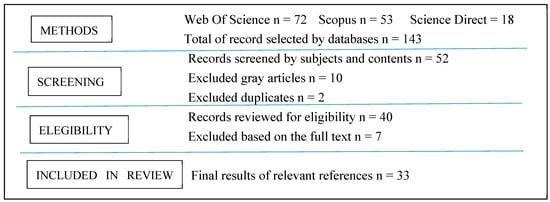
The research is based on the PRISMA (Preferred Reporting Items for Systematic Reviews and Meta-Analysis) method, as a tool for selecting the useful scientific data in the development of the study, to outline the whole screening process [21]. In this way, all the peer-reviewed academic literature has been searched, drawn by the three recognized electronic databases, such as Science Direct, Web of Sciences, and Scopus, to select the most important papers about rivers corridors, as the connecting steps in Natura 2000 network. To realize such a goal, a specific set of keywords combinations has been employed, such as fluvial corridor, river corridor, stream corridor, riverfront, riverside, riverscape, riparian vegetation, greenway, connecting step, Natura 2000 network and Calabria. The search has been conducted until 31 December 2024, including all the most relevant and available literature.
The inclusion criteria are the following:
- The study area is a coastal region characterized by high levels of biodiversity.
- The research is based on people’s knowledge.
- The review is an empirical study subjected to peer review.
The exclusion criteria are the following:
- Articles outside the topics discussed in the review.
- Gray literature.
- Duplicate articles.
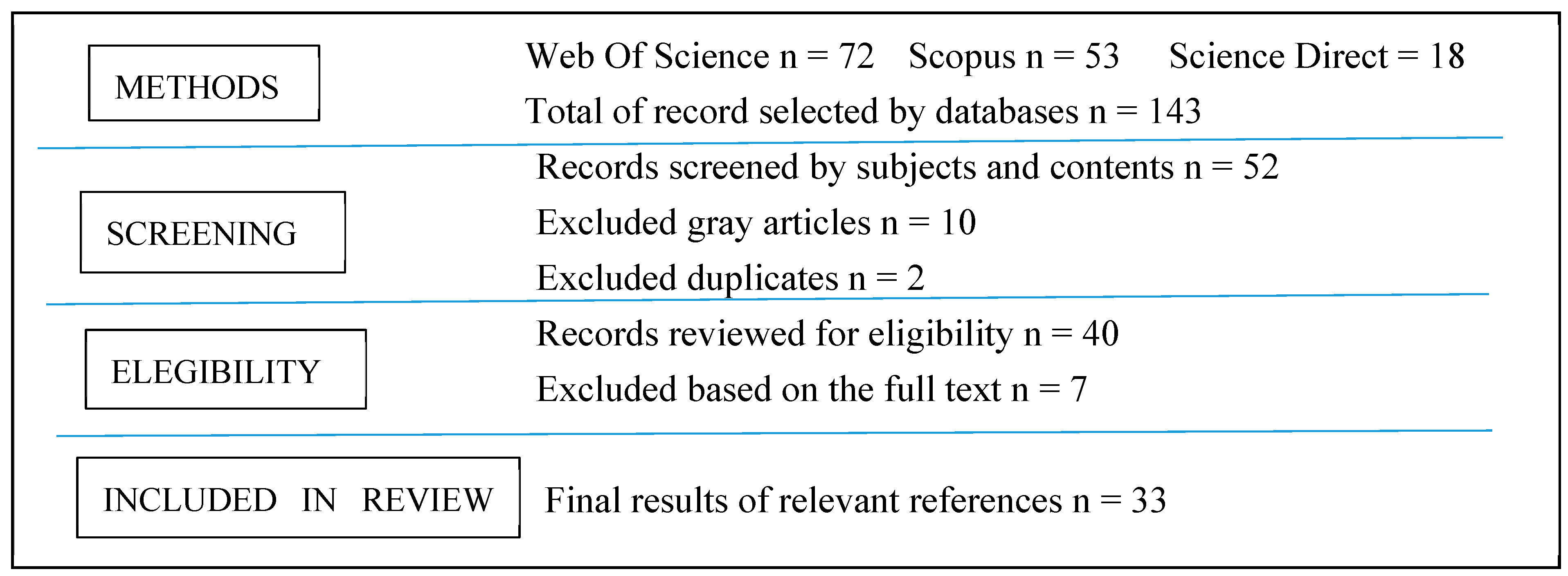
The steps followed in the review, according to the PRISMA methodology, are distinguished in four stages: (a) methods; (b) screening; (c) eligibility; and (d) included. The whole scheme is summarized in Figure 1.
Figure 1.
PRISMA 2000 flowchart included in the study.
From the collected data, the following have been excluded: articles unrelated to the searched keywords, gray literature, and duplicate articles. The resulting data of the research include a total of 143 articles. From this pool, 60 records for publication titles and subject areas have been excluded. The remaining 64 articles have been subjected to a secondary screening through which two duplicates and ten grey papers were identified and therefore removed. Finally, according to a deep analysis of their contents, 40 articles have been selected, cited in the main text, and reported in the list of references. According to this bibliographic approach, a set of 12 scientific papers have been selected, including only the most relevant and representative ones about fluvial catchments, Natura 2000 network, protected areas, and ICZM process to better describe the investigated area, its broader regional characteristics, and the fundamental ecological role of fluvial corridors for biodiversity conservation (Table 1).
Table 1.
Detailed scheme of selected papers drawn by the bibliographic search.
Finally, the field campaign, realized during a specific period between high and low water levels of the stream, was aimed at realizing a preliminary check list of the main plant and faunal species living in the fluvial corridor of Verri’s stream. So, the survey has been performed, in the phase of vegetative activity, by two volunteers supplied by the World Wildlife Fund of Italy (W.W.F.), covering both river banks, from downstream to upstream.
3. Study Area
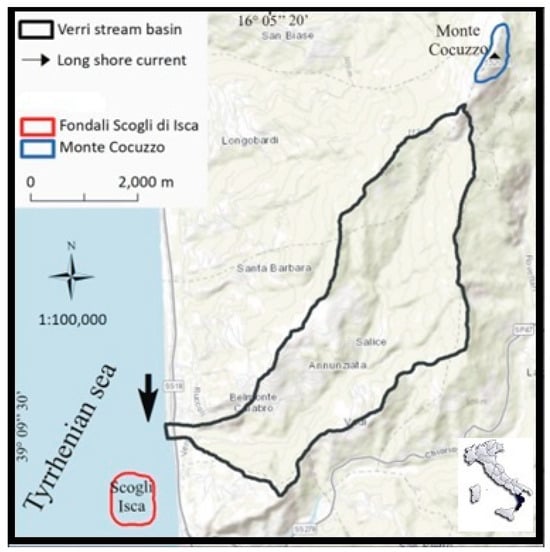
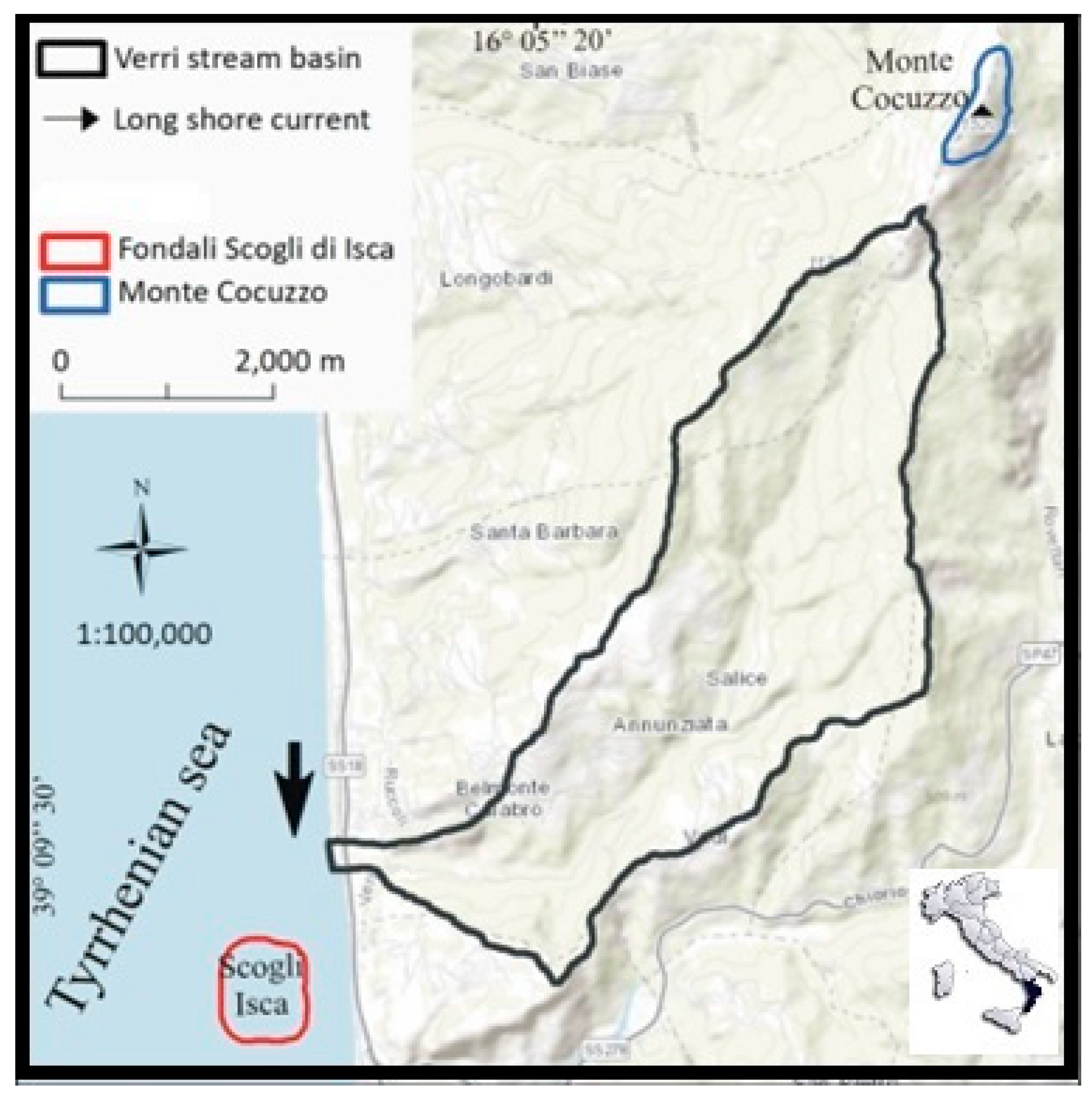
The study area (Figure 2) is distinguished by a Mediterranean climate characterized by a mild rainy winter and by a warm drought summer [32].
Figure 2.
The study area of the fluvial corridor of Verri’s stream basin (black cusp) connecting the terrestrial SAC “Monte Cocuzzo” (blue contour) with the marine SAC “Fondali Scogli di Isca” (red contour) along the Western Tyrrhenian coasts of Calabria region.
In particular, the orography of Calabria Tyrrhenian seaside shows a typical mountain ridge close to the regional coastline, named Coastal Chain, supporting the upcoming of western currents towards inland regions. The special assessment of the Coastal Chain triggers flowing of air masses, loaded with humidity, towards continental inlands causing frequent rainfalls, generally of slight intensity [22]. So, the catchment of the Verri stream is distinguished by a mild and temperate climate but, at the same time, by heavy rainfalls greater than other Calabria coastal regions. These special climatic conditions lead to a steady hydrological flow of the stream also in the summer season. The geological feature of the basin is formed by a crystalline metamorphic bedrock and by granite gneiss of Paleozoic ages [23]. The related permeability of the soil is characterized by areas at low permeability (58%), at medium permeability (26%), and at high permeability (16%) [33] concentrated in the porous ground of mountain ranges. Finally, the land use of the catchment is formed by natural pasture lands, grasslands, woods mixed at Castanea sativa (Miller) and at Alnus glutinosa (Linnaeus) Gaertner, woods at deciduous oaks and agricultural areas.
4. Results
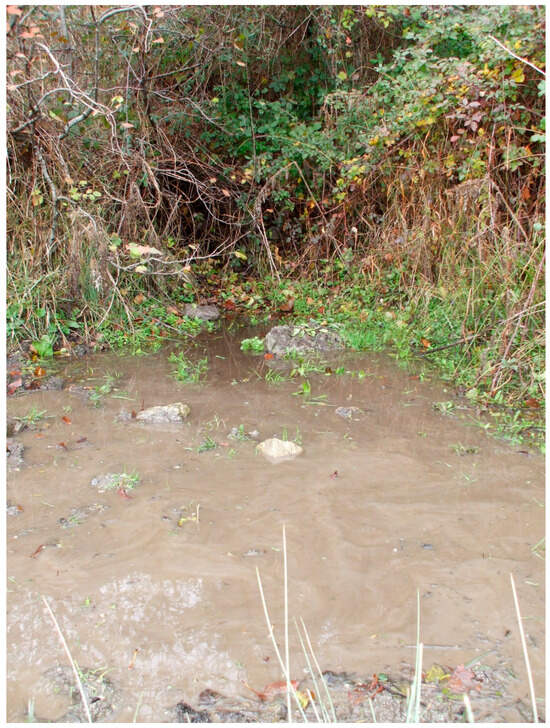
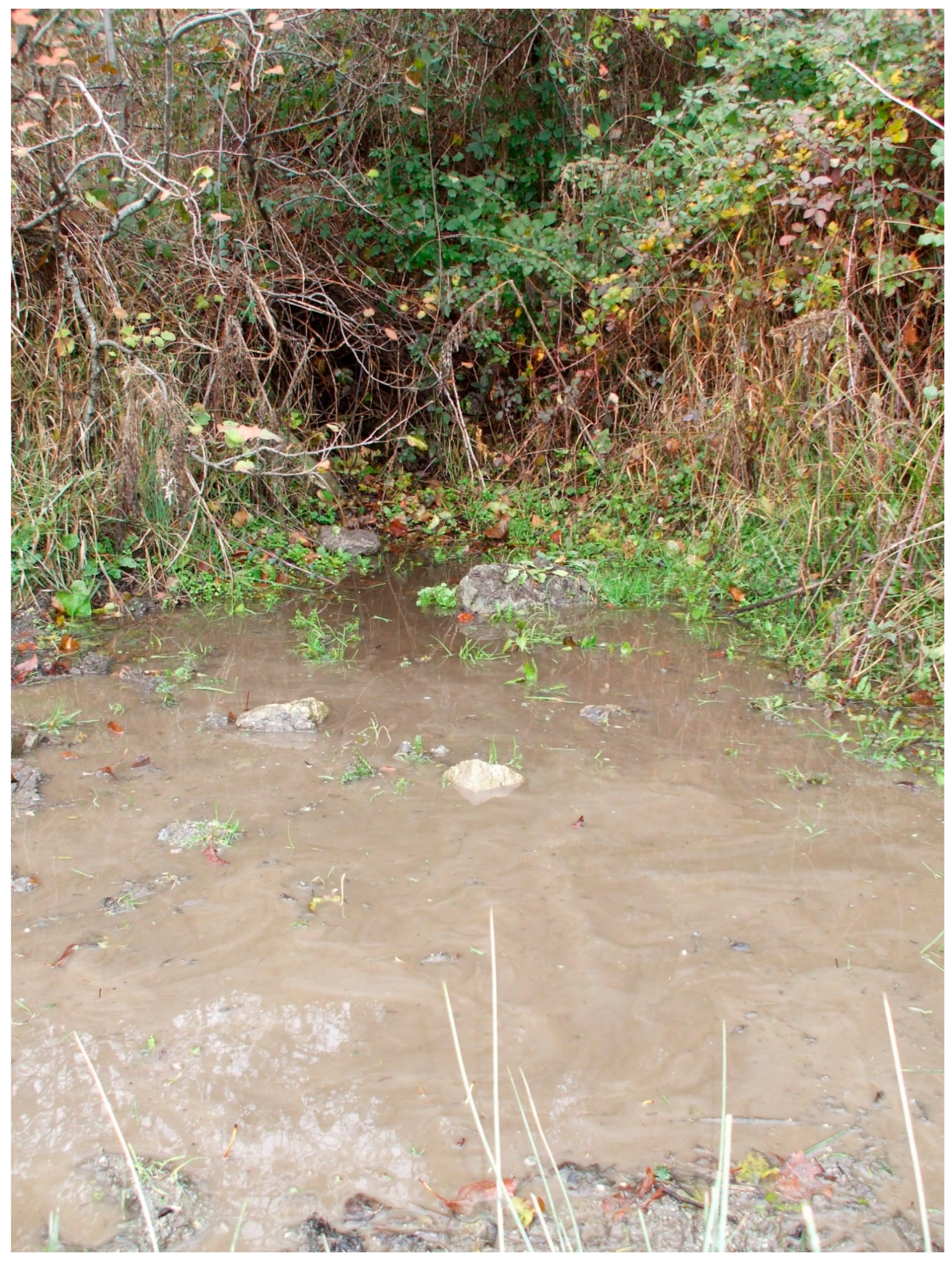
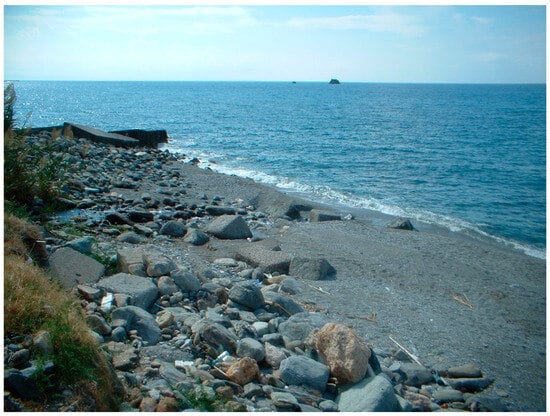
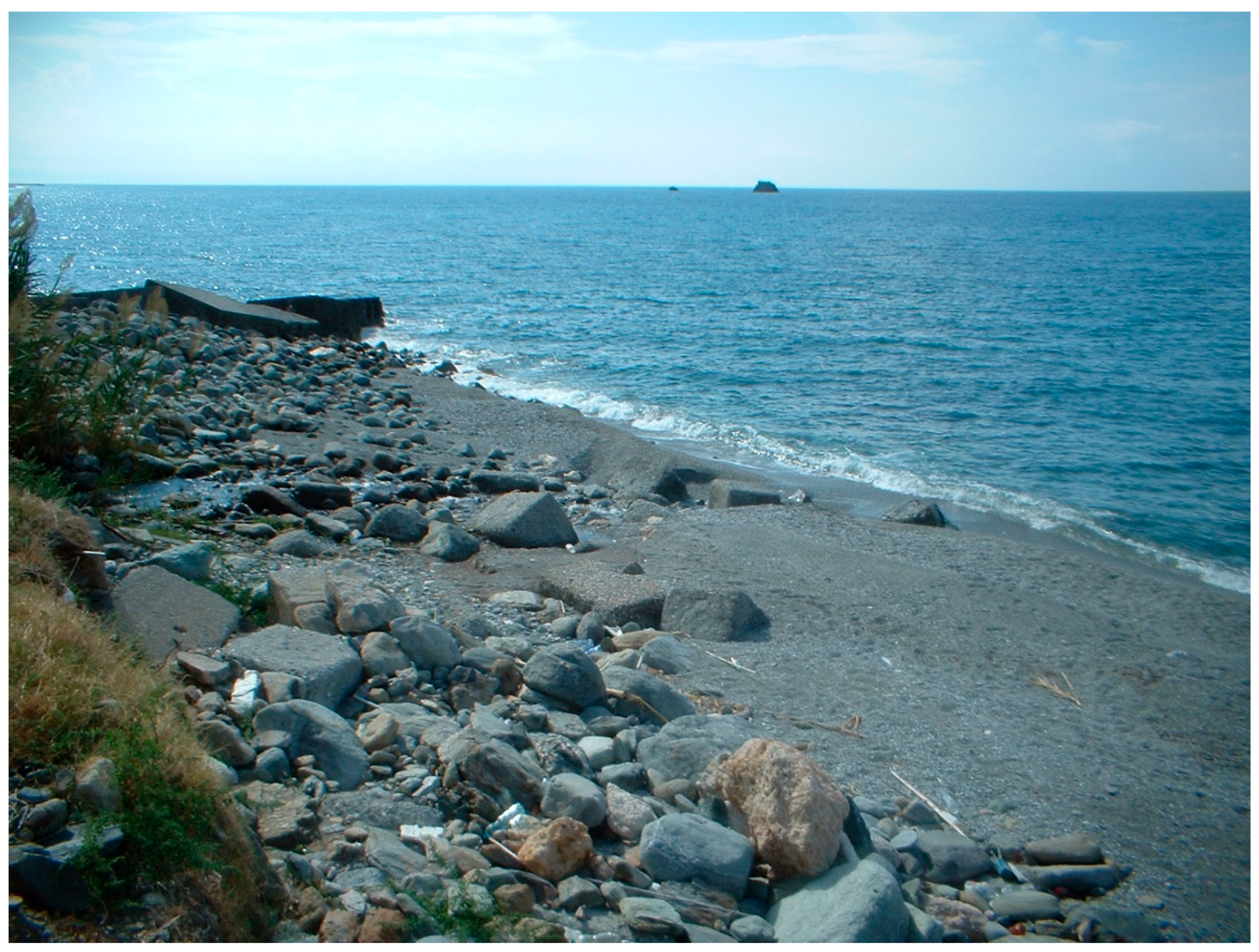
The coastal region of Belmonte Calabro (Cs, Calabria) is characterized by high levels of biodiversity for the adjoining existence of two important Special Areas of Conservation (SACs), as cornerstones of the Natura 2000 network. This wilderness area holds a wide ecological corridor, represented by the Verri stream, connecting the terrestrial SAC of “Monte Cocuzzo” with the marine one “Fondali Scogli di Isca”, actually established as Marine Regional Park. In particular, the waterway of the Verri stream springs up from an underground source on a surface area, located at 1100 m a.s.l., at the slope of Cocuzzo mountain. (Figure 3). From this puddle, a narrow stream goes on in the southwestern direction for a whole length of 9.5 km until its outlet in the Tyrrhenian Sea, close to the marine SAC “Fondali Scogli di Isca” (Figure 4).
Figure 3.
The underground spring of the Verri stream appears as a surface puddle on the slope of Cocuzzo’s mountain.
Figure 4.
The outlet of Verri stream in front of the marine SAC “Fondali Scogli di Isca” in the Western Tyrrhenian coast of Calabria region.
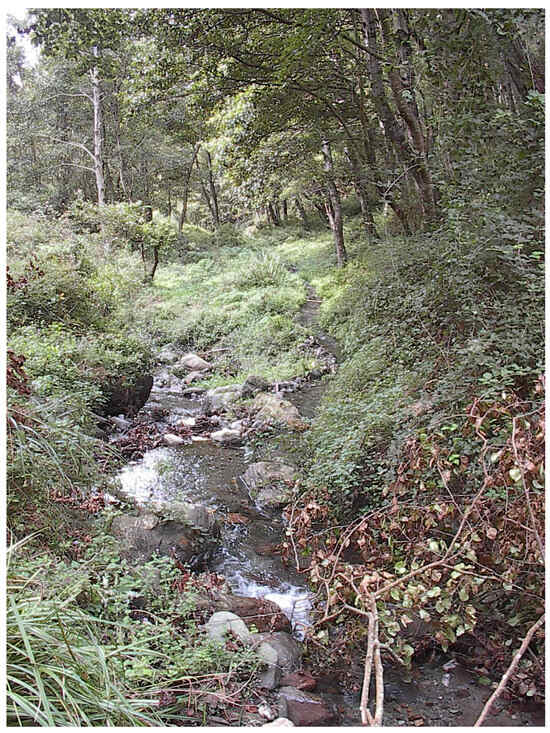
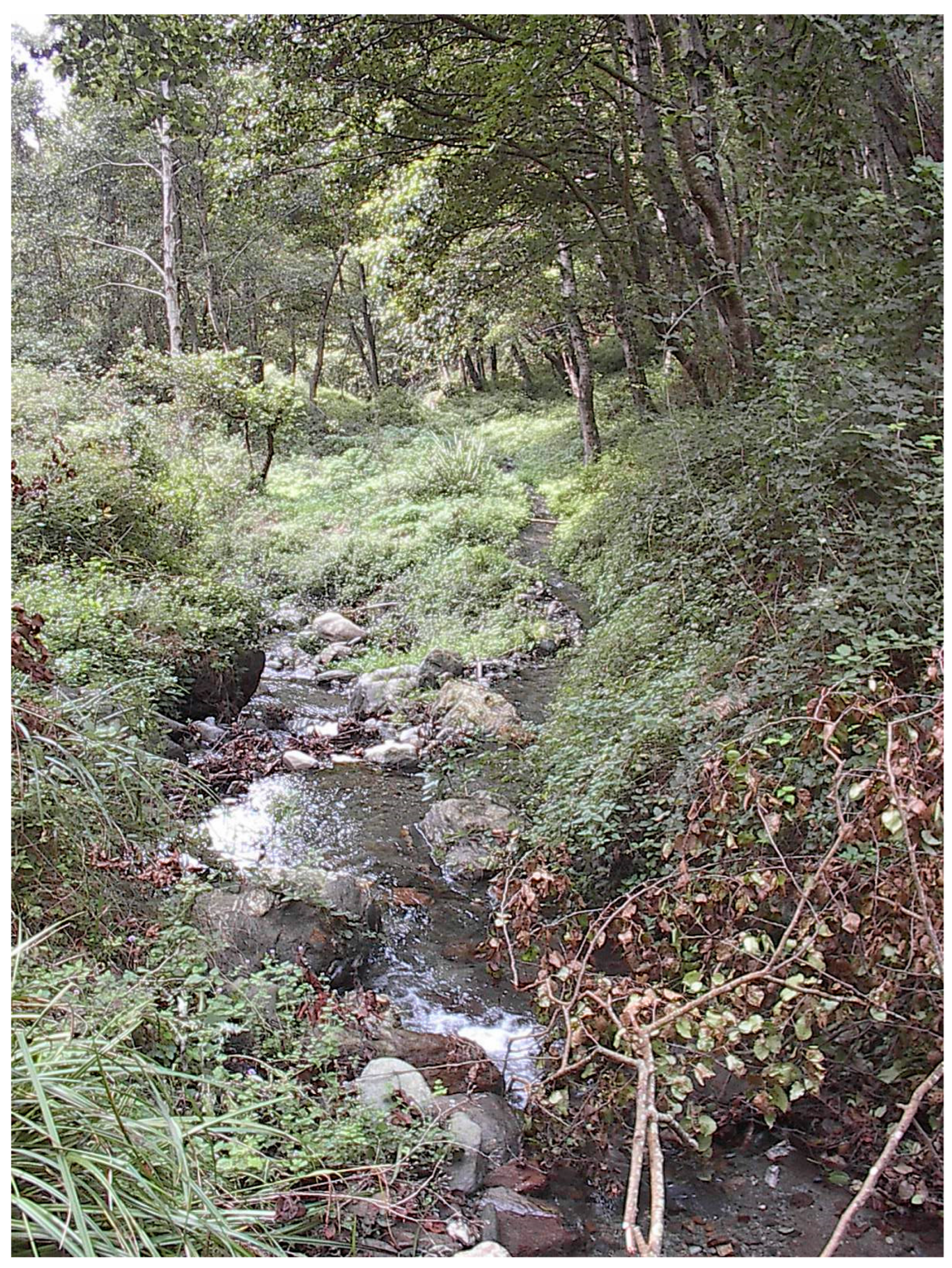
The fluvial catchment covers a global surface area of 23.9 square kilometers, showing a steep slope of about 10%. The most important feature of the whole basin is the distribution of a rich and highly diversified vegetation at both sides of the stream. In fact, it is possible to observe, in the whole fluvial corridor, a typical vegetated cross-gradient formed by herbaceous, scrub, and arboreous species proceeding from riverbeds towards the orographic sides of the basin. Most of the catchment area, along the waterway, in the watershed but also in the dumping zones inside the woodland of riverine sides, is characterized by a typical hydrophilous vegetation formed by hydrophyta and hygrophyta species such as Apium nodiflorum (Linnaeus) Lag. and others. Amongst the most representative arboreous species, the prevailing presence of Alnus glutinosa (Linnaeus) Gaertner is observed, commonly known as black alder, hygrophyta species of the fluvial corridor [34]. As a matter of fact, this tree is widespread in the transport zone of the basin not only in the riverbeds but also close to river banks on grounds enriched by high soil humidity (Figure 5).
Figure 5.
The vegetal association at Alnus glutinosa on the river banks of the Verri stream.
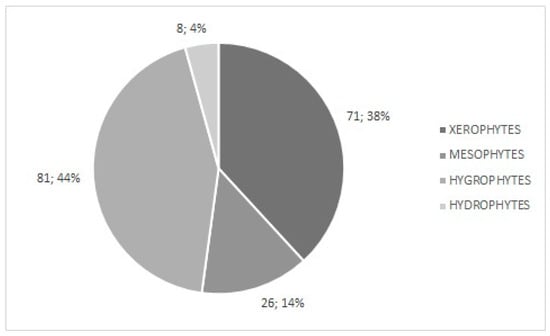
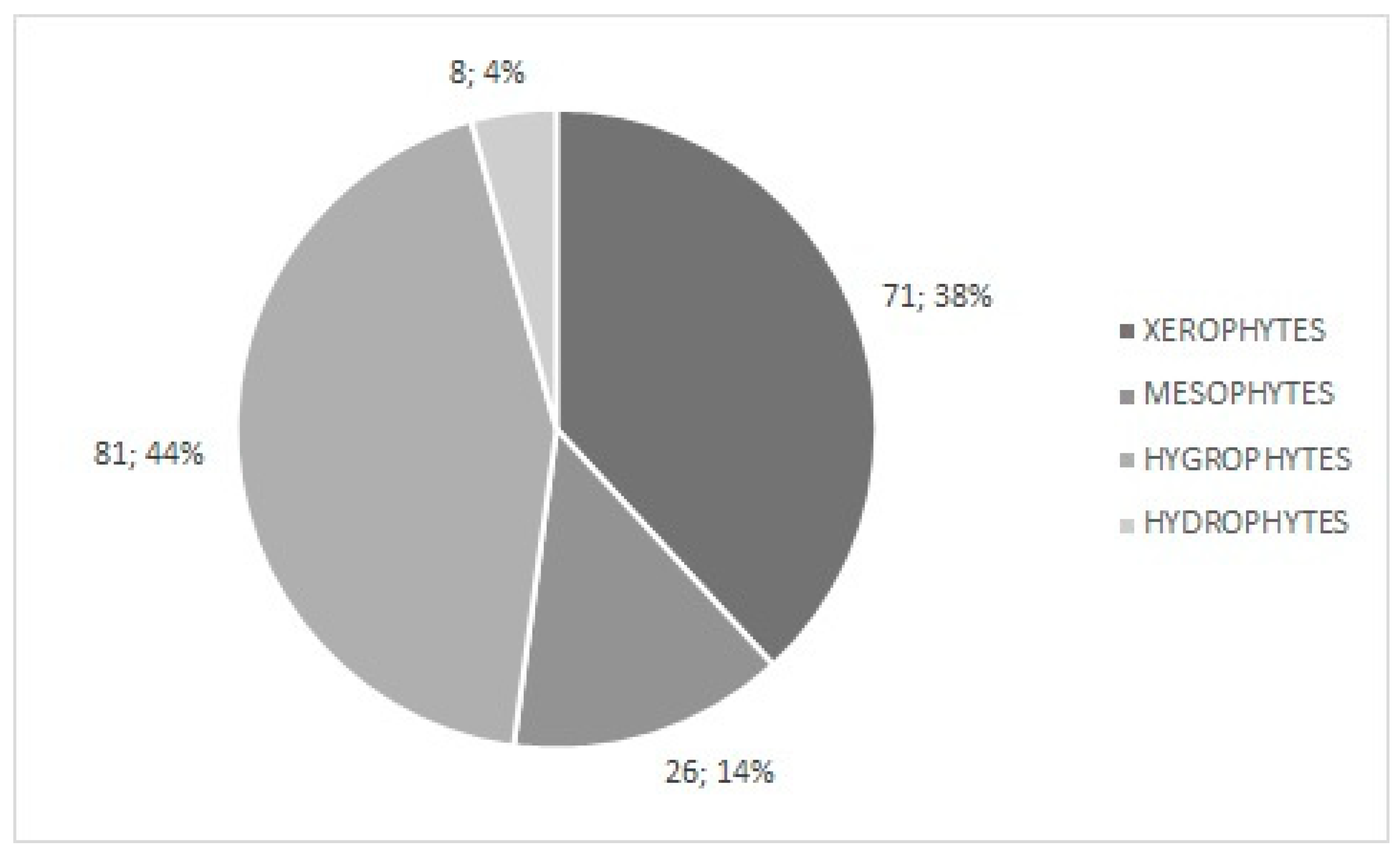
This species, sometimes mixed with Alnus cordata (Loisel.) Duby and with Ulmus minor Miller, may form a typical vegetal association very useful to guarantee the conditions of connectivity distinctive of a fluvial corridor [35]. The field survey, organized by World Wildlife Fund (W.W.F.), was aimed to realize the first checklist of the plant species living in the fluvial corridor of the Verri stream, realized through the systematic keys of [36] (Appendix A). So, the presence of 189 species of which 52% of the whole are hygrophyta and hydrophyta typical of dump environments was established (Figure 6).
Figure 6.
The percentage of ecological types of plants in the basin of the Verri stream.
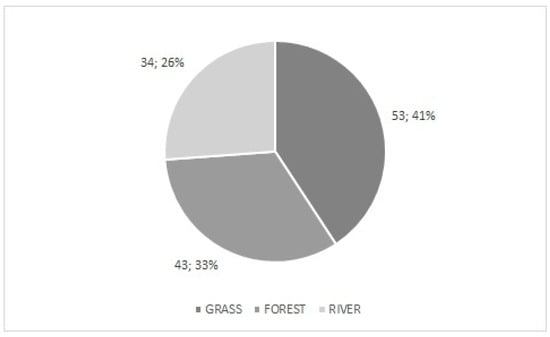
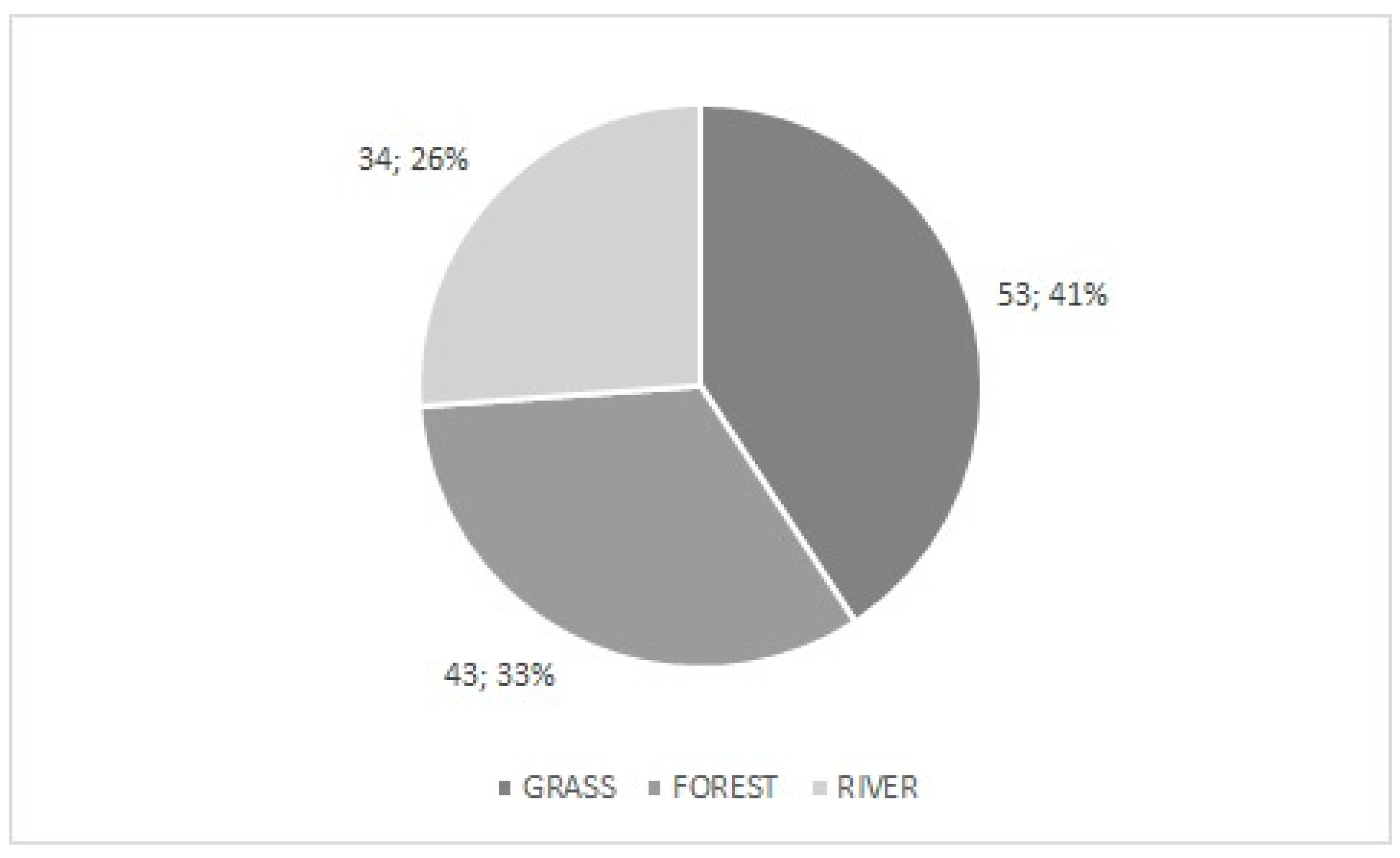
At the same time, a list of the most representative animal species living in the basin was realized, according to [37]. The list includes a total number of 130 species (Appendix B). Finally, the ecological types of fluvial fauna were assessed, distinguished in grassland (41%), forest (33%), and riverine (26%), as shown in Figure 7.
Figure 7.
The percentage of ecological types of animals in the basin of the Verri stream.
5. Discussion
The resulting data of the research, conducted in the littoral areas of Belmonte Calabro (Calabria, Southern Italy), confirm that marine and terrestrial environments show different approaches remaining actually disconnected. Also, the breaking up in patchy areas of coastal regions, caused by anthropic pressures, affects negatively landscape connectivity [38], and it is one of the main threats to biodiversity conservation [24]. Some anthropic pressures, such as quarrying plants widespread in the basin and some illegal uptakes of water from the stream for irrigation and agricultural purposes are affecting the ecological status of Verri’s catchment. These constraints hamper the potential of ICZM planning in the coastal region of Belmonte Calabro, such as the establishment of regional parks and the adoption of Nature Based Solutions (NBS) to improve the naturalization of this wilderness area. More generally, it has been remarked worldwide that, in the planning processes of coastal zones, the tight connections between landward and seaward sides are, frequently, ignored [25]. This gap could only be solved valuing the close relationships between continental and marine processes through the potential direction of fluvial and ecological corridors [39], as confirmed in the present case study. Land–sea connections must include natural processes, social interactions, and multiple threats originating in one environment and affecting the other [26,40]. Such conditions have already been observed in international programs of coastal planning but they have never been implemented in a consistent marine policy [41]. One of the troubles of integrating land–sea planning in coastal management is the lack of coordination between institutions, governments, departments, stakeholders, and policy makers [42]. However, a sound coastal governance, considering land–sea connections, faces three main challenges, as are [43]
- The correct determination of boundaries;
- The most suitable scales for coastal management;
- The development of a public knowledge.
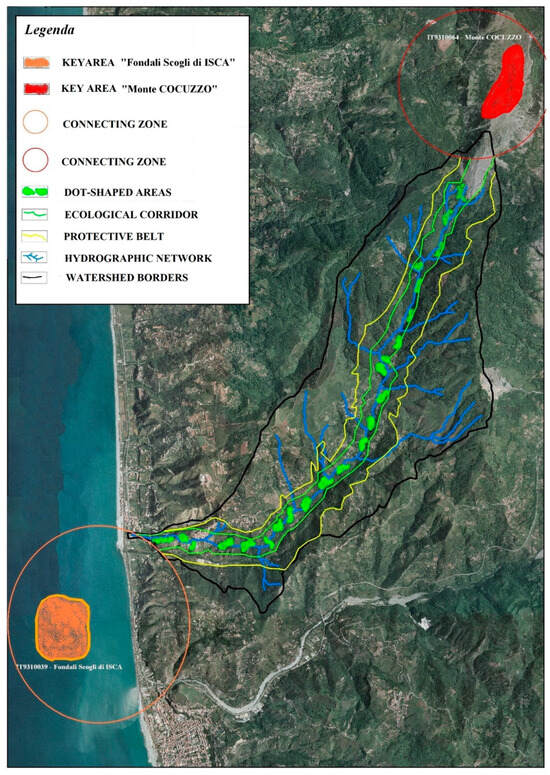
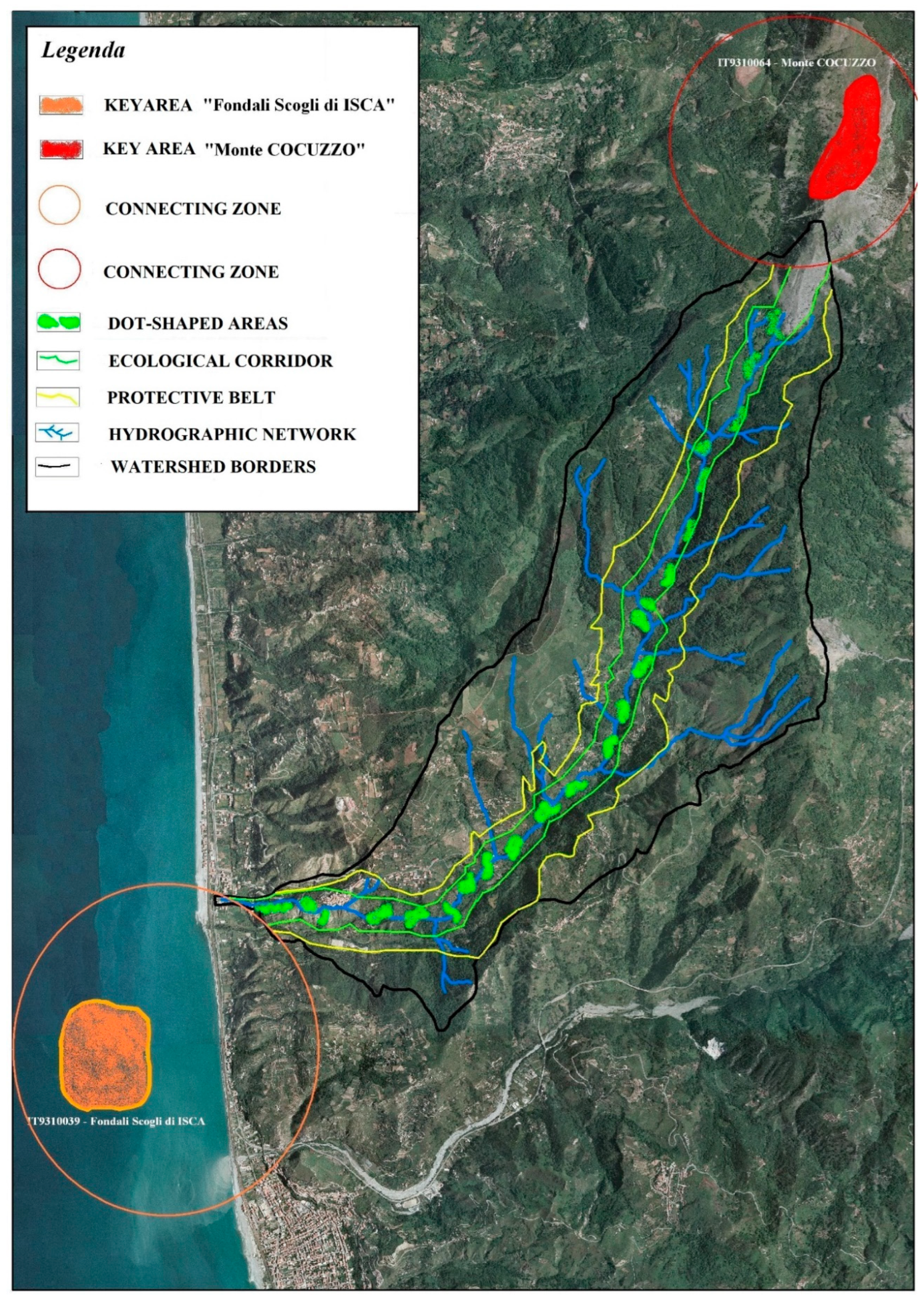
So, the Verri stream represents an ideal model of the ecological and fluvial corridor able to link two terrestrial and marine SACs, where it could be possible to realize the landscape connections between the landward and seaward sides of the same coastal region (Figure 8). Finally, in the Calabria region, the fundamental role of fluvial catchments must be emphasized as connecting steps able to merge marine and continental protected areas in the implementation of Natura 2000 network. In this kind of assessment, all the ecological processes could be mediated by fluvial downflows able to connect terrestrial, fluvial, and marine ecosystems for biodiversity conservation [27,44,45]. According to this integrated approach to coastal region, it is possible to address possible financial means towards an effective environmental protection so as to maximize the benefits deriving from the implementation of Natura 2000 network [46,47]. Such a new kind of territorial planning should value, also, all the social and economic relationships between terrestrial and marine environments where local people represent an important linking thread of the regional landscape. Most of the local people live in the coastal region between the littoral towns of Belmonte Calabro (Cs) and Amantea (Cs), affecting the complex dynamics of all the ecological processes interacting in this area. These relationships are marked in the coastal zone of Belmonte Calabro where the legacy between the marine and terrestrial ecosystems are mediated by the catchment of the Verri stream. The protection and the enhancement of the fluvial basin could attract a great tourist flow from the Marine Regional Park “Fondali Scogli di Isca” towards the waterway of the Verri stream. This trend could lead to financial benefits for local people [28,29,48] opening new chances in tourist sectors such as fishing activities, scuba diving, and natural trips.
Figure 8.
The ecological and fluvial corridor of the Verri stream linking terrestrial and marine SACs (Legend: the terrestrial and marine SACs are marked in orange and red colors; the ecological corridor of the Verri’s stream and the dot shaped areas, inside the riparian belt, are outlined in green color).
6. Conclusions
The resulting data highlight the important role of the fluvial catchment of Verri’s stream, as ecological corridor within Natura 2000 network [30,31,49,50] not only for the several plant and animal species living in the basin connected in the same environmental unit. In regard to fluvial catchments, it is necessary to protect them, improving all the efforts for an effective biodiversity conservation, including the protection of some target species, the establishment of new protected areas, a rationale land use planning, the realization of fish ways, the removal of obsolete bridles and dams obstructing the principle of “water continuum” [51], and the implementation of habitat restoration programs [52].
In Calabria, the issue of natural protection should be inserted within a new kind of vision able to develop from a narrow perspective “like a dot” to another one “at wide areas” [53]. To realize this difficult enterprise, it is necessary to involve municipal planning options within a bottom-up process able to realize the most effective efforts to fit these environmental tools into an integrated process. The goal could be achieved through a full implementation of the Natura 2000 network able to connect marine and terrestrial ecosystems within a texture of fluvial and ecological corridors. A real and effective connection between the seaward and landward sides of coastal region could favor the movement of plant and animal species to assure ideal conditions for biodiversity conservation [54,55,56,57].
These territorial linkages could be located along the regional fluvial basins, and amongst them, the catchment of the Verri stream represents an ideal model of the network. According to a global approach, policy makers, scientists, stakeholders, and public managers should be involved and could work altogether for a sound management of coastal regions [58,59,60].
This pilot project represents a potential pattern for other similar studies in Mediterranean coastal regions where fluvial corridors could become linking steps between terrestrial and marine environments within the Natura 2000 network. In conclusion, littoral and continental zones should form a joint environmental system where marine, fluvial, and terrestrial ecosystems become strictly bound with the social and economic pattern of the region.
Funding
This research received no external funding.
Informed Consent Statement
This study does not include any research with live animals performed by the author.
Data Availability Statement
Data will be made available on request.
Conflicts of Interest
The author declares no conflicts of interest.
Appendix A
Inventory of plant species inhabiting the fluvial corridor of Verri stream in the Calabria region (Southern Italy). The ecological types of the species are classified as Xerophyta, Mesophyta, Hygrophyta, and Hydrophyta. The list includes 189 species, inlcuding 71 Xerophyta, 26 Mesophyta, 84 Hygrophyta, and 8 Hydrophyta.
| Divisions | Classes | Orders | Families | Species | Ecological Types |
| Magnoliophyta | Asteridi | Lamiales | Acanthaceae | Acanthus mollis L. | Xerophyta |
| Magnoliophyta | Monocotiledoni | Poales | Poaceae | Agropyron repens (L.) Beauv. | Xerophyta |
| Magnoliophyta | Eudicotiledoni | Sapindales | Simaroubaceae | Ailantus altissima (Miller) Swingle | Mesophyta |
| Magnoliophyta | Eudicotiledoni | Fagales | Betulaceae | Alnus cordata (Loisel.) Desf. | Igrophyta |
| Magnoliophyta | Eudicotiledoni | Fagales | Betulaceae | Alnus glutinosa (L.) Gaertner | Igrophyta |
| Magnoliophyta | Eudicotiledoni | Caryophyllales | Amaranthaceae | Amaranthus retroflexus L. | Xerophyta |
| Magnoliophyta | Monocotiledoni | Asparagales | Orchidaceae | Anacamptis papilionacea (L.) R.M. Bateman, Pridgeon and M.W. Chase | Xerophyta |
| Magnoliophyta | Eudicotiledoni | Ericales | Primulaceae | Anagallis arvensis L. | Xerophyta |
| Magnoliophyta | Eudicotiledoni | Ericales | Primulaceae | Anagallis foemina Miller | Xerophyta |
| Magnoliophyta | Eudicotiledoni | Apiales | Apiaceae | Apium nodiflorum (L.) | Idrophyta |
| Magnoliophyta | Eudicotiledoni | Ericales | Ericaceae | Arbutus unedo L. | Xerophyta |
| Magnoliophyta | Eudicotiledoni | Asterales | Asteraceae | Arctium minus (Hill) Bernh. | Igrophyta |
| Magnoliophyta | Monocotiledoni | Alismatales | Araceae | Arisarum vulgare Targ. Tozz. | Mesophyta |
| Magnoliophyta | Monocotiledoni | Poales | Poaceae | Arundo donax L. | Idrophyta |
| Magnoliophyta | Monocotiledoni | Asparagales | Asparagaceae | Asparagus acutifolius L. | Xerophyta |
| Magnoliophyta | Monocotiledoni | Asparagales | Asphodelaceae | Asphodelus microcarpus Salzm. Et Viv. | Xerophyta |
| Pteridophyta | Polypodiopsida | Polypodiales | Asplenaceae | Asplenium ceterach L. | Igrophyta |
| Pteridophyta | Polypodiopsida | Polypodiales | Aspleniaceae | Asplenium ruta-muraria L. | Xerophyta |
| Pteridophyta | Polypodiopsida | Polypodiales | Aspleniaceae | Phyllitis scolopendrium L. | Igrophyta |
| Magnoliophyta | Monocotiledoni | Poales | Poaceae | Avena barbata Potter | Mesophyta |
| Magnoliophyta | Monocotiledoni | Poales | Poaceae | Avena fatua L. | Mesophyta |
| Magnoliophyta | Eudicotiledoni | Boraginales | Boraginaceae | Borago officinalis L. | Mesophyta |
| Magnoliophyta | Eudicotiledoni | Brassicales | Brassicaceae | Cakile maritima Scop. | Xerophyta |
| Magnoliophyta | Eudicotiledoni | Lamiales | Lamiaceae | Calamintha nepeta (L.) Savi | Xerophyta |
| Magnoliophyta | Eudicotiledoni | Asterales | Campanulaceae | Campanula trachelium L. | Mesophhyta |
| Magnoliophyta | Eudicotiledoni | Brassicales | Capparaceae | Capparis spinosa L. | Xerophyta |
| Magnoliophyta | Eudicotiledoni | Brassicales | Brassicaceae | Capsella bursa-pastoris L. | Mesophyta |
| Magnoliophyta | Eudicotiledoni | Fagales | Fagaceae | Castanea sativa Miller | Mesophyta |
| Magnoliophyta | Eudicotiledoni | Fabales | Fabaceae | Ceratonia siliqua L. | Xerophyta |
| Magnoliophyta | Eudicotiledoni | Ranunculales | Papaveraceae | Chelidonium majus L. | Igrophyta |
| Magnoliophyta | Eudicotiledoni | Caryophyllales | Amaranthaceae | Chenopodium album L. | Xerophyta |
| Magnoliophyta | Eudicotiledoni | Asterales | Asteraceae | Cichorium intybus L. | Igrophyta |
| Magnoliophyta | Eudicotiledoni | Asterales | Asteraceae | Cirsium arvense (L.) Scop. | Igrophyta |
| Magnoliophyta | Eudicotiledoni | Malvales | Cistaceae | Cistus creticus L. | Xerophyta |
| Magnoliophyta | Eudicotiledoni | Malvales | Cistaceae | Cistus salvifolius L. | Xerophyta |
| Magnoliophyta | Eudicotiledoni | Ranunculales | Ranunculaceae | Clematis vitalba L. | Igrophyta |
| Magnoliophyta | Eudicotiledoni | Fabales | Fabaceae | Colutea arborescens L. | Xerophyta |
| Magnoliophyta | Eudicotiledoni | Ranunculales | Ranunculaceae | Consolida regalis S.F. Gray | Xerophyta |
| Magnoliophyta | Eudicotiledoni | Solanales | Convolvulaceae | Convolvulus arvensis L. | Igrophyta |
| Magnoliophyta | Eudicotiledoni | Solanales | Convolvulaceae | Convolvulus sepium L. | Igrophyta |
| Magnoliophyta | Eudicotiledoni | Rosales | Rosaceae | Crataegus monogyna Jacq. | Xerophyta |
| Magnoliophyta | Eudicotiledoni | Apiales | Apiaceae | Crithmum maritimum L. | Xerophyta |
| Magnoliophyta | Eudicotiledoni | Ericales | Primulaceae | Cyclamen hederifolium Aiton | Igrophyta |
| Magnoliophyta | Monocotiledoni | Poales | Poaceae | Cynodon dactylon (L.) Pers. | Xerophyta |
| Magnoliophyta | Monocotiledoni | Poales | Cyperaceae | Cyperus longus L. | Idrophyta |
| Magnoliophyta | Monocotiledoni | Poales | Cyperaceae | Cyperus rotundus L. | Igrophyta |
| Magnoliophyta | Eudicotiledoni | Solanales | Solanaceae | Datura stramonium L. | Mesophyta |
| Magnoliophyta | Eudicotiledoni | Apiales | Apiaceae | Daucus carota L. | Xerophhyta |
| Magnoliophyta | Eudicotiledoni | Lamiales | Plantaginaceae | Digitalis ferruginea L. | Mesophyta |
| Magnoliophyta | Eudicotiledoni | Lamiales | Plantaginaceae | Digitalis micrantha Roth | Mesophyta |
| Magnoliophyta | Monocotiledoni | Poales | Poaceae | Digitaria sanguinalis (L.) Scop. | Igrophyta |
| Magnoliophyta | Eudicotiledoni | Brassicales | Brassicaceae | Diplotaxis tenuifolia (L.) D.C. | Xerophyta |
| Magnoliophyta | Eudicotiledoni | Dipsacales | Dipsacaceae | Dipsacus fullonum L. | Mesophyta |
| Magnoliophyta | Eudicotiledoni | Cucurbitales | Cucurbitaceae | Ecballium elaterium (L) A. Richard | Xerophyta |
| Magnoliophyta | Eudicotiledoni | Apiales | Apiacae | Echinophora spinosa L. | Xerophyta |
| Magnoliophyta | Eudicotiledoni | Boraginales | Boraginaceae | Echium italicum L. | Xerophyta |
| Magnoliophyta | Eudicotiledoni | Boraginales | Boraginaceae | Echium vulgare L. | Xerophyta |
| Magnoliophyta | Eudicotiledoni | Myrtales | Onagraceae | Epilobium hirsutum L. | Idrophyta |
| Pteridophyta | Equisetopsida | Equisetales | Equisetaceae | Equisetum arvense L. | Igrophyta |
| Pteridophyta | Equisetopsida | Equisetales | Equisetaceae | Equisetum ramosissimum Desf. | Xerophta |
| Pteridophyta | Equisetopsida | Equisetales | Equisetaceae | Equisetum telmateja Ehrh. | Igrophyta |
| Magnoliophyta | Eudicotiledoni | Ericales | Ericaceae | Erica arborea L. | Xerophyta |
| Magnoliophyta | Eudicotiledoni | Asterales | Asteraceae | Erigeron canadensis L. | Xerophyta |
| Magnoliophyta | Eudicotiledoni | Apiales | Apiacae | Eryngium maritimum L. | Igrophyta |
| Magnoliophyta | Eudicotiledoni | Asterales | Asteraceae | Eupatorium cannabinum L. | Igrophyta |
| Magnoliophyta | Eudicotiledoni | Malpighiales | Euphorbiaceae | Euphorbia dendroides L. | Xerophyta |
| Magnoliophyta | Eudicotiledoni | Malpighiales | Euphorbiaceae | Euphorbia helioscopia L. | Xerophyta |
| Magnoliophyta | Eudicotiledoni | Fagales | Fagacae | Fagus sylvatica L. | Mesophyta |
| Magnoliophyta | Eudicotiledoni | Apiales | Apiacae | Ferula communis L: | Xerophyta |
| Magnoliophyta | Eudicotiledoni | Apiales | Apiacae | Foeniculum vulgare Miller | Xerophyta |
| Magnoliophyta | Eudicotiledoni | Rosales | Rosaceae | Fragaria vesca L. | Igrophyta |
| Magnoliophyta | Eudicotiledoni | Ranunculales | Papaveraceae | Fumaria capreolata L. | Igrophyta |
| Magnoliophyta | Eudicotiledoni | Ranunculales | Papaveraceae | Fumaria officinalis L. | Xerophyta |
| Magnoliophyta | Monocotiledoni | Asparagales | Amaryllidaceae | Galanthus nivalis L. | Igrophyta |
| Magnoliophyta | Eudicotiledoni | Gentianales | Rubiaceae | Galium album Miller | Xerophyta |
| Magnoliophyta | Eudicotiledoni | Gentianales | Rubiaceae | Galium verum L. | Xerophyta |
| Magnoliophyta | Eudicotiledoni | Asparagales | Iridaceae | Gladiolus italicus Miller | Xerophyta |
| Magnoliophyta | Eudicotiledoni | Ranunculales | Papaveraceae | Glaucium flavum Crantz | Xerophyita |
| Magnoliophyta | Eudicotiledoni | Apiales | Araliaceae | Hedera elix L. | Igrophyta |
| Magnoliophyta | Eudicotiledoni | Malvales | Cistaceae | Helianthemum apenninum L. (Miller) | Xerophyta |
| Magnoliophyta | Eudicotiledoni | Malvales | Cistaceae | Helianthemum nummularium (L.) Miller | Xerophyta |
| Magnoliophyta | Eudicotiledoni | Asterales | Asteraceae | Helichrysum italicum (Roth) Don. | Xerophyta |
| Magnoliophyta | Monocotiledoni | Poales | Poaceae | Hordeum murinum L. | Mesophyta |
| Magnoliophyta | Eudicotiledoni | Saxifragales | Crassulaceae | Hylotelephium maximum (L.) Holub | Xerophyta |
| Magnoliophyta | Eudicotiledoni | Malpighiales | Hypericaceae | Hypericum perforatum L. | Xerophyta |
| Magnoliophyta | Eudicotiledoni | Dipsacales | Dipsacaceae | Knautia arvensis (L.) Coulter | Xerophyta |
| Magnoliophyta | Monocotiledoni | Poales | Poaceae | Lagurus ovatus L. | Xerophyta |
| Magnoliophyta | Monocotiledoni | Poales | Poaceae | Lolium perenne L. | Igrophyta |
| Magnoliophyta | Eudicotiledoni | Dipsacales | Caprifoliaceae | Lonicera etrusca L. | Mesophyta |
| Magnoliophyta | Eudicotiledoni | Malvales | Malvaceae | Malva sylvestris L. | Igrophyta |
| Magnoliophyta | Eudicotiledoni | Asterales | Asteraceae | Matricaria chamomilla L. | Mesophyta |
| Magnoliophyta | Eudicotiledoni | Fabales | Fabaceae | Medicago sativa L. | Xerophyta |
| Magnoliophyta | Eudicotiledoni | Myrtales | Myrtaceae | Myrtus communis L. | Igrophyta |
| Magnoliophyta | Monocotiledoni | Asparagales | Asparagaceae | Muscari comosum (L.) Miller | Xerophyta |
| Magnoliophyta | Eudicotiledoni | Brassicales | Brassicaceae | Nasturtium officinale R. Br. | Idrophyta |
| Magnoliophyta | Eudicotiledoni | Solanales | Solanaceae | Nicotiana glauca Graham | Xerophyta |
| Magnoliophyta | Eudicotiledoni | Ranunculales | Ranunculaceae | Nigella damascena L. | Xerophyta |
| Magnoliophyta | Monocotiledoni | Asparagales | Orchidacae | Ophyris sphegodes Miller | Xerophyta |
| Magnoliophyta | Eudicotiledoni | Caryophyllales | Cactaceae | Opuntia ficus-indica (L.) Miller | Xerophyta |
| Magnoliophyta | Monocotiledoni | Asparagales | Orchidaceae | Orchis antropophora (L.) All. | Xerophyta |
| Magnoliophyta | Monocotiledoni | Asparagales | Orchidaceae | Orchis provincialis Balb. | Mesophyta |
| Magnoliophyta | Eudicotiledoni | Lamiales | Lamiaceae | Origanum heracleoticum L. | Xerophyta |
| Magnoliophyta | Monocotiledoni | Asparagales | Asparagaceae | Ornithogalum umbellatum L. | Igrophyta |
| Magnoliophyta | Eudicotiledoni | Oxalidales | Oxalidaceae | Oxalis pes-caprae (Miller) L. | Mesophyta |
| Magnoliophyta | Eudicotiledoni | Ranunculales | Papaveraceae | Papaver dubium L. | Igrophyta |
| Magnoliophyta | Eudicotiledoni | Ranunculales | Papaveraceae | Papaver rhoeas L. | Mesophyta |
| Magnoliophyta | Eudicotiledoni | Rosales | Urticaceae | Parietaria judaica L. | Xerophyta |
| Magnoliophyta | Eudicotiledoni | Rosales | Urticaceae | Parietaria lusitanica L. | Igrophyta |
| Magnoliophyta | Eudicotiledoni | Rosales | Urticaceae | Parietaria officinalis L. | Igrophyta |
| Magnoliophyta | Eudicotiledoni | Asterales | Asteraceae | Petasites hybridus (L.) Gaertner | Igrophyta |
| Magnoliophyta | Monocotiledoni | Poales | Poaceae | Phalaris paradoxa L. | Igrophyta |
| Magnoliophyta | Monocotiledoni | Poales | Poaceae | Phragmites australis L. | Idrophyta |
| Magnoliophyta | Eudicotiledoni | Sapindales | Anacardiaceae | Pistacia lentiscus L. | Xerophyta |
| Magnoliophyta | Eudicotiledoni | Lamiales | Plantaginaceae | Plantago lanceolata L. | Igrophyta |
| Magnoliophyta | Eudicotiledoni | Lamiales | Plantaginaceae | Plantago major L. | Igrophyta |
| Magnoliophyta | Eudicotiledoni | Caryophyllales | Polygonaceae | Polygonum arenastrum Boreau | Igrophyta |
| Magnoliophyta | Eudicotiledoni | Caryophyllales | Polygonaceae | Polygonum maculosa Gray | Igrophyta |
| Magnoliophyta | Monocotiledoni | Poales | Poaceae | Polypogon monspeliensis (L.) Desf. | Igrophyta |
| Magnoliophyta | Monocotiledoni | Poales | Poaceae | Polypogon viridis (Gouan) Breistr. | Igrophyta |
| Magnoliophyta | Eudicotiledoni | Malpighiales | Salicaceae | Popolus alba L. | Igrophyta |
| Magnoliophyta | Eudicotiledoni | Malpighiales | Salicaceae | Popolus canadensis L. | Igrophyta |
| Magnoliophyta | Eudicotiledoni | Malpighiales | Salicaceae | Popolus nigra L. | Igrophyta |
| Magnoliophyta | Eudicotiledoni | Caryophyllales | Portulacaceae | Portulaca oleracea L. | Igrophyta |
| Magnoliophyta | Eudicotiledoni | Ericales | Primulaceae | Primula vulgaris Hudson | Igrophyta |
| Magnoliophyta | Eudicotiledoni | Rosales | Rosaceae | Prunus spinosa L. | Xerophyta |
| Pteridophyta | Polypodiopsida | Polypodiales | Dennstaedtiaceae | Pteridium aquilinum (L.) Kuhn | Igrophyta |
| Magnoliophyta | Eudicotiledoni | Fagales | Fagaceae | Quercus cerris L. | Igrophyta |
| Magnoliophyta | Eudicotiledoni | Fagales | Fagaceae | Quercus frainetto Ten. | Mesophyta |
| Magnoliophyta | Eudicotiledoni | Fagales | Fagaceae | Quercus ilex L. | Xerophyta |
| Magnoliophyta | Eudicotiledoni | Fagales | Fagaceae | Quercus petraea (Mattushka) Liebl. | Xerophyta |
| Magnoliophyta | Eudicotiledoni | Fagales | Fagaceae | Quercus pubescens Willd. | Xerophyta |
| Magnoliophyta | Eudicotiledoni | Fagales | Fagaceae | Quercus suber L. | Xerophyta |
| Magnoliophyta | Eudicotiledoni | Ranunculales | Ranunculaceae | Ranunculus repens L. | Igrophyta |
| Magnoliophyta | Eudicotiledoni | Malpighiales | Euphorbiaceae | Ricinus communis L. | Igrophyta |
| Magnoliophyta | Eudicotiledoni | Fabales | Fabaceae | Robinia pseudoacacia L. | Mesophyta |
| Magnoliophyta | Monocotiledoni | Asparagales | Iridaceae | Romulea bulbocodium (L.) Seb. et Mauri | Xerophyta |
| Magnoliophyta | Eudicotiledoni | Rosales | Rosaceae | Rosa canina L. | Mesophyta |
| Magnoliophyta | Eudicotiledoni | Rosales | Rosaceae | Rubus fruticosus L. | Igrophyta |
| Magnoliophyta | Eudicotiledoni | Caryophyllales | Polygonaceae | Rumex spinosus L. | Igrophyta |
| Magnoliophyta | Monocotiledoni | Asparagales | Asparagaceae | Ruscus aculeatus L. | Mesophyta |
| Magnoliophyta | Eudicotiledoni | Malpighiales | Salicaceae | Salix alba L. | Igrophyta |
| Magnoliophyta | Eudicotiledoni | Dipsacales | Viburnaceae | Sambucus ebulus L. | Igrophyta |
| Magnoliophyta | Eudicotiledoni | Dipsacales | Viburnaceae | Sambucus nigra L. | Igrophyta |
| Magnoliophyta | Eudicotiledoni | Caryophyllales | Caryophyllaceae | Saponaria officinalis L. | Igrophyta |
| Magnoliophyta | Monocotiledoni | Asparagales | Asparagaceae | Scilla bifolia L. | Igrophyta |
| Magnoliophyta | Monocotiledoni | Asparagales | Orchidaceae | Serapias lingua L. | Igrophyta |
| Magnoliophyta | Monocotiledoni | Poales | Poaceae | Setaria italica (L.) Beauv. | Xerophyta |
| Magnoliophyta | Monocotiledoni | Poales | Poaceae | Setaria pumila (Poir.) Roem. and Schult. | Xerophyta |
| Magnoliophyta | Monocotiledoni | Asparagales | Orchidaceae | Serapias vomeracea (Burm.) Briq. | Xerophyta |
| Magnoliophyta | Monocotiledoni | Poales | Poaceae | Setaria verticillata (L.) Beauv. | Igrophyta |
| Magnoliophyta | Eudicotiledoni | Caryophyllales | Caryophyllaceae | Silene vulgaris (Moenk) Garke | Mesophyta |
| Magnoliophyta | Monocotiledoni | Liliales | Smilacaceae | Smilax aspera L. | Igrophya |
| Magnoliophyta | Eudicotiledoni | Solanales | Solanaceae | Solanum dulcamara L. | Igrophyta |
| Magnoliophyta | Eudicotiledoni | Solanales | Solanaceae | Solanum nigrum L. | Igrophyta |
| Magnoliophyta | Eudicotiledoni | Solanales | Solanaceae | Solanum villosum Mill. | Igrophyta |
| Magnoliophyta | Eudicotiledoni | Asterales | Asteraceae | Sonchus oleraceus L. | Igrophyta |
| Magnoliophyta | Eudicotiledoni | Fabales | Fabaceae | Spartium junceum L. | Xerophyta |
| Magnoliophyta | Eudicotiledoni | Caryophyllales | Caryophyllaceae | Stellaria media L. | Igrophyta |
| Magnoliophyta | Eudicotiledoni | Fabales | Fabaceae | Sulla coronaria (L.) B.H. Choi and H. Ohashi | Xerophyta |
| Magnoliophyta | Eudicotiledoni | Caryophyllales | Tamaricaceae | Tamarix gallica L. | Igrophyta |
| Magnoliophyta | Monocotiledoni | Discoreales | Discoreaceae | Tamus communis L. | Igrophta |
| Magnoliophyta | Eudicotiledoni | Asterales | Asteraceae | Taraxacum officinale Weber | Mesophyta |
| Magnoliophyta | Eudicotiledoni | Asterales | Campanulaceae | Trachelium coeruleum L. | Igrophytra |
| Magnoliophyta | Eudicotiledoni | Asterales | Asteraceae | Tragopogon porrifolius L. | Xerophyta |
| Magnoliophyta | Eudicotiledoni | Fabales | Fabaceae | Trigonella alba (Medik.) Coulot and Rabaute | Igrophyta |
| Magnoliophyta | Eudicotiledoni | Fabales | Fabaceae | Trigonella officinalis (Medik.) Coulot and Rabaute | Igrophyta |
| Magnoliophyta | Eudicotiledoni | Fabales | Fabaceae | Trifolium pratense L. | Igrophyta |
| Magnoliophyta | Eudicotiledoni | Fabales | Fabaceae | Trifolium repens L. | Igrophyta |
| Magnoliophyta | Monocotiledoni | Poales | Poaceae | Tripidium ravennae (L.) H. Scholz | Idrophyta |
| Magnoliophyta | Eudicotiledoni | Asterales | Asteraceae | Tussilago farfara L. | Igrophyta |
| Magnoliophyta | Monocotiledoni | Poales | Typhaceae | Typha latifolia L. | Idrophyta |
| Magnoliophyta | Eudicotiledoni | Rosales | Ulmaceae | Ulmus minor Miller | Igrophyta |
| Magnoliophyta | Eudicotiledoni | Saxifragales | Crassulaceae | Umbilicus rupestris (Salisbury) Dandy | Igrophyta |
| Magnoliophyta | Eudicotiledoni | Rosales | Urticaceae | Urtica dioica L. | Igrophyta |
| Magnoliophyta | Eudicotiledoni | Rosales | Urticaceae | Urtica urens L. | Igrophyta |
| Magnoliophyta | Eudicotiledoni | Lamiales | Verbenaceae | Verbena officinalis L. | Igrophyta |
| Magnoliophyta | Eudicotiledoni | Lamiales | Plantaginaceae | Veronica anagallis-aquatica L. | Igrophyta |
| Magnoliophyta | Eudicotiledoni | Lamiales | Plantaginaceae | Veronica chamaedrys L. | Igrophyta |
| Magnoliophyta | Eudicotiledoni | Fabales | Fabaceae | Vicia sativa L. | Xerophyta |
| Magnoliophyta | Eudicotiledoni | Gentianales | Apocynaceae | Vinca major L. | Igrophyta |
| Magnoliophyta | Eudicotiledoni | Malpighiales | Violaceae | Viola odorata L. | Mesophyta |
| Magnoliophyta | Eudicotiledoni | Santalales | Santalaceae | Viscum album L. | Igrophyta |
| Magnoliophyta | Eudicotiledoni | Lamiales | Lamiaceae | Vitex agnus-castus L. | Igrophyta |
| Magnoliophyta | Eudicotiledoni | Asterales | Asteraceae | Xanthium strumarium L. | Xerophyta |
Appendix B
Inventory of animal species inhabiting the fluvial corridor of the Verri stream in the Calabria region (Southern Italy). The list includes 130 animal species, including 53 grasslands, 43 forest, and 34 fluvial.
| Divisions | Classes | Orders | Families | Species | Ecological Types |
| Arthropoda | Insecta | Lepidoptera | Sphingidae | Acherontia atropos L. | Forest |
| Arthropoda | Insecta | Orthoptera | Acrididae | Acrida bicolor Thunberg, 1815 | Grass |
| Arthropoda | Insecta | Lepidoptera | Nynphalidae | Aglais io L. | Forest |
| Arthropoda | Insecta | Odonata | Coenagrionidae | Agrion puella L. | River |
| Chordata | Aves | Passeriformes | Alaudidae | Alauda arvensis L. | Grass |
| Chordata | Actinopterygii | Anguilliformes | Anguillidae | Anguilla anguilla L. | River |
| Chordata | Reptilia | Squamata | Anguidae | Anguis fragilis L. | River |
| Chordata | Mammalia | Rodentia | Muridae | Apodemus sylvaticus L. | Forest |
| Chordata | Aves | Apodiformes | Apodidae | Apus apus L. | Grass |
| Mollusca | Gastropoda | Stylommatophora | Arionidae | Arion hortensis Fèrrusac, 1819 | Grass |
| Chordata | Mammalia | Rodentia | Cricetidae | Arvicola terrestris L. | River |
| Chordata | Aves | Strigiformes | Strigidae | Asio otus L. | Forest |
| Chordata | Aves | Strigiformes | Strigidae | Athene noctua Scopoli, 1769 | Grass |
| Arthropoda | Insecta | Phasmatodea | Bacillidae | Bacillus rossius Rossi, 1788 | River |
| Arthropoda | Insecta | Hymenoptera | Apidae | Bombus terrestris L. | Grass |
| Chordata | Amphibia | Anura | Bufonidae | Bufo bufo L. | River |
| Chordata | Aves | Accipitriformes | Accipitridae | Buteo buteo L. | Forest |
| Arthropoda | Insecta | Orthoptera | Acrididae | Calliptamus italicus L. | Grass |
| Chordata | Aves | Passeriformes | Fringillidae | Carduelis cannabina L. | Grass |
| Chordata | Aves | Passeriformes | Fringillidae | Carduelis carduelis L. | Grass |
| Chordata | Aves | Passeriformes | Fringillidae | Carduelis spinus L. | Forest |
| Arthropoda | Insecta | Coleoptera | Scarabaeidae | Ceratonia aurata L. | Forest |
| Chordata | Aves | Passeriformes | Cettiidae | Cettia cetti Temminck, 1820 | River |
| Chordata | Aves | Passeriformes | Fringillidae | Chloris chloris L. | Forest |
| Arthropoda | Insecta | Coleoptera | Chrysomelidae | Chrysolina grossa L. | River |
| Chordata | Aves | Passeriformes | Cinclidae | Cinclus cinclus L. | River |
| Arthropoda | Insecta | Coleoptera | Coccinelidae | Coccinella septempunctata L. | Grass |
| Chordata | Aves | Passeriformes | Corvidae | Convus cornix L. | Grass |
| Mollusca | Gastropoda | Styllomatophora | Helicidae | Cornu aspersum Müller, 1774 | Forest |
| Chordata | Aves | Passeriformes | Corvidae | Corvus corax L. | Grass |
| Chordata | Aves | Passeriformes | Corvidae | Corvus moneduloides L. | Grass |
| Arthropoda | Insecta | Lepidoptera | Cossidae | Cossu cossus L. | River |
| Chordata | Aves | Galliformes | Phasianidae | Coturnix coturnix L. | Grass |
| Chordata | Aves | Cuculiformes | Cuculidae | Cuculus canorus L. | Forest |
| Arthropoda | Insecta | Diptera | Culicidae | Culex pipiens L. | Forest |
| Chordata | Aves | Passeriformes | Hirundinidae | Delichon urbicum L. | Grass |
| Arthropoda | Insecta | Orthoptera | Acrididae | Dociostauros maroccanus Thunberg, 1815 | Grass |
| Chordata | Aves | Passeriformes | Emberizidae | Emberiza cirlus L. | Forest |
| Chordata | Mammalia | Eulypotiphla | Erinaceidae | Erinaceus europaeus L. | Grass |
| Chordata | Aves | Passeriformes | Muscicapidae | Erithacus rubecola L. | Forest |
| Arthropoda | Insecta | Hemiptera | Pentatomidae | Eurydema ornata L. | Grass |
| Chordata | Aves | Falconiformes | Falconidae | Falco tinninculus L. | Forest |
| Arthropoda | Insecta | Dermaptera | Forficulidae | Forficula auricularia L. | River |
| Arthropoda | Insecta | Neuroptera | Myrmeleontidae | Formicaleo telegrammicus L. | Grass |
| Chordata | Aves | Passeriformes | Fringillidae | Fringilla coelebs L. | Forest |
| Chordata | Aves | Gruiformes | Rallidae | Gallinula chloropus L. | River |
| Chordata | Aves | Passeriformes | Corvidae | Garrulus glandarius L. | Forest |
| Chordata | Mammalia | Rodentia | Gliridae | Glis glis L. | Forest |
| Arthropoda | Insecta | Lepidoptera | Pieridae | Gonepteryx rhamni L. | Forest |
| Arthropoda | Insecta | Orthoptera | Gryllotalpidae | Gryllotalpa gryllotalpa L. | River |
| Arthropoda | Insecta | Orthropoda | Gryllidae | Gryllus campestris L. | Grass |
| Mollusca | Gastropoda | Styllomatophora | Helicidae | Helix pomatia L. | River |
| Chordata | Reptilia | Squamata | Colubridae | Hierophis viridiflavus Lacépède, 1789 | River |
| Chordata | Aves | Passeriformes | Hirundidae | Hirundo rustica L. | Grass |
| Chordata | Amphibia | Anura | Hylidae | Hyla arborea L. | River |
| Chordata | Reptilia | Squamata | Sauria | Lacerta viridis Laurenti, 1768 | River |
| Arthropoda | Insecta | Coleoptera | Lampyridae | Lampyris noctiluca L. | Forest |
| Chordata | Aves | Passeriformes | Laridae | Lanius collurio L. | Grass |
| Chordata | Aves | Charadriiformes | Laridae | Larus cachinnans Pallas, 1811 | River |
| Chordata | Aves | Charadriiformes | Laridae | Larus ridibunus L. | River |
| Arthropoda | Insecta | Coleoptera | Chrysomelidae | Leptinotarsa decemlineata Say, 1824 | Grass |
| Arthropoda | Insecta | Orthoptera | Acrididae | Locusta migratoria L. | Grass |
| Chordata | Aves | Passeriformes | Muscicapidae | Luscinia megarhynchos Brehm, 1831 | Forest |
| Arthropoda | Insecta | Coleoptera | Meloidae | Lytta vesicatoria L. | Grass |
| Arthropoda | Insecta | Lepidoptera | Sphingidae | Macroglossum stellatarum L. | Grass |
| Arthropoda | Insecta | Lepidoptera | Lasiocampidae | Malacosoma neustria L. | Forest |
| Arthropoda | Insecta | Mantoidea | Mantidae | Mantis religiosa L. | Grass |
| Chordata | Mammalia | Carnivora | Mustelidae | Martes foina Erxleben, 1777 | Forest |
| Chordata | Mammalia | Carnivora | Mustelidae | Meles meles L. | Forest |
| Chordata | Mammalia | Rodentia | Cricetidae | Microtus arvalis Pallas, 1778 | Forest |
| Chordata | Aves | Passeriformes | Motacillidae | Motacilla alba L. | River |
| Chordata | Aves | Passeriformes | Motacillidae | Motacilla cinerea Tunnstall, 1758 | River |
| Chordata | Aves | Passeriformes | Motacillidae | Motacilla flava L. | River |
| Chordata | Mammalia | Rodentia | Muridae | Mus musculus L. | Grass |
| Chordata | Mammalia | Carnivora | Mustelidae | Mustela nivalis L. | Forest |
| Chordata | Mammalia | Carnivora | Mustelidae | Mustela putorius L. | River |
| Chordata | Reptilia | Squamata | Colubroidea | Natrix natrix L. | River |
| Chordata | Mammalia | Carnivora | Mustelidae | Nezara viridula L. | Grass |
| Arthropoda | Insecta | Orthoptera | Acrididae | Oedipoda coerulescens L. | Grass |
| Chordata | Aves | Passeriformes | Oriolidae | Oriolus oriolus L. | Forest |
| Arthropoda | Insecta | Lepidoptera | Papilionidae | Papilio machaon L. | River |
| Chordata | Aves | Passeriformes | Paridae | Parus coeruleus L. | Forest |
| Chordata | Aves | Passeriformes | Paridae | Parus major L. | Forest |
| Chordata | Aves | Passeriformes | Passeridae | Passer hispaniolensis Temmink, 1820 | Grass |
| Chordata | Aves | Passeriformes | Passeridae | Passer italiae Vieillot, 1817 | Grass |
| Chordata | Aves | Passeriformes | Passeridae | Passer montanus L. | Grass |
| Chordata | Amphibia | Anura | Ranidae | Pelophylax esculentus L. | River |
| Chordata | Aves | Galliformes | Phasianidae | Phasianus colchicus L. | River |
| Chordata | Aves | Passeriformes | Muscicapidae | Phoenicurus phoenicurus L. | Forest |
| Chordata | Aves | Passeriformes | Phylloscopidae | Phylloscopus collybita Veillot, 1817 | Forest |
| Chordata | Aves | Passeriformes | Phylloscopidae | Phylloscopus sibilatrix Bechstein, 1793 | Forest |
| Chordata | Aves | Passeriformes | Corvidae | Pica pica L. | Grass |
| Arthropoda | Insecta | Lepidoptera | Pieridae | Pieris brassicae L. | Grass |
| Arthropoda | Insecta | Lepidoptera | Pieridae | Pieris rapae L. | Grass |
| Chordata | Mammalia | Chiroptera | Vespertilionidae | Pipistrellus pipistrellus Schreber, 1774 | River |
| Chordata | Reptilia | Squamata | Sauria | Podarcis muralis Laurenti, 1768 | Grass |
| Chordata | Reptilia | Squamata | Lacertidae | Podarcis siculus Rafinesque, 1810 | Grass |
| Arthropoda | Insecta | Hymenoptera | Vespidae | Polistes gallicus L. | Grass |
| Arthropoda | Malacostraca | Decapoda | Potamidae | Potamon fluviatile Herbst, 1785 | River |
| Chordata | Mammalia | Rodentia | Muridae | Rattus rattus L. | River |
| Chordata | Amphibia | Urodela | Salamandridae | Salamandra salamandra L. | River |
| Chordata | Mammalia | Urodela | Salamandridae | Salamandrina terdigitata Bonnaterre, 1789 | River |
| Arthropoda | Insecta | Lepidoptera | Saturniidae | Saturnia pyri Denis et Schiffermüller, 1775 | Grass |
| Chordata | Aves | Charadiiformes | Scolopacidae | Scolopax rusticola L. | Forest |
| Chordata | Aves | Passeriformes | Fringillidae | Serinus serinus L. | Grass |
| Chordata | Aves | Columbiformes | Columbidae | Streptopelia turtur L. | Grass |
| Chordata | Aves | Strigiformes | Strigidae | Strix aluco L. | Forest |
| Chordata | Mammalia | Artiodactyla | Suidae | Sus scrofa L. | Forest |
| Chordata | Aves | Passeriformes | Sylviidae | Sylvia atricapilla L. | Forest |
| Chordata | Aves | Passeriformes | Sylviidae | Sylvia borin Boddaert, 1783 | Forest |
| Chordata | Aves | Passeriformes | Sylviidae | Sylvia communis Latham, 1787 | Forest |
| Chordata | Aves | Passeriformes | Sylviidae | Sylvia melanocephala Gmelin, 1789 | Grass |
| Chordata | Aves | Passeriformes | Sylviidae | Sylvia undata Boddaert, 1783 | Grass |
| Arthropoda | Insecta | Odonata | Libellulidae | Sympetrum flaveolum L. | River |
| Arthropoda | Insecta | Odonata | Libellulidae | Sympetrum pedemontanum Allioni, 1766 | River |
| Chordata | Mammalia | Soricomorpha | Talpidae | Talpa romana Thomas, 1902 | Forest |
| Chordata | Reptilia | Squamata | Phyllodactylidae | Tarentola mauritanica L. | Forest |
| Arthropoda | Insecta | Orthoptera | Tettigoniidae | Tettigonia viridissima Charpentier, 1854 | Grass |
| Arthropoda | Insecta | Hemiptera | Cicadidae | Tibicen plebeja Scopoli, 1763 | Forest |
| Chordata | Aves | Passeriformes | Troglodytidae | Troglodytes troglodytes L. | River |
| Chordata | Aves | Passeriformes | Turdidae | Turdus merula L. | Forest |
| Chordata | Aves | Passeriformes | Turdidae | Turdus musicus L. | Forest |
| Chordata | Aves | Strigiformes | Tytonidae | Tyto alba Scopoli, 1769 | Grass |
| Chordata | Aves | Bucerotiformes | Upupidae | Upupa epops L. | Grass |
| Arthropoda | Insecta | Lepidoptera | Nymphalidae | Vanessa atalanta L. | Grass |
| Arthropoda | Insecta | Hymenoptera | Vespidae | Vespa crabro L. | Grass |
| Chordata | Mammalia | Chiroptera | Vespertilionidae | Vespertillo serotinus Schreber, 1775 | Grass |
| Chordata | Mammalia | Carnivora | Canidae | Vulpes vulpes L. | Forest |
| Arthropoda | Insecta | Hymenoptera | Apidae | Xylocopa violacea L. | Grass |
| Arthropoda | Insecta | Lepidoptera | Zygaenidae | Zygaena filipendulae L. | Grass |
References
- Cañedo-Argüelles, M.; Brito, A.C.; Sen, I.; Roy, R. Editorial: Human impacts on river catchments and coastal ecosystems: A meta-ecosystem perspective. Front. Mar. Sci. 2023, 10, 1168296. [Google Scholar] [CrossRef] [Scilit]
- Lazzari, N.; Becerro, M.A.; Sanabria-Fernandez, J.A.; Martín-López, B. Spatial characterization of coastal marine social-ecological systems: Insights for integrated management. Environ. Sci. Policy 2019, 92, 56–65. [Google Scholar] [CrossRef] [Scilit]
- Badalamenti, F.; Ramos, A.; Voultsiadou, F.; Sánchex Lizaso, J.L.; D’Anna, G.; Pipitone, C.; Mas, J.; Ruiz Fernandez, J.A.; Whitmarsh, D.; Riggio, S. Cultural and socio-economic impact of Mediterranean marine protected areas. Environ. Conserv. 2000, 27, 110–125. [Google Scholar] [CrossRef] [Scilit]
- Charlier, R.H. Coastal Zone: Occupance, Management and Economic Competiveness. Ocean Shorel. Manag. 1989, 12, 383–402. [Google Scholar] [CrossRef] [Scilit]
- Mann, C.C.; Plummer, M.L. The High Cost of Biodiversity. Science 1993, 260, 1868–1871. [Google Scholar] [CrossRef] [Scilit]
- United Nations Centre for Human Settlements: Habitat II. Issues in the Integrated Planning and Management of River/Lake Basins and Coastal Areas. A Human Perspective; UN-Habitat: Nairobi, Kenya, 1996; pp. 1–57. [Google Scholar]
- European Commission. Towards a European Integrated Coastal Zone Management (ICZM) Strategy: General Principles and Policy Options; Office for Official Publication of the European Communities: Luxemburg, 1999; pp. 1–35. [Google Scholar]
- Barale, V.; Özhan, E. Advances in Integrated Coastal Management for the Mediterranean & Black Sea. J. Coast. Conserv. 2010, 14, 249–255. [Google Scholar] [CrossRef] [Scilit]
- Schneider, S.H. The Greenhouse Effect: Science and Policy. Science 1989, 243, 771–781. [Google Scholar] [CrossRef] [Scilit]
- Palmer, M.A.; Reidy Liermann, C.A.; Nilsson, C.; Flörke, M.; Alcamo, J.; Lake, P.S.; Bond, N. Climate change and the world’s river basins: Anticipating management options. Front. Ecol. Environ. 2008, 6, 81–89. [Google Scholar] [CrossRef] [Scilit]
- Biggs, R.; Schlüter, M.; Bohensky, E.; Burn-Silver, S.; Cundill, S.; Dakos, V.; Daw, T.; Evans, L.S.; Kotschy, K.; Leitch, A.M.; et al. Towards principles for enhancing the resilience of ecosystem services. Annu. Rev. Environ. Resour. 2012, 37, 421–448. [Google Scholar] [CrossRef] [Scilit]
- Groves, C.R.; Game, E.T.; Anderson, M.G.; Cross, M.; Enquist, C.; Ferdana, Z.; Shafer, S.L. Incorporating climate change into systematic conservation planning. Biodivers. Conserv. 2012, 21, 1651–1671. [Google Scholar] [CrossRef] [Scilit]
- Musarella, C.M.; Laface, V.L.A.; Angiolini, C.; Bacchetta, G.; Bajona, E.; Banfi, E.; Barone, G.; Biscotti, N.; Bonsanto, D.; Calvia, G.; et al. New alien plant taxa for Italy and Europe: An update. Plants 2024, 13, 620. [Google Scholar] [CrossRef] [Scilit]
- Montagnani, C.; Gentili, R.; Karrer, G.; Caronni, S.; Acosta, A.T.R.; Adorni, M.; Alessandrini, A.; Ardenghi, N.M.G.; Buffa, G.; Bartolucci, F.; et al. The invasion history of Ambrosia psilostachya (Asteraceae) in Italy: First record and distribution over more than one century. Plant Biosyst. 2025, 159, 522–533. [Google Scholar] [CrossRef] [Scilit]
- Finlayson, C.M.; Capon, S.J.; Rissik, D.; Pittock, J.; Fisk, G.; Davidson, N.C.; Bino, G. Policy considerations for managing wetlands under a changing climate. Mar. Freshw. Res. 2017, 68, 1803–1815. [Google Scholar] [CrossRef] [Scilit]
- Tomaselli, V.; Tenerelli, P.; Sciandrello, S. Mapping and quantifying habitat fragmentation in small coastal areas: A case study of three protected wetlands in Apulia (Italy). Environ. Monit. Assess. 2012, 184, 693–713. [Google Scholar] [CrossRef] [Scilit] [PubMed]
- Maceda-Veiga, A.; Mac Nally, R.; De Sostoa, A. The presence of non-native species is not associated with native fish sensitivity to water pollution in greatly hydrologically altered rivers. Sci. Total Environ. 2017, 607, 549–557. [Google Scholar] [CrossRef] [Scilit]
- Kies, F.; Kerfouf, A.; Elegbede, I.; Matemilola, S.; De Los Rios Escalante, M.P.; Khorchani, A.; Savari, S. Assessment of the coastal and estuarine environment quality of western Algeria using the bioindicator Polychaeta; the genus Nereis. J. Mater. Environ. Sci. 2020, 11, 1472–1481. [Google Scholar]
- Tomaselli, G.; Russo, P.; Riguccio, L.; Quattrone, M.; D’Emilio, A. Assessment of landscape regeneration of a Natura 2000 site hosting greenhouse farming by using a dashboard of indicators. A case in Sicily through the territorial implementation of a “pilot project” at farm level. Land Use Policy 2020, 92, 104444. [Google Scholar] [CrossRef] [Scilit]
- Chieffallo, L.; Palermo, A.; Viapiana, M.F. The Structural Plan’s sustainability in coastal areas. A case study in the Tyrrhenian coast of Calabria. J. Land Use Mobil. Environ. 2022, 15, 209–226. [Google Scholar]
- Cantasano, N.; Pellicone, G. Marine and river environments: A pattern of Integrated Coastal Zone Management (ICZM) in Calabria (Southern Italy). Ocean Coast. Manag. 2014, 89, 71–78. [Google Scholar] [CrossRef] [Scilit]
- Buttafuoco, G.; Caloiero, T.; Coscarelli, R. Analyses of drought events in Calabria (Southern Italy) using standardized precipitation index. Water Resour. Manag. 2015, 29, 557–573. [Google Scholar] [CrossRef] [Scilit]
- Caloiero, T.; Coscarelli, R.; Ferrari, E.; Mancini, M. Trend detection of annual and seasonal rainfall in Calabria (Southern Italy). Int. J. Climatol. 2011, 31, 44–56. [Google Scholar] [CrossRef] [Scilit]
- Noss, R.F. Corridors in real landscapes: A reply to Simberloff and Cox. Conserv. Biol. 1987, 1, 159–164. [Google Scholar] [CrossRef] [Scilit]
- Linehan, J.; Gross, M.; Finn, J. Greenway planning: Developing a landscape ecological network approach. Landsc. Urban Plan. 1995, 33, 179–193. [Google Scholar] [CrossRef] [Scilit]
- Beger, M.; Gratham, H.S.; Pressey, R.L.; Wilson, K.A.; Peterson, E.L. Conservation planning for connectivity across marine, freshwater and terrestrial realms. Biol. Conserv. 2010, 143, 565–575. [Google Scholar] [CrossRef] [Scilit]
- Pittman, J.; Armitage, D. Governance across the land-sea interface: A systematic review. Environ. Sci. Policy 2016, 64, 9–17. [Google Scholar] [CrossRef] [Scilit]
- Trovato, M.R.; Micalizzi, P.; Giuffrida, S. Assessment of Landscape Co-Benefits in Natura 2000 Site Management Plans. Sustainability 2021, 13, 5707. [Google Scholar] [CrossRef] [Scilit]
- Mendelsohn, R. Modelling the demand for outdoor recreation. Water Resour. Res. 1987, 23, 961–967. [Google Scholar] [CrossRef] [Scilit]
- Mech, S.G.; Hallet, J.G. Evaluating the effectiveness of corridors: A genetic approach. Conserv. Biol. 2001, 15, 467–474. [Google Scholar] [CrossRef] [Scilit]
- Gambino, R. La dimensione dell’area vasta nelle pratiche di pianificazione del territorio. Urban. Inf. Doss. 1996, 6, 6–14. (In Italian) [Google Scholar]
- Moher, D.; Liberati, A.; Tetzlaff, J.; Altman, D.C. Preferred reporting items for systematic reviews and meta-analyses: The PRISMA statement. PLoS Med. 2009, 6, e1000097. [Google Scholar] [CrossRef] [Scilit]
- Ogniben, L. Schema introduttivo alla geologia del confine calabro-lucano. Mem. Soc. Geol. Ital. 1969, 8, 453–763. (In Italian) [Google Scholar]
- Regione Calabria. Piano Stralcio di Bacino per l’assetto idrogeologico (D.L. 180/98—Carta della permeabilità Scala 1:250.000). Available online: https://autoritadibacino.regione.sardegna.it/pianificazione/piano-stralcio-di-bacino-per-lassetto-idrogeologico-pai/ (accessed on 6 November 2025). (In Italian)
- Gafta, D.; Canullo, R. The role of Alnus glutinosa (L.) Gaertner in the secondary succession on wet meadows in the Piné High Plain (North Italy). Stud. Geobotanica. Int. J. 1992, 12, 105–120. [Google Scholar]
- Sciandrello, S.; Ramno, V.; Tomaselli, V. The role of vegetation monitoring in the conservation of coastal habitats N2000: A case study of a wetland area in Southeast Sicily (Italy). Land 2024, 13, 62. [Google Scholar] [CrossRef] [Scilit]
- Pignatti, S. Flora d’Italia; Edagricole: Bologna, Italy, 1992; Volume 1–3. (In Italian) [Google Scholar]
- Minelli, A.; Ruffo, S.; La Posta, S. Check List Delle Specie Della Fauna Italiana; Fascicoli 1-110; Calderini Editore: Bologna, Italia, 1982. (In Italian) [Google Scholar]
- Ruttenberg, B.I.; Granek, E.F. Bridging the marine-terrestrial disconnect to improve marine coastal science and management. Mar. Ecol. Prog. Ser. 2011, 434, 203–212. [Google Scholar] [CrossRef] [Scilit]
- Stoms, D.M.; Davis, F.W.; Andelman, S.J.; Carr, M.H.; Gaines, S.D.; Halpern, B.S.; Hoenicke, R.; Leibowitz, S.G.; Leydecker, A.; Madin, E.M.P.; et al. Integrated coastal reserve planning: Making the land-sea connection. Front. Ecol. Environ. 2005, 3, 429–436. [Google Scholar] [CrossRef] [Scilit]
- Alvarez-Romero, J.; Pressey, R.L.; Ban, N.C.; Vance-Borland, K.; Willer, C.; Klein, C.J.; Gaines, S.D. Integrated Land-Sea Conservation Planning: The Missing Links. Annu. Rev. Ecol. Evol. Syst. 2015, 42, 381–409. [Google Scholar] [CrossRef] [Scilit]
- Plasman, C. Implementing marine spatial planning: A policy perspective. Mar. Policy 2008, 32, 811–815. [Google Scholar] [CrossRef] [Scilit]
- Cicin-Sain, B.; Belfiore, S. Linking marine protected areas to integrate coastal and ocean management: A review of theory and practice. Ocean Coast. Manag. 2005, 48, 847–868. [Google Scholar] [CrossRef] [Scilit]
- Wilson, E.O.; Willis, E.O. Applied biogeography. In Ecology and Evolution of Communities; Cody, M.L., Diamond, J.M., Eds.; Harvard University Press: Cambridge, UK, 1975; pp. 522–534. [Google Scholar]
- Arthington, A.H.; Naiman, R.J.; McClain, M.E.; Nilson, C. Preserving the biodiversity and ecological services of rivers: New challenges and research opportunities. Freshw. Biol. 2009, 55, 1–16. [Google Scholar] [CrossRef] [Scilit]
- Valentim, H.I.L.; Feio, M.J.; Almeida, S.F.P. Fluvial protected areas as a strategy to preserve riverine ecosystems—A review. Biodivers. Conserv. 2024, 33, 439–462. [Google Scholar] [CrossRef] [Scilit]
- Gantioler, S.; Rayment, M.; Brink, P.T.; McConville, A.; Kettunen, M.; Bassi, S. The costs and socio-economic benefits associated with the Natura 2000 network. Int. J. Sustain. Soc. 2014, 6, 135–157. [Google Scholar] [CrossRef] [Scilit]
- Hale, M.L.; Lurz, P.W.W.; Shirley, M.D.F.; Rushton, S.; Fuller, R.M.; Wolff, K. Impact of landscape management on the genetic structure of red squirrel populations. Science 2001, 293, 2246–2248. [Google Scholar] [CrossRef] [Scilit]
- European Union. Protocol on Integrated Coastal Zone Management in the Mediterranean. Off. J. Eur. Union 2009, 34, 19–28. [Google Scholar]
- de la Fuente, B.; Mateo-Sánchez, M.C.; Rodríguez, G.; Gastón, A.; de Ayala, R.P.; Colomina-Pérez, D.; Melero, M.; Saura, S. Natura 2000 sites, public forests and riparian corridors: The connectivity backbone of forest green infrastructure. Land Use Policy 2018, 75, 429–441. [Google Scholar] [CrossRef] [Scilit]
- Reid, A.J.; Carlson, A.K.; Creed, I.F.; Eliason, E.J.; Gell, P.A.; Johnson, P.T.; Cooke, S.J. Emerging threats and persistent conservation challenges for freshwater biodiversity. Biol. Rev. 2019, 94, 849–873. [Google Scholar] [CrossRef] [Scilit]
- United Nations. Working Group on the Issue of Human Rights and Transnational Corporations and Other Business Enterprises; Note A/73/163 by the Secretariat General; United Nations General Assembly: New York, NY, USA, 2018. [Google Scholar]
- Gambino, R. Conservazione e pianificazione dei sistemi di area vasta. In Proceedings of the Convegno Nazionale WWF Italia ONG ONLUS, Ecoregioni e Reti Ecologiche, Rome, Italy, 27–28 May 2004; Edicomprint Ed.: Rome, Italy, 2004; pp. 24–36. (In Italian) [Google Scholar]
- Hebblewhite, M.; Hilthy, J.A.; Williams, S.; Locke, H.; Chester, C.; Johns, D.; Kehm, G.; Francis, W.L. Can a large-landscape conservation vision contribute to acheving biodiversity targets? Conserv. Sci. Pract. 2021, 22, 4e588. [Google Scholar]
- Gilbert, F.; Gonzalez, A.; Evans–Freke, I. Corridors maintain species richness in the fragmented landscapes of a microecosystem. Proc. R. Soc. Lond. Ser. B 1998, 265, 577–582. [Google Scholar] [CrossRef] [Scilit]
- Gonzalez, A.; Lawton, J.H.; Gilbert, F.S.; Blackburn, T.M.; Evans-Freke, I. Metapopulation dynamics, abundance and distribution in microecosystem. Science 1998, 281, 2045–2047. [Google Scholar] [CrossRef] [Scilit]
- Fisher, J.; Allen, S.; Yetman, G.; Pistolesi, L. Assessing the influence of landscape conservation and protected areas on social wellbeing using random forest machine learning. Sci. Rep. 2024, 14, 11357. [Google Scholar] [CrossRef] [Scilit]
- Van Der Windt, H.J.; Swart, J.A.A. Ecological corridors, connecting science and politics: The case of the Green River in the Netherlands. J. Appl. Ecol. 2008, 45, 124–132. [Google Scholar] [CrossRef] [Scilit]
- Muñoz, J.M.B. Coastal management and public policy in Spain. Ocean Coast. Manag. 2010, 53, 209–217. [Google Scholar] [CrossRef] [Scilit]
- Elrick-Barr, C.E.; Thomsen, D.C.; Smith, T.F. Governance innovations in the coastal zone: Towards social-ecological resilience. Environ. Sci. Policy 2024, 153, 103687. [Google Scholar] [CrossRef] [Scilit]

Disclaimer/Publisher’s Note: The statements, opinions and data contained in all publications are solely those of the individual author(s) and contributor(s) and not of MDPI and/or the editor(s). MDPI and/or the editor(s) disclaim responsibility for any injury to people or property resulting from any ideas, methods, instructions or products referred to in the content. |
© 2025 by the author. Licensee MDPI, Basel, Switzerland. This article is an open access article distributed under the terms and conditions of the Creative Commons Attribution (CC BY) license (https://creativecommons.org/licenses/by/4.0/).