


Abstract
Short video use has become increasingly embedded in adolescents’ daily lives, highlighting the need for developmentally sensitive assessment of problematic engagement. The present study developed and validated the Short Video Addiction Scale for Chinese Adolescents (SVAS-CA) across four independent samples (N = 1465). Initial items were generated through qualitative interviews and refined using item analysis and exploratory factor analysis. Confirmatory factor analysis in an independent sample supported a 24-item, five-factor structure comprising withdrawal symptoms, time investment, salient behaviors, academic impairment, and social dysfunction. The SVAS-CA demonstrated satisfactory internal consistency, test–retest reliability, and convergent validity through positive associations with smartphone addiction and phubbing. Further evidence supporting the SVAS-CA as a developmentally sensitive assessment found that short video addiction was positively associated with peer rejection and negatively associated with core self-evaluation and friendship quality. Peer rejection was indirectly associated with short video addiction through lower core self-evaluation. Friendship quality moderated the direct association between peer rejection and short video addiction, with a stronger positive association at higher levels of friendship quality. Overall, the SVAS-CA provides a developmentally sensitive and psychometrically sound tool for assessing problematic short video use among Chinese adolescents.
1. Introduction
Short video applications, such as TikTok and Kwai, have become prominent environments for entertainment, information seeking, and participation in popular culture. Characterized by brief audiovisual content, rapid content switching, continuous scrolling, and highly personalized recommendation algorithms, short video platforms differ in important ways from traditional social networking sites, which typically place greater emphasis on interpersonal communication and maintenance of existing social ties (Chao et al., 2023; N. Zhang et al., 2023). In China, the number of short video users reached 1.04 billion, accounting for 93.8% of all internet users, and adolescents constitute one of the most active user groups (China Internet Network Information Center [CNNIC], 2025; Liu et al., 2022). Short video platforms have therefore become deeply embedded in adolescents’ everyday leisure, self-expression, and social experiences (Conte et al., 2025; Valkenburg et al., 2022).
1.1. Short Video Use and Adolescent Development
Beyond their widespread use, the design of short video platforms may encourage sustained engagement. Personalized recommendation systems continuously match content to users’ viewing behavior and preferences, while the rapid succession of novel and emotionally salient stimuli provides frequent opportunities for immediate reward (Gao et al., 2025). Continuous scrolling and autoplay can reduce natural stopping cues, potentially making it more difficult for users to disengage from content consumption (Natarajan, 2024). Accordingly, short video use is not simply another form of general smartphone or social media engagement. The combination of algorithmically curated content, personally rewarding viewing experiences, and minimal effort required to continue viewing may make short video platforms particularly conducive to sustained engagement (Montag et al., 2021; Natarajan, 2024; C. Su et al., 2021). Opponent process theory offers a further explanation for sustained engagement. Tian et al. (2023) linked short-video features with perceived enjoyment and withdrawal experiences, suggesting that repeated use may be reinforced both by the pursuit of pleasurable experiences and by attempts to alleviate unpleasant feelings when use stops. This perspective connects platform-related engagement with emotional experiences and helps distinguish initially rewarding participation from patterns maintained partly through negative reinforcement.
Adolescence may be a particularly important developmental period in which to examine such problematic short video engagement, given its associations with difficulties in attention, academic functioning, and emotional adjustment (Chao et al., 2023; Xu et al., 2023). These difficulties are especially relevant during a formative stage for developing autonomy, establishing a coherent sense of self, and negotiating increasingly complex social and academic demands (Branje et al., 2021; Steinberg & Morris, 2001). During this period, adolescents’ heightened responsiveness to immediate rewards and emotional experiences, together with their growing capacity for goal-directed control and self-regulation, may make it challenging to balance immediate gratification with longer-term goals (Casey et al., 2008; Gladwin et al., 2011). Growing evidence linking excessive short video engagement to psychological, cognitive, and behavioral difficulties has therefore generated increasing concern regarding problematic or addiction-like patterns of use among adolescents (Y. Chen et al., 2023; Nguyen et al., 2025; Wang & Lei, 2022).
At the same time, adolescents become increasingly sensitive to peer acceptance, social evaluation, and identity-related concerns (Orben et al., 2024). Digital environments may therefore be particularly attractive because they provide readily accessible opportunities for entertainment, self-expression, information seeking, social comparison, and identity exploration (Bucknell Bossen & Kottasz, 2020). When engagement becomes difficult to regulate, however, these same developmental characteristics may increase vulnerability to problematic use. Excessive short video engagement has been associated with difficulties in several developmentally salient domains, including academic functioning, sleep, emotional adjustment, attention, and interpersonal relationships (Mu et al., 2022; Xu et al., 2023; Yu et al., 2024; Zhu et al., 2024). A recent meta-analytic review similarly documented associations between short-form video use and a range of cognitive and mental-health outcomes, further highlighting the importance of developmentally appropriate assessment among adolescents (Nguyen et al., 2025).
1.2. Understanding and Measuring Short Video Addiction
Short video addiction generally refers to persistent difficulties regulating short video use despite adverse psychological, social, or functional consequences (Wang & Lei, 2022). This conceptualization overlaps with broader accounts of problematic digital-media use and behavioral addiction, in which behavioral salience, diminished control, withdrawal-like experiences, persistent or excessive engagement, and impairment in important areas of functioning are commonly emphasized (Griffiths, 2005). From this perspective, problematic short video use may share a common addictive core with other forms of problematic technology use while also exhibiting manifestations that reflect the specific affordances of short video platforms.
Nevertheless, considerable heterogeneity remains in how short video addiction has been conceptualized and operationalized. Some studies have adapted instruments originally designed to assess Facebook addiction, smartphone addiction, or general social media addiction. For example, N. Zhang et al. (2023) adapted an established social-media addiction framework to short video use and assessed dimensions including salience, mood modification, tolerance, withdrawal, conflict, and relapse. Similarly, Günlü et al. (2023) adapted an Instagram addiction measure to assess problematic TikTok use and identified obsession, escapism, and lack of control as three dimensions. Other researchers have instead generated short-video-specific items using qualitative approaches, yielding somewhat different structures involving behavioral changes, physical discomfort, interpersonal consequences, and other functional problems (Mao et al., 2022). These differences suggest that although short video addiction overlaps with established models of behavioral addiction, there is still no clear consensus regarding its core dimensional structure.
The relevance of these content differences becomes particularly important when assessment is extended to adolescents. Many earlier instruments were developed among university students, young adults, or general adult populations (Günlü et al., 2023; Mao et al., 2022; N. Zhang et al., 2023), which may limit their ability to capture manifestations that are particularly salient during adolescence. More recently, adolescent-specific measures have begun to emerge. For example, Ye et al. (2025) developed a Short Video Addiction Scale for middle school students that included academic procrastination, interpersonal strain, social communication difficulties, attention concentration difficulties, and impaired control. This work importantly demonstrates that adolescent short video addiction may extend beyond conventional addiction symptoms to include impairments in developmentally salient domains.
However, differences in the content and organization of existing measures leave open questions about how adolescents’ involvement in short videos, reactions to restricted use, and interference with everyday functioning are represented together. Two issues warrant further attention: (1) findings from instruments developed in adults do not by themselves establish whether their content and structure adequately represent younger adolescents’ experiences; (2) findings from existing adolescent-specific measures do not by themselves establish whether withdrawal experiences and time investment can be distinguished from academic and interpersonal difficulties within the same framework. To address these issues, the present study developed the Short Video Addiction Scale for Chinese Adolescents (SVAS-CA), with the aim of capturing addiction-related experiences alongside academic and interpersonal interference and empirically examining their dimensional organization. The study sought to contribute a developmentally grounded assessment that brings experiences of short video engagement and restricted access together with academic and interpersonal interference.
1.3. Psychosocial Influences on Adolescent Short Video Addiction
Beyond establishing its internal structure, an adolescent short video addiction measure should also demonstrate meaningful associations with psychosocial experiences that are theoretically relevant to problematic digital engagement. Peer relationships provide one particularly important context during adolescence (Giordano, 2003; Steinberg & Morris, 2001). As adolescents become increasingly reliant on peers for belonging, social evaluation, and self-definition, rejection by peers can represent a salient interpersonal stressor (Hamilton et al., 2023; Orben et al., 2024). According to the compensatory Internet use model, individuals experiencing offline psychosocial difficulties may turn to online environments to regulate negative affect, escape aversive experiences, or compensate for unmet psychological needs (Kardefelt-Winther, 2014). Short video platforms may be especially suited to such compensatory use because they provide immediate entertainment, distraction, and highly accessible rewarding content. Accordingly, adolescents who experience greater peer rejection may be more likely to develop problematic patterns of short video engagement.
Peer rejection may also be associated with short video addiction through adolescents’ evaluations of themselves. Core self-evaluation reflects a broad appraisal of one’s own worth, competence, and ability to cope effectively with life circumstances (Chang et al., 2012; Judge et al., 2003). Peer feedback becomes particularly salient during adolescence, when sensitivity to social evaluation increases (Somerville, 2013). Experiences of rejection may therefore threaten adolescents’ feelings of personal worth, providing a theoretical basis for examining their association with broader self-evaluations (Leary et al., 1995; Reijntjes et al., 2011). Cognitive-behavioral accounts of problematic Internet use similarly propose that negative self-related cognitions can increase reliance on online environments as a source of relief or alternative reinforcement (Davis, 2001). Consistent with this perspective, lower core self-evaluation has been associated with poorer psychological adjustment and problematic patterns of digital-media engagement (J. Ding et al., 2024). Thus, greater peer rejection may be related to lower core self-evaluation, which in turn is linked to greater short video addiction.
Friendship quality may further moderate adolescents’ responses to peer rejection. High-quality friendships are commonly viewed as an important source of emotional support and have been proposed to buffer the adverse consequences of stressful experiences (Alsarrani et al., 2022; Cohen & Wills, 1985). From this perspective, supportive friendships may reduce the need to seek psychological compensation through digital media when adolescents encounter peer difficulties (Kardefelt-Winther, 2014; Yang et al., 2022). However, close friendships may not always operate as uniformly protective factors. Highly involved friendships may also facilitate co-rumination, whereby adolescents repeatedly discuss interpersonal problems and negative emotions, potentially intensifying rather than alleviating distress (Borowski & Rose, 2024; Rose, 2002). Friendship quality may therefore constitute an important interpersonal context that alters how strongly peer rejection is associated with problematic short video engagement. Examining this moderation provides an additional test of whether short video addiction scores are embedded in theoretically meaningful patterns of adolescent social functioning.
1.4. The Present Study
Concerns about short video use in China arise within a broader context of problematic digital engagement. A meta-analysis of 24 countries found that China was among those with the highest problematic smartphone use scores (Olson et al., 2022). Although these findings do not establish the prevalence of problematic short video use among younger adolescents, they underscore the relevance of examining specific forms of digital engagement and developing appropriate assessment tools in China. Thus, the primary aims of the present research were to: (1) develop and validate a measure of short video addiction specifically for Chinese adolescents; and (2) examine the indirect association between peer rejection and short video addiction through core self-evaluation and whether friendship quality moderated their direct association. Accordingly, we first developed the Short Video Addiction Scale for Chinese Adolescents (SVAS-CA) and evaluated its psychometric properties, beginning with qualitative interviews with adolescents to generate an initial item pool, followed by item analysis and exploratory factor analysis to identify its underlying factor structure. The resulting factor structure was subsequently cross-validated using confirmatory factor analysis in an independent sample. We further evaluated the scale’s internal consistency, temporal stability, and convergent validity through its associations with smartphone addiction and phubbing.
Next, we examined a conceptual model linking peer rejection, core self-evaluation, friendship quality, and short video addiction to explore the psychosocial implications of the scale. Drawing on the compensatory Internet use framework (Kardefelt-Winther, 2014), we expected greater peer rejection to be associated with higher levels of short video addiction. We further expected core self-evaluation to account for part of this association, such that peer rejection would be associated with lower core self-evaluation, which in turn would be related to greater short video addiction. This indirect pathway is also consistent with cognitive-behavioral accounts suggesting that negative self-related cognitions may increase reliance on online environments as sources of relief or alternative reinforcement (Davis, 2001). Finally, we examined whether friendship quality moderated the association between peer rejection and short video addiction. Because high-quality friendships may provide emotional support but may also intensify interpersonal processing through processes such as co-rumination (e.g., Rose, 2002; Tompkins et al., 2011), we expected high-quality friendships to weaken the positive association between peer rejection and short video addiction. Together, these analyses were intended to establish both the psychometric properties and the broader construct validity of the SVAS-CA.
2. Materials and Methods
2.1. Participants
This study adopted sequential samples to develop and validate the Short Video Addiction Scale for Chinese Adolescents (SVAS-CA). In the initial stage, qualitative methods were employed to generate an item pool grounded in adolescents’ life experiences. A total of 27 adolescents from three provinces in China (14 boys, Mage = 15.26 years, SD = 1.96) participated in semi-structured interviews.
Subsequently, three independent quantitative samples were recruited to evaluate and validate the scale’s psychometric properties. The four samples were recruited from different schools, with no overlap in participants across samples.
Sample 2 comprised 487 students (278 boys, 209 girls) aged 12–16 years (Mage = 13.91 years, SD = 1.13) in Grades 7–9 from three middle schools in central China. Data were collected in 2024 fall. Of the 550 questionnaires returned, 63 were excluded because they were incomplete, leaving 487 valid questionnaires (88.55%) for item analysis and exploratory factor analysis. To assess temporal stability, a subsample of 80 students was selected for reassessment after a two-week interval, of whom 74 provided complete test–retest data (43 boys, 31 girls; Mage = 13.49 years, SD = 0.57).
Sample 3 comprised 481 students (262 boys, 219 girls) aged 12–16 years (Mage = 14.00 years, SD = 0.90) in Grades 7–9 from two junior middle schools in central China. Data were collected in 2024 fall. Of the 501 questionnaires returned, 20 were excluded because of incomplete surveys, leaving 481 valid participants (96.01%) for confirmatory factor analysis and further reliability and validity assessment, thereby cross-validating the factor structure and establishing the robustness of the instrument.
Sample 4 comprised 470 students (257 boys, 213 girls) in Grades 7–9 from two middle schools in central China (Mage = 13.97 years, SD = 0.86) in 2024 fall. Of the 560 questionnaires returned, 90 were excluded because of missing data or inattentive responding, leaving 470 valid questionnaires (83.93%). This sample was used to provide additional evidence of construct validity by examining the associations of SVAS-CA scores with peer rejection, core self-evaluation, and friendship quality, as well as the proposed mediation and moderation pathways.
2.2. Measures and Procedure
Short Video Addiction Scale for Chinese Adolescents (SVAS-CA). The final scale developed in this study consisted of 24 items across five dimensions: withdrawal symptoms, time investment, salient behaviors, academic impairment, and social dysfunction. Participants rated each item on a 5-point scale (1 = not at all true to 5 = always true), with higher scores indicating a greater level of short video addiction.
Smartphone Addiction Scale for College Students. The scale was developed by S. Su et al. (2014), consisting of 22 items. Participants rated each item on a 5-point scale (1 = not at all true to 5 = always true), with higher scores indicating greater smartphone addiction. Cronbach’s α was 0.92.
The Chinese Version of Generic Scale of Phubbing. The scale was developed by Chotpitayasunondh and Douglas (2018) and adapted for Chinese culture by L. Zhang and Zhang (2020). This 15-item scale assesses phubbing behavior using a 5-point scale from 1 (not at all true) to 5 (always true). Higher scores indicate a greater degree of phubbing behavior. Cronbach’s α was 0.90.
Peer rejection was assessed using a peer-nomination procedure based on Coie et al. (1982/1983). Within each classroom, students were asked to nominate up to three classmates with whom they would least like to interact. The number of negative nominations received by each participant was standardized within classroom to obtain a peer-rejection score, with higher scores indicating greater rejection by classmates. Peer-nomination methods have been widely used to assess children’s and adolescents’ peer status and provide an informant-based assessment that is independent of participants’ own self-reports.
The Chinese version of the Core Self-Evaluation Scale. This scale was used to assess core self-evaluation, adapted for Chinese children by Du et al. (2012) from the original measure developed by Judge et al. (2003). The scale contains 10 items rated on a 5-point scale ranging from 1 (strongly disagree) to 5 (strongly agree). Six items were reverse scored, and higher total scores reflected more positive core self-evaluations. Cronbach’s α was 0.83 in Sample 4.
Friendship Quality Questionnaire. This scale assessing friendship quality was originally developed by Parker and Asher (1993) and subsequently adapted for Chinese children and adolescents by Zhou et al. (2006). The shortened version contains 18 items assessing five positive dimensions of friendship and one negative dimension. Items were rated on a 5-point scale ranging from 1 (never) to 5 (always), with negatively worded items reverse scored. Higher total scores indicated better friendship quality. Cronbach’s α was 0.85 in Sample 4.
All measures were administered in paper-and-pencil format during regular class time and were group-administered by trained graduate students on a school day. Extensive explanations of the procedure were provided during the administration. Standardized instructions were provided to ensure procedural consistency. No evidence was found that the students had difficulties understanding the procedure or the items in the measures.
2.3. Item Development Procedure
Semi-structured interviews were conducted to explore the initial conceptual structure of adolescent short video addiction. Participants were asked to answer open-ended questions about the definition, manifestations and impacts of short video addiction (e.g., “What do you think is the definition of short video addiction?”). In-depth interviews were conducted online or in person following a standardized and pre-defined protocol while allowing for the flexibility to adapt questions as needed. Each interview lasted approximately 30 min and was conducted in a quiet environment free from external distractions.
Two graduate students independently conducted the coding process. The category agreement index (Schultheiss & Brunstein, 2001) between the two coders was 0.81. A total of 864 nodes related to short video addiction symptoms were identified and subsequently organized through three levels of thematic abstraction into 22 secondary codes, and 7 tertiary codes with higher-order categories: withdrawal symptoms, time investment, salient behaviors, academic impairment, social dysfunction, emotional experience, and psychosomatic detriment.
2.4. Statistical Analyses
Data were analyzed using NVivo 14.0, SPSS 22.0, and Mplus 8.3. Qualitative transcripts were analyzed using a three-stage coding procedure informed by grounded theory to generate the initial item pool and a preliminary version of the scale. First, open coding was conducted line by line to identify concepts describing participants’ experiences of short video use. Second, axial coding grouped related concepts into broader categories through constant comparison. Finally, selective coding integrated these categories into higher-order domains. To assess coding consistency, two graduate students with coding experience independently coded material.
Next, item analysis and exploratory factor analysis (EFA) using principal component extraction with Promax rotation were conducted to examine item discrimination and underlying factor structure. Items with low total correlations, low factor loadings, or cross-loadings were removed, resulting in the finalized scale.
Confirmatory factor analysis (CFA) using maximum likelihood estimation was subsequently performed on an independent sample to evaluate model fit and cross-validate the factor structure. The estimated model was determined based on the best fit indices (e.g., CFI and TLI ≥ 0.90, RMSEA ≤ 0.06, SRMR ≤ 0.05). Reliability was assessed using Cronbach’s alpha and McDonald’s omega coefficients and test–retest reliability, and convergent validity was examined through correlations with smartphone addiction and phubbing in Sample 3. Temporal stability was assessed using Pearson correlations between scores obtained two weeks apart in the 74-person subsample of Sample 2.
Finally, Sample 4 was used to examine the broader construct, or nomological, validity of the SVAS-CA. Observed composite scores were used to examine psychosocial associations involving the scale scores. Pearson correlations were first computed among short video addiction, peer rejection, core self-evaluation, and friendship quality. Mediation analyses were conducted using PROCESS for SPSS to test whether core self-evaluation statistically mediated the association between peer rejection and short video addiction. Indirect effects were estimated using 5000 bootstrap samples and 95% confidence intervals. Moderation analysis was then conducted to examine whether friendship quality moderated the association between peer rejection and short video addiction. Gender and grade were included as covariates in the mediation and moderation models. Significant interactions were probed using simple-slope analyses at one standard deviation below and above the mean of friendship quality.
3. Results
3.1. Item Development
The qualitative analysis identified 54 initial concepts, which were organized into 22 intermediate categories and integrated into seven higher-order domains: withdrawal symptoms, time investment, salient behaviors, academic impairment, social dysfunction, emotional experience, and psychosomatic detriment. These domains, participants’ descriptions, and a review of relevant measures informed an initial item pool of the Short Video Addiction Scale for Chinese Adolescents (SVAS-CA), including 66 items. The domains guided item generation rather than predetermining the final factor structure. Following review by two psychology professors and four graduate students for readability, relevance, redundancy, and ambiguity, 62 items were retained.
3.2. Item Analysis
Item-total correlation analysis was conducted to evaluate item discrimination. Items with correlation coefficients below 0.40 were removed to enhance consistency and homogeneity across the scale. After this screening process, 49 items were retained for subsequent factor analysis.
3.3. Exploratory Factor Analysis (EFA)
Exploratory factor analysis was conducted in Sample 2 to identify the underlying factor structure of the SVAS-CA. The Kaiser–Meyer–Olkin (KMO) index was 0.93, and Bartlett’s test of sphericity was significant (χ2 = 8899.98, df = 1176, p < 0.001), indicating that the data were suitable for factor analysis.
Principal component extraction with Promax rotation was used, allowing the dimensions to correlate. Factor retention was guided by eigenvalues greater than 1 and inspection of the scree plot. Items were sequentially removed based on the following criteria: (1) factor loading less than 0.40; (2) cross-loading on multiple factors with differences less than 0.15 between primary and secondary loadings; (3) the item content was inconsistent with the interpretation of its assigned factor; and (4) factors with fewer than 3 items. The analysis was repeated after each item removal until the retained items satisfied these criteria.
Of the 49 items entering the exploratory analysis, 25 were removed and 24 were retained. The final solution yielded five factors explaining 53.67% of the total variance. The retained 24 items loaded clearly onto five factors: withdrawal symptoms, time investment, salient behaviors, academic impairment, and social dysfunction. Items representing the initial qualitative domains of emotional experience and psychosomatic detriment were not retained during this process, and these domains therefore did not form part of the final five-dimensional structure. Detailed factor loadings, eigenvalues, and explained variance are presented in Table 1, and representative items are shown in Table 2.
Table 1.
Factor loadings, characteristic root and explainable variability of the scale (N = 487).
Table 2.
Example items from the SVAS-CA.
3.4. Confirmatory Factor Analysis (CFA)
Confirmatory factor analysis was conducted on Sample 3 to test the five-factor model derived from EFA. Following inspection of the modification indices, a residual covariance between item 21 and item 24, both indicators of Salient Behaviors, was freely estimated to improve model fit (MI = 40.044). The resulting model demonstrated acceptable fit: χ2 = 689.56, df = 241, χ2/df = 2.86, CFI = 0.91, TLI = 0.90, RMSEA = 0.06, SRMR = 0.05, providing preliminary support for the proposed five-factor structure.
3.5. Reliability Analysis
The SVAS-CA demonstrated satisfactory internal consistency. Cronbach’s alpha and McDonald’s omega were both 0.93 for the total scale. Across the five subscales, alpha ranged from 0.76 to 0.83, and omega ranged from 0.77 to 0.83. The two-week test–retest correlation was 0.81 for the total score. Among the subscales, time investment subscale showed the highest correlation, whereas the remaining subscales ranged from 0.32 to 0.50. All coefficients are displayed in Table 3.
Table 3.
Internal consistency and test–retest reliability of the scale.
3.6. Convergent Validity Analyses
Convergent validity was examined by correlating SVAS-CA scores with smartphone addiction and phubbing, two related forms of problematic digital engagement. As shown in Table 4, SVAS-CA scores were positively and significantly associated with both measures (r = 0.54~0.77, ps < 0.001), indicating robust convergent validity.
Table 4.
Pearson’s correlation coefficients among the SVAS-CA scores, SAS-CS, and C-GSP scores.
3.7. Psychosocial Implications for SVAS-CA
As an additional test of construct validity, we examined whether SVAS-CA scores were associated with theoretically relevant aspects of adolescents’ interpersonal and self-evaluative functioning in Sample 4. Short video addiction was positively correlated with peer rejection and negatively correlated with core self-evaluation and friendship quality. Peer rejection was negatively associated with both core self-evaluation and friendship quality, whereas core self-evaluation was positively associated with friendship quality. These associations were consistent with the expected nomological pattern, indicating that higher levels of short video addiction were associated with poorer peer and self-evaluative functioning. All correlational coefficients are displayed in Table 5.
Table 5.
Pearson’s correlation coefficients between the SVAS-CA scores and other variables.
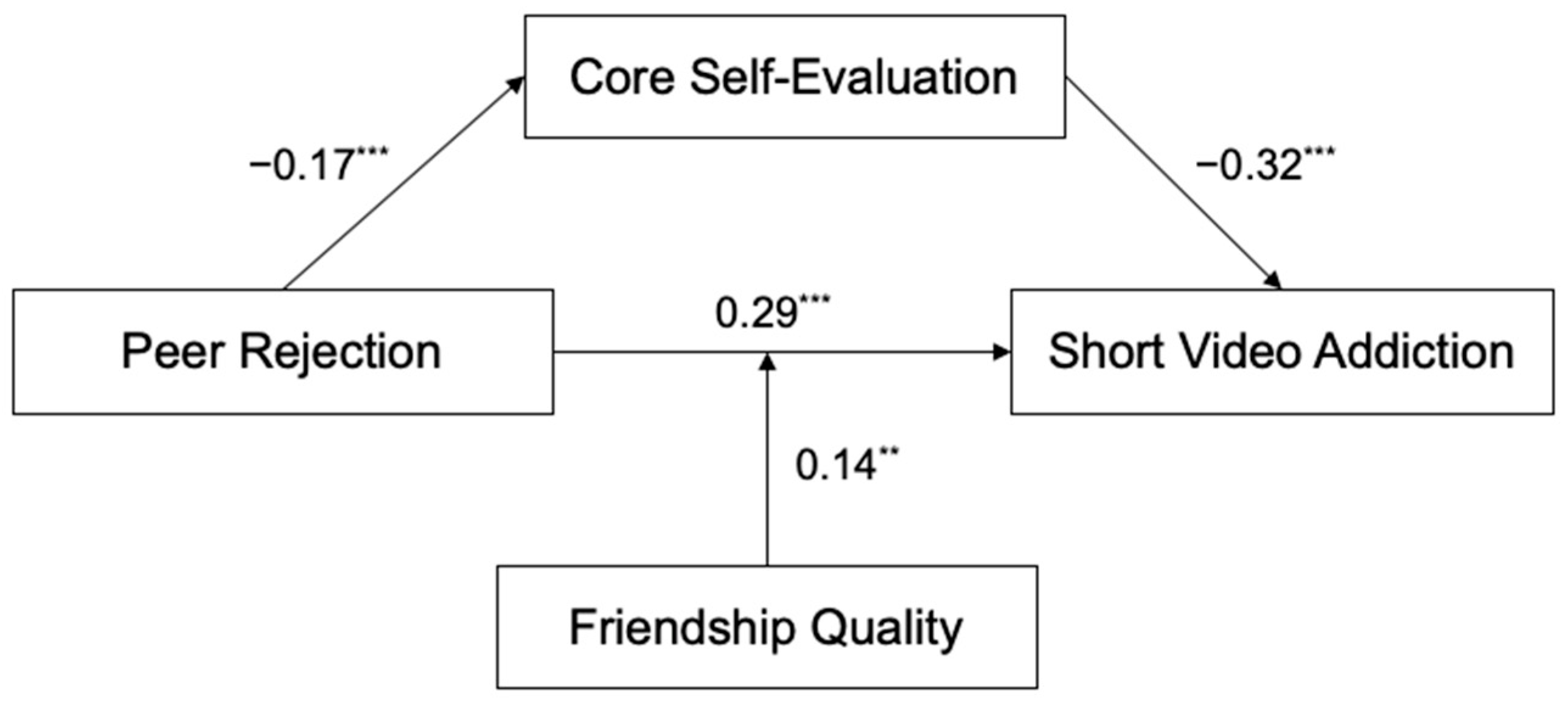
After controlling for gender and grade, peer rejection was indirectly associated with short video addiction through lower core self-evaluation (see Table 6). Bootstrap analysis using 5000 resamples supported a significant indirect effect of 0.06, with a 95% confidence interval of [0.02, 0.10], accounting for 21.42% of the total effect. The direct association between peer rejection and short video addiction remained significant, supporting partial mediation.
Table 6.
Regression analyses examining the mediating role of core self-evaluation in the association between peer rejection and short video addiction.
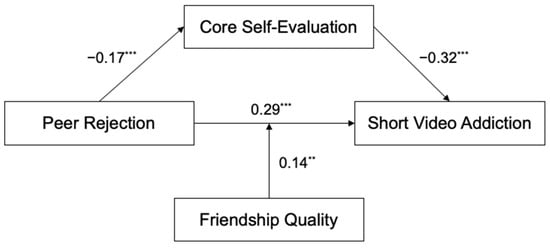
Finally, we examined whether friendship quality moderated the association between peer rejection and short video addiction, controlling for gender and grade (Figure 1). As shown in Table 7, the interaction between peer rejection and friendship quality was significant, indicating that the strength of the association varied as a function of friendship quality. Simple-slope analyses showed that peer rejection was positively associated with short video addiction at both lower and higher levels of friendship quality. At one standard deviation below the mean of friendship quality, the association was significant, β = 0.20, p < 0.001, 95% CI = [0.12, 0.28]. At one standard deviation above the mean, the association was stronger, β = 0.37, p < 0.001, 95% CI = [0.23, 0.52]. Thus, rather than buffering the association, higher friendship quality was associated with a stronger relation between peer rejection and short video addiction.
Figure 1.
A mediation model linking peer rejection to short video addiction, with friendship quality moderating the direct association. ** p < 0.01, *** p < 0.001.
Table 7.
Regression analyses examining the moderating role of friendship quality.
4. Discussion
The present study developed and validated the Short Video Addiction Scale for Chinese Adolescents (SVAS-CA), identifying five dimensions: withdrawal symptoms, time investment, salient behaviors, academic impairment, and social dysfunction. These dimensions bring together adolescents’ involvement in short videos, their reactions to restricted engagement, and interference with developmentally important activities and relationships. Although we retain the term “short video addiction” in the instrument’s name, the SVAS-CA is intended as a research measure of problematic engagement rather than a diagnostic instrument. The additional psychosocial findings further situated short video addiction within adolescents’ peer experiences and self-evaluations. Peer rejection was associated with greater short video addiction both directly and indirectly through lower core self-evaluation. Friendship quality was negatively associated with addiction scores overall but strengthened the association between peer rejection and short video addiction. These findings have implications for understanding what adolescent short video addiction encompasses and how it relates to adolescents’ everyday social experiences.
4.1. Conceptualizing Adolescent Short Video Addiction: The Five-Dimensional Structure
The five-dimensional structure suggests that adolescent short video addiction encompasses interconnected but distinguishable experiences of engagement and functional interference. Withdrawal symptoms capture negative experiences when access is restricted, time investment reflects the allocation of time to short video viewing, and salient behaviors describe the incorporation of short video content into everyday behavior. Academic impairment and social dysfunction, in turn, identify difficulties within school and interpersonal contexts. Considered together, these dimensions connect adolescents’ experiences of short video involvement with disruptions in important areas of their lives. This interpretation is consistent with behavioral addiction perspectives that emphasize both involvement in an activity and conflict with everyday functioning (Griffiths, 2005; Kardefelt-Winther et al., 2017). Their joint representation is particularly useful because time devoted to viewing does not, by itself, indicate how adolescents respond to interrupted access or whether their engagement interferes with learning and relationships. The present structure therefore supports an assessment approach that considers involvement alongside associated difficulties, while distinguishing the different forms these experiences may take.
Comparison with existing instruments helps clarify the conceptual contribution of this structure. Galanis et al. (2024) organized TikTok addiction around six established components: salience, mood modification, tolerance, withdrawal, conflict, and relapse. The withdrawal dimension of the SVAS-CA shows continuity with this framework, whereas academic impairment and social dysfunction distinguish two domains of interference encompassed by the broader concept of conflict. Griffiths’ (2005) components model provides a useful reference for interpreting the present structure, while also highlighting important differences. Withdrawal Symptoms corresponds conceptually to withdrawal, whereas Academic Impairment and Social Dysfunction distinguish school and interpersonal forms of conflict. Time Investment, however, does not establish tolerance, which involves an increasing amount of engagement required to achieve the desired effects. Similarly, Salient Behaviors captures the reproduction of short-video content in everyday expressions and actions rather than necessarily indicating that viewing dominates thoughts and activities. Mood modification and relapse are not represented as separate dimensions. The SVAS-CA should therefore be understood as a complementary organization of adolescent-reported experiences and difficulties, rather than a direct measure of all six components or a means of establishing a behavioral addiction diagnosis.
Beyond component-based addiction frameworks, Mao et al. (2022) approached problematic short video use through a different organization of behavioral, physical, and social experiences among university students. The SVAS-CA also offers greater behavioral specificity than general smartphone addiction and phubbing measures. Whereas smartphone addiction concerns engagement with a multifunctional device and phubbing focuses on phone-related interference with interpersonal interaction, the SVAS-CA assesses experiences specifically attributed to short video use. These instruments thus provide related but differently organized representations of problematic engagement. The SVAS-CA contributes to this literature by bringing withdrawal experiences, time investment, and everyday behavioral manifestations together with separately represented academic and interpersonal difficulties. Its contribution lies in this empirically derived organization of adolescents’ reported experiences, rather than in reproducing every component of established addiction frameworks. This specificity may help researchers characterize the activity and life domains associated with problematic engagement. Differences across instruments also underscore the importance of examining their item content, rather than assuming that similarly named dimensions assess equivalent experiences.
The adolescent measure developed by Ye et al. (2025) provides a particularly relevant comparison. Both instruments explicitly represent academic and interpersonal difficulties, suggesting convergence in the relevance of these domains to adolescent assessment. However, Ye et al. (2025) distinguished academic procrastination, interpersonal strain, social communication difficulties, attention concentration difficulties, and impaired control, whereas the SVAS-CA represents academic and social interference alongside withdrawal symptoms, time investment, and salient behaviors. The shared attention to school and peer functioning is developmentally meaningful. Adolescence involves increasing responsibility for learning and growing investment in peer relationships, making difficulties in these domains particularly relevant to everyday adjustment (Steinberg & Morris, 2001). Research linking short video engagement with cognitive functioning and academic performance, together with evidence connecting problematic smartphone use with adolescents’ peer experiences, further supports considering these domains in assessment (S. Su et al., 2022; Xu et al., 2023). The present findings therefore complement existing adolescent measurement research by locating academic and interpersonal difficulties within a structure that also differentiates adolescents’ experiences and expressions of involvement. Direct comparisons between the instruments would help establish the extent of their shared coverage and whether their distinctive content contributes additional information about adolescent functioning.
Salient behaviors warrant particular consideration because their meaning is not identical to salience in conventional addiction frameworks. Whereas traditional salience concerns an activity becoming dominant in thought and behavior (Griffiths, 2005), items in the present dimension address how short video content is reproduced or incorporated into everyday expressions and actions. This content may be especially relevant during adolescence, when digital participation offers opportunities for self-expression and social recognition and becomes integrated into peer interactions (Bucknell Bossen & Kottasz, 2020; Nesi et al., 2018). The dimension draws attention to involvement that extends beyond viewing itself and becomes visible in everyday behavior. Nevertheless, reproducing popular phrases or participating in trends can also reflect ordinary cultural participation. Such behaviors alone do not establish addiction or functional impairment (Kardefelt-Winther et al., 2017). Research on broader Internet use similarly distinguishes everyday behavioral correlates from symptom measures. Wickord et al. (2026) examined timekeeping habits separately from Internet use disorder symptoms and found that unintentionally prolonged smartphone use after checking the time was associated with greater symptom severity. This finding illustrates the value of examining everyday engagement patterns alongside, rather than equating them with, addiction-related symptoms. Time investment and imitation of short-video trends should likewise be interpreted in relation to difficulties regulating use and functional interference, rather than as sufficient indicators of addiction. Accordingly, this dimension should be interpreted alongside withdrawal experiences, time investment, and academic and social difficulties. Further research should examine when these behavioral expressions distinguish problematic engagement from enthusiastic but nonproblematic participation, thereby clarifying their contribution to the assessment of adolescent short video addiction.
4.2. Peer Rejection and the Role of Core Self-Evaluation
The positive association between peer rejection and short video addiction situates problematic viewing within adolescents’ offline peer experiences. Previous research has linked lower offline social support with greater short-form video addiction among Chinese adolescents (Yang et al., 2022). The present findings extend this work by examining rejection within adolescent peer groups using classmates’ nominations. Thus, the association was not confined to adolescents’ own perceptions of their social difficulties but was also evident in relation to their standing among peers. This finding is consistent with the compensatory Internet use perspective, which proposes that online activities may become appealing as a means of coping with distress or unmet offline needs (Kardefelt-Winther, 2014). For adolescents experiencing rejection, short videos may offer readily accessible entertainment and distraction without requiring acceptance from classmates. Such opportunities may be particularly appealing during a developmental period characterized by heightened sensitivity to social evaluation (Somerville, 2013). Thus, the findings extend the interpretation of SVAS-CA scores beyond involvement with technology to include their association with difficulties in adolescents’ social environments.
Core self-evaluation provided a further connection between peer rejection and short video addiction. Greater rejection was associated with less favorable self-evaluations, which, in turn, were associated with greater problematic viewing. Sociometer theory proposes that self-esteem is responsive to experiences of interpersonal acceptance and rejection, offering a basis for understanding how peer experiences may inform adolescents’ sense of personal worth (Leary & Baumeister, 2000). Core self-evaluation encompasses a broader appraisal of worth, competence, and control, extending attention beyond self-esteem alone (Judge et al., 2003). The present pattern is therefore consistent with the possibility that rejection is relevant not only as an aversive social experience but also through its association with how adolescents evaluate themselves. Negative self-related beliefs may make online activities appealing as sources of distraction or relief, consistent with findings of more favorable core self-evaluations among university students in a lower short video addiction profile (J. Ding et al., 2024).
4.3. Friendship Quality as a Context for Peer Rejection
Friendship quality showed a pattern that differed from the hypothesized protective role. Although higher friendship quality was associated with lower short video addiction overall, it was also associated with a stronger positive relationship between peer rejection and short video addiction. This interaction did not support the buffering expectation derived from social support theory (Cohen & Wills, 1985). The two findings address different aspects of adolescents’ social experiences: the negative overall association concerns how friendship quality relates to problematic viewing across adolescents, whereas the interaction concerns how strongly rejection relates to viewing at different levels of friendship quality. Thus, the results do not imply that high-quality friendships are generally harmful. Instead, they indicate that supportive friendship experiences do not necessarily weaken the association between broader peer adversity and problematic engagement.
Distinguishing close friendships from acceptance by the wider peer group offers an initial basis for interpreting this finding. Friendship quality concerns experiences within a particular relationship, whereas peer rejection reflects an adolescent’s position within the larger group (Parker & Asher, 1993). These aspects of peer functioning are related but distinguishable: recent longitudinal evidence suggests that close friendship quality and broader perceived social acceptance have different implications for later psychosocial adjustment (Shah et al., 2024). An adolescent may therefore experience companionship and support within a close friendship without being broadly accepted by classmates. From this perspective, the support available within a close relationship may not fully address difficulties arising from rejection by the wider group. This distinction offers a possible explanation for the absence of the expected buffering effect, although it does not, by itself, explain why the rejection-addiction association was stronger at higher levels of friendship quality. Understanding that pattern requires closer attention to the processes occurring within friendships, particularly how friends discuss and respond to distressing peer experiences (Borowski & Rose, 2024).
Co-rumination offers one possible explanation. Close friends may repeatedly revisit problems and dwell on negative emotions, allowing feelings of support and connection to coexist with continuing distress. Recent research has linked co-rumination with both positive experiences of support during problem discussion and more negative perceptions of the problems discussed (Borowski & Rose, 2024). Tilton-Weaver and Rose (2023) also identified a group of adolescents characterized by high co-rumination, high friendship support, and elevated depressive symptoms, although this combination was not evident among all adolescents who co-ruminated. Similarly, repeated discussion of rejection could potentially sustain attention to distressing experiences even within a supportive friendship, making distraction through short videos more appealing.
4.4. Limitations and Future Directions
First, the samples were recruited from central China, which limits the generalizability of the findings to adolescents in other regions and cultural settings. Given that sociocultural values may vary across different regions within China (X. Chen, 2018; X. Ding & Kong, 2026; X. Ding et al., 2025), these regional differences could shape both the manifestation and impact of short video addiction. Future research should therefore examine the applicability of the SVAS-CA across regions, socioeconomic backgrounds, and developmental stages, including tests of measurement invariance. Direct comparisons with existing short video addiction measures would also help clarify whether differences in dimensional structure reflect item content, sample characteristics, or both. Such comparisons are important for establishing the scope and distinctiveness of the construct assessed by the SVAS-CA (Clark & Watson, 2019).
Second, the psychosocial implications were based on cross-sectional data and cannot establish a causal sequence from peer rejection to lower core self-evaluation and subsequent short video addiction. Cross-sectional indirect associations may not accurately represent longitudinal processes, and reciprocal relationships remain plausible (Maxwell & Cole, 2007). Indeed, longitudinal research has identified reciprocal associations between problematic smartphone use and perceived friendship competence, suggesting that interpersonal difficulties may both precede and follow problematic digital engagement (S. Su et al., 2022). Future studies should combine repeated assessments with multiple information sources to clarify temporal ordering and longer-term implications. The unexpected moderation by friendship quality also requires replication and direct assessment of proposed explanatory processes, such as co-rumination and coping-related viewing motives. The analyses also did not explicitly account for the nesting of students within classrooms and schools. Dependence among students sharing these environments may have resulted in underestimated standard errors and overly narrow confidence intervals. The statistical inferences should therefore be interpreted cautiously, and future studies should use appropriate cluster-adjusted or multilevel procedures.
Third, future research should further examine the statistical modeling and scoring approaches used to evaluate the SVAS-CA. CFA used conventional maximum likelihood estimation despite skewness and substantial endorsement of the lowest response category for some items. Future research should evaluate the robustness of the structure using polychoric correlations and an appropriate ordinal estimator, such as WLSMV. Although the CFA examined five correlated dimensions, higher-order and bifactor models were not tested, leaving the structural justification for total-score interpretation incomplete. Associations involving the total score should therefore be interpreted as relating to a broad composite across the five domains, pending further evaluation of whether an overarching factor adequately supports this scoring approach. The psychosocial analyses used observed composite scores and did not explicitly account for measurement error, which may affect the estimated direct and indirect associations. Future research could integrate the measurement and structural models within a latent-variable SEM to evaluate the robustness of the direct and indirect associations.
Fourth, the practical interpretation and continued relevance of the SVAS-CA require further investigation. As short video platforms and recommendation systems evolve, the ways adolescents engage with content may change, making periodic evaluation of item relevance necessary. In particular, involvement-related behaviors should be examined alongside independently assessed functional impairment to clarify their ability to distinguish problematic use from enthusiastic but nonproblematic participation (Kardefelt-Winther et al., 2017). In addition, although the total score showed relatively high two-week test–retest stability, several subscales showed lower correlations, particularly Social Dysfunction, limiting confidence in their temporal consistency. Future research should use repeated assessments across different intervals to determine whether this lower stability reflects changes in adolescents’ experiences, measurement error, or both. Prospective and intervention studies should assess whether the SVAS-CA provides information beyond existing digital-use measures, predicts subsequent difficulties, and detects meaningful changes in functioning.
4.5. Implications
The present findings have implications for the conceptualization and assessment of adolescent short video addiction. The five-dimensional structure brings together withdrawal experiences, time investment, and everyday behavioral expressions of involvement with interference in academic and social functioning. This organization highlights the importance of considering how short video engagement intersects with developmentally salient responsibilities and relationships. In relation to existing instruments, the SVAS-CA offers a complementary framework grounded in adolescents’ own accounts, with separate attention to school and interpersonal difficulties. The psychosocial model adds a further contribution by linking this pattern to peer rejection, self-evaluation, and the context of close friendships. Together, the findings support an account emphasizing the interplay of personal characteristics, affective and cognitive processes, and social experiences in digital engagement (Brand et al., 2019; Nesi et al., 2018).
Practically, the SVAS-CA may help researchers and practitioners organize their assessment of adolescents’ short video use around both patterns of involvement and associated difficulties. Attention to schoolwork, relationships, and reactions to restricted access can provide a more informative picture than viewing duration alone. The model further identifies peer adversity and negative self-appraisals as relevant topics for assessment and future intervention research. The friendship-quality finding also suggests that a supportive close relationship should not be assumed to resolve wider peer difficulties. These findings identify coping with peer adversity, self-evaluative processes, and interactions within friendships as potential targets for future intervention research.
5. Conclusions
The present study developed and validated the Short Video Addiction Scale for Chinese Adolescents (SVAS-CA), a 24-item instrument comprising five dimensions: withdrawal symptoms, time investment, salient behaviors, academic impairment, and social dysfunction. The findings support the scale’s reliability, structural validity, and broader construct validity, indicating that the SVAS-CA captures both core addiction-like symptoms and developmentally salient impairments in adolescents’ daily functioning. In addition, SVAS-CA scores were systematically associated with peer rejection, core self-evaluation, and friendship quality, further supporting the scale’s relevance within adolescents’ broader psychosocial context. By providing a developmentally sensitive measurement tool for research examining problematic short video use and its psychosocial correlates among Chinese adolescents in educational and applied settings. Future research should examine its applicability across diverse populations, clarify the longitudinal relationships between scale scores and psychosocial functioning, and evaluate its continued relevance as platforms evolve.
Author Contributions
Conceptualization, X.D. and Q.C.; methodology, W.Z. and Q.C.; software, R.Z. and Q.C.; validation, W.Z., R.Z. and Q.C.; formal analysis, Q.C.; investigation, R.Z. and Q.C.; resources, X.D., N.H. and T.Z.; data curation, Q.C. and N.H.; writing—original draft preparation, W.Z. and R.Z.; writing—review and editing, X.D., N.H. and T.Z.; supervision, X.D.; project administration, X.D.; funding acquisition, X.D. All authors have read and agreed to the published version of the manuscript.
Funding
This research was supported by the National Social Science Fund of China (Grant No. 25BSH086).
Institutional Review Board Statement
The study was conducted in accordance with the Declaration of Helsinki, and approved by the Institutional Review Board of Shanghai Normal University (2025059).
Informed Consent Statement
Informed consent was obtained from all subjects involved in the study.
Data Availability Statement
The data that support the findings of this study are available from the corresponding author upon reasonable request.
Acknowledgments
The authors would like to thank all the participants who contributed to this study.
Conflicts of Interest
The authors declare no conflicts of interest.
Abbreviations
The following abbreviations are used in this manuscript:
| SVAS-CA | Short Video Addiction Scale for Chinese Adolescents |
| SAS-CS | Smartphone Addiction Scale for College Students |
| C-GSP | The Chinese Version of Generic Scale of Phubbing |
References
- Alsarrani, A., Hunter, R. F., Dunne, L., & Garcia, L. (2022). Association between friendship quality and subjective wellbeing among adolescents: A systematic review. BMC Public Health, 22, 2420. [Google Scholar] [CrossRef] [Scilit] [PubMed]
- Borowski, S. K., & Rose, A. J. (2024). Co-rumination between friends: Considering the roles of outcome expectations, relationship provisions, and perceptions of problems. Child Development, 95(4), 1063–1075. [Google Scholar] [CrossRef] [Scilit] [PubMed]
- Brand, M., Wegmann, E., Stark, R., Müller, A., Wölfling, K., Robbins, T. W., & Potenza, M. N. (2019). The interaction of person-affect-cognition-execution (I-PACE) model for addictive behaviors: Update, generalization to addictive behaviors beyond internet-use disorders, and specification of the process character of addictive behaviors. Neuroscience & Biobehavioral Reviews, 104, 1–10. [Google Scholar] [CrossRef] [Scilit] [PubMed]
- Branje, S., de Moor, E. L., Spitzer, J., & Becht, A. I. (2021). Dynamics of identity development in adolescence: A decade in review. Journal of Research on Adolescence, 31(4), 908–927. [Google Scholar] [CrossRef] [Scilit] [PubMed]
- Bucknell Bossen, C., & Kottasz, R. (2020). Uses and gratifications sought by pre-adolescent and adolescent TikTok consumers. Young Consumers, 21(4), 463–478. [Google Scholar] [CrossRef] [Scilit]
- Casey, B. J., Getz, S., & Galvan, A. (2008). The adolescent brain. Developmental Review, 28(1), 62–77. [Google Scholar] [CrossRef] [Scilit] [PubMed]
- Chang, C. H., Ferris, D. L., Johnson, R. E., Rosen, C. C., & Tan, J. A. (2012). Core self-evaluations: A review and evaluation of the literature. Journal of Management, 38(1), 81–128. [Google Scholar] [CrossRef] [Scilit]
- Chao, M., Lei, J., He, R., Jiang, Y., & Yang, H. (2023). TikTok use and psychosocial factors among adolescents: Comparisons of non-users, moderate users, and addictive users. Psychiatry Research, 325, 115247. [Google Scholar] [CrossRef] [Scilit] [PubMed]
- Chen, X. (2018). Culture, temperament, and social and psychological adjustment. Developmental Review, 50, 42–53. [Google Scholar] [CrossRef] [Scilit]
- Chen, Y., Li, M., Guo, F., & Wang, X. (2023). The effect of short-form video addiction on users’ attention. Behaviour & Information Technology, 42(16), 2893–2910. [Google Scholar] [CrossRef] [Scilit]
- China Internet Network Information Center (CNNIC). (2025). The 55th statistical report on China’s internet development. Available online: https://www.cnnic.cn/NMediaFile/2025/0313/MAIN17418452848150SDUMQZGSU.pdf (accessed on 20 September 2026).
- Chotpitayasunondh, V., & Douglas, K. M. (2018). Measuring phone snubbing behavior: Development and validation of the Generic Scale of Phubbing (GSP) and the Generic Scale of Being Phubbed (GSBP). Computers in Human Behavior, 88, 5–17. [Google Scholar] [CrossRef] [Scilit]
- Clark, L. A., & Watson, D. (2019). Constructing validity: New developments in creating objective measuring instruments. Psychological Assessment, 31(12), 1412–1427. [Google Scholar] [CrossRef] [Scilit] [PubMed]
- Cohen, S., & Wills, T. A. (1985). Stress, social support, and the buffering hypothesis. Psychological Bulletin, 98(2), 310–357. [Google Scholar] [CrossRef]
- Coie, J. D., Dodge, K. A., & Coppotelli, H. (1982). Dimensions and types of social status: A cross-age perspective. Developmental Psychology, 18(4), 557–570, (Correction in 1983, Developmental Psychology, 19, 224). [Google Scholar] [CrossRef]
- Conte, G., Di Iorio, G., Esposito, D., Romano, S., Panvino, F., Maggi, S., Altomonte, B., Casini, M. P., Ferrara, M., & Terrinoni, A. (2025). Scrolling through adolescence: A systematic review of the impact of TikTok on adolescent mental health. European Child & Adolescent Psychiatry, 34, 1511–1527. [Google Scholar] [CrossRef] [Scilit] [PubMed]
- Davis, R. A. (2001). A cognitive-behavioral model of pathological Internet use. Computers in Human Behavior, 17(2), 187–195. [Google Scholar] [CrossRef] [Scilit]
- Ding, J., Hu, Z., Zuo, Y., & Xv, Y. (2024). The relationships between short video addiction, subjective well-being, social support, personality, and core self-evaluation: A latent profile analysis. BMC Public Health, 24(1), 3459. [Google Scholar] [CrossRef] [Scilit] [PubMed]
- Ding, X., & Kong, X. (2026). Rethinking “local” and “in situ” in WILD among migrant children. Behavioral and Brain Sciences, 49, e266. [Google Scholar] [CrossRef] [Scilit] [PubMed]
- Ding, X., McVarnock, A., Li, M., Coplan, R. J., Ooi, L. L., Yu, J., & Sang, B. (2025). Motivations for social withdrawal and socio-emotional functioning among urban/suburban Chinese children. Journal of Applied Developmental Psychology, 98, 101787. [Google Scholar] [CrossRef] [Scilit]
- Du, J., Zhang, X., & Zhao, Y. (2012). Structural validation of core self-evaluations and revision of the core self-evaluations scale. Psychological Research, 5(3), 54–60. (In Chinese) [Google Scholar]
- Galanis, P., Katsiroumpa, A., Moisoglou, I., & Konstantakopoulou, O. (2024). The TikTok addiction scale: Development and validation. AIMS Public Health, 11(4), 1172–1197. [Google Scholar] [CrossRef] [Scilit] [PubMed]
- Gao, Y., Hu, Y., Wang, J., Liu, C., Im, H., Jin, W., Zhu, W., Ge, W., Zhao, G., Yao, Q., Wang, P., Zhang, M., Niu, X., He, Q., & Wang, Q. (2025). Neuroanatomical and functional substrates of the short video addiction and its association with brain transcriptomic and cellular architecture. NeuroImage, 307, 121029. [Google Scholar] [CrossRef] [Scilit] [PubMed]
- Giordano, P. C. (2003). Relationships in adolescence. Annual Review of Sociology, 29(1), 257–281. [Google Scholar] [CrossRef] [Scilit]
- Gladwin, T. E., Figner, B., Crone, E. A., & Wiers, R. W. (2011). Addiction, adolescence, and the integration of control and motivation. Developmental Cognitive Neuroscience, 1(4), 364–376. [Google Scholar] [CrossRef] [Scilit] [PubMed]
- Griffiths, M. (2005). A ‘components’ model of addiction within a biopsychosocial framework. Journal of Substance Use, 10(4), 191–197. [Google Scholar] [CrossRef] [Scilit]
- Günlü, A., Oral, T., Yoo, S., & Chung, S. (2023). Reliability and validity of the problematic TikTok use scale among the general population. Frontiers in Psychiatry, 14, 1068431. [Google Scholar] [CrossRef] [Scilit] [PubMed]
- Hamilton, J. L., Dreier, M. J., & Boyd, S. I. (2023). Social media as a bridge and a window: The changing relationship of adolescents with social media and digital platforms. Current Opinion in Psychology, 52, 101633. [Google Scholar] [CrossRef] [Scilit] [PubMed]
- Judge, T. A., Erez, A., Bono, J. E., & Thoresen, C. J. (2003). The core self-evaluations scale: Development of a measure. Personnel Psychology, 56(2), 303–331. [Google Scholar] [CrossRef] [Scilit]
- Kardefelt-Winther, D. (2014). A conceptual and methodological critique of internet addiction research: Towards a model of compensatory internet use. Computers in Human Behavior, 31, 351–354. [Google Scholar] [CrossRef] [Scilit]
- Kardefelt-Winther, D., Heeren, A., Schimmenti, A., van Rooij, A., Maurage, P., Carras, M., Edman, J., Blaszczynski, A., Khazaal, Y., & Billieux, J. (2017). How can we conceptualize behavioural addiction without pathologizing common behaviours? Addiction, 112(10), 1709–1715. [Google Scholar] [CrossRef] [Scilit] [PubMed]
- Leary, M. R., & Baumeister, R. F. (2000). The nature and function of self-esteem: Sociometer theory. Advances in Experimental Social Psychology, 32, 1–62. [Google Scholar] [CrossRef] [Scilit]
- Leary, M. R., Tambor, E. S., Terdal, S. K., & Downs, D. L. (1995). Self-esteem as an interpersonal monitor: The sociometer hypothesis. Journal of Personality and Social Psychology, 68(3), 518–530. [Google Scholar] [CrossRef]
- Liu, Q.-Q., Tu, W., Shang, Y.-F., & Xu, X.-P. (2022). Unique and interactive effects of parental neglect, school connectedness, and trait self-control on mobile short-form video dependence among Chinese left-behind adolescents. Child Abuse & Neglect, 134, 105939. [Google Scholar] [CrossRef] [Scilit] [PubMed]
- Mao, Z., Jiang, Y., Jin, T., & Wang, C. (2022). Preliminary development of problematic short video media use scale for university students. Chinese Journal of Behavioral Medicine and Brain Science, 31(5), 462–468. (In Chinese) [Google Scholar] [CrossRef]
- Maxwell, S. E., & Cole, D. A. (2007). Bias in cross-sectional analyses of longitudinal mediation. Psychological Methods, 12(1), 23–44. [Google Scholar] [CrossRef] [Scilit] [PubMed]
- Montag, C., Yang, H., & Elhai, J. D. (2021). On the psychology of TikTok use: A first glimpse from empirical findings. Frontiers in Public Health, 9, 641673. [Google Scholar] [CrossRef] [Scilit] [PubMed]
- Mu, H., Jiang, Q., Xu, J., & Chen, S. (2022). Drivers and consequences of short-form video (SFV) addiction amongst adolescents in China: Stress-coping theory perspective. International Journal of Environmental Research and Public Health, 19(21), 14173. [Google Scholar] [CrossRef] [Scilit] [PubMed]
- Natarajan, N. (2024). Do they stop? How do they stop? Why do they stop? Whether, how, and why teens insert “frictions” into social media’s infinite scroll. International Journal of Communication, 18, 1956–1975. Available online: https://ijoc.org/index.php/ijoc/article/view/21618 (accessed on 6 November 2026).
- Nesi, J., Choukas-Bradley, S., & Prinstein, M. J. (2018). Transformation of adolescent peer relations in the social media context: Part 1—A theoretical framework and application to dyadic peer relationships. Clinical Child and Family Psychology Review, 21(3), 267–294. [Google Scholar] [CrossRef] [Scilit] [PubMed]
- Nguyen, L., Walters, J., Paul, S., Monreal Ijurco, S., Rainey, G. E., Parekh, N., Blair, G., & Darrah, M. (2025). Feeds, feelings, and focus: A systematic review and meta-analysis examining the cognitive and mental health correlates of short-form video use. Psychological Bulletin, 151(9), 1125–1146. [Google Scholar] [CrossRef] [Scilit] [PubMed]
- Olson, J. A., Sandra, D. A., Colucci, É. S., Al Bikaii, A., Chmoulevitch, D., Nahas, J., Raz, A., & Veissière, S. P. L. (2022). Smartphone addiction is increasing across the world: A meta-analysis of 24 countries. Computers in Human Behavior, 129, 107138. [Google Scholar] [CrossRef] [Scilit]
- Orben, A., Meier, A., Dalgleish, T., & Blakemore, S.-J. (2024). Mechanisms linking social media use to adolescent mental health vulnerability. Nature Reviews Psychology, 3, 407–423. [Google Scholar] [CrossRef] [Scilit]
- Parker, J. G., & Asher, S. R. (1993). Friendship and friendship quality in middle childhood: Links with peer group acceptance and feelings of loneliness and social dissatisfaction. Developmental Psychology, 29(4), 611–621. [Google Scholar] [CrossRef]
- Reijntjes, A., Thomaes, S., Boelen, P., van der Schoot, M., Orobio de Castro, B., & Telch, M. J. (2011). Delighted when approved by others, to pieces when rejected: Children’s social anxiety magnifies the linkage between self- and other-evaluations. Journal of Child Psychology and Psychiatry, 52(7), 774–781. [Google Scholar] [CrossRef] [Scilit] [PubMed]
- Rose, A. J. (2002). Co-rumination in the friendships of girls and boys. Child Development, 73(6), 1830–1843. [Google Scholar] [CrossRef] [Scilit] [PubMed]
- Schultheiss, O. C., & Brunstein, J. C. (2001). Assessment of implicit motives with a research version of the TAT: Picture profiles, gender differences, and relations to other personality measures. Journal of Personality Assessment, 77(1), 71–86. [Google Scholar] [CrossRef] [Scilit] [PubMed]
- Shah, E. N., Szwedo, D. E., & Allen, J. P. (2024). Adolescent close friendships, self-perceived social acceptance, and peer-rated likeability as predictors of wellbeing in young adulthood. Frontiers in Developmental Psychology, 2, 1435727. [Google Scholar] [CrossRef] [Scilit]
- Somerville, L. H. (2013). The teenage brain: Sensitivity to social evaluation. Current Directions in Psychological Science, 22(2), 121–127. [Google Scholar] [CrossRef] [Scilit] [PubMed]
- Steinberg, L., & Morris, A. S. (2001). Adolescent development. Annual Review of Psychology, 52(1), 83–110. [Google Scholar] [CrossRef] [Scilit] [PubMed]
- Su, C., Zhou, H., Gong, L., Teng, B., Geng, F., & Hu, Y. (2021). Viewing personalized video clips recommended by TikTok activates default mode network and ventral tegmental area. NeuroImage, 237, 118136. [Google Scholar] [CrossRef] [Scilit] [PubMed]
- Su, S., Larsen, H., Cousijn, J., Wiers, R. W., & van den Eijnden, R. J. J. M. (2022). Problematic smartphone use and the quantity and quality of peer engagement among adolescents: A longitudinal study. Computers in Human Behavior, 126, 107025. [Google Scholar] [CrossRef] [Scilit]
- Su, S., Pan, T., Liu, Q., Chen, X., Wang, Y., & Li, M. (2014). Development of the smartphone addiction scale for college students. Chinese Mental Health Journal, 28(5), 392–397. (In Chinese) [Google Scholar] [CrossRef]
- Tian, X., Bi, X., & Chen, H. (2023). How short-form video features influence addiction behavior? Empirical research from the opponent process theory perspective. Information Technology & People, 36(1), 387–408. [Google Scholar] [CrossRef] [Scilit]
- Tilton-Weaver, L., & Rose, A. (2023). The trade-offs of co-ruminating with friends: A profile analysis. Journal of Research on Adolescence, 33(3), 957–972. [Google Scholar] [CrossRef] [Scilit] [PubMed]
- Tompkins, T. L., Hockett, A. R., Abraibesh, N., & Witt, J. L. (2011). A closer look at co-rumination: Gender, coping, peer functioning and internalizing/externalizing problems. Journal of Adolescence, 34(5), 801–811. [Google Scholar] [CrossRef] [Scilit] [PubMed]
- Valkenburg, P. M., Meier, A., & Beyens, I. (2022). Social media use and its impact on adolescent mental health: An umbrella review of the evidence. Current Opinion in Psychology, 44, 58–68. [Google Scholar] [CrossRef] [Scilit] [PubMed]
- Wang, H., & Lei, L. (2022). The relationship between parental phubbing and short-form videos addiction among Chinese adolescents. Journal of Research on Adolescence, 32(4), 1580–1591. [Google Scholar] [CrossRef] [Scilit] [PubMed]
- Wickord, L.-C., Bischof, A., Kannen, C., Löchner, D., Salbach, H., Mößle, T., Zumrode, L., Wölfling, K., Rumpf, H.-J., & Montag, C. (2026). Association of Internet use disorder and the use of traditional watches. Addictive Behaviors Reports, 23, 100685. [Google Scholar] [CrossRef] [Scilit] [PubMed]
- Xu, Z., Gao, X., Wei, J., Liu, H., & Zhang, Y. (2023). Adolescent user behaviors on short video application, cognitive functioning and academic performance. Computers & Education, 203, 104865. [Google Scholar] [CrossRef] [Scilit]
- Yang, J., Ti, Y., & Ye, Y. (2022). Offline and online social support and short-form video addiction among Chinese adolescents: The mediating role of emotion suppression and relatedness needs. Cyberpsychology, Behavior, and Social Networking, 25(5), 316–322. [Google Scholar] [CrossRef] [Scilit] [PubMed]
- Ye, J., Wang, W., Huang, D., Ma, S., Chen, S., Dong, W., & Zhao, X. (2025). Short video addiction scale for middle school students: Development and initial validation. Scientific Reports, 15(1), 9903. [Google Scholar] [CrossRef] [Scilit] [PubMed]
- Yu, Z., Zhu, X., & Li, Y. (2024). The association between problematic short video use and suicidal ideation and self-injurious behaviors: The mediating roles of sleep disturbance and depression. BMC Public Health, 24, 1689. [Google Scholar] [CrossRef] [Scilit] [PubMed]
- Zhang, L., & Zhang, L. (2020). Revision of the Chinese version of generic scale of phubbing. Chinese Journal of Clinical Psychology, 28(1), 29–32, 36. (In Chinese) [Google Scholar] [CrossRef]
- Zhang, N., Hazarika, B., Chen, K., & Shi, Y. (2023). A cross-national study on the excessive use of short-video applications among college students. Computers in Human Behavior, 145, 107752. [Google Scholar] [CrossRef] [Scilit]
- Zhou, Z., Zhao, D., Sun, X., & Ding, X. (2006). Children’s experiences with peers and loneliness: A two-year longitudinal study. Acta Psychologica Sinica, 38(5), 743–750. Available online: https://journal.psych.ac.cn/xlxb/CN/abstract/abstract1309.shtml (accessed on 20 September 2026). (In Chinese)
- Zhu, C., Jiang, Y., Lei, H., Wang, H., & Zhang, C. (2024). The relationship between short-form video use and depression among Chinese adolescents: Examining the mediating roles of need gratification and short-form video addiction. Heliyon, 10, e30346. [Google Scholar] [CrossRef] [Scilit] [PubMed]

Disclaimer/Publisher’s Note: The statements, opinions and data contained in all publications are solely those of the individual author(s) and contributor(s) and not of MDPI and/or the editor(s). MDPI and/or the editor(s) disclaim responsibility for any injury to people or property resulting from any ideas, methods, instructions or products referred to in the content. |
© 2026 by the authors. Licensee MDPI, Basel, Switzerland. This article is an open access article distributed under the terms and conditions of the Creative Commons Attribution (CC BY) license.