GenAI Use and GenAI-Assisted Learning Procrastination in University Students: The Roles of Planned Behavior Constructs and Learning GenAI Anxiety


Abstract
1. Introduction
2. Literature Review and Hypotheses
2.1. Prior Studies and Research Gaps
2.2. GenAI-Assisted Learning Procrastination and the Theory of Planned Behavior
2.3. GenAI Use, Theory of Planned Behavior Constructs, and GenAI-Assisted Learning Procrastination
2.4. Learning GenAI Anxiety as a Moderator of the Intention–Procrastination Association
3. Method
3.1. Participants
3.2. Measurements
3.3. Data Analysis
4. Results
4.1. Common Method Bias Tests
4.2. Descriptive Statistical Analysis
4.3. Correlation Analysis
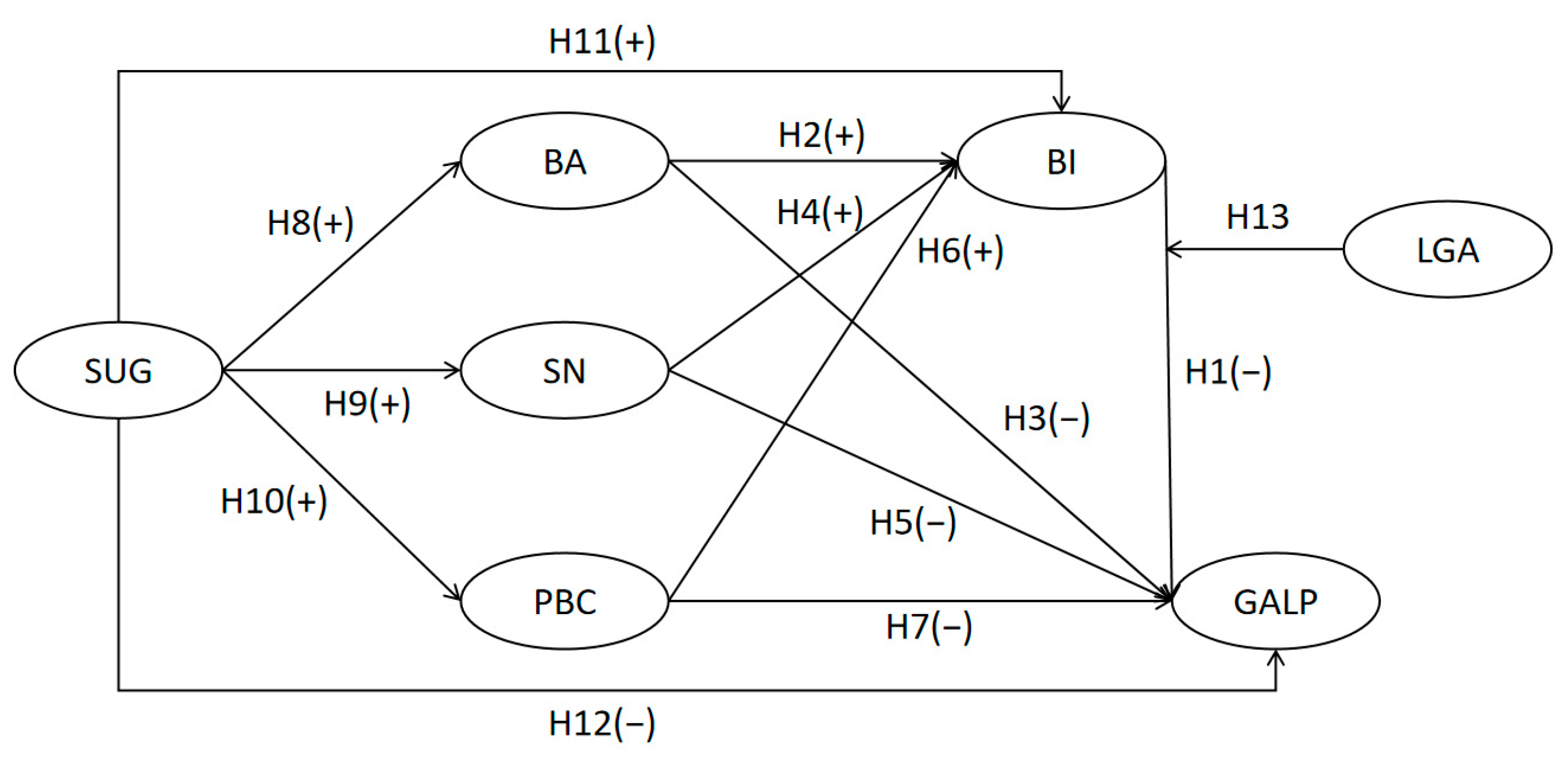
4.4. Path Analysis
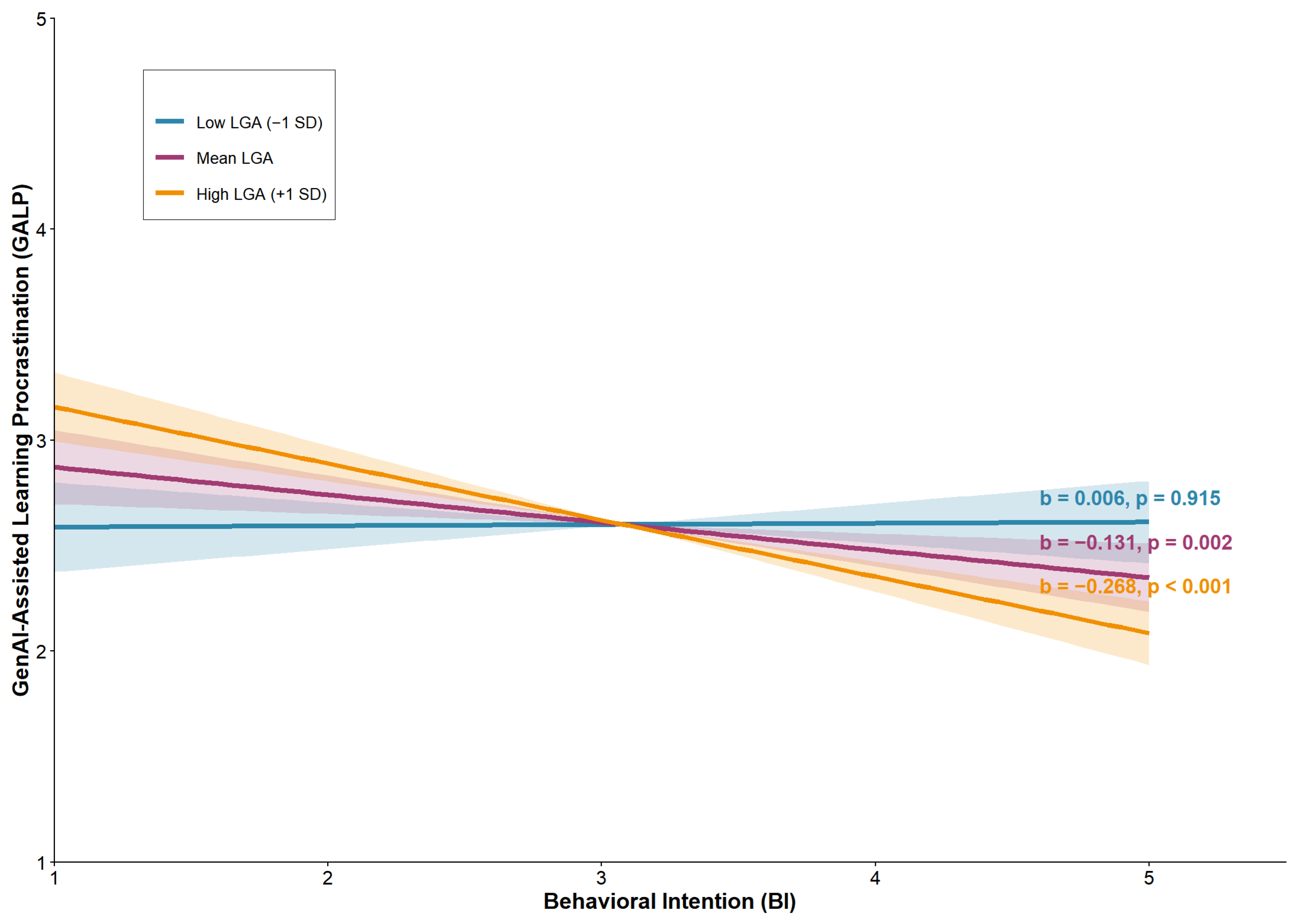
4.5. Moderated Indirect Association Analysis
5. Discussion
5.1. University Students’ Use of GenAI and GenAI-Assisted Learning Procrastination
5.2. Indirect Associations Through Behavioral Attitude, Subjective Norm, Perceived Behavioral Control, and Behavioral Intention
5.3. Theory of Planned Behavior-Based Indirect Associations Through Behavioral Intention
5.4. The Moderating Effect of Learning GenAI Anxiety
6. Conclusions and Implications
6.1. Conclusions
6.2. Theoretical Implications
6.3. Educational Practice Implications
6.4. Research Limitations
Author Contributions
Funding
Institutional Review Board Statement
Informed Consent Statement
Data Availability Statement
Acknowledgments
Conflicts of Interest
Abbreviations
| TPB | Theory of Planned Behavior |
| GALP | GenAI-assisted learning procrastination |
| SUG | Students using GenAI |
| BA | Behavioral attitude |
| SN | Subjective norm |
| PBC | Perceived behavioral control |
| BI | Behavioral intention |
| LGA | Learning GenAI anxiety |
Appendix A

| Variables | Item Code | Item Wording |
|---|---|---|
| SUG | SUG1 | I often use GenAI when completing daily assignments. |
| SUG2 | I often use GenAI when completing final-term assignments. | |
| SUG3 | I often use GenAI when preparing for examinations. | |
| BA | BA1 | I think using GenAI to complete daily assignments is important. |
| BA2 | I think using GenAI to complete final-term assignments is important. | |
| BA3 | I think using GenAI to prepare for examinations is important. | |
| BA4 | I think using GenAI to complete daily assignments is valuable. | |
| BA5 | I think using GenAI to complete final-term assignments is valuable. | |
| BA6 | I think using GenAI to prepare for examinations is valuable. | |
| BA7 | I think using GenAI to complete daily assignments is interesting. | |
| BA8 | I think using GenAI to complete final-term assignments is interesting. | |
| BA9 | I think using GenAI to prepare for examinations is interesting. | |
| SN | SN1 | Most of my classmates think I should use GenAI to complete daily assignments. |
| SN2 | Most of my classmates think I should use GenAI to complete final-term assignments. | |
| SN3 | Most of my classmates think I should use GenAI to prepare for examinations. | |
| PBC | PBC1 | I am confident that I can use GenAI to complete daily assignments. |
| PBC2 | I am confident that I can use GenAI to complete final-term assignments. | |
| PBC3 | I am confident that I can use GenAI to prepare for examinations. | |
| PBC4 | I feel in control when using GenAI to complete daily assignments. | |
| PBC5 | I feel in control when using GenAI to complete final-term assignments. | |
| PBC6 | I feel in control when using GenAI to prepare for examinations. | |
| PBC7 | Using GenAI to complete daily assignments is entirely up to me. | |
| PBC8 | Using GenAI to complete final-term assignments is entirely up to me. | |
| PBC9 | Using GenAI to prepare for examinations is entirely up to me. | |
| BI | BI1 | I intend to use GenAI to complete my daily assignments. |
| BI2 | I intend to use GenAI to complete my final-term assignments. | |
| BI3 | I intend to use GenAI to prepare for my examinations. | |
| BI4 | I am willing to exert effort to use GenAI to complete my daily assignments. | |
| BI5 | I am willing to exert effort to use GenAI to complete my final-term assignments. | |
| BI6 | I am willing to exert effort to use GenAI to prepare for my examinations. | |
| GALP | GALP1 | Although I plan to use GenAI for my daily assignments, I often unnecessarily put it off, even though I know it may cost me later. |
| GALP2 | Although I plan to use GenAI for my final-term projects, I often unnecessarily delay doing so, even though I know it may cost me later. | |
| GALP3 | Although I intend to use GenAI for exam preparation, I often unnecessarily postpone it, even though I know it may cost me later. | |
| LGA | LGA1 | Learning to understand all of the special functions associated with a GenAI technique/product makes me anxious. |
| LGA2 | Learning to use GenAI techniques/products makes me anxious. | |
| LGA3 | Learning to use specific functions of a GenAI technique/product makes me anxious. | |
| LGA4 | Learning how a GenAI technique/product works makes me anxious. | |
| LGA5 | Learning to interact with a GenAI technique/product makes me anxious. | |
| LGA6 | Taking a class about the development of GenAI techniques/products makes me anxious. | |
| LGA7 | Reading a GenAI technique/product manual makes me anxious. | |
| LGA8 | Being unable to keep up with the advances associated with GenAI techniques/products makes me anxious. |
References
- Abbas, M., Jam, F. A., & Khan, T. I. (2024). Is it harmful or helpful? Examining the causes and consequences of generative AI usage among university students. International Journal of Educational Technology in Higher Education, 21, 10. [Google Scholar] [CrossRef] [Scilit]
- Ackerman, D. S., & Gross, B. L. (2005). My instructor made me do it: Task characteristics of procrastination. Journal of Marketing Education, 27(1), 5–13. [Google Scholar] [CrossRef] [Scilit]
- Ajlouni, A. O., Wahba, F. A. A., & Almahaireh, A. S. (2023). Students’ attitudes towards using ChatGPT as a learning tool: The case of the University of Jordan. International Journal of Interactive Mobile Technologies, 17(18), 99–117. [Google Scholar] [CrossRef] [Scilit]
- Ajzen, I. (1991). The Theory of Planned Behavior. Organizational Behavior and Human Decision Processes, 50(2), 179–211. [Google Scholar] [CrossRef] [Scilit]
- Ajzen, I., & Driver, B. L. (1992a). Application of the Theory of Planned Behavior to leisure choice. Journal of Leisure Research, 24(3), 207–224. [Google Scholar] [CrossRef] [Scilit]
- Ajzen, I., & Driver, B. L. (1992b). Contingent value measurement: On the nature and meaning of willingness to pay. Journal of Consumer Psychology, 1(4), 297–316. [Google Scholar] [CrossRef] [Scilit]
- Alaya, M. B., Ouali, U., Youssef, S. B., Aissa, A., & Nacef, F. (2021). Academic procrastination in university students: Associated factors and impact on academic performance. European Psychiatry, 64(S1), S759–S760. [Google Scholar] [CrossRef] [Scilit]
- Alqahtani, T., Badreldin, H. A., Alrashed, M., Alshaya, A. I., Alghamdi, S. S., bin Saleh, K., Alowais, S. A., Alshaya, O. A., Rahman, I., Al Yami, M. S., & Albekairy, A. M. (2023). The emergent role of artificial intelligence, natural learning processing, and large language models in higher education and research. Research in Social and Administrative Pharmacy, 19, 1236–1242. [Google Scholar] [CrossRef] [Scilit] [PubMed]
- Alqasham, F. H. (2023). ChatGPT in the Saudi EFL classroom: A study of learner usage patterns and possibilities in learning optimization. Migration Letters, 20(7), 1251–1263. [Google Scholar]
- Amarnath, A., Ozmen, S., Struijs, S. Y., de Wit, L., & Cuijpers, P. (2023). Effectiveness of a guided internet-based intervention for procrastination among university students—A randomized controlled trial study protocol. Internet Interventions, 32, 100612. [Google Scholar] [CrossRef] [Scilit] [PubMed]
- Araya-Castillo, L., Burgos, M., González, P., Rivera, Y., Barrientos, N., Jara, V. Y., Ganga-Contreras, F., & Sáez, W. (2023). Procrastination in university students: A proposal of a theoretical model. Behavioral Sciences, 13(2), 128. [Google Scholar] [CrossRef] [Scilit] [PubMed]
- Armitage, C. J., & Christian, J. (2003). From attitudes to behaviour: Basic and applied research on the Theory of Planned Behaviour. Current Psychology, 22, 187–195. [Google Scholar] [CrossRef] [Scilit]
- Bamberg, S., Ajzen, I., & Schmidt, P. (2003). Choice of travel mode in the Theory of Planned Behavior: The roles of past behavior, habit, and reasoned action. Basic and Applied Social Psychology, 25(3), 175–187. [Google Scholar] [CrossRef] [Scilit] [PubMed]
- Barbeite, F. G., & Weiss, E. M. (2004). Computer self-efficacy and anxiety scales for an internet sample: Testing measurement equivalence of existing measures and development of new scales. Computers in Human Behavior, 20(1), 1–15. [Google Scholar] [CrossRef] [Scilit]
- Barrett, A., & Pack, A. (2023). Not quite eye to AI: Student and teacher perspectives on the use of generative artificial intelligence in the writing process. International Journal of Educational Technology in Higher Education, 20, 59. [Google Scholar] [CrossRef] [Scilit]
- Bhullar, P. S., Joshi, M., & Chugh, R. (2024). ChatGPT in higher education—A synthesis of the literature and a future research agenda. Education and Information Technologies, 29, 21501–21522. [Google Scholar] [CrossRef] [Scilit]
- Boubker, O. (2024). From chatting to self-educating: Can AI tools boost student learning outcomes? Expert Systems with Applications, 238, 121820. [Google Scholar] [CrossRef] [Scilit]
- Brosnan, M., & Lee, W. (1998). A cross-cultural comparison of gender differences in computer attitudes and anxieties: The United Kingdom and Hong Kong. Computers in Human Behavior, 14(4), 559–577. [Google Scholar] [CrossRef] [Scilit]
- Cabrera, C., & Neville, R. (2025). Widely used but barely trusted: Understanding student perceptions on the use of generative AI in higher education. Perspectives: Policy and Practice in Higher Education, 30, 352–363. [Google Scholar] [CrossRef] [Scilit]
- Carver, C. S., & Scheier, M. F. (1998). On the self-regulation of behavior. Cambridge University Press. [Google Scholar] [CrossRef] [Scilit]
- Chan, C. K. Y., & Hu, W. (2023). Students’ voices on generative AI: Perceptions, benefits, and challenges in higher education. International Journal of Educational Technology in Higher Education, 20, 43. [Google Scholar] [CrossRef] [Scilit]
- Chan, C. K. Y., & Lee, K. K. (2023). The AI generation gap: Are gen Z students more interested in adopting generative AI such as ChatGPT in teaching and learning than their gen X and millennial generation teachers? Smart Learning Environments, 10, 60. [Google Scholar] [CrossRef] [Scilit]
- Charlton, J. P., & Birkett, P. E. (1995). The development and validation of the computer apathy and anxiety scale. Journal of Educational Computing Research, 13(1), 41–59. [Google Scholar] [CrossRef] [Scilit]
- Chiu, T. K. F. (2024). The impact of Generative AI (GenAI) on practices, policies and research direction in education: A case of ChatGPT and Midjourney. Interactive Learning Environments, 32(10), 6187–6203. [Google Scholar] [CrossRef] [Scilit]
- Claessens, B. J. C., van Eerde, W., Rutte, C. G., & Roe, R. A. (2010). Things to do today…: A daily diary study on task completion at work. Applied Psychology: An International Review, 59(2), 273–295. [Google Scholar] [CrossRef] [Scilit]
- Cui, X., Feng, T., Shen, J., Fan, S., & Zhou, Q. (2025). Technology empowerment or risk avoidance?—Investigating the overlooked factors influencing college students’ acceptance of generative artificial intelligence. Studies in Higher Education, 50, 1123–1142. [Google Scholar] [CrossRef] [Scilit]
- Dahri, N. A., Yahaya, N., & Al-Rahmi, W. M. (2025). Exploring the influence of ChatGPT on student academic success and career readiness. Education and Information Technologies, 30, 8877–8921. [Google Scholar] [CrossRef] [Scilit]
- Dai, Y., Lai, S., Lim, C. P., & Liu, A. (2023). ChatGPT and its impact on research supervision: Insights from Australian postgraduate research students. Australasian Journal of Educational Technology, 39(4), 74–88. [Google Scholar] [CrossRef] [Scilit]
- Darancik, Y., Kaçar, E., & Sezik, A. (2025). AI anxiety and awareness of German teacher candidates. Education and Information Technologies, 30, 20215–20235. [Google Scholar] [CrossRef] [Scilit]
- Fang, L., Liu, T., Zhang, T., & Liu, S. (2024). Effect of time attitude on academic performance of high school students: A moderated mediation model. Current Psychology, 43, 32961–32975. [Google Scholar] [CrossRef] [Scilit]
- Fornell, C., & Larcker, D. F. (1981). Evaluating structural equation models with unobservable variables and measurement error. Journal of Marketing Research, 18(1), 39–50. [Google Scholar] [CrossRef] [Scilit]
- Gao, B., Wijaya, T. T., He, Y., Ma, H., & Wu, L. (2025). What factors affect student procrastination on mathematics homework: Self-determination theory perspective. Acta Psychologica, 256, 105020. [Google Scholar] [CrossRef] [Scilit] [PubMed]
- Gao, Z., Cheah, J. H., Lim, X. J., & Luo, X. (2024). Enhancing academic performance of business students using generative AI: An Interactive-Constructive-Active-Passive (ICAP) self-determination perspective. International Journal of Management Education, 22(2), 100958. [Google Scholar] [CrossRef] [Scilit]
- Gollwitzer, P. M., & Sheeran, P. (2006). Implementation intentions and goal achievement: A meta-analysis of effects and processes. Advances in Experimental Social Psychology, 38, 69–119. [Google Scholar] [CrossRef] [Scilit]
- Gökalp, Z. Ş., & Haktanir, A. (2024). The mediating role of self-control between stress and procrastination among adolescents: Examining the ego depletion theory. Psychology in the Schools, 61(8), 3359–3372. [Google Scholar] [CrossRef] [Scilit]
- Gupta, D. D., Singhal, D. A., Sharma, D. S., Hasan, D. A., & Raghuwanshi, D. S. (2023). Humans emotional and mental well-being under the influence of artificial intelligence. Journal of Reattach Therapy and Developmental Diversities, 6, 184–197. [Google Scholar] [CrossRef] [Scilit]
- Hasanein, A. M., & Sobaih, A. E. E. (2023). Drivers and consequences of ChatGPT use in higher education: Key stakeholder perspectives. European Journal of Investigation in Health, Psychology and Education, 13(11), 2599–2614. [Google Scholar] [CrossRef] [Scilit] [PubMed]
- Howell, A. J., Watson, D. C., Powell, R. A., & Buro, K. (2006). Academic procrastination: The pattern and correlates of behavioural postponement. Personality and Individual Differences, 40(8), 1519–1530. [Google Scholar] [CrossRef] [Scilit]
- Ivanov, S., Soliman, M., Tuomi, A., Alkathiri, N. A., & Al-Alawi, A. N. (2024). Drivers of generative AI adoption in higher education through the lens of the Theory of Planned Behaviour. Technology in Society, 77, 102521. [Google Scholar] [CrossRef] [Scilit]
- Jochmann, A., Gusy, B., Lesener, T., & Wolter, C. (2024). Procrastination, depression and anxiety symptoms in university students: A three-wave longitudinal study on the mediating role of perceived stress. BMC Psychology, 12, 276. [Google Scholar] [CrossRef] [Scilit] [PubMed]
- Johnson, D. G., & Verdicchio, M. (2017). AI anxiety. Journal of the Association for Information Science and Technology, 68(9), 2267–2270. [Google Scholar] [CrossRef] [Scilit]
- Katsantonis, A., & Katsantonis, I. G. (2024). University students’ attitudes toward artificial intelligence: An exploratory study of the cognitive, emotional, and behavioural dimensions of AI attitudes. Education Sciences, 14(9), 988. [Google Scholar] [CrossRef] [Scilit]
- Klingsieck, K. B., Grund, A., Schmid, S., & Fries, S. (2013). Why students procrastinate: A qualitative approach. Journal of College Student Development, 54(4), 397–412. [Google Scholar] [CrossRef] [Scilit]
- Lau, G. R., Low, W. Y., Tay, L., Guevarra, Y. A., Gašević, D., & Hartanto, A. (2026). Understanding critical thinking in generative artificial intelligence use: Development, validation, and correlates of the critical thinking in AI use scale. Computers in Human Behavior Reports, 22, 101103. [Google Scholar] [CrossRef] [Scilit]
- Li, C., Hu, Y., & Ren, K. (2022). Physical activity and academic procrastination among Chinese university students: A parallel mediation model of self-control and self-efficacy. International Journal of Environmental Research and Public Health, 19(10), 6017. [Google Scholar] [CrossRef] [Scilit] [PubMed]
- Liang, H. Y., & Mao, X. (2025). Students’ attitudes toward generative artificial intelligence in academic contexts: A multi-factor analysis. International Journal of Educational Development, 119, 103434. [Google Scholar] [CrossRef] [Scilit]
- Lodge, J. M., Yang, S., Furze, L., & Dawson, P. (2023). It’s not like a calculator, so what is the relationship between learners and generative artificial intelligence? Learning: Research and Practice, 9(2), 117–124. [Google Scholar] [CrossRef] [Scilit]
- Marcoulides, G. A. (1989). Measuring computer anxiety: The computer anxiety scale. Educational and Psychological Measurement, 49(3), 733–739. [Google Scholar] [CrossRef] [Scilit]
- Maslej, N., Fattorini, L., Perrault, R., Gil, Y., Parli, V., Kariuki, N., Capstick, E., Reuel, A., Brynjolfsson, E., Etchemendy, J., Ligett, K., Lyons, T., Manyika, J., Niebles, J., Shoham, Y., Wald, R., Walsh, T., Hamrah, A., Santarlasci, L., … Oak, S. (2025). Artificial intelligence index report 2025. arXiv, arXiv:2504.07139. [Google Scholar] [CrossRef] [Scilit]
- Molino, M., Cortese, C. G., & Ghislieri, C. (2020). The promotion of technology acceptance and work engagement in industry 4.0: From personal resources to information and training. International Journal of Environmental Research and Public Health, 17(7), 2438. [Google Scholar] [CrossRef] [Scilit] [PubMed]
- Ng, D. T. K., Tan, C. W., & Leung, J. K. L. (2024). Empowering student self-regulated learning and science education through ChatGPT: A pioneering pilot study. British Journal of Educational Technology, 55(4), 1328–1353. [Google Scholar] [CrossRef] [Scilit]
- Owens, S. G., Bowman, C. G., & Dill, C. A. (2008). Overcoming procrastination: The effect of implementation intentions. Journal of Applied Social Psychology, 38(2), 366–384. [Google Scholar] [CrossRef] [Scilit]
- Pychyl, T. A., Lee, J. M., Thibodeau, R., & Blunt, A. (2000). Five days of emotion: An experience sampling study of undergraduate student procrastination. Journal of Social Behavior & Personality, 15(5), 239–254. Available online: https://psycnet.apa.org/record/2002-10572-019 (accessed on 28 May 2026).
- Rahman, M. M., & Watanobe, Y. (2023). ChatGPT for education and research: Opportunities, threats, and strategies. Applied Sciences, 13(9), 5783. [Google Scholar] [CrossRef] [Scilit]
- Rejeb, A., Rejeb, K., Appolloni, A., Treiblmaier, H., & Iranmanesh, M. (2024). Exploring the impact of ChatGPT on education: A web mining and machine learning approach. The International Journal of Management Education, 22(1), 100932. [Google Scholar] [CrossRef] [Scilit]
- Rudolph, J., Tan, S., & Tan, S. (2023). ChatGPT: Bullshit spewer or the end of traditional assessments in higher education? Journal of Applied Learning and Teaching, 6(1), 342–363. [Google Scholar] [CrossRef] [Scilit]
- Russon, A., Josefowitz, N., & Edmonds, C. (1994). Making computer instruction accessible: Familiar analogies for female novices. Computers in Human Behavior, 10(2), 175–187. [Google Scholar] [CrossRef] [Scilit]
- Santos, Â., Cardoso, C., & Pereira, M. (2025). “I still have time”: Self-efficacy as a mediator in the association between the type of motivation and academic procrastination among PhD students. Psychological Reports, 1–20. [Google Scholar] [CrossRef] [Scilit] [PubMed]
- Sæle, R. G., Dahl, T. I., Sorlie, T., & Friborg, O. (2017). Relationships between learning approach, procrastination and academic achievement amongst first-year university students. Higher Education, 74(5), 757–774. [Google Scholar] [CrossRef] [Scilit]
- Sergeeva, O. V., Masalimova, A. R., Zheltukhina, M. R., Chikileva, L. S., Lutskovskai, L. Y., & Luzin, A. T. (2025). Impact of digital media literacy on attitude toward generative AI acceptance in higher education. Frontiers in Education, 10, 1563148. [Google Scholar] [CrossRef] [Scilit]
- Shahzad, M. F., Xu, S., & Javed, I. (2024). ChatGPT awareness, acceptance, and adoption in higher education: The role of trust as a cornerstone. International Journal of Educational Technology in Higher Education, 21, 46. [Google Scholar] [CrossRef] [Scilit]
- Sheeran, P., & Webb, T. L. (2016). The intention–behavior gap. Social and Personality Psychology Compass, 10(9), 503–518. [Google Scholar] [CrossRef] [Scilit]
- Shoufan, A. (2023). Exploring students’ perceptions of ChatGPT: Thematic analysis and follow-up survey. IEEE Access, 11, 38805–38818. [Google Scholar] [CrossRef] [Scilit]
- Sirois, F., & Pychyl, T. (2013). Procrastination and the priority of short-term mood regulation: Consequences for future self. Social and Personality Psychology Compass, 7(2), 115–127. [Google Scholar] [CrossRef] [Scilit]
- Sparfeldt, J. R., & Schwabe, S. (2024). Academic procrastination mediates the relation between conscientiousness and academic achievement. Personality and Individual Differences, 218, 112466. [Google Scholar] [CrossRef] [Scilit]
- Spielberger, C. D. (1966). Theory and research on anxiety. Anxiety and Behavior, 1(3), 413–428. [Google Scholar] [CrossRef] [Scilit]
- Steel, P. (2007). The nature of procrastination: A meta-analytic and theoretical review of quintessential self-regulatory failure. Psychological Bulletin, 133(1), 65–94. [Google Scholar] [CrossRef] [Scilit] [PubMed]
- Steel, P., & Klingsieck, K. B. (2016). Academic procrastination: Psychological antecedents revisited. Australian Psychologist, 51(1), 36–46. [Google Scholar] [CrossRef] [Scilit]
- Stojanov, A. (2023). Learning with ChatGPT 3.5 as a more knowledgeable other: An autoethnographic study. International Journal of Educational Technology in Higher Education, 20(1), 35. [Google Scholar] [CrossRef] [Scilit]
- Strzelecki, A. (2023). To use or not to use ChatGPT in higher education? A study of students’ acceptance and use of technology. Interactive Learning Environments, 32(9), 5142–5155. [Google Scholar] [CrossRef] [Scilit]
- Sullivan, M., Kelly, A., & McLaughlan, P. (2023). ChatGPT in higher education: Considerations for academic integrity and student learning. Journal of Applied Learning and Teaching, 6(1), 31–40. [Google Scholar] [CrossRef] [Scilit]
- Tan, Z., Chen, W. W., & Wang, Z. (2025). How is self-efficacy linked to procrastination? The mediating role of attentional control. Journal of Rational-Emotive & Cognitive-Behavior Therapy, 43, 20. [Google Scholar] [CrossRef] [Scilit]
- Tang, K. Q., Fan, F., Long, K., Chen, S. J., Peng, T., Yang, Y. C., & Ye, T. T. (2015). Early maladaptive schemas, anxiety, and procrastination among chinese university students. Psychological Development and Education, 31(3), 360–367. [Google Scholar] [CrossRef]
- Tian, X., Liu, X., Xiao, Z., & Lin, Q. (2023). Undergraduates’ negative emotion and academic procrastination during COVID-19: Life autonomy as a mediator and sense of school belonging as a moderator. Psychology Research and Behavior Management, 10, 3151–3169. [Google Scholar] [CrossRef] [Scilit] [PubMed]
- To, P. Y., Lo, B. C., Ng, T. K., Wong, B. P., & Choi, A. W. (2021). Striving to avoid inferiority and procrastination among university students: The mediating roles of stress and self-control. International Journal of Environmental Research and Public Health, 18(11), 5570. [Google Scholar] [CrossRef] [Scilit] [PubMed]
- Tossell, C. C., Tenhundfeld, N. L., Momen, A., Cooley, K., & De Visser, E. J. (2024). Student perceptions of ChatGPT use in a college essay assignment: Implications for learning, grading, and trust in artificial intelligence. IEEE Transactions on Learning Technologies, 17, 1069–1081. [Google Scholar] [CrossRef] [Scilit]
- Țală, M. L., Müller, C. N., Năstase, I. A., State, O., & Gheorghe, G. (2024). Exploring university students’ perceptions of generative artificial intelligence in education. Amfiteatre Economic, 26(65), 71–88. [Google Scholar] [CrossRef] [Scilit]
- Venkatesh, V., Morris, M. G., Davis, G. B., & Davis, F. D. (2003). User acceptance of information technology: Toward a unified view. MIS Quarterly, 27(3), 425–478. [Google Scholar] [CrossRef] [Scilit]
- Wang, Y. M., Wei, C. L., Lin, H. H., Wang, S. C., & Wang, Y. S. (2024). What drives students’ AI learning behavior: A perspective of AI anxiety. Interactive Learning Environments, 32(6), 2584–2600. [Google Scholar] [CrossRef] [Scilit]
- Wang, Y. S. (2007). Development and validation of a mobile computer anxiety scale. British Journal of Educational Technology, 38(6), 990–1009. [Google Scholar] [CrossRef] [Scilit]
- Wang, Y. Y., & Wang, Y. S. (2022). Development and validation of an artificial intelligence anxiety scale: An initial application in predicting motivated learning behavior. Interactive Learning Environments, 30(4), 619–634. [Google Scholar] [CrossRef] [Scilit]
- Xie, Y. Y., & Wang, S. F. (2025). Generative artificial intelligence in entrepreneurship education enhances entrepreneurial intention through self-efficacy and university support. Scientific Reports, 15, 24079. [Google Scholar] [CrossRef] [Scilit] [PubMed]
- Xue, X., Wang, Y., Li, H., Gao, J., & Si, J. (2023). The association between mathematical attitudes, academic procrastination and mathematical achievement among primary school students: The moderating effect of mathematical metacognition. Current Psychology, 42, 7953–7964. [Google Scholar] [CrossRef] [Scilit]
- Zhao, Y., Li, Y., Xiao, Y., Chang, H., & Liu, B. (2024). Factors influencing the acceptance of ChatGPT in high education: An integrated model with PLS-SEM and fsQCA approach. SAGE Open, 14(4), 1–16. [Google Scholar] [CrossRef] [Scilit]
- Zimmerman, B. J. (2002). Becoming a self-regulated learner: An overview. Theory into Practice, 41(2), 64–70. [Google Scholar] [CrossRef] [Scilit] [PubMed]

| Research Domain | What Prior Studies Have Done | What Remains Unresolved | Contribution of the Prior Studies |
|---|---|---|---|
| GenAI Acceptance & Use | Examined students’ perceptions, attitudes, and acceptance of GenAI; documented usage rates exceeding 77% among university students; identified gender, usage frequency, and ethical awareness as factors associated with attitudes (Cabrera & Neville, 2025; Katsantonis & Katsantonis, 2024; Sergeeva et al., 2025; Shoufan, 2023; Strzelecki, 2023). | Few studies have linked actual GenAI use with behavioral outcomes such as procrastination. | Examines the association between Students using GenAI and GALP. |
| TPB in Technology Contexts | Applied TPB to technology adoption and acceptance; validated TPB-based models for GenAI adoption (Ivanov et al., 2024; Zhao et al., 2024; Venkatesh et al., 2003). | Limited application to procrastination in GenAI-assisted learning. | Tests TPB-based indirect associations (behavioral attitude/subjective norm/perceived behavioral control → behavioral intention → GALP). |
| AI Anxiety & Learning Behavior | Developed AI anxiety scales and examined their association with learning behavior and motivation; indicated that AI anxiety is negatively associated with learning motivations (Y. Y. Wang & Wang, 2022; Y. M. Wang et al., 2024). | Learning GenAI anxiety as a boundary condition in the intention–behavior gap has not been examined. | Examines learning GenAI anxiety as a moderator of the association between behavioral intention and GALP. |
| Learning Procrastination | Extensively documented prevalence (approximately 50% of university students), antecedents (e.g., perfectionistic concerns), and consequences (e.g., poorer academic performance, anxiety, depression) (Steel, 2007; Klingsieck et al., 2013; Alaya et al., 2021). | Procrastination in GenAI-assisted learning contexts remains unexplored. | Defines and measures GALP as a context-specific form of procrastination. |
| Variables | Items | Standardized Factor Loadings | Cronbach’s α | CR | AVE |
|---|---|---|---|---|---|
| SUG | SUG1 | 0.85 | 0.86 | 0.86 | 0.67 |
| SUG2 | 0.80 | ||||
| SUG3 | 0.81 | ||||
| BA | BA1 | 0.67 | 0.88 | 0.88 | 0.44 |
| BA2 | 0.61 | ||||
| BA3 | 0.58 | ||||
| BA4 | 0.63 | ||||
| BA5 | 0.65 | ||||
| BA6 | 0.63 | ||||
| BA7 | 0.72 | ||||
| BA8 | 0.74 | ||||
| BA9 | 0.74 | ||||
| SN | SN1 | 0.91 | 0.94 | 0.95 | 0.85 |
| SN2 | 0.92 | ||||
| SN3 | 0.93 | ||||
| PBC | PBC1 | 0.68 | 0.89 | 0.88 | 0.46 |
| PBC2 | 0.66 | ||||
| PBC3 | 0.64 | ||||
| PBC4 | 0.65 | ||||
| PBC5 | 0.67 | ||||
| PBC6 | 0.67 | ||||
| PBC7 | 0.70 | ||||
| PBC8 | 0.71 | ||||
| PBC9 | 0.73 | ||||
| BI | BI1 | 0.70 | 0.83 | 0.83 | 0.45 |
| BI2 | 0.72 | ||||
| BI3 | 0.64 | ||||
| BI4 | 0.65 | ||||
| BI5 | 0.64 | ||||
| BI6 | 0.64 | ||||
| GALP | GALP1 | 0.91 | 0.95 | 0.95 | 0.87 |
| GALP2 | 0.95 | ||||
| GALP3 | 0.92 | ||||
| LGA | LGA1 | 0.71 | 0.91 | 0.91 | 0.57 |
| LGA2 | 0.78 | ||||
| LGA3 | 0.77 | ||||
| LGA4 | 0.78 | ||||
| LGA5 | 0.75 | ||||
| LGA6 | 0.74 | ||||
| LGA7 | 0.75 | ||||
| LGA8 | 0.76 |
| Variables | Minimum | Maximum | Mean | Standard Deviation |
|---|---|---|---|---|
| SUG | 1.00 | 5.00 | 3.05 | 0.98 |
| BA | 1.11 | 4.89 | 3.08 | 0.81 |
| SN | 1.00 | 5.00 | 3.35 | 0.98 |
| PBC | 1.11 | 5.00 | 3.16 | 0.88 |
| BI | 1.00 | 5.00 | 3.08 | 0.90 |
| GALP | 1.00 | 5.00 | 2.60 | 0.97 |
| LGA | 1.00 | 7.00 | 3.40 | 1.51 |
| Variables | SUG | BA | SN | PBC | BI | GALP | LGA |
|---|---|---|---|---|---|---|---|
| SUG | |||||||
| BA | 0.594 ** | ||||||
| SN | 0.456 ** | 0.437 ** | |||||
| PBC | 0.533 ** | 0.545 ** | 0.449 ** | ||||
| BI | 0.574 ** | 0.568 ** | 0.450 ** | 0.544 ** | |||
| GALP | −0.657 ** | −0.651 ** | −0.558 ** | −0.675 ** | −0.651 ** | ||
| LGA | 0.100 ** | 0.133 ** | 0.065 * | 0.088 * | 0.170 ** | −0.103 ** |
| Hypotheses | Paths | b | β | SE | p | 95%CI |
|---|---|---|---|---|---|---|
| H1 | BI → GALP | −0.131 | −0.137 | 0.043 | <0.001 | [−0.216, −0.047] |
| H2 | BA → BI | 0.310 | 0.273 | 0.062 | <0.001 | [0.190, 0.431] |
| H3 | BA → GALP | −0.179 | −0.164 | 0.046 | <0.001 | [−0.269, −0.090] |
| H4 | SN → BI | 0.110 | 0.116 | 0.035 | <0.01 | [0.040, 0.179] |
| H5 | SN → GALP | −0.155 | −0.171 | 0.027 | <0.001 | [−0.208, −0.101] |
| H6 | PBC → BI | 0.240 | 0.219 | 0.050 | <0.001 | [0.143, 0.337] |
| H7 | PBC → GALP | −0.347 | −0.331 | 0.048 | <0.001 | [−0.441, −0.253] |
| H8 | SUG → BA | 0.573 | 0.692 | 0.034 | <0.001 | [0.505, 0.642] |
| H9 | SUG → SN | 0.508 | 0.508 | 0.037 | <0.001 | [0.436, 0.581] |
| H10 | SUG → PBC | 0.530 | 0.617 | 0.034 | <0.001 | [0.463, 0.598] |
| H11 | SUG → BI | 0.280 | 0.297 | 0.053 | <0.001 | [0.176, 0.383] |
| H12 | SUG → GALP | −0.176 | −0.195 | 0.039 | <0.001 | [−0.252, −0.100] |
| Indirect Association Paths | Estimate | SE | p | 95%CI |
|---|---|---|---|---|
| Total Indirect Association (SUG → GALP) | −0.086 | 0.028 | <0.01 | [−0.139, −0.029] |
| SUG → BA → BI → GALP | −0.023 | 0.008 | <0.01 | [−0.040, −0.007] |
| SUG → SN → BI → GALP | −0.007 | 0.004 | <0.05 | [−0.014, −0.000] |
| SUG → PBC → BI → GALP | −0.017 | 0.007 | <0.05 | [−0.031, −0.003] |
| SUG → BI → GALP | −0.037 | 0.014 | <0.01 | [−0.064, −0.010] |
| Total Association (SUG → GALP) | −0.258 | 0.044 | <0.001 | [−0.346, −0.175] |
| Moderated Indirect Association Paths | Estimate | SE | p | 95%CI |
|---|---|---|---|---|
| SUG → BA → BI → GALP | −0.024 | 0.006 | <0.001 | [−0.035, −0.013] |
| SUG → SN → BI → GALP | −0.008 | 0.003 | <0.01 | [−0.013, −0.002] |
| SUG → PBC → BI → GALP | −0.017 | 0.004 | <0.001 | [−0.025, −0.009] |
| SUG → BI → GALP | −0.038 | 0.009 | <0.001 | [−0.055, −0.021] |
| Total Index of Moderated Indirect Association | −0.088 | 0.012 | <0.001 | [−0.111, −0.064] |
Disclaimer/Publisher’s Note: The statements, opinions and data contained in all publications are solely those of the individual author(s) and contributor(s) and not of MDPI and/or the editor(s). MDPI and/or the editor(s) disclaim responsibility for any injury to people or property resulting from any ideas, methods, instructions or products referred to in the content. |
© 2026 by the authors. Licensee MDPI, Basel, Switzerland. This article is an open access article distributed under the terms and conditions of the Creative Commons Attribution (CC BY) license.
Share and Cite
Li, Z.; Huang, J.; Cui, Z. GenAI Use and GenAI-Assisted Learning Procrastination in University Students: The Roles of Planned Behavior Constructs and Learning GenAI Anxiety. Behav. Sci. 2026, 16, 1256. https://doi.org/10.3390/bs16071256
Li Z, Huang J, Cui Z. GenAI Use and GenAI-Assisted Learning Procrastination in University Students: The Roles of Planned Behavior Constructs and Learning GenAI Anxiety. Behavioral Sciences. 2026; 16(7):1256. https://doi.org/10.3390/bs16071256
Chicago/Turabian StyleLi, Zilin, Jiali Huang, and Zhaodi Cui. 2026. "GenAI Use and GenAI-Assisted Learning Procrastination in University Students: The Roles of Planned Behavior Constructs and Learning GenAI Anxiety" Behavioral Sciences 16, no. 7: 1256. https://doi.org/10.3390/bs16071256
APA StyleLi, Z., Huang, J., & Cui, Z. (2026). GenAI Use and GenAI-Assisted Learning Procrastination in University Students: The Roles of Planned Behavior Constructs and Learning GenAI Anxiety. Behavioral Sciences, 16(7), 1256. https://doi.org/10.3390/bs16071256