Academic Stress and Mental Health Challenges Among International Students in China


Abstract
1. Introduction
1.1. Research Gap
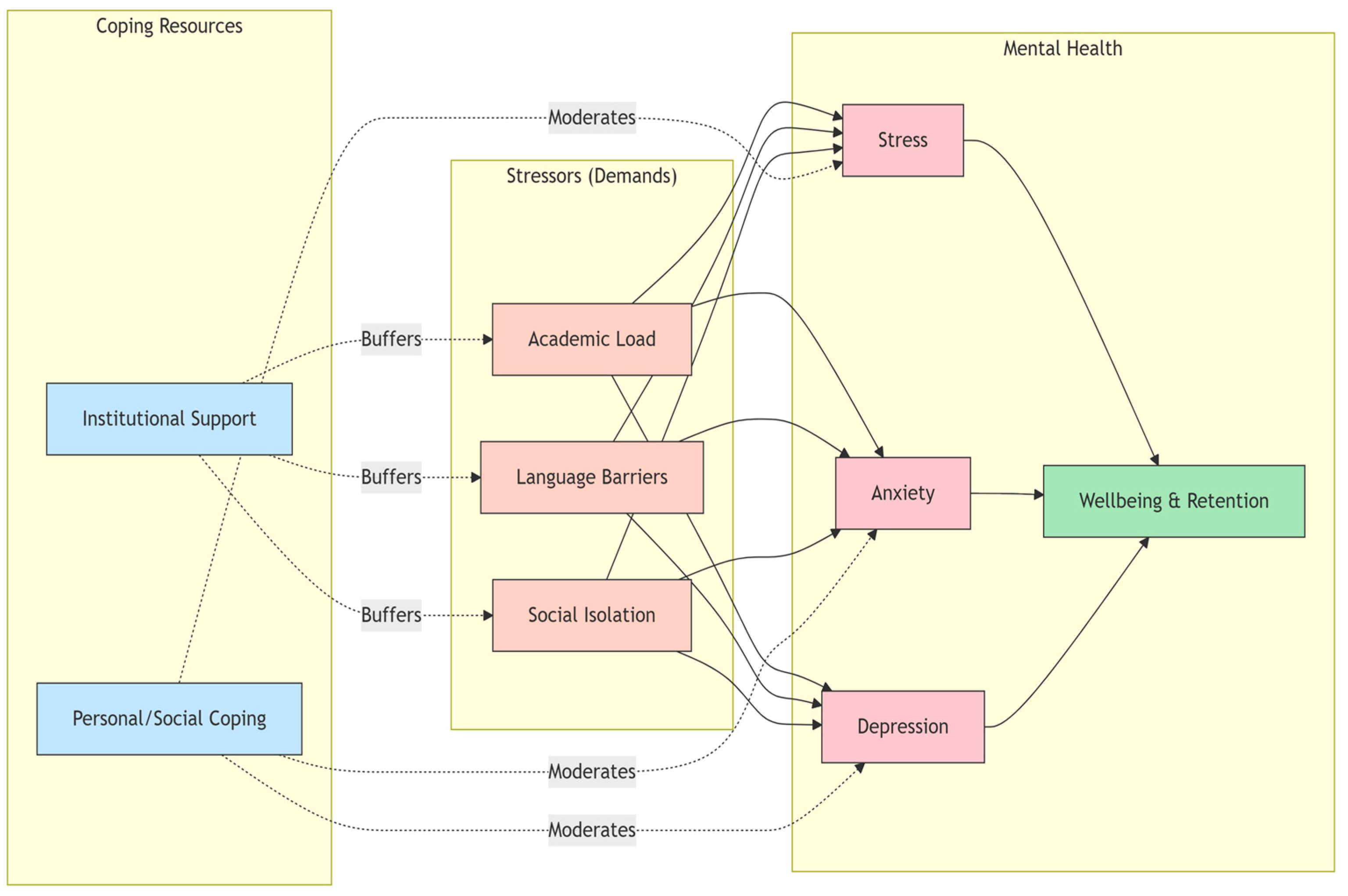
1.2. Theoretical Framework
2. Research Methodology
2.1. Research Design
2.2. Study Area and Sample Size
2.3. Sampling Method
2.4. Data Collection
2.5. Data Analysis
2.6. Ethical Considerations and Informed Consent
3. Results
3.1. Hierarchical Regression Analysis
3.2. Correlations Among Stressors and Mental Health
3.3. Validity and Reliability of the Data
3.4. Stress Distribution by Degree Level
3.5. Top Academic Stressors
3.6. Institutional Support Utilization and Satisfaction
3.7. Qualitative Insights from in Depth Interviews
“When I finish one assignment, another deadline immediately appears. It feels like there is never a break. The workload is continuous, and sometimes I feel mentally exhausted just trying to keep up.”(Master’s student, Asia)
“My supervisor encouraged me to target a Q1 SSCI journal instead of a journal I originally selected. The expectations became much higher, and the rejection of my manuscript seriously affected my confidence and mental health.”(PhD student, Africa)
“Language is one of the biggest challenges. Even after studying here for a long time, daily communication can still be difficult. Sometimes I hesitate to ask questions because I am not confident in expressing myself.”(Master’s student, Asia)
“Some lectures move very fast, and if I miss one concept because of language difficulties, it becomes difficult to follow the rest of the class. That creates a lot of stress before examinations.”(Undergraduate student, Africa)
“Back home, studying was a social activity. Here, I often study and eat alone. After several months, I still feel disconnected from people around me, which affects my motivation and emotional wellbeing.”(PhD student, South Asia)
“I tried to communicate with my classmates and lab members, but because of language and cultural differences, I often felt ignored or left out of conversations.”(Master’s student, Africa)
“There were periods when I could not sleep properly because I kept thinking about research deadlines, presentations, and exams. The stress affected both my concentration and physical health.”(PhD student, Asia)
“I have to wake up very early and travel a long distance to attend classes. The constant disruption of my sleep schedule makes me tired and stressed throughout the semester.”(Undergraduate student, Africa)
“Talking with other international students helps because they understand the same struggles. We support each other emotionally, but I think universities need more accessible mental health services specifically designed for international students.”(Master’s student, Asia)
4. Discussion
5. Conclusions
Study Limitations
Author Contributions
Funding
Institutional Review Board Statement
Informed Consent Statement
Data Availability Statement
Acknowledgments
Conflicts of Interest
References
- Abbas, M. Z., Liang, X.-M., & Liu, K.-Z. (2014). An evaluation of acculturation stress, mental health issues and adaptation difficulties of international students in China. Sichuan Mental Health, 27(2), 97. [Google Scholar] [CrossRef] [Scilit]
- Ahmad, A. B., & Shah, M. (2018). International students’ choice to study in China: An exploratory study. Tertiary Education and Management, 24(4), 325–337. [Google Scholar] [CrossRef] [Scilit]
- Alam, M. D., Lu, J., Ni, L., Hu, S., & Xu, Y. (2021). Psychological outcomes and associated factors among the international students living in China during the COVID-19 pandemic. Frontiers in Psychiatry, 12, 707342. [Google Scholar] [CrossRef] [Scilit] [PubMed]
- An, R., & Chiang, S. Y. (2015). International students’ culture learning and cultural adaptation in China. Journal of Multilingual and Multicultural Development, 36(7), 661–676. [Google Scholar] [CrossRef] [Scilit]
- Bagozzi, R. P., & Yi, Y. (1989). The degree of intention formation as a moderator of the attitude-behavior relationship. Social Psychology Quarterly, 52, 266–279. [Google Scholar] [CrossRef] [Scilit]
- Bakker, A. B., & Demerouti, E. (2017). Job demands–resources theory: Taking stock and looking forward. Journal of Occupational Health Psychology, 22(3), 273. [Google Scholar] [CrossRef] [Scilit] [PubMed]
- Berry, J. W. (2006). Contexts of acculturation. In The Cambridge handbook of acculturation psychology (Vol. 27, pp. 328–336). Cambridge University Press. [Google Scholar]
- Braun, V., & Clarke, V. (2006). Using thematic analysis in psychology. Qualitative Research in Psychology, 3(2), 77–101. [Google Scholar] [CrossRef] [Scilit]
- Cao, C., & Meng, Q. (2023). The dual processes of health impairment and motivation in international student adjustment in China: Insights from a demands-resources model. Current Psychology, 42(29), 25075–25088. [Google Scholar]
- Cao, C., Zhang, J., & Meng, Q. (2023). A social cognitive model predicting international students’ cross-cultural adjustment in China. Current Psychology, 42(17), 14529–14541. [Google Scholar]
- Creswell, J. W. (1999). Mixed-method research: Introduction and application. In Handbook of educational policy (pp. 455–472). Academic Press. [Google Scholar]
- Demerouti, E., & Bakker, A. B. (2023). Job demands-resources theory in times of crises: New propositions. Organizational Psychology Review, 13(3), 209–236. [Google Scholar]
- Ding, X. (2016). Exploring the experiences of international students in China. Journal of Studies in International Education, 20(4), 319–338. [Google Scholar] [CrossRef] [Scilit]
- Dong, W., Tang, H., Wu, S., Lu, G., Shang, Y., & Chen, C. (2024). The effect of social anxiety on teenagers’ internet addiction: The mediating role of loneliness and coping styles. BMC Psychiatry, 24(1), 395. [Google Scholar] [CrossRef] [Scilit] [PubMed]
- Dwumah Manu, B., Ying, F., Oduro, D., Antwi, J., & Yakubu Adjuik, R. (2023). The impact of social media use on student engagement and acculturative stress among international students in China. PLoS ONE, 18(4), e0284185. [Google Scholar] [CrossRef] [Scilit] [PubMed]
- Eisenberg, D., Gollust, S. E., Golberstein, E., & Hefner, J. L. (2007). Prevalence and correlates of depression, anxiety, and suicidality among university students. American Journal of Orthopsychiatry, 77(4), 534–542. [Google Scholar] [CrossRef] [Scilit] [PubMed]
- Fornell, C., & Larcker, D. F. (1981). Evaluating structural equation models with unobservable variables and measurement error. Journal of Marketing Research, 18(1), 39–50. [Google Scholar] [CrossRef] [Scilit]
- Gong, Y., Gao, X., Li, M., & Lai, C. (2021). Cultural adaptation challenges and strategies during study abroad: New Zealand students in China. Language, Culture and Curriculum, 34(4), 417–437. [Google Scholar]
- Guan, M., Fan, X., & Li, J. (2023). Pedagogical doctoral students in China under pressure: An empirical analysis of CSSCI journals. Problems of Education in the 21st Century, 81(4), 449–461. [Google Scholar] [CrossRef] [Scilit]
- Hair, J. F., Risher, J. J., Sarstedt, M., & Ringle, C. M. (2019). When to use and how to report the results of PLS-SEM. European Business Review, 31(1), 2–24. [Google Scholar] [CrossRef] [Scilit]
- Hussain, M., & Shen, H. (2019). A study on academic adaptation of international students in China. Higher Education Studies, 9(4), 80. [Google Scholar] [CrossRef] [Scilit]
- Ivankova, N. V., Creswell, J. W., & Stick, S. L. (2006). Using mixed-methods sequential explanatory design: From theory to practice. Field Methods, 18(1), 3–20. [Google Scholar] [CrossRef] [Scilit]
- Jiang, Q., Li, Y., & Shypenka, V. (2018). Loneliness, individualism, and smartphone addiction among international students in China. Cyberpsychology, Behavior, and Social Networking, 21(11), 711–718. [Google Scholar] [CrossRef] [Scilit] [PubMed]
- Levecque, K., Anseel, F., De Beuckelaer, A., Van der Heyden, J., & Gisle, L. (2017). Work organization and mental health problems in PhD students. Research Policy, 46(4), 868–879. [Google Scholar] [CrossRef] [Scilit]
- Li, X. (2015). International students in China: Cross-cultural interaction, integration, and identity construction. Journal of Language, Identity & Education, 14(4), 237–254. [Google Scholar] [CrossRef] [Scilit]
- Liu, S., Wei, M., Ko, S., Du, Y., Wang, C., He, L., & Tsai, P. C. (2024). Engagement with new possibilities, personal growth initiative, and optimism among East Asian international students. Journal of Asia Pacific Counseling, 14(2), 1–24. [Google Scholar] [CrossRef] [Scilit]
- Ma, J., & Zhao, K. (2018). International student education in China: Characteristics, challenges, and future trends. Higher Education, 76(4), 735–751. [Google Scholar] [CrossRef] [Scilit]
- Mao, Y., Zhang, N., Liu, J., Zhu, B., He, R., & Wang, X. (2019). A systematic review of depression and anxiety in medical students in China. BMC Medical Education, 19(1), 327. [Google Scholar] [CrossRef] [Scilit] [PubMed]
- Qian, J., & Yu, J. (2023). Effects of Chinese language learning anxiety on the mental health of international students in China: The chain mediating effect of campus adaptation and academic resilience. Psychology Research and Behavior Management, 16, 2201–2211. [Google Scholar] [CrossRef] [Scilit] [PubMed]
- Raja, R., Ma, J., Zhang, M., Li, X. Y., Almutairi, N. S., & Almutairi, A. H. (2023). Social identity loss and reverse culture shock: Experiences of international students in China during the COVID-19 pandemic. Frontiers in Psychology, 14, 994411. [Google Scholar] [CrossRef] [Scilit] [PubMed]
- Raksithaa, S. (2024). Publication stress amongst scholars and faculties: A concern of mental health. Mental Health and Social Inclusion. ahead-of-print.
- Sun, J., Dunne, M. P., & Hou, X. Y. (2012). Academic stress among adolescents in China. Australasian Epidemiologist, 19(1), 9–12. [Google Scholar]
- Troutman, J., Riley, D., & Mallouk, K. (2022, June 26–29). Visualizing stress and relief: How stressors and coping mechanisms interact in engineering graduate student experiences. 2022 ASEE Annual Conference & Exposition, Minneapolis, MN, USA. [Google Scholar]
- Wang, S., Li, H., Chen, X., Yan, N., & Wen, D. (2023). The mediating role of psychological capital in the association between life satisfaction and depressive and anxiety symptoms among Chinese medical students during the COVID-19 pandemic: A cross-sectional study. BMC Psychiatry, 23(1), 398. [Google Scholar] [CrossRef] [Scilit] [PubMed]
- Xu, X., Li, X. M., Zhang, J., & Wang, W. (2018). Mental health-related stigma in China. Issues in Mental Health Nursing, 39(2), 126–134. [Google Scholar] [PubMed]
- Yang, Z., & de Wit, H. (2019). International students in China: Facts, paths, and challenges. International Higher Education, (97), 18–20. [Google Scholar] [CrossRef] [Scilit]
- Yu, B., Chen, X., Li, S., Liu, Y., Jacques-Tiura, A. J., & Yan, H. (2014). Acculturative stress and influential factors among international students in China: A structural dynamic perspective. PLoS ONE, 9(4), e96322. [Google Scholar] [CrossRef] [Scilit] [PubMed]
- Yu, S., Kowitt, S. D., Fisher, E. B., & Li, G. (2018). Mental health in China: Stigma, family obligations, and the potential of peer support. Community Mental Health Journal, 54(6), 757–764. [Google Scholar] [CrossRef] [Scilit] [PubMed]
- Yuan, Q., Lu, X., Shi, X., Leng, J., & Fan, Z. (2024). Impact of the sense of power on loneliness among international students in China: The chain mediating role of perceived discrimination and loneliness stigma. BMC Psychology, 12(1), 784. [Google Scholar] [CrossRef] [Scilit] [PubMed]
- Zhu, J., Gu, M., Yang, L., Xun, S., Wan, M., & Li, J. (2022). Academic adaptation of international students in China: Evidence from the grounded theory and structure equation model. Sustainability, 15(1), 692. [Google Scholar] [CrossRef] [Scilit]


| Model | χ2 (df) | p-Value | CFI | TLI | RMSEA (90% CI) | SRMR |
|---|---|---|---|---|---|---|
| Overall Measurement Model | 412.85 (224) | <0.001 | 0.93 | 0.92 | 0.052 (0.045–0.058) | 0.047 |
| Variable | Category | Frequency (n) | Percentage (%) |
|---|---|---|---|
| Gender | Male | 280 | 56.0 |
| Female | 220 | 44.0 | |
| Age | 20–25 | 134 | 26.8 |
| 26–30 | 197 | 39.4 | |
| 31–40 | 169 | 33.8 | |
| Region | Africa | 210 | 42.0 |
| Asia | 290 | 58.0 | |
| Degree Level | Undergraduate | 100 | 20.0 |
| Master’s | 225 | 45.0 | |
| PhD | 175 | 35.0 |
| Symptom | Never (%) | Sometimes (%) | Often (%) | Always (%) |
|---|---|---|---|---|
| Stress | 12.0 | 48.0 | 32.0 | 8.0 |
| Anxiety | 18.0 | 42.0 | 28.0 | 12.0 |
| Depression | 22.0 | 38.0 | 27.0 | 13.0 |
| Sleep disturbance | 25.0 | 40.0 | 25.0 | 10.0 |
| Fatigue/burnout | 20.0 | 45.0 | 25.0 | 10.0 |
| Predictor | Stress β [95% CI] (FDR-adj p) | Anxiety β [95% CI] (FDR-adj p) | Depression β [95% CI] (FDR-adj p) |
|---|---|---|---|
| Step 1: Demographics | |||
| Female (ref: Male) | 0.18 [0.04, 0.32] (0.015) | 0.22 [0.08, 0.36] (0.008) | 0.20 [0.06, 0.34] (0.011) |
| Age | −0.07 [−0.15, 0.01] (0.096) | −0.05 [−0.13, 0.03] (0.148) | −0.08 [−0.16, 0.00] (0.086) |
| Step 1 R2/ΔR2 | 0.017/0.017 | 0.021/0.021 | 0.019/0.019 |
| Step 2: Academic Factors | |||
| Master’s | 0.16 [0.08, 0.40] (0.090) | 0.14 [0.06, 0.38] (0.112) | 0.12 [0.04, 0.36] (0.136) |
| PhD | 0.24 [−0.02, 0.34] (0.009) | 0.26 [−0.01, 0.36] (0.007) | 0.28 [0.01, 0.38] (0.005) |
| Academic Load | 0.37 [0.25, 0.49] (<0.001) | 0.34 [0.22, 0.46] (0.001) | 0.31 [0.19, 0.43] (0.003) |
| Step 2 R2/ΔR2 | 0.119/0.102 | 0.128/0.107 | 0.122/0.103 |
| Step 3: Social Factors | |||
| Social Isolation | 0.22 [0.08, 0.36] (0.006) | 0.19 [0.05, 0.33] (0.015) | 0.25 [0.11, 0.39] (0.004) |
| Language Barrier | 0.15 [0.03, 0.27] (0.020) | 0.17 [0.05, 0.29] (0.012) | 0.14 [0.02, 0.26] (0.024) |
| Step 3 R2/ΔR2 | 0.154/0.035 | 0.152/0.024 | 0.157/0.035 |
| Total Model R2 | 0.154 | 0.152 | 0.157 |
| Quantitative Finding | Qualitative Theme | Illustrative Quote |
|---|---|---|
| Academic load—strongest predictor of stress (β = 0.37, p < 0.001) | Overwhelming and cumulative workload | “When I complete one task, several more appear. It’s a cycle that never ends.” |
| Research/publication burden—highest mean stressor (M = 4.50) | Pressure from research and publication | “My supervisor insisted I withdraw from a good Q2 journal to target only Q1. It doubled my stress.” |
| Social isolation—significant predictor of depression (β = 0.25, p < 0.01) | Cultural distance and loneliness | “After six months, I still eat alone most days… I feel disconnected from people around me.” |
| Language barriers—significant predictor of anxiety (β = 0.17, p < 0.05) | Language as social and academic barrier | “Even after months here, I still struggle to communicate effectively in class and outside.” |
| Low counseling utilization (38%) and satisfaction (M = 3.02) | Cultural stigma and limited awareness | “In my culture, seeking psychological help feels shameful. Even if services exist, I hesitate to use them.” |
| Variable | 1 | 2 | 3 | 4 | 5 | 6 |
|---|---|---|---|---|---|---|
| 1. Academic Load | 1.00 | |||||
| 2. Language Barrier | 0.43 ** | 1.00 | ||||
| 3. Social Isolation | 0.31 ** | 0.34 ** | 1.00 | |||
| 4. Stress | 0.58 ** | 0.42 ** | 0.27 ** | 1.00 | ||
| 5. Anxiety | 0.53 ** | 0.39 ** | 0.29 ** | 0.68 ** | 1.00 | |
| 6. Depression | 0.51 ** | 0.36 ** | 0.32 ** | 0.65 ** | 0.74 ** | 1.00 |
| Construct | No. of Items | Cronbach’s Alpha | CR | AVE | CFA Loading Range |
|---|---|---|---|---|---|
| Academic Stress | 7 | 0.81 | 0.82 | 0.45 | 0.53–0.79 |
| Anxiety | 7 | 0.84 | 0.84 | 0.51 | 0.56–0.78 |
| Depression | 7 | 0.74 | 0.80 | 0.53 | 0.51–0.75 |
| Support Services | 3 | 0.73 | 0.73 | 0.40 | 0.45–0.72 |
| Language Barriers | 7 | 0.76 | 0.78 | 0.48 | 0.55–0.77 |
| Social Isolation | 7 | 0.79 | 0.80 | 0.49 | 0.52–0.76 |
| Degree Level | Low Stress n (%) | Moderate Stress n (%) | High Stress n (%) | Total |
|---|---|---|---|---|
| Undergraduate | 22 (22.0%) | 53 (53.0%) | 25 (25.0%) | 100 |
| Master’s | 37 (16.4%) | 108 (48.0%) | 80 (35.6%) | 225 |
| PhD | 45 (25.7%) | 80 (45.7%) | 50 (28.6%) | 175 |
| Total | 104 (20.8%) | 241 (48.2%) | 155 (31.0%) | 500 |
| Rank | Stressor | Mean (SD) |
|---|---|---|
| 1 | Research/Publication burden | 4.50 (0.70) |
| 2 | Thesis/Dissertation pressure | 4.10 (0.80) |
| 3 | Heavy academic workload | 3.80 (0.90) |
| 4 | Examination pressure | 3.60 (0.80) |
| 5 | Language barriers | 3.10 (0.70) |
| 6 | Social isolation (new) | 3.05 (0.75) |
| 7 | Financial stress (new) | 2.95 (0.78) |
| 8 | Supervisor student relationship challenges (new) | 2.85 (0.72) |
| Support Service | Mean Satisfaction (SD) | Students Using Service n (%) |
|---|---|---|
| Counseling/psychological services | 3.02 (1.28) | 190 (38.0%) |
| Academic advising services | 3.58 (0.82) | 290 (58.0%) |
| Thesis/dissertation support workshops | 4.05 (0.74) | 325 (65.0%) |
| Language support/writing center assistance | 3.40 (0.90) | 240 (48.0%) |
| Peer mentoring/international student buddy programs | 3.25 (0.88) | 210 (42.0%) |
| Orientation & integration programs | 3.70 (0.77) | 310 (62.0%) |
| Theme | Sub Themes | Participant Context/Quotes |
|---|---|---|
| Academic Stress | Overwhelming and cumulative workload | “When I complete one task, several more appear. It’s a cycle that never ends.” |
| Pressure from research and publication | “My supervisor insisted I withdraw from a good Q2 journal to target only Q1. It doubled my stress and delayed everything.” | |
| Heavy coursework and long classes | “The long-lasting classes of about 4 h, heavy workload including reading articles for assignments and presentations increases the academic load.” | |
| Acculturative and Institutional Pressure | Language as a social barrier | “Language is one of the biggest challenges. Even after months here, I still struggle to communicate effectively in class and outside.” |
| Cultural distance and loneliness | “Back home, my classmates and I would study together daily and share meals. Here, after six months, I still eat alone most days.” | |
| Logistical challenges | “Waking up early in the morning, waiting for buses to move to another campus has affected my mental health.” | |
| Mental Health Distress | Emotional and physical depletion | “I am always tired. Even when I sleep, I’m thinking about my paper. Headaches are normal now. Sometimes I just feel completely empty.” |
| Anxiety and stress symptoms | “The pressure of deadlines, presentations, and research makes me constantly anxious and fatigued.” | |
| Coping: Between Resilience and Exhaustion | Reliance on peer networks | “My only saving grace is my group of friends from my country. We vent, we cook together, we understand each other without explaining.” |
| Self-care and coping strategies | “I try to exercise and meditate, but it is not enough to counter the stress from research and classes.” | |
| Supervisor Student Interaction Stress | Conflicting expectations | “I wrote the paper targeting a specific journal, but my supervisor insisted on a higher-impact journal. Balancing my goals with their expectations is exhausting.” |
| Lack of guidance or over involvement | “Sometimes the supervisor’s interference increases stress rather than helping me; I feel caught between their instructions and my research plan.” | |
| Institutional Support Gaps | Limited awareness or accessibility of services | “Even though counseling is available, I don’t know how to access it, and language is a barrier in communicating with staff.” |
| Cultural stigma around mental health | “In my culture, seeking psychological help feels shameful. Even if services exist, I hesitate to use them.” |
Disclaimer/Publisher’s Note: The statements, opinions and data contained in all publications are solely those of the individual author(s) and contributor(s) and not of MDPI and/or the editor(s). MDPI and/or the editor(s) disclaim responsibility for any injury to people or property resulting from any ideas, methods, instructions or products referred to in the content. |
© 2026 by the authors. Licensee MDPI, Basel, Switzerland. This article is an open access article distributed under the terms and conditions of the Creative Commons Attribution (CC BY) license.
Share and Cite
Zeng, D.; Zubair, A.; Dong, H. Academic Stress and Mental Health Challenges Among International Students in China. Behav. Sci. 2026, 16, 1212. https://doi.org/10.3390/bs16071212
Zeng D, Zubair A, Dong H. Academic Stress and Mental Health Challenges Among International Students in China. Behavioral Sciences. 2026; 16(7):1212. https://doi.org/10.3390/bs16071212
Chicago/Turabian StyleZeng, Dongxia, Asim Zubair, and Haijun Dong. 2026. "Academic Stress and Mental Health Challenges Among International Students in China" Behavioral Sciences 16, no. 7: 1212. https://doi.org/10.3390/bs16071212
APA StyleZeng, D., Zubair, A., & Dong, H. (2026). Academic Stress and Mental Health Challenges Among International Students in China. Behavioral Sciences, 16(7), 1212. https://doi.org/10.3390/bs16071212