The Roles of Psychological Flexibility and Perceived Parental Emotional Support in Resilience and Social Anxiety Among College Students


Abstract
1. Introduction
1.1. Resilience and Social Anxiety
1.2. Psychological Flexibility as a Mediator
1.3. Perceived Parental Emotional Support as a Moderator
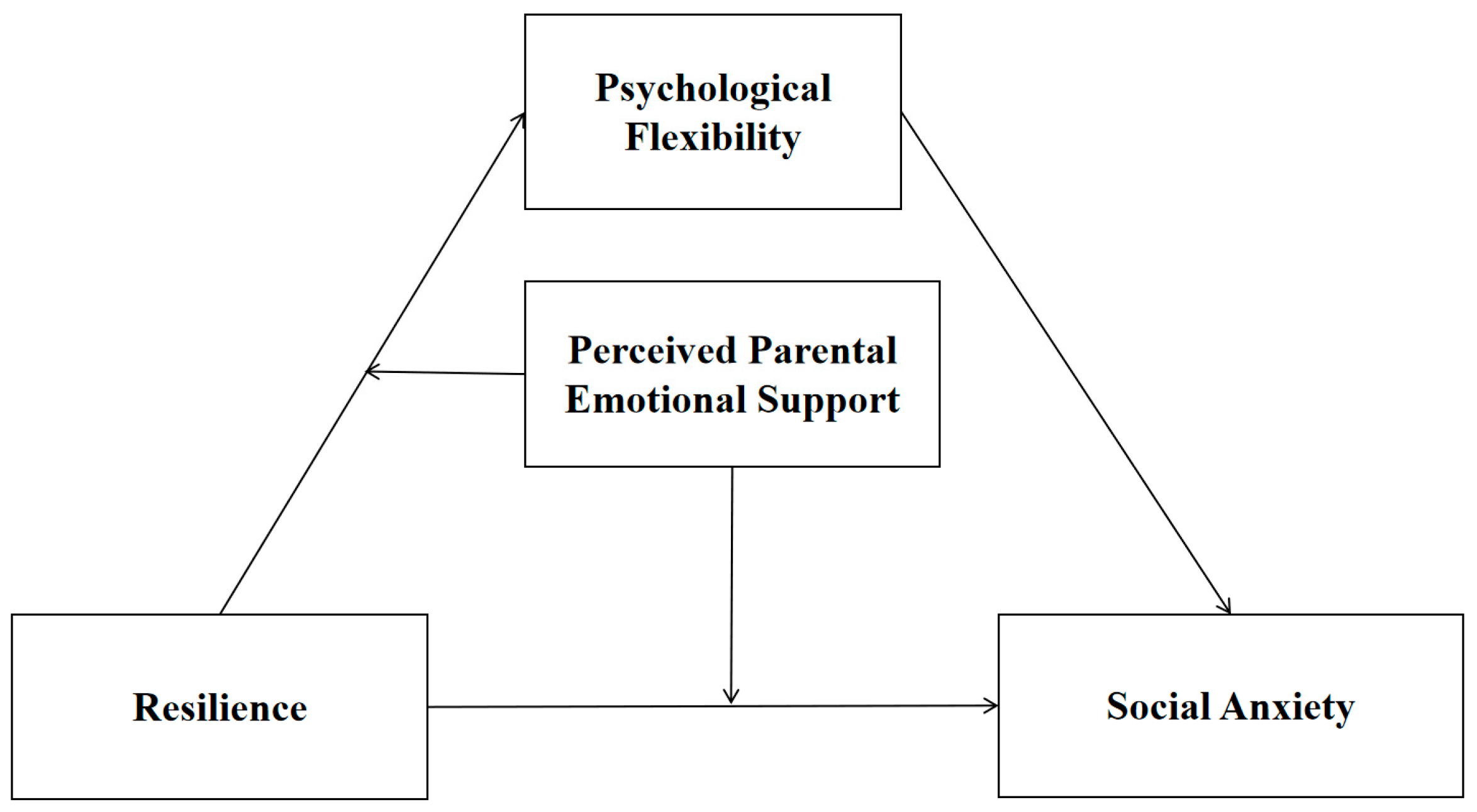
1.4. The Current Study
2. Methods
2.1. Participants and Procedure
2.2. Measures
2.2.1. Resilience Scale
2.2.2. Psychological Flexibility Scale
2.2.3. Social Anxiety Scale
2.2.4. Perceived Parental Emotional Support Scale
2.2.5. Demographic Covariates
2.3. Statistical Analysis
3. Results
3.1. Common Method Bias
3.2. Descriptive Statistics and Correlation Matrix
3.3. Testing of the Mediating Role of Psychological Flexibility
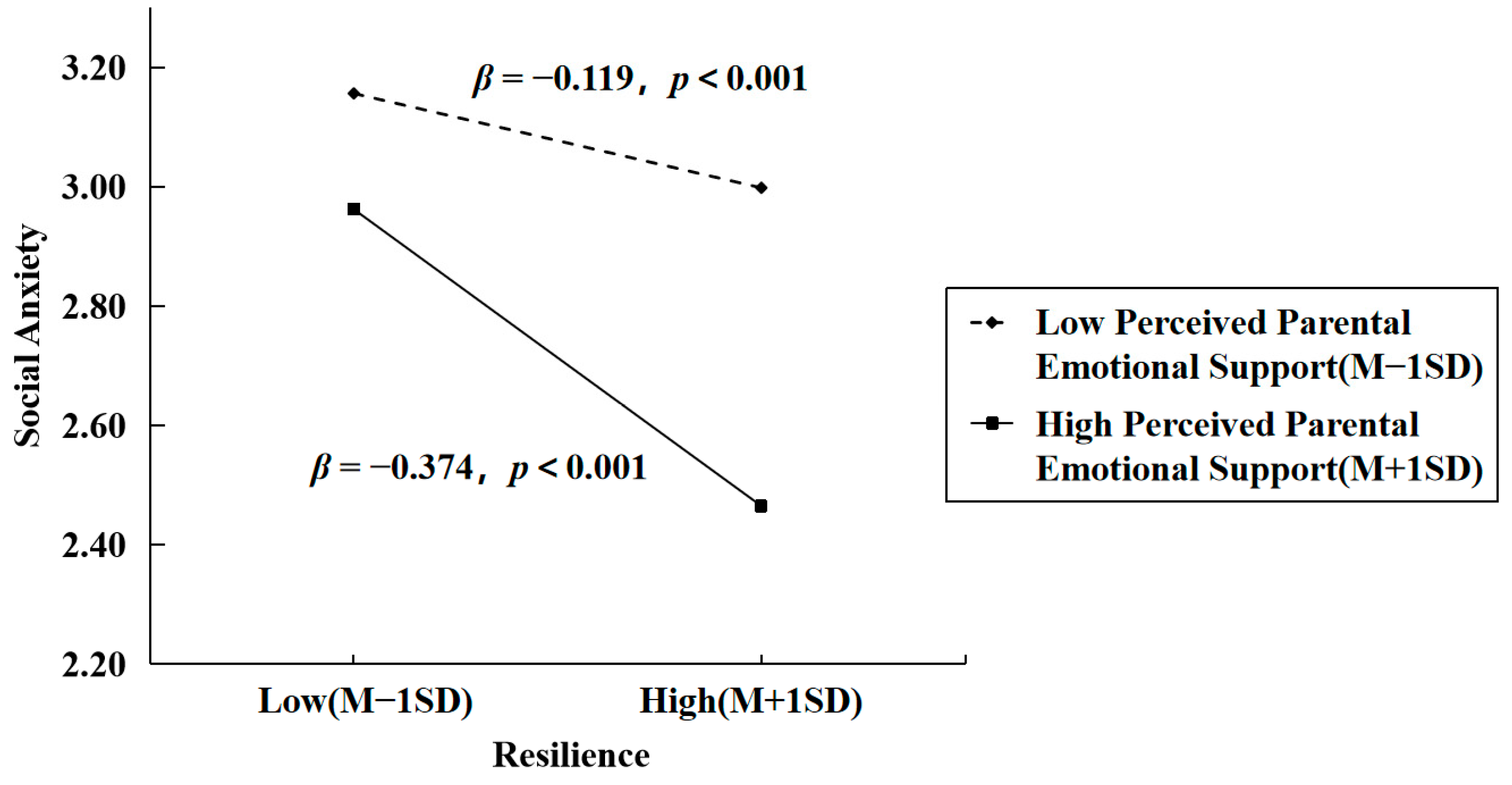
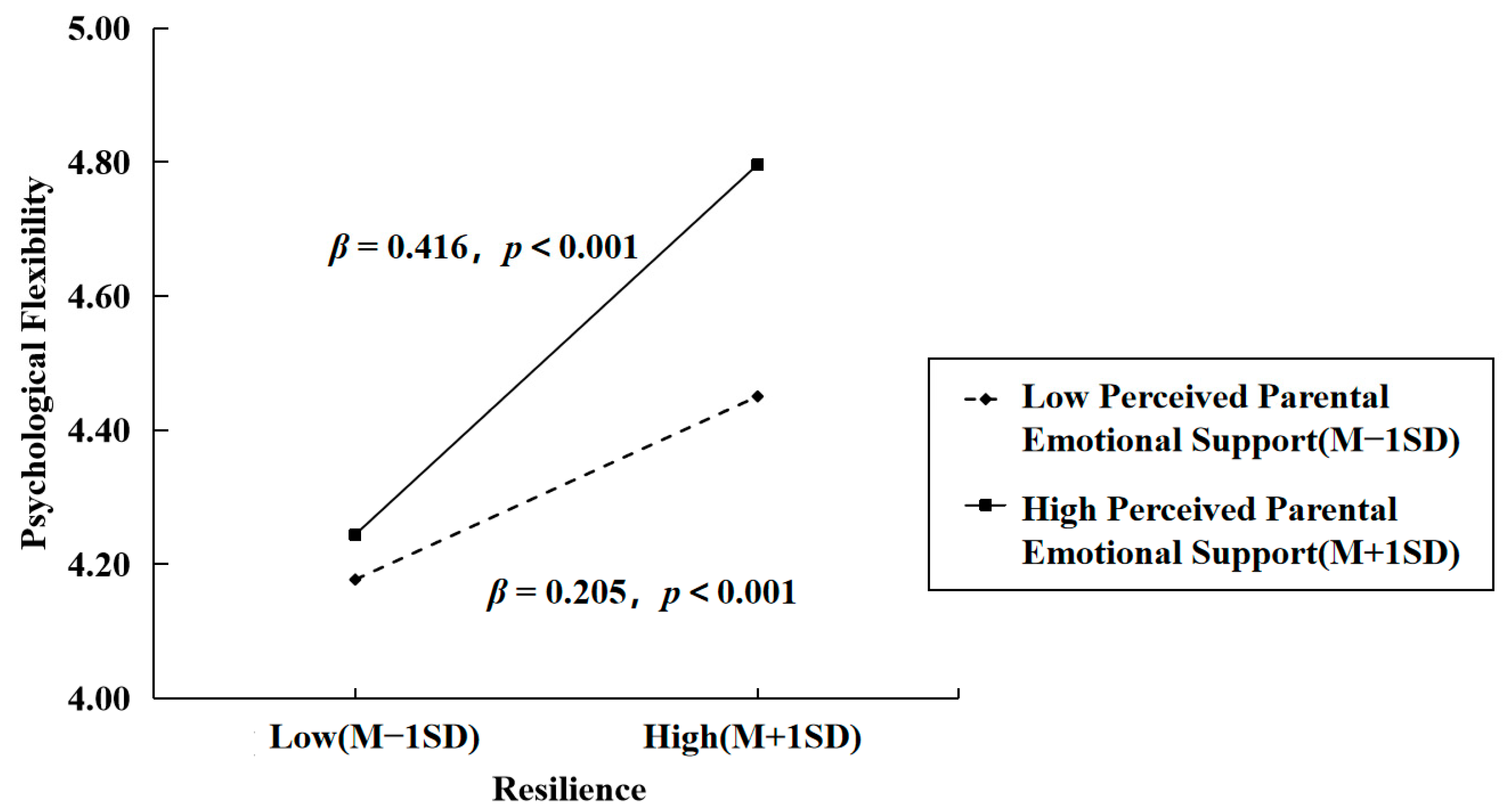
3.4. Testing of Moderated Mediation Model of Perceived Parental Emotional Support
4. Discussion
4.1. The Relationship Between Resilience and Social Anxiety
4.2. Mediating Effect of Psychological Flexibility
4.3. Moderating Effect of Perceived Parental Emotional Support
4.4. Implications and Limitations
5. Conclusions
Author Contributions
Funding
Institutional Review Board Statement
Informed Consent Statement
Data Availability Statement
Acknowledgments
Conflicts of Interest
References
- Alloway, R., & Bebbington, P. (1987). The buffer theory of social support—A review of the literature. Psychological Medicine, 17(1), 91–108. [Google Scholar] [CrossRef]
- Atik, S., Sumbas, E., & Erdemir, N. (2026). In the shadow of the digital age: The dance of self-efficacy, psychological resilience, social anxiety, and digital addiction among university students. Acta Psychologica, 265, 106681. [Google Scholar] [CrossRef]
- Barahmand, U., Shamsina, N., Carvey, K., Ancheta, A. M., & Sanchez, O. (2023). The associations between attitudes toward interpersonal affective touch, negative cognitions and social anxiety: A pilot study. Psychiatry, 86(1), 53–66. [Google Scholar] [CrossRef]
- Biggs, A., & Brough, P. (2025). Stress and coping theory. In Handbook of concepts in health, health behavior and environmental health (pp. 1–23). Springer. [Google Scholar] [CrossRef]
- Biggs, A., Brough, P., & Drummond, S. (2017). Lazarus and folkman’s psychological stress and coping theory. In The handbook of stress and health: A guide to research and practice (pp. 351–364). Wiley Blackwell. [Google Scholar] [CrossRef]
- Boudreault-Bouchard, A.-M., Dion, J., Hains, J., Vandermeerschen, J., Laberge, L., & Perron, M. (2013). Impact of parental emotional support and coercive control on adolescents’ self-esteem and psychological distress: Results of a four-year longitudinal study. Journal of Adolescence, 36(4), 695–704. [Google Scholar] [CrossRef]
- Carver, C. S., Scheier, M. F., & Weintraub, J. K. (1989). Assessing coping strategies: A theoretically based approach. Journal of Personality and Social Psychology, 56(2), 267–283. [Google Scholar] [CrossRef]
- Cheraghian, H., Moradian, K., & Nouri, T. (2023). Structural model of resilience based on parental support: The mediating role of hope and active coping. BMC Psychiatry, 23(1), 260. [Google Scholar] [CrossRef]
- Cherry, J., Singh, G., & Buck, M. (2024). Psychological flexibility as a mediator in the relationship between resilience and academic burnout among doctor of physical therapy students: A structural equation modeling study. Health Science Reports, 7(11), e2291. [Google Scholar] [CrossRef] [PubMed]
- Cherry, K. M., Hoeven, E. V., Patterson, T. S., & Lumley, M. N. (2021). Defining and measuring “psychological flexibility”: A narrative scoping review of diverse flexibility and rigidity constructs and perspectives. Clinical Psychology Review, 84, 101973. [Google Scholar] [CrossRef] [PubMed]
- Connor, K. M., & Davidson, J. R. T. (2003). Development of a new resilience scale: The Connor-Davidson Resilience Scale (CD-RISC). Depression and Anxiety, 18(2), 76–82. [Google Scholar] [CrossRef] [PubMed]
- Côté, S., Bouffard, T., & Vezeau, C. (2014). The mediating effect of self-evaluation bias of competence on the relationship between parental emotional support and children’s academic functioning. British Journal of Educational Psychology, 84(3), 415–434. [Google Scholar] [CrossRef]
- Davydov, D. M., Stewart, R., Ritchie, K., & Chaudieu, I. (2010). Resilience and mental health. Clinical Psychology Review, 30(5), 479–495. [Google Scholar] [CrossRef]
- Deng, Q., & Zhang, X. (2026). Interpretable analysis of social anxiety status and influencing factors among college students. Frontiers in Psychiatry, 17, 1776296. [Google Scholar] [CrossRef]
- Di Tata, D., Bianchi, D., & Laghi, F. (2024). Peer victimization and social anxiety in adolescence: A comparison between migrant and native students in Italy. Frontiers in Psychology, 15, 1346373. [Google Scholar] [CrossRef]
- Elliott, T. R., Hsiao, Y.-Y., Kimbrel, N. A., DeBeer, B. B., Gulliver, S. B., Kwok, O.-M., Morissette, S. B., & Meyer, E. C. (2019). Resilience facilitates adjustment through greater psychological flexibility among Iraq/Afghanistan war veterans with and without mild traumatic brain injury. Rehabilitation Psychology, 64(4), 383–397. [Google Scholar] [CrossRef] [PubMed]
- Fanchang, K. (2024). Psychosocial development theory. In The ECPH encyclopedia of psychology (pp. 1–2). Springer. [Google Scholar] [CrossRef]
- Figueiredo, D. V., Alves, F., & Vagos, P. (2024). Psychological inflexibility explains social anxiety over time: A mediation analyses with a clinical adolescent sample. Current Psychology, 43(5), 4404–4415. [Google Scholar] [CrossRef]
- Folkman, S. (2013). Stress: Appraisal and coping. In Encyclopedia of behavioral medicine (pp. 1913–1915). Springer. [Google Scholar] [CrossRef]
- Foroughi, B., Griffiths, M. D., Iranmanesh, M., & Salamzadeh, Y. (2022). Associations between Instagram addiction, academic performance, social anxiety, depression, and life satisfaction among university students. International Journal of Mental Health and Addiction, 20(4), 2221–2242. [Google Scholar] [CrossRef]
- Garcia-Dia, M. J., DiNapoli, J. M., Garcia-Ona, L., Jakubowski, R., & O’Flaherty, D. (2013). Concept analysis: Resilience. Archives of Psychiatric Nursing, 27(6), 264–270. [Google Scholar] [CrossRef]
- Gloster, A. T., Klotsche, J., Chaker, S., Hummel, K. V., & Hoyer, J. (2011). Assessing psychological flexibility: What does it add above and beyond existing constructs? Psychological Assessment, 23(4), 971–982. [Google Scholar] [CrossRef] [PubMed]
- Gloster, A. T., Walder, N., Levin, M. E., Twohig, M. P., & Karekla, M. (2020). The empirical status of acceptance and commitment therapy: A review of meta-analyses. Journal of Contextual Behavioral Science, 18, 181–192. [Google Scholar] [CrossRef]
- Hayes, S. C., Pistorello, J., & Levin, M. E. (2012a). Acceptance and commitment therapy as a unified model of behavior change. The Counseling Psychologist, 40(7), 976–1002. [Google Scholar] [CrossRef]
- Hayes, S. C., Strosahl, K. D., & Wilson, K. G. (2012b). Acceptance and commitment therapy: The process and practice of mindful change (2nd ed., pp. xiv, 402). The Guilford Press. [Google Scholar]
- Hobfoll, S. E. (1989). Conservation of resources. A new attempt at conceptualizing stress. American Psychologist, 44(3), 513–524. [Google Scholar] [CrossRef]
- Hofmann, S. G. (2007). Cognitive factors that maintain social anxiety disorder: A comprehensive model and its treatment implications. Cognitive Behaviour Therapy, 36(4), 193–209. [Google Scholar] [CrossRef] [PubMed]
- Holahan, C. J., Moos, R. H., & Bonin, L. (1997). Social support, coping, and psychological adjustment. In G. R. Pierce, B. Lakey, I. G. Sarason, & B. R. Sarason (Eds.), Sourcebook of social support and personality (pp. 169–186). Springer. [Google Scholar] [CrossRef]
- Jefferies, P., Höltge, J., & Ungar, M. (2021). Social anxiety and resilience: Associations vary by country and sex. Adversity and Resilience Science, 2(1), 51–62. [Google Scholar] [CrossRef]
- Jiang, Y., Tian, T., Li, F., Sun, J., Guo, Q., Wang, D., Li, X., & Yang, L. (2024). Chinese translation and validation of the personalized psychological flexibility index (PPFI) for medical college students. BMC Psychology, 12(1), 630. [Google Scholar] [CrossRef] [PubMed]
- Jiao, C., Cui, M., & Fincham, F. D. (2025). Predicting changes in helicopter parenting, fear of missing out (FOMO), and social anxiety in college students. Journal of Adult Development, 32(2), 121–130. [Google Scholar] [CrossRef]
- Kashdan, T. B., & Rottenberg, J. (2010). Psychological flexibility as a fundamental aspect of health. Clinical Psychology Review, Positive Clinical Psychology, 30(7), 865–878. [Google Scholar] [CrossRef]
- Leigh, E., Chiu, K., & Ballard, E. D. (2023). Social anxiety and suicidality in youth: A systematic review and meta-analysis. Research on Child and Adolescent Psychopathology, 51(4), 441–454. [Google Scholar] [CrossRef] [PubMed]
- Leigh, E., & Clark, D. M. (2018). Understanding social anxiety disorder in adolescents and improving treatment outcomes: Applying the cognitive model of clark and wells (1995). Clinical Child and Family Psychology Review, 21(3), 388–414. [Google Scholar] [CrossRef]
- Leipold, B., & Greve, W. (2009). Resilience: A conceptual bridge between coping and development. European Psychologist, 14(1), 40–50. [Google Scholar] [CrossRef]
- Leppin, A. L., Bora, P. R., Tilburt, J. C., Gionfriddo, M. R., Zeballos-Palacios, C., Dulohery, M. M., Sood, A., Erwin, P. J., Brito, J. P., Boehmer, K. R., & Montori, V. M. (2014). The efficacy of resiliency training programs: A systematic review and meta-analysis of randomized trials. PLoS ONE, 9(10), e111420. [Google Scholar] [CrossRef]
- Li, T., Shan, Y., & Li, Y. (2026). The relationship between parental emotional support, growth mindset, psychological resilience, and subjective well-being: A latent profile analysis—Based on the analysis of PISA 2018 data from four Chinese provinces. Journal of Affective Disorders, 395, 120717. [Google Scholar] [CrossRef]
- Li, X., Zhu, Y., & Shi, X. (2024). Interpersonal sensitivity as a mediator linking interpersonal stressors and social anxiety: Longitudinal mediation analysis using parallel process latent growth curve modeling. Journal of Affective Disorders, 351, 172–178. [Google Scholar] [CrossRef] [PubMed]
- Li, Y., & Zheng, P. (2025). Trait resilience protects against social anxiety in college students through emotion regulation and coping strategies. Scientific Reports, 15(1), 28143. [Google Scholar] [CrossRef]
- Liu, J., Tao, L., Zhu, M., Lin, Q., & He, J. (2025). Prevalence of and factors influencing social anxiety among Chinese college students: A protocol for a systematic review and meta-analysis. BMJ Open, 15(8), e103407. [Google Scholar] [CrossRef]
- Marroquín, B., Tennen, H., & Stanton, A. L. (2017). Coping, emotion regulation, and well-being: Intrapersonal and interpersonal processes. In M. D. Robinson, & M. Eid (Eds.), The happy mind: Cognitive contributions to well-being (pp. 253–274). Springer International Publishing. [Google Scholar] [CrossRef]
- Morrison, A. S., & Heimberg, R. G. (2013). Social anxiety and social anxiety disorder. Annual Review of Clinical Psychology, 9(1), 249–274. [Google Scholar] [CrossRef]
- Mou, Q., Zhuang, J., Wu, Q., Zhong, Y., Dai, Q., Cao, X., Gao, Y., Lu, Q., & Zhao, M. (2024). Social media addiction and academic engagement as serial mediators between social anxiety and academic performance among college students. BMC Psychology, 12(1), 190. [Google Scholar] [CrossRef] [PubMed]
- Ogunrinde, J. O., Dang, P., Martins, L., Niazi-Galindo, N., Adepoju, O., & Mitchell, L. Y. (2025). Exploring the relationship between social demographic factors and anxiety in college students. Journal of Affective Disorders Reports, 20, 100896. [Google Scholar] [CrossRef]
- Pakenham, K. I., Landi, G., Grandi, S., & Tossani, E. (2024). The mediating role of psychological flexibility in the relationship between resilience and distress and quality of life in people with multiple sclerosis. Journal of Health Psychology, 29(1), 65–80. [Google Scholar] [CrossRef]
- Perry, N., Johnson, A., Hostinar, C., & Gunnar, M. (2021). Parental emotional support and social buffering in previously institutionalized and typically developing children and adolescents. Developmental Psychobiology, 63(5), 1167–1176. [Google Scholar] [CrossRef]
- Piao, X., Kim, S., Shin, Y., Lee, C., & Yue, J. (2025). The effect of social anxiety on SNS addiction among college students in Northeast China: The mediating role of depressive symptoms. Acta Psychologica, 259, 105397. [Google Scholar] [CrossRef]
- Qian, M., Jin, R., Lu, C., & Zhao, M. (2024). Parental emotional support, self-efficacy, and mental health problems among adolescents in Hong Kong: A moderated mediation approach. Frontiers in Psychiatry, 15, 1458275. [Google Scholar] [CrossRef]
- Rapee, R. M., & Heimberg, R. G. (1997). A cognitive-behavioral model of anxiety in social phobia. Behaviour Research and Therapy, 35(8), 741–756. [Google Scholar] [CrossRef]
- Rastogi, S., Gupta, S., Deepak, D., Mishra, B. N., Gore, R., & Singh, V. (2025). A systematic literature review on anxiety among undergraduate students: Causes and coping strategies. Annals of Neurosciences, 9727531251366078. [Google Scholar] [CrossRef] [PubMed]
- Ratcliff, K., Hilton, C. L., Fingerhut, P. E., Jin, Y., & Hong, I. (2024). Relationship between emotional support for parents and autistic children’s participation in social and physical activities. Occupational Therapy in Health Care, 38(3), 651–665. [Google Scholar] [CrossRef] [PubMed]
- Romm, K. F., Metzger, A., & Turiano, N. A. (2021). Parental emotional support and health problems: The role of social support and social strain. Journal of Adult Development, 28(4), 319–331. [Google Scholar] [CrossRef]
- Rutter, M. (1985). Resilience in the face of adversity. Protective factors and resistance to psychiatric disorder. The British Journal of Psychiatry: The Journal of Mental Science, 147, 598–611. [Google Scholar] [CrossRef]
- Rutter, M. (1987). Psychosocial resilience and protective mechanisms. American Journal of Orthopsychiatry, 57(3), 316–331. [Google Scholar] [CrossRef]
- Ruzek, E. A., Hafen, C. A., Allen, J. P., Gregory, A., Mikami, A. Y., & Pianta, R. C. (2016). How teacher emotional support motivates students: The mediating roles of perceived peer relatedness, autonomy support, and competence. Learning and Instruction, 42, 95–103. [Google Scholar] [CrossRef]
- Scanlon, C. L., Del Toro, J., & Wang, M.-T. (2020). Socially anxious science achievers: The roles of peer social support and social engagement in the relation between adolescents’ social anxiety and science achievement. Journal of Youth and Adolescence, 49(5), 1005–1016. [Google Scholar] [CrossRef]
- Schäfer, S. K., Fritz, J., Sopp, M. R., Kunzler, A. M., von Boros, L., Tüscher, O., Göritz, A. S., Lieb, K., & Michael, T. (2023). Interrelations of resilience factors and their incremental impact for mental health: Insights from network modeling using a prospective study across seven timepoints. Translational Psychiatry, 13(1), 328. [Google Scholar] [CrossRef]
- Seligman, M. E. P., & Csikszentmihalyi, M. (2000). Positive psychology: An introduction. American Psychologist, 55(1), 5–14. [Google Scholar] [CrossRef] [PubMed]
- Southwick, S. M., Bonanno, G. A., Masten, A. S., Panter-Brick, C., & Yehuda, R. (2014). Resilience definitions, theory, and challenges: Interdisciplinary perspectives. European Journal of Psychotraumatology, 5, 25338. [Google Scholar] [CrossRef] [PubMed]
- Sun, M., Liu, K., Liu, L., Meng, L., & Huang, L. (2017). Validity and reliability evaluation of social anxiety scale of simplified version among junior middle school students. Modern Preventive Medicine, 44(23), 4310–4313. [Google Scholar]
- Tan, G. X. D., Soh, X. C., Hartanto, A., Goh, A. Y. H., & Majeed, N. M. (2023). Prevalence of anxiety in college and university students: An umbrella review. Journal of Affective Disorders Reports, 14, 100658. [Google Scholar] [CrossRef]
- Tang, Y., Huang, S., Xu, S., Gong, C., & Meng, Y. (2026). Development and psychometric evaluation of the parental emotional support scales for adolescents. Chinese Mental Health Journal, 40(3), 249–256. [Google Scholar] [CrossRef]
- Teng, M., Zou, H., Wang, F., Tian, Y., & Zhang, W. (2025). Dynamic association between stressful life events and social anxiety in university students: Within-person longitudinal mediation by rumination. Journal of Youth and Adolescence. [Google Scholar] [CrossRef]
- Tugade, M. M., & Fredrickson, B. L. (2004). Resilient individuals use positive emotions to bounce back from negative emotional experiences. Journal of Personality and Social Psychology, 86(2), 320–333. [Google Scholar] [CrossRef] [PubMed]
- Wang, J.-L., Zhang, D.-J., & Zimmerman, M. A. (2015). Resilience theory and its implications for Chinese adolescents. Psychological Reports, 117(2), 354–375. [Google Scholar] [CrossRef]
- Wang, L., Shi, Z., Zhang, Y., & Zhang, Z. (2010). Psychometric properties of the 10-item connor–davidson resilience scale in Chinese earthquake victims. Psychiatry and Clinical Neurosciences, 64(5), 499–504. [Google Scholar] [CrossRef]
- Wang, Z., Kouvonen, A., Satka, M., & Julkunen, I. (2019). Parental social support and adolescent well-being: A cross-sectional study in China. Child Indicators Research, 12(1), 299–317. [Google Scholar] [CrossRef]
- Ward, R. N., Brady, A. J., Jazdzewski, R., & Yalch, M. M. (2020). Stress, resilience, and coping. In Emotion, well-being, and resilience: Theoretical perspectives and practical applications (pp. 3–14). Apple Academic Press; Routledge. [Google Scholar]
- Waters, E., & Cummings, E. M. (2000). A secure base from which to explore close relationships. Child Development, 71(1), 164–172. [Google Scholar] [CrossRef]
- Watson, D., & Friend, R. (1969). Measurement of social-evaluative anxiety. Journal of Consulting and Clinical Psychology, 33(4), 448–457. [Google Scholar] [CrossRef]
- Wei, Y., & Mei, R. (2026). Family influencing factors of college students’ social anxiety: The role and internal mechanism of parental psychological control. Frontiers in Psychology, 17, 1728108. [Google Scholar] [CrossRef]
- Weng, X., Gao, M. M., Cao, H., & Han, Z. R. (2025). Linking parent-adolescent congruence in perceived parental emotional support to adolescent developmental outcomes: The more, the better? Journal of Youth and Adolescence, 54(3), 649–664. [Google Scholar] [CrossRef]
- Yang, X., Ilias, K., Anuar Md Isa, K., Li, Q., Wang, H., & Li, H. (2025). The role of healthy personality, psychological flexibility, and coping mechanisms in university students’ mental health in China. Frontiers in Psychology, 16, 1578793. [Google Scholar] [CrossRef]
- Yao, X., Chan, K. L., Chen, S., & Gao, S. (2024). Associations between psychological flexibility and mental health problems during the COVID-19 pandemic: A three-level meta-analytic review. Current Psychology, 43(26), 22734–22753. [Google Scholar] [CrossRef]
- Zhang, P., Yuan, Y., Wang, M., Ding, L., Zhang, J., & Qiu, S. (2025). The relationship between social exclusion and social anxiety among Chinese college students: A chain mediation role of fear of negative evaluation and rejection sensitivity. Current Psychology, 44(8), 7181–7192. [Google Scholar] [CrossRef]
- Zhao, K., Liu, Y., Shi, Y., Bi, D., Zhang, C., Chen, R., & Jin, Z. (2025). Mobile phone addiction and interpersonal problems among Chinese young adults: The mediating roles of social anxiety and loneliness. BMC Psychology, 13(1), 372. [Google Scholar] [CrossRef]
- Zhao, R., Wang, Y., Li, X., Wang, Q., Qiu, R., & Liu, X. (2025). Psychological resilience and social anxiety in aphasia: The mediating role of interpersonal relationship perception. Current Psychology, 44(21), 17398–17410. [Google Scholar] [CrossRef]
- Zhou, X., Xu, Q., Inglés, C. J., Hidalgo, M. D., & La Greca, A. M. (2008). Reliability and validity of the Chinese version of the social anxiety scale for adolescents. Child Psychiatry and Human Development, 39(2), 185–200. [Google Scholar] [CrossRef]



| Variables | 1 | 2 | 3 | 4 | 5 | 6 | 7 | 8 |
|---|---|---|---|---|---|---|---|---|
| 1 Gender | — | |||||||
| 2 Only-child Status | 0.014 | — | ||||||
| 3 Age | 0.094 *** | −0.128 *** | — | |||||
| 4 Grade | 0.079 ** | −0.091 *** | 0.854 *** | — | ||||
| 5 Resilience | −0.008 | −0.074 ** | 0.035 | 0.035 | — | |||
| 6 Psychological Flexibility | −0.277 *** | 0.055 * | −0.017 | −0.037 | 0.228 *** | — | ||
| 7 Social Anxiety | 0.053 * | 0.063 ** | −0.034 | −0.013 | −0.329 *** | −0.247 *** | — | |
| 8 Perceived Parental Emotional Support | −0.040 | −0.025 | 0.011 | 0.006 | 0.429 *** | 0.180 *** | −0.316 *** | — |
| M | - | - | 20.301 | 2.472 | 35.614 | 4.447 | 2.859 | 3.672 |
| SD | - | - | 1.535 | 1.119 | 0.664 | 1.131 | 0.888 | 0.659 |
| Variables | Model 1 (Psychological Flexibility) | Model 2 (Social Anxiety) | Model 3 (Social Anxiety) | |||
|---|---|---|---|---|---|---|
| β | t | β | t | β | t | |
| Resilience | 0.396 | 10.284 *** | −0.378 | −12.193 *** | −0.435 | −14.233 *** |
| Psychological Flexibility | −0.145 | −7.655 *** | ||||
| Gender | −0.627 | −12.251 *** | 0.002 | 0.038 | 0.092 | 2.271 * |
| Only-child Status | 0.206 | 3.458 ** | 0.099 | 2.118 * | 0.069 | 1.460 |
| Age | 0.067 | 2.101 * | −0.035 | −1.405 | −0.045 | −1.766 |
| Grade | −0.095 | −2.170 * | 0.037 | 1.079 | 0.051 | 1.458 |
| R2 | 0.136 | 0.143 | 0.114 | |||
| F | 53.569 *** | 47.475 *** | 43.772 *** | |||
| Variables | Model 1 (Psychological Flexibility) | Model 2 (Social Anxiety) | ||
|---|---|---|---|---|
| β | t | β | t | |
| Resilience | 0.311 | 7.265 *** | −0.247 | −7.410 *** |
| Psychological Flexibility | −0.124 | −6.670 *** | ||
| Perceived Parental Emotional Support | 0.156 | 3.675 *** | −0.276 | −8.423 *** |
| Resilience × Perceived Parental Emotional Support | 0.159 | 3.454 *** | −0.193 | −5.453 *** |
| Gender | −0.604 | −11.834 | −0.017 | −0.409 |
| Only-child Status | 0.212 | 3.584 | 0.088 | 1.932 |
| Age | 0.067 | 2.119 | −0.036 | −1.480 |
| Grade | −0.094 | −2.161 | 0.037 | 1.100 |
| R2 | 0.148 | 0.189 | ||
| F | 42.290 *** | 49.542 *** | ||
Disclaimer/Publisher’s Note: The statements, opinions and data contained in all publications are solely those of the individual author(s) and contributor(s) and not of MDPI and/or the editor(s). MDPI and/or the editor(s) disclaim responsibility for any injury to people or property resulting from any ideas, methods, instructions or products referred to in the content. |
© 2026 by the authors. Licensee MDPI, Basel, Switzerland. This article is an open access article distributed under the terms and conditions of the Creative Commons Attribution (CC BY) license.
Share and Cite
Cui, H.; Xie, M.; Zhang, S. The Roles of Psychological Flexibility and Perceived Parental Emotional Support in Resilience and Social Anxiety Among College Students. Behav. Sci. 2026, 16, 960. https://doi.org/10.3390/bs16060960
Cui H, Xie M, Zhang S. The Roles of Psychological Flexibility and Perceived Parental Emotional Support in Resilience and Social Anxiety Among College Students. Behavioral Sciences. 2026; 16(6):960. https://doi.org/10.3390/bs16060960
Chicago/Turabian StyleCui, Haiyan, Min Xie, and Shuyue Zhang. 2026. "The Roles of Psychological Flexibility and Perceived Parental Emotional Support in Resilience and Social Anxiety Among College Students" Behavioral Sciences 16, no. 6: 960. https://doi.org/10.3390/bs16060960
APA StyleCui, H., Xie, M., & Zhang, S. (2026). The Roles of Psychological Flexibility and Perceived Parental Emotional Support in Resilience and Social Anxiety Among College Students. Behavioral Sciences, 16(6), 960. https://doi.org/10.3390/bs16060960