Exploring the Relationship Between Academic Stress and Academic Engagement in Chemistry Laboratory Learning: The Mediating Role of Learning Burnout and the Differentiated Roles of Stress Sources


Abstract
1. Introduction
2. Literature Review and Research Hypotheses
2.1. Academic Stress and Academic Engagement in Chemistry Laboratory Learning
2.1.1. Concept Definition
2.1.2. Theoretical Mechanisms and Empirical Evidence
2.2. The Mediating Role of Learning Burnout
2.2.1. Concept Definition
2.2.2. Theoretical Relationship Between Stress, Burnout, and Engagement
2.2.3. Empirical Evidence
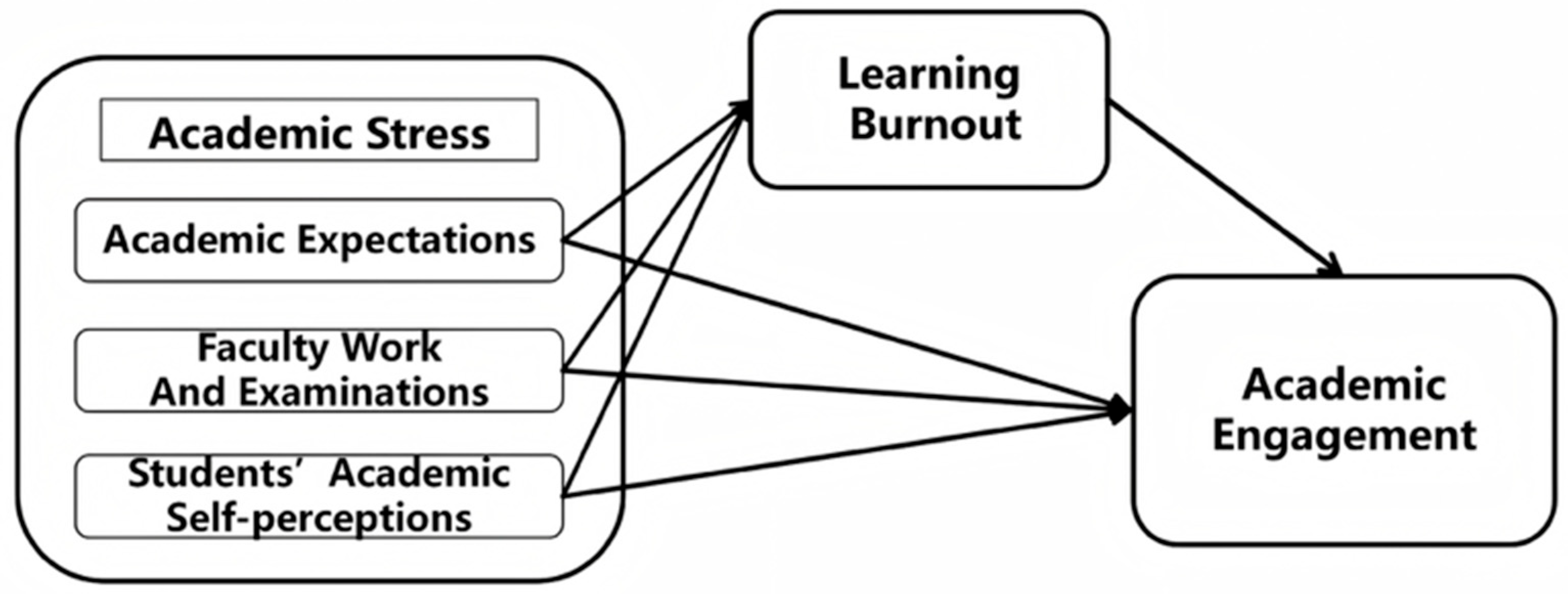
2.3. Theoretical Model of the Present Study
3. Research Method
3.1. Participants
3.2. Data Collection Procedure
3.3. Measures
3.3.1. Perceived Academic Stress in Chemistry Laboratory Learning (PAS)
3.3.2. Learning Burnout in Chemistry Laboratory Learning (LB)
3.3.3. Academic Engagement in Chemistry Laboratory Learning (AE)
3.4. Data Analysis
4. Results
4.1. Reliability and Validity of the Measures
4.2. Descriptive Statistics and Correlation Analysis
4.3. Structural Equation Modeling and Mediation Analysis
4.4. Exploratory Multi-Group SEM: Potential Moderating Effect of Grade
5. Discussion
5.1. Differential Associations of the Three Types of Stress
5.2. The Mediating Role of Learning Burnout and Structural Differences
5.3. Two Patterns of Impairment and Implications for Intervention
5.4. Implications for Research
5.5. Implications for Teaching
5.6. Implications of the Exploratory Multi-Group Analysis
5.7. Limitations and Future Directions
6. Conclusions
Author Contributions
Funding
Institutional Review Board Statement
Informed Consent Statement
Data Availability Statement
Conflicts of Interest
Abbreviations
| PAS | Perceived Academic Stress in Chemistry Laboratory Learning |
| LB | Learning Burnout in Chemistry Laboratory Learning |
| AE | Academic Engagement in Chemistry Laboratory Learning |
| SP | Students’ academic self-perception |
| WE | Faculty work and examinations |
| AExp | Academic expectations |
| EE | Emotional exhaustion |
| Dep | Depersonalization |
| PA | Reduced personal accomplishment |
| VI | Vigor |
| DE | Dedication |
| AB | Absorption |
Appendix A. Complete Adapted Measurement Instruments Used in This Study
Appendix A.1. Perceived Academic Stress in Chemistry Laboratory Learning Scale (PAS; 18 Items)
| Section Number | Question |
| 1 * | I am confident that I can successfully complete experiments during laboratory sessions. |
| 2 * | I believe that the abilities cultivated through chemistry laboratory courses are important for my future career development. |
| 3 * | When conducting experiments, I can easily make decisions when faced with situations requiring judgment or adjustment. |
| 4 * | The time I allocate to laboratory sessions and lab assignments is sufficient. |
| 5 * | I have enough time to relax after completing laboratory sessions. |
| 6 | My instructor is not very satisfied with my laboratory performance. |
| 7 | I am afraid of failing this year’s laboratory course. |
| 8 | I think my worry about laboratory exams is a personal flaw. |
| 9 | My instructor has unrealistic expectations of me in the laboratory. |
| 10 | There is too much workload during laboratory operations. |
| 11 | I think the amount of homework assigned for laboratory courses is too heavy. |
| 12 | If I fall behind in the laboratory sessions, I will not be able to catch up. |
| 13 | My parents’ unrealistic expectations cause me a lot of stress. |
| 14 | The competition with my classmates over laboratory grades is quite intense. |
| 15 | The questions on laboratory exams are usually very difficult. |
| 16 | The time for laboratory exams is too short for me to complete all the questions. |
| 17 | During laboratory exams, I always feel so stressed that I cannot bear it. |
| 18 | Even if I pass the laboratory exams, I worry that I will not find a job. |
| * Reverse-scored items. | |
Appendix A.2. Learning Burnout in Chemistry Laboratory Learning Scale (LB; 20 Items)
| Section Number | Question |
| 1 * | I can understand the experimental principles and independently complete the given laboratory operations. |
| 2 | I feel that the experimental knowledge I have learned is completely useless. |
| 3 * | Mastering experimental knowledge comes easily to me. |
| 4 | When I get up in the morning and think about today’s laboratory session, I feel exhausted. |
| 5 | I find it difficult to sustain lasting enthusiasm for experiments. |
| 6 * | During experiments, I can handle my emotional issues calmly. |
| 7 | I feel drained after completing laboratory sessions. |
| 8 * | So far, university laboratory courses have fully allowed me to demonstrate my abilities. |
| 9 | I feel bored with experiments. |
| 10 | I rarely study experiment-related content after laboratory sessions. |
| 11 * | I feel competent in university laboratory courses. |
| 12 | I often doze off during laboratory sessions. |
| 13 * | I am interested in the experiments I conduct. |
| 14 | I feel that I lack sufficient patience during laboratory work. |
| 15 * | For me, completing laboratory courses and achieving good grades is easy. |
| 16 | I only preview or review experimental content when lab reports are due or before exams. |
| 17 | I want to do experiments but find them tedious. |
| 18 * | I feel energetic during experiments. |
| 19 | I rarely preview laboratory content in advance or organize my lab reports. |
| 20 | Laboratory exams always bore me. |
| * Reverse-scored items. | |
Appendix A.3. Academic Engagement in Chemistry Laboratory Learning Scale (AE; 17 Items)
| Section Number | Question |
| 1 | During laboratory sessions, I feel full of energy. |
| 2 | I feel strong and vigorous when I am conducting experiments. |
| 3 | When I get up in the morning, I feel like going to the laboratory session. |
| 4 | I can continue conducting experiments for very long periods without needing a break. |
| 5 | Even when I feel mentally fatigued, I can recover quickly during experiments. |
| 6 | I always persevere during experiments, even when things do not go well. |
| 7 | I find the experiments that I do full of meaning and purpose. |
| 8 | I am enthusiastic about conducting experiments. |
| 9 | My experiments inspire me. |
| 10 | I am proud of the experiments that I do. |
| 11 | To me, my experiments are challenging. |
| 12 | When I am conducting experiments, time flies. |
| 13 | When I am conducting experiments, I forget everything else around me. |
| 14 | I feel happy when I am fully immersed in experiments. |
| 15 | I can get carried away by my experiments. |
| 16 | I am immersed in my experiments. |
| 17 | Once I start experimenting, it is difficult for me to detach from it. |
| Scoring Instructions: (1) Mean scores or total scores can be calculated for each subdimension. (2) Reverse-scored items should be reverse-coded prior to calculating mean scores. | |
Appendix B. Detailed Psychometric Properties of the Adapted Scales
Pattern Matrix of the Exploratory Factor Analysis (EFA)
| Item | Factor | SP | WE | AExp | EE | Dep | PA | VI | DE | AB |
| PAS01 | SP | 0.726 | −0.080 | −0.022 | −0.033 | 0.057 | 0.045 | −0.012 | 0.006 | −0.012 |
| PAS02 | 0.758 | −0.036 | −0.078 | −0.079 | 0.046 | 0.067 | −0.032 | 0.016 | 0.027 | |
| PAS03 | 0.817 | 0.038 | −0.025 | 0.012 | −0.038 | 0.051 | 0.010 | −0.029 | 0.005 | |
| PAS07 | 0.746 | −0.001 | 0.041 | 0.060 | −0.016 | −0.075 | −0.024 | 0.034 | −0.017 | |
| PAS08 | 0.682 | 0.052 | 0.052 | 0.034 | −0.031 | −0.089 | 0.070 | −0.023 | −0.010 | |
| PAS18 | 0.620 | 0.023 | 0.058 | 0.049 | −0.067 | −0.019 | −0.031 | 0.011 | −0.065 | |
| PAS04 | WE | 0.051 | 0.735 | −0.145 | −0.057 | 0.009 | 0.025 | −0.056 | −0.061 | 0.064 |
| PAS05 | −0.020 | 0.836 | −0.087 | −0.016 | −0.055 | 0.014 | −0.004 | −0.060 | 0.019 | |
| PAS10 | 0.021 | 0.661 | 0.034 | −0.048 | 0.072 | 0.003 | −0.049 | −0.014 | −0.013 | |
| PAS11 | −0.070 | 0.795 | 0.013 | −0.007 | 0.002 | −0.020 | −0.027 | 0.010 | −0.067 | |
| PAS12 | 0.025 | 0.853 | 0.048 | 0.018 | −0.006 | −0.005 | 0.022 | 0.031 | 0.033 | |
| PAS15 | −0.023 | 0.786 | 0.056 | 0.044 | −0.025 | −0.010 | 0.027 | 0.035 | −0.026 | |
| PAS16 | −0.032 | 0.835 | 0.034 | 0.054 | −0.003 | −0.020 | 0.018 | 0.034 | −0.039 | |
| PAS17 | 0.055 | 0.593 | 0.057 | −0.008 | 0.071 | 0.063 | 0.033 | −0.010 | −0.008 | |
| PAS06 | AExp | 0.079 | −0.051 | 0.588 | −0.068 | 0.049 | 0.065 | 0.036 | −0.081 | 0.011 |
| PAS09 | −0.020 | −0.002 | 0.811 | 0.042 | 0.017 | 0.009 | −0.066 | 0.054 | 0.049 | |
| PAS13 | −0.024 | 0.045 | 0.837 | −0.038 | −0.004 | −0.012 | 0.013 | −0.034 | 0.002 | |
| PAS14 | −0.006 | −0.021 | 0.717 | 0.043 | −0.043 | −0.007 | −0.024 | 0.005 | −0.051 | |
| LB03 | EE | 0.004 | 0.032 | −0.041 | 0.679 | −0.092 | 0.058 | −0.080 | −0.016 | 0.001 |
| LB06 | −0.040 | 0.006 | −0.031 | 0.550 | 0.012 | 0.052 | −0.044 | −0.020 | −0.003 | |
| LB11 | −0.031 | 0.020 | 0.050 | 0.727 | −0.018 | 0.070 | 0.073 | 0.013 | −0.008 | |
| LB13 | −0.019 | −0.039 | −0.005 | 0.822 | 0.102 | −0.050 | 0.035 | −0.021 | −0.007 | |
| LB15 | 0.082 | 0.030 | 0.047 | 0.741 | −0.061 | −0.021 | 0.005 | −0.012 | 0.017 | |
| LB18 | 0.031 | −0.051 | −0.034 | 0.816 | 0.125 | −0.036 | −0.012 | 0.027 | 0.037 | |
| LB02 | Dep | −0.031 | 0.047 | 0.045 | −0.036 | 0.761 | −0.091 | 0.011 | 0.055 | −0.003 |
| LB04 | 0.010 | 0.010 | −0.029 | −0.018 | 0.810 | −0.030 | 0.021 | −0.028 | 0.007 | |
| LB05 | 0.029 | 0.019 | −0.074 | 0.018 | 0.750 | −0.001 | −0.038 | −0.032 | 0.000 | |
| LB07 | 0.084 | −0.013 | 0.012 | −0.044 | 0.618 | 0.097 | 0.002 | −0.066 | 0.061 | |
| LB09 | −0.031 | −0.029 | 0.031 | 0.030 | 0.853 | 0.001 | 0.005 | 0.025 | −0.048 | |
| LB12 | −0.042 | −0.008 | 0.032 | 0.062 | 0.805 | 0.005 | 0.023 | −0.015 | 0.009 | |
| LB17 | 0.021 | 0.017 | −0.011 | 0.045 | 0.738 | 0.039 | −0.010 | 0.018 | −0.017 | |
| LB20 | −0.049 | −0.046 | −0.016 | 0.004 | 0.765 | 0.025 | −0.056 | −0.011 | −0.071 | |
| LB01 | PA | −0.080 | −0.021 | −0.078 | 0.143 | −0.146 | 0.679 | −0.080 | −0.026 | −0.086 |
| LB08 | −0.052 | −0.037 | −0.007 | 0.074 | −0.100 | 0.943 | 0.010 | −0.011 | −0.054 | |
| LB10 | 0.037 | −0.016 | 0.022 | 0.006 | 0.137 | 0.686 | −0.020 | 0.020 | 0.025 | |
| LB14 | 0.071 | 0.085 | 0.005 | −0.017 | 0.085 | 0.574 | 0.070 | 0.024 | 0.031 | |
| LB16 | 0.029 | 0.003 | 0.065 | −0.097 | 0.021 | 0.775 | 0.025 | 0.025 | 0.034 | |
| LB19 | −0.002 | 0.051 | 0.028 | 0.004 | 0.153 | 0.666 | 0.008 | 0.007 | 0.047 | |
| AE01 | VI | 0.003 | −0.027 | 0.053 | −0.009 | −0.006 | −0.019 | 0.800 | −0.002 | −0.011 |
| AE04 | −0.017 | 0.030 | 0.005 | 0.030 | −0.022 | 0.031 | 0.878 | 0.008 | 0.032 | |
| AE08 | 0.003 | −0.049 | −0.016 | −0.016 | −0.062 | −0.018 | 0.722 | −0.032 | −0.057 | |
| AE12 | −0.034 | −0.072 | 0.025 | −0.028 | −0.017 | 0.014 | 0.709 | 0.008 | −0.030 | |
| AE15 | 0.004 | −0.007 | −0.043 | 0.013 | 0.025 | −0.004 | 0.839 | 0.009 | −0.008 | |
| AE17 | 0.024 | 0.065 | −0.075 | −0.007 | 0.044 | 0.016 | 0.761 | 0.023 | 0.079 | |
| AE02 | DE | −0.009 | −0.020 | 0.036 | −0.011 | 0.020 | −0.019 | 0.035 | 0.802 | −0.009 |
| AE05 | 0.024 | 0.027 | 0.007 | 0.033 | −0.047 | −0.008 | 0.000 | 0.889 | 0.015 | |
| AE07 | 0.012 | 0.013 | −0.058 | 0.027 | 0.003 | −0.003 | 0.023 | 0.815 | −0.002 | |
| AE10 | −0.040 | −0.009 | −0.017 | −0.045 | 0.014 | 0.046 | −0.025 | 0.826 | −0.006 | |
| AE13 | 0.031 | −0.077 | −0.008 | −0.042 | −0.027 | 0.018 | −0.012 | 0.641 | 0.025 | |
| AE03 | AB | −0.022 | 0.009 | −0.008 | 0.005 | 0.075 | −0.088 | 0.025 | 0.066 | 0.723 |
| AE06 | 0.006 | −0.015 | −0.013 | 0.035 | −0.052 | −0.042 | −0.002 | −0.050 | 0.789 | |
| AE09 | 0.006 | 0.026 | −0.010 | −0.018 | 0.013 | 0.022 | −0.029 | 0.061 | 0.867 | |
| AE11 | −0.012 | 0.014 | 0.011 | 0.029 | −0.023 | −0.012 | −0.008 | −0.004 | 0.882 | |
| AE14 | −0.010 | 0.005 | 0.016 | 0.003 | −0.023 | 0.034 | 0.009 | −0.022 | 0.879 | |
| AE16 | −0.028 | −0.077 | 0.016 | −0.026 | −0.045 | 0.059 | 0.017 | −0.032 | 0.719 | |
| Note: KMO = 0.957; Bartlett’s test of sphericity: χ2(1485) = 31,001.987, p < 0.001. Nine factors were extracted, with a cumulative variance contribution rate of 61.214%. Extraction method: principal axis factoring. Rotation method: oblimin with Kaiser normalization (converged after 7 iterations). Factor loadings ≥0.40 are shown in bold. | ||||||||||
References
- Bakker, A. B., Demerouti, E., & Sanz-Vergel, A. I. (2014). Burnout and work engagement: The JD–R approach. Annual Review of Organizational Psychology and Organizational Behavior, 1, 389–411. [Google Scholar] [CrossRef]
- Bakker, A. B., & Mostert, K. (2024). Study demands–resources theory: Understanding student well-being in higher education. Educational Psychology Review, 36, 92. [Google Scholar] [CrossRef]
- Barbayannis, G., Bandari, M., Zheng, X., Baquerizo, H., Pecor, K. W., & Ming, X. (2022). Academic stress and mental well-being in college students: Correlations, affected groups, and COVID-19. Frontiers in Psychology, 13, 886344. [Google Scholar] [CrossRef]
- Bedewy, D., & Gabriel, A. (2015). Examining perceptions of academic stress and its sources among university students: The Perception of Academic Stress Scale. Health Psychology Open, 2(2), 2055102915596714. [Google Scholar] [CrossRef]
- Chen, C., Shen, Y., Zhu, Y., Xiao, F., Zhang, J., & Ni, J. (2023). The effect of academic adaptability on learning burnout among college students: The mediating effect of self-esteem and the moderating effect of self-efficacy. Psychology Research and Behavior Management, 16, 1615–1629. [Google Scholar] [CrossRef]
- Cheung, G. W., & Rensvold, R. B. (2002). Evaluating goodness-of-fit indexes for testing measurement invariance. Structural Equation Modeling, 9(2), 233–255. [Google Scholar] [CrossRef]
- Crawford, E. R., LePine, J. A., & Rich, B. L. (2010). Linking job demands and resources to employee engagement and burnout: A theoretical extension and meta-analytic test. Journal of Applied Psychology, 95(5), 834–848. [Google Scholar] [CrossRef]
- Deci, E. L., Olafsen, A. H., & Ryan, R. M. (2017). Self-determination theory in work organizations: The state of a science. Annual Review of Organizational Psychology and Organizational Behavior, 4, 19–43. [Google Scholar] [CrossRef]
- Demerouti, E., Bakker, A. B., Nachreiner, F., & Schaufeli, W. B. (2001). The job demands-resources model of burnout. Journal of Applied Psychology, 86(3), 499–512. [Google Scholar] [CrossRef] [PubMed]
- Fornell, C., & Larcker, D. F. (1981). Evaluating structural equation models with unobservable variables and measurement error. Journal of Marketing Research, 18(1), 39–50. [Google Scholar] [CrossRef]
- Freudenberger, H. J. (1974). Staff burn-out. Journal of Social Issues, 30(1), 159–165. [Google Scholar] [CrossRef]
- González-Romá, V., Schaufeli, W. B., Bakker, A. B., & Lloret, S. (2006). Burnout and work engagement: Independent factors or opposite poles? Journal of Vocational Behavior, 68(1), 165–174. [Google Scholar] [CrossRef]
- Hadi, M., Noviekayati, I. G. A. A., & Suhadianto. (2025). Systematic review on global trend in students’ academic stress: Prevalence, causal factor, and psychological implication. International Journal of Research and Innovation in Social Science, 9(11), 4262–4283. [Google Scholar] [CrossRef]
- Hobfoll, S. E. (1989). Conservation of resources: A new attempt at conceptualizing stress. American Psychologist, 44(3), 513–524. [Google Scholar] [CrossRef]
- Hu, L., & Bentler, P. M. (1999). Cutoff criteria for fit indexes in covariance structure analysis: Conventional criteria versus new alternatives. Structural Equation Modeling: A Multidisciplinary Journal, 6(1), 1–55. [Google Scholar] [CrossRef]
- Huangfu, Q., Yang, Y., & Lv, J. (2026). Relationships between students’ attributions in chemistry and chemistry learning burnout: The chain mediating roles of chemistry self-efficacy and chemistry learning engagement. Chemistry Education Research and Practice, 27, 844–863. [Google Scholar] [CrossRef]
- Jagodics, B., & Szabó, É. (2023). Student burnout in higher education: A demand-resource model approach. Trends in Psychology, 31(4), 757–776. [Google Scholar] [CrossRef]
- Kyynäräinen, R., Vilhunen, E., & Vesterinen, V.-M. (2024). How making mistakes shapes students’ situational engagement in chemistry laboratory? International Journal of Science Education, 48, 1151–1171. [Google Scholar] [CrossRef]
- Lesener, T., Pleiss, L. S., Gusy, B., & Wolter, C. (2020). The study demands-resources framework: An empirical introduction. International Journal of Environmental Research and Public Health, 17(14), 5183. [Google Scholar] [CrossRef] [PubMed]
- Liu, Z., Xie, Y., Sun, Z., Liu, D., Yin, H., & Shi, L. (2023). Factors associated with academic burnout and its prevalence among university students: A cross-sectional study. BMC Medical Education, 23(1), 317. [Google Scholar] [CrossRef]
- Marsh, H. W., & Craven, R. G. (2006). Reciprocal effects of self-concept and performance from a multidimensional perspective: Beyond seductive pleasure and unidimensional perspectives. Perspectives on Psychological Science, 1(2), 133–163. [Google Scholar] [CrossRef]
- Maslach, C., & Jackson, S. E. (1981). The measurement of experienced burnout. Journal of Organizational Behavior, 2(2), 99–113. [Google Scholar] [CrossRef]
- Maslach, C., & Leiter, M. P. (1997). The truth about burnout: How organizations cause personal stress and what to do about it. Jossey-Bass. [Google Scholar]
- Meade, A. W., & Craig, S. B. (2012). Identifying careless responses in survey data. Psychological Methods, 17(3), 437–455. [Google Scholar] [CrossRef] [PubMed]
- Muthén, L. K., & Muthén, B. O. (2024). Mplus user’s guide (8th ed.). Muthén & Muthén. [Google Scholar]
- Naibert, N., & Barbera, J. (2022). Investigating student engagement in general chemistry active learning activities using the Activity Engagement Survey (AcES). Journal of Chemical Education, 99(7), 2620–2629. [Google Scholar] [CrossRef]
- Podsakoff, P. M., MacKenzie, S. B., Lee, J.-Y., & Podsakoff, N. P. (2003). Common method biases in behavioral research: A critical review of the literature and recommended remedies. Journal of Applied Psychology, 88(5), 879–903. [Google Scholar] [CrossRef]
- Ruiz-Camacho, C., & Gozalo, M. (2025). Predicting university students’ stress responses: The role of academic stressors and sociodemographic variables. European Journal of Investigation in Health, Psychology and Education, 15(8), 163. [Google Scholar] [CrossRef]
- Salmela-Aro, K., & Upadyaya, K. (2014). School burnout and engagement in the context of demands-resources model. British Journal of Educational Psychology, 84(1), 137–151. [Google Scholar] [CrossRef]
- Schaufeli, W. B., Salanova, M., González-Romá, V., & Bakker, A. B. (2002). The measurement of engagement and burnout: A two sample confirmatory factor analytic approach. Journal of Happiness Studies, 3(1), 71–92. [Google Scholar] [CrossRef]
- Schaufeli, W. B., & Taris, T. W. (2014). A critical review of the job demands-resources model: Implications for improving work and health. In G. F. Bauer, & O. Hämmig (Eds.), Bridging occupational, organizational and public health: A transdisciplinary approach (pp. 43–68). Springer. [Google Scholar]
- Seery, M. K., Agustian, H. Y., Christiansen, F. V., Gammelgaard, B., & Malm, R. H. (2024). 10 guiding principles for learning in the laboratory. Chemistry Education Research and Practice, 25(2), 383–402. [Google Scholar] [CrossRef]
- Vandenberg, R. J., & Lance, C. E. (2000). A review and synthesis of the measurement invariance literature: Suggestions, practices, and recommendations for organizational research. Organizational Research Methods, 3(1), 4–70. [Google Scholar] [CrossRef]
- Yıldırım, M., & Green, Z. A. (2024). Social support and resilience mediate the relationship of stress with satisfaction with life and flourishing of youth. British Journal of Guidance & Counselling, 52(4), 685–696. [Google Scholar] [CrossRef]
- Zeng, Y., & Cong, Y. (2025). Challenge and hindrance academic stressors and university students’ well-being: The chain mediating roles of meaning in life and academic self-efficacy. International Journal of Mental Health Promotion, 27(11), 1663–1679. [Google Scholar] [CrossRef]
- Zhang, J., Meng, J., & Wen, X. (2025). The relationship between stress and academic burnout in college students: Evidence from longitudinal data on indirect effects. Frontiers in Psychology, 16, 1517920. [Google Scholar] [CrossRef]
- Zhao, H., Han, M., Wang, Z., & Liu, B. (2024). School connectedness and academic burnout in middle school students: A multiple serial mediation model. Behavioral Sciences, 14(11), 1077. [Google Scholar] [CrossRef] [PubMed]


| Variable | M | SD | SP | WE | AExp | LB | AE |
|---|---|---|---|---|---|---|---|
| SP | 2.521 | 0.618 | — | ||||
| WE | 2.580 | 0.776 | 0.333 ** | — | |||
| AExp | 2.517 | 0.889 | 0.338 ** | 0.478 ** | — | ||
| LB | 2.568 | 0.612 | 0.355 ** | 0.460 ** | 0.482 ** | — | |
| AE | 3.676 | 0.583 | −0.445 ** | −0.565 ** | −0.515 ** | −0.628 ** | — |
| 95% Bootstrap | ||||||
|---|---|---|---|---|---|---|
| Path | β | SE | p | LLCI | ULCI | Ratio (%) |
| Direct effects | ||||||
| SP → AE | −0.174 | 0.025 | <0.001 | −0.224 | −0.124 | 61.3% |
| WE → AE | −0.253 | 0.027 | <0.001 | −0.304 | −0.200 | 64.9% |
| AExp → AE | −0.112 | 0.028 | <0.001 | −0.164 | −0.058 | 36.4% |
| SP → LB | 0.204 | 0.028 | <0.001 | 0.149 | 0.257 | — |
| WE → LB | 0.255 | 0.031 | <0.001 | 0.195 | 0.317 | — |
| AExp → LB | 0.363 | 0.028 | <0.001 | 0.308 | 0.421 | — |
| LB → AE | −0.539 | 0.035 | <0.001 | −0.606 | −0.471 | — |
| Indirect effects | ||||||
| SP → LB → AE | −0.110 | 0.017 | <0.001 | −0.145 | −0.078 | 38.7% |
| WE → LB → AE | −0.138 | 0.019 | <0.001 | −0.179 | −0.102 | 35.4% |
| AExp → LB → AE | −0.196 | 0.021 | <0.001 | −0.239 | −0.157 | 63.6% |
| Total effects | ||||||
| SP | −0.284 | 0.026 | <0.001 | −0.334 | −0.233 | 100% |
| WE | −0.390 | 0.026 | <0.001 | −0.441 | −0.339 | 100% |
| AExp | −0.308 | 0.025 | <0.001 | −0.356 | −0.259 | 100% |
| Path | Lower Grade β | Upper Grade β | Δβ | Δχ2(1) | p |
|---|---|---|---|---|---|
| SP → LB | 0.281 | 0.178 | 0.103 | 3.56 | 0.059 |
| WE → LB | 0.332 | 0.336 | 0.004 | 0.01 | 0.929 |
| AExp → LB | 0.352 | 0.396 | 0.044 | 1.40 | 0.237 |
Disclaimer/Publisher’s Note: The statements, opinions and data contained in all publications are solely those of the individual author(s) and contributor(s) and not of MDPI and/or the editor(s). MDPI and/or the editor(s) disclaim responsibility for any injury to people or property resulting from any ideas, methods, instructions or products referred to in the content. |
© 2026 by the authors. Licensee MDPI, Basel, Switzerland. This article is an open access article distributed under the terms and conditions of the Creative Commons Attribution (CC BY) license.
Share and Cite
Zhong, Y.; Niu, M.; Zhang, Q.; Sun, H.; Liu, Y. Exploring the Relationship Between Academic Stress and Academic Engagement in Chemistry Laboratory Learning: The Mediating Role of Learning Burnout and the Differentiated Roles of Stress Sources. Behav. Sci. 2026, 16, 961. https://doi.org/10.3390/bs16060961
Zhong Y, Niu M, Zhang Q, Sun H, Liu Y. Exploring the Relationship Between Academic Stress and Academic Engagement in Chemistry Laboratory Learning: The Mediating Role of Learning Burnout and the Differentiated Roles of Stress Sources. Behavioral Sciences. 2026; 16(6):961. https://doi.org/10.3390/bs16060961
Chicago/Turabian StyleZhong, Yixian, Mutong Niu, Qianfeng Zhang, Haoran Sun, and Yurong Liu. 2026. "Exploring the Relationship Between Academic Stress and Academic Engagement in Chemistry Laboratory Learning: The Mediating Role of Learning Burnout and the Differentiated Roles of Stress Sources" Behavioral Sciences 16, no. 6: 961. https://doi.org/10.3390/bs16060961
APA StyleZhong, Y., Niu, M., Zhang, Q., Sun, H., & Liu, Y. (2026). Exploring the Relationship Between Academic Stress and Academic Engagement in Chemistry Laboratory Learning: The Mediating Role of Learning Burnout and the Differentiated Roles of Stress Sources. Behavioral Sciences, 16(6), 961. https://doi.org/10.3390/bs16060961