


Abstract
Although Chinese parents’ use of psychological control has been linked with adolescent mental health, no studies to our knowledge have considered how the association may differ across gender dyads of parents and adolescents and minimal research has examined the joint influences of Chinese mothers’ and fathers’ use of psychological control on adolescent depressive symptoms. Participants included 3069 Chinese adolescents who rated their depressive symptoms as well as their mothers’ and fathers’ use of psychological control. Regression results revealed that the positive association between fathers’ psychological control and depressive symptoms was significant at low but not at high levels of mothers’ psychological control. Moreover, the positive association between fathers’ psychological control and depressive symptoms was significant for daughters but not for sons. Mothers’ psychological control was consistently positively associated with adolescent depressive symptoms. Findings from this study provide a more nuanced understanding of how gender dyads within Chinese families may influence the link between parental psychological control and adolescent depressive symptoms and highlight the importance for mental health programs to include fathers in their treatment plans when working with Chinese adolescents and their families.
1. Introduction
In China, 24.6% of adolescents are diagnosed with depression with girls reporting greater depressive symptoms than boys (X. Fu et al., 2021). Parental psychological control has been reported to be associated with greater adolescent depressive symptoms in the U.S. and China (e.g., Barber, 1996; Barber & Harmon, 2002). However, most studies on parental psychological control have not considered the joint effects of mothers’ and fathers’ control on adolescent well-being (Bi et al., 2024; Luebbe et al., 2018; Nigela et al., 2015), and no known study has examined whether this association differs across gender dyads (i.e., mother–daughter; mother–son; father–daughter, father–son) in Chinese families. Additional consideration of gender is needed to gain a more nuanced understanding of parent–child dynamics in Chinese families and their association with adolescent mental health, particularly for girls, who are at great risk of depressive symptoms (X. Fu et al., 2021; Yang et al., 2025; Yu et al., 2021).
Parental psychological control (e.g., love withdrawal, guilt induction, shaming) has been described as intrusive, manipulative, and rejecting parental behaviors that are linked to aversive developmental results in adolescents’ self-development and psychological well-being (Barber, 1996; Barber et al., 2005; Yu et al., 2021). In China, a few studies have found a negative association between Chinese parents’ psychological control and children’s mental health problems (Leung & Shek, 2020), external/internal problem behaviors (Barber, 1996), and social adjustment barriers (Q. Li et al., 2024). For example, Luebbe et al. (2018) found in a sample of 247 highschoolers and their parents (60% mothers) in China that psychological control mediated the positive association between parents’ strong academic achievement goals and adolescents’ anxiety. Similarly, studies based in the U.S. have shown that when adolescents perceive their parents as controlling, they are more likely to report an increase in depressive symptoms (Barber et al., 2005; Chyung et al., 2022; Tang et al., 2024; Zhu et al., 2023).
To understand the associations between parental psychological control and children’s depressive symptoms during adolescence—a developmental period in which depressive symptoms increase most rapidly, especially among females (Kwong et al., 2019; Shorey et al., 2022; World Health Organization, 2025)—we first consider Interpersonal Parental Acceptance–Rejection Theory (IPARTheory; Rohner, 2021). In IPARTheory, parental warmth is conceptualized as a continuum with parental acceptance and parental rejection at opposite ends (Rohner, 2021). Several studies have considered psychological control as a form of parental rejection because (1) it consists of rejection behaviors such as love withdrawal and (2) when parents exert psychological control, adolescents feel that their autonomy, individuality, and sense of self are being rejected (Nelson et al., 2013; Rohner, 2021; Zhu et al., 2023). According to IPARTheory, perceived parental acceptance is required for positive psychological adjustment in adolescence, while parental rejection is associated with negative psychological adjustment (Rohner, 2021).
Although this study is based on IPARTheory, it is also guided by an ecological perspective (Bronfenbrenner, 1986), which posits that sociocultural and familial contexts should be considered when seeking to understand adolescent development. Although not a monolith, many Chinese families may continue to endorse traditional values and practices. For example, traditional Chinese parenting is described as heavily influenced by the two central Chinese value systems—Confucianism and Taoism (Y. Li et al., 2010; Peterson et al., 2005). Confucianism prescribes a hierarchical family structure in which children are expected to demonstrate filial piety (xiao), a deep sense of duty and reverence toward parents and ancestors (Ho, 1994). Within this framework, children’s individual needs, particularly autonomy, are often subordinated to collective family goals and parental authority (Chao, 1994). Taoism further reinforces this orientation by emphasizing harmony and restraint, which discourages children from openly expressing discontent or challenging parental decisions (Chang et al., 2011).
Psychological control may be used by Chinese parents to accomplish the traditional goals set forth by Confucianism and Taosim. A good example is the “shaming” practice—when children fail to meet their expectations, Chinese parents tend to blame them for losing the parents’ “face” and tarnishing the family reputation (Shek, 2008). Rooted in the Confucian concept of mianzi (face), this practice ties a child’s personal failures to the social standing of the entire family, which may generate feelings of shame and inadequacy (Fung, 1999). Because the traditional cultural context normalizes such practices as legitimate expressions of parental authority, it is possible that adolescents may not feel uniquely vulnerable; however, on the other hand, given the normalized practice, children may have fewer psychological or societal resources to resist the negative effects of these controlling behaviors. Thus, this controlling practice may diminish adolescents’ self-worth and increase their risk of developing depressive symptoms. Based on IPARTheory and ecological perspectives, we expect that Chinese adolescents will report greater depressive symptoms as they perceive greater parental psychological control. It is important to note that not all families in China strongly endorse traditional hierarchical structures and cultural values; and that as with all cultures, variability in parenting exists depending on their adherence to traditional values, but also other contextual factors such as socioeconomic status, geographic regions, and contemporary social change.
While previous research has established a robust link between parental psychological control and adolescent outcomes, the role of adolescent gender in this link is not well understood. In Chinese families, parents may apply more psychological control to sons due to the traditional favoritism of a male heir over a female one and thus have higher expectations for sons in the Chinese culture to promote the families’ legacy (Tam, 2009). However, daughters may be more vulnerable to parental psychological control as they tend to be more sensitive to parents’ psychological manipulations (C. Fu & Wang, 2021). Thus, we hypothesize that while adolescent sons will report receiving greater parental psychological control, the positive association between parental psychological control and adolescent depressive symptoms will be stronger in daughters.
It is also important to consider the gender of the parent when examining the association between parental psychological control and adolescent well-being (e.g., Bronfenbrenner, 1986). Traditionally, fathers hold the highest status in a Chinese family and are the primary decision-makers in major family affairs yet are less directly involved in daily life events such as homework. In contrast, mothers are the main caregivers who are tasked with day-to-day care of adolescents (Liu et al., 2022) and tending to their emotional needs (Liong, 2017). Many Chinese mothers exhibit the so-called “Tiger Mother” rearing style—mothers who are both highly nurturing and highly intrusive and controlling, especially when it comes to the educational development, decisions, and success of their children (see the literature on “Tiger Mothers” by Chao, 1994; Xie & Li, 2017). These mothers have high hopes for their children and believe it is their responsibility to ensure their academic success. Because of these factors, we believe that Chinese mothers in comparison to fathers will likely exert more psychological control on their children. Past empirical findings are mixed: while some adolescent samples reported fathers as more psychologically and behaviorally (i.e., expectations for good behavior) controlling than mothers (e.g., Shek, 2008), the opposite pattern has also been found (e.g., Zhang et al., 2019). Because of the culture-specific expectation for Chinese mothers, we hypothesize that mothers will be perceived to use more psychological control over their children.
Lastly, family systems theory posits that the family works as a system and therefore it is important to consider the parenting of both parents in the home (Cox & Paley, 2003). For example, research has found that having at least one warm and accepting parent in the home is associated with adolescent resilience such that the experience with the warm and accepting parent may help the promotion of a positive sense of self, which in turn can buffer the negative influence of the other parent using high levels of psychological control (e.g., Rohner, 2021; Van Bronkhorst et al., 2024). On the other hand, adolescents who experience high levels of psychological control by both parents simultaneously are unable to receive any parental messages of acceptance that are needed to develop a positive view of oneself or buffer their experiences with parental psychological control (Heard, 2007; Rogers et al., 2003; Salaam, 2024; Van Bronkhorst et al., 2024; Van Lissa et al., 2019). Thus, we expect a significant interaction effect between mothers’ and fathers’ psychological control on adolescents’ depressive symptoms. In particular, we expect that simultaneous use of psychological control from both parents will amplify adolescents’ depressive symptoms.
Consideration of unique gender dynamics within the Chinese family will provide a more nuanced understanding of the association between parental psychological control and adolescent adjustment (Van Petegem et al., 2022). Traditionally, sons are more highly regarded than daughters, and fathers have absolute authority in the family, thereby creating a noticeable power dynamic based on gender. Past studies have found that higher levels of depression in women compared to males can be explained in part by power gaps between genders in society (Maji, 2018). In addition, the hierarchical family structure sanctioned by Confucianism (Ho, 1994) recognizes fathers as having the greatest authority in the family in part due to their male gender and in part due to their age, because of its association with wisdom. Thus, out of all possible gender dyads in the family, the father–daughter dyad would have the largest gender power gap. Consequently, we hypothesize that in Chinese families, there will be a stronger, positive association between fathers’ use of psychological control and daughters’ depressive symptoms compared to other gender dyads in a family. As no known studies to date have examined the effects of parental psychological control and adolescent depressive symptoms across gender dyads in Chinese families (mother–son, father–son, mother–daughter, father–daughter), the current study addresses this gap in the literature by exploring these associations.
Current Study
While past research has examined the link between parental psychological control and adolescent well-being in China, the roles of parent and child gender in this relationship are unclear because most of these studies either have combined psychological control across two parents or only examined one parent’s use of control, typically mothers. The current study was designed to address these limitations and to explore both the independent and joint effects of parent gender and adolescent gender in the association between perceived parental psychological control and depressive symptoms in a large sample of Chinese adolescents. Based on cultural ecological and IPAR frameworks as well as previous empirical findings, we hypothesize:
H1.
Sons will report greater parental psychological control than daughters.
H2.
Mothers will be perceived to exert greater parental psychological control than fathers.
H3.
The positive association between parental psychological control and depressive symptoms will be stronger for daughters than sons.
H4.
The joint effect of high mother’s and high father’s psychological control will be associated with lower depressive symptoms for adolescent children.
2. Method
2.1. Participants and Procedure
Participants were recruited from local middle and high schools in three locations in southern China from 2015 to 2016. The choice of participating schools and classes as well as sample size was based on convenience and not on random sampling. From the initial sample of 3257 Chinese adolescents, only those who reported on both mothers’ and fathers’ psychological control were included in this study. This resulted in a sample of 3069 adolescents (Mage = 15.26, SD = 1.67; 45.6% boys and 54.4% girls) from middle and high schools in southern China. A precise response rate was not available; however, according to staff’s recollection, the response rate was high (in the 90% range). Schools that combine middle and high schools are commonly found in China. Adolescents were recruited from three geographic locations in China, including Guangzhou (n = 1460), Dongguan (n = 400), and Hengdong (n = 1209). Of those living in two-parent families (n = 79.9%), 77.9% reported living with biological parents.
All procedures performed in this study were approved in line with the ethical standards of the Institutional Review Board of the Guangzhou Medical University in China; and are in accordance with the ethical standards presented in the 1964 Declaration of Helsinki, as well as its later amendments. Informed consent was collected from participants’ guardians and passive assent was collected from participants. Members of the research team distributed paper questionnaires at a convenient time during a class meeting in participating classes. Students were informed of the general purpose of the study and that the study was anonymous and voluntary. They spent approximately 15–20 min completing the questionnaire. No incentive was provided.
2.2. Measures
All measures were translated from English to Mandarin by two of the researchers who are bilingual and have PhDs in Psychology. The two authors actively considered culturally sensitive language while adhering to authenticity in translation. When discrepancies arose, the authors debated and negotiated until an agreement was reached. A high school Mandarin teacher proofread the translated version to make sure the language was appropriate for adolescents. Finally, a small pilot study was conducted in Hengdong to ensure that high school students were able to comprehend the questions.
2.2.1. Demographic Questionnaire
Participants reported demographic characteristics such as their age, gender (boy = 0, girl = 1), location (urban = 1, rural = 0), marital status of parents (married = 1, others = 0), sibling status (yes = 1 and no = 0), and parent education level (response choice ranged from 1 = no schooling completed to 13 = doctorate degree).
2.2.2. Parental Psychological Control
Participants completed a 16-item scale that combined items from the Parental Behavior Inventory and Psychological Control Scale (Barber, 1996) and self-reported on both their mother’s and father’s use of parental psychological control. A sample item was “(My father/mother) tells me of all the things she/he had done for me.” While this measure has not been formally validated in China, previous research using items from this measure showed good construct validity and internal consistency reliability based on Chinese samples (e.g., Luebbe et al., 2018; Wang et al., 2007). Responses ranged from 1 = Definitely not like him/her to 3 = Definitely like him/her. Scores were calculated as the mean of 16 items for mothers and for fathers such that higher scores reflected greater perceived psychological control (αmother = 0.90 and αfather = 0.91).
2.2.3. Depressive Symptoms
The 20-item Center for Epidemiologic Studies Depression Scale-Revised (CESD-R) assessed the depressive symptoms of the participants (Eaton et al., 2004). Adolescents rated the frequency of each item (e.g., “I had trouble keeping my mind on what I was doing”) over the past week using a 5-point scale. A sum score was calculated across items. Higher scores indicated more depressive symptoms during the past week (α = 0.94).
3. Results
Measurement invariance analyses were conducted across boys and girls for measures of depressive symptoms, mother psychological control, and father psychological control. The results indicated a good model fit and supported the comparability of these measures between boys and girls (see Appendix A). Bivariate correlations, skewness, and kurtosis for all study variables are presented for descriptive purposes in Table 1. A parent gender X adolescent gender MANOVA revealed two significant main effects and a significant interaction. In support of H1, the main effect of adolescent gender suggested that boys perceived higher levels of parental psychological control than girls [F(1, 2996) = 25.94, p < 0.001; η2 = 0.01]. In support of H2, the main effect of parent gender suggested that adolescents perceived mothers to use more psychological control than fathers [F(1, 2996) = 324.45, p < 0.001; η2 = 0.10]. The interaction between parent and adolescent gender [F(1, 2996) = 36.53, p < 0.001; η2 = 0.01] indicated that boys reported receiving higher father psychological control than girls [F(1, 2996) = 54.42, p < 0.001; η2 = 0.02], while no significant differences were found between boys’ and girls’ reports of mother psychological control [F(1, 2996) = 2.97, p = 0.09; η2 = 0.001]. It is important to note that some of the statistically significant effects were small in magnitude (e.g., η2 = 0.01 and η2 = 0.001) and should therefore be interpreted with caution. Additionally, an independent sample t-test revealed that girls reported more severe depressive symptoms than boys [t (2974) = −5.26, p < 0.001; d = 0.20]. Correlational analyses indicated that both mothers’ and fathers’ psychological control were significantly and positively related to boys’ and girls’ depressive symptoms (see Table 1 and Table 2).
Table 1.
Demographic information of the sample (frequency).
Table 2.
Correlations, means, and standard deviations (SDs) for study variables by gender.
To explore our research questions on the effect of parent gender X adolescent gender on adolescent depressive symptoms, we adopted the hierarchical regression approach with multiple imputations to address missing data (about 2.71%). As suggested by Enders (2013), 10 imputations were generated to replace missing data using key study variables (gender, location, marital status, sibling status, parental education level, parental psychological control, and depressive symptoms). A five-step hierarchical regression was conducted for the original dataset and repeated for each of the 10 imputations: adolescent depressive symptoms were the dependent variable, mothers’ and fathers’ psychological control and adolescent gender were the predictors. All subsequent analyses were conducted across the 10 imputed datasets, and parameter estimates were pooled using Rubin’s rules. Multicollinearity diagnostics suggested that mothers’ and fathers’ psychological control did not exhibit severe collinearity. Although both variables showed shared variance on the same dimension, the corresponding condition index (13.80) was below conventional thresholds for serious concern. Inspection of the residual plots suggested that the assumptions of linearity and homoscedasticity were generally acceptable, although minor deviations were observed.
Control variables included six key demographic variables: mother and father education, single child or not [single (coded 1) and others (coded 0)], medium-size city (coded 1) or not (coded 0), large city (coded 1) or not (coded 0), and school grade level. All two-way and three-way interaction effects were tested. Prior to entering the regression, all continuous predictors and control variables were standardized. Interaction terms were formed by multiplying the standardized scores of the variables involved in the specific interaction. The five steps of the regression included: In Step 1, control variables were entered, including fathers’ and mothers’ education levels, adolescent only-child status, and location (urban vs. rural). In Step 2, the main predictors—father’s psychological control and mother’s psychological control—were entered. In Step 3, adolescent gender was entered. In Step 4, all two-way interaction terms were entered: mother control * gender, father control * gender, and mother control * father control. Finally, in Step 5, the three-way interaction term (mother control * father control * gender) was entered. Pooled results across the original dataset and the 10 imputations (e.g., unstandardized regression coefficients) were generated and reported below. This analysis was conducted in SPSS version 30 (IBM Corporation, Armonk, NY; see Table 1 and Table 2).
The results revealed that the three-way interaction between mother’s psychological control, father’s psychological control, and adolescent’s gender was not significant (B = 0.78, p = 0.10). Therefore, the results of significant two-way interactions from Step 4 were reported (see Table 3). For each significant two-way interaction, simple slope analyses were conducted to probe the nature of the interaction, and the results of these tests are presented alongside the regression findings.
Table 3.
Step 4 of the hierarchical regression model for 2-way interactions on adolescents’ depressive symptoms.
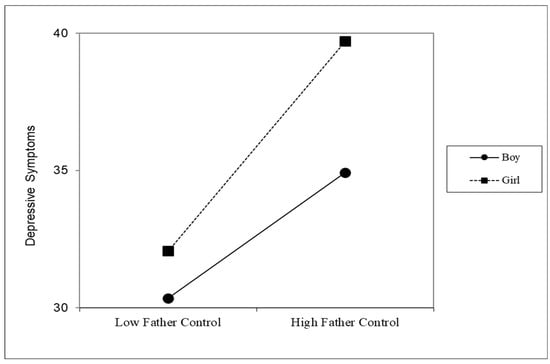
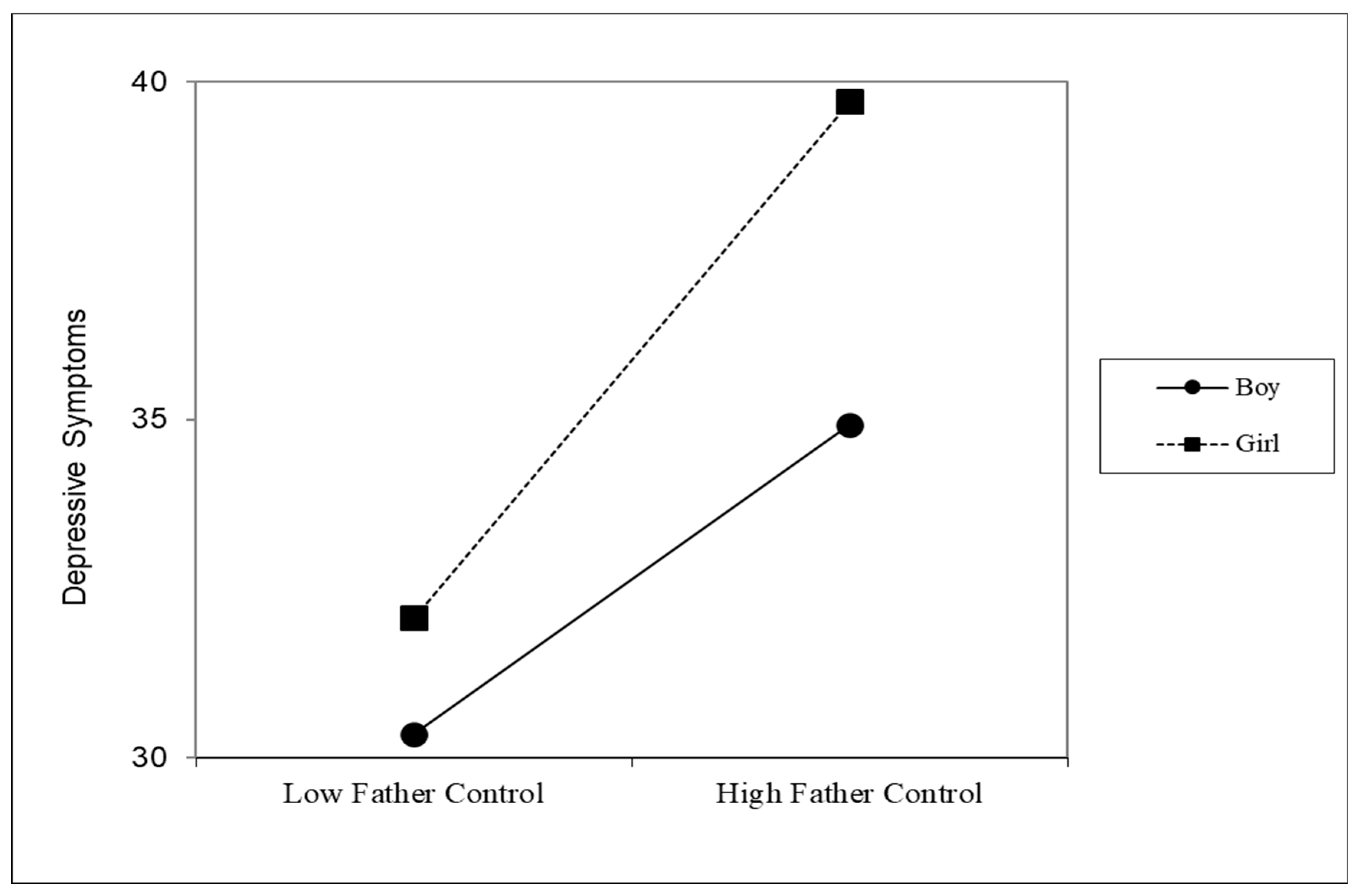
The results from the regression analyses indicated that both mother’s (B = 3.72, p < 0.001) and father’s (B = 1.37, p = 0.01) psychological control were positively associated with adolescent depressive symptoms (see Table 2). It also revealed a significant two-way interaction between mother’s vs. father’s control and adolescent gender (B = 2.20, p < 0.01). Further probing of the interaction showed that the positive association between father’s psychological control and depressive symptoms was stronger for daughters (B = 3.82, p < 0.01) than sons (B = 2.29, p < 0.01; see Table 3 and Figure 1). No significant two-way interaction was found between mother’s psychological control and adolescent’s gender on depressive symptoms (B = −0.15, p = 0.83).
Figure 1.
Estimated level of depression by father psychological control, stratified by gender.
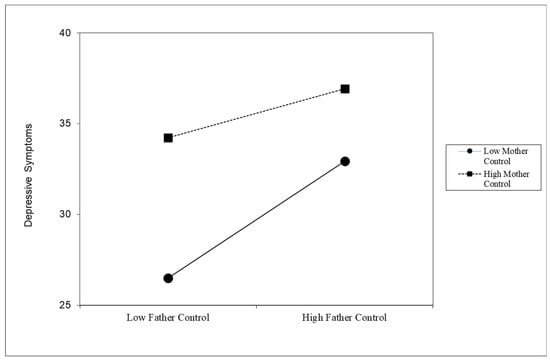
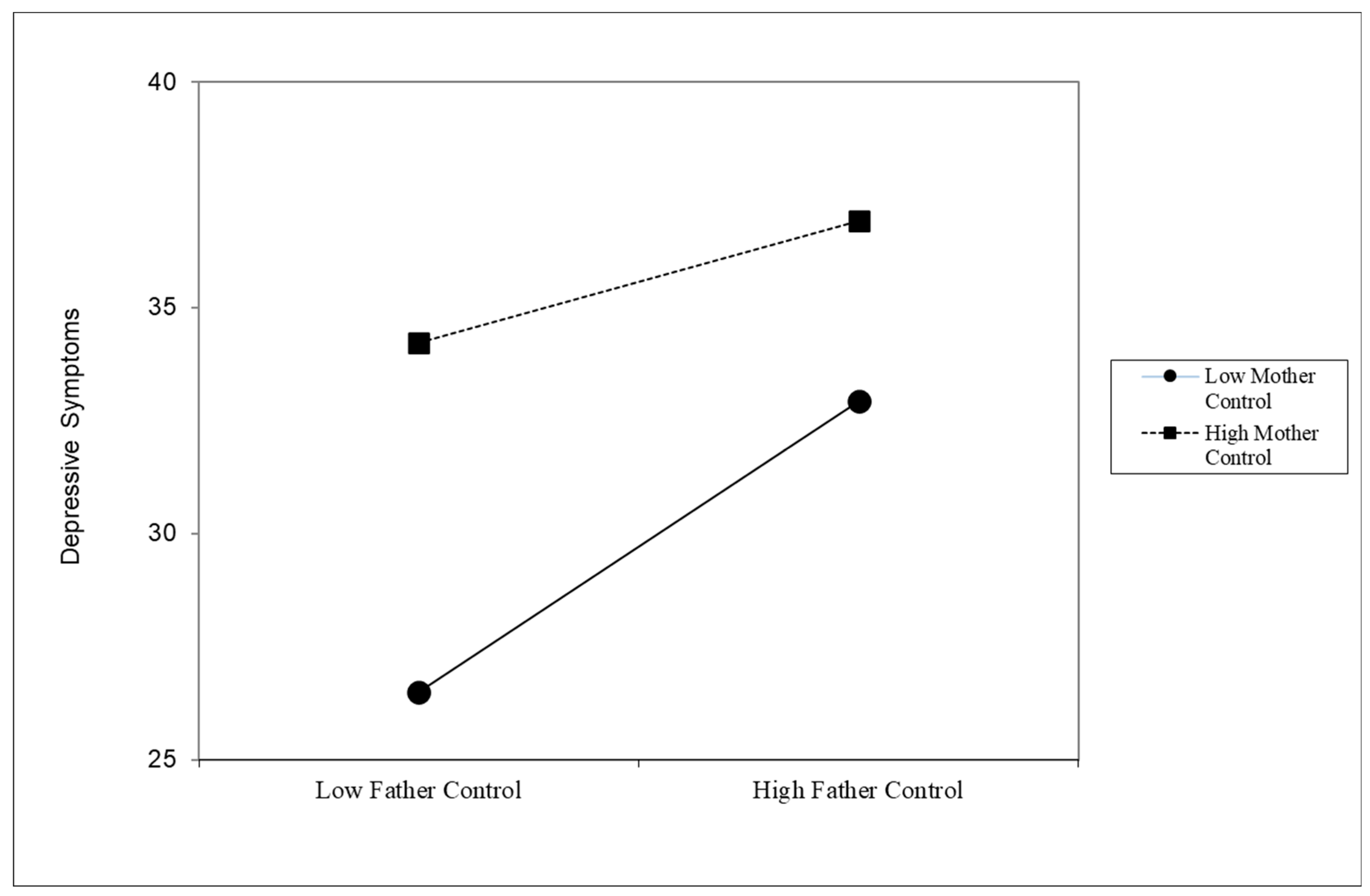
Lastly, the joint effect between father and mother control resulted in a significant two-way interaction (B = −0.81, p < 0.01). The simple slope test revealed a significant negative coefficient indicating that the incremental association of father psychological control and adolescent depressive symptoms weakened when mother psychological control was high (B = 1.35, p = 0.02) compared to when mother psychological control was low (B = 3.22, p < 0.01) (see Table 3 and Figure 2). See Appendix B for results from the full hierarchical regression model.
Figure 2.
Estimated level of depressive symptoms by father’s psychological control, stratified by mother’s psychological control.
4. Discussion
Although Chinese parents’ use of psychological control has been linked with adolescent mental health (Bi et al., 2024), no studies to our knowledge have considered how the association may differ across gender dyads of parents and adolescents and minimal research has examined the joint influences of Chinese mothers’ and fathers’ use of psychological control on adolescent depressive symptoms. Guided by sociocultural and familial frameworks, findings from this study provide a more nuanced understanding of how parent and adolescent gender may influence the link between parental psychological control and adolescent depressive symptoms, and thus inform the research, programs, and practice of mental health professionals who work with Chinese adolescents and their families.
Our study revealed that more adolescent depressive symptoms were associated with greater perceptions of mothers’ and fathers’ use of parental psychological control. These findings are consistent with previous studies that have also demonstrated a positive association between parental psychological control and Chinese adolescent depressive symptoms (Cui et al., 2014; Nigela et al., 2015). Providing further support for IPARTheory, the current findings suggest that regardless of the specific culture, parents’ intrusive and rejecting behaviors such as psychological control may adversely affect adolescent self-determination, identity development, and self-esteem, rendering them to engage in more self-criticism and to experience greater depressive symptoms (Rohner, 2021).
Taking the MANOVA and regression results together, an intriguing pattern emerged: even though daughters reported fathers’ use of psychological control to be lower than sons did, the positive association between daughters’ depressive symptoms and their perceptions of fathers’ use of psychological control was significantly stronger compared to sons. This finding supports past empirical findings revealing gender differences in adolescent perceptions of negative paternal parenting practices, where daughters were more negatively impacted by negative interpersonal interactions and unwanted parenting practices than sons (Zhu & Shek, 2021). Additionally, it aligns with two meta-analyses indicating that, in traditional societies, adults’ recollections of fathers’ use of psychological control were more strongly and positively associated with psychological maladjustment in adult daughters than in adult sons (Ali et al., 2015; Rohner, 2021). Thus, findings from this study are a major extension of past studies on parent–adolescent relationships, particularly father–daughter relationships (X. Fu et al., 2021), because they clearly indicate that while parental psychological control may have a consistent, negative association with adolescent depressive symptoms, the amount of control may not be the most critical factor in determining the impact of parental psychological control. Instead, we suspect the very large power discrepancy based on gender between fathers and their daughters in Chinese families may be an important yet understudied reason for this intriguing pattern. Indeed, the traditional hierarchical family structure endorsed by Confucianism entitles greater authority to fathers due to the combination of male gender and seniority (Ho, 1994). Past research has found that women are more likely to experience depressive symptoms than men in part because of gendered power dynamics (Maji, 2018). Thus, the father–daughter dyad may be the most vulnerable gender dyad in Chinese families to experiencing a positive association between parental psychological control and depressive symptoms. Additional studies are needed to explore the specific mechanism through which a father’s psychological control is associated with their daughter’s well-being, particularly over time.
Furthermore, results from the current study support the family system theory by demonstrating the importance of considering the parenting of both mothers and fathers in the family. Figure 2 shows that a father’s use of greater psychological control was only significantly associated with an adolescent’s depressive symptoms when a mother’s psychological control was low. In other words, the association between fathers’ control and children’s depressive symptoms weakened when mothers’ control was high. These findings suggest that while both parents’ psychological control tended to have a negative association with an adolescent’s mental health, mothers’ control appears to carry greater weight in this relationship. Although Chinese mothers may not traditionally be considered the primary authority figures within the family, they hold a vital role as nurturers and supporters of their children’s current well-being due to the mother’s main caregiver role (Chao, 1994). It is important to note that due to the cross-sectional nature of this study, we cannot rule out the possibility that when adolescents demonstrated greater depressive symptoms, it may have caused fathers to exert more psychological control at home. Previous research has indicated such a bidirectional pathway: Cao and Liu (2023) found that the quality of the Chinese parent–child relationship predicted adolescents’ emotional traits, and that an adolescent’s own emotional characteristics predicted subsequent changes in the parent–child relationship quality.
A major strength of this study is its consideration of the associations between parental psychological control and adolescent depressive symptoms across specific parent–adolescent gender dyads within Chinese families (i.e., mother–son, mother–daughter, father–son, father–daughter). This dyadic approach offers a more nuanced understanding of how gender dynamics may shape the impact of parenting practices on adolescents’ mental health. Another important contribution of the current study is its examination of the joint effects of both mothers’ and fathers’ use of psychological control. By simultaneously considering the roles of both parents, the study acknowledges the interdependent nature of parenting in Chinese families, where maternal and paternal influences may interact to shape adolescent outcomes in unique and nuanced ways.
There are several noteworthy limitations to discuss. The current study is a cross-sectional study that limits the ability to explore causal explanations. Longitudinal research on adolescent–parent gender dyads would be extremely helpful to understand the developmental trajectory and causal direction of the parental psychological control–adolescent depression link. A longitudinal design would have also allowed us to account for the nested nature of collecting surveys from middle and senior high schools in three different geographic regions in China. Also, the study measures were based entirely on adolescent self-reports, which may threaten the internal validity of the findings due to shared method variance and response biases. Even though adolescents’ perceptions of parental psychological control are important for understanding other internal characteristics such as adolescents’ depressive symptoms, it would be informative if future research measured parental psychological control by using more objective methods such as observations or by including multiple reporters such as parents, peers, and teachers.
To our knowledge, this study is the first to consider gender dyads of parents and adolescents when examining the association between perceived psychological control and depressive symptoms in Chinese families. Given that our findings indicate that Chinese daughters are particularly vulnerable to the negative effects of psychological control by fathers, it is important that mental health programs include fathers in their treatment plans. Future research and preventive interventionists seeking to strengthen adolescent and family well-being must continue to consider sociocultural and gendered norms that intersect and influence parent–adolescent interactions.
Author Contributions
Conceptualization, Y.Z. and L.C.H.; methodology, Y.Z. and S.L.; formal analysis, Y.Z. and S.L.; investigation, S.L. and H.W.; data curation, S.L. and H.W.; writing—original draft preparation, Y.Z. and L.C.H., writing—review and editing, Y.Z., S.L., L.C.H., E.A.M.-W., A.H. and M.A.B.; supervision, S.L. and L.C.H.; project administration, H.W. All authors have read and agreed to the published version of the manuscript.
Funding
This research received no external funding.
Institutional Review Board Statement
The study was conducted in accordance with the Declaration of Helsinki and approved by the Ethics Committee of the Guangzhou Medical University in China (protocol code 20161005 and date of approval 25 October 2016).
Informed Consent Statement
Verbal informed consent was obtained from the guardians of participants or school administrators. Verbal consent was obtained rather than written because this study involved a low-risk anonymous questionnaire, without the collection of identifying information. Prior to the study, the guardians or school administrators were informed about the purpose of the study, the voluntary nature of participation, the anonymity and confidentiality of participants’ responses, and their right to refuse or withdraw at any time without consequences. Verbal informed consent was obtained from the guardians of the students/school administrators in China to offer the opportunity to students to fill out a survey. Students could opt in or opt out of the opportunity to complete the survey.
Data Availability Statement
The data presented in this study are available on reasonable request from the second author. The data are not publicly available due to confidentiality and research ethics.
Conflicts of Interest
The authors declare no conflicts of interest.
Appendix A. Measurement Invariance Across Boys and Girls
| Measure | Model | χ2 | df | CFI | TLI | RMSEA | SRMR |
| MC | Configural | 1850.68 | 200 | 0.917 | 0.900 | 0.074 | 0.048 |
| Metric | 1894.22 | 215 | 0.915 | 0.905 | 0.072 | 0.051 | |
| Scalar | 1980.07 | 230 | 0.912 | 0.908 | 0.071 | 0.052 | |
| FC | Configural | 2036.95 | 200 | 0.915 | 0.898 | 0.078 | 0.048 |
| Metric | 2076.39 | 215 | 0.914 | 0.904 | 0.076 | 0.050 | |
| Scalar | 2159.85 | 230 | 0.910 | 0.907 | 0.075 | 0.053 | |
| DEP | Configural | 3357.73 | 324 | 0.905 | 0.889 | 0.079 | 0.043 |
| Metric | 3448.12 | 343 | 0.903 | 0.892 | 0.078 | 0.050 | |
| Scalar | 3551.10 | 362 | 0.900 | 0.895 | 0.077 | 0.051 | |
| Note. MC = mother control; FC = father control; DEP = depression. As shown in Table 1, MC, FC, and DEP all demonstrated good general equality across boys and girls, with evidence for configural, metric, and near-scalar invariance in the revised models. | |||||||
Appendix B. Full Results for the Hierarchical Regression for 2-Way Interactions on Adolescents’ Depressive Symptoms
| Steps | Variables | B | SE | t | p |
| Step 1 | Constant | 36.61 | 1.00 | 36.59 | <0.001 |
| Father Education | 0.21 | 0.19 | 1.12 | 0.27 | |
| Mother Education | −0.19 | 0.18 | −1.03 | 0.30 | |
| Only Child | −1.00 | 0.75 | −1.33 | 0.18 | |
| Medium City | 0.06 | 1.02 | 0.06 | 0.95 | |
| Big City | −1.97 | 0.76 | −2.59 | 0.01 | |
| School Grade Level | 1.51 | 0.63 | 2.38 | 0.02 | |
| Step 2 | Constant | 34.82 | 0.93 | 37.26 | <0.001 |
| Father Education | 0.24 | 0.18 | 1.36 | 0.18 | |
| Mother Education | −0.08 | 0.17 | −0.46 | 0.64 | |
| Only Child | −1.27 | 0.71 | −1.77 | 0.08 | |
| Medium City | 1.11 | 0.98 | 1.13 | 0.26 | |
| Big City | −2.19 | 0.73 | −3.02 | <0.001 | |
| School Grade Level | 3.33 | 0.62 | 5.39 | <0.001 | |
| Mother Control | 3.66 | 0.35 | 10.55 | <0.001 | |
| Father Control | 1.70 | 0.35 | 4.92 | <0.001 | |
| Step 3 | Constant | 32.83 | 0.98 | 33.66 | <0.001 |
| Father Education | 0.23 | 0.18 | 1.27 | 0.21 | |
| Mother Education | −0.08 | 0.17 | −0.48 | 0.63 | |
| Only Child | −0.87 | 0.71 | −1.22 | 0.22 | |
| Medium City | 0.72 | 0.97 | 0.74 | 0.46 | |
| Big City | −2.02 | 0.72 | −2.79 | 0.01 | |
| School Grade Level | 3.42 | 0.61 | 5.58 | <0.001 | |
| Mother Control | 3.54 | 0.35 | 10.25 | <0.001 | |
| Father Control | 1.98 | 0.35 | 5.72 | <0.001 | |
| Gender | 3.54 | 0.58 | 6.15 | <0.001 | |
| Step 4 | Constant | 33.43 | 0.99 | 33.92 | <0.001 |
| Father Education | 0.23 | 0.18 | 1.30 | 0.20 | |
| Mother Education | −0.09 | 0.17 | −0.53 | 0.60 | |
| Only Child | −0.89 | 0.71 | −1.25 | 0.21 | |
| Medium City | 0.95 | 0.97 | 0.98 | 0.33 | |
| Big City | −1.99 | 0.72 | −2.74 | 0.01 | |
| School Grade Level | 3.46 | 0.61 | 5.66 | <0.001 | |
| Mother Control | 3.72 | 0.54 | 6.89 | <0.001 | |
| Father Control | 1.37 | 0.53 | 2.60 | 0.01 | |
| Gender | 3.51 | 0.57 | 6.12 | <0.001 | |
| MC*G | −0.15 | 0.71 | −0.21 | 0.83 | |
| FC*G | 2.20 | 0.70 | 3.16 | <0.001 | |
| MC*FC | −0.81 | 0.22 | −3.67 | <0.001 | |
| Step 5 | Constant | 33.59 | 0.99 | 33.85 | <0.001 |
| Father Education | 0.23 | 0.18 | 1.30 | 0.20 | |
| Mother Education | −0.09 | 0.17 | −0.50 | 0.62 | |
| Only Child | −0.92 | 0.71 | −1.30 | 0.20 | |
| Medium City | 0.95 | 0.97 | 0.98 | 0.33 | |
| Big City | −1.94 | 0.73 | −2.67 | 0.01 | |
| School Grade Level | 3.46 | 0.61 | 5.66 | <0.001 | |
| Mother Control | 3.83 | 0.54 | 7.08 | <0.001 | |
| Father Control | 1.56 | 0.54 | 2.89 | <0.001 | |
| Gender | 3.06 | 0.62 | 4.91 | <0.001 | |
| MC*G | −0.20 | 0.70 | −0.29 | 0.77 | |
| FC*G | 1.74 | 0.75 | 2.32 | 0.02 | |
| MC*FC | −1.16 | 0.30 | −3.86 | <0.001 | |
| MC*FC*G | 0.78 | 0.47 | 1.66 | 0.10 | |
| Note. B = unstandardized coefficient; SE = standard error; MC = mother psychological control; FC = father psychological control; G = gender. Step 1 included the control variables. Step 2 added MC and FC. Step 3 added G. Step 4 added the two-way interaction terms (MC*G, FC*G, and MC*FC). Step 5 added the three-way interaction term (MC*FC*G). Coefficients are based on pooled estimates from multiple imputations. | |||||
References
- Ali, S., Khaleque, A., & Rohner, R. P. (2015). Pancultural gender differences in the relation between perceived parental acceptance and psychological adjustment of children and adult offspring: A meta-analytic review of worldwide research. Journal of Cross-Cultural Psychology, 46(8), 1059–1080. [Google Scholar] [CrossRef] [Scilit]
- Barber, B. K. (1996). Parental psychological control: Revisiting a neglected construct. Child Development, 67, 3296–3319. [Google Scholar] [CrossRef]
- Barber, B. K., & Harmon, E. L. (2002). Violating the self: Parental psychological control of children and adolescents. In B. K. Barber (Ed.), Intrusive parenting: How psychological control affects children and adolescents (pp. 15–52). American Psychological Association. [Google Scholar] [CrossRef] [Scilit]
- Barber, B. K., Stolz, H. E., Olsen, J. A., Collins, W. A., & Burchinal, M. (2005). Parental support, psychological control, and behavioral control: Assessing relevance across time, culture, and method. Monographs of the Society for Research in Child Development, 70(4), 1–137. [Google Scholar] [CrossRef] [Scilit]
- Bi, S., Huang, J., Cui, L., & Zhou, H. (2024). Within-family associations between parental psychological control and externalizing problems among Chinese children: Links to between-family mindful parenting. Research on Child and Adolescent Psychopathology, 52(1), 65–77. [Google Scholar] [CrossRef] [Scilit]
- Bronfenbrenner, U. (1986). Ecology of the family as a context for human development: Research perspectives. Developmental Psychology, 22(6), 723–742. [Google Scholar] [CrossRef]
- Cao, X., & Liu, X. (2023). Understanding the role of parent–child relationships in Conscientiousness and Neuroticism development among Chinese middle school students: A cross-lagged model. Behavioral Sciences, 13(10), 876. [Google Scholar] [CrossRef] [Scilit]
- Chang, L., Schwartz, D., Dodge, K. A., & McBride-Chang, C. (2011). Harsh parenting in relation to child emotion regulation and aggression. Journal of Family Psychology, 17(4), 598–606. [Google Scholar] [CrossRef] [Scilit]
- Chao, R. K. (1994). Beyond parental control and authoritarian parenting style: Understanding Chinese parenting through the cultural notion of training. Child Development, 65(4), 1111–1119. [Google Scholar] [CrossRef]
- Chyung, Y. J., Lee, Y. A., Ahn, S. J., & Bang, H. S. (2022). Associations of perceived parental psychological control with depression, anxiety in children and adolescents: A meta-analysis. Marriage & Family Review, 58(2), 158–197. [Google Scholar] [CrossRef] [Scilit]
- Cox, M. J., & Paley, B. (2003). Understanding families as systems. Current Directions in Psychological Science, 12(5), 193–196. [Google Scholar] [CrossRef] [Scilit]
- Cui, L., Morris, A. S., Criss, M. M., Houltberg, B. J., & Silk, J. S. (2014). Parental psychological control and adolescent adjustment: The role of adolescent emotion regulation. Parenting, 14(1), 47–67. [Google Scholar] [CrossRef] [Scilit] [PubMed]
- Eaton, W. W., Muntaner, C., Smith, C., Tien, A., & Ybarra, M. (2004). Center for epidemiologic studies depression scale: Review and revision (CESD and CESD-R). In M. E. Maruish (Ed.), The use of psychological testing for treatment planning and outcomes assessment (3rd ed., pp. 363–377). Lawrence Erlbaum. [Google Scholar]
- Enders, C. K. (2013). Dealing with missing data in developmental research. Child Development Perspectives, 7(1), 27–31. [Google Scholar] [CrossRef] [Scilit]
- Fu, C., & Wang, M. (2021). Parental corporal punishment and girls’ self-esteem: The moderating effects of girls’ agency and communion in China. Sex Roles, 84(7), 392–403. [Google Scholar] [CrossRef] [Scilit]
- Fu, X., Zhang, K., Chen, X., & Chen, Z. (2021). Report on national mental health development in China (2019–2020). Social Sciences Academic Press. [Google Scholar]
- Fung, H. (1999). Becoming a moral child: The socialization of shame among young Chinese children. Ethos, 27(2), 180–209. [Google Scholar] [CrossRef] [Scilit]
- Heard, H. E. (2007). Fathers, mothers, and family structure: Family trajectories, parent gender, and adolescent schooling. Journal of Marriage and Family, 69(2), 435–450. [Google Scholar] [CrossRef] [Scilit]
- Ho, D. Y. (1994). Filial piety, authoritarian moralism, and cognitive conservatism in Chinese societies. Genetic, Social, and General Psychology Monographs, 120(3), 349–365. [Google Scholar]
- Kwong, A. S. F., Manley, D., Timpson, N. J., Pearson, R. M., Heron, J., Sallis, H., Stergiakouli, E., Davis, O. S. P., & Leckie, G. (2019). Identifying critical points of trajectories of depressive symptoms from childhood to young adulthood. Journal of Youth and Adolescence, 48, 815–827. [Google Scholar] [CrossRef] [Scilit]
- Leung, J. T. Y., & Shek, D. T. L. (2020). Parental control and adolescent wellbeing in Chinese adolescents in Hong Kong. Child Indicators Research, 13, 703–727. [Google Scholar] [CrossRef] [Scilit]
- Li, Q., Wei, S., & Liu, Z. (2024). How is parental psychological control associated with adolescent mental health in economically disadvantaged areas? The serial mediating role of psychological reactance and problematic smartphone use. Frontiers in Psychiatry, 15, 1458378. [Google Scholar] [CrossRef] [Scilit]
- Li, Y., Costanzo, P. R., & Putallaz, M. (2010). Maternal socialization goals, parenting styles, and social-emotional adjustment among Chinese and European American young adults: Testing a mediation model. Journal of Genetic Psychology, 171, 330–362. [Google Scholar] [CrossRef] [Scilit] [PubMed]
- Liong, M. (2017). Chinese fatherhood, gender and family: Father mission. Palgrave Macmillan. [Google Scholar]
- Liu, Y., Haslam, D. M., Dittman, C. K., Guo, M., & Morawska, A. (2022). Predicting Chinese father involvement: Parental role beliefs, fathering self-efficacy and maternal gatekeeping. Frontiers in Psychology, 13, 1066876. [Google Scholar] [CrossRef] [Scilit] [PubMed]
- Luebbe, A. M., Tu, C., & Fredrick, J. W. (2018). Socialization goals, parental psychological control, and youth anxiety in Chinese students: Moderated indirect effects based on school type. Journal of Youth and Adolescence, 47(2), 413–429. [Google Scholar] [CrossRef] [Scilit]
- Maji, S. (2018). Society and ‘good woman’: A critical review of gender differences in depression. International Journal of Social Psychiatry, 64(4), 396–405. [Google Scholar] [CrossRef] [Scilit] [PubMed]
- Nelson, D. A., Yang, C., Coyne, S. M., Olsen, J. A., & Hart, C. H. (2013). Parental psychological control dimensions: Connections with Russian preschoolers’ physical and relational aggression. Journal of Applied Developmental Psychology, 34, 1–8. [Google Scholar] [CrossRef] [Scilit]
- Nigela, A., Xia, B., Yan, Y., & Li, D. (2015). The direct and indirect impacts of parental control on adolescent depression. Chinese Journal of Clinical Psychology, 23(3), 494–497, 533. [Google Scholar] [CrossRef]
- Peterson, G. W., Cobas, J. A., Bush, K. R., Supple, A., & Wilson, S. M. (2005). Parent-youth relationships and the self-esteem of Chinese adolescents: Collectivism versus individualism. Marriage & Family Review, 36, 173–200. [Google Scholar] [CrossRef] [Scilit]
- Rogers, K. N., Buchanan, C. M., & Winchell, M. E. (2003). Psychological control during early adolescence: Links to adjustment in differing parent/adolescent dyads. The Journal of Early Adolescence, 23(4), 349–383. [Google Scholar] [CrossRef] [Scilit]
- Rohner, R. P. (2021). Introduction to interpersonal acceptance-rejection theory (IPARTheory) and evidence. Online Readings in Psychology and Culture, 6(1), 4. [Google Scholar] [CrossRef] [Scilit]
- Salaam, B. (2024). Interactive associations of maternal and paternal parenting and adolescents’ anxiety. International Journal of Behavioral Development, 48(1), 85–91. [Google Scholar] [CrossRef] [Scilit]
- Shek, D. T. (2008). Perceived parental control and parent–child relational qualities in early adolescents in Hong Kong: Parent gender, child gender and grade differences. Sex Roles, 58(9), 666–681. [Google Scholar] [CrossRef] [Scilit]
- Shorey, S., Ng., E. D., & Wong, C. H. J. (2022). Global prevalence of depression and elevated depressive symptoms among adolescents: A systematic review and meta-analysis. British Journal of Clinical Psychology, 61(2), 287–305. [Google Scholar] [CrossRef] [Scilit]
- Tam, V. C. W. (2009). A comparison of fathers’ and mothers’ contributions in the prediction of academic performance of school-age children in Hong Kong. International Journal of Psychology, 44(2), 147–156. [Google Scholar] [CrossRef] [Scilit] [PubMed]
- Tang, Y., Novin, S., Lin, X., Becht, A., & Thomaes, S. (2024). Parental psychological control and children’s self-esteem: A longitudinal investigation in children with and without oppositional defiant problems. Child and Adolescent Psychiatry and Mental Health, 18(1), 50. [Google Scholar] [CrossRef] [Scilit] [PubMed]
- Van Bronkhorst, S. B., Abraham, E., Dambreville, R., Ramos-Olazagasti, M. A., Wall, M., Saunders, D. C., Monk, C., Alegría, M., Canino, G. J., Bird, H., & Duarte, C. S. (2024). Sociocultural risk and resilience in the context of adverse childhood experiences. JAMA Psychiatry, 81(4), 406–413. [Google Scholar] [CrossRef] [Scilit]
- Van Lissa, C. J., Keizer, R., Van Lier, P. A. C., Meeus, W. H. J., & Branje, S. (2019). The role of fathers’ versus mothers’ parenting in emotion-regulation development from mid-late adolescence: Disentangling between-family differences from within-family effects. Developmental Psychology, 55(2), 377–389. [Google Scholar] [CrossRef] [Scilit]
- Van Petegem, S., Albert Sznitman, G., Darwiche, J., & Zimmermann, G. (2022). Putting parental overprotection into a family systems context: Relations of overprotective parenting with perceived coparenting and adolescent anxiety. Family Process, 61(2), 792–807. [Google Scholar] [CrossRef] [Scilit]
- Wang, Q., Pomerantz, E. M., & Chen, H. (2007). The role of parents’ control in early adolescents’ psychological functioning: A longitudinal investigation in the United States and China. Child Development, 78, 1592–1610. [Google Scholar] [CrossRef] [Scilit]
- World Health Organization. (2025). Mental health of adolescents. Available online: https://www.who.int/news-room/fact-sheets/detail/adolescent-mental-health (accessed on 15 January 2026).
- Xie, S., & Li, H. (2017). ‘Tiger mom, panda dad’: A study of contemporary Chinese parenting profiles. Early Child Development and Care, 189(2), 284–300. [Google Scholar] [CrossRef] [Scilit]
- Yang, Z., Luo, Y., Chen, F., Qi, M., Luo, R., Li, Y., & Wang, Y. (2025). Exploring the co-occurrence of depressive symptoms and aggression among Chinese adolescents: Patterns and stability. Journal of Youth and Adolescence, 54(1), 46–61. [Google Scholar] [CrossRef] [Scilit] [PubMed]
- Yu, X., Fu, X., Yang, Z., Zhang, M., Liu, X., Fu, Y., & Lv, Y. (2021). Bidirectional relationship between parental psychological control and adolescent maladjustment. Journal of Adolescence, 92, 75–85. [Google Scholar] [CrossRef] [Scilit]
- Zhang, Q., Xing, T., Wang, M., Ren, L., & Xu, F. (2019, October 18–20). Parental anxiety, parental control and child anxiety relationships and sex differences [Conference presentation]. The 22nd National Academic Congress of Psychology, Hangzhou, China. [Google Scholar]
- Zhu, X., Dou, D., & Pan, Y. (2023). Developing and validating a multidimensional Chinese parental psychological control scale. Frontiers in Psychology, 14, 1116625. [Google Scholar] [CrossRef] [Scilit] [PubMed]
- Zhu, X., & Shek, D. T. (2021). Parental factors and adolescent well-being: Associations between developmental trajectories. Children and Youth Services Review, 127, 106071. [Google Scholar] [CrossRef] [Scilit]

Disclaimer/Publisher’s Note: The statements, opinions and data contained in all publications are solely those of the individual author(s) and contributor(s) and not of MDPI and/or the editor(s). MDPI and/or the editor(s) disclaim responsibility for any injury to people or property resulting from any ideas, methods, instructions or products referred to in the content. |
© 2026 by the authors. Licensee MDPI, Basel, Switzerland. This article is an open access article distributed under the terms and conditions of the Creative Commons Attribution (CC BY) license.