


The Impact of Maternal Phubbing on Toddlers’ Language Development and Subsequent Social Development: A Three-Month Time-Lagged Analysis

Abstract
1. Introduction
- What are the trends in maternal phubbing, infant language development, and infant social development?
- What are the structural relationships between maternal phubbing, infant language development, and infant social development?
2. Methods
2.1. Participants
2.2. Measures
2.2.1. Maternal Phubbing
2.2.2. Language Development
2.2.3. Social Development
2.3. Data Analysis
3. Results
3.1. Descriptive Statistics of Main Variables
3.2. Correlations Among Main Variables
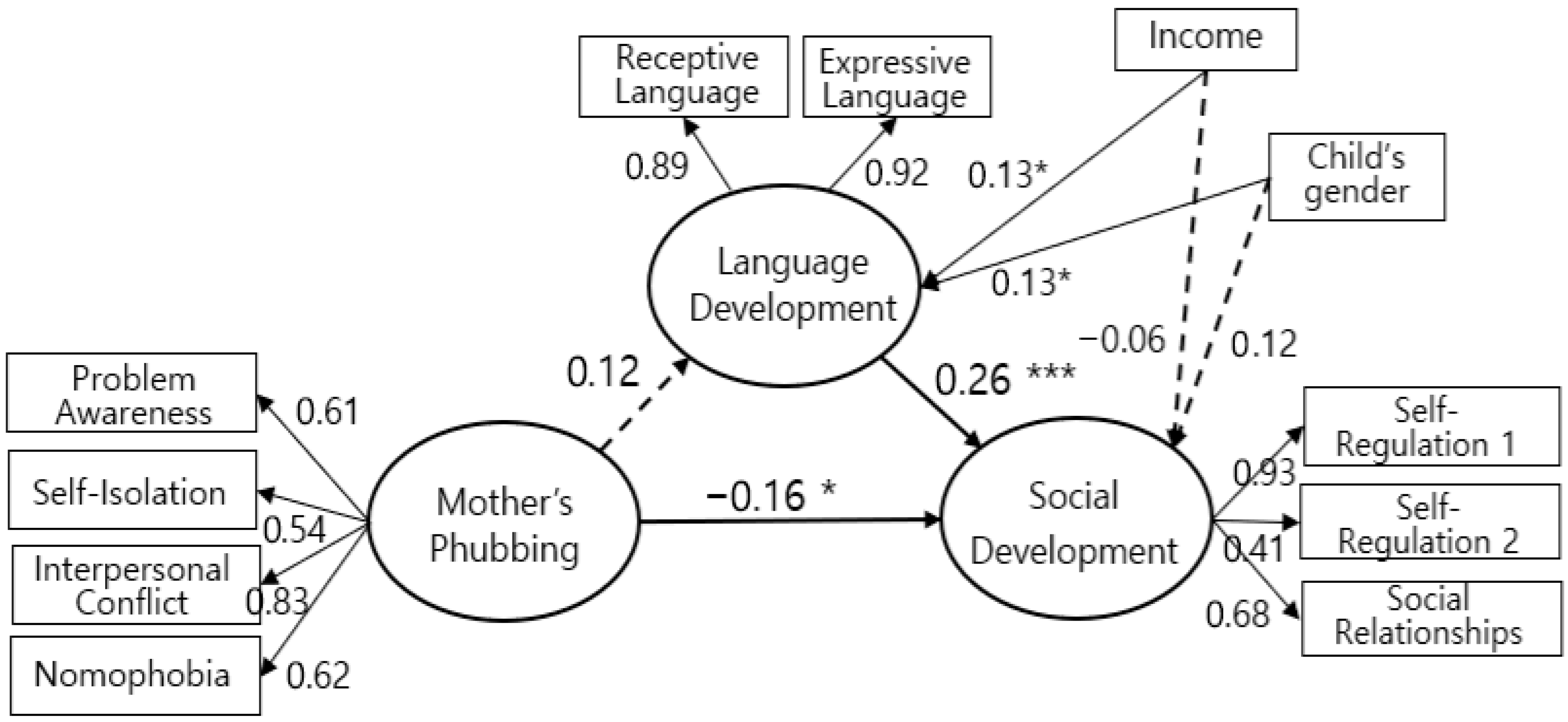
3.3. Structural Equation Model Analysis
4. Discussion
5. Conclusions
Author Contributions
Funding
Institutional Review Board Statement
Informed Consent Statement
Data Availability Statement
Conflicts of Interest
References
- Beitchman, J. H., Wilson, B., Johnson, C. J., Atkinson, L., Young, A., Adlaf, E., Escobar, M., & Douglas, L. (2001). Fourteen-year follow-up of speech/language-impaired and control children: Psychiatric outcome. Journal of the American Academy of Child & Adolescent Psychiatry, 40(1), 75–82. [Google Scholar] [CrossRef] [Scilit]
- Bowlby, J. (1982). Attachment and loss: Retrospect and prospect. The American Journal of Orthopsychiatry, 52(4), 664–678. [Google Scholar] [CrossRef] [Scilit] [PubMed]
- Carson, V., & Kuzik, N. (2021). The association between parent-child technology interference and cognitive and social-emotional development in preschool-aged children. Child: Care, Health and Development, 47(4), 477–483. [Google Scholar] [CrossRef] [Scilit] [PubMed]
- Chotpitayasunondh, V., & Douglas, K. M. (2018). The effects of “phubbing” on social interaction. Journal of Applied Social Psychology, 48(6), 304–316. [Google Scholar] [CrossRef] [Scilit]
- David, M. E., & Roberts, J. A. (2017). Phubbed and alone: Investigating the effect of surviving phubbing on self-esteem and depression. Journal of Adolescence, 61, 117–124. [Google Scholar] [CrossRef] [Scilit]
- Davies, D. (2004). Child development: A practitioner’s guide (2nd ed.). The Guilford Press. [Google Scholar]
- Elias, N., Lemish, D., Dalyot, S., & Floegel, D. (2021). “Where are you?” an observational exploration of parental technoference in public places in the US and Israel. Journal of Children and Media, 15(3), 376–388. [Google Scholar] [CrossRef] [Scilit]
- Erikson, E. H. (1975). Life history and the historical movement. Norton. [Google Scholar]
- Fenson, L., Dale, P. S., Reznick, J. S., Bates, E., Thal, D. J., Pethick, S. J., Tomasello, M., Mervis, C. B., & Stiles, J. (1994). Variability in early communicative development. Monographs of the Society for Research in Child Development, 59(5), 1–185. [Google Scholar] [CrossRef] [Scilit]
- Gonçalves, S., Dias, P., & Correia, A. P. (2020). Nomophobia and lifestyle: Smartphone use and its relationship to psychopathologies. Computers in Human Behavior Reports, 2, 100025. [Google Scholar] [CrossRef] [Scilit]
- Hart, B. M., & Risley, T. R. (1995). Meaningful differences in the everyday experience of young American children. Brookes. [Google Scholar]
- Hoff, E., & Naigles, L. (2002). How children use input to acquire a lexicon. Child Development, 73(2), 418–433. [Google Scholar] [CrossRef] [Scilit]
- Jang, Y.-J. (2018). The effect of mother and teacher reported peer interaction to receptive/expressive vocabulary of 3 and 5 years old children. Early Childhood Education Research & Review, 22(4), 123–140. (In Korean) [Google Scholar] [CrossRef] [Scilit]
- Jang, Y.-J., & Hong, Y.-J. (2019). Identifying the latent classes of changing mobile phone dependency among adolescents and testing the effects of micro-system variables. Asian Journal of Education, 20(1), 71–94. (In Korean) [Google Scholar] [CrossRef] [Scilit]
- Karadağ, E., Tosuntaş, Ş. B., Erzen, E., Duru, P., Bostan, N., Şahin, B. M., Çulha, I., & Babadağ, B. (2015). Determinants of phubbing, which is the sum of many virtual addictions: A structural equation model. Journal of Behavioral Addictions, 4(2), 60–74. [Google Scholar] [CrossRef] [Scilit]
- Kim, G.-H., & Lim, Y.-J. (2025). The relationship between anxiety sensitivity and problematic social media use among young adult men and women: The mediating role of coping motives and the moderated mediation effect of gender. Journal of Human Understanding and Counseling, 46(2), 25–41. (In Korean) [Google Scholar] [CrossRef] [Scilit]
- Kim, H. I. (2010). Development of a social development rating scale for 2-year-old infants [Unpublished doctoral dissertation, Duksung Women’s University]. (In Korean) [Google Scholar]
- Kim, M. B., Choi, J. G., & Song, W. Y. (2022). Validation of the Korean phubbing scale (PS-K). Journal of Developmental Support, 11(1), 15–40. (In Korean) [Google Scholar]
- Kim, Y. T., Kim, K. H., Yoon, H. R., & Kim, H. S. (2003). Sequenced language scale for infants (SELSI). Special Education Publishing. (In Korean) [Google Scholar]
- Korea Press Foundation. (2023). 2023 Survey on children’s media usage. Korea Press Foundation. (In Korean)
- Lee, J. (2014). Current status of infant and toddler smartphone exposure and protection policies. Korea Institute of Child Care and Education. [Google Scholar]
- Lee, J. J. (2023). The effect of parental phubbing on young children’s smartphone overdependence: The mediating effect of attachment security [Unpublished master’s thesis, Kyung Hee University]. (In Korean) [Google Scholar]
- Lim, Y. (2024). Social anxiety and problematic social media use: The mediating role of SNS use motives. The Korean Journal of Rehabilitation Psychology, 31(2), 1–13. (In Korean) [Google Scholar] [CrossRef]
- McDaniel, B. T. (2019). Parent distraction with phones, reasons for use, and impacts on parenting and child outcomes: A review of the emerging research. Human Behavior and Emerging Technologies, 1(2), 72–80. [Google Scholar] [CrossRef] [Scilit]
- McDaniel, B. T., & Radesky, J. (2018). Technoference: Parent distraction by technology and associations with child behavior problems. Child Development, 89, 100–109. [Google Scholar] [CrossRef] [Scilit] [PubMed]
- McGillion, M., Davies, C., Hendry, A., & Gonzalez-Gomez, N. (2024). Caregiver sensitivity supported young children’s vocabulary development during the Covid-19 UK lockdowns. Journal of Child Language, 51(5), 1213–1229. [Google Scholar]
- Min, Y., Choi, Y.-S., & Kim, B.-N. (2024). Filling the mental service gap on campus: An effectiveness trial testing the utility of app-based mindfulness psychological intervention for college students. Current Psychology, 43(17), 15434–15444. [Google Scholar] [CrossRef] [Scilit]
- Ministry of Education. (2025). Childcare statistics: As of the end of December 2024. Department of Early Childhood Policy. (In Korean) [Google Scholar]
- Ministry of Science and ICT. (2024). The survey on smartphone overdependence 2023. Ministry of Science and ICT. (In Korean) [Google Scholar]
- Ministry of Science and ICT. (2025). The survey on smartphone overdependence 2024. Ministry of Science and ICT. (In Korean)
- National Data Portal. (2025). Results of the 2025 household finance and welfare survey. Statistics Korea. (In Korean)
- Pancani, L., Gerosa, T., Gui, M., & Riva, P. (2021). “Mom, dad, look at me”: The development of the parental phubbing scale. Journal of Social and Personal Relationships, 38(2), 435–458. [Google Scholar] [CrossRef] [Scilit]
- Radesky, J. S., Kistin, C., Eisenberg, S., Gross, J., Block, G., Zuckerman, B., & Silverstein, M. (2016). Parent perspectives on their mobile technology use: The excitement and exhaustion of parenting while connected. Journal of Developmental & Behavioral Pediatrics, 37(9), 694–701. [Google Scholar] [CrossRef] [Scilit]
- Radesky, J. S., Kistin, C. J., Zuckerman, B., Nitzberg, K., Gross, J., Kaplan-Sanoff, M., & Silverstein, M. (2014). Patterns of mobile device use by caregivers and children during meals in fast food restaurants. Pediatrics, 133(4), e843–e849. [Google Scholar] [CrossRef] [Scilit]
- Raudaskoski, S., Mantere, E., & Valkonen, S. (2017). The influence of parental smartphone use, eye contact and ‘bystander ignorance’ on child development. In A. R. Lahikainen, T. Mälkiä, & K. Repo (Eds.), Media, family interaction and the digitalization of childhood (pp. 173–184). Edward Elgar publishing, Inc. [Google Scholar] [CrossRef] [Scilit]
- Reed, J., Hirsh-Pasek, K., & Golinkoff, R. M. (2017). Learning on hold: Cell phones sidetrack parent-child interactions. Developmental psychology, 53(8), 1428–1436. [Google Scholar] [CrossRef] [Scilit] [PubMed]
- Roberts, J. A., & David, M. E. (2016). My life has become a major distraction from my cell phone: Partner phubbing and relationship satisfaction among romantic partners. Computers in Human Behavior, 54, 134–141. [Google Scholar] [CrossRef] [Scilit]
- Sameroff, A. (2010). A unified theory of development: A dialectic integration of nature and nurture. Child Development, 81(1), 6–22. [Google Scholar] [CrossRef] [Scilit]
- Shin, Y., Kim, E., Kim, K., Kim, J. S., Kim, S., & Kim, B. N. (2025). Predicting efficacy of virtual reality-based stabilization for individuals with posttraumatic stress symptoms: A machine learning approach. Psychiatry Investigation, 22(10), 1178. [Google Scholar] [CrossRef] [Scilit] [PubMed]
- Song, H. K., & Jang, Y. J. (2021). The effects of mothers’ perception of smart devices, infants’ usage status, and book-reading interaction on language development. Journal of Korean Wellness, 16(2), 9–15. (In Korean) [Google Scholar] [CrossRef] [Scilit]
- Swanson, M. R. (2020). The role of caregiver speech in supporting language development in infants and toddlers with autism spectrum disorder. Development and Psychopathology, 32(4), 1230–1239. [Google Scholar] [CrossRef] [Scilit]
- Thurm, A., Manwaring, S. S., Cardozo Jimenez, C., Swineford, L., Farmer, C., Gallo, R., & Maeda, M. (2018). Socioemotional and behavioral problems in toddlers with language delay. Infant Mental Health Journal, 39(5), 569–580. [Google Scholar]
- Tomasello, M. (2017). A natural history of human thinking. Harvard University Press. [Google Scholar]
- Vygotsky, L. S. (1978). Children and communication. Prentice-Hall. [Google Scholar]
- Wang, P., Ouyang, M., & Yin, Y. (2023). Mother phubbing and adolescents’ problematic SNS use: The mediating role of perceived burdensomeness and the moderating role of need to belong. Frontiers in Psychology, 14, 1098707. [Google Scholar] [CrossRef] [Scilit]
- West, S. G., Finch, J. F., & Curran, P. J. (1995). Structural equation modeling with nonnormal variables: Problems and remedies. In R. H. Hoyle (Ed.), Structural equation modeling: Concepts, issues, and applications (pp. 56–75). Sage. [Google Scholar]
- Wolfers, L. N. (2021). Parental mobile media use for coping with stress: A focus groups study. Human Behavior and Emerging Technologies, 3, 304–315. [Google Scholar] [CrossRef] [Scilit]

| M | SD | Min | Max | Skewness | Kurtosis | ||
|---|---|---|---|---|---|---|---|
| Mother’s Phubbing | Nomophobia | 2.76 | 0.73 | 1.00 | 4.50 | −0.11 | −0.44 |
| Interpersonal Conflict | 1.68 | 0.58 | 1.00 | 3.75 | 0.66 | 0.06 | |
| Self-Isolation | 1.60 | 0.62 | 1.00 | 3.50 | 0.85 | −0.24 | |
| Problem Awareness | 2.81 | 0.87 | 1.00 | 4.67 | −0.40 | −0.38 | |
| Total | 2.21 | 0.53 | 1.06 | 3.46 | −0.02 | −0.41 | |
| Language Development | Receptive Language | 48.78 | 8.08 | 20.00 | 56.00 | −1.23 | 0.78 |
| Expressive Language | 45.23 | 10.27 | 17.00 | 56.00 | −0.57 | −0.89 | |
| Total | 94.01 | 17.50 | 37.00 | 112.00 | −0.81 | −0.31 | |
| Social Development | Self-Regulation1 | 3.81 | 0.64 | 2.00 | 5.00 | −0.34 | −0.16 |
| Self-Regulation2 | 3.31 | 0.78 | 1.00 | 5.00 | −0.21 | 0.01 | |
| Social Relationships | 3.91 | 0.62 | 2.11 | 5.00 | −0.17 | −0.51 | |
| Total | 3.71 | 0.53 | 2.24 | 4.90 | −0.10 | −0.27 | |
| 1 | 2 | 3 | 4 | 5 | 6 | 7 | 8 | 9 | |
|---|---|---|---|---|---|---|---|---|---|
| 1 | 1 | ||||||||
| 2 | 0.52 *** | 1 | |||||||
| 3 | 0.23 *** | 0.47 *** | 1 | ||||||
| 4 | 0.43 *** | 0.47 *** | 0.35 *** | 1 | |||||
| 5 | 0.01 | 0.01 | 0.10 | 0.05 | 1 | ||||
| 6 | 0.02 | 0.08 | 0.15 * | 0.06 | 0.82 *** | 1 | |||
| 7 | −0.05 | −0.02 | 0.06 | −0.04 | 0.22 *** | 0.25 *** | 1 | ||
| 8 | −0.08 | −0.16 * | −0.00 | −0.12 † | 0.16 * | 0.17 ** | 0.37 *** | 1 | |
| 9 | −0.04 | 0.06 | 0.03 | −0.02 | 0.04 | 0.10 | 0.63 *** | 0.31 *** | 1 |
| χ2 | χ2/df | RMR | GFI | AGFI | NFI | IFI | TLI | CFI | RMSEA | |
|---|---|---|---|---|---|---|---|---|---|---|
| Criteria | ≥0.90 | ≥0.90 | ≥0.90 | ≥0.90 | ≥0.90 | ≥0.90 | <0.08 | |||
| Measurement Model | 54.93 | 1.37 | 0.20 | 0.96 | 0.94 | 0.92 | 0.98 | 0.97 | 0.98 | 0.04 |
| Path | Estimate | S.E. | t | |
|---|---|---|---|---|
| B | β | |||
| Phubbing → Language Development | 1.53 | 0.12 | 0.91 | 1.69 |
| Phubbing → Social Development | −0.13 | −0.16 | 0.07 | −2.05 * |
| Language Development → Social Development | 0.02 | 0.26 | 0.01 | 3.31 *** |
Disclaimer/Publisher’s Note: The statements, opinions and data contained in all publications are solely those of the individual author(s) and contributor(s) and not of MDPI and/or the editor(s). MDPI and/or the editor(s) disclaim responsibility for any injury to people or property resulting from any ideas, methods, instructions or products referred to in the content. |
© 2026 by the authors. Licensee MDPI, Basel, Switzerland. This article is an open access article distributed under the terms and conditions of the Creative Commons Attribution (CC BY) license.
Share and Cite
Ji, H.; Lee, T.; Jang, Y. The Impact of Maternal Phubbing on Toddlers’ Language Development and Subsequent Social Development: A Three-Month Time-Lagged Analysis. Behav. Sci. 2026, 16, 596. https://doi.org/10.3390/bs16040596
Ji H, Lee T, Jang Y. The Impact of Maternal Phubbing on Toddlers’ Language Development and Subsequent Social Development: A Three-Month Time-Lagged Analysis. Behavioral Sciences. 2026; 16(4):596. https://doi.org/10.3390/bs16040596
Chicago/Turabian StyleJi, Hyojin, Taekmin Lee, and Yujin Jang. 2026. "The Impact of Maternal Phubbing on Toddlers’ Language Development and Subsequent Social Development: A Three-Month Time-Lagged Analysis" Behavioral Sciences 16, no. 4: 596. https://doi.org/10.3390/bs16040596
APA StyleJi, H., Lee, T., & Jang, Y. (2026). The Impact of Maternal Phubbing on Toddlers’ Language Development and Subsequent Social Development: A Three-Month Time-Lagged Analysis. Behavioral Sciences, 16(4), 596. https://doi.org/10.3390/bs16040596

