


Abstract
Social media are now integral to young women’s sexual socialization, yet evidence remains polarized between educational benefits and behavioral risks. This narrative review examines why the same platforms can protect and endanger young women’s sexual health. Quantitative and qualitative studies of young women with a mean or median age of 15–29 years, together with content analyses, were synthesized. Social media broadened access to sexual and reproductive health information, particularly where formal sex education was inadequate. They may reduce stigma and promote peer support and self-advocacy. However, exposure was more consistently associated with knowledge and attitudes than with behavior, and the few controlled trials showed no clear effect on behavior. Concurrently, platforms disseminated misinformation, often from non-professionals, transmitted sexualized appearance norms, and exposed users to problematic use and technology-facilitated sexual violence. Six interrelated mechanisms may underlie this ambivalence: social comparison, norm internalization, peer approval pressure, information–misinformation interplay, algorithmic amplification, and sexual self-esteem and agency. Their direction likely depends on content quality, patterns of use, critical health literacy, individual vulnerability and platform architecture. Social media therefore constitute a modifiable environment whose protective potential may be strengthened through expert-based content, digital health literacy and service-linked interventions, pending controlled evaluation.
1. Introduction
Although parents, peers and educational institutions are traditionally considered the main educators in sexual socialization, decades of mass media research indicate that the media are an additional and influential source that shapes young people’s knowledge, norms and expectations of sexuality (Brown et al., 2005; Ward, 2003). Back in the day, the frequent portrayals of sexual content in television programs, music videos and magazines had perpetuated and reinforced gender-specific standards of attractiveness, relationship patterns and social roles (Ward, 2003). Exposure to this type of content has primarily been linked to an increased awareness of social expectations regarding sex. Adolescents who reported learning about sex from the media were more likely to hold beliefs associated with an increased likelihood of engaging in sexual intercourse (Bleakley et al., 2009). Today, social media increasingly plays this role, acting as a conduit for information and knowledge about sexuality and providing an interactive space for the exchange of experiences, opinions and norms concerning sexuality (Döring & Conde, 2021). Unlike traditional media, communication on social media is dynamic, engaging and personalized. This enables young users to simultaneously consume, create and contribute content related to sexual health. At the same time, a review of the research indicates that these platforms are used to communicate and promote sexual health, particularly among young people. They can support the dissemination of information and the promotion of behaviors that protect sexual health, such as testing for sexually transmitted infections (STIs) and condom use (Gabarron & Wynn, 2016). The influence of the media is therefore increasingly recognized as a significant, although underestimated factor in determining the health and sexual behavior of teenagers and young adults (Landry et al., 2017; Yonker et al., 2015).
Young women are a group particularly vulnerable to the influence of social media. This vulnerability is rooted in specific social expectations and the way the platforms themselves operate, rather than in any inherent susceptibility. Image-based platforms facilitate and intensify body comparison and the perception of one’s own body solely through the lens of physical attractiveness. This process is known as self-objectification. Young women, particularly those with low self-esteem who internalize the social expectation to be slim, are especially vulnerable to these processes (Perloff, 2014). Research findings support this association. More frequent use of Facebook and Instagram is associated with higher levels of body dissatisfaction. This association appears to be partly explained by the internalization of imposed beauty ideals and by comparisons with others, particularly peers, celebrities or idealized online images (Fardouly et al., 2015, 2018). The impact of these platforms extends beyond esthetic considerations and is linked to gender roles. Analyses show that the patterns of sexual behavior promoted online are strongly linked to users’ gender. A qualitative study of young African American women aged 15–24 years found that participants were exposed to overly sexualized and stereotypical models online, which they felt shaped their understanding of intimate health and their decisions about their sex lives (Dorsey et al., 2026).
Furthermore, the digital space also carries risks to women’s sexual safety. Certain forms of online sexual violence, such as online harassment or the unlawful sharing of intimate images, primarily affect women, especially young female users, who constitute the majority of victims of such behavior (Henry & Powell, 2018). These examples demonstrate that young women are under constant pressure online regarding their appearance, relationships and sexuality. This makes them a key group in research into the impact of social media on attitudes and behaviors relating to sexual health.
Social media have become an integral part of the sexual socialization of young generations. Unfortunately, research into this issue is disorganized and has failed to keep pace with rapid technological progress. Existing studies are methodologically diverse and mainly focus on content analysis and selected intervention measures (educational and preventive), rather than considering the balance of benefits and risks (Döring & Conde, 2021; Gabarron & Wynn, 2016). Existing publications generally fall into two parallel categories. For example, they emphasize the importance of social media as a source of information on reproductive health for teenage girls and young women (Saha et al., 2022; Skouteris & Savaglio, 2021), whereas other studies highlight the risks. A meta-analysis of studies of young people (mostly mixed-sex samples) found that more frequent use of these platforms was associated with a higher likelihood of risky sexual behavior (Purba et al., 2023). Some studies suggest that certain risk mechanisms may be particularly relevant for girls. For instance, sexy self-presentation online predicted a greater willingness to engage in sexting among adolescent girls, but not among boys or young adults (Van Oosten & Vandenbosch, 2017). However, there is still a lack of research combining the two opposing approaches to the topic to demonstrate the dual effect of exposure to digital content. On the one hand, it supports the sexual autonomy of young women. On the other, it reinforces harmful beliefs. Existing research artificially separates safe behaviors from risky ones. However, there is no clear boundary between them. In the everyday lives of young women, these two types of behavior overlap, as they may arise from the same psychological mechanisms and platform features. Therefore, the literature still lacks an integrated perspective that considers both sides together. Such a perspective would recognize that the same platforms can support access to information and knowledge, as well as empower users. At the same time, these platforms could reinforce peer pressure and risky behavior or expose users to low-quality content.
In response to this gap, this narrative review aims to synthesize the literature to better understand the dual role of social media in shaping the sexual health of young women. This review will consider the mechanisms by which the same platforms can work as a protective factor in some contexts and a risk factor in others. The review is based on three questions: (1) How do social media support behaviors that promote sexual health among young women? (2) How might they promote harmful standards, misinformation and risky behaviors? (3) What psychosocial, relational and platform-related mechanisms are responsible for these contradictory effects? By organizing the evidence around the concept of ambivalence rather than simply listing benefits and harms, this review aims to clarify and systematize the role of social media in contemporary patterns of sexual health behavior among young women. To go beyond contrasting benefits and harms, the review grades each finding by the directness of its population and by the level of outcome measured, from exposure and engagement to recorded behavior, and specifies the conditions under which the same mechanisms are likely to operate in a protective or a harmful direction.
For this review, we define social media as applications that enable users to create and share content (Kaplan & Haenlein, 2010). We focused on platforms where users create profiles, connect with others, comment and post content. For this article, these platforms primarily include Instagram, TikTok, Snapchat, YouTube, Facebook, WhatsApp, X (formerly known as Twitter) and Reddit. We selected platforms on which young people increasingly create, discuss, exchange information and shape norms regarding sexual health within their interactive spaces (Döring & Conde, 2021). For transparency, we excluded dating apps, pornography, and esthetic medicine-related content from our main analyses. We consider them only when they are an integral part of social media use itself, which is clearly indicated in such cases. This narrowing of the topic is intentional, because equating dating apps or pornography with content-sharing platforms would distract from the mechanisms under study.
This article adopts the World Health Organization’s (WHO) definition of sexual health. According to the WHO, sexual health is not solely the absence of disease, dysfunction or infection. Rather, it is a multifaceted state of well-being related to sexuality. Sexual health encompasses physical, emotional, mental and social aspects. It also includes the ability to form relationships and have sexual experiences based on safety, respect, consent and freedom from coercion, discrimination and violence (World Health Organization, 2006). Based on this definition, we consider behaviors related to sexual health to be specific, observable and measurable actions that are important for health. These behaviors include seeking information about sexual health, receiving online sex education, communicating about consent, boundaries and contraception, getting tested for STIs, accessing sexual healthcare and practicing safer sex. This approach is consistent with research on sexual health promotion on social media. A review by Gabarron and Wynn (2016) indicated that some social media-based interventions were associated with measurable behavioral outcomes, including increased condom use, more frequent human immunodeficiency virus (HIV)/STIs testing, use of health services and increased intention to get tested. At the same time, Döring and Conde (2021) demonstrate that publicly available social media content on sexual health covers a broad spectrum of topics, including HIV/STIs, gender and sexual identities, sexual violence, fertility and contraception, sexual and reproductive disorders and functions, lifestyles and sexual pleasure.
Unlike behaviors themselves, we view sexual decision-making as a complex cognitive, emotional and relational process through which young women make choices regarding sexual initiation, partner selection, contraception, consent, sexting, disclosure of preferences and risk-taking or risk avoidance. A study by Dorsey et al. (2026), conducted among young Black women aged 15–24 years, suggests that, in participants’ perception, social media content influenced their sexual health knowledge and their decision-making about sexual activity. Distinguishing between behaviors and decision-making processes allows us to analyze not only the actions young women take but also how online content, social norms, and relationships influence these choices (Dorsey et al., 2026).
The main premise of this review is that social media’s impact on sexual health is neither exclusively positive nor negative. Its influence depends on the specific situation. The same platform can serve as a source of reliable information and support while simultaneously spreading misinformation and imposing harmful expectations. Whether interacting with social media is ultimately beneficial depends on the type and source of the content viewed, the way the applications are used, and the user’s everyday environment and surroundings.
2. Materials and Methods
Evidence was identified through searches of PubMed/MEDLINE, Google Scholar, for English-language publications from 2003 to July 2026 (with exception: a German-language scoping review with an English abstract (Döring & Conde, 2021)) were included. The search combined terms for social media and individual platforms (Instagram, TikTok, Snapchat, YouTube, Facebook, WhatsApp, X/Twitter, Reddit) with terms for sexual health and behavior (e.g., sexual behavior, contraception, sexually transmitted infections, sexting, body image, misinformation, sexual harassment, sexual agency) and for adolescents and young women. The search was supplemented by manually searching the reference lists of retrieved reviews. Records were screened by a single author for relevance to social media use and sexual health in girls and young women, excluding conference abstracts and studies focusing solely on dating applications, pornography or esthetic medicine content.
Studies of girls and women with a mean or median age of 15–29 years were eligible for the core synthesis. Studies of mixed-sex samples were eligible only if they reported results for female participants separately, and only these results are cited. When a study reported results separately for age groups, results for groups with a mean age outside this range were cited only for comparison and are labeled as such. Eligible studies were treated as direct evidence when they measured a sexual health outcome and as indirect evidence when they measured only proximal outcomes, such as body image. Studies outside these criteria were retained only when no eligible study addressed the same question. Such studies are labeled as indirect evidence throughout, together with the reason for their inclusion. Content analyses and one gray literature report (Regehr et al., 2024) were treated as contextual evidence, and reviews and theoretical works were cited to describe concepts and mechanisms, not as evidence on young women. Studies cited in the Introduction to outline the wider research context were not subject to these criteria. Findings were synthesized thematically around the three review questions and six recurring mechanisms, with direct evidence presented first. For each study, we also recorded the level of outcome measured, distinguishing exposure and engagement (e.g., views and clicks), knowledge and attitudes, self-reported behavior and objectively recorded behavior. Findings are described as behavioral only when self-reported or objectively recorded behavior was measured.
3. Social Media as a Resource for Sexual Health
3.1. Broadening Access to Information
Several studies suggest that social media platforms widen access to sexual and reproductive knowledge, most clearly where formal education (e.g., school-based family life education) is insufficient. A content analysis of the most-watched sexual health-related videos on TikTok found that popular videos addressed topics often missing from formal education, such as anatomy, the physiology of arousal and contraception (Fowler et al., 2022). Saha et al. (2022) analyzed survey data from over 10,000 adolescent girls aged 15–19 years in India and found that fewer than one in ten had sufficient knowledge of pregnancy, HIV/acquired immunodeficiency syndrome (AIDS) or contraception. However, social media exposure was independently associated with higher odds of adequate knowledge across all domains, most strongly for HIV/AIDS knowledge. Among young Australian women aged 18–25 years, 40% used social media for general health information, and one-third searched for preconception advice weekly (Skouteris & Savaglio, 2021). In Nigeria, 70% of female undergraduates reported high exposure to contraceptive content on TikTok, most describing it as simultaneously educational and entertaining (Nwafor & Nnaemeka, 2023). In a mixed-methods study of 92 sexually active female university students aged 18–24 years, 56.5% preferred health care providers as a source of information on direct-to-consumer STI screening, whereas interviewees proposed social media, for example Instagram advertisements, to raise awareness of these screening options (Griner et al., 2023). In participatory workshops in South Africa, social media and the internet received the largest share of votes from young women aged 18–24 years as a channel for information on new HIV and pregnancy prevention products (19.0%), closely followed by community radio and newspapers (18.0%) (Mataboge et al., 2023).
3.2. Destigmatisation, Peer Support and Self-Advocacy
Social media may also reduce the shame surrounding sexual health, although this evidence comes mainly from content analyses and small qualitative studies and is therefore contextual. In an analysis of public YouTube and Instagram comments on Girlsplained, an entertainment-education series created for Black, Asian and minority ethnic women in the United Kingdom, viewers responded mainly to characters and storylines that mirrored their racial and gendered experiences, while comments on HIV prevention, pre-exposure prophylaxis (PrEP) and pregnancy prevention were comparatively less frequent (Cope et al., 2022). Anonymous “sex secrets” pages may serve a similar function: on one such Facebook page linked to a Hong Kong university, nearly 70% of the comments on posts seeking advice were supportive (Yeo & Chu, 2017). Fourteen unmarried South Korean women recruited at ages 18–29 years (the enrolled participants ultimately ranged from 20 to 31 years, mean 24) who took part in a co-design study described online communities as valuable sources of support on sexual and reproductive health topics that remain taboo offline, although they also encountered microaggressions (Ryu & Pratt, 2025). A content analysis of communication by leading obstetrician-gynecologist influencers on Weibo, a Chinese microblogging platform, found that the use of plain language, empathetic responses and the removal of blame from women were the strategies most strongly associated with follower engagement. And removing blame was framed as a destigmatization cue that may help to destigmatize reproductive health conditions (Liu & Zou, 2024). Social media are also used for self-advocacy where clinical care leaves gaps. In qualitative interviews, 15 women aged 20–34 years (mean age 26 years) who had been diagnosed with polycystic ovary syndrome (PCOS) within the previous five years described how they used online health information and social media to compare their experiences with those of other women and to work out what was “normal” for them (Gomula et al., 2024). Similarly, in a thematic analysis of Reddit posts, women with heavy menstrual bleeding validated one another’s symptoms and exchanged strategies for responding to medical dismissal (Young & Kirk, 2025). These empowering effects were described mainly when offline care had failed to provide guidance that women could trust and understand.
3.3. From Exposure to Behavior: The Translation Gap
Exposure to social media content about sexual health is more consistently associated with knowledge and attitudes than with clinical behavior. The only randomized evaluation identified that recorded behavior objectively was a cluster randomized controlled trial in three United States (US) states. Over one month, Facebook advertisements emphasizing the effectiveness, convenience and safety of long-acting reversible contraception (intrauterine devices and implants) reached 126,231 women aged 18–34 years, with 1.8 million impressions in total. Insertions were counted in the records of 21 reproductive health centers (patients aged 18–34 years, mean age 24.8 years). In the primary analysis, insertions rose by 5.7% among women from the intervention areas compared with the control areas. This rise, however, was attributable to one large center where insertions had already begun to increase before the campaign, possibly because of staffing changes there; when that center was excluded, or when changes in clinic attendance were taken into account, no effect on insertions was observed in the following four months (Byker et al., 2019).
In a Bolivian randomized trial, women aged 16–24 years with an unmet need for contraception received contraceptive messages via instant messaging on a mobile phone app. The intervention group showed slightly higher acceptability and use of effective contraception than the control group, but neither difference was statistically significant (with acceptability on the borderline of significance), and the trial was underpowered because recruitment fell short of the planned sample size (McCarthy et al., 2020).
Gabarron and Wynn’s (2016) scoping review found limited and mixed evidence for the effects of social media interventions. For example, one randomized trial found that a multichannel reminder intervention, which included Facebook, did not increase human papillomavirus (HPV) vaccine completion rates (Gabarron & Wynn, 2016). Whether combining sexual health messages with direct links to services closes this gap has not yet been tested in controlled studies of young women. Overall, exposure to sexual health content does not guarantee understanding, and understanding does not guarantee behavior change.
4. Social Media as a Source of Risk and Distortion
Despite the previously mentioned benefits, social media use has also been associated with risks to sexual health. The following sections address three areas of risk: the spread of misinformation, heavy and problematic social media use, and exposure to coercion and harassment. The transmission of sexualized norms is discussed together with the underlying mechanisms in Section 5.
4.1. Misinformation and Uneven Content Quality
While social media openness widens access, it also lets distortion through. In a content analysis of the 700 most-viewed contraception videos on TikTok, only about one in five videos (19.3%) was created by health care professionals, yet these videos accounted for 41.3% of all views. Most content therefore came from non-professionals (Stoddard et al., 2024). Another content analysis of contraceptive information on TikTok found that many highly popular posts contained incomplete or misleading information about the effects of contraception on the body (de Moel-Mandel et al., 2025). Nearly the entire sample of a survey of US women aged 18–29 years acknowledged that misinformation is prevalent on TikTok, yet exhibited a third-person effect, judging others more susceptible to misinformation than themselves, suggesting they may underestimate their own exposure to misinformation (Kirkpatrick & Lawrie, 2024). In a survey of 2470 German women aged 18–29 years, 79.8% named the internet as a source of information on oral contraceptives, and these women tended to have less favorable perceptions of the pill and lower trust in gynecologists. The authors discussed this finding in the context of a media and social media trend that emphasized the negative effects of hormonal contraception (Vieth et al., 2022). A content analysis suggests that the problem extends beyond contraception: most YouTube videos on recurrent urinary tract infections (UTIs) gave UTI definitions inconsistent with guidelines. Nearly half promoted nonguideline-based hygiene practices, and some described affected women as “unclean,” which may reinforce stigma and raise health equity concerns (Bondok et al., 2024).
Whether exposure to health-related content on social media helps or harms may depend heavily on users’ critical health literacy. Two findings are particularly relevant here: most contraception content on TikTok is created by non-professionals (Stoddard et al., 2024), and users tend to underestimate their own susceptibility to health misinformation, a third-person effect that may leave them vulnerable to content they assume affects only others (Kirkpatrick & Lawrie, 2024). However, qualitative evidence on PCOS suggests that the same platforms can be turned into tools for evidence-based self-management when users critically evaluate what they find. Women with PCOS cross-referenced experiences shared on social media against peer-reviewed articles and medical websites before making treatment decisions (Gomula et al., 2024).
4.2. Heavy and Problematic Social Media Use and Sexual Health
Heavy (intensive) use refers to the time spent on social media or the frequency of use, whereas problematic use refers to addiction-like symptoms, such as loss of control and continued use despite negative consequences. The two overlap but are not equivalent. This distinction appears to matter for sexual health. In an online survey of 546 Polish women (mean age 23.1 years) conducted during the coronavirus disease 2019 (COVID-19) pandemic, women who screened positive for social media addiction risk (5.68% of the sample) had lower Female Sexual Function Index scores than the other participants, whereas the time spent on social media was not significantly associated with these scores (Pawlikowska et al., 2022). Because this cross-sectional study compared groups without adjusting for other factors, it cannot show that problematic use impairs sexual functioning.
4.3. Coercion and Online Harassment
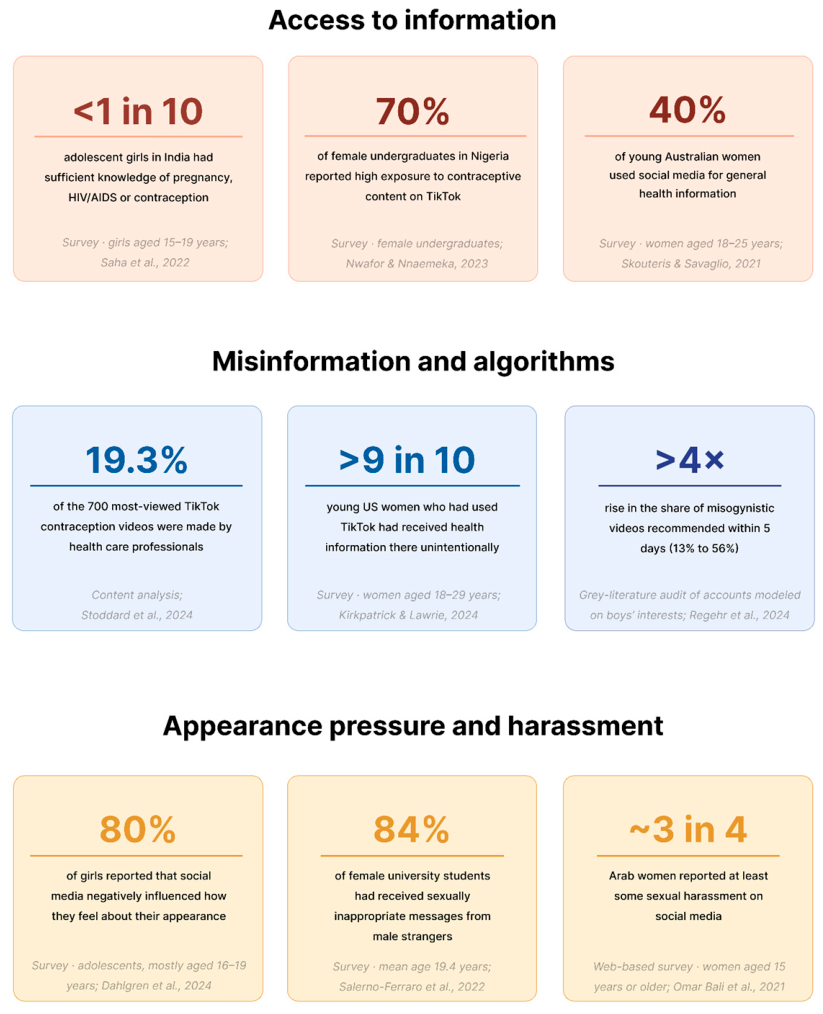
Technology-facilitated sexual violence is a category covering sexually aggressive or harassing behavior carried out through digital means, from online sexual harassment and image-based abuse to coercion. Such violence disproportionately affects young women, and it belongs in a discussion of sexual health because it shapes how they reveal information online and manage personal boundaries, with consequences for their well-being (Henry & Powell, 2018). Most of 381 female university students (aged 18–38 years, mean age 19.4 years) had experienced online sexual harassment by male strangers. For example, 84% had received sexually inappropriate messages, and explicit images of male genitalia were also among the forms reported. These experiences often began at the age of 12–14 years. The usual responses were disgust, anger or fear, and participants most often ignored, blocked or deleted the messages rather than confronting the senders (Salerno-Ferraro et al., 2022). In a web-based survey of 1312 Arab women aged 15 years and older (56.5% aged 15–25 years), only 37.3% had posted a personal photograph on social media. Among those who had not, the most common reason was fear that the image would be misused (67.2%). About three-quarters reported at least some sexual harassment on social media, irrespective of age, and some were considering leaving social media altogether (Omar Bali et al., 2021). Moreover, in a study of women aged 18–52 years (mean age 28.7 years), cyber-sexual harassment was associated with more symptoms of anxiety, depression and trauma and with greater body image dissatisfaction. It was more common among younger women and those with more followers. However, when both forms of harassment were considered together, body image dissatisfaction was explained mainly by in-person harassment (Iroegbu et al., 2024). The key quantitative findings illustrating both the protective potential and the risks of social media described in Section 3 and Section 4 are summarized in Figure 1.
Figure 1.
Illustrative findings from selected studies relevant to social media and sexual and reproductive health. Access to information (left to right): Saha et al. (2022); Nwafor and Nnaemeka (2023); Skouteris and Savaglio (2021). Misinformation and algorithms: Stoddard et al. (2024); Kirkpatrick and Lawrie (2024); Regehr et al. (2024). Appearance pressure and harassment: Dahlgren et al. (2024); Salerno-Ferraro et al. (2022); Omar Bali et al. (2021). Abbreviations: HIV, human immunodeficiency virus; AIDS, acquired immunodeficiency syndrome; US, United States.
5. Proposed Mechanisms Underlying the Ambivalent Effects of Social Media Use on Young Women’s Sexual Health-Related Behaviors
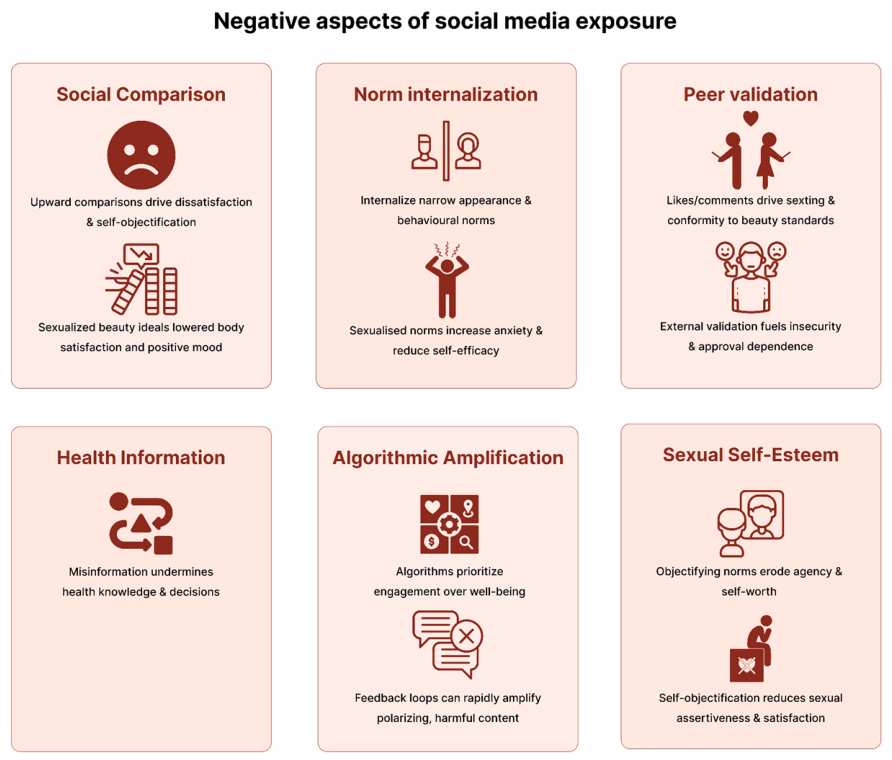
The relationship between social media use and sexual health-related behaviors among young women cannot be reduced to a simple division into harms and benefits. Rather, the existing literature points to a range of interrelated mechanisms of a psychosocial, relational and platform-specific nature, through which social media may produce divergent effects that can be both preventive and harmful. This is what is meant by the term ambivalent. Understanding these mechanisms is essential to comprehend the conditions under which exposure to social media content influences young women’s knowledge, attitudes and decision-making processes regarding sexual health. This section summarizes the evidence regarding six mechanisms, namely social comparison, internalization of norms, peer validation and approval pressure, the interplay between health information and disinformation on social media, algorithmic content reach amplification and effects on sexual self-esteem and agency. Figure 2 and Figure 3 summarize the protective and the harmful pathways, respectively. Because most of the underlying evidence is cross-sectional, these mechanisms are presented as hypotheses rather than as established causal pathways.
These six mechanisms operate at different levels. Platform architecture, in particular algorithmic amplification and quantified feedback such as likes and comments, determines which content users encounter and how visible peer approval is. In turn, content carries health information or misinformation and conveys appearance and sexual norms. Psychosocial processes, such as social comparison, the internalization of norms and the pursuit of peer approval, translate this content into proximal outcomes. These include body image, sexual self-esteem, sexual agency, knowledge and attitudes, which may shape sexual health-related behaviors. Sexual self-esteem and agency are therefore best understood as proximal outcomes rather than mechanisms in the strict sense. Whether a given pathway is protective or harmful appears to depend on moderating conditions such as the quality and diversity of content, patterns of use (active or passive, moderate or problematic), critical health literacy, individual vulnerability and the wider cultural and health care context (Valkenburg & Peter, 2013). Direct evidence on sexual health outcomes among young women is mainly available for the information pathway and for sexual self-esteem and agency. This evidence is largely cross-sectional or qualitative, and links between the remaining mechanisms and sexual health behaviors are mainly inferred from studies of body image and mental health.
5.1. Social Comparison
Social comparison theory, according to which individuals evaluate themselves by comparing themselves to others, serves as a foundational framework for understanding how social media platforms shape young women’s body image, self-esteem, and, by extension, sexual health behaviors. The literature distinguishes between upward comparisons (perceiving others as better), lateral comparisons (perceiving similarity), and downward comparisons (perceiving others as worse), which can carry different psychological consequences depending on the direction of the comparison (Bonfanti et al., 2025; Verduyn et al., 2020). Evidence from a systematic review and meta-analysis indicates that more frequent online social comparison is associated with greater body image concerns and eating disorder symptoms, with the association stronger in samples with a higher proportion of women (Bonfanti et al., 2025). Evidence from systematic reviews and meta-analyses indicates that social media use (particularly on photo-oriented platforms such as Instagram) is associated with more frequent engagement in upward social comparisons, which is in turn associated with greater body dissatisfaction, lower appearance-related self-esteem, and a deterioration in mental health among users (Bonfanti et al., 2025). This pattern is consistent with the theoretical framework proposed by Perloff (2014), according to which social media environments heighten appearance comparison and self-objectification in young women. This view is supported by empirical studies of young women, which have shown correlations between more frequent use of platforms such as Instagram and Facebook and greater body dissatisfaction. This association appears to be explained in part by appearance comparisons and the internalization of unrealistic beauty standards promoted online (Fardouly et al., 2015, 2018). However, the case is considerably more complex than a straightforward negative impact of social media use. In an experiment with 231 female university students (mean age 23.2 years), Rüther et al. (2023) found that exposure to static images of female influencers on Instagram triggered contrastive upward comparisons regarding appearance, linked to lower appearance-related self-esteem. However, it also produced a small positive direct effect on overall state self-esteem, possibly through upward assimilation or emotional contagion, providing evidence that a single exposure can elicit ambivalent reactions across different self-esteem dimensions. In line with this, Carraturo et al. (2023) note that the consensus in the field has shifted away from categorical harm narratives, acknowledging that social media use may promote positive emotional outcomes under particular conditions. The type and direction of comparison, rather than exposure itself, may therefore be a key determinant of outcome. The nature of the social media activity itself also matters (Carraturo et al., 2023). In a cross-sectional study of 259 Australian women aged 18–29 years, Cohen et al. (2017) found that appearance-focused Instagram activities, such as following health and fitness and celebrity accounts, were associated with thin-ideal internalization and body surveillance, whereas the total time spent on Facebook and Instagram was unrelated to these outcomes. The distinction between passive consumption of appearance-related content and more neutral or active uses of social media has important implications. It appears that passive scrolling through idealized images is a particularly strong driver of unfavorable comparisons, whereas active or socially engaging forms of media use may largely be unrelated to these negative effects (Verduyn et al., 2020). Experimental evidence offers additional nuance regarding the role of content type in modulating comparison outcomes. Di Michele et al. (2023), in two experiments among young Italian women on Instagram and TikTok, found that exposure to body-positive content led to higher body satisfaction relative to pre-exposure measures, while positive mood was maintained and negative mood declined. Body-positive content was beneficial whether it was sexualized or non-sexualized, whereas exposure to sexualized beauty ideals lowered both body satisfaction and positive mood. Participants exposed to beauty ideal content engaged in upward appearance comparison, associated with lower body satisfaction, while body-positive content elicited downward comparison, which mediated improvements in body satisfaction and mood. Importantly, problematic social media use moderated these effects: participants reporting more problematic use showed greater benefits from body-positive content. Therefore, social comparison on social media does not appear to operate as a uniform risk factor; rather, its effects appear to be content-sensitive and dependent on patterns of use. The same platform features that may amplify appearance-related harm during passive use may support protective outcomes when the content encountered is intentionally diversified. Research has documented a correlation between self-comparison in online spaces and the objectification of one’s own body. In an experiment with 256 women aged 18–29 years, viewing sexualized photographs of peers triggered a significant response characterized by self-objectification and dehumanizing the subjects in the images. The response was further characterized by participants’ own hashtags focusing on appearance and body parts, and generating such appearance-focused hashtags was itself associated with heightened state self-objectification (Vendemia & Fox, 2024). The platforms themselves serve to reinforce this trend. An analysis of Instagram profiles revealed that around a third of posts by women aged 18–24 exhibited self-objectifying characteristics. The frequency with which such photos were posted was positively associated with the number of likes received on previous posts, suggesting that positive online reactions may serve as a reward and reinforcement mechanism for creating a sexualized image (Bell et al., 2018). Specifically concerning sexual health, social media may foster social comparison, which may increase appearance-based concerns and body dissatisfaction (Santoniccolo et al., 2023). Comparison-induced self-objectification may also extend to sexual well-being, a pathway examined so far only in a mixed-sex sample (Section 5.6; Medina et al., 2026). This mechanism may operate through appearance monitoring, whereby internalized concerns about appearance are activated during intimate relations, disrupting sexual presence and pleasure.
5.2. Internalization of Norms
Beyond comparison, social media is a powerful tool for transmitting and reinforcing gender norms and patterns of sexual behavior. The objectification theory posits that an environment saturated with sexualized representations of the female body leads to the internalization of these images as standards for self-evaluation (Fredrickson & Roberts, 1997), a pathway that has been extended to social media contexts (Medina et al., 2026). Santoniccolo et al. (2023) situate this process within the broader context of the history of gender stereotypes created by the media, noting that portrayals of women in both traditional and digital media consistently emphasize appearance and sexuality while overlooking their agency and competence (Santoniccolo et al., 2023). These authors claim that prolonged exposure to such representations leads to the internalization of patterns that shape not only perceptions of one’s own body but also sexual attitudes and health behaviors. On social media, this internalization process may be amplified by the interactive nature of platforms such as Instagram and TikTok, where idealized, sexualized images of the female body are not just passively consumed, but actively shared, promoted, and rewarded (Bell et al., 2018; Santoniccolo et al., 2023). The dynamics of feedback on image-based platforms can therefore serve as a mechanism for reinforcing norms. Content that is consistent with dominant patterns of sexual appearance and behavior receives greater social recognition, which indirectly reinforces these patterns as desirable and normative. The theory of social norms offers a complementary perspective by distinguishing between injunctive norms (what one should do) and descriptive norms (what we perceive others as doing). It also emphasizes that norms exert their strongest influence when they are internalized, meaning that they are perceived as consistent with one’s own identity rather than as externally imposed (Gross & Vostroknutov, 2022; Wenzel & Woodyatt, 2025). An automated collection of over 5000 public Instagram images posted by women in Mexico was analyzed with the Google Vision application programming interface. Over 90% of the examined images contained some degree of nudity or provocative poses (Piña-García et al., 2025). This suggests that hypersexualized self-presentation may be common on visually oriented platforms, reinforced by features that reward interaction. The internalization of social norms may have important consequences for sexual health. In women, the internalization of traditional gender roles and viewing oneself as an object are associated with symptoms of anxiety and depression, reduced self-efficacy, and body shame (Santoniccolo et al., 2023). Importantly, the direction and magnitude of these effects maydepend largely depend on the diversity of appearance standards presented in an individual’s social media environment. Exposure to diverse body ideals appears to mitigate body dissatisfaction, regardless of the degree of content sexualization (Santoniccolo et al., 2023). The experimental findings described in Section 5.1 (Di Michele et al., 2023) suggest that content-level interventions may disrupt this internalization pathway.
Figure 2.
Positive aspects of social media exposure. Abbreviation: STI, sexually transmitted infection.
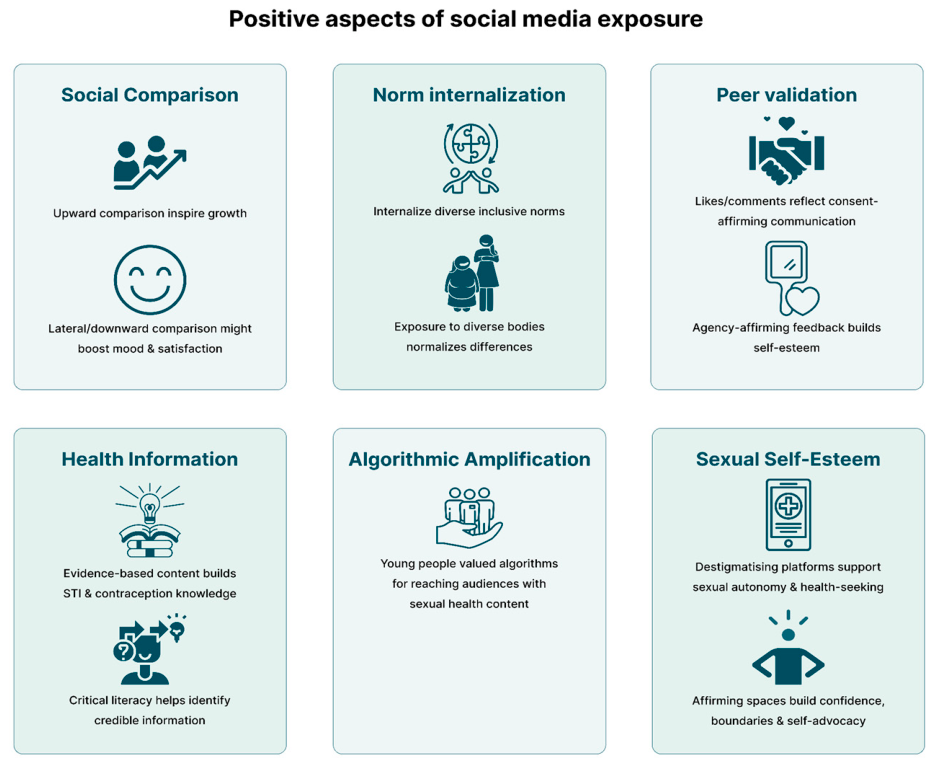
Figure 3.
Negative aspects of social media exposure.
5.3. Peer Validation and Approval Pressure
A third mechanism concerns the role of social approval in shaping women’s sexual health-related behavior. On social media, approval is measurable and publicly visible through likes, shares, and comments. This creates a situation in which behaviors may be motivated more by the desire for recognition from others than by personal values. In the context of sexual health, behaviors related to seeking acceptance on social media appear to be linked to sexting practices and body image concerns among girls and young women. In a cross-sectional study of 569 Italian adolescent girls aged 14–19 years (mean age 16.9 years), Verrastro et al. (2023) found that frequent sexters reported lower global self-esteem and greater social media influence on the internalization of body and beauty ideals. Verrastro et al. (2023) suggest that this is linked to a need for external acceptance, which may be shaped by exposure to beauty standards on social media, and could constitute a possible motivation behind sexting in this group. Sexy self-presentation may be one link between approval seeking and sexting, although this link may depend on age. In a two-wave panel study, sexy self-presentation on social network sites did not predict willingness to engage in sexting among young adult women aged 18–25 years, whereas it did among adolescent girls aged 13–17 years (mean age 14.9 years), a group below the age range of this review that is cited only for comparison (Van Oosten & Vandenbosch, 2017). Perceived appearance-related feedback from social media may also shape how young women feel about their bodies. In a cross-sectional survey of 1558 Norwegian adolescents, mostly aged 16–19 years, Dahlgren et al. (2024) found that 80% of girls reported that social media negatively influenced how they feel about their appearance, while 61.7% also reported a positive influence. Negative influence was reported most often for image-centric platforms such as Instagram and TikTok, whose focus on photo- and video-based content, often edited and filtered, may encourage users to compare their appearance with others (Dahlgren et al., 2024). The quality of social media use, specifically the extent to which engagement focuses on appearance, may determine whether a platform functions as a source of social connection or as a factor that induces appearance-related concerns (Cohen et al., 2017; Zsila & Reyes, 2023). Overall, the evidence suggests that approval pressure on social media is not uniform in its consequences. Its effects on young women’s sexual health-related behavior appear to depend on the content rewarded by peer feedback and possibly on age, although evidence on age differences comes from a single study.
5.4. Health Information and Disinformation
Social media platforms serve simultaneously as vectors for evidence-based sexual health education and as environments in which health misinformation spreads. A growing number of studies points to the potential of social media to expand access to sexual and reproductive health information among social groups with limited access to such information. Saha et al. (2022) found a significant positive association between social media exposure and sexual and reproductive healthknowledge among adolescent girls aged 15–19 years in India, which persisted after adjusting for sociodemographic factors, although the association appeared to be concentrated among girls who were more educated, lived in urban areas and came from wealthier households. These findings are consistent with the views of young people themselves. In a literature review of the perceived benefits and barriers associated with sexual health promotion on social media, Engel (2026) found that young people consistently cited the availability of information, anonymity, reduced stigma, and a fun and accessible content format on social media as factors that may promote sexual health behaviors. In particular, humor was perceived as an effective strategy for destigmatizing sensitive topics. At the same time, maintaining the right balance between education and entertainment was identified as an ongoing challenge (Engel, 2026). The picture is considerably less straightforward, however, when the source is TikTok. Kirkpatrick and Lawrie (2024), in a large-scale survey of young women in the US, found that the great majority had encountered health content on the platform, with nearly two-thirds doing so intentionally and over nine in ten unintentionally. Perceptions of credibility were moderate overall and were higher among women with greater TikTok intensity, that is, a stronger emotional connection to the platform and its integration into daily routines (Kirkpatrick & Lawrie, 2024). This may point to a paradox: the same affective investment in a platform that makes health content feel credible and personally relevant may simultaneously lower the critical threshold at which misinformation about contraception, STI risk, or sexual norms is accepted. This is a mechanism with potential implications for sexual health decision-making among young women who rely on social media as a primary health information source. In the domain of contraception, this paradox may have particularly serious consequences. In a commentary, Pfender and Fowler (2024) noted a growing trend among social media influencers to spread unverified or factually incorrect claims about hormonal contraception, which may lead some users to abandon effective contraceptive methods. This dynamic aligns with broader evidence indicating that false content can spread online faster and farther than accurate content, although this has not been established specifically for sexual health content, and that automated detection of such content remains insufficient (Aïmeur et al., 2023). The case of misinformation regarding contraception illustrates how the structural features of social media, such as algorithmic amplification, influencer credibility cues and parasocial engagement, may amplify the effects of health misinformation in ways that could translate into risky decisions regarding sexual health.
5.5. Algorithmic Amplification
Underlying each of the mechanisms discussed above is the way platform algorithms select and deliver content to a user. Recommendation algorithms, designed to maximize user engagement, tend to promote content that generates high levels of interaction. This, in the context of appearance- and sexuality-related content, often means images and narratives that reinforce idealized and sexualized standards of femininity. Dahlgren et al. (2024) suggest that when users begin engaging with appearance- or weight-focused content on Instagram or TikTok, algorithmic feedback loops saturate their feeds with similar material, making it increasingly difficult to break away from environments of appearance-normative content. This process may have implications for sexual health, as content found through algorithmic exposure may shape perceived descriptive norms regarding sexual appearance, behaviors, and risks (Dahlgren et al., 2024). Evidence on the speed of comparable processes comes from a gray literature audit of TikTok recommendations, in which four accounts were set up to model the interests of boys and young men. Within five days, the proportion of misogynistic videos on the “For You” page increased more than fourfold, from 13% to 56% (Regehr et al., 2024). Although young women’s feeds were not examined, this finding illustrates how users who do not actively seek out such content may be increasingly exposed to it through recommendation, which may shape peer norms regarding women’s bodies, sexuality and consent. Whether the same recommendation systems can be redirected toward protective content has not been tested directly. Content-level interventions offer indirect support. In a randomized controlled trial among 2000 Indonesian girls and young women aged 15–19 years, a fictional six-episode video series shared on social media, combined with online activities, reduced the internalization of appearance ideals, and, also at one-month follow-up, improved body satisfaction relative to a waitlist control, although the effects were small (Garbett et al., 2023). This trial tested the content itself rather than algorithmic delivery. Young people similarly identified the double-edged character of the format: social media was seen as highly accessible and engaging for seeking health information, and algorithms were valued for reaching young audiences, while concerns about inaccuracy and information overload were reported as key barriers (Engel, 2026). In a survey of 585 Chinese women (mean age 23.1 years), Tingrong and Gen (2025) found that short-video social media exposure was positively associated with appearance anxiety. This association was statistically mediated by the perceived capitalization of sexual attractiveness as social currency and by upward appearance comparison, both processes that may be facilitated by recommendation algorithms prioritizing high-engagement, appearance-centered content (Tingrong & Gen, 2025).
5.6. Sexual Self-Esteem and Agency
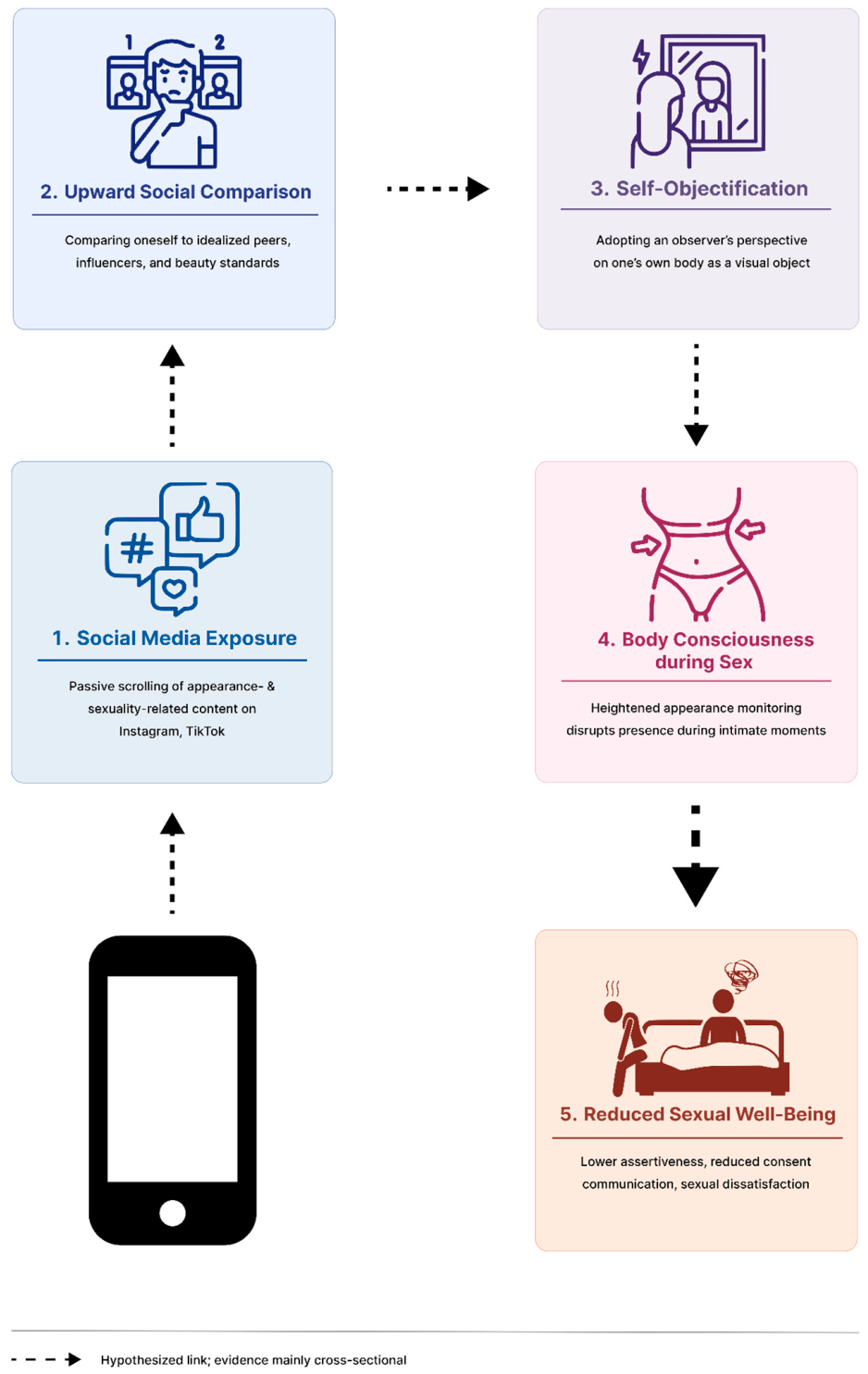
Finally, the cumulative effects of social comparison, norm internalization, approval pressure, information exposure, and algorithmic curation converge on a set of outcomes with direct relevance to sexual health decision-making: sexual self-esteem, body agency, and the capacity to assert and communicate one’s boundaries and needs. Self-objectification, defined as the habitual adoption of an observer’s perspective on one’s own body, has been proposed as a key mediating pathway between social media exposure and sexual well-being. In a cross-sectional study of emerging adult women and men from four English-speaking countries (a mixed-sex sample, retained because no eligible study addressed this pathway, Section 2), Medina et al. (2026) found that appearance-related social media consciousness was associated with greater body consciousness during sexual activity and, in turn, with lower sexual assertiveness. This suggests that self-objectification processes activated in the social media context may persist into intimate settings and interfere with sexual presence and assertiveness (Medina et al., 2026). Figure 4 presents a suggested model of this pathway. In a web-based cross-sectional survey of 1258 Polish women (mean age 25.7 years), Gryc et al. (2023) reported that the amount of time spent on social media was significantly and negatively associated with both body satisfaction and sexual life satisfaction, an association that may operate through comparison with influencers, heightened body preoccupation during intimacy and fear of rejection. Comparing oneself with social media representations was also a significant predictor of body image disturbance and sexual dissatisfaction. These findings suggest that the potential effects of social media on sexual health are not limited to behavioral outcomes such as contraceptive use or STI testing but may extend to the relational and experiential dimensions of sexual well-being, including a woman’s sense of entitlement to pleasure, her capacity to communicate her needs, and her subjective experience of intimacy (Gryc et al., 2023).
Figure 4.
A suggested model for how social media use affects young women’s sexual well-being, based on social comparison and self-objectification.
The impact of social media on body image is also evident in perceptions of the genitals. The widespread sharing of content on social media platforms, including pornography and materials promoting plastic surgery procedures, may have contributed to an unrealistic, uniform ideal, namely, a vulva without visible protruding tissue (Michala, 2020). According to this clinical review, genital dissatisfaction of this kind may lead to significant embarrassment and anxiety, and sexual education is needed to counterbalance the perceived normal anatomy portrayed in pornography and female genital cosmetic surgery advertisements (Michala, 2020). Social media may also shape sexual agency more directly. In a qualitative study of young Black women aged 15–24 years, Dorsey et al. (2026) found that social media simultaneously functioned as a site where harmful sexual scripts and hypersexualizing stereotypes were encountered, and as a space where some young women negotiated sexual health knowledge and decision-making in the context of these scripts. This duality suggests that social media’s effects on sexual agency are not predetermined by platform architecture alone but may also be shaped by users’ active interpretive practices and the community norms of specific online spaces. On the other hand, social media environments may in some contexts actively support sexual agency. Platforms offering destigmatizing representations of diverse sexualities, informational content about consent and bodily autonomy, or peer communities that validate sexual health-seeking behavior may function as protective resources, particularly for young women with limited access to formal sexual health education (Engel, 2026; Gabarron & Wynn, 2016; Saha et al., 2022). The randomized body-image intervention by Garbett et al. (2023) shows that positive content delivered through social media can improve body image. Whether this also benefits sexual well-being has not been tested. Whether social media functions as a resource for sexual agency or as an environment that erodes it appears to depend substantially on the type of content encountered, the degree of critical engagement brought to it, the health literacy of the user, and the structural features of the platform that determine which content is made visible. These mechanisms reviewed together help explain why the relationship between social media and sexual health-related behaviors is ambivalent. Each discussed mechanism may operate in two directions, and the same social media environment may simultaneously facilitate access to health-promoting resources and strengthen appearance norms that undermine sexual well-being. The net result for any given individual is likely shaped by the interaction of platform-level factors (content curation, algorithmic design), individual-level vulnerabilities (self-esteem, health literacy, prior experiences), and broader contextual variables (cultural norms, access to alternative health information sources). This complexity calls for further research that moves beyond mean-level associations toward a more precise specification of the conditions under which social media exerts protective versus harmful effects on young women’s sexual health-related behaviors.
6. Discussion
The opposing effects resulting from a single mechanism raise the question of what determines their direction. Several conditions recur in the reviewed literature. The first is the nature of the content itself. In experimental studies, exposure to sexualized beauty ideals triggered upward comparisons and reduced body satisfaction, whereas body-positive content triggered downward comparisons, increased body satisfaction and reduced negative mood (Di Michele et al., 2023). According to a review, a more diverse range of appearance ideals may mitigate body dissatisfaction (Santoniccolo et al., 2023). The second condition is the way platforms are used. Appearance-focused activities, rather than the total time spent on Facebook and Instagram, were associated with thin-ideal internalization and body surveillance (Cohen et al., 2017), and problematic, addiction-like use, rather than the time spent on social media, was associated with poorer sexual functioning (Pawlikowska et al., 2022). A review also suggests that passive scrolling through idealized images is more strongly linked to unfavorable comparisons than active, socially engaging use (Verduyn et al., 2020). Notably, the pattern of use did not operate in one direction only. Women with more problematic social media use benefited more from body-positive content (Di Michele et al., 2023), which suggests that the users most exposed to harm may also be the most responsive to protective content. The third condition is users’ ability to evaluate what they see critically. The same emotional engagement that makes platform content seem credible and relevant may also reduce vigilance against misinformation (Kirkpatrick & Lawrie, 2024), whereas women who checked information shared on social media against peer-reviewed and medical sources were able to use the same platforms for evidence-based self-management (Gomula et al., 2024). Individual characteristics, such as self-esteem and developmental stage, add a further layer of variability. Adolescent girls who sexted frequently reported lower self-esteem and greater social media influence on their body ideals (Verrastro et al., 2023), and in a panel study, sexy self-presentation predicted willingness to engage in sexting among adolescent girls younger than the population of this review, but not among young adult women (Van Oosten & Vandenbosch, 2017). Finally, platform architecture and the wider context matter. Recommendation systems may escalate harmful content within days, as an audit of accounts modeled on the interests of boys and young men showed (Regehr et al., 2024). Whether they can be redirected toward protective content remains untested, although content-level interventions show promise (Garbett et al., 2023). The differential susceptibility to media effects model (Valkenburg & Peter, 2013) may help explain these patterns. According to this model, media effects are conditional and transactional and depend on dispositional, developmental and social susceptibility, so that the same content can affect different users, and the same user in different contexts, in different ways. A recurring and practically important pattern is that exposure to sexual health content on social media is more consistently associated with knowledge and attitudes than with recorded behavior. In the strongest design available, a cluster randomized trial of Facebook advertising for long-acting reversible contraception, an apparent increase in clinic-recorded insertions disappeared once an outlier clinic was excluded (Byker et al., 2019). A messaging trial among young women in Bolivia found no statistically significant effect on either the acceptability or the use of effective contraception, although it was underpowered (McCarthy et al., 2020), and a scoping review of social media interventions in broader populations found limited and mixed evidence of effects (Gabarron & Wynn, 2016). Access to information therefore appears necessary but not sufficient to change behavior. Whether combining reliable information with direct links to services, privacy assurances and tailored messages closes this gap is a hypothesis that requires controlled evaluation among young women rather than an established finding. This conclusion cautions against the overly optimistic assumption that the broader dissemination of information will by itself improve sexual health behaviors. The protective effects described were most noticeable where offline clinical care had failed to provide women with clear and trustworthy guidance. In the included publications, this applied particularly to women with stigmatized or poorly managed conditions, women who experienced dismissive attitudes from medical staff, and girls and women with limited access to formal sex education. For example, women with PCOSor heavy menstrual bleeding turned to online communities to validate their symptoms, determine what was normal and respond to medical dismissal (Gomula et al., 2024; Young & Kirk, 2025). Although social media can provide basic sexual and reproductive health knowledge to girls with limited access to education, a large survey suggests that these benefits are currently concentrated among more educated, urban and wealthier groups (Saha et al., 2022). Social media therefore appear to fill some of the gaps left by health and education systems, but they may also widen existing inequalities if the most disadvantaged groups cannot use them effectively. This highlights which groups would benefit most from well-designed digital resources. The risks identified in this review cannot be reduced to individual vulnerability. Popular contraception content is often incomplete or misleading, and most of it is created by non-professionals (de Moel-Mandel et al., 2025; Stoddard et al., 2024) Online sexual harassment by male strangers was reported by most young women in one survey, often beginning in early adolescence (Salerno-Ferraro et al., 2022), and about three-quarters of women in another survey reported at least some sexual harassment on social media (Omar Bali et al., 2021). Cyber-sexual harassment was associated with anxiety, depression, trauma and body image dissatisfaction (Iroegbu et al., 2024), and some women deleted their accounts or considered leaving social media altogether (Omar Bali et al., 2021; Salerno-Ferraro et al., 2022). These findings suggest that such experiences are embedded in the social media environment rather than brought on by individual users. Therefore, protection cannot rest on individual users alone and also requires platform-level safeguards. The impact of social media on health may depend on the quality of the content and the recipient’s ability to evaluate information critically (Kirkpatrick & Lawrie, 2024). Developing the ability to assess the credibility of sources and to recognize misinformation is therefore crucial and may protect more effectively than attempts to limit exposure to negative content. These skills should be cultivated from early adolescence, before media use habits become entrenched. Recommendation systems may amplify harmful content (Regehr et al., 2024). Whether they can be harnessed for protective purposes remains to be tested, although well-designed content can improve body image (Garbett et al., 2023). Public health bodies and qualified professionals have both the opportunity and the responsibility to create engaging, evidence-based content and to recommend credible experts, rather than ceding this space to non-professional creators who attract large audiences (Stoddard et al., 2024). Given the gap between exposure and action, initiatives should combine reliable information with direct, easily accessible links to services, and their effects on behavior should be evaluated in controlled designs. From a clinical perspective, these results suggest that the online environment should be acknowledged rather than disregarded. Young women already use it to learn about sexual health and to make related decisions, which argues for treating it as a legitimate arena for health counseling and health promotion. The review also reveals several research priorities. First, the evidence base relies primarily on cross-sectional studies, which limits conclusions about causality. Longitudinal and experimental studies are needed to establish the temporal sequence between social media exposure, the proposed mechanisms and behavior. Second, randomized evaluations with objectively recorded behavioral outcomes, such as clinic-recorded contraceptive uptake or STI testing, remain rare and are needed to test whether service-linked interventions change behavior. Third, studies should report the age and sex composition of their samples and present results separately for girls and young women, which would allow future syntheses to rely on direct rather than inferred evidence. Fourth, because effects appear to depend on specific platforms and cultural contexts, more platform-specific and cross-cultural research is needed, together with greater consistency in how sexual health behaviors and sexual decision-making are defined and measured. Finally, research should move from average associations toward testing the specific conditions under which social media exert protective or harmful effects.
7. Limitations
This review has several limitations. First, as it is a narrative synthesis, it is interpretive in nature. No meta-analysis or formal risk-of-bias assessment was performed. Despite efforts to ensure systematic and transparent procedures, selectivity in identifying and evaluating evidence cannot be ruled out. In particular, the search was limited to PubMed/MEDLINE and Google Scholar. Second, the included studies differed in how they defined and measured key concepts of sexual health, sexual health-related behaviors and sexual decision-making. This makes it difficult to directly compare the results. The level of outcome measured also differed between studies, ranging from exposure and engagement to self-reported and objectively recorded behavior. Few studies measured objectively recorded behavior. Therefore, evidence that social media-based interventions change sexual-health behavior, rather than knowledge or attitudes, remains limited. Third, the evidence base is dominated by cross-sectional studies, which limits causal inferences. Thus, many associations should be interpreted as correlational. The same applies to the mechanisms discussed in Section 5, which should be regarded as hypotheses to be tested in longitudinal and experimental studies rather than as established causal pathways. Fourth, direct evidence on girls and young women aged 15–29 years was limited. Eligibility was based on the mean or median age of each sample, so some included samples also contained girls younger than 15 years or women older than 29 years, and results reported for age groups outside this range were cited only for comparison. Mixed-sex studies were included only when they reported results for female participants separately, and the only study outside these criteria, a mixed-sex study (Medina et al., 2026), was retained as a predefined exception and is labeled as indirect evidence. Content analyses and one gray literature report (Regehr et al., 2024), which was not peer-reviewed and was based on accounts modeled on the interests of boys and young men, provided contextual evidence only. Additionally, much of the evidence concerning the mechanisms relates to body image and self-objectification rather than sexual health behaviors. Links to behavior were therefore inferred rather than directly observed, and generalizations about young women had to be made with caution. Fifth, the body of research was geographically diverse, including studies from India, Nigeria, South Africa, China, Korea, Indonesia, Bolivia and other countries. However, most countries were represented by only one or two studies, and appearance-related mechanisms were examined mainly in high-income countries, such as Australia, the United States and several European countries, whereas the role of social media as a source of sexual health information was also studied in lower-resource settings, such as India, Nigeria and South Africa. Protective and harmful pathways were therefore rarely examined in the same populations. Cultural and relational contexts are likely to shape the effects under study, and this diversity both enriches the synthesis and limits the generalisability of its conclusions. Sixth, limiting the search to English-language publications (with one exception) may have resulted in the omission of relevant evidence, particularly from non-English-speaking countries. Seventh, social media platforms, their features and their algorithms are constantly changing. Therefore, research findings related to specific platforms or features may quickly become outdated. Because recommendation algorithms are proprietary, their role could also be inferred only indirectly.
8. Conclusions
The findings of this review suggest that social media should not be viewed as either a risk to be disregarded or a health promotion tool to be disseminated. A more accurate view is to treat it as a shifting, dual-purpose space that can shape young women’s sexual health in protective or harmful ways, depending on how it is used. The same platforms and, more precisely, the same psychosocial and algorithmic mechanisms may expand access to information, reduce stigma and foster peer support and self-advocacy. At the same time, they can spread misinformation, reinforce appearance-based norms, and expose female users to harassment. Which factor predominates appears to depend on a set of conditions repeatedly identified in the literature, including the nature and quality of the content encountered, how the platforms are used, the user’s ability to critically interpret content, her vulnerability, the platform’s structure, and the surrounding cultural and clinical context. The platform itself does not point in any specific direction. Rather, that direction is shaped by the quality of the content and what each user brings to the interaction. In the available studies, how social media were used, in particular appearance-focused and problematic, addiction-like use, mattered more than the time spent on them, although this evidence is largely cross-sectional.
Labeling social media as good or bad for young women’s sexual health obscures the more useful question in this field: in what circumstances does it have a positive impact, and how can these circumstances be created and maintained? Examples include high-quality, expert-based content, the development of digital skills related to sexual health, and interventions that link reliable information with immediate access to care, although their effects on behavior still require controlled evaluation. In this context, social media is neither a problem nor a solution. It is an environment whose impact on the sexual health of young women can be channeled toward a protective effect through thoughtful design, appropriate guidance and support.
Author Contributions
Conceptualization, A.M.M.; methodology, A.M.M.; formal analysis, A.M.M.; investigation, A.M.M.; resources, A.M.M., J.B., A.D.U. and J.K.; data curation, A.M.M., J.B., A.D.U. and J.K.; writing—original draft preparation, A.M.M., J.B. and A.D.U.; writing—review and editing, A.M.M., J.B., A.D.U. and J.K.; visualization, N.N.; supervision, J.K.; project administration, A.M.M.; funding acquisition, A.M.M. All authors have read and agreed to the published version of the manuscript.
Funding
This research received funding from the Medical University of Białystok with the project number: B.SUB.26.162.
Institutional Review Board Statement
Not applicable.
Informed Consent Statement
Not applicable.
Data Availability Statement
No new data were created or analyzed in this study. Data sharing is not applicable to this article.
Acknowledgments
During the preparation of this manuscript, the authors used Anthropic Claude Sonnet 5 (medium) for editorial support, including language refinement, structural review, and condensation of text. All illustrations were produced using Figma (version 126.10.13). The authors have reviewed and edited the output and take full responsibility for the content of this publication.
Conflicts of Interest
The authors declare no conflicts of interest. The funding sponsors had no role in the design of the study, in the collection, analyses, or interpretation of data, in the writing of the manuscript or in the decision to publish the results.
References
- Aïmeur, E., Amri, S., & Brassard, G. (2023). Fake news, disinformation and misinformation in social media: A review. Social Network Analysis and Mining, 13(1), 30. [Google Scholar] [CrossRef] [Scilit]
- Bell, B. T., Cassarly, J. A., & Dunbar, L. (2018). Selfie-objectification: Self-objectification and positive feedback (“likes”) are associated with frequency of posting sexually objectifying self-images on social media. Body Image, 26, 83–89. [Google Scholar] [CrossRef] [Scilit]
- Bleakley, A., Hennessy, M., Fishbein, M., & Jordan, A. (2009). How sources of sexual information relate to adolescents’ beliefs about sex. American Journal of Health Behavior, 33(1), 37–48. [Google Scholar] [CrossRef] [Scilit]
- Bondok, M., Stothers, L., Macnab, A., Bondok, M., Ackerman, A. L., Dixon, E., Trochez, M., Petersen, K., & Selvakumar, R. (2024). Health care workers online Youtube content compared to AUA prevention of recurrent urinary tract infections in women guidelines: An integrative review of quality and comprehensiveness analysis. Urology Practice, 11(3), 498–505. [Google Scholar] [CrossRef] [Scilit]
- Bonfanti, R. C., Melchiori, F., Teti, A., Albano, G., Raffard, S., Rodgers, R., & Lo Coco, G. (2025). The association between social comparison in social media, body image concerns and eating disorder symptoms: A systematic review and metaanalysis. Body Image, 52, 101841. [Google Scholar] [CrossRef] [Scilit]
- Brown, J. D., Halpern, C. T., & L’Engle, K. L. (2005). Mass media as a sexual super peer for early maturing girls. Journal of Adolescent Health, 36(5), 420–427. [Google Scholar] [CrossRef] [Scilit]
- Byker, T., Myers, C., & Graff, M. (2019). Can a social media campaign increase the use of long-acting reversible contraception? Evidence from a cluster randomized control trial using Facebook. Contraception, 100(2), 116–122. [Google Scholar] [CrossRef] [Scilit]
- Carraturo, F., Di Perna, T., Giannicola, V., Nacchia, M. A., Pepe, M., Muzii, B., Bottone, M., Sperandeo, R., Bochicchio, V., Maldonato, N. M., & Scandurra, C. (2023). Envy, social comparison, and depression on social networking sites: A systematic review. European Journal of Investigation in Health, Psychology and Education, 13(2), 364–376. [Google Scholar] [CrossRef] [Scilit]
- Cohen, R., Newton-John, T., & Slater, A. (2017). The relationship between Facebook and Instagram appearance-focused activities and body image concerns in young women. Body Image, 23, 183–187. [Google Scholar] [CrossRef] [Scilit]
- Cope, A., Rajendram, P., Rafael, S., Matsiko, J., Mougammadou Aribou, Z., Barker, K., Senter, K., & Riley, A. H. (2022). Qualitative findings from Girlsplained: A social media application of the Sabido methodology for sexual health and HIV prevention in the United Kingdom. Journal of Visual Communication in Medicine, 45(2), 67–75, (Correction in 2022, Journal of Visual Communication in Medicine, 45(2), i–ii. https://doi.org/10.1080/17453054.2022.2069714). [Google Scholar] [CrossRef] [Scilit]
- Dahlgren, C. L., Sundgot-Borgen, C., Kvalem, I. L., Wennersberg, A.-L., & Wisting, L. (2024). Further evidence of the association between social media use, eating disorder pathology and appearance ideals and pressure: A cross-sectional study in Norwegian adolescents. Journal of Eating Disorders, 12(1), 34. [Google Scholar] [CrossRef] [Scilit]
- de Moel-Mandel, C., Donnelly, A., & Bugden, M. (2025). “Do you know what birth control actually does to your body?”: Assessing contraceptive information on TikTok. Perspectives on Sexual and Reproductive Health, 57(3), 358–367. [Google Scholar] [CrossRef] [Scilit]
- Di Michele, D., Guizzo, F., Canale, N., Fasoli, F., Carotta, F., Pollini, A., & Cadinu, M. (2023). #SexyBodyPositive: When sexualization does not undermine young women’s body image. International Journal of Environmental Research and Public Health, 20(2), 991. [Google Scholar] [CrossRef] [Scilit]
- Dorsey, M. S., Adams, V., Howard, T., Rutledge, J. D., King, D., Craddock, J. B., & Jaffery, A. (2026). Exploring the role of social media content on sexual health behaviors and decision-making among young black females. Journal of Adolescent Research, 41, 517–546. [Google Scholar] [CrossRef] [Scilit]
- Döring, N., & Conde, M. (2021). Sexuelle gesundheitsinformationen in sozialen medien: Ein systematisches scoping review [Sexual health information on social media: A systematic scoping review]. Bundesgesundheitsblatt, Gesundheitsforschung, Gesundheitsschutz, 64(11), 1416–1429. [Google Scholar] [CrossRef] [Scilit]
- Engel, E. (2026). Young people’s perceived benefits and barriers of sexual health promotion on social media: A literature review. International Journal of Health Promotion and Education, 64(5), 392–411. [Google Scholar] [CrossRef] [Scilit]
- Fardouly, J., Diedrichs, P. C., Vartanian, L. R., & Halliwell, E. (2015). The mediating role of appearance comparisons in the relationship between media usage and self-objectification in young women. Psychology of Women Quarterly, 39(4), 447–457. [Google Scholar] [CrossRef] [Scilit]
- Fardouly, J., Willburger, B. K., & Vartanian, L. R. (2018). Instagram use and young women’s body image concerns and self-objectification: Testing mediational pathways. New Media & Society, 20(4), 1380–1395. [Google Scholar] [CrossRef] [Scilit]
- Fowler, L. R., Schoen, L., Smith, H. S., & Morain, S. R. (2022). Sex education on TikTok: A content analysis of themes. Health Promotion Practice, 23(5), 739–742. [Google Scholar] [CrossRef] [Scilit]
- Fredrickson, B. L., & Roberts, T.-A. (1997). Objectification theory: Toward understanding women’s lived experiences and mental health risks. Psychology of Women Quarterly, 21(2), 173–206. [Google Scholar] [CrossRef] [Scilit]
- Gabarron, E., & Wynn, R. (2016). Use of social media for sexual health promotion: A scoping review. Global Health Action, 9(1), 392–411. [Google Scholar] [CrossRef] [Scilit]
- Garbett, K. M., Haywood, S., Craddock, N., Nasution, K., White, P., Saraswati, L. A., Medise, B. E., White, P., Diedrichs, P. C., & Williamson, H. (2023). Evaluating the efficacy of a social media–based intervention (Warna-Warni Waktu) to improve body image among young Indonesian women: Parallel randomized controlled trial. Journal of Medical Internet Research, 25, e42499. [Google Scholar] [CrossRef] [Scilit]
- Gomula, J., Warner, M., & Blandford, A. (2024). Women’s use of online health and social media resources to make sense of their polycystic ovary syndrome (PCOS) diagnosis: A qualitative study. BMC Women’s Health, 24(1), 157. [Google Scholar] [CrossRef] [Scilit]
- Griner, S. B., Johnson, K. C., Neelamegam, M., Webb, N. J., Kinard, A., & Kline, N. (2023). Direct-to-consumer sexually transmitted infection screening methods: Preferred communication sources and channels among young adult women. Sexually Transmitted Diseases, 50(9), 619–624. [Google Scholar] [CrossRef] [Scilit]
- Gross, J., & Vostroknutov, A. (2022). Why do people follow social norms? Current Opinion in Psychology, 44, 1–6. [Google Scholar] [CrossRef] [Scilit]
- Gryc, A. K., Grudzień, M., Nowińska, A. M., Tuszyńska, W., Juchnowicz, D., Krukow, P., & Karakuła-Juchnowicz, H. (2023). Is Instagram destroying sex life? An analysis of the impact of social media use on the sexual life of young Polish women—Results of a web-based cross-sectional survey. Annals of Agricultural and Environmental Medicine, 30(4), 729–736. [Google Scholar] [CrossRef] [Scilit]
- Henry, N., & Powell, A. (2018). Technology-facilitated sexual violence: A literature review of empirical research. Trauma, Violence & Abuse, 19(2), 195–208. [Google Scholar] [CrossRef] [Scilit]
- Iroegbu, M., O’Brien, F., Muñoz, L. C., & Parsons, G. (2024). Investigating the psychological impact of cyber-sexual harassment. Journal of Interpersonal Violence, 39(15–16), 3424–3445. [Google Scholar] [CrossRef] [Scilit]
- Kaplan, A. M., & Haenlein, M. (2010). Users of the world, unite! The challenges and opportunities of social media. Business Horizons, 53(1), 59–68. [Google Scholar] [CrossRef] [Scilit]
- Kirkpatrick, C. E., & Lawrie, L. L. (2024). TikTok as a source of health information and misinformation for young women in the United States: Survey study. JMIR Infodemiology, 4, e54663. [Google Scholar] [CrossRef] [Scilit]
- Landry, M., Turner, M., Vyas, A., & Wood, S. (2017). Social media and sexual behavior among adolescents: Is there a link? JMIR Public Health and Surveillance, 3(2), e28. [Google Scholar] [CrossRef] [Scilit]
- Liu, Z., & Zou, W. (2024). Breaking taboos in women’s reproductive health: The communication strategies used by top OB/GYN influencers in Chinese social media. Health Communication, 39(4), 685–696. [Google Scholar] [CrossRef] [Scilit]
- Mataboge, P., Mthimkhulu, N., Kutywayo, A., Martin, C. E., Mazibuko, M., Kwatsha, K., Makalela, N., Briedenhann, E., Butler, V., Bothma, R., & Mullick, S. (2023). Preferences, educational messaging, and demand creation channels for multipurpose-prevention technologies (MPTs) among women in South Africa. BMC Public Health, 23(1), 2090. [Google Scholar] [CrossRef] [Scilit]
- McCarthy, O. L., Aliaga, C., Torrico Palacios, M. E., López Gallardo, J., Huaynoca, S., Leurent, B., Edwards, P., Palmer, M., Ahamed, I., & Free, C. (2020). An intervention delivered by mobile phone instant messaging to increase acceptability and use of effective contraception among young women in bolivia: Randomized controlled trial. Journal of Medical Internet Research, 22(6), e14073. [Google Scholar] [CrossRef] [Scilit]
- Medina, C. M., Maes, C., Maheux, A. J., Roberts, S. R., & Choukas-Bradley, S. (2026). From the screen to the bed: Appearance-related social media consciousness and sexual well-being among emerging adult women and men. Body Image, 56, 102018. [Google Scholar] [CrossRef] [Scilit]
- Michala, L. (2020). The adolescent and genital dissatisfaction. Clinical Obstetrics and Gynecology, 63(3), 528–535. [Google Scholar] [CrossRef] [Scilit]
- Nwafor, G. U., & Nnaemeka, F. O. (2023). Influence of TikTok as an edutainment platform on female students’ awareness and use of contraceptives. Journal of Advanced Research and Multidisciplinary Studies, 3(3), 65–77. [Google Scholar] [CrossRef] [Scilit]
- Omar Bali, A., Omer, E., Abdulridha, K., & Ahmad, A. R. (2021). Psychological violence against Arab women in the context of social media: Web-based questionnaire study. Journal of Medical Internet Research, 23(8), e27944. [Google Scholar] [CrossRef] [Scilit]
- Pawlikowska, A., Szuster, E., Kostrzewska, P., Mandera, A., Biernikiewicz, M., Sobieszczańska, M., Rożek-Piechura, K., Markiewicz, M., Rusiecka, A., & Kałka, D. (2022). Internet addiction and Polish women’s sexual functioning: The role of social media, online pornography, and game use during the COVID-19 pandemic-online surveys based on FSFI and BSMAS questionnaires. International Journal of Environmental Research and Public Health, 19(13), 8193. [Google Scholar] [CrossRef] [Scilit]
- Perloff, R. M. (2014). Social media effects on young women’s body image concerns: Theoretical perspectives and an agenda for research. Sex Roles: A Journal of Research, 71(11–12), 363–377. [Google Scholar] [CrossRef] [Scilit]
- Pfender, E. J., & Fowler, L. R. (2024). Social media is influencing contraceptive choice. Journal of Women’s Health, 33(5), 563–564. [Google Scholar] [CrossRef] [Scilit]
- Piña-García, C. A., Cruz, G., & Espinoza, A. (2025). The impact of social media on sexual self-concept: A qualitative analysis of Instagram in Mexico. Sexes, 6(1), 9. [Google Scholar] [CrossRef] [Scilit]
- Purba, A. K., Thomson, R. M., Henery, P. M., Pearce, A., Henderson, M., & Katikireddi, S. V. (2023). Social media use and health risk behaviours in young people: Systematic review and meta-analysis. BMJ, 383, e073552. [Google Scholar] [CrossRef] [Scilit]
- Regehr, K., Shaughnessy, C., Zhao, M., & Shaughnessy, N. (2024). Safer scrolling: How algorithms popularise and gamify online hate and misogyny for young people. University College London; University of Kent; Association of School and College Leaders. Available online: https://www.ascl.org.uk/ASCL/media/ASCL/Help%20and%20advice/Inclusion/Safer-scrolling.pdf (accessed on 1 August 2026).
- Rüther, L., Jahn, J., & Marksteiner, T. (2023). #Influenced! The impact of social media influencers on self-esteem and the role of social comparison and resilience. Frontiers in Psychology, 14, 1216195. [Google Scholar] [CrossRef] [Scilit]
- Ryu, H., & Pratt, W. (2025). Women’s educating and coping strategies for cultivating supportive web-based spaces for discussing sexual and reproductive health: Co-design study. Journal of Medical Internet Research, 27, e62716. [Google Scholar] [CrossRef] [Scilit]
- Saha, R., Paul, P., Yaya, S., & Banke-Thomas, A. (2022). Association between exposure to social media and knowledge of sexual and reproductive health among adolescent girls: Evidence from the UDAYA survey in Bihar and Uttar Pradesh, India. Reproductive Health, 19(1), 178. [Google Scholar] [CrossRef] [Scilit]
- Salerno-Ferraro, A. C., Erentzen, C., & Schuller, R. A. (2022). Young Women’s experiences with technology-facilitated sexual violence from male strangers. Journal of Interpersonal Violence, 37(19–20), NP17860–NP17885. [Google Scholar] [CrossRef] [Scilit]
- Santoniccolo, F., Trombetta, T., Paradiso, M. N., & Rollè, L. (2023). Gender and media representations: A review of the literature on gender stereotypes, objectification and sexualization. International Journal of Environmental Research and Public Health, 20(10), 5770. [Google Scholar] [CrossRef] [Scilit]
- Skouteris, H., & Savaglio, M. (2021). The use of social media for preconception information and pregnancy planning among young women. Journal of Clinical Medicine, 10(9), 1892. [Google Scholar] [CrossRef] [Scilit]
- Stoddard, R. E., Pelletier, A., Sundquist, E. N., Haas-Kogan, M. E., Kassamali, B., Huang, M., Johnson, N. R., & Bartz, D. (2024). Popular contraception videos on TikTok: An assessment of content topics. Contraception, 129, 110300. [Google Scholar] [CrossRef] [Scilit]
- Tingrong, Y., & Gen, Z. (2025). Magic mirror, who is the fairest one of all? Testing the mediating effect between short-video social media exposure and appearance anxiety. BMC Psychology, 13(1), 283. [Google Scholar] [CrossRef] [Scilit]
- Valkenburg, P. M., & Peter, J. (2013). The differential susceptibility to media effects model. Journal of Communication, 63(2), 221–243. [Google Scholar] [CrossRef] [Scilit]
- Van Oosten, J. M. F., & Vandenbosch, L. (2017). Sexy online self-presentation on social network sites and the willingness to engage in sexting: A comparison of gender and age. Journal of Adolescence, 54, 42–50. [Google Scholar] [CrossRef] [Scilit]
- Vendemia, M. A., & Fox, J. (2024). How social media images of sexualized young women elicit appearance commentary from their peers and reinforce objectification. Body Image, 49, 101683. [Google Scholar] [CrossRef] [Scilit]
- Verduyn, P., Gugushvili, N., Massar, K., Täht, K., & Kross, E. (2020). Social comparison on social networking sites. Current Opinion in Psychology, 36, 32–37. [Google Scholar] [CrossRef] [Scilit]
- Verrastro, V., Saladino, V., Eleuteri, S., Barberis, N., & Cuzzocrea, F. (2023). Sexting, self-esteem, and social media: A comparison among frequent, occasional, and non-sexting Italian adolescent girls. Psychology in Russia: State of the Art, 16(4), 3–20. [Google Scholar] [CrossRef] [Scilit]
- Vieth, S. J., Hartmann-Boyce, J., Maass, N., & Jani, A. (2022). Survey of young women’s state of knowledge and perceptions about oral contraceptives in Germany. AJOG Global Reports, 2(4), 100119. [Google Scholar] [CrossRef] [Scilit]
- Ward, L. M. (2003). Understanding the role of entertainment media in the sexual socialization of American youth: A review of empirical research. Developmental Review, 23(3), 347–388. [Google Scholar] [CrossRef] [Scilit]
- Wenzel, M., & Woodyatt, L. (2025). The power and pitfalls of social norms. Annual Review of Psychology, 76, 583–606. [Google Scholar] [CrossRef] [Scilit]
- World Health Organization. (2006). Defining sexual health: Report of a technical consultation on sexual health, 28–31 January 2002. World Health Organization. Available online: https://www.who.int/teams/sexual-and-reproductive-health-and-research/key-areas-of-work/sexual-health/defining-sexual-health (accessed on 1 August 2026).
- Yeo, T. E. D., & Chu, T. H. (2017). Sharing “sex secrets” on Facebook: A content analysis of youth peer communication and advice exchange on social media about sexual health and intimate relations. Journal of Health Communication, 22(9), 753–762. [Google Scholar] [CrossRef] [Scilit]
- Yonker, L. M., Zan, S., Scirica, C. V., Jethwani, K., & Kinane, T. B. (2015). “Friending” teens: Systematic review of social media in adolescent and young adult health care. Journal of Medical Internet Research, 17(1), e4. [Google Scholar] [CrossRef] [Scilit]
- Young, E. J., & Kirk, H. M. (2025). How women discuss heavy menstrual bleeding in online forums (“It’s like revenge of the uterus”): Template approach to thematic analysis. Journal of Medical Internet Research, 27, e73532. [Google Scholar] [CrossRef] [Scilit]
- Zsila, Á., & Reyes, M. E. S. (2023). Pros & cons: Impacts of social media on mental health. BMC Psychology, 11, 201. [Google Scholar] [CrossRef] [Scilit]
Disclaimer/Publisher’s Note: The statements, opinions and data contained in all publications are solely those of the individual author(s) and contributor(s) and not of MDPI and/or the editor(s). MDPI and/or the editor(s) disclaim responsibility for any injury to people or property resulting from any ideas, methods, instructions or products referred to in the content. |
© 2026 by the authors. Licensee MDPI, Basel, Switzerland. This article is an open access article distributed under the terms and conditions of the Creative Commons Attribution (CC BY) license.