


Abstract
This study examines how preschool teachers interpret children’s emotional, behavioural, and interpersonal responses during competitive play and how these interpretations inform pedagogical action. Semi-structured interviews with twelve preschool teachers were analysed using codebook thematic analysis. Five interconnected themes were organised across three broader analytic domains: teachers’ interpretations of competitive situations, teacher-perceived child responses, and teachers’ pedagogical responses. These patterns were not treated as a fixed developmental sequence; rather, teachers’ accounts suggested that they were dynamically related and shaped by child-related and contextual influences, including sensitivity to competition, temperament, media exposure, parental attitudes, and classroom conditions. Teachers reported several transformative strategies, including emotional co-regulation, cognitive reframing, self-concept restoration, and structural regulation, alongside a less commonly reported compensatory strategy involving outcome alteration. Transformative strategies, such as emotional co-regulation and cognitive reframing, addressed children’s engagement with competitive experiences without altering the actual outcome, whereas compensatory strategies sought immediate emotional relief by modifying or re-presenting outcomes. This distinction reveals a central pedagogical and ethical tension between supporting children in processing competitive experiences and reducing distress by altering the outcome itself. Erikson’s initiative–guilt framework and Social Comparison Theory were used abductively to interpret teachers’ accounts of persistence, withdrawal, and peer comparison. Together, these perspectives illuminate how competitive play may make children’s initiatives socially visible and comparatively positioned. The study contributes a provisional interpretive framework of teacher decision-making and provides a basis for critical professional reflection and future observational and child-centred research.
1. Introduction
The roles of teachers in play-based activities within ECE settings have increasingly become a focus of research. However, a substantial portion of the existing literature continues to concentrate primarily on free play, particularly pretend and make-believe play (Trawick-Smith & Lee, 2025). In contrast, the balanced use of child-centered play and teacher-directed play can represent an effective pedagogical decision (Cheung, 2017). The predominance of research on child-centered free play suggests that our understanding of teachers’ pedagogical roles and how they manage teacher-directed play contexts remains limited. This limitation becomes particularly critical in play settings that involve competition, where emotional tension and intense social interactions among children are more likely to emerge. Accordingly, the present study develops a provisional interpretive framework of how preschool teachers perceive children’s responses to competitive play and translate these interpretations into pedagogical action.
Competitive play is generally defined as “a form of play in which participants follow established rules as they compete against one another with the intent of winning.” (F. P. Hughes, 2010, p. 50). Within a typical school day, such play may be initiated by children who exhibit a high tendency toward competitiveness, or it may be deliberately structured by teachers due to its anticipated outcomes. In both cases, children’s expectations from competitive play may shape the nature of the play process. Whether a child engages in play with the goal of winning or for enjoyment represents an important expectation that may be associated with both the dynamics of play and subsequent patterns of peer interaction (Chu et al., 2025). This is particularly important because the presence of a “positivity bias” in early childhood does not necessarily imply a high tolerance for failure (Rhodes & Brickman, 2008). Indeed, the desire to outperform others—an indicator of emerging competitiveness—becomes more pronounced between the ages of four and six, with competitive behaviors peaking around age five (Masters, 1971).
During this developmental period in which competitive behaviors become increasingly observable, developmental and behavioural findings associated with competitive activities are heterogeneous and appear to vary across multiple child-related and contextual factors, including winning and losing experiences (Emen Parlatan & Sığırtmaç, 2022), children’s self-regulation skills (executive functions: Nilsen & Valcke, 2018; inhibitory control: Huyder & Nilsen, 2012), sociocognitive development levels (Tsoi et al., 2021), and the cultural norms within which children are situated (individualistic vs. collectivist contexts: Eriksson, 2025; Liu et al., 2025). Competitive play during early childhood has been associated with positive responses or outcomes such as happiness (Tsiakara & Digelidis, 2015), excitement and enjoyment (Eriksson et al., 2021), self-confidence (Liu et al., 2025), and increased motivation (M. Yıldız & Arslan Çiftçi, 2025) among children who win. However, it has also been associated with intense emotional responses—particularly in the context of losing—such as anger, frustration, and sadness (Liu et al., 2025; M. Yıldız & Arslan Çiftçi, 2025). This variability suggests that competitive play may generate different emotional and interpersonal dynamics, requiring context-sensitive pedagogical responses.
In terms of behavioral outcomes, classroom-based competitive practices have been associated with increased physical engagement and effort (Toppe et al., 2021), attempts to re-enter elimination-style games through alternative strategies (Yasar & Yanik, 2014), as well as behaviors such as crying and aggression (C. Hughes et al., 2001; Emen Parlatan & Sığırtmaç, 2022). Additional responses include withdrawal from activities when children anticipate losing (Stipek et al., 1992) and refusal to participate in subsequent classroom tasks, indicating reduced task engagement. Although these findings are often discussed at the individual level, competitive outcomes are also publicly visible and may acquire meaning through peer comparison. Consequently, competitive episodes may be associated not only with emotional and behavioural responses but also with changing patterns of participation, partner selection, and peer interaction (Pappert et al., 2017). Although some studies suggest that the effects of competitive practices on children’s behavior are primarily short-term and do not lead to lasting changes in social behavior (Toppe et al., 2021), exposure to peer groups characterised by anger and negative emotional climates has been associated with poorer social competence development (Denham et al., 2001). Such findings underscore the relevance of classroom emotional climate when interpreting competitive interactions. In intergroup competitive contexts, cognitive processes such as strategic partner selection may be perceived as indicators of social power, thereby influencing children’s perceptions of peer acceptance or exclusion (Eidsvåg & Rosell, 2021).
1.1. Teachers’ Pedagogical Strategies for Competitive Play
Previous research has identified a range of pedagogical strategies that teachers employ in classroom settings to support children’s emotional and behavioral regulation. Teachers may draw on emotional support, modeling, and structural adjustments to facilitate children’s participation, enhance interaction, and promote positive peer engagement (Houston et al., 2024; Wang & Bonawitz, 2022). For example, emotionally supportive responses such as validating children’s feelings have been shown to increase effort following experiences of frustration (Jeon & Park, 2024), while higher levels of emotional support are associated with lower levels of aggression (Merritt et al., 2012). Similarly, modeling and structuring peer interactions can influence children’s motivation and patterns of participation (Leonard et al., 2020; Eidsvåg & Rosell, 2021). These strategies may be particularly salient in competitive play, where teachers may encounter both heightened engagement and emotional or social challenges. Despite the identification of these pedagogical approaches, existing research has largely examined them as discrete practices. Consequently, little is known about how teachers interpret the relationships among children’s reported emotional, behavioural, and interpersonal responses and how these interpretations inform their pedagogical actions during competitive episodes.
1.2. Theoretical Framework: Initiative, Guilt, and Social Comparison in Competitive Play
In ECE, competitive play may create situations in which children’s attempts to act, lead, persist, and participate become publicly visible and open to evaluation. From an Eriksonian perspective, these situations may be understood in relation to the psychosocial tension between initiative and guilt, which characterizes the preschool years (Batra, 2013). Initiative is supported when children are encouraged to make choices, pursue goals, test their abilities, and re-engage after difficulty. When these efforts are acknowledged and guided without humiliation or excessive restriction, children may develop a stronger sense of purpose—the psychosocial strength associated with this developmental stage. By contrast, repeated experiences in which children’s initiatives are dismissed, publicly devalued, or associated with blame may contribute to guilt, hesitation, or withdrawal (Batra, 2013). Competitive play does not therefore constitute a developmental crisis in itself; rather, it may provide a social context in which the initiative–guilt tension becomes particularly visible. Because success and failure are often publicly observed by peers, teachers’ interpretations and responses may play an important role in whether competitive episodes are experienced as opportunities for continued participation or as situations that discourage further initiative.
From the perspective of Social Comparison Theory, competitive play makes children’s performances visible in relation to those of their peers. Children may interpret their performance through upward, downward, or lateral comparisons, depending on the relative success and perceived similarity of others (Festinger, 1954; Dijkstra et al., 2008). Considered alongside Erikson’s initiative–guilt framework, these comparisons may help explain why competitive episodes are associated with persistence, re-engagement, or withdrawal. Erikson foregrounds children’s developing initiative, whereas Social Comparison Theory highlights the peer reference points through which performance may acquire meaning. In this study, these theories are used as interpretive lenses for teachers’ accounts rather than as direct evidence of children’s internal processes.
1.3. Current Study
Previous research has identified pedagogical strategies that support children’s emotional and behavioural regulation; however, these strategies have largely been examined as discrete practices. Less is known about how preschool teachers interpret children’s responses during competitive episodes and how these interpretations inform their pedagogical actions. Recent systematic evidence similarly indicates that, despite a growing literature on the developmental correlates of competition in early childhood, direct examination of teacher mediation and pedagogical responses remains limited (Keleş, 2026). This gap is particularly important because competitive play may involve emotionally charged experiences and complex interpersonal dynamics that require immediate professional judgment.
To address this gap, the present study develops a provisional interpretive framework of teachers’ accounts of competitive play. The framework focuses on the relationships among teacher-perceived child responses, reported interpersonal dynamics, and transformative and compensatory pedagogical strategies. Erikson’s initiative–guilt framework and Social Comparison Theory are used abductively to interpret these relationships rather than as predetermined coding categories or direct representations of children’s internal processes.
The study was guided by the following research questions:
How do preschool teachers perceive and interpret children’s emotional, behavioural, and interpersonal responses during competitive play?
What pedagogical strategies do teachers report using in response to these perceived reactions?
How can the relationships among teacher-perceived child responses and reported pedagogical strategies be conceptualized within a provisional interpretive framework?
2. Method
2.1. Research Design and Participants
This qualitative study employed codebook thematic analysis to examine how preschool teachers interpreted children’s responses to competitive play and described their own pedagogical responses to these situations. Codebook thematic analysis was selected because it enabled the researchers to develop a shared and systematically organized coding framework while retaining an interpretive orientation toward participants’ accounts (Braun & Clarke, 2021). Twelve preschool teachers were recruited through maximum variation sampling. The sampling strategy was designed in advance to capture variation across four characteristics considered relevant to teachers’ experiences of competitive play: school type (public/private), years of professional experience, educational background, and geographical location within the study context (see Table 1). The study was conducted in Türkiye, and participants worked across five different cities located in the European and Asian parts of the country. Geographical location was included as a maximum-variation sampling dimension to reduce concentration within a single local educational context and to capture diversity in teachers’ professional settings across different parts of Türkiye. This geographical variation was not treated as an analytic grouping variable and was not intended to imply cross-cultural comparison. Participants were therefore selected purposively to ensure representation across these dimensions rather than recruited solely on the basis of convenience or availability. Eleven of the twelve participants were female. This gender distribution reflects the predominantly female composition of the preschool teaching workforce in Türkiye; national statistics for the 2023–2024 academic year indicate that approximately 94.7% of teachers in pre-primary education are female (Ministry of National Education [MoNE], 2024). All participants were working with children aged four to six years at the time of data collection.
Table 1.
Participants.
The sample size was evaluated in relation to the focused nature of the research questions, the specificity of the participant group, and the recurrence of relevant patterns across teachers’ accounts. Because all participants had direct professional experience of organizing or responding to competitive play in preschool classrooms, their accounts provided information-rich data relevant to the study aim. Across the later interviews, the existing coding framework continued to capture the patterns relevant to the research questions, while the final interviews contributed additional examples, contextual variation, and nuance. Sample adequacy was therefore considered in relation to the focused research questions, the specificity of the participant group, and the informational contribution of the dataset rather than through a claim of thematic saturation. Participants were contacted through school administrators, who facilitated access to preschool teachers meeting the study criteria. A total of 18 teachers were approached; six declined participation because of time constraints, resulting in a final sample of 12 teachers. Two interviews were conducted face-to-face in the school setting, whereas the remaining ten interviews were conducted online via Zoom.
2.2. Data Collection
Data were collected through semi-structured interviews developed by the researchers. The interview protocol was informed by ethnographic interviewing techniques described by Spradley (1979) and operationalized through the question types summarized by Westby (1990), including grand-tour, mini-tour, experience, and descriptive questions. The interview guide consisted of five sections: (1) demographic and professional information, (2) descriptions of a typical school day, (3) descriptions of classroom play activities, (4) detailed accounts of competitive play situations, and (5) teachers’ observations, interpretations, and responses during competitive play.
Before data collection, the interview protocol was reviewed by three experts in early childhood education. Their feedback was used to improve the clarity, relevance, and developmental appropriateness of the questions. The complete interview guide, including the seven main questions, is provided in Supplementary File S1. Interviews lasted between 9 and 28 min, with a mean duration of 18.25 min and a median duration of 16 min. The resulting transcripts contained a total of 20,442 words, with an average of approximately 1704 words per interview and a median of approximately 1409 words. The interviews were conducted and transcribed verbatim in Turkish. Quotations selected for inclusion in the manuscript were translated into English by the first author. To preserve semantic accuracy, the translated excerpts were subsequently checked against the original Turkish transcripts by the second author, with particular attention to meaning, tone, and context. Where necessary, wording was revised collaboratively to achieve the closest possible conceptual equivalence. Formal back-translation was not used. Although some participants provided relatively concise accounts, all interviews addressed the central questions concerning competitive play and teachers’ responses. The variation in interview length and transcript detail is acknowledged as a constraint on the depth of some individual accounts and is addressed in the limitations of the study.
2.3. Researcher Positionality and Reflexivity
The researchers’ professional backgrounds informed both their engagement with the topic and their interpretation of the data. The lead researcher is an early childhood education scholar with experience in preschool pedagogy, play, and teacher education. The second researcher has a background in early childhood education. These backgrounds sensitized the researchers to the developmental, pedagogical, and ethical dimensions of competitive play but also created the possibility that particular teacher responses could be interpreted through pre-existing professional assumptions.
To address this, the researchers engaged in reflexive discussions throughout the analysis. They examined how their own views regarding competition, emotional support, fairness, and developmentally appropriate practice might shape the coding and interpretation of participants’ accounts. Particular attention was given to accounts that challenged the researchers’ expectations, including teachers’ reports of intentionally increasing competition, modifying game outcomes, or using gender-based assumptions when allocating tasks. Analytic decisions and revisions to the codebook and thematic structure were documented to support transparency and reflexive accountability.
2.4. Data Analysis
The data were analysed using codebook thematic analysis (Braun & Clarke, 2021). Both researchers first reviewed the complete set of interview transcripts and discussed their initial analytic observations. Coding was conducted manually in Microsoft Word. The unit of coding was flexible and meaning-based, ranging from a meaningful phrase or sentence to a short paragraph, depending on the amount of context required to preserve the intended meaning of the participant’s account. An initial codebook was then developed from recurring meanings identified in the data and the research questions. The codebook included code labels, operational definitions, inclusion and exclusion criteria, and illustrative excerpts. Both researchers collaboratively reviewed and refined the codebook by comparing its application across the full dataset, discussing areas of conceptual overlap and ambiguity, and revising code definitions and boundaries where necessary. The final codebook was agreed upon by both researchers and served as the shared analytic framework for the study. The complete final codebook is provided in Supplementary File S2.
Following agreement on the final codebook, one researcher undertook the primary organisation of the coded material and developed the preliminary thematic structure. This stage involved examining relationships among codes, identifying recurring patterns across participants, and distinguishing among teachers’ interpretations of competitive situations, teacher-perceived child responses, and reported pedagogical responses. Both researchers then reviewed the complete thematic structure against the full dataset. They examined the internal coherence and distinctiveness of the themes, discussed alternative interpretations, and revised category boundaries and thematic relationships where necessary. Differences in interpretation were treated as opportunities for analytic discussion rather than as errors requiring statistical reliability testing.
The analysis was primarily grounded in participants’ accounts, with theoretical concepts introduced abductively during the later stages of interpretation. Erikson’s initiative–guilt framework and Social Comparison Theory were therefore used to illuminate selected aspects of the emerging analysis—such as persistence, withdrawal, peer comparison, and social positioning—rather than as predetermined coding categories. The distinction between transformative and compensatory pedagogical strategies emerged from teachers’ reported practices rather than from either theoretical framework. Participant validation was not conducted because the analysis focused on interpreting patterns across participants’ accounts rather than seeking endorsement of the researchers’ thematic interpretations. Throughout theme development, the researchers actively examined accounts that diverged from dominant patterns or complicated emerging interpretations and used these instances to refine theme boundaries and strengthen analytic transparency.
2.5. Analytic Quality and Transparency
Several procedures were used to strengthen the transparency and interpretive quality of the analysis. All interviews were transcribed verbatim, and the researchers repeatedly returned to the full transcripts when developing and reviewing the themes. The collaboratively developed codebook provided a shared analytic framework, while joint review of the thematic structure enabled alternative interpretations and category boundaries to be critically examined.
An audit trail was maintained to document changes to code definitions, thematic decisions, and the development of the provisional interpretive framework. Themes were supported by direct data excerpts, including accounts that illustrated variation, overlap, and tension within teachers’ reported practices. Participant identifiers are reported in the thematic table to make the distribution of coded patterns across participants’ accounts transparent; they are used descriptively rather than as estimates of prevalence or as indicators of thematic importance. Verbatim quotations are presented in the Findings section to allow readers to assess the relationship between participants’ accounts and the researchers’ interpretations.
2.6. Ethical Considerations
The study involved teacher interviews only; no children were directly observed, interviewed, or otherwise recruited as research participants, and no identifiable child-level data were collected. Ethical approval for the study was obtained from the relevant institutional review board (Approval No: 669595, dated 2 November 2025, Zonguldak Bülent Ecevit University Human Research Ethics Committee). All participants took part voluntarily in the study. Informed consent was obtained from all participants prior to data collection. Participants were assured of confidentiality and anonymity, and all identifying information was removed during transcription and reporting.
3. Results
Unless otherwise stated, all references to children’s emotional, behavioural, and interpersonal responses in this section reflect teachers’ retrospective perceptions and reports rather than independently observed child-level outcomes. The findings are organized across three interconnected analytic domains encompassing five themes: teachers’ interpretations of competitive situations, teacher-perceived child responses, and teachers’ pedagogical responses (Table 2). In addition, teachers identified several child-related and contextual factors that appeared to shape these patterns across competitive episodes.
Table 2.
Analytic Domains, Themes, Codes, and Participant Distribution in Teachers’ Accounts of Competitive Play.
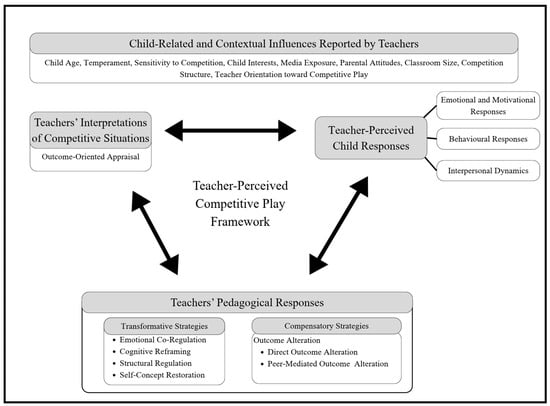
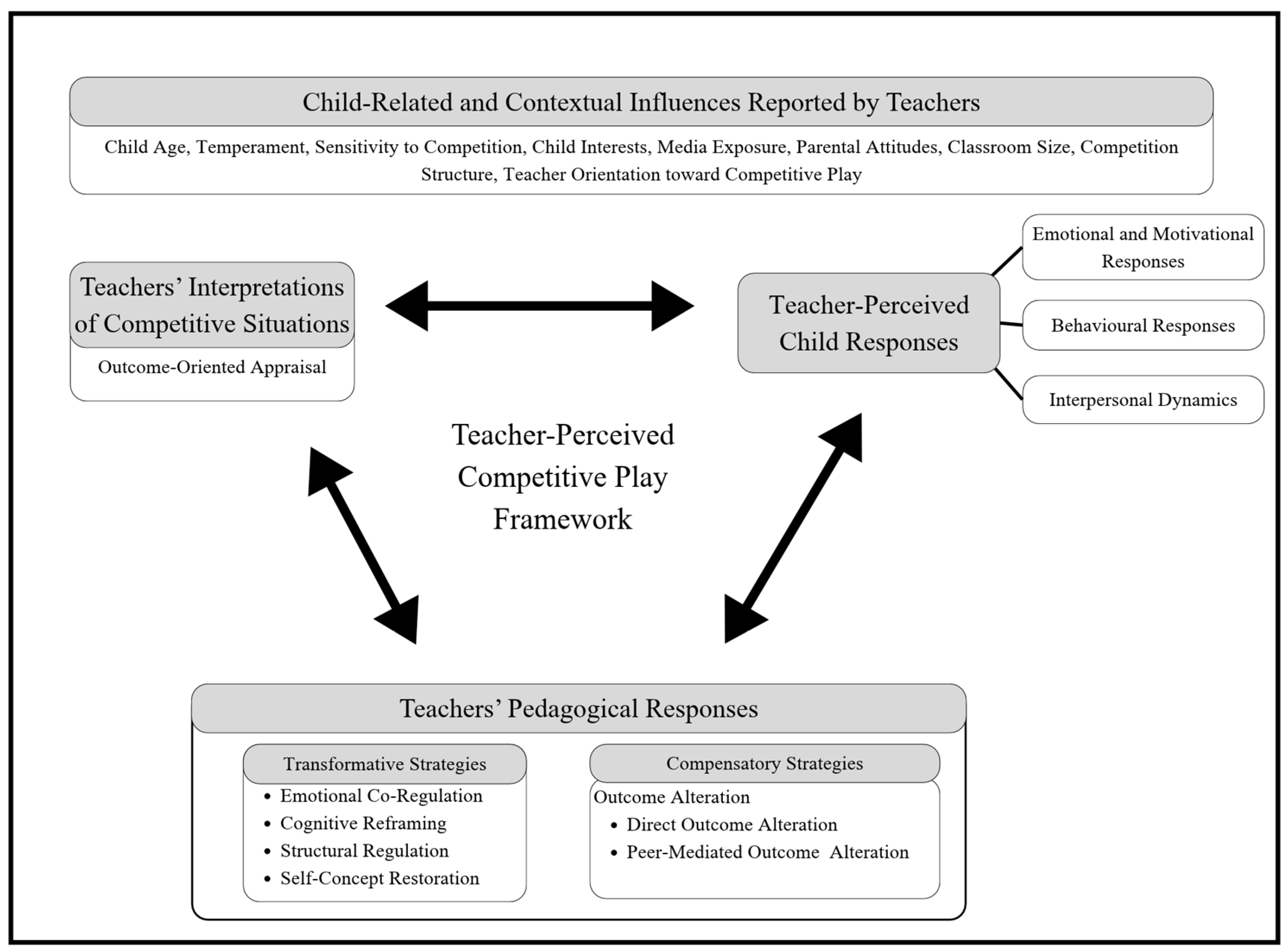
Figure 1 represents the relationships among teacher-perceived child responses, contextual influences, and teachers’ pedagogical responses during competitive play. Teacher responses are conceptualized as a two-part distinction between transformative and compensatory pedagogical strategies. The framework also incorporates contextual factors that teachers described as shaping these relationships across competitive episodes.
Figure 1.
A provisional interpretive framework of teacher-perceived competitive play. Note. The figure represents conceptual relationships identified in teachers’ retrospective accounts. The three analytic domains are presented as dynamically interconnected rather than as sequential stages. Bidirectional arrows indicate relational, non-causal associations among the domains. Child-related and contextual influences are represented as conditions reported by teachers as shaping these relationships. The framework is not intended to depict a fixed temporal sequence, causal pathway, developmental model, or validated intervention model.
3.1. Child-Related and Contextual Influences Reported by Teachers
Based on the interviews, teachers reflected on factors they perceived as shaping children’s responses to competitive activities and interpreted these responses within a holistic framework. Teachers attributed differences in children’s responses to several child-related and contextual factors, including individual sensitivity to competition, exposure to competitive media content, experiences of playing primarily with adult partners during the pandemic, and parental attitudes. In addition to child-related factors, teachers also highlighted the influence of broader cultural and global factors. For example, T9 pointed to cultural influences by stating:
“Especially during the period when they watched Survivor frequently on television, they were happy when doing obstacle course activities themselves… At home, fathers play wrestling with their children. The father says, ‘you won, I lost.’ Parents and grandparents intentionally lose, so the child starts to believe that they will always win. When they lose at school, they experience intense crying episodes.”
Similarly, T10 emphasized temporal and global influences:
“In my 17 years of experience, the last five years have been more challenging, especially after the pandemic. Children who came after 2020 are very different. I hesitate to organize games because children create chaos; they seem to be in a state of conflict. In previous years, there were not as many children who cried, but now it happens much more frequently.”
The framework presented in Figure 1 is organized around three interconnected analytic domains, within which the five themes are situated.
3.2. Analytic Domain 1: Teachers’ Interpretations of Competitive Situations
Theme 1: Outcome-Oriented Appraisal of Competition
Teachers frequently interpreted children’s responses during competitive play in relation to outcome-oriented understandings of winning and losing. They emphasized that competitive activities are frequently initiated with the implicit assumption that children participate not for enjoyment, but to win. T9 illustrated children’s expectations using a metaphor:
“Think of the game as a notebook. The child says, ‘I don’t want to write losing in my notebook. I don’t want a draw either. I want to always be the winner. If I am going to lose in this game, then I don’t want to participate, because I don’t want to write that in my notebook.’”
Teachers described interpersonal competition as being associated with more negative experiences among children in the losing group. For instance, T7 stated:
“After competitive games, children do not really enjoy the activity. They focus on the outcome rather than the process. They think about whether they won or lost, and they don’t care about having fun or spending time with their friends.”
Teachers’ accounts consistently linked outcome-oriented interpretations with children’s reported emotional and motivational responses during competitive play.
3.3. Analytic Domain 2: Teacher-Perceived Child Responses
3.3.1. Theme 2: Emotional and Motivational Responses in Competitive Play
Most teachers described competitive play as involving both positive and negative emotional and motivational responses. Winning was commonly associated in their accounts with increased motivation, happiness, and self-confidence, whereas losing was more often associated with sadness, frustration, anger, and reduced confidence. These patterns were not uniform across children or situations. For example, T7 explained: “The child who wins gains self-confidence at that moment. But if we consider the losing side, the child experiences a decrease in self-confidence.” Teachers also noted that the intensity of emotional and motivational responses could vary according to the structure of competition. As T2 observed, “When it is played as a group, they ask, ‘Teacher, why did we lose?’ But when it is individual, the child who loses feels much more upset.”
3.3.2. Theme 3: Behavioural Responses in Competitive Play
Teachers described both internalized behavioural responses (e.g., crying, withdrawal) and socially disruptive behaviours (e.g., aggression) in their accounts of competitive episodes. These accounts also highlighted variations in children’s individual sensitivity thresholds toward competition. For example, T3 emphasized the variability in the intensity and duration of reactions to losing:
“Some children handle it much more maturely… they say, ‘Our group didn’t win.’ But I also have children who prolong the experience of losing, exaggerate it, and react very intensely, almost as if it is a major crisis.”
The behavioural responses reported by a larger number of participants included crying, withdrawal, and avoidance. Teachers most often linked these behaviours with experiences of losing. Likewise, T3 explained:
“If they lose, I observe that they turn inward, cry, or become withdrawn. They say, ‘I didn’t like this game. I don’t want to participate anymore. I won’t join again,’ and they move to a corner.”
Teachers described competitive episodes as sometimes disrupting ongoing communication and task engagement, creating turbulence in classroom interaction patterns. Teachers also attributed variation in the intensity of behavioural responses partly to the structure of competition. For instance, T1 noted:
“In individual games, especially the children who lose tend to react more strongly and cry more. But in group-based competitive games, crying responses are much less frequent.”
Teachers’ accounts suggested that intergroup competition was sometimes associated with less intense behavioural responses than individual competition. Teachers’ accounts reflected a tension between responding immediately to withdrawal or avoidance and considering more structured pedagogical responses across competitive episodes.
3.3.3. Theme 4: Interpersonal Dynamics in Competitive Play
Teachers described competitive episodes as extending beyond individual responses into classroom social dynamics, including peer appreciation and group cohesion as well as blaming, mocking, exclusion, dominance, and status differentiation. T7 described strategic partner selection during competitive play as one way in which competitive episodes could become intertwined with classroom peer dynamics:
“They don’t want to include the child who is weaker or who lost in previous games. That child already has low self-confidence, and then starts to struggle in building relationships with peers. Their peer relationships weaken. Everything affects each other.”
This account illustrates how teachers perceived competitive episodes as extending beyond immediate emotional reactions into ongoing peer interactions. Within these reported interpersonal dynamics, teachers also described task engagement among some children in the winning group as being associated with social status and outcome-oriented expectations. Teachers described intergroup competitive structures as sometimes coinciding with group cohesion, while also noting that such contexts could involve hierarchical dynamics within the winning group. For instance, T5 stated:
“If a group wins, they want to compete within the group as well… They want to have a leader, so a strong sense of group cohesion does not really develop in the winning group.”
Teachers interpreted some children’s efforts to win as being associated not only with the game outcome but also with status positioning within the peer group. T3 further illustrated teachers’ perceptions that group cohesion did not always emerge in intergroup competitive contexts. Overall, teachers’ accounts suggested that competitive outcomes could become socially consequential through partner selection, exclusion, peer comparison, and status positioning, creating pedagogical demands that extended beyond children’s immediate emotional responses.
3.4. Analytic Domain 3: Teachers’ Pedagogical Responses
Theme 5: Teachers’ Responses
Teachers’ pedagogical responses were described as both anticipatory and reactive and were often used in combination rather than as isolated strategies. Across participants’ accounts, these responses clustered into two broader categories: transformative strategies, which addressed children’s engagement with competitive experiences without changing the outcome, and compensatory strategies, which involved modifying or re-presenting the outcome itself. Within the transformative category, teachers described emotional support and validation, cognitive reframing, self-concept restoration, modelling of failure, encouraging retry, and structural regulation. T3, for example, described validating a child’s disappointment and restructuring participation through peer-mediated outcome alteration, indicating that teachers’ responses were not confined to a single strategy category. Teachers described some strategies as anticipatory, including verbal reframing and structural adjustments made before competitive play began. Other strategies were described as being used during competitive episodes in response to emerging emotional, behavioural, or interpersonal concerns.
Teachers described reactive strategies as responses to different emotional, behavioural, and interpersonal demands that emerged during competitive episodes. Teachers reported a range of transformative strategies, including emotional co-regulation, cognitive reframing, self-concept restoration, and structural regulation, alongside a compensatory strategy involving outcome alteration. Teachers reported employing supportive strategies such as acknowledging children’s emotions and providing emotional support following experiences of loss, while also frequently engaging in cognitive reframing of competition (see Table 2). T3 described an approach centered on validating children’s emotions:
“If they continue to express sadness, I allow them that space; I say, ‘Yes, you can feel upset, and if you want to experience it, you can.’… I also tell the class, ‘Our friend might be upset and may want to sit in the corner for a while; let’s give them space.’”
Teachers also described strategies intended to support children’s confidence and willingness to re-engage following competitive outcomes. These practices were coded as self-concept restoration when they aimed to support children’s perceived capability or continued participation without altering the actual outcome. This strategy was identified in the accounts of T1, T3, T5, and T9.
Cognitive reframing was one of the most widely reported strategies and was employed by nearly all participants. Teachers used statements that normalized both winning and losing and encouraged persistence, such as “Losing does not prevent you from playing again” (T2) and “This is just a game; losing is as normal as winning” (T7, T9). In addition to these verbal strategies, teachers also engaged in self-modeling, as illustrated by T4:
“Sometimes I intentionally lose to show that I can also lose. I say, ‘Look, I also don’t always win, just like earlier.’”
Teachers framed these approaches as ways of normalizing loss and encouraging continued participation. Teachers also described encouraging children to try again after losing as a way of supporting continued participation. For instance, T5 explained:
“When a child starts crying, I refer to a story—like the tortoise and the hare—and say, ‘Actually, we can still do it at the last moment; let’s not give up trying.’ I explain that losing is just a situation and that it’s okay. This approach is often effective.”
Although some teachers described particular strategies as effective, these judgments reflected participants’ own perceptions and were not independently evaluated through observational or child-level outcome data. Teachers also described structural regulation aimed at balancing groups, abilities, or task demands in order to promote fairness and incorporate peer-support mechanisms. For example, T9 described how groups were deliberately structured to balance abilities:
“I need to create equal groups. We are 17 in the class, so I divide them into two groups—one has 8 and the other 9. But I assign two less skilled children to the larger group so that it is fair… Boys are generally better at physical activities, so I include fine motor tasks as well. Since girls are better at those, it increases their chances of winning and decreases the boys’. This way, it’s not always the boys who win; girls can also win.”
Although T9 framed this practice as an attempt to distribute opportunities for success more equitably, the strategy also relied on generalized assumptions about boys’ and girls’ abilities. This illustrates how fairness-oriented structural regulation may itself contain pedagogical and ethical tensions.
Outcome alteration emerged as a less frequently reported but conceptually distinctive form of compensatory pedagogical response. This pattern was identified in the accounts of four participants (T3, T4, T5, and T6) and comprised two analytically distinct forms: Direct Outcome Alteration and Peer-Mediated Outcome Alteration. Direct Outcome Alteration referred to instances in which teachers themselves modified, neutralised, or re-presented the competitive result. As T4 explained, “If the game has to end with someone winning, sometimes I change how the game ends.” By contrast, Peer-Mediated Outcome Alteration involved teachers influencing the participation of peers in ways that increased another child’s opportunity to experience success. T3 illustrated this approach by encouraging a peer to “give Ayşe a little chance” and subsequently describing how the child slowed down and made space for Ayşe to participate successfully. Although these two forms differed in the locus of intervention, both were classified as compensatory because they modified how success or the competitive outcome was made available to a particular child, either through direct teacher alteration or through peer-mediated participation, rather than supporting the child’s engagement with an unchanged competitive outcome.
4. Discussion
The present study proposes a provisional interpretive framework comprising three interconnected analytic domains: teachers’ interpretations of competitive situations, teacher-perceived child responses, and teachers’ pedagogical responses. Across these domains, five themes captured recurring patterns in teachers’ retrospective accounts of competitive play. These themes were described as interconnected and contextually shaped rather than as fixed stages through which children necessarily progress. Consistent with previous research indicating that competitive experiences may vary according to child-related and contextual factors (e.g., Zhu et al., 2015; S. Yıldız & Sak, 2024), teachers in the present study attributed differences in their perceived child responses to factors such as temperament, sensitivity to competition, exposure to competitive media, parental attitudes, and classroom conditions. These accounts suggest that teachers understand competitive play not as a uniform experience but as a context in which emotional, behavioural, and interpersonal responses may vary considerably across children and situations. This context-sensitive interpretation is also consistent with recent systematic evidence showing that developmental findings associated with competition vary according to children’s capacities and relational positioning, the structure of competitive activities, and broader sociocultural meanings (Keleş, 2026). This interpretation is consistent with Fülöp’s (2004) argument that the meaning attributed to competition is personally and culturally constructed and can shape how competitive situations are interpreted and enacted. Recent experimental evidence similarly indicates that children’s behaviour during competitive games is best understood by considering game outcome together with individual characteristics such as gender, emotion regulation, and socio-cognitive skills (Gevaux & Nilsen, 2026).
Consistent with prior research (Eriksson et al., 2021; Emen Parlatan & Sığırtmaç, 2022), teachers described competitive episodes as involving both positive and negative emotional responses. Winning was commonly associated in their accounts with happiness, motivation, and increased self-confidence, whereas losing was associated with disappointment, frustration, and reduced confidence. These patterns should be understood as teacher-perceived responses rather than direct evidence of children’s internal experiences. From an Eriksonian perspective, teachers’ accounts of persistence, hesitation, withdrawal, and re-engagement may be interpreted in relation to the initiative–guilt tension characteristic of the preschool period. Competitive episodes may make children’s attempts to act, persist, and participate publicly visible, while teachers’ responses may either support continued initiative or be associated with hesitation and withdrawal. The prominence of winning and losing in teachers’ accounts also resonates with evidence that preschool children distinguish between product- and process-oriented goals, with product-oriented conditions directing greater attention toward performance outcomes (Tsiakara & Digelidis, 2021). The present findings extend this work by suggesting that, from teachers’ perspectives, outcome salience may also become pedagogically consequential when it is accompanied by disappointment, withdrawal, or heightened emotional reactions.
Teachers also described competitive play as extending into peer relationships through status differentiation, partner selection, exclusion, blaming, and peer dominance. Viewed through Social Comparison Theory, these accounts suggest that competitive performance may acquire social meaning through children’s relative positioning among peers. Rather than establishing children’s motives directly, the findings indicate that teachers interpreted some partner-selection and status-related behaviours in relation to peer comparison and relative standing. Competitive episodes were therefore described not only as individual emotional experiences but also as socially visible events embedded within peer dynamics. This relational interpretation is consistent with earlier school-based research showing that competition can be intertwined with both cooperation and conflict and may be associated with markedly different interpersonal climates depending on how it is constructed and enacted (Ross et al., 2006). The present findings add to this relational perspective by identifying partner selection, peer blaming, exclusion, and status positioning as specific mechanisms through which teachers perceived competitive outcomes as becoming socially consequential within the peer group.
The findings conceptualize teachers’ reported responses as a central component of the pedagogical management of competitive episodes and organize them within a two-part distinction between transformative and compensatory pedagogical strategies. Importantly, these strategies should not be interpreted as stable teacher types or mutually exclusive forms of practice; rather, they represent a flexible pedagogical repertoire that teachers may combine or shift between across competitive episodes. This interpretation is consistent with earlier research showing that preschool teachers may adopt contingent forms of intervention in response to play-related situations (Keleş et al., 2018). Transformative strategies were described as aiming to support children in processing emotions, reframing competitive experiences, or sustaining participation without altering the actual outcome of play. In contrast, compensatory strategies, comprising Direct Outcome Alteration and Peer-Mediated Outcome Alteration, were characterised by attempts to modify or re-present the competitive outcome. However, transformative strategies should not be assumed to be inherently beneficial. Their pedagogical value may depend on how, when, and why they are implemented; for example, self-concept restoration or cognitive reframing may raise questions concerning perceived fairness, authenticity, and the meaning children attribute to teacher support. The distinction between transformative and compensatory strategies therefore extends existing accounts of teacher intervention by drawing attention to what the intervention changes. Transformative strategies were described as targeting children’s engagement with, or teachers’ reframing of, the competitive experience, whereas compensatory strategies targeted the representation of the outcome itself. Unlike forms of emotional support that preserve the original structure and outcome of an activity, outcome alteration changes the meaning of the competitive result itself. Teacher support during competitive play may therefore differ not only in timing or intensity, but also in whether it addresses the experience surrounding an outcome or re-presents the outcome available for interpretation. Both strategy types were described in accounts concerned with supporting children, yet they differed in how they negotiated emotional protection, outcome authenticity, and opportunities to process disappointment.
The data also contained accounts that complicated any straightforward distinction between supportive and problematic forms of teacher intervention. For example, strategies described as transformative were not uniformly unproblematic: structural regulation could be framed as promoting fairness while simultaneously relying on generalized assumptions about children’s abilities. Conversely, compensatory responses such as outcome alteration were described by teachers as attempts to protect children from immediate distress, despite raising questions about authenticity and opportunities to process disappointment. These divergent accounts suggest that the pedagogical meaning of a strategy cannot be inferred from its category alone but depends on how, why, and under what conditions it is enacted.
The findings also complicate the notion of structural regulation as an inherently equitable strategy. For example, one teacher attempted to balance opportunities for success by varying task demands according to gender, but this reasoning simultaneously reproduced generalized assumptions about boys’ and girls’ abilities. Such assumptions warrant caution because gender differences in young children’s competitive behaviour appear to be context-dependent rather than uniform. For example, Weinberger and Stein (2008) found that gender differences in kindergarten children’s competitive behaviour varied according to the gender composition of the peer group, while girls and boys showed comparable levels of strategic game behaviour. More recent experimental evidence likewise indicates that gender differences in prosocial responses to competition may depend on the competitive or cooperative structure of the activity (Zhang et al., 2025). Thus, practices intended to promote fairness may themselves embed normative assumptions that warrant critical reflection. Structural regulation should therefore be considered not only in terms of whether it redistributes opportunities for success, but also in terms of the assumptions through which fairness is defined and enacted.
4.1. Implications
The implications of the present study concern primarily how competitive play and teachers’ responses to it can be approached as objects of pedagogical reflection rather than as components of a prescriptive intervention sequence. The proposed framework may help make visible the different considerations teachers described when competitive episodes became emotionally, behaviourally, or interpersonally salient. In this sense, the framework is more appropriately positioned as a reflective resource rather than as a guide prescribing particular teacher responses. This orientation is consistent with research showing that structured pedagogical support can help early childhood teachers reflect on their involvement in children’s play and use such reflection to inform subsequent pedagogical planning (Loizou, 2017). Teacher intervention in play also requires sensitivity to the specific interactional context, with previous work emphasizing observation, planning, and reflection when determining how and when to intervene in children’s peer interactions (Stanton-Chapman, 2015). Loizou’s study specifically found that a play-focused teacher guide was used to support reflection on teacher involvement, documentation, and subsequent planning, rather than simply functioning as a fixed instructional script. Stanton-Chapman similarly emphasizes observation and context-sensitive intervention in preschool peer play.
The distinction between transformative and compensatory strategies provides one potential focus for such reflection. The present study does not establish that either strategy type is more effective or developmentally preferable. Rather, the distinction draws attention to what teachers’ responses appear to change: transformative strategies were described as addressing children’s engagement with the competitive experience, whereas compensatory strategies modified or re-presented the outcome itself. This distinction is particularly relevant to questions of fairness. Fairness in early childhood should not automatically be equated with equalizing outcomes, as classroom-based research suggests that young children are capable of engaging with fairness in more nuanced, equity-oriented ways, including attending to others’ needs and advocating for others (Lee et al., 2022). Future research should therefore examine how children themselves interpret practices such as outcome alteration and structural regulation, including whether these practices are experienced as fair, supportive, or authentic.
The interpersonal dimension of the findings also suggests that reflection on competitive play should extend beyond children’s immediate emotional reactions. Teachers described competitive episodes as involving partner selection, exclusion, blaming, and status positioning. These patterns make questions of participation and belonging especially relevant. Research on preschool peer communities similarly indicates that categorisation and positioning can shape children’s opportunities for participation, belonging, and exclusion (Emilson & Johansson, 2025). The same work emphasizes the importance of teachers critically examining their own categorisations and the ways in which children are positioned within peer communities. Accordingly, pedagogical reflection on competitive play may need to consider not only how teachers respond to winning and losing, but also how their responses intersect with children’s access to participation and meaningful positions within the peer group.
4.2. Professional Development
Professional development related to competitive play may benefit from emphasizing critical reflection on teachers’ existing interpretations and practices rather than training teachers to implement a predetermined sequence of strategies. This orientation is consistent with research identifying reflection as an important dimension of ECE teachers’ pedagogical competence and professional development. Fonsén and Ukkonen-Mikkola (2019), for example, describe professional development as a continuing process and highlight the role of critical reflection, pedagogical knowledge, and the ability to justify pedagogical decisions in strengthening professional competence. Their review of professional development work also notes that new knowledge can provide a basis for teachers to reflect on existing practices.
Professional learning may also encourage teachers to examine how they interpret winning, losing, effort, and failure. Previous work suggests that teachers’ attributions concerning student failure can be associated with differences in their emotional and supportive responses (Georgiou et al., 2002). In the context of competitive play, such reflection may be particularly relevant because teachers’ interpretations of children’s disappointment, withdrawal, persistence, or conflict may shape the kinds of responses they consider appropriate. However, the present study did not directly assess teachers’ attributional processes, and this possibility should therefore be treated as a direction for professional reflection rather than an empirical conclusion of the current study.
Scenario-based professional learning could be explored as one possible means of facilitating this form of reflection. Rather than presenting predetermined “correct” responses, scenarios could depict pedagogically ambiguous situations identified in the present study—for example, a child becoming distressed after losing, peers excluding a child perceived as less competent, a teacher considering whether to alter an outcome, or a teacher restructuring an activity in the name of fairness. Such scenarios could invite teachers to compare alternative responses and make explicit the assumptions about fairness, participation, emotional support, and competition underlying their decisions. This proposal is consistent with the broader value of structured pedagogical tools and reflective professional learning in supporting teachers’ examination of their practice (Loizou, 2017; Fonsén & Ukkonen-Mikkola, 2019), but the effectiveness of scenario-based professional development specifically for competitive play has not yet been established and should be evaluated empirically before being recommended for routine practice.
Finally, future research should examine competitive experiences directly from children’s own perspectives. Research in ECE has emphasized that children’s understandings of peer life and belonging cannot simply be inferred from adult accounts and that child-centred approaches can provide forms of knowledge inaccessible through teacher reports alone (Erwin et al., 2024). Erwin and colleagues also identify developmentally appropriate approaches such as drawings, photographs, focus groups, and other child-generated materials as useful ways of accessing children’s perspectives on peer culture and belonging. Observational and child-centred studies could therefore investigate how children themselves interpret losing, peer comparison, exclusion, teacher support, outcome alteration, and fairness before the proposed framework is translated confidently into professional development or classroom guidance.
4.3. Limitations
This study has several limitations. First, the findings are based on preschool teachers’ self-reported and retrospective accounts of competitive play rather than on direct observations of classroom interactions or children’s own perspectives. Accordingly, the reported emotional, behavioural, and interpersonal patterns reflect teachers’ perceptions and interpretations and should not be treated as direct evidence of children’s internal experiences or as a verified temporal sequence of responses. The retrospective nature of the interviews may also have introduced recall bias, particularly in accounts referring to changes perceived after the COVID-19 pandemic. Because the study relied on teachers’ self-reported retrospective accounts, the findings may also be affected by social desirability bias. In particular, teachers may have been less likely to report practices they perceived as pedagogically or ethically questionable, including outcome alteration. Second, interview length varied considerably, ranging from 9 to 28 min (M = 18.25, Md = 16). Although all interviews addressed the core research questions, the brevity of some interviews may have limited the depth and contextual detail of individual accounts and, consequently, the interpretive depth of some themes. Third, the study was conducted with twelve preschool teachers in a single national context. Although variation was sought in school type, professional experience, educational background, and geographical location within the study setting, the findings should not be assumed to be transferable to different cultural or educational contexts without further investigation. Finally, the study did not include observational, longitudinal, or child-level data and did not assess outcomes such as emotional regulation, task engagement, perceived fairness, or teacher–child trust. Accordingly, no causal conclusions can be drawn regarding the relative effectiveness or longer-term developmental consequences of transformative and compensatory strategies. Future research combining teacher reports with classroom observations, child perspectives, and longitudinal designs would provide a stronger basis for evaluating the proposed interpretive framework.
5. Conclusions
This study identified five interconnected themes organised across three broader analytic domains within preschool teachers’ accounts of competitive play: outcome-oriented appraisal, emotional and motivational responses, behavioural reactions, interpersonal dynamics, and pedagogical responses. These themes were not interpreted as a fixed developmental or temporal sequence but as recurring relationships within teachers’ retrospective accounts of competitive episodes. A second contribution of the study is the distinction between transformative and compensatory pedagogical strategies. Transformative strategies were described as supporting children’s engagement with competitive experiences without altering the actual outcome, whereas a less commonly reported compensatory strategy involved modifying or re-presenting the outcome itself. Together, these findings provide a provisional interpretive framework of how teachers make sense of and respond to competitive play.
Erikson’s initiative–guilt framework and Social Comparison Theory were used abductively to interpret how teachers described persistence, withdrawal, peer comparison, and social positioning. These interpretations should not be taken as direct evidence of children’s internal experiences. The study did not assess child outcomes, teachers’ ethical reasoning, or the effects of particular strategies on emotional regulation, perceived fairness, or teacher–child trust. Accordingly, the proposed framework should be understood as a conceptual organization of teachers’ reported perceptions and practices rather than as a validated intervention framework. Future observational, child-centred, and longitudinal research across diverse cultural and educational contexts is needed to test and refine the framework.
Supplementary Materials
The following supporting information can be downloaded at: https://www.mdpi.com/article/10.3390/bs16112031/s1, Supplementary File S1: Semi-Structured Interview Guide; Supplementary File S2: Final Codebook: Teachers’ Interpretations of Competitive Situations.
Author Contributions
Conceptualization, S.K. and T.B.; methodology, S.K.; validation, S.K. and T.B.; formal analysis, S.K. and T.B.; investigation, S.K.; data curation, T.B.; writing—original draft preparation, S.K. and T.B.; writing—review and editing, S.K.; visualization, T.B.; project administration, S.K. All authors have read and agreed to the published version of the manuscript.
Funding
This research received no external funding.
Institutional Review Board Statement
The study was conducted in accordance with the Declaration of Helsinki and approved by the Human Research Ethics Committee of Zonguldak Bülent Ecevit University (protocol code 669595, 2 November 2025).
Informed Consent Statement
Informed consent was obtained from all subjects involved in the study.
Data Availability Statement
The data supporting the findings of this study are not publicly available due to ethical and privacy considerations related to the confidentiality of interview participants. De-identified data may be available from the corresponding author upon reasonable request, subject to ethical and institutional restrictions.
Acknowledgments
During the preparation of this manuscript, the authors used ChatGPT 6.1 (OpenAI, San Francisco, CA, USA) for language editing, wording refinement, and structural improvement of selected sections. The authors reviewed and edited all outputs and take full responsibility for the content of this publication.
Conflicts of Interest
The authors declare no conflicts of interest.
References
- Batra, S. (2013). The psychosocial development of children: Implications for education and society—Erik Erikson in context. Contemporary Education Dialogue, 10(2), 249–278. [Google Scholar] [CrossRef] [Scilit]
- Braun, V., & Clarke, V. (2021). Thematic analysis: A practical guide. SAGE. [Google Scholar]
- Cheung, R. H. P. (2017). Teacher-directed versus child-centred: The challenge of promoting creativity in Chinese preschool classrooms. Pedagogy, Culture & Society, 25(1), 73–86. [Google Scholar] [CrossRef] [Scilit]
- Chu, J., Rule, J. S., Goddu, M. K., Pinter, V., Reagan, E. R., Bonawitz, E., Gopnik, A., & Ullman, T. D. (2025). Fun isn’t easy: Children selectively manipulate task difficulty when “playing for fun” versus “playing to win”. Developmental Psychology, 62(11), 2115–2127. [Google Scholar] [CrossRef] [Scilit]
- Denham, S., Mason, T., Caverly, S., Schmidt, M., Hackney, R., Caswell, C., & DeMulder, E. (2001). Preschoolers at play: Co-socialisers of emotional and social competence. International Journal of Behavioral Development, 25(4), 290–301. [Google Scholar] [CrossRef] [Scilit]
- Dijkstra, P., Kuyper, H., van der Werf, G., Buunk, A. P., & van der Zee, Y. G. (2008). Social comparison in the classroom: A review. Review of Educational Research, 78(4), 828–879. [Google Scholar] [CrossRef] [Scilit]
- Eidsvåg, G. M., & Rosell, Y. (2021). The power of belonging: Interactions and values in children’s group play in early childhood programs. International Journal of Early Childhood, 53, 83–99. [Google Scholar] [CrossRef] [Scilit]
- Emen Parlatan, M., & Sığırtmaç, A. D. (2022). Preschool children’s behaviours in competitive games: Are these games really harmful to social-emotional development? Early Child Development and Care, 192(14), 2200–2212. [Google Scholar] [CrossRef] [Scilit]
- Emilson, A. C., & Johansson, E. M. (2025). Belonging in preschool—An existential and political concern for children. Education Sciences, 15(7), 808. [Google Scholar] [CrossRef] [Scilit]
- Eriksson, M. (2025). Playing games: Exploring children’s other-oriented, self-oriented and strategic social behaviors [Doctoral dissertation, Acta Universitatis Upsaliensis]. [Google Scholar]
- Eriksson, M., Kenward, B., Poom, L., & Stenberg, G. (2021). The behavioral effects of cooperative and competitive board games in preschoolers. Scandinavian Journal of Psychology, 62(3), 355–364. [Google Scholar] [CrossRef] [Scilit]
- Erwin, E. J., Valentine, M., & Toumazou, M. (2024). The study of belonging in early childhood education: Complexities and possibilities. International Journal of Early Years Education, 32(1), 6–20. [Google Scholar] [CrossRef] [Scilit]
- Festinger, L. (1954). A theory of social comparison processes. Human Relations, 7(2), 117–140. [Google Scholar] [CrossRef] [Scilit]
- Fonsén, E., & Ukkonen-Mikkola, T. (2019). Early childhood education teachers’ professional development towards pedagogical leadership. Educational Research, 61(2), 181–196. [Google Scholar] [CrossRef] [Scilit]
- Fülöp, M. (2004). Competition as a culturally constructed concept. In C. Baillie, E. Dunn, & Y. Zheng (Eds.), Travelling facts: The social construction, distribution, and accumulation of knowledge (pp. 124–148). Campus Verlag. [Google Scholar]
- Georgiou, S. N., Christou, C., Stavrinides, P., & Panaoura, G. (2002). Teacher attributions of student failure and teacher behavior toward the failing student. Psychology in the Schools, 39(5), 583–595. [Google Scholar] [CrossRef] [Scilit]
- Gevaux, N. S., & Nilsen, E. S. (2026). Children’s performance and social behaviour during competitive games. Journal of Cognition and Development, 27, 803–833. [Google Scholar] [CrossRef] [Scilit]
- Houston, K. B., Liffley, E., & Wahman, C. L. (2024). Emotion talk in early childhood: A systematic literature review. Topics in Early Childhood Special Education, 46(1), 80–92. [Google Scholar] [CrossRef] [Scilit]
- Hughes, C., Cutting, A. L., & Dunn, J. (2001). Acting nasty in the face of failure? Longitudinal observations of “hard to-manage” children playing a rigged competitive game with a friend. Journal of Abnormal Child Psychology, 29(5), 403–416. [Google Scholar] [CrossRef] [Scilit]
- Hughes, F. P. (2010). Children, play, and development (4th ed.). Sage Publication. [Google Scholar]
- Huyder, V., & Nilsen, E. S. (2012). A dyadic data analysis of executive functioning and children’s socially competent behaviours. Journal of Applied Developmental Psychology, 33(4), 197–208. [Google Scholar] [CrossRef] [Scilit]
- Jeon, J., & Park, D. (2024). Your feelings are reasonable: Emotional validation promotes persistence among preschoolers. Developmental Science, 27(5), e13523. [Google Scholar] [CrossRef] [Scilit]
- Keleş, S. (2026). Competition in early childhood: A systematic review of developmental evidence and a preliminary ecological framework. Behavioral Sciences, 16(10), 1746. [Google Scholar] [CrossRef] [Scilit]
- Keleş, S., Yurt, Ö., & Kandır, A. (2018). Kültürel-tarihsel kuram’a göre “–mış gibi oyunlar”: Okul öncesi öğretmenlerinin eğilimlerinin incelenmesi. Sakarya University Journal of Education, 8(4), 265–285. [Google Scholar] [CrossRef] [Scilit]
- Lee, S., Adair, J. K., Payne, K. A., & Barry, D. (2022). Revisioning fairness as social justice in early childhood education. Early Childhood Education Journal, 50(7), 1083–1095. [Google Scholar] [CrossRef] [Scilit]
- Leonard, J. A., Garcia, A., & Schulz, L. E. (2020). How adults’ actions, outcomes, and testimony affect preschoolers’ persistence. Child Development, 91(4), 1254–1271. [Google Scholar] [CrossRef] [Scilit]
- Liu, Y., Gao, J., Wu, F., & Chen, L. (2025). Understanding of competition among preschool children in China. Early Child Development and Care, 195(15–16), 1570–1589. [Google Scholar] [CrossRef] [Scilit]
- Loizou, E. (2017). Towards play pedagogy: Supporting teacher play practices with a teacher guide about socio-dramatic and imaginative play. European Early Childhood Education Research Journal, 25(5), 784–795. [Google Scholar] [CrossRef] [Scilit]
- Masters, J. C. (1971). Social comparison by young children. In Young children (Vol. 27, pp. 37–60). National Association for the Education of Young Children. Available online: http://www.jstor.org/stable/42643277 (accessed on 4 June 2026).
- Merritt, E. G., Wanless, S. B., Rimm-Kaufman, S. E., Cameron, C., & Peugh, J. L. (2012). The contribution of teachers’ emotional support to children’s social behaviors and self-regulatory skills in first grade. School Psychology Review, 41(2), 141–159. [Google Scholar] [CrossRef] [Scilit]
- Ministry of National Education [MoNE]. (2024). Millî eğitim istatistikleri: Örgün eğitim 2023/2024 [National education statistics: Formal education 2023/2024]. Ministry of National Education, Strategy Development Presidency. [Google Scholar]
- Nilsen, E. S., & Valcke, A. (2018). Children’s sharing with collaborators versus competitors: The impact of theory of mind and executive functioning. Journal of Applied Developmental Psychology, 58, 38–48. [Google Scholar] [CrossRef] [Scilit]
- Pappert, A. T., Williams, A., & Moore, C. (2017). The influence of competition on resource allocation in preschool children. Social Development, 26(2), 367–381. [Google Scholar] [CrossRef] [Scilit]
- Rhodes, M., & Brickman, D. (2008). Preschoolers’ responses to social comparisons involving relative failure. Psychological Science, 19(10), 968–972. [Google Scholar] [CrossRef] [Scilit]
- Ross, A., Fülöp, M., & Kuščer, M. P. (2006). Teachers’ and pupils’ constructions of competition and cooperation: A three-country study of Slovenia, Hungary and England. University of Ljubljana Press. [Google Scholar]
- Spradley, J. P. (1979). The ethnographic interview. Holt, Rinehart and Winston. [Google Scholar]
- Stanton-Chapman, T. L. (2015). Promoting positive peer interactions in the preschool classroom: The role and the responsibility of the teacher in supporting children’s sociodramatic play. Early Childhood Education Journal, 43(2), 99–107. [Google Scholar] [CrossRef] [Scilit]
- Stipek, D., Recchia, S., McClintic, S., & Lewis, M. (1992). Self-evaluation in young children. Monographs of the Society for Research in Child Development, 57(1), 1–95. [Google Scholar] [CrossRef] [Scilit]
- Toppe, T., Hardecker, S., Zerres, F., & Haun, D. B. (2021). The influence of cooperation and competition on preschoolers’ prosociality toward in-group and out-group members. Royal Society Open Science, 8(5), 202171. [Google Scholar] [CrossRef] [Scilit]
- Trawick-Smith, J., & Lee, K. (2025). Ethical dimensions of teacher-child play interactions in preschool. In N. Pramling, A. Farrell, C. Wallerstedt, & M. Nilsen (Eds.), Adults in play with children (pp. 23–43). Springer. [Google Scholar] [CrossRef] [Scilit]
- Tsiakara, A. A., & Digelidis, N. M. (2015). Preschoolers’ perceptions of performance and satisfaction under competitive and non-competitive conditions. Early Child Development and Care, 185(7), 1109–1117. [Google Scholar] [CrossRef] [Scilit]
- Tsiakara, A. A., & Digelidis, N. M. (2021). The role of competitive activities on preschool children performance. International Journal of Childhood Education, 2(1), 23–26. [Google Scholar] [CrossRef] [Scilit]
- Tsoi, L., Hamlin, J. K., Waytz, A., Baron, A. S., & Young, L. L. (2021). A cooperation advantage for theory of mind in children and adults. Social Cognition, 39(1), 19–40. [Google Scholar] [CrossRef] [Scilit]
- Wang, J., & Bonawitz, E. (2022). Children’s sensitivity to difficulty and reward probability when deciding to take on a task. Journal of Cognition and Development, 24(3), 341–353. [Google Scholar] [CrossRef] [Scilit]
- Weinberger, N., & Stein, K. (2008). Early competitive game playing in same- and mixed gender peer groups. Merrill-Palmer Quarterly, 54(4), 499–514. [Google Scholar] [CrossRef] [Scilit]
- Westby, C. E. (1990). Ethnographic interviewing: Asking the right questions to the right people in the right ways. Journal of Childhood Communication Disorders, 13(1), 101–111. [Google Scholar] [CrossRef] [Scilit]
- Yasar, M., & Yanik, B. (2014). Competitive games with rules and strategies to cope with losing. In J. Galbraith, O. Ozgun, & M. Yasar (Eds.), Contemporary perspectives and research on early childhood education (pp. 73–83). Cambridge Scholars Publishing. [Google Scholar]
- Yıldız, M., & Arslan Çiftçi, H. (2025). Rekabet oyunlarına ilişkin okul öncesi öğretmenlerinin görüşleri ve uygulamaları. Sivas Cumhuriyet Üniversitesi Eğitim Bilimleri Enstitüsü Dergisi, 4(2), 121–131. [Google Scholar]
- Yıldız, S., & Sak, R. (2024). Investigation of the relationship between preschoolers’ competition styles, anxiety levels and their parents’ parental styles. Southeast Asia Early Childhood, 13(2), 52–67. [Google Scholar] [CrossRef] [Scilit]
- Zhang, Q., Ruan, J., & Xiong, D. (2025). Differential effects of exposure to cooperative versus competitive games on sharing behavior in young children. Frontiers in Psychiatry, 16, 1545932. [Google Scholar] [CrossRef] [Scilit]
- Zhu, Y., Guan, X., & Li, Y. (2015). The effects of intergroup competition on prosocial behaviors in young children: A comparison of 2.5–3.5 year-olds with 5.5–6.5 year olds. Frontiers in Behavioral Neuroscience, 9(16), 1–8. [Google Scholar] [CrossRef] [Scilit]

Disclaimer/Publisher’s Note: The statements, opinions and data contained in all publications are solely those of the individual author(s) and contributor(s) and not of MDPI and/or the editor(s). MDPI and/or the editor(s) disclaim responsibility for any injury to people or property resulting from any ideas, methods, instructions or products referred to in the content. |
© 2026 by the authors. Licensee MDPI, Basel, Switzerland. This article is an open access article distributed under the terms and conditions of the Creative Commons Attribution (CC BY) license.